Скачать презентацию NCODA Variational Ocean Data Assimilation System NCODA v
6bd679f5a650b511763a0b3bba1e131a.ppt
- Количество слайдов: 22
 NCODA Variational Ocean Data Assimilation System (NCODA v 3. 5) James Cummings Naval Research Laboratory, Monterey, CA GODAE Ocean View / CLIVAR GSOP Workshop 13 -17 June 2011 University California Santa Cruz
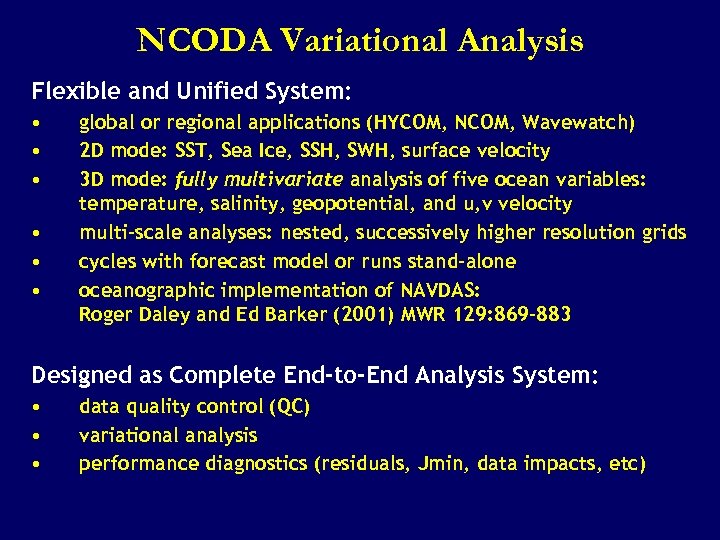 NCODA Variational Analysis Flexible and Unified System: • • • global or regional applications (HYCOM, NCOM, Wavewatch) 2 D mode: SST, Sea Ice, SSH, SWH, surface velocity 3 D mode: fully multivariate analysis of five ocean variables: temperature, salinity, geopotential, and u, v velocity multi-scale analyses: nested, successively higher resolution grids cycles with forecast model or runs stand-alone oceanographic implementation of NAVDAS: Roger Daley and Ed Barker (2001) MWR 129: 869 -883 Designed as Complete End-to-End Analysis System: • • • data quality control (QC) variational analysis performance diagnostics (residuals, Jmin, data impacts, etc)
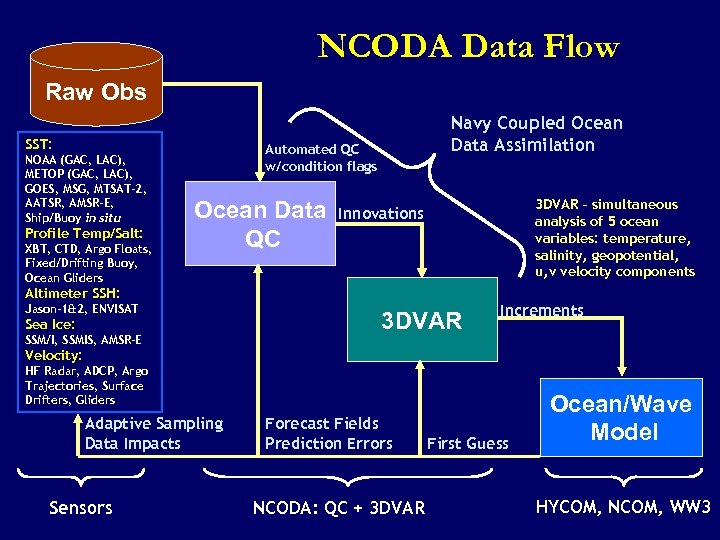 NCODA Data Flow Raw Obs SST: NOAA (GAC, LAC), METOP (GAC, LAC), GOES, MSG, MTSAT-2, AATSR, AMSR-E, Ship/Buoy in situ Profile Temp/Salt: XBT, CTD, Argo Floats, Fixed/Drifting Buoy, Ocean Gliders Navy Coupled Ocean Data Assimilation Automated QC w/condition flags Ocean Data QC 3 DVAR – simultaneous analysis of 5 ocean variables: temperature, salinity, geopotential, u, v velocity components Innovations Altimeter SSH: Jason-1&2, ENVISAT Sea Ice: SSM/I, SSMIS, AMSR-E 3 DVAR Increments Velocity: HF Radar, ADCP, Argo Trajectories, Surface Drifters, Gliders Adaptive Sampling Data Impacts Sensors Forecast Fields Prediction Errors NCODA: QC + 3 DVAR First Guess Ocean/Wave Model HYCOM, NCOM, WW 3
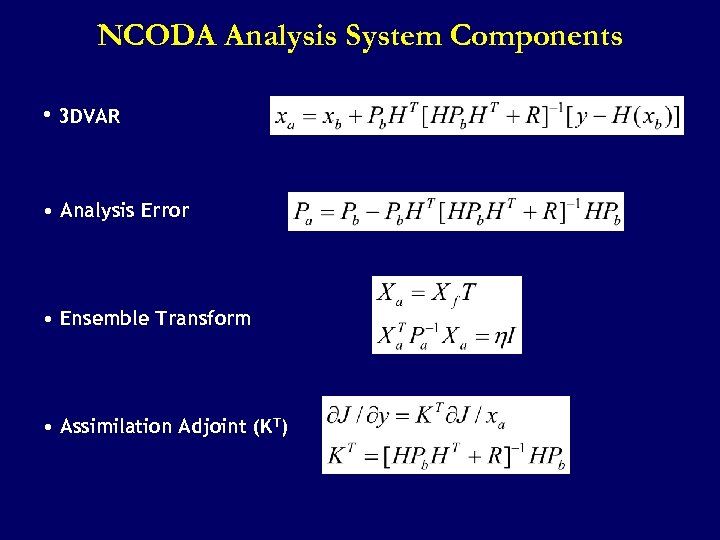 NCODA Analysis System Components • 3 DVAR • Analysis Error • Ensemble Transform • Assimilation Adjoint (KT)
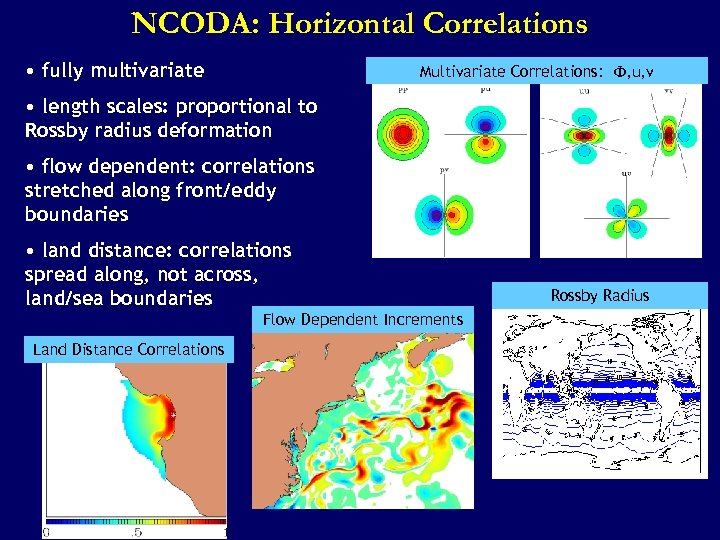 NCODA: Horizontal Correlations • fully multivariate Multivariate Correlations: , u, v • length scales: proportional to Rossby radius deformation • flow dependent: correlations stretched along front/eddy boundaries • land distance: correlations spread along, not across, land/sea boundaries Flow Dependent Increments Land Distance Correlations Rossby Radius
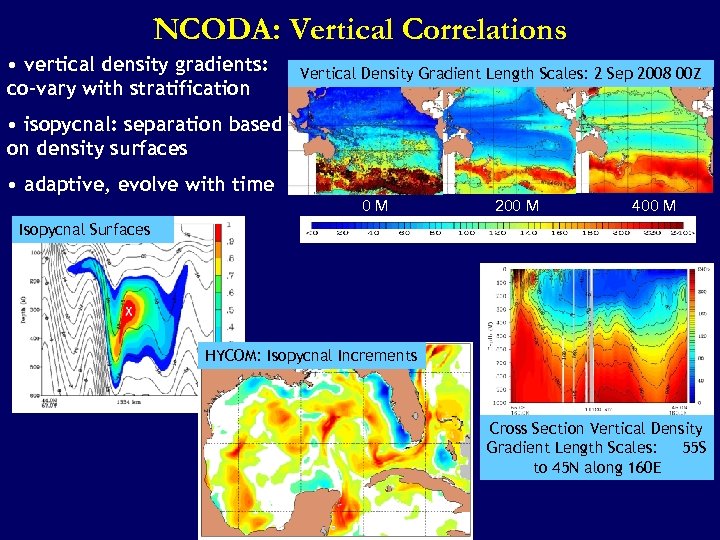 NCODA: Vertical Correlations • vertical density gradients: co-vary with stratification Vertical Density Gradient Length Scales: 2 Sep 2008 00 Z • isopycnal: separation based on density surfaces • adaptive, evolve with time 0 M 200 M 400 M Isopycnal Surfaces HYCOM: Isopycnal Increments Cross Section Vertical Density Gradient Length Scales: 55 S to 45 N along 160 E
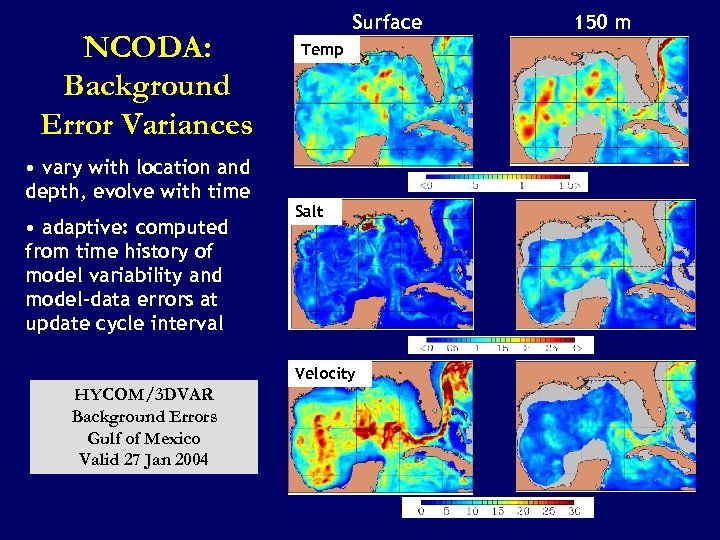 NCODA: Background Error Variances • vary with location and depth, evolve with time • adaptive: computed from time history of model variability and model-data errors at update cycle interval Surface Temp Salt Velocity HYCOM/3 DVAR Background Errors Gulf of Mexico Valid 27 Jan 2004 150 m
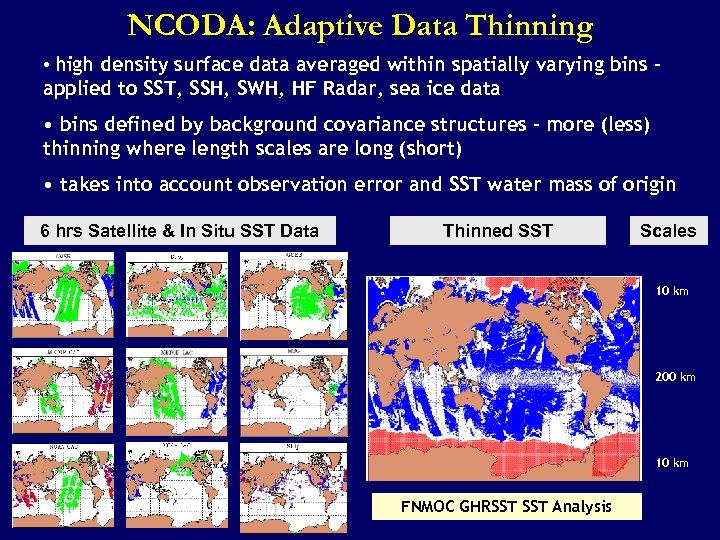 NCODA: Adaptive Data Thinning • high density surface data averaged within spatially varying bins – applied to SST, SSH, SWH, HF Radar, sea ice data • bins defined by background covariance structures – more (less) thinning where length scales are long (short) • takes into account observation error and SST water mass of origin 6 hrs Satellite & In Situ SST Data Thinned SST Scales 10 km 200 km 10 km FNMOC GHRSST Analysis
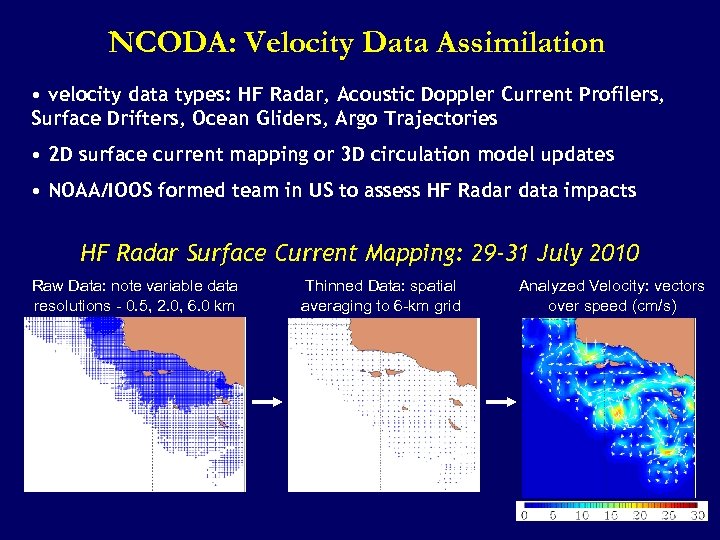 NCODA: Velocity Data Assimilation • velocity data types: HF Radar, Acoustic Doppler Current Profilers, Surface Drifters, Ocean Gliders, Argo Trajectories • 2 D surface current mapping or 3 D circulation model updates • NOAA/IOOS formed team in US to assess HF Radar data impacts HF Radar Surface Current Mapping: 29 -31 July 2010 Raw Data: note variable data resolutions - 0. 5, 2. 0, 6. 0 km Thinned Data: spatial averaging to 6 -km grid Analyzed Velocity: vectors over speed (cm/s)
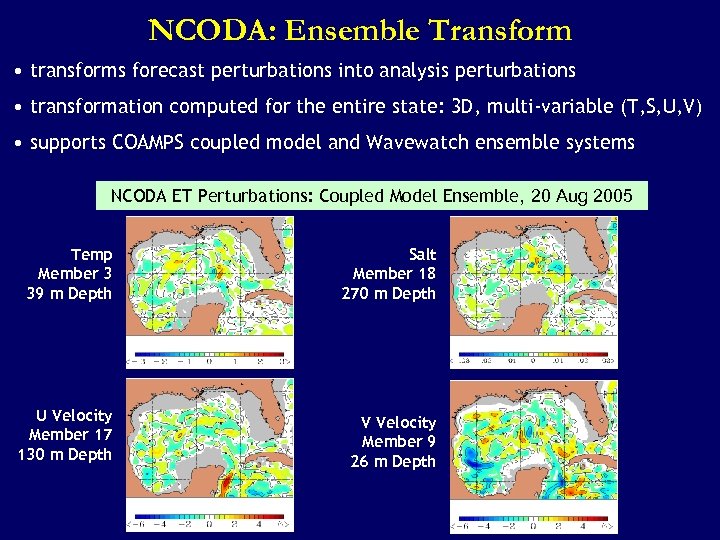 NCODA: Ensemble Transform • transforms forecast perturbations into analysis perturbations • transformation computed for the entire state: 3 D, multi-variable (T, S, U, V) • supports COAMPS coupled model and Wavewatch ensemble systems NCODA ET Perturbations: Coupled Model Ensemble, 20 Aug 2005 Temp Member 3 39 m Depth Salt Member 18 270 m Depth U Velocity Member 17 130 m Depth V Velocity Member 9 26 m Depth
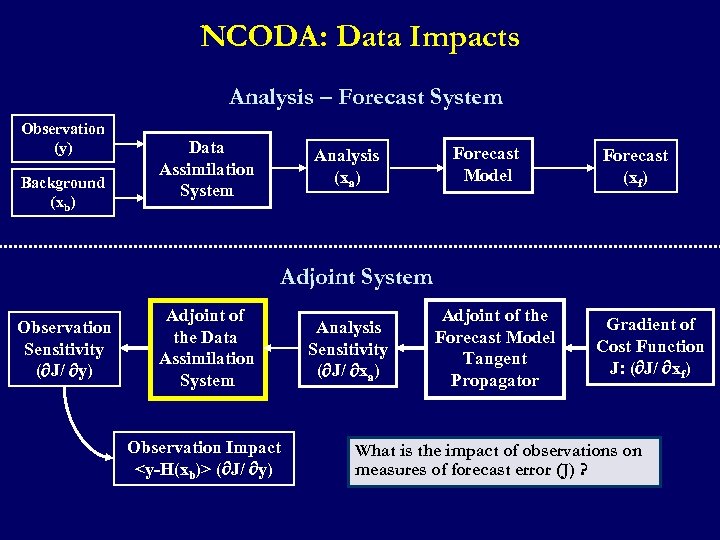 NCODA: Data Impacts Analysis – Forecast System Observation (y) Background (xb) Data Assimilation System Analysis (xa) Forecast Model Forecast (xf) Adjoint System Observation Sensitivity ( J/ y) Adjoint of the Data Assimilation System Observation Impact
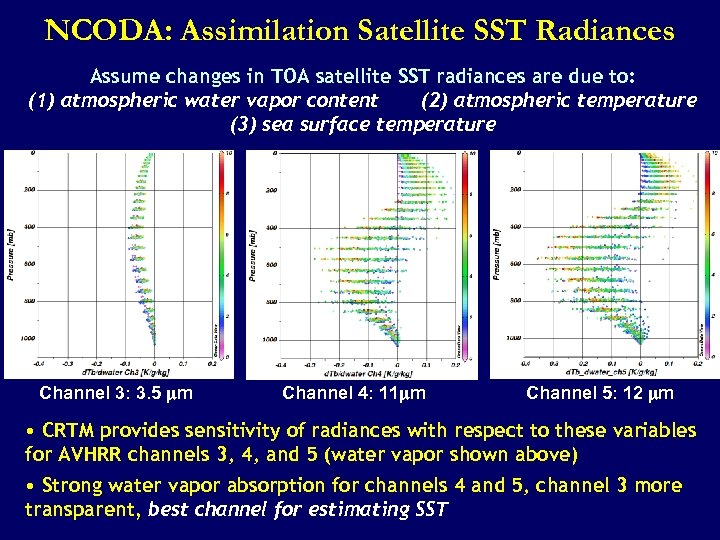 NCODA: Assimilation Satellite SST Radiances Assume changes in TOA satellite SST radiances are due to: (1) atmospheric water vapor content (2) atmospheric temperature (3) sea surface temperature Channel 3: 3. 5 m Channel 4: 11 m Channel 5: 12 m • CRTM provides sensitivity of radiances with respect to these variables for AVHRR channels 3, 4, and 5 (water vapor shown above) • Strong water vapor absorption for channels 4 and 5, channel 3 more transparent, best channel for estimating SST
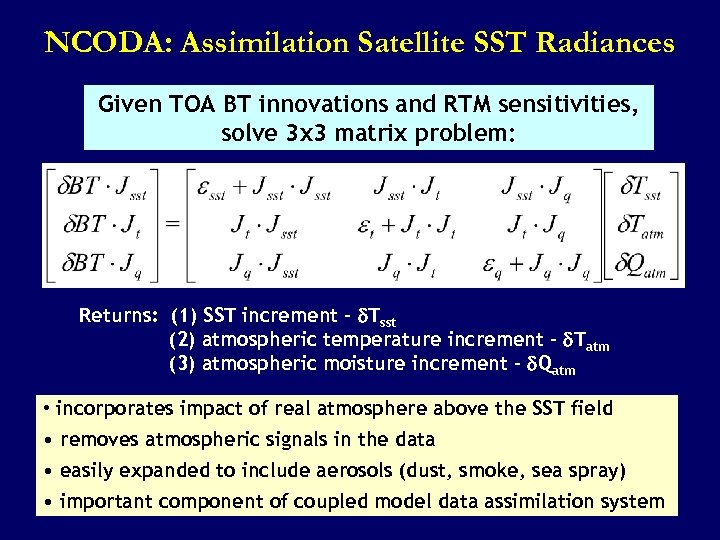 NCODA: Assimilation Satellite SST Radiances Given TOA BT innovations and RTM sensitivities, solve 3 x 3 matrix problem: Returns: (1) SST increment - Tsst (2) atmospheric temperature increment - Tatm (3) atmospheric moisture increment - Qatm • incorporates impact of real atmosphere above the SST field • removes atmospheric signals in the data • easily expanded to include aerosols (dust, smoke, sea spray) • important component of coupled model data assimilation system
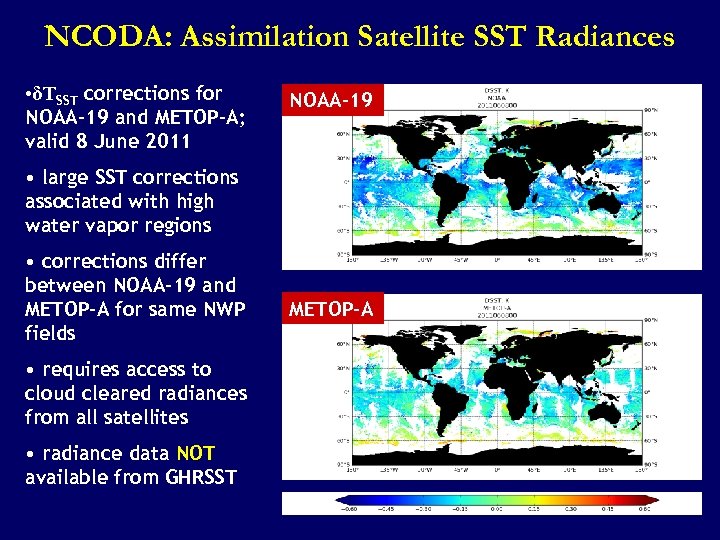 NCODA: Assimilation Satellite SST Radiances • δTSST corrections for NOAA-19 and METOP-A; valid 8 June 2011 NOAA-19 • large SST corrections associated with high water vapor regions • corrections differ between NOAA-19 and METOP-A for same NWP fields • requires access to cloud cleared radiances from all satellites • radiance data NOT available from GHRSST METOP-A
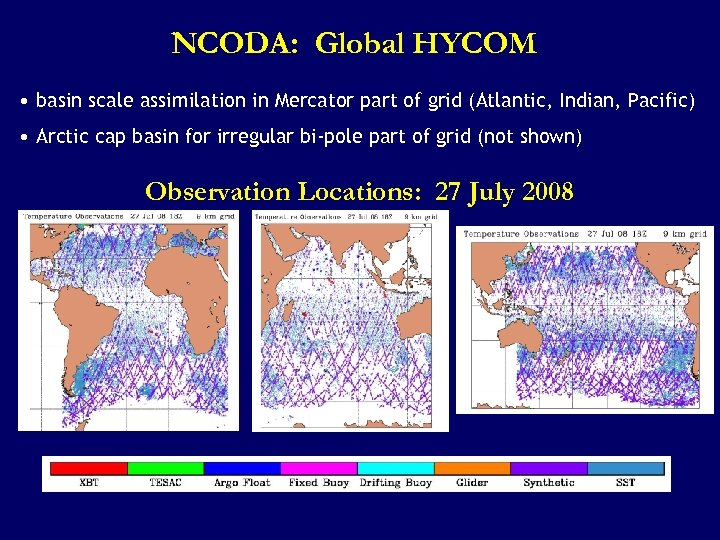 NCODA: Global HYCOM • basin scale assimilation in Mercator part of grid (Atlantic, Indian, Pacific) • Arctic cap basin for irregular bi-pole part of grid (not shown) Observation Locations: 27 July 2008
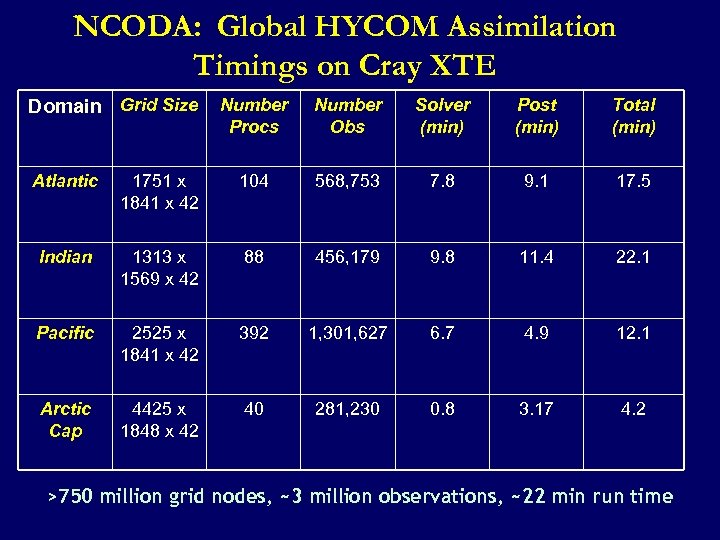 NCODA: Global HYCOM Assimilation Timings on Cray XTE Domain Grid Size Number Procs Number Obs Solver (min) Post (min) Total (min) Atlantic 1751 x 1841 x 42 104 568, 753 7. 8 9. 1 17. 5 Indian 1313 x 1569 x 42 88 456, 179 9. 8 11. 4 22. 1 Pacific 2525 x 1841 x 42 392 1, 301, 627 6. 7 4. 9 12. 1 Arctic Cap 4425 x 1848 x 42 40 281, 230 0. 8 3. 17 4. 2 >750 million grid nodes, ~3 million observations, ~22 min run time
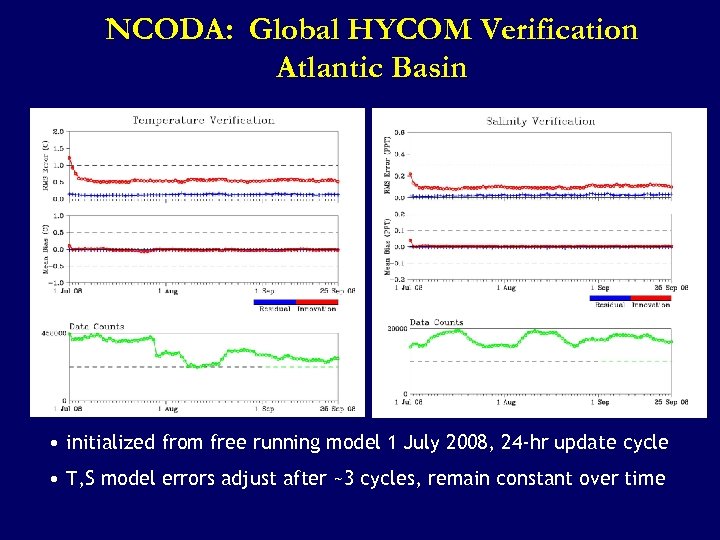 NCODA: Global HYCOM Verification Atlantic Basin • initialized from free running model 1 July 2008, 24 -hr update cycle • T, S model errors adjust after ~3 cycles, remain constant over time
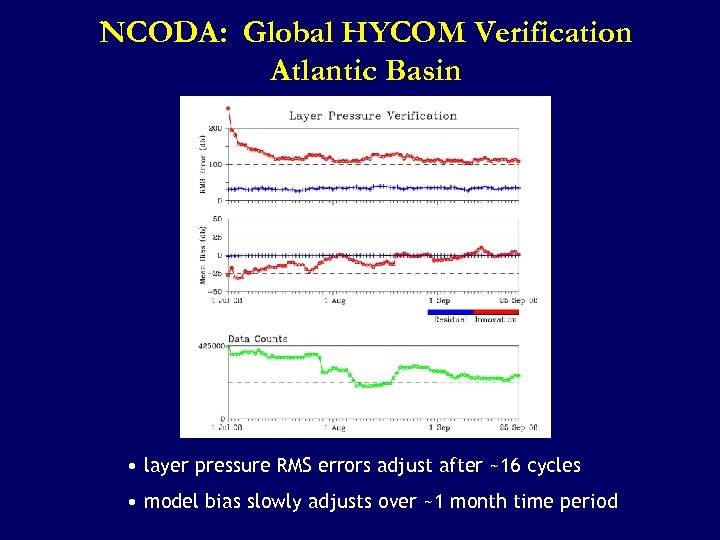 NCODA: Global HYCOM Verification Atlantic Basin • layer pressure RMS errors adjust after ~16 cycles • model bias slowly adjusts over ~1 month time period
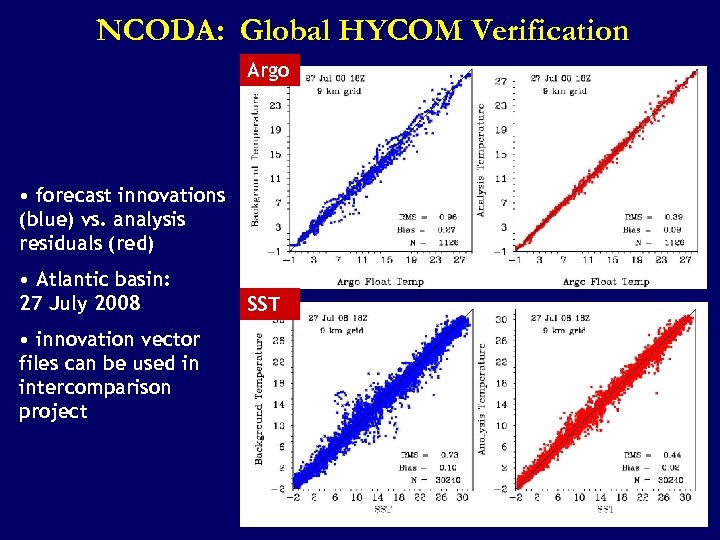 NCODA: Global HYCOM Verification Argo • forecast innovations (blue) vs. analysis residuals (red) • Atlantic basin: 27 July 2008 • innovation vector files can be used in intercomparison project SST
 NCODA v 3. x: Planned Upgrades • analysis QC based on iterative variational solution • variational bias correction to maintain model T/S relationships at depth NCODA v 4. 0: generalized NAVDAS-AR framework • more efficient for large amounts of data • compatible with planned ensemble, coupled, and hybrid DA developments • interest in joint development by JCSDA partners • new ONR funding FY 11 -FY 13 to prototype system (with Craig Bishop)
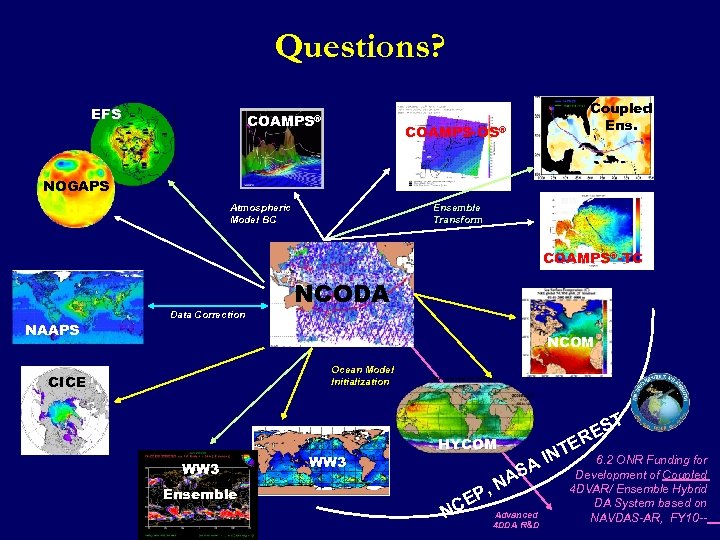 Questions? EFS COAMPS® Coupled Ens. COAMPS-OS® NOGAPS Atmospheric Model BC Ensemble Transform COAMPS®-TC NAAPS Data Correction NCODA NCOM Ocean Model Initialization CICE WW 3 Ensemble WW 3 S RE E HYCOM NC , EP INT A AS N Advanced 4 DDA R&D T 6. 2 ONR Funding for Development of Coupled 4 DVAR/ Ensemble Hybrid DA System based on NAVDAS-AR, FY 10 --