 Скачать презентацию NCknows Challenges There is only one little problem
ca8ce9a569e1f7d24653be2891a64833.ppt
- Количество слайдов: 7



NCknows Challenges “There is only one little problem, of course. We are not on the Web, or we are not on it in any kind of a meaningful way. That position is still open. But there can be little doubt that we are the best ones to fill it. ” – Steve Coffman From Anhang, Abe and Steve Coffman. "The Great Reference Debate" American Libraries 33(3) (March 2002): 50 -54.
“Issues” • • • “Other” patrons Quality Control Humanizing Virtual Interactions Marketing Referral
“Other” Patrons • Why shouldn’t you partner academic, public and special libraries? • Why should you? Time, money, NCLIVE and your patrons! • Minimum performance standards- RUSA Guidelines (http: //www. ala. org/ala/rusaprotools/referenceguide/professional. htm) Reference Interview in Digital Reference (http: //www. lis. uiuc. edu/~b-sloan/interview. htm) • How will we know if it works? • How to make it better: – NCknows listserv to reinforce resources and VR interactions – Ongoing informal needs assessment based on transcript reviews. – Websites arranged for the practicing NCknows’er (http: //www. 247 ref. org/info/manual/librarianprotocol. cfm) – Training taskforce to investigate need and organize class sessions.
Quality Control • Who reads the transcripts? Evaluators and designated representative from each library. • This will be done by the evaluators on a broad scale but by us on a day to day basis. • Skills and trust. • Quality vs. Privacy (http: //www. ncknows. org/using. htm- scroll down) • We need and will ask for regular input from you on the relevance of NCknows to your mission and professional goals and a formal evaluation process that includes your input.
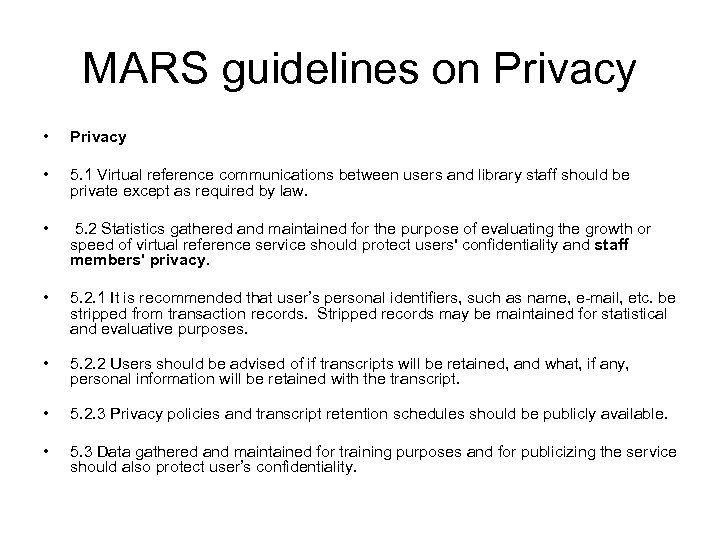
MARS guidelines on Privacy • Privacy • 5. 1 Virtual reference communications between users and library staff should be private except as required by law. • 5. 2 Statistics gathered and maintained for the purpose of evaluating the growth or speed of virtual reference service should protect users' confidentiality and staff members' privacy. • 5. 2. 1 It is recommended that user’s personal identifiers, such as name, e-mail, etc. be stripped from transaction records. Stripped records may be maintained for statistical and evaluative purposes. • 5. 2. 2 Users should be advised of if transcripts will be retained, and what, if any, personal information will be retained with the transcript. • 5. 2. 3 Privacy policies and transcript retention schedules should be publicly available. • 5. 3 Data gathered and maintained for training purposes and for publicizing the service should also protect user’s confidentiality.
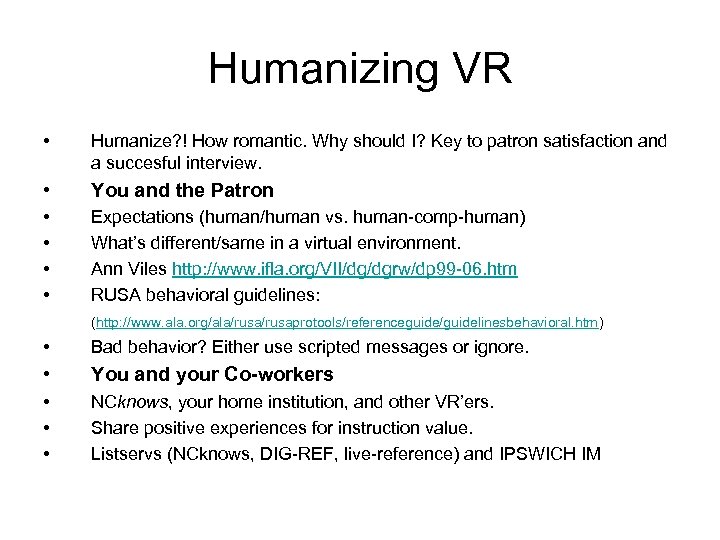
Humanizing VR • Humanize? ! How romantic. Why should I? Key to patron satisfaction and a succesful interview. • You and the Patron • • Expectations (human/human vs. human-comp-human) What’s different/same in a virtual environment. Ann Viles http: //www. ifla. org/VII/dg/dgrw/dp 99 -06. htm RUSA behavioral guidelines: (http: //www. ala. org/ala/rusaprotools/referenceguide/guidelinesbehavioral. htm) • Bad behavior? Either use scripted messages or ignore. • You and your Co-workers • • • NCknows, your home institution, and other VR’ers. Share positive experiences for instruction value. Listservs (NCknows, DIG-REF, live-reference) and IPSWICH IM
Marketing • • Meet Pam Jaskot, Communication Programs Specialist LSTA grant: Phase II Marketing task-force After March 11, we will re-evaluate to see if libraries can market on their own.
Скачать презентацию NCknows Challenges There is only one little problem
ca8ce9a569e1f7d24653be2891a64833.ppt