 Скачать презентацию NCDs Behavior Change Communication Advocacy Strategies Dr
7fcdb137809b819541839fa80d4bed07.ppt
- Количество слайдов: 26



NCDs: Behavior Change Communication & Advocacy Strategies Dr. Nabeela Ali COP HSS Component of USAID MCH Program 27 February, 2014 Health Systems Strengthening Component of USAID’s MCH Program
Advocacy is a set of targeted actions directed at decision makers in support of a specific policy issue. Health Systems Strengthening Component of USAID’s MCH Program
What is News? An event, idea, or opinion that is timely, that interests or affects a large number of people in a community and that is capable of being understood by them M. Lyle Spencer, University of Washington Health Systems Strengthening Component of USAID’s MCH Program
Understanding underlying issues are key to dispelling doubts "Communications can’t fix a problem you don’t understand. But sometimes the lack of confidence is not just about communicating more effectively, but about delivery issues or different belief systems or, for example in the case of polio, needing security and diplomacy strategies. " Excerpts from an interview with Dr Heidi Larson in the Bulletin of the World Health Organization Volume 92, Number 2, February 2014, 77 -152. Health Systems Strengthening Component of USAID’s MCH Program
NCDs: Need for BCC Strategies • The determinants of health underlie the double burden of communicable and non-communicable diseases – determinants in Physical environment, biological, behavioral, & socioeconomic – these determinants are closely interlinked to poverty, low education, poor diet, inequitable access to health services • To address these determinants, effectively, Integrated and comprehensive approaches are required BCC is effective in facilitating and tackling these underlying determinants of NCDs. Health Systems Strengthening Component of USAID’s MCH Program
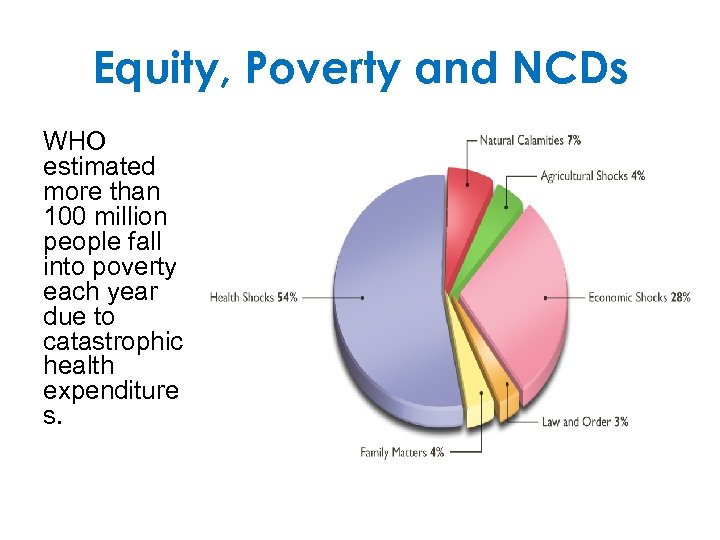
Equity, Poverty and NCDs WHO estimated more than 100 million people fall into poverty each year due to catastrophic health expenditure s.
Donor Investments • Donors invest huge amounts annually in achieving global health goals. But there is a wide gap between rich and poor countries with a large pool of donors backing vertical, disease-specific programs and funds. Health Systems Strengthening Component of USAID’s MCH Program
Donor Funded Health Projects in Last Decade • • PHC MNCH Family Planning Water and Sanitation TB, Malaria and HIV/AIDS Commodity Security Health Systems Strengthening Component of USAID’s MCH Program
Equity is not just about extending health coverage to everyone. It’s about ensuring that in the process we address differences in health status that are avoidable and unfair and it’s about the power that people have to influence their health systems. Health Systems Strengthening Component of USAID’s MCH Program
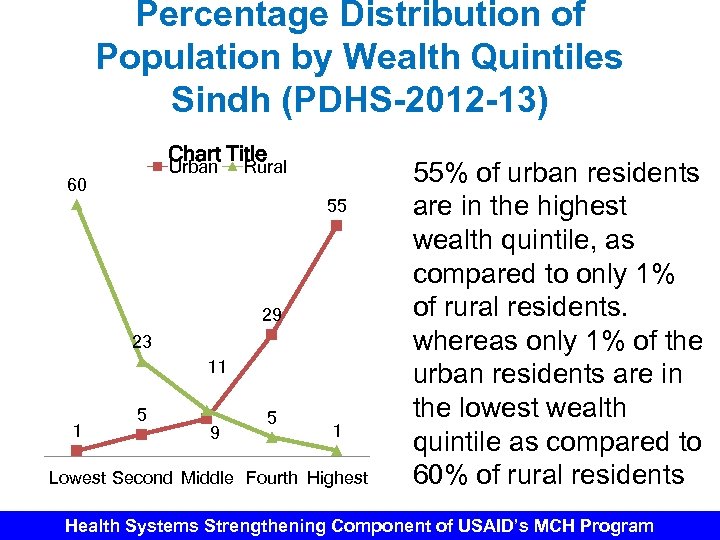
Percentage Distribution of Population by Wealth Quintiles Sindh (PDHS-2012 -13) Chart Title Urban 60 Rural 55 29 23 11 1 5 9 5 1 Lowest Second Middle Fourth Highest 55% of urban residents are in the highest wealth quintile, as compared to only 1% of rural residents. whereas only 1% of the urban residents are in the lowest wealth quintile as compared to 60% of rural residents Health Systems Strengthening Component of USAID’s MCH Program
BCC Guiding principles • Health is a basic human right • Equity, justice, peace, shelter, stable environment, finances are major prerequisites for health • BCC is primarily a process used to address the broad, underlying determinants of health • Regulatory role of the state is central to health actions • Multi-sectoral collaboration, Partnerships, networks, alliances are important avenues for enhancing health Health Systems Strengthening Component of USAID’s MCH Program
Insufficient Health Expenditure • A total of $22 per capita was spent on health in 2009 -2010 in which: – $8 per capita are by the government – $14 per capita are OOP Health Systems Strengthening Component of USAID’s MCH Program
Financial Outlay • The total outlay of health sector budgeted is 79. 4 billion for more than 185 million population – 17. 3 billion for development – 62. 1 billion for recurrent expenditure • Equivalent to 0. 35 % of GDP 2012 -2013 as compared to 0. 27% in 2011 -2012 Economic Survey 2012 -2013 Health Systems Strengthening Component of USAID’s MCH Program
Major challenges in BCC development and implementation • Inadequate technical leadership for BCC at various levels • Limited integration and collaboration • Scattered interventions and programs • Weak structures-staffing, funding, skills, documentation, publications and dissemination. Health Systems Strengthening Component of USAID’s MCH Program
Major Health promotion strategies • Knowledge and skills development Enabling/empowerment for healthy behavior • Mitigation of competing interests in society Creation of conditions that support healthy behavior including re-orientation of health services, healthy policies, legislation, regulations • Advocacy for health Increased resources and political support for health services and development Health Systems Strengthening Component of USAID’s MCH Program
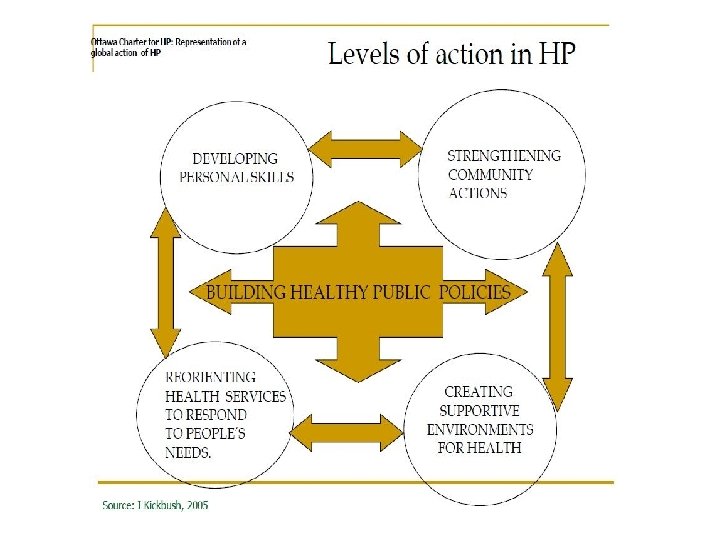
1. Developing Personal Skills • BCC supports personal development through providing information, education for health, and enhancing life skills • BCC increases the options available to people to exercise control over their own health and over their environments, and to make right choices • BCC enables people to learn, throughout life, to prepare themselves to cope with chronic illness and injuries (diet, activity in youth and their effects in middle and old age). Health Systems Strengthening Component of USAID’s MCH Program
2. Strengthening Community Actions • BCC supports relevant knowledge, skills and attitudes on causes and prevention • BCC facilitates problem identification, priority setting, selecting strategies and implementing activities • BCC enables a sense of ownership over health actions Health Systems Strengthening Component of USAID’s MCH Program
3. Creating Supportive Environment for Health • Creating national and regional partnerships for NCD control • Developing national NCD policies, strategies and plans of action • Legislation and compliance • Supporting patient associations for diabetes, cancer, stroke etc. Health Systems Strengthening Component of USAID’s MCH Program
4. Reorienting Health Needs according to Peoples Needs • The role of the health sector must move increasingly towards prevention, besides its responsibility for providing clinical and curative services • Health services need to embrace an expanded mandate which is sensitive to and respects socioeconomic needs • The health sector should engage communities and the society as a whole. Health Systems Strengthening Component of USAID’s MCH Program
Building Healthy Public Policies • Health must be put on the agenda of policy making in all sectors and at all levels • Policy makers need to be aware of the health consequences of their decisions Health Systems Strengthening Component of USAID’s MCH Program
Evidence that BCC works The Advanced Family Planning (AFP) project has used advocacy to increase funding, change policies, build capacity and raise the profile of FP in Indonesia, Uganda, Tanzania and globally. – In Uganda, increased national budget for FP from 1. 5 to 8. 0 billion shillings – In Indonesia, FP was included in a government program to provide free maternal care services for women – In Tanzania, the Parliamentary Family Planning Club (PFPC) was established. Health Systems Strengthening Component of USAID’s MCH Program
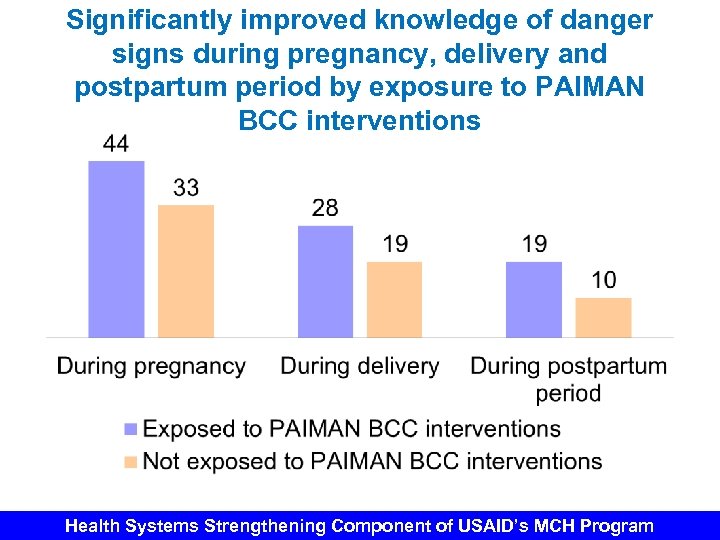
Significantly improved knowledge of danger signs during pregnancy, delivery and postpartum period by exposure to PAIMAN BCC interventions Health Systems Strengthening Component of USAID’s MCH Program
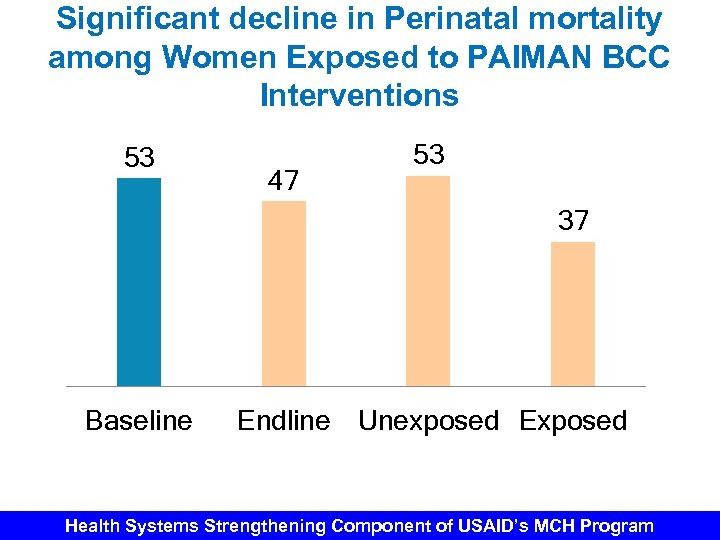
Significant decline in Perinatal mortality among Women Exposed to PAIMAN BCC Interventions 53 47 53 37 Baseline Endline Unexposed Exposed Health Systems Strengthening Component of USAID’s MCH Program
BCC interventions focus on improvement of people’s health, prevention of disease as well as appropriate treatment. BCC should be an integral component of all health interventions including NCDs. Health Systems Strengthening Component of USAID’s MCH Program
THANK YOU! The Health Systems Strengthening Component is funded by the United States Agency for International Development and implemented by JSI Research & Training Institute, Inc. , in collaboration with Heartfile, Contech International, and Rural Support Programs Network Health Systems Strengthening Component of USAID’s MCH Program
Скачать презентацию NCDs Behavior Change Communication Advocacy Strategies Dr
7fcdb137809b819541839fa80d4bed07.ppt