


 Скачать презентацию NC PROGRAMMING IE 450 Manufacturing Systems R
bd7993cda4bef2726feb070b30ae0ce2.ppt
- Количество слайдов: 66
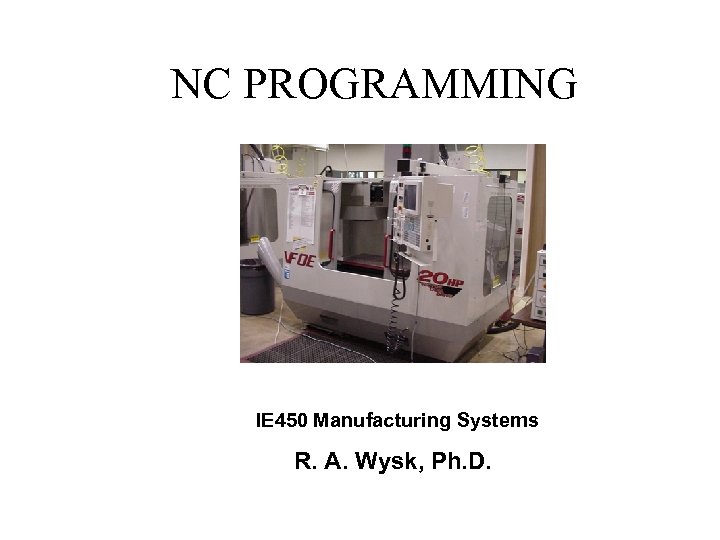 NC PROGRAMMING IE 450 Manufacturing Systems R. A. Wysk, Ph. D.
 Agenda Introduction Types of NC Machines Components of a NC Machine Control Mechanisms Interpolation Software Components
 Readings • Chapters 12 -13 of Computer Aided Manufacturing, Wang, H. P. , Chang, T. C. and Wysk, R. A. , 3 rd Edition , 2006. Chapter 9.
 Objectives • To be able to know when and what type of NC should be used • To be able to read and interpret an NC part program • To be able to create NC part programs for milled parts • To understand the difference between world, machine and part coordinates • To understand how to set machine offsets • To execute an NC part program
 HISTORICAL DEVELOPMENT • 15 th century - machining metal. • 18 th century - industrialization, production-type machine tools. • 20 th century - F. W. Taylor - tool metal - HSS Automated production equipment Screw machines Transfer lines Assembly lines using cams and preset stops Programmable automation NC PLC Robots
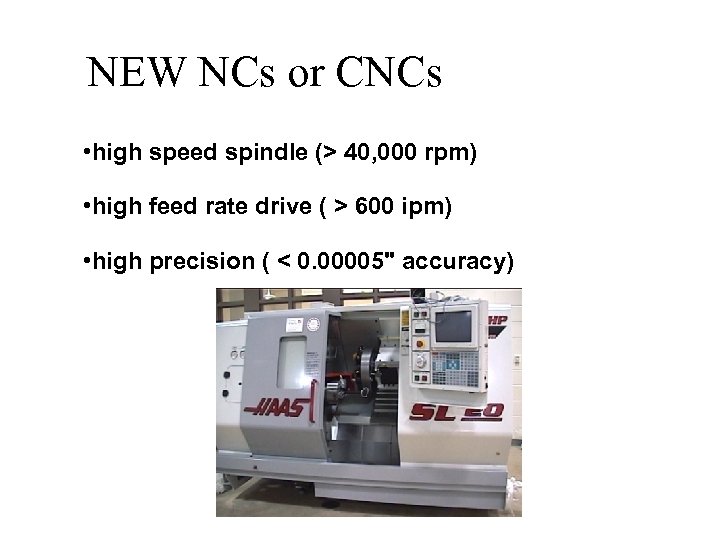 NEW NCs or CNCs • high speed spindle (> 40, 000 rpm) • high feed rate drive ( > 600 ipm) • high precision ( < 0. 00005" accuracy)
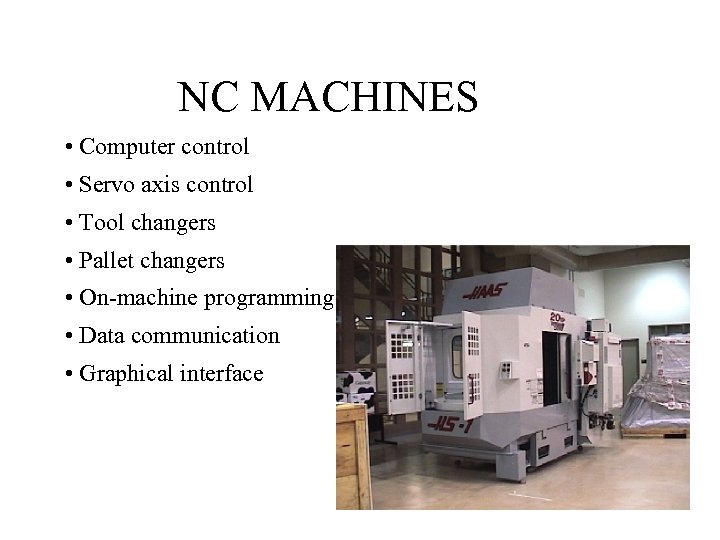 NC MACHINES • Computer control • Servo axis control • Tool changers • Pallet changers • On-machine programming • Data communication • Graphical interface
 Group Exercise As a group, discuss how you could justify the purchase of an NC machine. • What are the downsides for purchasing an NC machine? • Besides direct labor reductions, what other benefits come from NC machines?
 Justification • Variance reduction – Time and quality • Eliminate direct labor • Produce increased part complexity – Contouring • Improve process efficiencies
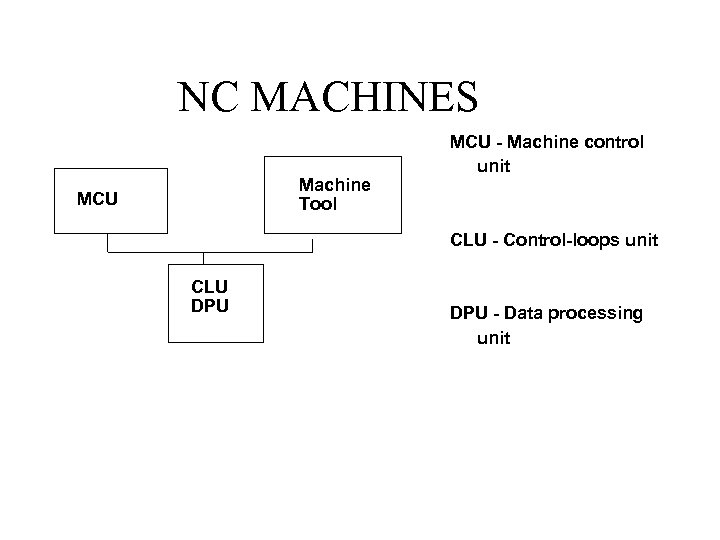 NC MACHINES Machine Tool MCU - Machine control unit CLU - Control-loops unit CLU DPU - Data processing unit
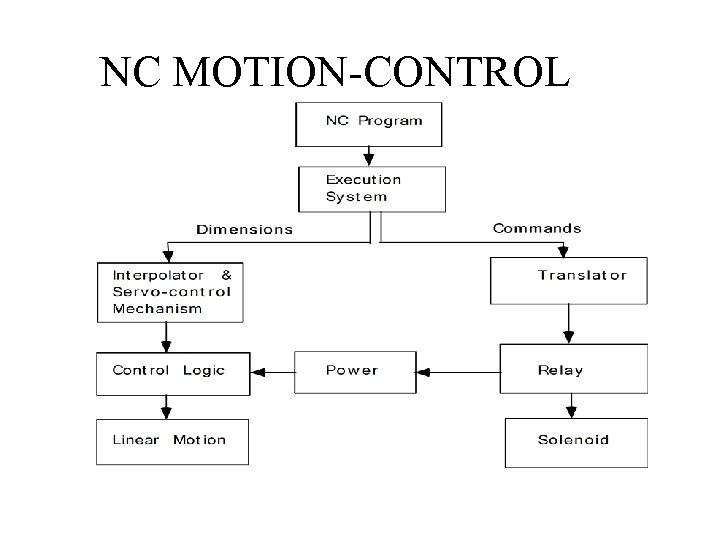 NC MOTION-CONTROL
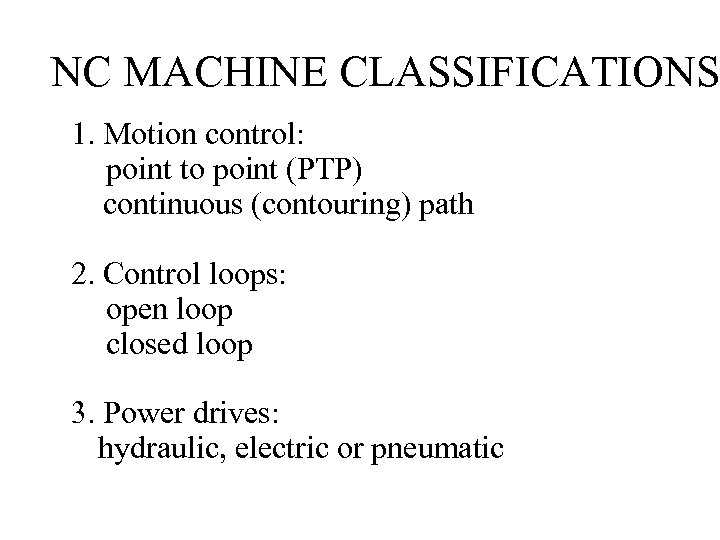 NC MACHINE CLASSIFICATIONS 1. Motion control: point to point (PTP) continuous (contouring) path 2. Control loops: open loop closed loop 3. Power drives: hydraulic, electric or pneumatic
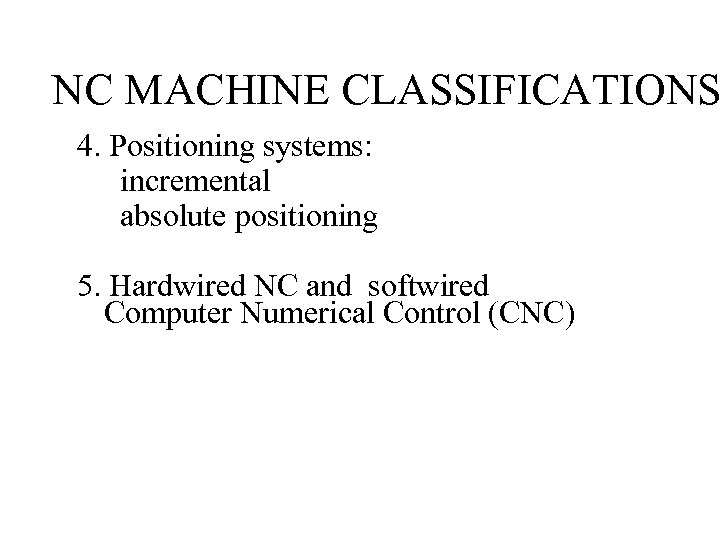 NC MACHINE CLASSIFICATIONS 4. Positioning systems: incremental absolute positioning 5. Hardwired NC and softwired Computer Numerical Control (CNC)
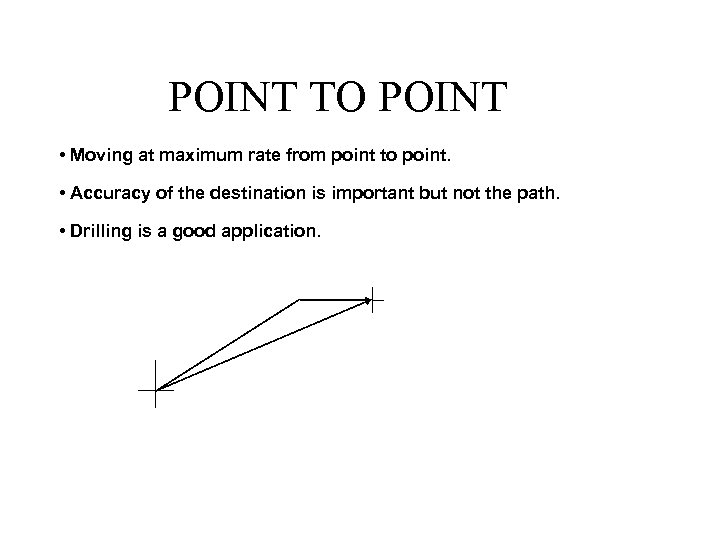 POINT TO POINT • Moving at maximum rate from point to point. • Accuracy of the destination is important but not the path. • Drilling is a good application.
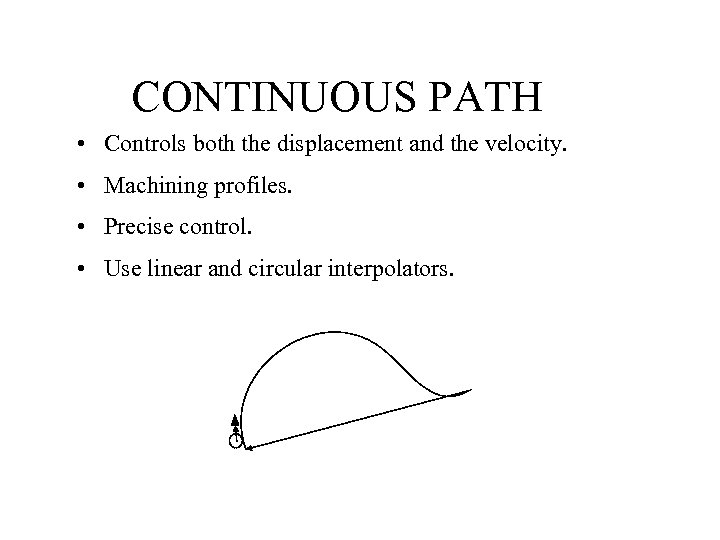 CONTINUOUS PATH • Controls both the displacement and the velocity. • Machining profiles. • Precise control. • Use linear and circular interpolators.
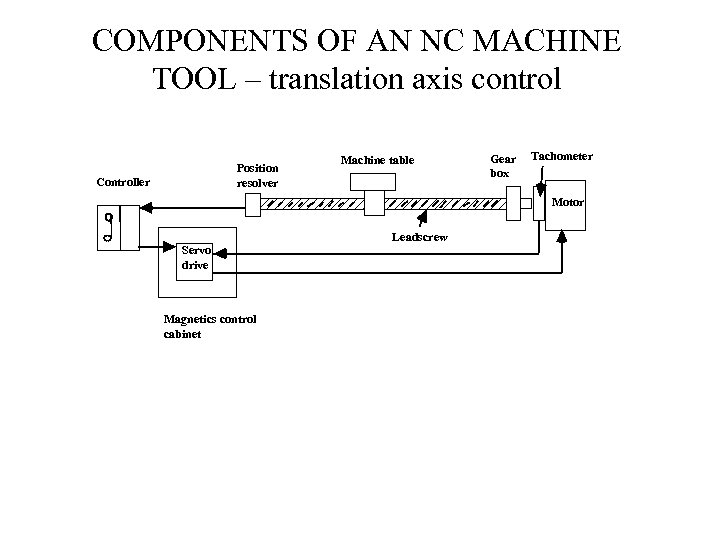 COMPONENTS OF AN NC MACHINE TOOL – translation axis control Position resolver Controller Machine table Gear box Tachometer Motor Leadscrew Servo drive Magnetics control cabinet
 NC MACHINE RATING • • • Accuracy Repeatability Spindle and axis motor horsepower Number of controlled axes Dimension of workspace Features of the machine and the controller.
 NC ACCURACY • Accuracy - control instrumentation resolution and hardware accuracy. • Control resolution: the minimum length distinguishable by the control unit (BLU). • Hardware inaccuracies are caused by physical machine errors.
 HARDWARE INACCURACIES Component tolerances: inaccuracies in the machine elements, machine-tool assembly errors, spindle runout, and leadscrew backlash. Machine operation: Tool deflection (a function of the cutting force), produces dimensional error and chatter marks on the finished part.
 HARDWARE INACCURACIES Thermal error: heat generated by the motor operation, cutting process, friction on the ways and bearings, etc. Use cutting fluids, locating drive motors away from the center of a machine, and reducing friction from the ways and bearings
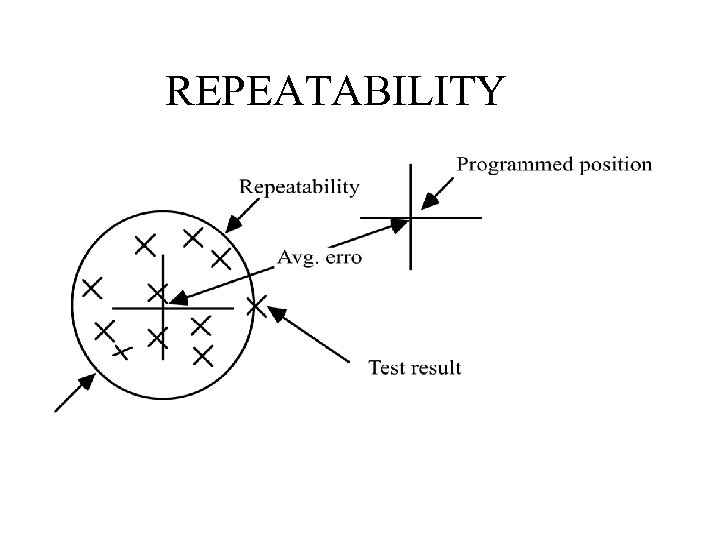 REPEATABILITY
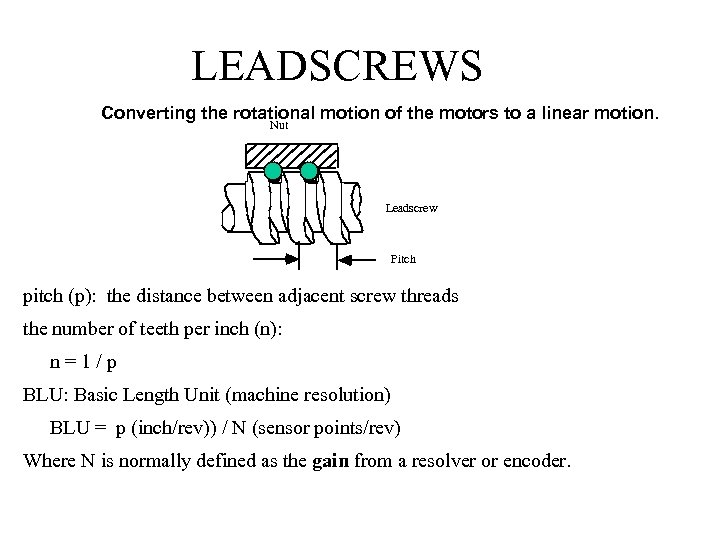 LEADSCREWS Converting the rotational motion of the motors to a linear motion. Nut Leadscrew Pitch pitch (p): the distance between adjacent screw threads the number of teeth per inch (n): n = 1 / p BLU: Basic Length Unit (machine resolution) BLU = p (inch/rev)) / N (sensor points/rev) Where N is normally defined as the gain from a resolver or encoder.
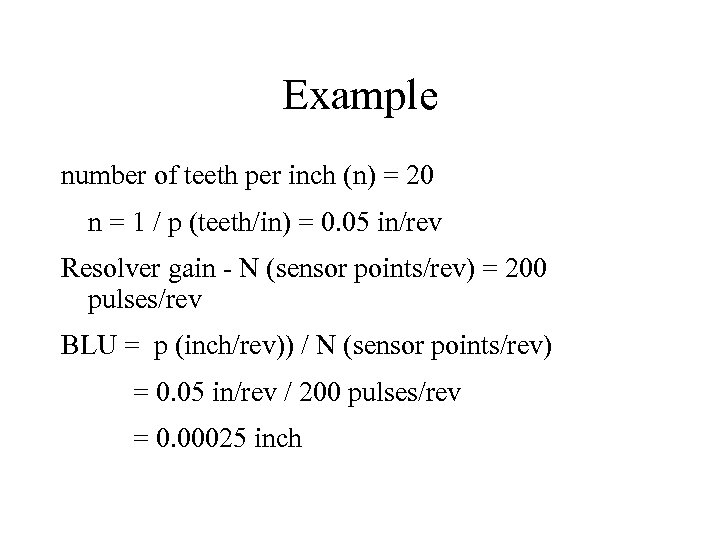 Example number of teeth per inch (n) = 20 n = 1 / p (teeth/in) = 0. 05 in/rev Resolver gain - N (sensor points/rev) = 200 pulses/rev BLU = p (inch/rev)) / N (sensor points/rev) = 0. 05 in/rev / 200 pulses/rev = 0. 00025 inch
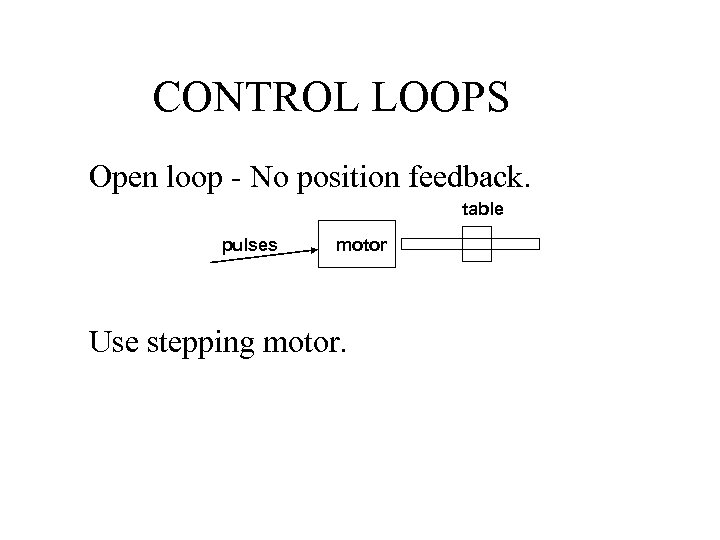 CONTROL LOOPS Open loop - No position feedback. table pulses motor Use stepping motor.
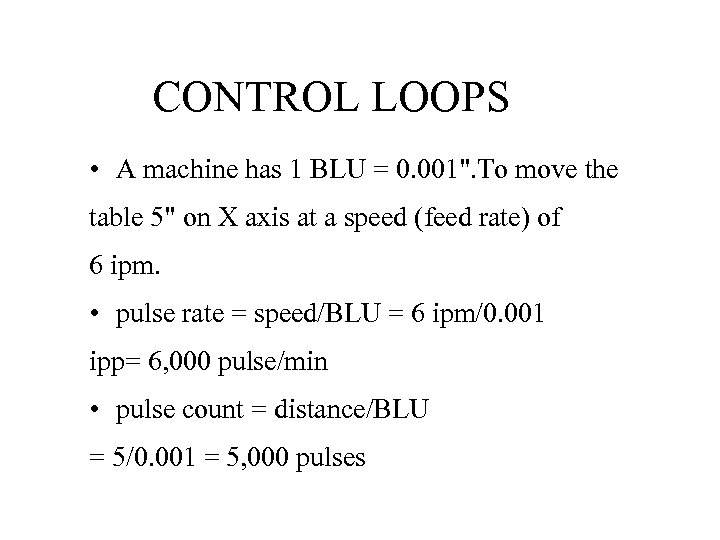 CONTROL LOOPS • A machine has 1 BLU = 0. 001". To move the table 5" on X axis at a speed (feed rate) of 6 ipm. • pulse rate = speed/BLU = 6 ipm/0. 001 ipp= 6, 000 pulse/min • pulse count = distance/BLU = 5/0. 001 = 5, 000 pulses
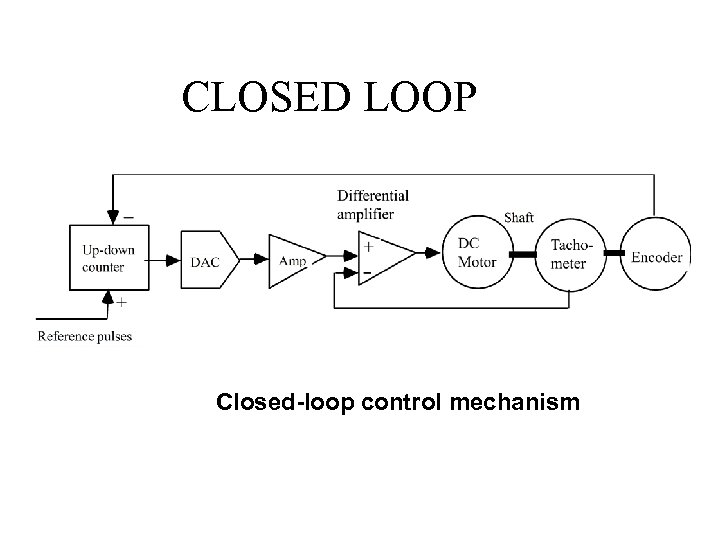 CLOSED LOOP Closed-loop control mechanism
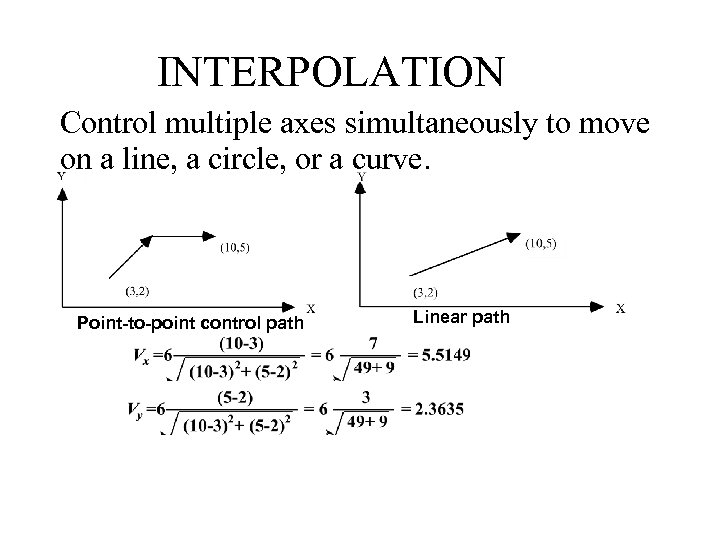 INTERPOLATION Control multiple axes simultaneously to move on a line, a circle, or a curve. Point-to-point control path Linear path
 INTERPOLATORS • Most common : linear and circular • Since interpolation is right above the servo level, speed is critical, and the process must not involve excessive computation. • Traditional NC interpolators: Digital Differential Analyzer (DDA) • Higher order curves, such as Bezier's curve, use off-line approximation algorithms to break the curves into linear or circular segments.
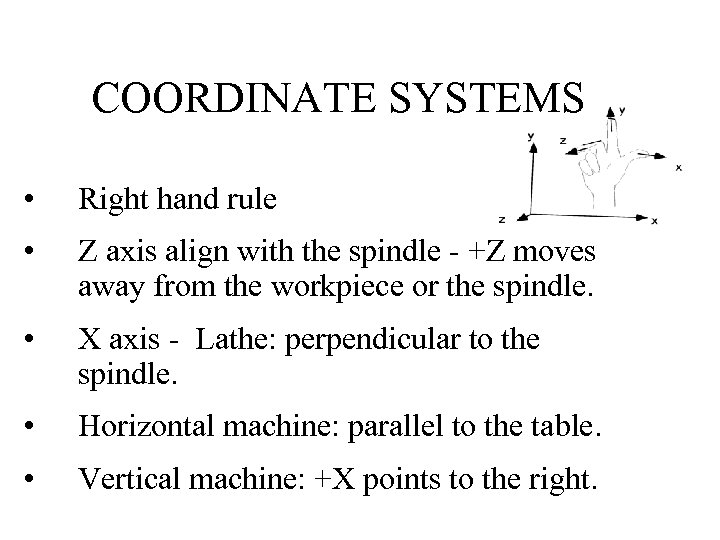 COORDINATE SYSTEMS • Right hand rule • Z axis align with the spindle - +Z moves away from the workpiece or the spindle. • X axis - Lathe: perpendicular to the spindle. • Horizontal machine: parallel to the table. • Vertical machine: +X points to the right.
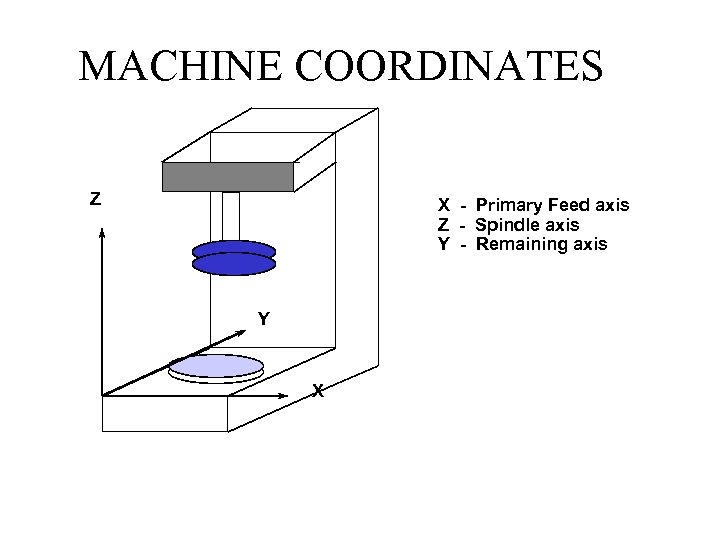 MACHINE COORDINATES Z X - Primary Feed axis Z - Spindle axis Y - Remaining axis Y X
 PROGRAM STORAGE • Paper tape Paper or Mylar coated paper. • Diskettes • From other computers through RS 232 or local area network (LAN)
 SYMBOLIC CODES • ASCII or ISO, use even parity • EIA - Binary Coded Decimal (BCD), RS 244 A standard, use odd parity.
 Configurations • Machining centers • Turning centers
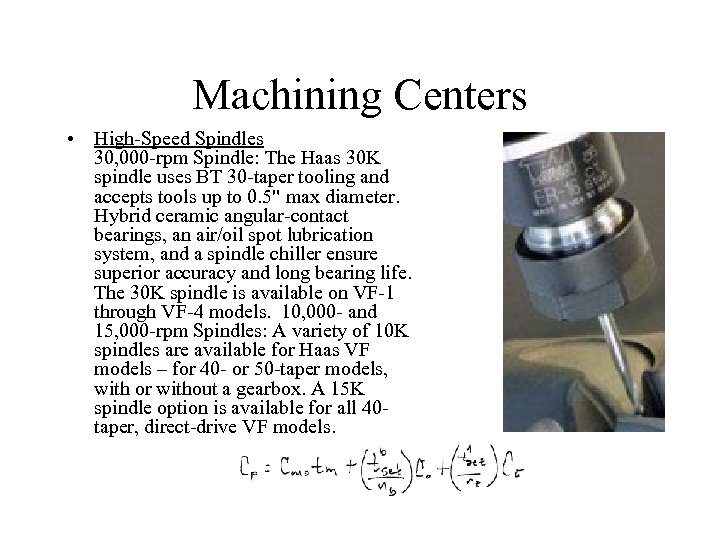 Machining Centers • High-Speed Spindles 30, 000 -rpm Spindle: The Haas 30 K spindle uses BT 30 -taper tooling and accepts tools up to 0. 5" max diameter. Hybrid ceramic angular-contact bearings, an air/oil spot lubrication system, and a spindle chiller ensure superior accuracy and long bearing life. The 30 K spindle is available on VF-1 through VF-4 models. 10, 000 - and 15, 000 -rpm Spindles: A variety of 10 K spindles are available for Haas VF models – for 40 - or 50 -taper models, with or without a gearbox. A 15 K spindle option is available for all 40 taper, direct-drive VF models.
 Machining Centers Continued • High-Speed Machining The HSM option provides a powerful tool to reduce cycle times and improve accuracy. Using a motion algorithm called ”acceleration before interpolation, “ combined with full look-ahead of up to 80 blocks, HSM provides fast contouring feeds without distortion of the programmed path. The Haas HSM option accepts ISO standard G code, and is a fraction of the cost of other highspeed controls
 Machining Centers • Through-Spindle Coolant Optional TSC supplies coolant at up to 300 psi to the cutting edge, for longer tool life, higher speeds, and improved deep hole drilling and blind pocket milling – as well as reduced cycle times. The exclusive Haas design includes a special seal that disengages when the system is not in use, which extends the life of the system. (Note: This system provides 300 psi at a flow rate of 1. 5 gallons per minute and 250 psi at 4 gpm. The actual pressure will vary with the diameter of the coolant passages in the tool). High-Pressure (1000 psi) TSC Available on the VF Super Speed models and all 50 -taper VF models, high-pressure TSC makes it easier to perform deep-hole drilling and heavy cuts, allows faster feedrates and provides better surface finishes. Max flow rate is 6 gal/min at 1000 psi; max spindle speed is 10, 000 rpm with the high-pressure TSC option enabled.
 Machining Centers • Linear Scales When absolute positioning accuracy is necessary, linear scales are the only way to ensure exact axis positioning under the fluctuating conditions that exist in today’s machine shops. Linear scales ensure positioning accuracy along X, Y and Z axes by compensating for thermal variations inherent in all machine tools. With 2 -micron resolution, these scales deliver high accuracy for the type of precision that mold making and other high-tolerance machining applications demand.
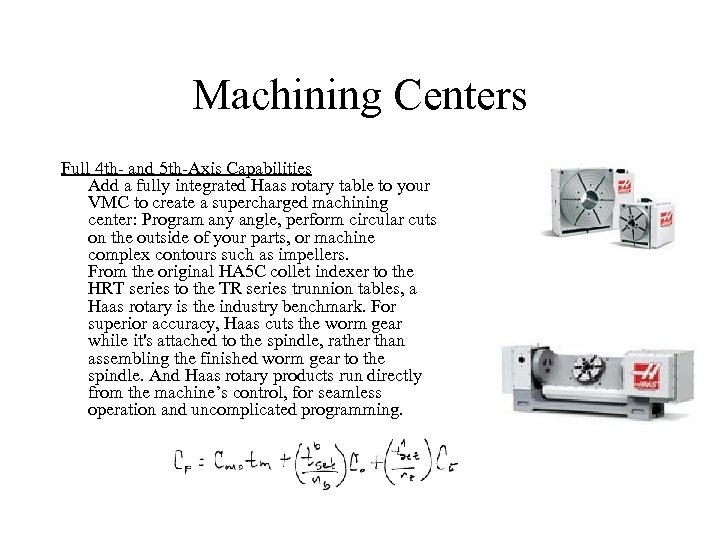 Machining Centers Full 4 th- and 5 th-Axis Capabilities Add a fully integrated Haas rotary table to your VMC to create a supercharged machining center: Program any angle, perform circular cuts on the outside of your parts, or machine complex contours such as impellers. From the original HA 5 C collet indexer to the HRT series to the TR series trunnion tables, a Haas rotary is the industry benchmark. For superior accuracy, Haas cuts the worm gear while it's attached to the spindle, rather than assembling the finished worm gear to the spindle. And Haas rotary products run directly from the machine’s control, for seamless operation and uncomplicated programming.
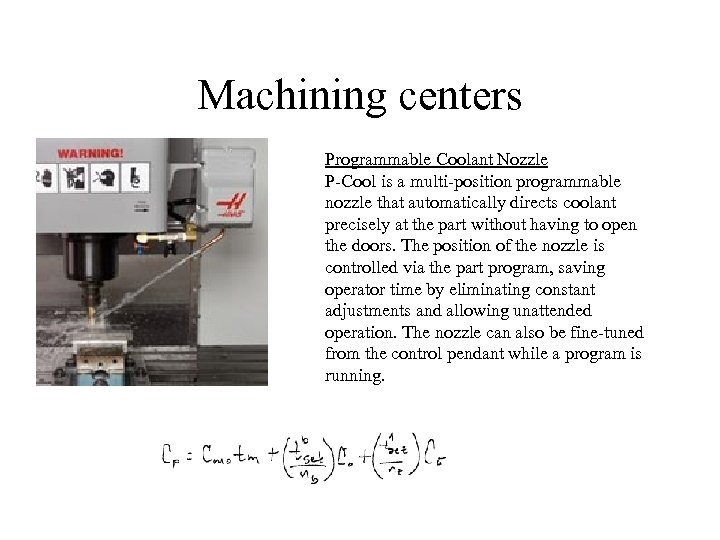 Machining centers Programmable Coolant Nozzle P-Cool is a multi-position programmable nozzle that automatically directs coolant precisely at the part without having to open the doors. The position of the nozzle is controlled via the part program, saving operator time by eliminating constant adjustments and allowing unattended operation. The nozzle can also be fine-tuned from the control pendant while a program is running.
 Machining Centers Auto Door With this option, the machine doors open and close automatically via the part program. This reduces operator fatigue during repetitive machining – which can increase operator productivity by up to 25% – and allows for unattended operation when used with a robotic loader. Hard Drive & Ethernet Interface w/USB Support This option provides tremendous flexibility in program transfer and storage. The 20 GB hard drive supplies ample storage space for program files, and the USB connection supports either a customersupplied ZIP™ drive or flash disk. The Ethernet component allows quick and easy data transmission between your Haas machine and a network or PC, and large files can be accessed by multiple machines. High-speed data transfers allow DNC of large files at up to 1000 blocks per second. The Ethernet interface works with Windows XP, ME, 2000 Pro & Server, NT 4. 0, 98 and 95. IPX/SPX or TCP/IP protocol; easy setup from the control screen.
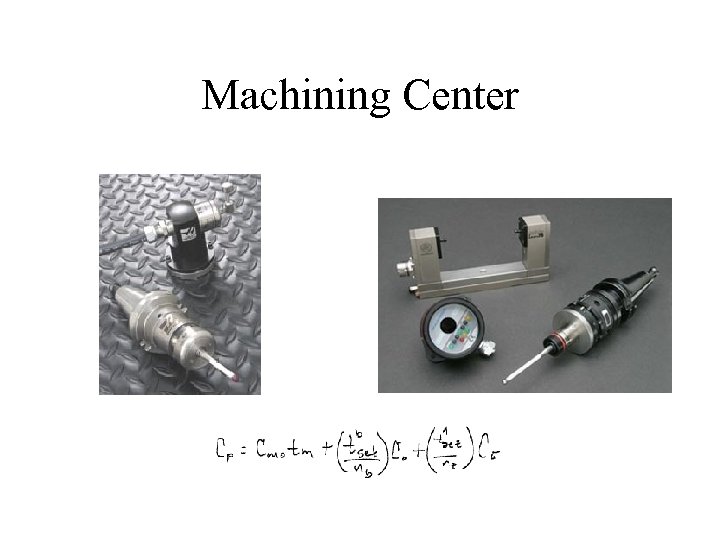
 Machining Center • Haas Probing Systems ML PS 95/175 Laser Tool Monitor and Work Measure Upgrade Kit: Upgrade to Marposs - This non-contact laser system allows for automatic tool length, diameter measurement and breakage detection for tools from 0. 008" to 6. 8" in diameter. The laser can be programmed to check tool profiles, monitor wear on multi-insert end mills, and can update tool offsets and compensates for thermal variations. This kit features IPC, Instant Productivity Cycles for quick and easy use on both laser tool setting and work probe systems by anyone who can operate an edge finder and indicator. IPC are defaulted program cycles that do not require approximate tool offset inputs or descriptions for length and diameter measurements. IPC along with the work probe are just as easy to use for setting work offsets and measuring and finding part features by utilizing the wide range of defaulted programs. IPC features are many, fully defaulted cycles or creative and program them yourself. This upgrade kit will reduce your set-up times, while automatically updating your tool offset registers and more!
 Machining Center
 Machining Centers
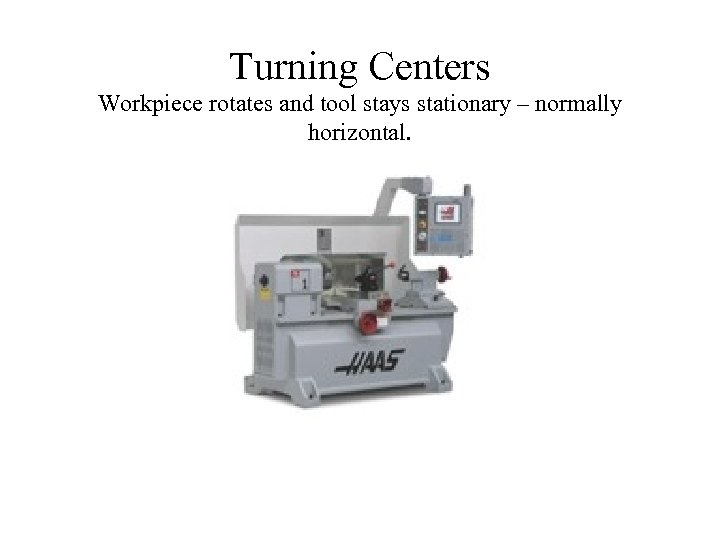 Turning Centers Workpiece rotates and tool stays stationary – normally horizontal.
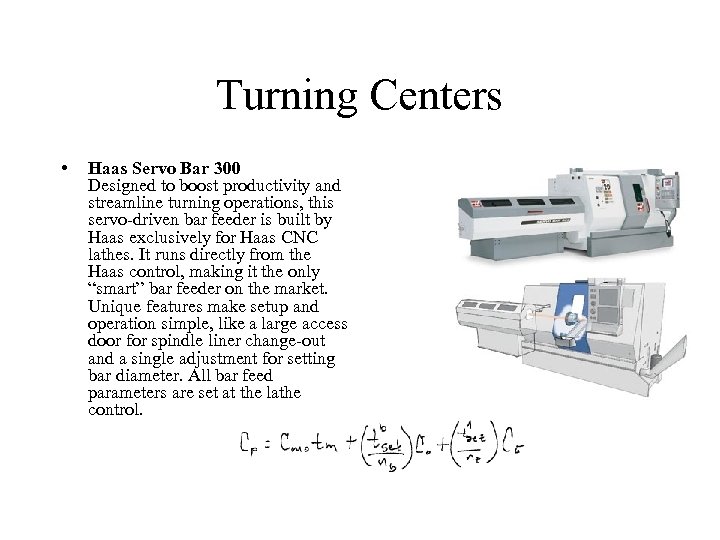 Turning Centers • Haas Servo Bar 300 Designed to boost productivity and streamline turning operations, this servo-driven bar feeder is built by Haas exclusively for Haas CNC lathes. It runs directly from the Haas control, making it the only “smart” bar feeder on the market. Unique features make setup and operation simple, like a large access door for spindle liner change-out and a single adjustment for setting bar diameter. All bar feed parameters are set at the lathe control.
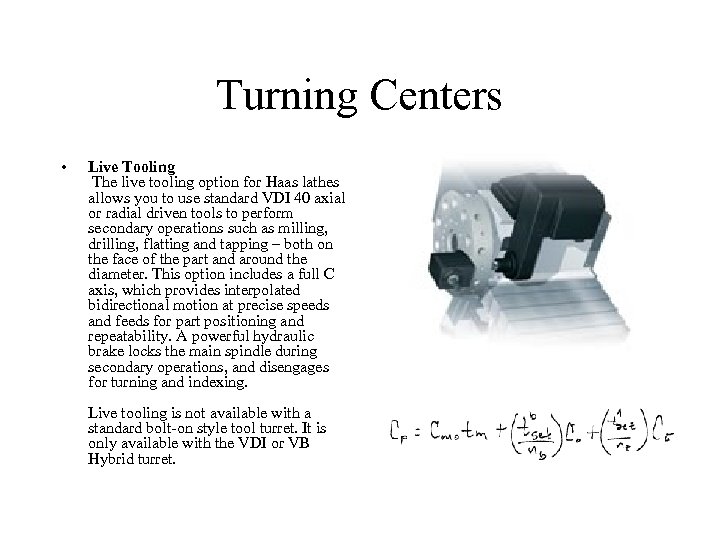 Turning Centers • Live Tooling The live tooling option for Haas lathes allows you to use standard VDI 40 axial or radial driven tools to perform secondary operations such as milling, drilling, flatting and tapping – both on the face of the part and around the diameter. This option includes a full C axis, which provides interpolated bidirectional motion at precise speeds and feeds for part positioning and repeatability. A powerful hydraulic brake locks the main spindle during secondary operations, and disengages for turning and indexing. Live tooling is not available with a standard bolt-on style tool turret. It is only available with the VDI or VB Hybrid turret.
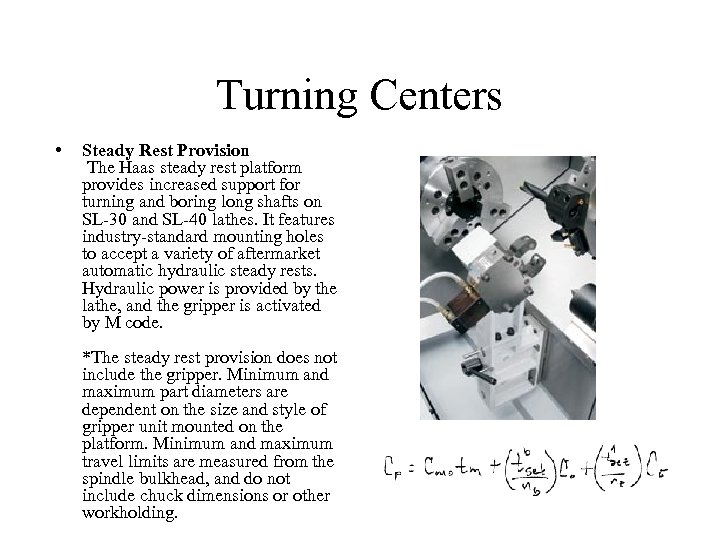 Turning Centers • Steady Rest Provision The Haas steady rest platform provides increased support for turning and boring long shafts on SL-30 and SL-40 lathes. It features industry-standard mounting holes to accept a variety of aftermarket automatic hydraulic steady rests. Hydraulic power is provided by the lathe, and the gripper is activated by M code. *The steady rest provision does not include the gripper. Minimum and maximum part diameters are dependent on the size and style of gripper unit mounted on the platform. Minimum and maximum travel limits are measured from the spindle bulkhead, and do not include chuck dimensions or other workholding.
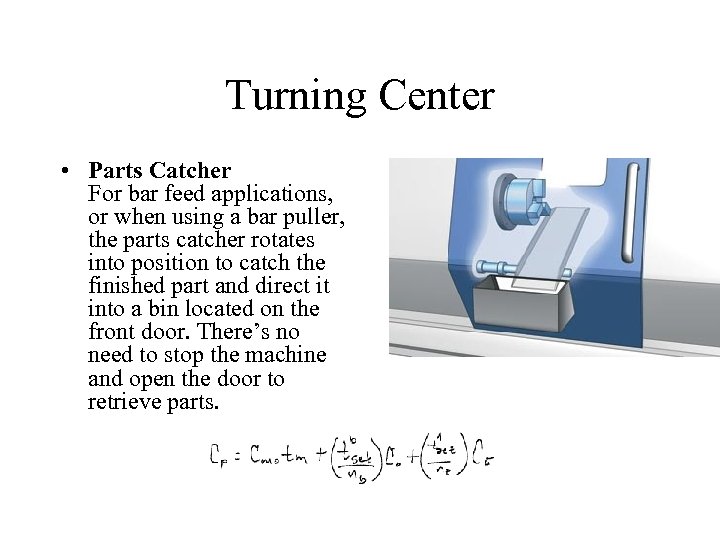 Turning Center • Parts Catcher For bar feed applications, or when using a bar puller, the parts catcher rotates into position to catch the finished part and direct it into a bin located on the front door. There’s no need to stop the machine and open the door to retrieve parts.
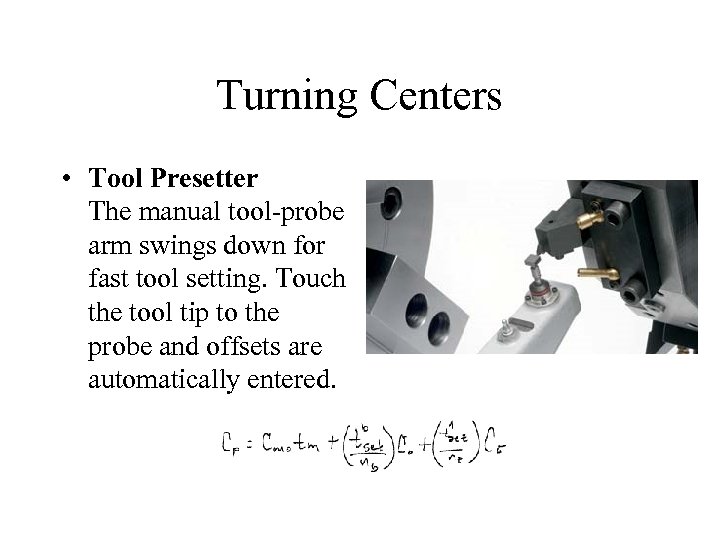 Turning Centers • Tool Presetter The manual tool-probe arm swings down for fast tool setting. Touch the tool tip to the probe and offsets are automatically entered.
 Turning Centers
 Turning Centers
 Resources • Primary Reference: Chang T-C. , Wysk, R. A. , and Wang, H-P. , “Computer Aided Manufacturing”, Prentice Hall International Series in Industrial and Systems Engineering, 2006, Upper Saddle Valley, NJ 07458. ISBN 0 -13 -754524 -X Chapter 12 http: //www. haascnc. com/
 Agenda • Introduction • Absolute and Incremental Programming • Elements of NC Program • NC Words (G, M, T, S, … Codes) • Examples • Cutter Compensation and Offsets • Examples • Conclusions
 Introduction to NC programming • Manual part programming • Computer-assisted part programming • Formats – Fixed-Address – Tab-Sequential – Word-Address
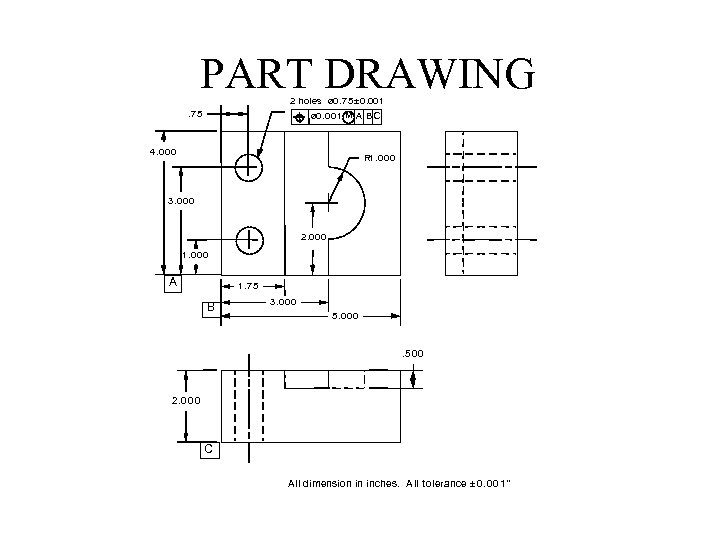
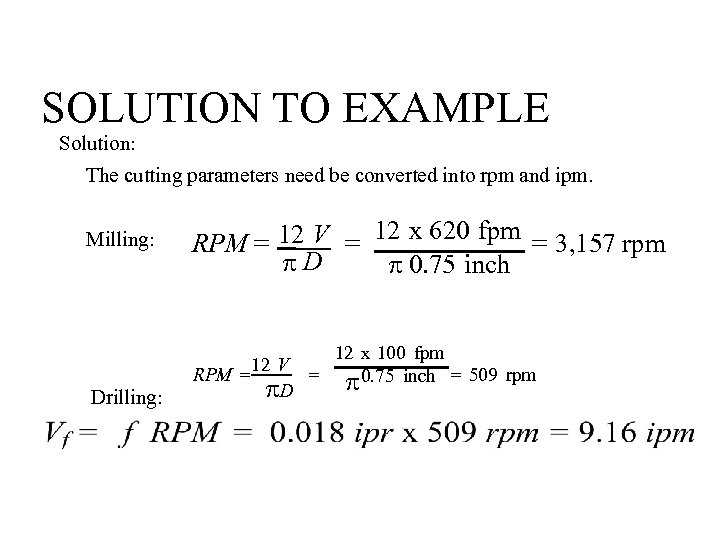
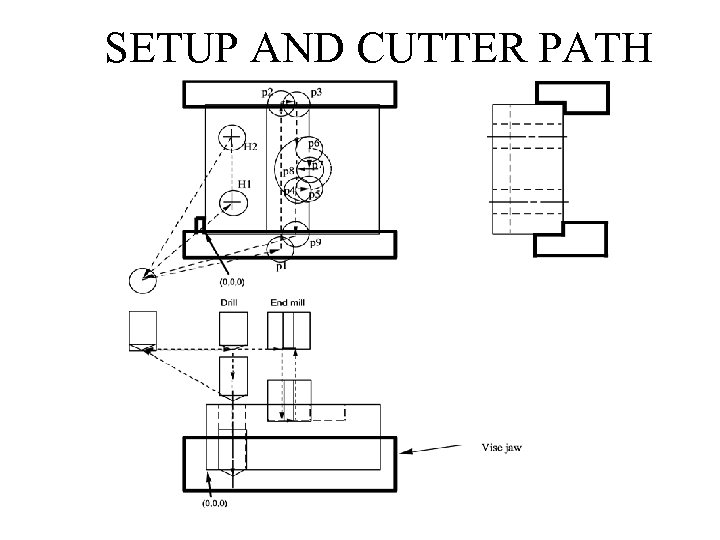
 MANUAL PART PROGRAMMING Example 9. 1 Machined from a 5" x 4" x 2" workpiece. low carbon steel. The process plan: 1. Set the lower left bottom corner of the part as the machine zero point (floating zero programming). 2. Clamp the workpiece in a vise. 3. Mill the slot with a 3/4" four flute flat end mill made of carbide. From the machinability data handbook, the recommended feed is 0. 005 inch/tooth/rev, and the recommended cutting speed is 620 fpm. 4. Drill two holes with a 0. 75" dia twist drill. Use 0. 18 ipr feed and 100 fpm speed.
 PART DRAWING 2 ho les ø 0. 7 5 ± 0. 00 1 . 7 5 ø 0. 0 0 1 M A B C M 4. 0 0 0 R 1. 0 0 0 3. 0 0 0 2. 0 00 1. 0 0 0 A 1. 7 5 B 3. 0 0 0 5. 0 0 0 . 5 00 2. 0 0 0 C All dimension in inches. A ll t olerance ± 0. 00 1 "
 SOLUTION TO EXAMPLE Solution: The cutting parameters need be converted into rpm and ipm. Milling: 12 V = 12 x 620 fpm = 3, 157 rpm RPM = D 0. 75 inch Drilling: 12 V RPM = = D 12 x 100 fpm 0. 75 inch = 509 rpm
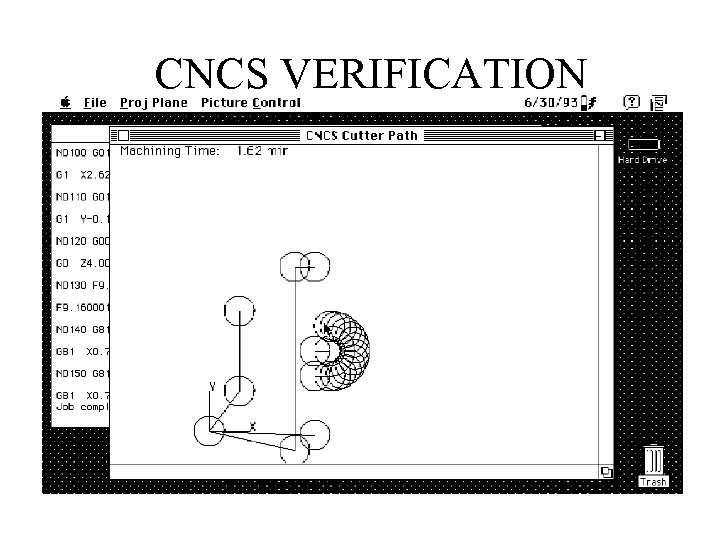
 SETUP AND CUTTER PATH
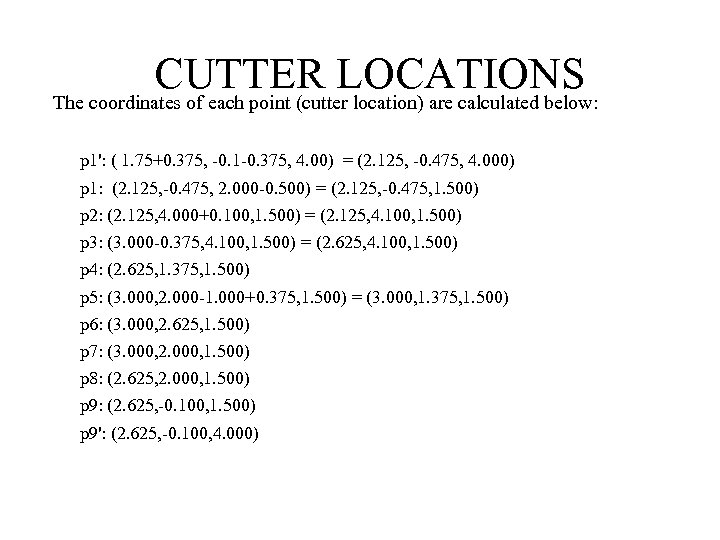 CUTTER LOCATIONS The coordinates of each point (cutter location) are calculated below: p 1': ( 1. 75+0. 375, -0. 1 -0. 375, 4. 00) = (2. 125, -0. 475, 4. 000) p 1: (2. 125, -0. 475, 2. 000 -0. 500) = (2. 125, -0. 475, 1. 500) p 2: (2. 125, 4. 000+0. 100, 1. 500) = (2. 125, 4. 100, 1. 500) p 3: (3. 000 -0. 375, 4. 100, 1. 500) = (2. 625, 4. 100, 1. 500) p 4: (2. 625, 1. 375, 1. 500) p 5: (3. 000, 2. 000 -1. 000+0. 375, 1. 500) = (3. 000, 1. 375, 1. 500) p 6: (3. 000, 2. 625, 1. 500) p 7: (3. 000, 2. 000, 1. 500) p 8: (2. 625, 2. 000, 1. 500) p 9: (2. 625, -0. 100, 1. 500) p 9': (2. 625, -0. 100, 4. 000)
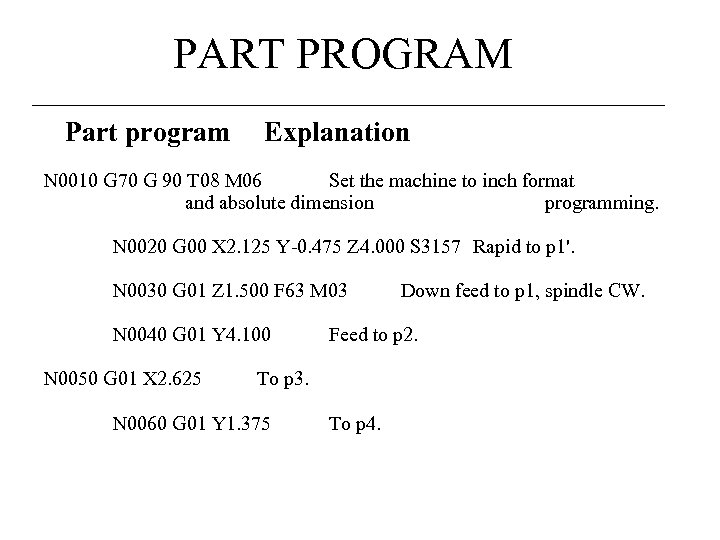 PART PROGRAM Part program Explanation N 0010 G 70 G 90 T 08 M 06 Set the machine to inch format and absolute dimension programming. N 0020 G 00 X 2. 125 Y-0. 475 Z 4. 000 S 3157 Rapid to p 1'. N 0030 G 01 Z 1. 500 F 63 M 03 N 0040 G 01 Y 4. 100 N 0050 G 01 X 2. 625 Feed to p 2. To p 3. N 0060 G 01 Y 1. 375 Down feed to p 1, spindle CW. To p 4.
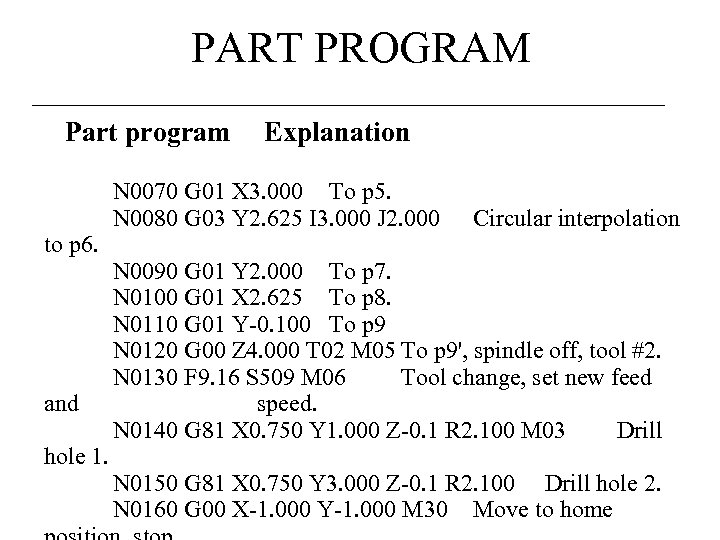 PART PROGRAM Part program to p 6. and hole 1. Explanation N 0070 G 01 X 3. 000 To p 5. N 0080 G 03 Y 2. 625 I 3. 000 J 2. 000 Circular interpolation N 0090 G 01 Y 2. 000 To p 7. N 0100 G 01 X 2. 625 To p 8. N 0110 G 01 Y-0. 100 To p 9 N 0120 G 00 Z 4. 000 T 02 M 05 To p 9', spindle off, tool #2. N 0130 F 9. 16 S 509 M 06 Tool change, set new feed speed. N 0140 G 81 X 0. 750 Y 1. 000 Z-0. 1 R 2. 100 M 03 Drill N 0150 G 81 X 0. 750 Y 3. 000 Z-0. 1 R 2. 100 Drill hole 2. N 0160 G 00 X-1. 000 Y-1. 000 M 30 Move to home
 CNCS VERIFICATION
 CNCS 3 D DRAWING
 Offsets • Fixture – G 10, G 54. 1 • Diameter • Tool – Length compensation – Part-Edge compensation • Cutter Compensation – Next Slides • Others Discussed in Lab Exercises (Simulators)
 Tool Radius Compensation • Cutter Compensation Shifting tool path so that the actual finished cut is either moved to the left or right of the programmed path. • Normally, shifted exactly by tool radius • Tool Entry and Exit Issues
 Where you should be • You should know how an NC machine works • You should be able to create an NC program using Master. CAM • You should be able to read an NC program and understand what the machine will do • You should be safe in the FAME lab using NC machines