 Скачать презентацию NBS-M 009 2010 LOW CARBON BUSINESS REGULATION
82d16b8137c756692e7b6378a34db81b.ppt
- Количество слайдов: 60



NBS-M 009 – 2010 LOW CARBON BUSINESS REGULATION AND ENTREPRENEURSHIP Transmission issues for the Future Mechanisms to Promote Renewable Energy • • • Non Fossil Fuel Obligation Renewable Obligation • Marine Supply Obligation (Scotland) Feed in Tariffs Renewable Transport Fuel Obligation Renewable Heat Incentive? An Integrated Obligation? 1
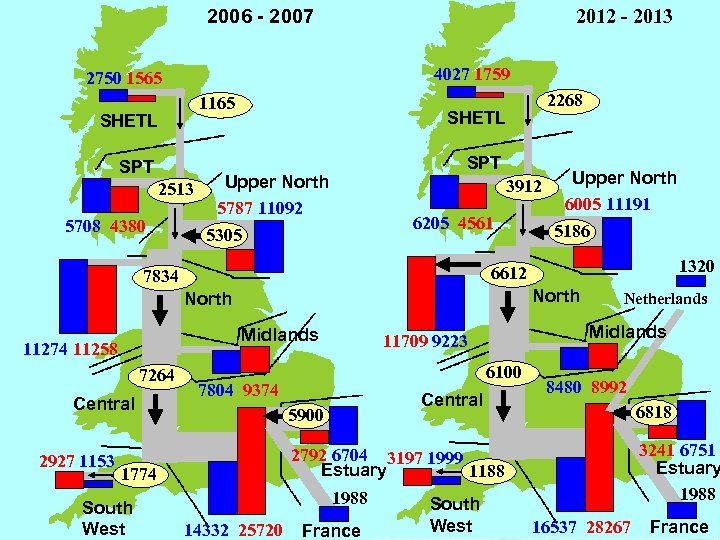
2006 - 2007 2012 - 2013 4027 1759 2750 1565 1165 SHETL SPT 2513 5708 4380 SHETL Upper North 5787 11092 5305 SPT 3912 6205 4561 Midlands Central 2927 1153 6100 Central 5900 Netherlands Midlands 11709 9223 7804 9374 8480 8992 6818 3241 6751 Estuary 1988 2792 6704 3197 1999 Estuary 1188 1774 South West 1320 North 7264 Upper North 6005 11191 5186 6612 7834 11274 11258 2268 1988 14332 25720 France South West 16537 28267 France 2 2
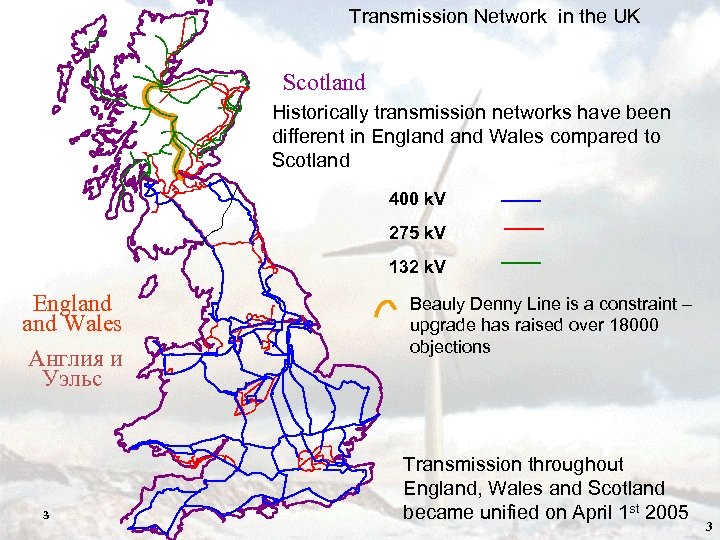
Transmission Network in the UK Scotland Historically transmission networks have been different in England Wales compared to Scotland 400 k. V 275 k. V 132 k. V England Wales Англия и Уэльс 3 Beauly Denny Line is a constraint – upgrade has raised over 18000 objections Transmission throughout England, Wales and Scotland became unified on April 1 st 2005 3
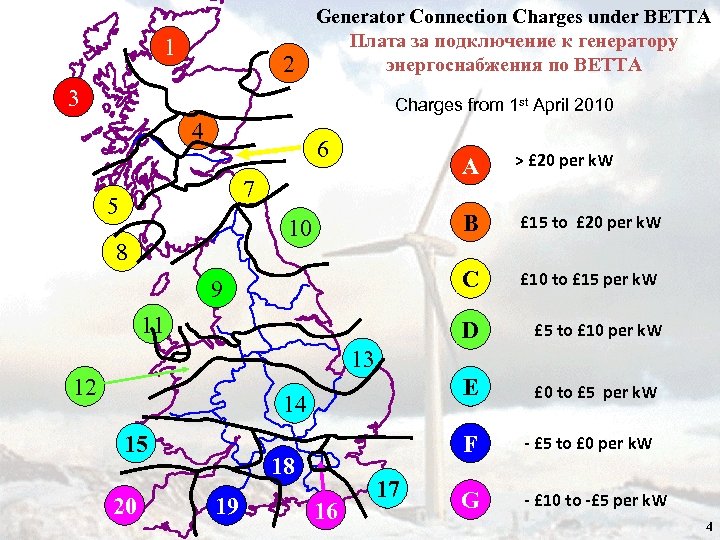
1 2 Generator Connection Charges under BETTA Плата за подключение к генератору энергоснабжения по BETTA 3 Charges from 1 st April 2010 4 6 A 7 5 > £ 20 per k. W B £ 0 to £ 5 per k. W F 11 £ 5 to £ 10 per k. W E 9 £ 10 to £ 15 per k. W D 8 £ 15 to £ 20 per k. W C 10 - £ 5 to £ 0 per k. W G - £ 10 to -£ 5 per k. W 13 12 14 15 20 18 19 16 17 4
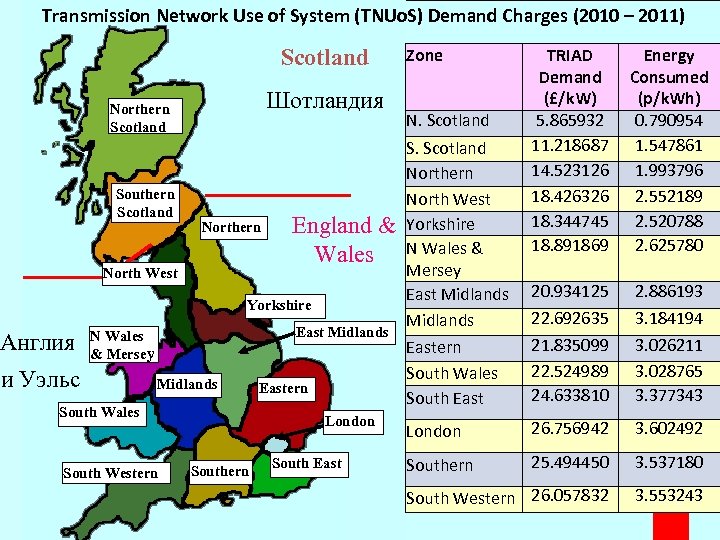
Transmission Network Use of System (TNUo. S) Demand Charges (2010 – 2011) Scotland Шотландия Northern Scotland Англия и Уэльс Zone TRIAD Demand (£/k. W) 5. 865932 11. 218687 14. 523126 18. 426326 18. 344745 18. 891869 Energy Consumed (p/k. Wh) 0. 790954 1. 547861 1. 993796 2. 552189 2. 520788 2. 625780 20. 934125 22. 692635 21. 835099 22. 524989 24. 633810 2. 886193 3. 184194 3. 026211 3. 028765 3. 377343 London 26. 756942 3. 602492 Southern 25. 494450 3. 537180 South Western 26. 057832 3. 553243 N. Scotland S. Scotland Northern Southern North West Scotland Northern England & Yorkshire Wales N Wales & Mersey North West East Midlands Yorkshire Midlands East Midlands N Wales Eastern & Mersey South Wales Midlands Eastern South East South Wales South Western London Southern 5 South East
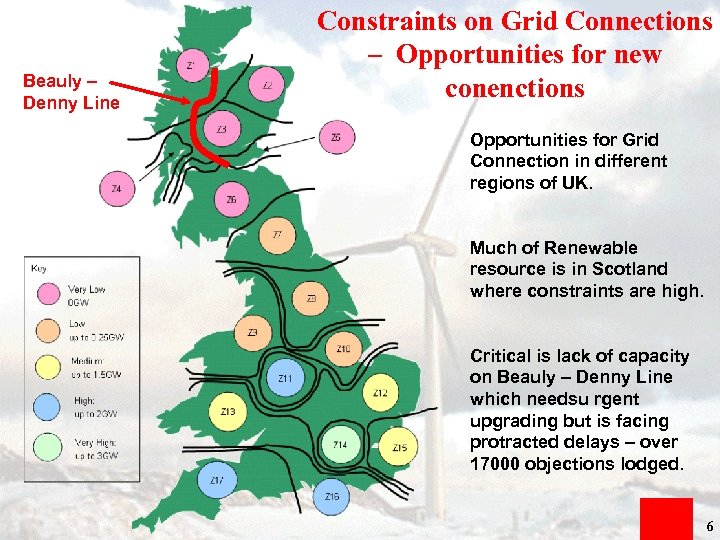
Beauly – Denny Line Constraints on Grid Connections – Opportunities for new conenctions Opportunities for Grid Connection in different regions of UK. Much of Renewable resource is in Scotland where constraints are high. Critical is lack of capacity on Beauly – Denny Line which needsu rgent upgrading but is facing protracted delays – over 17000 objections lodged. 6
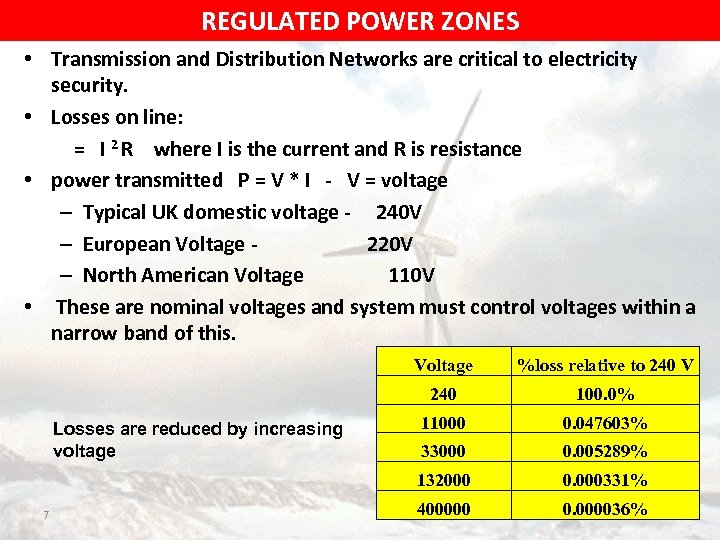
REGULATED POWER ZONES • Transmission and Distribution Networks are critical to electricity security. • Losses on line: = I 2 R where I is the current and R is resistance • power transmitted P = V * I - V = voltage – Typical UK domestic voltage - 240 V – European Voltage - 220 V – North American Voltage 110 V • These are nominal voltages and system must control voltages within a narrow band of this. Voltage 240 7 100. 0% 11000 0. 047603% 33000 0. 005289% 132000 Losses are reduced by increasing voltage %loss relative to 240 V 0. 000331% 400000 0. 000036%
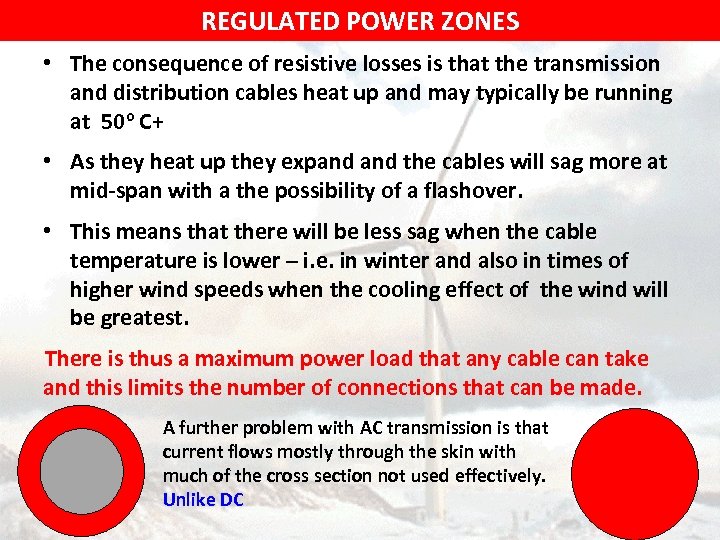
REGULATED POWER ZONES • The consequence of resistive losses is that the transmission and distribution cables heat up and may typically be running at 50 o C+ • As they heat up they expand the cables will sag more at mid-span with a the possibility of a flashover. • This means that there will be less sag when the cable temperature is lower – i. e. in winter and also in times of higher wind speeds when the cooling effect of the wind will be greatest. There is thus a maximum power load that any cable can take and this limits the number of connections that can be made. 8 A further problem with AC transmission is that current flows mostly through the skin with much of the cross section not used effectively. Unlike DC
REGULATED POWER ZONES Traditional way to allocate generation connections: • Order of application according to potential maximum connection capacity up to total capacity of transmission/distribution line. • A safe approach which ensures that transmission/ distribution lines are not overloaded. BUT • May not make optimum use of transmission capacity. Example: • Suppose a line has 2000 MW capacity - a typical twin circuit 400 k. V line. • Order of connection allocations: – Generator 1: 1000 MW – say with 2 x 500 MW sets – Generator 2: 500 MW 9 – Generator 3: 500 MW – with 2 x 250 MW sets.
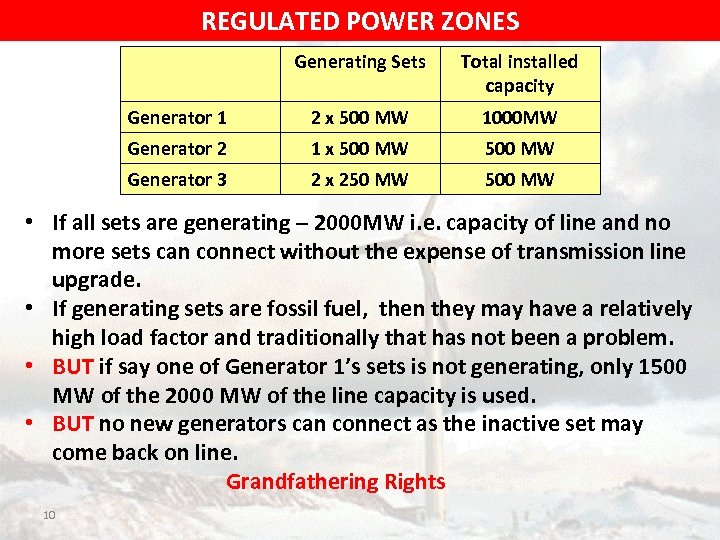
REGULATED POWER ZONES Generating Sets Total installed capacity Generator 1 2 x 500 MW 1000 MW Generator 2 1 x 500 MW Generator 3 2 x 250 MW 500 MW • If all sets are generating – 2000 MW i. e. capacity of line and no more sets can connect without the expense of transmission line upgrade. • If generating sets are fossil fuel, then they may have a relatively high load factor and traditionally that has not been a problem. • BUT if say one of Generator 1’s sets is not generating, only 1500 MW of the 2000 MW of the line capacity is used. • BUT no new generators can connect as the inactive set may come back on line. Grandfathering Rights 10
REGULATED POWER ZONES Problem is exacerbated with generating plant of low load factor e. g. wind and was first identified in Orkney where significant renewable generation threatened to seriously overload distribution system. Orkney is connected to mainland by 1 x 30 MW and 1 x 20 MW cable. A fossil fired power station on Flotta associated with the oil terminal must run for safety reasons typically around 4. 5 MW. Burgar Hill had historic rights of around 7 MW with the European Marine Energy Centre a further 7 MW also in this category. Thereafter there were several other wind developments which threatened to exceed total capacity of cables to mainland as it was assumed that one of the two cables might be out of action giving only a maximum potential connection capacity of 20 MW. 11
REGULATED POWER ZONES Total Historic Generating Capacity ~ 18. 5 MW Minimum Demand in Orkney ~ 7 MW Capacity of smaller cable to mainland ~ 20 MW Maximum Generation on Orkney which would not overload single mainland cable is 27 MW – i. e 8. 5 MW new capacity could be connected. But EMEC capacity is often 0 MW, and rarely is Burgar Hill at its rated output. If dynamic dispatch of generation capacity is used much more generation could be connected. 12
REGULATED POWER ZONES Evaluate total system capability at any one time C = mainland connection capacity (i. e. 20 or 30 or 50 MW) + instantaneous demand on Orkney Subtract from C those generating connection which have grandfathering rights, but only up to the amount of instantaneous generation (NOT maximum connection rights) This gives maximum additional capacity which can be connected at that time. If this also is done on a first application first served basis, it would be possible to connect much more renewable generation than otherwise possible. However, it may mean that wind turbines at the end of the queue may not be able to generate when wind speed is optimum and returns on investment are best 13
REGULATED POWER ZONES Suppose C = 60 MW – i. e. both cables operating and demand is 10 MW If Flotta output is 7 MW and EMEC is 7 MW and Burgar Hill say 3. 5 MW (i. e less than rated connection of 7 MW as wind speed is low – i. e. instantaneous load factor is 50%) Available additional connection is 60 – 17. 5 i. e 42. 5 MW If this were taken by additional Wind at 50% load factor then 85 MW of additional capacity could connect. BUT if wind speed increased to rated speed of wind turbines, Burgar Hill would now be at 7 MW and available capacity would be 39 MW. If all of this were as wind turbines at rated output (i. e. 100% load factor) only 39 MW could actually generate and 46 MW would have to shut down at the time they were most productive. 14
REGULATED POWER ZONES Consequence of Dynamic Regulation of Power Zone • More effective use of transmission/distribution cables is made • A greater proportion of renewable energy can be brought on line at an earlier stage BUT • Those connecting last may find return on investment poor. Lincolnshire RPZ operates only to transmit power from offshore wind farm • Does not primarily address demand, but cooling effect on cables to minimise sag • In winter – higher wind speeds – greater output capacity from wind turbines • BUT weather is cooler and cooling effect of wind on cables is 15 greater so cables can transmit more
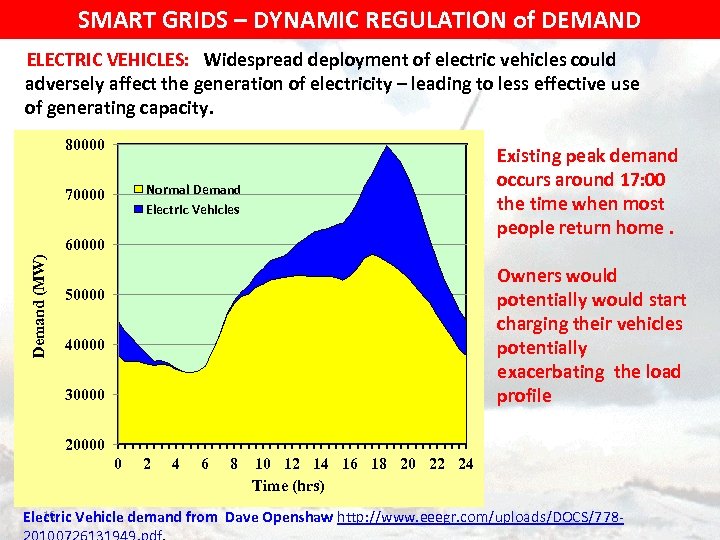
SMART GRIDS – DYNAMIC REGULATION of DEMAND ELECTRIC VEHICLES: Widespread deployment of electric vehicles could adversely affect the generation of electricity – leading to less effective use of generating capacity. 80000 Existing peak demand occurs around 17: 00 the time when most people return home. Normal Demand Electric Vehicles 70000 Demand (MW) 60000 Owners would potentially would start charging their vehicles potentially exacerbating the load profile 50000 40000 30000 20000 0 2 4 6 8 10 12 14 16 18 20 22 24 Time (hrs) 16 Electric Vehicle demand from Dave Openshaw http: //www. eeegr. com/uploads/DOCS/778 -
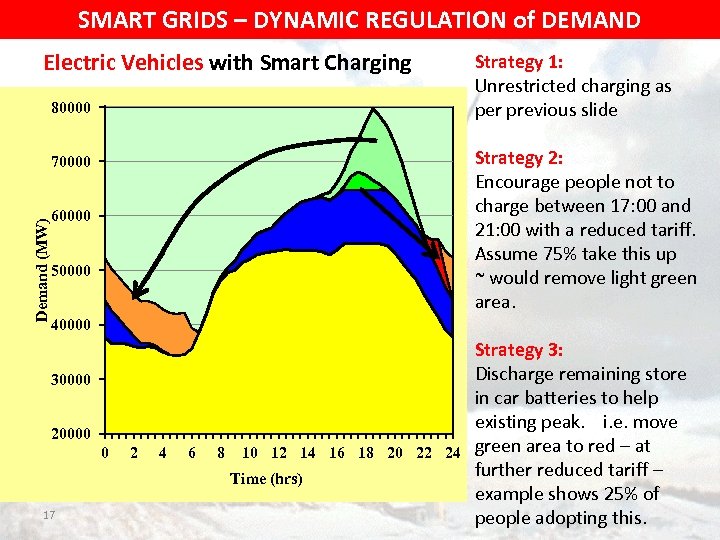
SMART GRIDS – DYNAMIC REGULATION of DEMAND Electric Vehicles with Smart Charging 80000 Strategy 2: Encourage people not to charge between 17: 00 and 21: 00 with a reduced tariff. Assume 75% take this up ~ would remove light green area. 70000 Demand (MW) Strategy 1: Unrestricted charging as per previous slide 60000 50000 40000 30000 20000 0 2 4 6 8 10 12 14 16 18 20 22 24 Time (hrs) 17 Strategy 3: Discharge remaining store in car batteries to help existing peak. i. e. move green area to red – at further reduced tariff – example shows 25% of people adopting this.
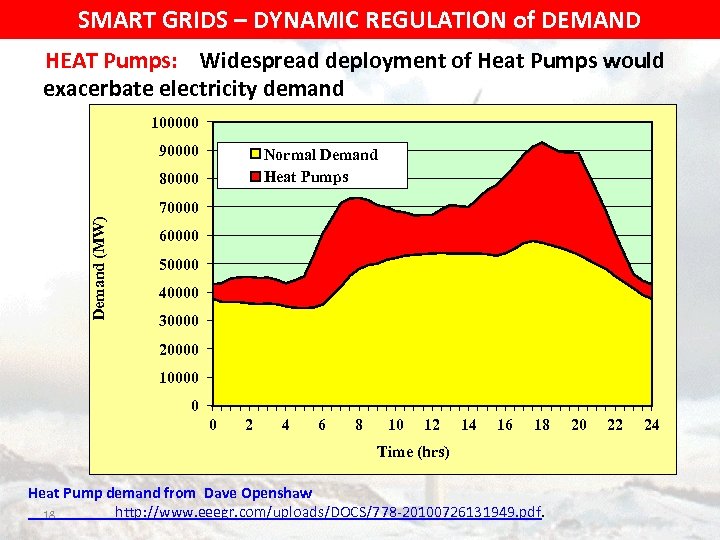
SMART GRIDS – DYNAMIC REGULATION of DEMAND HEAT Pumps: Widespread deployment of Heat Pumps would exacerbate electricity demand 100000 90000 Normal Demand Heat Pumps 80000 Demand (MW) 70000 60000 50000 40000 30000 20000 10000 0 0 2 4 6 8 10 12 14 16 18 Time (hrs) Heat Pump demand from Dave Openshaw http: //www. eeegr. com/uploads/DOCS/778 -20100726131949. pdf. 18 20 22 24
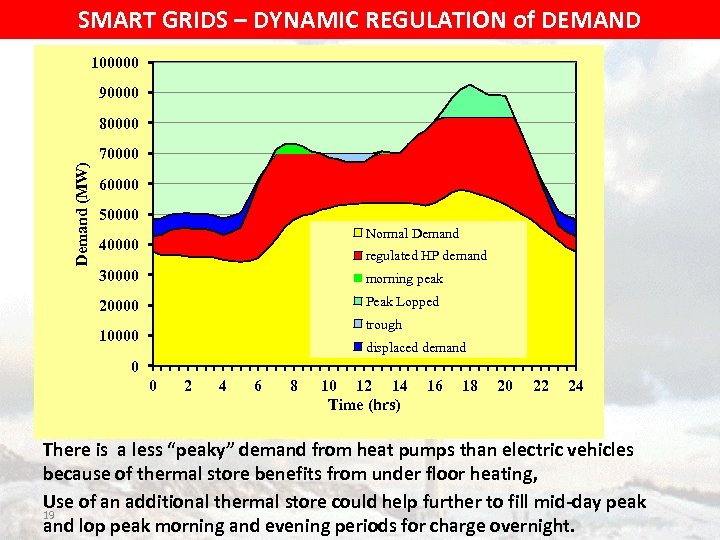
SMART GRIDS – DYNAMIC REGULATION of DEMAND 100000 90000 Demand (MW) 80000 70000 60000 50000 Normal Demand 40000 regulated HP demand 30000 morning peak 20000 Peak Lopped trough 10000 displaced demand 0 0 2 4 6 8 10 12 14 Time (hrs) 16 18 20 22 24 There is a less “peaky” demand from heat pumps than electric vehicles because of thermal store benefits from under floor heating, Use of an additional thermal store could help further to fill mid-day peak 19 and lop peak morning and evening periods for charge overnight.
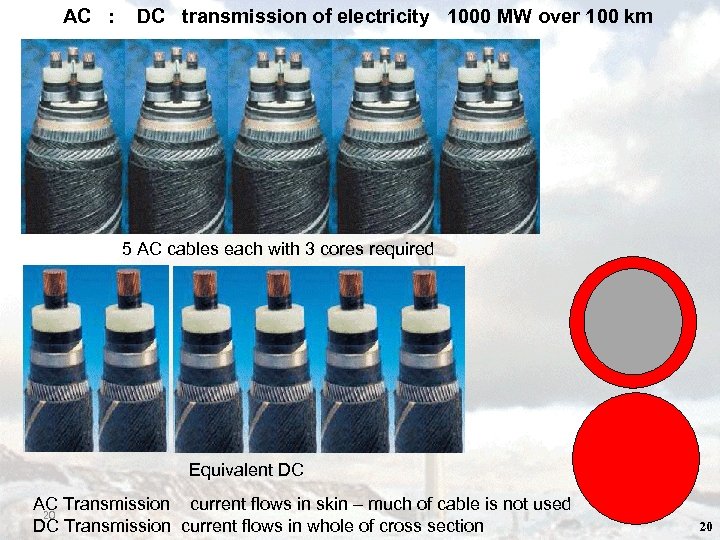
AC : DC transmission of electricity 1000 MW over 100 km 5 AC cables each with 3 cores required Equivalent DC AC Transmission current flows in skin – much of cable is not used 20 DC Transmission current flows in whole of cross section 20
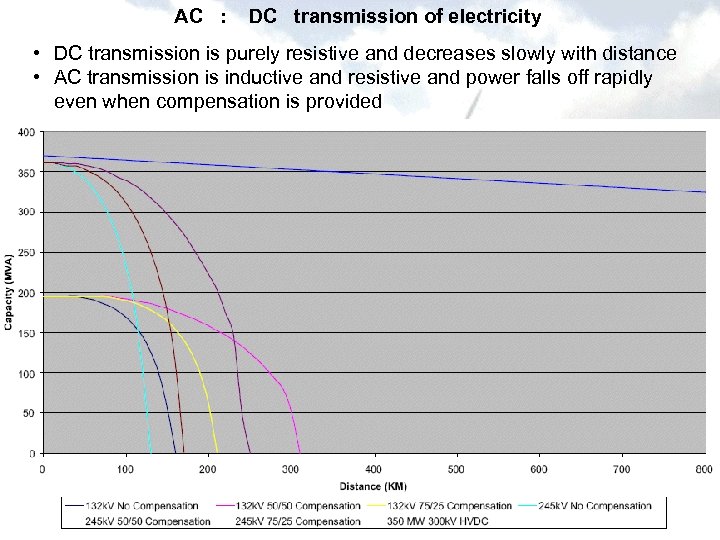
AC : DC transmission of electricity • DC transmission is purely resistive and decreases slowly with distance • AC transmission is inductive and resistive and power falls off rapidly even when compensation is provided 21 21
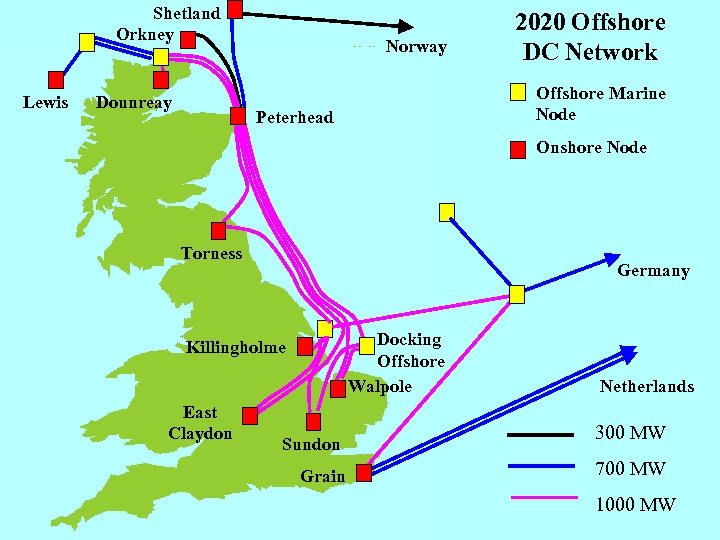
Shetland Orkney Lewis Dounreay Norway 2020 Offshore DC Network Offshore Marine Node Peterhead Onshore Node Torness Germany Docking Offshore Walpole Killingholme East Claydon Sundon Grain Netherlands 300 MW 700 MW 1000 MW 22 22
Costs of East Coast DC Network • • • Stage 1 Core Network: £ 1. 6 b Stage 2 full Network: £ 4. 8 b Average cost £ 750 per MW-km Would be built in sectors: Typical Segment costs: – Peterhead to Walpole: £ 381 M (1000 MW cable – 608 km) – Peterhead to North Scotland Offshore Marine Hub £ 412 M (2000 MW cable – 245 km) • For details see WEB Links West Coast DC Links from North Scotland to Mersey are also being examined 23
LOW CARBON BUSINESS REGULATION AND ENTREPRENEURSHIP Mechanisms to Promote Renewable Energy • Non Fossil Fuel Obligation • The Renewable Obligation – Marine Supply Obligation (Scotland) • • Feed in Tariffs The Renewable Transport Obligation Renewable Heat Incentive An Integrated Obligation? 24 24
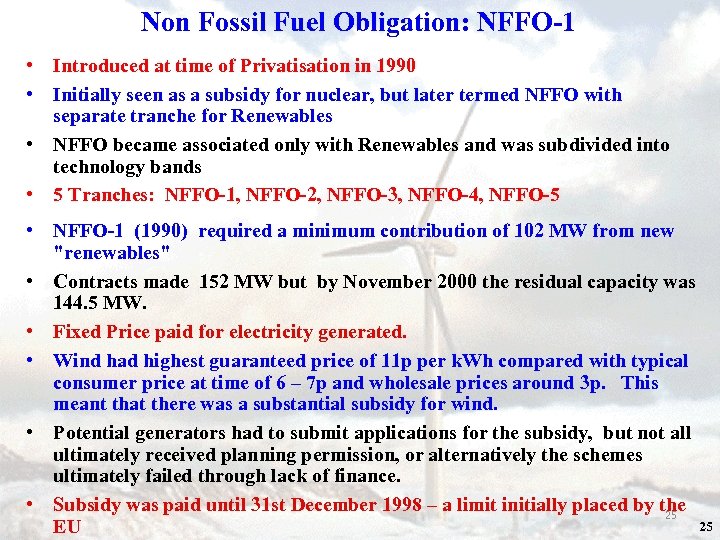
Non Fossil Fuel Obligation: NFFO-1 • Introduced at time of Privatisation in 1990 • Initially seen as a subsidy for nuclear, but later termed NFFO with separate tranche for Renewables • NFFO became associated only with Renewables and was subdivided into technology bands • 5 Tranches: NFFO-1, NFFO-2, NFFO-3, NFFO-4, NFFO-5 • NFFO-1 (1990) required a minimum contribution of 102 MW from new "renewables" • Contracts made 152 MW but by November 2000 the residual capacity was 144. 5 MW. • Fixed Price paid for electricity generated. • Wind had highest guaranteed price of 11 p per k. Wh compared with typical consumer price at time of 6 – 7 p and wholesale prices around 3 p. This meant that there was a substantial subsidy for wind. • Potential generators had to submit applications for the subsidy, but not all ultimately received planning permission, or alternatively the schemes ultimately failed through lack of finance. • Subsidy was paid until 31 st December 1998 – a limit initially placed by the 25 25 EU
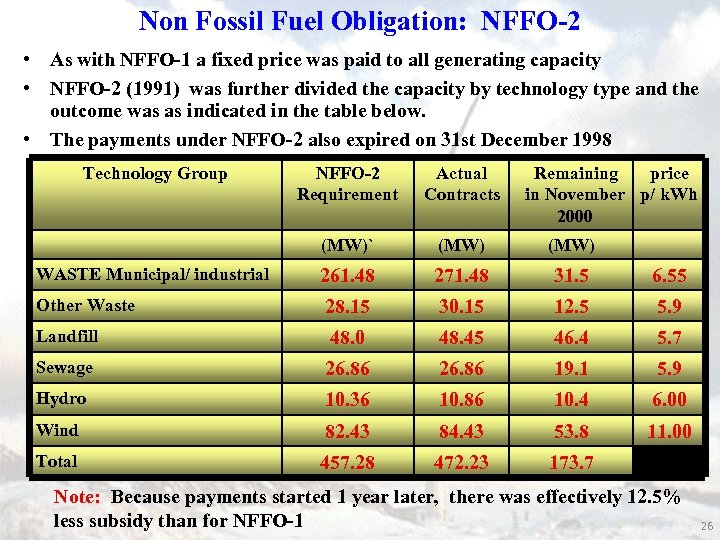
Non Fossil Fuel Obligation: NFFO-2 • As with NFFO-1 a fixed price was paid to all generating capacity • NFFO-2 (1991) was further divided the capacity by technology type and the outcome was as indicated in the table below. • The payments under NFFO-2 also expired on 31 st December 1998 Technology Group NFFO-2 Actual Requirement Contracts Remaining price in November p/ k. Wh 2000 (MW)` (MW) WASTE Municipal/ industrial 261. 48 271. 48 31. 5 6. 55 Other Waste 28. 15 30. 15 12. 5 5. 9 Landfill 48. 0 48. 45 46. 4 5. 7 Sewage 26. 86 19. 1 5. 9 Hydro 10. 36 10. 86 10. 4 6. 00 Wind 82. 43 84. 43 53. 8 11. 00 Total 457. 28 472. 23 173. 7 Note: Because payments started 1 year later, there was effectively 12. 5% less subsidy than for NFFO-1 26
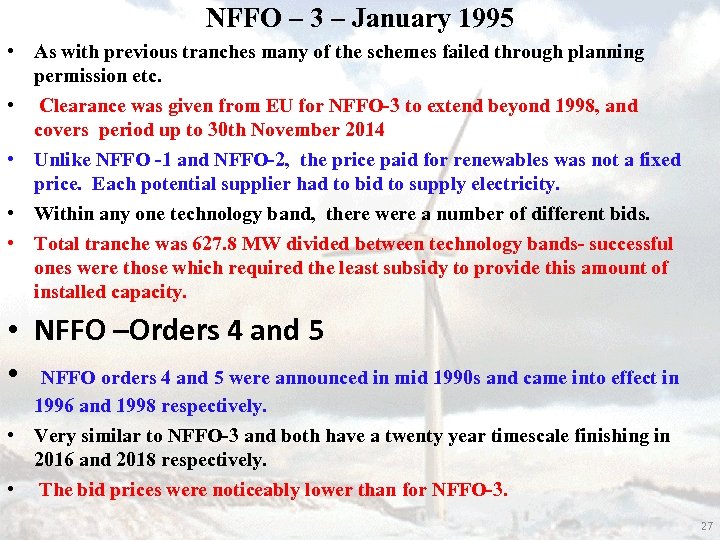
NFFO – 3 – January 1995 • As with previous tranches many of the schemes failed through planning permission etc. • Clearance was given from EU for NFFO-3 to extend beyond 1998, and covers period up to 30 th November 2014 • Unlike NFFO -1 and NFFO-2, the price paid for renewables was not a fixed price. Each potential supplier had to bid to supply electricity. • Within any one technology band, there were a number of different bids. • Total tranche was 627. 8 MW divided between technology bands- successful ones were those which required the least subsidy to provide this amount of installed capacity. • NFFO –Orders 4 and 5 • NFFO orders 4 and 5 were announced in mid 1990 s and came into effect in 1996 and 1998 respectively. • Very similar to NFFO-3 and both have a twenty year timescale finishing in 2016 and 2018 respectively. • The bid prices were noticeably lower than for NFFO-3. 27
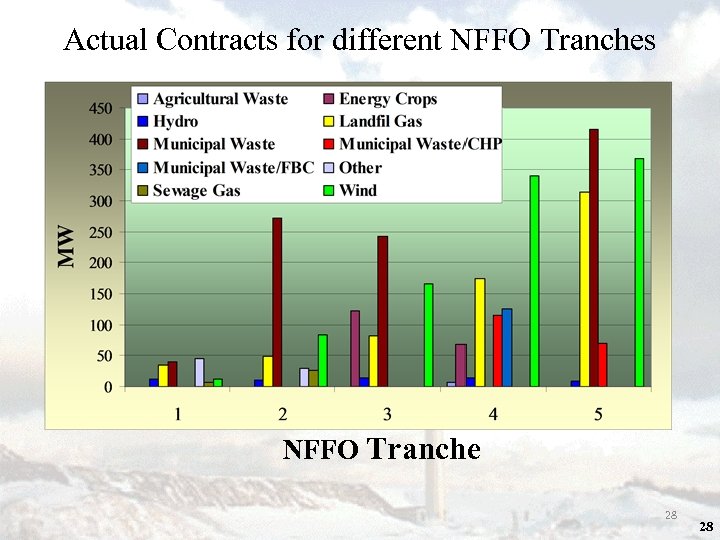
Actual Contracts for different NFFO Tranches NFFO Tranche 28 28
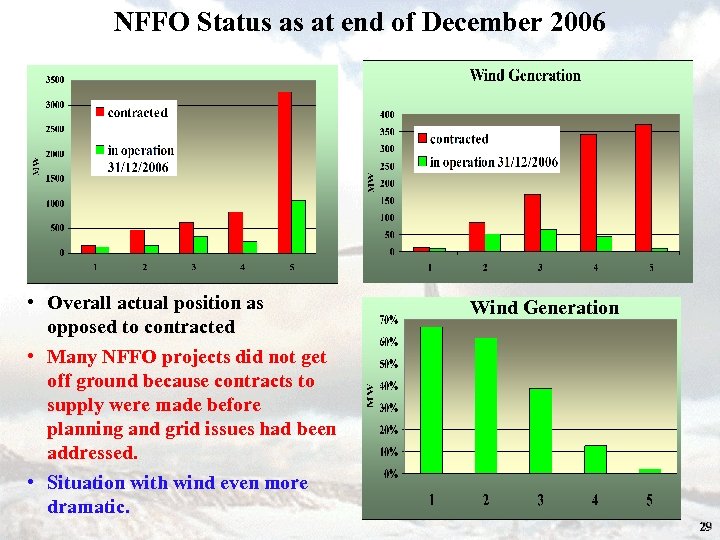
NFFO Status as at end of December 2006 • Overall actual position as opposed to contracted • Many NFFO projects did not get off ground because contracts to supply were made before planning and grid issues had been addressed. • Situation with wind even more dramatic. Wind Generation 29 29
Renewables Obligation 1999/2000 UK Government considered different mechanisms to promote renewables following end of NFFO. • NFFO 1 and NFFO 2 were a form of feed in tariff now used by Germany • NFFO 3, 4, and 5 were a derivative of this - generators bid to supply and cheapest were given a guaranteed price for whole of life of project up to 20 years. Other mechanisms considered • Climatic Change Levy (CCL) goes a small way to encouraging renewables, but only applies to businesses and is at a fixed rate of 0. 43 p per k. Wh. Charge was neutral to businesses overall as there was a rebate for the Employers National Insurance Contribution. Energy Efficient business with large staff numbers benefitted. • Direct Grants for Renewable Energy Projects • Energy Taxes/Emissions Trading • Renewable Obligation – targets set for each year and a mechanism of payments for failure to comply. 30
Renewables Obligation On whom should Obligation Fall • Generators • System Operator (National Grid) • Distributed Network Operator • Supplier • Consumer For various reasons the obligation fell on Suppliers For an enhanced move towards low carbon an obligation on large businesses may be more effective but retaining obligation on suppliers for small businesses and domestic market. >> An integrated renewable obligation ? ? ? ? ? Decision taken that only Suppliers should be Obligated 31
Renewables Obligation • Requires all suppliers to provide a minimum percentage of electricity from Eligible (New) Renewables. • Each 1 MWh generated by renewable qualifies for a Renewable Obligation Certificate (ROC) • Obligation increases each year – currently it is 10. 4% of electricity supplied to consumers. Accounting Period is 1 st April – 31 st March • Compliance can be achieved by: Either – Generating sufficient renewable energy to get required number of ROCs – Purchase ROCs from another generator – Pay a Buy – Out Fine • Buy-Out set initially at £ 30 / MWh but indexed linked each year. This is decided by OFGEM usually in January preceding accounting period and is currently (2010 -11) set at £ 36. 99 32
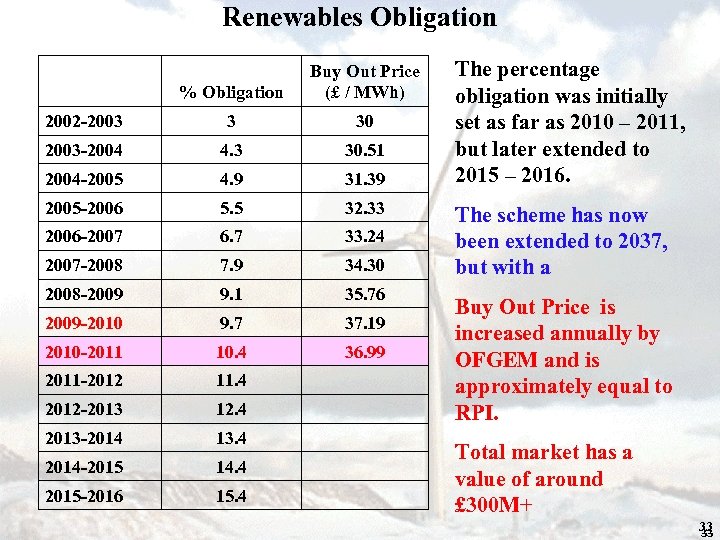
Renewables Obligation % Obligation Buy Out Price (£ / MWh) 2002 -2003 3 30 2003 -2004 4. 3 30. 51 2004 -2005 4. 9 31. 39 2005 -2006 5. 5 32. 33 2006 -2007 6. 7 33. 24 2007 -2008 7. 9 34. 30 2008 -2009 9. 1 35. 76 2009 -2010 9. 7 37. 19 2010 -2011 10. 4 36. 99 2011 -2012 11. 4 2012 -2013 12. 4 2013 -2014 13. 4 2014 -2015 14. 4 2015 -2016 15. 4 The percentage obligation was initially set as far as 2010 – 2011, but later extended to 2015 – 2016. The scheme has now been extended to 2037, but with a Buy Out Price is increased annually by OFGEM and is approximately equal to RPI. Total market has a value of around £ 300 M+ 33 33
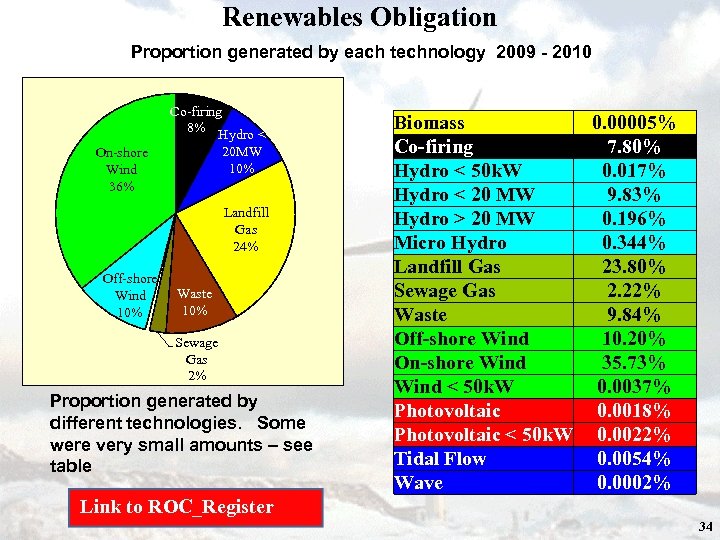
Renewables Obligation Proportion generated by each technology 2009 - 2010 Co-firing 8% Hydro < 20 MW 10% On-shore Wind 36% Landfill Gas 24% Off-shore Wind 10% Waste 10% Sewage Gas 2% Proportion generated by different technologies. Some were very small amounts – see table Biomass 0. 00005% Co-firing 7. 80% Hydro < 50 k. W 0. 017% Hydro < 20 MW 9. 83% Hydro > 20 MW 0. 196% Micro Hydro 0. 344% Landfill Gas 23. 80% Sewage Gas 2. 22% Waste 9. 84% Off-shore Wind 10. 20% On-shore Wind 35. 73% Wind < 50 k. W 0. 0037% Photovoltaic 0. 0018% Photovoltaic < 50 k. W 0. 0022% Tidal Flow 0. 0054% Wave 0. 0002% Link to ROC_Register 34
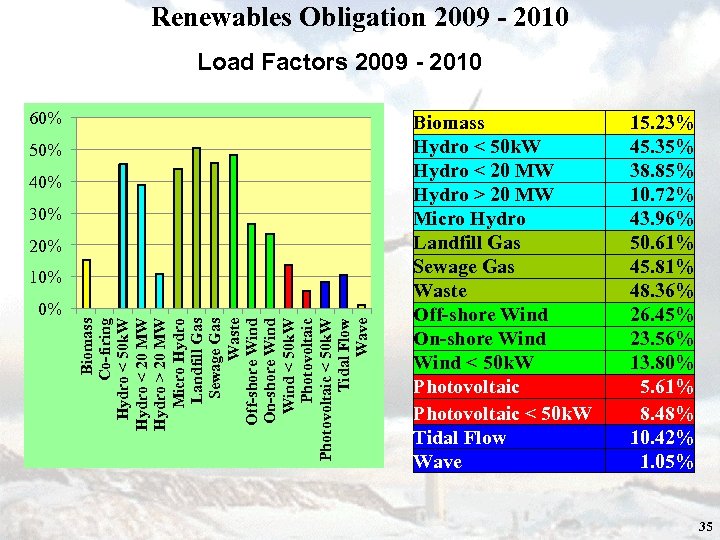
Renewables Obligation 2009 - 2010 Load Factors 2009 - 2010 60% 50% 40% 30% 20% 0% Biomass Co-firing Hydro < 50 k. W Hydro < 20 MW Hydro > 20 MW Micro Hydro Landfill Gas Sewage Gas Waste Off-shore Wind On-shore Wind < 50 k. W Photovoltaic < 50 k. W Tidal Flow Wave 10% Biomass Hydro < 50 k. W Hydro < 20 MW Hydro > 20 MW Micro Hydro Landfill Gas Sewage Gas Waste Off-shore Wind On-shore Wind < 50 k. W Photovoltaic < 50 k. W Tidal Flow Wave 15. 23% 45. 35% 38. 85% 10. 72% 43. 96% 50. 61% 45. 81% 48. 36% 26. 45% 23. 56% 13. 80% 5. 61% 8. 48% 10. 42% 1. 05% 35
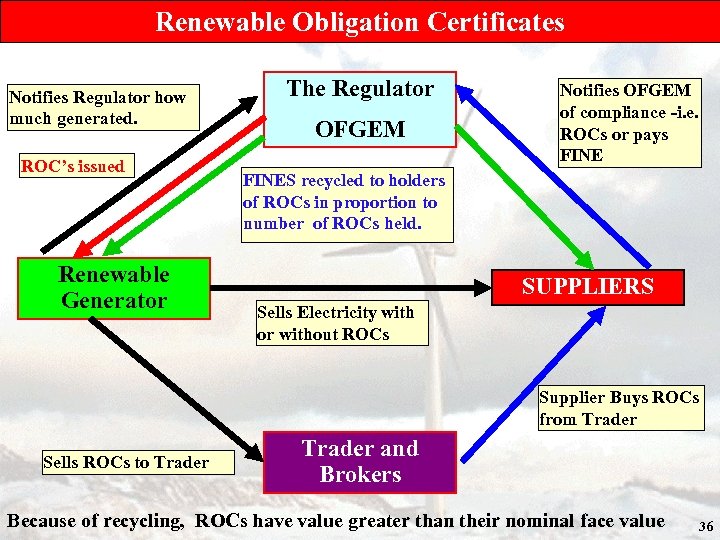
Renewable Obligation Certificates Notifies Regulator how much generated. ROC’s issued Renewable Generator The Regulator OFGEM Notifies OFGEM of compliance -i. e. ROCs or pays FINES recycled to holders of ROCs in proportion to number of ROCs held. SUPPLIERS Sells Electricity with or without ROCs Supplier Buys ROCs from Trader Sells ROCs to Trader and Brokers Because of recycling, ROCs have value greater than their nominal face value 36
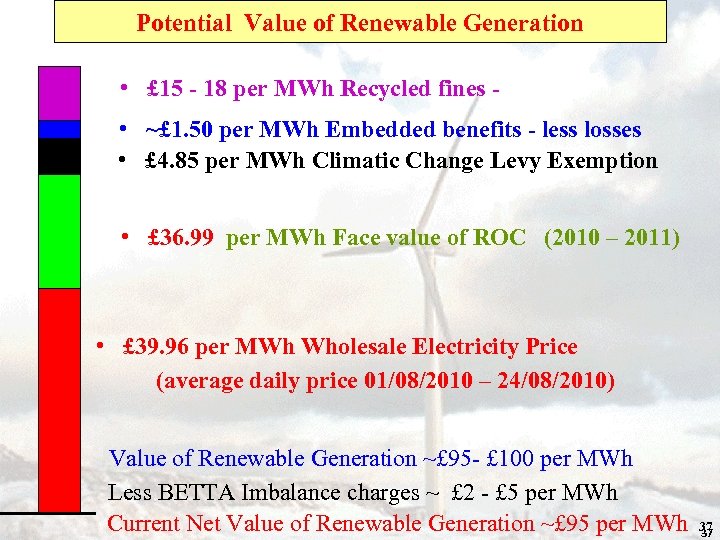
Potential Value of Renewable Generation • £ 15 - 18 per MWh Recycled fines - • ~£ 1. 50 per MWh Embedded benefits - less losses • £ 4. 85 per MWh Climatic Change Levy Exemption • £ 36. 99 per MWh Face value of ROC (2010 – 2011) • £ 39. 96 per MWh Wholesale Electricity Price (average daily price 01/08/2010 – 24/08/2010) Value of Renewable Generation ~£ 95 - £ 100 per MWh Less BETTA Imbalance charges ~ £ 2 - £ 5 per MWh Current Net Value of Renewable Generation ~£ 95 per MWh 37 37
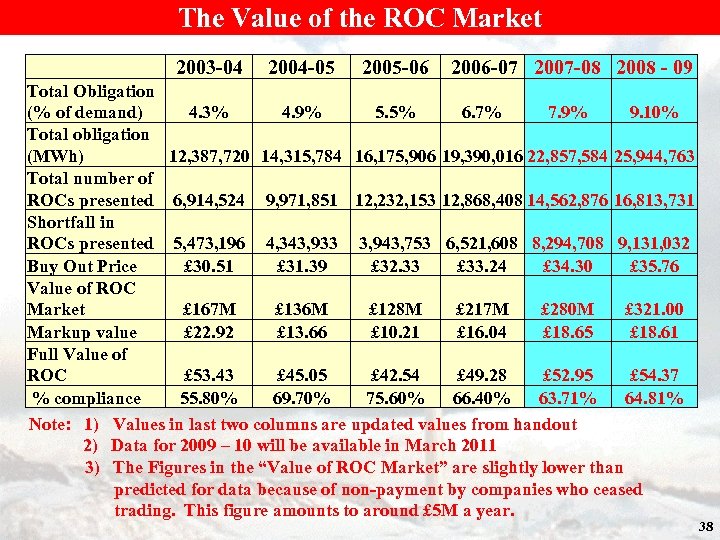
The Value of the ROC Market 2003 -04 2004 -05 2005 -06 2006 -07 2007 -08 2008 - 09 Total Obligation (% of demand) 4. 3% 4. 9% 5. 5% 6. 7% 7. 9% 9. 10% Total obligation 12, 387, 720 14, 315, 784 16, 175, 906 19, 390, 016 22, 857, 584 25, 944, 763 (MWh) Total number of ROCs presented 6, 914, 524 9, 971, 851 12, 232, 153 12, 868, 408 14, 562, 876 16, 813, 731 Shortfall in ROCs presented 5, 473, 196 4, 343, 933 3, 943, 753 6, 521, 608 8, 294, 708 9, 131, 032 Buy Out Price £ 30. 51 £ 31. 39 £ 32. 33 £ 33. 24 £ 34. 30 £ 35. 76 Value of ROC £ 167 M £ 136 M £ 128 M £ 217 M £ 280 M £ 321. 00 Market Markup value £ 22. 92 £ 13. 66 £ 10. 21 £ 16. 04 £ 18. 65 £ 18. 61 Full Value of ROC £ 53. 43 £ 45. 05 £ 42. 54 £ 49. 28 £ 52. 95 £ 54. 37 % compliance 55. 80% 69. 70% 75. 60% 66. 40% 63. 71% 64. 81% Note: 1) Values in last two columns are updated values from handout 2) Data for 2009 – 10 will be available in March 2011 3) The Figures in the “Value of ROC Market” are slightly lower than predicted for data because of non-payment by companies who ceased trading. This figure amounts to around £ 5 M a year. 38
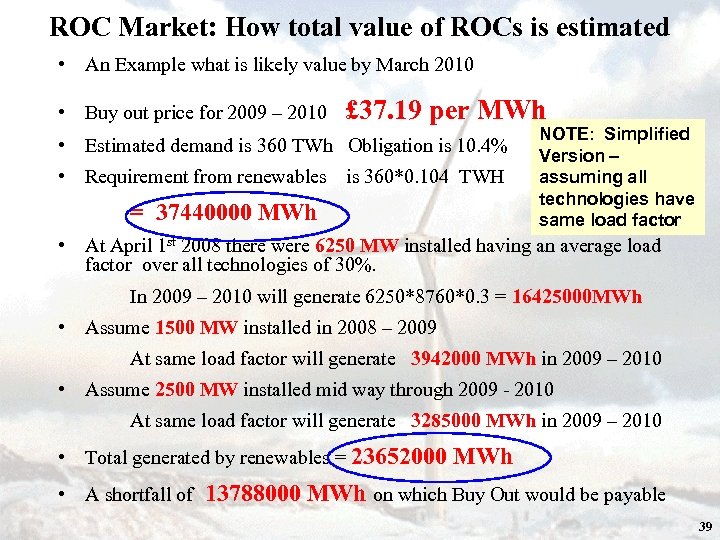
ROC Market: How total value of ROCs is estimated • An Example what is likely value by March 2010 • Buy out price for 2009 – 2010 £ 37. 19 per MWh • Estimated demand is 360 TWh Obligation is 10. 4% • Requirement from renewables is 360*0. 104 TWH = 37440000 MWh NOTE: Simplified Version – assuming all technologies have same load factor • At April 1 st 2008 there were 6250 MW installed having an average load factor over all technologies of 30%. In 2009 – 2010 will generate 6250*8760*0. 3 = 16425000 MWh • Assume 1500 MW installed in 2008 – 2009 At same load factor will generate 3942000 MWh in 2009 – 2010 • Assume 2500 MW installed mid way through 2009 - 2010 At same load factor will generate 3285000 MWh in 2009 – 2010 • Total generated by renewables = 23652000 MWh • A shortfall of 13788000 MWh on which Buy Out would be payable 39
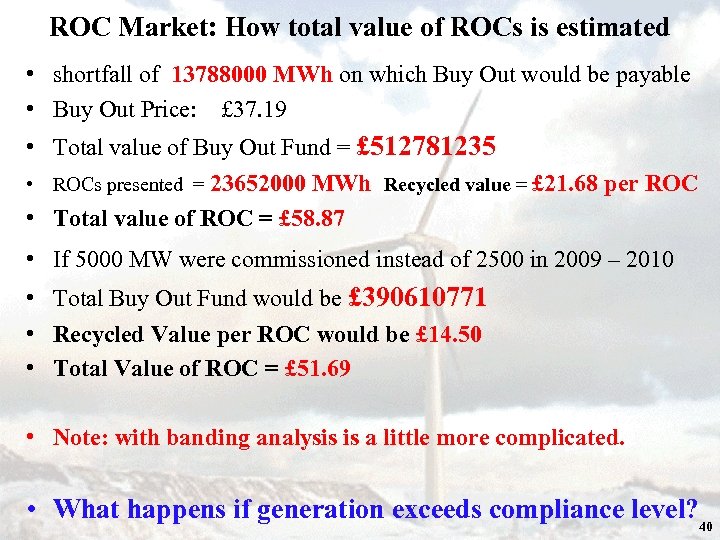
ROC Market: How total value of ROCs is estimated • shortfall of 13788000 MWh on which Buy Out would be payable • Buy Out Price: £ 37. 19 • Total value of Buy Out Fund = £ 512781235 • ROCs presented = 23652000 MWh Recycled value = £ 21. 68 per ROC • Total value of ROC = £ 58. 87 • If 5000 MW were commissioned instead of 2500 in 2009 – 2010 • Total Buy Out Fund would be £ 390610771 • Recycled Value per ROC would be £ 14. 50 • Total Value of ROC = £ 51. 69 • Note: with banding analysis is a little more complicated. • What happens if generation exceeds compliance level? 40
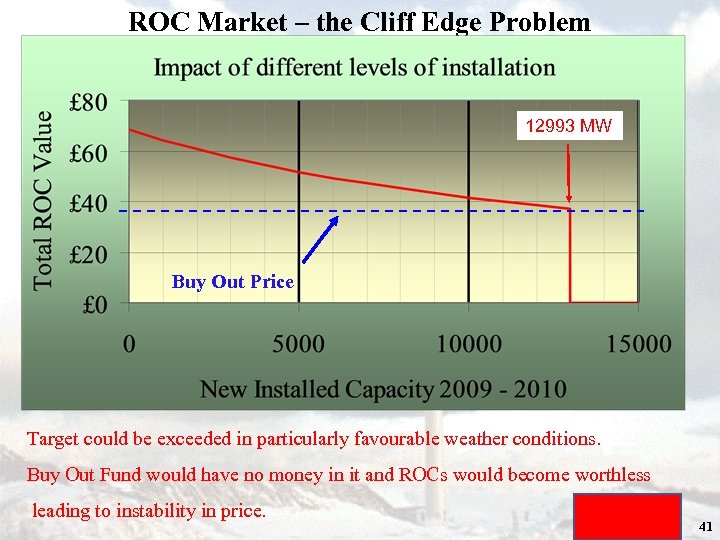
ROC Market – the Cliff Edge Problem 12993 MW Buy Out Price Target could be exceeded in particularly favourable weather conditions. Buy Out Fund would have no money in it and ROCs would become worthless leading to instability in price. 41
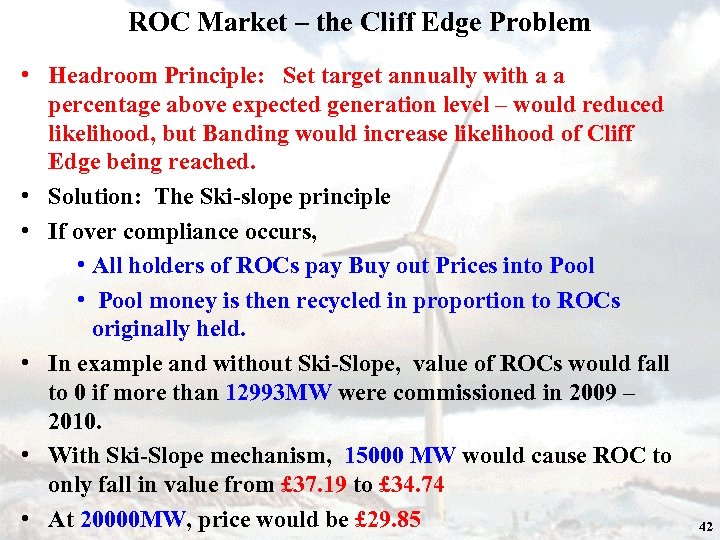
ROC Market – the Cliff Edge Problem • Headroom Principle: Set target annually with a a percentage above expected generation level – would reduced likelihood, but Banding would increase likelihood of Cliff Edge being reached. • Solution: The Ski-slope principle • If over compliance occurs, • All holders of ROCs pay Buy out Prices into Pool • Pool money is then recycled in proportion to ROCs originally held. • In example and without Ski-Slope, value of ROCs would fall to 0 if more than 12993 MW were commissioned in 2009 – 2010. • With Ski-Slope mechanism, 15000 MW would cause ROC to only fall in value from £ 37. 19 to £ 34. 74 • At 20000 MW, price would be £ 29. 85 42
Developments in the Renewables Obligation • Banding System wasintroduced from 1 st April 2009. • Reference projects such as on-shore wind will continue to get 1 ROC per MWh, • Technologies such as offshore wind get 1. 5 ROCs per MWh, • Solar PV, advanced gasification Biomass get 2. 0 ROCs per MWh, • Co-firing generates 0. 5 ROCs per MWh • With no banding: incentive only to exploit established technologies • Banding will enhance returns for developing technologies. • If targets are kept the same, it is easier to achieve targets and “Cliff Edge” Problem could become acute. • Targets for a given % of renewables in terms of MWh will not be met under current legislation if there is an upward drift in banding. • Only if reduced ROCs from co-firing balance enhanced ROCs from newer technologies will system remain stable. 43
Scottish Renewable Obligation • Scottish Renewable Obligations are largely similar but there are some differences > SROCs but introduced concept of a Marine Supply Obligation covering Tidal and Wave. • The MSO was to set an obligation (up to the output from 75 MW) on suppliers as a part of the Renewable Obligation. • Problem – How do you set a target at a time when no devices are yet operational - everyone would have to pay buy – out • Solution: – Use the capacity of devices due to come on line in year and use this as basis of obligation. – Need to incorporate Headroom Principle to avoid “Cliff Edge” problem NOTE: the HEADROOM Principle is now planned for use with ROCs 44
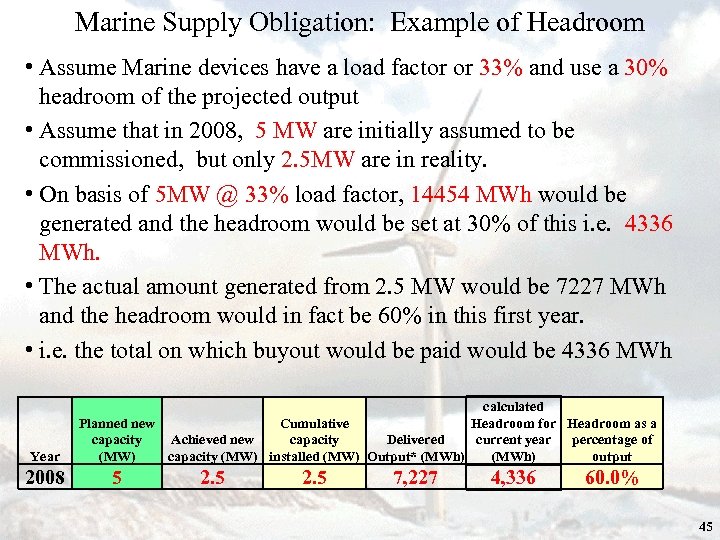
Marine Supply Obligation: Example of Headroom • Assume Marine devices have a load factor or 33% and use a 30% headroom of the projected output • Assume that in 2008, 5 MW are initially assumed to be commissioned, but only 2. 5 MW are in reality. • On basis of 5 MW @ 33% load factor, 14454 MWh would be generated and the headroom would be set at 30% of this i. e. 4336 MWh. • The actual amount generated from 2. 5 MW would be 7227 MWh and the headroom would in fact be 60% in this first year. • i. e. the total on which buyout would be paid would be 4336 MWh Year 2008 calculated Planned new Cumulative Headroom for Headroom as a capacity Achieved new Delivered current year percentage of (MW) capacity (MW) installed (MW) Output* (MWh) output (MWh) 5 2. 5 7, 227 4, 336 60. 0% 45
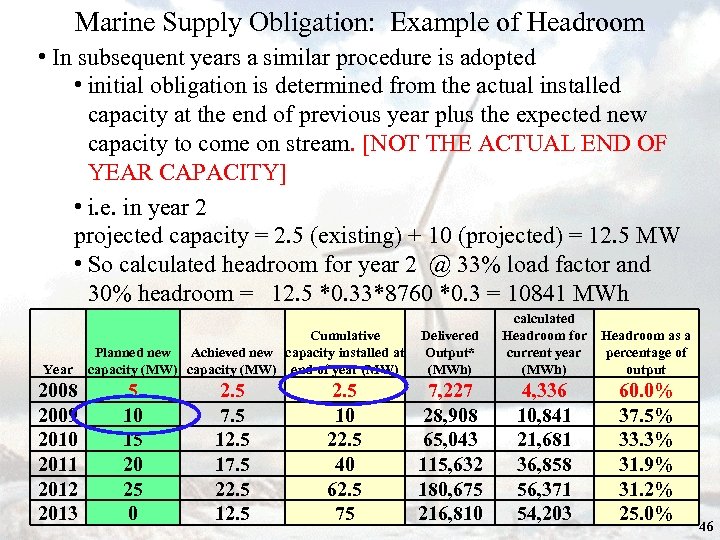
Marine Supply Obligation: Example of Headroom • In subsequent years a similar procedure is adopted • initial obligation is determined from the actual installed capacity at the end of previous year plus the expected new capacity to come on stream. [NOT THE ACTUAL END OF YEAR CAPACITY] • i. e. in year 2 projected capacity = 2. 5 (existing) + 10 (projected) = 12. 5 MW • So calculated headroom for year 2 @ 33% load factor and 30% headroom = 12. 5 *0. 33*8760 *0. 3 = 10841 MWh Year 2008 2009 2010 2011 2012 2013 Cumulative Delivered Planned new Achieved new capacity installed at Output* capacity (MW) end of year (MW) (MWh) 5 10 15 20 25 0 2. 5 7. 5 12. 5 17. 5 22. 5 12. 5 10 22. 5 40 62. 5 75 7, 227 28, 908 65, 043 115, 632 180, 675 216, 810 calculated Headroom for Headroom as a current year percentage of output (MWh) 4, 336 10, 841 21, 681 36, 858 56, 371 54, 203 60. 0% 37. 5% 33. 3% 31. 9% 31. 2% 25. 0% 46
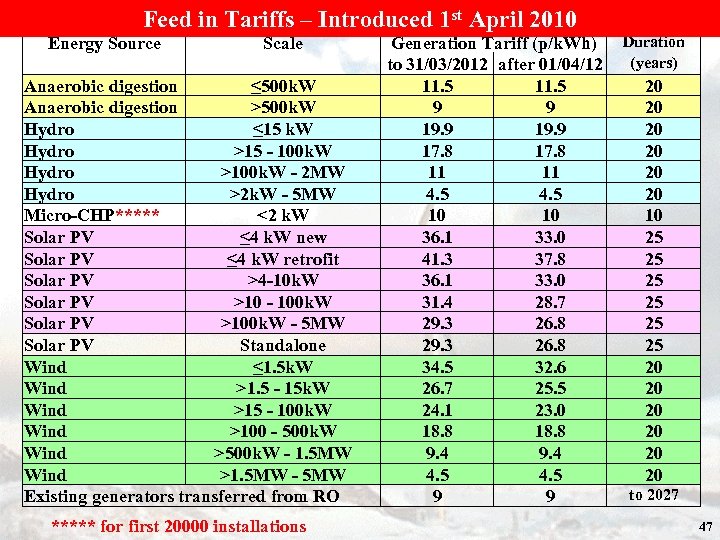
Feed in Tariffs – Introduced 1 st April 2010 Energy Source Scale Anaerobic digestion ≤ 500 k. W Anaerobic digestion >500 k. W Hydro ≤ 15 k. W Hydro >15 - 100 k. W Hydro >100 k. W - 2 MW Hydro >2 k. W - 5 MW Micro-CHP***** <2 k. W Solar PV ≤ 4 k. W new Solar PV ≤ 4 k. W retrofit Solar PV >4 -10 k. W Solar PV >10 - 100 k. W Solar PV >100 k. W - 5 MW Solar PV Standalone Wind ≤ 1. 5 k. W Wind >1. 5 - 15 k. W Wind >15 - 100 k. W Wind >100 - 500 k. W Wind >500 k. W - 1. 5 MW Wind >1. 5 MW - 5 MW Existing generators transferred from RO ***** for first 20000 installations Generation Tariff (p/k. Wh) to 31/03/2012 after 01/04/12 11. 5 9 9 19. 9 17. 8 11 11 4. 5 10 10 36. 1 33. 0 41. 3 37. 8 36. 1 33. 0 31. 4 28. 7 29. 3 26. 8 34. 5 32. 6 26. 7 25. 5 24. 1 23. 0 18. 8 9. 4 4. 5 9 9 Duration (years) 20 20 20 10 25 25 25 20 20 20 to 2027 47
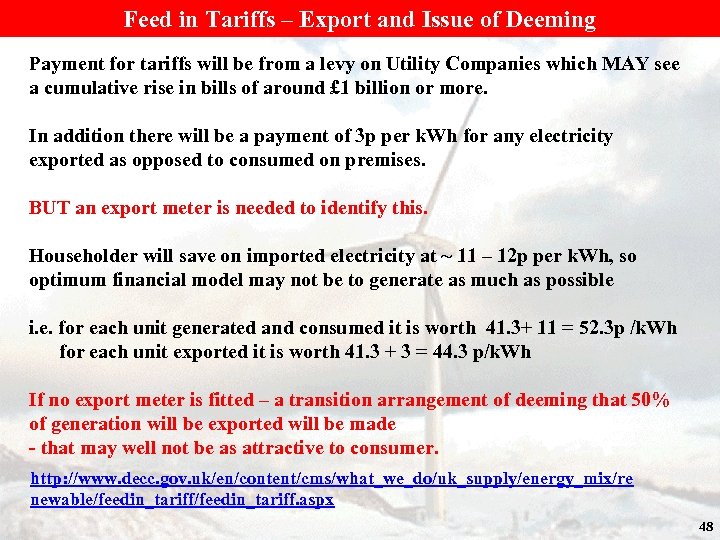
Feed in Tariffs – Export and Issue of Deeming Payment for tariffs will be from a levy on Utility Companies which MAY see a cumulative rise in bills of around £ 1 billion or more. In addition there will be a payment of 3 p per k. Wh for any electricity exported as opposed to consumed on premises. BUT an export meter is needed to identify this. Householder will save on imported electricity at ~ 11 – 12 p per k. Wh, so optimum financial model may not be to generate as much as possible i. e. for each unit generated and consumed it is worth 41. 3+ 11 = 52. 3 p /k. Wh for each unit exported it is worth 41. 3 + 3 = 44. 3 p/k. Wh If no export meter is fitted – a transition arrangement of deeming that 50% of generation will be exported will be made - that may well not be as attractive to consumer. http: //www. decc. gov. uk/en/content/cms/what_we_do/uk_supply/energy_mix/re newable/feedin_tariff. aspx 48

From the National Infra-Structure Plan 2010 following Comprehensive Spending Review • The Government will reform the electricity market, so that it attracts the private sector investment necessary to meet the UK’s energy security and climate change objectives, including the investment in nuclear, carbon capture and storage and renewable technology. • In addition to supporting the carbon price, this will also assess the role that revenue support mechanisms (such as Feed-In Tariffs), capacity mechanisms and emission performance standards could play. • For complete information see Section 4 of http: //www. hm-treasury. gov. uk/d/nationalinfrastructureplan 251010. pdf 49
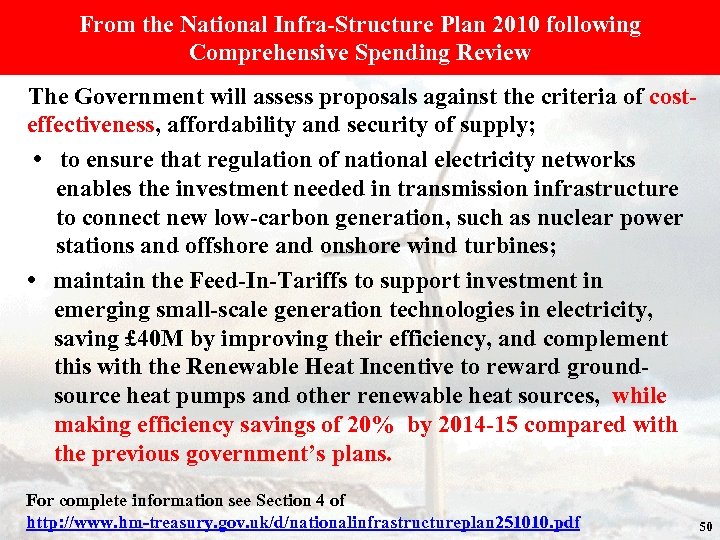
From the National Infra-Structure Plan 2010 following Comprehensive Spending Review The Government will assess proposals against the criteria of costeffectiveness, affordability and security of supply; • to ensure that regulation of national electricity networks enables the investment needed in transmission infrastructure to connect new low-carbon generation, such as nuclear power stations and offshore and onshore wind turbines; • maintain the Feed-In-Tariffs to support investment in emerging small-scale generation technologies in electricity, saving £ 40 M by improving their efficiency, and complement this with the Renewable Heat Incentive to reward groundsource heat pumps and other renewable heat sources, while making efficiency savings of 20% by 2014 -15 compared with the previous government’s plans. For complete information see Section 4 of http: //www. hm-treasury. gov. uk/d/nationalinfrastructureplan 251010. pdf 50
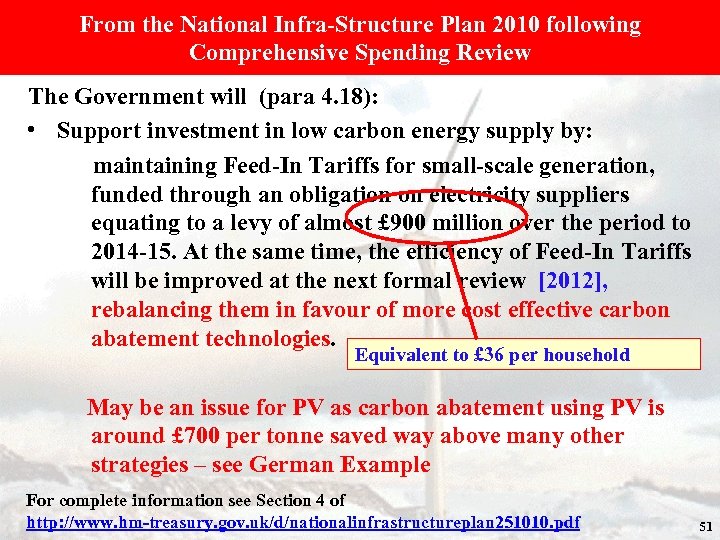
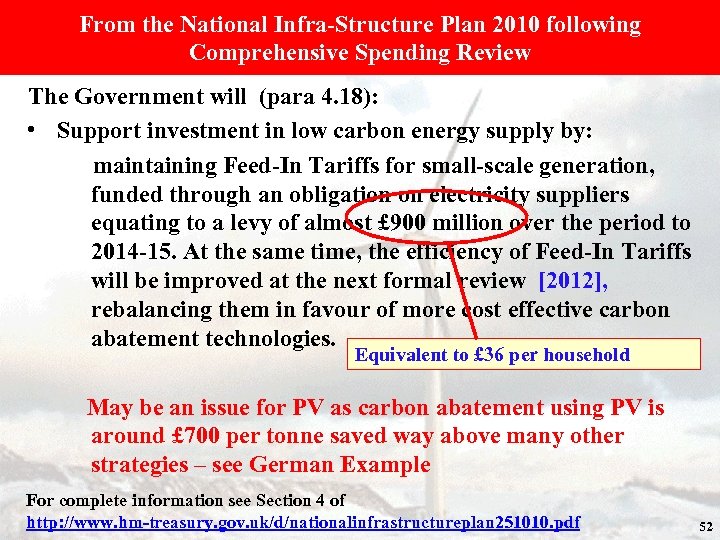
From the National Infra-Structure Plan 2010 following Comprehensive Spending Review The Government will (para 4. 18): • Support investment in low carbon energy supply by: maintaining Feed-In Tariffs for small-scale generation, funded through an obligation on electricity suppliers equating to a levy of almost £ 900 million over the period to 2014 -15. At the same time, the efficiency of Feed-In Tariffs will be improved at the next formal review [2012], rebalancing them in favour of more cost effective carbon abatement technologies. Equivalent to £ 36 per household May be an issue for PV as carbon abatement using PV is around £ 700 per tonne saved way above many other strategies – see German Example For complete information see Section 4 of http: //www. hm-treasury. gov. uk/d/nationalinfrastructureplan 251010. pdf 51
From the National Infra-Structure Plan 2010 following Comprehensive Spending Review The Government will (para 4. 18): • Support investment in low carbon energy supply by: maintaining Feed-In Tariffs for small-scale generation, funded through an obligation on electricity suppliers equating to a levy of almost £ 900 million over the period to 2014 -15. At the same time, the efficiency of Feed-In Tariffs will be improved at the next formal review [2012], rebalancing them in favour of more cost effective carbon abatement technologies. Equivalent to £ 36 per household May be an issue for PV as carbon abatement using PV is around £ 700 per tonne saved way above many other strategies – see German Example For complete information see Section 4 of http: //www. hm-treasury. gov. uk/d/nationalinfrastructureplan 251010. pdf 52
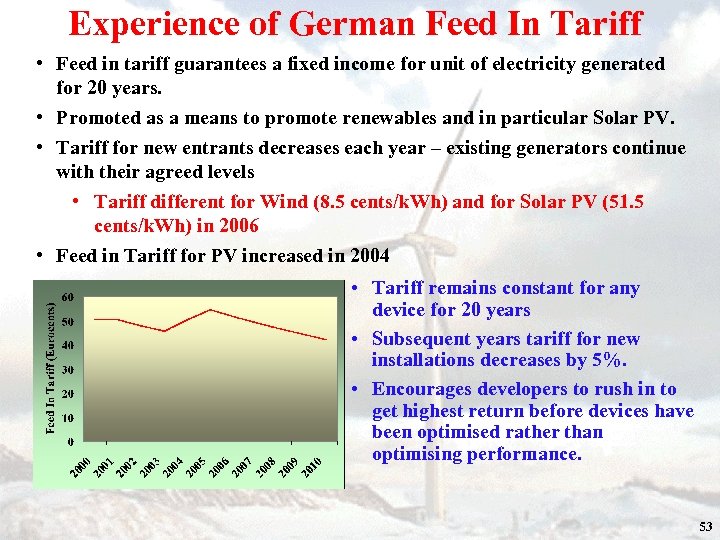
Experience of German Feed In Tariff • Feed in tariff guarantees a fixed income for unit of electricity generated for 20 years. • Promoted as a means to promote renewables and in particular Solar PV. • Tariff for new entrants decreases each year – existing generators continue with their agreed levels • Tariff different for Wind (8. 5 cents/k. Wh) and for Solar PV (51. 5 cents/k. Wh) in 2006 • Feed in Tariff for PV increased in 2004 • Tariff remains constant for any device for 20 years • Subsequent years tariff for new installations decreases by 5%. • Encourages developers to rush in to get highest return before devices have been optimised rather than optimising performance. 53
German Feed In Tariff • Each household with no PV is subsidising those with by £ 6 – a figure which will rise progressively • Subsidy for PV alone in Germany is costing consumers approaching € 2 billion (£ 1. 5 billion) a year in subsidy. For all green electricity it reaches ~€ 10 billion a year • In UK under ROCs consumers paid an addition £ 0. 3 billion a year or around 1% extra. • Secondary aim was to promote German Industry • In early years this was true • However high proportion are now manufactured overseas • In May 2008, German Government increases reduction rate in feed-in tariff following concerns over cost. • Cost of carbon dioxide abatement of subsidy by German Feed In Tariff for PV is ~ £ 750 per tonne way above the majority of other technologies • See article in Ruhr Economic Series for a critique “Germany’s Solar Cell Promotion: Dark Clouds on the Horizon” • http: //www 2. env. uea. ac. uk/gmmc/energy_links/renewables_Obligation/Feed _in_Tariffs/PV_Cost_critique_Ruhr_papers. pdf 54
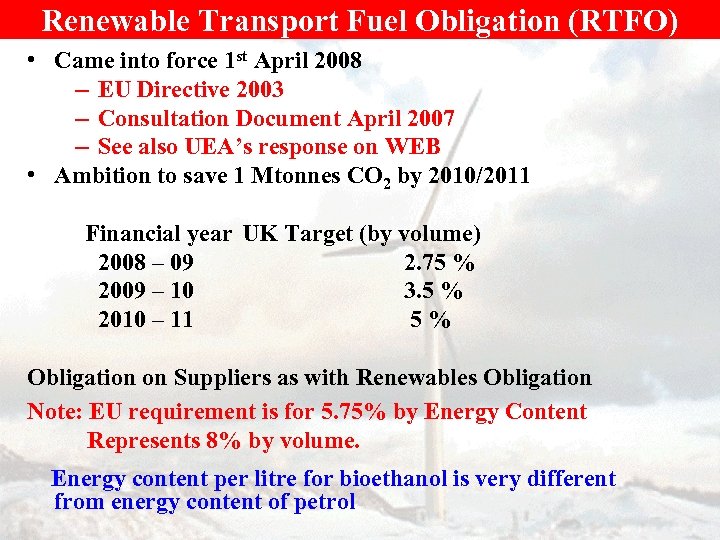
Renewable Transport Fuel Obligation (RTFO) • Came into force 1 st April 2008 – EU Directive 2003 – Consultation Document April 2007 – See also UEA’s response on WEB • Ambition to save 1 Mtonnes CO 2 by 2010/2011 Financial year UK Target (by volume) 2008 – 09 2. 75 % 2009 – 10 3. 5 % 2010 – 11 5 % Obligation on Suppliers as with Renewables Obligation Note: EU requirement is for 5. 75% by Energy Content Represents 8% by volume. Energy content per litre for bioethanol is very different from energy content of petrol
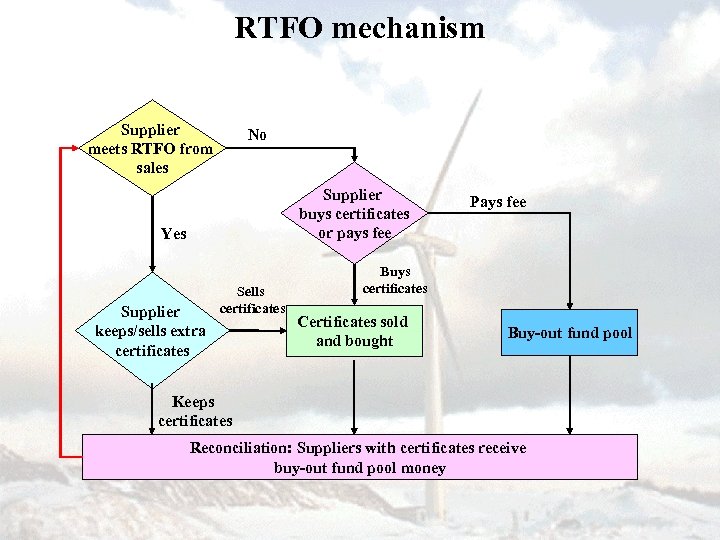
RTFO mechanism Supplier meets RTFO from sales No Supplier buys certificates or pays fee Yes Supplier keeps/sells extra certificates Sells certificates Pays fee Buys certificates Certificates sold and bought Buy-out fund pool Keeps certificates Reconciliation: Suppliers with certificates receive buy-out fund pool money
The level of the obligation? • Calculated as percentage of volume of fossil fuel sales, rather than of total sales of all fuels – 5 % of total fuels represented as 5. 2651 % of fossil fuel sales – Reduces UK commitment further – Reason • Duty paid in terms of volume • Need to switch to energy based pricing • Would make comparison between petrol, diesel and biofuels more rational – Maximum 5 % by volume additive is already permitted in EN-standard petrol and diesel fuels - • Warranty issues • Unlike RO, where recycled money is used in UK, recycled RTFO money is likely to go abroad
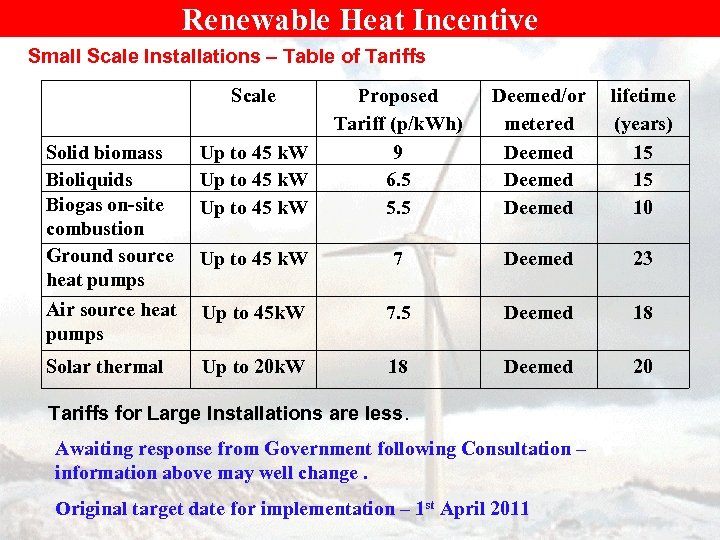
Renewable Heat Incentive Small Scale Installations – Table of Tariffs Scale Solid biomass Bioliquids Biogas on-site combustion Ground source heat pumps Air source heat pumps Up to 45 k. W Proposed Tariff (p/k. Wh) 9 6. 5 5. 5 Deemed/or metered Deemed lifetime (years) 15 15 10 Up to 45 k. W 7 Deemed 23 Up to 45 k. W 7. 5 Deemed 18 Solar thermal Up to 20 k. W 18 Deemed 20 Tariffs for Large Installations are less. Awaiting response from Government following Consultation – information above may well change. Original target date for implementation – 1 st April 2011
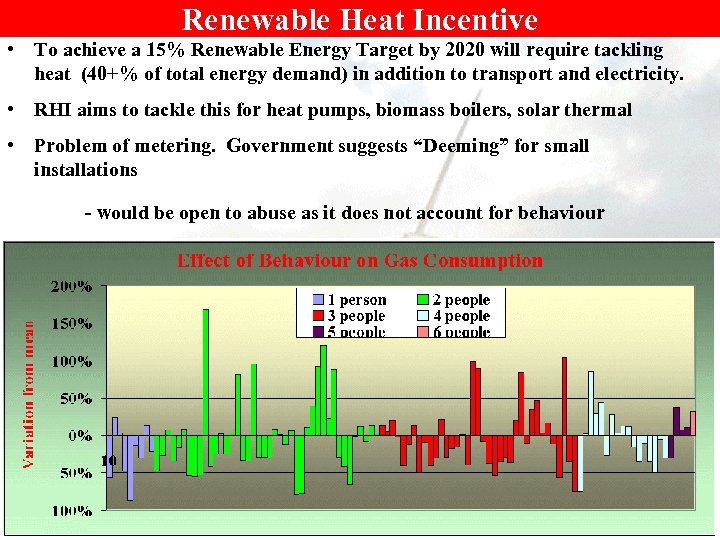
Renewable Heat Incentive • To achieve a 15% Renewable Energy Target by 2020 will require tackling heat (40+% of total energy demand) in addition to transport and electricity. • RHI aims to tackle this for heat pumps, biomass boilers, solar thermal • Problem of metering. Government suggests “Deeming” for small installations - would be open to abuse as it does not account for behaviour
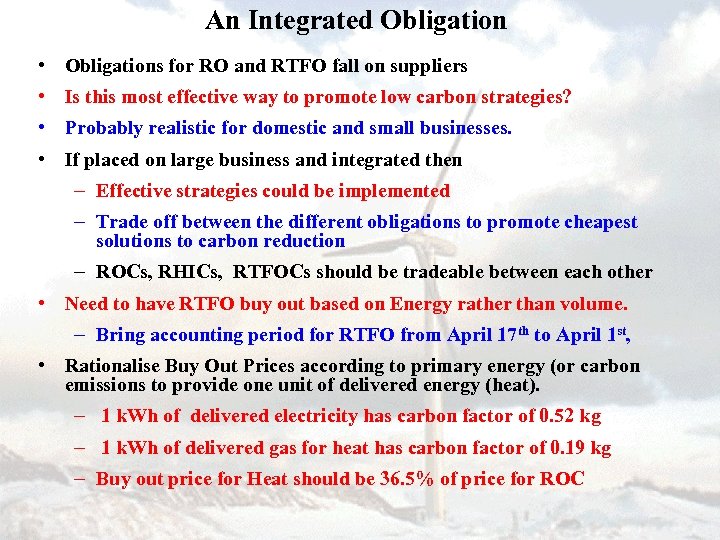
An Integrated Obligation • Obligations for RO and RTFO fall on suppliers • Is this most effective way to promote low carbon strategies? • Probably realistic for domestic and small businesses. • If placed on large business and integrated then – Effective strategies could be implemented – Trade off between the different obligations to promote cheapest solutions to carbon reduction – ROCs, RHICs, RTFOCs should be tradeable between each other • Need to have RTFO buy out based on Energy rather than volume. – Bring accounting period for RTFO from April 17 th to April 1 st, • Rationalise Buy Out Prices according to primary energy (or carbon emissions to provide one unit of delivered energy (heat). – 1 k. Wh of delivered electricity has carbon factor of 0. 52 kg – 1 k. Wh of delivered gas for heat has carbon factor of 0. 19 kg – Buy out price for Heat should be 36. 5% of price for ROC
Скачать презентацию NBS-M 009 2010 LOW CARBON BUSINESS REGULATION
82d16b8137c756692e7b6378a34db81b.ppt