 Скачать презентацию NBA 600 Session 8 E-Commerce Amazon com 13
5913d6c9f23cf7799307758b51921c87.ppt
- Количество слайдов: 23



NBA 600: Session 8 E-Commerce Amazon. com 13 February 2003 Daniel Huttenlocher
Today’s Class § Retail electronic commerce – Look at Amazon. com • Where they are today • How they got there • What future holds – shopping platform – Amazon’s focus on user experience (UE) – Leave e. Bay to communities, not a retailer § Some electronic commerce statistics – Multi channel shoppers § Revisiting some failed businesses – Fresh. Direct 2
E-Commerce: Amazon. com § Launched in July 1995 with two goals – World’s largest selection of books • High value given large number of titles – Convenience that delights the customer § Now a broad-based online retailer – Core business BMV (books-music-video) – Sales of $3. 9 B in 2002; Q 4 up 33% y-o-y • 17% ROIC, low-teens cost of capital (Lehman) • Company predicts 15% sales growth in 2003 – 25 -30 M unique visitors per month (Nielsen) • Estimates of about 50 M “active customers” 3
What Amazon. com Provides § Online storefront – user experience – For own stores as well as partners and Marketplace merchants • Marketplace is “mall” of independent merchants - 23% of sales in Q 1 2002 (Jupiter Media Metrix) – Extensive focus on delightful user experience • Driven many innovations, adopted others § Payment processing § Fulfillment – Via own warehouses and partnerships with distributors – Close ties with shippers (UPS, Fedex) 4
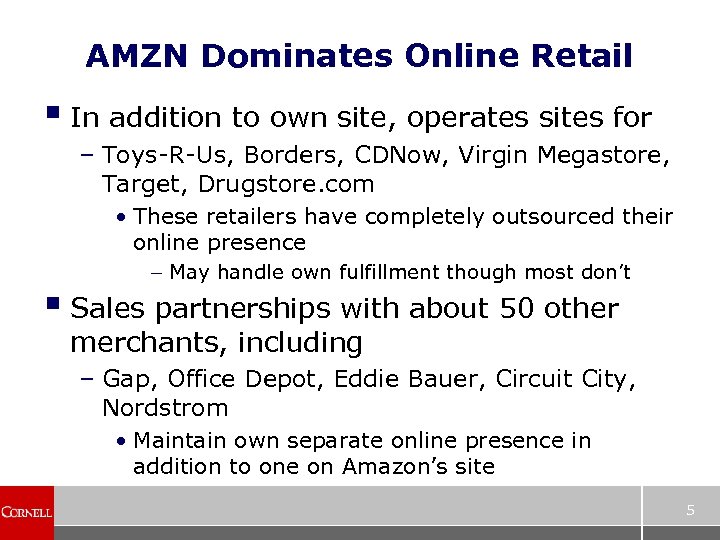
AMZN Dominates Online Retail § In addition to own site, operates sites for – Toys-R-Us, Borders, CDNow, Virgin Megastore, Target, Drugstore. com • These retailers have completely outsourced their online presence - May handle own fulfillment though most don’t § Sales partnerships with about 50 other merchants, including – Gap, Office Depot, Eddie Bauer, Circuit City, Nordstrom • Maintain own separate online presence in addition to one on Amazon’s site 5
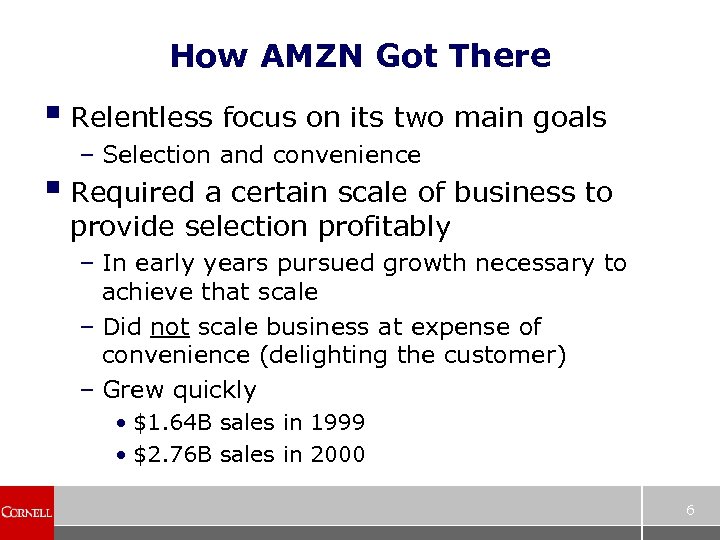
How AMZN Got There § Relentless focus on its two main goals – Selection and convenience § Required a certain scale of business to provide selection profitably – In early years pursued growth necessary to achieve that scale – Did not scale business at expense of convenience (delighting the customer) – Grew quickly • $1. 64 B sales in 1999 • $2. 76 B sales in 2000 6
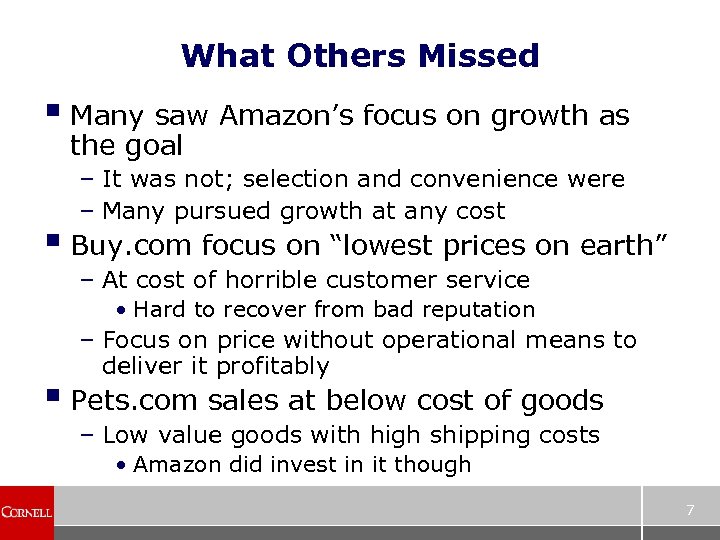
What Others Missed § Many saw Amazon’s focus on growth as the goal – It was not; selection and convenience were – Many pursued growth at any cost § Buy. com focus on “lowest prices on earth” – At cost of horrible customer service • Hard to recover from bad reputation – Focus on price without operational means to deliver it profitably § Pets. com sales at below cost of goods – Low value goods with high shipping costs • Amazon did invest in it though 7
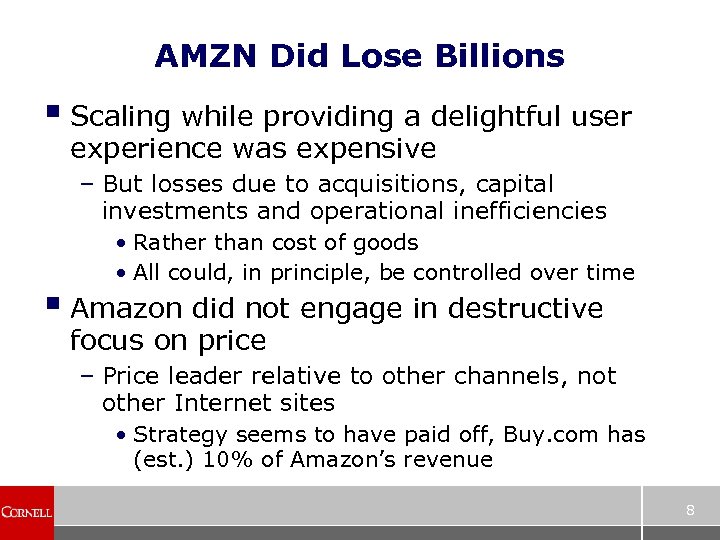
AMZN Did Lose Billions § Scaling while providing a delightful user experience was expensive – But losses due to acquisitions, capital investments and operational inefficiencies • Rather than cost of goods • All could, in principle, be controlled over time § Amazon did not engage in destructive focus on price – Price leader relative to other channels, not other Internet sites • Strategy seems to have paid off, Buy. com has (est. ) 10% of Amazon’s revenue 8
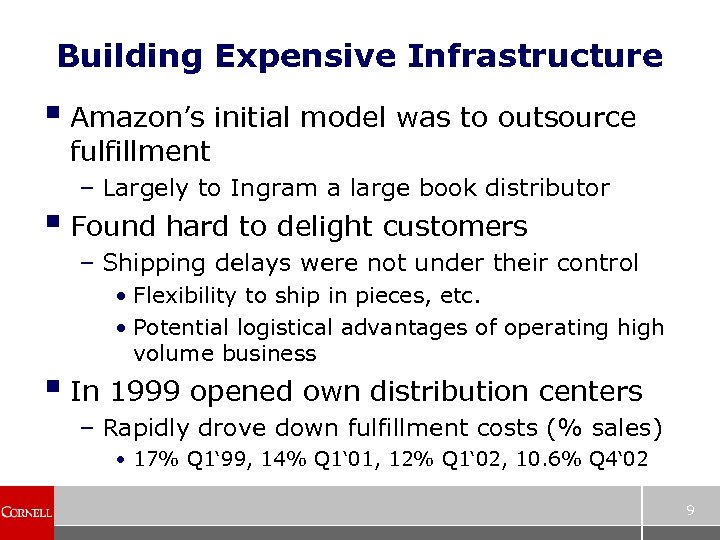
Building Expensive Infrastructure § Amazon’s initial model was to outsource fulfillment – Largely to Ingram a large book distributor § Found hard to delight customers – Shipping delays were not under their control • Flexibility to ship in pieces, etc. • Potential logistical advantages of operating high volume business § In 1999 opened own distribution centers – Rapidly drove down fulfillment costs (% sales) • 17% Q 1‘ 99, 14% Q 1‘ 01, 12% Q 1‘ 02, 10. 6% Q 4‘ 02 9
Capital Markets Forced a Change § Profitability rather than growth as best strategy to achieve goals – Q 4 2000 Bezos “March to profitability” § Lehman report questioned whether cash necessary to survive the year, Q 1 2001 – Potential problem for supplier credit relations • Critical for operational costs – March became a dash • More open about what was profitable and by what measures § Pursued strategies market allowed 10
AMZN Marketplace § Also in late 2000 started showing goods from independent vendors along side own merchandise – Amazon’s merchandise description and pricing with links to other, generally used, versions § Now also support sales of items not sold by Amazon itself – Brings Amazon and e. Bay closer in terms of independent merchants and merchandise • Different models – auction versus fixed pricing • e. Bay experimenting with fixed price – Different consumer populations? 11
A Page from Wal. Mart Playbook § In late 2001 Amazon started focusing more on price – has driven growth – Free shipping on orders over certain size • Many studies show shipping costs are biggest impediment to shopping online – Discounts on certain product categories • E. g. , books over $30 § Had achieved scale and operational efficiencies to enable price leadership – Did not make price primary strategy until able • Quickly dropping fulfillment costs; gross sales 12
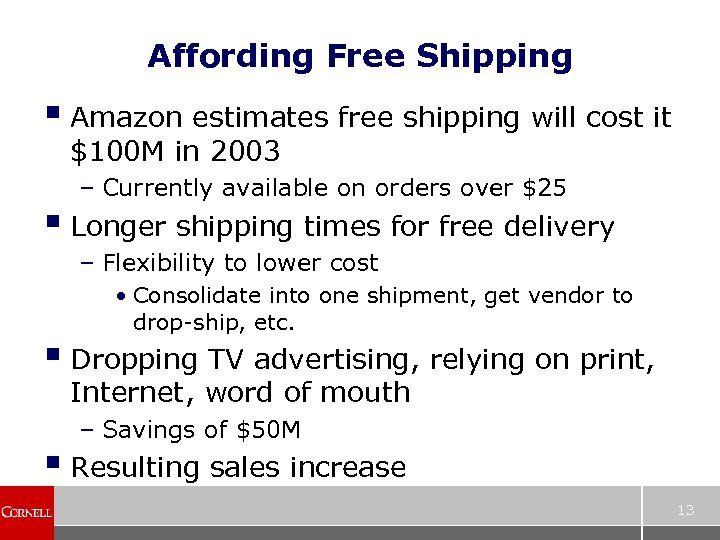
Affording Free Shipping § Amazon estimates free shipping will cost it $100 M in 2003 – Currently available on orders over $25 § Longer shipping times for free delivery – Flexibility to lower cost • Consolidate into one shipment, get vendor to drop-ship, etc. § Dropping TV advertising, relying on print, Internet, word of mouth – Savings of $50 M § Resulting sales increase 13
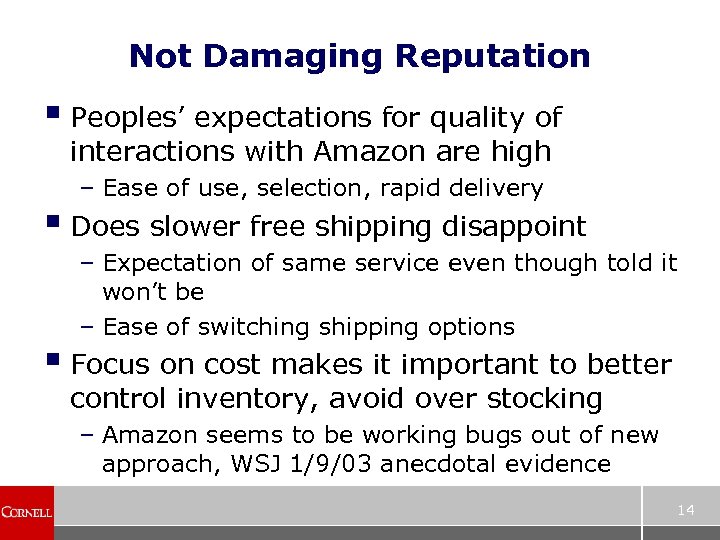
Not Damaging Reputation § Peoples’ expectations for quality of interactions with Amazon are high – Ease of use, selection, rapid delivery § Does slower free shipping disappoint – Expectation of same service even though told it won’t be – Ease of switching shipping options § Focus on cost makes it important to better control inventory, avoid over stocking – Amazon seems to be working bugs out of new approach, WSJ 1/9/03 anecdotal evidence 14
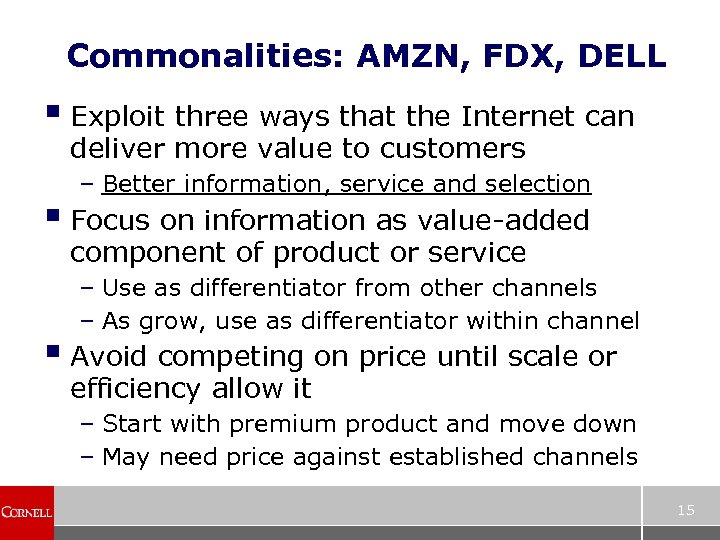
Commonalities: AMZN, FDX, DELL § Exploit three ways that the Internet can deliver more value to customers – Better information, service and selection § Focus on information as value-added component of product or service – Use as differentiator from other channels – As grow, use as differentiator within channel § Avoid competing on price until scale or efficiency allow it – Start with premium product and move down – May need price against established channels 15
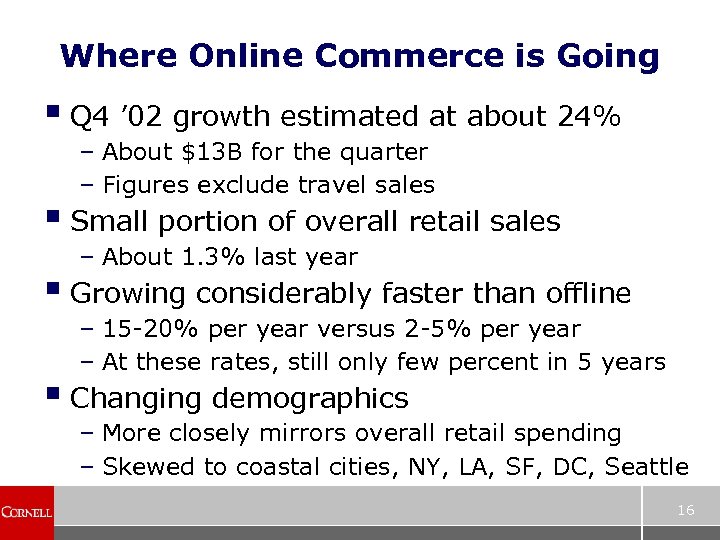
Where Online Commerce is Going § Q 4 ’ 02 growth estimated at about 24% – About $13 B for the quarter – Figures exclude travel sales § Small portion of overall retail sales – About 1. 3% last year § Growing considerably faster than offline – 15 -20% per year versus 2 -5% per year – At these rates, still only few percent in 5 years § Changing demographics – More closely mirrors overall retail spending – Skewed to coastal cities, NY, LA, SF, DC, Seattle 16
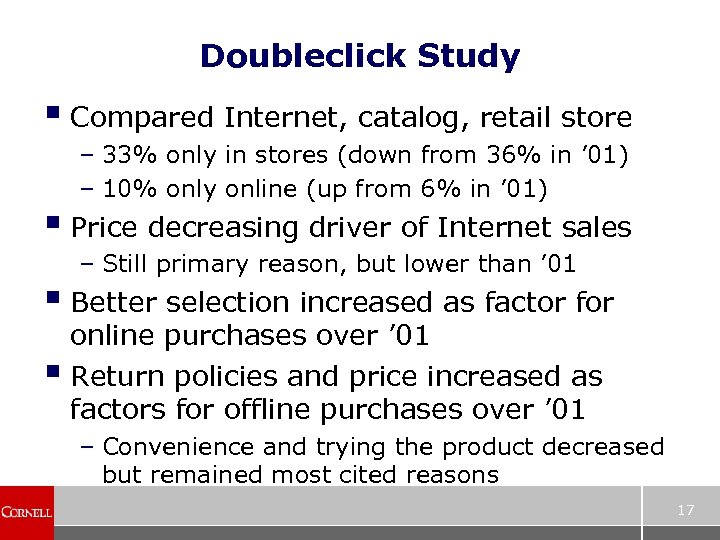
Doubleclick Study § Compared Internet, catalog, retail store – 33% only in stores (down from 36% in ’ 01) – 10% only online (up from 6% in ’ 01) § Price decreasing driver of Internet sales – Still primary reason, but lower than ’ 01 § Better selection increased as factor for online purchases over ’ 01 § Return policies and price increased as factors for offline purchases over ’ 01 – Convenience and trying the product decreased but remained most cited reasons 17
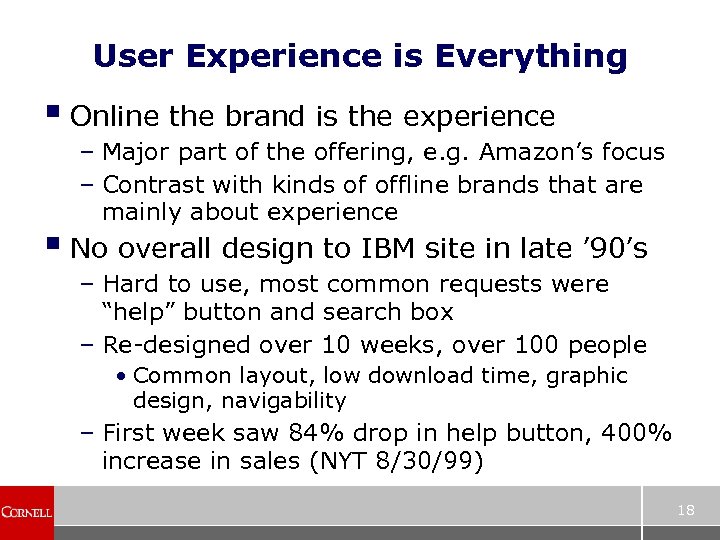
User Experience is Everything § Online the brand is the experience – Major part of the offering, e. g. Amazon’s focus – Contrast with kinds of offline brands that are mainly about experience § No overall design to IBM site in late ’ 90’s – Hard to use, most common requests were “help” button and search box – Re-designed over 10 weeks, over 100 people • Common layout, low download time, graphic design, navigability – First week saw 84% drop in help button, 400% increase in sales (NYT 8/30/99) 18
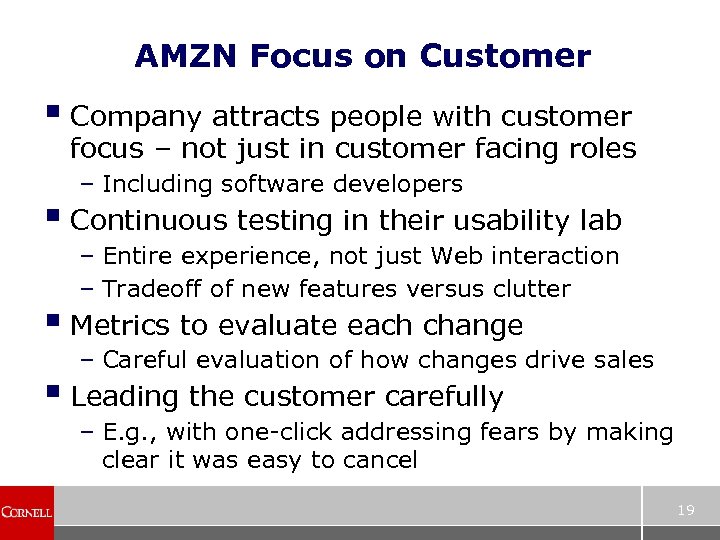
AMZN Focus on Customer § Company attracts people with customer focus – not just in customer facing roles – Including software developers § Continuous testing in their usability lab – Entire experience, not just Web interaction – Tradeoff of new features versus clutter § Metrics to evaluate each change – Careful evaluation of how changes drive sales § Leading the customer carefully – E. g. , with one-click addressing fears by making clear it was easy to cancel 19
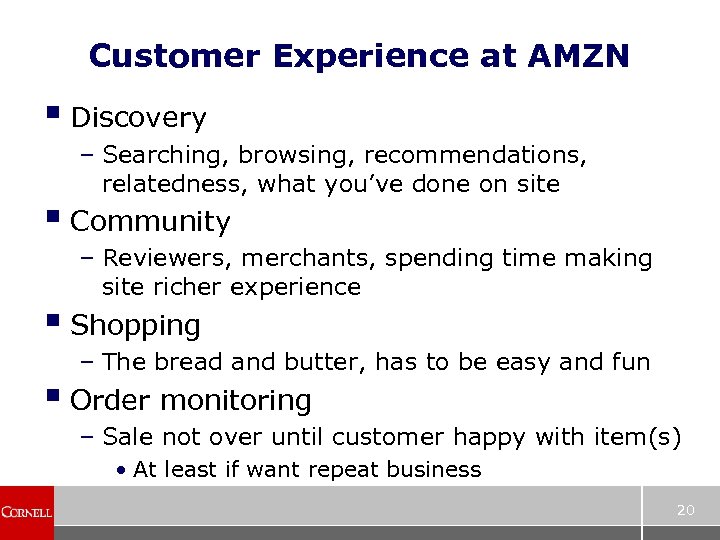
Customer Experience at AMZN § Discovery – Searching, browsing, recommendations, relatedness, what you’ve done on site § Community – Reviewers, merchants, spending time making site richer experience § Shopping – The bread and butter, has to be easy and fun § Order monitoring – Sale not over until customer happy with item(s) • At least if want repeat business 20
Revisiting E-Commerce Failures § Some were just too early – Level of comfort with online shopping – E. g. , much furniture bought offline not seen • But Living. com didn’t make it § Some didn’t fit online model well – E. g. , pet supplies • Low value and high shipping cost items § Some built un-sustainable costs/debt – E. g. , Webvan provided value beyond pricing • Fresh. Direct giving online grocery a try in NYC 21
Fresh. Direct Online Grocer § Focus is on the food – Modeled on Dell: provide great choice and use Internet to deliver it • With new manufacturing process § Better quality and selection of fresh foods – Prices 10 -30% lower than Manhattan stores – Fixed $3. 95 delivery fee, minimum $40 order • Deliver only at night and on weekends § Direct from warehouse to customer – Many items prepared in the warehouse § Raised $120 M; goal $225 M/yr sales by ’ 04 22
Summary § Importance of user experience on brand – Requires commitment across the company – Requires common site design, navigation • But content needs to be accurate, so best under control of individual business group/team § Selection and convenience are big drivers of online commerce – Price secondary focus for successful firms – Perhaps getting less important for consumers § Online community plays role too 23
Скачать презентацию NBA 600 Session 8 E-Commerce Amazon com 13
5913d6c9f23cf7799307758b51921c87.ppt