 Скачать презентацию NBA 600 Session 2 The Internet and its
52716d765343793e2eb10188fc4461dc.ppt
- Количество слайдов: 26



NBA 600: Session 2 The Internet and its Use 23 January 2003 Daniel Huttenlocher
Today’s Class § Reflect on Tuesday’s lessons § Competitive forces and online businesses – Consider Porter’s 5 forces – Illustrate with a mom & pop business • Importance of online community § Structure of Internet – How it is constructed and connected – How it is paid for – Implications for electronic goods and services § Credibility and expectations online – Why it is important, how it can be achieved 2
Reflect: On Staying Informed § Where do people get information today? – Personal or work – At home, at office, elsewhere – News, govt. , health, product, work, gossip § How do people exchange information directly with one another today? – Friends, family or coworkers – At home, at office, elsewhere – Face-to-face, email, IM, gaming… § How are these changing? 3
Reflect: Value vs. Revenue § Many Internet services that people rate as valuable are not generating much revenue – How can the value be captured by service providers? • E. g. , instant messaging on the Internet vs. short -text messages on mobile phones - How important is AIM to AOL? • Tension between giving away and charging – As more services move online or move digital what are revenue opportunities? – Differences in what people are willing to pay for online and offline 4
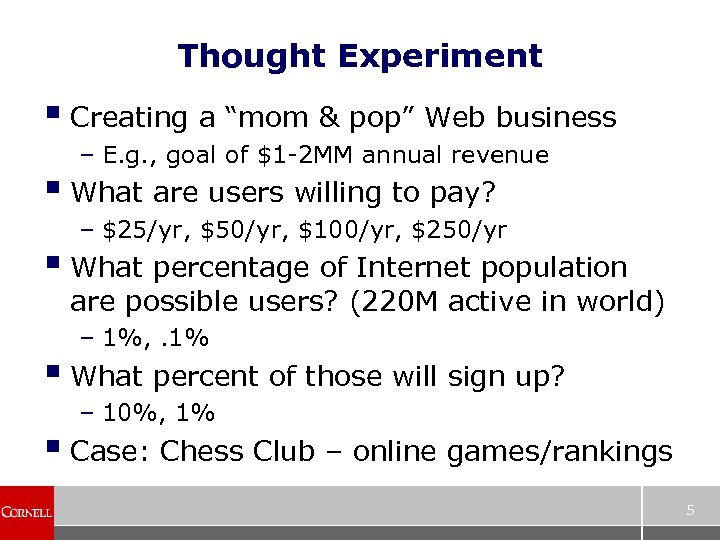
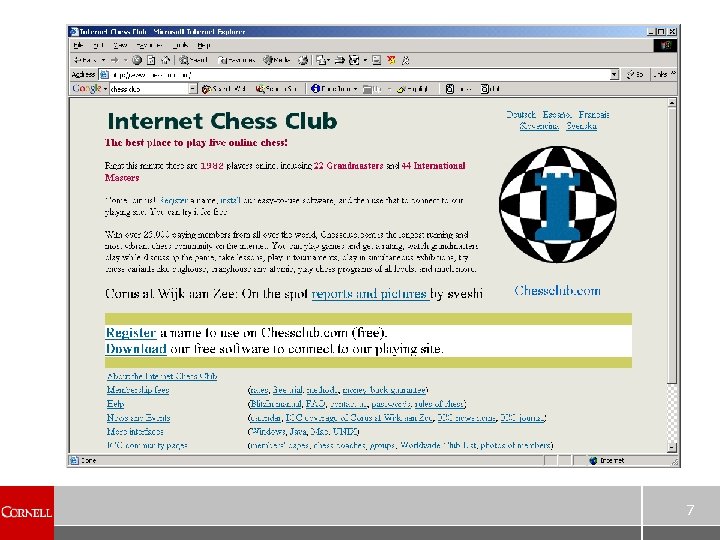
Thought Experiment § Creating a “mom & pop” Web business – E. g. , goal of $1 -2 MM annual revenue § What are users willing to pay? – $25/yr, $50/yr, $100/yr, $250/yr § What percentage of Internet population are possible users? (220 M active in world) – 1%, . 1% § What percent of those will sign up? – 10%, 1% § Case: Chess Club – online games/rankings 5
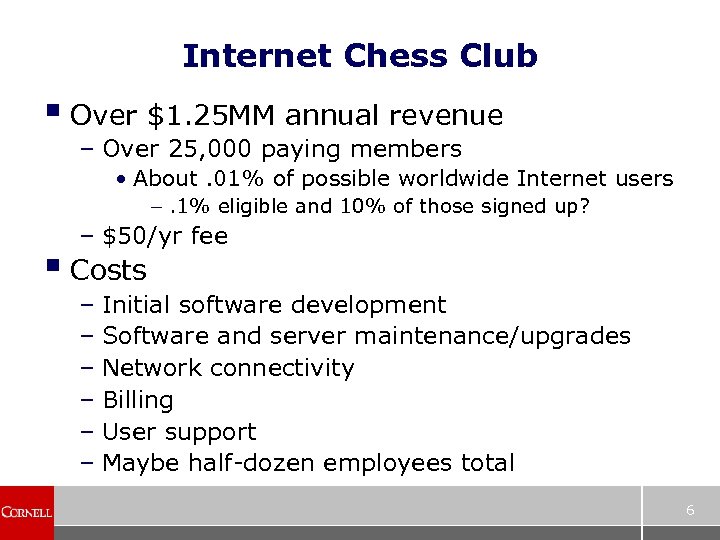
Internet Chess Club § Over $1. 25 MM annual revenue – Over 25, 000 paying members • About. 01% of possible worldwide Internet users -. 1% eligible and 10% of those signed up? – $50/yr fee § Costs – Initial software development – Software and server maintenance/upgrades – Network connectivity – Billing – User support – Maybe half-dozen employees total 6
7
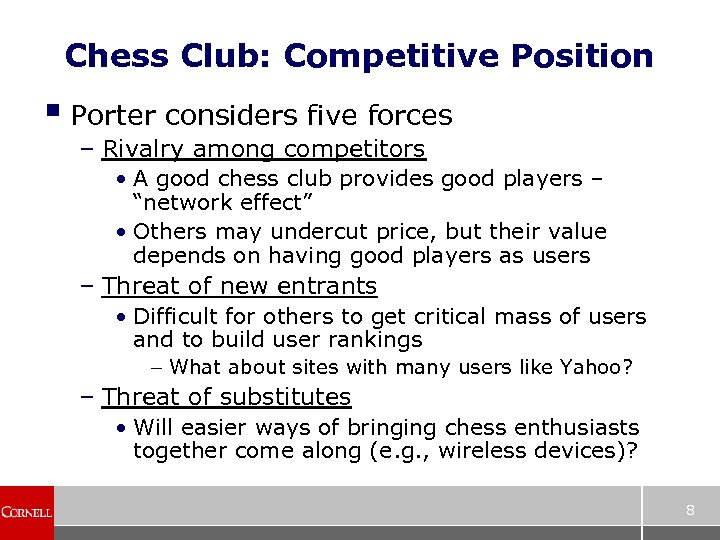
Chess Club: Competitive Position § Porter considers five forces – Rivalry among competitors • A good chess club provides good players – “network effect” • Others may undercut price, but their value depends on having good players as users – Threat of new entrants • Difficult for others to get critical mass of users and to build user rankings - What about sites with many users like Yahoo? – Threat of substitutes • Will easier ways of bringing chess enthusiasts together come along (e. g. , wireless devices)? 8
Chess Club: Competitive Position § Porters forces continued – Bargaining power of suppliers • No real suppliers except commodity hardware, software and networking (chess software developed in-house) – Bargaining power of customers • Need to find the cost comparable to other chess activities, other forms of entertainment § Appears to be sustainable business – Can it be grown? § How general – what similar businesses to be built – Online community 9
Structure of Internet: 2 Main Ideas § 1: The Internet is a collection of networks – Held together by standard “protocols” (TCP) – Like road networks • Local, county, state, national • Agree on where to connect and how to drive § 2: Packed switched data – Information broken up into small packets each addressed separately to the recipient • Unique addresses – “IP address” – Like filling up separate cars and sending to same place with independent drivers • Each driver makes own local routing decisions 10
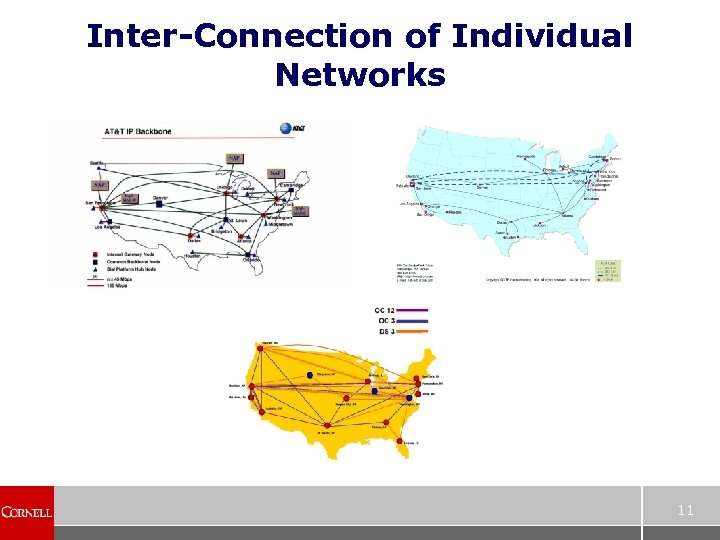
Inter-Connection of Individual Networks 11
How Data Gets Where Its Going § User generally provides a hostname – E. g. , www. cornell. edu, www. cnn. com § Name translated to an IP address – Uniquely specifies where data goes to reach the hostname – Domain Name System (DNS) handles lookup • Small number of “root servers” around globe • Local servers handle most requests (e. g. , CUDNS) § IP address is used to route data – At each connection of networks, best place to go to get closer to that address • Routes change dynamically with traffic conditions 12
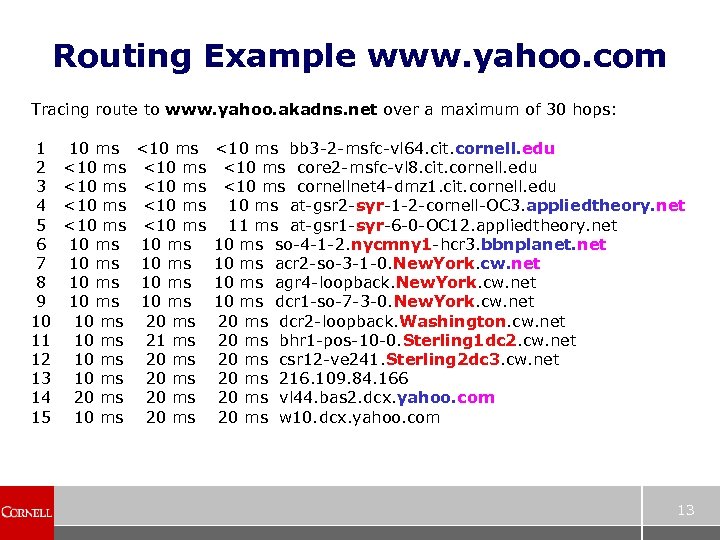
Routing Example www. yahoo. com Tracing route to www. yahoo. akadns. net over a maximum of 30 hops: 1 2 3 4 5 6 7 8 9 10 11 12 13 14 15 10 ms <10 ms 10 ms 10 ms 20 ms 10 ms <10 ms <10 ms 10 ms 21 ms 20 ms <10 ms bb 3 -2 -msfc-vl 64. cit. cornell. edu <10 ms core 2 -msfc-vl 8. cit. cornell. edu <10 ms cornellnet 4 -dmz 1. cit. cornell. edu 10 ms at-gsr 2 -syr-1 -2 -cornell-OC 3. appliedtheory. net 11 ms at-gsr 1 -syr-6 -0 -OC 12. appliedtheory. net 10 ms so-4 -1 -2. nycmny 1 -hcr 3. bbnplanet. net 10 ms acr 2 -so-3 -1 -0. New. York. cw. net 10 ms agr 4 -loopback. New. York. cw. net 10 ms dcr 1 -so-7 -3 -0. New. York. cw. net 20 ms dcr 2 -loopback. Washington. cw. net 20 ms bhr 1 -pos-10 -0. Sterling 1 dc 2. cw. net 20 ms csr 12 -ve 241. Sterling 2 dc 3. cw. net 20 ms 216. 109. 84. 166 20 ms vl 44. bas 2. dcx. yahoo. com 20 ms w 10. dcx. yahoo. com 13
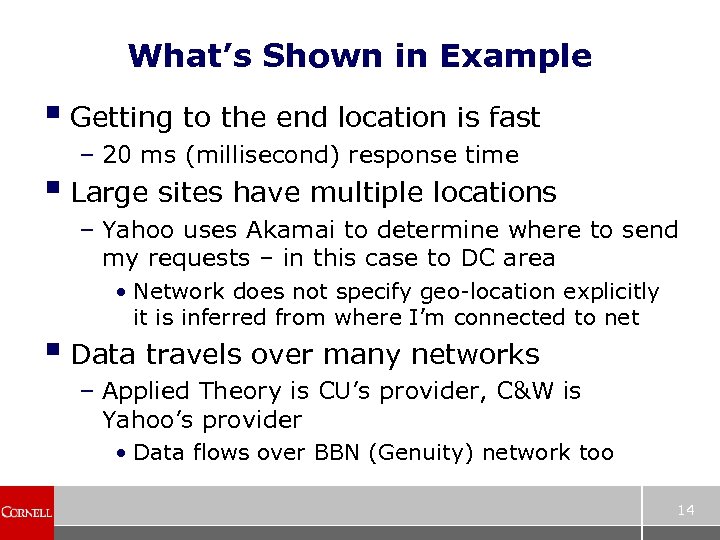
What’s Shown in Example § Getting to the end location is fast – 20 ms (millisecond) response time § Large sites have multiple locations – Yahoo uses Akamai to determine where to send my requests – in this case to DC area • Network does not specify geo-location explicitly it is inferred from where I’m connected to net § Data travels over many networks – Applied Theory is CU’s provider, C&W is Yahoo’s provider • Data flows over BBN (Genuity) network too 14
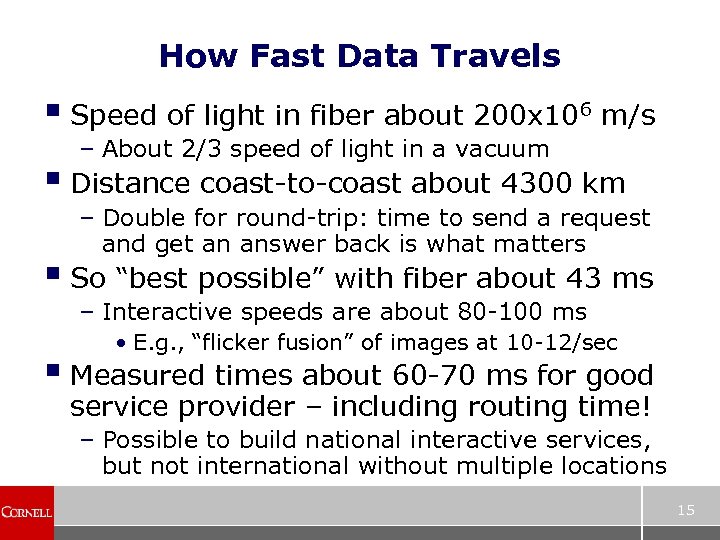
How Fast Data Travels § Speed of light in fiber about 200 x 106 m/s – About 2/3 speed of light in a vacuum § Distance coast-to-coast about 4300 km – Double for round-trip: time to send a request and get an answer back is what matters § So “best possible” with fiber about 43 ms – Interactive speeds are about 80 -100 ms • E. g. , “flicker fusion” of images at 10 -12/sec § Measured times about 60 -70 ms for good service provider – including routing time! – Possible to build national interactive services, but not international without multiple locations 15
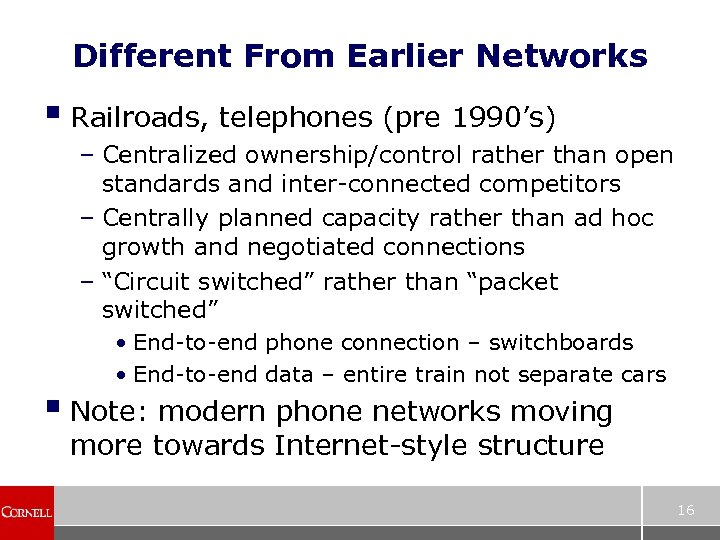
Different From Earlier Networks § Railroads, telephones (pre 1990’s) – Centralized ownership/control rather than open standards and inter-connected competitors – Centrally planned capacity rather than ad hoc growth and negotiated connections – “Circuit switched” rather than “packet switched” • End-to-end phone connection – switchboards • End-to-end data – entire train not separate cars § Note: modern phone networks moving more towards Internet-style structure 16
How Internet is Constructed § Each network provider (ISP) builds its own network – Chooses what other network(s) to connect to – Chooses what traffic to accept from connected network(s) § Pairwise peering arrangements govern what inter-network traffic will be carried – Sometimes involves charges, sometimes involves trades – local decisions by two ISP’s § Each provider motivated to provide connectivity needed by their customers 17
Payment Structure of the Internet § End-users pay for bandwidth – $20/mo 56 kb dialup (consumer) – $40/mo 128 kb upstream - 768 kb downstream broadband (consumer) – $900/mo 1. 6 mb T 1 (commercial) – $40 k/mo 155 mb OC 3 (commercial) § Commercial users tend to use their full bandwidth 24/7, consumers not – Asymmetric broadband appears to be disproportionately cheaper as a result § Each of these categories generates $100’s millions of monthly revenue 18
Connectivity of Internet and Web § Evolutionary rather than designed – Shows many patterns similar to natural or “organic” growth phenomena • E. g. , neurons, “six degrees of Kevin Bacon” § Good routes evolve through needs of endusers – Any two hosts about 15 hops (degrees) apart § Aside: analogous structure in hyperlinks between Web pages – This structure is used for search engines, e. g. , Google 19
Geo-Location in Internet § The cabling and “routers” (connections) of the Internet are in physical locations – Often in or near big cities where the traffic is § These physical locations are not evident in the IP addressing scheme – Companies sell services that try to determine geo-location from IP address • For marketing, security, legal and other uses § Large service providers need to combat physical location – Packet transit times in the network too slow – Potential for congestion with single site 20
Difficult to “Map” Internet § Trace routes from certain locations (host machines) in the Internet – Routes change dynamically – Only see routes from a few places to many – Like trying to map roads by exploring specific destinations from a few starting locations § Internet changing every day – On order of 150, 000 “routable networks” • I. e. , service providers with peering agreements § Easier to depend on gross characteristics than specifics of Internet structure 21
Reflect: Conclusions We Can Draw § Relentless, organic, drive to connectivity – Services that do not connect to the Internet are at risk • Consider case of AOL’s free AIM client • What does this say about text messaging - Consider Blackberry/RIM or Bloomberg messaging niche businesses § Global, highly interactive services need multiple physical locations in the network – Simply slow if interacting users far apart § Upstream bandwidth will remain costly 22

Credibility Online § Crucial to success of any online business – Can’t use many traditional means: location, offices, attire § Brand important, but for new business hard to build – For existing business important not to damage • Low credibility online presence may hurt § What is credible online? – People say: identity, sponsors, service, privacy – Stanford study reveals layout and design most important – old “say vs. do problem” 23
What is Credible Online § Consider Orbitz – new business – Strong pedigree (sponsors), heavy advertising, fairly simple almost “retro” design – Has quickly grown into large business § Consider Internet Chess Club – Existing business, little pedigree, no advertising, little design – Successful small business • Online community – appearance less a factor? § Effect of broken sites – Recognized brand versus not 24
Summing Up § Porter’s 5 competitive forces and Internet – Network effect – value of large user base and its impact on competitors or new entrants – Lack of non-commodity suppliers for many netbased businesses § Technical architecture of the Internet supports decentralized as-needed growth – Local demand for connectivity driving growth – For what businesses is that connectivity key § Building credibility is important but poorly understood – need good layout and design 25
Next Time § Internet and New Economy debate – Readings: Porter, Tapscott, Magretta – Skim: Nordhaus – Be prepared to take a position and defend it § First individual assignments next Tuesday – Due following Tuesday Feb 4, before class – Choice of topics: • Challenges and opportunities for consumer mobile text messaging services in the US • Porter-Tapscott debate, changes to strategy in the Internet age 26
Скачать презентацию NBA 600 Session 2 The Internet and its
52716d765343793e2eb10188fc4461dc.ppt