


 Скачать презентацию Název školy Integrovaná střední škola technická Vysoké Mýto
fa1aba63ab988fb4ed7dba5d81bfb045.ppt
- Количество слайдов: 12
 Název školy Integrovaná střední škola technická, Vysoké Mýto, Mládežnická 380 Číslo a název projektu CZ. 1. 07/1. 5. 00/34. 0374 Inovace vzdělávacích metod EU - OP VK Číslo a název klíčové aktivity II/2 – Inovace a zkvalitnění výuky cizích jazyků na středních školách Autor Mgr. Radmila Vovková Číslo materiálu VY_22_INOVACE_ANJ_34 S 2 N_VO_27_28 Název Relative Pronouns and Relative Clauses Druh učebního materiálu Prezentace Power. Point Předmět Anglický jazyk Ročník 3. , 4. roč. SŠ, 2. roč. nástavbového studia Tématický celek Gramatika Anotace Výkladová prezentace seznamuje žáky se vztažnými zájmeny, která uvozují vedlejší věty vztažné, s pravidly pro jejich užití ve větách. Dále seznamuje žáky s omezovacími a popisnými vztažnými větami a s příslušnými pravidly. Na cvičeních si získané znalosti procvičí. Metodický pokyn Viz předposlední snímek prezentace Klíčová slova Who, whose, which, that, whom, restrictive clauses, non-restrictive clauses Očekávaný výstup Žáci si osvojí vztažná zájmena, naučí se je používat ve větách. Získanou znalost si ověří prakticky na cvičeních. Datum vytvoření 16. 1. 2014
 Relative Pronouns and Relative Clauses
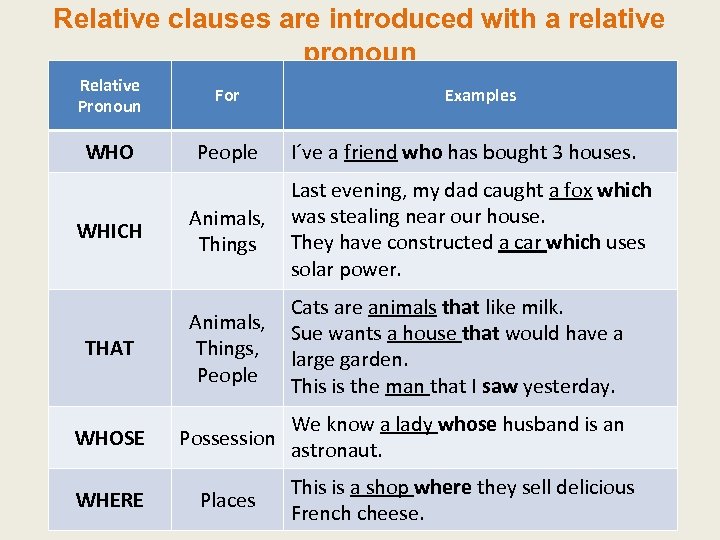 Relative clauses are introduced with a relative pronoun Relative Pronoun For WHO People WHICH THAT WHOSE WHERE Examples I´ve a friend who has bought 3 houses. Animals, Things Last evening, my dad caught a fox which was stealing near our house. They have constructed a car which uses solar power. Animals, Things, People Cats are animals that like milk. Sue wants a house that would have a large garden. This is the man that I saw yesterday. We know a lady whose husband is an Possession astronaut. Places This is a shop where they sell delicious French cheese.
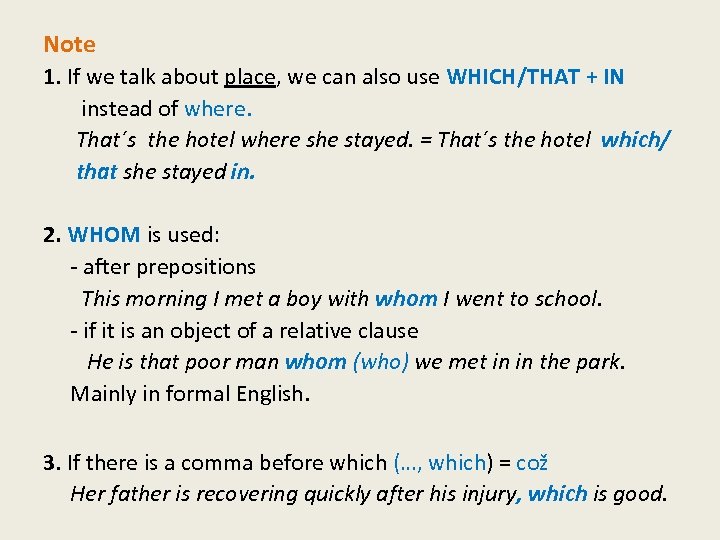 Note 1. If we talk about place, we can also use WHICH/THAT + IN instead of where. That´s the hotel where she stayed. = That´s the hotel which/ that she stayed in. 2. WHOM is used: - after prepositions This morning I met a boy with whom I went to school. - if it is an object of a relative clause He is that poor man whom (who) we met in in the park. Mainly in formal English. 3. If there is a comma before which (…, which) = což Her father is recovering quickly after his injury, which is good.
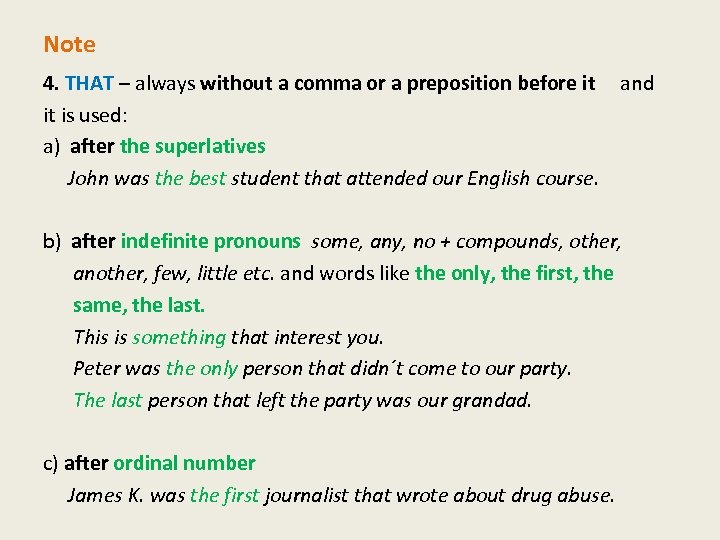 Note 4. THAT – always without a comma or a preposition before it and it is used: a) after the superlatives John was the best student that attended our English course. b) after indefinite pronouns some, any, no + compounds, other, another, few, little etc. and words like the only, the first, the same, the last. This is something that interest you. Peter was the only person that didn´t come to our party. The last person that left the party was our grandad. c) after ordinal number James K. was the first journalist that wrote about drug abuse.
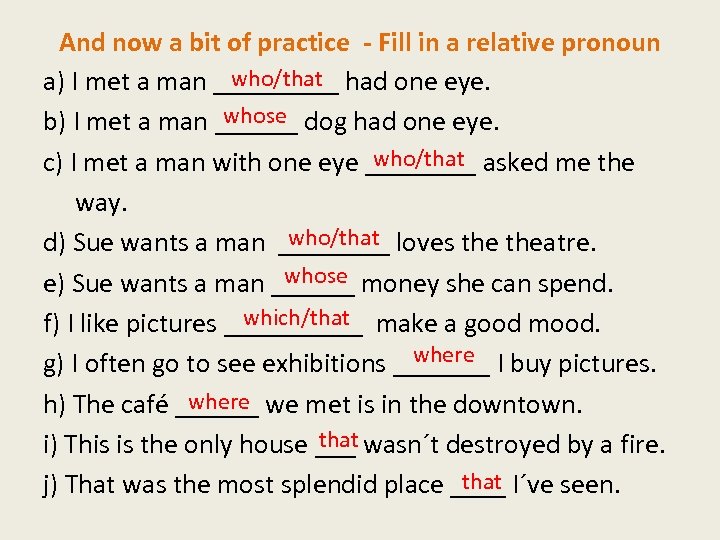 And now a bit of practice - Fill in a relative pronoun who/that a) I met a man _____ had one eye. whose b) I met a man ______ dog had one eye. who/that c) I met a man with one eye ____ asked me the way. who/that d) Sue wants a man ____ loves theatre. whose e) Sue wants a man ______ money she can spend. which/that f) I like pictures _____ make a good mood. where g) I often go to see exhibitions _______ I buy pictures. where h) The café ______ we met is in the downtown. that i) This is the only house ___ wasn´t destroyed by a fire. that j) That was the most splendid place ____ I´ve seen.
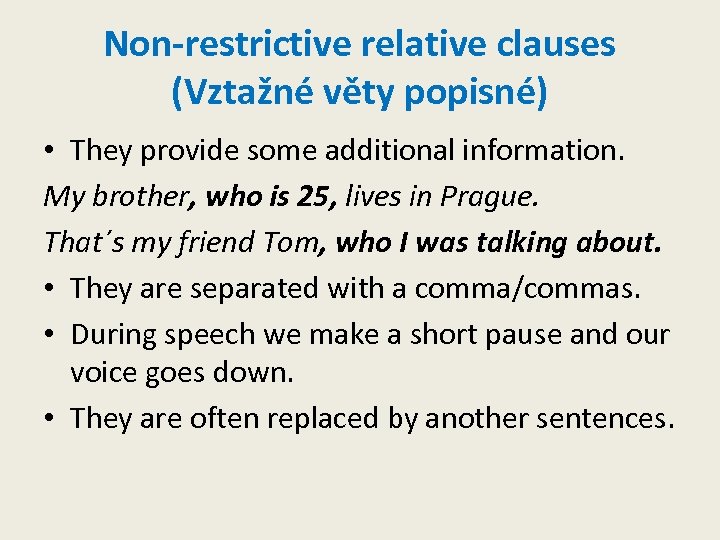 Non-restrictive relative clauses (Vztažné věty popisné) • They provide some additional information. My brother, who is 25, lives in Prague. That´s my friend Tom, who I was talking about. • They are separated with a comma/commas. • During speech we make a short pause and our voice goes down. • They are often replaced by another sentences.
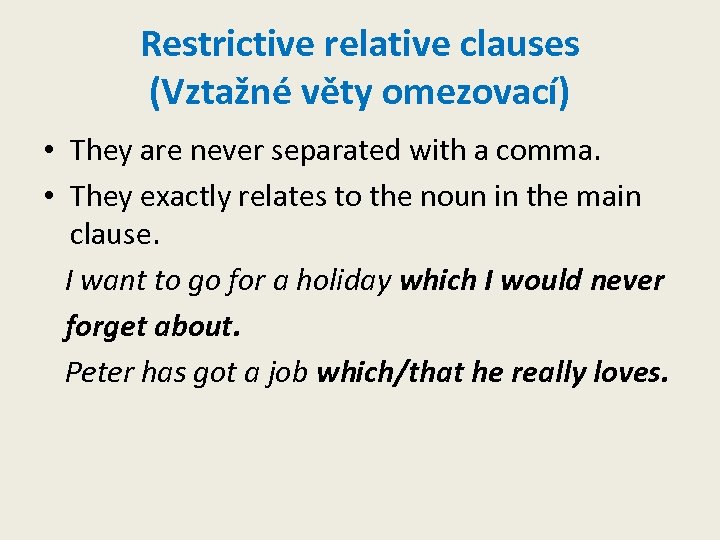 Restrictive relative clauses (Vztažné věty omezovací) • They are never separated with a comma. • They exactly relates to the noun in the main clause. I want to go for a holiday which I would never forget about. Peter has got a job which/that he really loves.
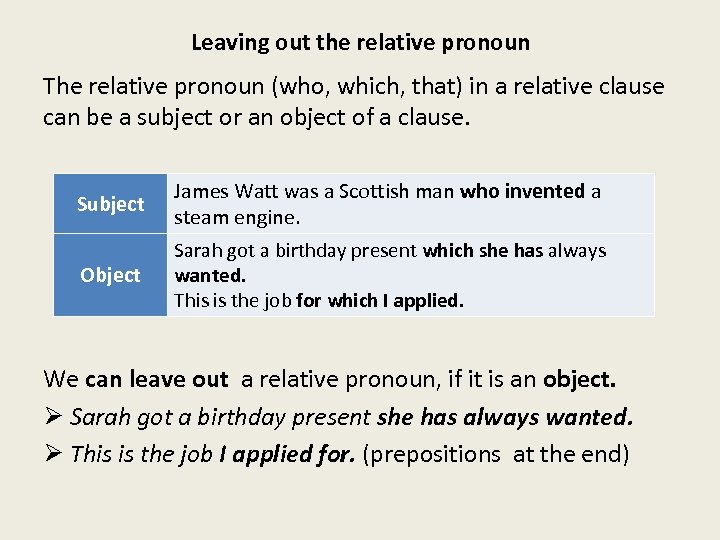 Leaving out the relative pronoun The relative pronoun (who, which, that) in a relative clause can be a subject or an object of a clause. Subject Object James Watt was a Scottish man who invented a steam engine. Sarah got a birthday present which she has always wanted. This is the job for which I applied. We can leave out a relative pronoun, if it is an object. Ø Sarah got a birthday present she has always wanted. Ø This is the job I applied for. (prepositions at the end)
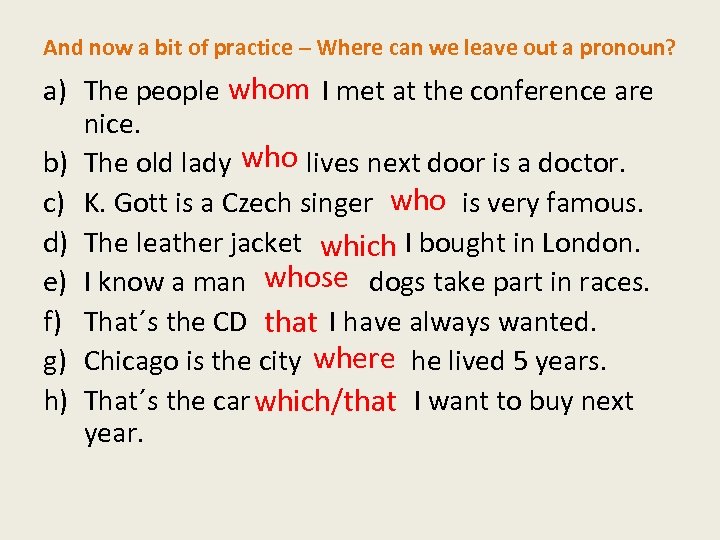 And now a bit of practice – Where can we leave out a pronoun? a) The people whom I met at the conference are nice. b) The old lady who lives next door is a doctor. c) K. Gott is a Czech singer who is very famous. d) The leather jacket which I bought in London. e) I know a man whose dogs take part in races. f) That´s the CD that I have always wanted. g) Chicago is the city where he lived 5 years. h) That´s the car which/that I want to buy next year.
 Metodické pokyny k materiálu 1) Tento digitální učební materiál je zaměřen na osvojení si učiva týkajícího se vztažných zájmen a jejich užití ve vztažných větách. 2) Na první straně se žáci seznámí se vztažnými zájmeny a pravidly pro jejich užití ve větách. 3) Další část materiálu je zaměřena na doplňování těchto zájmen to textu. 4) Další stránky se věnují popisným a omezovacím vztažným větám a pravidlům, která v těchto větách platí. 5) Poslední část je zaměřena na procvičení poznatků z předchozího bodu. 6) Metodické pokyny jsou uvedeny u cvičení. 7) Cvičení lze využít v papírové podobě nebo s nimi lze pracovat skupinově na interaktivní tabuli.
 Použité zdroje MURPHY, Raymond. English Grammar in Use. Intermediate. Cambridge: Cambridge University Press, 2004, ISBN 0 52153289 2. FOLEY, Mark; HALL, Diane. My Grammar Lab: Intermediate. Harlow: Pearson, 2013, ISBN 9781408299159. Cvičení – vlastní tvorba