 Скачать презентацию Navigating the Brain Mark P Wachowiak Ph D
46247529305acf2b9c42f0ad6bc4b85b.ppt
- Количество слайдов: 61



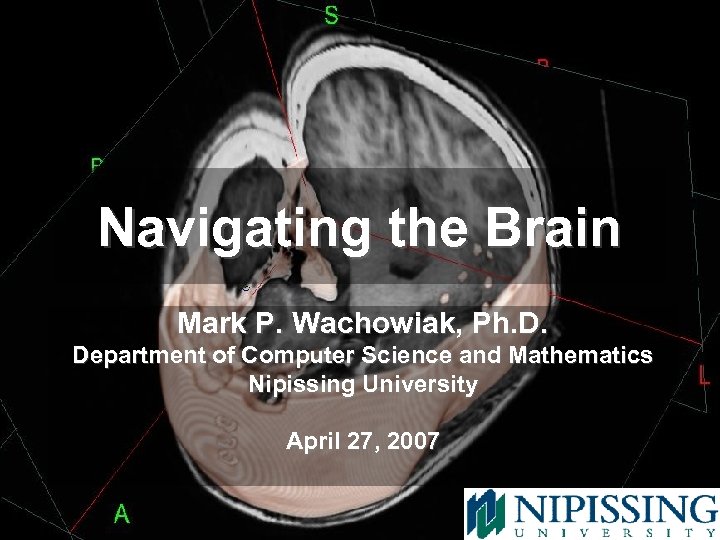
Navigating the Brain Mark P. Wachowiak, Ph. D. Department of Computer Science and Mathematics Nipissing University April 27, 2007
Outline • Basic brain anatomy • Brain imaging – Magnetic resonance imaging (MRI) – Computed tomography (CT) – Functional imaging • Brain navigation • Future directions
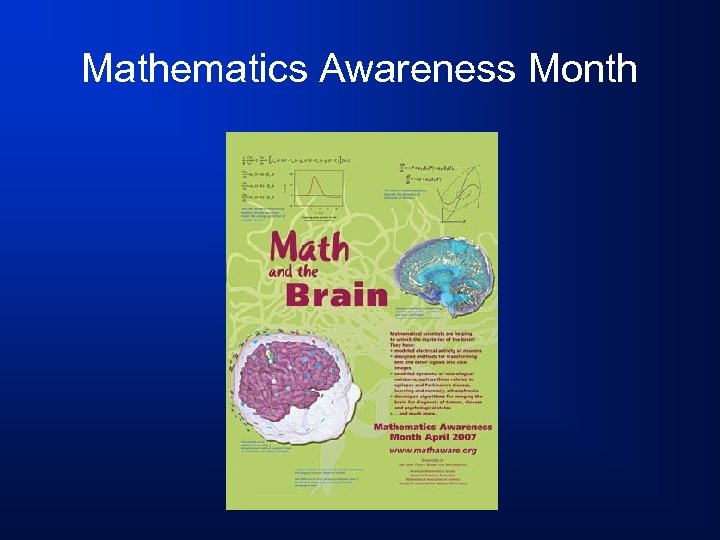
Mathematics Awareness Month
Interdisciplinary Nature of Brain Research • • Neuroscientists Physicians Psychologists Mathematicians Biologists Engineers Computer scientists
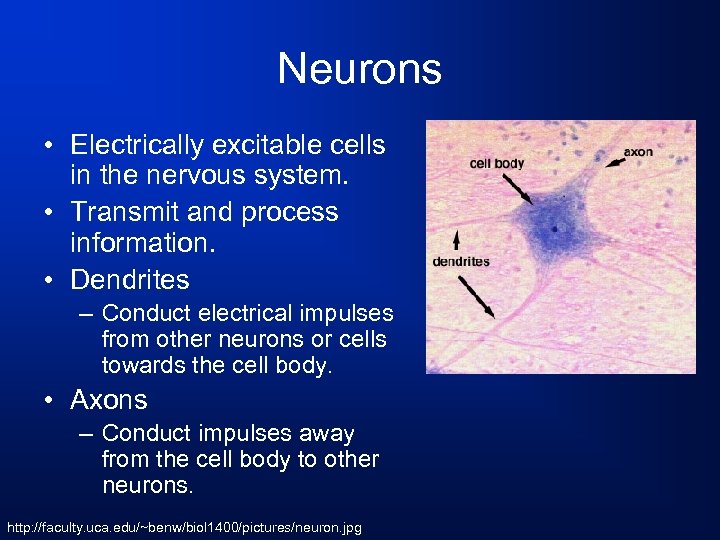
Neurons • Electrically excitable cells in the nervous system. • Transmit and process information. • Dendrites – Conduct electrical impulses from other neurons or cells towards the cell body. • Axons – Conduct impulses away from the cell body to other neurons. http: //faculty. uca. edu/~benw/biol 1400/pictures/neuron. jpg
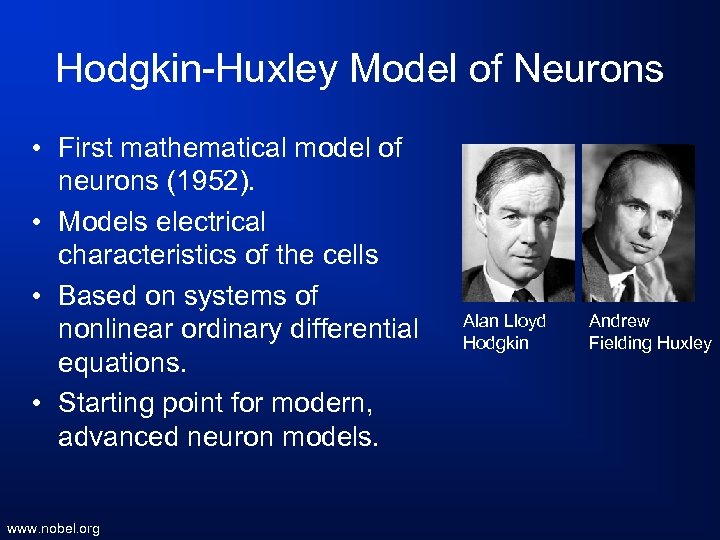
Hodgkin-Huxley Model of Neurons • First mathematical model of neurons (1952). • Models electrical characteristics of the cells • Based on systems of nonlinear ordinary differential equations. • Starting point for modern, advanced neuron models. www. nobel. org Alan Lloyd Hodgkin Andrew Fielding Huxley
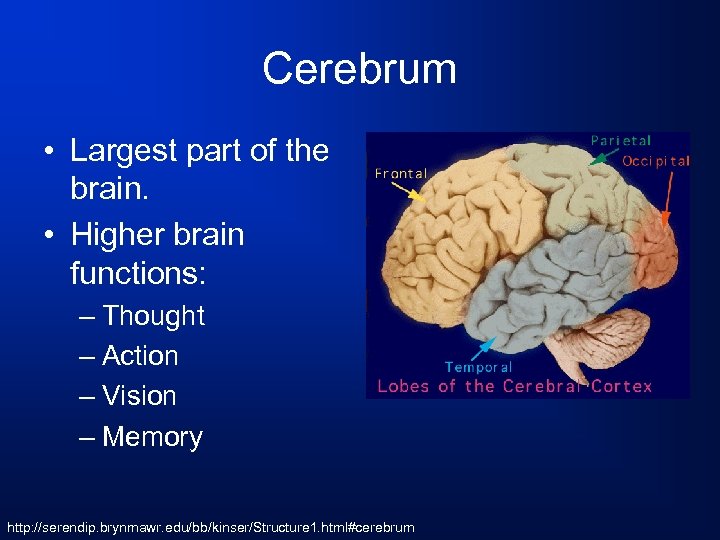
Cerebrum • Largest part of the brain. • Higher brain functions: – Thought – Action – Vision – Memory http: //serendip. brynmawr. edu/bb/kinser/Structure 1. html#cerebrum
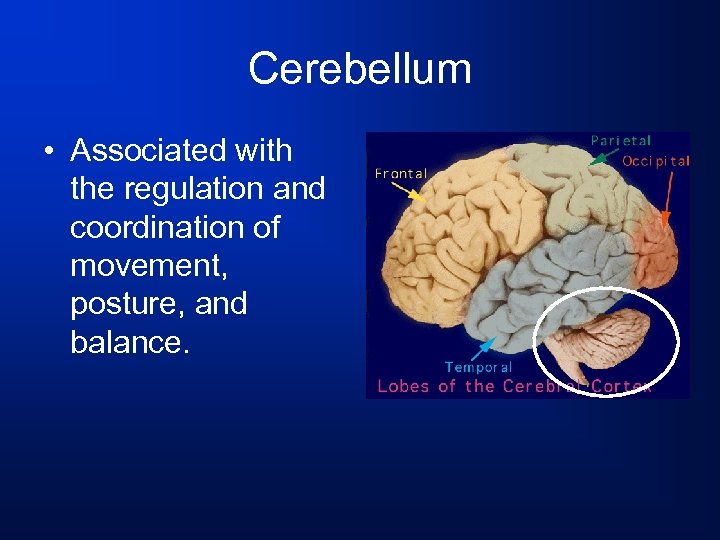
Cerebellum • Associated with the regulation and coordination of movement, posture, and balance.
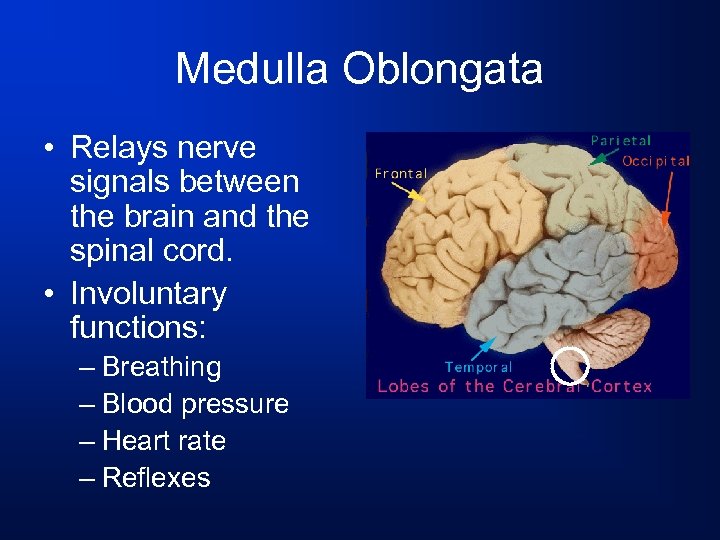
Medulla Oblongata • Relays nerve signals between the brain and the spinal cord. • Involuntary functions: – Breathing – Blood pressure – Heart rate – Reflexes
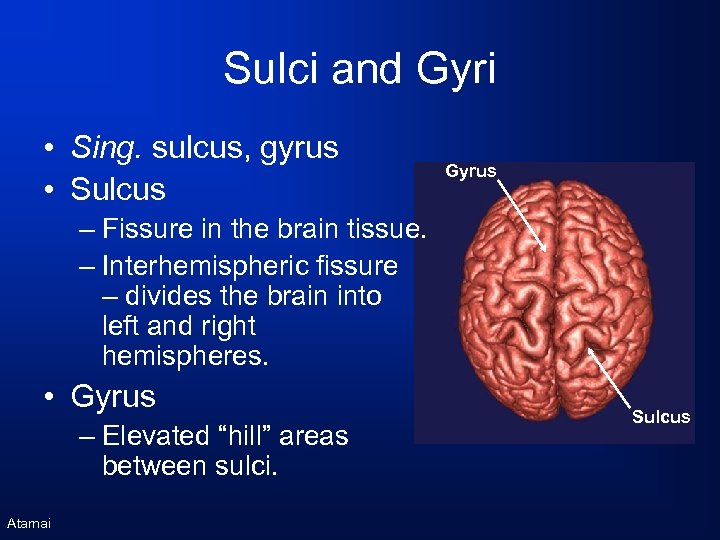
Sulci and Gyri • Sing. sulcus, gyrus • Sulcus Gyrus – Fissure in the brain tissue. – Interhemispheric fissure – divides the brain into left and right hemispheres. • Gyrus – Elevated “hill” areas between sulci. Atamai Sulcus
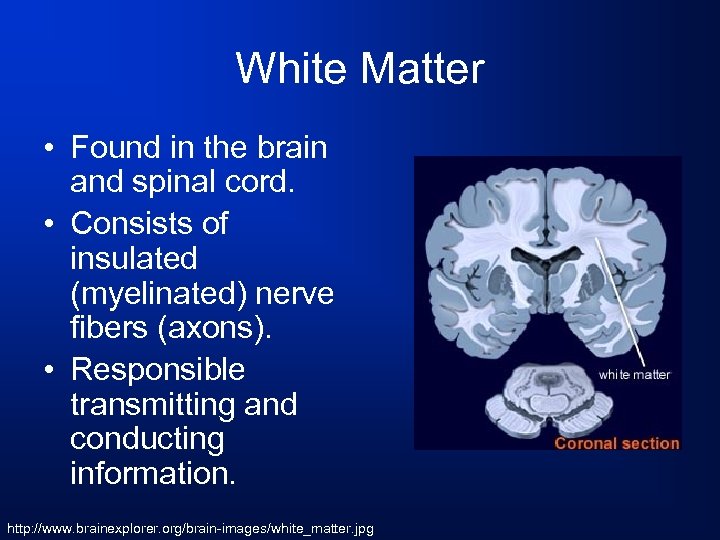
White Matter • Found in the brain and spinal cord. • Consists of insulated (myelinated) nerve fibers (axons). • Responsible transmitting and conducting information. http: //www. brainexplorer. org/brain-images/white_matter. jpg
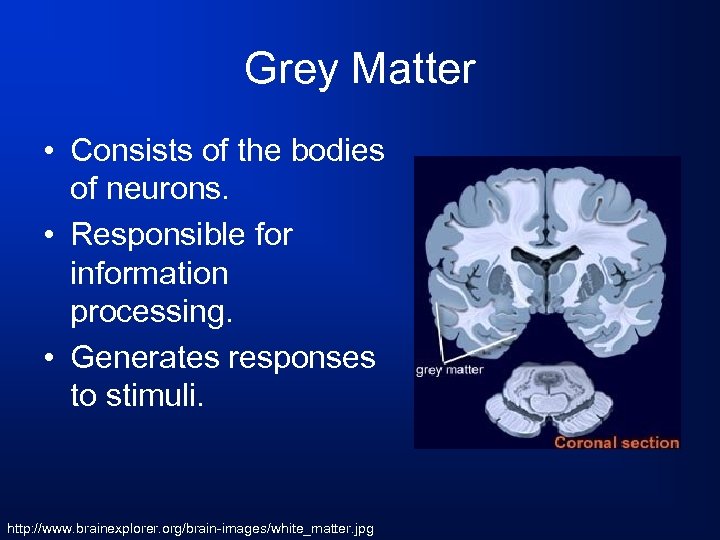
Grey Matter • Consists of the bodies of neurons. • Responsible for information processing. • Generates responses to stimuli. http: //www. brainexplorer. org/brain-images/white_matter. jpg
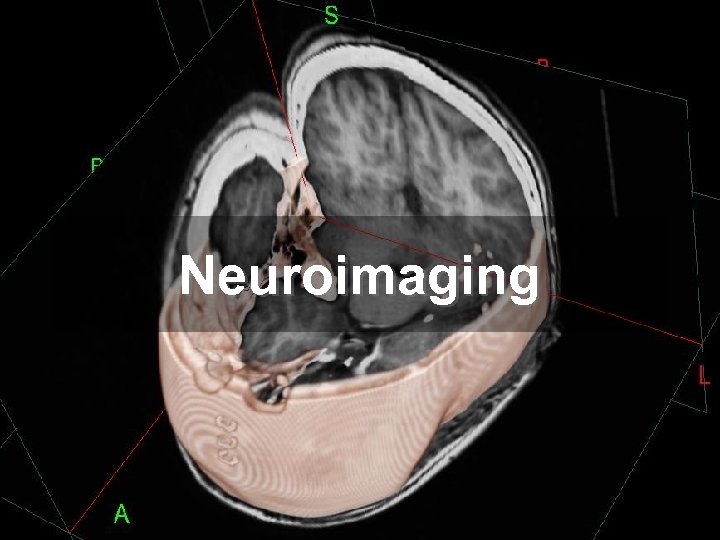
Neuroimaging
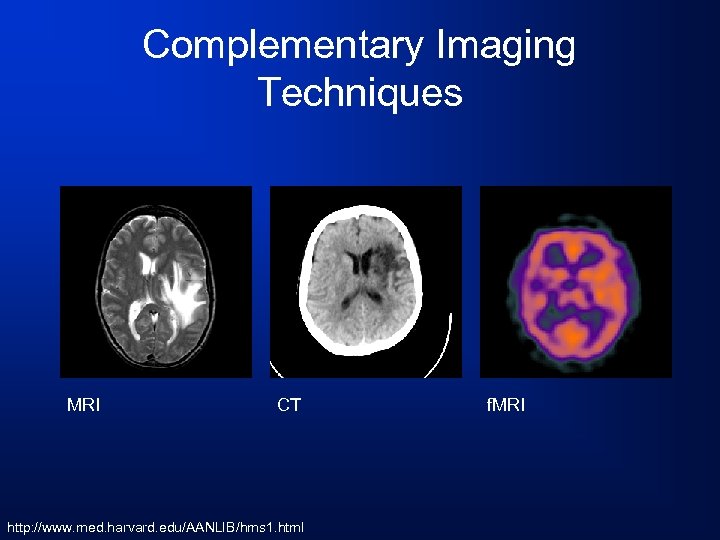
Types of Neuroimaging • Structural – Magnetic resonance imaging – Computed tomography – Ultrasound • Functional – Functional MRI – Positron emission tomography – Single photon emission computed tomography
Magnetic Resonance Imaging • Excellent for clearly visualizing structures in soft tissues, such as the brain. • Very commonly used in: – Diagnosis – Image-guided surgery and therapy • By adjusting scanning settings, specific features can be detected. • MRI images are 2 D slices through the body at a specific location.
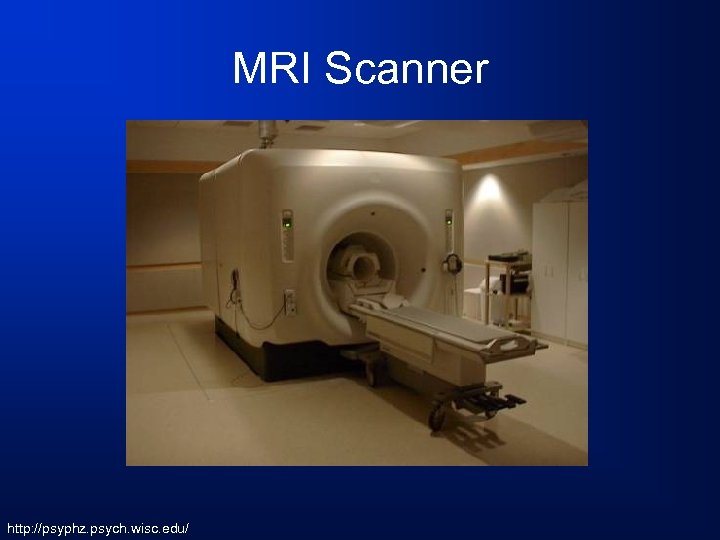
MRI Scanner http: //psyphz. psych. wisc. edu/
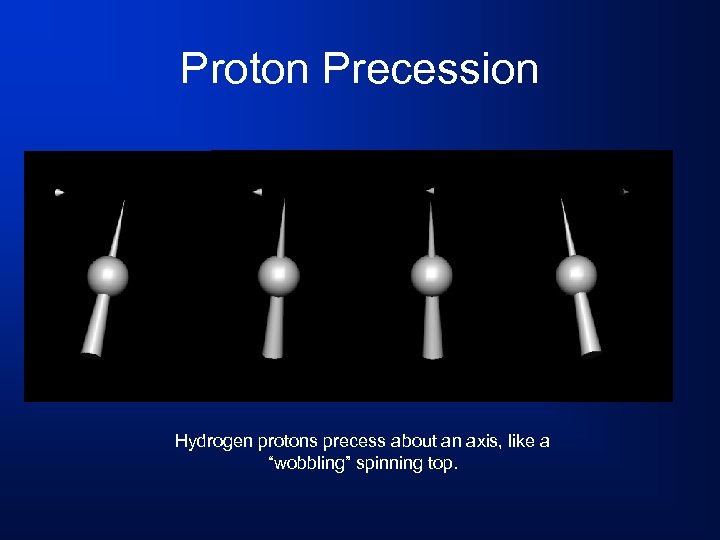
Proton Precession Hydrogen protons precess about an axis, like a “wobbling” spinning top.
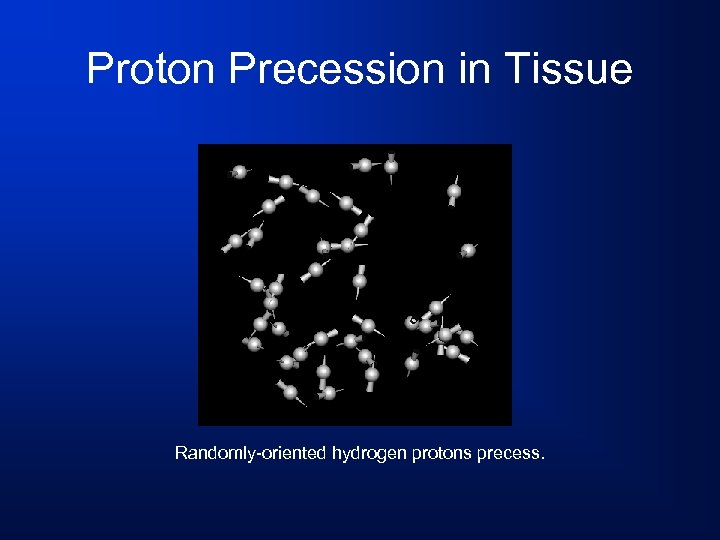
Proton Precession in Tissue Randomly-oriented hydrogen protons precess.
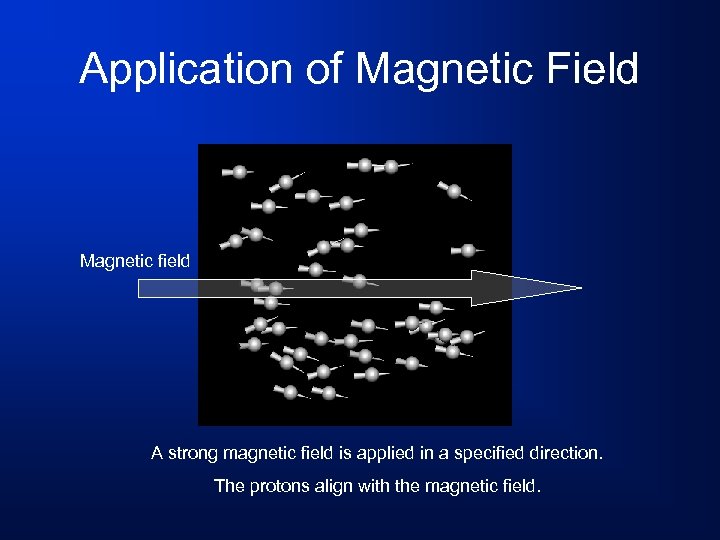
Application of Magnetic Field Magnetic field A strong magnetic field is applied in a specified direction. The protons align with the magnetic field.
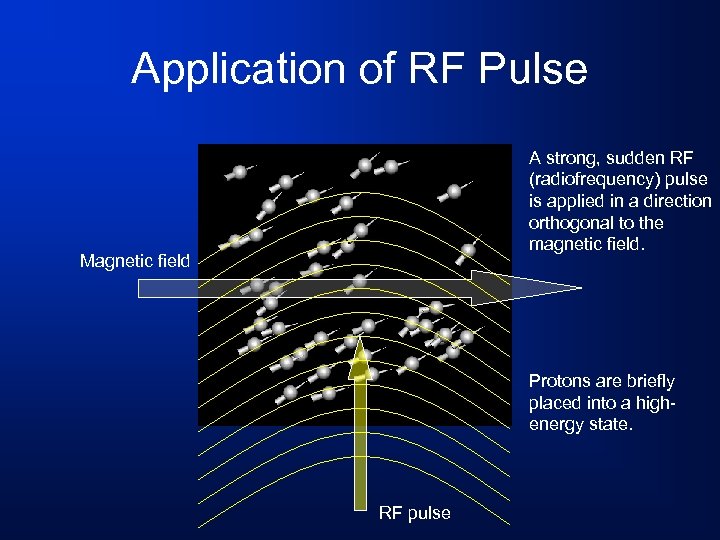
Application of RF Pulse A strong, sudden RF (radiofrequency) pulse is applied in a direction orthogonal to the magnetic field. Magnetic field Protons are briefly placed into a highenergy state. RF pulse
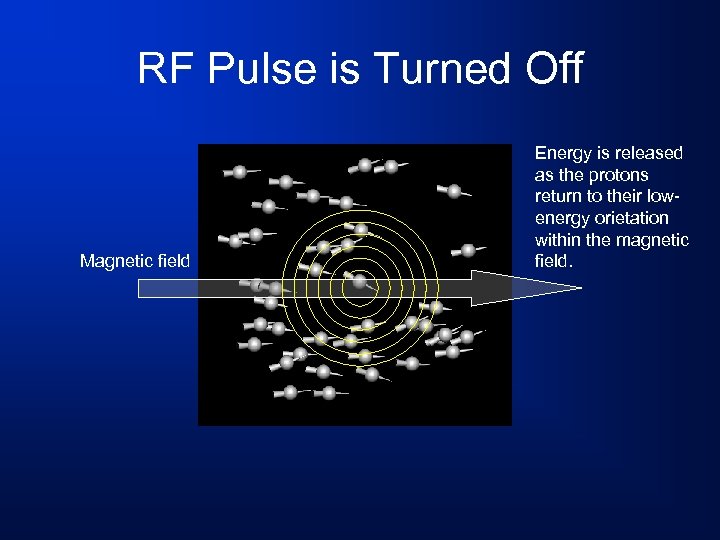
RF Pulse is Turned Off Magnetic field Energy is released as the protons return to their lowenergy orietation within the magnetic field.
MRI Image Formation • When the RF pulse is turned off, the hydrogen protons return to their natural alignment within the magnetic field. • Energy is released. • The coil detects this signal and sends it to a computer for processing. • The signal consists of complex values which have real and imaginary components.
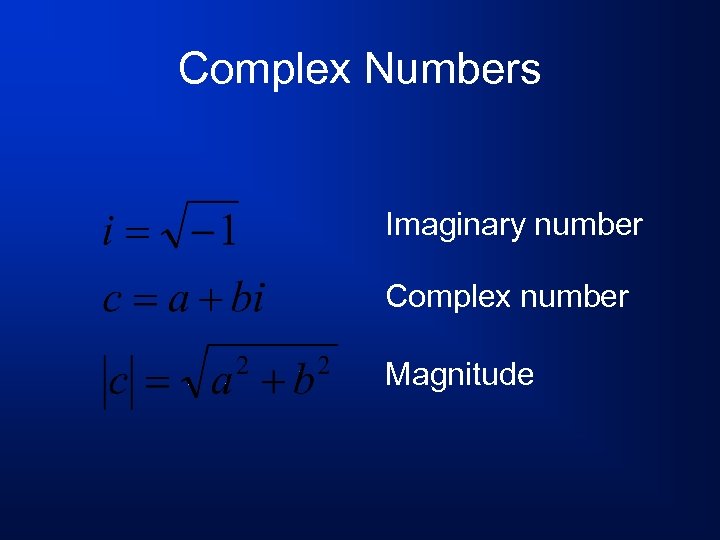
Complex Numbers Imaginary number Complex number Magnitude
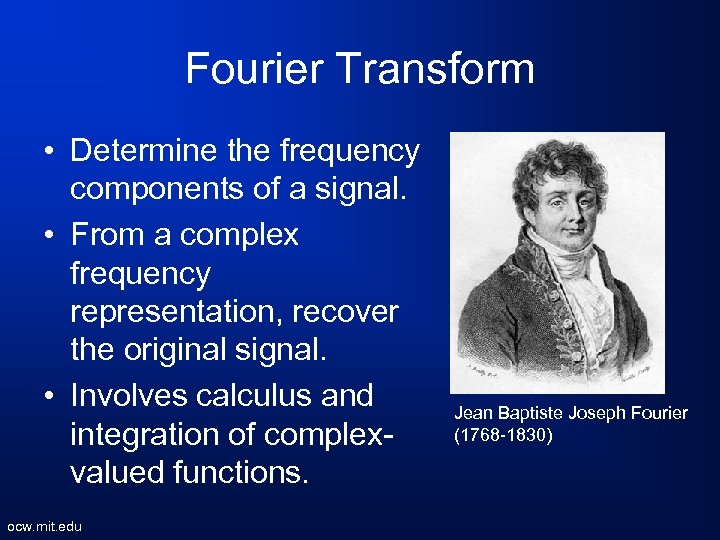
Fourier Transform • Determine the frequency components of a signal. • From a complex frequency representation, recover the original signal. • Involves calculus and integration of complexvalued functions. ocw. mit. edu Jean Baptiste Joseph Fourier (1768 -1830)
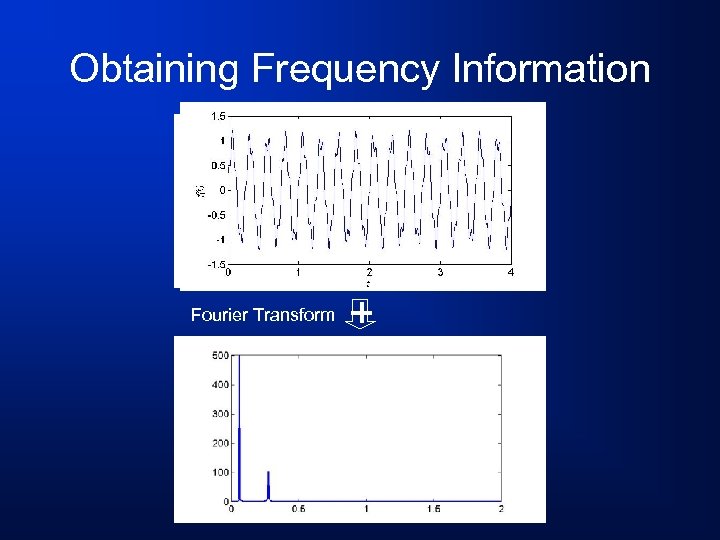
Obtaining Frequency Information Fourier Transform +
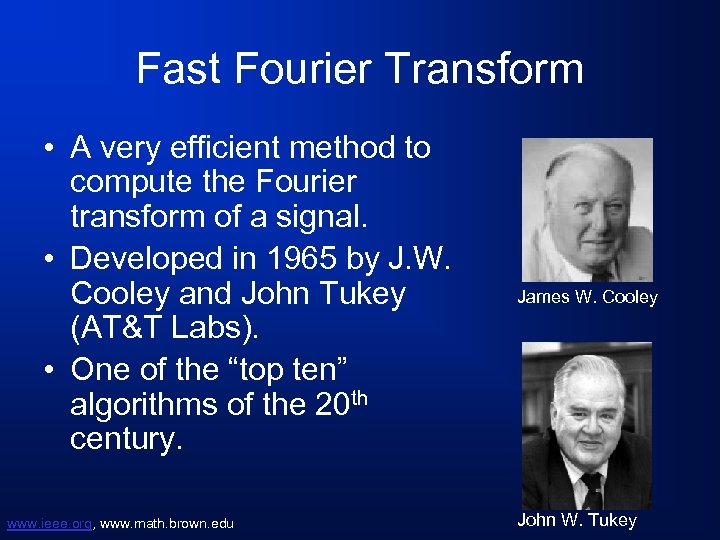
Fast Fourier Transform • A very efficient method to compute the Fourier transform of a signal. • Developed in 1965 by J. W. Cooley and John Tukey (AT&T Labs). • One of the “top ten” algorithms of the 20 th century. www. ieee. org, www. math. brown. edu James W. Cooley John W. Tukey
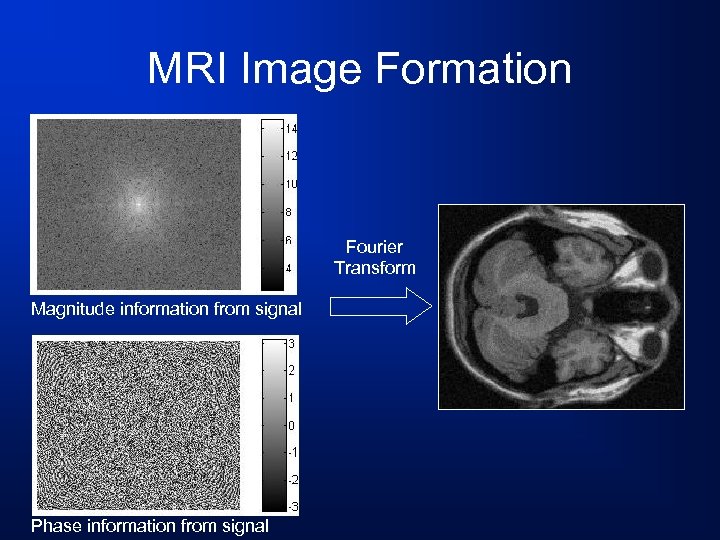
MRI Image Formation Fourier Transform Magnitude information from signal Phase information from signal
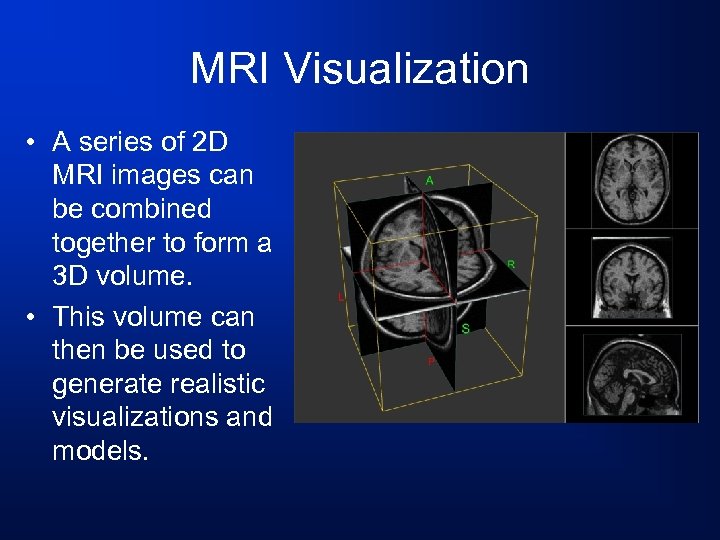
MRI Visualization • A series of 2 D MRI images can be combined together to form a 3 D volume. • This volume can then be used to generate realistic visualizations and models.
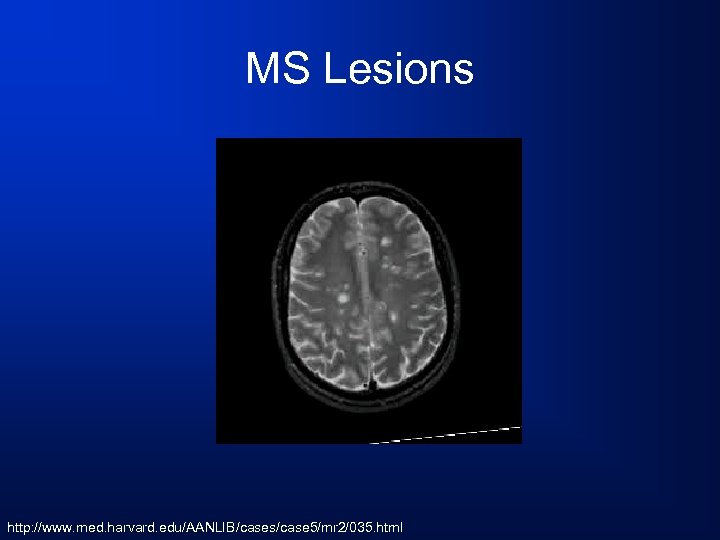
MS Lesions http: //www. med. harvard. edu/AANLIB/cases/case 5/mr 2/035. html
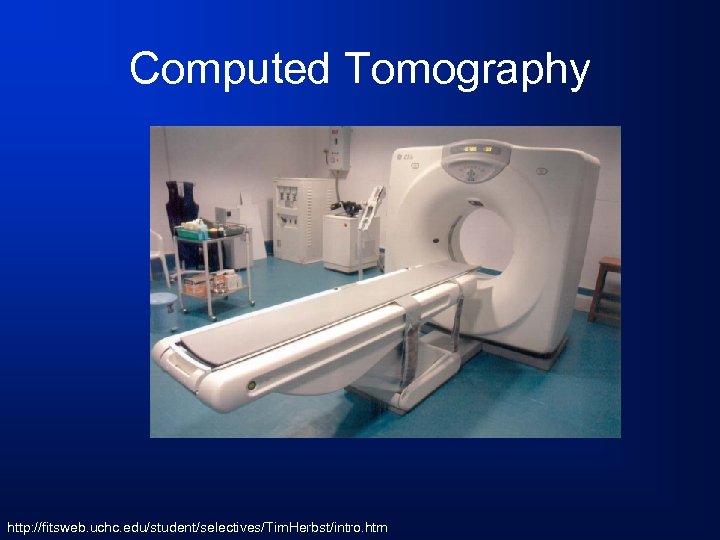
Computed Tomography (CT) • Tomography – Imaging in sections, or slices. • Computed – Geometric processing used to reconstruct an image. – Computerized algorithms
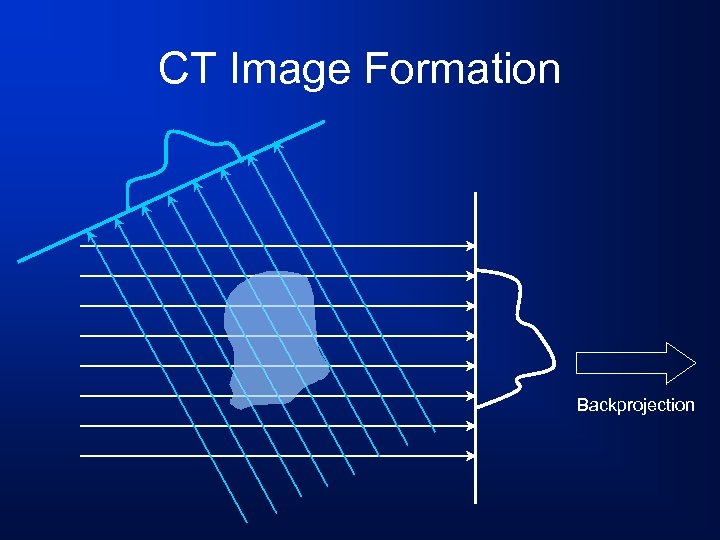
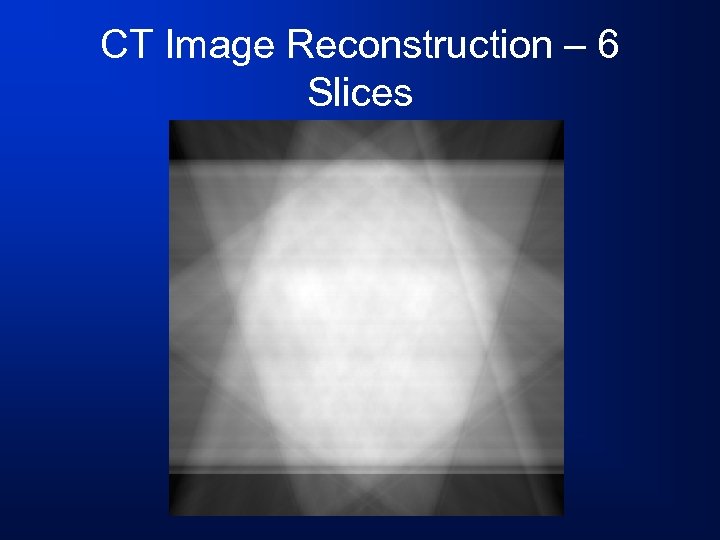
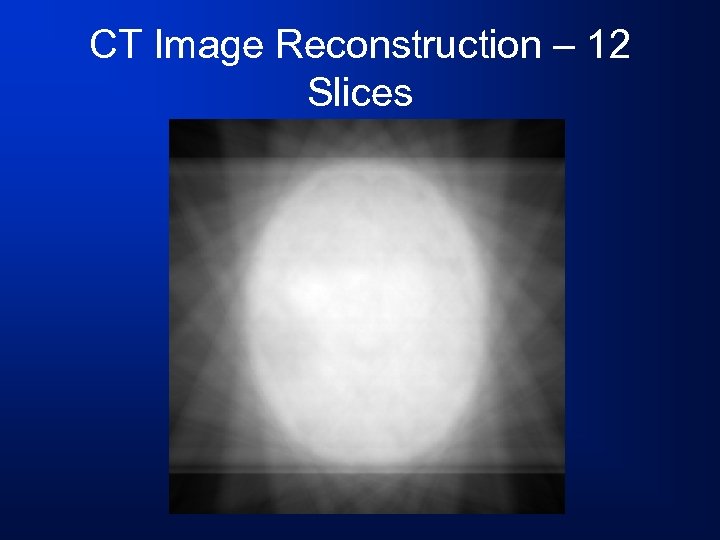
Computed Tomography (2) • Uses X-rays – Dense tissue, like bone, blocks x-rays. – Gray matter weakens (attenuates) the x-rays. – Fluid attenuates even less. • A computerized algorithm (filtered backprojection) reconstructs an image of each slice.
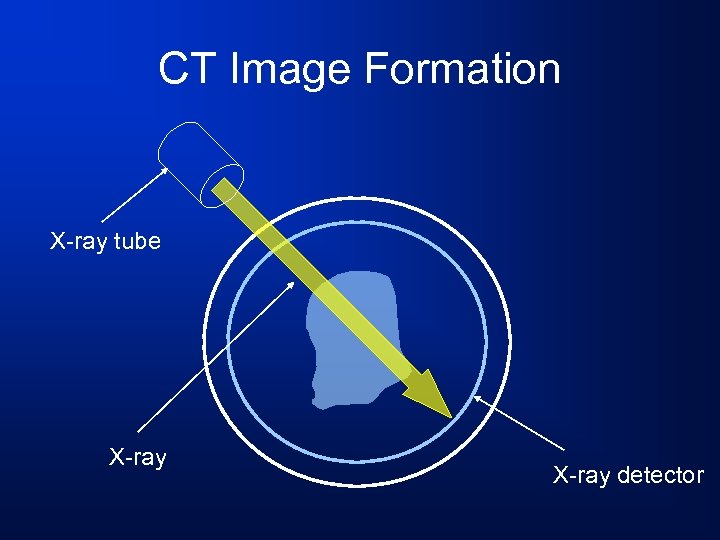
CT Image Formation X-ray tube X-ray detector
Computed Tomography http: //fitsweb. uchc. edu/student/selectives/Tim. Herbst/intro. htm
CT Image Formation Backprojection
CT Image Reconstruction – 6 Slices
CT Image Reconstruction – 12 Slices
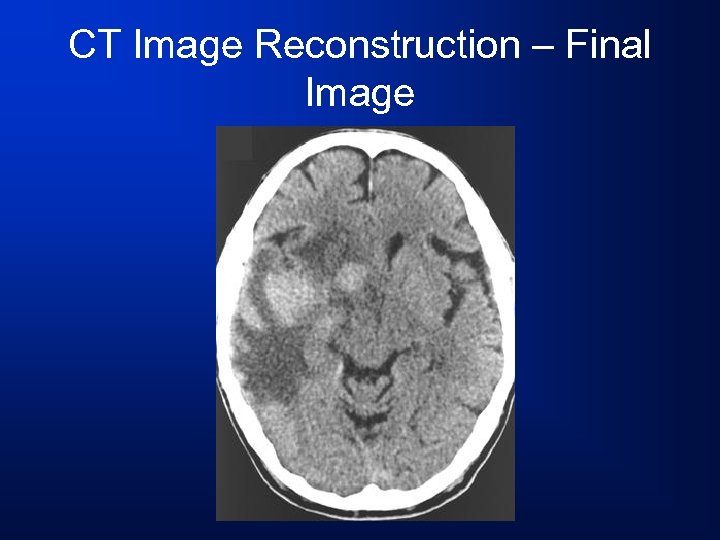
CT Image Reconstruction – Final Image
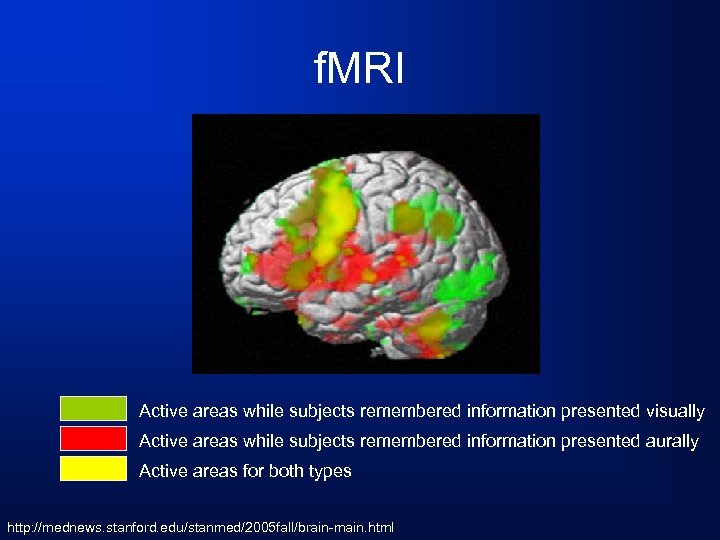
f. MRI • Functional MRI – used to investigate brain function. • Enables watching brain activity in vivo. • Measures haemodynamic response. – Changes in oxygen content of the blood occur as the result of neuronal activity.
Interdisciplinary Nature of f. MRI • Physics – Hardware tools • Electrophysiology – Neuronal behaviour • Psychology – Cognitive psychology • Statistics – Making sense of observations • Neuroanatomy
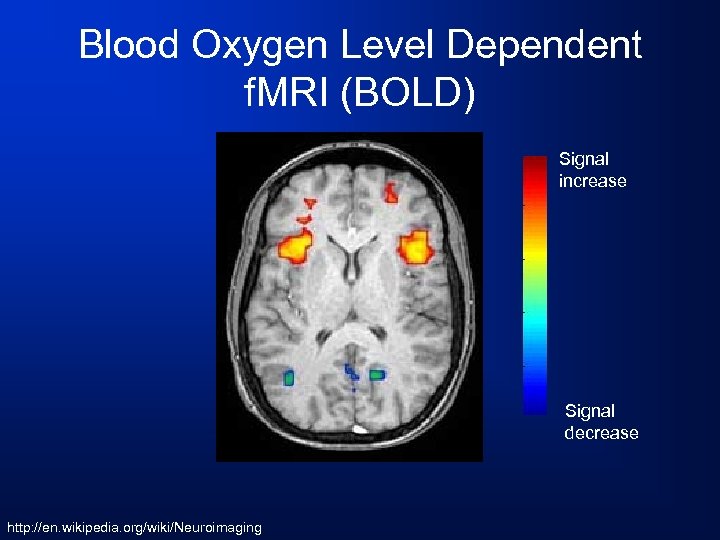
Blood Oxygen Level Dependent f. MRI (BOLD) Signal increase Signal decrease http: //en. wikipedia. org/wiki/Neuroimaging
f. MRI Active areas while subjects remembered information presented visually Active areas while subjects remembered information presented aurally Active areas for both types http: //mednews. stanford. edu/stanmed/2005 fall/brain-main. html
Complementary Imaging Techniques MRI CT http: //www. med. harvard. edu/AANLIB/hms 1. html f. MRI
Brain Navigation
Mathematical Challenges in Neuroimaging • Segmentation – Identifying structures or abnormalities from 2 D or 3 D brain images. – Development of models to help plan surgery and therapy. – Concepts from computer graphics, geometry, topology, probability theory.
Mathematical Challenges in Brain Imaging • Registration – Aligning and combining images from the same or different type of image. – Useful in simulation, modeling, and in planning surgical procedures. – Employs concepts from probability theory, information theory, geometry, topology, optimization, parallel computing, and many other areas.
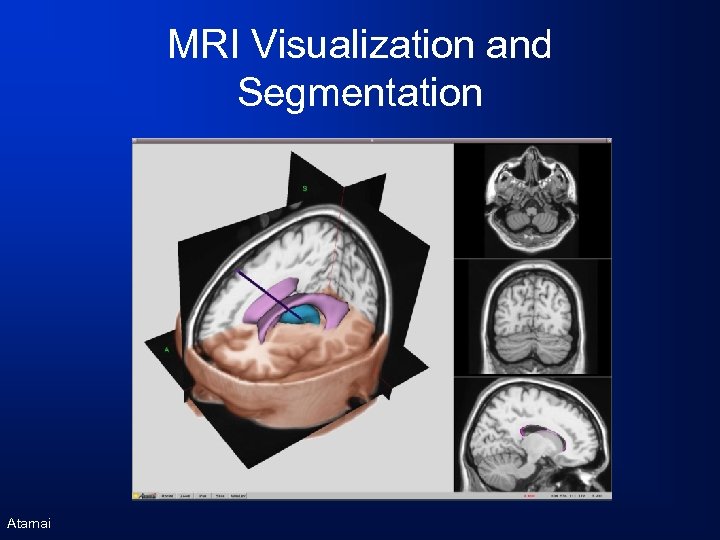
MRI Visualization and Segmentation Atamai
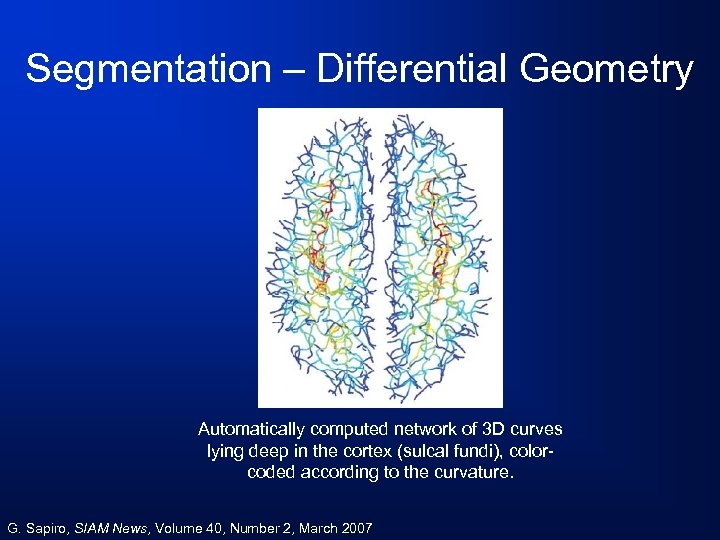
Segmentation – Differential Geometry Automatically computed network of 3 D curves lying deep in the cortex (sulcal fundi), colorcoded according to the curvature. G. Sapiro, SIAM News, Volume 40, Number 2, March 2007
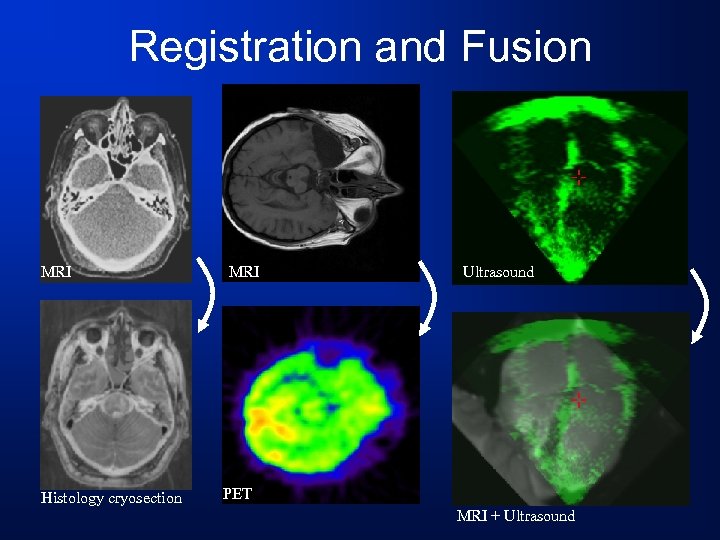
Registration and Fusion MRI Histology cryosection MRI Ultrasound PET MRI + Ultrasound
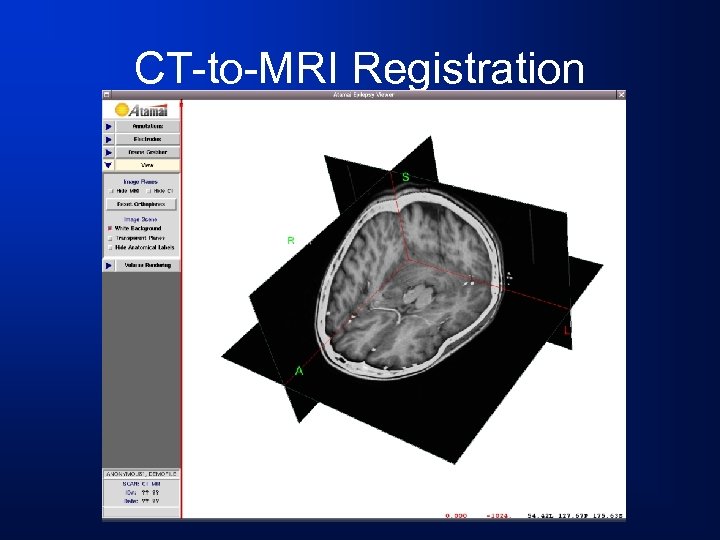
CT-to-MRI Registration
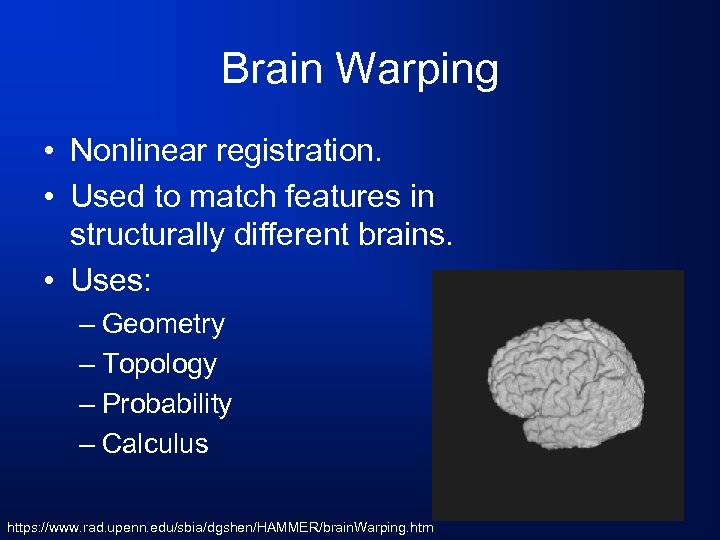
Brain Warping • Nonlinear registration. • Used to match features in structurally different brains. • Uses: – Geometry – Topology – Probability – Calculus https: //www. rad. upenn. edu/sbia/dgshen/HAMMER/brain. Warping. htm
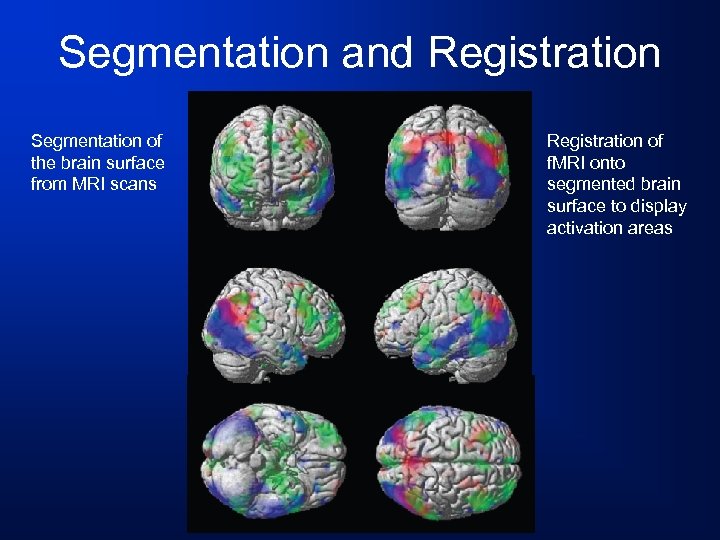
Segmentation and Registration Segmentation of the brain surface from MRI scans Registration of f. MRI onto segmented brain surface to display activation areas
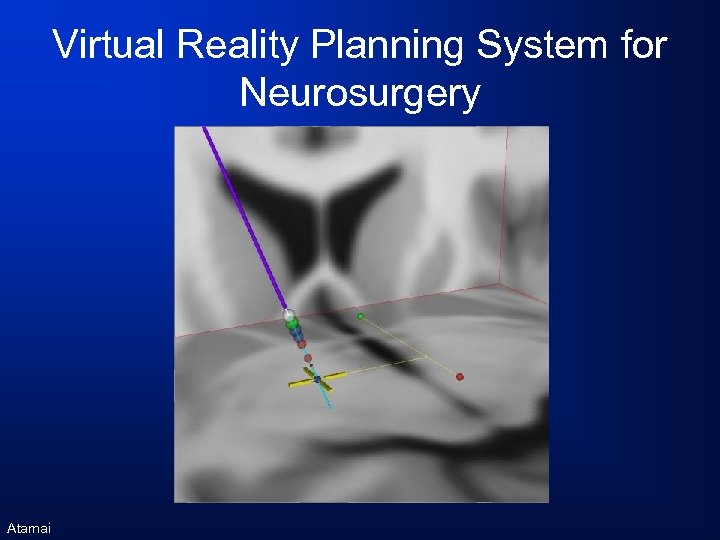
Virtual Reality Planning System for Neurosurgery Atamai
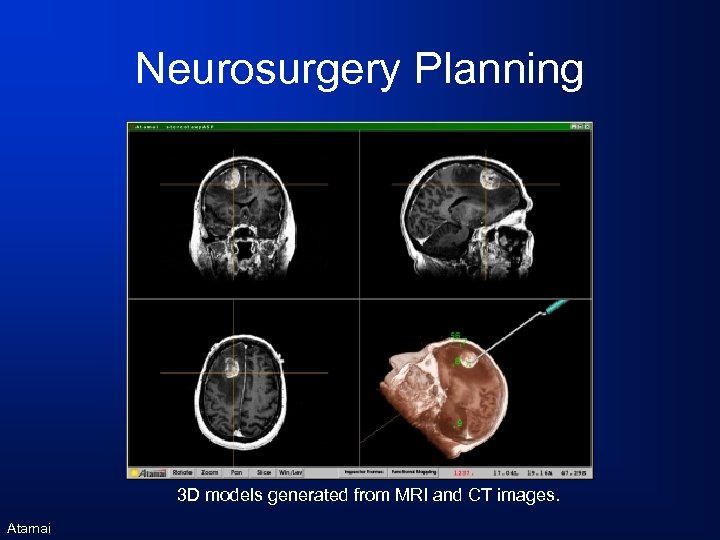
Neurosurgery Planning 3 D models generated from MRI and CT images. Atamai
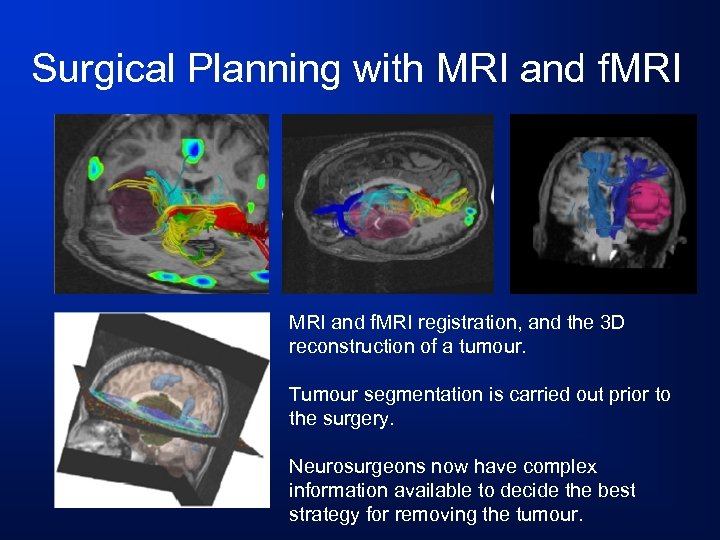
Surgical Planning with MRI and f. MRI registration, and the 3 D reconstruction of a tumour. Tumour segmentation is carried out prior to the surgery. Neurosurgeons now have complex information available to decide the best strategy for removing the tumour.
Future Areas • Functional imaging for to relieve acute and chronic pain. • Modeling to develop better therapies for: – Alzheimer’s disease – Multiple sclerosis – Brain tumours – Strokes – Psychiatric disorders – Other neurological and brain diseases
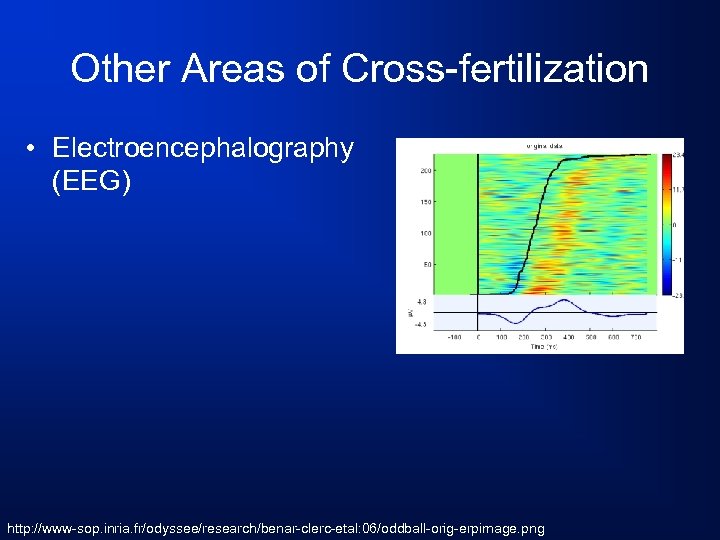
Other Areas of Cross-fertilization • Electroencephalography (EEG) http: //www-sop. inria. fr/odyssee/research/benar-clerc-etal: 06/oddball-orig-erpimage. png
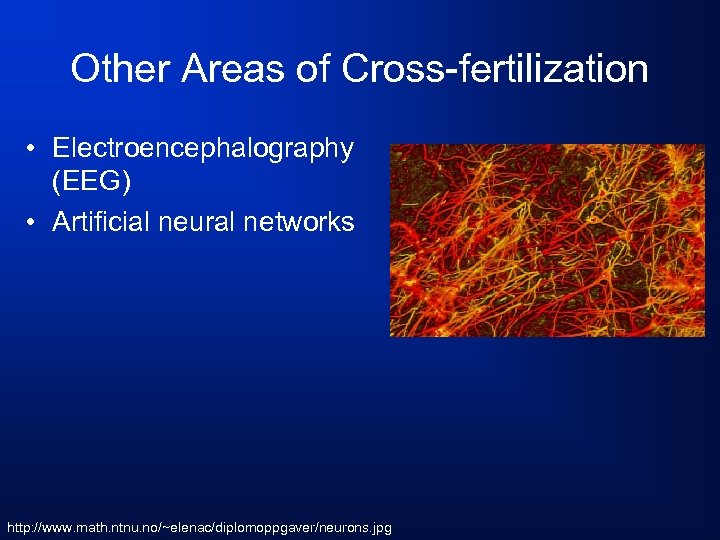
Other Areas of Cross-fertilization • Electroencephalography (EEG) • Artificial neural networks http: //www. math. ntnu. no/~elenac/diplomoppgaver/neurons. jpg
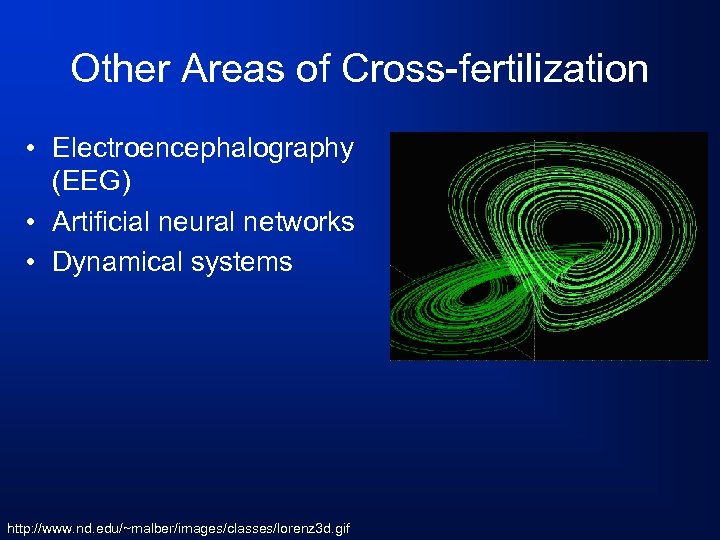
Other Areas of Cross-fertilization • Electroencephalography (EEG) • Artificial neural networks • Dynamical systems http: //www. nd. edu/~malber/images/classes/lorenz 3 d. gif
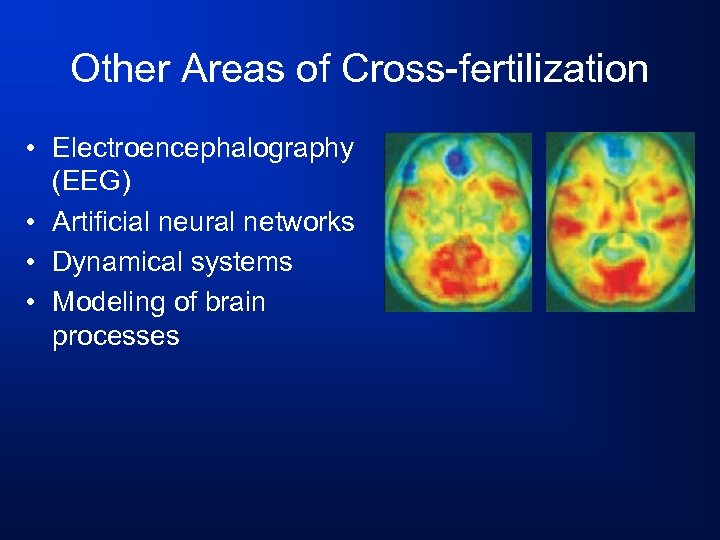
Other Areas of Cross-fertilization • Electroencephalography (EEG) • Artificial neural networks • Dynamical systems • Modeling of brain processes
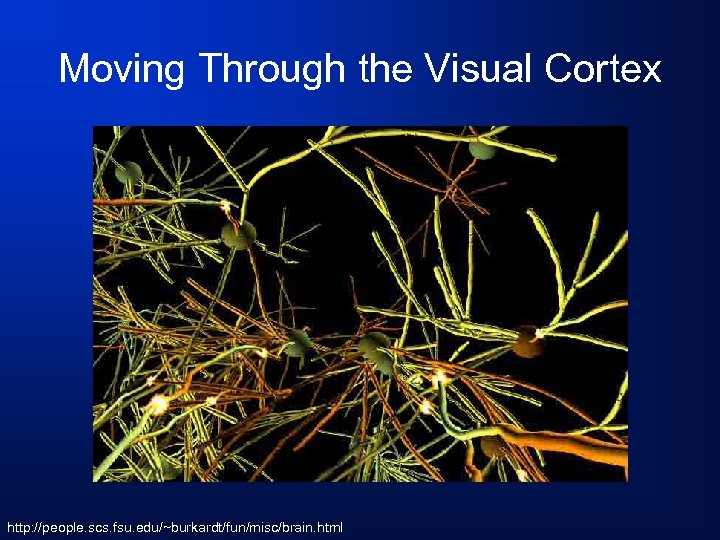
Moving Through the Visual Cortex http: //people. scs. fsu. edu/~burkardt/fun/misc/brain. html
Thank You. http: //www. nipissingu. ca/numeric
Скачать презентацию Navigating the Brain Mark P Wachowiak Ph D
46247529305acf2b9c42f0ad6bc4b85b.ppt