


 Скачать презентацию Naval Program on Human Modeling for Computer Generated
f72867046d53008998123e09dbfbc044.ppt
- Количество слайдов: 20
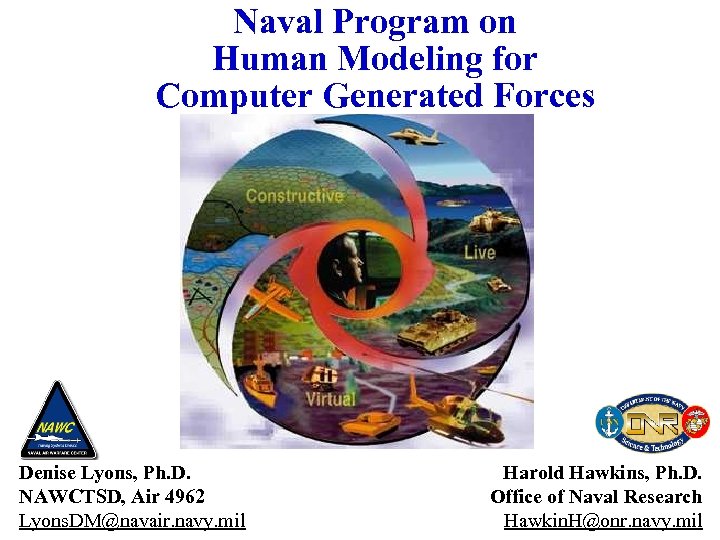 Naval Program on Human Modeling for Computer Generated Forces Denise Lyons, Ph. D. NAWCTSD, Air 4962 Lyons. DM@navair. navy. mil Harold Hawkins, Ph. D. Office of Naval Research Hawkin. H@onr. navy. mil
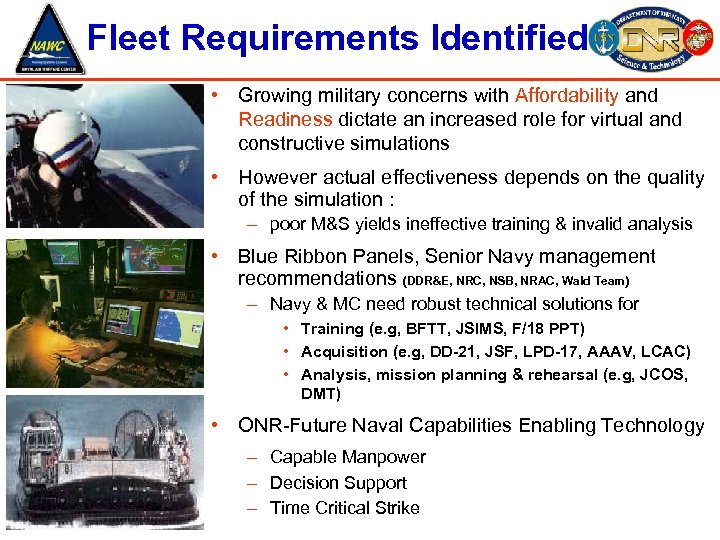 Fleet Requirements Identified • Growing military concerns with Affordability and Readiness dictate an increased role for virtual and constructive simulations • However actual effectiveness depends on the quality of the simulation : – poor M&S yields ineffective training & invalid analysis • Blue Ribbon Panels, Senior Navy management recommendations (DDR&E, NRC, NSB, NRAC, Wald Team) – Navy & MC need robust technical solutions for • Training (e. g, BFTT, JSIMS, F/18 PPT) • Acquisition (e. g, DD-21, JSF, LPD-17, AAAV, LCAC) • Analysis, mission planning & rehearsal (e. g, JCOS, DMT) • ONR-Future Naval Capabilities Enabling Technology – Capable Manpower – Decision Support – Time Critical Strike
 Naval (and Do. D) Interests in Cognitive Modeling • Good predictive models of human cognition & performance needed in military simulations for training and analysis – Challenging simulated adversaries and intelligent team mates for simulation-based training and mission rehearsal – Intelligent tutors and diagnostic student models for intelligent computer -aided instruction – Human-like intelligence for • Mission planning • Human-system interface design • Requirements identification and assessment • Decision support • Simulation-based acquisition • High level control techniques for autonomous platforms
 Human Modeling Thrust Targets Shortcomings of Current CGF Technology • Current military simulation environments rely on Semi-Automated Forces (controller augmented) because underlying models of behavior exhibit limited capabilities – Behave predictably, usually according to doctrine, making them gameable – Reactive planning absent or highly restricted – Sensitivity to performance modulators (stress, risk aversion, fatigue, training, fear, etc) limited, often not validated – Situation awareness capabilities limited – Do not generate useful self-explanation – Many lack integrated perceptual-motor and cognitive systems – Limited in ability to respond reasonably to unanticipated events (robustness) – Mechanisms for learning from experience (adaptability) lacking or limited These are some of the shortfalls the Program aims to address
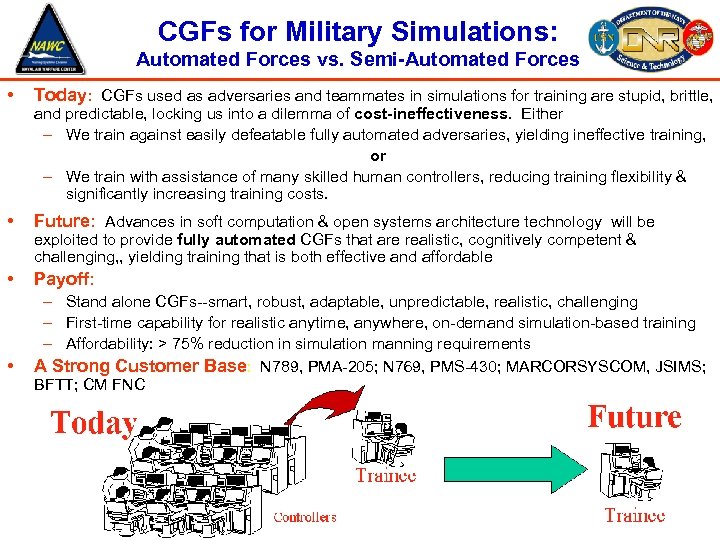 CGFs for Military Simulations: Automated Forces vs. Semi-Automated Forces • Today: CGFs used as adversaries and teammates in simulations for training are stupid, brittle, • Future: Advances in soft computation & open systems architecture technology will be • Payoff: • and predictable, locking us into a dilemma of cost-ineffectiveness. Either – We train against easily defeatable fully automated adversaries, yielding ineffective training, or – We train with assistance of many skilled human controllers, reducing training flexibility & significantly increasing training costs. exploited to provide fully automated CGFs that are realistic, cognitively competent & challenging, , yielding training that is both effective and affordable – Stand alone CGFs--smart, robust, adaptable, unpredictable, realistic, challenging – First-time capability for realistic anytime, anywhere, on-demand simulation-based training – Affordability: > 75% reduction in simulation manning requirements A Strong Customer Base: N 789, PMA-205; N 769, PMS-430; MARCORSYSCOM, JSIMS; BFTT; CM FNC
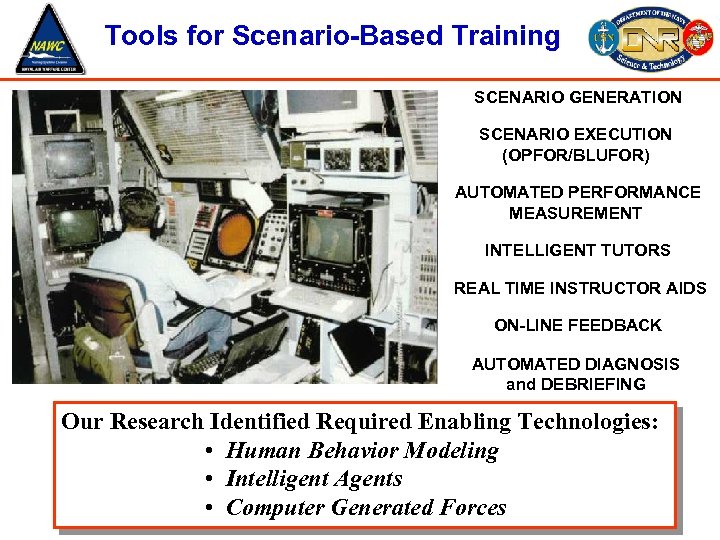 Tools for Scenario-Based Training SCENARIO GENERATION SCENARIO EXECUTION (OPFOR/BLUFOR) AUTOMATED PERFORMANCE MEASUREMENT INTELLIGENT TUTORS REAL TIME INSTRUCTOR AIDS ON-LINE FEEDBACK AUTOMATED DIAGNOSIS and DEBRIEFING Our Research Identified Required Enabling Technologies: • Human Behavior Modeling • Intelligent Agents • Computer Generated Forces
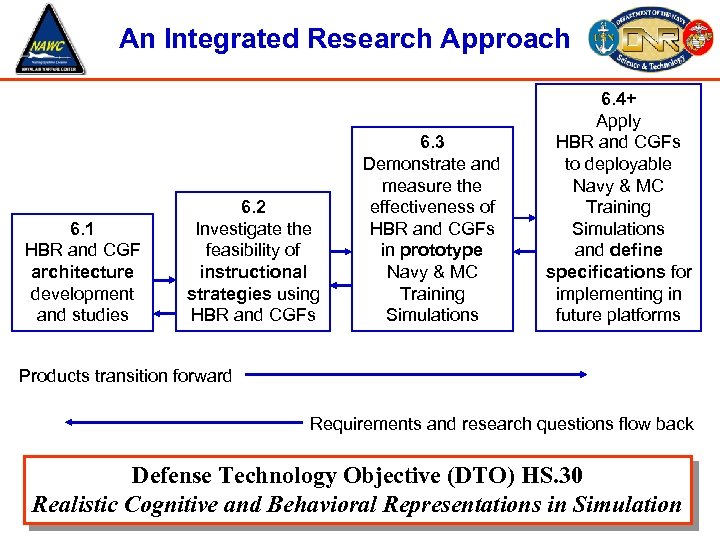 An Integrated Research Approach 6. 1 HBR and CGF architecture development and studies 6. 2 Investigate the feasibility of instructional strategies using HBR and CGFs 6. 3 Demonstrate and measure the effectiveness of HBR and CGFs in prototype Navy & MC Training Simulations 6. 4+ Apply HBR and CGFs to deployable Navy & MC Training Simulations and define specifications for implementing in future platforms Products transition forward Requirements and research questions flow back Defense Technology Objective (DTO) HS. 30 Realistic Cognitive and Behavioral Representations in Simulation
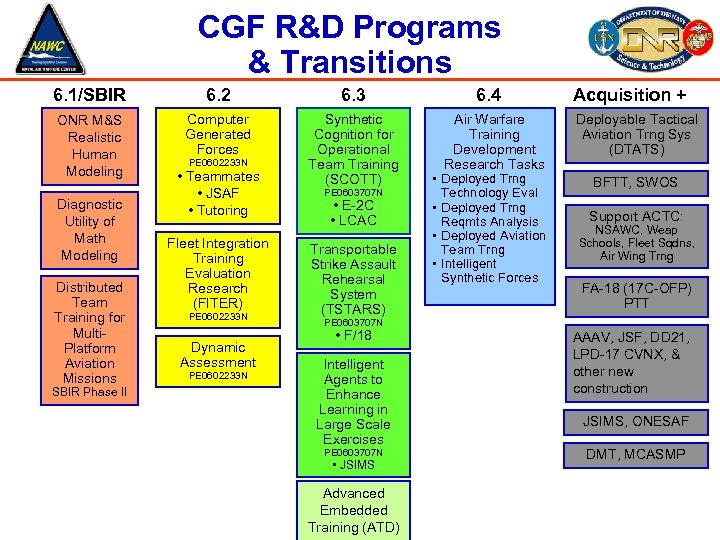 CGF R&D Programs & Transitions 6. 1/SBIR 6. 2 6. 3 ONR M&S Realistic Human Modeling Computer Generated Forces Synthetic Cognition for Operational Team Training (SCOTT) Diagnostic Utility of Math Modeling Distributed Team Training for Multi. Platform Aviation Missions SBIR Phase II PE 0602233 N • Teammates • JSAF • Tutoring Fleet Integration Training Evaluation Research (FITER) PE 0602233 N Dynamic Assessment PE 0602233 N PE 0603707 N • E-2 C • LCAC Transportable Strike Assault Rehearsal System (TSTARS) 6. 4 Air Warfare Training Development Research Tasks • Deployed Trng Technology Eval • Deployed Trng Reqmts Analysis • Deployed Aviation Team Trng • Intelligent Synthetic Forces Acquisition + Deployable Tactical Aviation Trng Sys (DTATS) BFTT, SWOS Support ACTC: NSAWC, Weap Schools, Fleet Sqdns, Air Wing Trng FA-18 (17 C-OFP) PTT PE 0603707 N • F/18 Intelligent Agents to Enhance Learning in Large Scale Exercises PE 0603707 N • JSIMS Advanced Embedded Training (ATD) AAAV, JSF, DD 21, LPD-17 CVNX, & other new construction JSIMS, ONESAF DMT, MCASMP
 Human Modeling for CGFs: Sampling of Current 6. 1 Effort (FY 00) – ACT-R/PM provided with multi-tasking capability for more realistic performance of complex multitask environments (AMBR ATC) composed of multiple concurrent sub-tasks; extended learning capabilities & team modeling to be added (Lebiere and Anderson/CMU) – COGNET, a leading blackboard based model of human cognition, enhanced to include both perceptual and motor system modeling, providing a significant increase in its range of application (Zachary/CHI Systems) – A principled analysis of key sources of brittleness in rule-based models has been conducted--to be used to enhance robustness of Tac-Air Soar (Nielsen/Soar, Inc) – A mechanism to control the real-time execution of action is being added to SOAR, enabling it to produce cognition-action sequences in the same time frame as humans, and affected in a like way by performance moderators (Laird/U. Mich) – A high training value self explanation capability is being created for broad application across rule-based cognitive architectures (Jones/Soar, Inc)
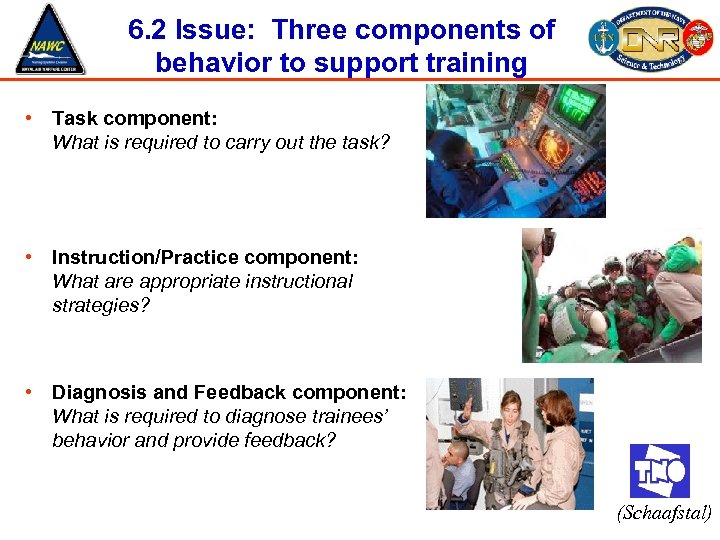 6. 2 Issue: Three components of behavior to support training • Task component: What is required to carry out the task? • Instruction/Practice component: What are appropriate instructional strategies? • Diagnosis and Feedback component: What is required to diagnose trainees’ behavior and provide feedback? (Schaafstal)
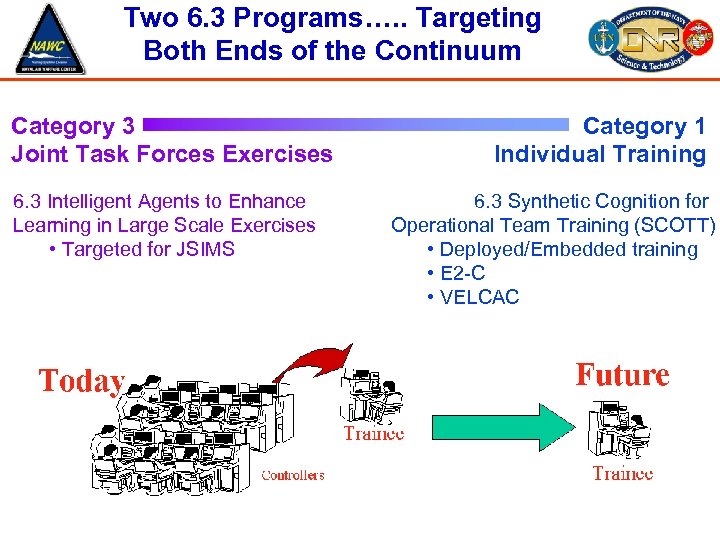 Two 6. 3 Programs…. . Targeting Both Ends of the Continuum Category 3 Joint Task Forces Exercises 6. 3 Intelligent Agents to Enhance Learning in Large Scale Exercises • Targeted for JSIMS Category 1 Individual Training 6. 3 Synthetic Cognition for Operational Team Training (SCOTT) • Deployed/Embedded training • E 2 -C • VELCAC
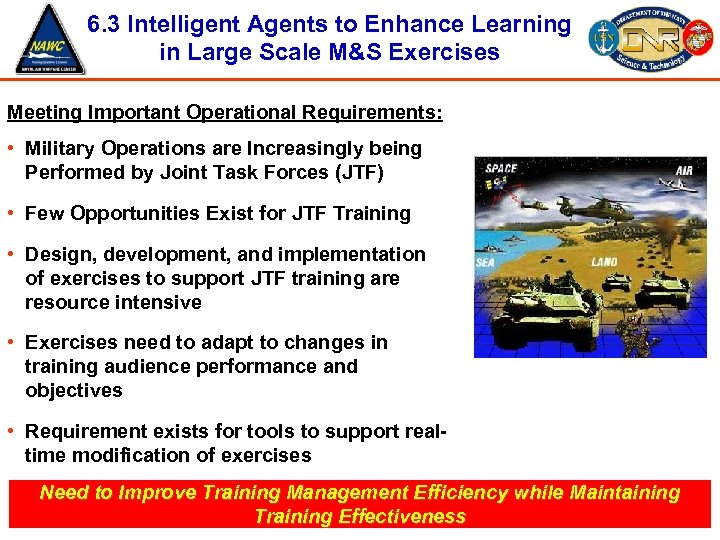 6. 3 Intelligent Agents to Enhance Learning in Large Scale M&S Exercises Meeting Important Operational Requirements: • Military Operations are Increasingly being Performed by Joint Task Forces (JTF) • Few Opportunities Exist for JTF Training • Design, development, and implementation of exercises to support JTF training are resource intensive • Exercises need to adapt to changes in training audience performance and objectives • Requirement exists for tools to support realtime modification of exercises Need to Improve Training Management Efficiency while Maintaining Training Effectiveness
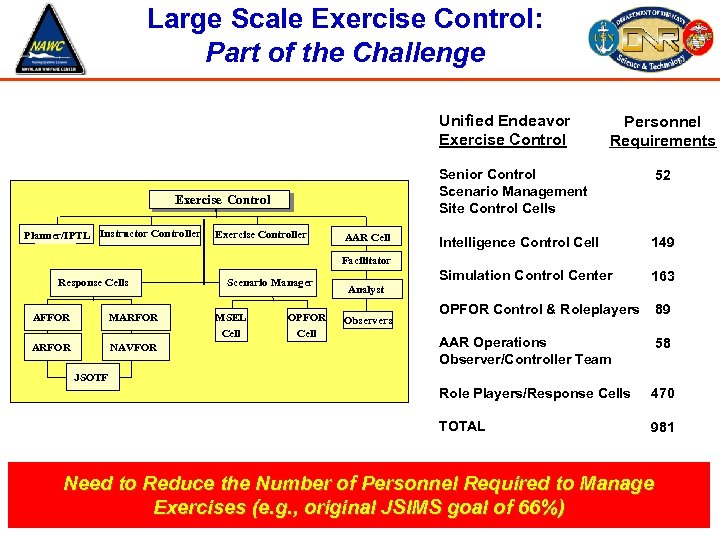 Large Scale Exercise Control: Part of the Challenge Unified Endeavor Exercise Control Personnel Requirements Senior Control Scenario Management Site Control Cells Analyst AAR Cell 163 OPFOR Control & Roleplayers 89 AAR Operations Observer/Controller Team 58 470 TOTAL Exercise Controller 149 Role Players/Response Cells Planner/IPTL Instructor Controller Planner Intelligence Control Cell Simulation Control Center Exercise Control 52 981 Facilitator Response Cells AFFOR MARFOR NAVFOR Scenario Manager MSEL Cell OPFOR Cell Analyst AAR Cell Observers JSOTF Need to Reduce the Number of Personnel Required to Manage Exercises (e. g. , original JSIMS goal of 66%)
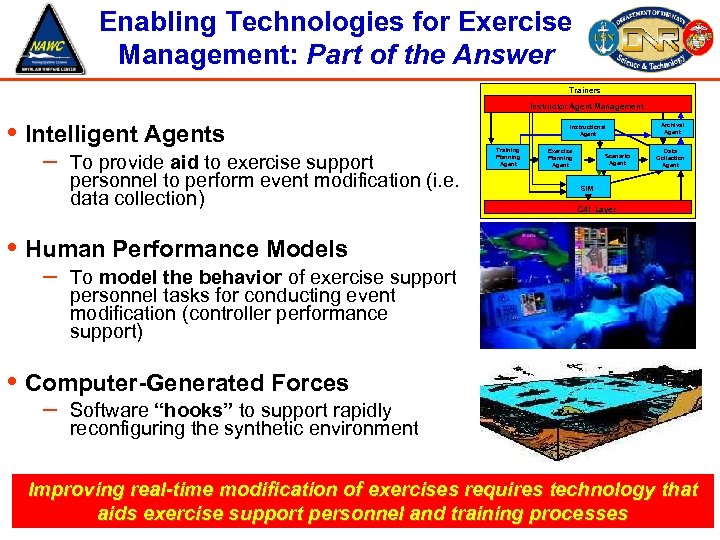 Enabling Technologies for Exercise Management: Part of the Answer Trainers Instructor Agent Management • Intelligent Agents – To provide aid to exercise support personnel to perform event modification (i. e. data collection) Instructional Agent Training Planning Agent Exercise Planning Agent Scenario Agent Archival Agent Data Collection Agent SIM C 4 I Layer • Human Performance Models – To model the behavior of exercise support personnel tasks for conducting event modification (controller performance support) • Computer-Generated Forces – Software “hooks” to support rapidly reconfiguring the synthetic environment Improving real-time modification of exercises requires technology that aids exercise support personnel and training processes
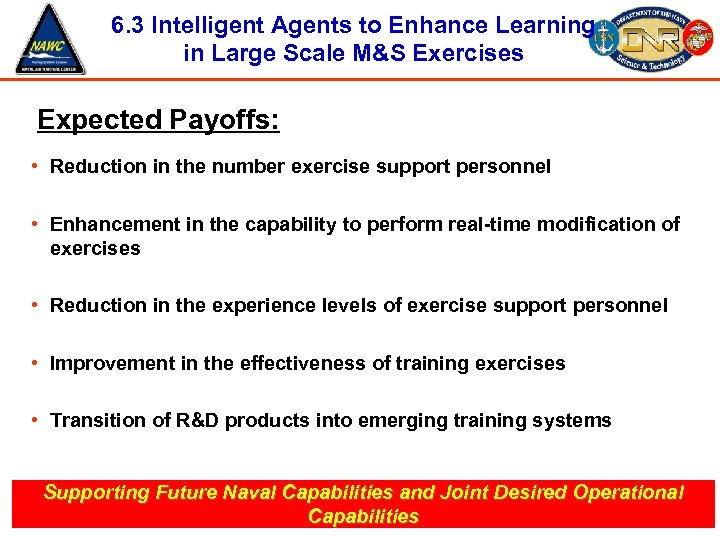 6. 3 Intelligent Agents to Enhance Learning in Large Scale M&S Exercises Expected Payoffs: • Reduction in the number exercise support personnel • Enhancement in the capability to perform real-time modification of exercises • Reduction in the experience levels of exercise support personnel • Improvement in the effectiveness of training exercises • Transition of R&D products into emerging training systems Supporting Future Naval Capabilities and Joint Desired Operational Capabilities
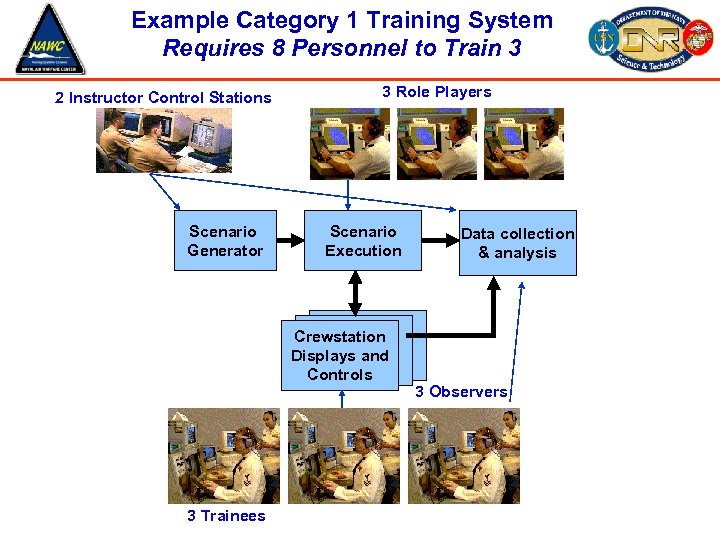 Example Category 1 Training System Requires 8 Personnel to Train 3 2 Instructor Control Stations Scenario Generator 3 Role Players Scenario Execution Crewstation Displays and Controls 3 Trainees Data collection & analysis 3 Observers
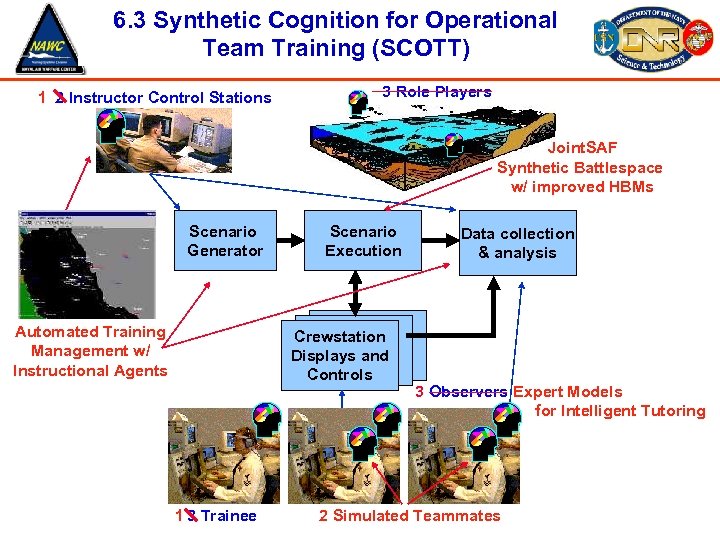 6. 3 Synthetic Cognition Simulated Forces Vision Training System w/ for Operational Requires 1 Instructor for 1 -3 Trainees Team Training (SCOTT) 1 2 Instructor Control Stations 3 Role Players Joint. SAF Synthetic Battlespace w/ improved HBMs Scenario Generator Automated Training Management w/ Instructional Agents Scenario Execution Crewstation Displays and Controls 1 3 Trainees Data collection & analysis 3 Observers Expert Models for Intelligent Tutoring 2 Simulated Teammates
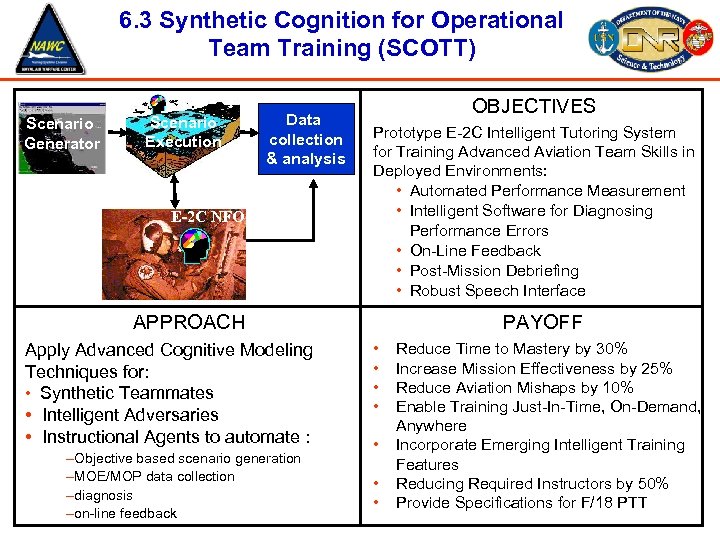 6. 3 Synthetic Cognition for Operational Team Training (SCOTT) Scenario Generator Scenario Execution Data collection & analysis E-2 C NFO OBJECTIVES Prototype E-2 C Intelligent Tutoring System for Training Advanced Aviation Team Skills in Deployed Environments: • Automated Performance Measurement • Intelligent Software for Diagnosing Performance Errors • On-Line Feedback • Post-Mission Debriefing • Robust Speech Interface APPROACH Apply Advanced Cognitive Modeling Techniques for: • Synthetic Teammates • Intelligent Adversaries • Instructional Agents to automate : –Objective based scenario generation –MOE/MOP data collection –diagnosis –on-line feedback PAYOFF • • Reduce Time to Mastery by 30% Increase Mission Effectiveness by 25% Reduce Aviation Mishaps by 10% Enable Training Just-In-Time, On-Demand, Anywhere Incorporate Emerging Intelligent Training Features Reducing Required Instructors by 50% Provide Specifications for F/18 PTT
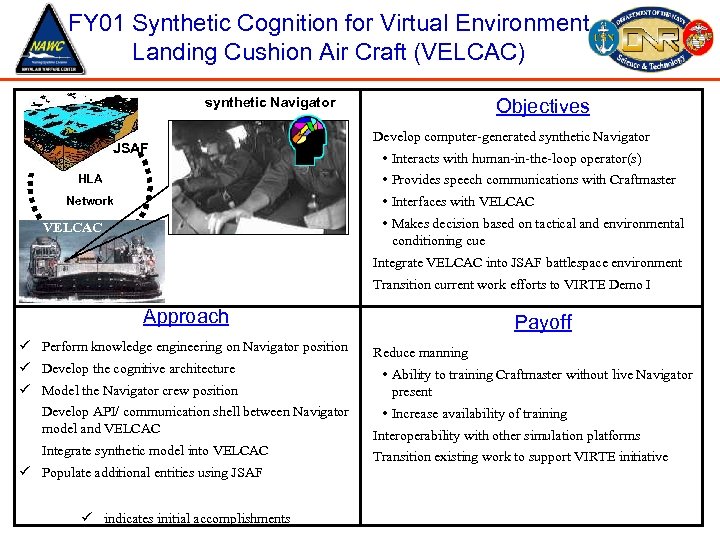 FY 01 Synthetic Cognition for Virtual Environment Landing Cushion Air Craft (VELCAC) synthetic Navigator JSAF Objectives Develop computer-generated synthetic Navigator • Interacts with human-in-the-loop operator(s) • Provides speech communications with Craftmaster HLA • Interfaces with VELCAC Network • Makes decision based on tactical and environmental conditioning cue VELCAC Integrate VELCAC into JSAF battlespace environment Transition current work efforts to VIRTE Demo I Approach ü Perform knowledge engineering on Navigator position ü Develop the cognitive architecture ü Model the Navigator crew position Develop API/ communication shell between Navigator model and VELCAC Integrate synthetic model into VELCAC ü Populate additional entities using JSAF ü indicates initial accomplishments Payoff Reduce manning • Ability to training Craftmaster without live Navigator present • Increase availability of training Interoperability with other simulation platforms Transition existing work to support VIRTE initiative
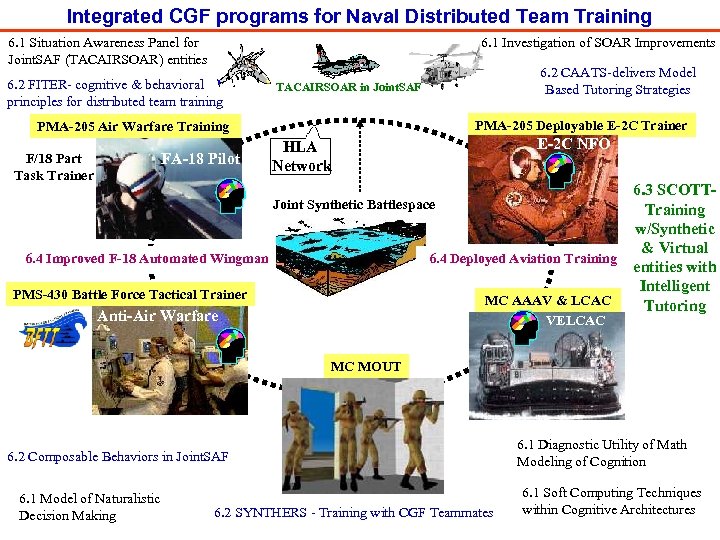 Integrated CGF programs for Naval Distributed Team Training 6. 1 Situation Awareness Panel for Joint. SAF (TACAIRSOAR) entities 6. 1 Investigation of SOAR Improvements 6. 2 FITER- cognitive & behavioral principles for distributed team training 6. 2 CAATS-delivers Model Based Tutoring Strategies TACAIRSOAR in Joint. SAF PMA-205 Deployable E-2 C Trainer PMA-205 Air Warfare Training FA-18 Pilot F/18 Part Task Trainer E-2 C NFO HLA Network Joint Synthetic Battlespace 6. 4 Improved F-18 Automated Wingman 6. 4 Deployed Aviation Training PMS-430 Battle Force Tactical Trainer MC AAAV & LCAC VELCAC Anti-Air Warfare 6. 3 SCOTTTraining w/Synthetic & Virtual entities with Intelligent Tutoring MC MOUT 6. 2 Composable Behaviors in Joint. SAF 6. 1 Model of Naturalistic Decision Making 6. 2 SYNTHERS - Training with CGF Teammates 6. 1 Diagnostic Utility of Math Modeling of Cognition 6. 1 Soft Computing Techniques within Cognitive Architectures