


 Скачать презентацию National Violent Death Reporting System NVDRS Data Management
c167afef19450c5f65329502330fe998.ppt
- Количество слайдов: 22
 National Violent Death Reporting System (NVDRS): Data Management Challenges and Solutions December 12, 2005 Malinda Steenkamp, M. Phil; Nikolay Lipskiy, Dr. PH (presenter); Division of Violence Prevention National Center for Injury Prevention and Control Centers for Disease Control and Prevention
 NVDRS Vision: Reduce and prevent the occurrence of violent deaths in the US through the provision of accurate, timely and comprehensive surveillance data. NVDRS Goals: • • • Collect and analyze timely, high-quality data for monitoring the magnitude and characteristics of violent deaths at the national, state, and local levels Ensure that violent death data are routinely and expeditiously disseminated to public health officials, law enforcement officials, policy makers and the public Provide data for developing, implementing and evaluating strategies, programs and policies designed to prevent violent deaths and injuries at the national, state and local levels Build and strengthen partnerships with organizations and communities at the national, state, and local levels to ensure that data are collected and used to reduce and prevent violent deaths and injuries Expand the National Violent Death Reporting System into all 50 states, the District of Columbia and US territories
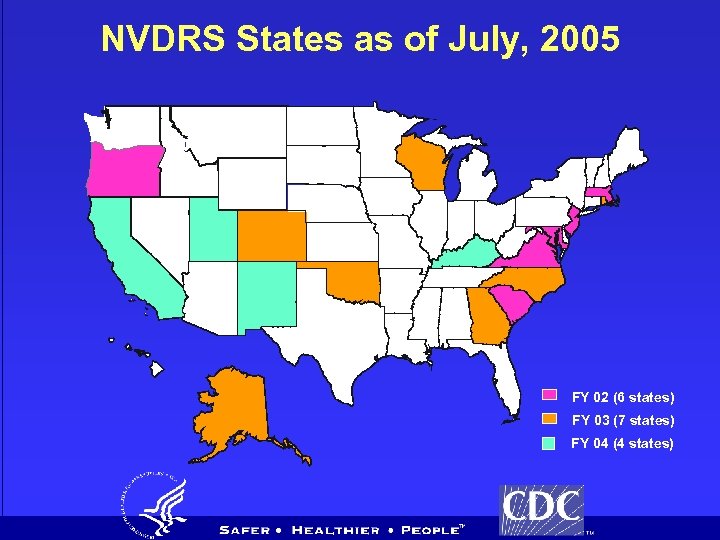 NVDRS States as of July, 2005 FY 02 (6 states) FY 03 (7 states) FY 04 (4 states)
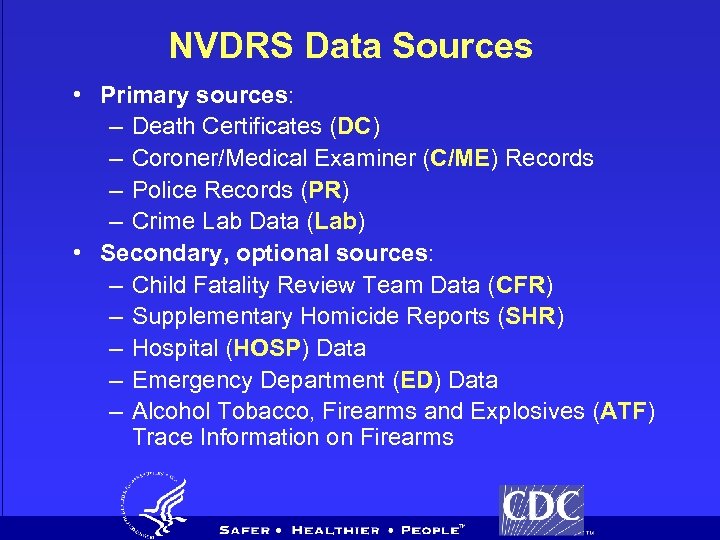 NVDRS Data Sources • Primary sources: – Death Certificates (DC) – Coroner/Medical Examiner (C/ME) Records – Police Records (PR) – Crime Lab Data (Lab) • Secondary, optional sources: – Child Fatality Review Team Data (CFR) – Supplementary Homicide Reports (SHR) – Hospital (HOSP) Data – Emergency Department (ED) Data – Alcohol Tobacco, Firearms and Explosives (ATF) Trace Information on Firearms
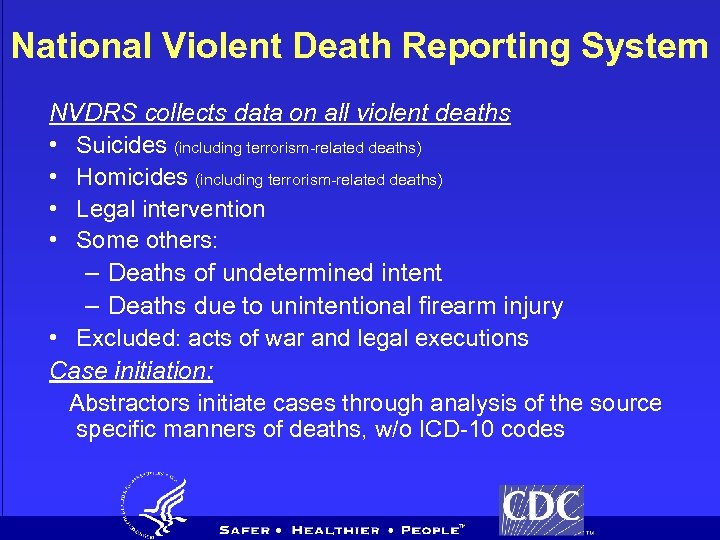 National Violent Death Reporting System NVDRS collects data on all violent deaths • Suicides (including terrorism-related deaths) • Homicides (including terrorism-related deaths) • Legal intervention • Some others: – Deaths of undetermined intent – Deaths due to unintentional firearm injury • Excluded: acts of war and legal executions Case initiation: Abstractors initiate cases through analysis of the source specific manners of deaths, w/o ICD-10 codes
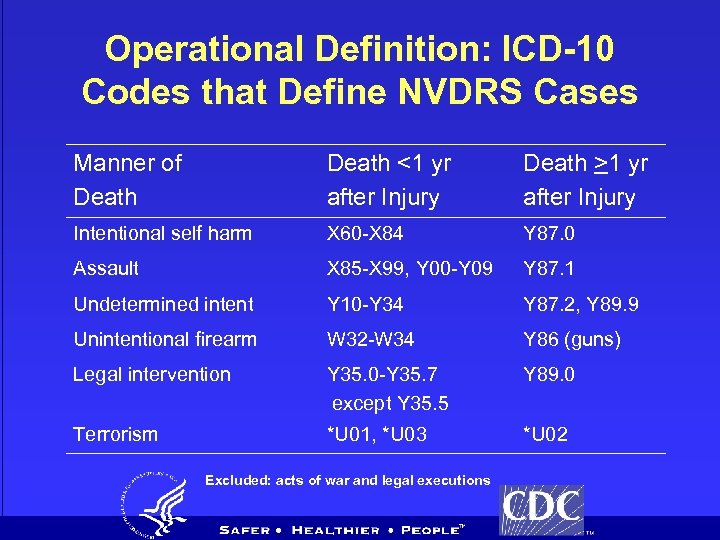 Operational Definition: ICD-10 Codes that Define NVDRS Cases Manner of Death <1 yr after Injury Death >1 yr after Injury Intentional self harm X 60 -X 84 Y 87. 0 Assault X 85 -X 99, Y 00 -Y 09 Y 87. 1 Undetermined intent Y 10 -Y 34 Y 87. 2, Y 89. 9 Unintentional firearm W 32 -W 34 Y 86 (guns) Legal intervention Y 35. 0 -Y 35. 7 except Y 35. 5 Y 89. 0 Terrorism *U 01, *U 03 *U 02 Excluded: acts of war and legal executions
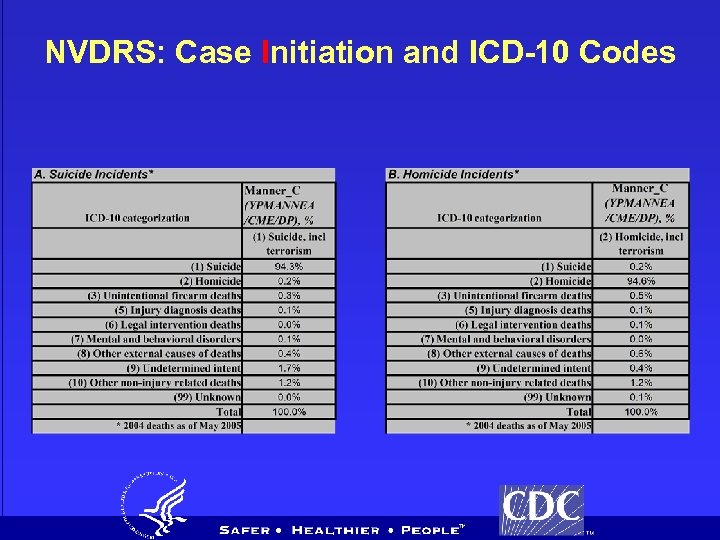 NVDRS: Case Initiation and ICD-10 Codes
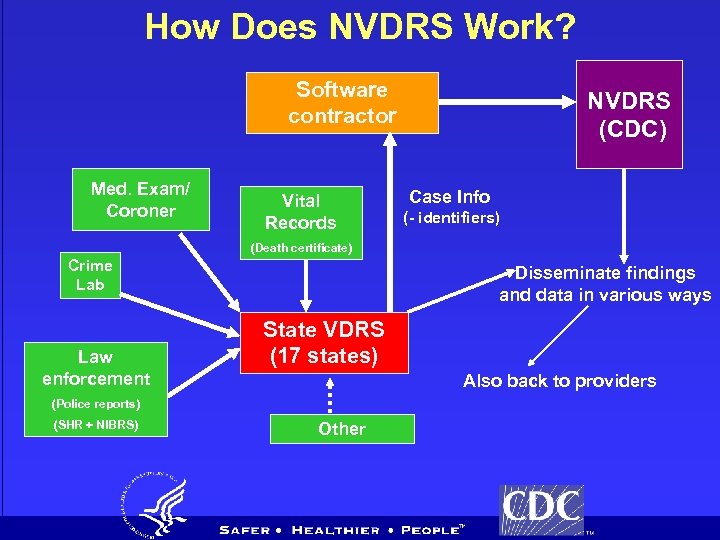 How Does NVDRS Work? Software contractor Med. Exam/ Coroner Vital Records NVDRS (CDC) Case Info (- identifiers) (Death certificate) Crime Lab Law enforcement Disseminate findings and data in various ways State VDRS (17 states) Also back to providers (Police reports) (SHR + NIBRS) Other
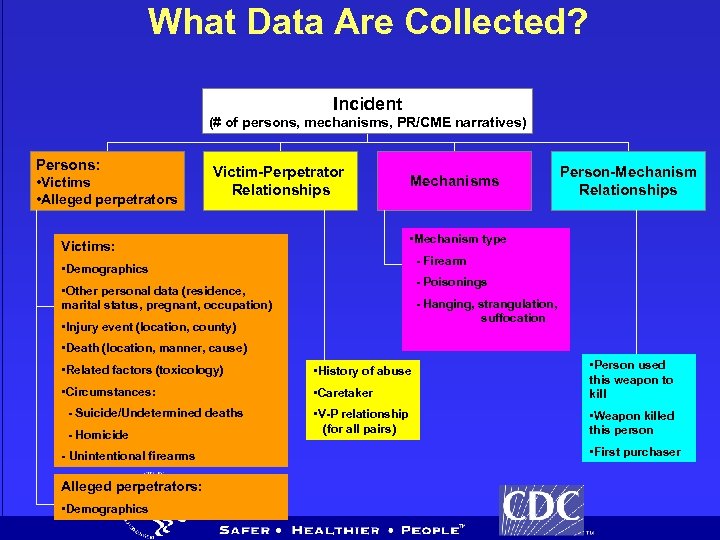 What Data Are Collected? Incident (# of persons, mechanisms, PR/CME narratives) Persons: • Victims • Alleged perpetrators Victim-Perpetrator Relationships Mechanisms Person-Mechanism Relationships • Mechanism type Victims: - Firearm • Demographics - Poisonings • Other personal data (residence, marital status, pregnant, occupation) - Hanging, strangulation, suffocation • Injury event (location, county) • Death (location, manner, cause) • Related factors (toxicology) • History of abuse • Circumstances: • Caretaker • Person used this weapon to kill • V-P relationship (for all pairs) • Weapon killed this person - Suicide/Undetermined deaths - Homicide - Unintentional firearms Alleged perpetrators: • Demographics • First purchaser
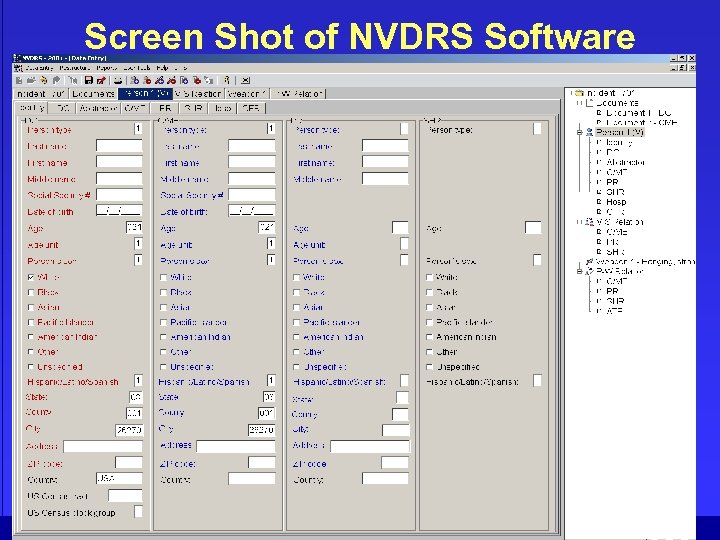 Screen Shot of NVDRS Software
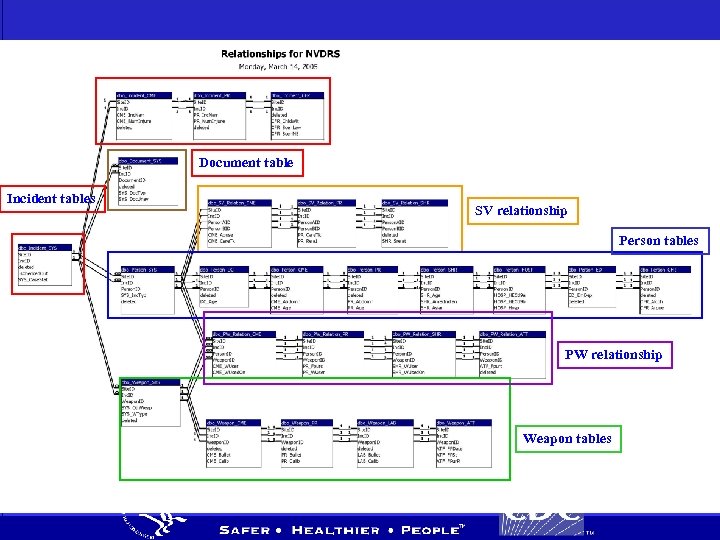 Document table Incident tables SV relationship Person tables PW relationship Weapon tables
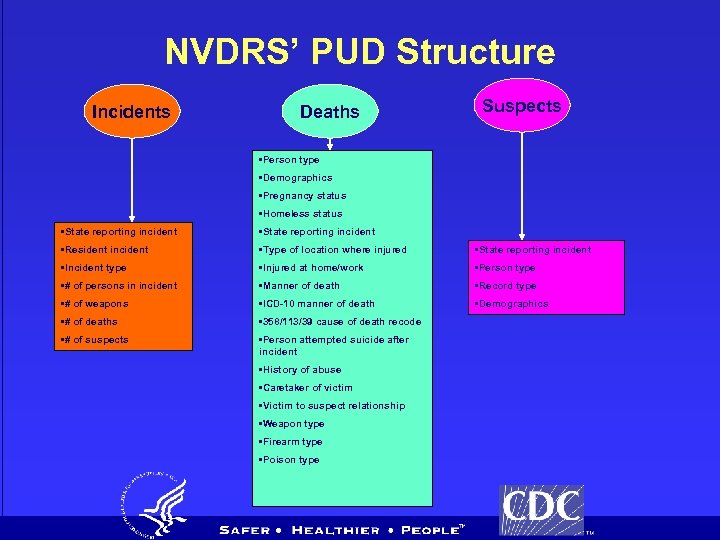 NVDRS’ PUD Structure Incidents Deaths Suspects • Person type • Demographics • Pregnancy status • Homeless status • State reporting incident • Resident incident • Type of location where injured • State reporting incident • Incident type • Injured at home/work • Person type • # of persons in incident • Manner of death • Record type • # of weapons • ICD-10 manner of death • Demographics • # of deaths • 358/113/39 cause of death recode • # of suspects • Person attempted suicide after incident • History of abuse • Caretaker of victim • Victim to suspect relationship • Weapon type • Firearm type • Poison type
 Approach To Analyze NVDRS Data • Created 6 data analysis files based on six entities: – – – Incident Person (Victims, Suspect/Victims, Suspects) Weapon Victim – Suspect Relationship Person – Weapon Relationship Document • All files includes linking variables – Site ID, Incident ID – Will also include person ID in future • Files can be combined/merged as needed
 Analyzing NVDRS Data • Different ways to identify cases – 5 manners of death (DC, CME, Abstractor, ICD-10, CDC Manner) • At different points in time – completion rates for manner differ (ICD-10 more incomplete for longer) • Abstractor assigned manner is a gateway variable
 Analyzing NVDRS Data (cont. ) • Need to know that there are gateway variables – Abstractor assigned manner – Person type – Circumstances known – Weapon type (not discussed today) • Need to know how to use these: – Person type • When looking at deaths - Select person types 1 (Victim) and 3 (Suspect/Victim) (Person type 2 = live suspects)
 CDC Analysis Variables • Similar variables – multiple sources – combine • Example for sex data element: – Variable comes from four data sources • DC, CME, SHR, PR, – Rule of primacy • Created a CDC analysis variable (combined variable) • Identified by _c (e. g. Sex_C)
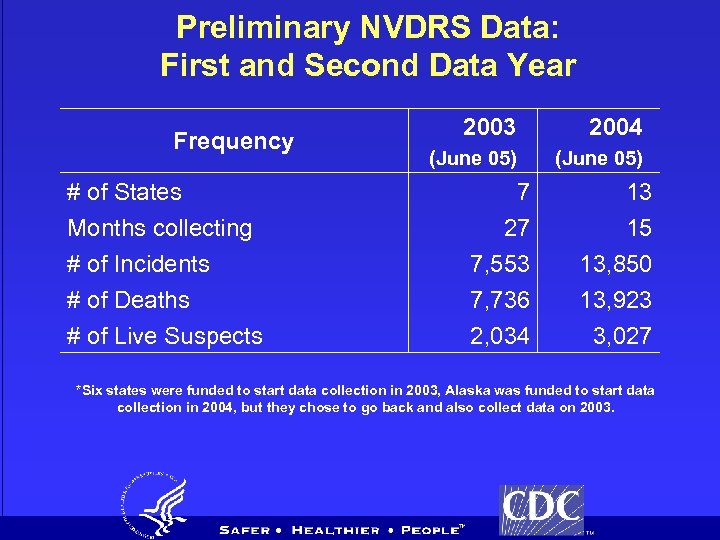 Preliminary NVDRS Data: First and Second Data Year Frequency # of States Months collecting # of Incidents # of Deaths # of Live Suspects 2003 2004 (June 05) 7 27 13 15 7, 553 7, 736 2, 034 13, 850 13, 923 3, 027 *Six states were funded to start data collection in 2003, Alaska was funded to start data collection in 2004, but they chose to go back and also collect data on 2003.
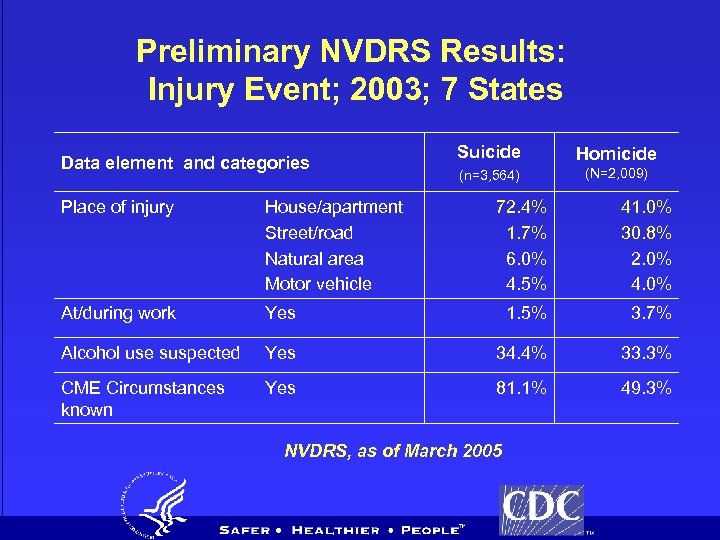 Preliminary NVDRS Results: Injury Event; 2003; 7 States Data element and categories Place of injury House/apartment Street/road Natural area Motor vehicle At/during work Suicide Homicide (n=3, 564) (N=2, 009) 72. 4% 1. 7% 6. 0% 4. 5% 41. 0% 30. 8% 2. 0% 4. 0% Yes 1. 5% 3. 7% Alcohol use suspected Yes 34. 4% 33. 3% CME Circumstances known Yes 81. 1% 49. 3% NVDRS, as of March 2005
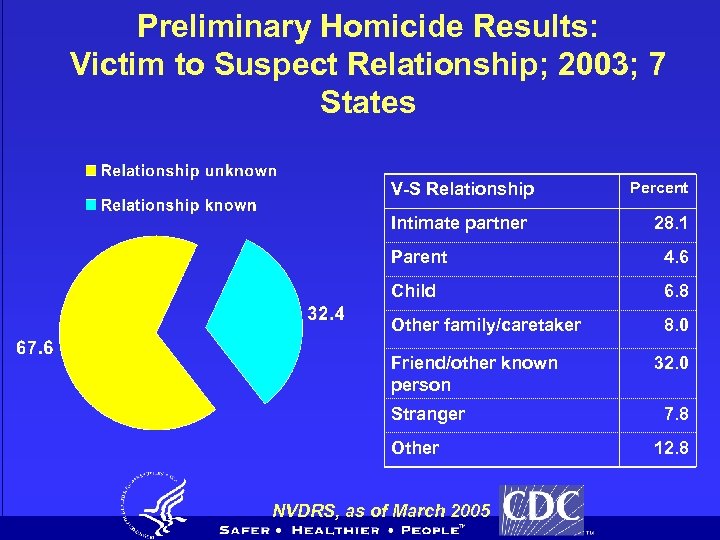 Preliminary Homicide Results: Victim to Suspect Relationship; 2003; 7 States V-S Relationship Intimate partner Percent 28. 1 Parent 4. 6 Child 6. 8 Other family/caretaker 8. 0 Friend/other known person Stranger Other NVDRS, as of March 2005 32. 0 7. 8 12. 8
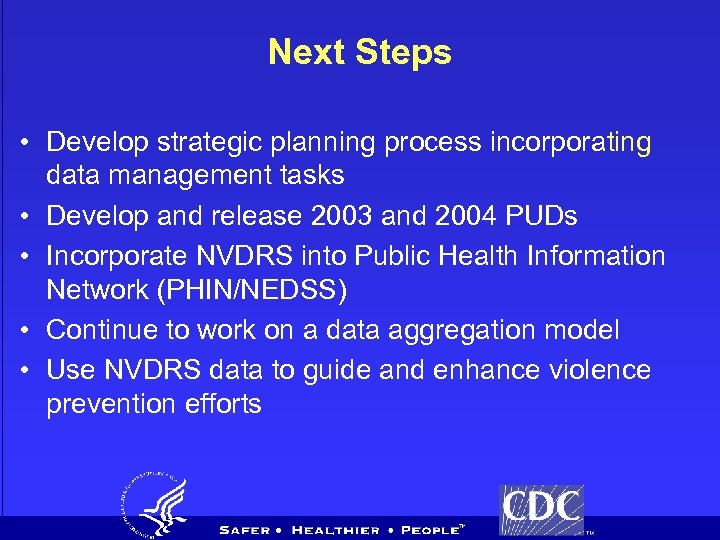 Next Steps • Develop strategic planning process incorporating data management tasks • Develop and release 2003 and 2004 PUDs • Incorporate NVDRS into Public Health Information Network (PHIN/NEDSS) • Continue to work on a data aggregation model • Use NVDRS data to guide and enhance violence prevention efforts
 Summary NVDRS improves quality and completeness of violent death data through the timely collection and aggregation of multi-source information Major pitfalls data collection and management: - Involvement of different agencies - Need a standardization of data element definitions across all agencies - The development and implementation of QA methods for data collection and management, from a multi-source perspective, is a complex problem Major data management challenges: - development of a data management model for the population-based violent death surveillance system - development of a reliable violent death data source for the public health - to grow towards becoming a comprehensive public health measurement tool
 For Additional Information, Contact: Malinda Steenkamp, M. Phil NVDRS Senior Advisor (770) 488 -4476 Email: Msteenkamp@cdc. gov Nikolay Lipskiy, MPH, MBA, Dr. PH NVDRS Epidemiologist (770) 488 -1306 Email: dgz 1@cdc. gov