


 Скачать презентацию National Traffic System ARRL Eastern New York ENY
a9229e62d49c98ae82ccaf4c8194c318.ppt
- Количество слайдов: 61
 National Traffic System ARRL Eastern New York (ENY) Section Thomas J Cody, WE 2 G ARRL Section Traffic Manager
 What is the National Traffic System? The National Traffic System or NTS is a system that organizes Amateur Radio Operators for the purpose of providing timely and reliable movement of third-party message traffic from origin to destination as a free public service to the amateur community and the general public Our goals are efficiency and accuracy
 Goal 1: Efficiency Efficient net operation Participants Maintain proper net discipline Proper pace for radiogram transmission Conditions Ability of the receiving station (know your stations!) NCS Sending stations off frequency to move traffic in parallel (know your stations!) Prioritizing traffic based on quantity
 Goal 2: Accuracy Never change a message in transit for any reason! If you feel that corrections are necessary, add an op note instead. Follow proper net procedure, and use proper voicing techniques to help ensure accurate copy.
 History of the National Traffic System The National Traffic system (NTS) has its roots in the earliest days of Amateur Radio The American Radio Relay League (ARRL) was founded in 1914 by Hiram Percy Maxim to facilitate the relay of radiogram message traffic The ARRL organized amateurs as Official Relay Stations The ORS appointment still used today in the ARRL Field Organization
 Why should you get involved? Great public service opportunity Great training opportunity for ARES/RACES Great opportunity to earn wallpaper Public Service Honor Roll (PSHR) Certificates are available for repeated qualification (12 months straight or 18 months out of 24) See your callsign in QST every month you qualify ORS Appointment Net certificates STM Appointment Lots of fun and camaraderie
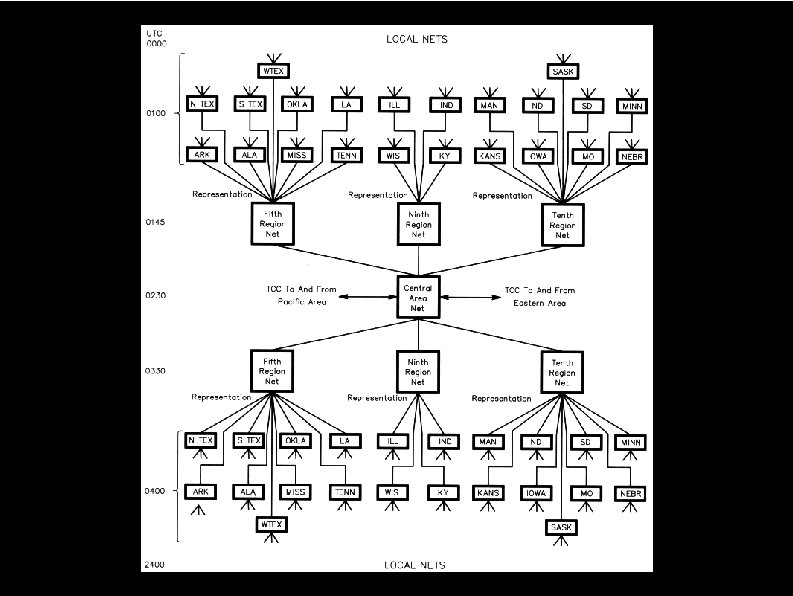
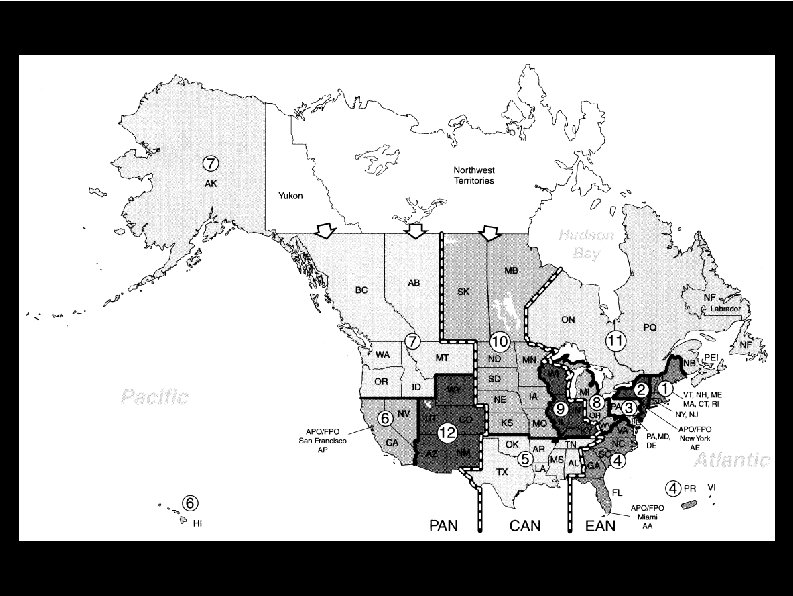
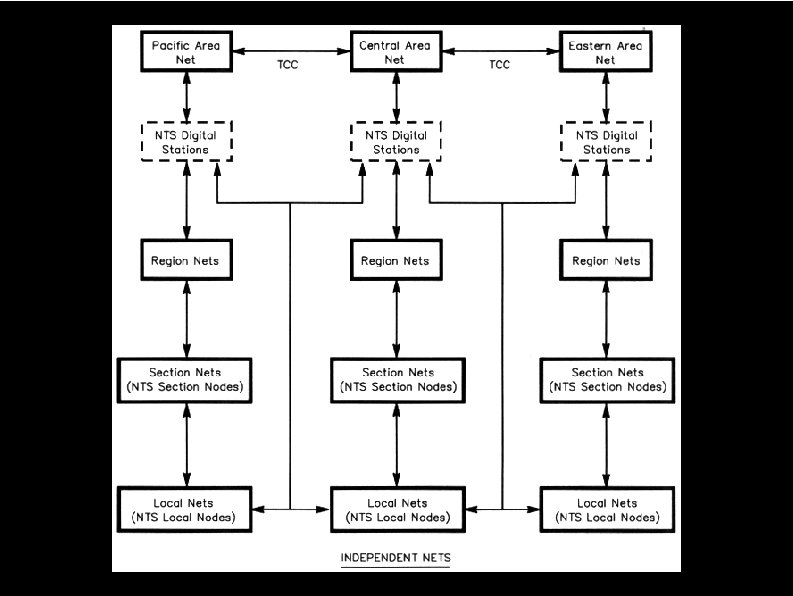
 How message traffic moves NTS (Phone and CW modes) Structure NTS operates in four daily Cycles which are structured to provide 24 -hour transit from origin to delivery anywhere in the US and Canada under ideal conditions Transit Origination Local, section (state), region, area nets, Trans Continental Corps (TCC) Delivery
 How message traffic moves (cont'd) NTSD (Digital Modes)PACTOR I, PACTOR III, PACTOR IV, VHF Packet Independent (Non-NTS) traffic nets
 Typical radiogram messages Common (routine) message traffic Holiday and birthday greetings Call Book or roster traffic Examples (paraphrased) Congratulations on your new call sign Your amateur radio license is about to expire Congratulations on your recent license renewal Please join a slow speed CW net Welcome to FISTS Purpose of call book traffic
 Typical radiogram messages (cont'd) Uncommon message traffic Health and welfare Emergency traffic Priority traffic
 NTS Message Format NTS Radiogram Messages Made Easy
 Message Number Serial Number assigned by originating station. Many stations begin with number “ 1” at beginning of each year or month. Allows easy reference to message in the event of service or delivery problem
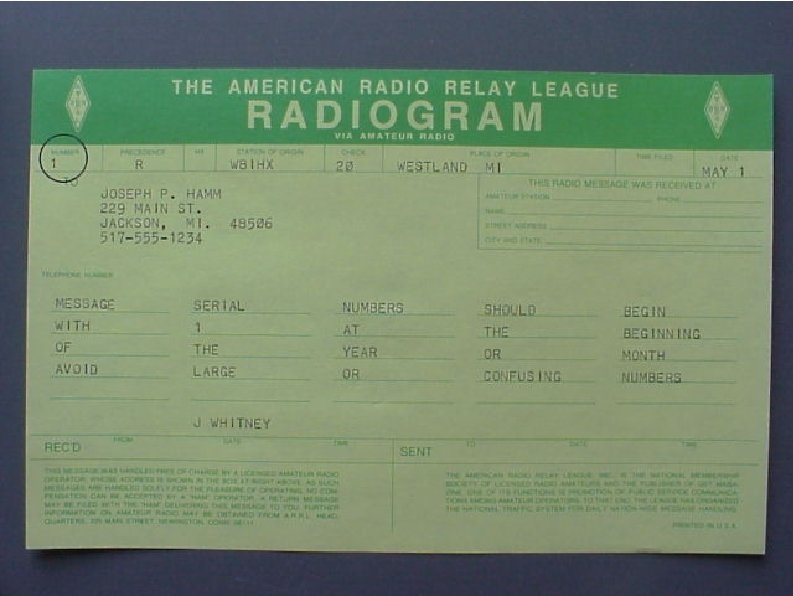
 Precedence Indicates importance of message to originator (or served agency) Provides guidance for Net Operators
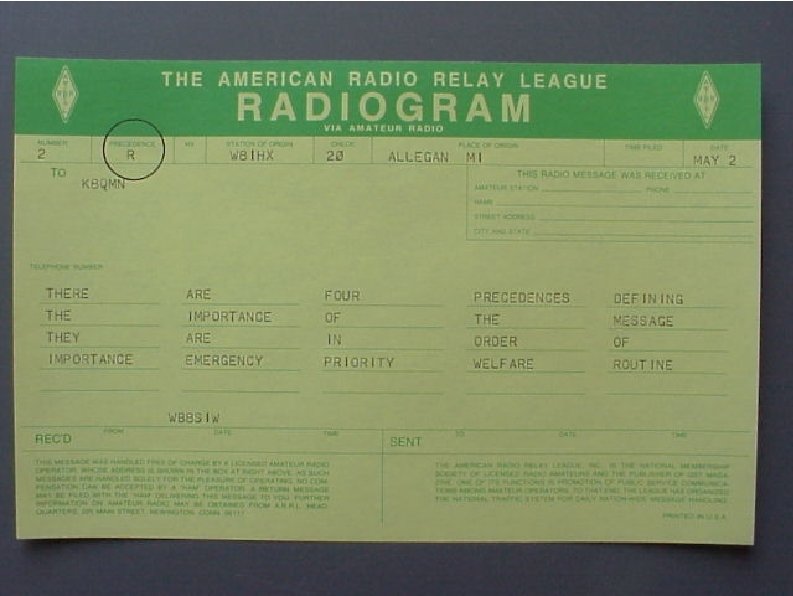
 Precedence (cont'd) Four Categories Emergency: Life or Death – always spelled out! Priority: Time sensitive – abbreviated “P” Welfare: Information pertaining to the well being of an individual in a disaster area – abbreviated “W” Routine: Casual greeting or routine public service message – abbreviated “R”
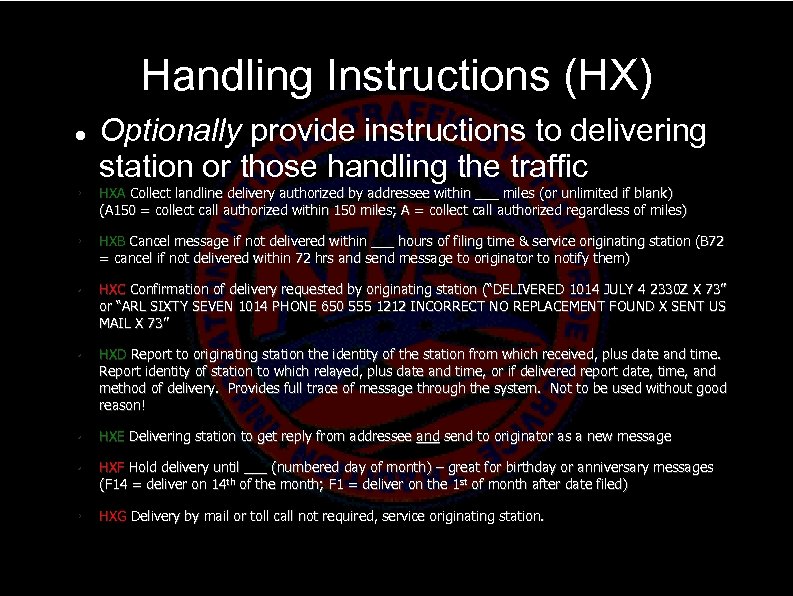 Handling Instructions (HX) Optionally provide instructions to delivering station or those handling the traffic • HXA Collect landline delivery authorized by addressee within ___ miles (or unlimited if blank) (A 150 = collect call authorized within 150 miles; A = collect call authorized regardless of miles) • HXB Cancel message if not delivered within ___ hours of filing time & service originating station (B 72 = cancel if not delivered within 72 hrs and send message to originator to notify them) • HXC Confirmation of delivery requested by originating station (“DELIVERED 1014 JULY 4 2330 Z X 73” or “ARL SIXTY SEVEN 1014 PHONE 650 555 1212 INCORRECT NO REPLACEMENT FOUND X SENT US MAIL X 73” • HXD Report to originating station the identity of the station from which received, plus date and time. Report identity of station to which relayed, plus date and time, or if delivered report date, time, and method of delivery. Provides full trace of message through the system. Not to be used without good reason! • HXE Delivering station to get reply from addressee and send to originator as a new message • HXF Hold delivery until ___ (numbered day of month) – great for birthday or anniversary messages (F 14 = deliver on 14 th of the month; F 1 = deliver on the 1 st of month after date filed) • HXG Delivery by mail or toll call not required, service originating station.
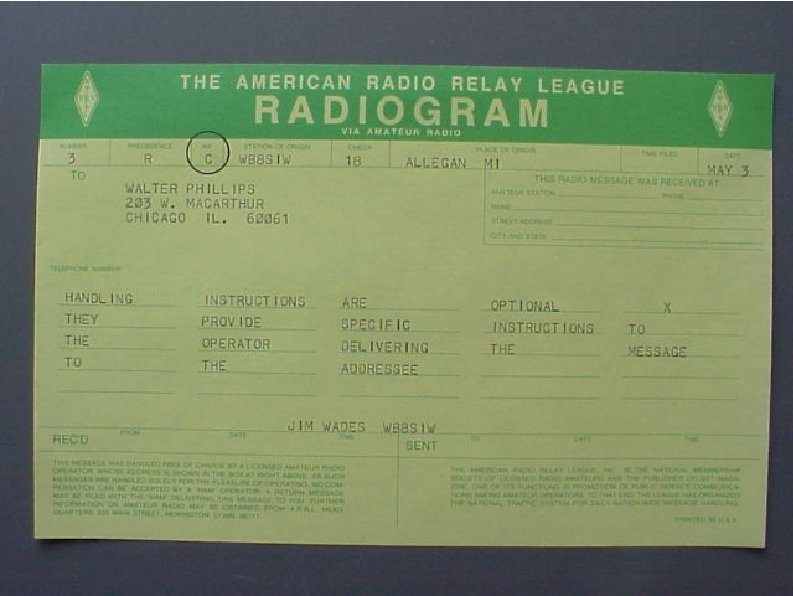
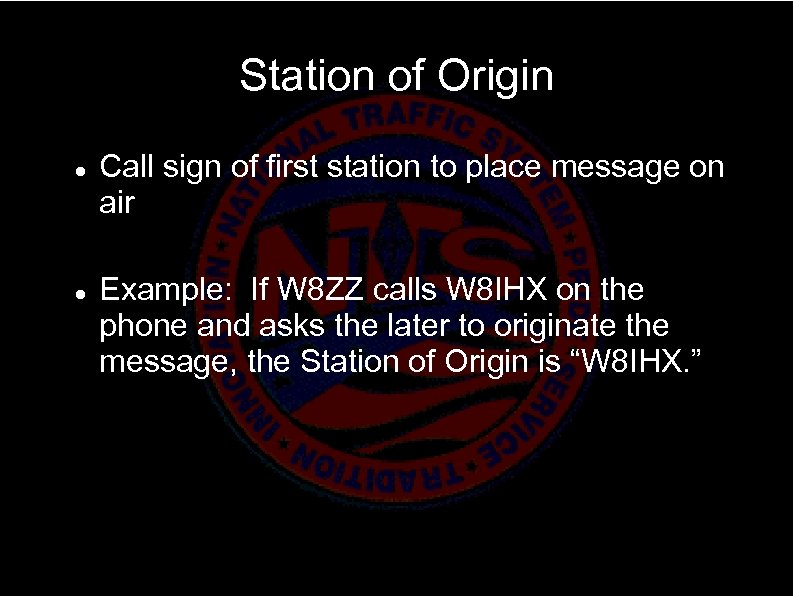 Station of Origin Call sign of first station to place message on air Example: If W 8 ZZ calls W 8 IHX on the phone and asks the later to originate the message, the Station of Origin is “W 8 IHX. ”
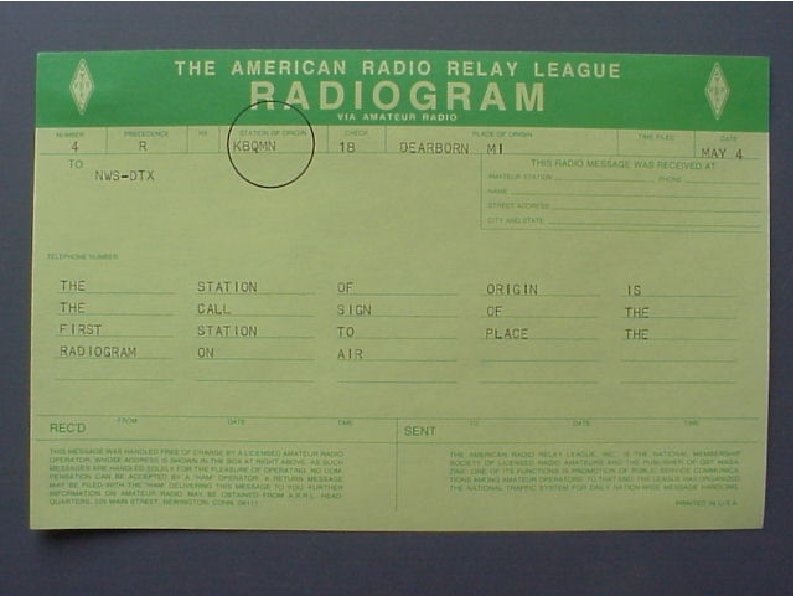
 Check The number of words or groups in the text Does not include address or signature Mixed groups, such as “ 6 TH” or “FSD 212” count as one word The “X-ray” (“X”), used in place of a period, counts as one word The word count is preceded by “ARL” when ARRL Numbered Radiograms are present in the text Telephone numbers with area code count as 3 words
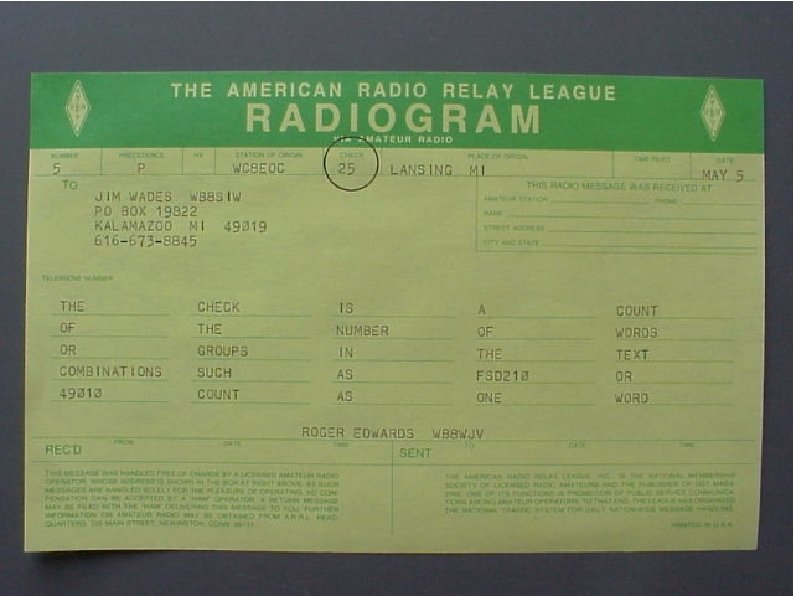
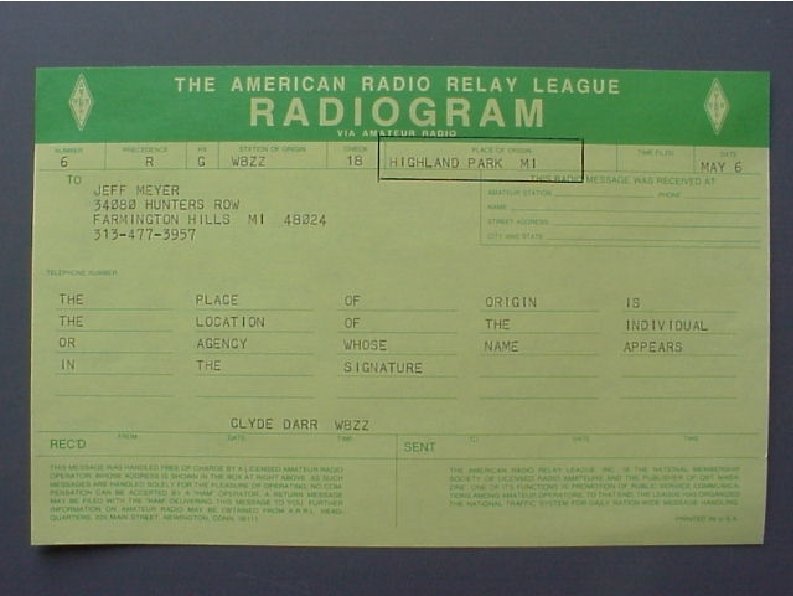
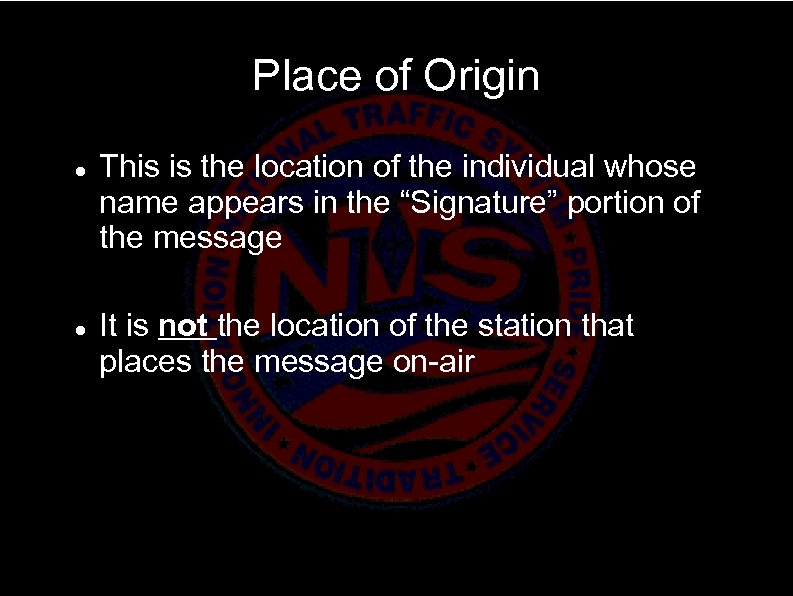 Place of Origin This is the location of the individual whose name appears in the “Signature” portion of the message It is not the location of the station that places the message on-air
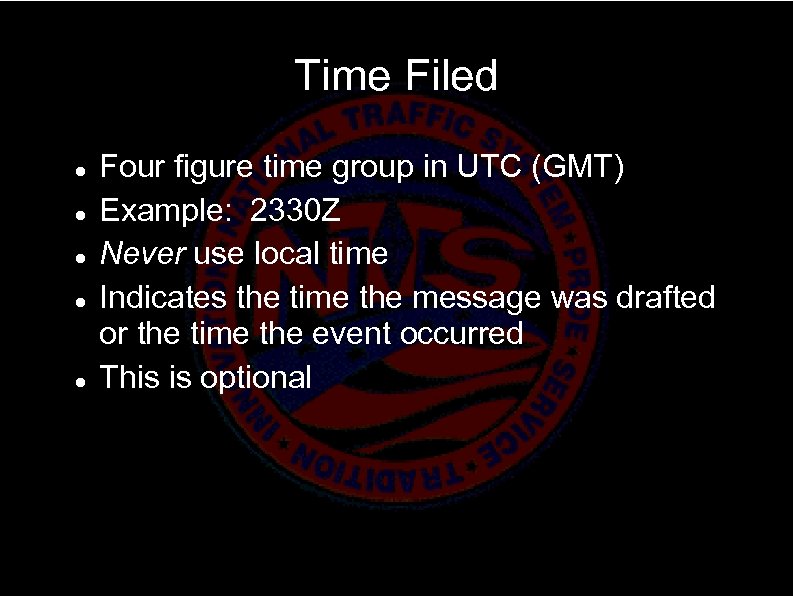 Time Filed Four figure time group in UTC (GMT) Example: 2330 Z Never use local time Indicates the time the message was drafted or the time the event occurred This is optional
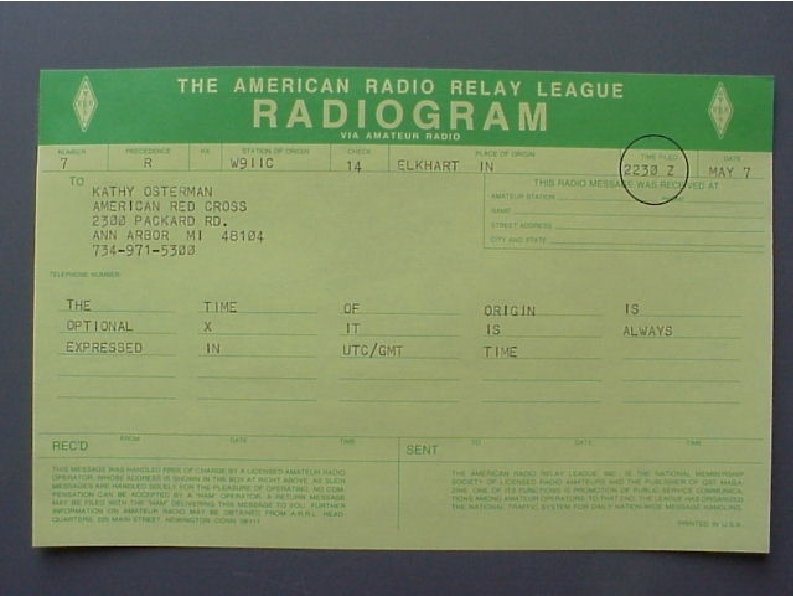
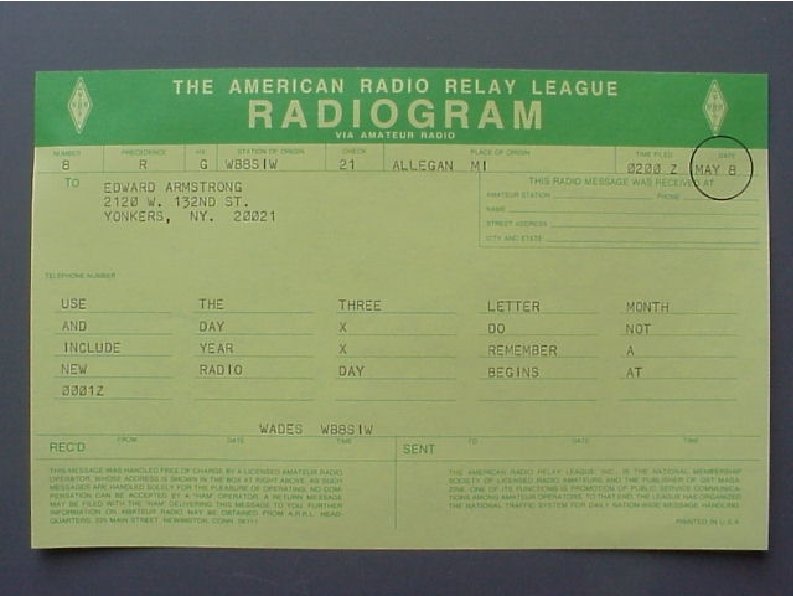
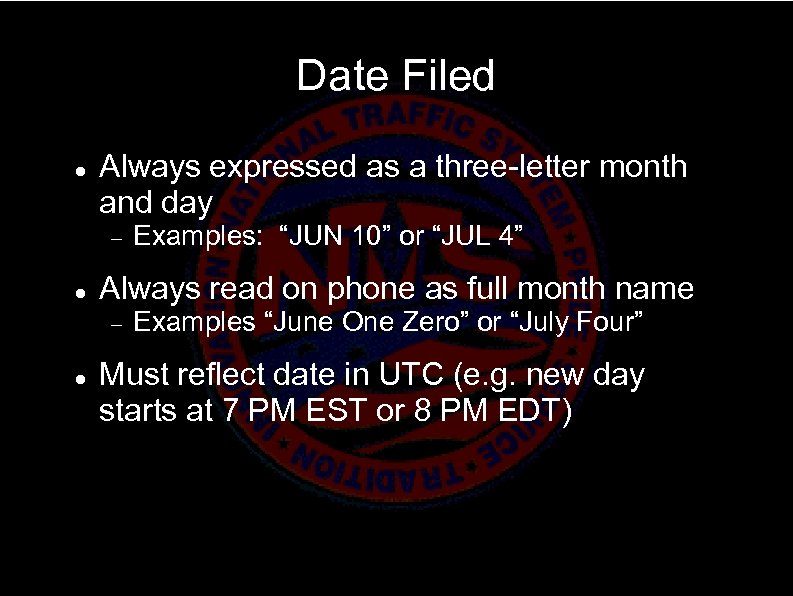 Date Filed Always expressed as a three-letter month and day Always read on phone as full month name Examples: “JUN 10” or “JUL 4” Examples “June One Zero” or “July Four” Must reflect date in UTC (e. g. new day starts at 7 PM EST or 8 PM EDT)
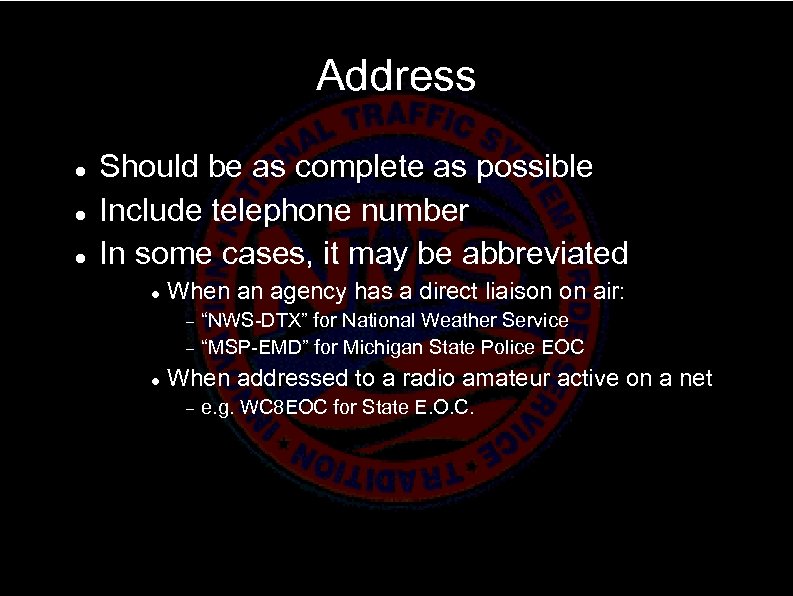 Address Should be as complete as possible Include telephone number In some cases, it may be abbreviated When an agency has a direct liaison on air: “NWS-DTX” for National Weather Service “MSP-EMD” for Michigan State Police EOC When addressed to a radio amateur active on a net e. g. WC 8 EOC for State E. O. C.
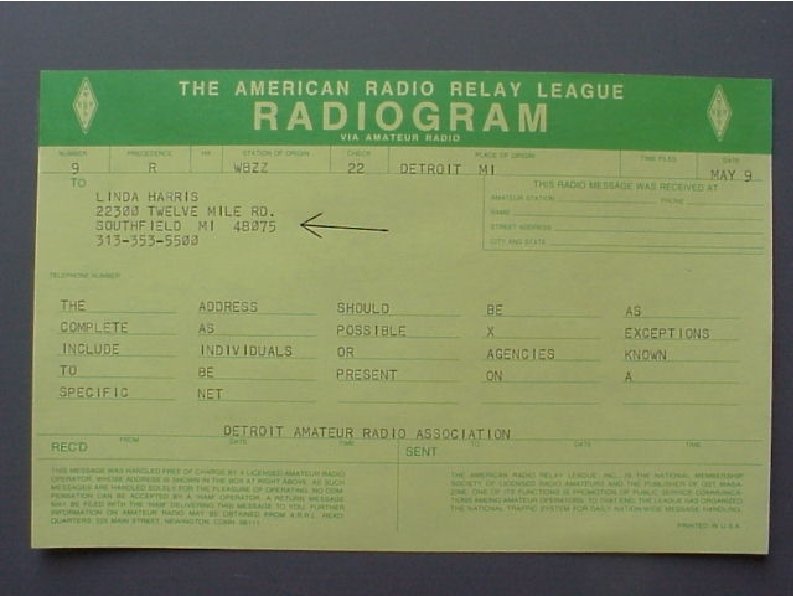
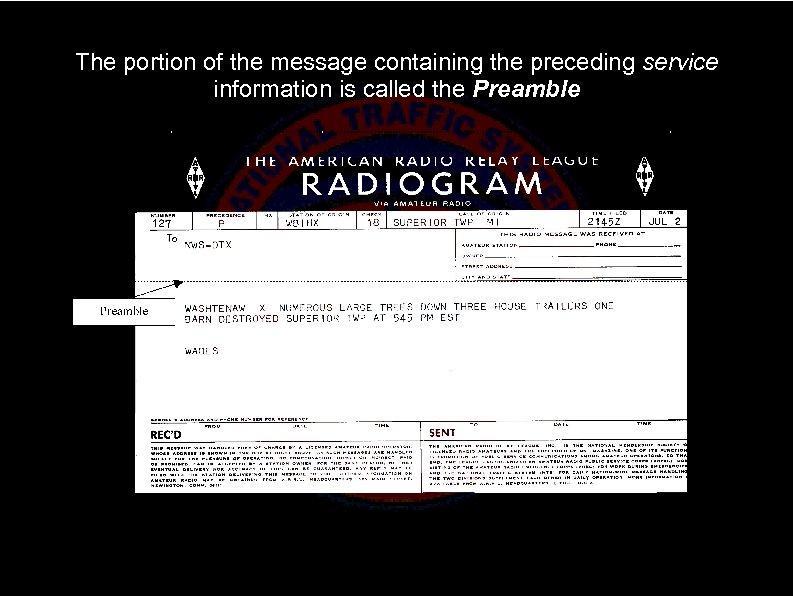 The portion of the message containing the preceding service information is called the Preamble
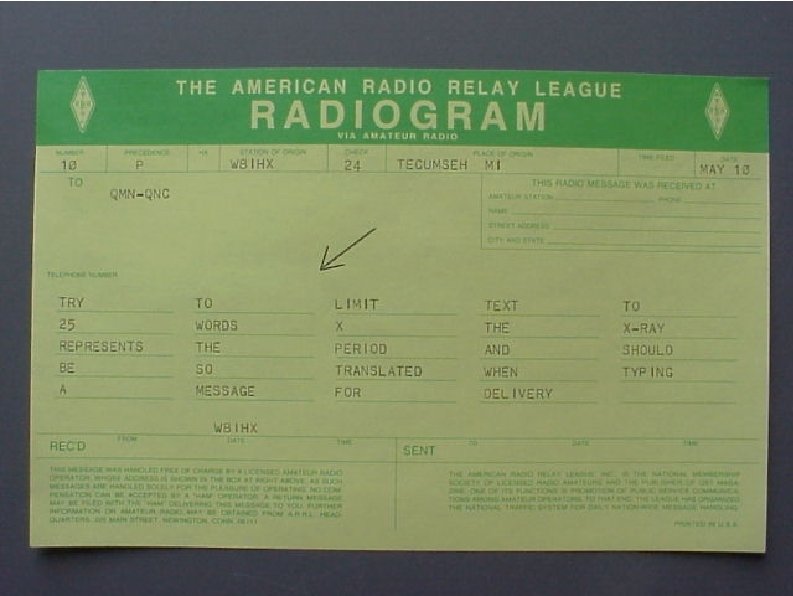
 The Text Try to limit to 25 words or less for routine messages Keep as brief as possible for official traffic Avoid difficult or confusing language Utilize the “X” for a period. Never end a radiogram text with an X Always convert the “X” to a period when delivering traffic in writing.
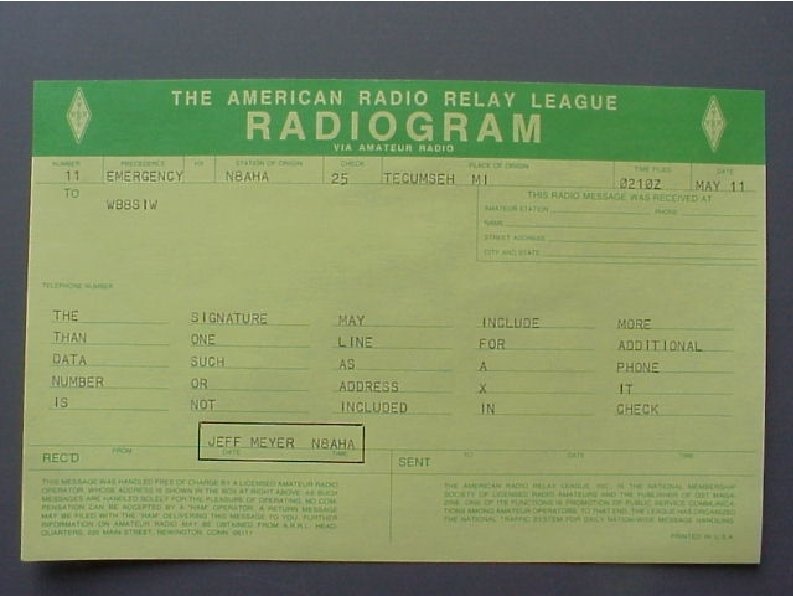
 The Signature The name of the individual or agency originating the message. May include additional data, such as address or telephone number, title, etc.
 Op Note Conveys additional information to relay or delivery stations Two kinds of op notes Address op note, after name /address / phone number Signature op note, after the signature
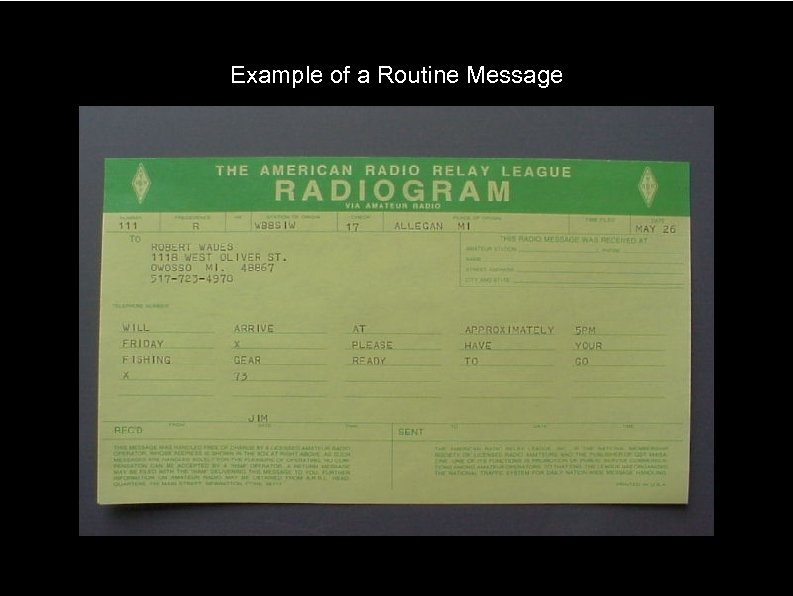 Example of a Routine Message
 ARL Texts Common message texts designated by a code to speed transmission of traffic Example: ARL One = “Everyone safe here please don’t worry” ARL numbers are always spelled out
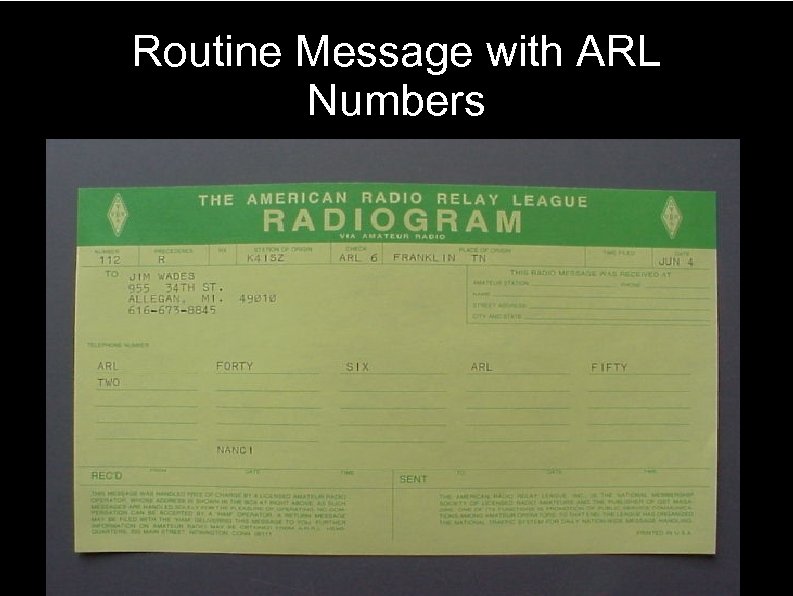 Routine Message with ARL Numbers
 Radiogram Form Record Keeping REC'D SENT Record call sign, net, date, and time of receipt Record call sign, net, date, and time of relay THIS RADIO MESSAGE WAS RECEIVED AT Record your contact information when providing paper delivery by US Mail or by hand
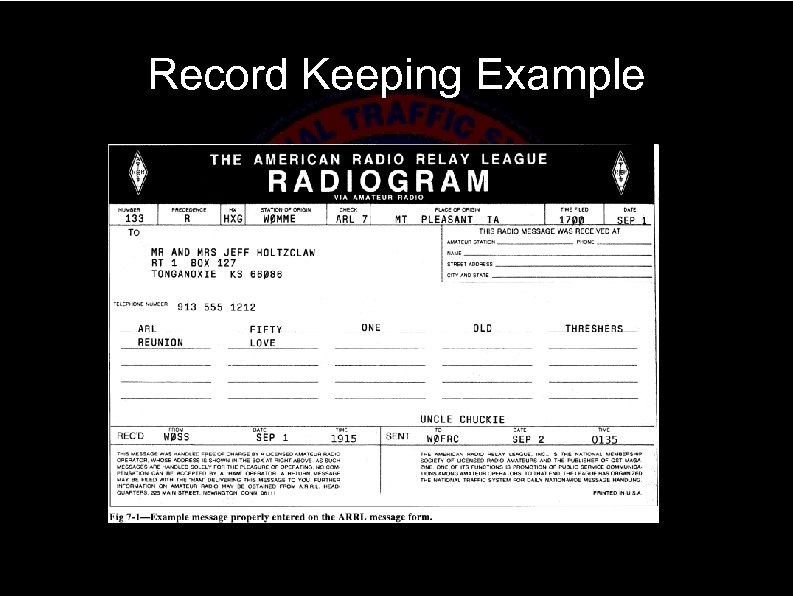 Record Keeping Example
 Voicing on phone nets It is important that you use pro-words properly to ensure correct copy Once you begin transmitting a message, every word you say should be either part of the written message or a pro-word. Traffic handling is a formal procedure and is not an informal conversation. NTS MPG has all the details on voicing and pro -words. Basic pro-words are on the next slide.
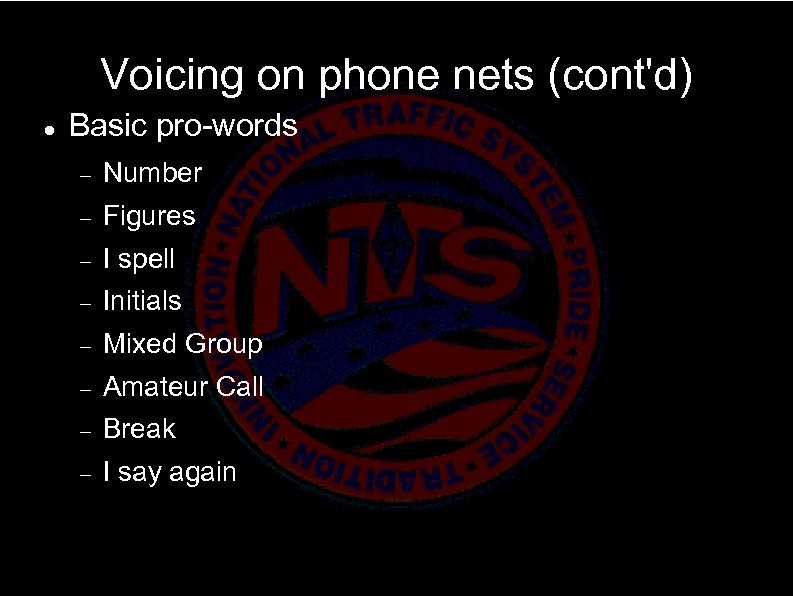 Voicing on phone nets (cont'd) Basic pro-words Number Figures I spell Initials Mixed Group Amateur Call Break I say again
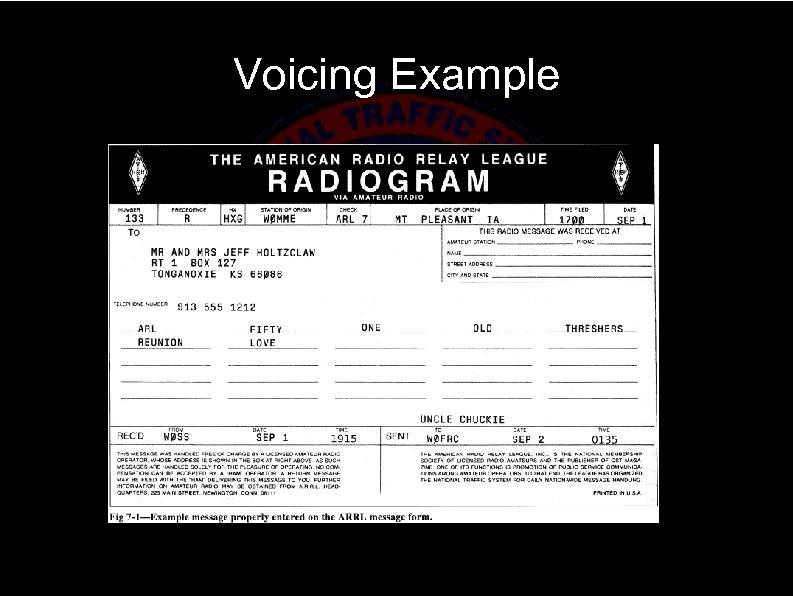 Voicing Example
 Book Traffic Groups together messages with similar contents for convenience Eliminates the need to repeat the same information multiple times “Basic Book” has the same text for every message in the book, with varying message numbers and recipients Other permutations are less common but are perfectly legitimate
 Net Operations NTS Traffic nets are formal, directed nets. The Net Control Station is in charge. Be sure to follow instructions from NCS accurately to the best of your ability.
 Delivery Confirmed delivery (preferred) Telephone By hand Unconfirmed delivery Voice mail or answering machine U. S. Mail Service originating station if they requested confirmation, or if delivery was unsuccessful or unconfirmed
 Delivery (cont'd) You are representing all Ham Radio operators Make the call Identifying yourself Non-Hams The Message Radiogram vs. Telegram Hardly ever bad news Example: “My name is Nick and I'm a ham radio operator. I have a radiogram message of greeting for David Smith from Steve Jones in Dallas, Texas. May I please speak with David? ”
 Reporting Station Activity Report (SAR) Appreciated from any station handling traffic Mandatory for stations with ORS appointment Use a log sheet to keep track of your messages Originated, Received, Sent, & Delivered Public Service Honor Roll (PSHR) Keep another log sheet with tally of number of net checkins, total time of participation in nets and other public service activities (planned and unplanned) Report SAR and PSHR totals to STM and SM STM = Tom Cody, WE 2 G (we 2 g@arrl. net) SM = Pete Cecere, N 2 YJZ (n 2 yjz@arrl. org)
 International Third Party Traffic You may handle international third party traffic as long as the US has signed an official thirdparty traffic agreement with that particular country, or the third party is a licensed amateur. http: //www. arrl. org/Fand. ES/field/regulations/io/3 rdparty. html The traffic must be non-commercial and of a personal, unimportant nature. During an emergency, the US State Department will often work out a special temporary agreement with the country involved. But in normal times, never handle traffic without first making sure it is legally permitted.
 How can you get involved? You do not need to make a big time commitment Start by just checking in to the local nets Learn the basic check-in procedures Casual check-ins are OK up to the section level Maybe take some traffic for delivery or originate a piece Substitute for a missing liaison or NCS Regularly filling one assignment would be a big help to the system
 Getting your Feet Wet All NTS nets are for training Local VHF nets are specifically intended for training Do not be afraid to make mistakes. You will receive tips and guidance from more experienced operators, which will help you learn how to do it. “Anything that's worth doing, is worth doing poorly. ” http: //www. desktop-meditation. com/new_page_114. htm
 Please help! We need help at every level of NTS from local nets to TCC Phone operators are needed! CW operators are needed! Digital operators are needed! Personal training is available Email or call me!
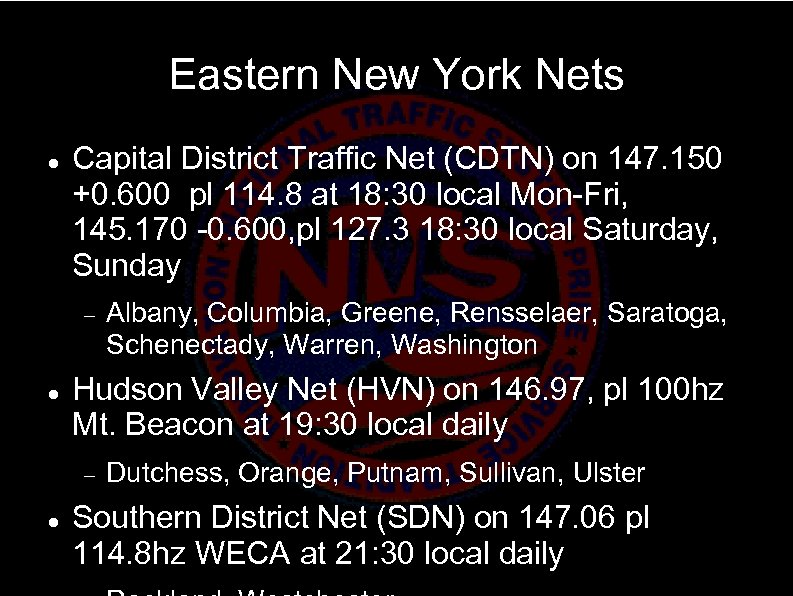 Eastern New York Nets Capital District Traffic Net (CDTN) on 147. 150 +0. 600 pl 114. 8 at 18: 30 local Mon-Fri, 145. 170 -0. 600, pl 127. 3 18: 30 local Saturday, Sunday Hudson Valley Net (HVN) on 146. 97, pl 100 hz Mt. Beacon at 19: 30 local daily Albany, Columbia, Greene, Rensselaer, Saratoga, Schenectady, Warren, Washington Dutchess, Orange, Putnam, Sullivan, Ulster Southern District Net (SDN) on 147. 06 pl 114. 8 hz WECA at 21: 30 local daily
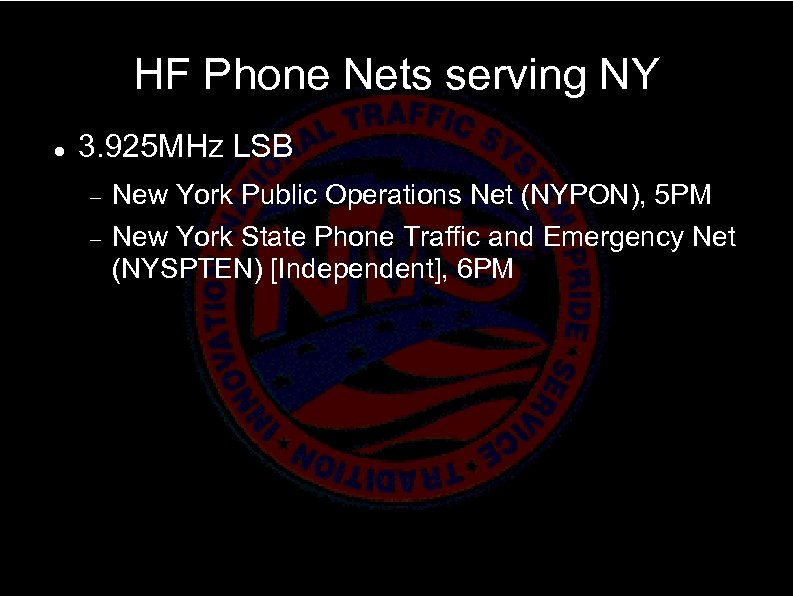 HF Phone Nets serving NY 3. 925 MHz LSB New York Public Operations Net (NYPON), 5 PM New York State Phone Traffic and Emergency Net (NYSPTEN) [Independent], 6 PM
 Finding more information NTS-ENY web site Through the ENY Section web page http: //hudson. arrl. org/eny/ Click on “NTS” http: //www. arrl. org/Fand. ES/field/nts-mpg/ Email or call me!
 Thanks for listening! Contact information: we 2 g@arrl. net ENY STM Tom Cody, WE 2 G 1 -518 -828 -7084 Any questions?
 Credits Thanks to the following sources: The American Radio Relay League, Inc. http: //www. arrl. org/Fand. ES/field/pscm. pdf http: //www. arrl. org/Fand. ES/field/nts-mpg/ http: //www. arrl. org/Fand. ES/field/regulations/io/3 rdparty. html Steven R. Ewald, WV 1 X, ed. , The ARRL Net Directory 2001 -2002 Edition (Connecticut: The American Radio Relay League, Inc. , 2001), back cover. Chuck Hutchinson, K 8 CH, ed. , The ARRL Operating Manual Seventh Edition (Connecticut: The American Radio Relay League, Inc. , 2000), p. 7 -6. James Wades K 8 SIW, and the Michigan Net, QMN / National Radio Emergency Net (with permission) http: //71. 238. 11. 155: 81/nren/docs/ntst. ppt Jim Shultz W 5 OMG (with permission) Nicholas Castellano, N 2 QZ Thomas Cody, WE 2 G http: //myweb. cebridge. net/kb 5 jbv/Resources/National_Traffic_System. ppt