


 Скачать презентацию National Technical University of Athens School of Rural
9985f5287ed53011fad6dfb18a6ce6a6.ppt
- Количество слайдов: 21
 National Technical University of Athens School of Rural and Surveying Engineering UN/ECE WPLA activity in Land Administration-New Trends Dr Chryssy A Potsiou Bureau member of UN/ECE WPLA
 Land Administration • • • Cadastre Land registers Land consolidation Valuation LIS
 Land Administration Includes processes that • Determine rights and other attributes • The survey and description of these • Their detailed documentation • Provision of information
 Land administration rather than just cadastre or land registration!
 UN/ECE WPLA www. unece. org/env/hs/wpla • ECE- 1 st international organization which defined & addressed the issue of Land Administration in Europe • 1996 Meeting of Officials on Land Administration MOLA • 1999 Working Party on Land Administration WPLA (under the auspices of the ECE Committee on Human Settlements-contributes in activities on housing reforms & sustainable spatial planning) WPLA is developed into an effective network of LA officials in Europe & North America
 WPLA major objective is to promote LA through: • Security of tenure in the region • Establishment of real estate markets in countries in transition • Modernization of land registration systems in advanced economies WPLA coordinates with other ECE activities on the environment, facilitation of trade, foreign investment, industrial development
 The WPLA structure • • Open to all ECE countries (ca 55) No EU membership is required No fees-voluntary input One or several organizations from each country are accepted to participate Workshops (2 every year), task forces, publications (guidelines, policy papers), land administration reviews (expert missions)/ recommendations on national programs on land market development & real estate registration in response to a high demand from the ECE member states
 Terms of Reference 1. (ECE/HBP/96) LA is the process of recording and disseminating information about: Ownership, Value, and Use of land its associated resources 2. WPLA works in the areas of: • Basic land management legislation • Land administration measures • Land information systems • Organization and management issues 3. Cooperates with UN-Habitat, FAO, UNDP, FIG, CINDER, EUROGI, PCC, Euro. Geographics, INSPIRE, EULIS, etc
 Who are represented in WPLA activities? • Formally nations • Cadastral organizations • Land registries & Land information organizations • Ministries • Private organizations • Universities Exchange of information, knowledge & experience
 UN/ECE WPLA Publications (1) • Benefits of Good Land Administration • Social & Economic Benefits of Good Land Administration (new edition) • Land Administration Guidelines (1996) • Inventory of Land Administration Systems in Europe and North America (1998, new edition) • Report on “key aspects of Land Registration and Cadastral Legislation” • Land (real estate) Mass Valuation Systems for Taxation Purposes in Europe (2001)
 UN/ECE WPLA Publications (2) • Restrictions of ownership, leasing, transfer and financing of land real properties in Europe and North America (2003) • Inventory of international LA projects in Europemaintained by the delegation of Austria: http: //www. bev. gv. at/ • ECE Guidelines on Real Estate Units and Identifiers (2004) • LA in ECE Region, Development Trends & Main Principles (Nov 2005) • Principles for the use of Public Private Partnerships (PPP) within La in ECE member countries (Nov 2005)
 ECE Guidelines on Real Estate Units and Identifiers • November 2001 first decision UNECE Committee on Human Settlements • 2002 WPLA Bureau decision to establish a task force (organizational & financial arrangements) • Task force chair: Helge Onsrud (Norway) • Consultant: Prof Peter Dale • 9 task force members (from various countries) • Additionally, a questionnaire was prepared & sent to selected LA authorities of the UNECE countries
 ECE Guidelines on Real Estate Units and Identifiers • To assist countries re-engineering their Land Book & cadastral systems • To help those who are seeking harmonization across European Union so that data relating to real property can be shared • To support good governance and sound decision-making by other parties involved , both from the public & private sector, i. e. citizens, businesses and government • To help smooth operation of the land market • To be used for professional training & university students
 ECE Guidelines on Real Estate Units and Identifiers The Guidelines : • Contain a number of recommendations but do not attempt to provide a single solution to what are complex problems • Underline issues that are common in most cases • Offer examples of good practice • Aim to facilitate internal and external cooperation Each nation must decide what it wants and what is best for its own circumstances
 ECE Guidelines on Real Estate Units and Identifiers Part one contains a review of: • the social & economic importance of land (physical & economic value, legal & cultural entity) • Land administration & management of property information (examples of data held, and of various land market forms: sales/rental/mortgage) • Why identification & accurate description of real property units is essential if land markets are to operate smoothly and openly for the benefit of all: Property identifiers are the link between various components of a land market (i. e. ownership, rights); Clear definition of what is transacted & where it is located is important
 ECE Guidelines on Real Estate Units and Identifiers • the development of an effective system of real property & parcel identification is discussed • Types of land tenure & legal rights vary among countries • The 3 rd dimension, land buildings, condominiums rights, minerals, hydrocarbons, water rights, • land use & land use rights, land use controls & physical planning • The importance of integrated administration & control (examples of IACS & cadastre identification systems-lack of coordination)
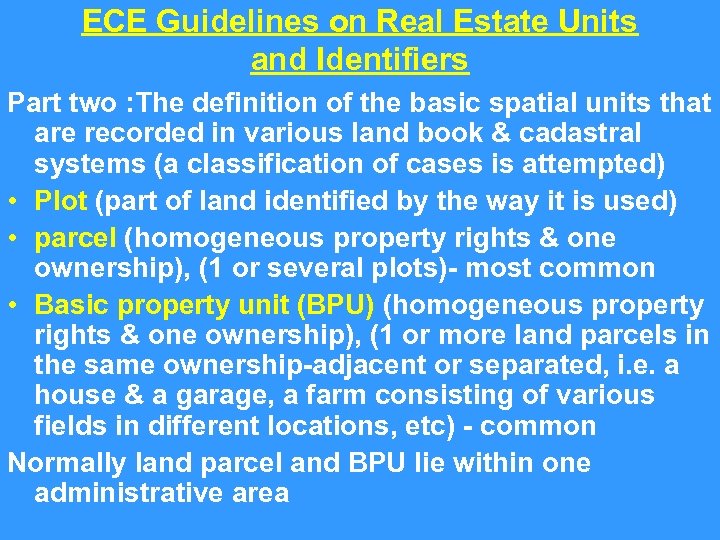 ECE Guidelines on Real Estate Units and Identifiers Part two : The definition of the basic spatial units that are recorded in various land book & cadastral systems (a classification of cases is attempted) • Plot (part of land identified by the way it is used) • parcel (homogeneous property rights & one ownership), (1 or several plots)- most common • Basic property unit (BPU) (homogeneous property rights & one ownership), (1 or more land parcels in the same ownership-adjacent or separated, i. e. a house & a garage, a farm consisting of various fields in different locations, etc) - common Normally land parcel and BPU lie within one administrative area
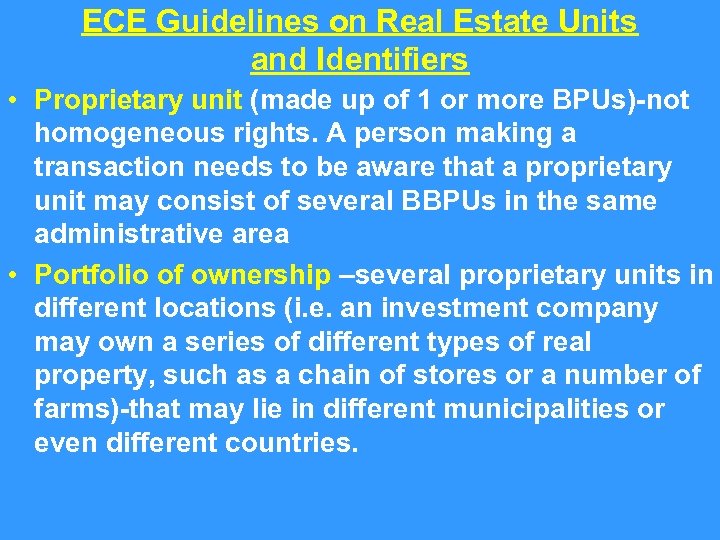 ECE Guidelines on Real Estate Units and Identifiers • Proprietary unit (made up of 1 or more BPUs)-not homogeneous rights. A person making a transaction needs to be aware that a proprietary unit may consist of several BBPUs in the same administrative area • Portfolio of ownership –several proprietary units in different locations (i. e. an investment company may own a series of different types of real property, such as a chain of stores or a number of farms)-that may lie in different municipalities or even different countries.
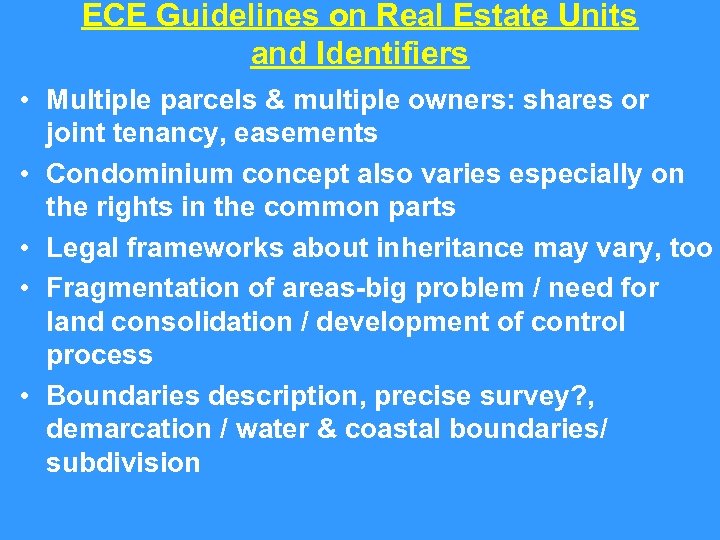 ECE Guidelines on Real Estate Units and Identifiers • Multiple parcels & multiple owners: shares or joint tenancy, easements • Condominium concept also varies especially on the rights in the common parts • Legal frameworks about inheritance may vary, too • Fragmentation of areas-big problem / need for land consolidation / development of control process • Boundaries description, precise survey? , demarcation / water & coastal boundaries/ subdivision
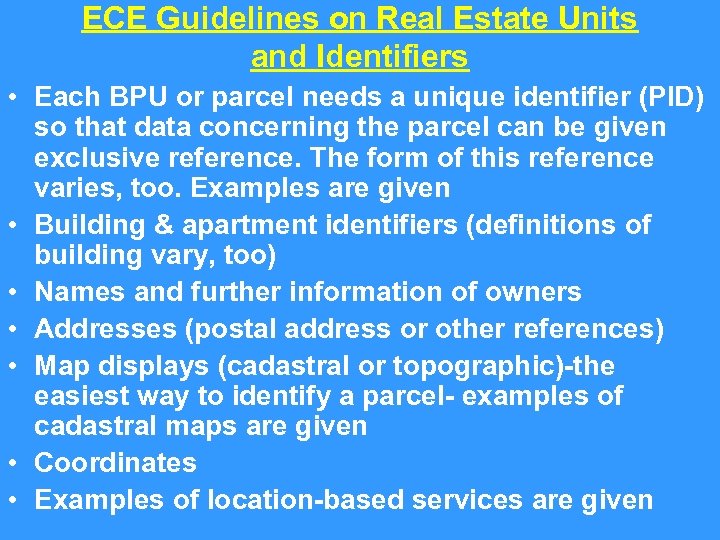 ECE Guidelines on Real Estate Units and Identifiers • Each BPU or parcel needs a unique identifier (PID) so that data concerning the parcel can be given exclusive reference. The form of this reference varies, too. Examples are given • Building & apartment identifiers (definitions of building vary, too) • Names and further information of owners • Addresses (postal address or other references) • Map displays (cadastral or topographic)-the easiest way to identify a parcel- examples of cadastral maps are given • Coordinates • Examples of location-based services are given
 ECE Guidelines on Real Estate Units and Identifiers • Conclusions & recommendations are given to be used as a framework within which appropriate identifiers can be developed • As harmonization across Europe gathers pace a specifically European solution may emerge.