 Скачать презентацию National Standard for December 2015 WA Health
a6504e20a855ccf20466101eb6367ac1.ppt
- Количество слайдов: 53



National Standard for December 2015 WA Health
Presentation Summary > Labelling for safety > Labelling Standard • Aims • Minimum requirements • Outline and content > Application in clinical practice User-applied labelling of injectable medicines | 2
Labelling for Safety > Labelling of injectable medicines, fluids and delivery devices is a major patient safety issue > Labelling is often not done or incomplete, omitting information such as: • name of medicine • medicine dose • patient name • time of preparation. > Incomplete/omitted labelling is a source of medication error User-applied labelling of injectable medicines | 3
Medicine administration errors related to absent or inadequate labelling include: > Wrong medicine > Wrong route > Wrong patient Labelling errors are particularly associated with: > Patient transfer between clinical areas > Perioperative sterile field > 0. 9% sodium chloride flush > Line misconnections User-applied labelling of injectable medicines | 4
Medicine administration errors Case Report 1 10 mg morphine was given in error as the clinician thought the syringe contained 0. 9% sodium chloride. The unlabelled syringe had a 0. 9% sodium chloride ampoule attached. (unpublished) User-applied labelling of injectable medicines | 5
Medicine administration errors Case Report 2 A patient was given intravenous (IV) lignocaine with adrenaline solution intended for local anaesthetic infiltration. This syringe had been drawn up and placed in a kidney dish alongside IV morphine and midazolam for procedural sedation. (unpublished) User-applied labelling of injectable medicines | 6
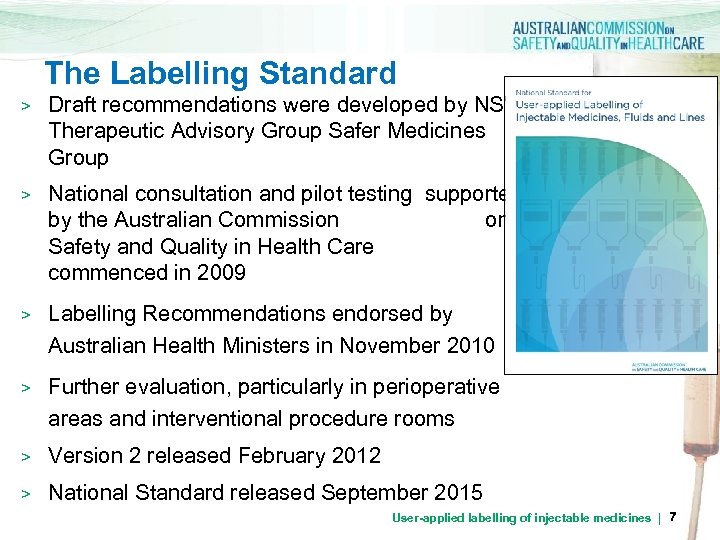
The Labelling Standard > Draft recommendations were developed by NSW Therapeutic Advisory Group Safer Medicines Group > National consultation and pilot testing supported by the Australian Commission on Safety and Quality in Health Care commenced in 2009 > Labelling Recommendations endorsed by Australian Health Ministers in November 2010 > Further evaluation, particularly in perioperative areas and interventional procedure rooms > Version 2 released February 2012 > National Standard released September 2015 User-applied labelling of injectable medicines | 7
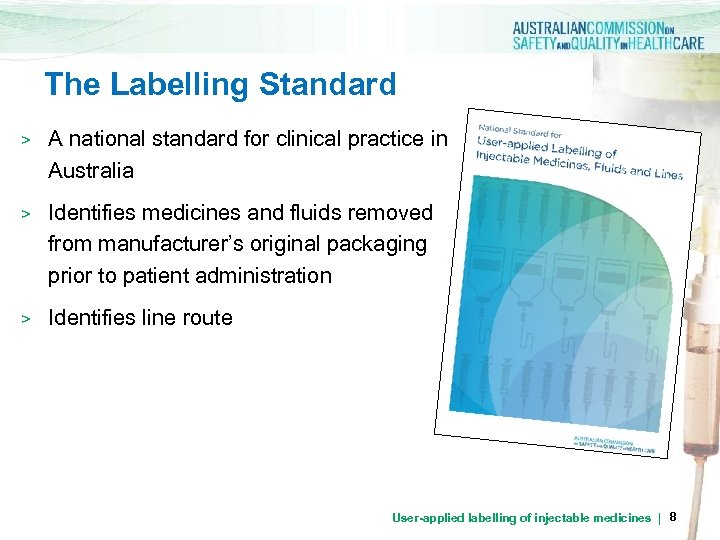
The Labelling Standard > A national standard for clinical practice in Australia > Identifies medicines and fluids removed from manufacturer’s original packaging prior to patient administration > Identifies line route User-applied labelling of injectable medicines | 8
Labelling Standard Aims > Provide standardisation for user-applied labelling of injectable medicines > Provide minimum requirements for userapplied labelling of injectable medicines > Promote safer use of injectable medicines User-applied labelling of injectable medicines | 9
Labelling Standard Development > Based on: • International literature/recommendations • Australian Standard AS 4940: 2002 User-applied identification labels for use on fluid bags, syringes and drug administration lines. • International Standard ISO 26825: 2008 Anaesthetic and respiratory equipment – user-applied labels for syringes containing drugs used during anaesthesia – colours, design and performance • Expert opinion • Pilot testing • Reported medicine administration incidents User-applied labelling of injectable medicines | 10
Labelling Standard Minimum requirements > All medicines and fluids removed from the manufacturer’s or hospital pharmacy’s original packaging must be identifiable. > All containers (e. g. bags, syringes) containing medicines leaving the hands of the person preparing the medicine must be labelled. > Prepare and label one medicine at a time before the preparation and labelling of a subsequent medicine. > Any medicine or fluid that cannot be identified (e. g. in an unlabelled syringe or other container) is considered unsafe and should be discarded. User-applied labelling of injectable medicines | 11
Labelling Standard Consultation Labelling Standard development since 2009 has involved: n State and territory health departments n Cardiac Society of Australia and New Zealand n State and territory safer medicines groups n Catheter Laboratory Nursing Council n Australian Association of Nuclear Medicine Specialists n Clinical Oncological Society of Australia n College of Emergency Nursing Australia n Australian College of Critical Care Nurses n Consumers Health Forum n Australian College of Nursing n Council of Australian Therapeutic Advisory Groups n Australian College of Operating Room Nurses n n Australian and New Zealand College of Anaesthetists Intensive Care Coordination and Monitoring Unit, New South Wales n Renal Society of Australasia n Australian and New Zealand Intensive Care Society n n Australian and New Zealand Society for Nuclear Medicine Royal Australian and New Zealand College of Radiologists n SESIAHS Sterilising Services, Randwick Hospitals Campus n Australian Nursing and Midwifery Federation n Australian Pharmaceutical Healthcare Systems n Society of Hospital Pharmacists of Australia n Australian Private Hospitals Association n Women’s & Children’s Hospitals Australasia n Cancer Council Australia User-applied labelling of injectable medicines | 12
Labelling Standard Outline > What should be labelled > What should be included on the label > Where the label should be placed > Where the Labelling Standard applies User-applied labelling of injectable medicines | 13
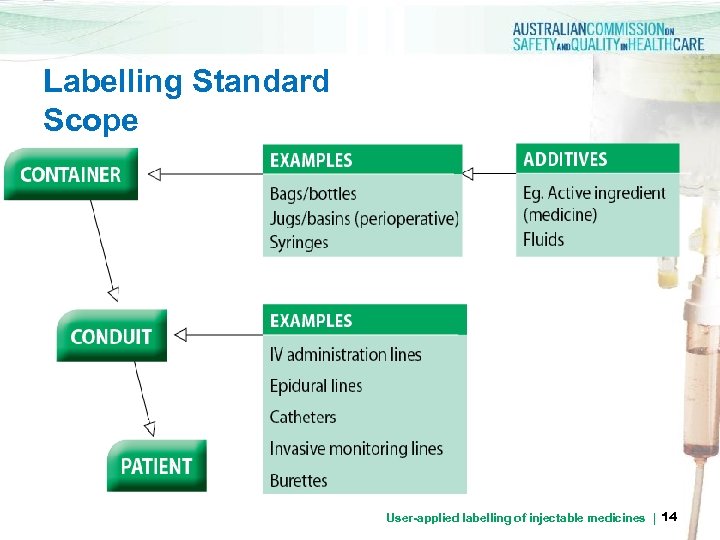
Labelling Standard Scope User-applied labelling of injectable medicines | 14
Labelling Standard Scope > all clinical areas where injectable medicines and fluids are administered > all injectable medicines and fluids prepared in the ward or clinical area > injectable medicines, defined as any sterile medicine intended for administration by bolus injection, perfusion or infusion by the following routes: intravenous, intramuscular, intrathecal, intra-arterial, subcutaneous, intradermal, intraventricular, epidural, intravesicular, intravitreal, intrapleural and intra-ocular. This list is not exhaustive, and other routes of injection should also be considered in the context of the Labelling Standard (e. g. intraosseous and intraperitoneal) medicines | 15 User-applied labelling of injectable
Labelling Standard Extended Scope > Labelling of containers in perioperative settings (including cardiac catheter and interventional radiology units). The Anaesthetic Labelling Standard (ISO 26825: 2008) applies to syringes containing medicines used during anaesthesia > Colour coded pre-printed medicine labels for use on dedicated continuous infusion lines > Liquid medicines for oral, enteral and inhalational use > Labelling of non-injectable medicines and fluids prepared in the same area as injectable medicines. User-applied labelling of injectable medicines | 16
Labelling Standard Exclusions > Injectable medicines and fluids: > prepared by hospital pharmacy departments, external manufacturers or compounding centres > not directly administered to the patient e. g. ampoules > Administration portals > Topical products prepared when injectable medicines are not present; however, the same principles of identification translate to topical use of medicines, solutions, chemicals > extemporaneously dispensed radiopharmaceuticals and reagents User-applied labelling of injectable medicines | 17
Application in clinical practice User-applied labelling of injectable medicines | 18
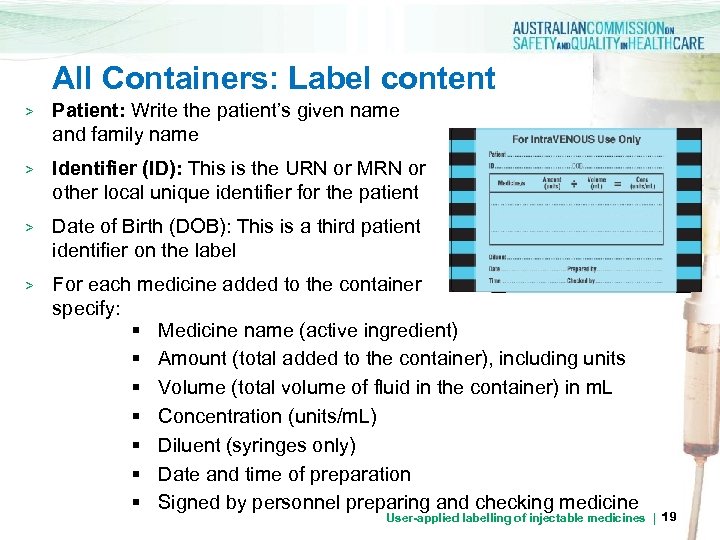
All Containers: Label content > Patient: Write the patient’s given name and family name > Identifier (ID): This is the URN or MRN or other local unique identifier for the patient DOB > Date of Birth (DOB): This is a third patient identifier on the label > For each medicine added to the container specify: § Medicine name (active ingredient) § Amount (total added to the container), including units § Volume (total volume of fluid in the container) in m. L § Concentration (units/m. L) § Diluent (syringes only) § Date and time of preparation § Signed by personnel preparing and checking medicine User-applied labelling of injectable medicines | 19
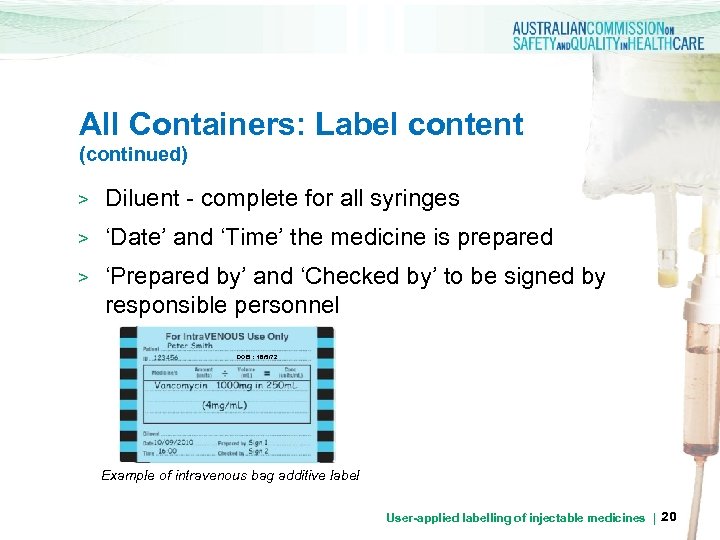
All Containers: Label content (continued) > Diluent - complete for all syringes > ‘Date’ and ‘Time’ the medicine is prepared > ‘Prepared by’ and ‘Checked by’ to be signed by responsible personnel DOB : 18/5/72 Example of intravenous bag additive label User-applied labelling of injectable medicines | 20
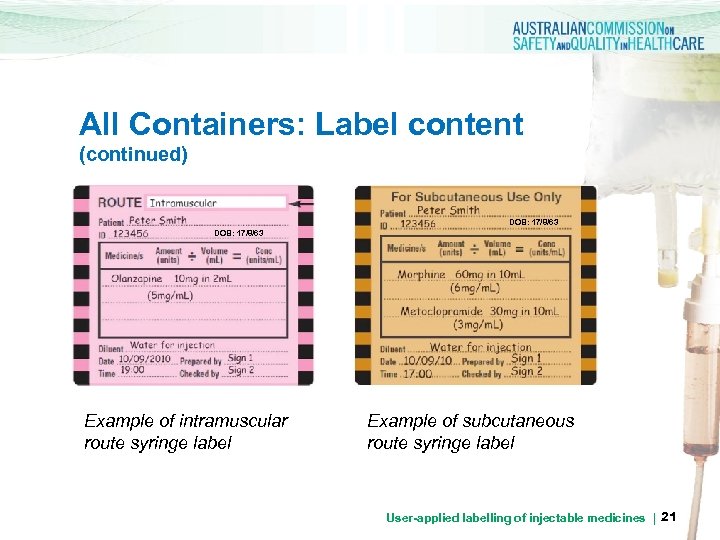
All Containers: Label content (continued) DOB: 17/8/63 Example of intramuscular route syringe label Example of subcutaneous route syringe label User-applied labelling of injectable medicines | 21
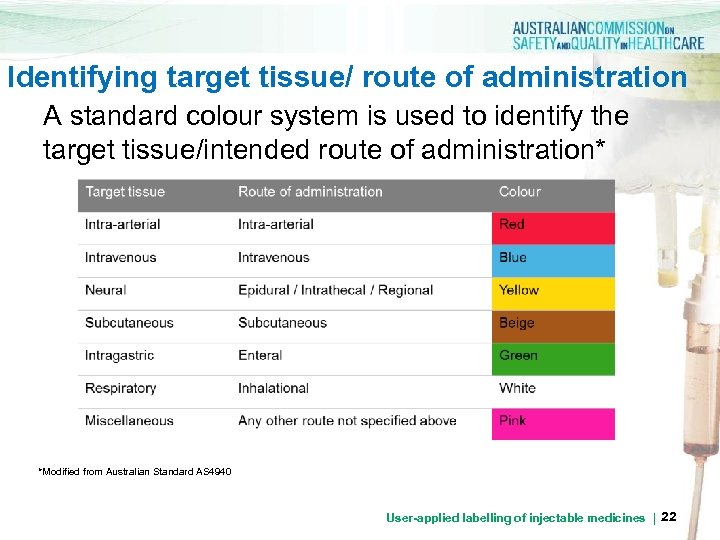
Identifying target tissue/ route of administration A standard colour system is used to identify the target tissue/intended route of administration* *Modified from Australian Standard AS 4940 User-applied labelling of injectable medicines | 22
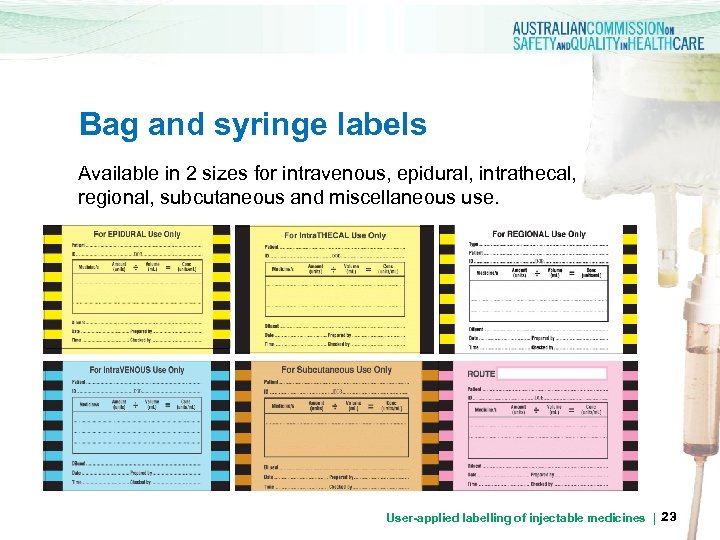
Bag and syringe labels Available in 2 sizes for intravenous, epidural, intrathecal, regional, subcutaneous and miscellaneous use. User-applied labelling of injectable medicines | 23
Bags with additives > Bags (and bottles) only require user-applied labels when a medicine is added in the clinical/ward area > Label IMMEDIATELY an injectable medicine is added > The ‘diluent’ should be identified on the label if the base fluid contained is not easily identifiable from the original manufacturers label (see label placement). User-applied labelling of injectable medicines | 24
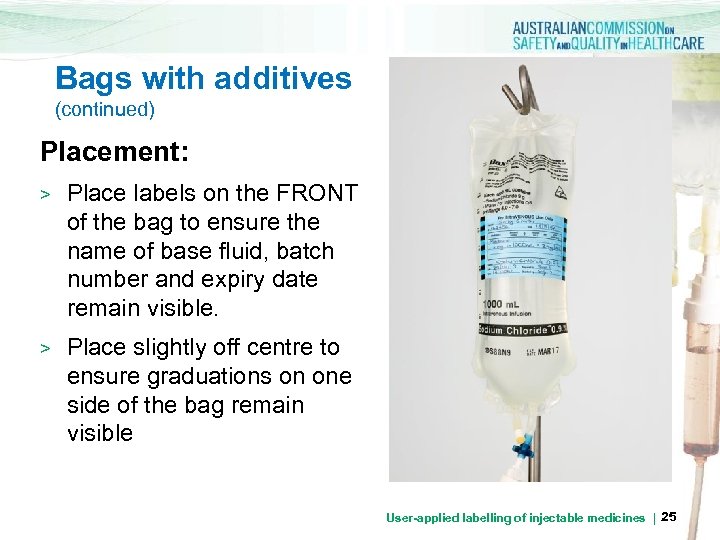
Bags with additives (continued) Placement: > > Place labels on the FRONT of the bag to ensure the name of base fluid, batch number and expiry date remain visible. DOB: 17/8/63 Place slightly off centre to ensure graduations on one side of the bag remain visible User-applied labelling of injectable medicines | 25
Syringes For bolus or infusion > Label all injectable medicines drawn up in syringes that leave the hand of the operator IMMEDIATELY. > Prepare multiple syringes by preparing and labelling one syringe in an independent operation before preparing a subsequent medicine > Labelling is NOT required when preparation and bolus administration of a SINGLE medicine from a SINGLE syringe are one uninterrupted process, and ¨ the syringe remains in the hand of the person who prepared it, and ¨ the same person administers the medicine IMMEDIATELY ¨ User-applied labelling of injectable medicines | 26
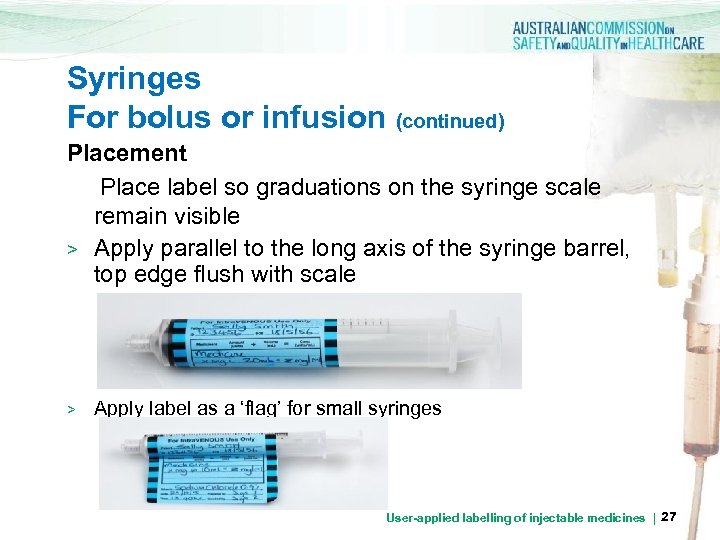
Syringes For bolus or infusion (continued) Placement Place label so graduations on the syringe scale remain visible > Apply parallel to the long axis of the syringe barrel, top edge flush with scale > Apply label as a ‘flag’ for small syringes User-applied labelling of injectable medicines | 27
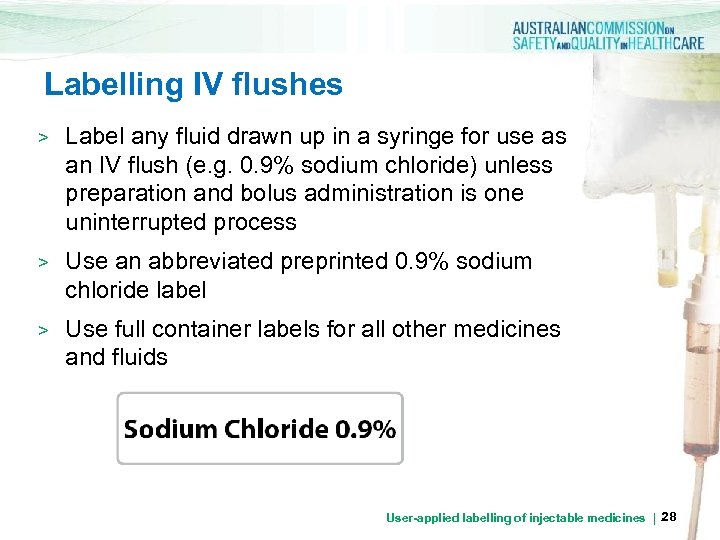
Labelling IV flushes > Label any fluid drawn up in a syringe for use as an IV flush (e. g. 0. 9% sodium chloride) unless preparation and bolus administration is one uninterrupted process > Use an abbreviated preprinted 0. 9% sodium chloride label > Use full container labels for all other medicines and fluids User-applied labelling of injectable medicines | 28
All containers: Discarding Content > Any unlabelled container holding a solution must be immediately discarded > Any container, where there is doubt over content, must be discarded > Any medicine remaining in the container at the end of a procedure must be discarded User-applied labelling of injectable medicines | 29
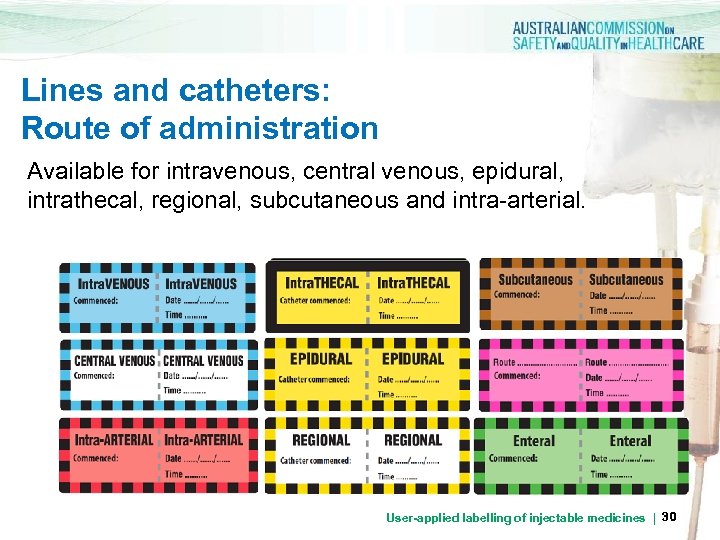
Lines and catheters: Route of administration Available for intravenous, central venous, epidural, intrathecal, regional, subcutaneous and intra-arterial. User-applied labelling of injectable medicines | 30
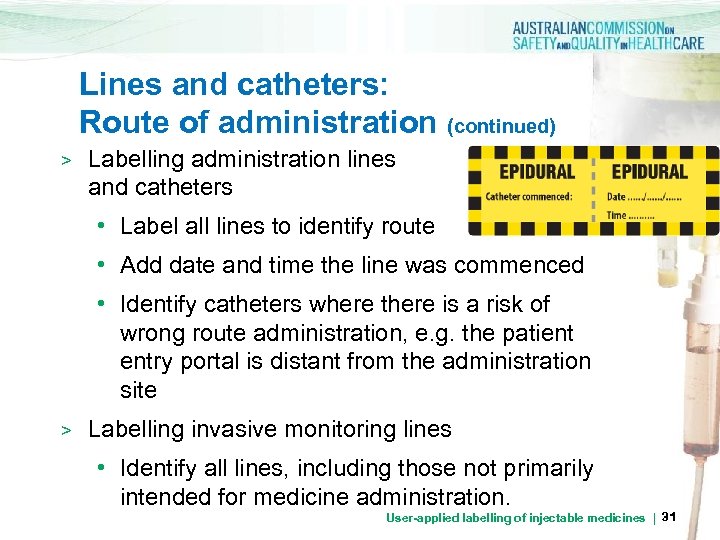
Lines and catheters: Route of administration (continued) > Labelling administration lines and catheters • Label all lines to identify route • Add date and time the line was commenced • Identify catheters where there is a risk of wrong route administration, e. g. the patient entry portal is distant from the administration site > Labelling invasive monitoring lines • Identify all lines, including those not primarily intended for medicine administration. User-applied labelling of injectable medicines | 31
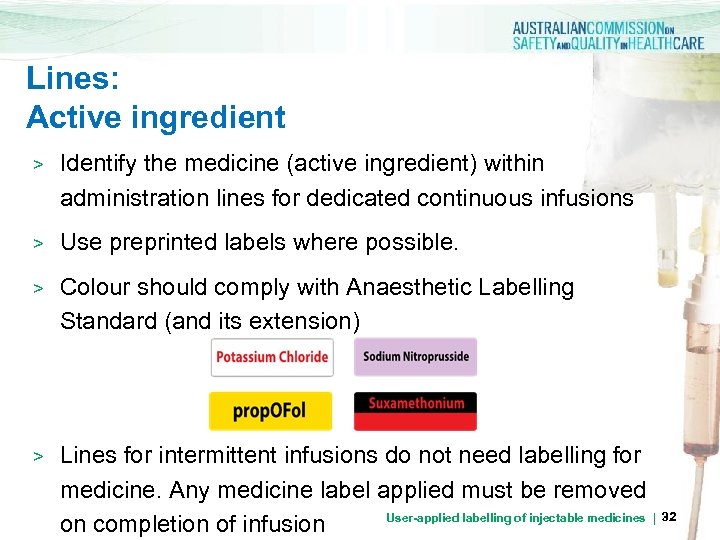
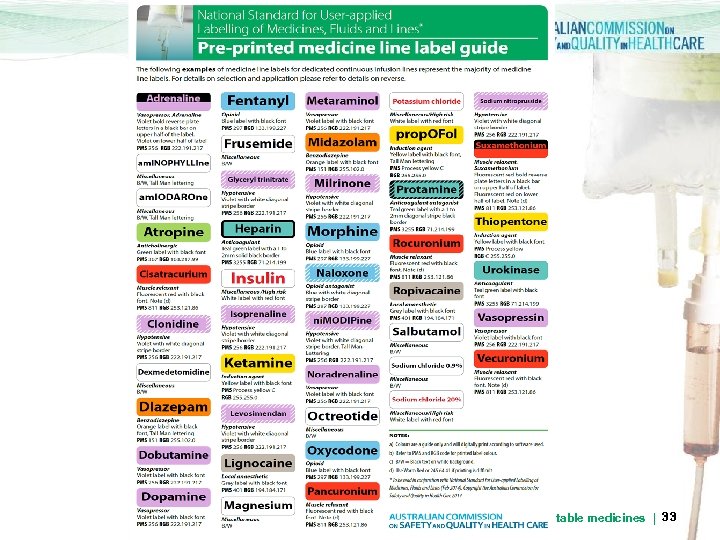
Lines: Active ingredient > Identify the medicine (active ingredient) within administration lines for dedicated continuous infusions > Use preprinted labels where possible. > Colour should comply with Anaesthetic Labelling Standard (and its extension) > Lines for intermittent infusions do not need labelling for medicine. Any medicine label applied must be removed User-applied labelling of injectable medicines | 32 on completion of infusion
User-applied labelling of injectable medicines | 33
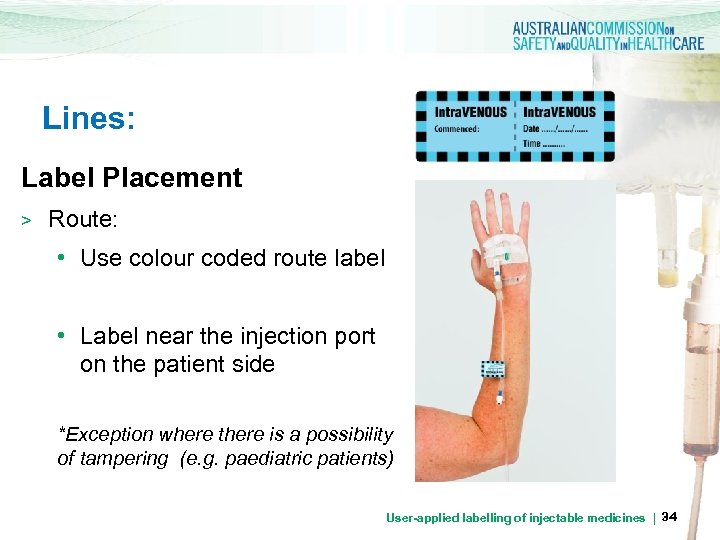
Lines: Label Placement > Route: • Use colour coded route label • Label near the injection port on the patient side *Exception where there is a possibility of tampering (e. g. paediatric patients) User-applied labelling of injectable medicines | 34
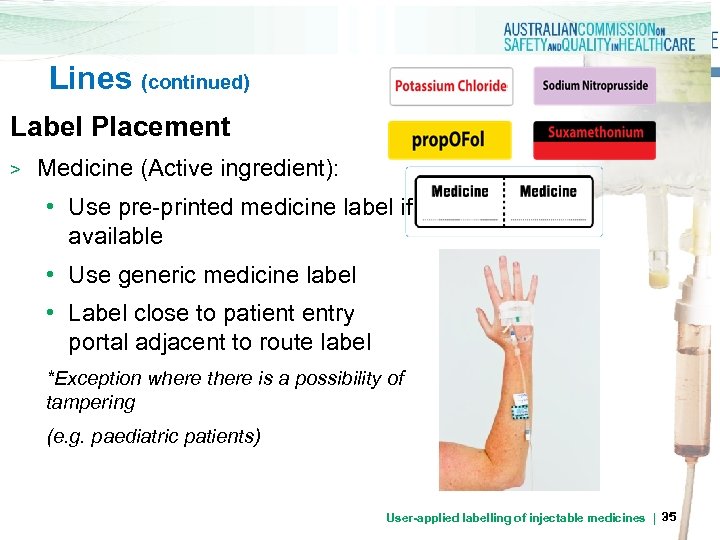
Lines (continued) Label Placement > Medicine (Active ingredient): • Use pre-printed medicine label if available • Use generic medicine label • Label close to patient entry portal adjacent to route label *Exception where there is a possibility of tampering (e. g. paediatric patients) User-applied labelling of injectable medicines | 35
Special circumstances No label required if: Preparation and bolus administration of a SINGLE medicine from a SINGLE syringe is one uninterrupted process - the syringe DOES NOT leave the hands of the person who prepared it, and - that same person administers the medicine IMMEDIATELY User-applied labelling of injectable medicines | 36
Burettes User-applied labelling of injectable medicines | 37
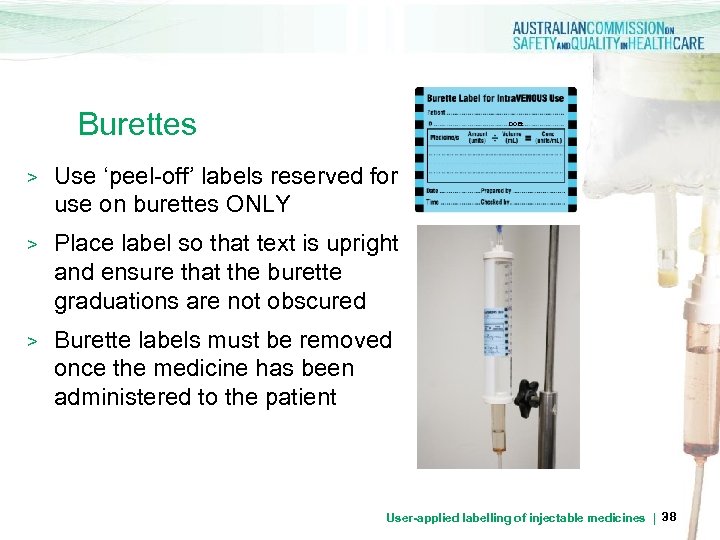
Burettes DOB: > Use ‘peel-off’ labels reserved for use on burettes ONLY > Place label so that text is upright and ensure that the burette graduations are not obscured > Burette labels must be removed once the medicine has been administered to the patient User-applied labelling of injectable medicines | 38

Catheter Lock User-applied labelling of injectable medicines | 39
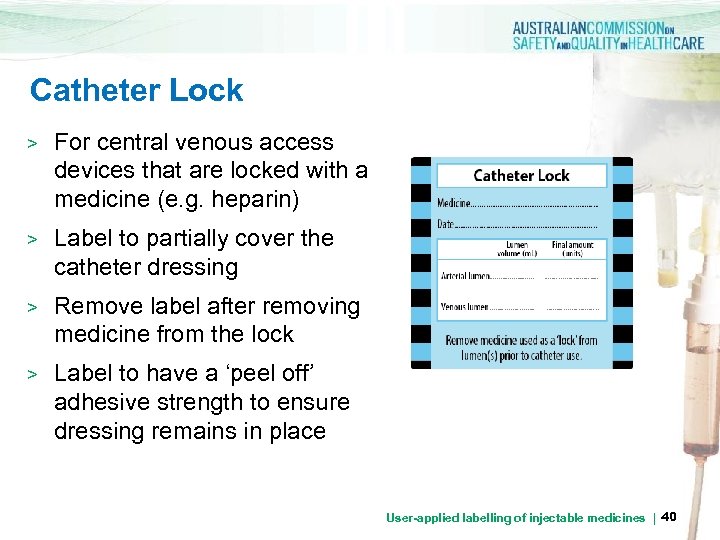
Catheter Lock > For central venous access devices that are locked with a medicine (e. g. heparin) > Label to partially cover the catheter dressing > Remove label after removing medicine from the lock > Label to have a ‘peel off’ adhesive strength to ensure dressing remains in place User-applied labelling of injectable medicines | 40
Non-Injectable Medicine - ENTERAL ROUTE - INHALATION User-applied labelling of injectable medicines | 41
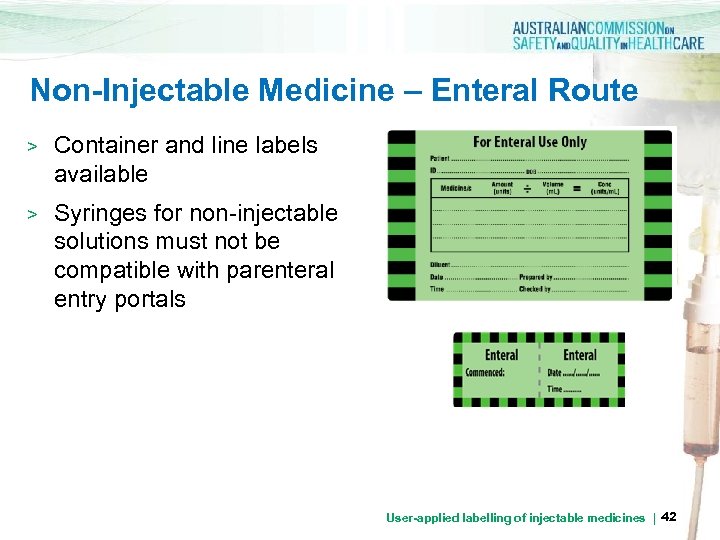
Non-Injectable Medicine – Enteral Route > Container and line labels available > Syringes for non-injectable solutions must not be compatible with parenteral entry portals User-applied labelling of injectable medicines | 42
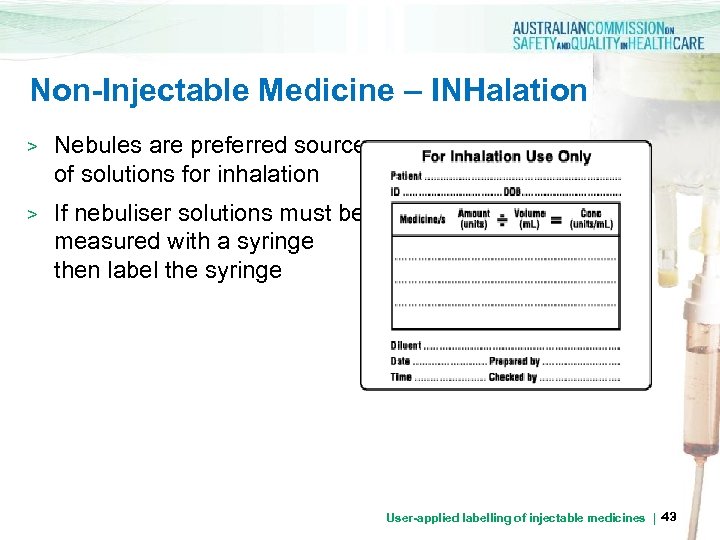
Non-Injectable Medicine – INHalation > Nebules are preferred source of solutions for inhalation > If nebuliser solutions must be measured with a syringe then label the syringe User-applied labelling of injectable medicines | 43

Closed –Practice Environments - Perioperative Sterile Field - Interventional Cardiology - Radiology User-applied labelling of injectable medicines | 44
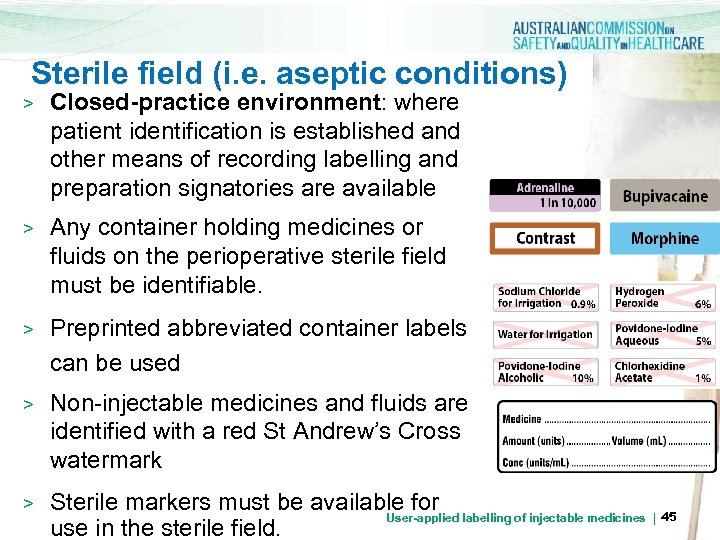
Sterile field (i. e. aseptic conditions) > Closed-practice environment: where patient identification is established and other means of recording labelling and preparation signatories are available > Any container holding medicines or fluids on the perioperative sterile field must be identifiable. > Preprinted abbreviated container labels can be used > Non-injectable medicines and fluids are identified with a red St Andrew’s Cross watermark > Sterile markers must be available for labelling of injectable medicines | 45 User-applied use in the sterile field.

Perioperative environments Perioperative Environment User-applied labelling of injectable medicines | 46
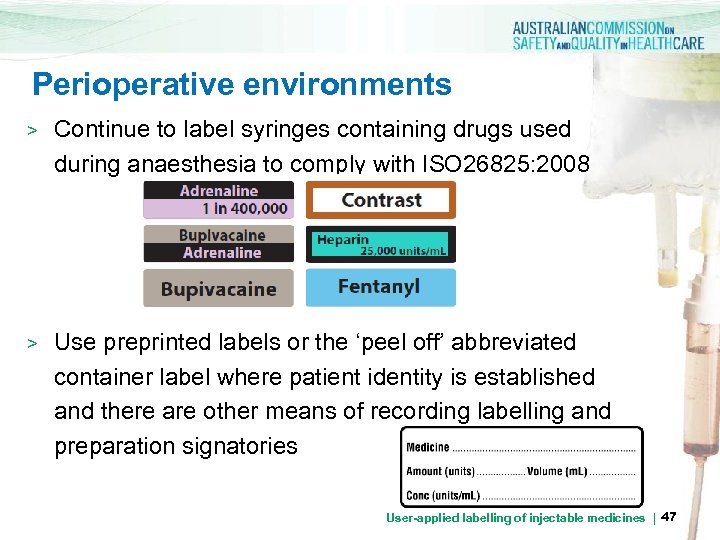
Perioperative environments > Continue to label syringes containing drugs used during anaesthesia to comply with ISO 26825: 2008 > Use preprinted labels or the ‘peel off’ abbreviated container label where patient identity is established and there are other means of recording labelling and preparation signatories User-applied labelling of injectable medicines | 47
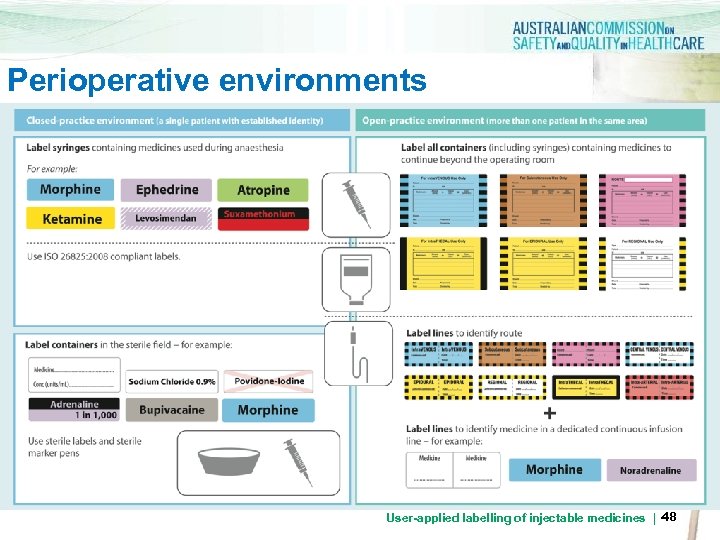
Perioperative environments User-applied labelling of injectable medicines | 48
Perioperative sterile field > Use preprinted label sheets with medicine name and concentration. Colour coding to follow ISO 26825: 2008 (Anaesthetic Labelling Standard) > Use abbreviated container label where preprinted labels unavailable > Labels must remain intact for duration of procedure > Labels must adhere for duration of procedure > Labels should be removed at the end of the procedure for reusable hollowware containers User-applied labelling of injectable medicines | 49
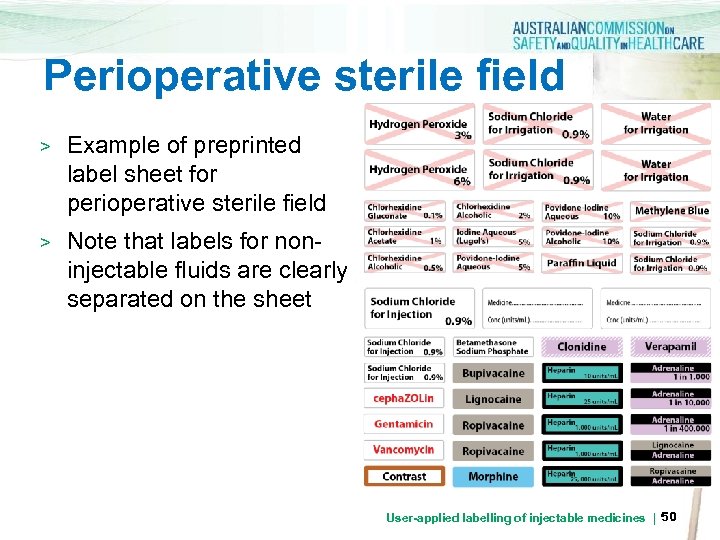
Perioperative sterile field > Example of preprinted label sheet for perioperative sterile field > Note that labels for noninjectable fluids are clearly separated on the sheet User-applied labelling of injectable medicines | 50
Interventional cardiology, radiology and other Perioperative Environment low-light procedure areas User-applied labelling of injectable medicines | 51
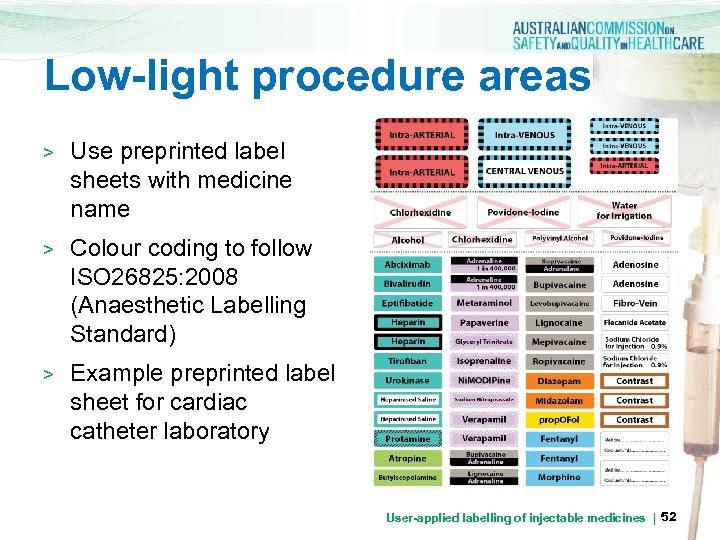
Low-light procedure areas > Use preprinted label sheets with medicine name > Colour coding to follow ISO 26825: 2008 (Anaesthetic Labelling Standard) > Example preprinted label sheet for cardiac catheter laboratory User-applied labelling of injectable medicines | 52
Further information: Go to the Australian Commission on Safety and Quality in Health Care website www. safetyandquality. gov. au User-applied labelling of injectable medicines | 53
Скачать презентацию National Standard for December 2015 WA Health
a6504e20a855ccf20466101eb6367ac1.ppt