


 Скачать презентацию National Spectrum Managers Association 21 May 2003 Earth
20b9358bab8a508c7bf63df5a06ebb65.ppt
- Количество слайдов: 14
 National Spectrum Managers Association 21 May 2003 Earth Stations on Vessels Technical and Regulatory Developments Robert Hanson Vice President – Regulatory Affairs
 Topics for this talk. . . • The Business of ESVs – Types of applications • Technical advances in ESVs – Engineering/System Design – ESV networks • International Regulatory Environment – Technical Recommendations – WRC-03 • National Regulatory Environment – First indications – Frequency coordination • Questions?
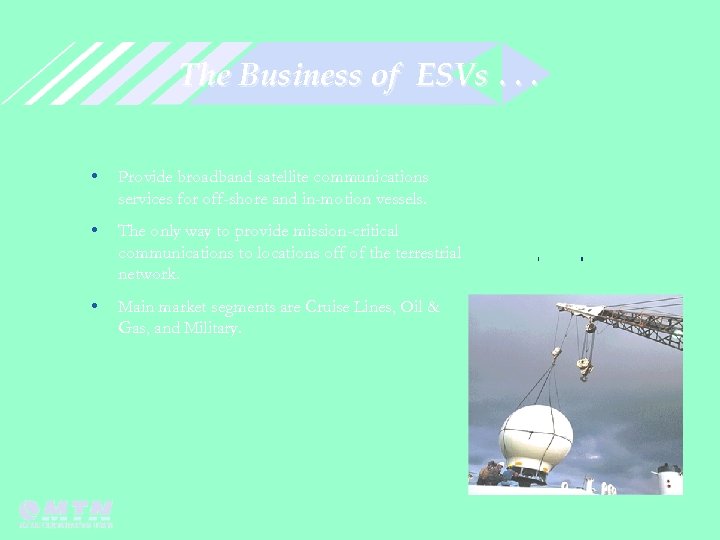 The Business of ESVs. . . • Provide broadband satellite communications services for off-shore and in-motion vessels. • The only way to provide mission-critical communications to locations off of the terrestrial network. • Main market segments are Cruise Lines, Oil & Gas, and Military.
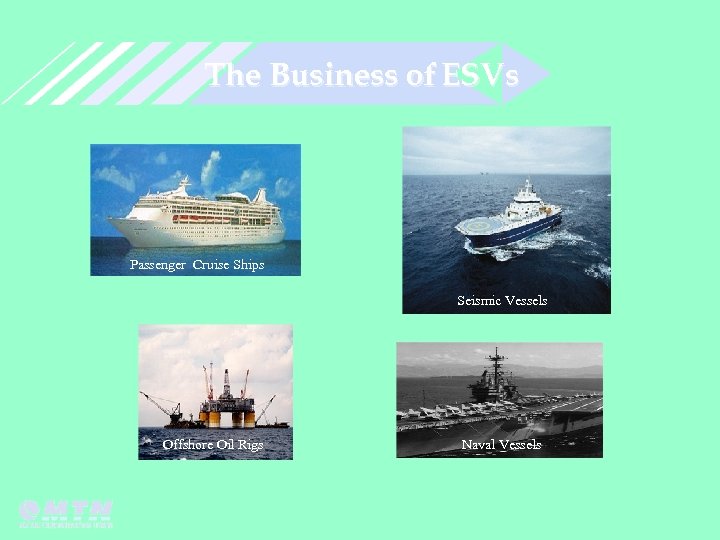 The Business of ESVs Passenger Cruise Ships Seismic Vessels Offshore Oil Rigs Naval Vessels
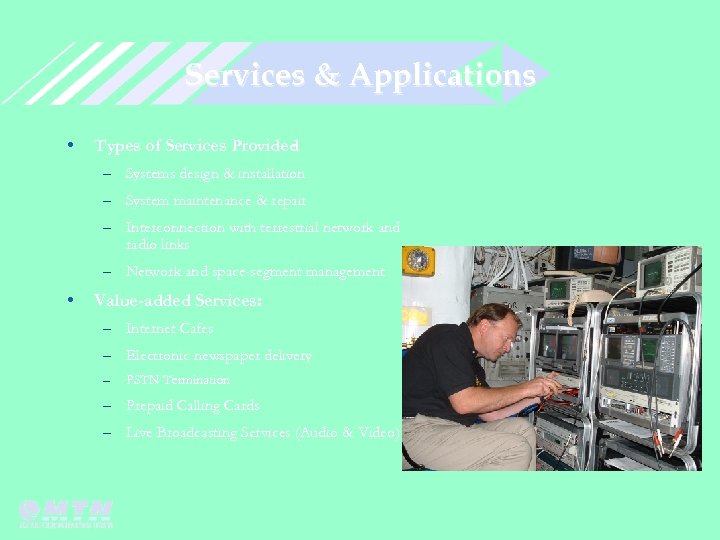 Services & Applications • Types of Services Provided : – Systems design & installation – System maintenance & repair – Interconnection with terrestrial network and radio links – Network and space-segment management • Value-added Services: – Internet Cafes – Electronic newspaper delivery – PSTN Termination – Prepaid Calling Cards – Live Broadcasting Services (Audio & Video)
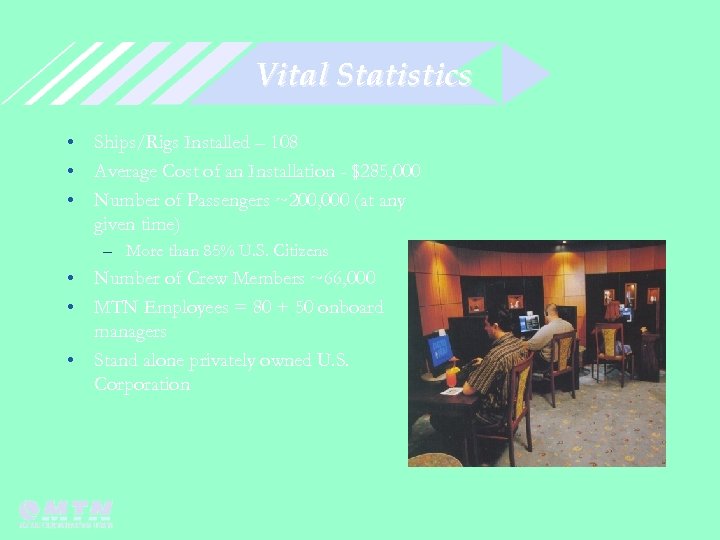 Vital Statistics • Ships/Rigs Installed – 108 • Average Cost of an Installation - $285, 000 • Number of Passengers ~200, 000 (at any given time) – More than 85% U. S. Citizens • Number of Crew Members ~66, 000 • MTN Employees = 80 + 50 onboard managers • Stand alone privately owned U. S. Corporation
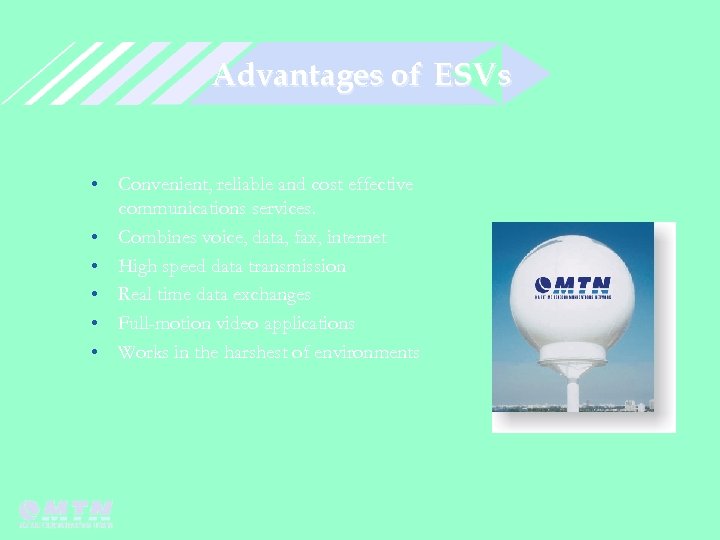 Advantages of ESVs • Convenient, reliable and cost effective communications services. • Combines voice, data, fax, internet • High speed data transmission • Real time data exchanges • Full-motion video applications • Works in the harshest of environments
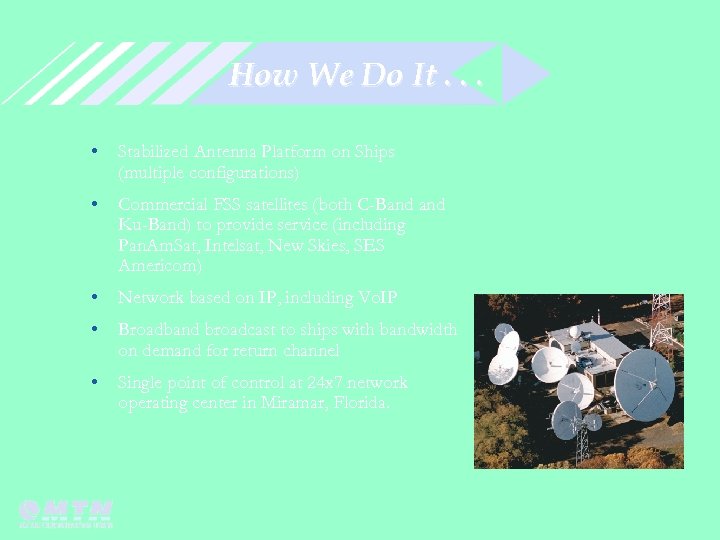 How We Do It. . . • Stabilized Antenna Platform on Ships (multiple configurations) • Commercial FSS satellites (both C-Band Ku-Band) to provide service (including Pan. Am. Sat, Intelsat, New Skies, SES Americom) • Network based on IP, including Vo. IP • Broadband broadcast to ships with bandwidth on demand for return channel • Single point of control at 24 x 7 network operating center in Miramar, Florida.
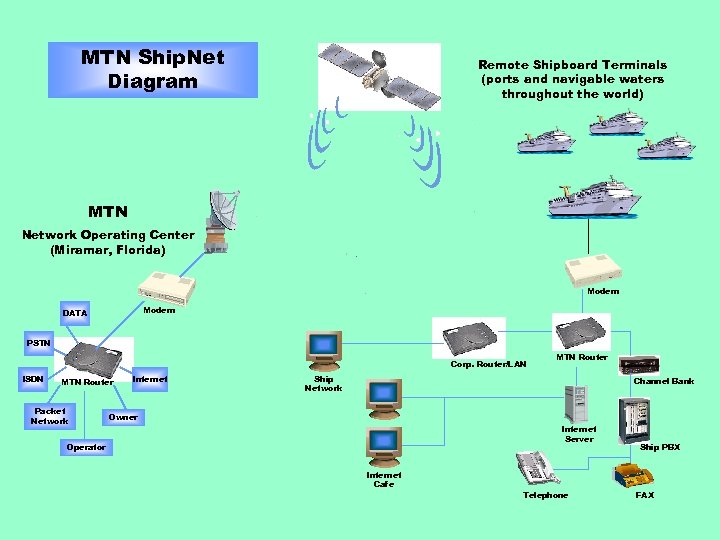 MTN Ship. Net Diagram Remote Shipboard Terminals (ports and navigable waters throughout the world) MTN Network Operating Center (Miramar, Florida) Modem DATA PSTN Corp. Router/LAN ISDN MTN Router Packet Network Internet MTN Router Ship Network Channel Bank Owner Internet Server Operator Internet Cafe Telephone Ship PBX FAX
 Technical Advances in ESVs • Pointing accuracy better than 0. 2 degrees and tracking very stable even in extremely rough seas • Automatic control and location improved • Power and bandwith requirements reduced through use of IP network • Ku-band systems deployed for inland waterways • Dual-band systems still not practical
 Sharing with Existing Users • Compatible with existing FSS satellite networks • Does not interfer with other FSS stations • Negligible increase number of FSS stations • Can use conventional frequency coordination methodology when at a predefined location • In-motion frequency clearance methodology developed through ITU-R • Over 13 years of operation without a single interference incident!
 International Regulatory Status • Final preparations for WRC-03 are now underway • Europe, Asia and Americas all agree that ESVs should operate within the FSS in C-band Ku-band – Common proposals from CEPT, APT, and CITEL contain similar approaches – CITEL proposal was developed within the U. S. , and was supported by industry and government users • Technical coordination guidelines and methodologies for ESVs have been developed in the ITU-R, and are captured in a series of new ITU Recommendations • WRC-03 is expected to confirm the regulatory approach developed within the ITU-R
 Domestic Regulatory History • 1990 Crescomm files an application for a license • 1991 First experimental license granted and as call sign KI 2 XEE, File No. 2237 -EX-PL-91 • 1991 Crescomm submits petition for rulemaking • 1996 Crescomm Order issued (RM-7912) • First STAs issued in 1997 • First PCNs for 17 US ports submitted in 1998 • STAs and experimental license terminated in September 2000 (DA 00 -1300) • Petition for reconsideration denied in June 2001 (DA 01 -1283) • Operation on non-interference basis since then
 Domestic Regulatory Status • NOI issued February 2002 (FCC 02 -18) • Replies and comments completed by April 2002 • NPRM expected shortly with proposed framework for regulations