 Скачать презентацию National Shipping Board Ministry of Shipping END-TO-END LOGISTICS
979c95a958d5909f0d5db1fe533ce779.ppt
- Количество слайдов: 31



National Shipping Board Ministry of Shipping END-TO-END LOGISTICS & COSTS FOR SHIPPING THROUGH PORTS
National Shipping Board - Mo. S CONTENTS 1 Background 2 Objectives 3 Our Methodology 4 Findings 5 Key suggestions 6 Way forward
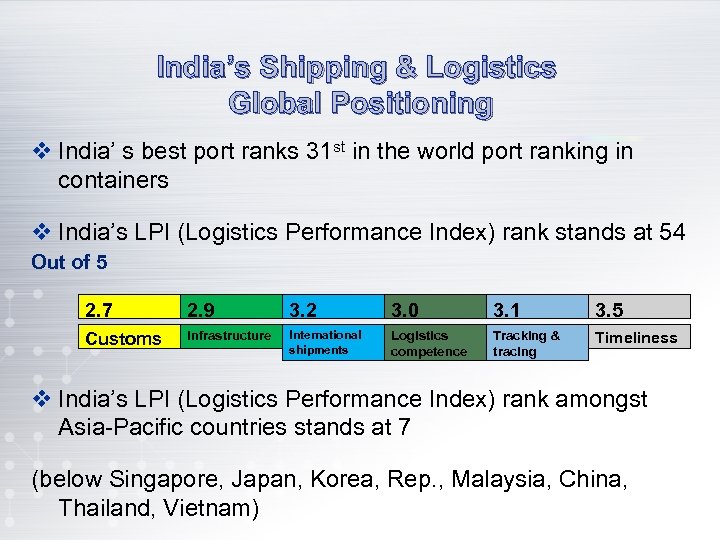
India’s Shipping & Logistics Global Positioning v India’ s best port ranks 31 st in the world port ranking in containers v India’s LPI (Logistics Performance Index) rank stands at 54 Out of 5 2. 7 2. 9 3. 2 3. 0 3. 1 3. 5 Customs Infrastructure International shipments Logistics competence Tracking & tracing Timeliness v India’s LPI (Logistics Performance Index) rank amongst Asia-Pacific countries stands at 7 (below Singapore, Japan, Korea, Rep. , Malaysia, China, Thailand, Vietnam)
Key Objectives of the Study 1. 2. 3. To identify break up of costs of transportation. To study the legislative & policy framework. To suggest modifications in procedures and transparency in logistics costs.
Methodology The study was based on both primary and secondary data. Ø The primary data were collated through both Focus Group Discussion (FDG) sessions, direct interviews, questionnaires and survey involving all stakeholders, pan India. Ø Interaction with DG Shipping officials and other stakeholders were also held.
Major Findings……. 1 § There are large number of players are grouped into both organized or unorganized and registered individuals and firms. § The registration of the players in the chain are covered by various acts implemented by different agencies. § The issue of cost transparency in the logistics chain arises out of “poor control environment” under which these agencies operate.
Major Findings……. 2 § In case of import, about 30 headings charges are levied on account of: Ø landed charges or Ø cost of recovery charges or Ø T. H. C. or Ø local charges - which account for 10 -15% of the total freight. Thus under CIF terms, in addition to freight the importer in many occasions need to pay additional charges to the tune of 10 -15% of total freight excluding import duties. § Shipping lines attribute the additional charges to deployment of inappropriate agencies by the importers.
Major Findings……. 3 § Freight forwarders attribute such additional exorbitant charges to the presence of freight forwarders who are not registered as CHA. § Shipping Agents claim that all charges levied by them are through the freight or directly, are on account of shipping bearing their service charges. § The charges increase if the number of players increases in the chain. The irony: Every player in the chain agreed there additional charges levied by the other players
Major Findings……. 4 § In case of CFS the charge heads are different as their services are for off-dock facility. § Shipping Agents suggest that if shippers approach them directly, the costs will go down substantially. § In case of export cargo, LCL consignment suffers major variations in cost. This is primarily due to the issue of “HOUSE BILL OF LADING”.
Major Findings……. 5 § The major complaints in an export transaction against shipping line include – 1. Levy of delivery order charges 2. Delay in getting delivery order 3. CFS operators reimburse a commission to Shipping Lines forwarding the business. ”NOMINATION PREMIUM”. 1. The format for MTD & Bill of Lading are not standardized. § T. H. C. charges(mentioned various terms) are not mentioned clearly by the Shipping Lines. The Shipping Lines do not indicate what charges are paid for particular container i. e. container-wise additional charges.
Major Findings……. 6 § Freight Forwarders keep cushion in their service charges due to the uncertainty in demurrage cost charged by the Shipping Lines. § Policy of registration of MTO does not include – Ø Stakeholders who do not wish to call them as MTOs but continue to play the role of agencies that comes under the purview of MTO. Ø Stakeholders whose turnover is more than 50 lakh are only included. Hence many smaller players are excluded.
Major Findings……. 7 § Basic issue of transparency is in import of items to India. § Shippers feel deceived by the surprise charges not known to them, termed as landside cost by shipping lines in the Indian ports. § The landside charges are collected by the shippers’ agent. § Shippers agents include anyone referred as CHA, C&F agent, Freight Forwarder, 3 PL, Shipping and logistics companies.
Major Findings……. 8 v Only CHAs are regulated by Customs Act. No other nomenclature of agents referred above falls under any regulatory act related to EXIM operations. v Registration of MTOs by DG, Shipping is one such attempt to regulate EXIM operators. Not effective. v However, it is limited to the fact that it only concerns export and invites only those operators who issue Multi Model Transport document (MTD). v This has resulted in very low registration so far.
Key Suggestions……. 1 v. It is proposed to widen the scope of MTO operators to include all those who are related to EXIM operations.
Key Suggestions……. 2 v In order to bring transparency in costs, such agencies also need to be regulated. Hence, IIFT suggest the definition of MTO operators as those operators who provide Multi Model Services. v The services would mean any job related to transport of goods ultimately by sea mode of transport as container cargo. v “Any Job” would specifically related to collection of consignments from the exporter or shipper, transport of these consignments by first carrier to any custom notified zone such as ICD or CFS or sea port, filing and clearance of customs document, liaison with the port for cart-in order, payment of port charges, collection of Multi Modal Transport document and/or master bill of lading. v Multi Modal Transport Document cannot be termed as a negotiable document unless until it is so included under Bills of Lading Act and compliance to BIMCO Conventions.
Key Suggestions……. 3 v It is proposed that all MTDs mention the shipping line connect in the document and the registration ID identification of the MTO operator including the complete list of charges for export or import clearances. v All ports may be advised to include the MTO registration number while registering the MTO to operate in that particular port. This registration can be done under the purview of Port Community System.
Key Suggestions……. 4 v EXIM operator may get registered under a SROs (Self Regulating Organisations) v SROs may get registered with DG Shipping v This would imply that individual members of SROs are registered with D G Shipping However, ………………….
Key Suggestions……. 5 v One EXIM operator may be member of several SROs. v Hence, the data bases of all these SROs needs to be made on line and integrated in real time basis. v This in turn should be integrated in data base of the DG, Shipping. v SROs have not so far committed on their timeline to create online system and integrate with the data base of DG, Shipping. Hence, ……………………. .
Key Suggestions……. 6 v It is proposed that the EXIM operator who gets registered under a SRO may have their data filed with the DG, Shipping data base. v This may be done through online interface to be provided by DG, Shipping to the operator and the SRO for single window entry of information. v In case the SROs are not ready with their real time integrated data base, they may use online user interface of the DG, Shipping for deemed registration under Merchant Shipping Act. v Once the SROs are ready with their data base, in the long run there may be real time message exchange between SROs and the DG, Shipping. v In that case DG Shipping may indirectly regulate as a soft regulatory body.
Key Suggestions……. 7 v As regards grievance redressals, an alternative is proposed to follow the framework similar to Banking Ombudsmen Act. v In addtion an alternative is that this may be put under another conciliatory arbitration mechanism under the Indian Council of Arbitration, which already has a Maritime arbitration set up and rules which are made in consultation with the Ministry of Shipping and Ministry of Law.
Key Suggestions……. 8 v It is proposed that an Apex Body of all SROs related to EXIM operations may be created who may provide the grievance redressal forum to the shipper and the EXIM operators. v This body may be under the purview of a Committee with members from DG, NSB etc. v Till then the arbitration mechanism of chamber of commerce may be adopted.
Key Suggestions……. 9 § All shipping lines should be asked to be transparent about the likely costs and cost heads and display the same in their websites. Regarding the competition Act provisions the clarification may be obtained from the Competition Commission. § Unforeseen costs (e. g. Delay-cost due to documentation errors or Handling ‘Heavy Cargo’ embedded costs or fuel -fluctuation-costs) should be included in the document such as Invoice or HBL issued by the agencies.
Key Suggestions……. 10 § EXIM body should exercise to standardize their contract document to include the charges to be paid to shipping lines. § NVOCC should be accredited by the shipping lines or their agency in India. § Definition for all T. H. C. costs should be of the purview of terminal and not the shipping line.
Key Suggestions……. 11 § Website may be developed for lodging complaint to be monitored by bodies like NSB and track the progress of cases under Shipping or Export -Import Ombudsman. § The foreign shipping lines that open their agency services in India should have Indian counterpart as SPV or JV or any such arrangement. § There should be on-line system of collecting the DO. § The Bill of lading should include the charges that are required to be paid by the importers as well as it should be standardized for all shipping lines calling to the Indian ports. § There should be standardization for Invoice and House-Bill-of-lading issued by the Freight Forwarder or NVOCC or Shipping Agent or for all shipping lines dealing with EX-IM.
Key Suggestions……. 12 § Accreditation may be carried out by apex body of individual stakeholders. And accreditation may be made under certain pre-determined criteria e. g. a. Length of service after registration b. Turnover c. Multi-port presence d. Multi-country presence e. Number of complaint lodged f. Services provided etc.
Finally…………… 1 § The entire issue of non-transparency in EXIM cost needs to be resolved following the 5 (five) basic principles: 1. Simplification (of processes) 2. Harmonization (of cost heads) 3. Standardization (of documents) 4. Regulations (of players) 5. Accreditation (of stakeholders)
Finally…………… 2 § MTO provision may be amended – it is so proposed as any activity in the export/import process involves multi-modalism & hence MMTG Act could be amended accordingly incorporating the suggestions of IIFT. § MTD and Bill of Lading may be re-oriented § It should include all charges § A single comprehensive charge may be levied by the Shipping Line for import goods § Reserve Bank of India (RBI) regulation of authorized dealership and registration as NVOCC may be included in the registration process under the MMTG Act. § It is proposed to create a body that may act as the apex of all the SRO’s.
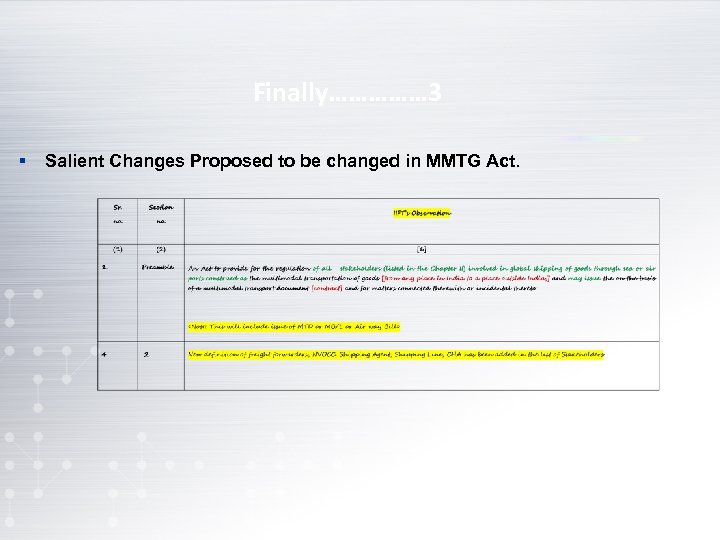
Finally…………… 3 § Salient Changes Proposed to be changed in MMTG Act.
Finally…………… 3 § Salient Changes Proposed to be changed in MMTG Act. In § Preamble § Section 2, 3, 4, 6, 9 12, 24 § To re-define Preamble / Stakeholder / Registration Mechanism / Grievance Handling
Way Forward…………………. . § Include Airline agents § Include non-container cargo § Incorporate global standards § Create single agency to monitor LPI and DBI
the edge all s nowl d hi fully ack thank , NSB an We irman of t of Cha airmans por sup g, Ch Shippin ociations, FIEO G team, D e ass y……. nd all th mmunit de co ports a eign tra for and the
Скачать презентацию National Shipping Board Ministry of Shipping END-TO-END LOGISTICS
979c95a958d5909f0d5db1fe533ce779.ppt