


 Скачать презентацию National Senior Certificate Examinations 2014 Presentation to
f5c777b778cc910c28b979df92de9743.ppt
- Количество слайдов: 108
 National Senior Certificate Examinations – 2014 Presentation to Portfolio Committee on Basic Education 3 March 2015 1
 Introduction 2
 Introduction a) The National Senior Certificate results not only provides data on the performance of the Class of 2014, but it serves as an important indicator of the performance of the system. b) Hence post the release of the results there has been intensive analysis, both quantitative and qualitative, at all levels of the system to: • establish trends • identify areas of weakness/strengths • reasons for drop in performance 3 • identify focussed interventions for 2015 and
 Introduction… c) A national workshop was conducted in January of all provincial officials responsible for curriculum, assessment and teacher development to review and strengthen the plan for improvement of learner performance. d) Examinations and Assessment Lekgotla convened in February to evaluate and review examination and assessment credibility. e) Provincial road shows, have commenced, where a detailed analysis of the provincial and district performance is discussed and improvement plans are consolidated. 4
 Introduction… f) A meeting with District Directors convened by the Minister on 26 and 27 February allow them an opportunity to account for their district performance and present plans for improvement. g) The planned improvement strategies target the following: • under-performing provinces. • under-performing districts. • under-performing schools. • under-performing subjects • Under-performing classes 5
 Introduction… h) DBE has developed a diagnostic report which provides a detailed analysis of the subject performance, specific remedial measures and an improvement framework. i) This Diagnostic Report provides the basis of the engagement with PEDs at the Provincial Road Shows. 5
 Historical Trends 12
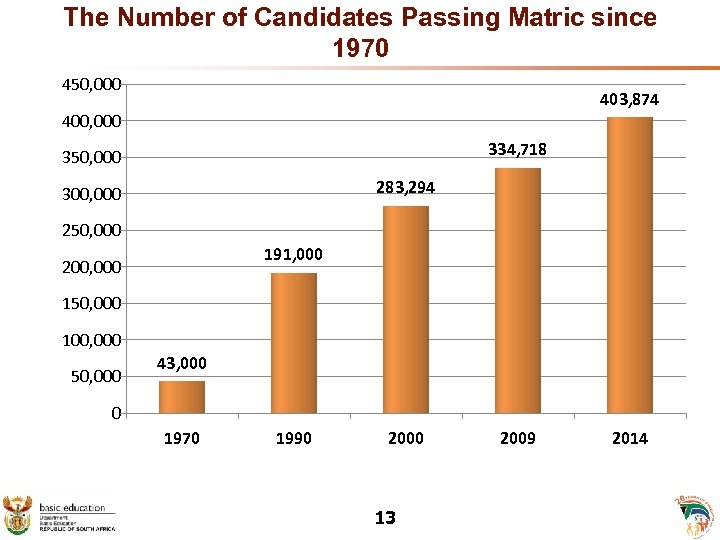 The Number of Candidates Passing Matric since 1970 450, 000 403, 874 400, 000 334, 718 350, 000 283, 294 300, 000 250, 000 191, 000 200, 000 150, 000 100, 000 50, 000 43, 000 0 1970 1990 2000 13 2009 2014
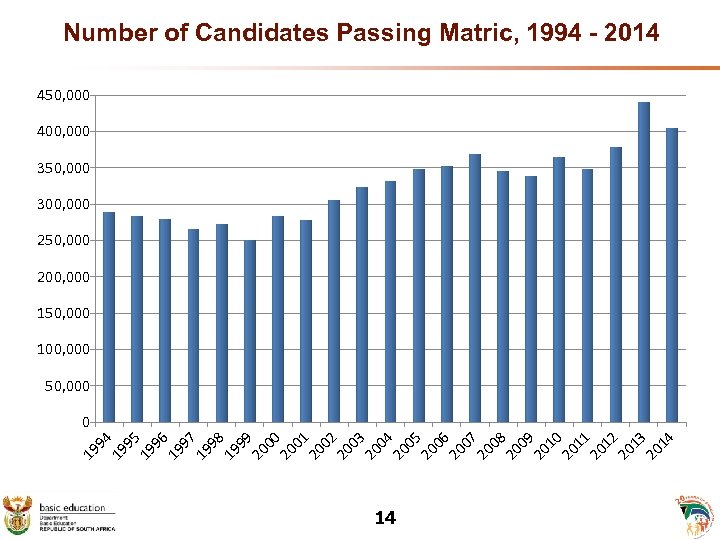 Number of Candidates Passing Matric, 1994 - 2014 450, 000 400, 000 350, 000 300, 000 250, 000 200, 000 150, 000 100, 000 50, 000 19 94 19 95 19 96 19 97 19 98 19 99 20 00 20 01 20 02 20 03 20 04 20 05 20 06 20 07 20 08 20 09 20 10 20 11 20 12 20 13 20 14
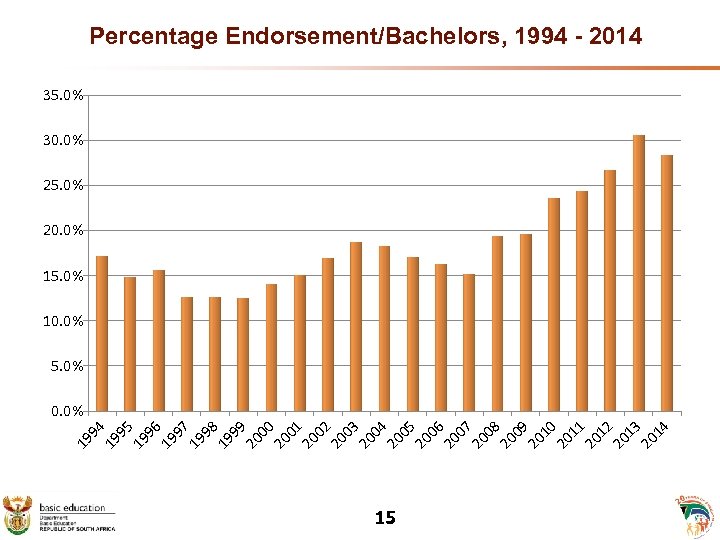 Percentage Endorsement/Bachelors, 1994 - 2014 35. 0% 30. 0% 25. 0% 20. 0% 15. 0% 10. 0% 5. 0% 19 94 19 95 19 96 19 97 19 98 19 99 20 00 20 01 20 02 20 03 20 04 20 05 20 06 20 07 20 08 20 09 20 10 20 11 20 12 20 13 20 14 0. 0% 15
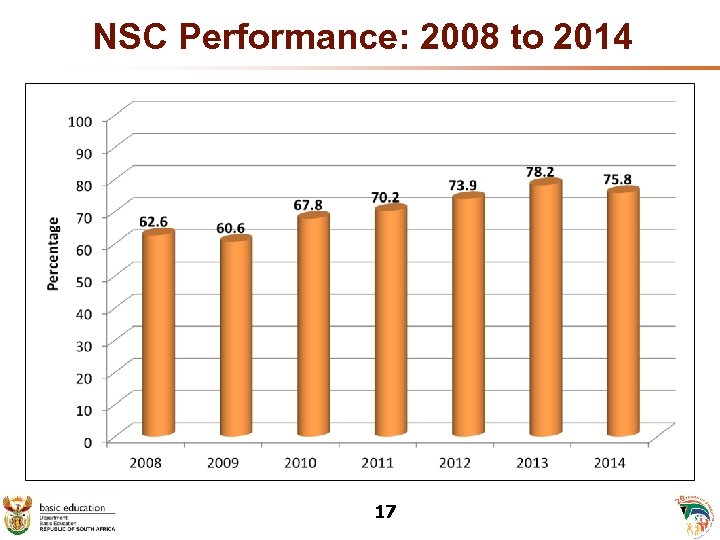 NSC Performance: 2008 to 2014 17
 Performance of the Class of 2014 12
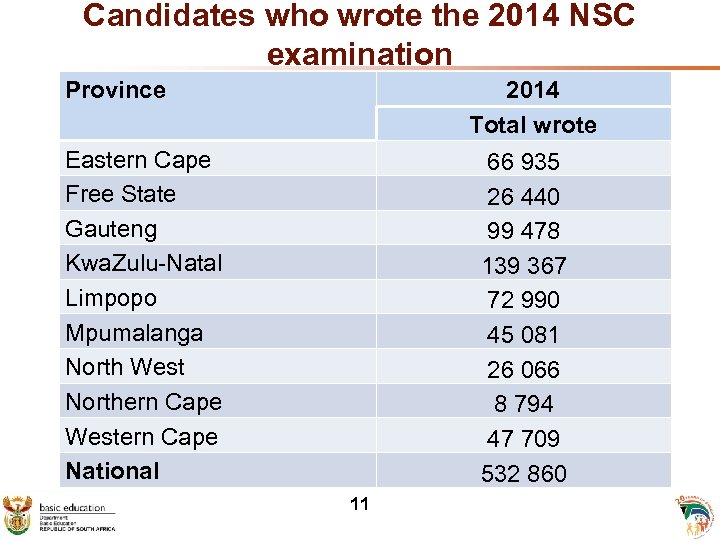 Candidates who wrote the 2014 NSC examination Province 2014 Total wrote Eastern Cape Free State Gauteng Kwa. Zulu-Natal Limpopo Mpumalanga North West Northern Cape Western Cape National 66 935 26 440 99 478 139 367 72 990 45 081 26 066 8 794 47 709 532 860 11
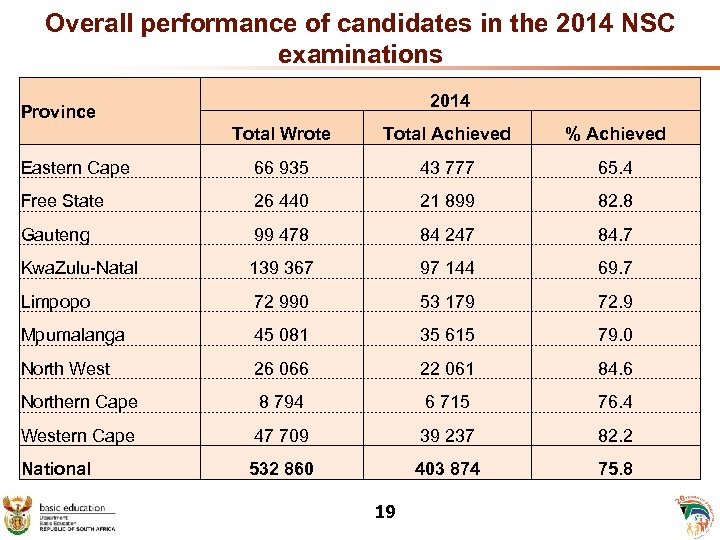 Overall performance of candidates in the 2014 NSC examinations 2014 Province Total Wrote Total Achieved % Achieved Eastern Cape 66 935 43 777 65. 4 Free State 26 440 21 899 82. 8 Gauteng 99 478 84 247 84. 7 Kwa. Zulu-Natal 139 367 97 144 69. 7 Limpopo 72 990 53 179 72. 9 Mpumalanga 45 081 35 615 79. 0 North West 26 066 22 061 84. 6 Northern Cape 8 794 6 715 76. 4 Western Cape 47 709 39 237 82. 2 National 532 860 403 874 75. 8 19
 Quality Improvements 18
 NSC Passes by Qualification Type 18
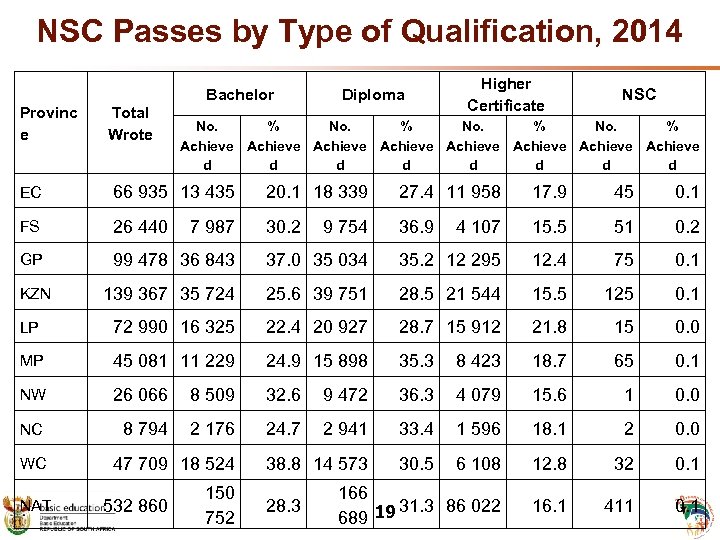 NSC Passes by Type of Qualification, 2014 Bachelor Provinc e Total Wrote Diploma Higher Certificate NSC No. % Achieve Achieve d d d d EC 66 935 13 435 20. 1 18 339 27. 4 11 958 17. 9 45 0. 1 FS 26 440 30. 2 36. 9 4 107 15. 5 51 0. 2 GP 99 478 36 843 37. 0 35 034 35. 2 12 295 12. 4 75 0. 1 139 367 35 724 25. 6 39 751 28. 5 21 544 15. 5 125 0. 1 LP 72 990 16 325 22. 4 20 927 28. 7 15 912 21. 8 15 0. 0 MP 45 081 11 229 24. 9 15 898 35. 3 8 423 18. 7 65 0. 1 NW 26 066 8 509 32. 6 9 472 36. 3 4 079 15. 6 1 0. 0 NC 8 794 2 176 24. 7 2 941 33. 4 1 596 18. 1 2 0. 0 38. 8 14 573 30. 5 6 108 12. 8 32 0. 1 166 19 31. 3 86 022 689 16. 1 411 0. 1 KZN WC NAT 7 987 47 709 18 524 532 860 150 752 28. 3 9 754
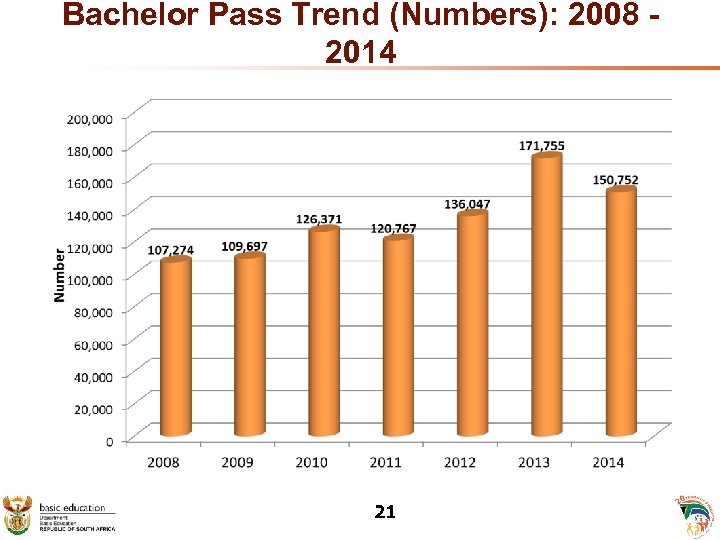 Bachelor Pass Trend (Numbers): 2008 2014 21
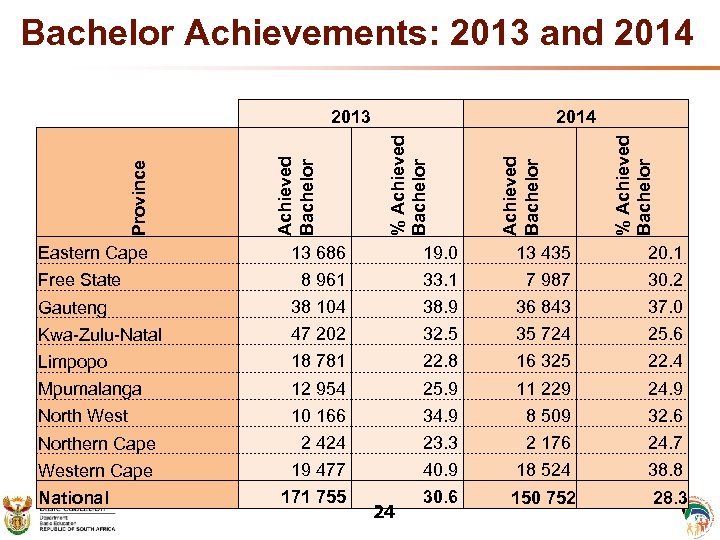 Bachelor Achievements: 2013 and 2014 % Achieved Bachelor Province 2013 13 686 19. 0 13 435 20. 1 8 961 33. 1 7 987 30. 2 Gauteng 38 104 38. 9 36 843 37. 0 Kwa-Zulu-Natal 47 202 32. 5 35 724 25. 6 Limpopo 18 781 22. 8 16 325 22. 4 Mpumalanga 12 954 25. 9 11 229 24. 9 North West 10 166 34. 9 8 509 32. 6 Northern Cape 2 424 23. 3 2 176 24. 7 Western Cape 19 477 40. 9 18 524 38. 8 171 755 30. 6 150 752 28. 3 Eastern Cape Free State National 24
 School Performance within different Percentage Categories 27
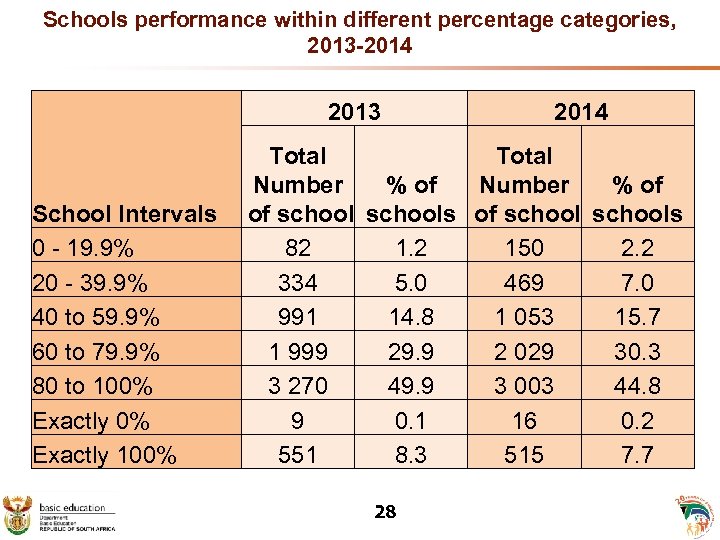 Schools performance within different percentage categories, 2013 -2014 2013 2014 Total % of Number School Intervals of schools 150 2. 2 0 - 19. 9% 82 1. 2 20 - 39. 9% 334 5. 0 469 7. 0 40 to 59. 9% 991 14. 8 1 053 15. 7 60 to 79. 9% 1 999 29. 9 2 029 30. 3 80 to 100% 3 270 49. 9 3 003 44. 8 Exactly 0% 9 0. 1 16 0. 2 Exactly 100% 551 8. 3 515 7. 7 28
 School Performance by Quintiles 30
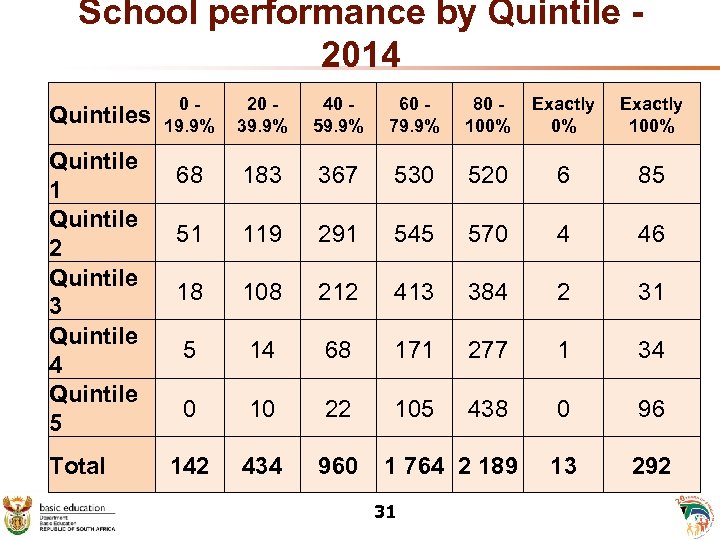 School performance by Quintile - 2014 Quintiles Quintile 1 Quintile 2 Quintile 3 Quintile 4 Quintile 5 Total 0 - 19. 9% 20 - 39. 9% 40 - 59. 9% 60 - 79. 9% 80 - 100% Exactly 100% 68 183 367 530 520 6 85 51 119 291 545 570 4 46 18 108 212 413 384 2 31 5 14 68 171 277 1 34 0 10 22 105 438 0 96 142 434 960 13 292 1 764 2 189 31
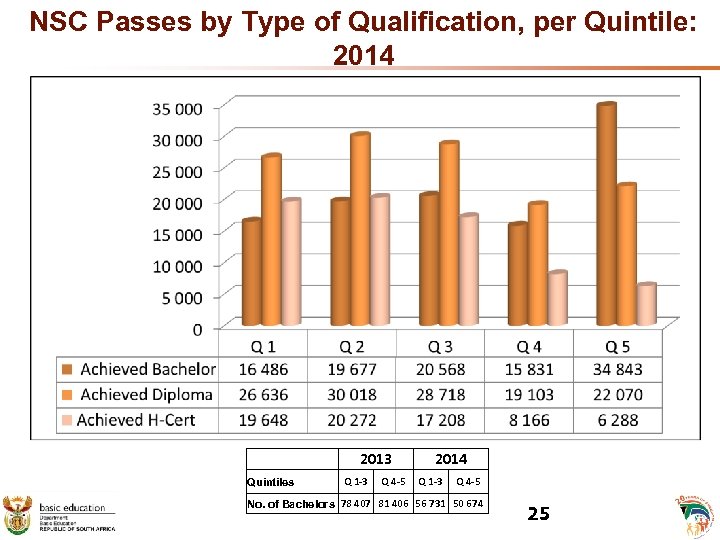 NSC Passes by Type of Qualification, per Quintile: 2014 2013 Quintiles Q 1 -3 Q 4 -5 2014 Q 1 -3 Q 4 -5 No. of Bachelors 78 407 81 406 56 731 50 674 25
 Subject Performance 32
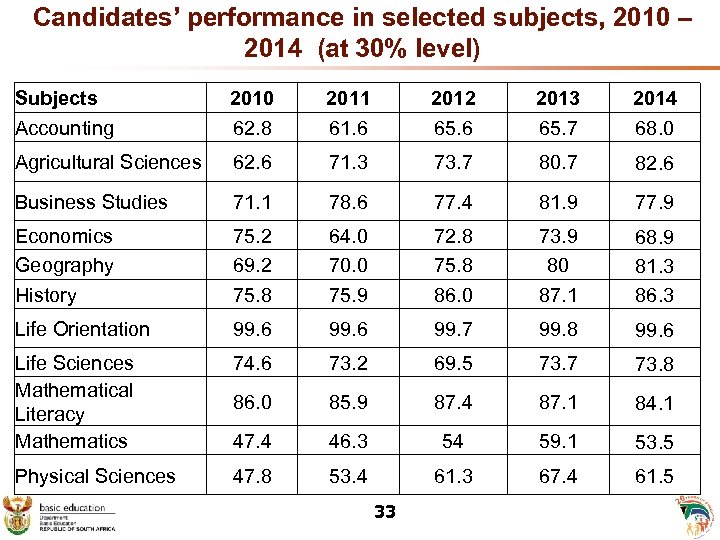 Candidates’ performance in selected subjects, 2010 – 2014 (at 30% level) Subjects Accounting 2010 62. 8 2011 61. 6 2012 65. 6 2013 65. 7 2014 68. 0 Agricultural Sciences 62. 6 71. 3 73. 7 80. 7 82. 6 Business Studies 71. 1 78. 6 77. 4 81. 9 77. 9 Economics Geography History 75. 2 69. 2 75. 8 64. 0 70. 0 75. 9 72. 8 75. 8 86. 0 73. 9 80 87. 1 68. 9 81. 3 86. 3 Life Orientation 99. 6 99. 7 99. 8 99. 6 Life Sciences Mathematical Literacy Mathematics 74. 6 73. 2 69. 5 73. 7 73. 8 86. 0 85. 9 87. 4 87. 1 84. 1 47. 4 46. 3 54 59. 1 53. 5 Physical Sciences 47. 8 53. 4 61. 3 67. 4 61. 5 33
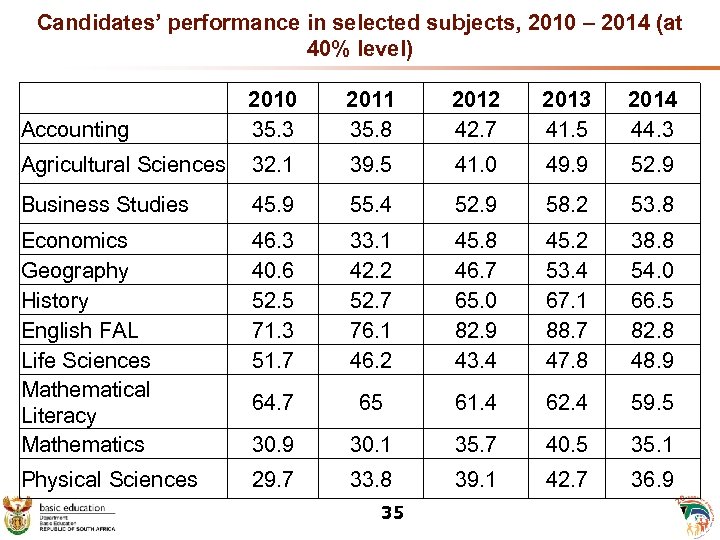 Candidates’ performance in selected subjects, 2010 – 2014 (at 40% level) Accounting 2010 35. 3 2011 35. 8 2012 42. 7 2013 41. 5 2014 44. 3 Agricultural Sciences 32. 1 39. 5 41. 0 49. 9 52. 9 Business Studies 45. 9 55. 4 52. 9 58. 2 53. 8 Economics Geography History English FAL Life Sciences Mathematical Literacy Mathematics 46. 3 40. 6 52. 5 71. 3 51. 7 33. 1 42. 2 52. 7 76. 1 46. 2 45. 8 46. 7 65. 0 82. 9 43. 4 45. 2 53. 4 67. 1 88. 7 47. 8 38. 8 54. 0 66. 5 82. 8 48. 9 64. 7 65 61. 4 62. 4 59. 5 30. 9 30. 1 35. 7 40. 5 35. 1 Physical Sciences 29. 7 33. 8 39. 1 42. 7 36. 9 35
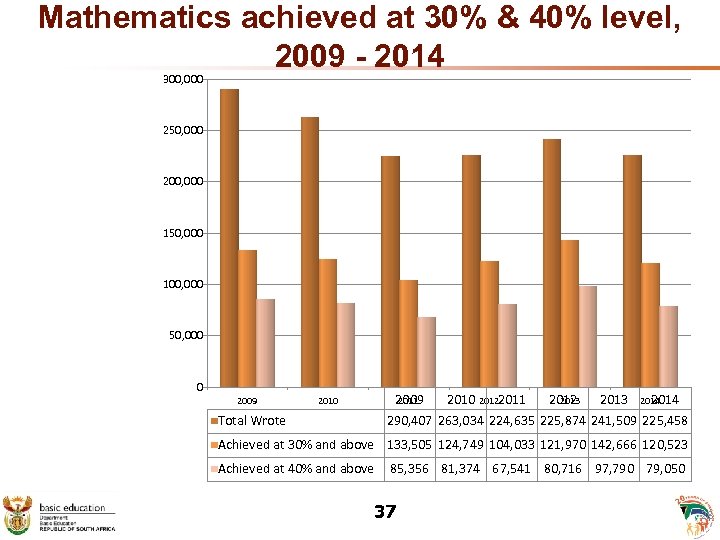 Mathematics achieved at 30% & 40% level, 2009 - 2014 300, 000 250, 000 200, 000 150, 000 100, 000 50, 000 0 2009 2010 20122011 2012 2013 2014 2011 2013 290, 407 263, 034 224, 635 225, 874 241, 509 225, 458 2010 Total Wrote Achieved at 30% and above 133, 505 124, 749 104, 033 121, 970 142, 666 120, 523 Achieved at 40% and above 85, 356 81, 374 67, 541 80, 716 97, 790 79, 050 37 28
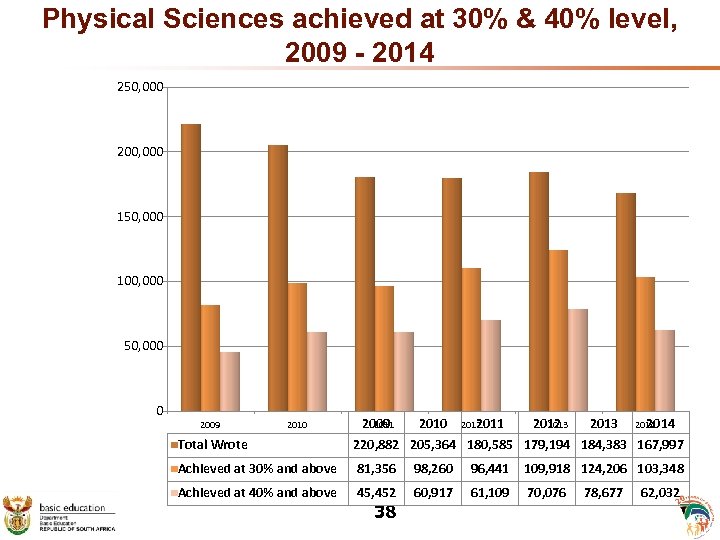 Physical Sciences achieved at 30% & 40% level, 2009 - 2014 250, 000 200, 000 150, 000 100, 000 50, 000 0 Total Wrote 2009 2010 2012 2011 2012 2013 2014 2011 2013 220, 882 205, 364 180, 585 179, 194 184, 383 167, 997 Achieved at 30% and above 81, 356 98, 260 96, 441 109, 918 124, 206 103, 348 Achieved at 40% and above 45, 452 60, 917 61, 109 70, 076 2009 2010 38 78, 677 62, 032
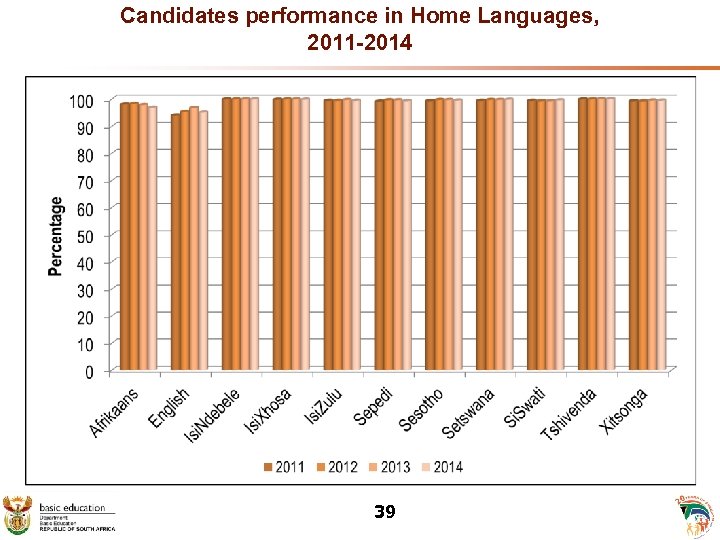 Candidates performance in Home Languages, 2011 -2014 39
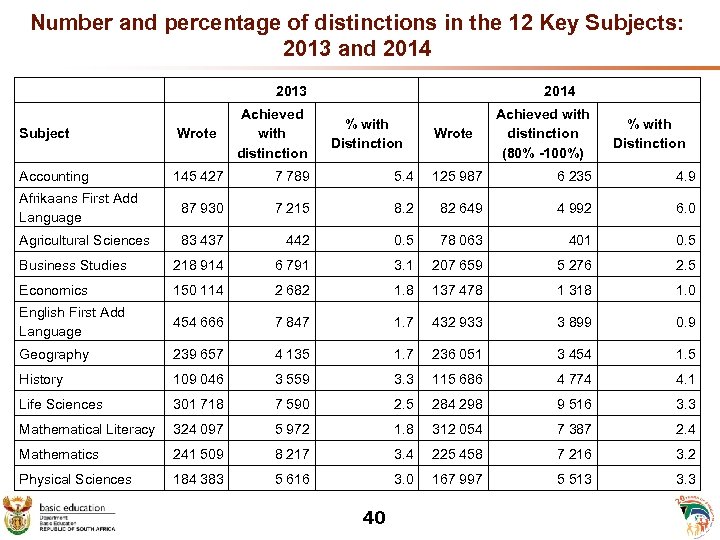 Number and percentage of distinctions in the 12 Key Subjects: 2013 and 2014 2013 Achieved with distinction 2014 % with Distinction Subject Wrote Accounting 145 427 7 789 5. 4 125 987 6 235 4. 9 Afrikaans First Add Language 87 930 7 215 8. 2 82 649 4 992 6. 0 Agricultural Sciences 83 437 442 0. 5 78 063 401 0. 5 Business Studies 218 914 6 791 3. 1 207 659 5 276 2. 5 Economics 150 114 2 682 1. 8 137 478 1 318 1. 0 English First Add Language 454 666 7 847 1. 7 432 933 3 899 0. 9 Geography 239 657 4 135 1. 7 236 051 3 454 1. 5 History 109 046 3 559 3. 3 115 686 4 774 4. 1 Life Sciences 301 718 7 590 2. 5 284 298 9 516 3. 3 Mathematical Literacy 324 097 5 972 1. 8 312 054 7 387 2. 4 Mathematics 241 509 8 217 3. 4 225 458 7 216 3. 2 Physical Sciences 184 383 5 616 3. 0 167 997 5 513 3. 3 40 Wrote Achieved with distinction (80% -100%)
 District Performance 42
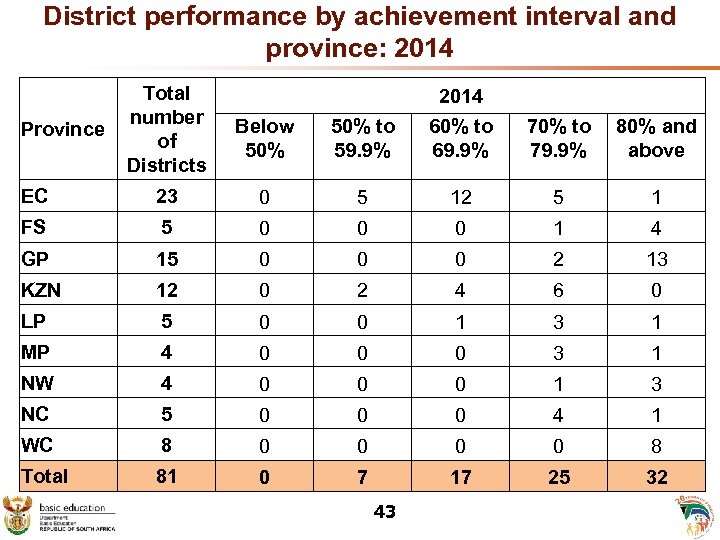 District performance by achievement interval and province: 2014 Total number Province of Districts 2014 Below 50% to 59. 9% 60% to 69. 9% 70% to 80% and 79. 9% above EC 23 0 5 12 5 1 FS 5 0 0 0 1 4 GP 15 0 0 0 2 13 KZN 12 0 2 4 6 0 LP 5 0 0 1 3 1 MP 4 0 0 0 3 1 NW 4 0 0 0 1 3 NC 5 0 0 0 4 1 WC 8 0 0 8 Total 81 0 7 17 25 32 43
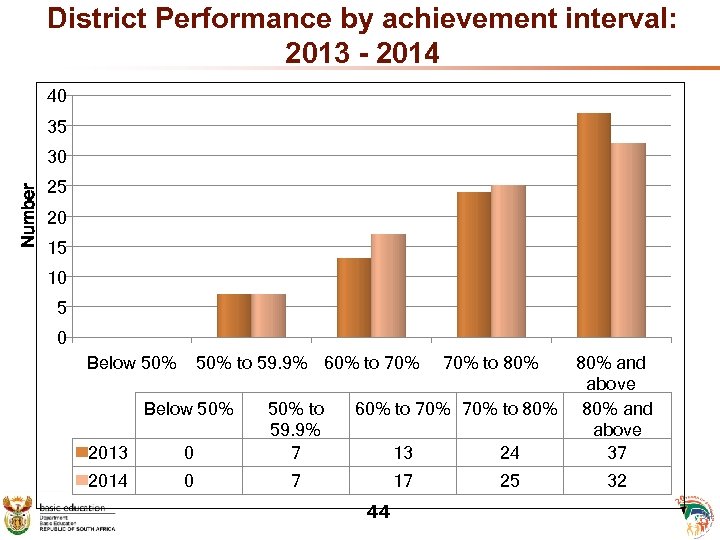 District Performance by achievement interval: 2013 - 2014 40 35 Number 30 25 20 15 10 5 0 Below 50% to 59. 9% 60% to 70% Below 50% 2013 0 50% to 59. 9% 7 2014 0 80% and above 60% to 70% to 80% and above 13 24 37 7 17 44 70% to 80% 25 32 34
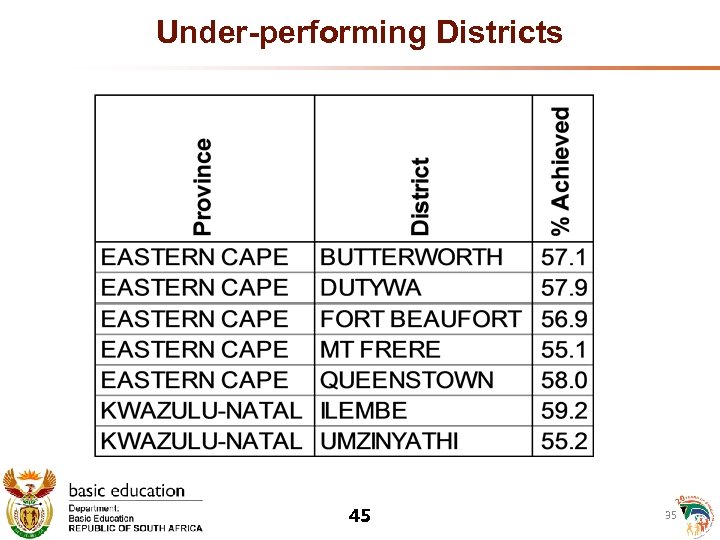 Under-performing Districts 45 35
 Performance of Special Needs Candidates 50
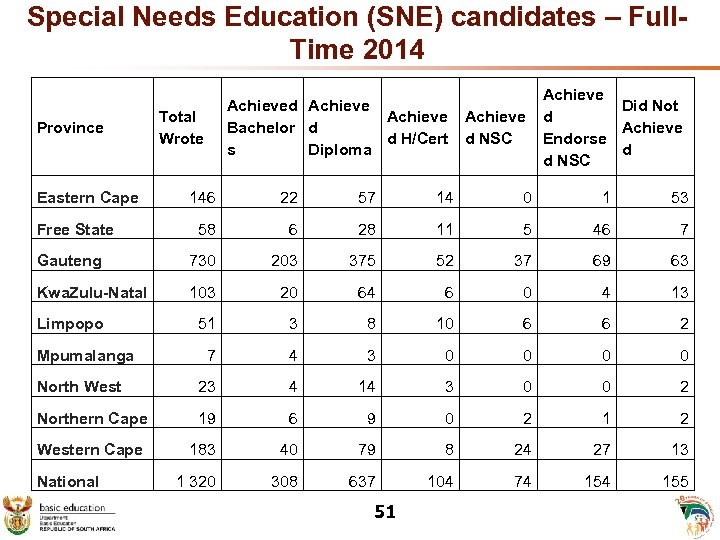 Special Needs Education (SNE) candidates – Full. Time 2014 Province Eastern Cape Achieved Achieve Bachelor d d H/Cert d NSC s Diploma Total Wrote Achieve Did Not d Achieve Endorse d d NSC 146 22 57 14 0 1 53 58 6 28 11 5 46 7 Gauteng 730 203 375 52 37 69 63 Kwa. Zulu-Natal 103 20 64 6 0 4 13 51 3 8 10 6 6 2 7 4 3 0 0 North West 23 4 14 3 0 0 2 Northern Cape 19 6 9 0 2 1 2 Western Cape 183 40 79 8 24 27 13 1 320 308 637 104 74 155 Free State Limpopo Mpumalanga National 51
 Irregularities relating to Group Copying: NSC 2014
 Group Copying • Irregularities occur in all examinations/ assessments and the examination system has mechanisms to manage irregularities, to avoid lapses in exam credibility • However whether an irregularity becomes a threat to the system depends on the nature and extent of the irregularity • In the 2014 NSC examination group copying has been identified in 7 of the 9 Provinces 39
 Group copying • Group copying is when three or more learners share information or support each other in the examination room. • This can be done with or without the involvement of the chief invigilator or invigilator. • Concern emanates when the group copying is orchestrated by the chief invigilator/invigilator. 40
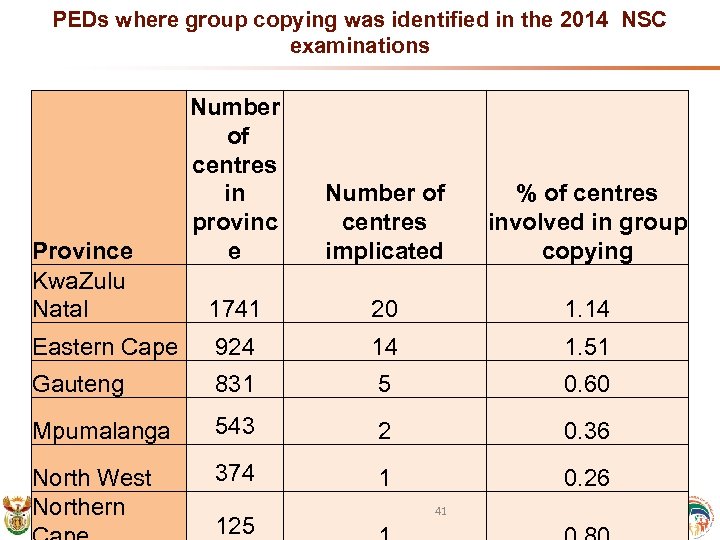 PEDs where group copying was identified in the 2014 NSC examinations Number of centres in provinc e Number of centres implicated % of centres involved in group copying 1741 20 1. 14 Eastern Cape 924 14 1. 51 Gauteng 831 5 0. 60 Mpumalanga 543 2 0. 36 North West Northern 374 1 0. 26 Province Kwa. Zulu Natal 125 41
 Examination Credibility • The DBE on an annual basis reviews its examination processes and continuously enhances its systems. • In 2014 PEDs adopted a differentiated approach to examination invigilation which included: – Administrative take over – Residential monitoring – Roving monitoring • Hence the vigilance of the system is improving 42
 Group Copying • The DBE views group copying in a very serious light and therefore on detection of these irregularities, an extensive contingency plan was rolled out. • Investigations relating to group copying in the 2014 NSC examinations, took the form of: – auditing of scripts – interviews with learners, – Interviews with invigilators and chief invigilators 43
 General Findings • Both the invigilator and learner interviews were extremely challenging. • Evidence of copying is erratic – limited to specific questions or even sub-questions. Not wide spread across the script. • The confusing aspect is the isolated inclusion of specific figures, terms or statements in the script. 44
 General Findings • In most cases the interview panels were confronted with denial of any wrong doing. • The explanation offered for the common answers, common wrong answers, verbatim responses was that they studied in groups or were taught that way. • Confessions were also made in a few cases 45
 General Findings • Based on the interviews, hearings and the evidence from the script: – there was support provided to the whole class. – copying occurred in sub-groups in the room. – learners responded based on erroneous teaching and rote learning. – evidence is not substantial or convincing in some cases. 46
 Progress to Date • Investigation relating to the implicated schools have been completed and evidence has been gathered. • Individual learner hearings are scheduled to commence. At these hearings the learners will be presented with the evidence and be given an opportunity to defend the charge against them • Implicated learners have been allowed to write the supplementary examination on a provisional basis, pending the outcome of the hearing. • If the hearings confirm imposed teacher assistance, the November results will be nullified and the supplementary examination results will be recognised. 47
 Progress to Date • If learners acted on own accord, normal sanctions will apply. This can extend to being barred from writing the NSC examination for three years. • Teachers that are implicated will be subjected to a disciplinary process in terms of the Employment of Educators Act. • This will be conducted after the learner hearings. 48
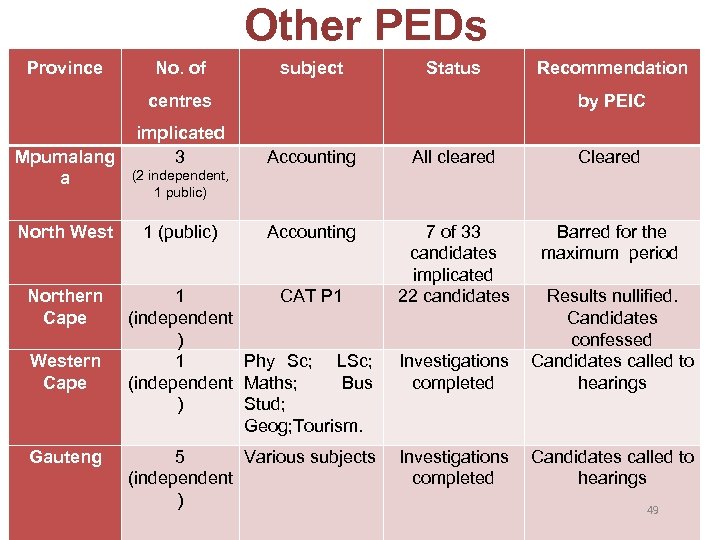 Other PEDs Province No. of subject Status centres Mpumalang a North West Northern Cape Western Cape Gauteng implicated 3 Recommendation by PEIC Accounting All cleared Cleared Accounting 7 of 33 candidates implicated 22 candidates Barred for the maximum period (2 independent, 1 public) 1 (public) 1 CAT P 1 (independent ) 1 Phy Sc; LSc; (independent Maths; Bus ) Stud; Geog; Tourism. 5 Various subjects (independent ) Results nullified. Candidates confessed Investigations Candidates called to completed hearings 49
 Strategies to Curb Irregularities
 Integrity in Assessment • Need to develop a culture and an attitude of respect for examination and assessment integrity. • Active campaign to promote integrity in assessment from Grade R. • Included in the Life Orientation curriculum. • Assessment integrity to be included in the Learners Code of Conduct. • Schools to develop policy and implement systems to address assessment irregularities from the lower grades. • Signing of an examination/assessment pledge to be done at all grades. Pledge signing to include 51 learners, teachers and officials.
 Policy Review • Policy to be amended to address assessment malpractices across all grades. • Need to change the stance in dealing with irregularities – from a reactive to a proactive approach. • School Assessment Irregularities Committee (SAIC) to be redesigned to be constituted as School Assessment Integrity Committees (SAIC). • The role of these committees will be to promote assessment integrity and to deal with assessment malpractices when they occur. 52
 Categorisation of Exam Centres Based on the risk profile of an examination centre, centres will be categorised as follows: (a) High Risk Centres (HRC) - administered by the PED (b) Medium Risk Centres (MRC) - placement of resident monitors (c) Low Risk Centres (LRC) - administered by the school with a roving monitor Legislation to be amended to accommodate this dispensation 53
 Accreditation of Independent Centres Independent centres must only be allowed to administer an examination if they satisfy the following criteria: (a) Registered with the PED (EMIS No) (b) Accredited by Umalusi (c) Registered as an exam centre Limit the number of independent centres Rigorous monitoring by PED 54
 Registration of Public Exam Centres • Currently public schools by virtue of their public school status are deemed to be registered as exam centres. • Public exam centres are subject to periodic evaluation. • Public schools must be subjected to annual evaluation and where there is repeated violation of the examination code, they must lose their examination status. 55
 Senior Certificate Examination • The SC examination will be administered at designated centres within the district. • These centres will be administered by the district officials. • All these centres will be audited by the DBE to ensure compliance with the strict criteria stipulated. • DBE will manage a data base of all these approved centres. 56
 Intensive monitoring • The DBE will strengthen its monitoring of all PEDs so as to ensure a regular reporting and feedback on each component of the examination cycle. • DBE will appoint Chief Invigilators, resident monitors and roving monitors where the PED lacks the resources or where the DBE has established a need. • These persons will be appointed as the part-time staff of the DBE and will report to the DBE.
 Intensive monitoring • Special attention given to KZN, Eastern Cape and Limpopo • In the case of the Kwa. Zulu Natal, Limpopo and Eastern Cape provinces, the DBE will appoint a resident monitor at the provincial level to monitor all examination processes from the beginning of the cycle until the end of the cycle. Such a resident monitor will report to the DBE on a weekly basis. • During the writing of the examinations, a resident monitor will be deployed to each of the 81 districts to monitor and report on the daily examination
 Invigilator training • Invigilator training will be prioritised so that it is based on a nationally approved Manual • Training will be initiated nationally through national standard setting meetings • Training will be cascaded provincially, DBE will support PEDs as they train and monitor against set standards.
 Umalusi Concerns
 Question Papers Repeated External Moderation in 6 of the 130 Nov 2014 papers • Closer collaboration between external and internal moderators. Pre determination of content and cognitive levels • DBE to ensure that analysis grids for content and cognitive levels completed prior to question paper setting by all panels
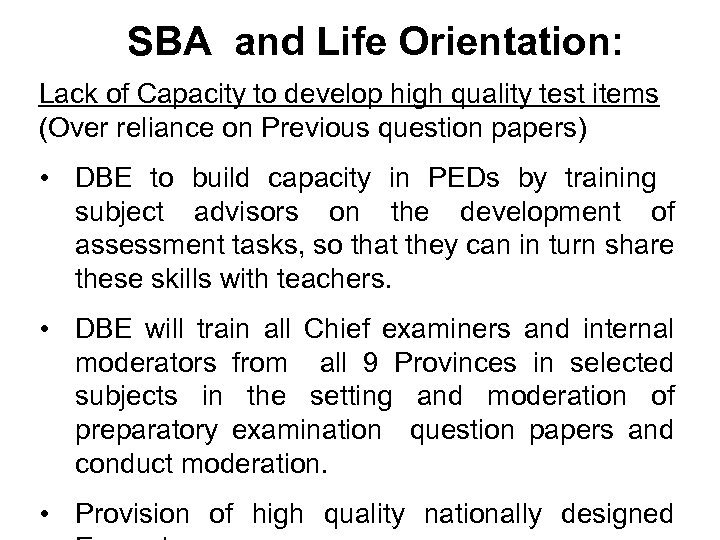 SBA and Life Orientation: Lack of Capacity to develop high quality test items (Over reliance on Previous question papers) • DBE to build capacity in PEDs by training subject advisors on the development of assessment tasks, so that they can in turn share these skills with teachers. • DBE will train all Chief examiners and internal moderators from all 9 Provinces in selected subjects in the setting and moderation of preparatory examination question papers and conduct moderation. • Provision of high quality nationally designed
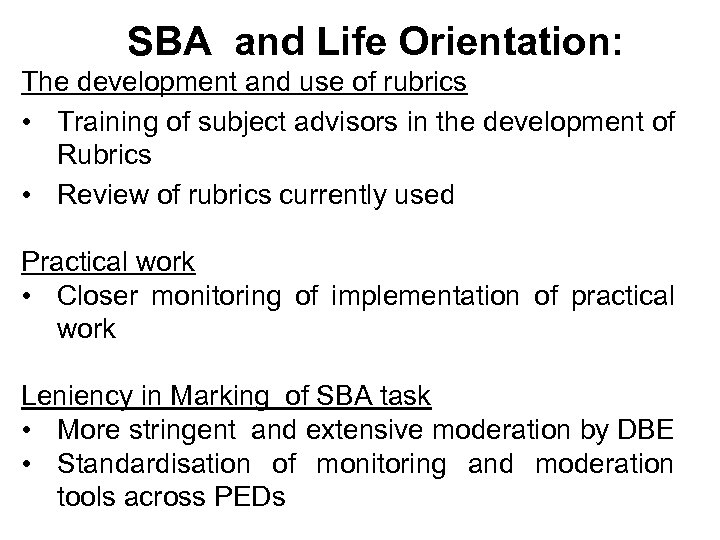 SBA and Life Orientation: The development and use of rubrics • Training of subject advisors in the development of Rubrics • Review of rubrics currently used Practical work • Closer monitoring of implementation of practical work Leniency in Marking of SBA task • More stringent and extensive moderation by DBE • Standardisation of monitoring and moderation tools across PEDs
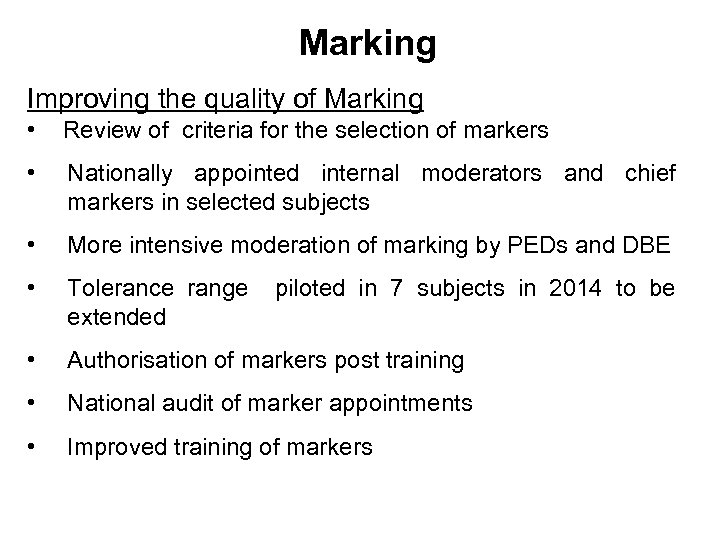 Marking Improving the quality of Marking • Review of criteria for the selection of markers • Nationally appointed internal moderators and chief markers in selected subjects • More intensive moderation of marking by PEDs and DBE • Tolerance range piloted in 7 subjects in 2014 to be extended • Authorisation of markers post training • National audit of marker appointments • Improved training of markers
 CURRICULUM INTERVENTIONS
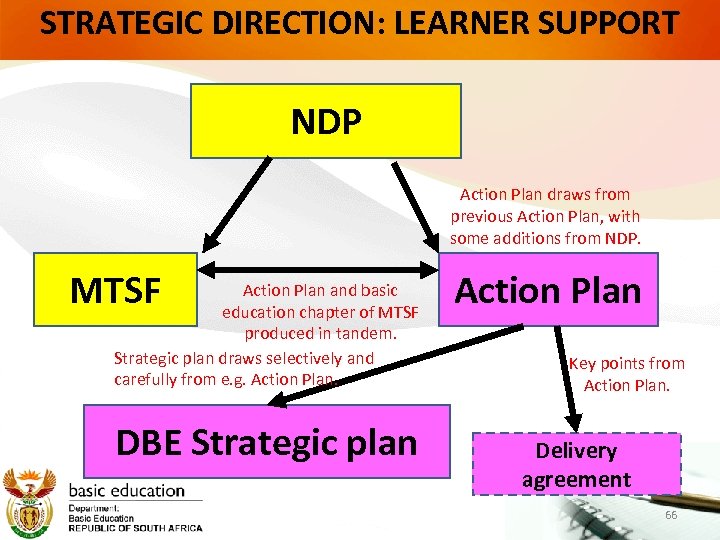 STRATEGIC DIRECTION: LEARNER SUPPORT NDP Action Plan draws from previous Action Plan, with some additions from NDP. MTSF Action Plan and basic education chapter of MTSF produced in tandem. Strategic plan draws selectively and carefully from e. g. Action Plan. DBE Strategic plan Action Plan Key points from Action Plan. Delivery agreement 66
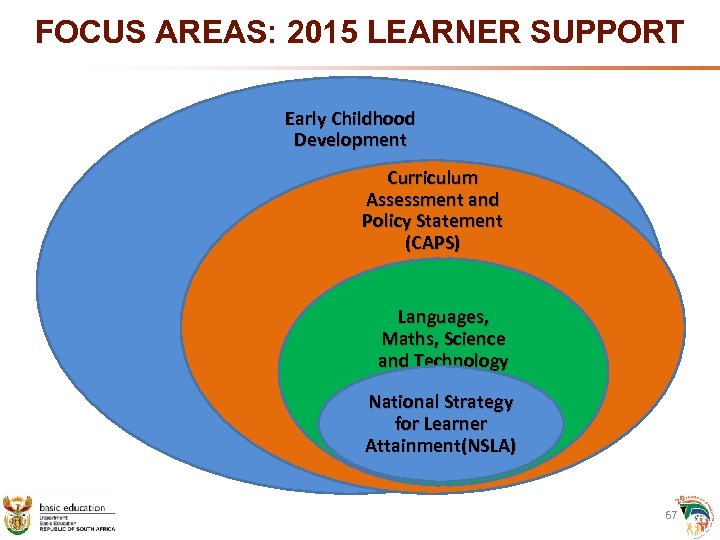 FOCUS AREAS: 2015 LEARNER SUPPORT Early Childhood Development Curriculum Assessment and Policy Statement (CAPS) Languages, Maths, Science and Technology (LMST) National Strategy for Learner Attainment(NSLA) 67
 LESSONS LEARNT IN 2014 AND STRATEGY FOR 2015
 2015 NSLA STRENGTHENED FRAMEWORK • 2015 National Strategy for Learner Attainment (NSLA) revised and strengthened. • Accountability tool for the Basic Education Sector in pursuit of Basic Functionality towards Quality and Excellence to address: – Poor learner attainment; – Poor accountability; and – Lack of basic functionality
 2015 NSLA STRENGTHENED FRAMEWORK • Section 1: • Section 2: • Section 3: • Section 4: • Section 5: • Section 6: • Section 7: • Section 8: • Section 9: Management and Leadership Early Childhood Development Primary/GET Schools: Multi-grade; Foundation Phase; Intermediate Phase; and Senior Phase. High/FET Schools Mathematics, Science and Technology Comprehensive Teacher Development Programme Resource provisioning Inclusive Education: Special Schools; Full-service schools; Home Education ICT
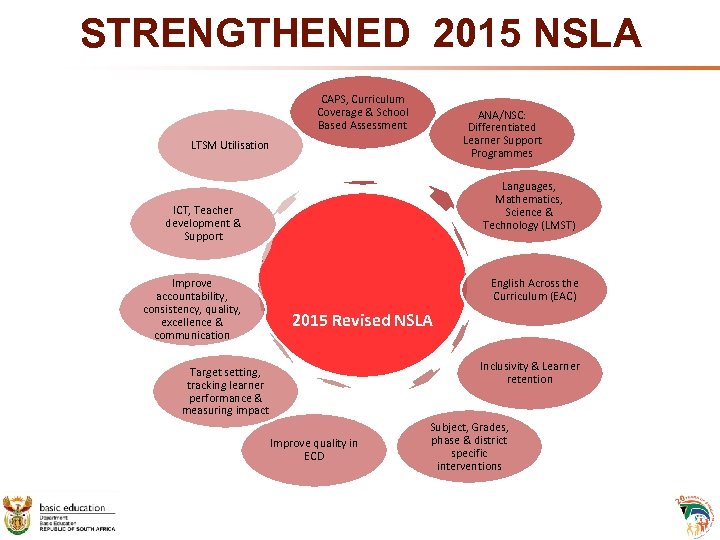 STRENGTHENED 2015 NSLA CAPS, Curriculum Coverage & School Based Assessment ANA/NSC: Differentiated Learner Support Programmes LTSM Utilisation Languages, Mathematics, Science & Technology (LMST) ICT, Teacher development & Support Improve accountability, consistency, quality, excellence & communication English Across the Curriculum (EAC) 2015 Revised NSLA Inclusivity & Learner retention Target setting, tracking learner performance & measuring impact Improve quality in ECD Subject, Grades, phase & district specific interventions
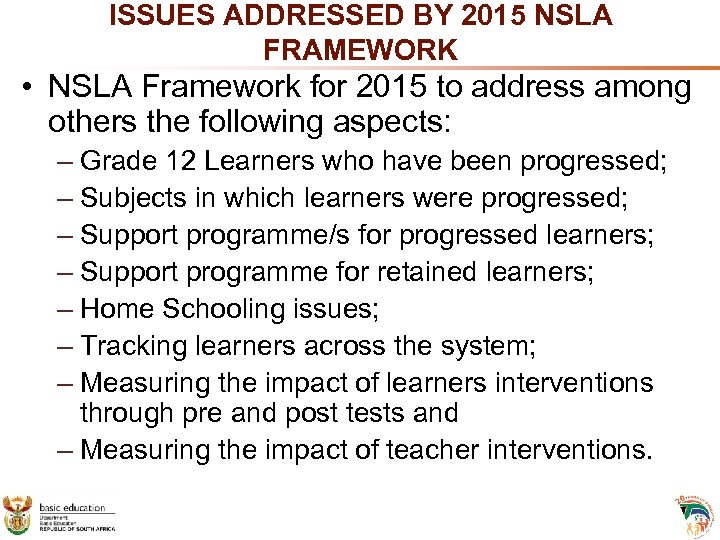 ISSUES ADDRESSED BY 2015 NSLA FRAMEWORK • NSLA Framework for 2015 to address among others the following aspects: – Grade 12 Learners who have been progressed; – Subjects in which learners were progressed; – Support programme/s for progressed learners; – Support programme for retained learners; – Home Schooling issues; – Tracking learners across the system; – Measuring the impact of learners interventions through pre and post tests and – Measuring the impact of teacher interventions.
 2015 GRADE 12 EVIDENCEBASED REPORT: INTEGRATED IN NSLA
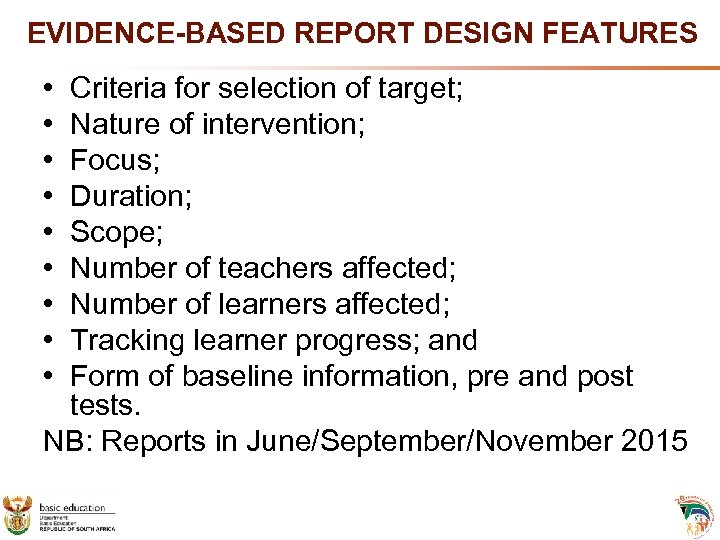 EVIDENCE-BASED REPORT DESIGN FEATURES • • • Criteria for selection of target; Nature of intervention; Focus; Duration; Scope; Number of teachers affected; Number of learners affected; Tracking learner progress; and Form of baseline information, pre and post tests. NB: Reports in June/September/November 2015
 Diagnostic Subject Analysis 2
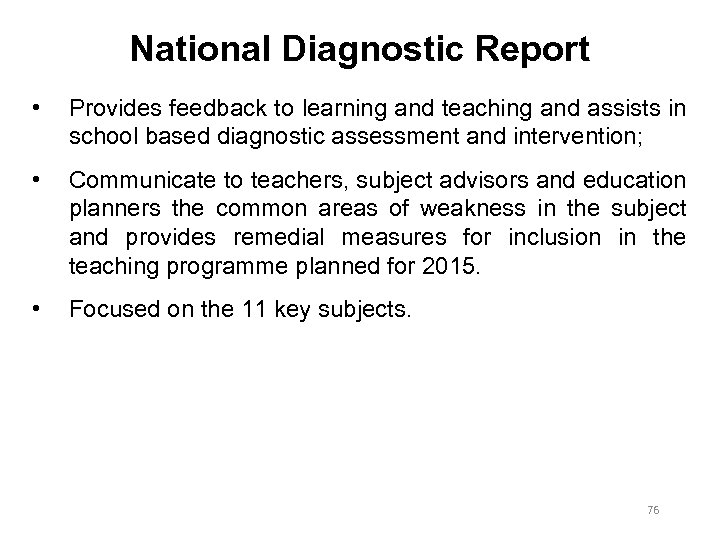 National Diagnostic Report • Provides feedback to learning and teaching and assists in school based diagnostic assessment and intervention; • Communicate to teachers, subject advisors and education planners the common areas of weakness in the subject and provides remedial measures for inclusion in the teaching programme planned for 2015. • Focused on the 11 key subjects. 76
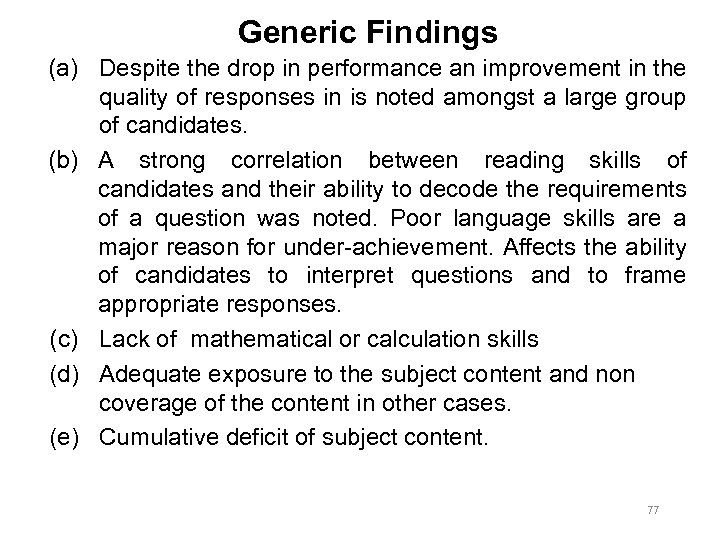 Generic Findings (a) Despite the drop in performance an improvement in the quality of responses in is noted amongst a large group of candidates. (b) A strong correlation between reading skills of candidates and their ability to decode the requirements of a question was noted. Poor language skills are a major reason for under-achievement. Affects the ability of candidates to interpret questions and to frame appropriate responses. (c) Lack of mathematical or calculation skills (d) Adequate exposure to the subject content and non coverage of the content in other cases. (e) Cumulative deficit of subject content. 77
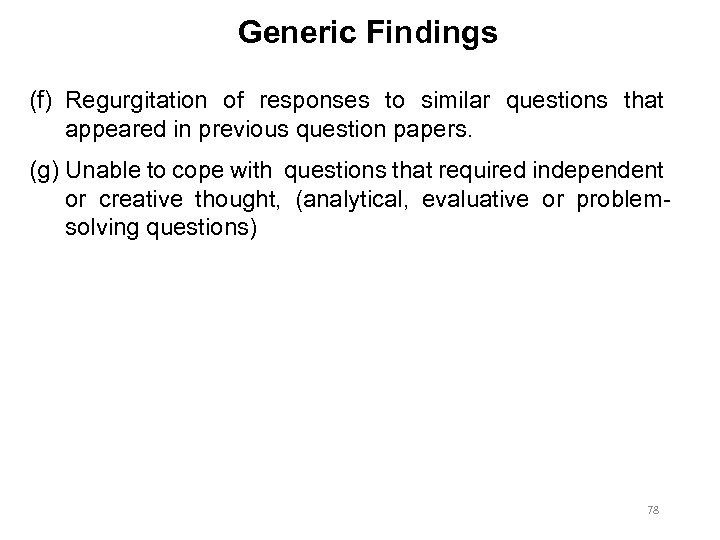 Generic Findings (f) Regurgitation of responses to similar questions that appeared in previous question papers. (g) Unable to cope with questions that required independent or creative thought, (analytical, evaluative or problemsolving questions) 78
 Subject Specific Analysis 2
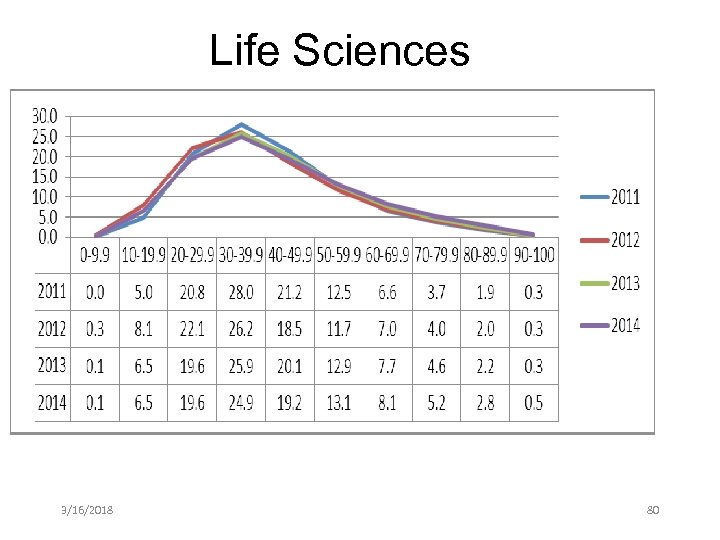 Life Sciences 3/16/2018 80
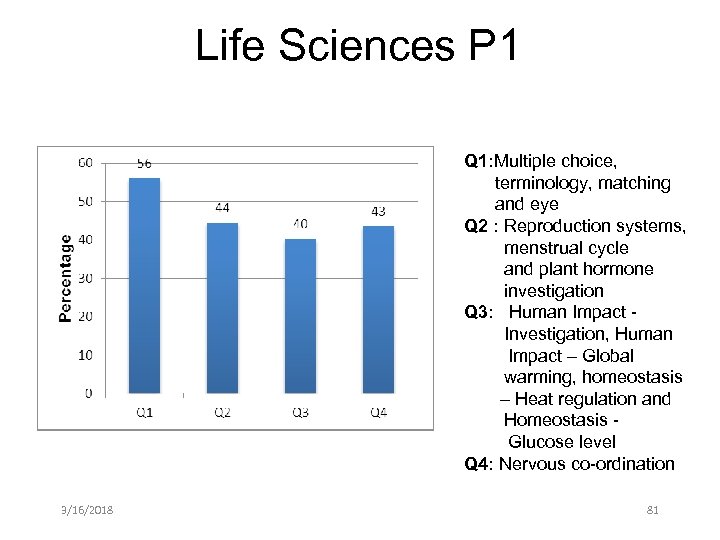 Life Sciences P 1 Q 1: Multiple choice, terminology, matching and eye Q 2 : Reproduction systems, menstrual cycle and plant hormone investigation Q 3: Human Impact - Investigation, Human Impact – Global warming, homeostasis – Heat regulation and Homeostasis Glucose level Q 4: Nervous co-ordination 3/16/2018 81
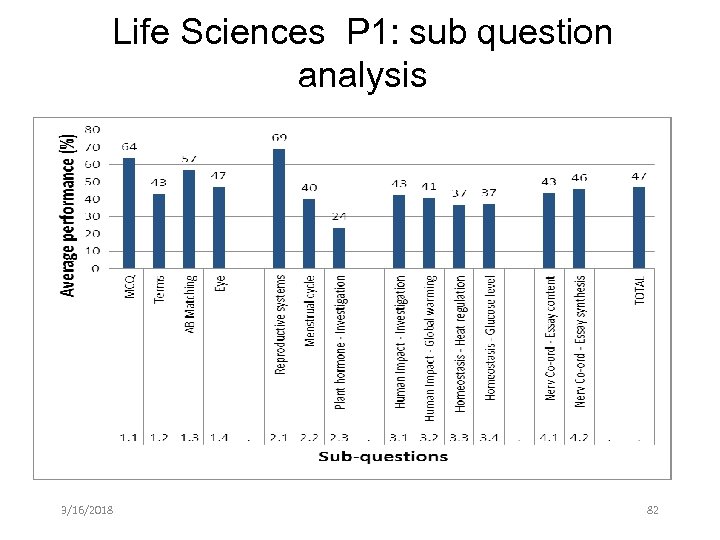 Life Sciences P 1: sub question analysis 3/16/2018 82
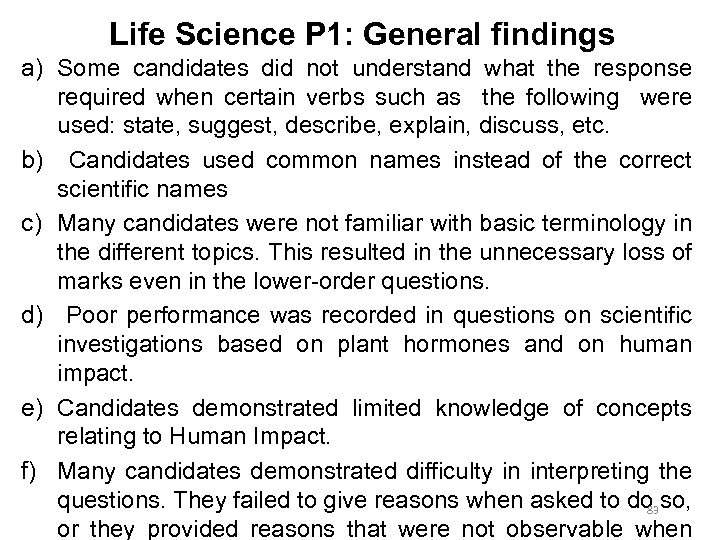 Life Science P 1: General findings a) Some candidates did not understand what the response required when certain verbs such as the following were used: state, suggest, describe, explain, discuss, etc. b) Candidates used common names instead of the correct scientific names c) Many candidates were not familiar with basic terminology in the different topics. This resulted in the unnecessary loss of marks even in the lower-order questions. d) Poor performance was recorded in questions on scientific investigations based on plant hormones and on human impact. e) Candidates demonstrated limited knowledge of concepts relating to Human Impact. f) Many candidates demonstrated difficulty in interpreting the questions. They failed to give reasons when asked to do so, 83 or they provided reasons that were not observable when
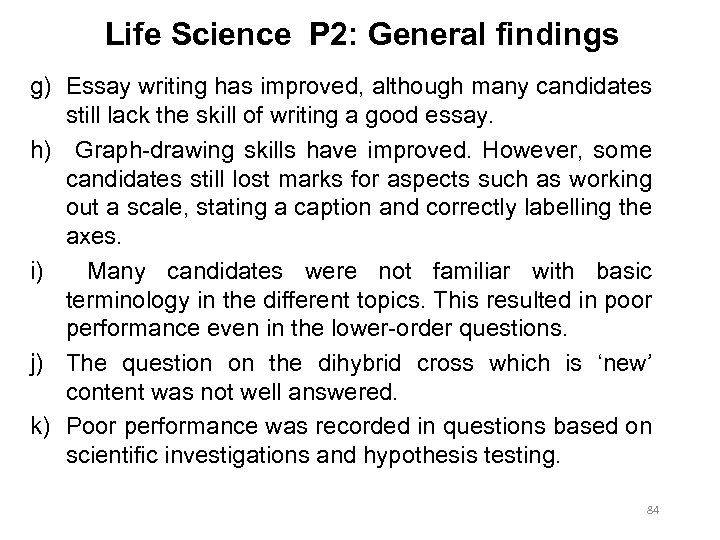 Life Science P 2: General findings g) Essay writing has improved, although many candidates still lack the skill of writing a good essay. h) Graph-drawing skills have improved. However, some candidates still lost marks for aspects such as working out a scale, stating a caption and correctly labelling the axes. i) Many candidates were not familiar with basic terminology in the different topics. This resulted in poor performance even in the lower-order questions. j) The question on the dihybrid cross which is ‘new’ content was not well answered. k) Poor performance was recorded in questions based on scientific investigations and hypothesis testing. 84
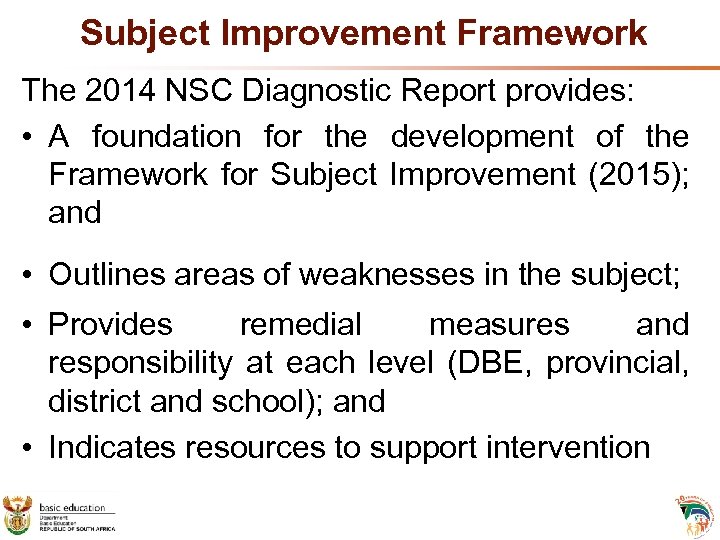 Subject Improvement Framework The 2014 NSC Diagnostic Report provides: • A foundation for the development of the Framework for Subject Improvement (2015); and • Outlines areas of weaknesses in the subject; • Provides remedial measures and responsibility at each level (DBE, provincial, district and school); and • Indicates resources to support intervention
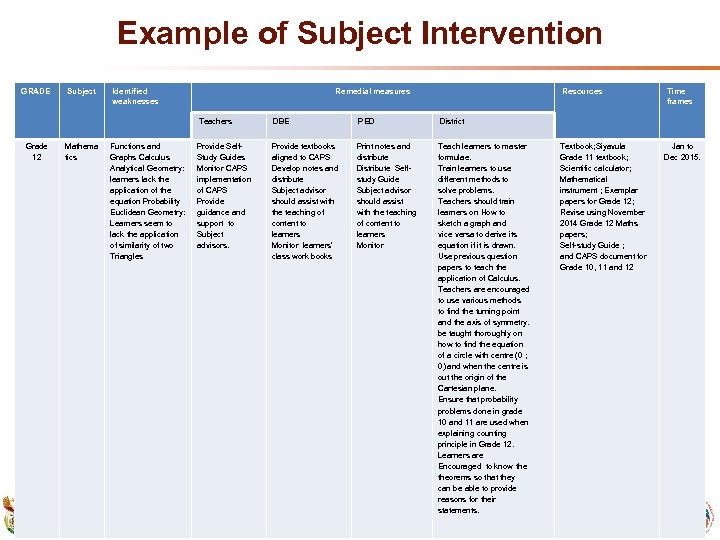 Example of Subject Intervention GRADE Subject Identified weaknesses Remedial measures Resources Teachers Grade 12 Mathema tics Functions and Graphs Calculus Analytical Geometry: learners lack the application of the equation Probability Euclidean Geometry: Learners seem to lack the application of similarity of two Triangles DBE PED Provide textbooks aligned to CAPS Develop notes and distribute Subject advisor should assist with the teaching of content to learners Monitor learners’ class work books Print notes and distribute Distribute Selfstudy Guide Subject advisor should assist with the teaching of content to learners Monitor Teach learners to master formulae. Train learners to use different methods to solve problems. Teachers should train learners on How to sketch a graph and vice versa to derive its equation if it is drawn. Use previous question papers to teach the application of Calculus. Teachers are encouraged to use various methods to find the turning point and the axis of symmetry. be taught thoroughly on how to find the equation of a circle with centre (0 ; 0) and when the centre is out the origin of the Cartesian plane. Ensure that probability problems done in grade 10 and 11 are used when explaining counting principle in Grade 12. Learners are Encouraged to know theorems so that they can be able to provide reasons for their statements. Textbook; Siyavula Grade 11 textbook; Scientific calculator; Mathematical instrument ; Exemplar papers for Grade 12; Revise using November 2014 Grade 12 Maths papers; Self-study Guide ; and CAPS document for Grade 10, 11 and 12 Jan to Dec 2015. District Provide Self. Study Guides Monitor CAPS implementation of CAPS Provide guidance and support to Subject advisors. Time frames
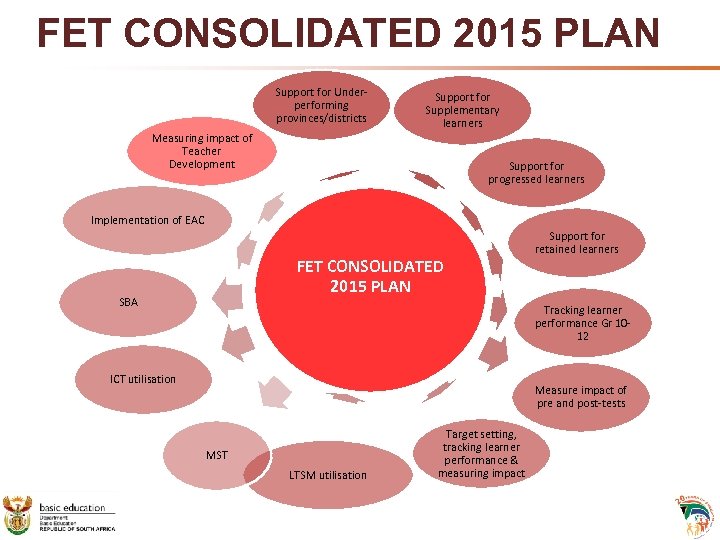 FET CONSOLIDATED 2015 PLAN Support for Underperforming provinces/districts Support for Supplementary learners Measuring impact of Teacher Development Support for progressed learners Implementation of EAC FET CONSOLIDATED 2015 PLAN SBA Support for retained learners Tracking learner performance Gr 1012 ICT utilisation Measure impact of pre and post-tests MST LTSM utilisation Target setting, tracking learner performance & measuring impact
 DIFFERENTIATED SUPPORT • Learner Support plans have been drawn from recommendations by the commissions of the Teacher Development and Curriculum Management (TDCM) workshop held on 26 -28 January 2015 • The theme was “Consolidation of plans in pursuit of Quality and Efficiency”
 WORKSHOP COMMISSIONS • National Strategy for Learner Attainment (NSLA) and Evidence-based Report • Teacher Development • MST (Maths, Science & Technology) and SP (Senior Phase) Interventions Framework • Languages and LOLT (Language of Learning & Teaching) • ECD (Early Childhood Development), IE (Inclusive Education) and Multi-grade schools
 DOCUMENTS INFORMING 2015 GRADE 12 INTERVENTIONS a) The National Senior Certificate Technical Report; b) Schools Performance Report; c) Schools Subject Report; and d) National Diagnostic Report. e) Subject Improvement Framework for NSC (FET) f) Subject Profiles
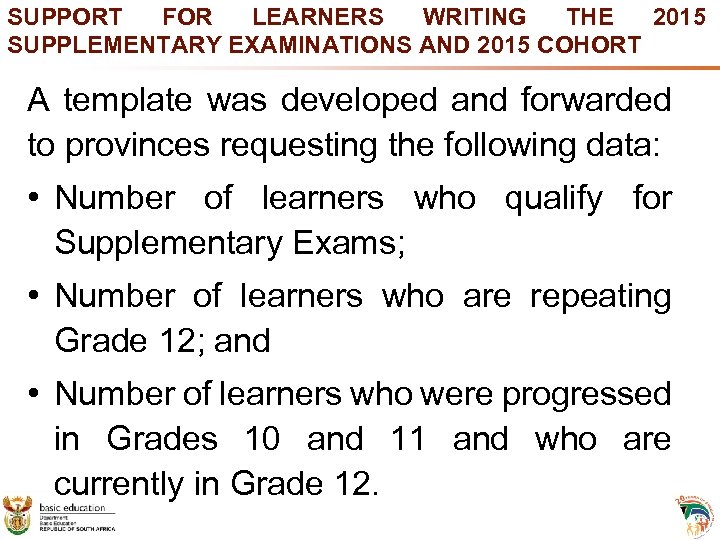 SUPPORT FOR LEARNERS WRITING THE 2015 SUPPLEMENTARY EXAMINATIONS AND 2015 COHORT A template was developed and forwarded to provinces requesting the following data: • Number of learners who qualify for Supplementary Exams; • Number of learners who are repeating Grade 12; and • Number of learners who were progressed in Grades 10 and 11 and who are currently in Grade 12.
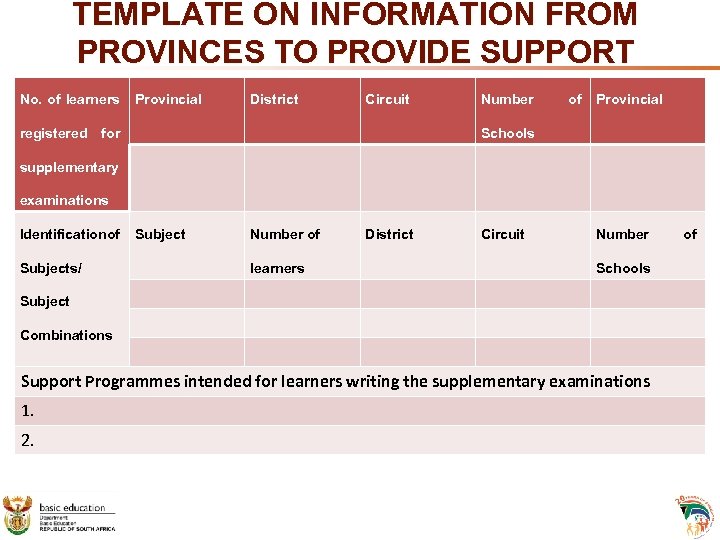 TEMPLATE ON INFORMATION FROM PROVINCES TO PROVIDE SUPPORT No. of learners Provincial District Circuit registered for Number of Provincial Schools supplementary examinations Identification f Subject o Number of Subjects/ learners District Circuit Number Schools Subject Combinations Support Programmes intended for learners writing the supplementary examinations 1. 2. of
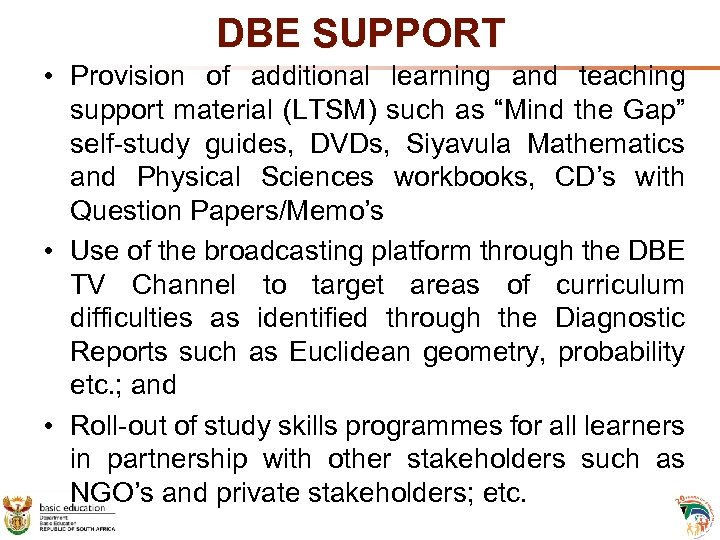 DBE SUPPORT • Provision of additional learning and teaching support material (LTSM) such as “Mind the Gap” self-study guides, DVDs, Siyavula Mathematics and Physical Sciences workbooks, CD’s with Question Papers/Memo’s • Use of the broadcasting platform through the DBE TV Channel to target areas of curriculum difficulties as identified through the Diagnostic Reports such as Euclidean geometry, probability etc. ; and • Roll-out of study skills programmes for all learners in partnership with other stakeholders such as NGO’s and private stakeholders; etc.
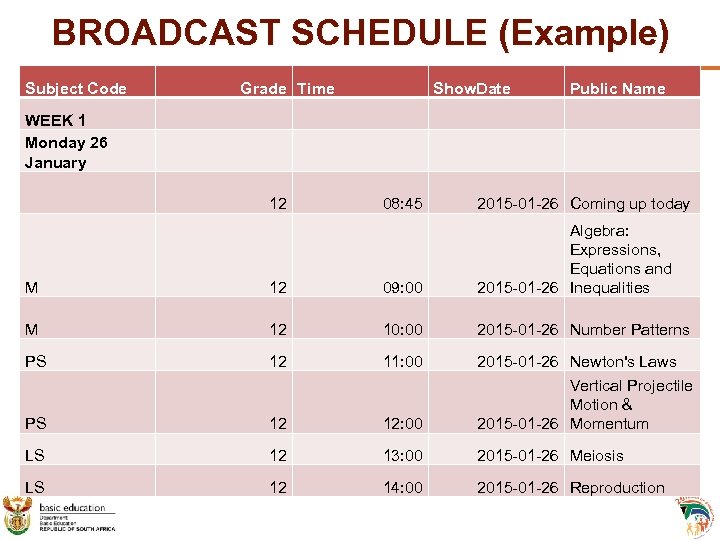 BROADCAST SCHEDULE (Example) Subject Code WEEK 1 Monday 26 January Grade Time Show. Date Public Name 12 08: 45 2015 -01 -26 Coming up today M 12 09: 00 Algebra: Expressions, Equations and 2015 -01 -26 Inequalities M 12 10: 00 2015 -01 -26 Number Patterns PS 12 11: 00 2015 -01 -26 Newton's Laws PS 12 12: 00 Vertical Projectile Motion & 2015 -01 -26 Momentum LS 12 13: 00 2015 -01 -26 Meiosis LS 12 14: 00 2015 -01 -26 Reproduction
 SUPPORT BY PROVINCES • Mediation of all material from the DBE to districts and schools; • Printing and distribution of “Teacher Training Manuals” on Geometry and Probability which was developed in 2014 and used in provinces for the training of teachers by the Department of Basic Education; and • Presentation of Extra Lessons using teacher centres, etc. for differentiated support.
 SUPPORT BY PROVINCES • Identifying the subjects failed by the majority of learners to provide focussed differentiated support; • Provision of additional learning and teaching support material (LTSM) such as Exemplar Papers, DVDs, Siyavula Mathematics and Physical Sciences workbooks; • Learner camps in areas where severe under-performance is anticipated will be organised; • Roll-out of study skills programmes for all learners in partnership with other stakeholders such as NGO’s and private stakeholders; and • Use the contract between schools and parents and the learner as a source of enforced responsibility and allow parents to sign the contract.
 SUPPORT FOR TEACHERS To make this attainable, teachers will be supported in the following manner: • Capacitate teachers in the implementation of learner progression regulations & procedures; • Accelerated teacher training programmes to improve the application of differentiated teaching methodologies; and • Strengthening monitoring and evaluation of curriculum coverage and learner performance through effective implementation of the SBA (School Based. Assessment) to evaluate the impact of the learning and teaching methods applied within the classroom.
 MONITORING AND ACCOUNTABILITY MECHANISMS
 EXPECTED OUTCOMES FOR 2015 ANA AND NSC WORKSHOPS • Provincial plans aligned to DBE’s interventions so that there are concerted and uniform efforts across all provinces to improve learning outcomes; • An increased focus on implementation, monitoring and support by DBE and Provincial Education Departments; • Accountability at all levels of the system in terms of accurate monitoring and reporting on NSLA; • Improvements in learner performance.
 STRUCTURE OF THE WORKSHOP – The Provincial Engagements include a One-day workshop in Western Cape, Gauteng, Free State and North West; – a two-day workshop at provincial level in Mpumalanga and Northern Cape; and – a two-day workshop at provincial and district levels in Eastern Cape Limpopo and Kwa. Zulu-Natal.
 SUPPORT FOR UNDERPERFORMING DISTRICTS / SCHOOLS
 RATIONALE FOR THE VISITS • Share the 2014 ANA & NSC results; • Mediate diagnostic reports and the 2015 Improvement Frameworks; and • Provide information and sector expectations to provinces/districts on support to under-performing districts and schools. • The key focus areas and targeted interventions will be managed and implemented through NSLA.
 THE ROLE OF DISTRICTS “Districts should provide targeted support to improve practices within schools and ensure communication and information sharing between authorities and schools. Schools need to share best practices. This requires teachers to carry out assessment practices that enable learners to compare their performance with their counterparts in other schools in the district. ” National Planning Commission: Diagnostic Report, November 2011 103
 MANAGEMENT STRUCTURE FOR NSLA: 2015 • A new management team for the NSLA was structured; • The team comprises representatives from various branches within the DBE and are responsible for a particular area; • Provincial offices have been requested to nominate an official who will co-ordinate NSLA activities in their respective provinces.
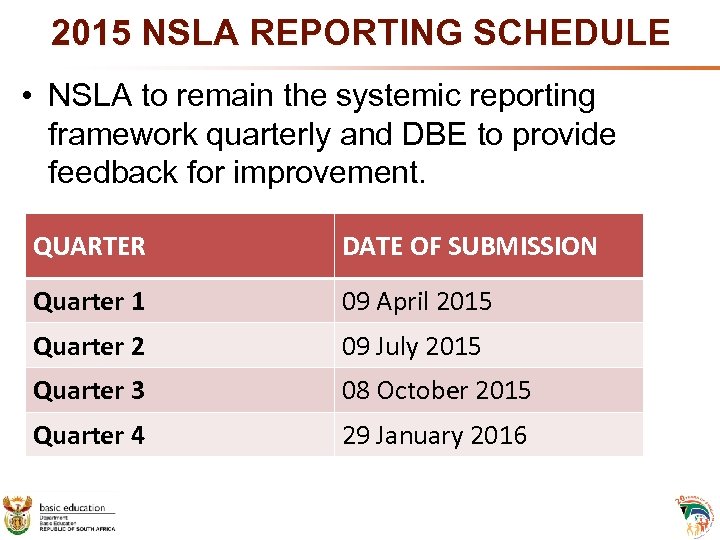 2015 NSLA REPORTING SCHEDULE • NSLA to remain the systemic reporting framework quarterly and DBE to provide feedback for improvement. QUARTER DATE OF SUBMISSION Quarter 1 09 April 2015 Quarter 2 09 July 2015 Quarter 3 08 October 2015 Quarter 4 29 January 2016
 PROVINCIAL NSLA PROGRESS REPORTS: PRESENTED AND EVALUATED • TDCM meetings: o 26 -28 January 2015 o 8 -10 April 2015 o 3 -5 June 2015 o 5 -7 August 2015 o 6 -8 October 2015 o 1 -3 December 2015 • Inter-Provincial Forums (MST, IE, ECD and ICT) • HEDCOM/CEM
 Conclusion • The DBE has embarked on an intensive analysis and review of the 2014 NSC examination data, both from a qualitative and quantitative perspective. • Interventions relating to data utilisation at district and school level have been strengthened. • Ongoing monitoring and evaluation will be more robust and streamlined. • Confident that 2015 will see an improvement in learner performance.
 THANK YOU Website: www. education. gov. za Call Centre: 0800 202 933 | callcentre@dbe. gov. za Twitter: @DBE_SA | Facebook: DBE SA