


 Скачать презентацию National Senior Certificate — 2013 Portfolio Committee on
8b1f9582b681b8d88e5f338fcc4be625.ppt
- Количество слайдов: 134
 National Senior Certificate - 2013 Portfolio Committee on Basic Education 18 February 2014 1
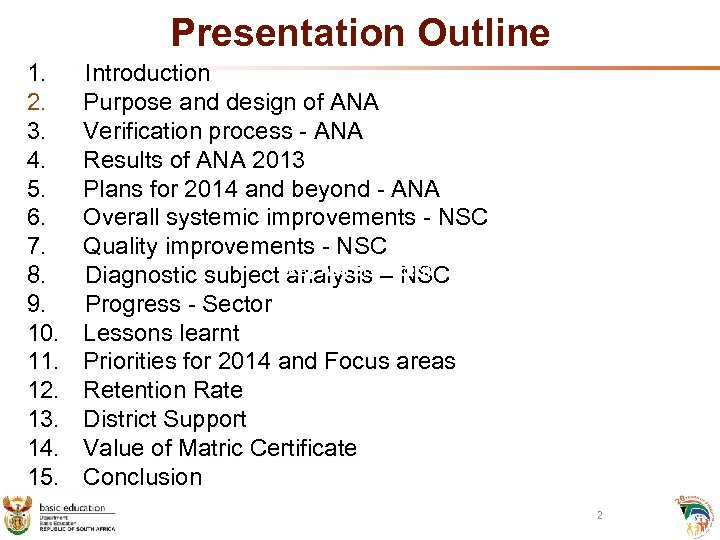 Presentation Outline 1. 2. 3. 4. 5. 6. 7. 8. 9. 10. 11. 12. 13. 14. 15. Introduction Purpose and design of ANA Verification process - ANA Results of ANA 2013 Plans for 2014 and beyond - ANA Overall systemic improvements - NSC Quality improvements - NSC Key Aea of concern Diagnostic subject analysis – NSC Progress - Sector Lessons learnt Priorities for 2014 and Focus areas Retention Rate District Support Value of Matric Certificate Conclusion 2
 ANA 2013
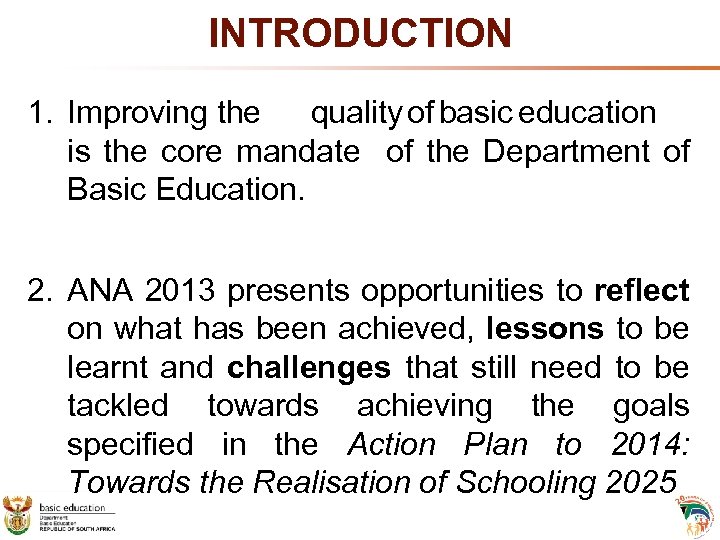 INTRODUCTION 1. Improving the quality of basic education is the core mandate of the Department of Basic Education. 2. ANA 2013 presents opportunities to reflect on what has been achieved, lessons to be learnt and challenges that still need to be tackled towards achieving the goals specified in the Action Plan to 2014: Towards the Realisation of Schooling 2025
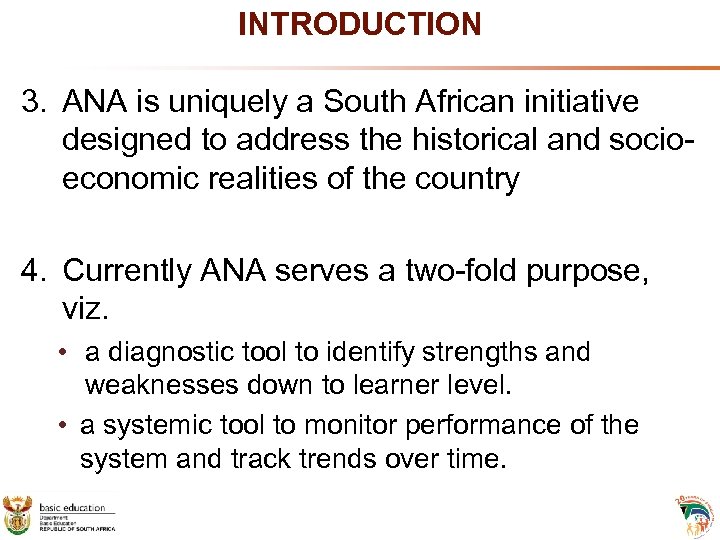 INTRODUCTION 3. ANA is uniquely a South African initiative designed to address the historical and socioeconomic realities of the country 4. Currently ANA serves a two-fold purpose, viz. • a diagnostic tool to identify strengths and weaknesses down to learner level. • a systemic tool to monitor performance of the system and track trends over time.
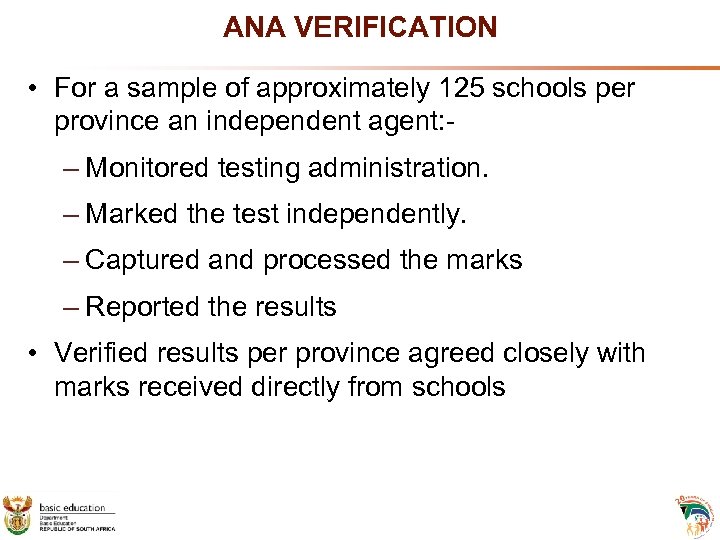 ANA VERIFICATION • For a sample of approximately 125 schools per province an independent agent: – Monitored testing administration. – Marked the test independently. – Captured and processed the marks – Reported the results • Verified results per province agreed closely with marks received directly from schools
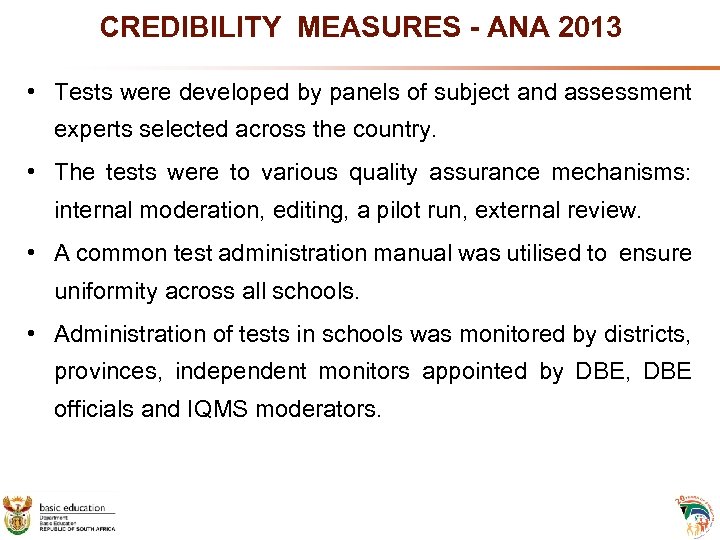 CREDIBILITY MEASURES - ANA 2013 • Tests were developed by panels of subject and assessment experts selected across the country. • The tests were to various quality assurance mechanisms: internal moderation, editing, a pilot run, external review. • A common test administration manual was utilised to ensure uniformity across all schools. • Administration of tests in schools was monitored by districts, provinces, independent monitors appointed by DBE, DBE officials and IQMS moderators.
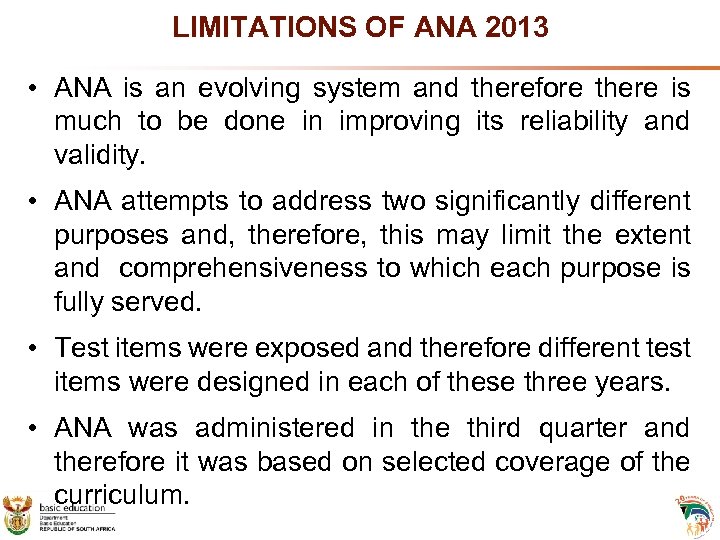 LIMITATIONS OF ANA 2013 • ANA is an evolving system and therefore there is much to be done in improving its reliability and validity. • ANA attempts to address two significantly different purposes and, therefore, this may limit the extent and comprehensiveness to which each purpose is fully served. • Test items were exposed and therefore different test items were designed in each of these three years. • ANA was administered in the third quarter and therefore it was based on selected coverage of the curriculum.
 ANA RESULTS 2013
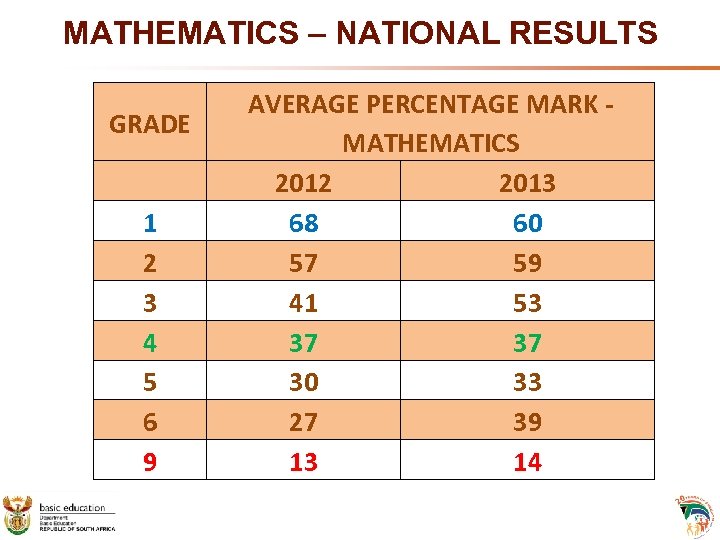 MATHEMATICS – NATIONAL RESULTS GRADE 1 2 3 4 5 6 9 AVERAGE PERCENTAGE MARK - MATHEMATICS 2012 2013 68 60 57 59 41 53 37 37 30 33 27 39 13 14
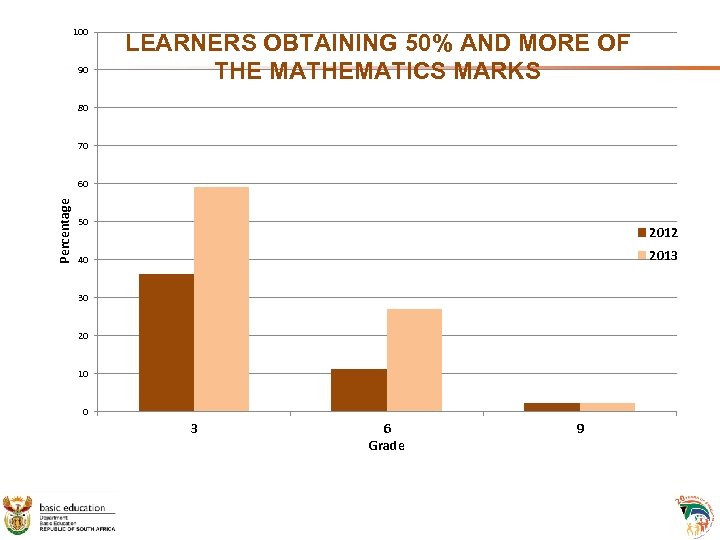 100 90 LEARNERS OBTAINING 50% AND MORE OF THE MATHEMATICS MARKS 80 70 Percentage 60 50 2012 2013 40 30 20 10 0 3 6 Grade 9
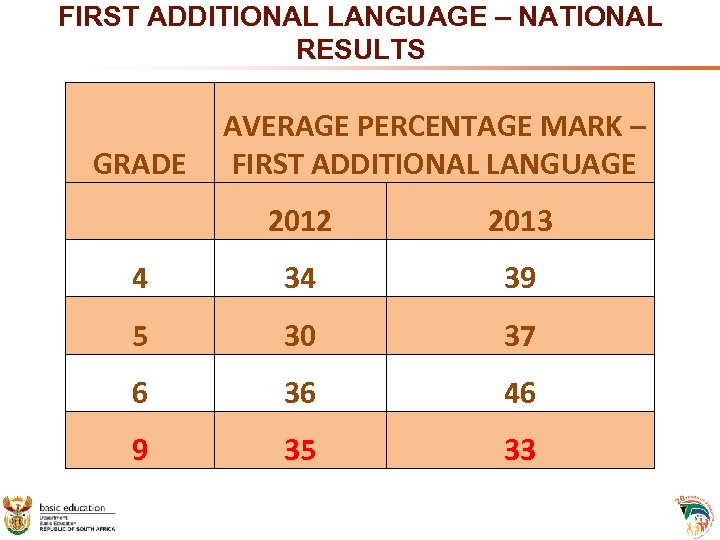 FIRST ADDITIONAL LANGUAGE – NATIONAL RESULTS GRADE AVERAGE PERCENTAGE MARK – FIRST ADDITIONAL LANGUAGE 2012 2013 4 34 39 5 30 37 6 36 46 9 35 33
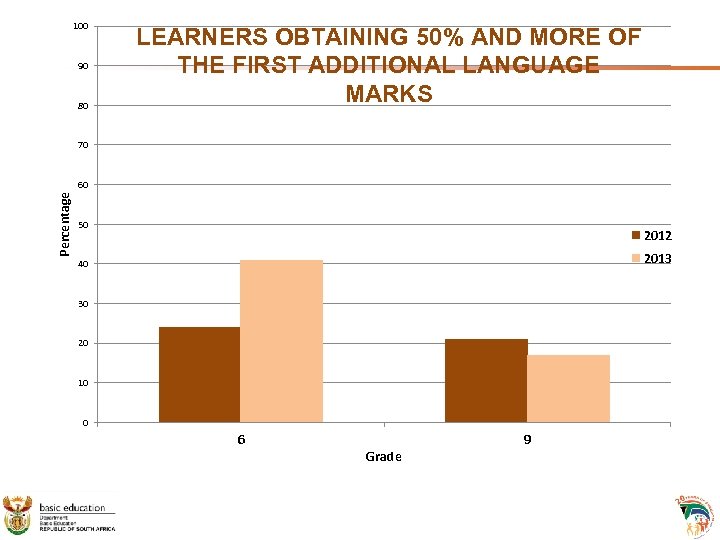 100 90 80 LEARNERS OBTAINING 50% AND MORE OF THE FIRST ADDITIONAL LANGUAGE MARKS 70 Percentage 60 50 2012 2013 40 30 20 10 0 6 Grade 9
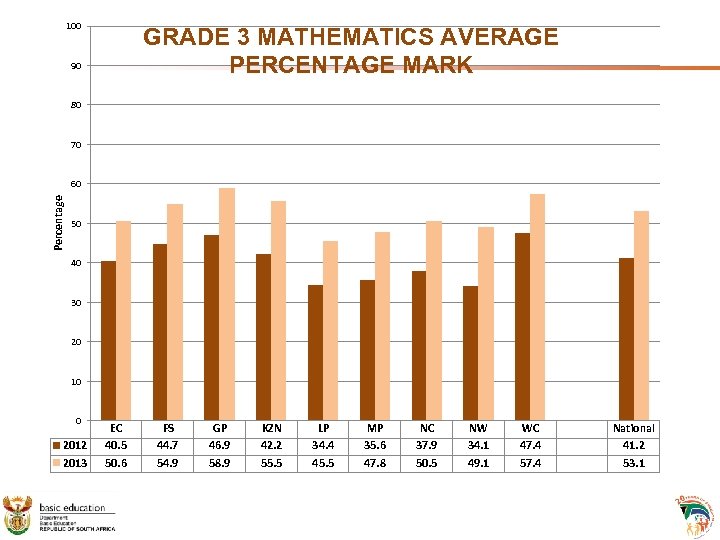 100 GRADE 3 MATHEMATICS AVERAGE PERCENTAGE MARK 90 80 70 Percentage 60 50 40 30 20 10 0 2012 2013 EC 40. 5 50. 6 FS 44. 7 54. 9 GP 46. 9 58. 9 KZN 42. 2 55. 5 LP 34. 4 45. 5 MP 35. 6 47. 8 NC 37. 9 50. 5 NW 34. 1 49. 1 WC 47. 4 57. 4 National 41. 2 53. 1
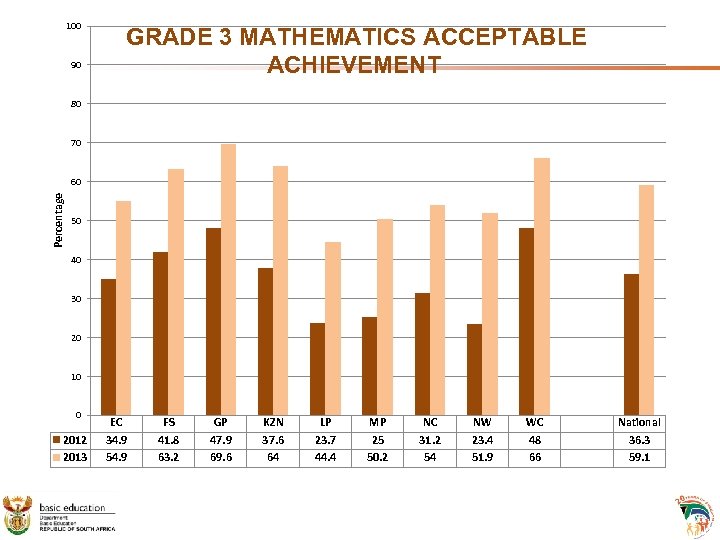 100 GRADE 3 MATHEMATICS ACCEPTABLE ACHIEVEMENT 90 80 70 Percentage 60 50 40 30 20 10 0 2012 2013 EC 34. 9 54. 9 FS 41. 8 63. 2 GP 47. 9 69. 6 KZN 37. 6 64 LP 23. 7 44. 4 MP 25 50. 2 NC 31. 2 54 NW 23. 4 51. 9 WC 48 66 National 36. 3 59. 1
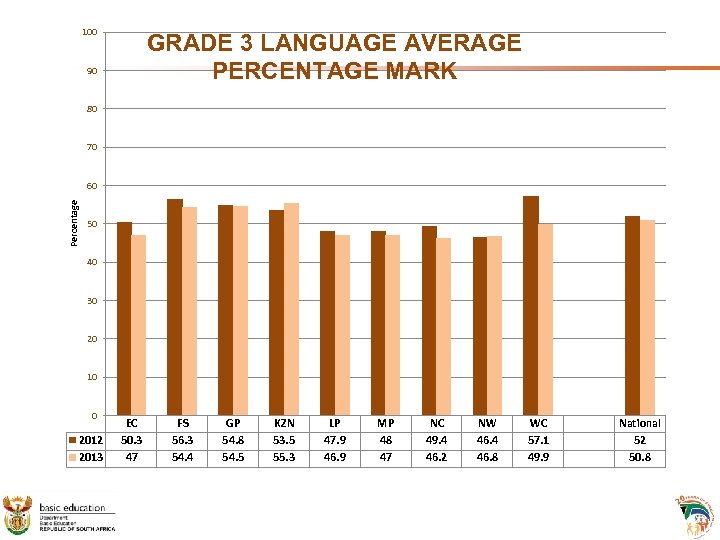 100 GRADE 3 LANGUAGE AVERAGE PERCENTAGE MARK 90 80 70 Percentage 60 50 40 30 20 10 0 2012 2013 EC 50. 3 47 FS 56. 3 54. 4 GP 54. 8 54. 5 KZN 53. 5 55. 3 LP 47. 9 46. 9 MP 48 47 NC 49. 4 46. 2 NW 46. 4 46. 8 WC 57. 1 49. 9 National 52 50. 8
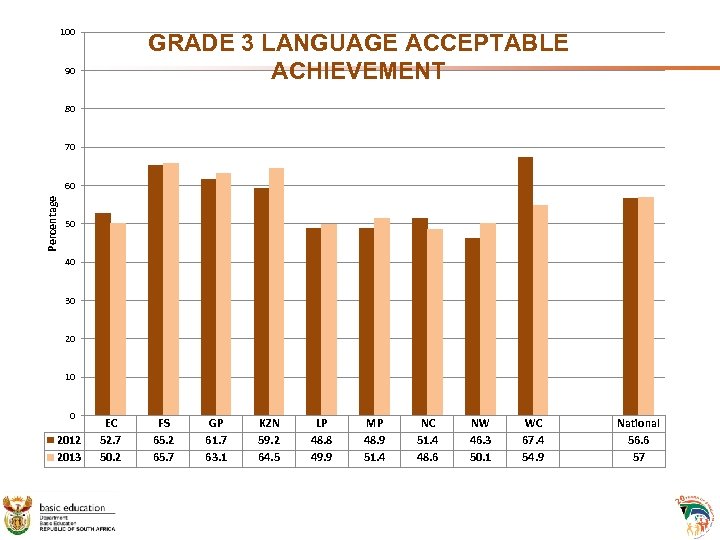 100 GRADE 3 LANGUAGE ACCEPTABLE ACHIEVEMENT 90 80 70 Percentage 60 50 40 30 20 10 0 2012 2013 EC 52. 7 50. 2 FS 65. 2 65. 7 GP 61. 7 63. 1 KZN 59. 2 64. 5 LP 48. 8 49. 9 MP 48. 9 51. 4 NC 51. 4 48. 6 NW 46. 3 50. 1 WC 67. 4 54. 9 National 56. 6 57
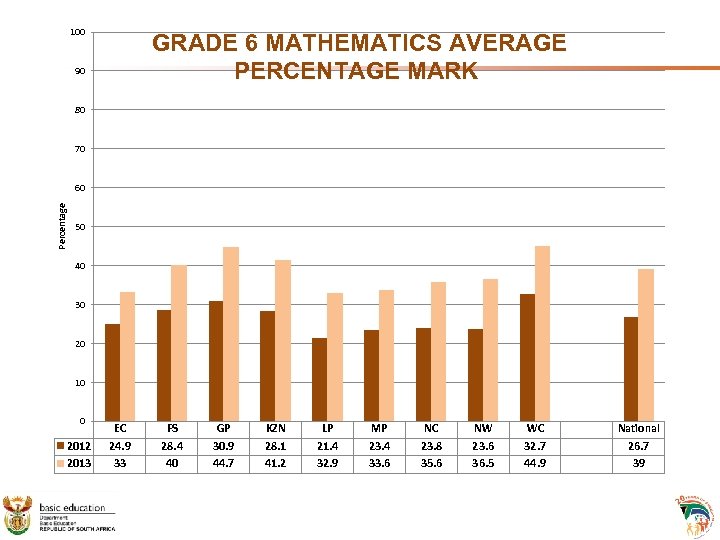 100 GRADE 6 MATHEMATICS AVERAGE PERCENTAGE MARK 90 80 70 Percentage 60 50 40 30 20 10 0 2012 2013 EC 24. 9 33 FS 28. 4 40 GP 30. 9 44. 7 KZN 28. 1 41. 2 LP 21. 4 32. 9 MP 23. 4 33. 6 NC 23. 8 35. 6 NW 23. 6 36. 5 WC 32. 7 44. 9 National 26. 7 39
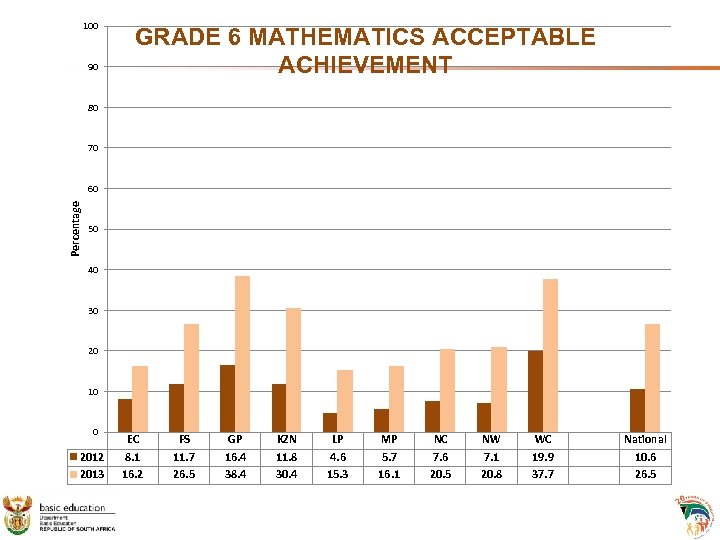 100 90 GRADE 6 MATHEMATICS ACCEPTABLE ACHIEVEMENT 80 70 Percentage 60 50 40 30 20 10 0 2012 2013 EC 8. 1 16. 2 FS 11. 7 26. 5 GP 16. 4 38. 4 KZN 11. 8 30. 4 LP 4. 6 15. 3 MP 5. 7 16. 1 NC 7. 6 20. 5 NW 7. 1 20. 8 WC 19. 9 37. 7 National 10. 6 26. 5
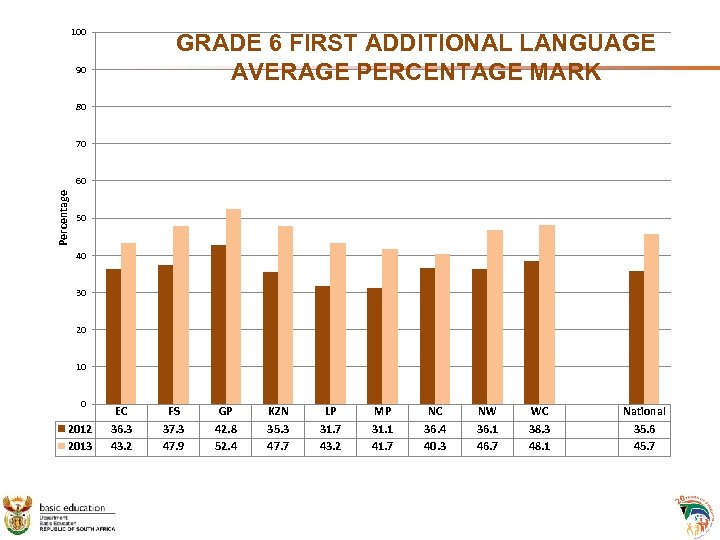 100 GRADE 6 FIRST ADDITIONAL LANGUAGE AVERAGE PERCENTAGE MARK 90 80 70 Percentage 60 50 40 30 20 10 0 2012 2013 EC 36. 3 43. 2 FS 37. 3 47. 9 GP 42. 8 52. 4 KZN 35. 3 47. 7 LP 31. 7 43. 2 MP 31. 1 41. 7 NC 36. 4 40. 3 NW 36. 1 46. 7 WC 38. 3 48. 1 National 35. 6 45. 7
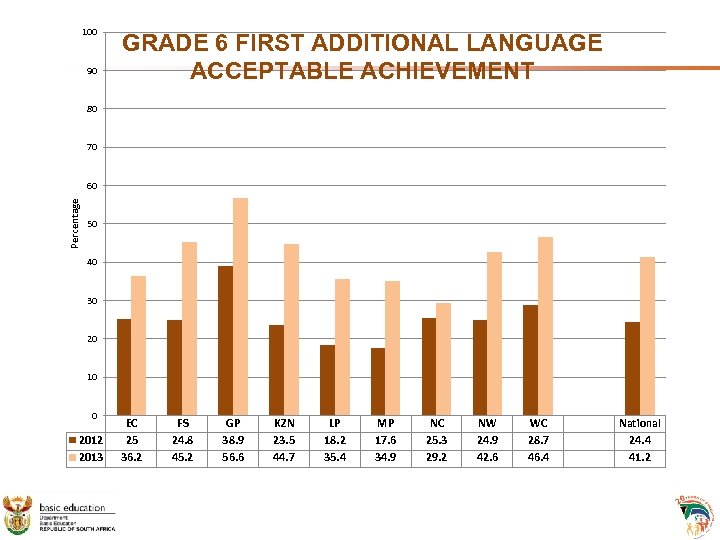 100 90 GRADE 6 FIRST ADDITIONAL LANGUAGE ACCEPTABLE ACHIEVEMENT 80 70 Percentage 60 50 40 30 20 10 0 2012 2013 EC 25 36. 2 FS 24. 8 45. 2 GP 38. 9 56. 6 KZN 23. 5 44. 7 LP 18. 2 35. 4 MP 17. 6 34. 9 NC 25. 3 29. 2 NW 24. 9 42. 6 WC 28. 7 46. 4 National 24. 4 41. 2
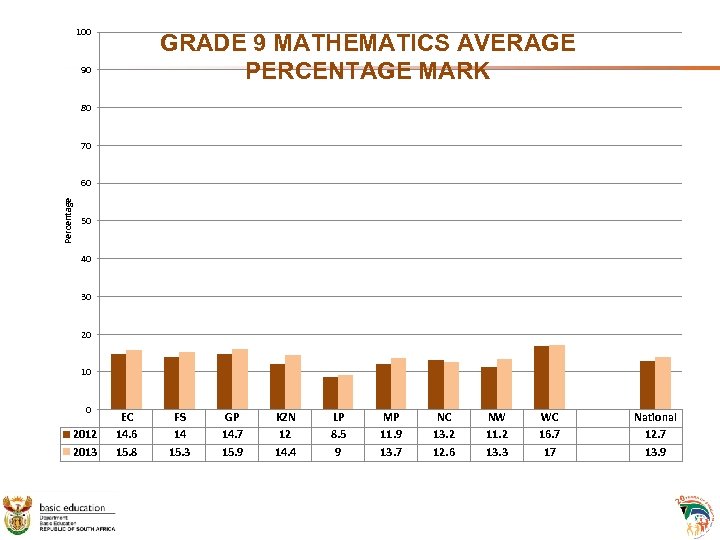 100 GRADE 9 MATHEMATICS AVERAGE PERCENTAGE MARK 90 80 70 Percentage 60 50 40 30 20 10 0 2012 2013 EC 14. 6 15. 8 FS 14 15. 3 GP 14. 7 15. 9 KZN 12 14. 4 LP 8. 5 9 MP 11. 9 13. 7 NC 13. 2 12. 6 NW 11. 2 13. 3 WC 16. 7 17 National 12. 7 13. 9
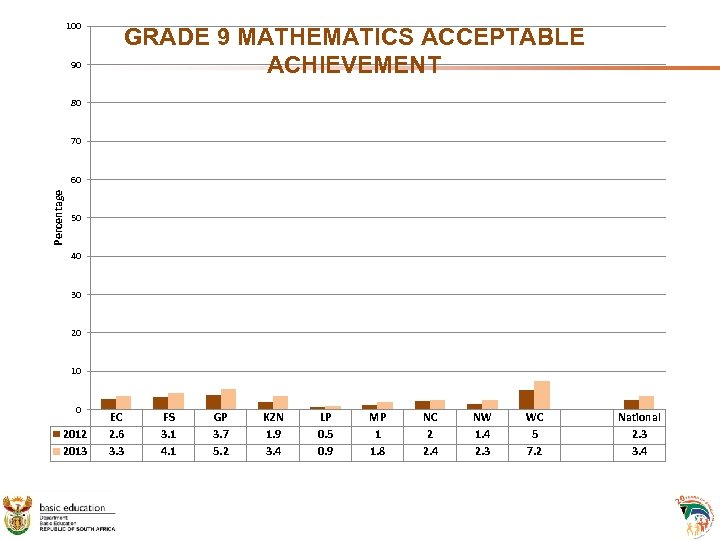 100 90 GRADE 9 MATHEMATICS ACCEPTABLE ACHIEVEMENT 80 70 Percentage 60 50 40 30 20 10 0 2012 2013 EC 2. 6 3. 3 FS 3. 1 4. 1 GP 3. 7 5. 2 KZN 1. 9 3. 4 LP 0. 5 0. 9 MP 1 1. 8 NC 2 2. 4 NW 1. 4 2. 3 WC 5 7. 2 National 2. 3 3. 4
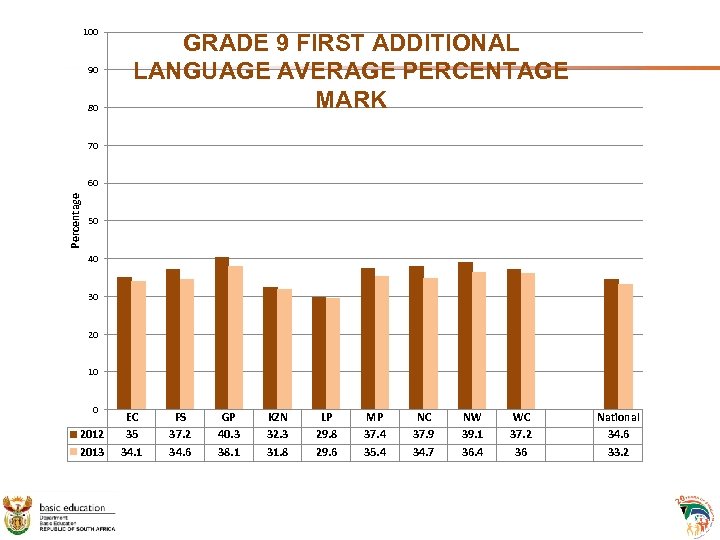 100 90 80 GRADE 9 FIRST ADDITIONAL LANGUAGE AVERAGE PERCENTAGE MARK 70 Percentage 60 50 40 30 20 10 0 2012 2013 EC 35 34. 1 FS 37. 2 34. 6 GP 40. 3 38. 1 KZN 32. 3 31. 8 LP 29. 8 29. 6 MP 37. 4 35. 4 NC 37. 9 34. 7 NW 39. 1 36. 4 WC 37. 2 36 National 34. 6 33. 2
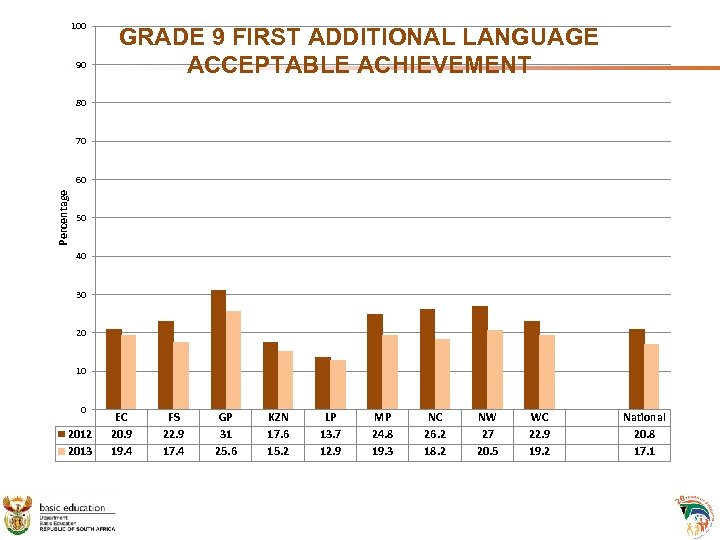 100 90 GRADE 9 FIRST ADDITIONAL LANGUAGE ACCEPTABLE ACHIEVEMENT 80 70 Percentage 60 50 40 30 20 10 0 2012 2013 EC 20. 9 19. 4 FS 22. 9 17. 4 GP 31 25. 6 KZN 17. 6 15. 2 LP 13. 7 12. 9 MP 24. 8 19. 3 NC 26. 2 18. 2 NW 27 20. 5 WC 22. 9 19. 2 National 20. 8 17. 1
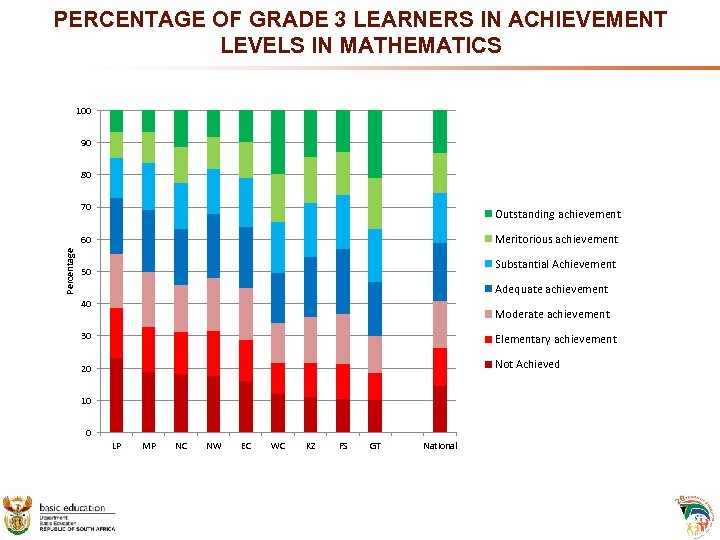 PERCENTAGE OF GRADE 3 LEARNERS IN ACHIEVEMENT LEVELS IN MATHEMATICS 100 90 80 70 Outstanding achievement Meritorious achievement Percentage 60 Substantial Achievement 50 Adequate achievement 40 Moderate achievement 30 Elementary achievement 20 Not Achieved 10 0 LP MP NC NW EC WC KZ FS GT National
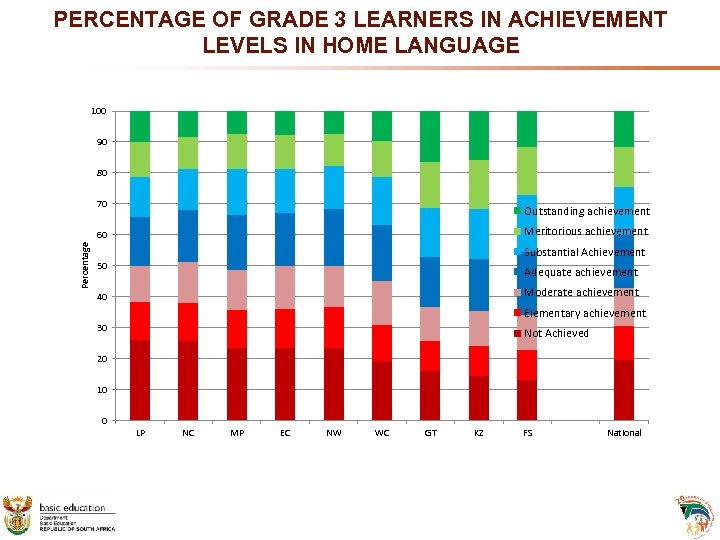 PERCENTAGE OF GRADE 3 LEARNERS IN ACHIEVEMENT LEVELS IN HOME LANGUAGE 100 90 80 70 Outstanding achievement Meritorious achievement Percentage 60 Substantial Achievement 50 Adequate achievement Moderate achievement 40 Elementary achievement 30 Not Achieved 20 10 0 LP NC MP EC NW WC GT KZ FS National
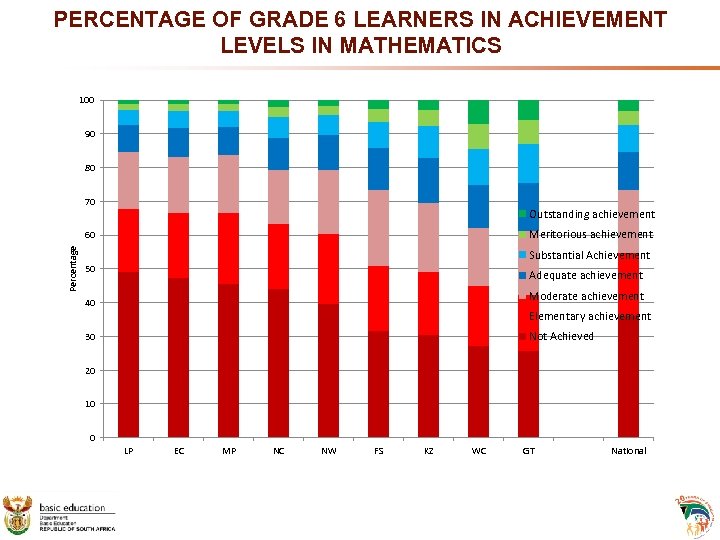 PERCENTAGE OF GRADE 6 LEARNERS IN ACHIEVEMENT LEVELS IN MATHEMATICS 100 90 80 70 Outstanding achievement Meritorious achievement Percentage 60 Substantial Achievement 50 Adequate achievement Moderate achievement 40 Elementary achievement Not Achieved 30 20 10 0 LP EC MP NC NW FS KZ WC GT National
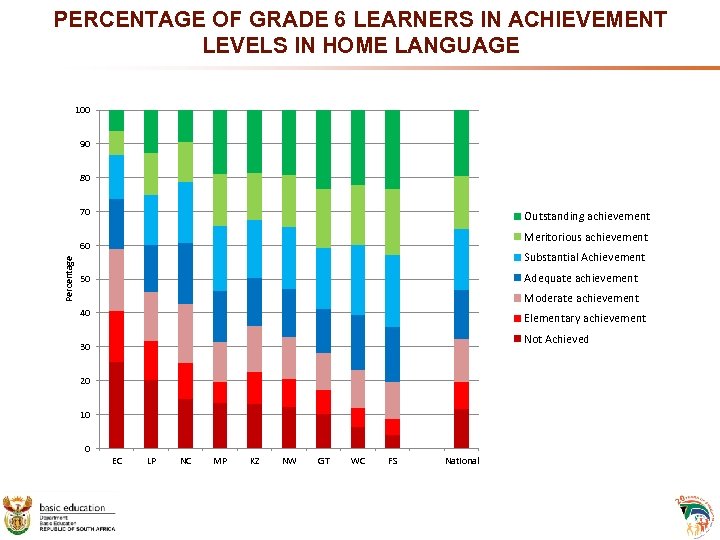 PERCENTAGE OF GRADE 6 LEARNERS IN ACHIEVEMENT LEVELS IN HOME LANGUAGE 100 90 80 70 Outstanding achievement Meritorious achievement Percentage 60 Substantial Achievement Adequate achievement 50 Moderate achievement 40 Elementary achievement Not Achieved 30 20 10 0 EC LP NC MP KZ NW GT WC FS National
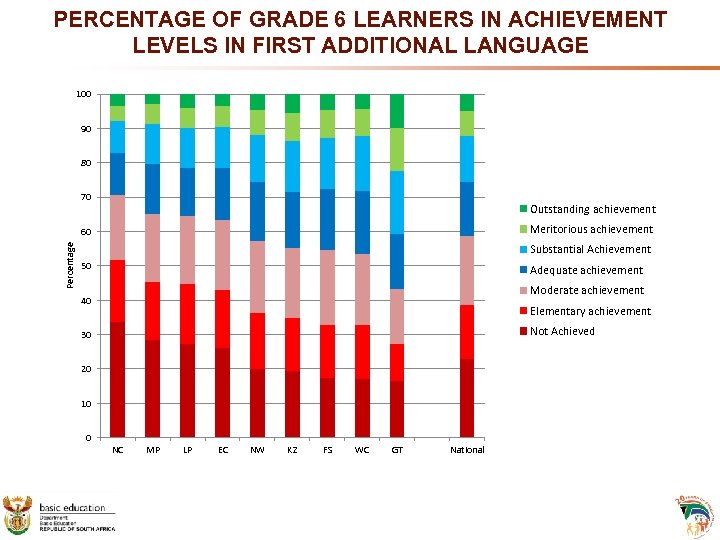 PERCENTAGE OF GRADE 6 LEARNERS IN ACHIEVEMENT LEVELS IN FIRST ADDITIONAL LANGUAGE 100 90 80 70 Outstanding achievement Meritorious achievement Percentage 60 Substantial Achievement 50 Adequate achievement Moderate achievement 40 Elementary achievement Not Achieved 30 20 10 0 NC MP LP EC NW KZ FS WC GT National
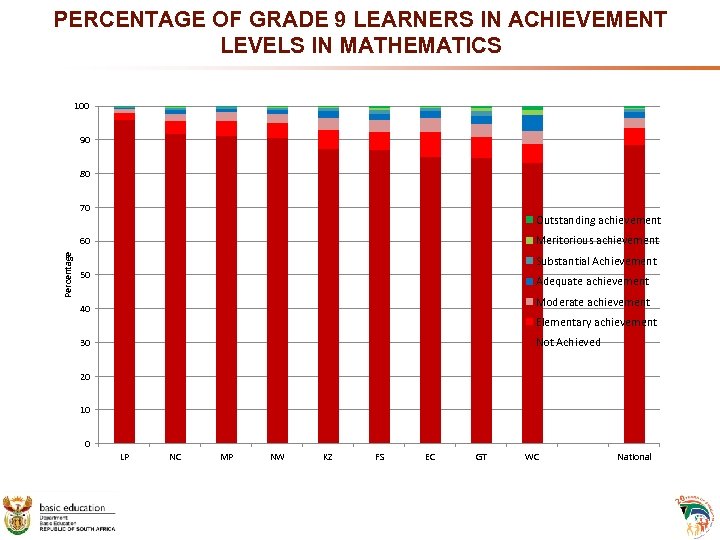 PERCENTAGE OF GRADE 9 LEARNERS IN ACHIEVEMENT LEVELS IN MATHEMATICS 100 90 80 70 Outstanding achievement Meritorious achievement Percentage 60 Substantial Achievement 50 Adequate achievement Moderate achievement 40 Elementary achievement Not Achieved 30 20 10 0 LP NC MP NW KZ FS EC GT WC National
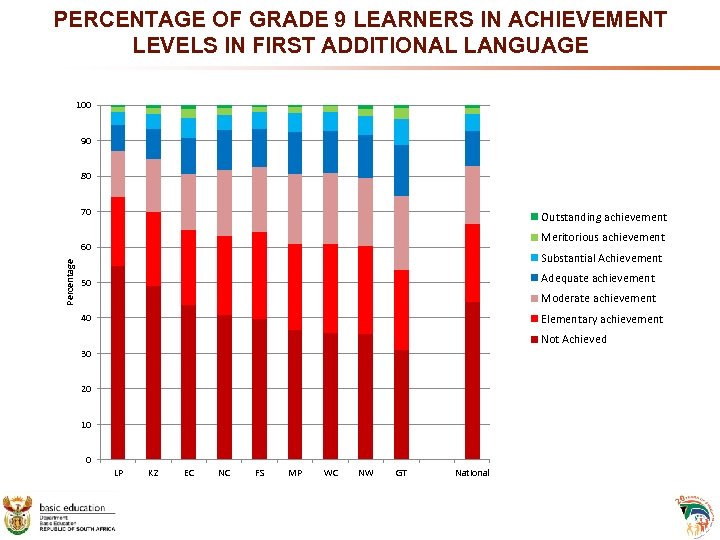 PERCENTAGE OF GRADE 9 LEARNERS IN ACHIEVEMENT LEVELS IN FIRST ADDITIONAL LANGUAGE 100 90 80 70 Outstanding achievement Meritorious achievement Percentage 60 Substantial Achievement Adequate achievement 50 Moderate achievement Elementary achievement 40 Not Achieved 30 20 10 0 LP KZ EC NC FS MP WC NW GT National
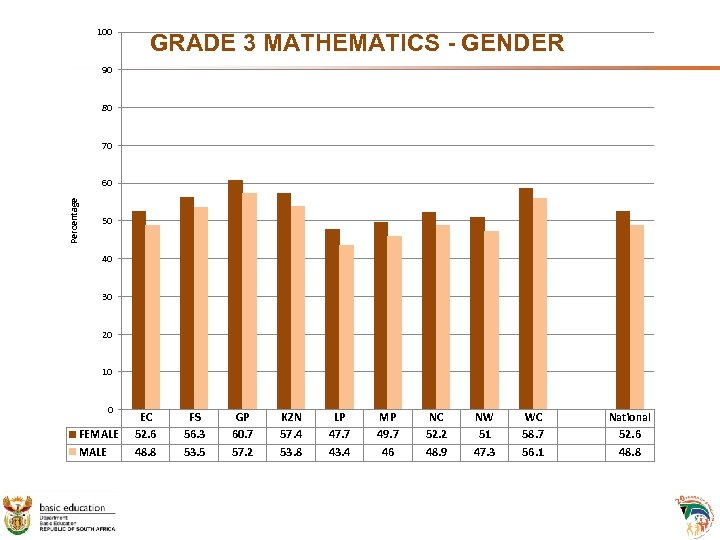 100 GRADE 3 MATHEMATICS - GENDER 90 80 70 Percentage 60 50 40 30 20 10 0 FEMALE EC 52. 6 48. 8 FS 56. 3 53. 5 GP 60. 7 57. 2 KZN 57. 4 53. 8 LP 47. 7 43. 4 MP 49. 7 46 NC 52. 2 48. 9 NW 51 47. 3 WC 58. 7 56. 1 National 52. 6 48. 8
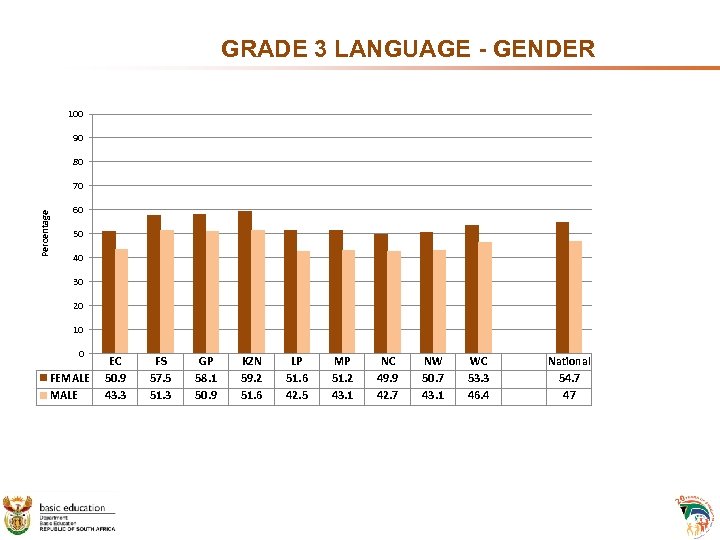 GRADE 3 LANGUAGE - GENDER 100 90 80 Percentage 70 60 50 40 30 20 10 0 FEMALE EC 50. 9 43. 3 FS 57. 5 51. 3 GP 58. 1 50. 9 KZN 59. 2 51. 6 LP 51. 6 42. 5 MP 51. 2 43. 1 NC 49. 9 42. 7 NW 50. 7 43. 1 WC 53. 3 46. 4 National 54. 7 47
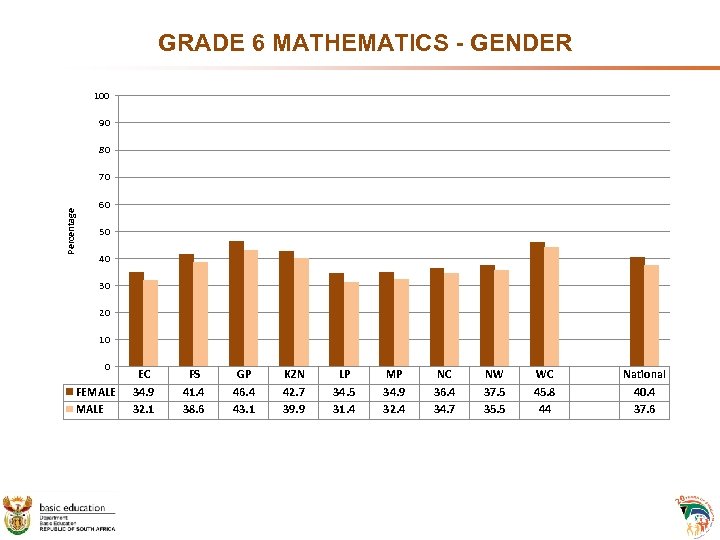 GRADE 6 MATHEMATICS - GENDER 100 90 80 Percentage 70 60 50 40 30 20 10 0 FEMALE EC 34. 9 32. 1 FS 41. 4 38. 6 GP 46. 4 43. 1 KZN 42. 7 39. 9 LP 34. 5 31. 4 MP 34. 9 32. 4 NC 36. 4 34. 7 NW 37. 5 35. 5 WC 45. 8 44 National 40. 4 37. 6
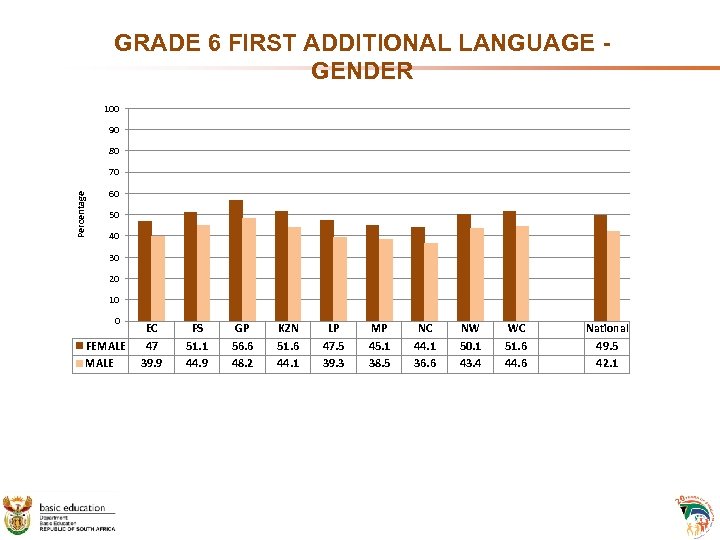 GRADE 6 FIRST ADDITIONAL LANGUAGE - GENDER 100 90 80 Percentage 70 60 50 40 30 20 10 0 FEMALE EC 47 39. 9 FS 51. 1 44. 9 GP 56. 6 48. 2 KZN 51. 6 44. 1 LP 47. 5 39. 3 MP 45. 1 38. 5 NC 44. 1 36. 6 NW 50. 1 43. 4 WC 51. 6 44. 6 National 49. 5 42. 1
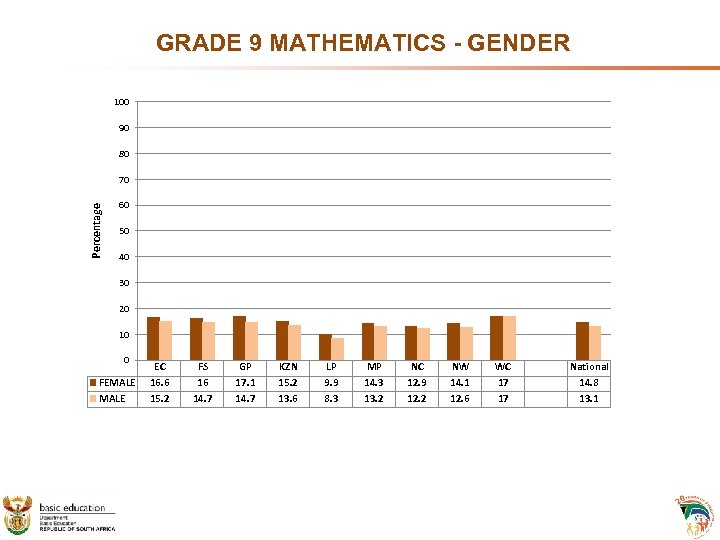 GRADE 9 MATHEMATICS - GENDER 100 90 80 Percentage 70 60 50 40 30 20 10 0 FEMALE EC 16. 6 15. 2 FS 16 14. 7 GP 17. 1 14. 7 KZN 15. 2 13. 6 LP 9. 9 8. 3 MP 14. 3 13. 2 NC 12. 9 12. 2 NW 14. 1 12. 6 WC 17 17 National 14. 8 13. 1
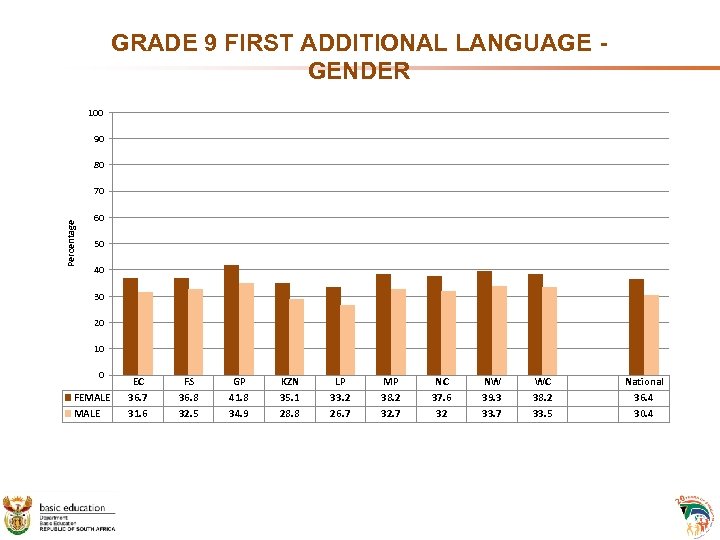 GRADE 9 FIRST ADDITIONAL LANGUAGE - GENDER 100 90 80 Percentage 70 60 50 40 30 20 10 0 FEMALE EC 36. 7 31. 6 FS 36. 8 32. 5 GP 41. 8 34. 9 KZN 35. 1 28. 8 LP 33. 2 26. 7 MP 38. 2 32. 7 NC 37. 6 32 NW 39. 3 33. 7 WC 38. 2 33. 5 National 36. 4 30. 4
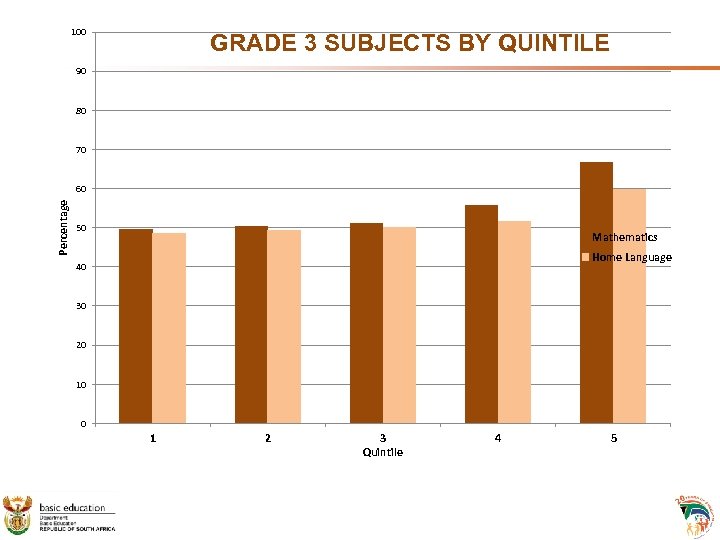 100 GRADE 3 SUBJECTS BY QUINTILE 90 80 70 Percentage 60 50 Mathematics Home Language 40 30 20 10 0 1 2 3 Quintile 4 5
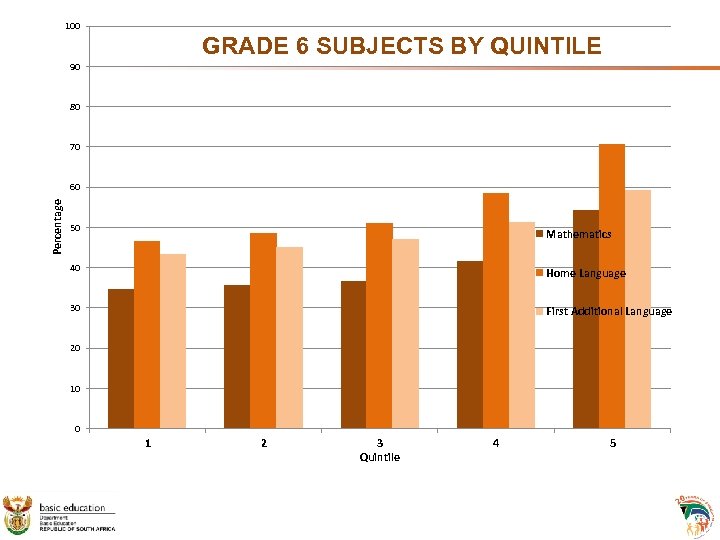 100 GRADE 6 SUBJECTS BY QUINTILE 90 80 70 Percentage 60 50 Mathematics 40 Home Language 30 First Additional Language 20 10 0 1 2 3 Quintile 4 5
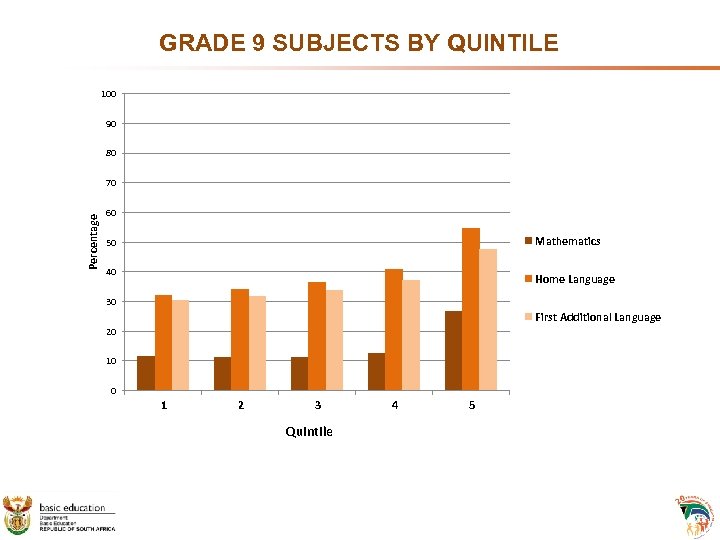 GRADE 9 SUBJECTS BY QUINTILE 100 90 80 Percentage 70 60 Mathematics 50 40 Home Language 30 First Additional Language 20 10 0 1 2 3 Quintile 4 5
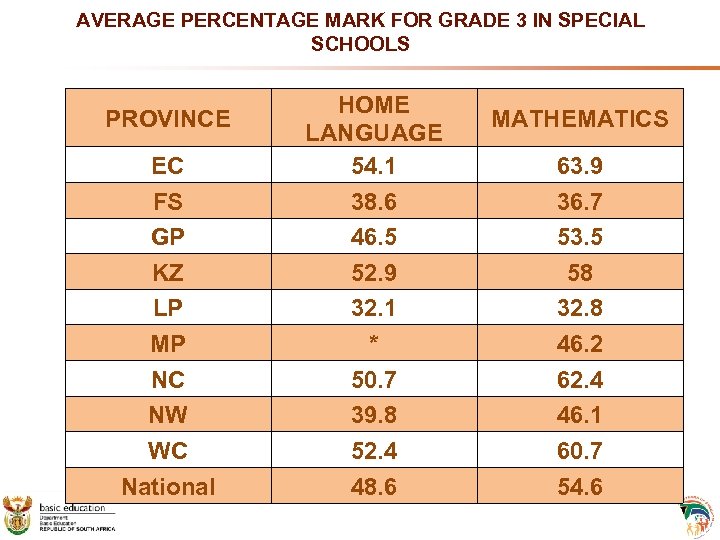 AVERAGE PERCENTAGE MARK FOR GRADE 3 IN SPECIAL SCHOOLS PROVINCE EC FS GP KZ LP MP NC NW WC National HOME LANGUAGE 54. 1 38. 6 46. 5 52. 9 32. 1 * 50. 7 39. 8 52. 4 48. 6 MATHEMATICS 63. 9 36. 7 53. 5 58 32. 8 46. 2 62. 4 46. 1 60. 7 54. 6
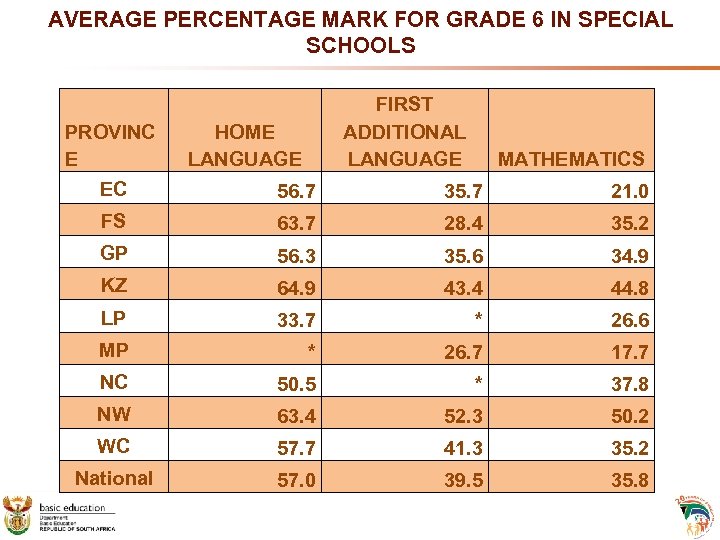 AVERAGE PERCENTAGE MARK FOR GRADE 6 IN SPECIAL SCHOOLS PROVINC E EC FIRST ADDITIONAL LANGUAGE HOME LANGUAGE MATHEMATICS 56. 7 35. 7 21. 0 FS 63. 7 28. 4 35. 2 GP 56. 3 35. 6 34. 9 KZ 64. 9 43. 4 44. 8 LP 33. 7 * 26. 6 MP * 26. 7 17. 7 NC 50. 5 * 37. 8 NW 63. 4 52. 3 50. 2 WC 57. 7 41. 3 35. 2 National 57. 0 39. 5 35. 8
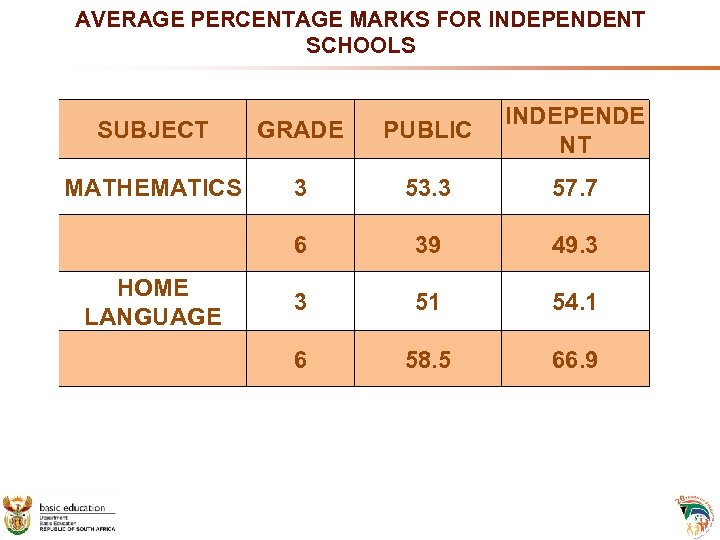 AVERAGE PERCENTAGE MARKS FOR INDEPENDENT SCHOOLS SUBJECT GRADE PUBLIC INDEPENDE NT MATHEMATICS 3 53. 3 57. 7 6 39 49. 3 HOME LANGUAGE 3 51 54. 1 6 58. 5 66. 9
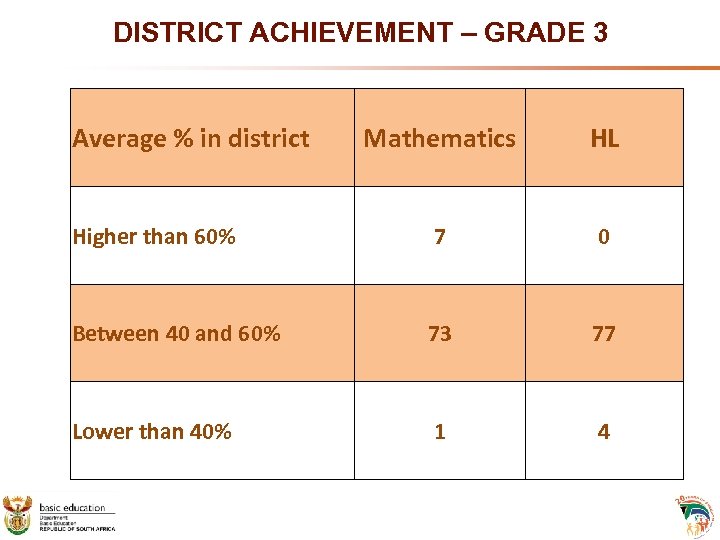 DISTRICT ACHIEVEMENT – GRADE 3 Average % in district Mathematics HL Higher than 60% 7 0 Between 40 and 60% 73 77 Lower than 40% 1 4
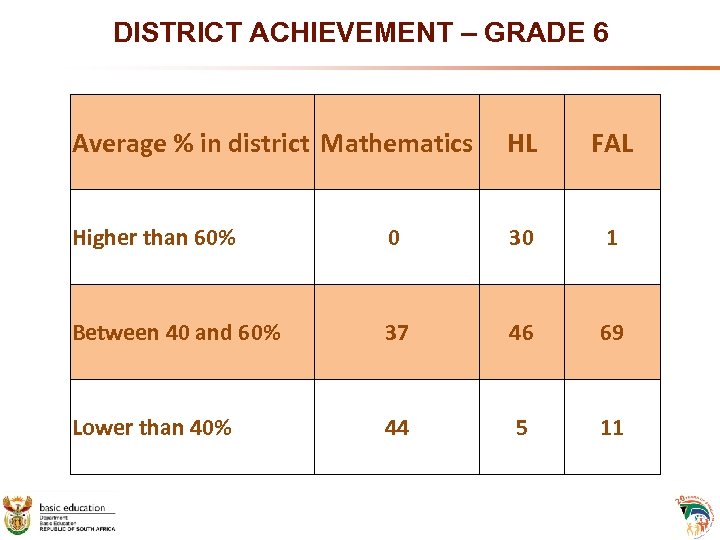 DISTRICT ACHIEVEMENT – GRADE 6 Average % in district Mathematics HL FAL Higher than 60% 0 30 1 Between 40 and 60% 37 46 69 Lower than 40% 44 5 11
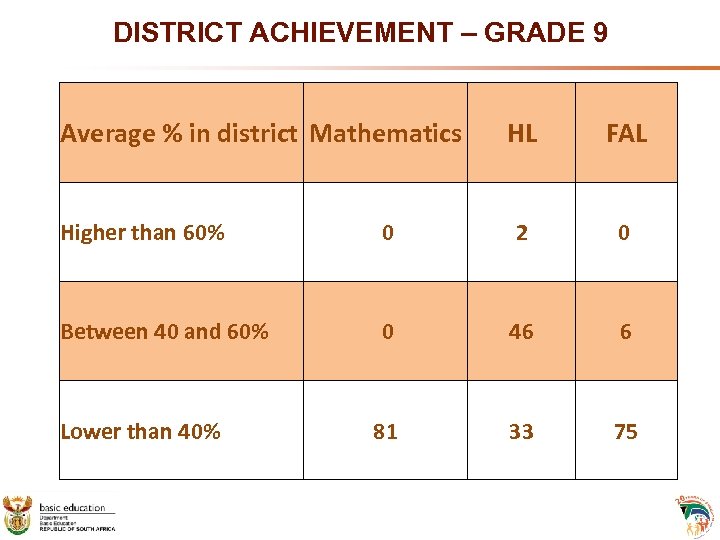 DISTRICT ACHIEVEMENT – GRADE 9 Average % in district Mathematics HL FAL Higher than 60% 0 2 0 Between 40 and 60% 0 46 6 Lower than 40% 81 33 75
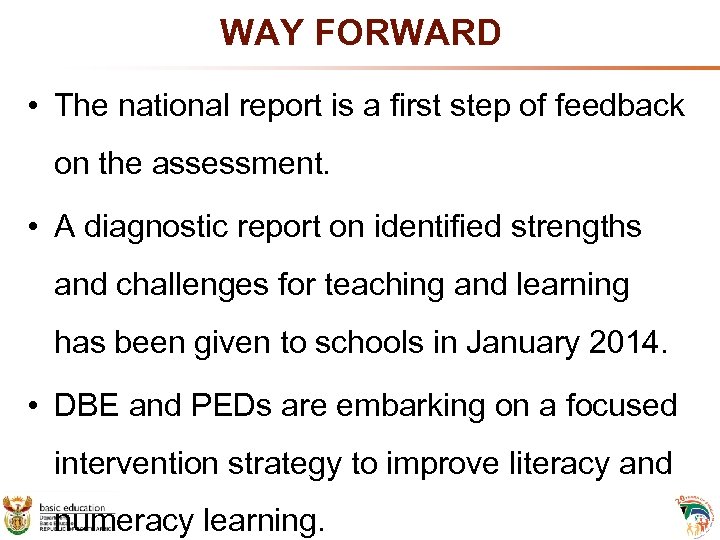 WAY FORWARD • The national report is a first step of feedback on the assessment. • A diagnostic report on identified strengths and challenges for teaching and learning has been given to schools in January 2014. • DBE and PEDs are embarking on a focused intervention strategy to improve literacy and numeracy learning.
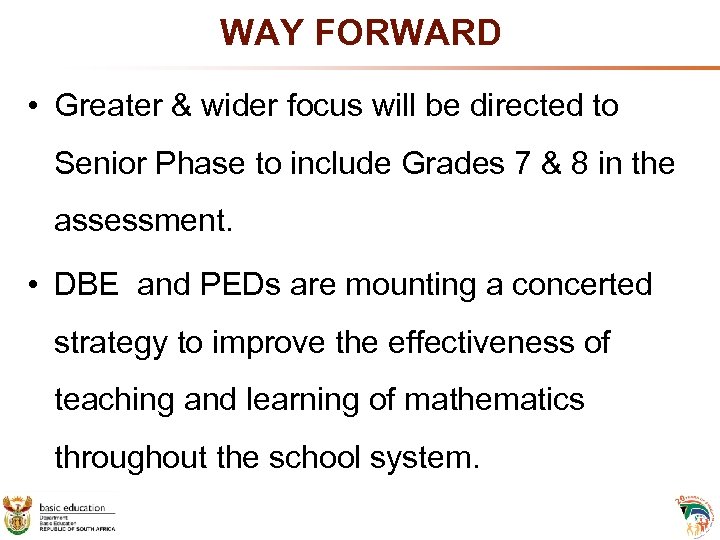 WAY FORWARD • Greater & wider focus will be directed to Senior Phase to include Grades 7 & 8 in the assessment. • DBE and PEDs are mounting a concerted strategy to improve the effectiveness of teaching and learning of mathematics throughout the school system.
 NSC 2013
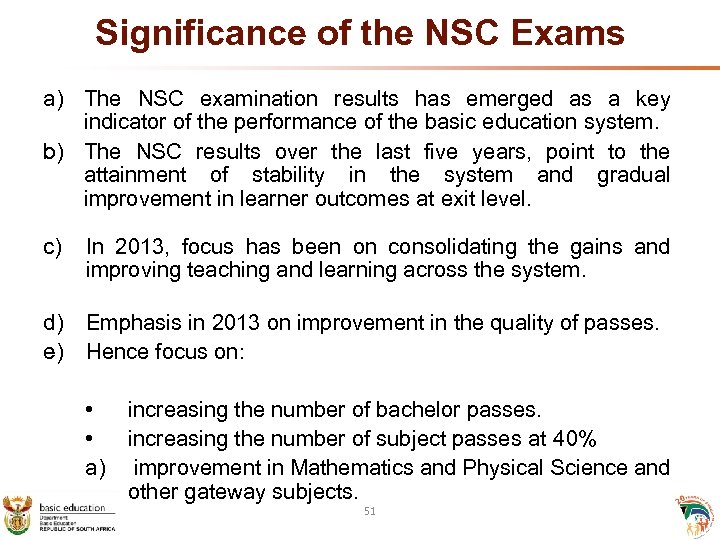 Significance of the NSC Exams a) The NSC examination results has emerged as a key indicator of the performance of the basic education system. b) The NSC results over the last five years, point to the attainment of stability in the system and gradual improvement in learner outcomes at exit level. c) In 2013, focus has been on consolidating the gains and improving teaching and learning across the system. d) Emphasis in 2013 on improvement in the quality of passes. e) Hence focus on: • • a) increasing the number of bachelor passes. increasing the number of subject passes at 40% improvement in Mathematics and Physical Science and other gateway subjects. 51
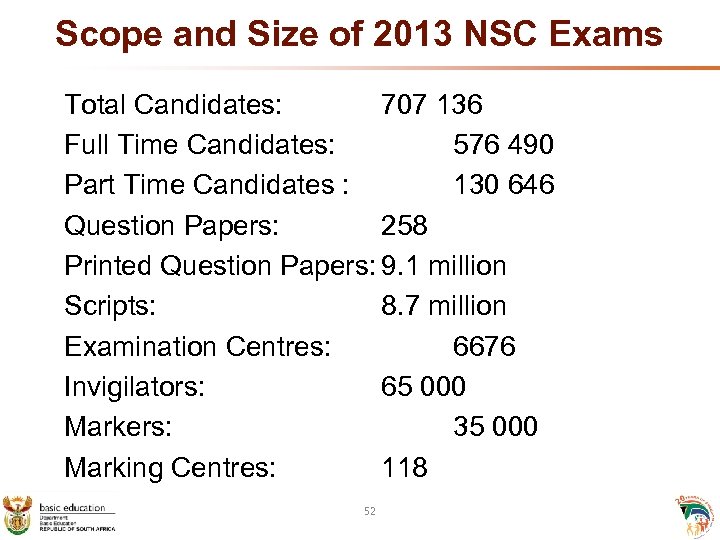 Scope and Size of 2013 NSC Exams Total Candidates: 707 136 Full Time Candidates: 576 490 Part Time Candidates : 130 646 Question Papers: 258 Printed Question Papers: 9. 1 million Scripts: 8. 7 million Examination Centres: 6676 Invigilators: 65 000 Markers: 35 000 Marking Centres: 118 52
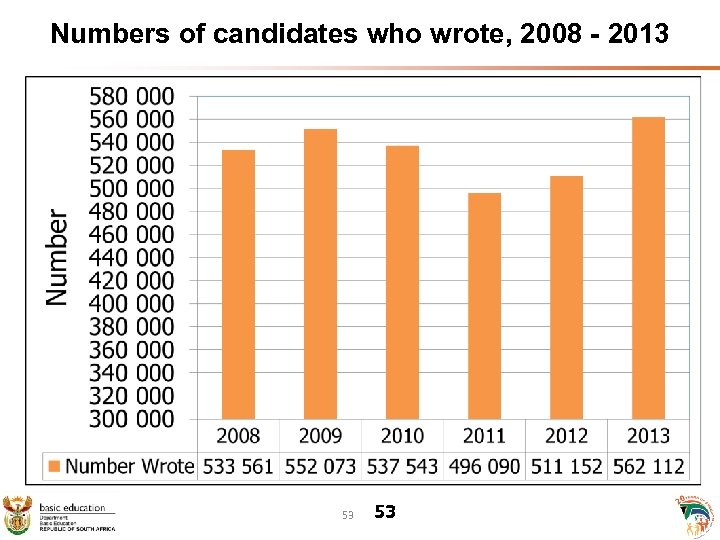 Numbers of candidates who wrote, 2008 - 2013 53 53
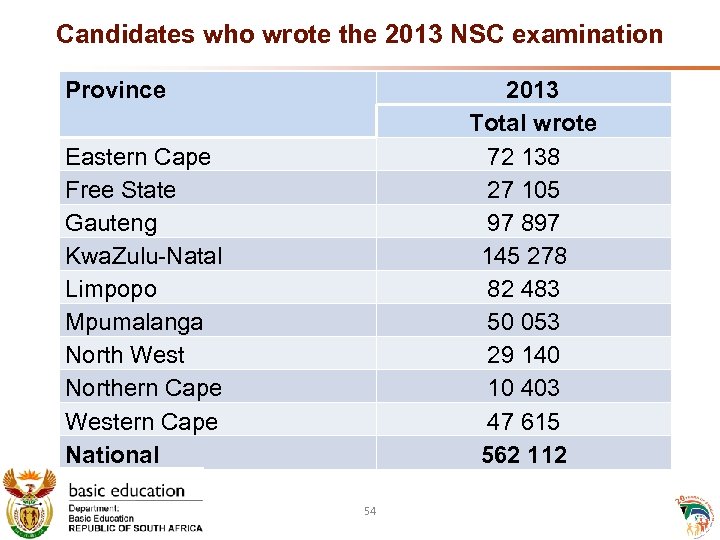 Candidates who wrote the 2013 NSC examination Province 2013 Total wrote 72 138 27 105 97 897 145 278 82 483 50 053 29 140 10 403 47 615 562 112 Eastern Cape Free State Gauteng Kwa. Zulu-Natal Limpopo Mpumalanga North West Northern Cape Western Cape National 54
 Overall Systemic Improvements 55
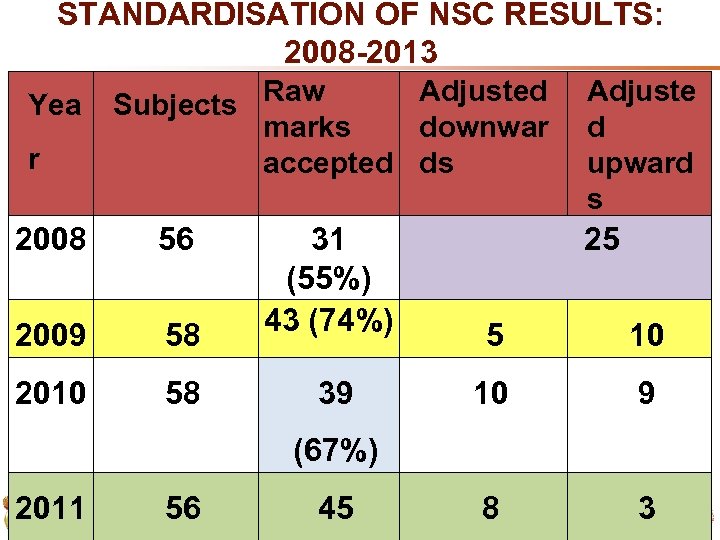 STANDARDISATION OF NSC RESULTS: 2008 -2013 Yea r Adjusted Subjects Raw marks downwar accepted ds 2008 56 2009 58 2010 58 Adjuste d upward s 31 25 (55%) 43 (74%) 5 10 39 10 9 8 3 (67%) 2011 56 45
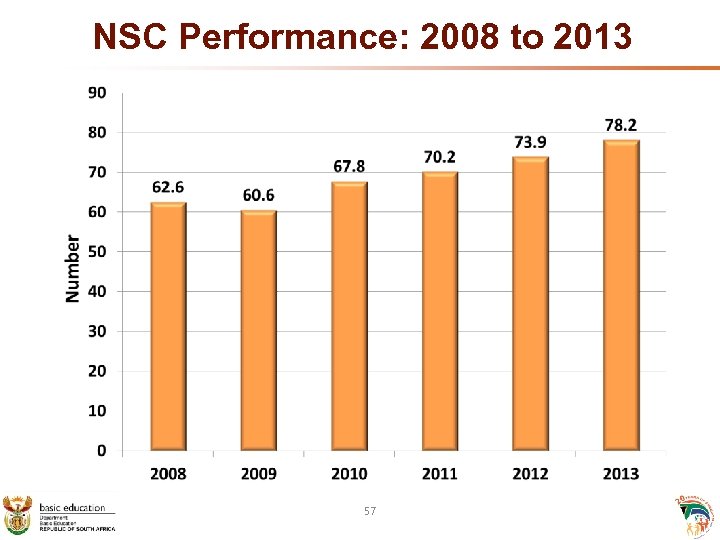 NSC Performance: 2008 to 2013 57
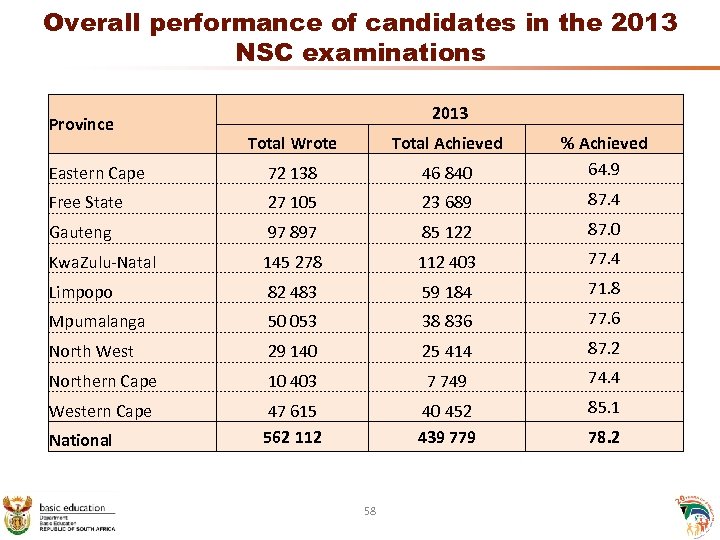 Overall performance of candidates in the 2013 NSC examinations Province 2013 Total Wrote Total Achieved Eastern Cape 72 138 46 840 % Achieved 64. 9 Free State 27 105 23 689 87. 4 Gauteng 97 85 122 87. 0 Kwa. Zulu-Natal 145 278 112 403 77. 4 Limpopo 82 483 59 184 71. 8 Mpumalanga 50 053 38 836 77. 6 North West 29 140 25 414 87. 2 Northern Cape 10 403 7 749 74. 4 Western Cape 47 615 562 112 40 452 439 779 85. 1 National 58 78. 2
 Quality Improvements 59
 NSC Passes by Qualification Type 60
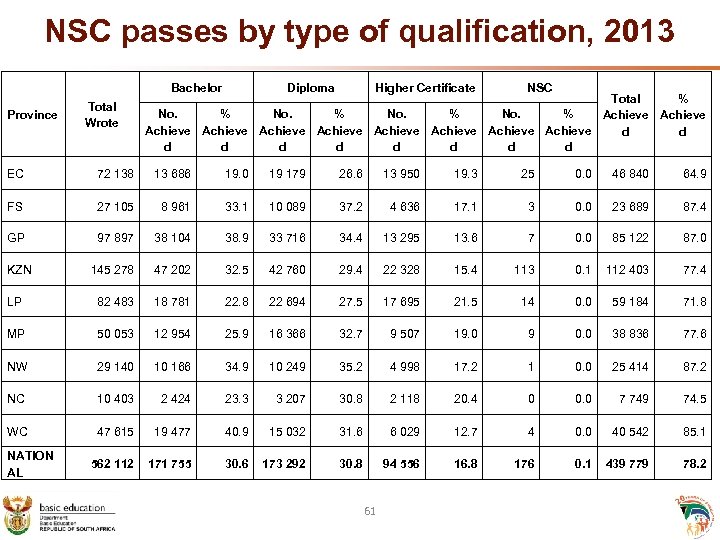 NSC passes by type of qualification, 2013 Bachelor Province Total Wrote Diploma Higher Certificate NSC Total % No. % Achieve Achieve Achieve d d d d d EC 72 138 13 686 19. 0 19 179 26. 6 13 950 19. 3 25 0. 0 46 840 64. 9 FS 27 105 8 961 33. 1 10 089 37. 2 4 636 17. 1 3 0. 0 23 689 87. 4 GP 97 897 38 104 38. 9 33 716 34. 4 13 295 13. 6 7 0. 0 85 122 87. 0 KZN 145 278 47 202 32. 5 42 760 29. 4 22 328 15. 4 113 0. 1 112 403 77. 4 LP 82 483 18 781 22. 8 22 694 27. 5 17 695 21. 5 14 0. 0 59 184 71. 8 MP 50 053 12 954 25. 9 16 366 32. 7 9 507 19. 0 9 0. 0 38 836 77. 6 NW 29 140 10 166 34. 9 10 249 35. 2 4 998 17. 2 1 0. 0 25 414 87. 2 NC 10 403 2 424 23. 3 3 207 30. 8 2 118 20. 4 0 0. 0 7 749 74. 5 WC 47 615 19 477 40. 9 15 032 31. 6 6 029 12. 7 4 0. 0 40 542 85. 1 562 112 171 755 30. 6 173 292 30. 8 94 556 16. 8 176 0. 1 439 779 78. 2 NATION AL 61
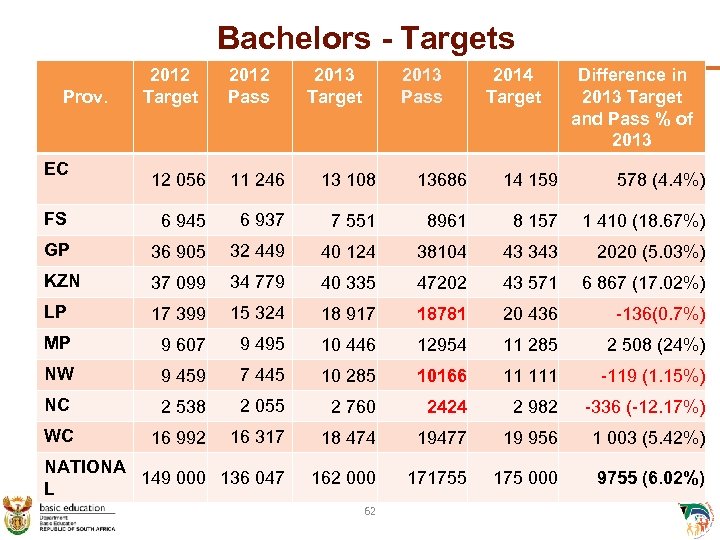 Bachelors - Targets Prov. EC 2012 Target 2012 Pass 2013 Target 2013 Pass 2014 Target Difference in 2013 Target and Pass % of 2013 12 056 11 246 13 108 13686 14 159 578 (4. 4%) FS 6 945 6 937 7 551 8961 8 157 1 410 (18. 67%) GP 36 905 32 449 40 124 38104 43 343 2020 (5. 03%) KZN 37 099 34 779 40 335 47202 43 571 6 867 (17. 02%) LP 17 399 15 324 18 917 18781 20 436 MP 9 607 9 495 10 446 12954 11 285 2 508 (24%) NW 9 459 7 445 10 285 10166 11 111 -119 (1. 15%) NC 2 538 2 055 2 760 2424 2 982 -336 (-12. 17%) WC 16 992 16 317 18 474 19477 19 956 1 003 (5. 42%) NATIONA 149 000 136 047 L 162 000 171755 175 000 9755 (6. 02%) 62 -136(0. 7%)
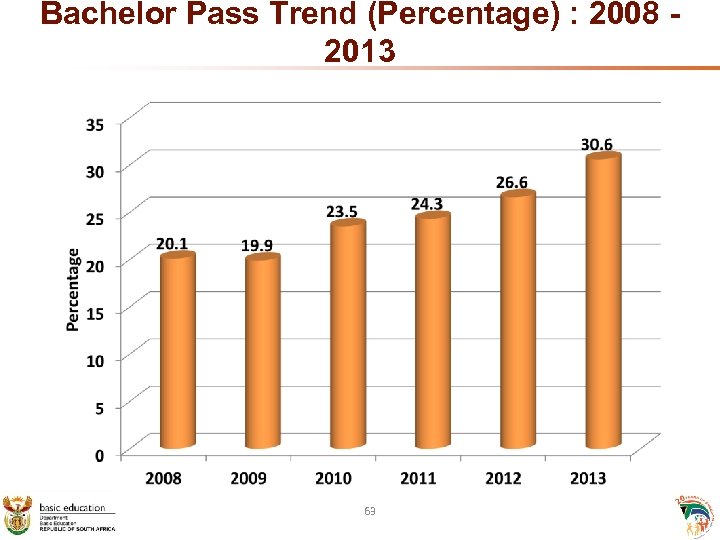 Bachelor Pass Trend (Percentage) : 2008 2013 63
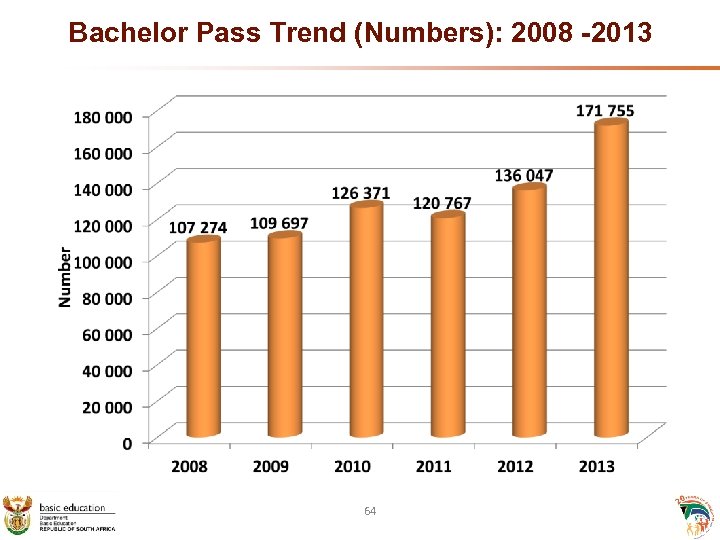 Bachelor Pass Trend (Numbers): 2008 -2013 64
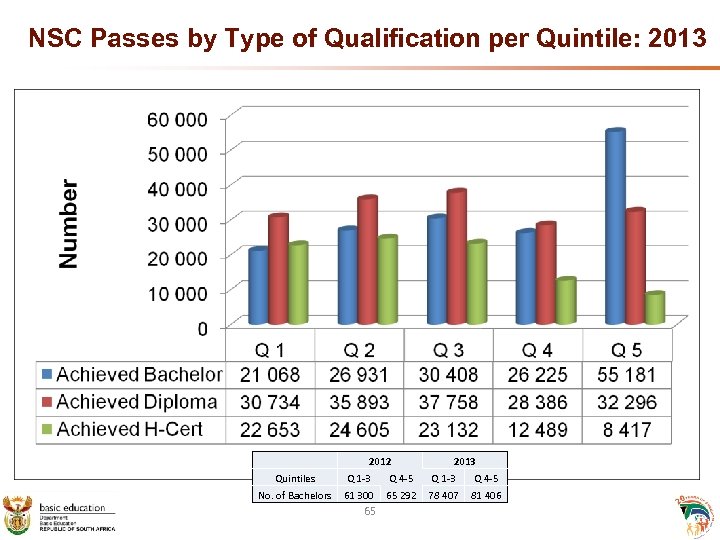 NSC Passes by Type of Qualification per Quintile: 2013 2012 2013 Quintiles Q 1 -3 Q 4 -5 No. of Bachelors 61 300 65 292 78 407 81 406 65
 School Performance within different Percentage Categories 66
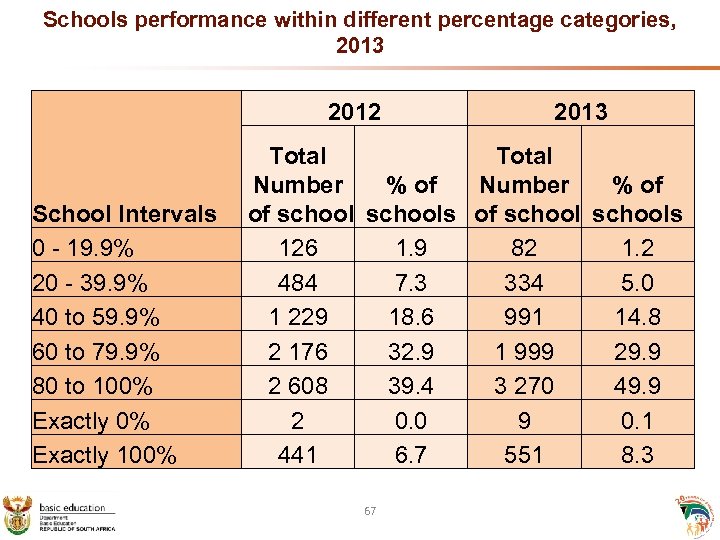 Schools performance within different percentage categories, 2013 2012 2013 Total % of Number School Intervals of schools 0 - 19. 9% 126 1. 9 82 1. 2 20 - 39. 9% 484 7. 3 334 5. 0 40 to 59. 9% 1 229 18. 6 991 14. 8 60 to 79. 9% 2 176 32. 9 1 999 29. 9 80 to 100% 2 608 39. 4 3 270 49. 9 Exactly 0% 2 0. 0 9 0. 1 Exactly 100% 441 6. 7 551 8. 3 67
 School Performance by Quintiles 68
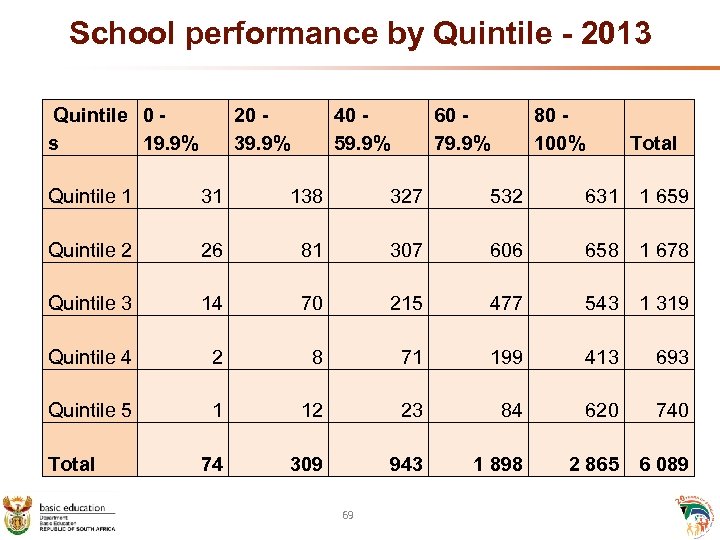 School performance by Quintile - 2013 Quintile 0 - s 19. 9% 20 - 39. 9% 40 - 59. 9% 60 - 79. 9% 80 - 100% Total Quintile 1 31 138 327 532 631 1 659 Quintile 2 26 81 307 606 658 1 678 Quintile 3 14 70 215 477 543 1 319 Quintile 4 2 8 71 199 413 693 Quintile 5 1 12 23 84 620 74 309 943 1 898 2 865 6 089 Total 69
 Subject Performance 70
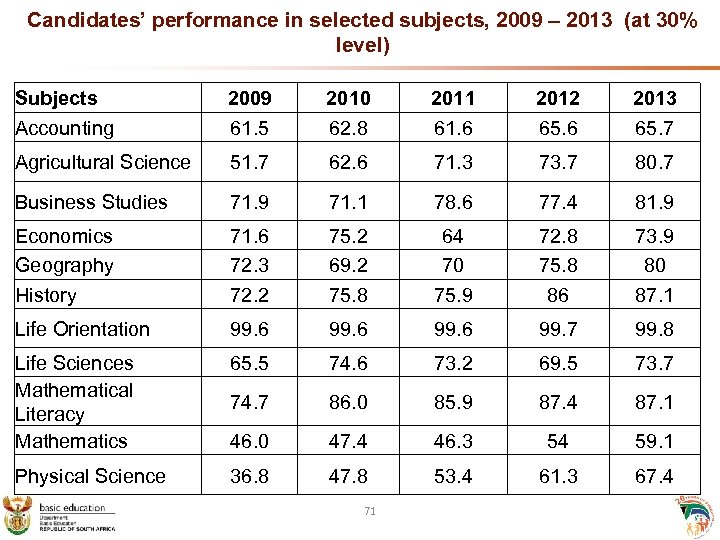 Candidates’ performance in selected subjects, 2009 – 2013 (at 30% level) Subjects Accounting 2009 61. 5 2010 62. 8 2011 61. 6 2012 65. 6 2013 65. 7 Agricultural Science 51. 7 62. 6 71. 3 73. 7 80. 7 Business Studies 71. 9 71. 1 78. 6 77. 4 81. 9 Economics Geography History 71. 6 72. 3 72. 2 75. 2 69. 2 75. 8 64 70 75. 9 72. 8 75. 8 86 73. 9 80 87. 1 Life Orientation 99. 6 99. 7 99. 8 Life Sciences Mathematical Literacy Mathematics 65. 5 74. 6 73. 2 69. 5 73. 7 74. 7 86. 0 85. 9 87. 4 87. 1 46. 0 47. 4 46. 3 54 59. 1 Physical Science 36. 8 47. 8 53. 4 61. 3 67. 4 71
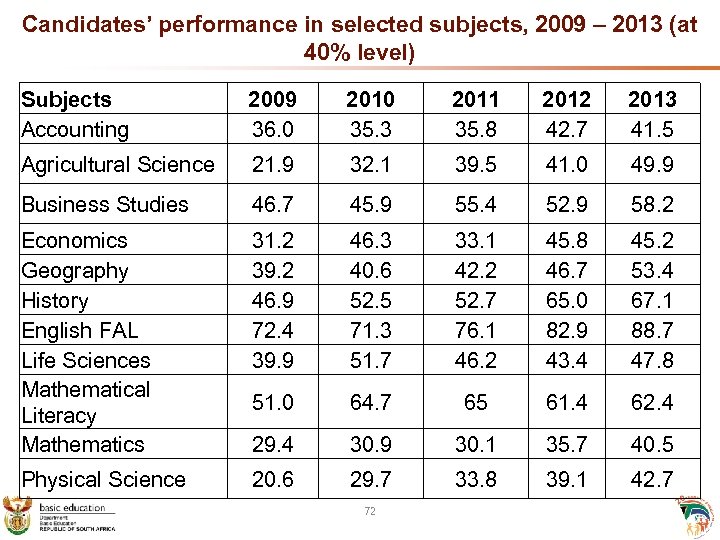 Candidates’ performance in selected subjects, 2009 – 2013 (at 40% level) Subjects Accounting 2009 36. 0 2010 35. 3 2011 35. 8 2012 42. 7 2013 41. 5 Agricultural Science 21. 9 32. 1 39. 5 41. 0 49. 9 Business Studies 46. 7 45. 9 55. 4 52. 9 58. 2 Economics Geography History English FAL Life Sciences Mathematical Literacy Mathematics 31. 2 39. 2 46. 9 72. 4 39. 9 46. 3 40. 6 52. 5 71. 3 51. 7 33. 1 42. 2 52. 7 76. 1 46. 2 45. 8 46. 7 65. 0 82. 9 43. 4 45. 2 53. 4 67. 1 88. 7 47. 8 51. 0 64. 7 65 61. 4 62. 4 29. 4 30. 9 30. 1 35. 7 40. 5 Physical Science 20. 6 29. 7 33. 8 39. 1 42. 7 72
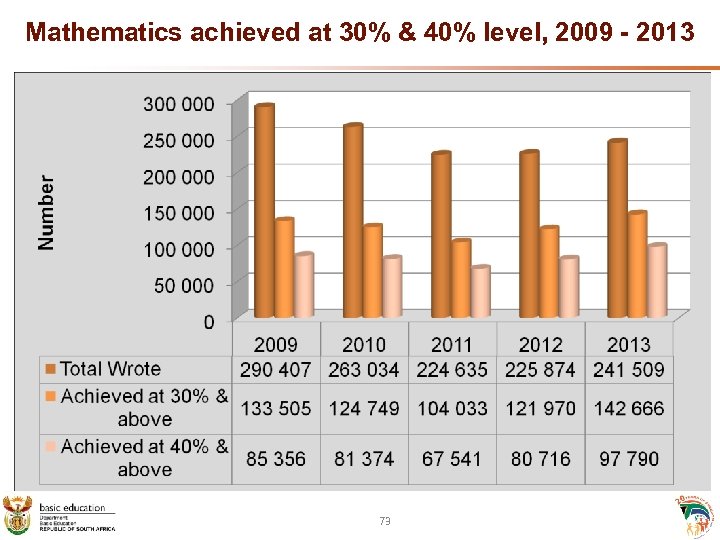 Mathematics achieved at 30% & 40% level, 2009 - 2013 73
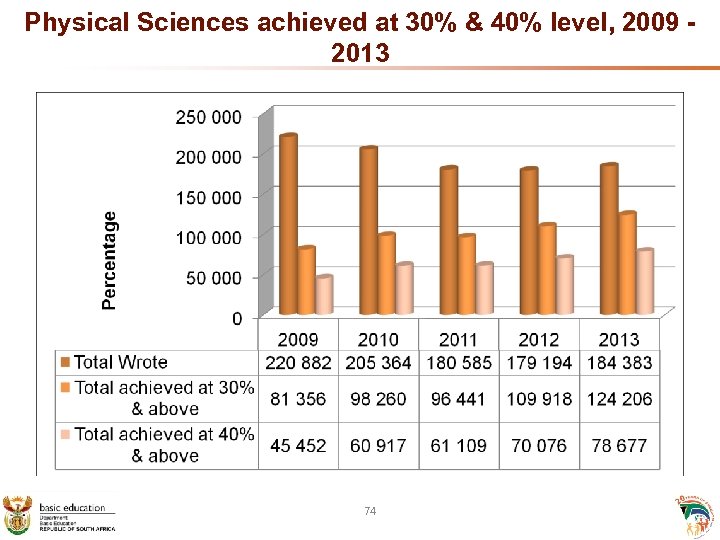 Physical Sciences achieved at 30% & 40% level, 2009 - 2013 74
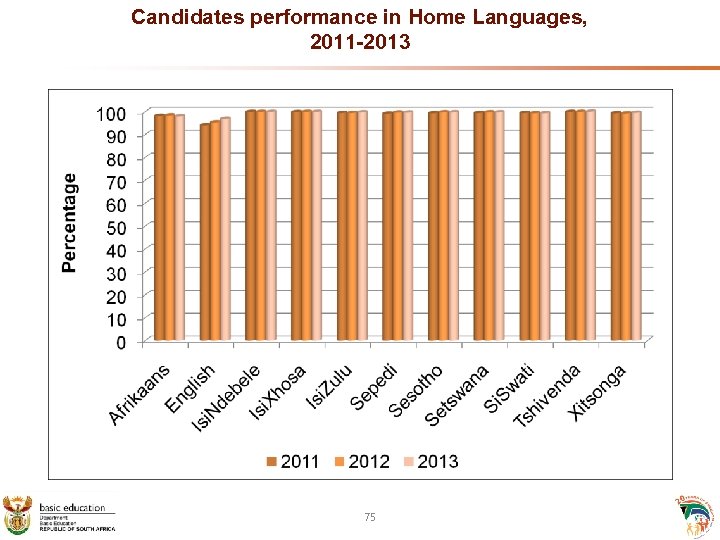 Candidates performance in Home Languages, 2011 -2013 75
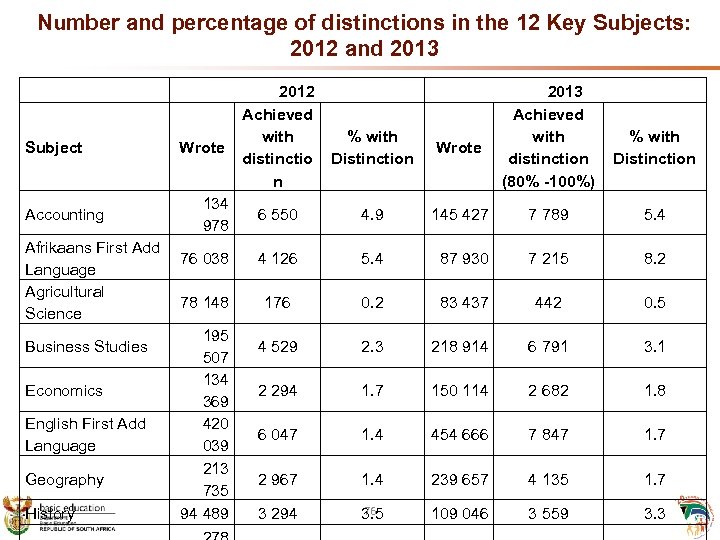 Number and percentage of distinctions in the 12 Key Subjects: 2012 and 2013 Subject Accounting Wrote 134 978 Afrikaans First Add 76 038 Language Agricultural 78 148 Science 195 Business Studies 507 134 Economics 369 English First Add 420 Language 039 213 Geography 735 History 94 489 2012 Achieved with % with distinctio Distinction n Wrote 2013 Achieved with distinction (80% -100%) % with Distinction 6 550 4. 9 145 427 7 789 5. 4 4 126 5. 4 87 930 7 215 8. 2 176 0. 2 83 437 442 0. 5 4 529 2. 3 218 914 6 791 3. 1 2 294 1. 7 150 114 2 682 1. 8 6 047 1. 4 454 666 7 847 1. 7 2 967 1. 4 239 657 4 135 1. 7 3 294 76 3. 5 109 046 3 559 3. 3
 District Performance 77
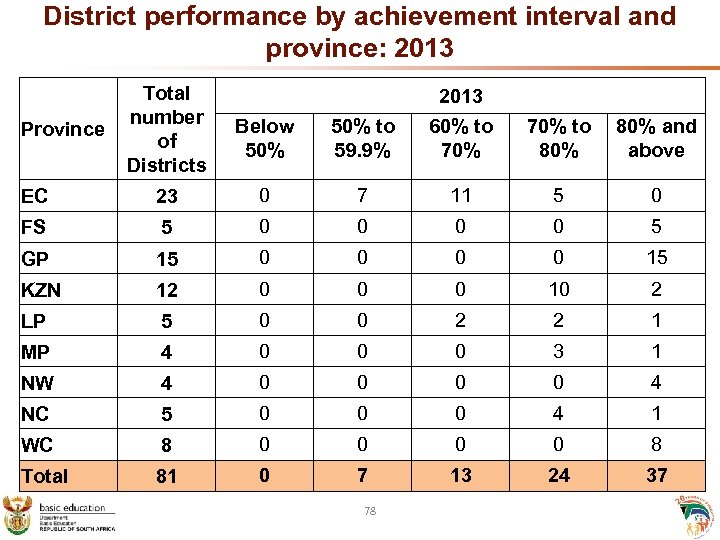 District performance by achievement interval and province: 2013 Total number Province of Districts 2013 Below 50% to 59. 9% 60% to 70% to 80% and 80% above EC 23 0 7 11 5 0 FS 5 0 0 5 GP 15 0 0 15 KZN 12 0 0 0 10 2 LP 5 0 0 2 2 1 MP 4 0 0 0 3 1 NW 4 0 0 4 NC 5 0 0 0 4 1 WC 8 0 0 8 Total 81 0 7 13 24 37 78
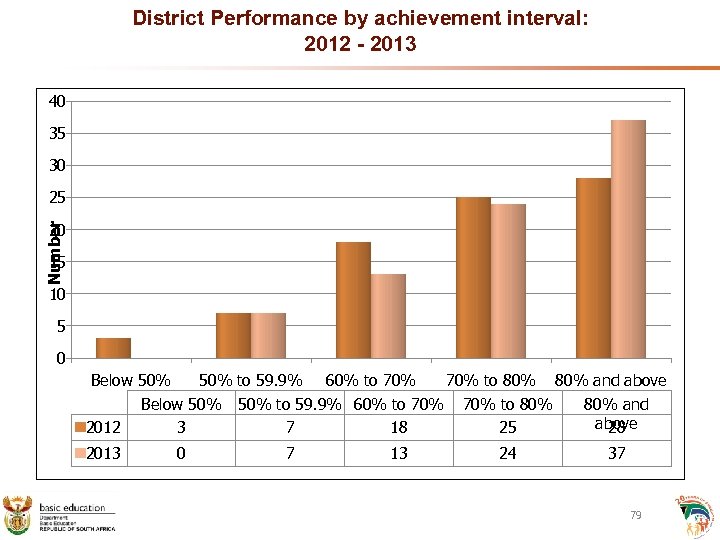 District Performance by achievement interval: 2012 - 2013 40 35 30 25 Number 20 15 10 5 0 Below 50% 50% to 59. 9% 60% to 70% 70% to 80% 80% and above 2012 3 7 18 25 28 2013 0 7 13 24 37 79
 Diagnostic subject Analysis
 Generic Improvements • Improvement in the quality of answers provided, which confirms that improvement strategies are making a difference. • Gradual consistent improvement in the pass rate in each of the subjects analysed both at the 30% and 40% achievement levels. • Fewer candidates scoring between 0 -29% in most of the subjects. • Improved performance in a number of gateway subjects which suggests interventions in these subjects are bearing fruit
 Generic Shortcomings • Inadequate linguistic skills which are required to interpret questions and write proper paragraphs. • Inadequate numerical/mathematical skills resulting in poor performance in questions that required Mathematical skills. • Failure to interpret questions accurately,
 Mathematics Website: www. education. gov. za Call Centre: 0800 202 933 | callcentre@dbe. gov. za Twitter: @DBE_SA | Facebook: DBE SA
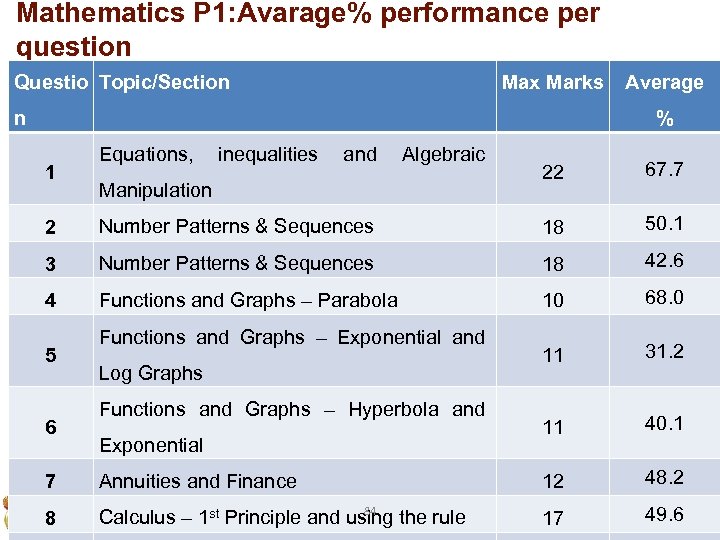 Mathematics P 1: Avarage% performance per question Questio Topic/Section Max Marks n Average % 1 Equations, inequalities and Algebraic Manipulation 22 67. 7 2 Number Patterns & Sequences 18 50. 1 3 Number Patterns & Sequences 18 42. 6 4 Functions and Graphs – Parabola 10 68. 0 11 31. 2 11 40. 1 5 6 Functions and Graphs – Exponential and Log Graphs Functions and Graphs – Hyperbola and Exponential 7 Annuities and Finance 12 48. 2 8 84 Calculus – 1 st Principle and using the rule 17 49. 6
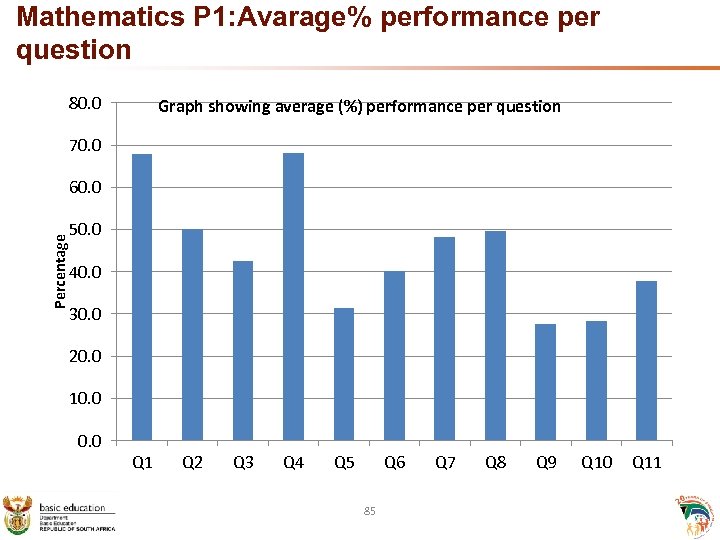 Mathematics P 1: Avarage% performance per question 80. 0 Graph showing average (%) performance per question 70. 0 Percentage 60. 0 50. 0 40. 0 30. 0 20. 0 10. 0 Q 1 Q 2 Q 3 Q 4 Q 5 Q 6 85 Q 7 Q 8 Q 9 Q 10 Q 11
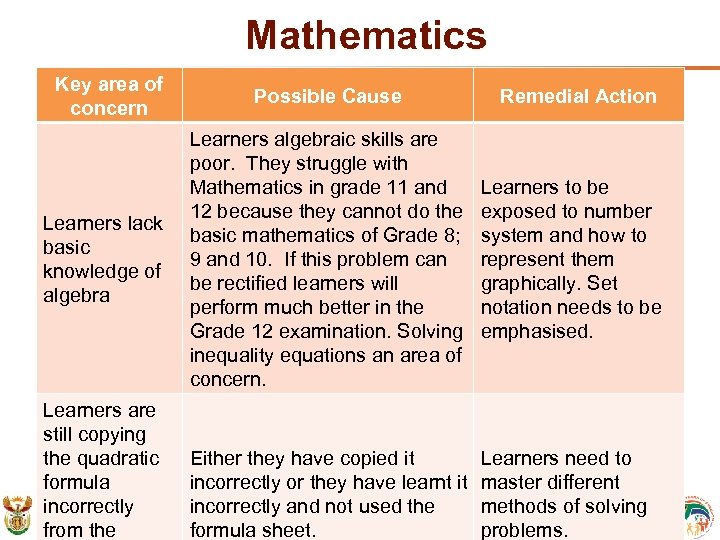 Mathematics Key area of concern Learners lack basic knowledge of algebra Learners are still copying the quadratic formula incorrectly from the Possible Cause Remedial Action Learners algebraic skills are poor. They struggle with Mathematics in grade 11 and 12 because they cannot do the basic mathematics of Grade 8; 9 and 10. If this problem can be rectified learners will perform much better in the Grade 12 examination. Solving inequality equations an area of concern. Learners to be exposed to number system and how to represent them graphically. Set notation needs to be emphasised. Either they have copied it incorrectly or they have learnt it incorrectly and not used the formula sheet. Learners need to master different methods of solving problems.
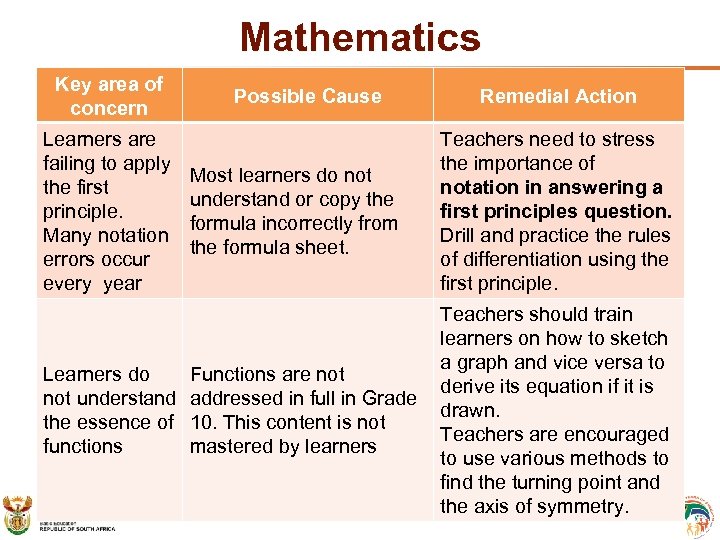 Mathematics Key area of concern Learners are failing to apply the first principle. Many notation errors occur every year Possible Cause Most learners do not understand or copy the formula incorrectly from the formula sheet. Remedial Action Teachers need to stress the importance of notation in answering a first principles question. Drill and practice the rules of differentiation using the first principle. Teachers should train learners on how to sketch a graph and vice versa to Learners do Functions are not derive its equation if it is not understand addressed in full in Grade drawn. the essence of 10. This content is not Teachers are encouraged functions mastered by learners to use various methods to find the turning point and the axis of symmetry.
 Physical Sciences
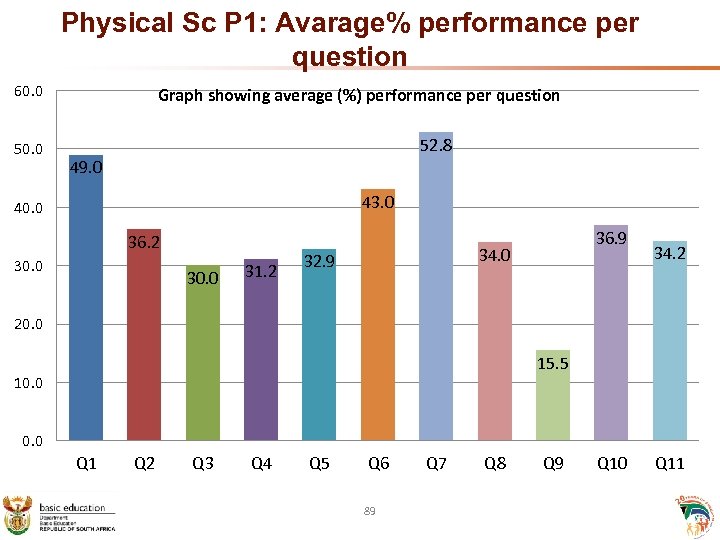 Physical Sc P 1: Avarage% performance per question 60. 0 50. 0 Graph showing average (%) performance per question 52. 8 49. 0 43. 0 40. 0 36. 2 30. 0 31. 2 36. 9 34. 0 32. 9 34. 2 20. 0 15. 5 10. 0 Q 1 Q 2 Q 3 Q 4 Q 5 Q 6 89 Q 7 Q 8 Q 9 Q 10 Q 11
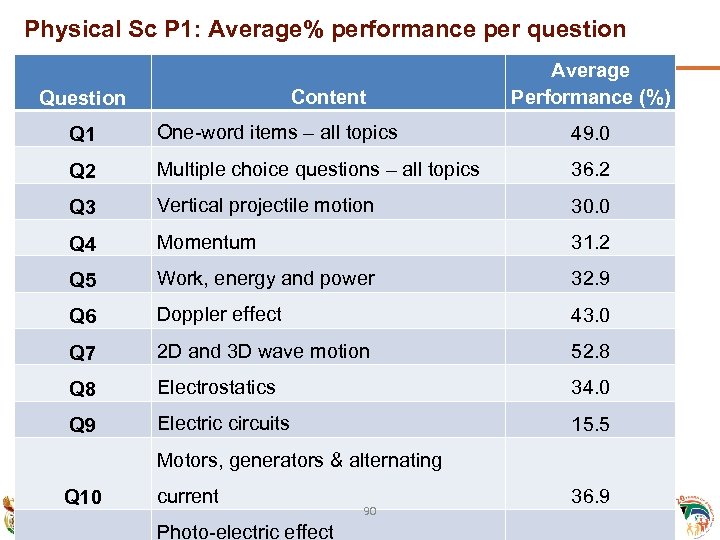 Physical Sc P 1: Average% performance per question Content Question Average Performance (%) Q 1 One-word items – all topics 49. 0 Q 2 Multiple choice questions – all topics 36. 2 Q 3 Vertical projectile motion 30. 0 Q 4 Momentum 31. 2 Q 5 Work, energy and power 32. 9 Q 6 Doppler effect 43. 0 Q 7 2 D and 3 D wave motion 52. 8 Q 8 Electrostatics 34. 0 Q 9 Electric circuits 15. 5 Motors, generators & alternating Q 10 current Photo-electric effect 90 36. 9
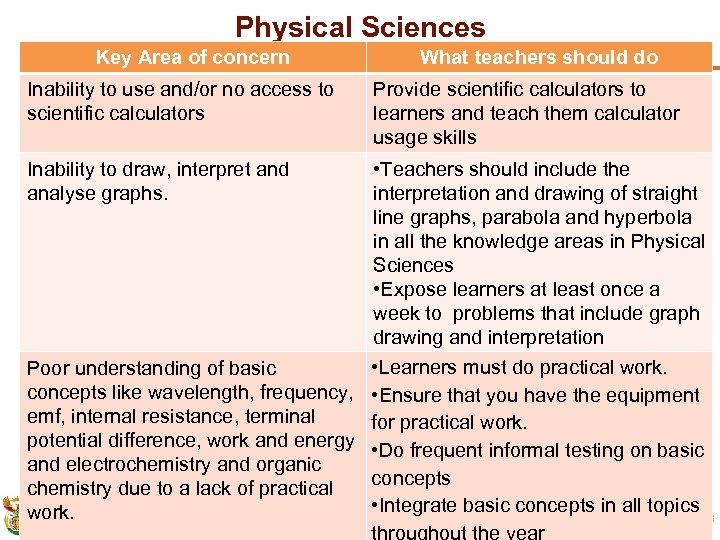 Physical Sciences Key Area of concern Inability to use and/or no access to scientific calculators What teachers should do Provide scientific calculators to learners and teach them calculator usage skills • Teachers should include the interpretation and drawing of straight line graphs, parabola and hyperbola in all the knowledge areas in Physical Sciences • Expose learners at least once a week to problems that include graph drawing and interpretation • Learners must do practical work. Poor understanding of basic concepts like wavelength, frequency, • Ensure that you have the equipment emf, internal resistance, terminal for practical work. potential difference, work and energy • Do frequent informal testing on basic and electrochemistry and organic concepts chemistry due to a lack of practical • Integrate basic concepts in all topics work. throughout the year Inability to draw, interpret and analyse graphs.
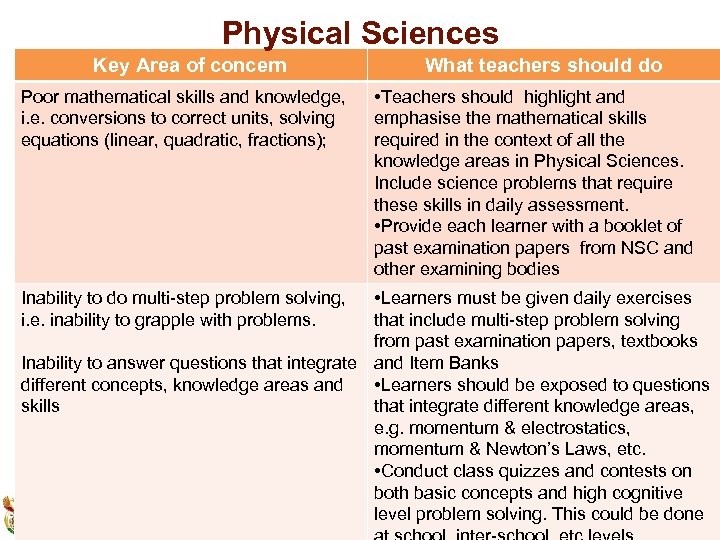 Physical Sciences Key Area of concern Poor mathematical skills and knowledge, i. e. conversions to correct units, solving equations (linear, quadratic, fractions); What teachers should do • Teachers should highlight and emphasise the mathematical skills required in the context of all the knowledge areas in Physical Sciences. Include science problems that require these skills in daily assessment. • Provide each learner with a booklet of past examination papers from NSC and other examining bodies • Learners must be given daily exercises that include multi-step problem solving from past examination papers, textbooks Inability to answer questions that integrate and Item Banks different concepts, knowledge areas and • Learners should be exposed to questions skills that integrate different knowledge areas, e. g. momentum & electrostatics, momentum & Newton’s Laws, etc. • Conduct class quizzes and contests on both basic concepts and high cognitive level problem solving. This could be done Inability to do multi-step problem solving, i. e. inability to grapple with problems.
 WHAT PROGRESS HAS BEEN MADE IN THE SECTOR?
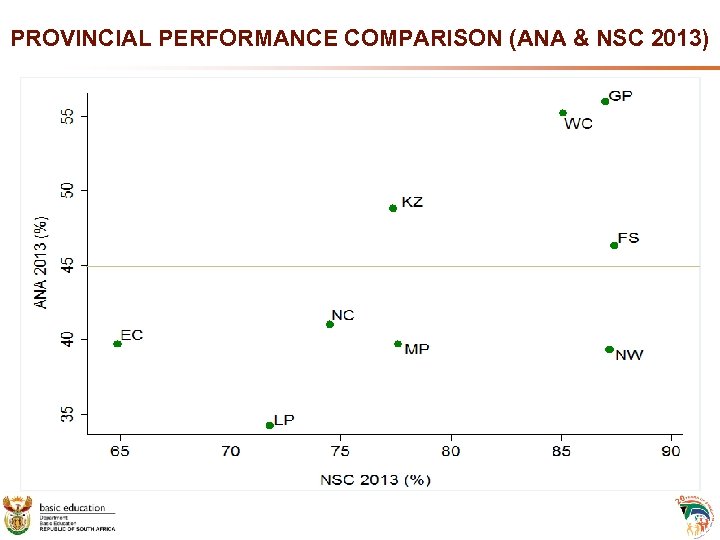 PROVINCIAL PERFORMANCE COMPARISON (ANA & NSC 2013)
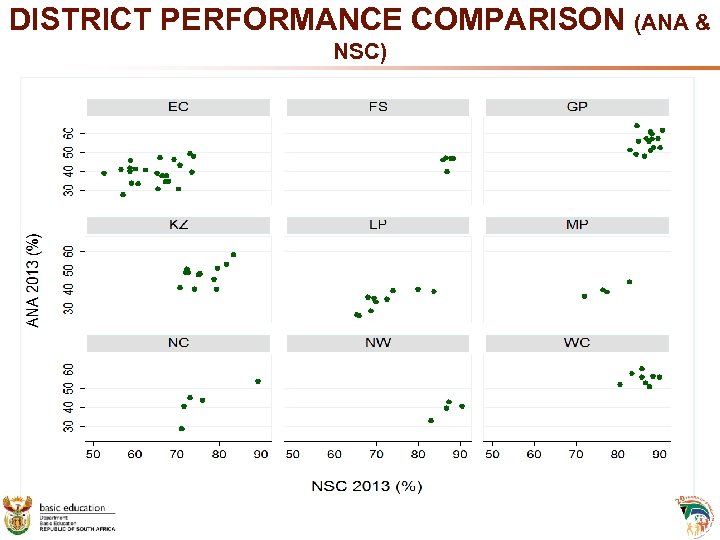 DISTRICT PERFORMANCE COMPARISON (ANA & NSC)
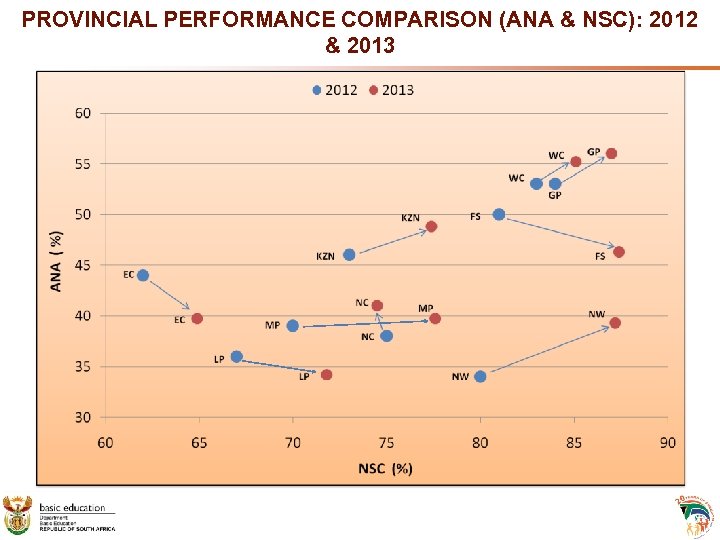 PROVINCIAL PERFORMANCE COMPARISON (ANA & NSC): 2012 & 2013
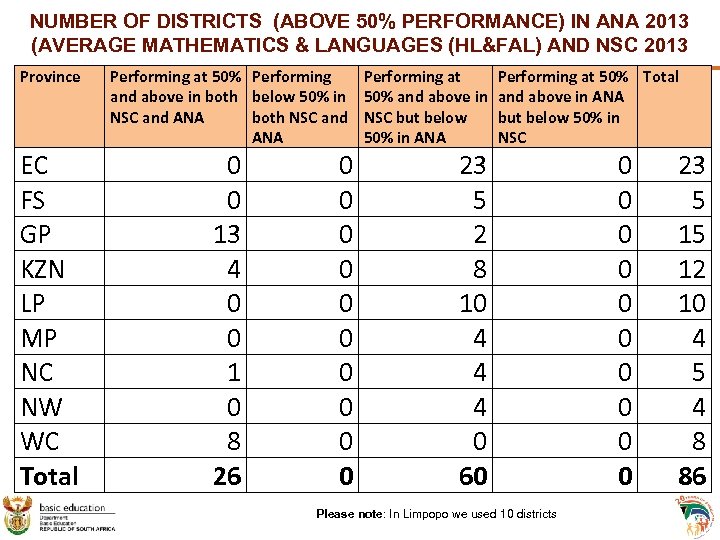 NUMBER OF DISTRICTS (ABOVE 50% PERFORMANCE) IN ANA 2013 (AVERAGE MATHEMATICS & LANGUAGES (HL&FAL) AND NSC 2013 Province EC FS GP KZN LP MP NC NW WC Total Performing at 50% Performing and above in both below 50% in NSC and ANA both NSC and ANA 0 0 13 4 0 0 1 0 8 26 0 0 0 0 0 Performing at 50% and above in NSC but below 50% in ANA 23 5 2 8 10 4 4 4 0 60 Performing at 50% Total and above in ANA but below 50% in NSC Please note: In Limpopo we used 10 districts 0 0 0 0 0 23 5 15 12 10 4 5 4 8 86
 WHAT ARE THE LESSONS LEARNT IN 2013
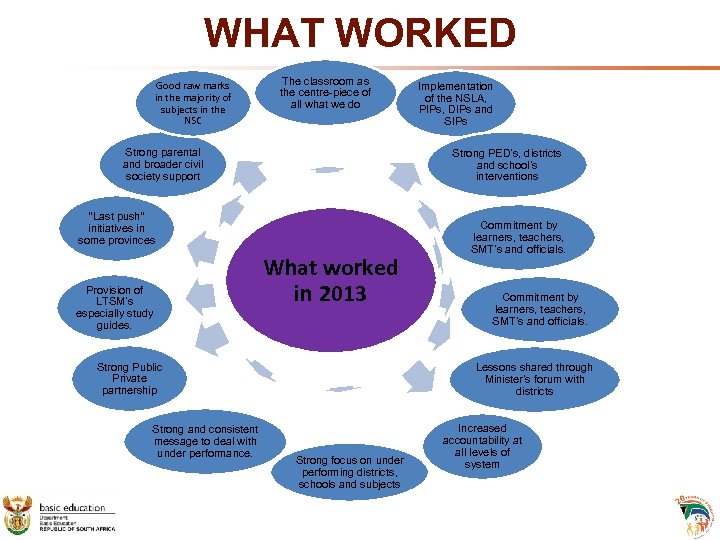 WHAT WORKED Good raw marks in the majority of subjects in the NSC The classroom as the centre-piece of all what we do Strong parental and broader civil society support Strong PED’s, districts and school’s interventions “Last push” initiatives in some provinces Provision of LTSM’s especially study guides. What worked in 2013 Strong Public Private partnership Strong and consistent message to deal with under performance. Implementation of the NSLA, PIPs, DIPs and SIPs Commitment by learners, teachers, SMT’s and officials. Lessons shared through Minister’s forum with districts Strong focus on under performing districts, schools and subjects Increased accountability at all levels of system
 REFLECTING ON ACHIEVEMENTS AND WEAKNESSES “Our achievements, however, we know full well, must not be used as an excuse for exaggerating our successes for ignoring errors committed and weaknesses that require urgent attention” From: Nelson Mandela 100
 WHAT ARE OUR PRIORITIES FOR 2014?
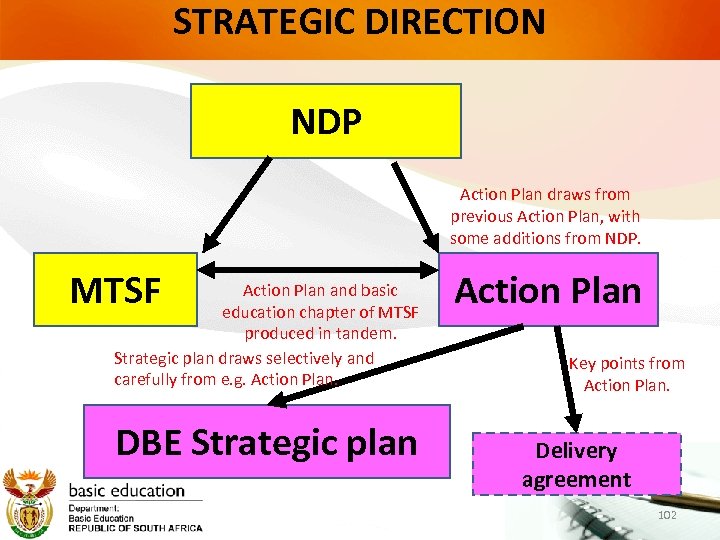 STRATEGIC DIRECTION NDP Action Plan draws from previous Action Plan, with some additions from NDP. MTSF Action Plan and basic education chapter of MTSF produced in tandem. Strategic plan draws selectively and carefully from e. g. Action Plan. DBE Strategic plan Action Plan Key points from Action Plan. Delivery agreement 102
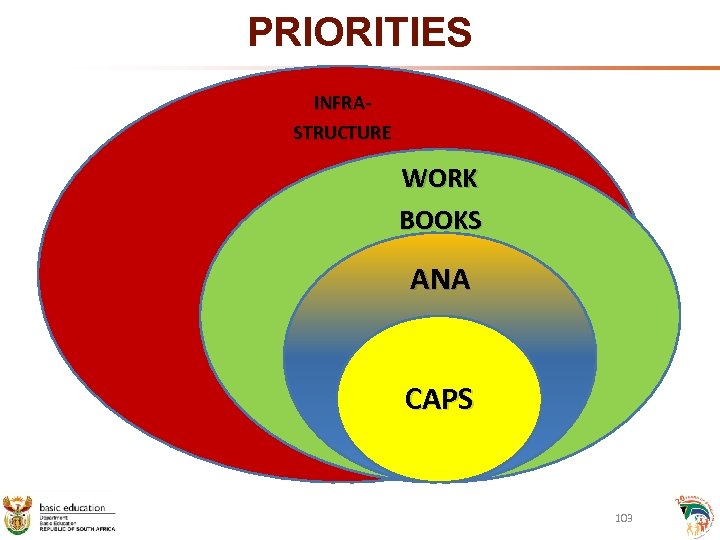 PRIORITIES INFRASTRUCTURE WORK BOOKS ANA CAPS 103
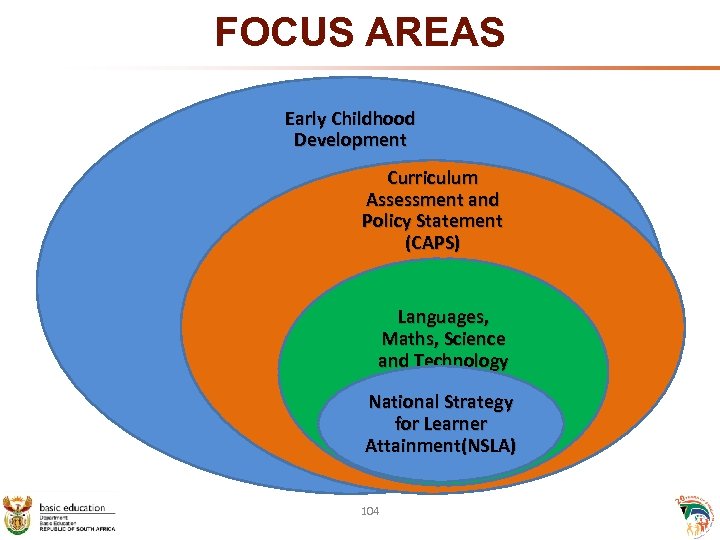 FOCUS AREAS Early Childhood Development Curriculum Assessment and Policy Statement (CAPS) Languages, Maths, Science and Technology (LMST) National Strategy for Learner Attainment(NSLA) 104
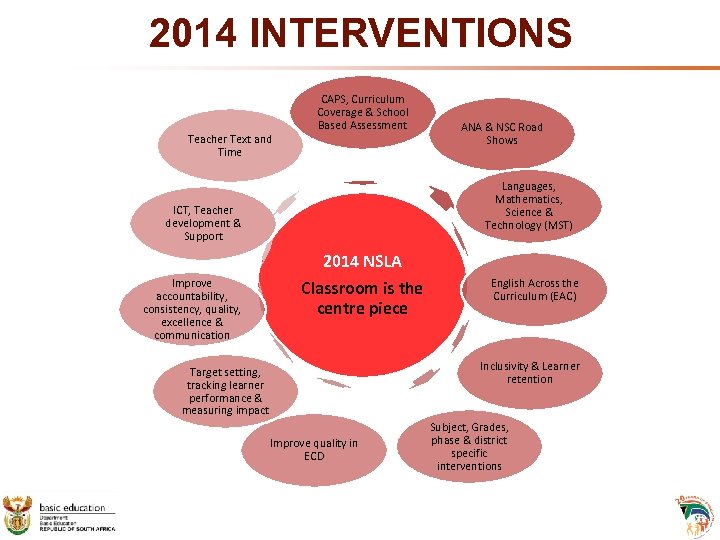 2014 INTERVENTIONS Teacher Text and Time CAPS, Curriculum Coverage & School Based Assessment ANA & NSC Road Shows Languages, Mathematics, Science & Technology (MST) ICT, Teacher development & Support 2014 NSLA Improve accountability, consistency, quality, excellence & communication Classroom is the centre piece English Across the Curriculum (EAC) Inclusivity & Learner retention Target setting, tracking learner performance & measuring impact Improve quality in ECD Subject, Grades, phase & district specific interventions
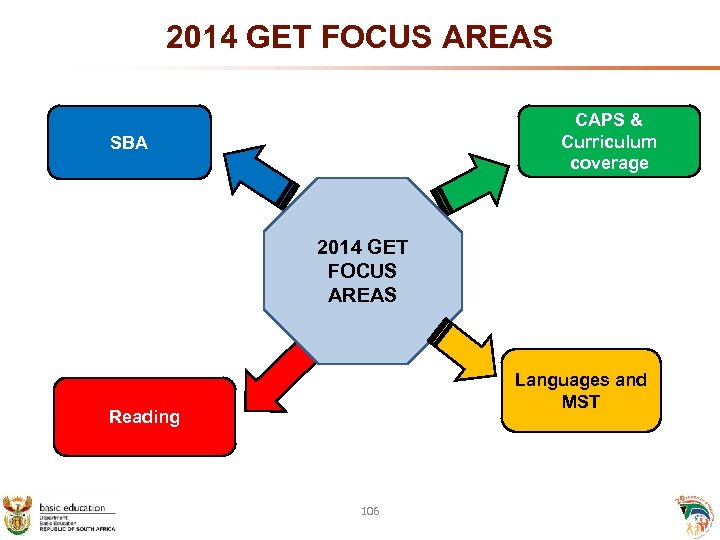 2014 GET FOCUS AREAS CAPS & Curriculum coverage SBA 2014 GET FOCUS AREAS Languages and MST Reading 106
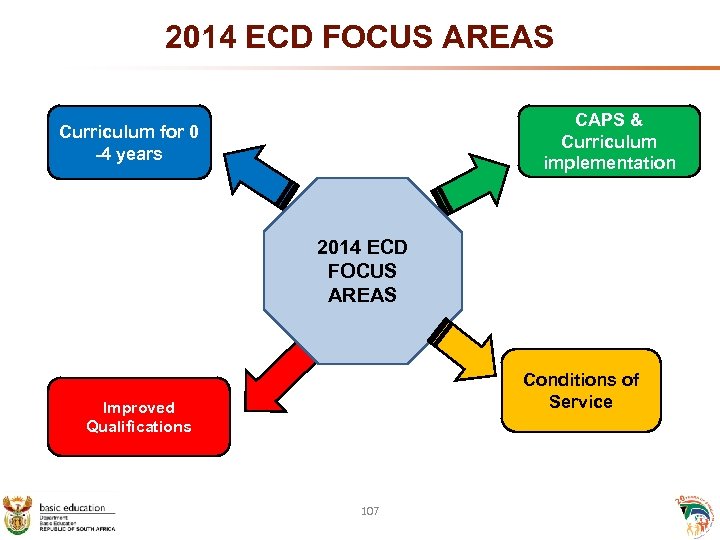 2014 ECD FOCUS AREAS CAPS & Curriculum implementation Curriculum for 0 -4 years 2014 ECD FOCUS AREAS Conditions of Service Improved Qualifications 107
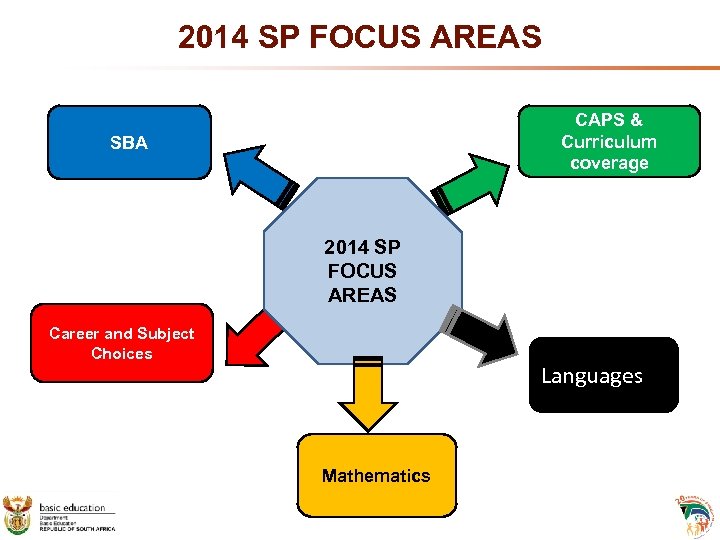 2014 SP FOCUS AREAS CAPS & Curriculum coverage SBA 2014 SP FOCUS AREAS Career and Subject Choices Languages Mathematics 108
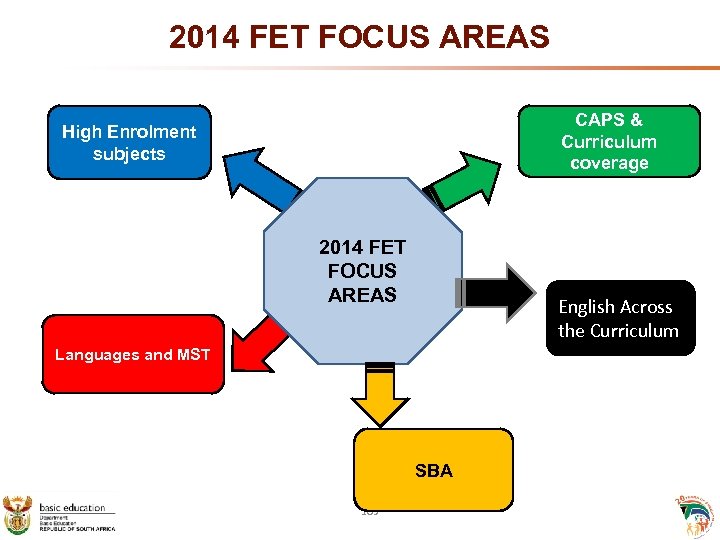 2014 FET FOCUS AREAS CAPS & Curriculum coverage High Enrolment subjects 2014 FET FOCUS AREAS Languages and MST SBA 109 English Across the Curriculum
 WHAT PROGRESS HAS BEEN MADE ON RETENTION?
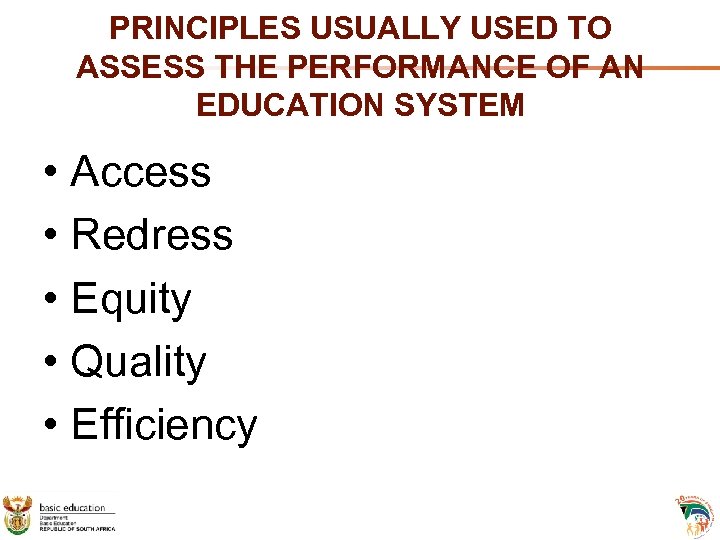 PRINCIPLES USUALLY USED TO ASSESS THE PERFORMANCE OF AN EDUCATION SYSTEM • Access • Redress • Equity • Quality • Efficiency
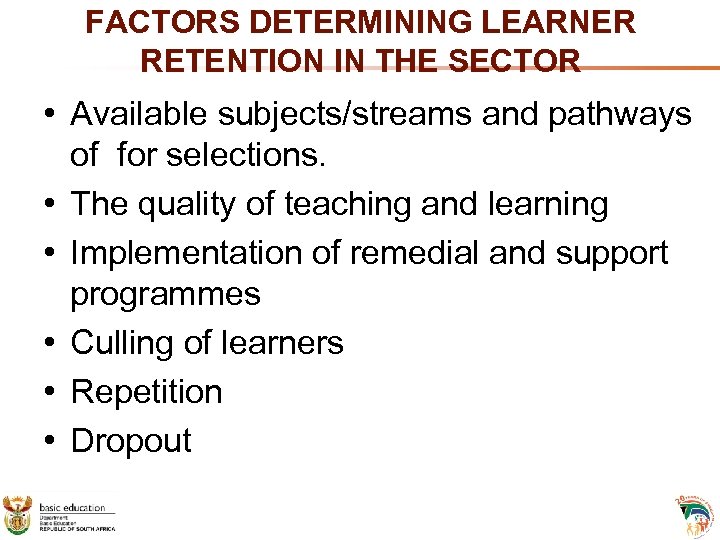 FACTORS DETERMINING LEARNER RETENTION IN THE SECTOR • Available subjects/streams and pathways of for selections. • The quality of teaching and learning • Implementation of remedial and support programmes • Culling of learners • Repetition • Dropout
 FACTORS INFLUENCING LEARNER RETENTION Website: www. education. gov. za Call Centre: 0800 202 933 | callcentre@dbe. gov. za Twitter: @DBE_SA | Facebook: DBE SA
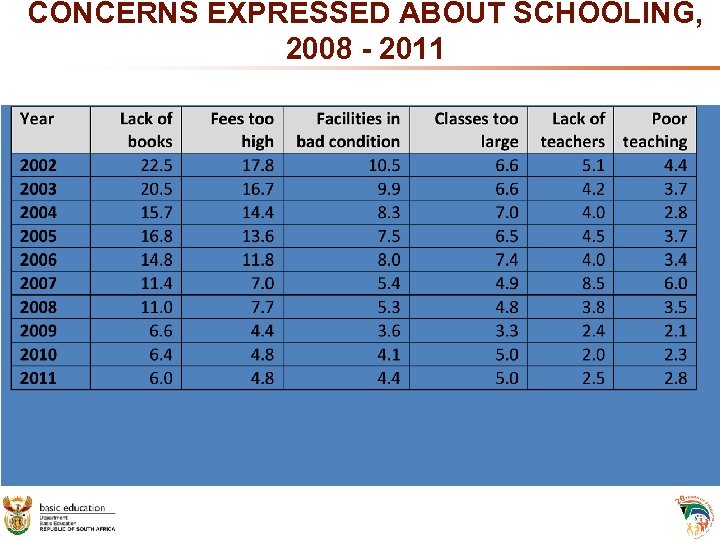 CONCERNS EXPRESSED ABOUT SCHOOLING, 2008 - 2011 Source: Statistics South Africa, General Household Survey, 2009 2011, DBE own analysis
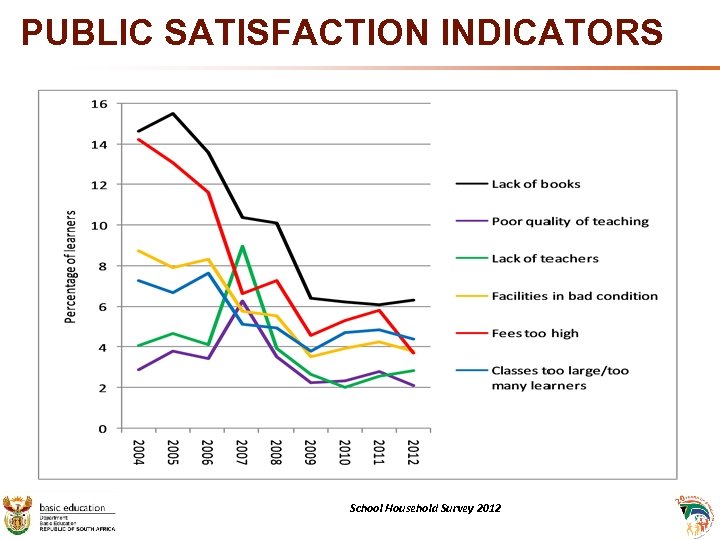 PUBLIC SATISFACTION INDICATORS School Household Survey 2012
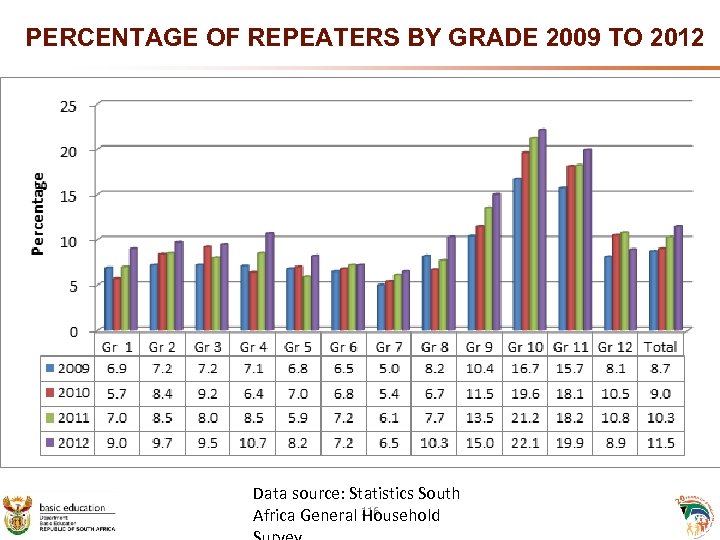 PERCENTAGE OF REPEATERS BY GRADE 2009 TO 2012 Data source: Statistics South Africa General 116 Household
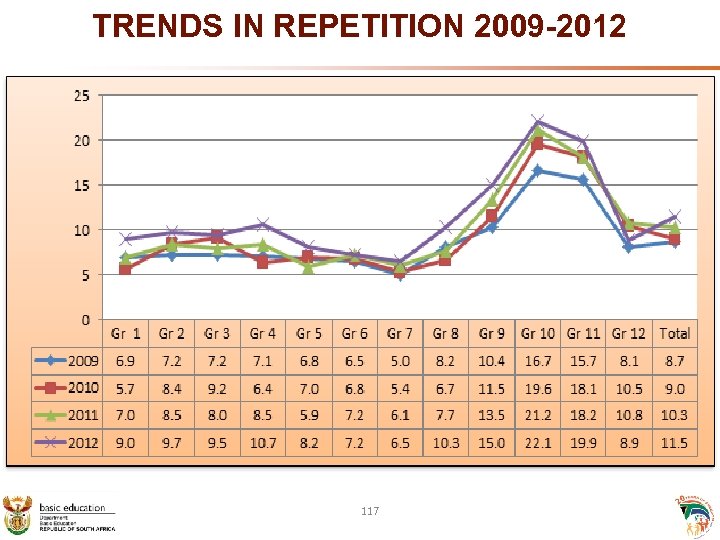 TRENDS IN REPETITION 2009 -2012 117
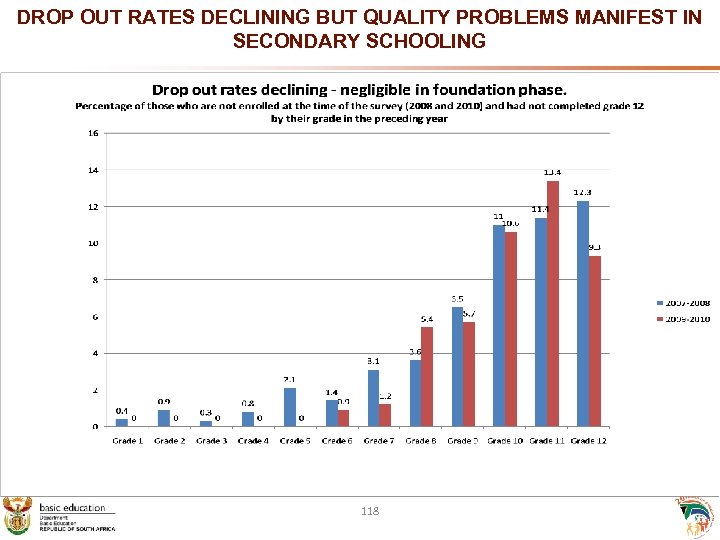 DROP OUT RATES DECLINING BUT QUALITY PROBLEMS MANIFEST IN SECONDARY SCHOOLING 118
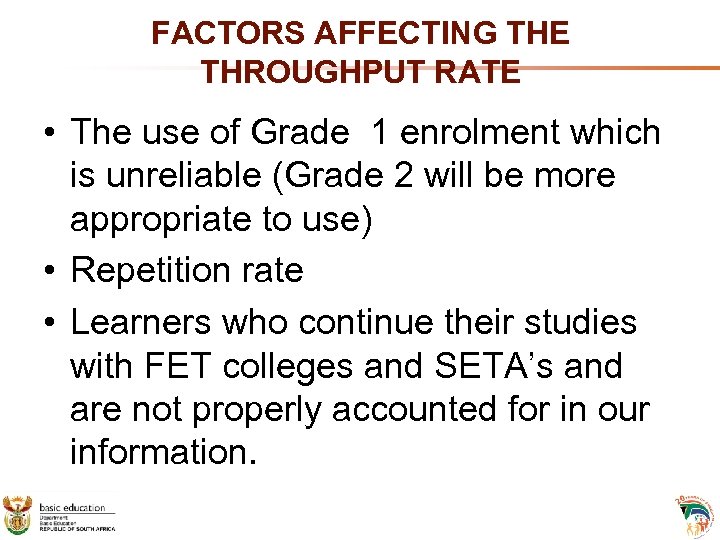 FACTORS AFFECTING THE THROUGHPUT RATE • The use of Grade 1 enrolment which is unreliable (Grade 2 will be more appropriate to use) • Repetition rate • Learners who continue their studies with FET colleges and SETA’s and are not properly accounted for in our information.
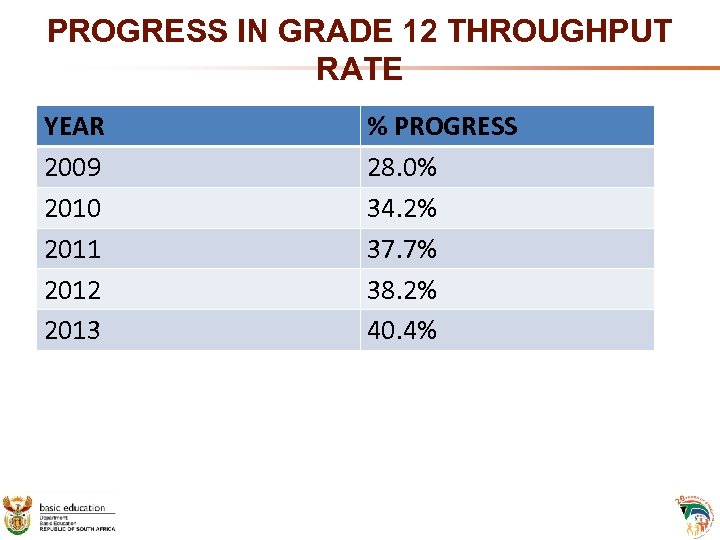 PROGRESS IN GRADE 12 THROUGHPUT RATE YEAR 2009 2010 2011 2012 2013 % PROGRESS 28. 0% 34. 2% 37. 7% 38. 2% 40. 4%
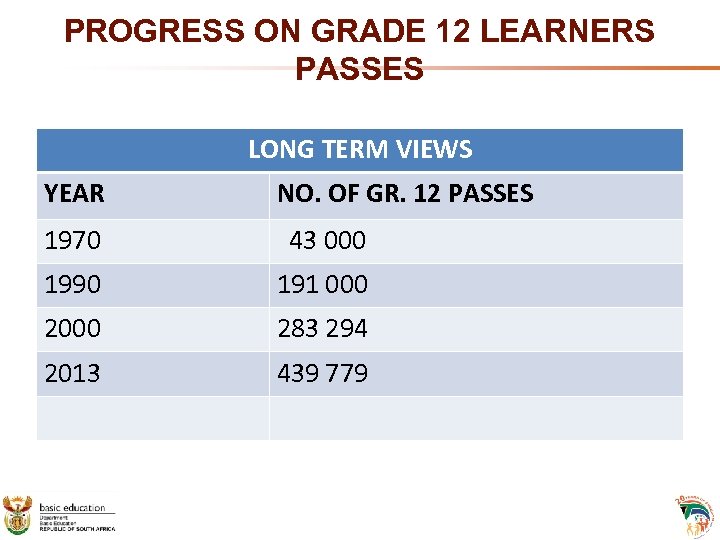 PROGRESS ON GRADE 12 LEARNERS PASSES LONG TERM VIEWS YEAR NO. OF GR. 12 PASSES 1970 43 000 1990 191 000 283 294 2013 439 779
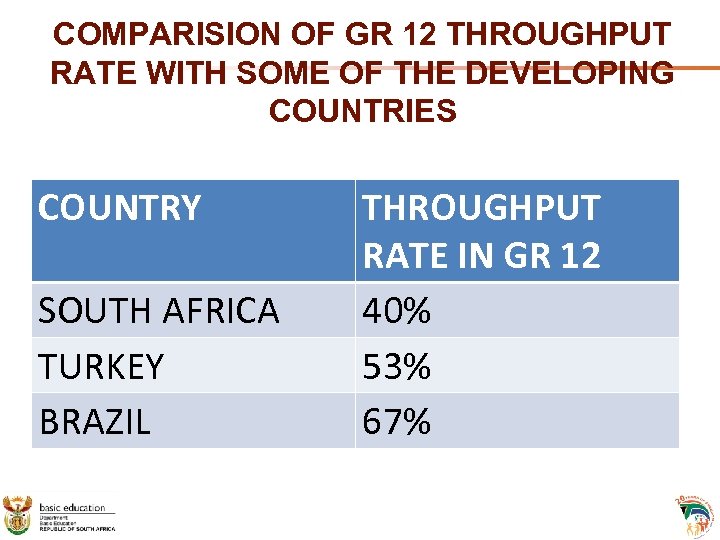 COMPARISION OF GR 12 THROUGHPUT RATE WITH SOME OF THE DEVELOPING COUNTRIES COUNTRY SOUTH AFRICA TURKEY BRAZIL THROUGHPUT RATE IN GR 12 40% 53% 67%
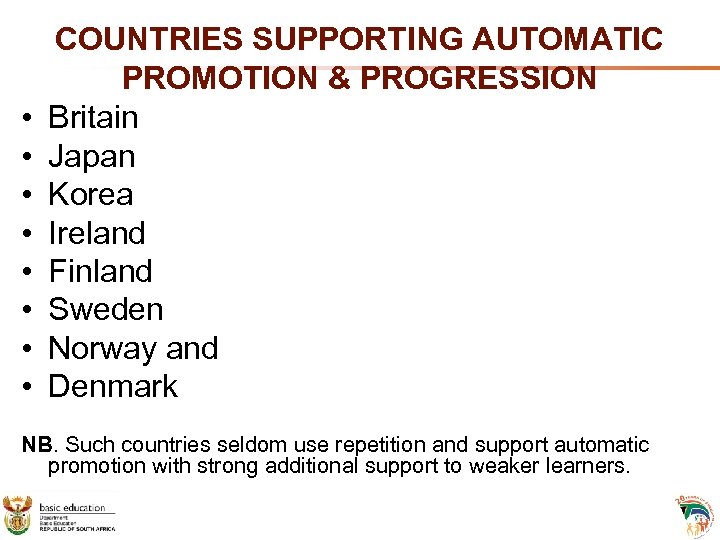 • • COUNTRIES SUPPORTING AUTOMATIC PROMOTION & PROGRESSION Britain Japan Korea Ireland Finland Sweden Norway and Denmark NB. Such countries seldom use repetition and support automatic promotion with strong additional support to weaker learners.
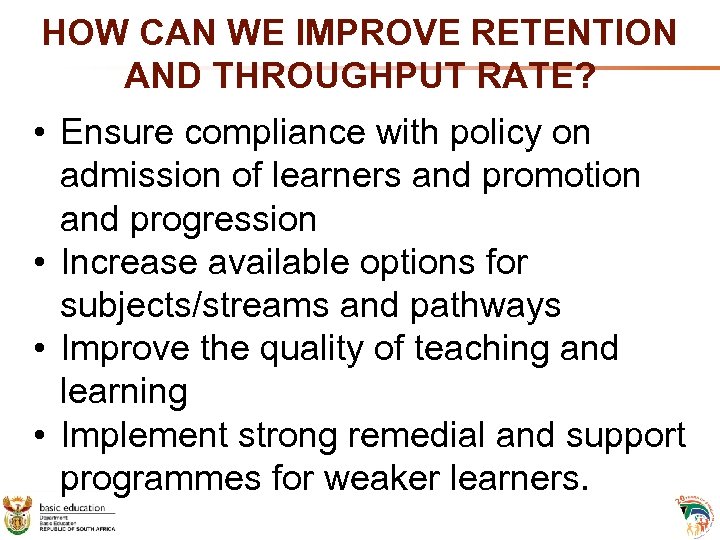 HOW CAN WE IMPROVE RETENTION AND THROUGHPUT RATE? • Ensure compliance with policy on admission of learners and promotion and progression • Increase available options for subjects/streams and pathways • Improve the quality of teaching and learning • Implement strong remedial and support programmes for weaker learners.
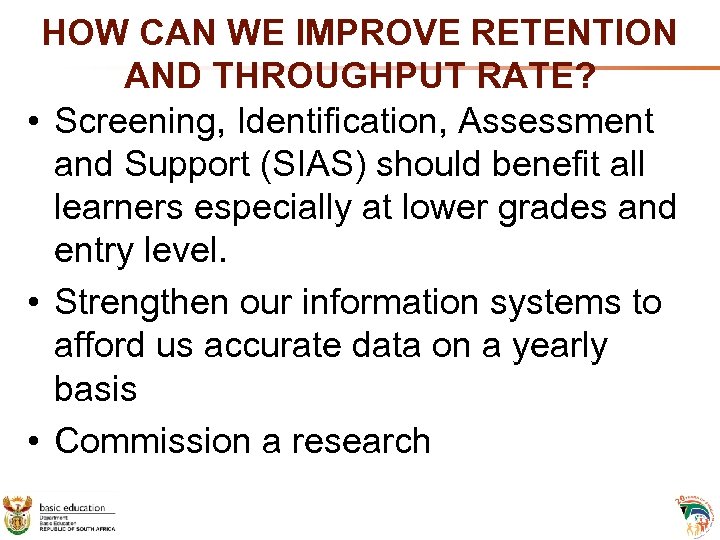 HOW CAN WE IMPROVE RETENTION AND THROUGHPUT RATE? • Screening, Identification, Assessment and Support (SIAS) should benefit all learners especially at lower grades and entry level. • Strengthen our information systems to afford us accurate data on a yearly basis • Commission a research
 WHERE SHOULD WE FOCUS TO TURN THE SECTOR AROUND?
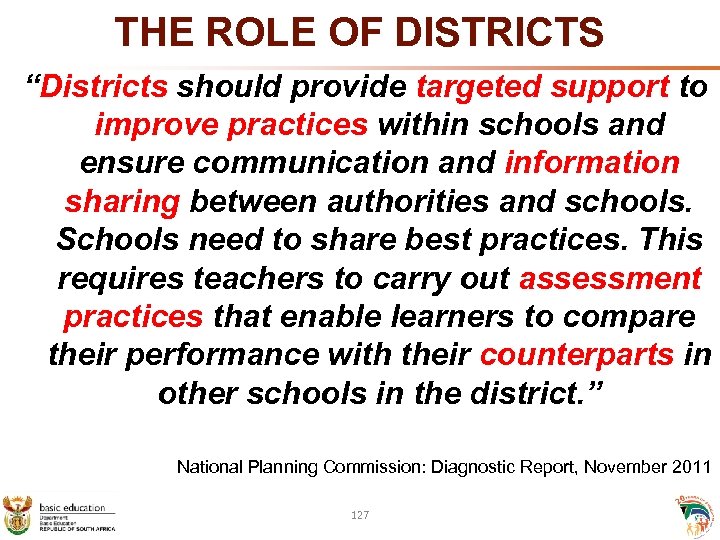 THE ROLE OF DISTRICTS “Districts should provide targeted support to improve practices within schools and ensure communication and information sharing between authorities and schools. Schools need to share best practices. This requires teachers to carry out assessment practices that enable learners to compare their performance with their counterparts in other schools in the district. ” National Planning Commission: Diagnostic Report, November 2011 127
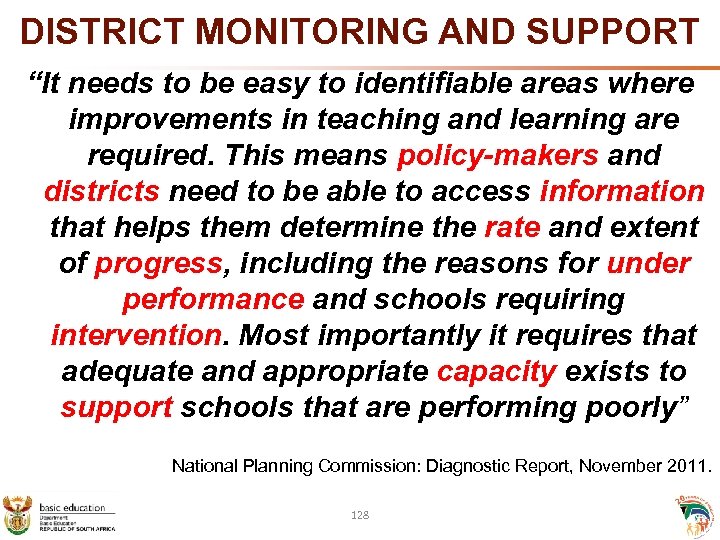 DISTRICT MONITORING AND SUPPORT “It needs to be easy to identifiable areas where improvements in teaching and learning are required. This means policy-makers and districts need to be able to access information that helps them determine the rate and extent of progress, including the reasons for under performance and schools requiring intervention. Most importantly it requires that adequate and appropriate capacity exists to support schools that are performing poorly” National Planning Commission: Diagnostic Report, November 2011. 128
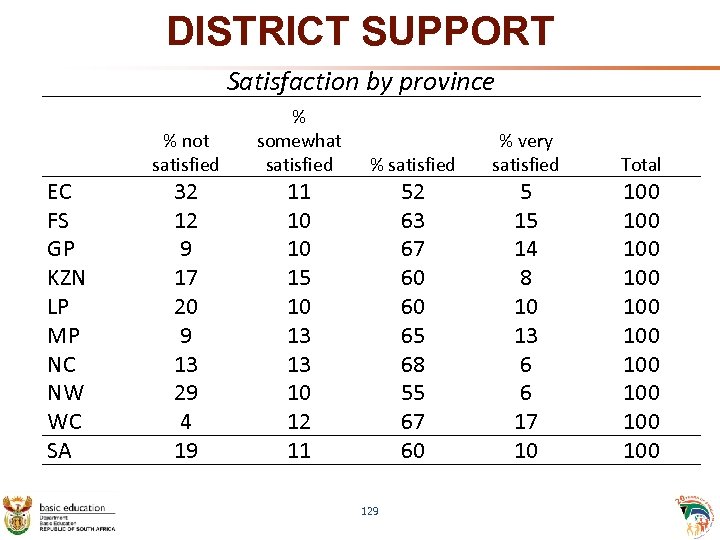 DISTRICT SUPPORT Satisfaction by province EC FS GP KZN LP MP NC NW WC SA % not satisfied 32 12 9 17 20 9 13 29 4 19 % somewhat satisfied 11 10 10 15 10 13 13 10 12 11 % satisfied 52 63 67 60 60 65 68 55 67 60 129 % very satisfied 5 15 14 8 10 13 6 6 17 10 Total 100 100 100
 WHAT IS THE VALUE OF THE MATRIC CERTIFICATE IN THE LABOUR MARKET? Clare Hofmeyr, Nicola Branson, Murray Leibbrandt, Cally Ardington, David Lam (14/10/13), UCT
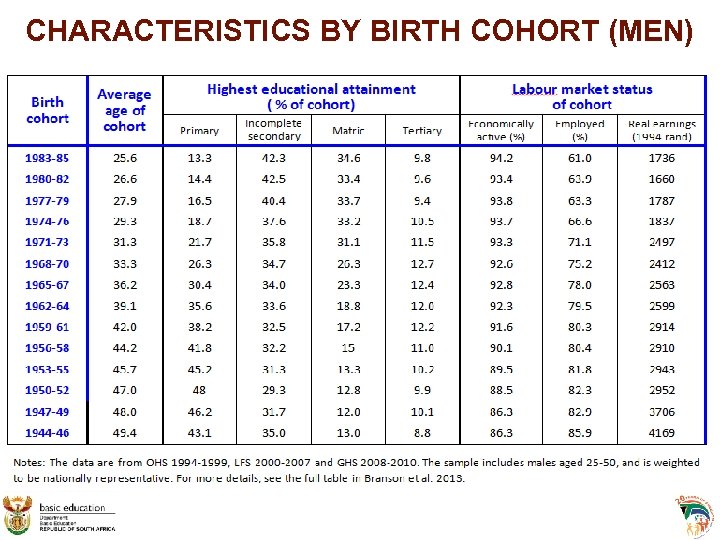 CHARACTERISTICS BY BIRTH COHORT (MEN)
 SUMMARY OF FINDINGS • Educational attainment has risen steadily over the last five decades. • More recent cohorts having larger proportions of post-primary graduates than their predecessors. • A greater proportion of these men (with a growing proportion of matric graduates among them) became economically active in the labour market.
 CONCLUSION • Increasing levels of youth unemployment and learners’ poor performance at school have led to claims that the matric certificate no longer has much value in the labour market. • However, the evidence does not support this claim. • While the labour market conditions facing secondary school graduates have indeed worsened with time, the value of a matric certificate relative to that of grade 10 and 11 has remained positive both in terms of earnings and the likelihood of finding employment.
 THANK YOU Website: www. education. gov. za Call Centre: 0800 202 933 | callcentre@dbe. gov. za Twitter: @DBE_SA | Facebook: DBE SA