


 Скачать презентацию National Scientific Company Sales Review Meeting 4
3636d8c1dd1e30bfaa9883a1692adb85.ppt
- Количество слайдов: 40
 National Scientific Company Sales Review Meeting 4 & 5 Sep 2007 PAC Product Presentation By A. Vetrivel PAC Product Specialist
 Petroleum Laboratory Analyzer Segment PAC One of the most complete Petroleum Laboratory Product Offering in the Industry
 PAC LP Corporate Headquarters Houston, Texas USA
 PAC Brand Centers Houston, Texas USA Verson, France Lauda, Germany
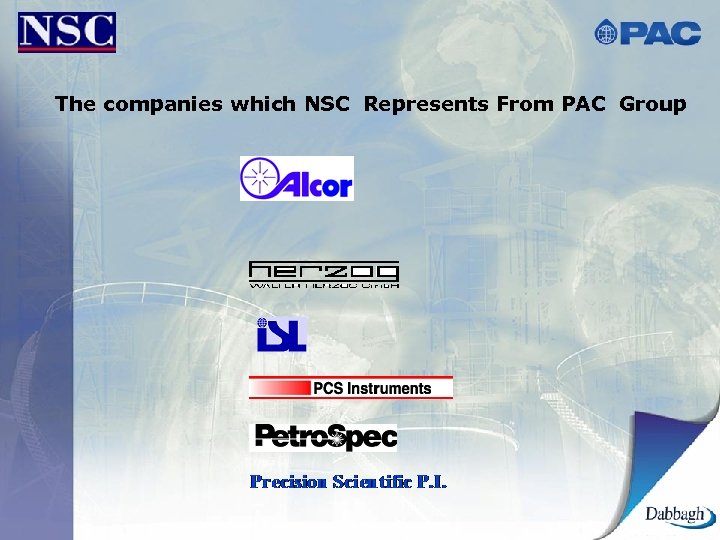 The companies which NSC Represents From PAC Group
 Basic Concept of all Instrument Range in PAC Group Automatic Petroleum Testing Instruments Which Complies Strictly the Standard Test Method well known as ASTM Method The Standard Test Method that defines the way a test is performed.
 ASTM Methods for which Instruments are Manufactured by PAC Group of Companies ASTM D 36 - Standard Test Method for Softening Point of Bitumen (Ring-and-Ball Apparatus) ASTM D 56 - Standard Test Method for Flash Point by Tag Closed Cup Tester ASTM D 86 - Standard Test Method for Distillation of Petroleum Products at Atmospheric Pressure ASTM D 92 - Standard Test Method for Flash and Fire Points by Cleveland Open Cup Tester ASTM D 93 - Standard Test Methods for Flash Point by Pensky-Martens Closed Cup Tester
 ASTM D 97 - Standard Test Method for Pour Point of Petroleum Products ASTM D 323 - Standard Test Method for Vapor Pressure of Petroleum Products (Reid Method) ASTM D 445 - Standard Test Method for Kinematic Viscosity of Transparent and Opaque Liquids ASTM D 1160 -Standard Test Method for Distillation of Petroleum Products at Reduced Pressure ASTM D 3230 -Standard Test Method for Salts in Crude Oil
 ASTM D 3241 -Standard Test Method for Thermal Oxidation Stability of Aviation Turbine Fuels (JFTOT ASTM D 4530 -Standard Test Method for Determination of Carbon Residue (Micro Method) ASTM D 5001 -Standard Test Method for Measurement of Lubricity of Aviation Turbine Fuels by the Ball-on-Cylinder Lubricity Evaluator (BOCLE) ASTM D 5191 -Standard Test Method for Vapor Pressure of Petroleum Products (Mini Method) ASTM D 6079 -Standard Test Method for Evaluating Lubricity of Diesel Fuels by the High-Frequency Reciprocating Rig (HFRR )
 Group of Products §Distillation §Viscosity §Hot Properties §Cold Behavior §Lubricity §Vapor Pressure
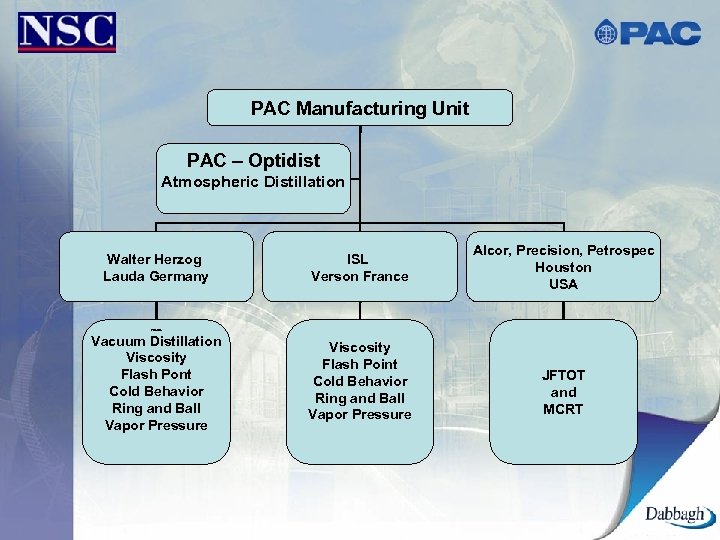 PAC Manufacturing Unit PAC – Optidist Atmospheric Distillation Walter Herzog Lauda Germany ISL Verson France Alcor, Precision, Petrospec Houston USA FViscos Vacuum Distillation Viscosity Flash Pont Cold Behavior Ring and Ball Vapor Pressure Viscosity Flash Point Cold Behavior Ring and Ball Vapor Pressure JFTOT and MCRT
 The PAC World of Instruments…
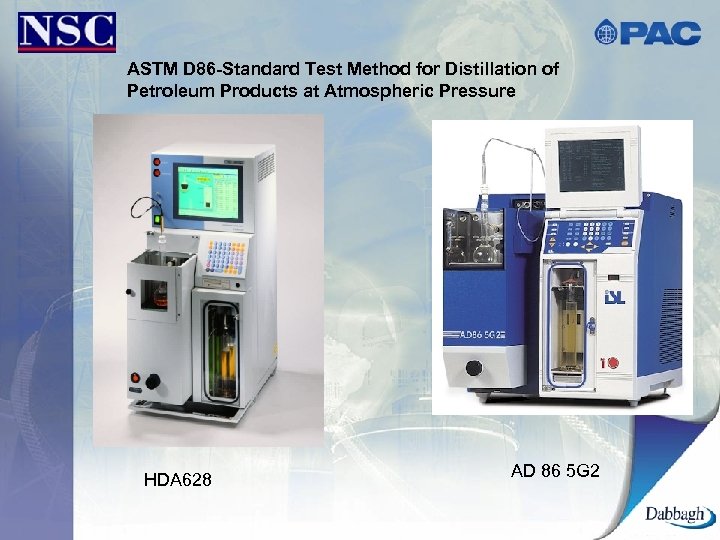 ASTM D 86 -Standard Test Method for Distillation of Petroleum Products at Atmospheric Pressure HDA 628 AD 86 5 G 2
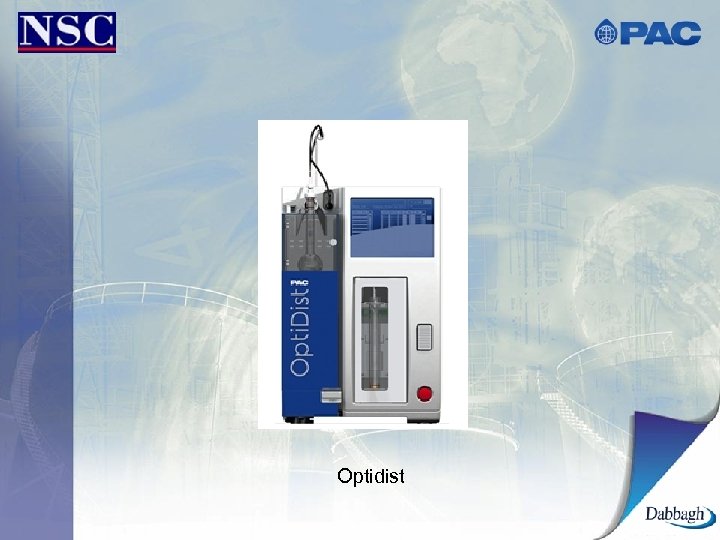 Optidist
 ASTM D 86 -Standard Test Method for Distillation of Petroleum Products at Atmospheric Pressure This test method covers the atmospheric distillation of petroleum products using a laboratory batch distillation unit to determine quantitatively the boiling range characteristics of such products as light and middle distillates, aviation gasolines, aviation turbine fuels, 1 -D and 2 -D regular and low sulfur diesel fuels, kerosines,
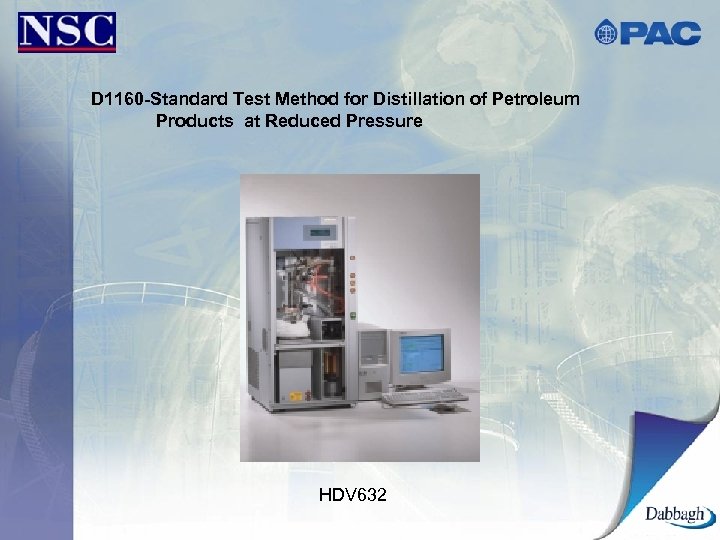 D 1160 -Standard Test Method for Distillation of Petroleum Products at Reduced Pressure HDV 632
 D 1160 -Standard Test Method for Distillation of Petroleum Products at Reduced Pressure This test method covers the determination, at reduced pressures, of the range of boiling points for petroleum products that can be partially or completely vaporized at a maximum liquid temperature of 400°C. .
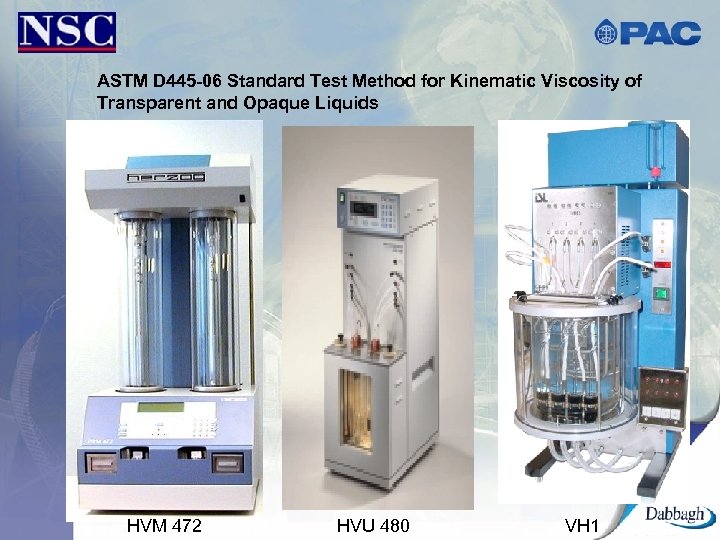 ASTM D 445 -06 Standard Test Method for Kinematic Viscosity of Transparent and Opaque Liquids HVM 472 HVU 480 VH 1
 ASTM D 445 -Standard Test Method for Kinematic Viscosity of Transparent and Opaque Liquids This test method specifies a procedure for the determination of the kinematic viscosity, of liquid petroleum products, both transparent and opaque, by measuring the time for a volume of liquid to flow under gravity through a calibrated glass capillary viscometer
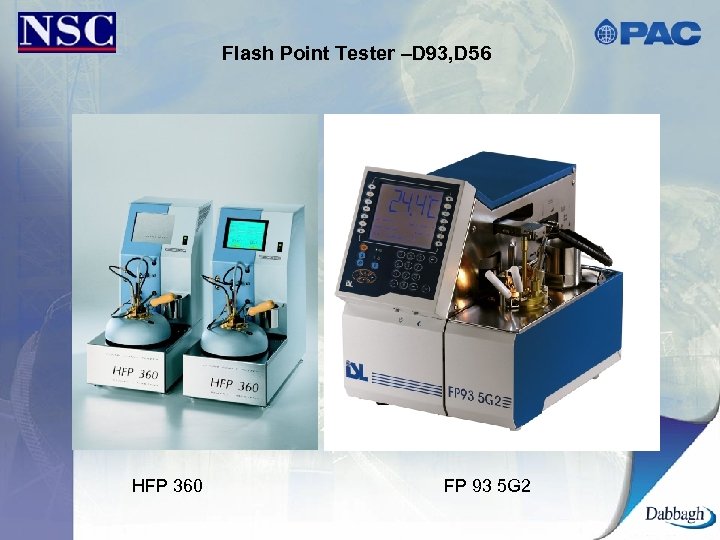 Flash Point Tester –D 93, D 56 HFP 360 FP 93 5 G 2
 ASTM D 93 -Standard Test Methods for Flash Point by Pensky-Martens Closed Cup Tester This test methods cover the determination of the flash point of petroleum products in the temperature range from 40 to 360 C by a automated Pensky-Martens closed-cup apparatus. ASTM D 56 -Standard Test Method for Flash Point by Tag Closed Cup Tester This test method covers the determination of the flash point, by tag manual and automated closed testers, of liquids with a viscosity below 5. 5 mm 2/s (c. St) at 40°C (104°F), or below 9. 5 mm 2/s (c. St) at 25°C (77°F), and a flash point below 93°C (200°F).
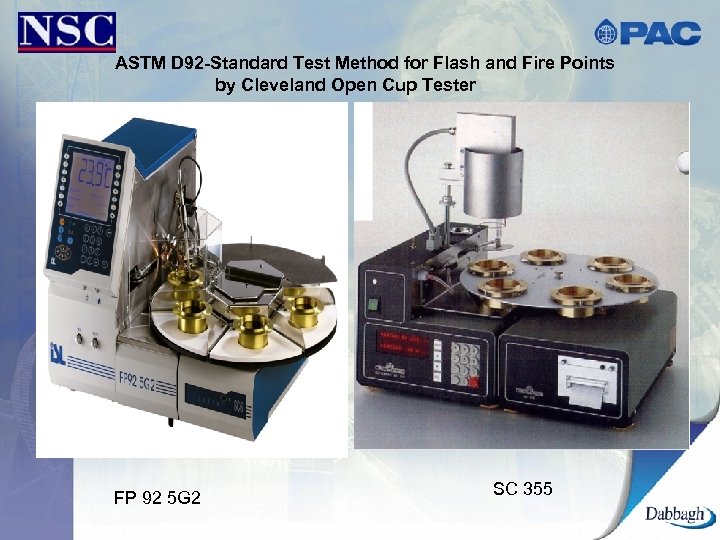 ASTM D 92 -Standard Test Method for Flash and Fire Points by Cleveland Open Cup Tester FP 92 5 G 2 SC 355
 ASTM D 92 -Standard Test Method for Flash and Fire Points by Cleveland Open Cup Tester This test method describes the determination of the flash point automated Cleveland open cup apparatus. This test method is applicable to all petroleum products with flash points above 79 C (175 F) and below 400 C (752 F).
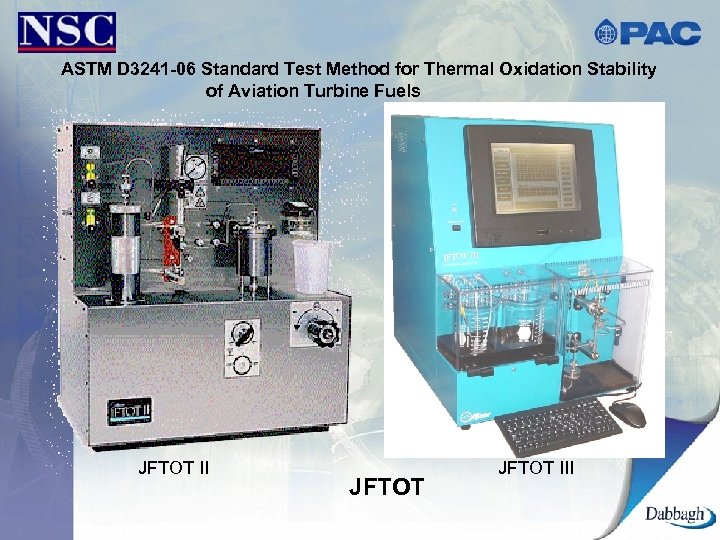 ASTM D 3241 -06 Standard Test Method for Thermal Oxidation Stability of Aviation Turbine Fuels JFTOT III
 ASTM D 3241 -Standard Test Method for Thermal Oxidation Stability of Aviation Turbine Fuels This test method covers the procedure for rating the tendencies of gas turbine fuels to deposit decomposition products within the fuel system.
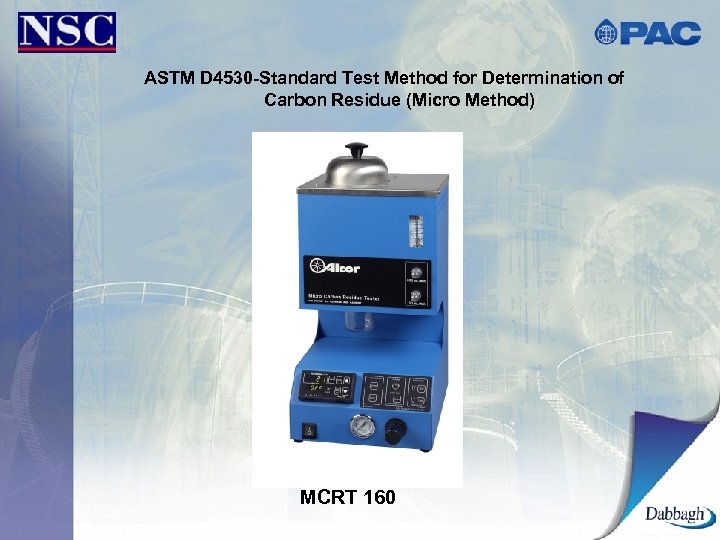 ASTM D 4530 -Standard Test Method for Determination of Carbon Residue (Micro Method) MCRT 160
 ASTM D 4530 -Standard Test Method for Determination of Carbon Residue (Micro Method) This test method covers the determination of the amount of carbon residue formed after evaporation of petroleum materials under certain conditions and is intended to provide some indication of the relative coke forming tendency of such materials.
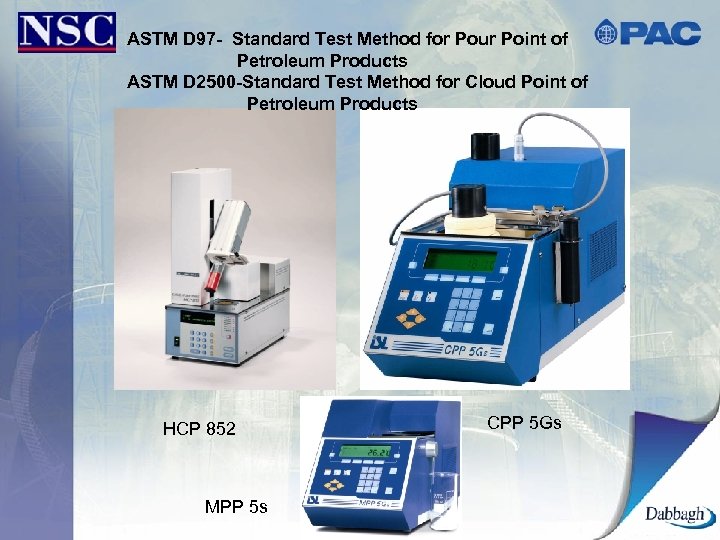 ASTM D 97 - Standard Test Method for Pour Point of Petroleum Products ASTM D 2500 -Standard Test Method for Cloud Point of Petroleum Products HCP 852 MPP 5 s CPP 5 Gs
 ASTM D 97 -Standard Test Method for Pour Point of Petroleum Products This test method covers and is intended for use on any petroleum product to find the flow properties Pour Point. ASTM D 2500 -Standard Test Method for Cloud Point of Petroleum Products This test method covers only petroleum products and that are transparent in layers 40 mm in thickness, and with a cloud point below 49 C
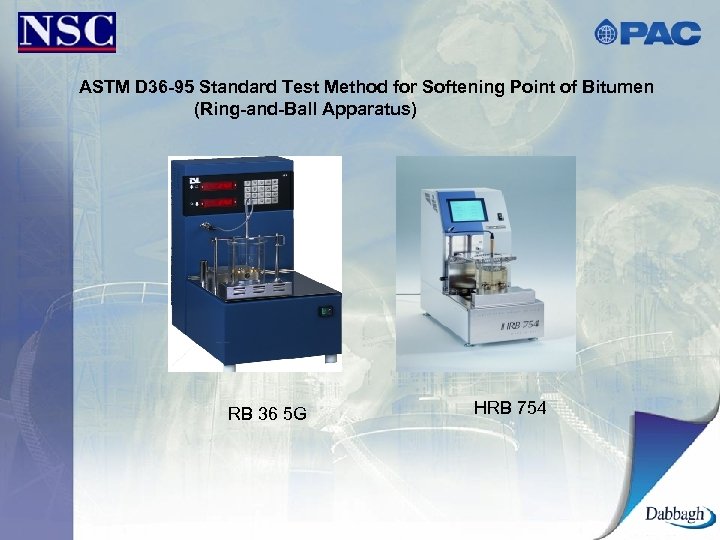 ASTM D 36 -95 Standard Test Method for Softening Point of Bitumen (Ring-and-Ball Apparatus) RB 36 5 G HRB 754
 ASTM D 36 -Standard Test Method for Softening Point of Bitumen (Ring-and-Ball Apparatus) This test method covers the determination of the softening point of bitumen in the range from 30 to 157°C (86 to 315°F) using the ring-and-ball apparatus
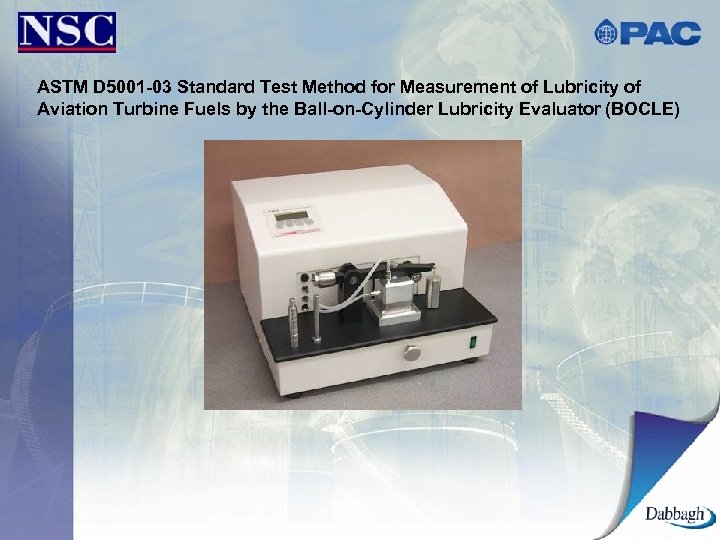 ASTM D 5001 -03 Standard Test Method for Measurement of Lubricity of Aviation Turbine Fuels by the Ball-on-Cylinder Lubricity Evaluator (BOCLE)
 ASTM D 5001 -03 Standard Test Method for Measurement of Lubricity of Aviation Turbine Fuels by the Ball-on-Cylinder Lubricity Evaluator (BOCLE) This test method covers the evaluation of the lubricity of aviation turbine fuels using a Ball -on-Cylinder (rubbing steel surfaces)
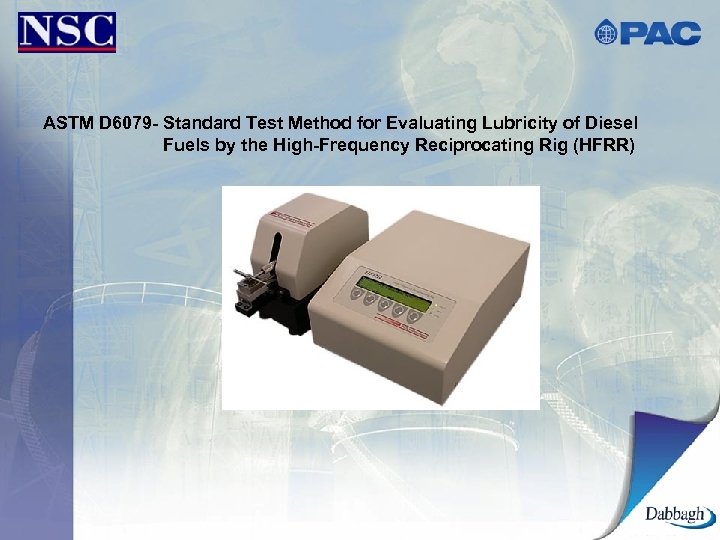 ASTM D 6079 - Standard Test Method for Evaluating Lubricity of Diesel Fuels by the High-Frequency Reciprocating Rig (HFRR)
 ASTM D 6079 - Standard Test Method for Evaluating Lubricity of Diesel Fuels by the High-Frequency Reciprocating Rig (HFRR) This test method covers the evaluation of the lubricity of diesel fuels using a high-frequency reciprocating rig (HFRR).
 Competitors for PAC Anton Paar(G. Kaki) Grabner(G. Kaki) Tanaka(A. Kaki) Normalab(Attest) Petrotest(KIAK)
 Our Strength …. Name for PAC in the market Heavy Duty Instrument NSC’s Reputation as the best Service Provider Competitor's Strength… Low Cost Instrument Competitor's Weakness… Service—very weak
 Glossary Flash Point: The flash point of a flammable liquid is the lowest temperature at which it can form an ignitable mixture in air. At this temperature the vapor may cease to burn when the source of ignition is removed. Fire Point: A slightly higher temperature, the fire point, is defined as the temperature at which the vapor continues to burn after being ignited. Distillation: Distillation, process of heating a liquid until its more volatile constituents pass into the vapor phase, and then cooling the vapor to recover such constituents in liquid form by condensation. The main purpose of distillation is to separate a mixture of several components by taking advantage of their different volatilities, or the separation of volatile materials from nonvolatile materials Viscosity: Viscosity, property of a fluid that tends to prevent it from flowing when subjected to an applied force. High-viscosity fluids resist flow; low-viscosity fluids flow easily.
 Pour Point: The pour point of a liquid is the lowest temperature at which it will pour or flow under prescribed conditions. It is a rough indication of the lowest temperature at which oil is readily pump able. Cloud Point: The temperature at which the first wax crystals appear and a standardized ASTM test protocol is used to determine this temperature Vapor Pressure: This test method covers the use of automated vapor pressure instruments to determine the total vapor pressure exerted in vacuum by air-containing, volatile, liquid petroleum products. Thermal Oxidation: thermal oxide, growth of native oxide of the solid through oxidation of solid's surface at elevated temperature Lubricity: Ability of an oil or grease to lubricate. Lubricants, substances applied to the bearing, guiding, or contact surfaces of machinery to reduce friction between moving parts
 BIG THANKS FOR BEING WITH ME Wish a GOOD Business!