 Скачать презентацию National Science Foundation and Broadening Participation Engineering Workforce
3f9b1f6fb349e3ead0395d3ff15d1036.ppt
- Количество слайдов: 42



National Science Foundation and Broadening Participation “Engineering Workforce Development for the Road Ahead” James H. Wyche, Ph. D. , Director Division of Human Resource (HRD) Directorate of Education & Human Resources (EHR) National Science Foundation March 2009
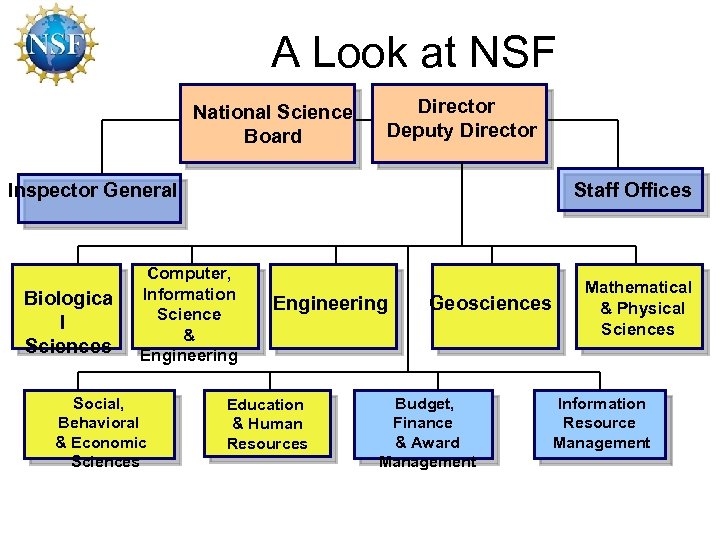
A Look at NSF National Science Board Director Deputy Director Inspector General Biologica l Sciences Staff Offices Computer, Information Science & Engineering Social, Behavioral & Economic Sciences Engineering Education & Human Resources Geosciences Budget, Finance & Award Management Mathematical & Physical Sciences Information Resource Management
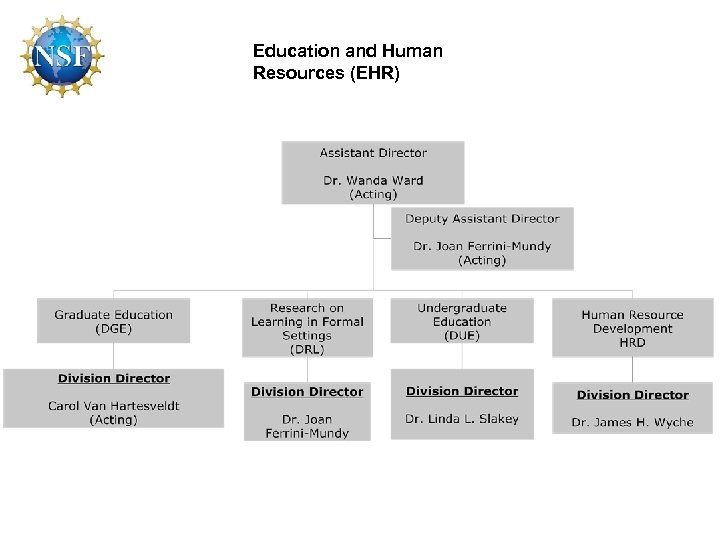
Education and Human Resources (EHR)
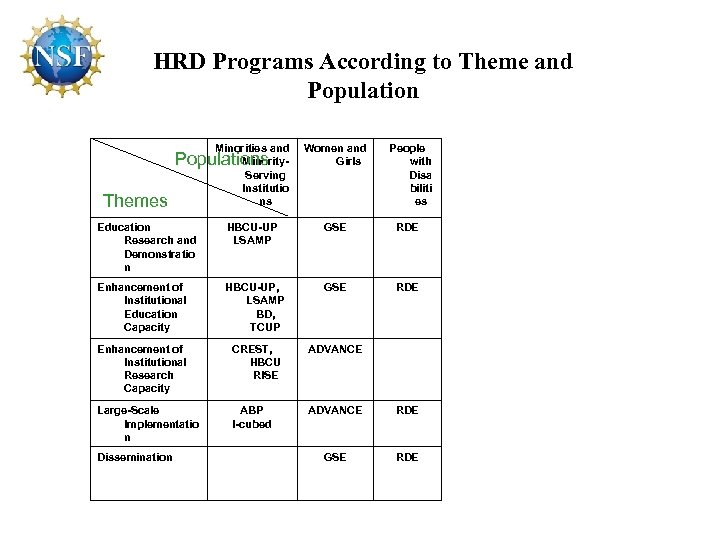
HRD Programs According to Theme and Population Minorities and Populations Minority. Themes Women and Girls Serving Institutio ns People with Disa biliti es Education Research and Demonstratio n HBCU-UP LSAMP GSE RDE Enhancement of Institutional Education Capacity HBCU-UP, LSAMP BD, TCUP GSE RDE Enhancement of Institutional Research Capacity CREST, HBCU RISE ADVANCE Large-Scale Implementatio n ABP I-cubed ADVANCE RDE GSE RDE Dissemination
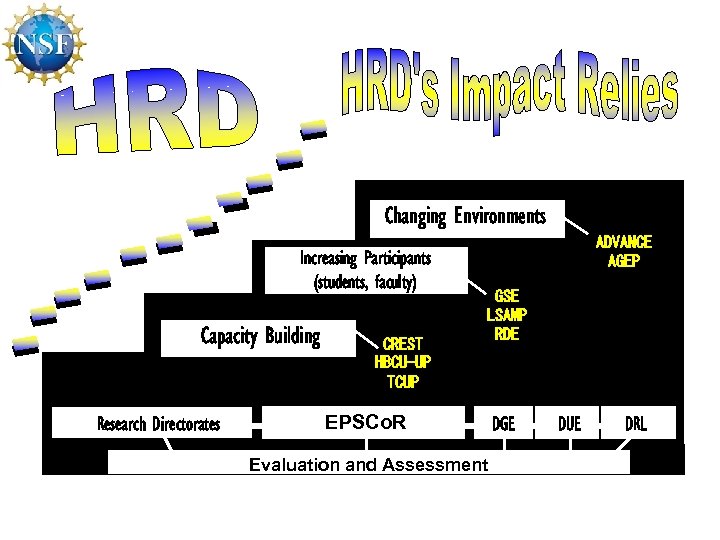
Changing Environments Increasing Participants (students, faculty) Capacity Building Research Directorates CREST HBCU-UP TCUP ADVANCE AGEP GSE LSAMP RDE EPSCo. R Evaluation and Assessment DGE DUE DRL
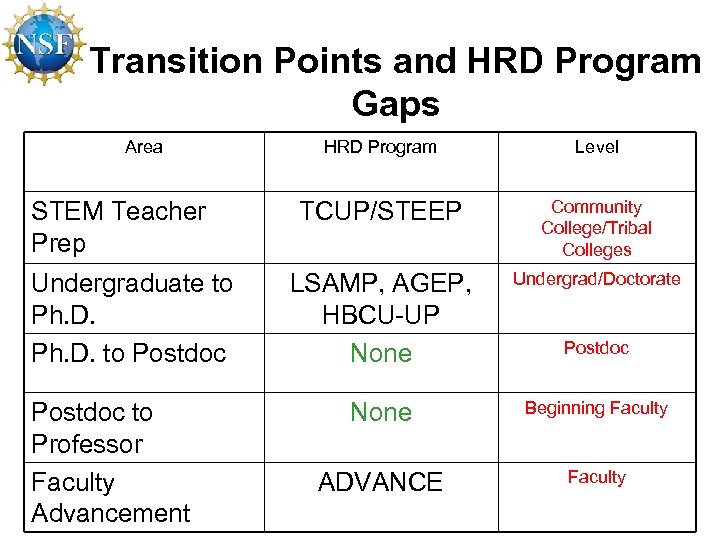
Transition Points and HRD Program Gaps Area STEM Teacher Prep Undergraduate to Ph. D. to Postdoc to Professor Faculty Advancement HRD Program Level TCUP/STEEP Community College/Tribal Colleges LSAMP, AGEP, HBCU-UP None Undergrad/Doctorate None Beginning Faculty ADVANCE Faculty Postdoc
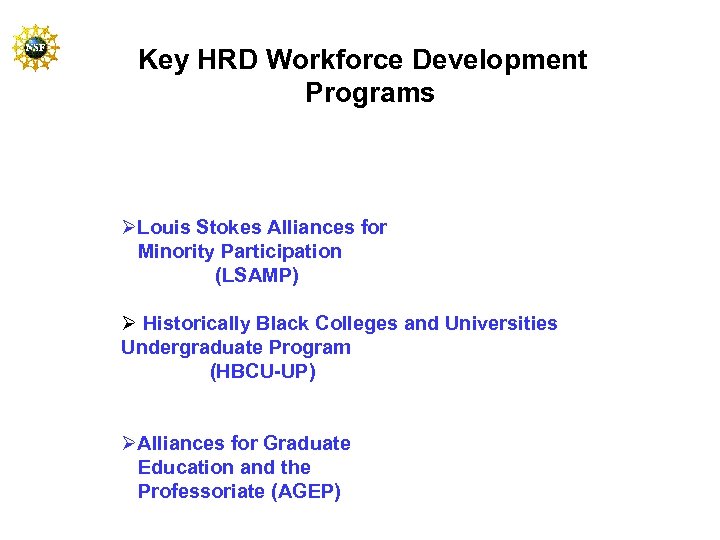
Key HRD Workforce Development Programs ØLouis Stokes Alliances for Minority Participation (LSAMP) Ø Historically Black Colleges and Universities Undergraduate Program (HBCU-UP) ØAlliances for Graduate Education and the Professoriate (AGEP)
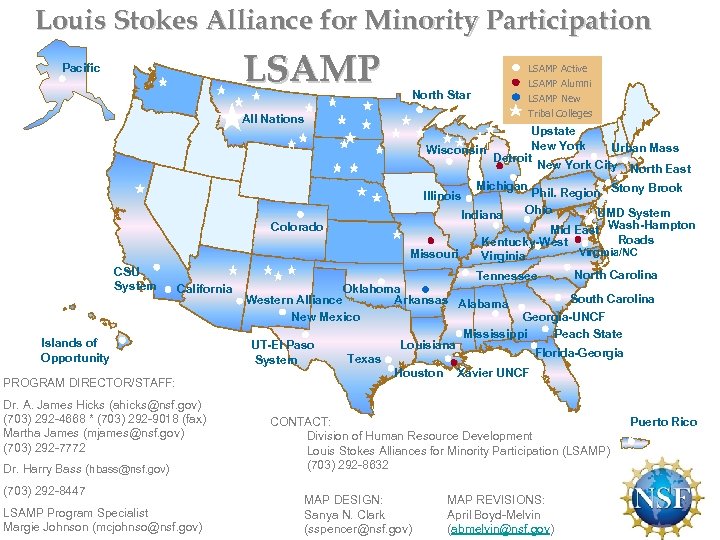
Louis Stokes Alliance for Minority Participation LSAMP Pacific North Star All Nations Upstate New York Urban Mass Wisconsin Detroit New York City North East CSU System California Islands of Opportunity PROGRAM DIRECTOR/STAFF: Dr. A. James Hicks (ahicks@nsf. gov) (703) 292 -4668 * (703) 292 -9018 (fax) Martha James (mjames@nsf. gov) (703) 292 -7772 Dr. Harry Bass (hbass@nsf. gov) (703) 292 -8447 LSAMP Program Specialist Margie Johnson (mcjohnso@nsf. gov) Michigan Phil. Region Stony Brook Ohio UMD System Indiana Mid East Wash-Hampton Roads Kentucky-West Virginia/NC Missouri Virginia Illinois Colorado LSAMP Active LSAMP Alumni LSAMP New Tribal Colleges Tennessee North Carolina Oklahoma South Carolina Western Alliance Arkansas Alabama Georgia-UNCF New Mexico Peach State Mississippi UT-El Paso Louisiana Florida-Georgia Texas System Houston Xavier UNCF CONTACT: Division of Human Resource Development Louis Stokes Alliances for Minority Participation (LSAMP) (703) 292 -8632 MAP DESIGN: Sanya N. Clark (sspencer@nsf. gov) MAP REVISIONS: April Boyd-Melvin (abmelvin@nsf. gov) Puerto Rico
Historically Black Colleges and Universities-Undergraduate Program (HBCU-UP) New Program Guidelines Broadens participation in the Nation’s STEM workforce by enhancing the quality of undergraduate STEM education at HBCUs. 9
Impact of HBCU-UP has supported the development of STEM education and research at 80 HBCUs (78%) since 2001, including funding for programs at 82% of the Nation’s 4 year HBCUs and 46% of the Nation’s 2 year HBCUs. More than 16, 000 STEM students have graduated from HBCU-UP supported institutions since 1998.
U. S. Students Studying Abroad Increasingly, experiences abroad are coming to be seen as a critical component of education for U. S. students in the globalizing economy. During the 2005 -06 academic year, 223, 534 U. S. students studied abroad in foreign institutions of higher education, representing an increase of 32, 213 students (16. 8%) over the number who had gone abroad in the 2003 -04 academic year. U. S. students were most likely to study in European nations: the United Kingdom (32, 109), Italy (26, 078), Spain (21, 881) and France (15, 602). China ranked 7 th as the destination for 8, 830 students, almost twice as many as the 4, 737 who studied in China in 2003 -04. Female students showed a greater propensity to study abroad, accounting for 65. 5% of U. S. students studying abroad in 2005 -06. In 2005 -06, white students accounted for 83. 0% of U. S. students studying abroad with African American students constituting 3. 5%, Hispanics 5. 4%, Asian Americans 6. 3% and American Indians 0. 6%. Source: Nicole M. Di Fabio, Carolyn Brandi, Lisa M. Frehill. November 2008. Forthcoming in the 23 rd Edition of Professional Women and Minorities: A Total Human Resources Data Compendium
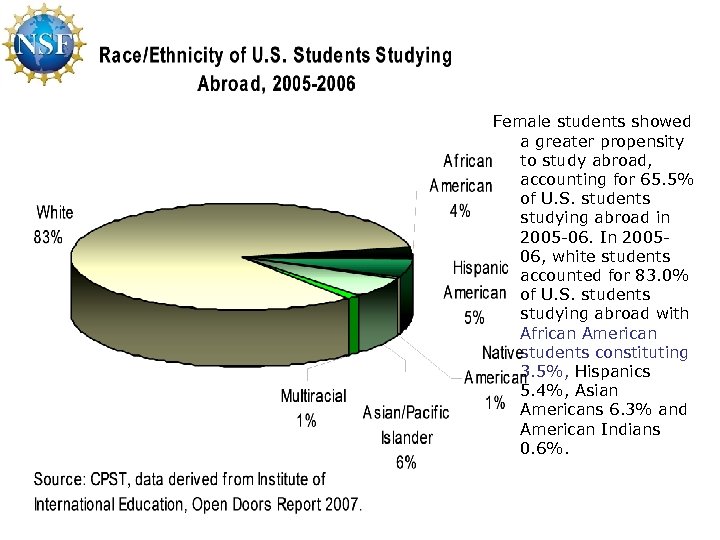
Female students showed a greater propensity to study abroad, accounting for 65. 5% of U. S. students studying abroad in 2005 -06. In 200506, white students accounted for 83. 0% of U. S. students studying abroad with African American students constituting 3. 5%, Hispanics 5. 4%, Asian Americans 6. 3% and American Indians 0. 6%.
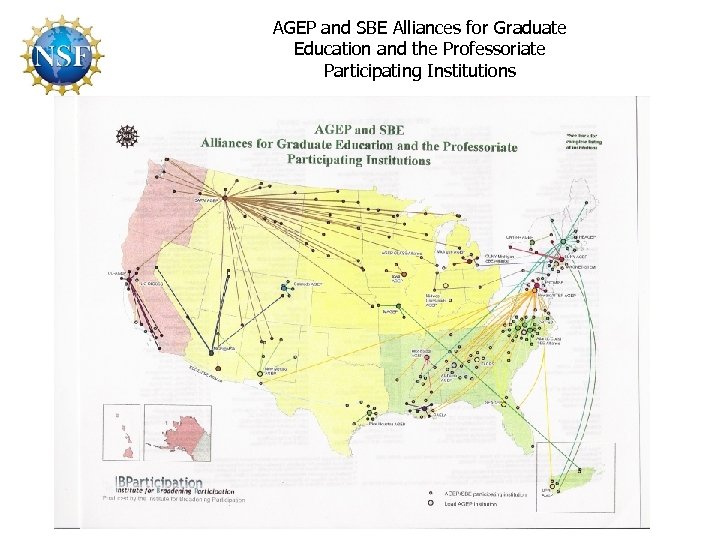
AGEP and SBE Alliances for Graduate Education and the Professoriate Participating Institutions
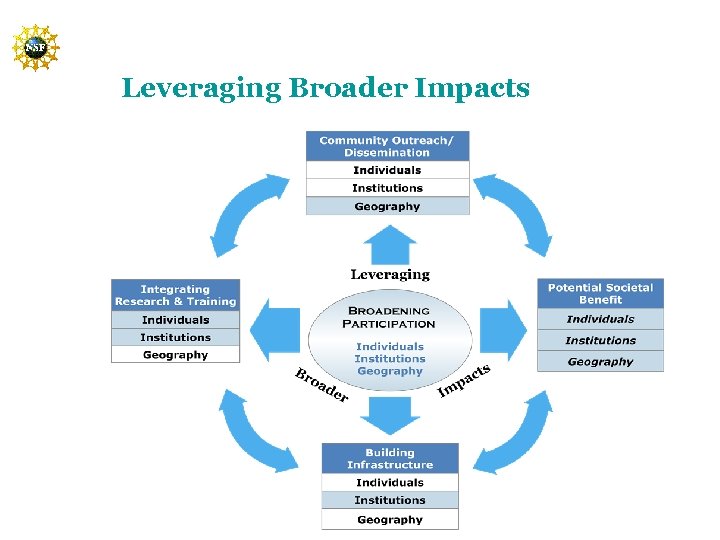
Leveraging Broader Impacts
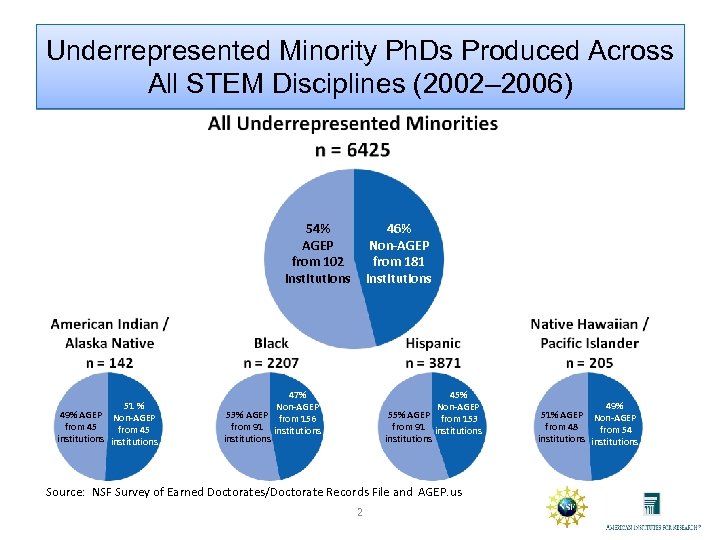
Underrepresented Minority Ph. Ds Produced Across All STEM Disciplines (2002– 2006) 54% AGEP from 102 institutions 51 % 49% AGEP Non-AGEP from 45 institutions 46% Non-AGEP from 181 institutions 47% Non-AGEP 53% AGEP from 156 from 91 institutions 45% Non-AGEP 55% AGEP from 153 from 91 institutions Source: NSF Survey of Earned Doctorates/Doctorate Records File and AGEP. us 2 49% 51% AGEP Non-AGEP from 48 from 54 institutions
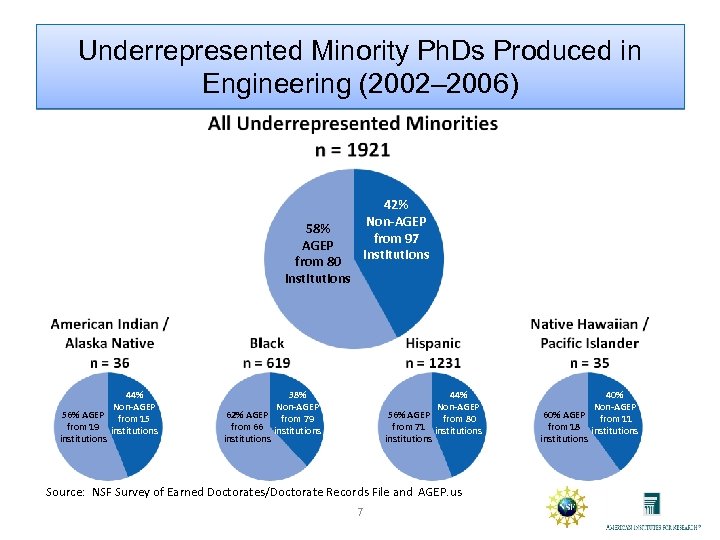
Underrepresented Minority Ph. Ds Produced in Engineering (2002– 2006) 42% Non-AGEP from 97 institutions 58% AGEP from 80 institutions 44% Non-AGEP 56% AGEP from 15 from 19 institutions 38% Non-AGEP 62% AGEP from 79 from 66 institutions 44% Non-AGEP 56% AGEP from 80 from 71 institutions Source: NSF Survey of Earned Doctorates/Doctorate Records File and AGEP. us 7 40% Non-AGEP 60% AGEP from 11 from 18 institutions
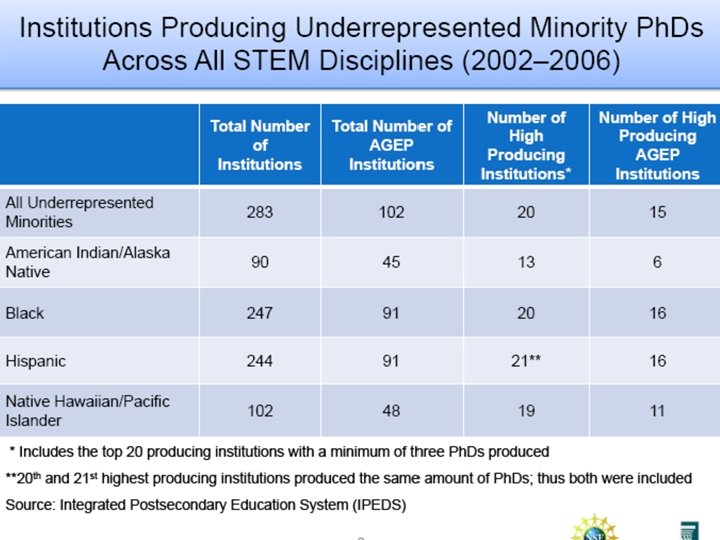
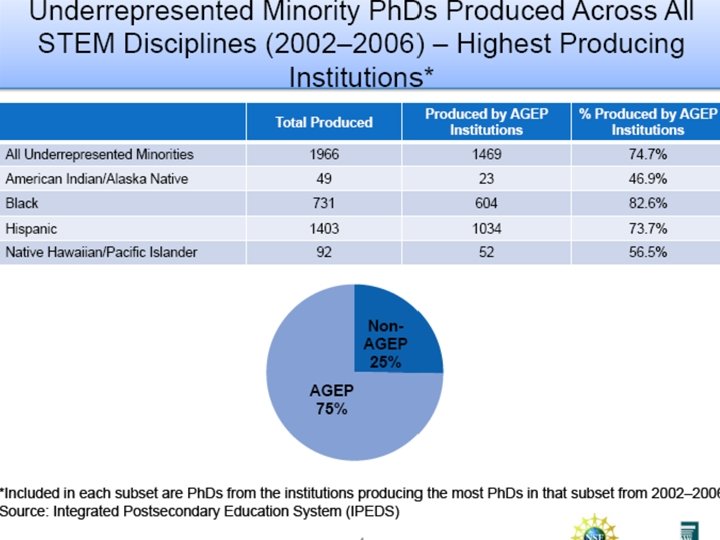
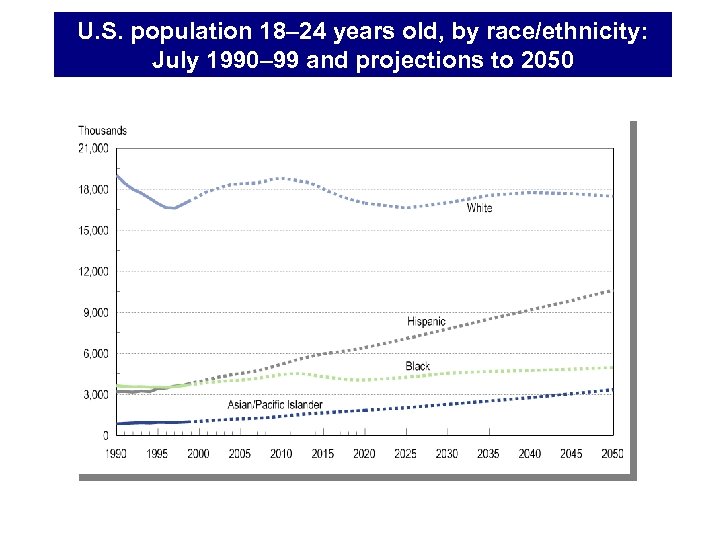
U. S. population 18– 24 years old, by race/ethnicity: July 1990– 99 and projections to 2050
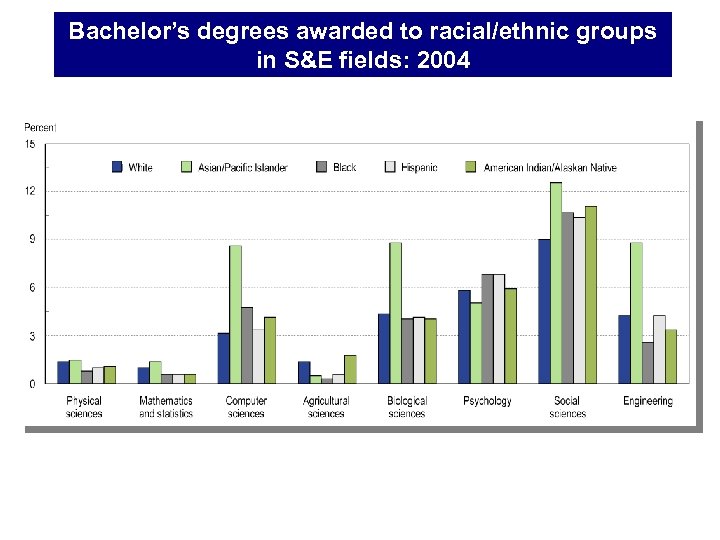
Bachelor’s degrees awarded to racial/ethnic groups in S&E fields: 2004
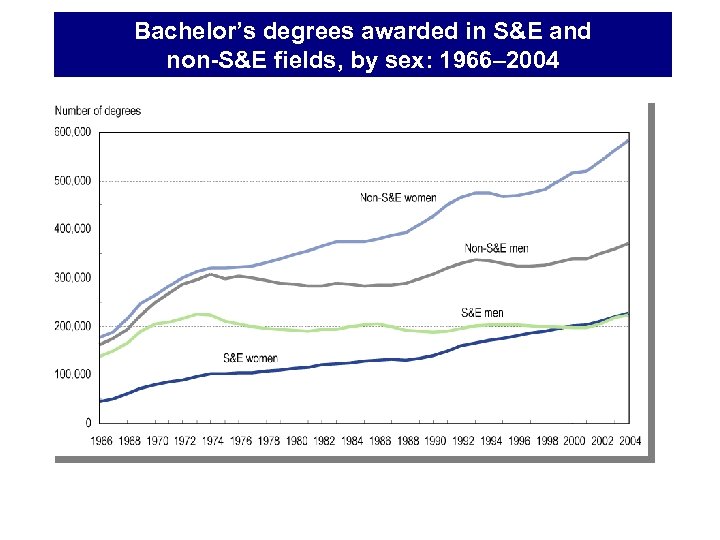
Bachelor’s degrees awarded in S&E and non-S&E fields, by sex: 1966– 2004
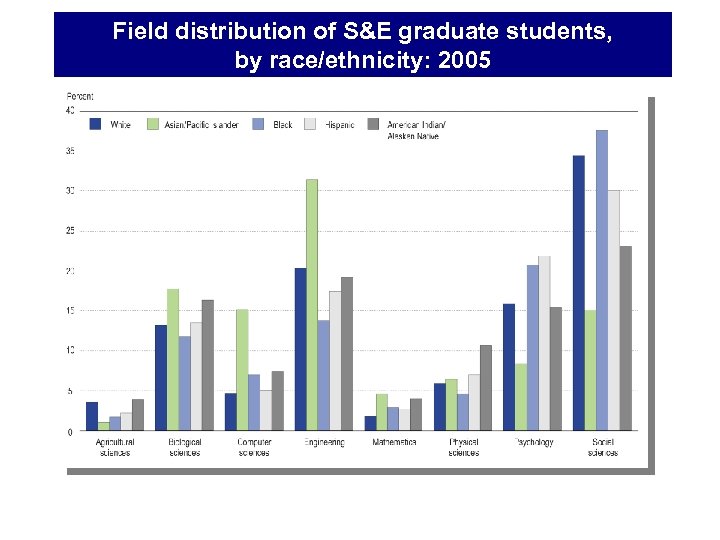
Field distribution of S&E graduate students, by race/ethnicity: 2005
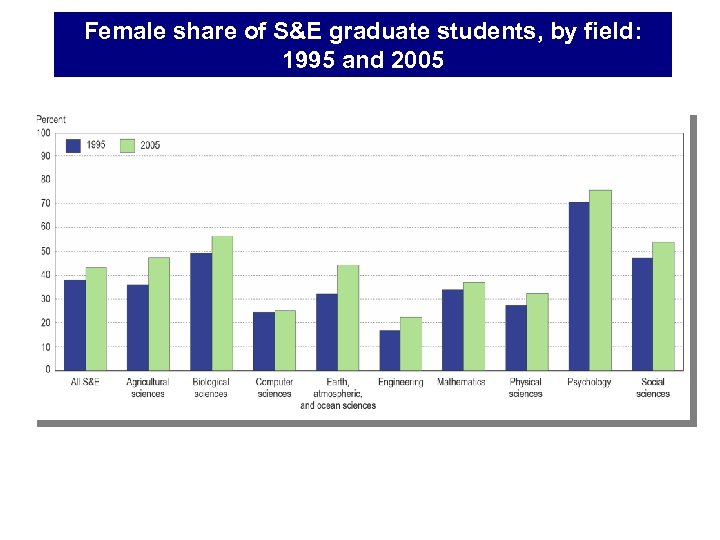
Female share of S&E graduate students, by field: 1995 and 2005
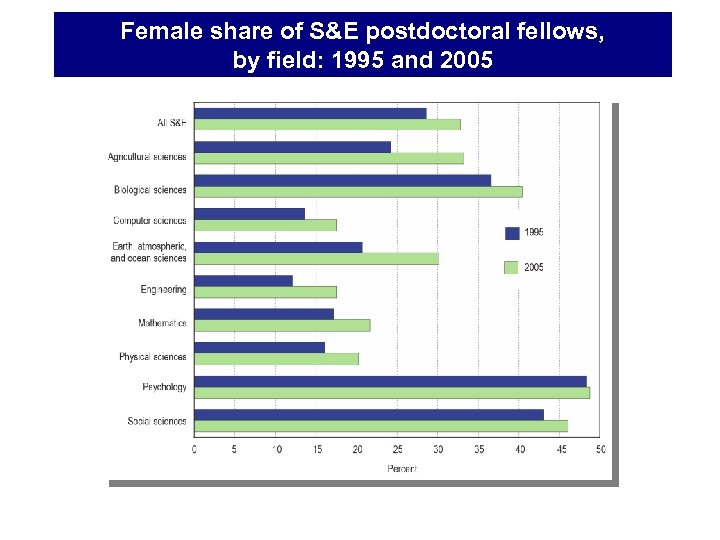
Female share of S&E postdoctoral fellows, by field: 1995 and 2005
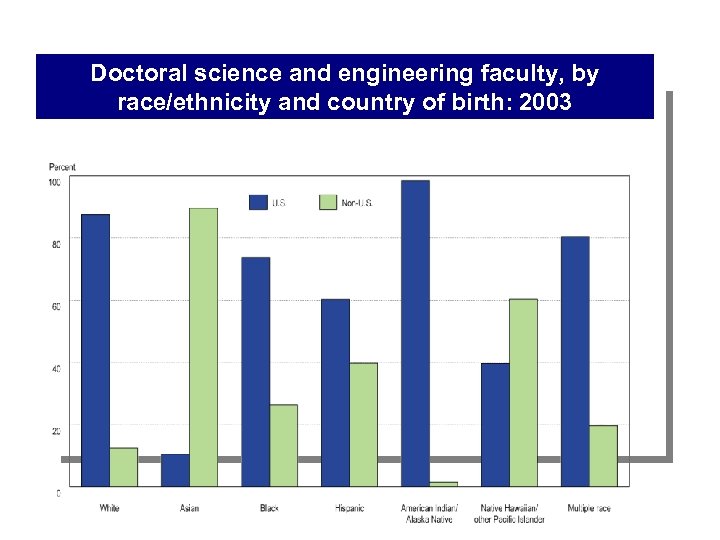
Doctoral science and engineering faculty, by race/ethnicity and country of birth: 2003
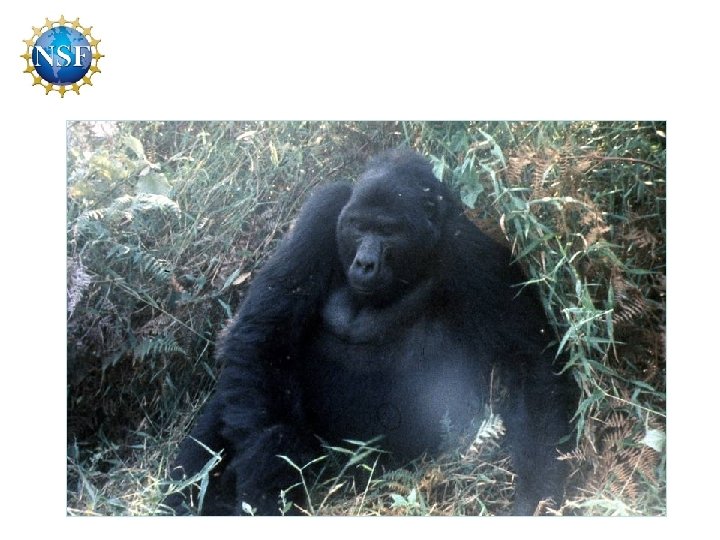
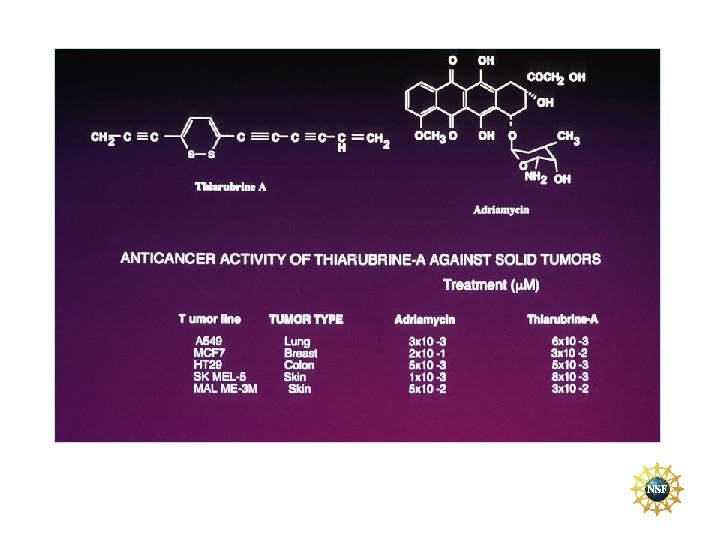
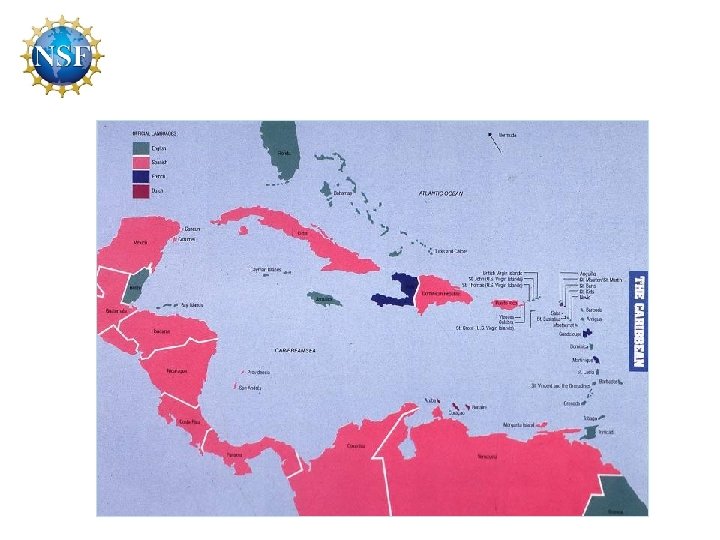
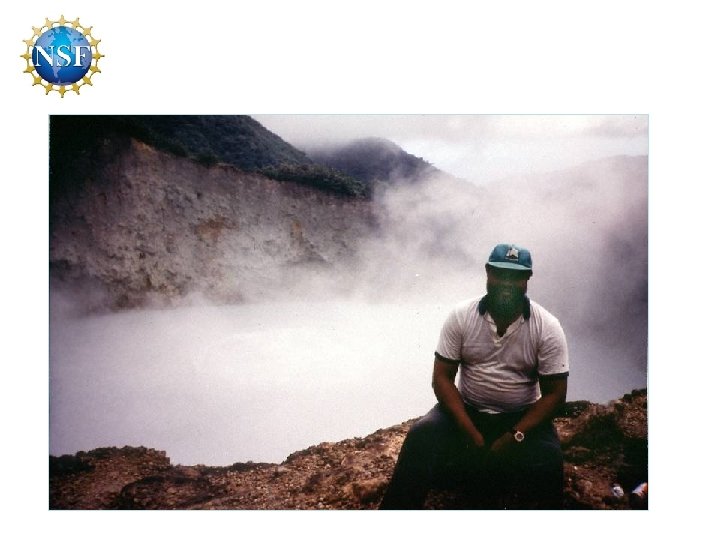
International Research Activities v Africa v Caribbean/Latin America v South America
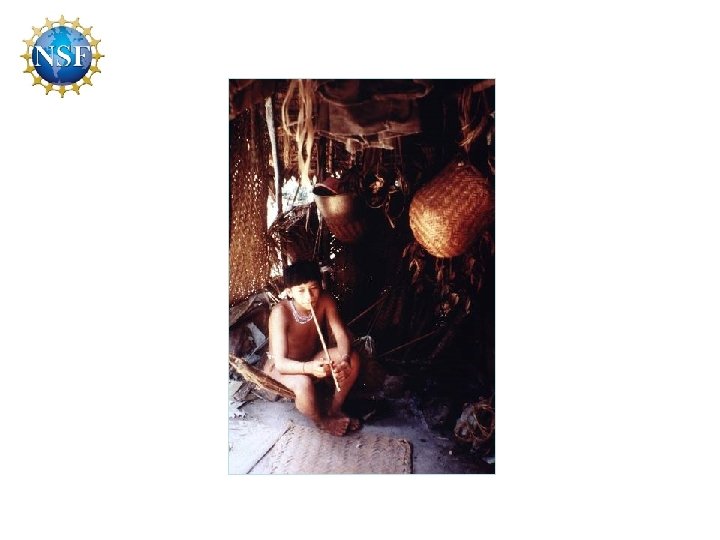
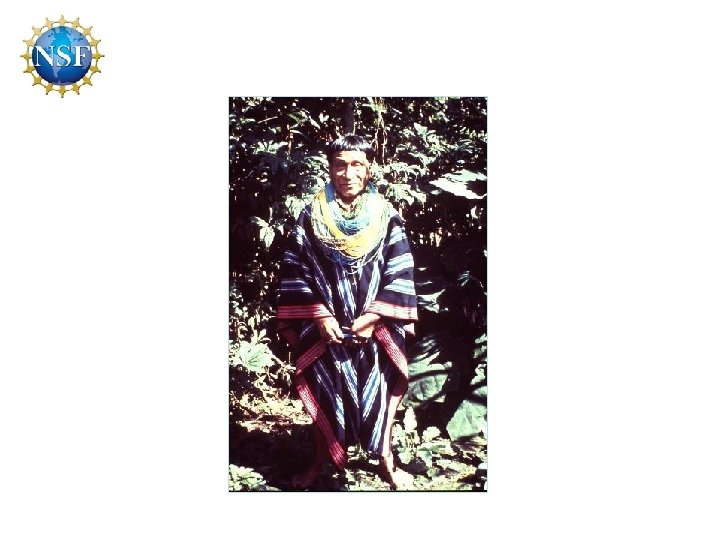

Successful Products of Future Workforce Development

Arlie O. Petters Professor of Mathematics, Physics, and Business Administration Duke University: Arts & Sciences and Fuqua School of Business Education: Ph. D. MIT, 1991 (Mathematics) Ph. D. thesis advisors: Bertram Kostant (MIT) and David Spergel (Princeton University) Ph. D. thesis title: Singularities in Gravitational Microlensing PRINCETON UNIVERSITY, 1988 -1991 (Exchange Scholar; in absentia from MIT) MIT, 1986 -1988 (Department of Mathematics); B. A. /M. A. HUNTER COLLEGE - C. U. N. Y. , 1986 (Mathematics and Physics) M. A. thesis title: The Mathematical Theory of General Relativity
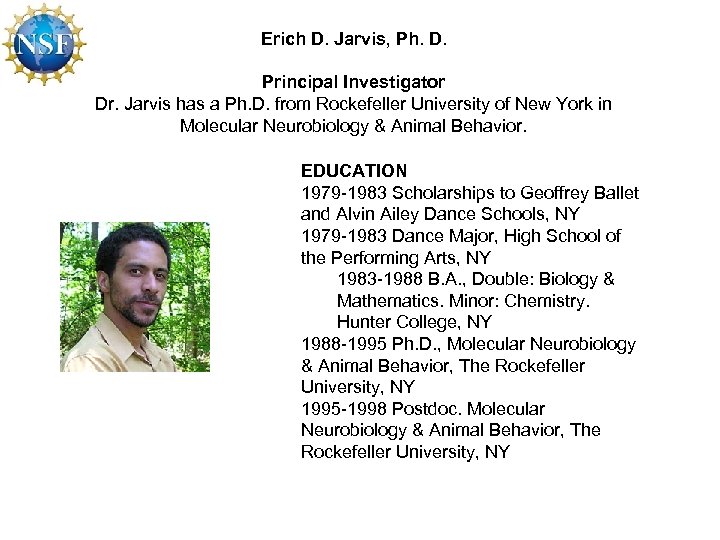
Erich D. Jarvis, Ph. D. Principal Investigator Dr. Jarvis has a Ph. D. from Rockefeller University of New York in Molecular Neurobiology & Animal Behavior. EDUCATION 1979 -1983 Scholarships to Geoffrey Ballet and Alvin Ailey Dance Schools, NY 1979 -1983 Dance Major, High School of the Performing Arts, NY 1983 -1988 B. A. , Double: Biology & Mathematics. Minor: Chemistry. Hunter College, NY 1988 -1995 Ph. D. , Molecular Neurobiology & Animal Behavior, The Rockefeller University, NY 1995 -1998 Postdoc. Molecular Neurobiology & Animal Behavior, The Rockefeller University, NY
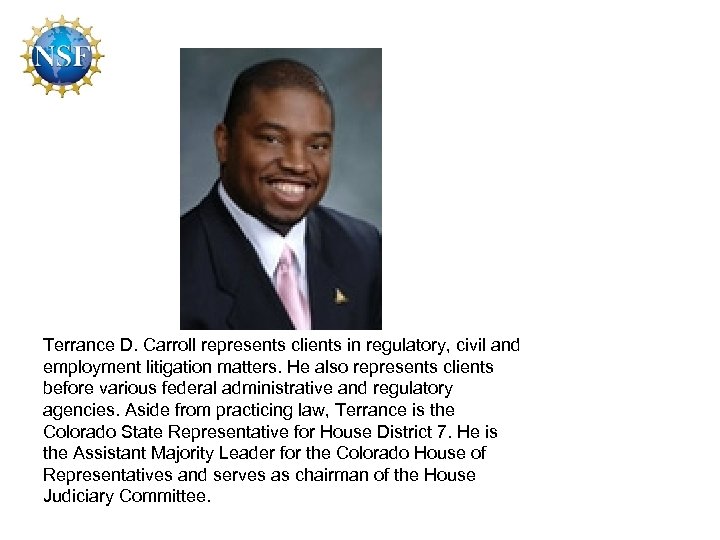
Terrance D. Carroll represents clients in regulatory, civil and employment litigation matters. He also represents clients before various federal administrative and regulatory agencies. Aside from practicing law, Terrance is the Colorado State Representative for House District 7. He is the Assistant Majority Leader for the Colorado House of Representatives and serves as chairman of the House Judiciary Committee.
STRATEGIC PLANNING &FUTURE DIRECTIONS q Full scale longitudinal evaluation of all HRD programs q Broadening participation & workforce issues are goals and endpoints for all HRD program objectives q Examine the role of community colleges in STEM student production for HRD programs q Create initiatives that close the gap on transition points in the development of STEM students through the professional pathway q Create and sustain collaborations within the NSF, with other federal agencies, and private organizations that enhance STEM workforce development q Create an globally competitive workforce
 Скачать презентацию National Science Foundation and Broadening Participation Engineering Workforce
3f9b1f6fb349e3ead0395d3ff15d1036.ppt