


 Скачать презентацию National Response Plan Intervention Options Various Scenarios
79aad3bc0cea1b37cdd1809fcc642ec5.ppt
- Количество слайдов: 24
 National Response Plan
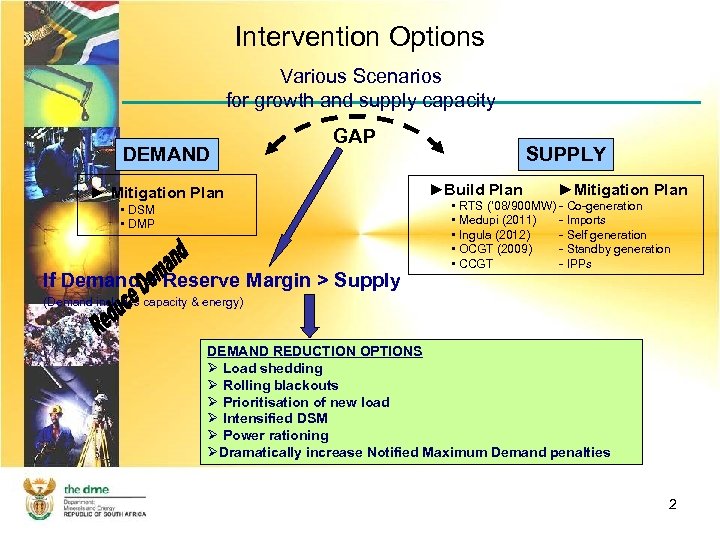 Intervention Options Various Scenarios for growth and supply capacity DEMAND GAP ► Mitigation Plan • DSM • DMP If Demand + Reserve Margin > Supply SUPPLY ►Build Plan ►Mitigation Plan • RTS (’ 08/900 MW) - Co-generation • Medupi (2011) - Imports • Ingula (2012) - Self generation • OCGT (2009) - Standby generation • CCGT - IPPs (Demand includes capacity & energy) DEMAND REDUCTION OPTIONS Ø Load shedding Ø Rolling blackouts Ø Prioritisation of new load Ø Intensified DSM Ø Power rationing ØDramatically increase Notified Maximum Demand penalties 2
 Supply or Demand Side? • The Capacity Expansion programme will solve the supply problem in the long run (5 -8 years). • In the Short term, Demand Side Management is the only real option, specifically curtailment of Demand in the immediate term. 3
 Demand Side Options • Most of the Demand Side Management (DSM) Consumer Behavioural Options need immediate implementation, but the effects take time to manifest on the system • A Power Rationing Program is the only immediate term “quick hit” solution that will reduce and, depending on its success negate the need for load shedding 4
 Interventions 5
 Intervention Timeframes • Immediate (6 months) • Medium Term (18 months) • Long Term (more than 18 months) 6
 Intervention Plan • Immediate implementation of a Power Rationing Programme • Immediate implementation of a number of specific Demand Side Behavioural Change programs • Renewed Focus and Emphasis on Medium Term and Long Term initiatives • Multi-stakeholder Task Team has been set up to manage the situation and drive the Intervention Plan) 7
 Proposed Demand Side Intervention Plan • Immediate implementation – within 6 months: o Power Rationing Programme o Demand Side Behavioural Change programs v v v v Aggressive Energy Efficiency in Government and State. Owned Enterprises’ Buildings Restrict Sale of Incandescent Lightbulbs National Housing Specifications (Water Heating) National Housing Specifications (Building Standards) National Efficient Lighting Programme National Solar Water Heating Programme Intensive Consumer Awareness Campaign (proper Load Shedding communication as well as general energy savings) Revision of Load Shedding Protocols o Multi-stakeholder Task Team to manage the situation and drive the Intervention Plan 8
 Proposed Demand Side Intervention Plan • Medium Term to Long Term – up to 18 months o Residential Time-of-Use Tariffs o o De-marketing of Residential Cooking Load to Gas Traffic Lights o Public Lighting o Hospitality Industry o Revision of EEDSM Policy o Pro-poor Cost Reflective Tariffs o EIA Fast-tracking 9
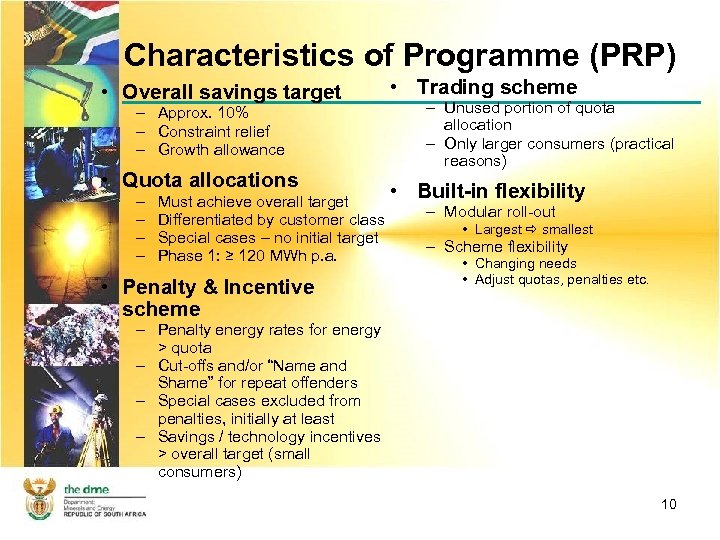 Characteristics of Programme (PRP) • Overall savings target – Approx. 10% – Constraint relief – Growth allowance • Quota allocations – – Must achieve overall target Differentiated by customer class Special cases – no initial target Phase 1: ≥ 120 MWh p. a. • Penalty & Incentive scheme • Trading scheme – Unused portion of quota allocation – Only larger consumers (practical reasons) • Built-in flexibility – Modular roll-out • Largest smallest – Scheme flexibility • Changing needs • Adjust quotas, penalties etc. – Penalty energy rates for energy > quota – Cut-offs and/or “Name and Shame” for repeat offenders – Special cases excluded from penalties, initially at least – Savings / technology incentives > overall target (small consumers) 10
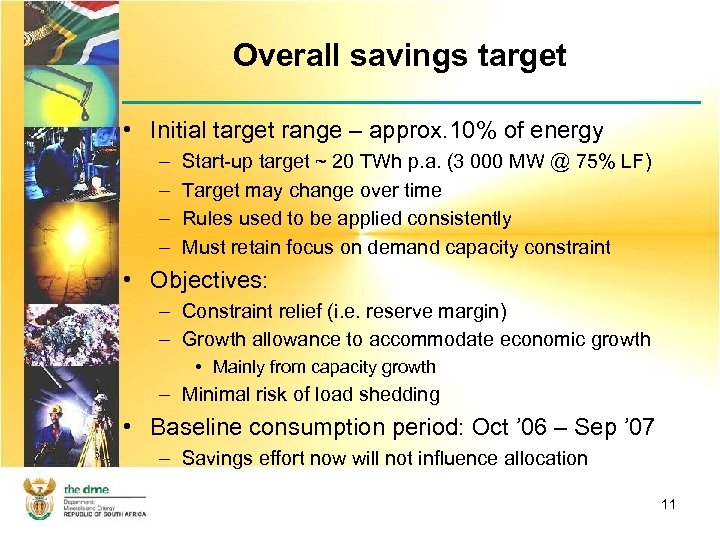 Overall savings target • Initial target range – approx. 10% of energy – – Start-up target ~ 20 TWh p. a. (3 000 MW @ 75% LF) Target may change over time Rules used to be applied consistently Must retain focus on demand capacity constraint • Objectives: – Constraint relief (i. e. reserve margin) – Growth allowance to accommodate economic growth • Mainly from capacity growth – Minimal risk of load shedding • Baseline consumption period: Oct ’ 06 – Sep ’ 07 – Savings effort now will not influence allocation 11
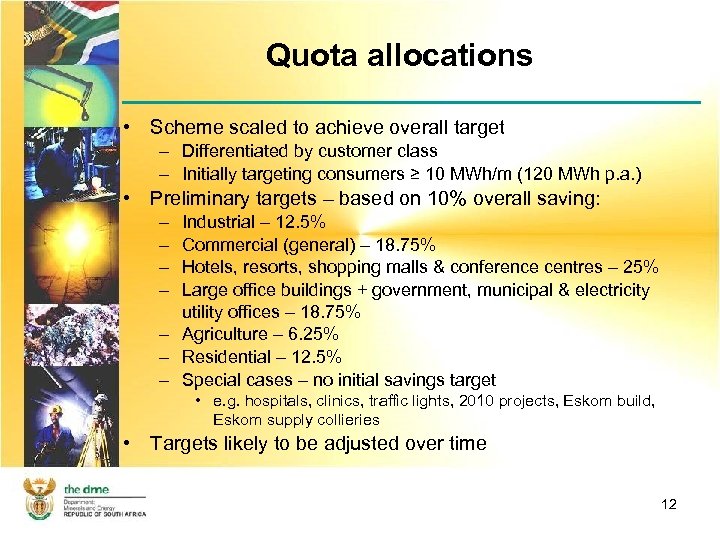 Quota allocations • Scheme scaled to achieve overall target – Differentiated by customer class – Initially targeting consumers ≥ 10 MWh/m (120 MWh p. a. ) • Preliminary targets – based on 10% overall saving: – – Industrial – 12. 5% Commercial (general) – 18. 75% Hotels, resorts, shopping malls & conference centres – 25% Large office buildings + government, municipal & electricity utility offices – 18. 75% – Agriculture – 6. 25% – Residential – 12. 5% – Special cases – no initial savings target • e. g. hospitals, clinics, traffic lights, 2010 projects, Eskom build, Eskom supply collieries • Targets likely to be adjusted over time 12
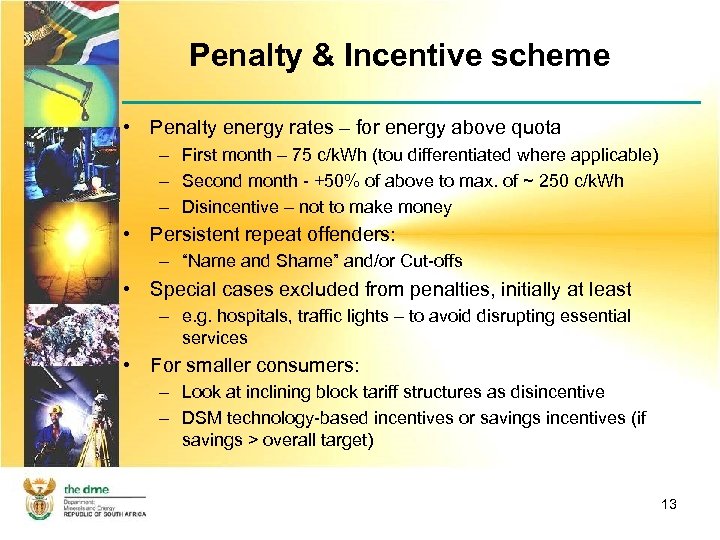 Penalty & Incentive scheme • Penalty energy rates – for energy above quota – First month – 75 c/k. Wh (tou differentiated where applicable) – Second month - +50% of above to max. of ~ 250 c/k. Wh – Disincentive – not to make money • Persistent repeat offenders: – “Name and Shame” and/or Cut-offs • Special cases excluded from penalties, initially at least – e. g. hospitals, traffic lights – to avoid disrupting essential services • For smaller consumers: – Look at inclining block tariff structures as disincentive – DSM technology-based incentives or savings incentives (if savings > overall target) 13
 Trading scheme • Aimed at optimal allocation of scarce resource • If consumers can save > their targets – Can offer “unused” portion of quota allocation – To be purchased by other consumers prepared to pay the price • Applicable only to larger consumers – For practical reasons – May be extended over time • Eskom & other generators may trade in the market – To achieve of optimal market balance – Limited market access to avoid manipulation 14
 Built-in flexibility • Modular roll-out possibilities – – Eskom first, followed by metros, then other municipalities Largest customers first, smallest last Target: All consumers ≥ 10 MWh / month by Sep ’ 08 Smaller consumers later to permit system adaptation, etc. • Scheme flexibility is critical: – “Right first time” unrealistic – To deal with special circumstances, e. g. FIFA 2010 • Key areas of flexibility: – – – Overall savings target Quota allocations Penalty scheme & rates Incentives Trading “rights” 15
 Energy efficiency regulations q. Prohibitions in respect of lighting q. Prohibitions in respect of water heating in commercial and residential buildings, to be in place not later than year 2010 q. Norms and Standards for reticulations services 16
 Definitions “Dwelling” refers to a house, flat, townhouse or any other building used for residential purpose. “The Act” refers to the Electricity Regulation Act of 2006 as amended 17
 Prohibitions in respect of lighting with immediate effect Use of incandescent lights Lighting of unoccupied buildings especially after working hours Lighting of streets and highways during broad day light Disposal of lights that containing mercury in a manner which adversely impact the environment 18
 Prohibitions in respect of water heating in commercial and residential buildings with immediate effect Installation of electric geyser that does not incorporate solar water heating facility to new dwelling with a value exceeding R 750 000; and Not withstanding the price, installation of an electric geyser without a facility for solar water heating facility to new dwelling with more than 300 m 2 The installation new geyser without geyser insulation to dwellings below R 750 000 or dwellings above 300 m 2 19
 Prohibitions in respect of water heating in commercial and residential buildings, to be completed not later the year 2010 Installation of an electric geyser that does not incorporate solar heating facility to office blocks, hostels, resorts and shopping complexes feeding from centralised water heating systems; An electric geyser without a facility for the licensee to remotely control its supply of electricity 20
 Prohibitions in respect of space heating, ventilation and cooling in commercial and residential buildings, to be completed not later than the year 2010 Heating, ventilation and cooling system without a facility for the licensee to remotely control its supply of electricity A swimming pool drive and heating system without a facility for the licensee to remotely control its supply of electricity 21
 Norms and Standards for reticulation service in terms of the Electricity Regulation Amendment Act All streets must be fitted with an energy efficient bulbs A municipality may pass by-laws prohibiting any other activity in respect of energy efficiency complementing these regulations End user or customer with monthly consumption of 500 k. Wh and above must be on time of use tariff not later than the year 2010 22
 Conclusion These regulations were proposed to assist energy efficiency These regulations will further be supported by rationing framework to be proposed in due course The proposed regulations are available on the DME website (www. dme. gov. za) comment The closing date for comments is 25 February 2008 23
 I Thank You