 Скачать презентацию National Public Health Strategy for Terrorism Preparedness and
945f9ed01b46cae0beca19fcf437d90c.ppt
- Количество слайдов: 12



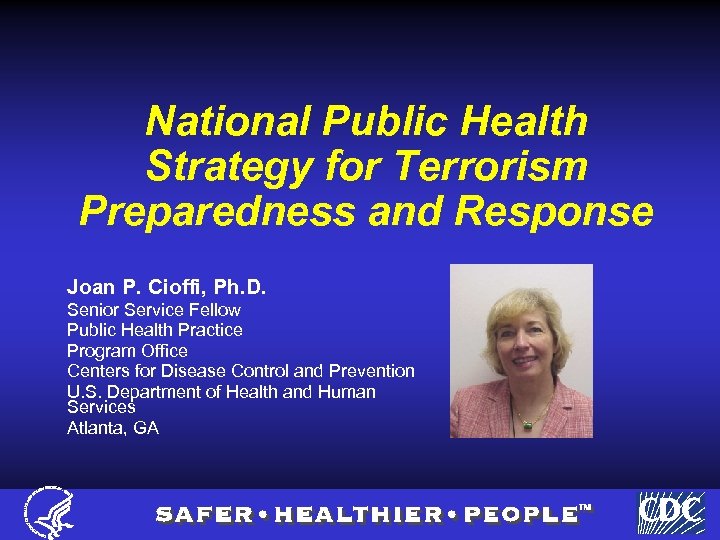
National Public Health Strategy for Terrorism Preparedness and Response Joan P. Cioffi, Ph. D. Senior Service Fellow Public Health Practice Program Office Centers for Disease Control and Prevention U. S. Department of Health and Human Services Atlanta, GA
CDC: National Public Health Strategy for Terrorism Preparedness and Response +Strategic Imperative: “a competent and sustainable workforce” +Implementation: !State and local grant program !CDC-directed education/training !Partnerships
State and Local Grantee Education and Training +Grantees include: 50 states, D. C. , NYC, LA, Chicago and 8 territories +Education/training part of all 7 focus areas +52% grantees completed needs assessments in FY 2003 +FY 2004 – most grantees planned distinct training interventions to address needs ( Range: 10 - 67) +Next steps !Disseminate best practices !Use performance indicators; exercises/drills to refine training plans
Leveraging Partnerships +Centers for Public Health Preparedness 23 academic centers (Schools of Public Health) !13 specialty centers ( School of Medicine, Nursing, Veterinary Medicine, Law) +Clinician Outreach !Association of American Medical Colleges (AAMC) and 8 specialty !
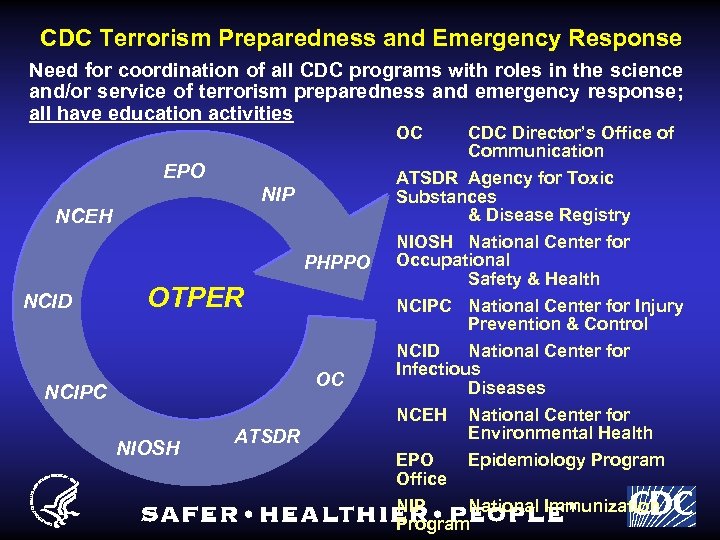
CDC Terrorism Preparedness and Emergency Response Need for coordination of all CDC programs with roles in the science and/or service of terrorism preparedness and emergency response; all have education activities OC EPO NIP NCEH PHPPO NCID OTPER OC NCIPC CDC Director’s Office of Communication ATSDR Agency for Toxic Substances & Disease Registry NIOSH National Center for Occupational Safety & Health NCIPC National Center for Injury Prevention & Control NCID National Center for Infectious Diseases NCEH NIOSH National Center for Environmental Health EPO Office Epidemiology Program ATSDR NIP National Immunization Program
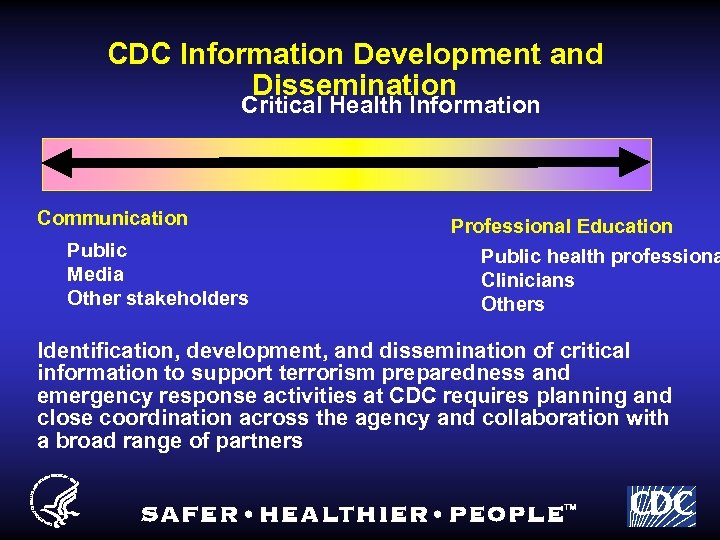
CDC Information Development and Dissemination Critical Health Information Communication Public Media Other stakeholders Professional Education Public health professiona Clinicians Others Identification, development, and dissemination of critical information to support terrorism preparedness and emergency response activities at CDC requires planning and close coordination across the agency and collaboration with a broad range of partners
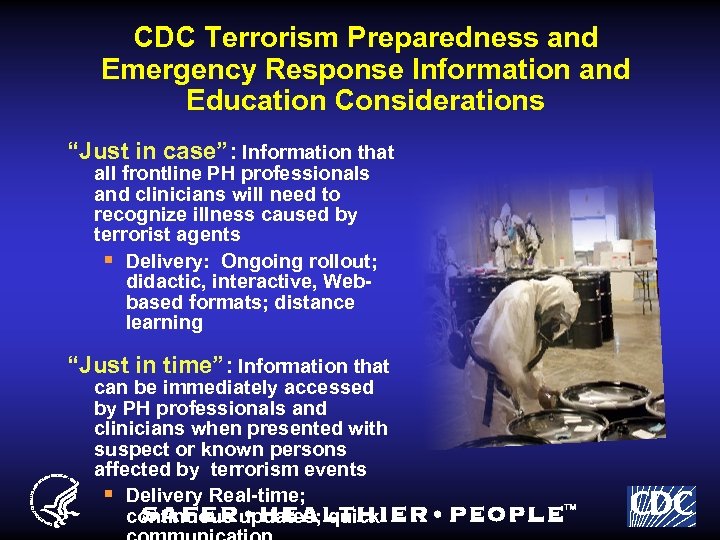
CDC Terrorism Preparedness and Emergency Response Information and Education Considerations “Just in case”: Information that all frontline PH professionals and clinicians will need to recognize illness caused by terrorist agents § Delivery: Ongoing rollout; didactic, interactive, Webbased formats; distance learning “Just in time”: Information that can be immediately accessed by PH professionals and clinicians when presented with suspect or known persons affected by terrorism events § Delivery Real-time; continuous updates; quick
Resources +www. cdc. gov +Lynn Steele, Senior Advisor for Education and Training, OTPER/CDC !LSteele@cdc. gov
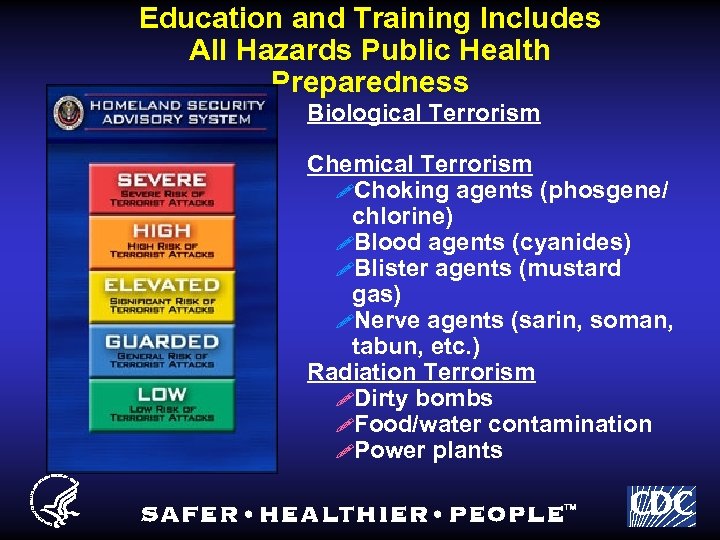
Education and Training Includes All Hazards Public Health Preparedness Biological Terrorism Chemical Terrorism !Choking agents (phosgene/ chlorine) !Blood agents (cyanides) !Blister agents (mustard gas) !Nerve agents (sarin, soman, tabun, etc. ) Radiation Terrorism !Dirty bombs !Food/water contamination !Power plants
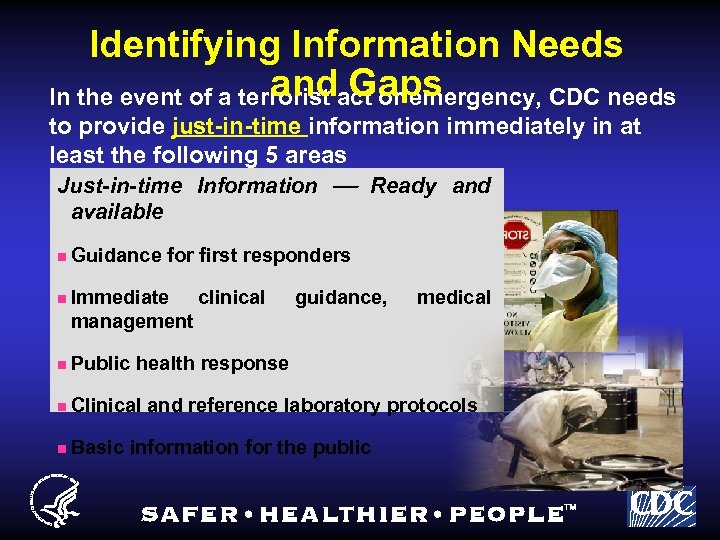
Identifying Information Needs and Gaps In the event of a terrorist act or emergency, CDC needs to provide just-in-time information immediately in at least the following 5 areas Just-in-time Information Ready and available n Guidance for first responders n Immediate clinical guidance, medical management n Public health response n Clinical n Basic and reference laboratory protocols information for the public
Refining a Terrorism Preparedness Education Strategy Questions to Consider: § What have we learned from the needs assessments? § How can we minimize redundancy of materials? Can we consolidate/standardize? § What actions can be taken to ensure consistent, accurate information? Quality education? § What is the impact of education? How do we know that learning has occurred? What evaluation programs are/should be in place? § Where are the content gaps in training and education materials? In audiences reached? § Can we better coordinate resources for
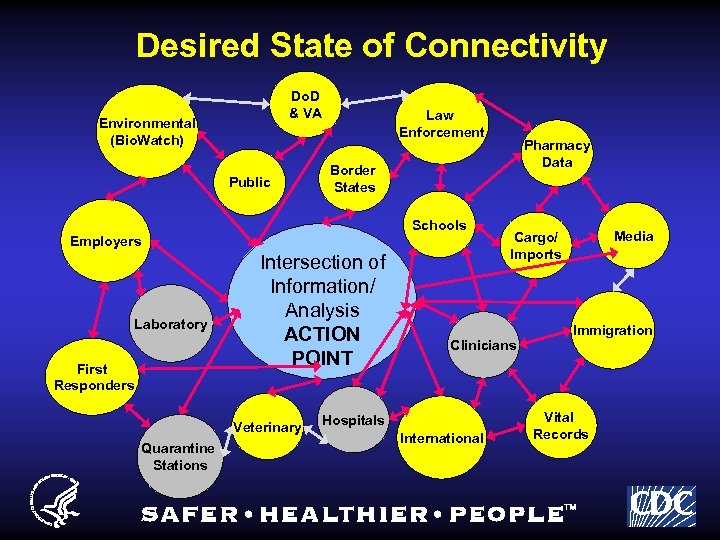
Desired State of Connectivity Do. D & VA Environmental (Bio. Watch) Public Law Enforcement Border States Schools Employers Laboratory First Responders Intersection of Information/ Analysis ACTION POINT Veterinary Quarantine Stations Pharmacy Data Clinicians Hospitals International Media Cargo/ Imports Immigration Vital Records
Скачать презентацию National Public Health Strategy for Terrorism Preparedness and
945f9ed01b46cae0beca19fcf437d90c.ppt