


 Скачать презентацию National Petroleum Council Natural Gas Demand Natural
98a14161d431fc0d67e6f196d7ea0866.ppt
- Количество слайдов: 56
 National Petroleum Council Natural Gas Demand
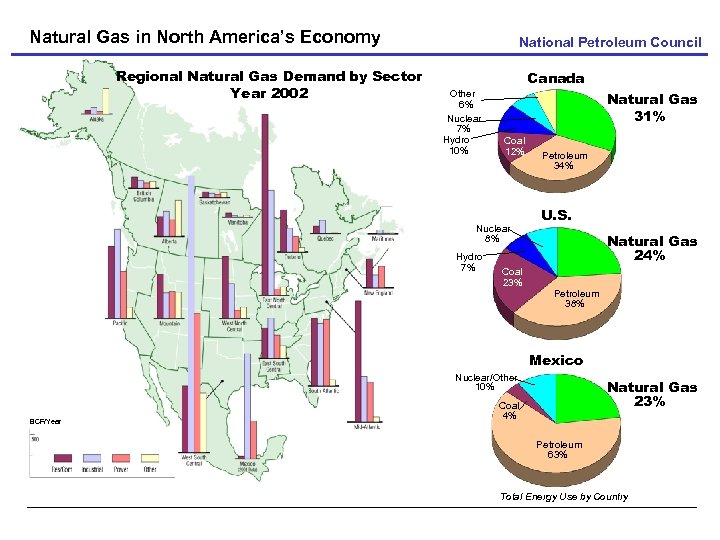 Natural Gas in North America’s Economy Regional Natural Gas Demand by Sector Year 2002 National Petroleum Council Canada Other 6% Nuclear 7% Hydro 10% Natural Gas 31% Coal 12% Nuclear 8% Hydro 7% Coal 23% Petroleum 34% U. S. Natural Gas 24% Petroleum 38% Mexico Nuclear/Other 10% Natural Gas 23% Coal 4% BCF/Year Petroleum 63% Total Energy Use by Country
 Demand Task Group Approach National Petroleum Council • Develop a sector-by-sector demand picture • Analyze existing and future electric power • Assess industrial process energy and raw materials • Evaluate the role of energy efficiency in all sectors • Integrate U. S. & Canadian demand; Mexico modeled as net export/import
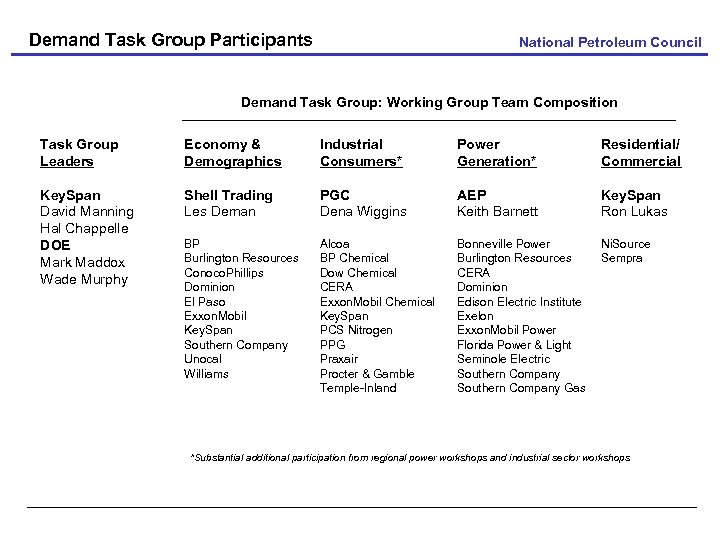 Demand Task Group Participants National Petroleum Council Demand Task Group: Working Group Team Composition Task Group Leaders Economy & Demographics Industrial Consumers* Power Generation* Residential/ Commercial Key. Span David Manning Hal Chappelle DOE Mark Maddox Wade Murphy Shell Trading Les Deman PGC Dena Wiggins AEP Keith Barnett Key. Span Ron Lukas BP Burlington Resources Conoco. Phillips Dominion El Paso Exxon. Mobil Key. Span Southern Company Unocal Williams Alcoa BP Chemical Dow Chemical CERA Exxon. Mobil Chemical Key. Span PCS Nitrogen PPG Praxair Procter & Gamble Temple-Inland Bonneville Power Burlington Resources CERA Dominion Edison Electric Institute Exelon Exxon. Mobil Power Florida Power & Light Seminole Electric Southern Company Gas Ni. Source Sempra *Substantial additional participation from regional power workshops and industrial sector workshops
 Findings on Natural Gas Demand National Petroleum Council Greater energy efficiency and conservation are vital near-term and long-term mechanisms for moderating price levels and reducing volatility Power generators and industrial consumers are more dependent on gas-fired equipment and less able to respond to higher gas prices by utilizing alternate sources of energy Gas consumption will grow, but such growth will be moderated as the most price-sensitive industries become less competitive, causing some industries and associated jobs to relocate outside North America
 Recommendations Related to Natural Gas Demand National Petroleum Council Objective: Improve demand flexibility and efficiency Recommendation #1 Encourage Increased Efficiency and Conservation through Market-Oriented Initiatives and Consumer Education Recommendation #2 Increase Industrial and Power Generation Capability to Utilize Alternate Fuels
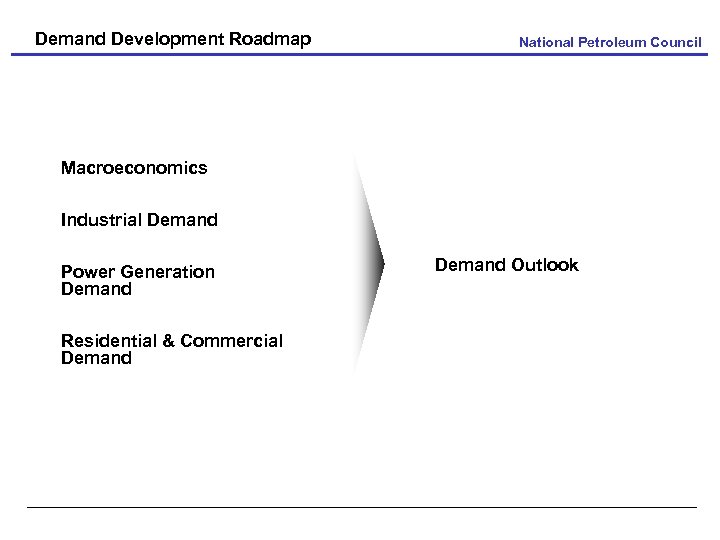 Demand Development Roadmap National Petroleum Council Macroeconomics Industrial Demand Power Generation Demand Residential & Commercial Demand Outlook
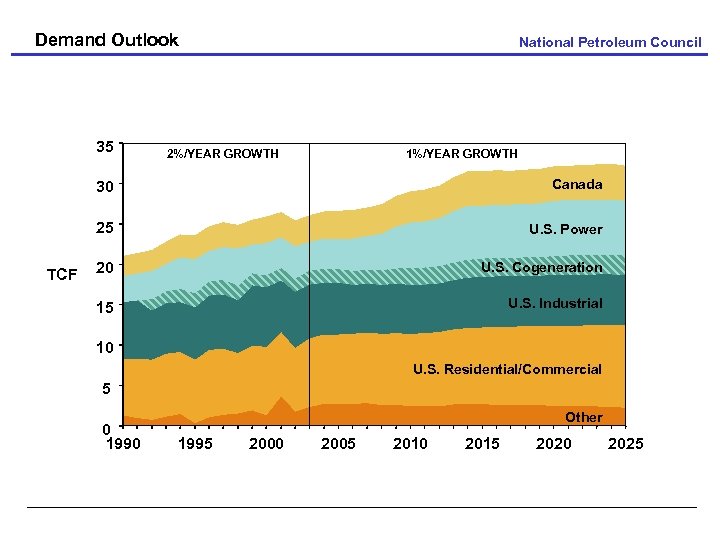 Demand Outlook 35 National Petroleum Council 2%/YEAR GROWTH 1%/YEAR GROWTH 30 25 TCF Canada U. S. Power 20 U. S. Cogeneration 15 U. S. Industrial 10 U. S. Residential/Commercial 5 0 1990 Other 1995 2000 2005 2010 2015 2020 2025
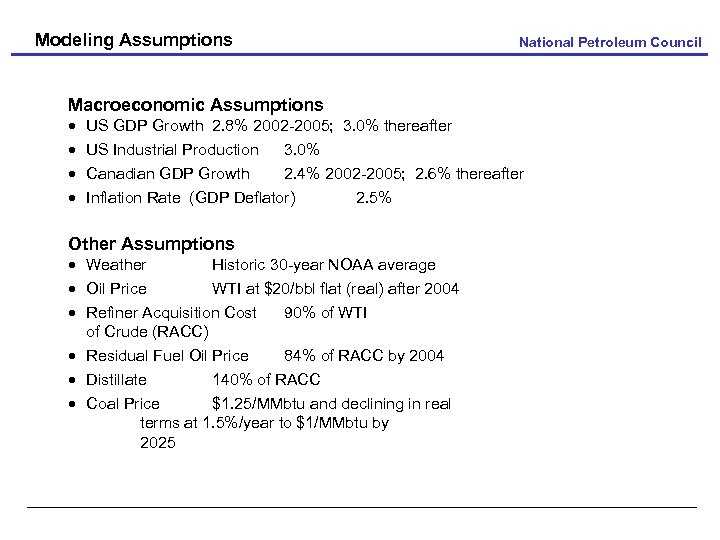 Modeling Assumptions National Petroleum Council Macroeconomic Assumptions · · US GDP Growth 2. 8% 2002 -2005; 3. 0% thereafter US Industrial Production 3. 0% Canadian GDP Growth 2. 4% 2002 -2005; 2. 6% thereafter Inflation Rate (GDP Deflator) Other Assumptions 2. 5% · Weather Historic 30 -year NOAA average · Oil Price WTI at $20/bbl flat (real) after 2004 · Refiner Acquisition Cost 90% of WTI of Crude (RACC) · Residual Fuel Oil Price 84% of RACC by 2004 · Distillate 140% of RACC · Coal Price $1. 25/MMbtu and declining in real terms at 1. 5%/year to $1/MMbtu by 2025
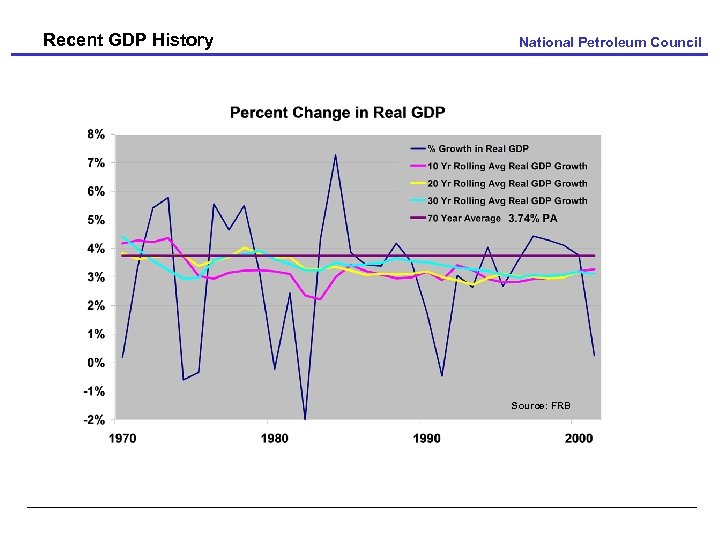 Recent GDP History National Petroleum Council Source: FRB
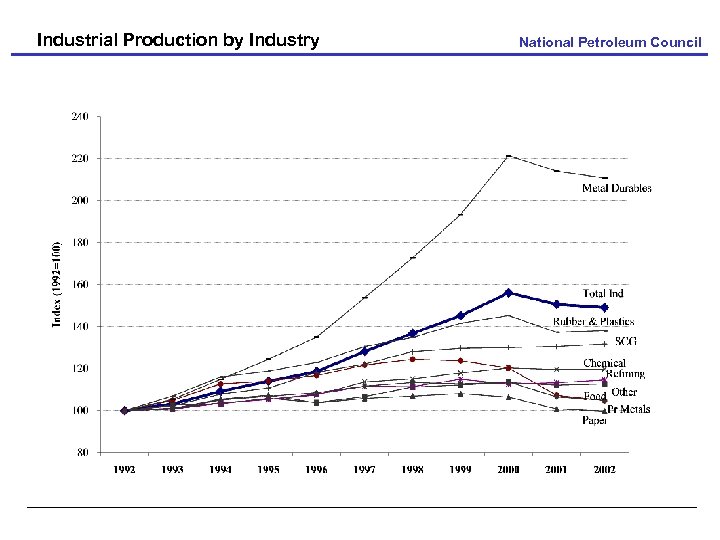 Industrial Production by Industry National Petroleum Council
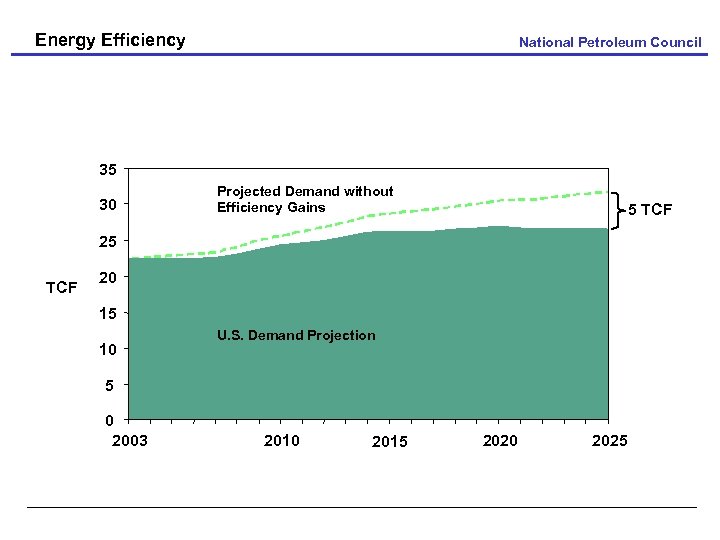 Energy Efficiency National Petroleum Council 35 30 Projected Demand without Efficiency Gains 5 TCF 20 15 10 U. S. Demand Projection 5 0 2003 2010 2015 2020 2025
 National Petroleum Council Industrial Demand
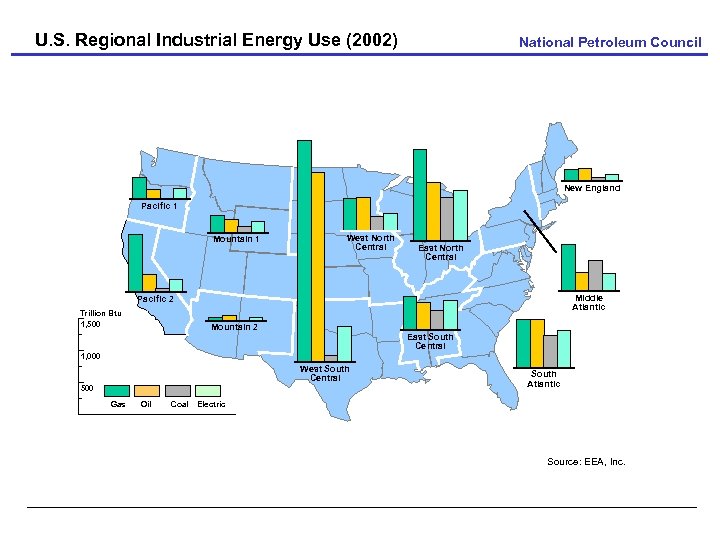 U. S. Regional Industrial Energy Use (2002) National Petroleum Council New England Pacific 1 Mountain 1 West North Central East North Central Middle Atlantic Pacific 2 Trillion Btu 1, 500 Mountain 2 East South Central 1, 000 West South Central 500 Gas Oil South Atlantic Coal Electric Source: EEA, Inc.
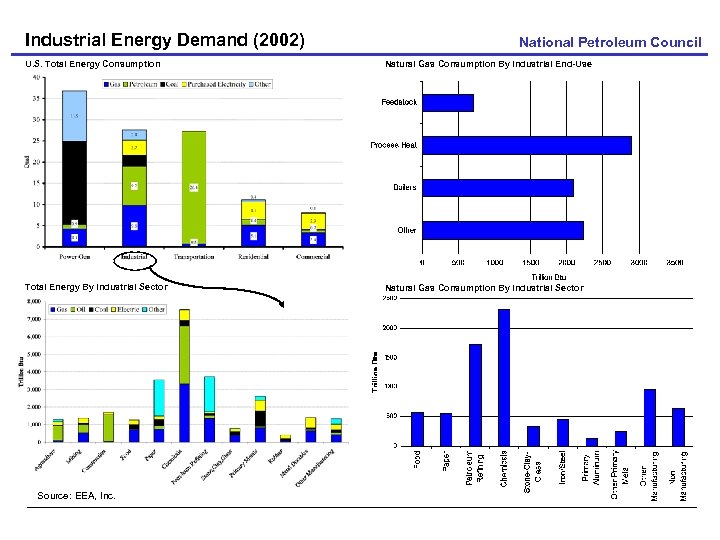 Industrial Energy Demand (2002) National Petroleum Council U. S. Total Energy Consumption Natural Gas Consumption By Industrial End-Use Total Energy By Industrial Sector Natural Gas Consumption By Industrial Sector Source: EEA, Inc.
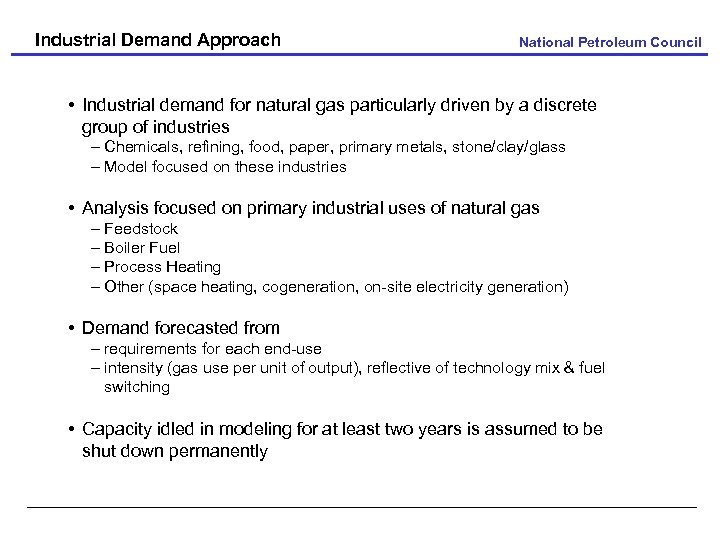 Industrial Demand Approach National Petroleum Council • Industrial demand for natural gas particularly driven by a discrete group of industries – Chemicals, refining, food, paper, primary metals, stone/clay/glass – Model focused on these industries • Analysis focused on primary industrial uses of natural gas – Feedstock – Boiler Fuel – Process Heating – Other (space heating, cogeneration, on-site electricity generation) • Demand forecasted from – requirements for each end-use – intensity (gas use per unit of output), reflective of technology mix & fuel switching • Capacity idled in modeling for at least two years is assumed to be shut down permanently
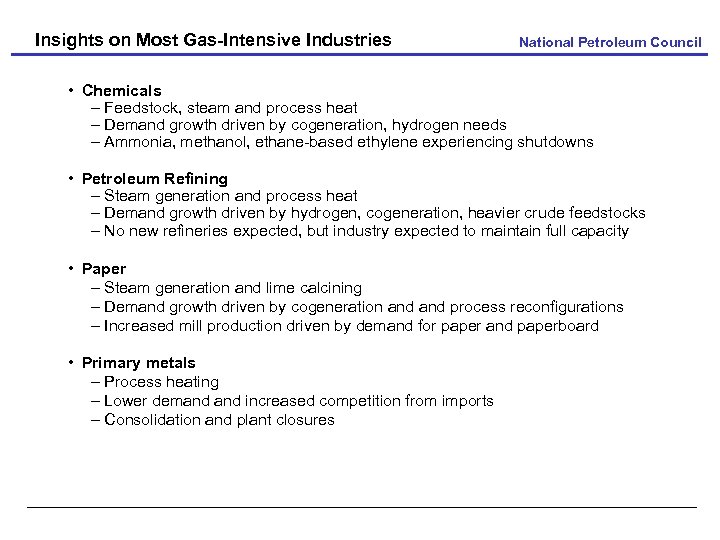 Insights on Most Gas-Intensive Industries National Petroleum Council • Chemicals – Feedstock, steam and process heat – Demand growth driven by cogeneration, hydrogen needs – Ammonia, methanol, ethane-based ethylene experiencing shutdowns • Petroleum Refining – Steam generation and process heat – Demand growth driven by hydrogen, cogeneration, heavier crude feedstocks – No new refineries expected, but industry expected to maintain full capacity • Paper – Steam generation and lime calcining – Demand growth driven by cogeneration and process reconfigurations – Increased mill production driven by demand for paper and paperboard • Primary metals – Process heating – Lower demand increased competition from imports – Consolidation and plant closures
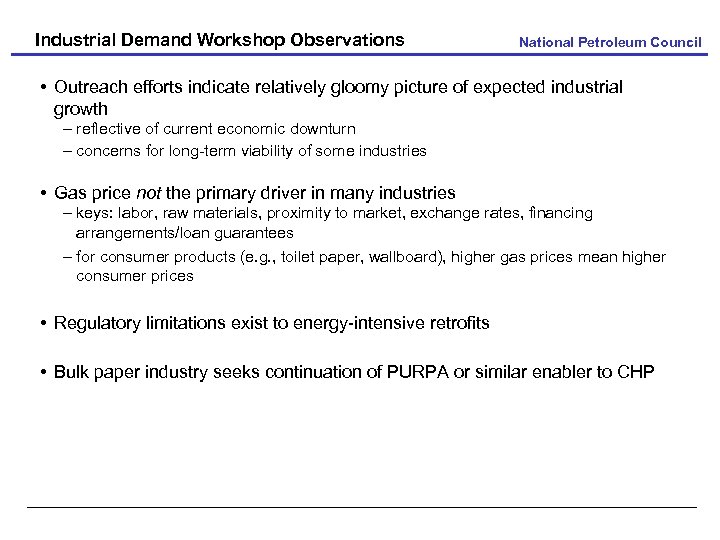 Industrial Demand Workshop Observations National Petroleum Council • Outreach efforts indicate relatively gloomy picture of expected industrial growth – reflective of current economic downturn – concerns for long-term viability of some industries • Gas price not the primary driver in many industries – keys: labor, raw materials, proximity to market, exchange rates, financing arrangements/loan guarantees – for consumer products (e. g. , toilet paper, wallboard), higher gas prices mean higher consumer prices • Regulatory limitations exist to energy-intensive retrofits • Bulk paper industry seeks continuation of PURPA or similar enabler to CHP
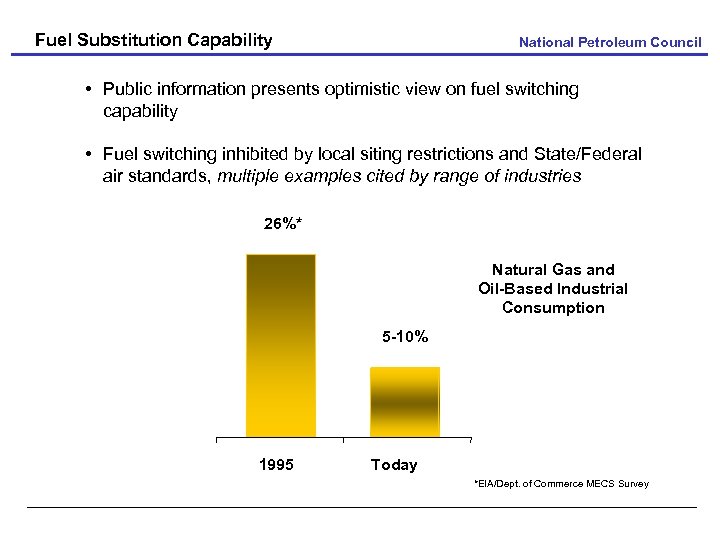 Fuel Substitution Capability National Petroleum Council • Public information presents optimistic view on fuel switching capability • Fuel switching inhibited by local siting restrictions and State/Federal air standards, multiple examples cited by range of industries 26%* Natural Gas and Oil-Based Industrial Consumption 5 -10% 1995 Today *EIA/Dept. of Commerce MECS Survey
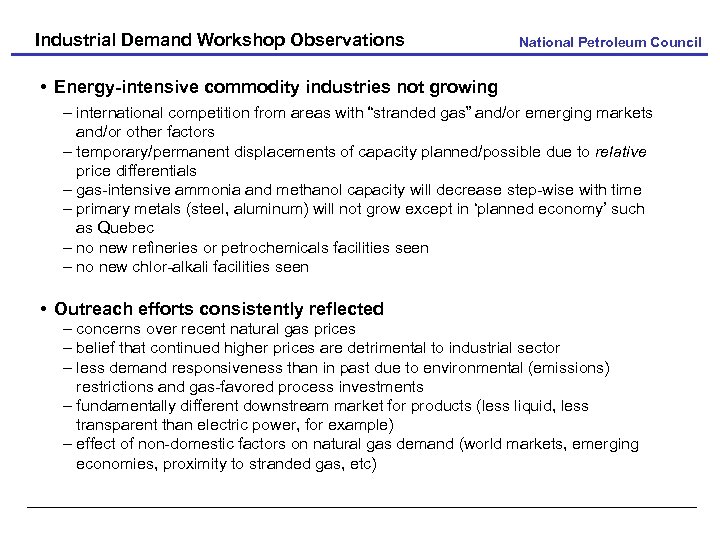 Industrial Demand Workshop Observations National Petroleum Council • Energy-intensive commodity industries not growing – international competition from areas with “stranded gas” and/or emerging markets and/or other factors – temporary/permanent displacements of capacity planned/possible due to relative price differentials – gas-intensive ammonia and methanol capacity will decrease step-wise with time – primary metals (steel, aluminum) will not grow except in ‘planned economy’ such as Quebec – no new refineries or petrochemicals facilities seen – no new chlor-alkali facilities seen • Outreach efforts consistently reflected – concerns over recent natural gas prices – belief that continued higher prices are detrimental to industrial sector – less demand responsiveness than in past due to environmental (emissions) restrictions and gas-favored process investments – fundamentally different downstream market for products (less liquid, less transparent than electric power, for example) – effect of non-domestic factors on natural gas demand (world markets, emerging economies, proximity to stranded gas, etc)
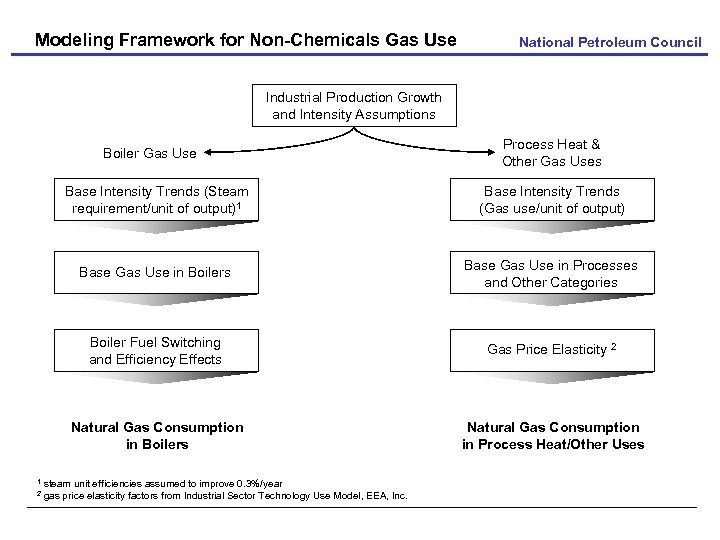 Modeling Framework for Non-Chemicals Gas Use National Petroleum Council Industrial Production Growth and Intensity Assumptions Boiler Gas Use Process Heat & Other Gas Uses Base Intensity Trends (Steam requirement/unit of output)1 Base Gas Use in Boilers Gas Price Elasticity 2 Natural Gas Consumption in Boilers 2 Base Gas Use in Processes and Other Categories Boiler Fuel Switching and Efficiency Effects 1 Base Intensity Trends (Gas use/unit of output) Natural Gas Consumption in Process Heat/Other Uses steam unit efficiencies assumed to improve 0. 3%/year gas price elasticity factors from Industrial Sector Technology Use Model, EEA, Inc.
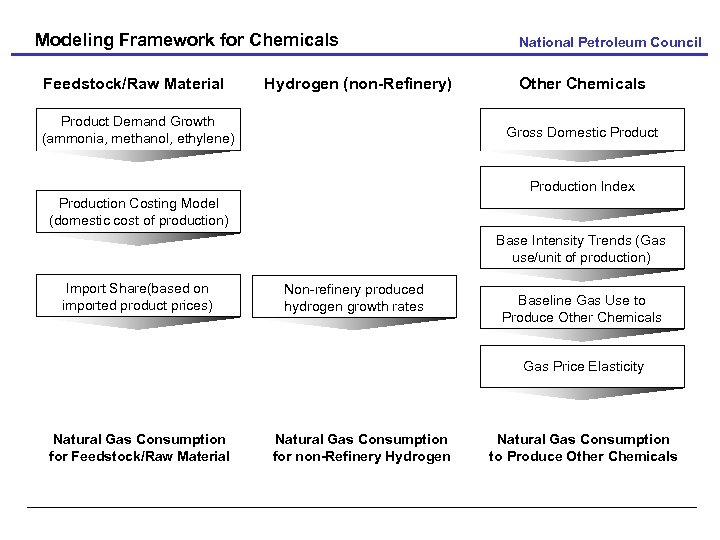 Modeling Framework for Chemicals Feedstock/Raw Material Hydrogen (non-Refinery) Product Demand Growth (ammonia, methanol, ethylene) National Petroleum Council Other Chemicals Gross Domestic Production Index Production Costing Model (domestic cost of production) Base Intensity Trends (Gas use/unit of production) Import Share(based on imported product prices) Non-refinery produced hydrogen growth rates Baseline Gas Use to Produce Other Chemicals Gas Price Elasticity Natural Gas Consumption for Feedstock/Raw Material Natural Gas Consumption for non-Refinery Hydrogen Natural Gas Consumption to Produce Other Chemicals
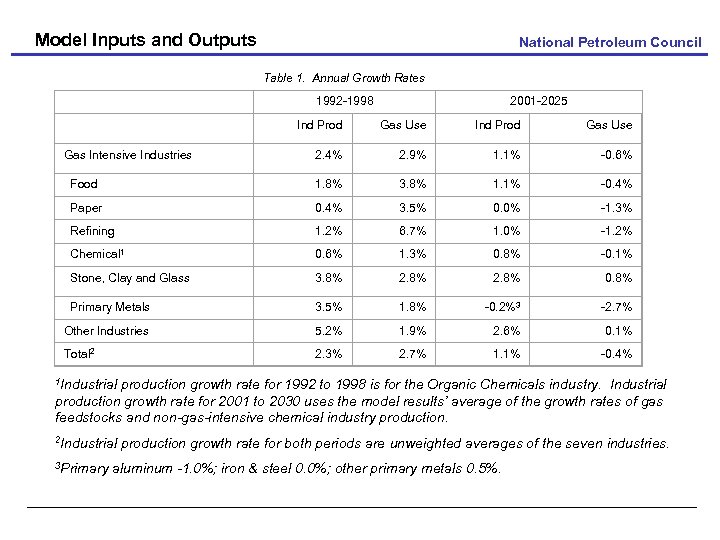 Model Inputs and Outputs National Petroleum Council Table 1. Annual Growth Rates 1992 -1998 2001 -2025 Ind Prod Gas Use 2. 4% 2. 9% 1. 1% -0. 6% Food 1. 8% 3. 8% 1. 1% -0. 4% Paper 0. 4% 3. 5% 0. 0% -1. 3% Refining 1. 2% 6. 7% 1. 0% -1. 2% Chemical 1 0. 6% 1. 3% 0. 8% -0. 1% Stone, Clay and Glass 3. 8% 2. 8% 0. 8% Primary Metals 3. 5% 1. 8% -0. 2%3 -2. 7% Other Industries 5. 2% 1. 9% 2. 6% 0. 1% Total 2 2. 3% 2. 7% 1. 1% -0. 4% Gas Intensive Industries 1 Industrial production growth rate for 1992 to 1998 is for the Organic Chemicals industry. Industrial production growth rate for 2001 to 2030 uses the model results’ average of the growth rates of gas feedstocks and non-gas-intensive chemical industry production. 2 Industrial 3 Primary production growth rate for both periods are unweighted averages of the seven industries. aluminum -1. 0%; iron & steel 0. 0%; other primary metals 0. 5%.
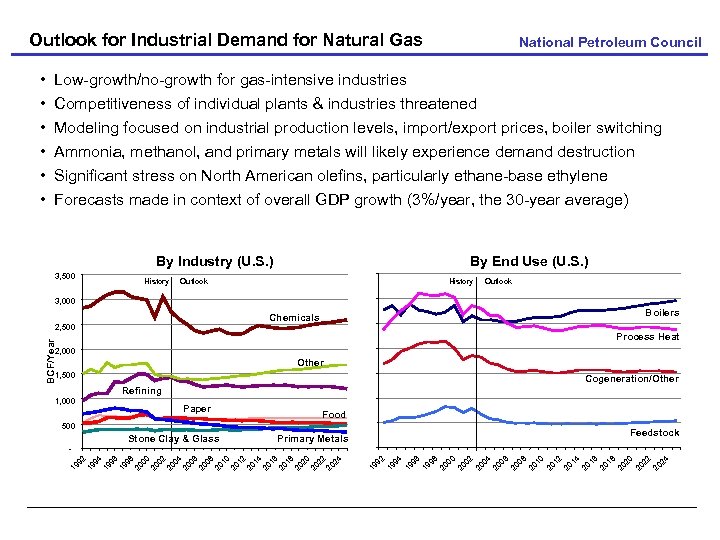 Outlook for Industrial Demand for Natural Gas • • • National Petroleum Council Low-growth/no-growth for gas-intensive industries Competitiveness of individual plants & industries threatened Modeling focused on industrial production levels, import/export prices, boiler switching Ammonia, methanol, and primary metals will likely experience demand destruction Significant stress on North American olefins, particularly ethane-base ethylene Forecasts made in context of overall GDP growth (3%/year, the 30 -year average) By Industry (U. S. ) 3, 500 History By End Use (U. S. ) Outlook History Outlook 3, 000 Boilers Chemicals 2, 500 BCF/Year Process Heat 2, 000 Other 1, 500 Cogeneration/Other Refining 1, 000 Paper Food 500 Stone Clay & Glass Feedstock Primary Metals 02 20 04 20 06 20 08 20 10 20 12 20 14 20 16 20 18 20 20 20 22 20 24 00 20 98 20 96 19 94 19 92 19 19 94 19 96 19 98 20 00 20 02 20 04 20 06 20 08 20 10 20 12 20 14 20 16 20 18 20 20 20 22 20 24 19 19 92 -
 National Petroleum Council Power Generation Demand
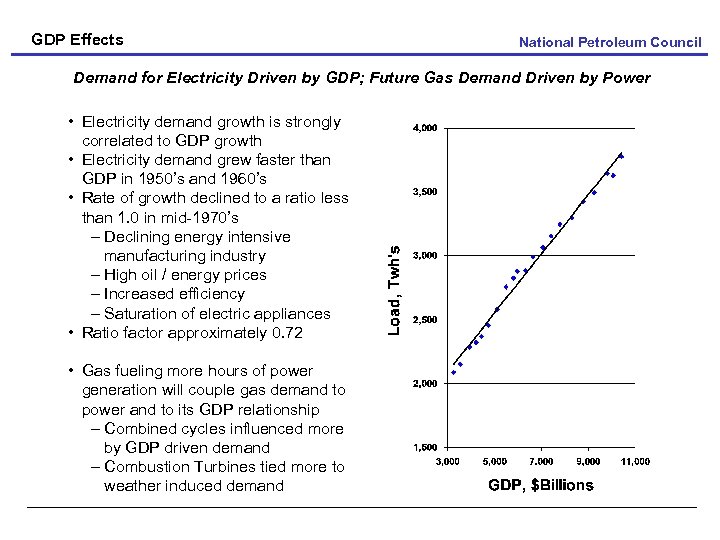 GDP Effects National Petroleum Council Demand for Electricity Driven by GDP; Future Gas Demand Driven by Power • Electricity demand growth is strongly correlated to GDP growth • Electricity demand grew faster than GDP in 1950’s and 1960’s • Rate of growth declined to a ratio less than 1. 0 in mid-1970’s – Declining energy intensive manufacturing industry – High oil / energy prices – Increased efficiency – Saturation of electric appliances • Ratio factor approximately 0. 72 • Gas fueling more hours of power generation will couple gas demand to power and to its GDP relationship – Combined cycles influenced more by GDP driven demand – Combustion Turbines tied more to weather induced demand
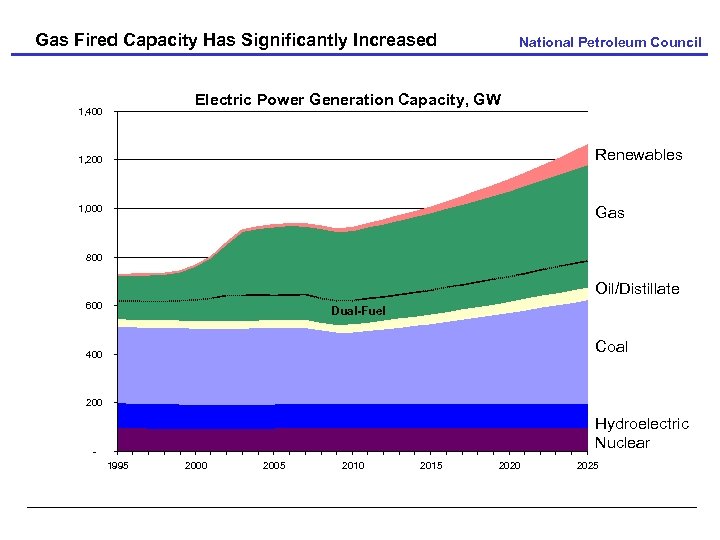 Gas Fired Capacity Has Significantly Increased National Petroleum Council Electric Power Generation Capacity, GW 1, 400 Renewables 1, 200 Gas 1, 000 800 Oil/Distillate 600 Dual-Fuel Coal 400 200 Hydroelectric Nuclear 1995 2000 2005 2010 2015 2020 2025
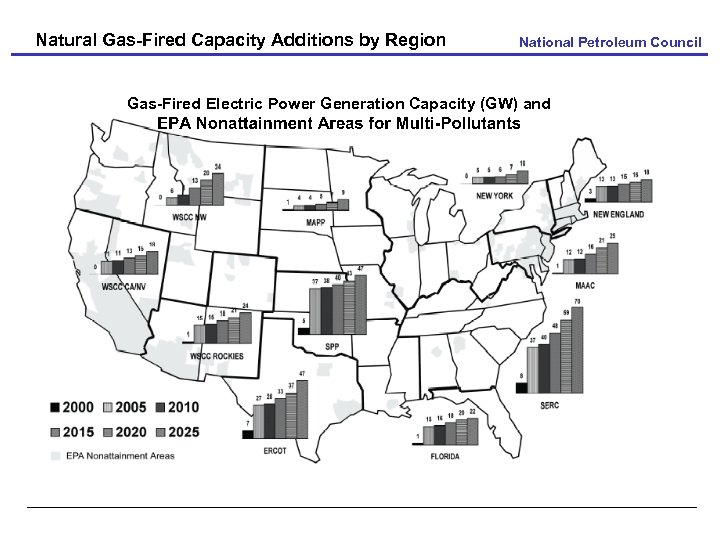 Natural Gas-Fired Capacity Additions by Region National Petroleum Council Gas-Fired Electric Power Generation Capacity (GW) and
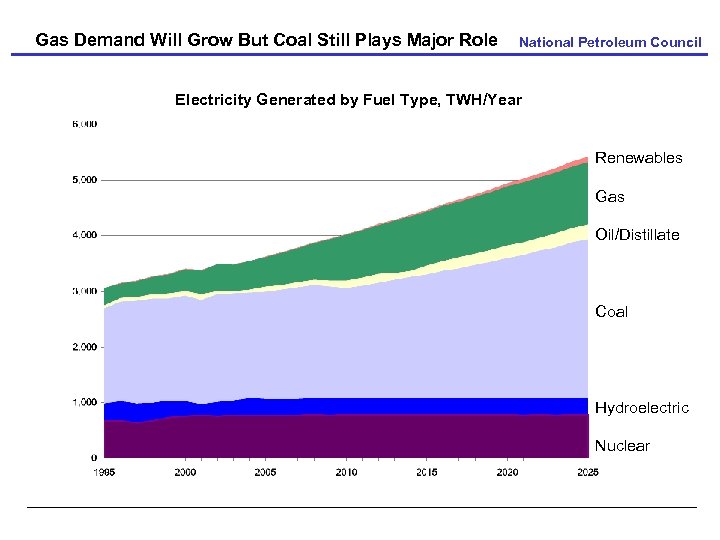 Gas Demand Will Grow But Coal Still Plays Major Role National Petroleum Council Electricity Generated by Fuel Type, TWH/Year Renewables Gas Oil/Distillate Coal Hydroelectric Nuclear
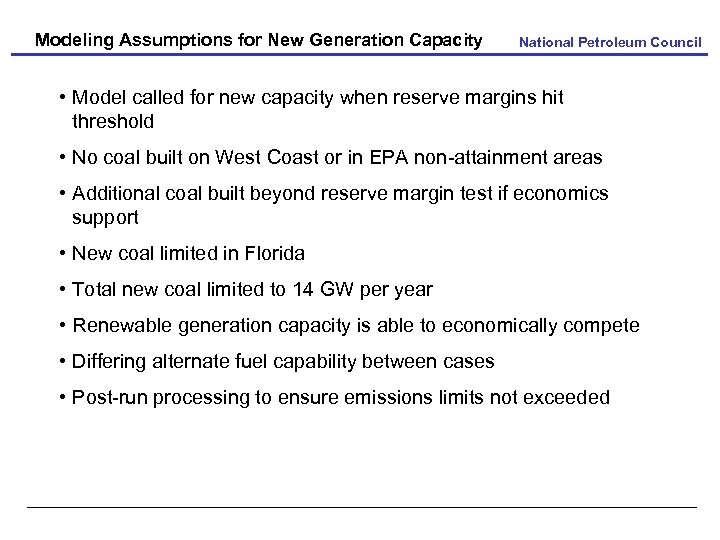 Modeling Assumptions for New Generation Capacity National Petroleum Council • Model called for new capacity when reserve margins hit threshold • No coal built on West Coast or in EPA non-attainment areas • Additional coal built beyond reserve margin test if economics support • New coal limited in Florida • Total new coal limited to 14 GW per year • Renewable generation capacity is able to economically compete • Differing alternate fuel capability between cases • Post-run processing to ensure emissions limits not exceeded
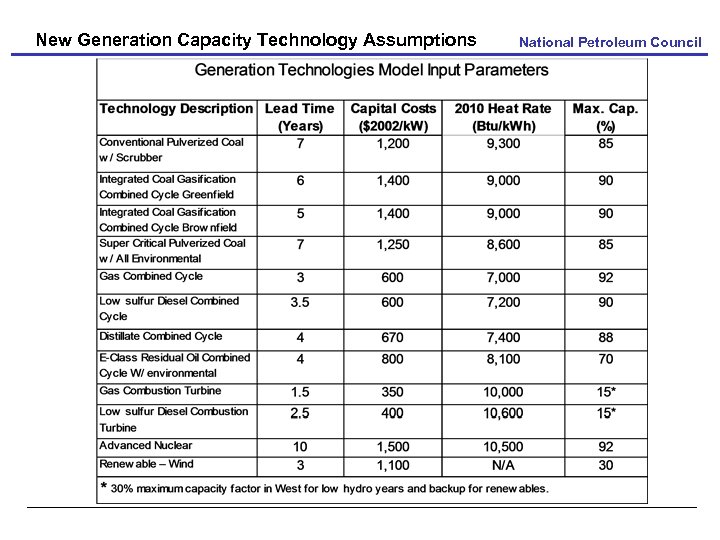 New Generation Capacity Technology Assumptions National Petroleum Council
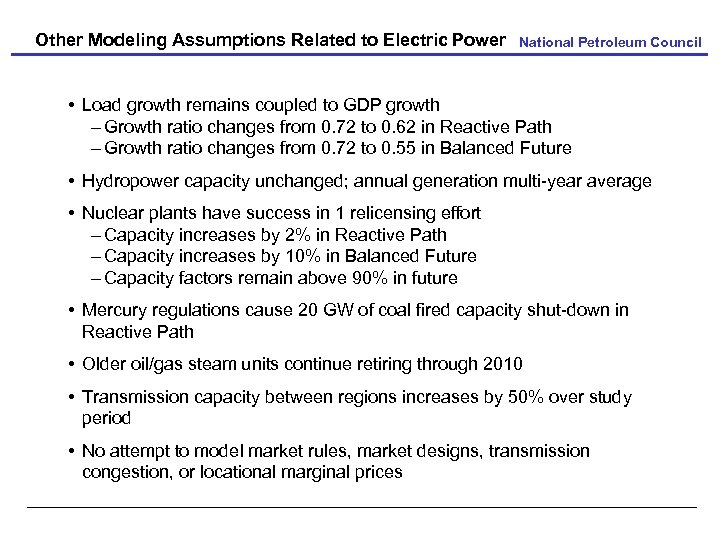 Other Modeling Assumptions Related to Electric Power National Petroleum Council • Load growth remains coupled to GDP growth – Growth ratio changes from 0. 72 to 0. 62 in Reactive Path – Growth ratio changes from 0. 72 to 0. 55 in Balanced Future • Hydropower capacity unchanged; annual generation multi-year average • Nuclear plants have success in 1 relicensing effort – Capacity increases by 2% in Reactive Path – Capacity increases by 10% in Balanced Future – Capacity factors remain above 90% in future • Mercury regulations cause 20 GW of coal fired capacity shut-down in Reactive Path • Older oil/gas steam units continue retiring through 2010 • Transmission capacity between regions increases by 50% over study period • No attempt to model market rules, market designs, transmission congestion, or locational marginal prices
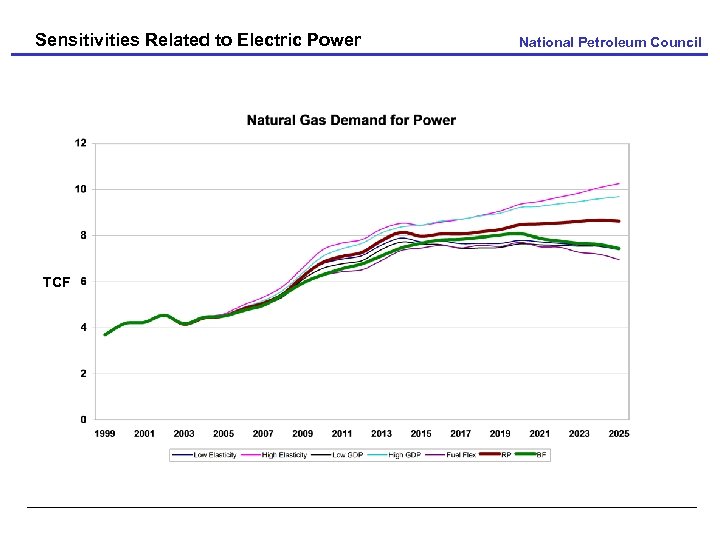
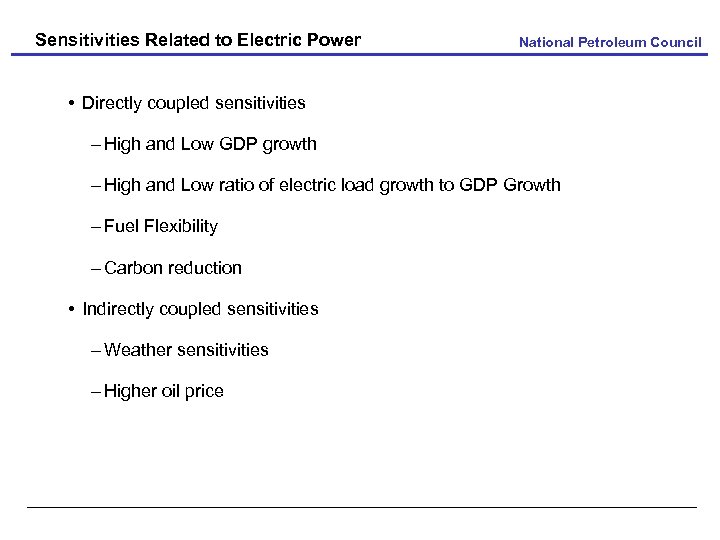 Sensitivities Related to Electric Power National Petroleum Council • Directly coupled sensitivities – High and Low GDP growth – High and Low ratio of electric load growth to GDP Growth – Fuel Flexibility – Carbon reduction • Indirectly coupled sensitivities – Weather sensitivities – Higher oil price
 Sensitivities Related to Electric Power TCF National Petroleum Council
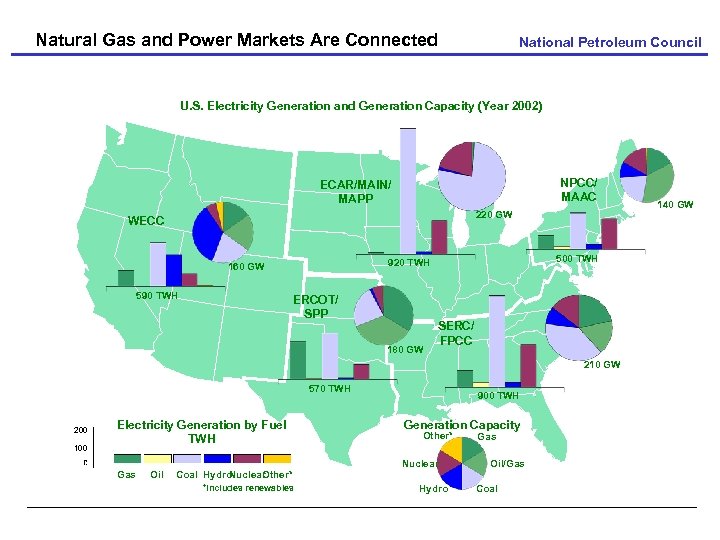 Natural Gas and Power Markets Are Connected National Petroleum Council U. S. Electricity Generation and Generation Capacity (Year 2002) NPCC/ MAAC ECAR/MAIN/ MAPP 220 GW WECC 590 TWH 500 TWH 920 TWH 160 GW ERCOT/ SPP 180 GW SERC/ FPCC 210 GW 570 TWH 200 100 Electricity Generation by Fuel TWH Gas Oil Nuclear Other* Coal Hydro *includes renewables 900 TWH Generation Capacity Other* Nuclear Hydro Gas Oil/Gas Coal 140 GW
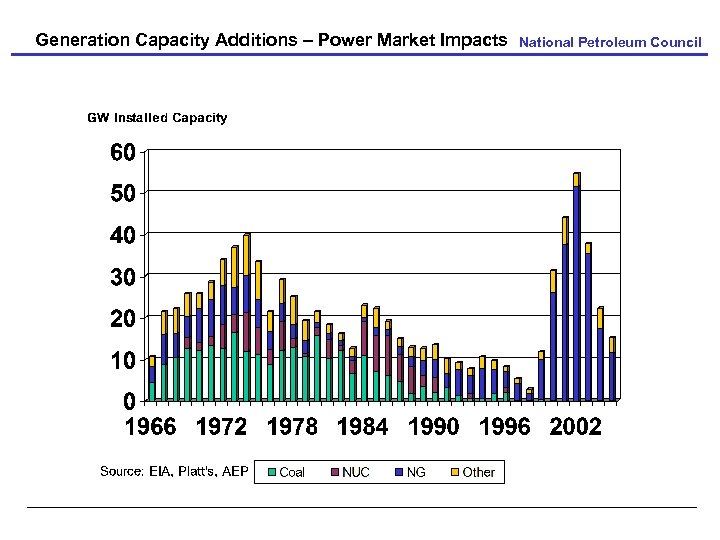 Generation Capacity Additions – Power Market Impacts National Petroleum Council
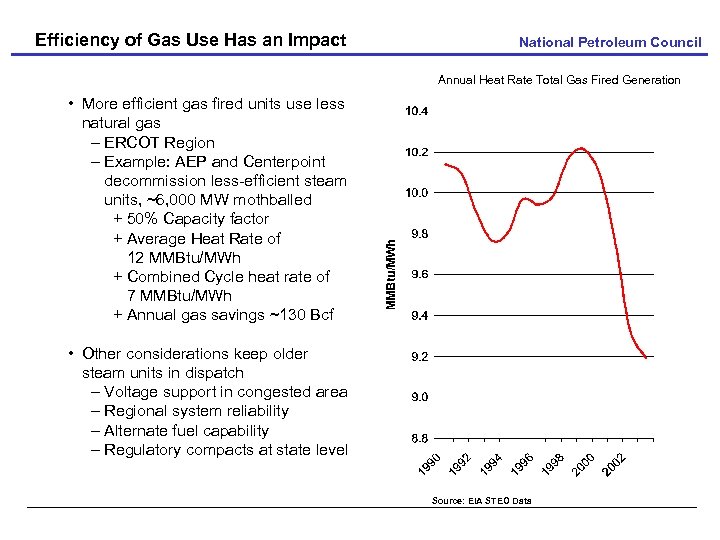 Efficiency of Gas Use Has an Impact National Petroleum Council Annual Heat Rate Total Gas Fired Generation • More efficient gas fired units use less natural gas – ERCOT Region – Example: AEP and Centerpoint decommission less-efficient steam units, ~6, 000 MW mothballed + 50% Capacity factor + Average Heat Rate of 12 MMBtu/MWh + Combined Cycle heat rate of 7 MMBtu/MWh + Annual gas savings ~130 Bcf • Other considerations keep older steam units in dispatch – Voltage support in congested area – Regional system reliability – Alternate fuel capability – Regulatory compacts at state level Source: EIA STEO Data
 National Petroleum Council Residential & Commercial Demand
 Residential & Commercial Demand Residential National Petroleum Council Commercial Customers (Millions) Demand (TCF) Source: EIA
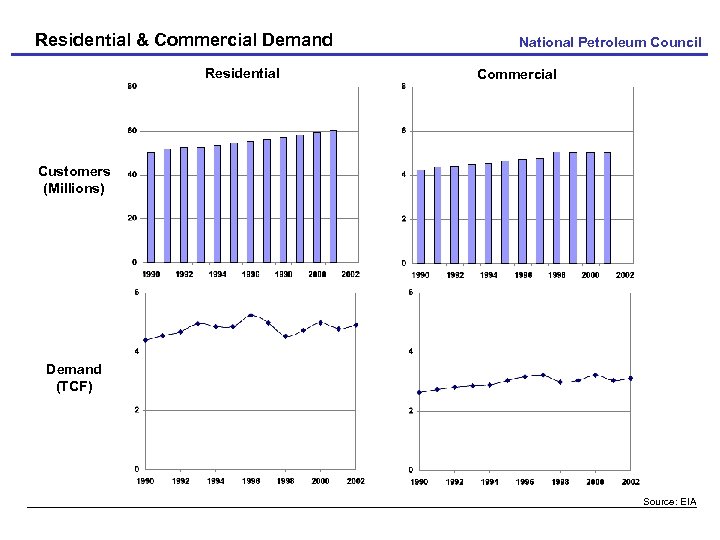
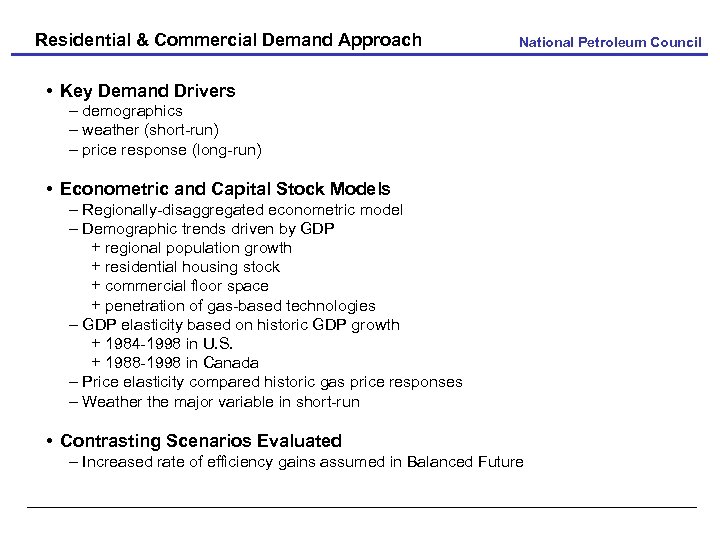 Residential & Commercial Demand Approach National Petroleum Council • Key Demand Drivers – demographics – weather (short-run) – price response (long-run) • Econometric and Capital Stock Models – Regionally-disaggregated econometric model – Demographic trends driven by GDP + regional population growth + residential housing stock + commercial floor space + penetration of gas-based technologies – GDP elasticity based on historic GDP growth + 1984 -1998 in U. S. + 1988 -1998 in Canada – Price elasticity compared historic gas price responses – Weather the major variable in short-run • Contrasting Scenarios Evaluated – Increased rate of efficiency gains assumed in Balanced Future
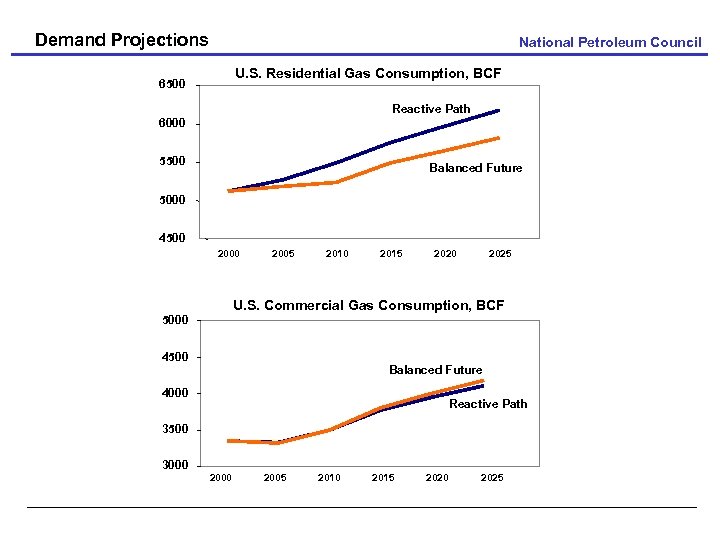 Demand Projections National Petroleum Council U. S. Residential Gas Consumption, BCF 6500 Reactive Path 6000 5500 Balanced Future 5000 4500 2005 2010 2015 2020 2025 U. S. Commercial Gas Consumption, BCF 5000 4500 Balanced Future 4000 Reactive Path 3500 3000 2005 2010 2015 2020 2025
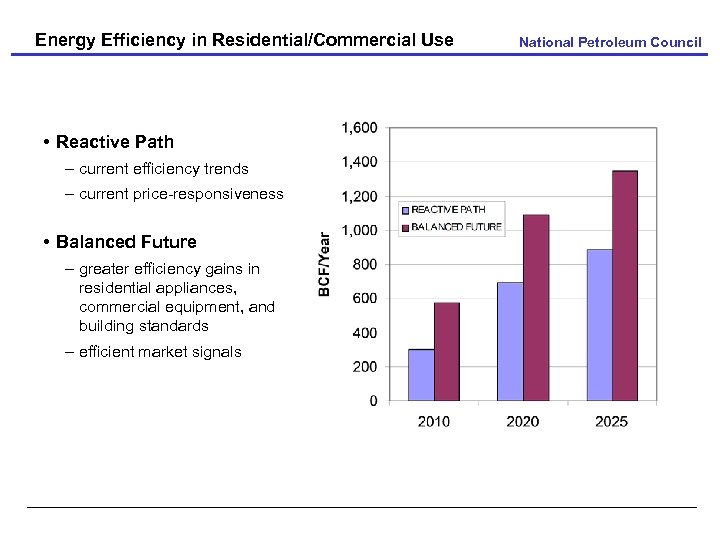 Energy Efficiency in Residential/Commercial Use • Reactive Path – current efficiency trends – current price-responsiveness • Balanced Future – greater efficiency gains in residential appliances, commercial equipment, and building standards – efficient market signals National Petroleum Council
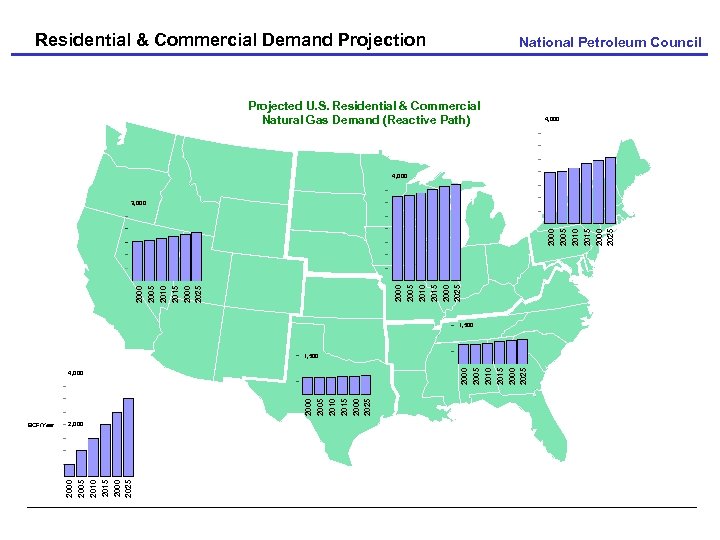 Residential & Commercial Demand Projection National Petroleum Council Projected U. S. Residential & Commercial Natural Gas Demand (Reactive Path) 4, 000 2000 2005 2010 2015 2000 2025 3, 000 1, 500 2000 2005 2010 2015 2000 2025 4, 000 2025 2, 000 2005 2010 2015 BCF/Year
 National Petroleum Council Demand Summary
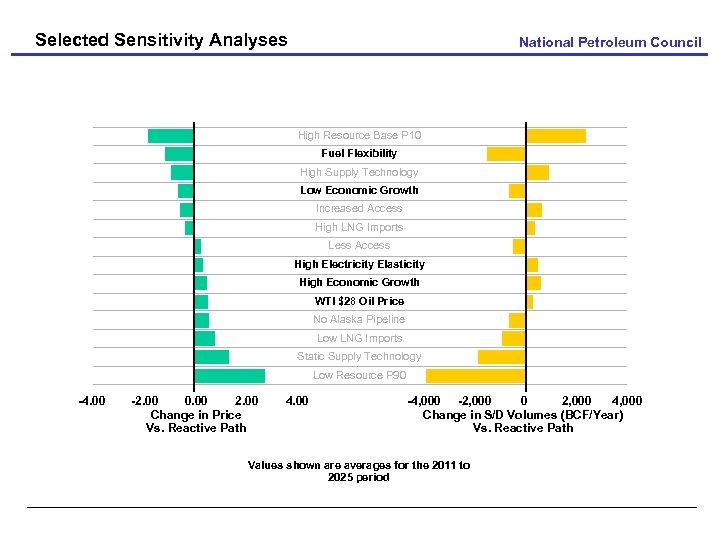 Selected Sensitivity Analyses National Petroleum Council High Resource Base P 10 Fuel Flexibility High Supply Technology Low Economic Growth Increased Access High LNG Imports Less Access High Electricity Elasticity High Economic Growth WTI $28 Oil Price No Alaska Pipeline Low LNG Imports Static Supply Technology Low Resource P 90 -4. 00 -2. 00 0. 00 2. 00 Change in Price Vs. Reactive Path 4. 00 -4, 000 -2, 000 0 2, 000 4, 000 Change in S/D Volumes (BCF/Year) Vs. Reactive Path Values shown are averages for the 2011 to 2025 period
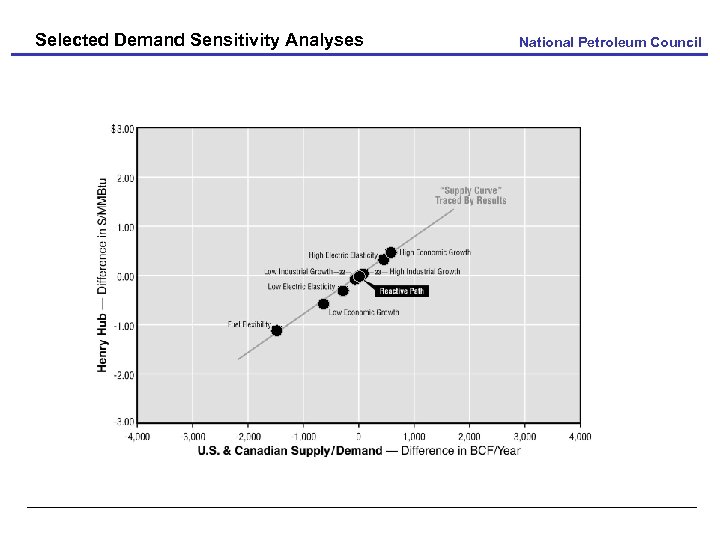 Selected Demand Sensitivity Analyses National Petroleum Council
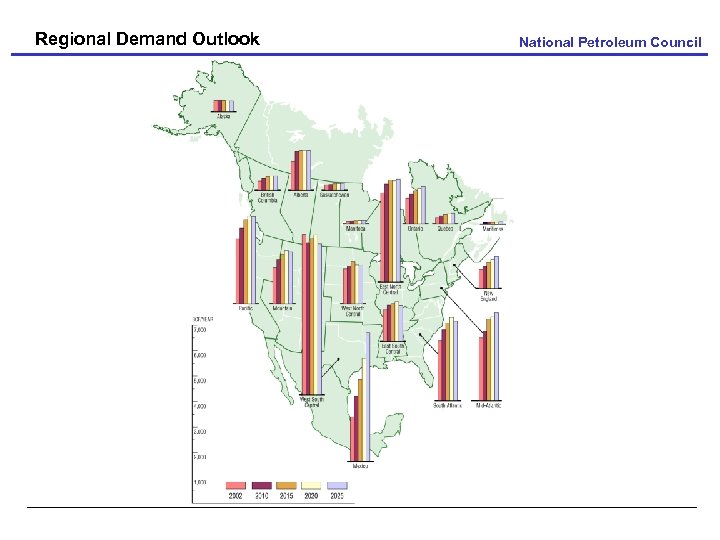 Regional Demand Outlook National Petroleum Council
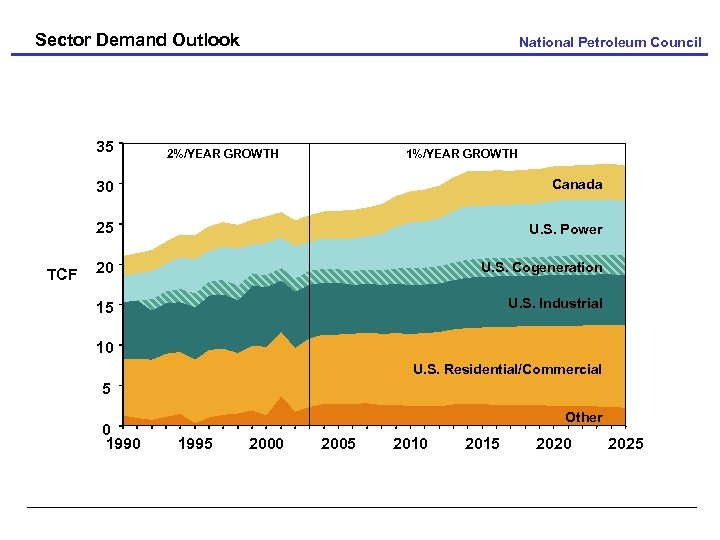 Sector Demand Outlook 35 National Petroleum Council 2%/YEAR GROWTH 1%/YEAR GROWTH 30 25 TCF Canada U. S. Power 20 U. S. Cogeneration 15 U. S. Industrial 10 U. S. Residential/Commercial 5 0 1990 Other 1995 2000 2005 2010 2015 2020 2025
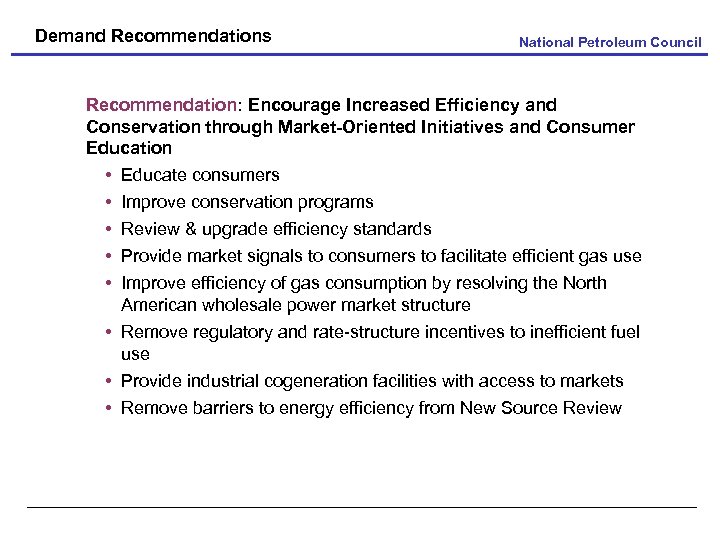 Demand Recommendations National Petroleum Council Recommendation: Encourage Increased Efficiency and Conservation through Market-Oriented Initiatives and Consumer Education • • • Educate consumers Improve conservation programs Review & upgrade efficiency standards Provide market signals to consumers to facilitate efficient gas use Improve efficiency of gas consumption by resolving the North American wholesale power market structure • Remove regulatory and rate-structure incentives to inefficient fuel use • Provide industrial cogeneration facilities with access to markets • Remove barriers to energy efficiency from New Source Review
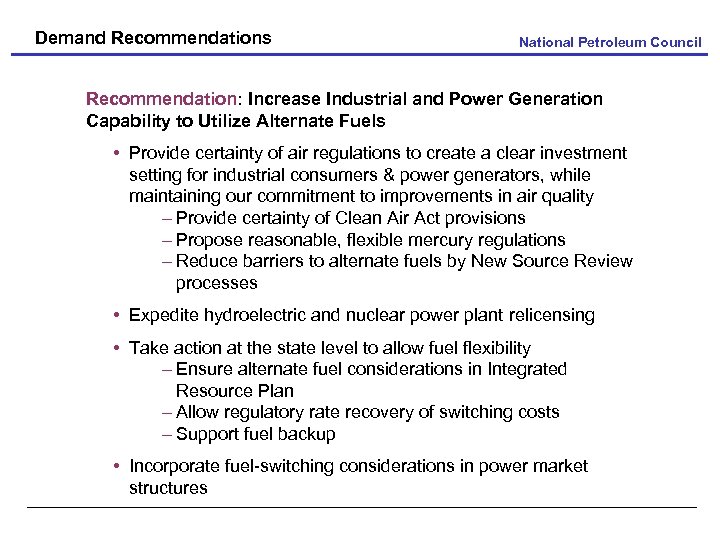 Demand Recommendations National Petroleum Council Recommendation: Increase Industrial and Power Generation Capability to Utilize Alternate Fuels • Provide certainty of air regulations to create a clear investment setting for industrial consumers & power generators, while maintaining our commitment to improvements in air quality – Provide certainty of Clean Air Act provisions – Propose reasonable, flexible mercury regulations – Reduce barriers to alternate fuels by New Source Review processes • Expedite hydroelectric and nuclear power plant relicensing • Take action at the state level to allow fuel flexibility – Ensure alternate fuel considerations in Integrated Resource Plan – Allow regulatory rate recovery of switching costs – Support fuel backup • Incorporate fuel-switching considerations in power market structures
 National Petroleum Council Natural Gas Markets
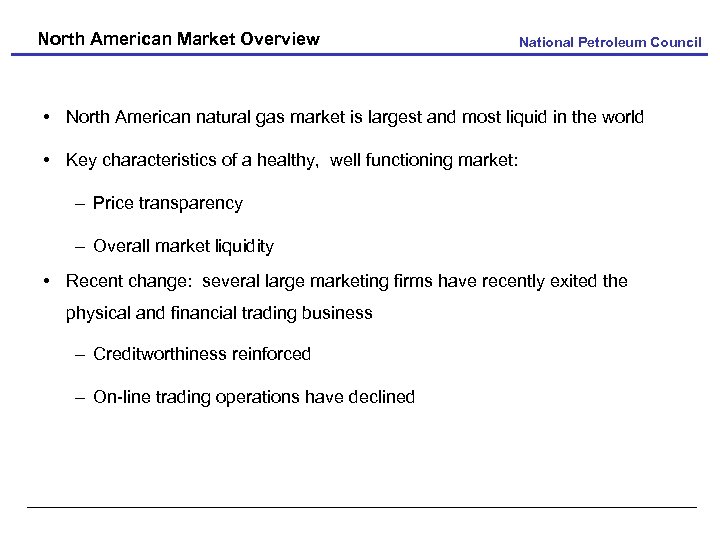 North American Market Overview National Petroleum Council • North American natural gas market is largest and most liquid in the world • Key characteristics of a healthy, well functioning market: – Price transparency – Overall market liquidity • Recent change: several large marketing firms have recently exited the physical and financial trading business – Creditworthiness reinforced – On-line trading operations have declined
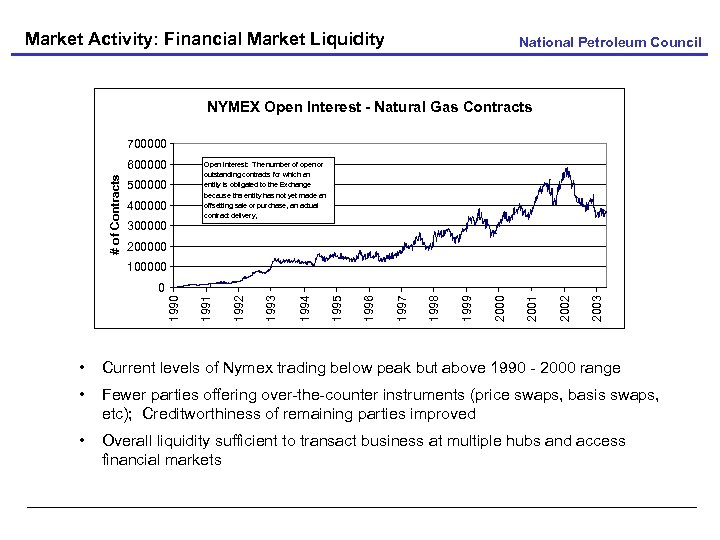 Market Activity: Financial Market Liquidity National Petroleum Council NYMEX Open Interest - Natural Gas Contracts 700000 # of Contracts 600000 Open Interest: The number of open or outstanding contracts for which an entity is obligated to the Exchange because tha entity has not yet made an offsetting sale or purchase, an actual contract delivery, 500000 400000 300000 200000 100000 2003 2002 2001 2000 1999 1998 1997 1996 1995 1994 1993 1992 1991 1990 0 • Current levels of Nymex trading below peak but above 1990 - 2000 range • Fewer parties offering over-the-counter instruments (price swaps, basis swaps, etc); Creditworthiness of remaining parties improved • Overall liquidity sufficient to transact business at multiple hubs and access financial markets
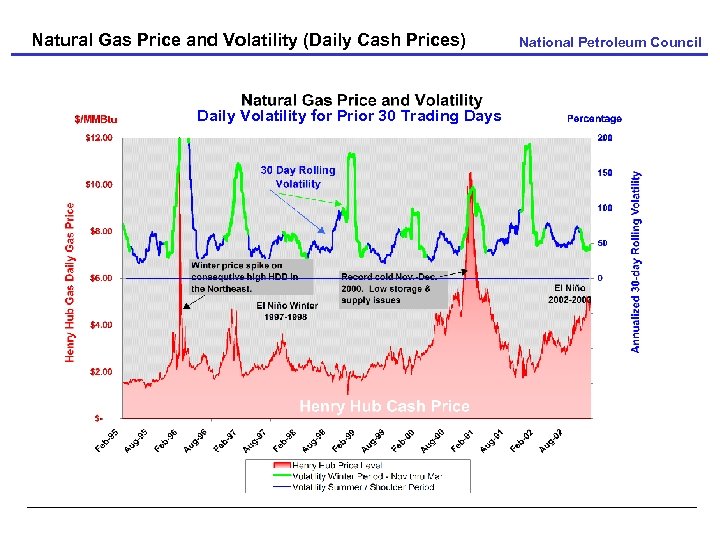 Natural Gas Price and Volatility (Daily Cash Prices) Daily Volatility for Prior 30 Trading Days National Petroleum Council
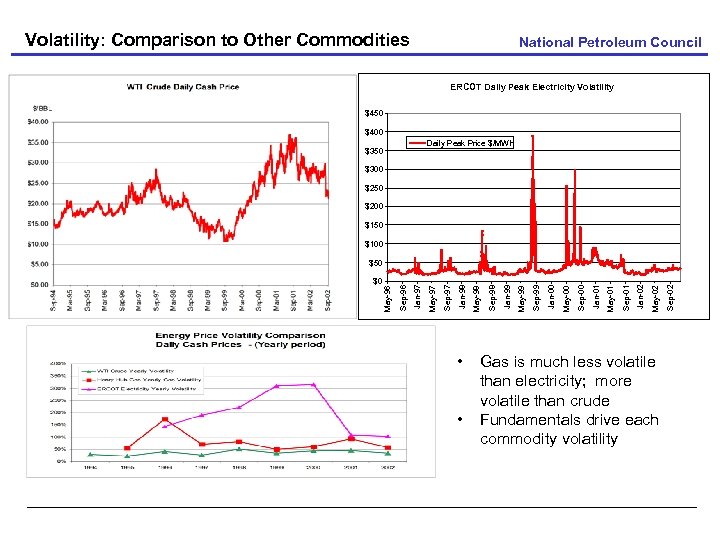 Volatility: Comparison to Other Commodities National Petroleum Council ERCOT Daily Peak Electricity Volatility $450 $400 Daily Peak Price $/MWH $350 $300 $250 $200 $150 $100 • Gas is much less volatile than electricity; more volatile than crude Fundamentals drive each commodity volatility Sep-02 May-02 Jan-02 Sep-01 May-01 Jan-01 Sep-00 May-00 Jan-00 Sep-99 May-99 Jan-99 Sep-98 Jan-98 • May-98 Sep-97 Jan-97 May-97 Sep-96 $0 May-96 $50
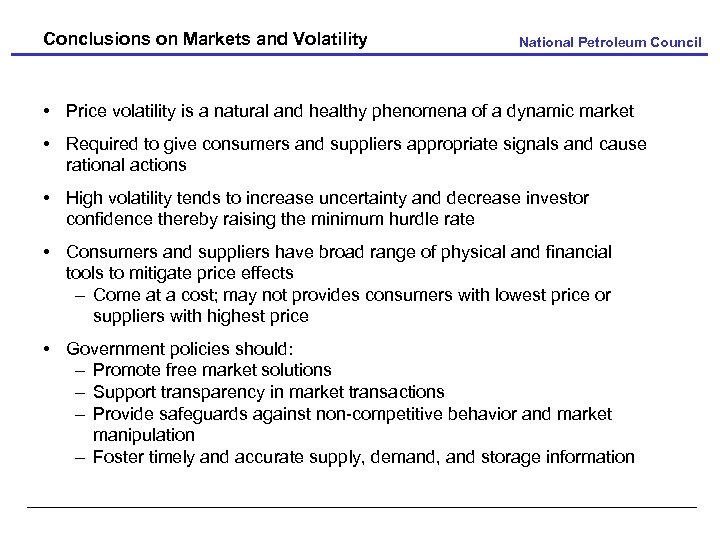 Conclusions on Markets and Volatility National Petroleum Council • Price volatility is a natural and healthy phenomena of a dynamic market • Required to give consumers and suppliers appropriate signals and cause rational actions • High volatility tends to increase uncertainty and decrease investor confidence thereby raising the minimum hurdle rate • Consumers and suppliers have broad range of physical and financial tools to mitigate price effects – Come at a cost; may not provides consumers with lowest price or suppliers with highest price • Government policies should: – Promote free market solutions – Support transparency in market transactions – Provide safeguards against non-competitive behavior and market manipulation – Foster timely and accurate supply, demand, and storage information