


 Скачать презентацию National Ocean Research Leadership Council NORLC Developing a
84baae2c2c7dadd314f37c751cbbcdb3.ppt
- Количество слайдов: 29
 National Ocean Research Leadership Council (NORLC) Developing a User-Driven, Integrated Ocean Observing System (IOOS) • Recent History Tom Malone, Director Ocean. US Office for Integrated & Sustained Ocean Observations • Conceptual Design • Evolution • Funding
 Integrated Ocean Observing System (IOOS) • IOOS exists in concept only – Global Ocean-Climate Component • Plans for initial system completed • Implementation underway – Coastal Component • In early stages of planning • Private sector involvement critical to successful development
 Recent History
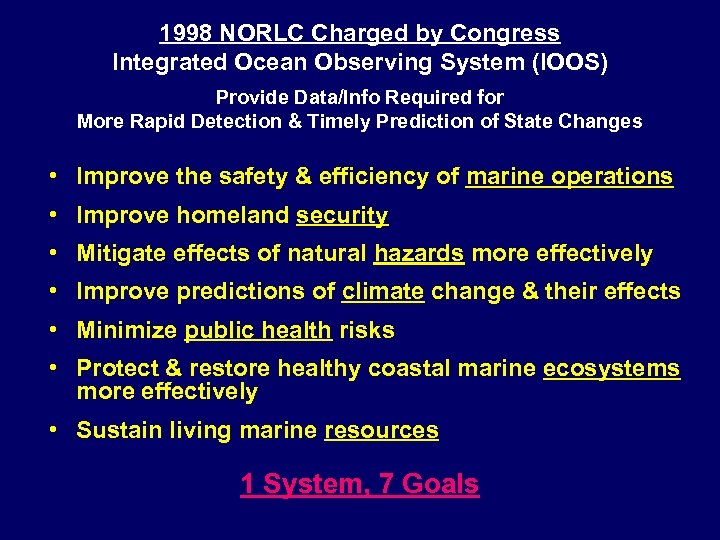 1998 NORLC Charged by Congress Integrated Ocean Observing System (IOOS) Provide Data/Info Required for More Rapid Detection & Timely Prediction of State Changes • Improve the safety & efficiency of marine operations • Improve homeland security • Mitigate effects of natural hazards more effectively • Improve predictions of climate change & their effects • Minimize public health risks • Protect & restore healthy coastal marine ecosystems more effectively • Sustain living marine resources 1 System, 7 Goals
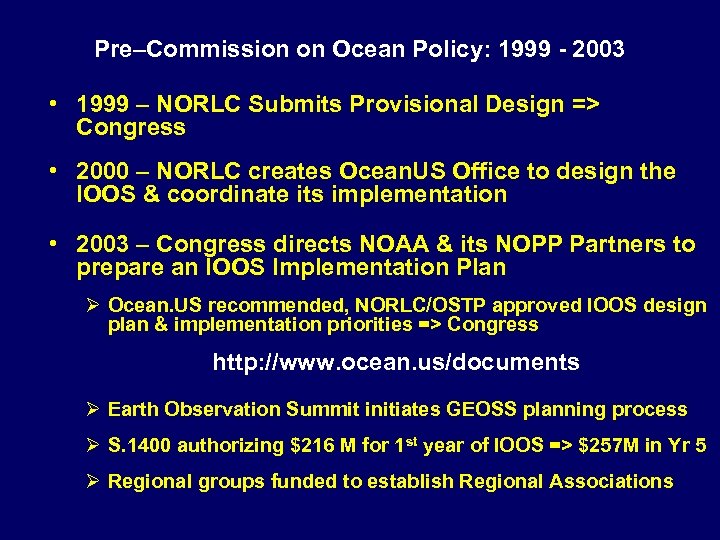 Pre–Commission on Ocean Policy: 1999 - 2003 • 1999 – NORLC Submits Provisional Design => Congress • 2000 – NORLC creates Ocean. US Office to design the IOOS & coordinate its implementation • 2003 – Congress directs NOAA & its NOPP Partners to prepare an IOOS Implementation Plan Ø Ocean. US recommended, NORLC/OSTP approved IOOS design plan & implementation priorities => Congress http: //www. ocean. us/documents Ø Earth Observation Summit initiates GEOSS planning process Ø S. 1400 authorizing $216 M for 1 st year of IOOS => $257 M in Yr 5 Ø Regional groups funded to establish Regional Associations
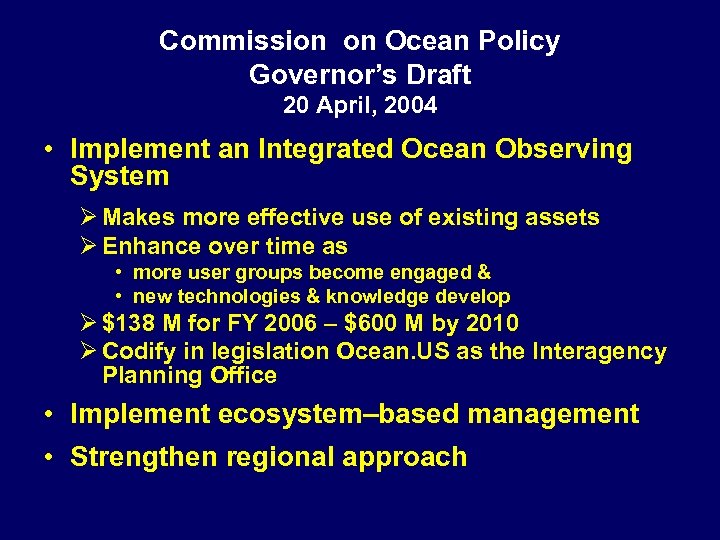 Commission on Ocean Policy Governor’s Draft 20 April, 2004 • Implement an Integrated Ocean Observing System Ø Makes more effective use of existing assets Ø Enhance over time as • more user groups become engaged & • new technologies & knowledge develop Ø $138 M for FY 2006 – $600 M by 2010 Ø Codify in legislation Ocean. US as the Interagency Planning Office • Implement ecosystem–based management • Strengthen regional approach
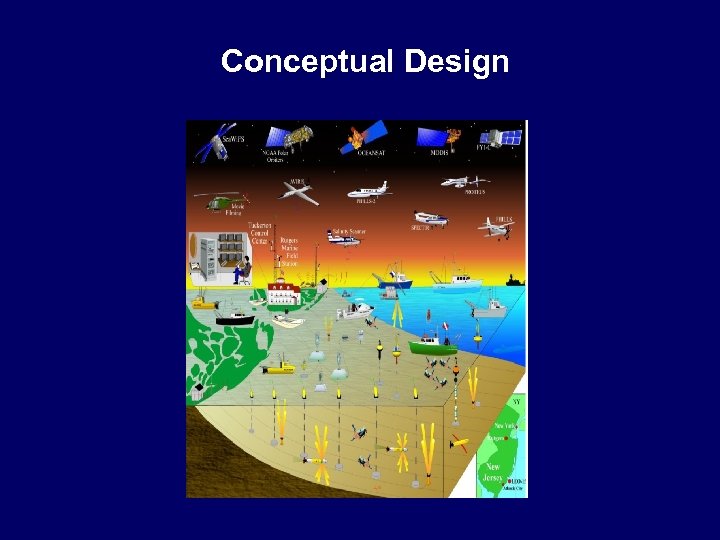 Conceptual Design
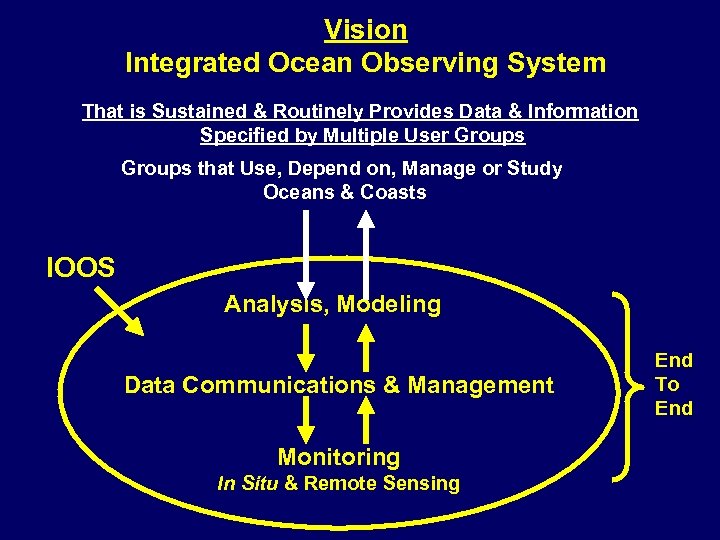 Vision Integrated Ocean Observing System That is Sustained & Routinely Provides Data & Information Specified by Multiple User Groups that Use, Depend on, Manage or Study Oceans & Coasts IOOS Analysis, Modeling Data Communications & Management Monitoring In Situ & Remote Sensing End To End
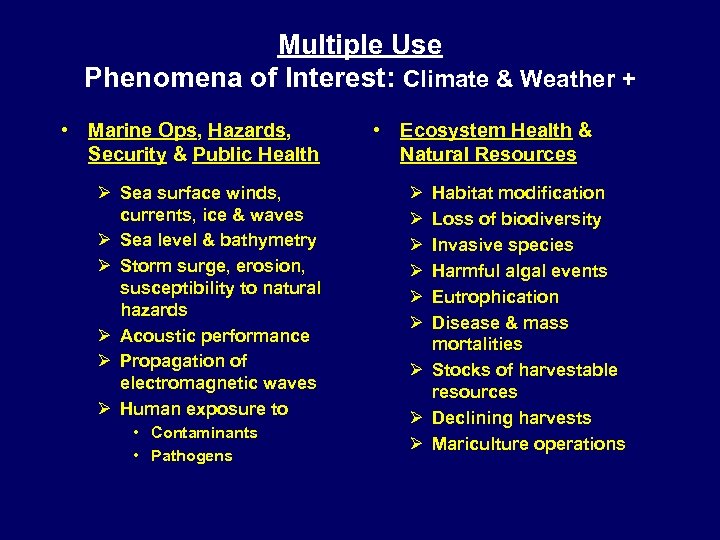 Multiple Use Phenomena of Interest: Climate & Weather + • Marine Ops, Hazards, Security & Public Health Ø Sea surface winds, currents, ice & waves Ø Sea level & bathymetry Ø Storm surge, erosion, susceptibility to natural hazards Ø Acoustic performance Ø Propagation of electromagnetic waves Ø Human exposure to • Contaminants • Pathogens • Ecosystem Health & Natural Resources Ø Ø Ø Habitat modification Loss of biodiversity Invasive species Harmful algal events Eutrophication Disease & mass mortalities Ø Stocks of harvestable resources Ø Declining harvests Ø Mariculture operations
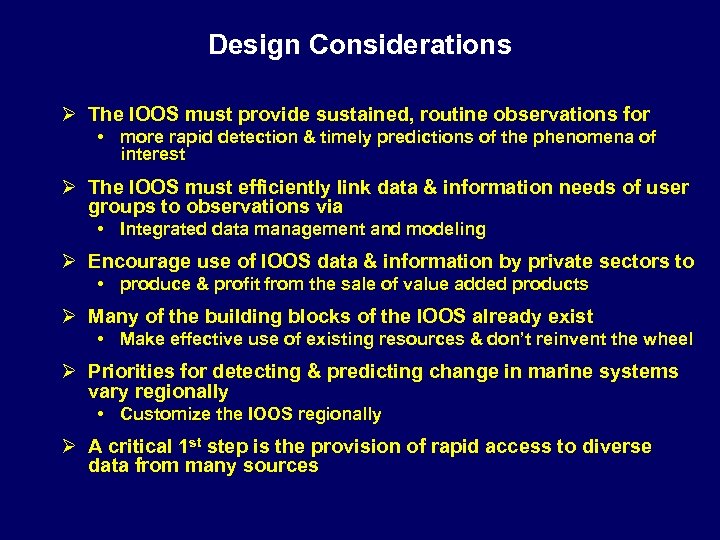 Design Considerations Ø The IOOS must provide sustained, routine observations for • more rapid detection & timely predictions of the phenomena of interest Ø The IOOS must efficiently link data & information needs of user groups to observations via • Integrated data management and modeling Ø Encourage use of IOOS data & information by private sectors to • produce & profit from the sale of value added products Ø Many of the building blocks of the IOOS already exist • Make effective use of existing resources & don’t reinvent the wheel Ø Priorities for detecting & predicting change in marine systems vary regionally • Customize the IOOS regionally Ø A critical 1 st step is the provision of rapid access to diverse data from many sources
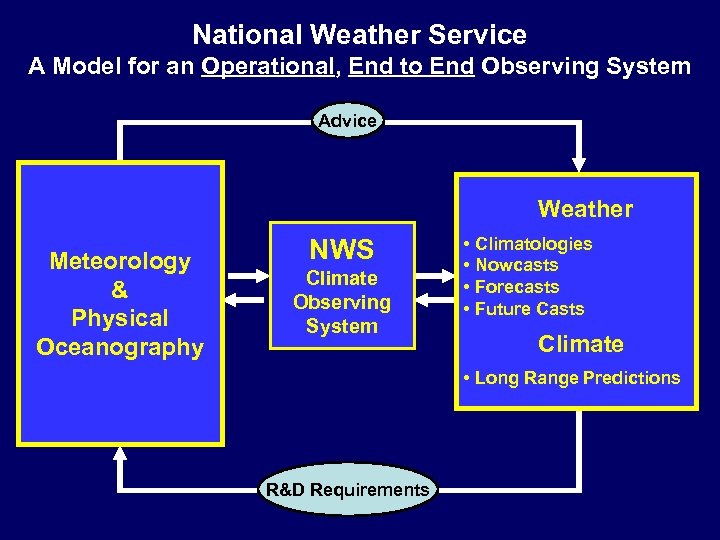 National Weather Service A Model for an Operational, End to End Observing System Advice Weather Meteorology & Physical Oceanography NWS Climate Observing System • Climatologies • Nowcasts • Forecasts • Future Casts Climate • Long Range Predictions R&D Requirements
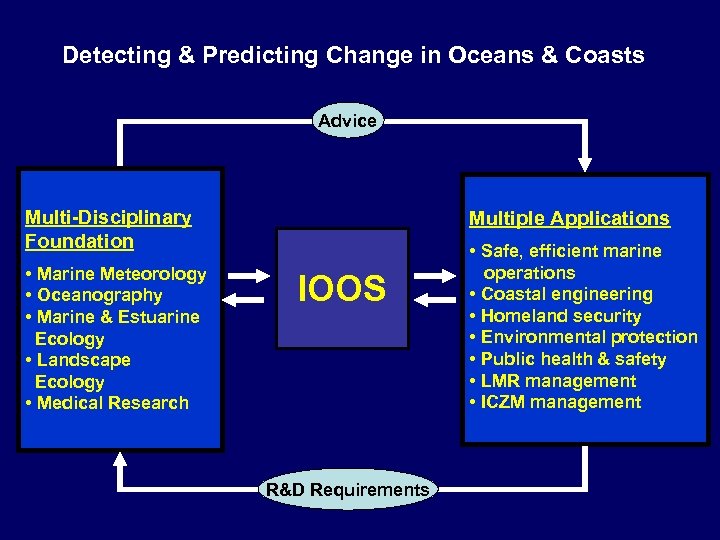 Detecting & Predicting Change in Oceans & Coasts Advice Multi-Disciplinary Foundation • Marine Meteorology • Oceanography • Marine & Estuarine Ecology • Landscape Ecology • Medical Research Multiple Applications IOOS R&D Requirements • Safe, efficient marine operations • Coastal engineering • Homeland security • Environmental protection • Public health & safety • LMR management • ICZM management
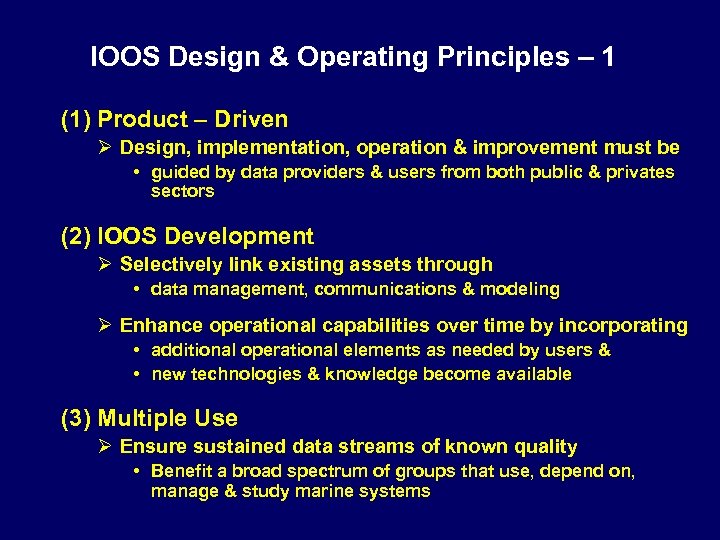 IOOS Design & Operating Principles – 1 (1) Product – Driven Ø Design, implementation, operation & improvement must be • guided by data providers & users from both public & privates sectors (2) IOOS Development Ø Selectively link existing assets through • data management, communications & modeling Ø Enhance operational capabilities over time by incorporating • additional operational elements as needed by users & • new technologies & knowledge become available (3) Multiple Use Ø Ensure sustained data streams of known quality • Benefit a broad spectrum of groups that use, depend on, manage & study marine systems
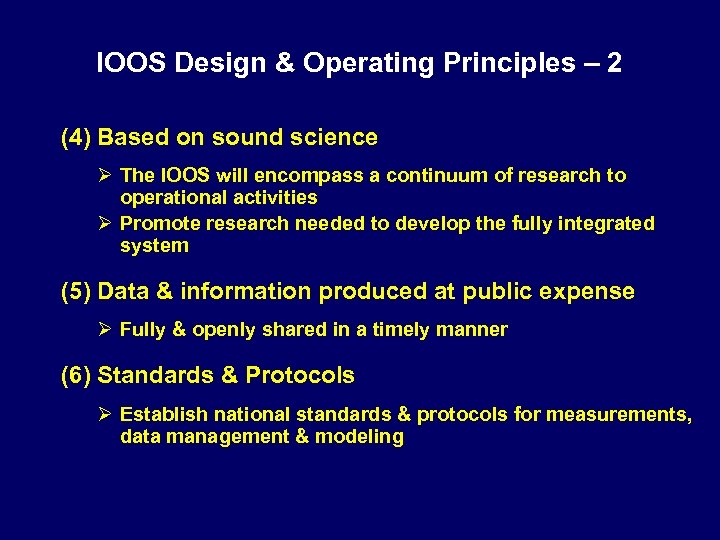 IOOS Design & Operating Principles – 2 (4) Based on sound science Ø The IOOS will encompass a continuum of research to operational activities Ø Promote research needed to develop the fully integrated system (5) Data & information produced at public expense Ø Fully & openly shared in a timely manner (6) Standards & Protocols Ø Establish national standards & protocols for measurements, data management & modeling
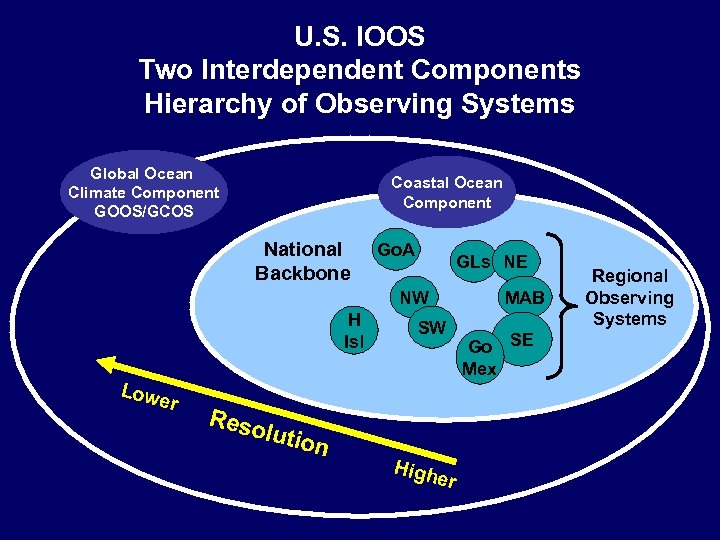 U. S. IOOS Two Interdependent Components Hierarchy of Observing Systems Global Ocean Climate Component GOOS/GCOS Coastal Ocean Component National Backbone Go. A GLs NE NW H Isl Low er Reso MAB SW lutio n High er Go SE Mex Regional Observing Systems
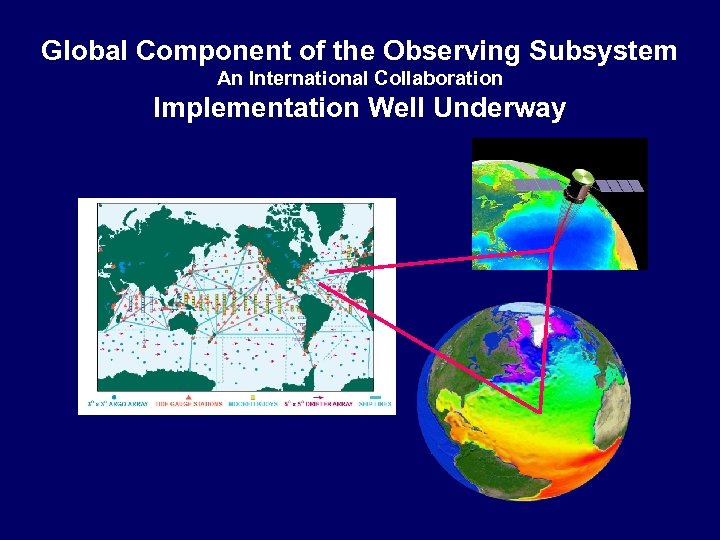 Global Component of the Observing Subsystem An International Collaboration Implementation Well Underway
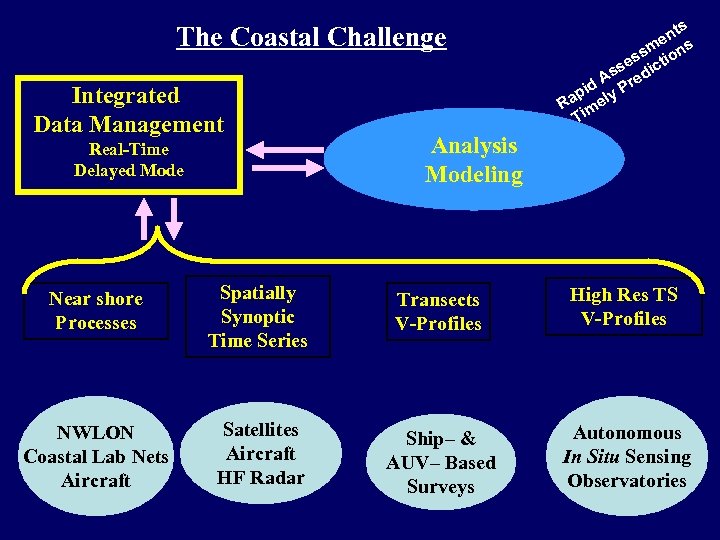 The Coastal Challenge Integrated Data Management Real-Time Delayed Mode ts en s sm n es ictio ss A Pred pid ly Ra me Ti Analysis Modeling Near shore Processes Spatially Synoptic Time Series Transects V-Profiles High Res TS V-Profiles NWLON Coastal Lab Nets Aircraft Satellites Aircraft HF Radar Ship– & AUV– Based Surveys Autonomous In Situ Sensing Observatories
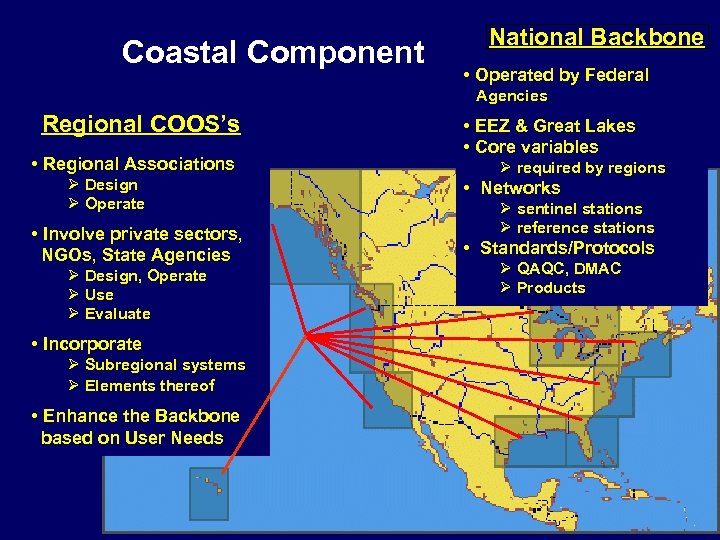 Coastal Component National Backbone • Operated by Federal Agencies Regional COOS’s • Regional Associations Ø Design Ø Operate • Involve private sectors, NGOs, State Agencies Ø Design, Operate Ø Use Ø Evaluate • Incorporate Ø Subregional systems Ø Elements thereof • Enhance the Backbone based on User Needs • EEZ & Great Lakes • Core variables Ø required by regions • Networks Ø sentinel stations Ø reference stations • Standards/Protocols Ø QAQC, DMAC Ø Products
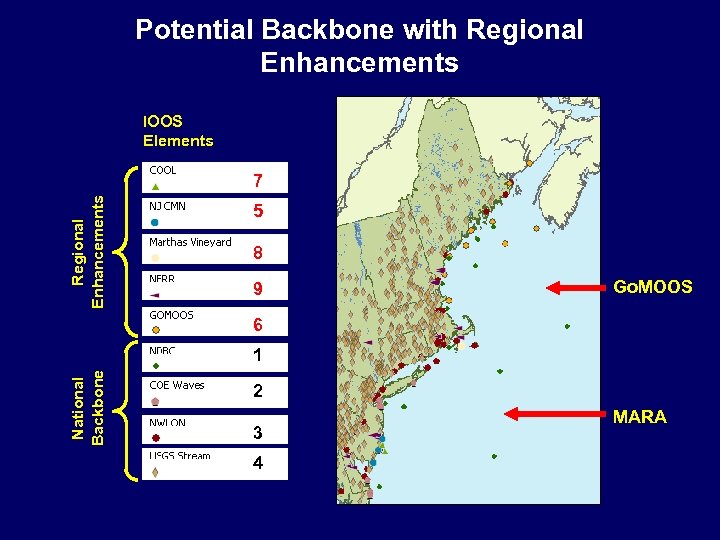 Potential Backbone with Regional Enhancements IOOS Elements Regional Enhancements 7 5 8 9 Go. MOOS 6 National Backbone 1 2 3 4 MARA
 IOOS Evolution
 Desired Roles of Private Sectors • Contribute to IOOS design, implementation, operation & improvement – Observations, data telemetry, data management, modeling • Sell products to develop & operate the IOOS – Vendors of instruments, standards, communications, etc. • Provide data served by the IOOS – Recognizing that use may be restricted • Use data served by the IOOS to create value added products – Commercial weather forecasting • Purchase value added products from commercial vendors for their own purposes
 Engaging Private Sectors in IOOS Development • Two convergent, interdependent approaches Ø Regional • Focus on engaging private sectors, NGOs, and state agencies from the beginning Ø National • Focus on serving data & information to attract the interest of private sectors & stimulate product development • Regional Approach Ø Regional workshops – East & West Coasts, Great Lakes, Gulf of Mexico Ø Standing User Forums • National Approach Ø Annual IOOS Implementation Conference to formulate & update the IOOS Development Plan
 Gulf of Mexico Regional Workshop • Marathon Oil Co. , Houston, TX, 2 -4 March 2004 • Explore Private Sector Interests & Roles in the U. S. IOOS • Results – Private sector demands • Actively involved in planning, governance, operation, evaluation • Funding opportunities must be open to private sectors – Private sector concerns • More effective, proactive communications by IOOS developers • Protection of their right to sell products & services w/o competition from government agencies • Protection of proprietary data from unauthorized distribution & use – Private sector advocacy • Yes, if treated as equal partners in addressing the issues above • Next Steps – Regional Workshops for Great Lakes, East & West Coasts – RAs establish regional “user” group forums
 1 st Annual IOOS Development Plan • Part I – Structure and Governance Ø Vision & design principles Ø Planning Implementation Cycle • Part II – Building the Initial IOOS (FY 05 – 06) Ø Integrate existing assets across agencies Ø Coordinated regional development • Part III – Improving the IOOS (FY 07 – 14) Ø Enhance the initial IOOS Ø R&D priorities
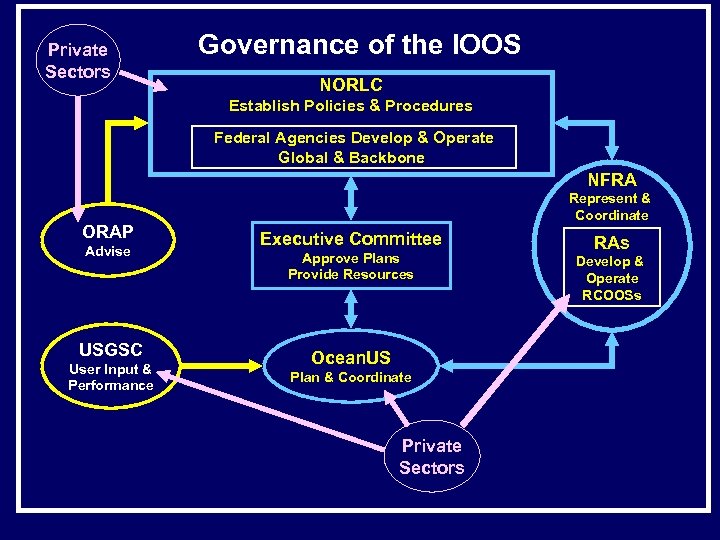 Private Sectors Governance of the IOOS NORLC Establish Policies & Procedures Federal Agencies Develop & Operate Global & Backbone NFRA ORAP Advise USGSC User Input & Performance Represent & Coordinate Executive Committee Approve Plans Provide Resources Ocean. US Plan & Coordinate Private Sectors RAs Develop & Operate RCOOSs
 Funding
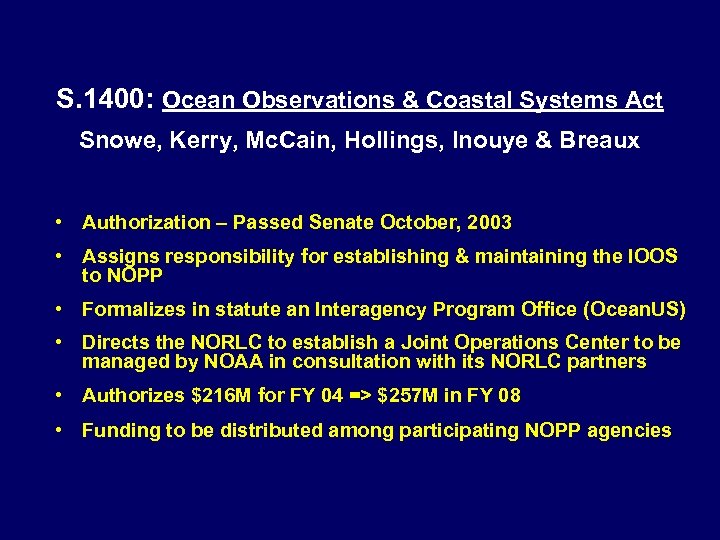 S. 1400: Ocean Observations & Coastal Systems Act Snowe, Kerry, Mc. Cain, Hollings, Inouye & Breaux • Authorization – Passed Senate October, 2003 • Assigns responsibility for establishing & maintaining the IOOS to NOPP • Formalizes in statute an Interagency Program Office (Ocean. US) • Directs the NORLC to establish a Joint Operations Center to be managed by NOAA in consultation with its NORLC partners • Authorizes $216 M for FY 04 => $257 M in FY 08 • Funding to be distributed among participating NOPP agencies
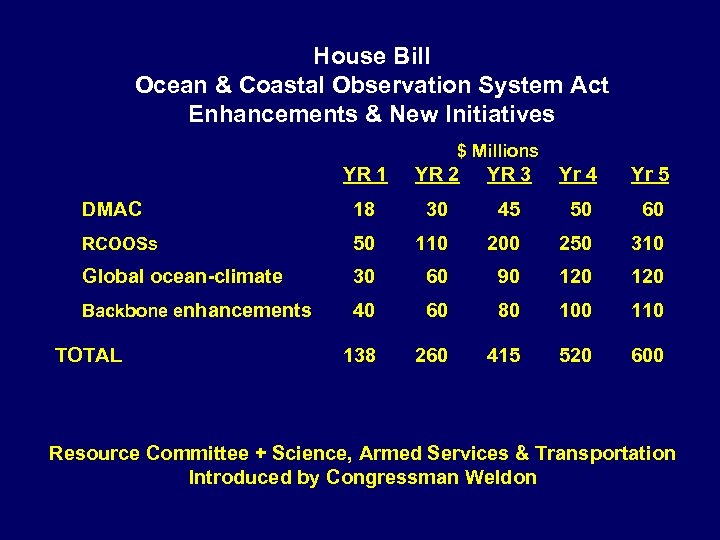 House Bill Ocean & Coastal Observation System Act Enhancements & New Initiatives $ Millions YR 1 YR 2 YR 3 Yr 4 Yr 5 18 30 45 50 60 RCOOSs 50 110 200 250 310 Global ocean-climate 30 60 90 120 Backbone enhancements 40 60 80 100 110 138 260 415 520 600 DMAC TOTAL Resource Committee + Science, Armed Services & Transportation Introduced by Congressman Weldon
 THANK YOU