 Скачать презентацию National Level Learning Alliance Platform SANITATION BAZAAR SNOWS
b2a994d00ebd2140206a73fe53e1d438.ppt
- Количество слайдов: 18



National Level Learning Alliance Platform SANITATION BAZAAR SNOWS (Scientists Networked For Outcomes From Water and Sanitation ) Date: June 4, 2010 Venue: Coconut Grove Regency Hotel, Accra
Overview • • • Project Partners Purpose and work packages of Project Key Project Activities Governance Structure Schedule of main events for 2010
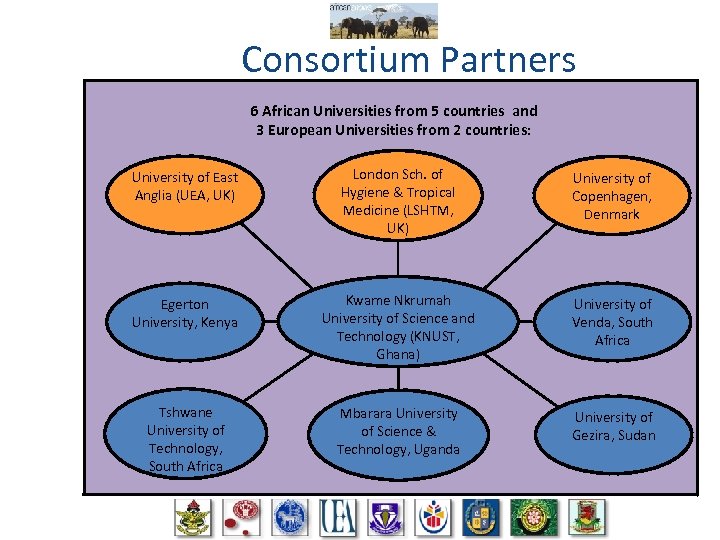
Consortium Partners 6 African Universities from 5 countries and 3 European Universities from 2 countries: University of East Anglia (UEA, UK) London Sch. of Hygiene & Tropical Medicine (LSHTM, UK) University of Copenhagen, Denmark Egerton University, Kenya Kwame Nkrumah University of Science and Technology (KNUST, Ghana) University of Venda, South Africa Tshwane University of Technology, South Africa Mbarara University of Science & Technology, Uganda University of Gezira, Sudan
Purpose of Initiative q Principal purpose of the project is to build a critical mass of sustainable local research and capacity across Africa, through strengthening African universities and research institutions in Water Supply, Sanitation and Environmental Health. q Research Vision: To provide internally excellent Africa-based research that will enable all African children to realize their maximum potential through sustainable water supply, sanitation and hygiene delivery. Work Packages • WP 1: Managing the consortium • WP 2: Needs assessment for capacity building • WP 3: Training in research practice and methods • WP 4. Strengthening research management capacity of institutions • WP 5. Strengthening research capacity of individuals • WP 6. Networking and communication
Key Project Activities • Carrying out a participatory needs assessment for individual and institutional capacity building • Developing modules for MSc courses, and the capacity to offer relevant short courses, at a number of leading universities • Establishing staff exchange schemes among partner universities
Key Project Activities • Supporting linked interdisciplinary multi-centre practically-oriented research projects • Establishing common field platforms for research from multiple perspectives • Building and sustaining institutional capacity over the long term
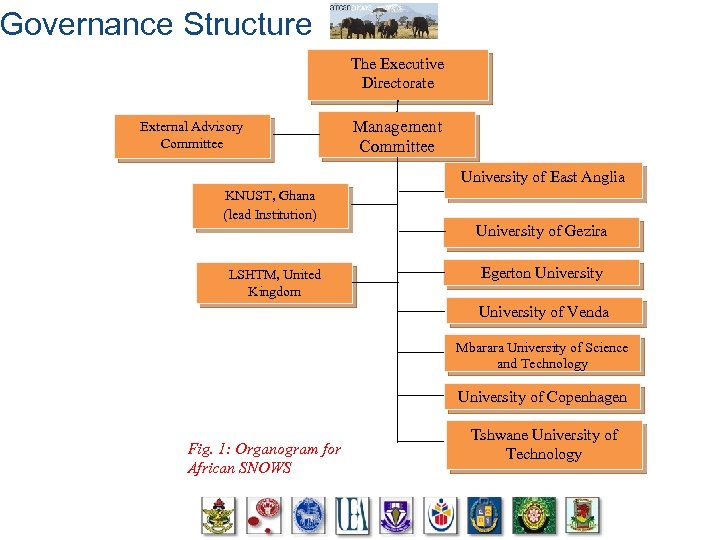
Governance Structure The African SNOWS Consortium is made up of 9 institutions from 7 countries and aims at building a critical mass of sustainable local research capacity across Africa, through strengthening African universities and research institutions in Water Supply, Sanitation and Environmental Health. The Executive Directorate External Advisory Committee Management Committee University of East Anglia KNUST, Ghana (lead Institution) LSHTM, United Kingdom University of Gezira Egerton University of Venda Mbarara University of Science and Technology University of Copenhagen Fig. 1: Organogram for African SNOWS Tshwane University of Technology
Schedule of Main events for 2010 • Mapping: this is intended to provide an objective overview of resources, rules, regulations and procedures of relevance to institutional research management, and postgraduate and doctorate training programmes • Situation analysis: To provide a subjective and stakeholder informed assessment of strengths and weaknesses of existing research management capacities, and postgraduate and doctorate training programmes.
Activity 1: Needs Assessment/Questionnaire Survey • To provide a subjective assessment of capacity strengthening needs with a view to optimize research management capacities, and postgraduate and doctorate training programmes Main Objectives: • To strengthen the post-graduate and doctorate programmes at African partner institutions with emphasis on water supply, sanitation and environmental health • To strengthen the capacity of administrative, technical and academic staff as well as students through in-country training and exchange programmes • To foster stronger linkages between consortium partners
Eligible numbers of respondents for Questionnaire survey: • Administrative university personnel (10 -20) • Academic university personnel (20 – 50) • Current or recently graduated Ph. D fellows (0 - 40) • Current or recently graduated post-graduate (Master-level) students (30 – 60)
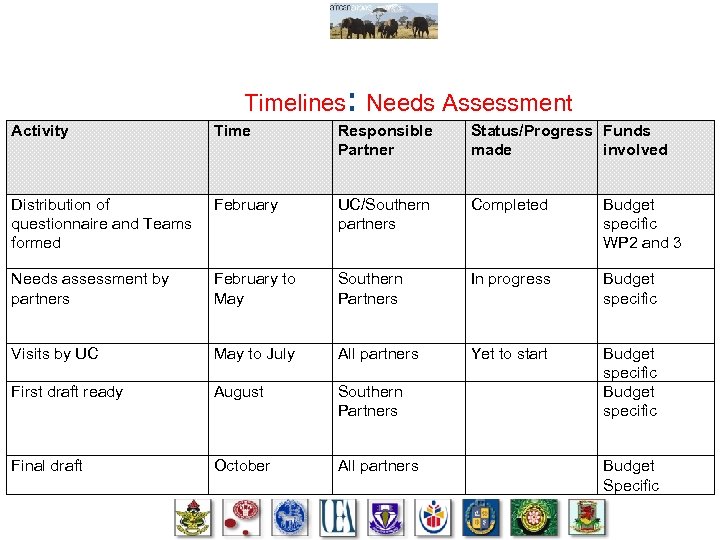
: Timelines Needs Assessment Activity Time Responsible Partner Status/Progress Funds made involved Distribution of questionnaire and Teams formed February UC/Southern partners Completed Budget specific WP 2 and 3 Needs assessment by partners February to May Southern Partners In progress Budget specific Visits by UC May to July All partners Yet to start First draft ready August Southern Partners Budget specific Final draft October All partners Budget Specific
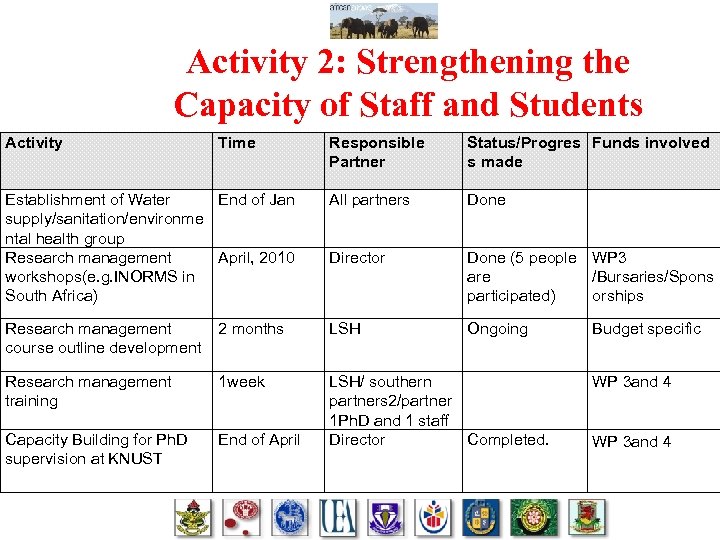
Activity 2: Strengthening the Capacity of Staff and Students Activity Time Responsible Partner Status/Progres Funds involved s made Establishment of Water End of Jan supply/sanitation/environme ntal health group Research management April, 2010 workshops(e. g. INORMS in South Africa) All partners Done Director Done (5 people WP 3 are /Bursaries/Spons participated) orships Research management course outline development 2 months LSH Ongoing Research management training 1 week Capacity Building for Ph. D supervision at KNUST End of April LSH/ southern partners 2/partner 1 Ph. D and 1 staff Director Completed. Budget specific WP 3 and 4
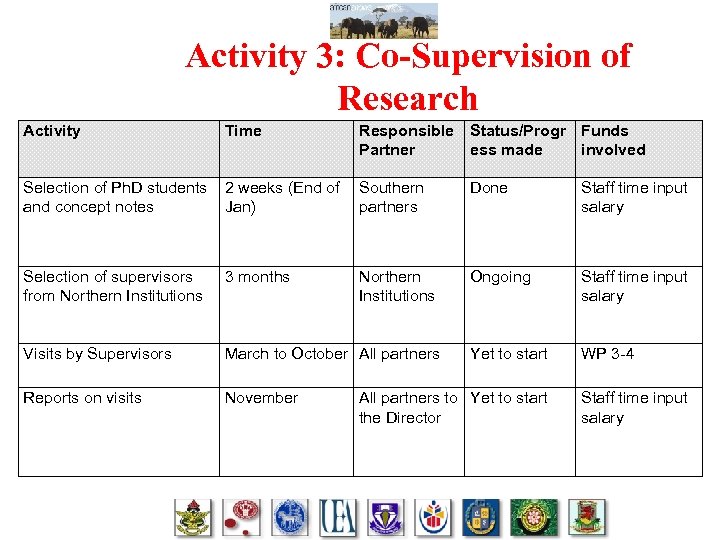
Activity 3: Co-Supervision of Research Activity Time Responsible Status/Progr Funds Partner ess made involved Selection of Ph. D students and concept notes 2 weeks (End of Jan) Southern partners Done Staff time input salary Selection of supervisors from Northern Institutions 3 months Northern Institutions Ongoing Staff time input salary Visits by Supervisors March to October All partners Yet to start WP 3 -4 Reports on visits November All partners to Yet to start the Director Staff time input salary
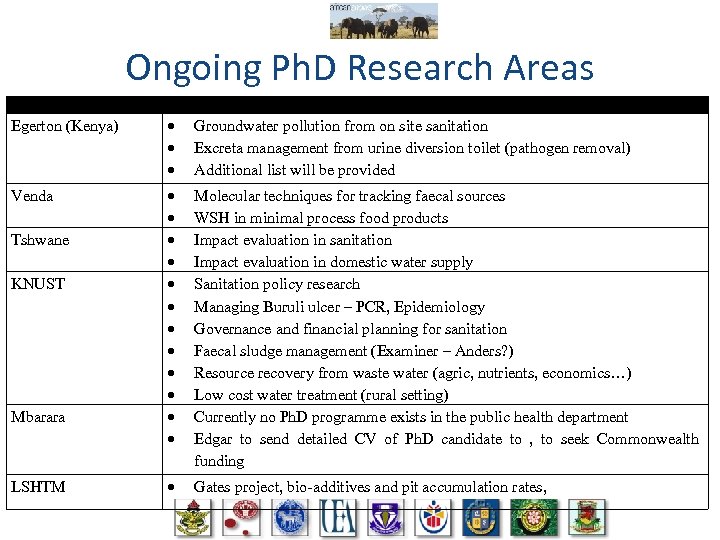
Ongoing Ph. D Research Areas Partner Institution Ph. D Research Area/Activity Egerton (Kenya) Groundwater pollution from on site sanitation Excreta management from urine diversion toilet (pathogen removal) Additional list will be provided Venda Molecular techniques for tracking faecal sources WSH in minimal process food products Impact evaluation in sanitation Impact evaluation in domestic water supply Sanitation policy research Managing Buruli ulcer – PCR, Epidemiology Governance and financial planning for sanitation Faecal sludge management (Examiner – Anders? ) Resource recovery from waste water (agric, nutrients, economics…) Low cost water treatment (rural setting) Currently no Ph. D programme exists in the public health department Edgar to send detailed CV of Ph. D candidate to , to seek Commonwealth funding Gates project, bio-additives and pit accumulation rates, Tshwane KNUST Mbarara LSHTM
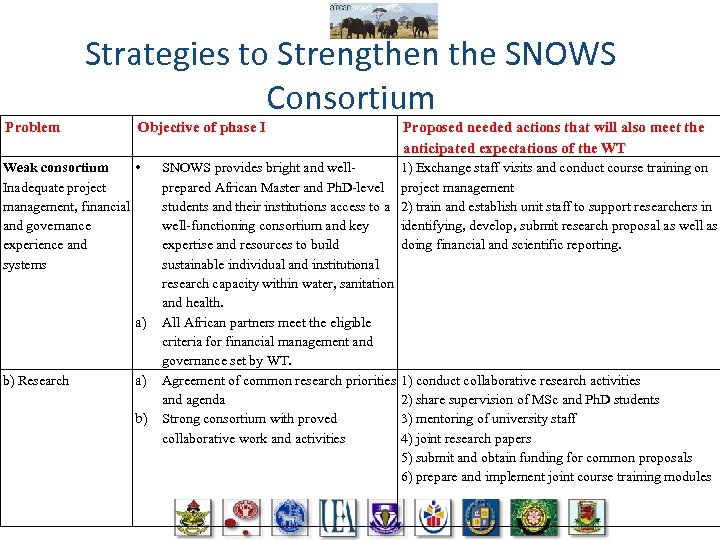
Strategies to Strengthen the SNOWS Consortium Problem Objective of phase I Weak consortium • Inadequate project management, financial and governance experience and systems a) b) Research a) b) SNOWS provides bright and wellprepared African Master and Ph. D-level students and their institutions access to a well-functioning consortium and key expertise and resources to build sustainable individual and institutional research capacity within water, sanitation and health. All African partners meet the eligible criteria for financial management and governance set by WT. Agreement of common research priorities and agenda Strong consortium with proved collaborative work and activities Proposed needed actions that will also meet the anticipated expectations of the WT 1) Exchange staff visits and conduct course training on project management 2) train and establish unit staff to support researchers in identifying, develop, submit research proposal as well as doing financial and scientific reporting. 1) conduct collaborative research activities 2) share supervision of MSc and Ph. D students 3) mentoring of university staff 4) joint research papers 5) submit and obtain funding for common proposals 6) prepare and implement joint course training modules
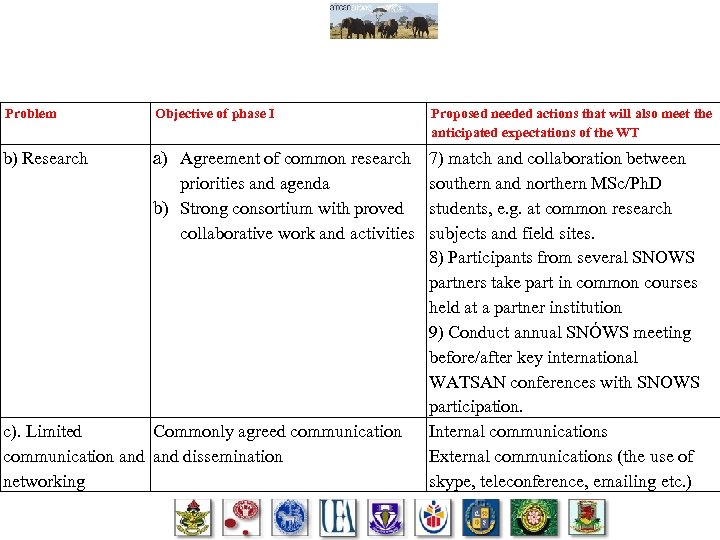
Problem Objective of phase I Proposed needed actions that will also meet the anticipated expectations of the WT b) Research a) Agreement of common research priorities and agenda b) Strong consortium with proved collaborative work and activities 7) match and collaboration between southern and northern MSc/Ph. D students, e. g. at common research subjects and field sites. 8) Participants from several SNOWS partners take part in common courses held at a partner institution 9) Conduct annual SNÓWS meeting before/after key international WATSAN conferences with SNOWS participation. Internal communications External communications (the use of skype, teleconference, emailing etc. ) c). Limited Commonly agreed communication and dissemination networking
Activity 4: Scoping study of other Sources of funding • • Source Responsible Partner Edulink LSH ERASMUSMUNDUS CU IFS Individual Ph. D students Bill Gates LSH ACU (Commonwealth) Mbarara/LSH Wellcome Trust LSH Timing; draft report by end of inception period Final draft December 2010
THANK YOU
Скачать презентацию National Level Learning Alliance Platform SANITATION BAZAAR SNOWS
b2a994d00ebd2140206a73fe53e1d438.ppt