


 Скачать презентацию NATIONAL ICT CONVENTION 23 -25 March 2004 Top-Down
726b872819321afd835b7e351757e1f2.ppt
- Количество слайдов: 38
 NATIONAL ICT CONVENTION 23 -25 March 2004 “Top-Down” or “Bottom-Up”? Locating ICT Strategy in Kenya’s Growth, Equity & Poverty Reduction Agenda Dennis Kabaara CEO, Institute of Economic Affairs – Kenya 23 March 2004, Safari Park Hotel
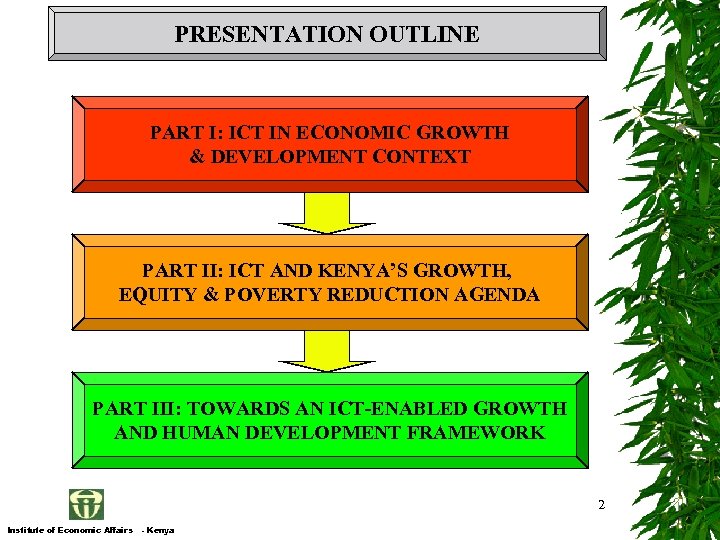 PRESENTATION OUTLINE PART I: ICT IN ECONOMIC GROWTH & DEVELOPMENT CONTEXT PART II: ICT AND KENYA’S GROWTH, EQUITY & POVERTY REDUCTION AGENDA PART III: TOWARDS AN ICT-ENABLED GROWTH AND HUMAN DEVELOPMENT FRAMEWORK 2 Institute of Economic Affairs - Kenya
 PART I ICT IN ECONOMIC GROWTH & DEVELOPMENT CONTEXT
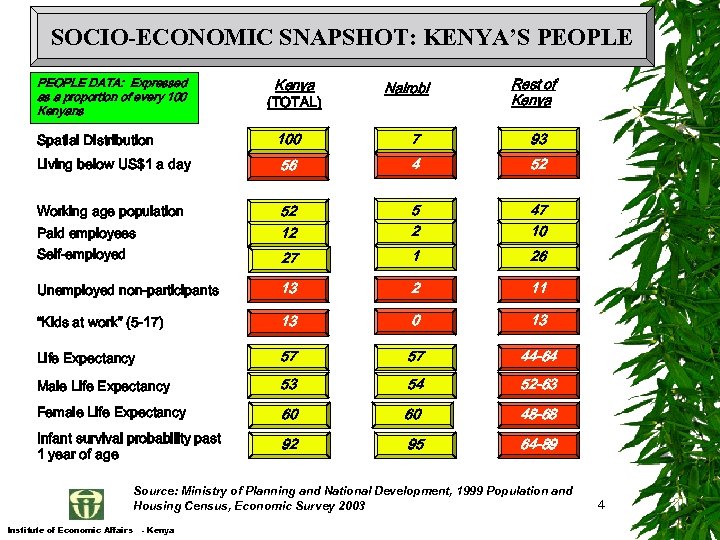 SOCIO-ECONOMIC SNAPSHOT: KENYA’S PEOPLE DATA: Expressed as a proportion of every 100 Kenyans Kenya (TOTAL) Nairobi Rest of Kenya Spatial Distribution 100 7 93 Living below US$1 a day 56 4 52 Working age population Paid employees 52 12 5 2 47 10 Self-employed 27 1 26 Unemployed non-participants 13 2 11 “Kids at work” (5 -17) 13 0 13 Life Expectancy 57 57 44 -64 Male Life Expectancy 53 54 52 -63 Female Life Expectancy 60 60 48 -68 Infant survival probability past 1 year of age 92 95 64 -89 Source: Ministry of Planning and National Development, 1999 Population and Housing Census, Economic Survey 2003 Institute of Economic Affairs - Kenya 4
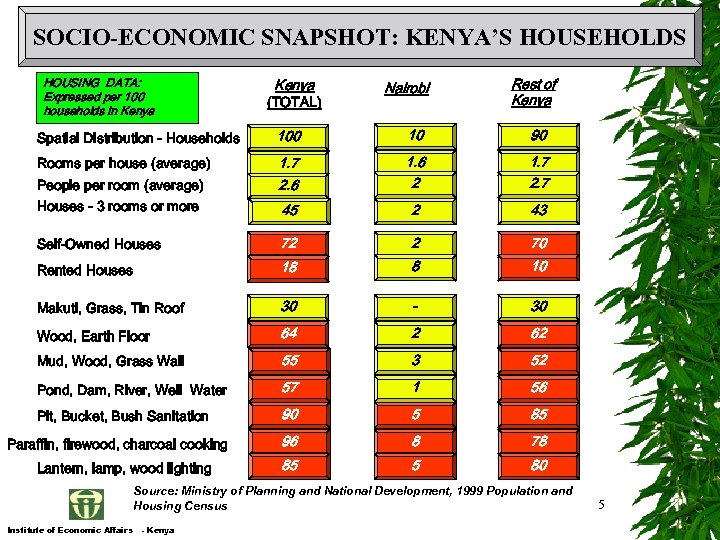 SOCIO-ECONOMIC SNAPSHOT: KENYA’S HOUSEHOLDS HOUSING DATA: Expressed per 100 households in Kenya (TOTAL) Nairobi Rest of Kenya Spatial Distribution - Households 100 10 90 Rooms per house (average) People per room (average) 1. 7 2. 6 1. 6 2 1. 7 2. 7 Houses - 3 rooms or more 45 2 43 Self-Owned Houses 72 2 70 Rented Houses 18 8 10 Makuti, Grass, Tin Roof 30 - 30 Wood, Earth Floor 64 2 62 Mud, Wood, Grass Wall 55 3 52 Pond, Dam, River, Well Water 57 1 56 Pit, Bucket, Bush Sanitation 90 5 85 96 8 78 85 5 80 Paraffin, firewood, charcoal cooking Lantern, lamp, wood lighting Source: Ministry of Planning and National Development, 1999 Population and Housing Census Institute of Economic Affairs - Kenya 5
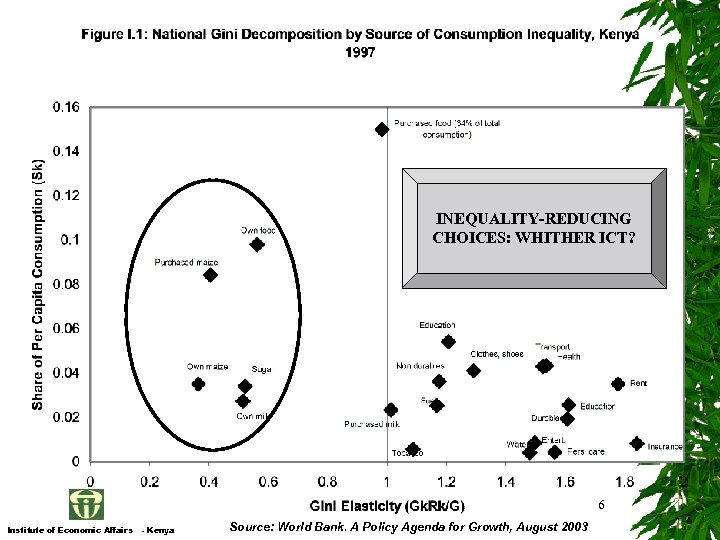 INEQUALITY-REDUCING CHOICES: WHITHER ICT? 6 Institute of Economic Affairs - Kenya Source: World Bank. A Policy Agenda for Growth, August 2003
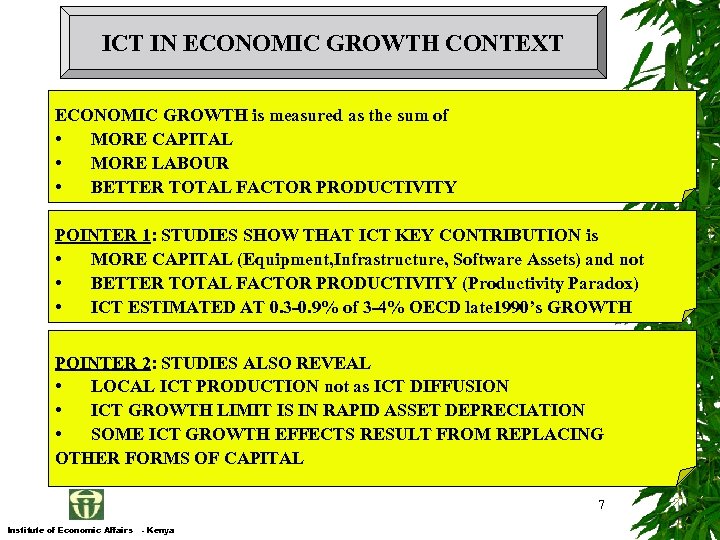 ICT IN ECONOMIC GROWTH CONTEXT ECONOMIC GROWTH is measured as the sum of • MORE CAPITAL • MORE LABOUR • BETTER TOTAL FACTOR PRODUCTIVITY POINTER 1: STUDIES SHOW THAT ICT KEY CONTRIBUTION is • MORE CAPITAL (Equipment, Infrastructure, Software Assets) and not • BETTER TOTAL FACTOR PRODUCTIVITY (Productivity Paradox) • ICT ESTIMATED AT 0. 3 -0. 9% of 3 -4% OECD late 1990’s GROWTH POINTER 2: STUDIES ALSO REVEAL • LOCAL ICT PRODUCTION not as ICT DIFFUSION • ICT GROWTH LIMIT IS IN RAPID ASSET DEPRECIATION • SOME ICT GROWTH EFFECTS RESULT FROM REPLACING OTHER FORMS OF CAPITAL 7 Institute of Economic Affairs - Kenya
 PART II ICT IN KENYA’s GROWTH, EQUITY & POVERTY REDUCTION AGENDA
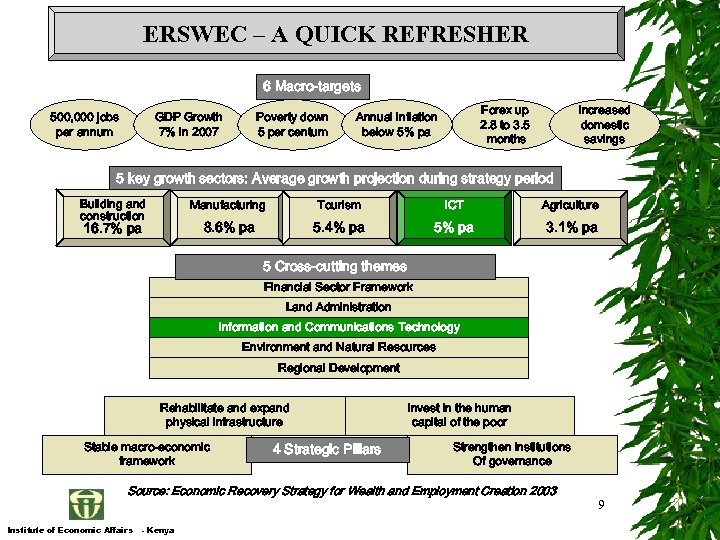 ERSWEC – A QUICK REFRESHER 6 Macro-targets 500, 000 jobs per annum GDP Growth 7% in 2007 Poverty down 5 per centum Forex up 2. 8 to 3. 5 months Annual inflation below 5% pa Increased domestic savings 5 key growth sectors: Average growth projection during strategy period Building and construction Manufacturing ICT Agriculture 8. 6% pa 16. 7% pa Tourism 5. 4% pa 5% pa 3. 1% pa 5 Cross-cutting themes Financial Sector Framework Land Administration Information and Communications Technology Environment and Natural Resources Regional Development Rehabilitate and expand physical infrastructure Stable macro-economic framework 4 Strategic Pillars Invest in the human capital of the poor Strengthen institutions Of governance Source: Economic Recovery Strategy for Wealth and Employment Creation 2003 Institute of Economic Affairs - Kenya 9
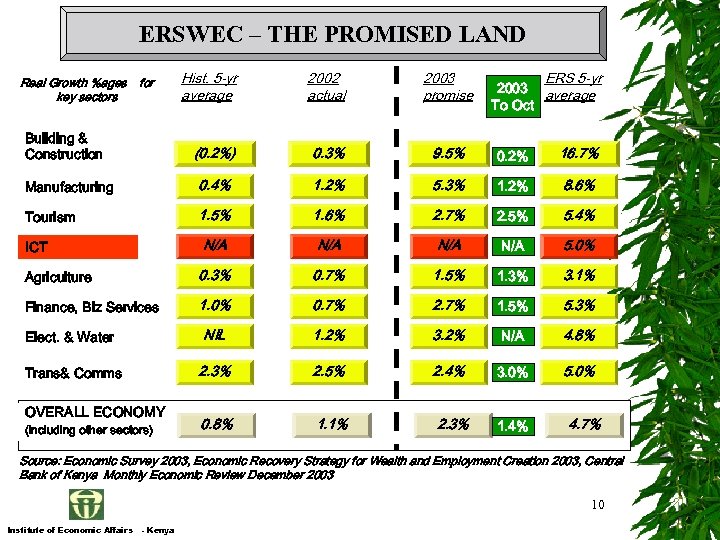 ERSWEC – THE PROMISED LAND Hist. 5 -yr average 2002 actual 2003 promise (0. 2%) 0. 3% 9. 5% 0. 2% 16. 7% Manufacturing 0. 4% 1. 2% 5. 3% 1. 2% 8. 6% Tourism 1. 5% 1. 6% 2. 7% 2. 5% 5. 4% N/A N/A 5. 0% Agriculture 0. 3% 0. 7% 1. 5% 1. 3% 3. 1% Finance, Biz Services 1. 0% 0. 7% 2. 7% 1. 5% 5. 3% Elect. & Water NIL 1. 2% 3. 2% N/A 4. 8% Trans& Comms 2. 3% 2. 5% 2. 4% 3. 0% 5. 0% 0. 8% 1. 1% 2. 3% Real Growth %ages key sectors for Building & Construction ICT OVERALL ECONOMY (including other sectors) ERS 5 -yr 2003 average To Oct 1. 4% 4. 7% Source: Economic Survey 2003, Economic Recovery Strategy for Wealth and Employment Creation 2003, Central Bank of Kenya Monthly Economic Review December 2003 10 Institute of Economic Affairs - Kenya
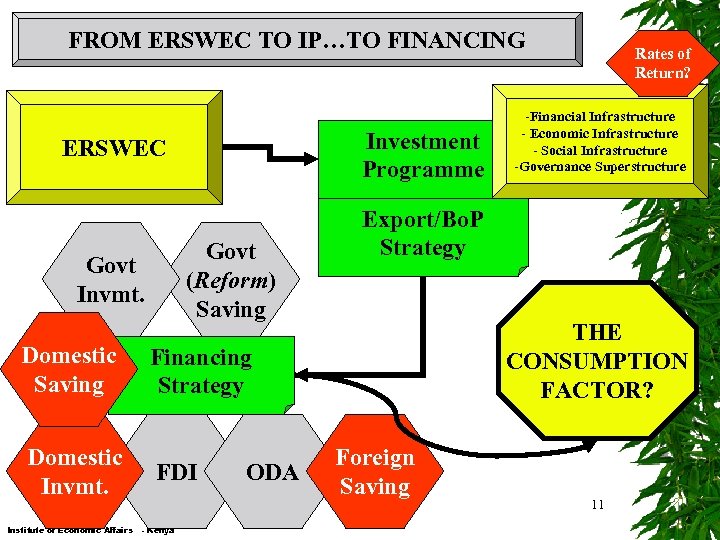 FROM ERSWEC TO IP…TO FINANCING Investment Programme ERSWEC Govt (Reform) Saving Govt Invmt. Domestic Saving FDI Institute of Economic Affairs - Kenya ODA -Financial Infrastructure - Economic Infrastructure - Social Infrastructure -Governance Superstructure Export/Bo. P Strategy THE CONSUMPTION FACTOR? Financing Strategy Domestic Invmt. Rates of Return? Foreign Saving 11
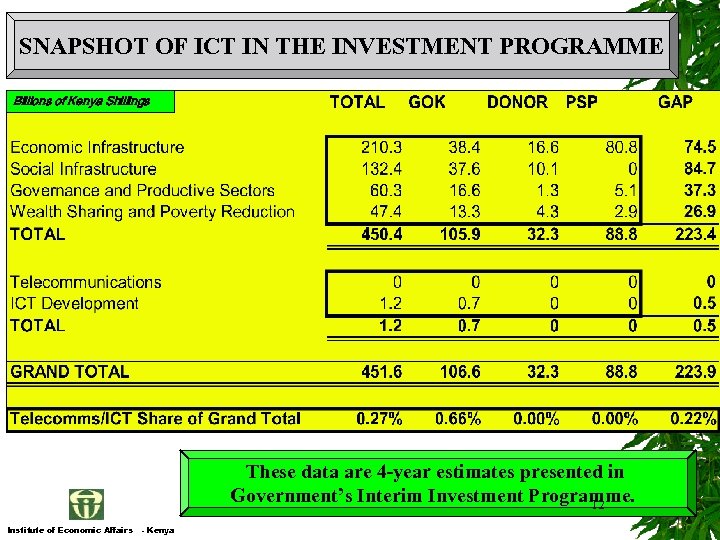 SNAPSHOT OF ICT IN THE INVESTMENT PROGRAMME Billions of Kenya Shillings These data are 4 -year estimates presented in Government’s Interim Investment Programme. 12 Institute of Economic Affairs - Kenya
 PART III TOWARDS AN ICTENABLED GROWTH & HUMAN DEVELOPMENT FRAMEWORK
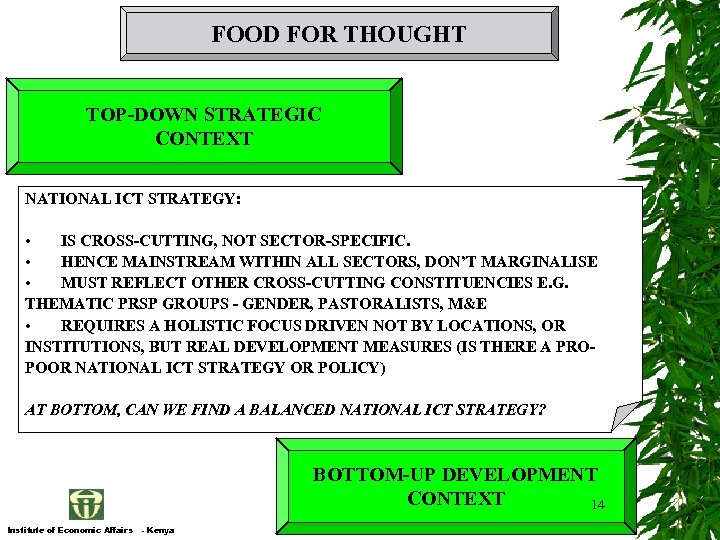 FOOD FOR THOUGHT TOP-DOWN STRATEGIC CONTEXT NATIONAL ICT STRATEGY: • IS CROSS-CUTTING, NOT SECTOR-SPECIFIC. • HENCE MAINSTREAM WITHIN ALL SECTORS, DON’T MARGINALISE • MUST REFLECT OTHER CROSS-CUTTING CONSTITUENCIES E. G. THEMATIC PRSP GROUPS - GENDER, PASTORALISTS, M&E • REQUIRES A HOLISTIC FOCUS DRIVEN NOT BY LOCATIONS, OR INSTITUTIONS, BUT REAL DEVELOPMENT MEASURES (IS THERE A PROPOOR NATIONAL ICT STRATEGY OR POLICY) AT BOTTOM, CAN WE FIND A BALANCED NATIONAL ICT STRATEGY? BOTTOM-UP DEVELOPMENT CONTEXT 14 Institute of Economic Affairs - Kenya
 REFERENCES q Collechia A & Schreyer P, October 2001. “ICT Investment and Economic Growth in the 1990 s: Is the United States a Unique Case? – A Comparative Study of 9 OECD Countries. ” _______. q Central Bank of Kenya, December 2003. “Dec 2003 Monthly Economic Review”. Nairobi. q Central Bureau of Statistics. August 2002. “The 1999 Population and Housing Census”. Nairobi q Institute of Economic Affairs, 2002. “Telecommunications Policy in Transition: Mainstreaming Kenya into the Global Information Economy”. Research Paper Series No 2. Nairobi. q Institute of Economic Affairs, 2003. “A Quest for National Recovery: Repositioning ICT as a pillar for national economic growth” – Commissioned Paper (M Mureithi, Summit Strategies). Nairobi. q Kenya ICT Federation, March 2004. “From National ICT Policy to National ICT Strategy”. Nairobi. q Kenya ICT Federation, March 2004. “Sector-Based ICT Strategies for Kenya: Action Programme 2003 -04”. Nairobi. q M Mureithi (Summit Strategies) & K Owino (Institute of Economic Affairs), November 2003. “An Inclusive ICT Policy Imperative for National Development in Kenya: A Field Survey of ICT Stakeholders”: UNESCO Commissioned Research. Nairobi. q Ministry of Planning and National Development. 2003. “Economic Recovery Strategy for Wealth and Employment Creation 2003 -2007”. Nairobi. q Ministry of Planning and National Development. 2003. “Interim Investment Programme for the Economic Recovery Strategy for Wealth and Employment Creation 2003 -2007”. Nairobi. q Ministry of Planning and National Development. May 2003. “ 2003 Economic Survey”. Nairobi. q NGO Council, Action. Aid Kenya, Institute of Economic Affairs and Christian Partners Development Agency. November 2003. “Civil Society Issues Paper - Response to Interim Investment Programme”. Nairobi. 15 Institute of Economic Affairs - Kenya
 ANNEX SECTOR-BY-SECTOR COMPARISON OF ERSWEC, PRSP and INVESTMENT PROGRAM
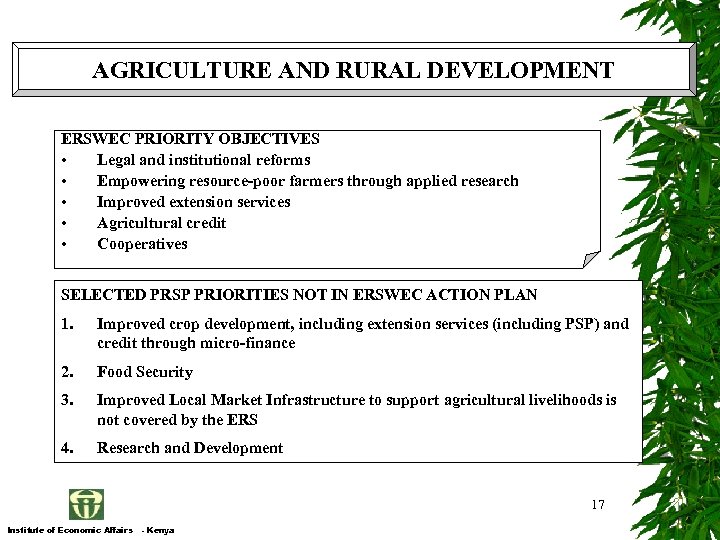 AGRICULTURE AND RURAL DEVELOPMENT ERSWEC PRIORITY OBJECTIVES • Legal and institutional reforms • Empowering resource-poor farmers through applied research • Improved extension services • Agricultural credit • Cooperatives SELECTED PRSP PRIORITIES NOT IN ERSWEC ACTION PLAN 1. Improved crop development, including extension services (including PSP) and credit through micro-finance 2. Food Security 3. Improved Local Market Infrastructure to support agricultural livelihoods is not covered by the ERS 4. Research and Development 17 Institute of Economic Affairs - Kenya
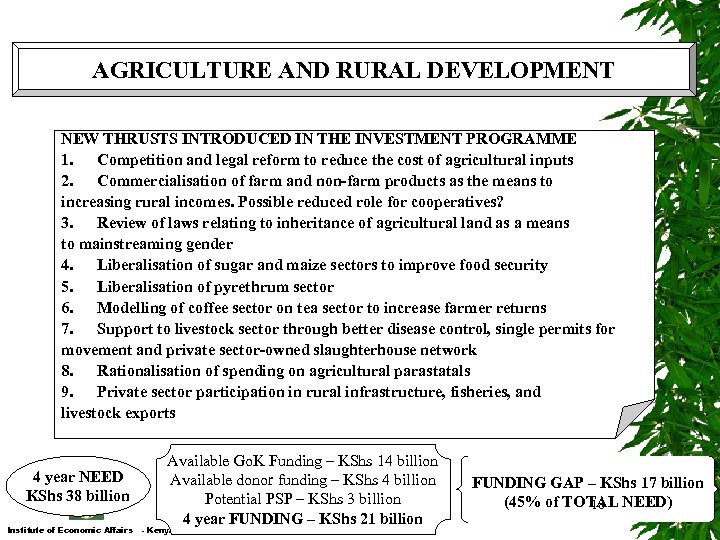 AGRICULTURE AND RURAL DEVELOPMENT NEW THRUSTS INTRODUCED IN THE INVESTMENT PROGRAMME 1. Competition and legal reform to reduce the cost of agricultural inputs 2. Commercialisation of farm and non-farm products as the means to increasing rural incomes. Possible reduced role for cooperatives? 3. Review of laws relating to inheritance of agricultural land as a means to mainstreaming gender 4. Liberalisation of sugar and maize sectors to improve food security 5. Liberalisation of pyrethrum sector 6. Modelling of coffee sector on tea sector to increase farmer returns 7. Support to livestock sector through better disease control, single permits for movement and private sector-owned slaughterhouse network 8. Rationalisation of spending on agricultural parastatals 9. Private sector participation in rural infrastructure, fisheries, and livestock exports 4 year NEED KShs 38 billion Institute of Economic Affairs Available Go. K Funding – KShs 14 billion Available donor funding – KShs 4 billion Potential PSP – KShs 3 billion 4 year FUNDING – KShs 21 billion - Kenya FUNDING GAP – KShs 17 billion (45% of TOTAL NEED) 18
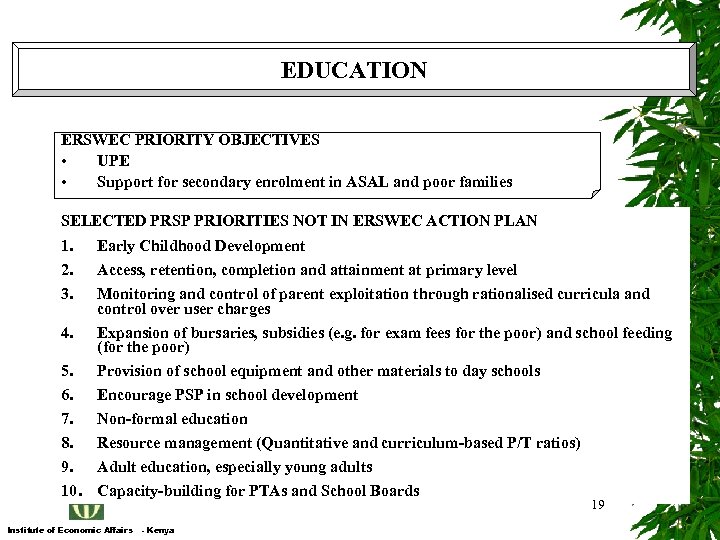 EDUCATION ERSWEC PRIORITY OBJECTIVES • UPE • Support for secondary enrolment in ASAL and poor families SELECTED PRSP PRIORITIES NOT IN ERSWEC ACTION PLAN 1. 2. 3. 4. Early Childhood Development Access, retention, completion and attainment at primary level Monitoring and control of parent exploitation through rationalised curricula and control over user charges Expansion of bursaries, subsidies (e. g. for exam fees for the poor) and school feeding (for the poor) Provision of school equipment and other materials to day schools Encourage PSP in school development Non-formal education Resource management (Quantitative and curriculum-based P/T ratios) Adult education, especially young adults 5. 6. 7. 8. 9. 10. Capacity-building for PTAs and School Boards Institute of Economic Affairs - Kenya 19
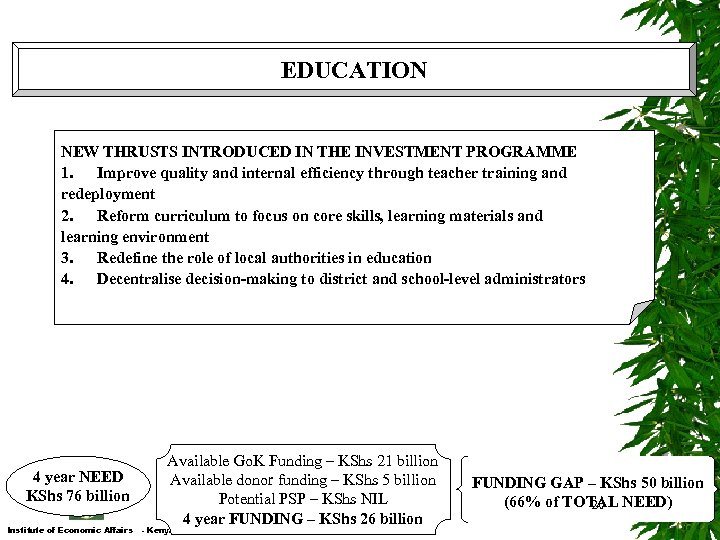 EDUCATION NEW THRUSTS INTRODUCED IN THE INVESTMENT PROGRAMME 1. Improve quality and internal efficiency through teacher training and redeployment 2. Reform curriculum to focus on core skills, learning materials and learning environment 3. Redefine the role of local authorities in education 4. Decentralise decision-making to district and school-level administrators 4 year NEED KShs 76 billion Institute of Economic Affairs Available Go. K Funding – KShs 21 billion Available donor funding – KShs 5 billion Potential PSP – KShs NIL 4 year FUNDING – KShs 26 billion - Kenya FUNDING GAP – KShs 50 billion (66% of TOTAL NEED) 20
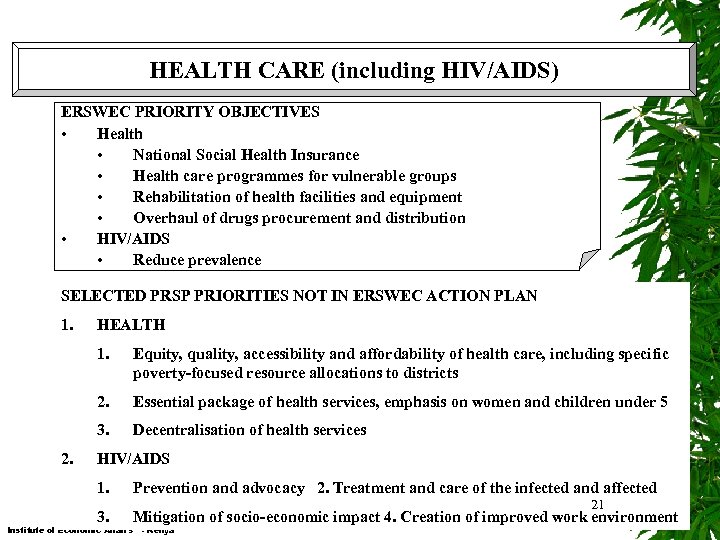 HEALTH CARE (including HIV/AIDS) ERSWEC PRIORITY OBJECTIVES • Health • National Social Health Insurance • Health care programmes for vulnerable groups • Rehabilitation of health facilities and equipment • Overhaul of drugs procurement and distribution • HIV/AIDS • Reduce prevalence SELECTED PRSP PRIORITIES NOT IN ERSWEC ACTION PLAN 1. HEALTH 1. 2. Essential package of health services, emphasis on women and children under 5 3. 2. Equity, quality, accessibility and affordability of health care, including specific poverty-focused resource allocations to districts Decentralisation of health services HIV/AIDS 1. Prevention and advocacy 2. Treatment and care of the infected and affected 3. Mitigation of socio-economic impact 4. Creation of improved work environment Institute of Economic Affairs 21 - Kenya
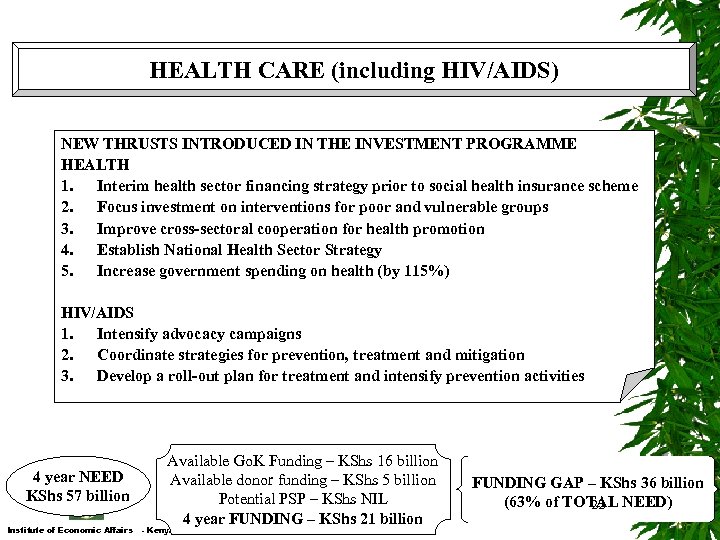 HEALTH CARE (including HIV/AIDS) NEW THRUSTS INTRODUCED IN THE INVESTMENT PROGRAMME HEALTH 1. Interim health sector financing strategy prior to social health insurance scheme 2. Focus investment on interventions for poor and vulnerable groups 3. Improve cross-sectoral cooperation for health promotion 4. Establish National Health Sector Strategy 5. Increase government spending on health (by 115%) HIV/AIDS 1. Intensify advocacy campaigns 2. Coordinate strategies for prevention, treatment and mitigation 3. Develop a roll-out plan for treatment and intensify prevention activities 4 year NEED KShs 57 billion Institute of Economic Affairs Available Go. K Funding – KShs 16 billion Available donor funding – KShs 5 billion Potential PSP – KShs NIL 4 year FUNDING – KShs 21 billion - Kenya FUNDING GAP – KShs 36 billion (63% of TOTAL NEED) 22
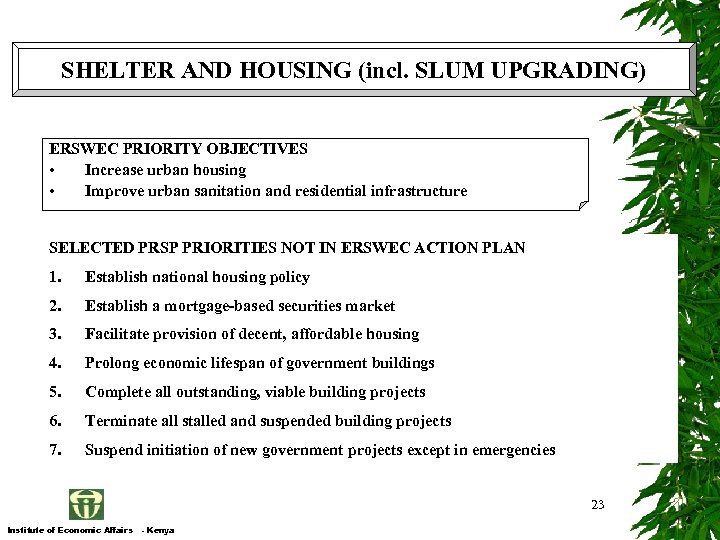 SHELTER AND HOUSING (incl. SLUM UPGRADING) ERSWEC PRIORITY OBJECTIVES • Increase urban housing • Improve urban sanitation and residential infrastructure SELECTED PRSP PRIORITIES NOT IN ERSWEC ACTION PLAN 1. Establish national housing policy 2. Establish a mortgage-based securities market 3. Facilitate provision of decent, affordable housing 4. Prolong economic lifespan of government buildings 5. Complete all outstanding, viable building projects 6. Terminate all stalled and suspended building projects 7. Suspend initiation of new government projects except in emergencies 23 Institute of Economic Affairs - Kenya
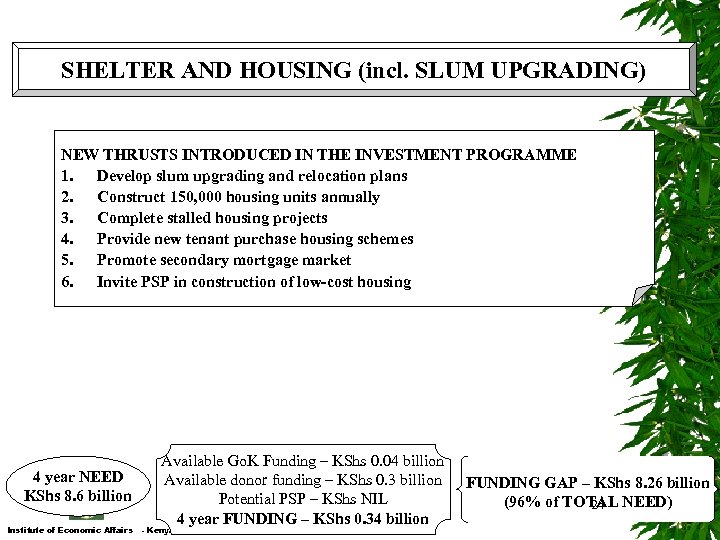 SHELTER AND HOUSING (incl. SLUM UPGRADING) NEW THRUSTS INTRODUCED IN THE INVESTMENT PROGRAMME 1. Develop slum upgrading and relocation plans 2. Construct 150, 000 housing units annually 3. Complete stalled housing projects 4. Provide new tenant purchase housing schemes 5. Promote secondary mortgage market 6. Invite PSP in construction of low-cost housing 4 year NEED KShs 8. 6 billion Institute of Economic Affairs Available Go. K Funding – KShs 0. 04 billion Available donor funding – KShs 0. 3 billion Potential PSP – KShs NIL 4 year FUNDING – KShs 0. 34 billion - Kenya FUNDING GAP – KShs 8. 26 billion (96% of TOTAL NEED) 24
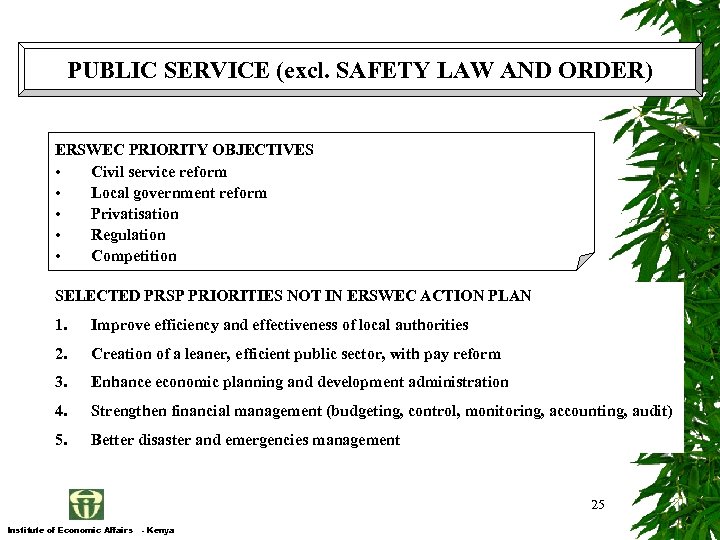 PUBLIC SERVICE (excl. SAFETY LAW AND ORDER) ERSWEC PRIORITY OBJECTIVES • Civil service reform • Local government reform • Privatisation • Regulation • Competition SELECTED PRSP PRIORITIES NOT IN ERSWEC ACTION PLAN 1. Improve efficiency and effectiveness of local authorities 2. Creation of a leaner, efficient public sector, with pay reform 3. Enhance economic planning and development administration 4. Strengthen financial management (budgeting, control, monitoring, accounting, audit) 5. Better disaster and emergencies management 25 Institute of Economic Affairs - Kenya
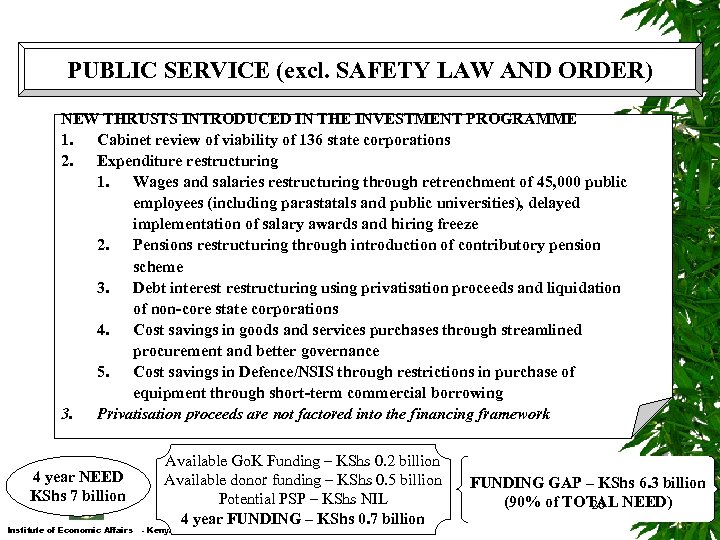 PUBLIC SERVICE (excl. SAFETY LAW AND ORDER) NEW THRUSTS INTRODUCED IN THE INVESTMENT PROGRAMME 1. Cabinet review of viability of 136 state corporations 2. Expenditure restructuring 1. Wages and salaries restructuring through retrenchment of 45, 000 public employees (including parastatals and public universities), delayed implementation of salary awards and hiring freeze 2. Pensions restructuring through introduction of contributory pension scheme 3. Debt interestructuring using privatisation proceeds and liquidation of non-core state corporations 4. Cost savings in goods and services purchases through streamlined procurement and better governance 5. Cost savings in Defence/NSIS through restrictions in purchase of equipment through short-term commercial borrowing 3. Privatisation proceeds are not factored into the financing framework 4 year NEED KShs 7 billion Institute of Economic Affairs Available Go. K Funding – KShs 0. 2 billion Available donor funding – KShs 0. 5 billion Potential PSP – KShs NIL 4 year FUNDING – KShs 0. 7 billion - Kenya FUNDING GAP – KShs 6. 3 billion (90% of TOTAL NEED) 26
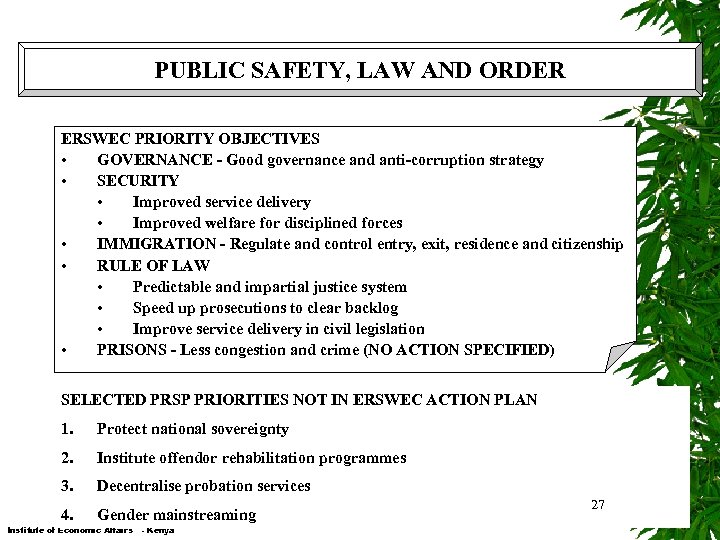 PUBLIC SAFETY, LAW AND ORDER ERSWEC PRIORITY OBJECTIVES • GOVERNANCE - Good governance and anti-corruption strategy • SECURITY • Improved service delivery • Improved welfare for disciplined forces • IMMIGRATION - Regulate and control entry, exit, residence and citizenship • RULE OF LAW • Predictable and impartial justice system • Speed up prosecutions to clear backlog • Improve service delivery in civil legislation • PRISONS - Less congestion and crime (NO ACTION SPECIFIED) SELECTED PRSP PRIORITIES NOT IN ERSWEC ACTION PLAN 1. Protect national sovereignty 2. Institute offendor rehabilitation programmes 3. Decentralise probation services 4. Gender mainstreaming Institute of Economic Affairs - Kenya 27
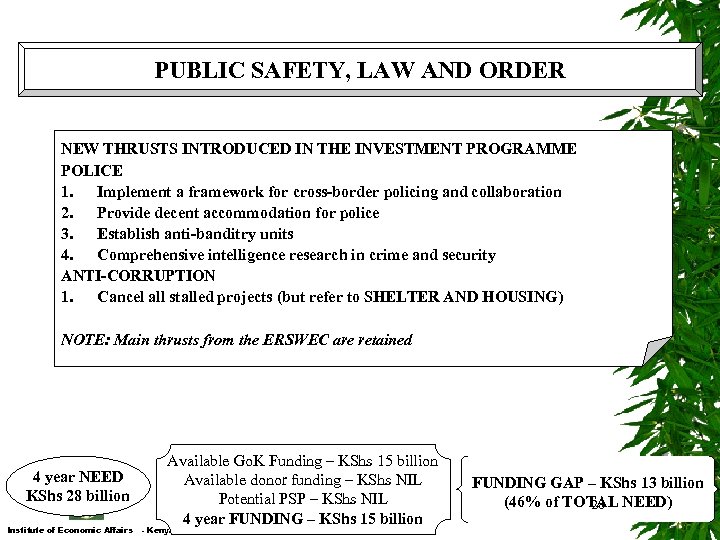 PUBLIC SAFETY, LAW AND ORDER NEW THRUSTS INTRODUCED IN THE INVESTMENT PROGRAMME POLICE 1. Implement a framework for cross-border policing and collaboration 2. Provide decent accommodation for police 3. Establish anti-banditry units 4. Comprehensive intelligence research in crime and security ANTI-CORRUPTION 1. Cancel all stalled projects (but refer to SHELTER AND HOUSING) NOTE: Main thrusts from the ERSWEC are retained 4 year NEED KShs 28 billion Institute of Economic Affairs Available Go. K Funding – KShs 15 billion Available donor funding – KShs NIL Potential PSP – KShs NIL 4 year FUNDING – KShs 15 billion - Kenya FUNDING GAP – KShs 13 billion (46% of TOTAL NEED) 28
 TOURISM, TRADE AND INDUSTRY ERSWEC PRIORITY OBJECTIVES • Investment Code • Export Promotion • Tourism – increased arrivals and diversified source markets • Manufacturing – export-focused growth • Medium and Small-Scale Enterprises – Growth and employment creation • Trade policy • Fisheries development • Forestry development • Mining development • Quarrying SELECTED PRSP PRIORITIES NOT IN ERSWEC ACTION PLAN 1. Enhanced TTI information networks (Industrial Database) 2. Specific internal and external trade strategy 29 Institute of Economic Affairs - Kenya
 TOURISM NEW THRUSTS INTRODUCED IN THE INVESTMENT PROGRAMME 1. Security 2. Review of tax structures in tourism sub-sector 3. Pro-poor thrusts 1. Foster community-based and eco-tourism in northern and western Kenya, targeted at backpackers and nationals 2. Compensation policy for human-wildlife conflict 3. Guidance, credit and incentives to SMEs 4. Review park tariffs in less-visited areas 5. Restructure KTDC into an investment and SME credit institution 4 year NEED KShs 15 billion Institute of Economic Affairs Available Go. K Funding – KShs 2 billion Available donor funding – KShs NIL Potential PSP – KShs 5 billion 4 year FUNDING – KShs 7 billion - Kenya FUNDING GAP – KShs 8 billion (53% of TOTAL NEED) 30
 TRADE, INDUSTRY AND SMEs NEW THRUSTS INTRODUCED IN THE INVESTMENT PROGRAMME TRADE AND INVESTMENT 1. World Bank-Go. K trade diagnostic study – to influence trade policy 2. New regulatory framework for finance and infrastructure 3. Investment authority and investment road map by 2005 INDUSTRY 1. Liberalise trade 2. Deepen financial market 3. Facilitate use of technology licenses 4. Review mechanisms for wage determination 5. Improve access to quality training 6. Benchmarking studies of textiles (AGOA? ) and sugar (But refer to Agriculture) SMEs 1. Strengthen credit institutions, including KIE 2. Develop training market for SMEs 4 year NEED KShs 9 billion Institute of Economic Affairs Available Go. K Funding – KShs 0. 8 billion Available donor funding – KShs NIL Potential PSP – KShs NIL 4 year FUNDING – KShs 0. 8 billion - Kenya FUNDING GAP – KShs 8. 2 billion (91% of TOTAL NEED) 31
 ROADS, ENERGY AND WATER ERSWEC PRIORITY OBJECTIVES ROADS • Efficient road transport ENERGY • Adequate affordable supply (KPLC, Ken-Gen) • Increased oil refinery efficiency • Oil pipeline extension to Kampala WATER • Rural access to water • Sustainable management of water resources SELECTED PRSP PRIORITIES NOT IN ERSWEC ACTION PLAN ROADS 1. Improved road transport, focus on rural areas 2. Road network maintenance 3. Reform of Mechanical and Transport Dept operations ENERGY 1. Rural access 2. Diversified energy sources 3. Reduced dependence on imported petroleum WATER 1. Improved access to water and sanitation, especially poor and vulnerable groups 32 2. Increased coverage of urban sewerage and sanitation Institute of Economic Affairs - Kenya
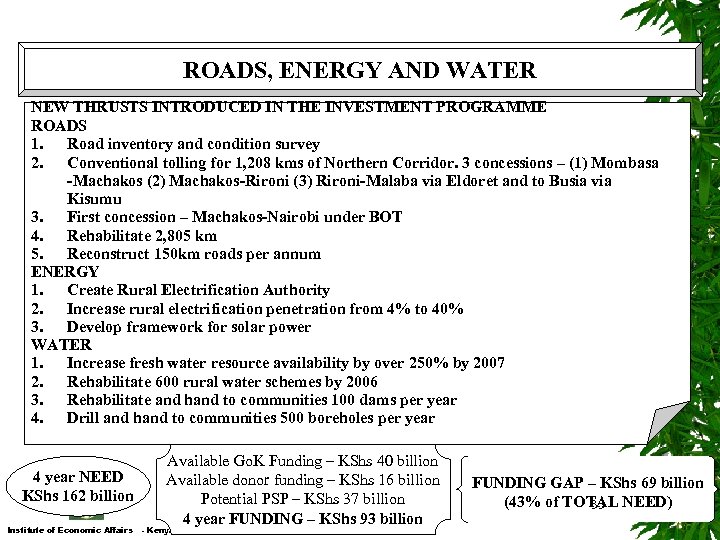 ROADS, ENERGY AND WATER NEW THRUSTS INTRODUCED IN THE INVESTMENT PROGRAMME ROADS 1. Road inventory and condition survey 2. Conventional tolling for 1, 208 kms of Northern Corridor. 3 concessions – (1) Mombasa -Machakos (2) Machakos-Rironi (3) Rironi-Malaba via Eldoret and to Busia via Kisumu 3. First concession – Machakos-Nairobi under BOT 4. Rehabilitate 2, 805 km 5. Reconstruct 150 km roads per annum ENERGY 1. Create Rural Electrification Authority 2. Increase rural electrification penetration from 4% to 40% 3. Develop framework for solar power WATER 1. Increase fresh water resource availability by over 250% by 2007 2. Rehabilitate 600 rural water schemes by 2006 3. Rehabilitate and hand to communities 100 dams per year 4. Drill and hand to communities 500 boreholes per year 4 year NEED KShs 162 billion Institute of Economic Affairs Available Go. K Funding – KShs 40 billion Available donor funding – KShs 16 billion Potential PSP – KShs 37 billion 4 year FUNDING – KShs 93 billion - Kenya FUNDING GAP – KShs 69 billion (43% of TOTAL NEED) 33
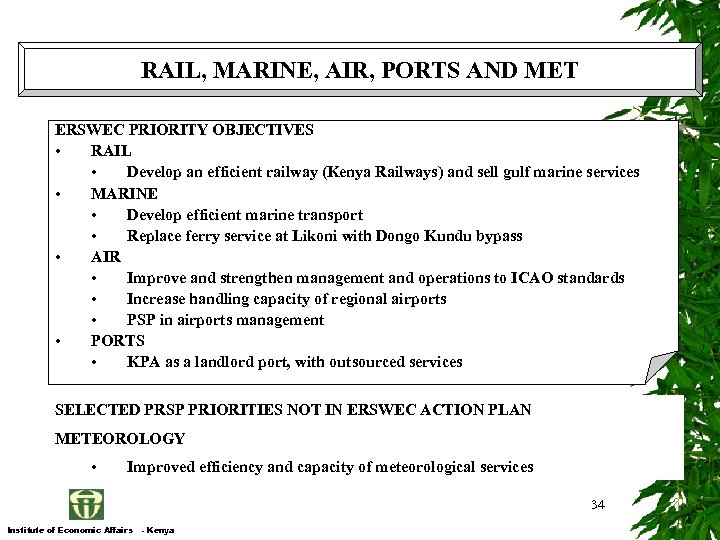 RAIL, MARINE, AIR, PORTS AND MET ERSWEC PRIORITY OBJECTIVES • RAIL • Develop an efficient railway (Kenya Railways) and sell gulf marine services • MARINE • Develop efficient marine transport • Replace ferry service at Likoni with Dongo Kundu bypass • AIR • Improve and strengthen management and operations to ICAO standards • Increase handling capacity of regional airports • PSP in airports management • PORTS • KPA as a landlord port, with outsourced services SELECTED PRSP PRIORITIES NOT IN ERSWEC ACTION PLAN METEOROLOGY • Improved efficiency and capacity of meteorological services 34 Institute of Economic Affairs - Kenya
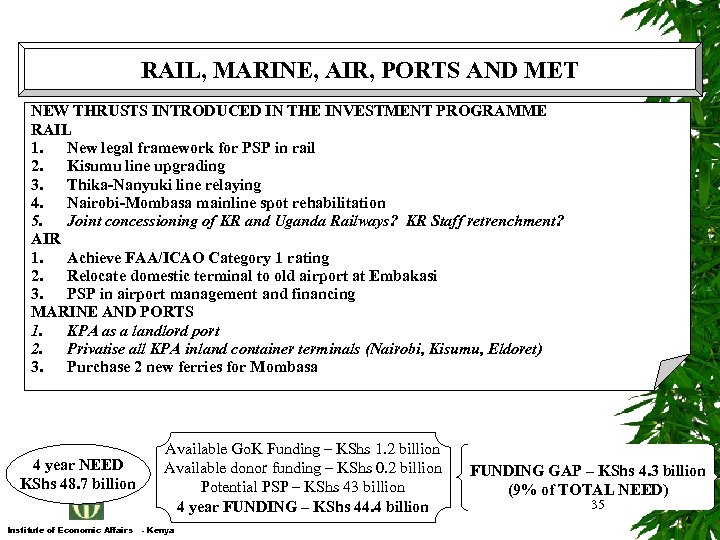 RAIL, MARINE, AIR, PORTS AND MET NEW THRUSTS INTRODUCED IN THE INVESTMENT PROGRAMME RAIL 1. New legal framework for PSP in rail 2. Kisumu line upgrading 3. Thika-Nanyuki line relaying 4. Nairobi-Mombasa mainline spot rehabilitation 5. Joint concessioning of KR and Uganda Railways? KR Staff retrenchment? AIR 1. Achieve FAA/ICAO Category 1 rating 2. Relocate domestic terminal to old airport at Embakasi 3. PSP in airport management and financing MARINE AND PORTS 1. KPA as a landlord port 2. Privatise all KPA inland container terminals (Nairobi, Kisumu, Eldoret) 3. Purchase 2 new ferries for Mombasa 4 year NEED KShs 48. 7 billion Institute of Economic Affairs Available Go. K Funding – KShs 1. 2 billion Available donor funding – KShs 0. 2 billion Potential PSP – KShs 43 billion 4 year FUNDING – KShs 44. 4 billion - Kenya FUNDING GAP – KShs 4. 3 billion (9% of TOTAL NEED) 35
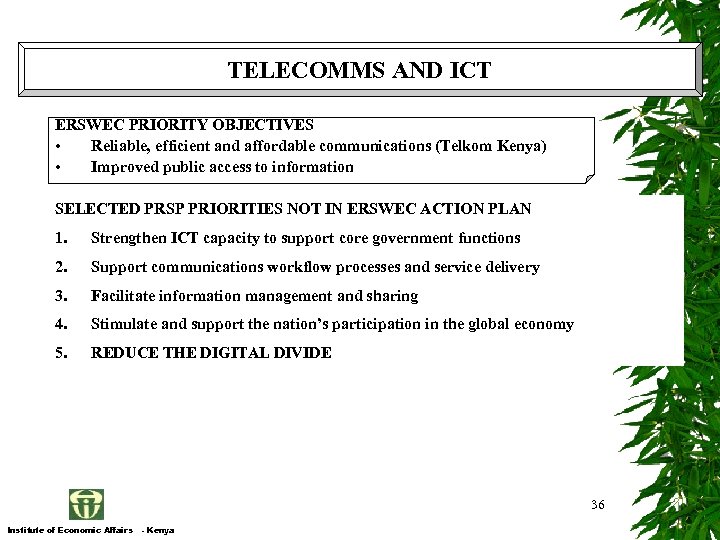 TELECOMMS AND ICT ERSWEC PRIORITY OBJECTIVES • Reliable, efficient and affordable communications (Telkom Kenya) • Improved public access to information SELECTED PRSP PRIORITIES NOT IN ERSWEC ACTION PLAN 1. Strengthen ICT capacity to support core government functions 2. Support communications workflow processes and service delivery 3. Facilitate information management and sharing 4. Stimulate and support the nation’s participation in the global economy 5. REDUCE THE DIGITAL DIVIDE 36 Institute of Economic Affairs - Kenya
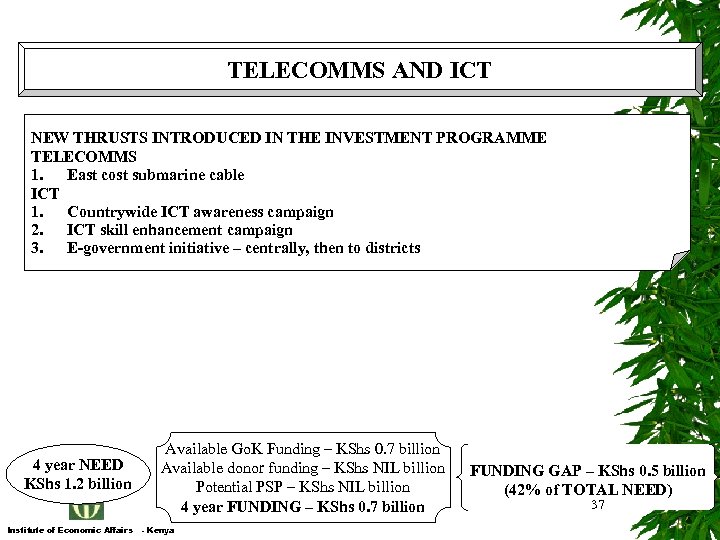 TELECOMMS AND ICT NEW THRUSTS INTRODUCED IN THE INVESTMENT PROGRAMME TELECOMMS 1. East cost submarine cable ICT 1. Countrywide ICT awareness campaign 2. ICT skill enhancement campaign 3. E-government initiative – centrally, then to districts 4 year NEED KShs 1. 2 billion Institute of Economic Affairs Available Go. K Funding – KShs 0. 7 billion Available donor funding – KShs NIL billion Potential PSP – KShs NIL billion 4 year FUNDING – KShs 0. 7 billion - Kenya FUNDING GAP – KShs 0. 5 billion (42% of TOTAL NEED) 37
 THE CASE OF SPECIAL INTEREST GROUPS The ERSWEC and IP identifies special interest groups as: • ASALs/Pastoralists but ignores the following thematic groups from PRSP 1. Gender 2. Disabilities 3. Youth 38 Institute of Economic Affairs - Kenya