 Скачать презентацию National HMO Network Conference London Fire Brigade Headquarters
08bba7687c765914403378887ed4f2fa.ppt
- Количество слайдов: 108




National HMO Network Conference London Fire Brigade Headquarters Friday 27 thth November 2015 Welcome Neil Coles, Chair, National HMO Network

Working with Bristol City Council’s Fit and Proper Person Policy Anne Ambrose Enforcement Liaison Officer People Directorate Private Housing and Accessible Homes Service Slide 3
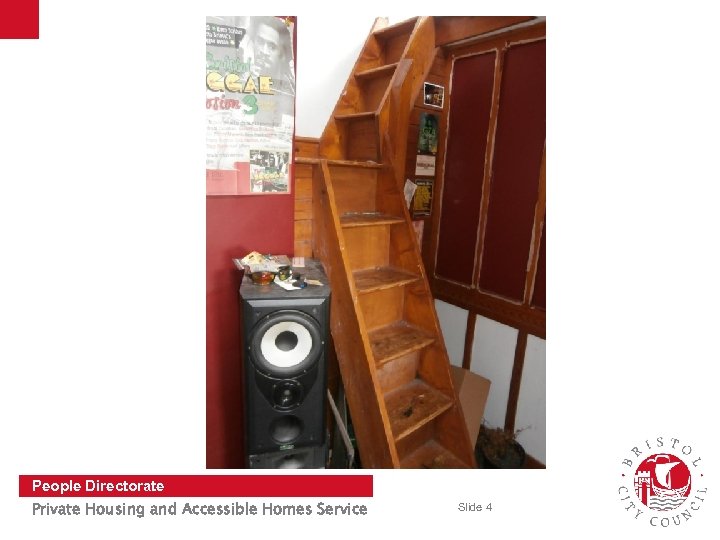
People Directorate Private Housing and Accessible Homes Service Slide 4
‘Fit and Proper Persons’ Section 64, Housing Act 2004 § § Proposed Licence Holder and Manager must be a Fit and Proper Person Proposed management arrangements are otherwise satisfactory People Directorate Private Housing and Accessible Homes Service Slide 5
Making decisions if people are fit and proper? At application Due to Enforcement Action Due to complaint, new concerns, or change in circumstances People Directorate Private Housing and Accessible Homes Service Slide 6
Example Portfolio Landlord Warning given due to operating unlicensed HMO Then successful prosecution for a further unlicensed HMO Written to and informed that directors of the company no longer fit and proper Threat of a Judicial Review…………. People Directorate Private Housing and Accessible Homes Service Slide 7
Reasonable and Proportionate? Legal advice was that our decision was not reasonable and proportionate. We retracted the decision due to Size of portfolio Affect on the business Previous history People Directorate Private Housing and Accessible Homes Service Slide 8
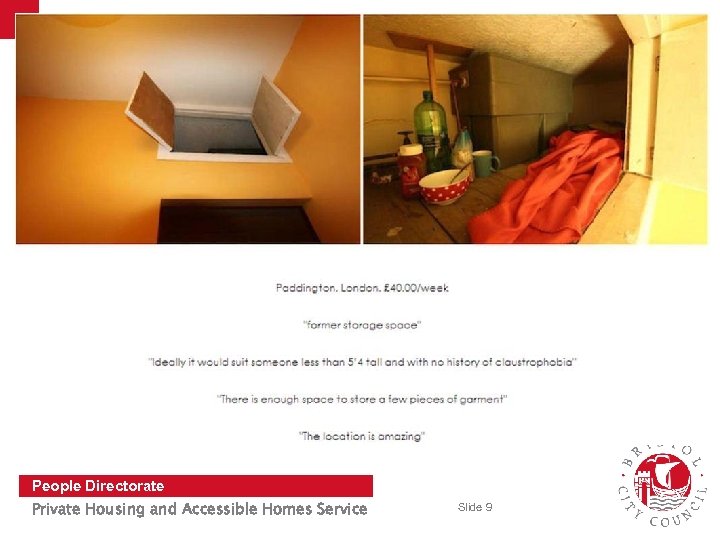
People Directorate Private Housing and Accessible Homes Service Slide 9
So what did we do? We wrote the Bristol City Council Fit and Proper Person Policy We developed the decision form. We now make accountable, justifiable decisions. People Directorate Private Housing and Accessible Homes Service Slide 10
Testing! Large portfolio landlord Previous conviction for breaches of the HMO Management Regulations Three new offences identified; Failing to licence an HMO Further HMO management breaches Knowingly over occupied a licensed HMO (later dropped) History of problems, poor management, non compliance People Directorate Private Housing and Accessible Homes Service Slide 11
Our concerns Two cases were in prep and over next couple of months 10 licences were due for renewal. The landlord declared the conviction …. eventually. Decision necessary People Directorate Private Housing and Accessible Homes Service Slide 12
Links People Ten different owners An independent manager Properties Portfolio of over 40 properties including care homes Two different companies Family members Other directors Two properties with cases in prep for prosecution Portfolio of 14 licensable properties, 10 due for renewal People Directorate Private Housing and Accessible Homes Service Slide 13
Evidence Each property history was reviewed All occurrences of contraventions, non compliance and non co operation Dates, times and outcomes. Also included all occurrences where things went well (there weren’t many!) People Directorate Private Housing and Accessible Homes Service Slide 14
The file got BIG!! 76 pages of listed occurrences 2 lever arch files of exhibits People Directorate Private Housing and Accessible Homes Service Slide 15
What did we prove? 1. A long history of non compliance. Issues ranged from repeated failure to send in certificates and missing appointments, to serious Housing Act breaches and convictions. We showed the persistence of EH teams in trying to get informal results, and how the LL failed to take up offers of help and assistance 2. Manager had little control or power 3. Repeated offences, no learning…on both sides People Directorate Private Housing and Accessible Homes Service Slide 16
Unsatisfactory management. Between owner and Manager No written contracts, no agreed lines of responsibilities, manager did not have the money or authority to carry out works required. Management of the properties suffered as manager not always sure if he was manager or not as landlord repeatedly interfered. People Directorate Private Housing and Accessible Homes Service Slide 17
…. and the result? Landlord not considered a Fit and Proper Person Landlord chose his manager to be Licence Holder. Concerns over the problems identified with the manager led to a fit and proper person review of the manager. Decision that manager was fit and proper, but the council had concerns on future management of the properties. People Directorate Private Housing and Accessible Homes Service Slide 18
So. . . All existing licences were revoked New licence applications were refused We requested a written contract between landlord and manager New applications in the name of new manager One year licence issued with manager as LH EHOs still logging all occurrences and will review all FPP when licences are renewed. People Directorate Private Housing and Accessible Homes Service Slide 19
What did we learn? Making someone not Fit and Proper is serious and proper consideration needs to be proven. Decision making process is time consuming but identifies the issues so clearly the room for challenge is reduced. Clearly identifies unsatisfactory management Clearly identifies persons involved People Directorate Private Housing and Accessible Homes Service Slide 20
Other examples Mrs I and Miss K Mr B Agent C People Directorate Private Housing and Accessible Homes Service Slide 21
Appeals? Not yet…one laid, but withdrawn. We invite landlords in to discuss our findings, and give them a copy of the decision with the grounds and reasons, at the proposed stage. If insufficient evidence to prove not FPP but unsatisfactory management is demonstrated we invite them in and direct them to common problems, give advice on what action could be taken to improve. Develops a better working relationship with Landlords. People Directorate Private Housing and Accessible Homes Service Slide 22
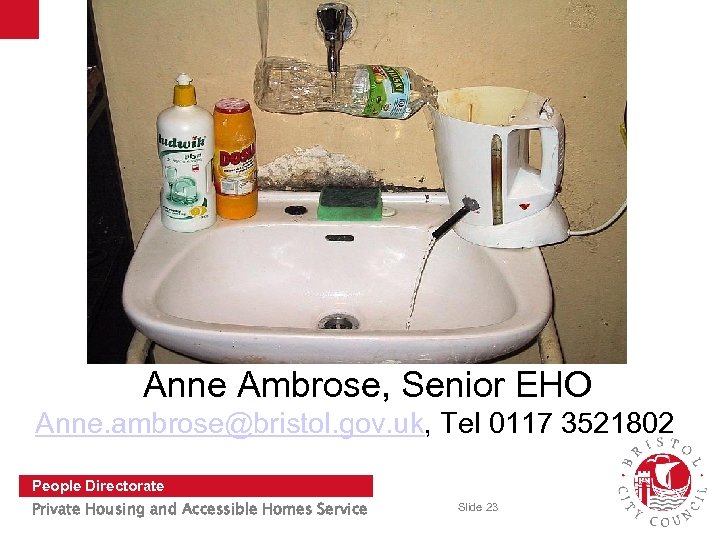
Anne Ambrose, Senior EHO Anne. ambrose@bristol. gov. uk, Tel 0117 3521802 People Directorate Private Housing and Accessible Homes Service Slide 23
Refreshments courtesy of

The ICO and the Data Protection Act 1998 Stacey Egerton, Lead Policy Officer, ICO London Fire Brigade HQ, 27 February 2015
Overview • • Who is the ICO and what do we do? The Data Protection Act 1998 and the 8 principles Principle 1 – Fair and Lawful Principle 3 – adequate relevant and not excessive Exemptions Individual Rights Guidance Questions

Who is the ICO – Our Mission to uphold information rights in the public interest, promoting openness by public bodies and data privacy for individuals.

The role of the ICO • Regulating and enforcing • Promote good practice • Handling concerns • Maintaining a register of data controllers
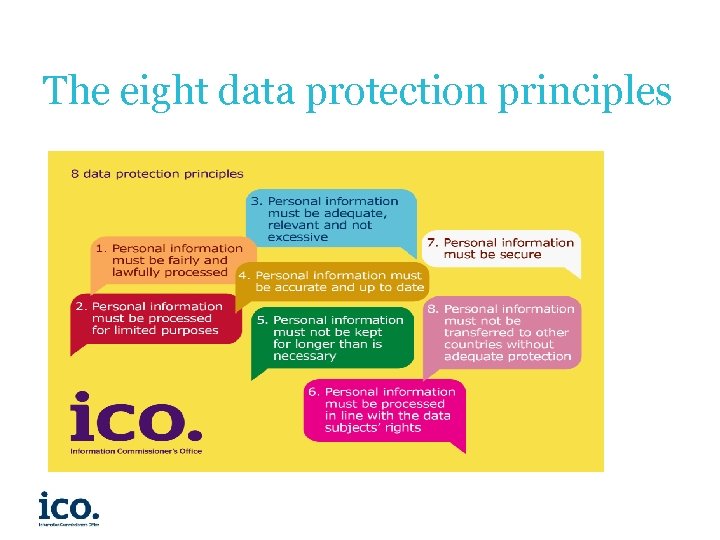
The eight data protection principles
Principle one 1. Fair 2. Lawful 3. Legitimate Grounds

Principle three 1. Adequate 2. Relevant 3. Not excessive Ø Purpose is key!
Housing Act 2004 Register of licences 1. What does the Housing Act Say? 2. What are the Data Protection considerations? 3. Examples of good practice
Openness of Local Government Bodies Regulations 2014 1. What do the regulations say? (regs 7 -9) 1. What are the DPA considerations? 1. Examples of good practice
Exemptions • S. 29 - Crime and Taxation • ICO guidance - (Releasing information to prevent or detect crime (section 29))
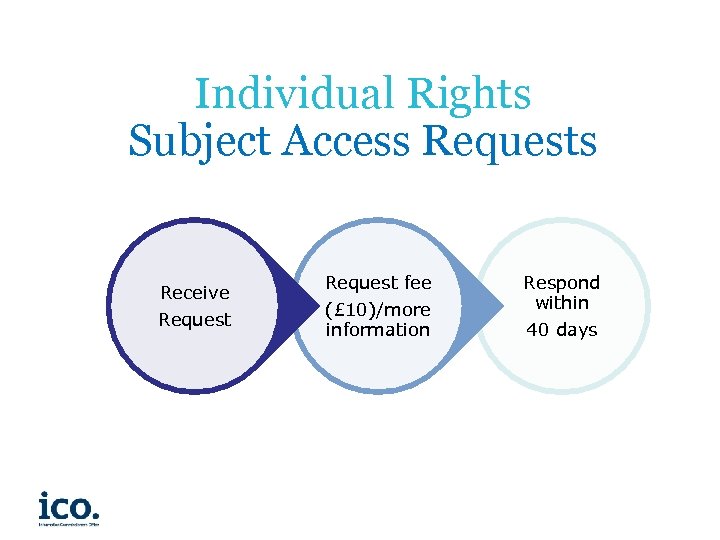
Individual Rights Subject Access Requests Receive Request fee (£ 10)/more information Respond within 40 days

Contact us • Helpline - 0303 123 1113 or 01625 545745 • Website - http: //www. ico. org. uk/ • Advice about the law - casework@ico. org. uk • Notification queries - notification@ico. org. uk

Keep in touch Subscribe to our e-newsletter at www. ico. org. uk or find us on… /iconews @iconews

Any questions

National Landlords Association Immigration checks Richard Price – Director of Operations www. landlords. org. uk
Background • The Immigration Act places new restrictions on illegal immigrants accessing private rented accommodation • Landlords will need to carry out checks to identify if a potential tenant has the right to reside in the UK. • The scheme started in the West Midlands from 1 Dec 14 Birmingham, Dudley, Walsall, Sandwell and Wolverhampton • Following an evaluation, expected to be rolled out nationally www. landlords. org. uk
Who is impacted by right to rent checks? Ø Landlords / Agents and tenants of private rental residential properties (initially only in the W Midlands area selected for phased roll-out) Ø Tenancies starting on or after enactment (i. e. not retrospective) Ø Existing tenancies are not impacted as long as there is no break in the tenancy Ø All adults (18 yrs and over) living at the property whether or not they are named on the tenancy agreement www. landlords. org. uk
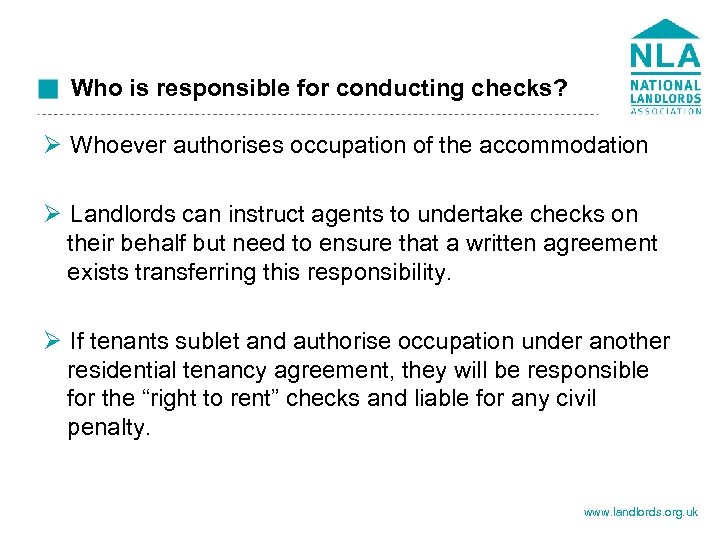
Who is responsible for conducting checks? Ø Whoever authorises occupation of the accommodation Ø Landlords can instruct agents to undertake checks on their behalf but need to ensure that a written agreement exists transferring this responsibility. Ø If tenants sublet and authorise occupation under another residential tenancy agreement, they will be responsible for the “right to rent” checks and liable for any civil penalty. www. landlords. org. uk
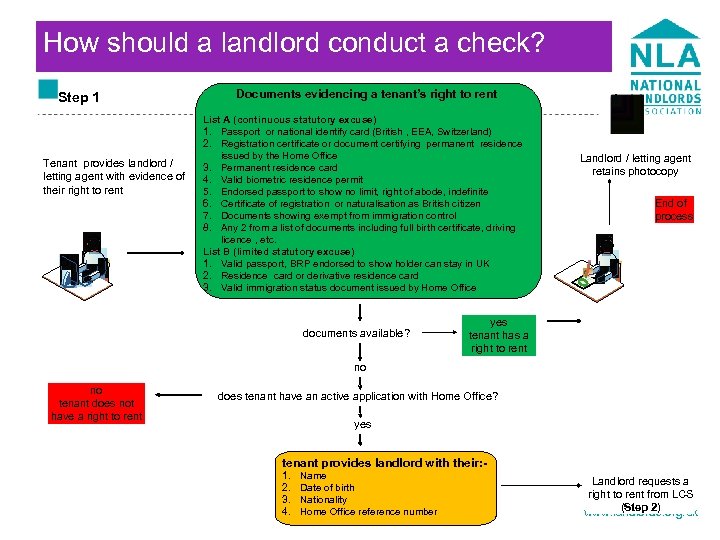
How should a landlord conduct a check? Documents evidencing a tenant’s right to rent Step 1 Tenant provides landlord / letting agent with evidence of their right to rent List A (continuous statutory excuse) 1. Passport or national identify card (British , EEA, Switzerland) 2. Registration certificate or document certifying permanent residence issued by the Home Office 3. Permanent residence card 4. Valid biometric residence permit 5. Endorsed passport to show no limit, right of abode, indefinite 6. Certificate of registration or naturalisation as British citizen 7. Documents showing exempt from immigration control 8. Any 2 from a list of documents including full birth certificate, driving licence , etc. List B (limited statutory excuse) 1. Valid passport, BRP endorsed to show holder can stay in UK 2. Residence card or derivative residence card 3. Valid immigration status document issued by Home Office documents available? Landlord / letting agent retains photocopy End of process yes tenant has a right to rent no no tenant does not have a right to rent does tenant have an active application with Home Office? yes tenant provides landlord with their: 1. 2. 3. 4. Name Date of birth Nationality Home Office reference number Landlord requests a right to rent from LCS (Step 2) www. landlords. org. uk
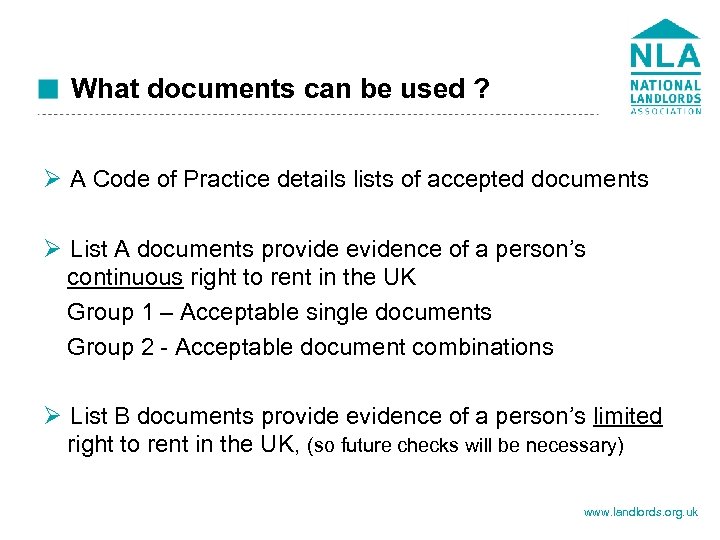
What documents can be used ? Ø A Code of Practice details lists of accepted documents Ø List A documents provide evidence of a person’s continuous right to rent in the UK Group 1 – Acceptable single documents Group 2 - Acceptable document combinations Ø List B documents provide evidence of a person’s limited right to rent in the UK, (so future checks will be necessary) www. landlords. org. uk
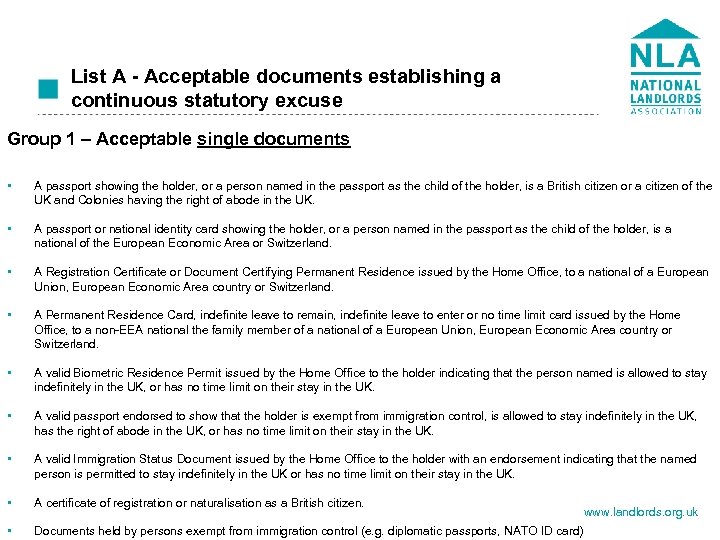
List A - Acceptable documents establishing a continuous statutory excuse Group 1 – Acceptable single documents • A passport showing the holder, or a person named in the passport as the child of the holder, is a British citizen or a citizen of the UK and Colonies having the right of abode in the UK. • A passport or national identity card showing the holder, or a person named in the passport as the child of the holder, is a national of the European Economic Area or Switzerland. • A Registration Certificate or Document Certifying Permanent Residence issued by the Home Office, to a national of a European Union, European Economic Area country or Switzerland. • A Permanent Residence Card, indefinite leave to remain, indefinite leave to enter or no time limit card issued by the Home Office, to a non-EEA national the family member of a national of a European Union, European Economic Area country or Switzerland. • A valid Biometric Residence Permit issued by the Home Office to the holder indicating that the person named is allowed to stay indefinitely in the UK, or has no time limit on their stay in the UK. • A valid passport endorsed to show that the holder is exempt from immigration control, is allowed to stay indefinitely in the UK, has the right of abode in the UK, or has no time limit on their stay in the UK. • A valid Immigration Status Document issued by the Home Office to the holder with an endorsement indicating that the named person is permitted to stay indefinitely in the UK or has no time limit on their stay in the UK. • A certificate of registration or naturalisation as a British citizen. • Documents held by persons exempt from immigration control (e. g. diplomatic passports, NATO ID card) www. landlords. org. uk
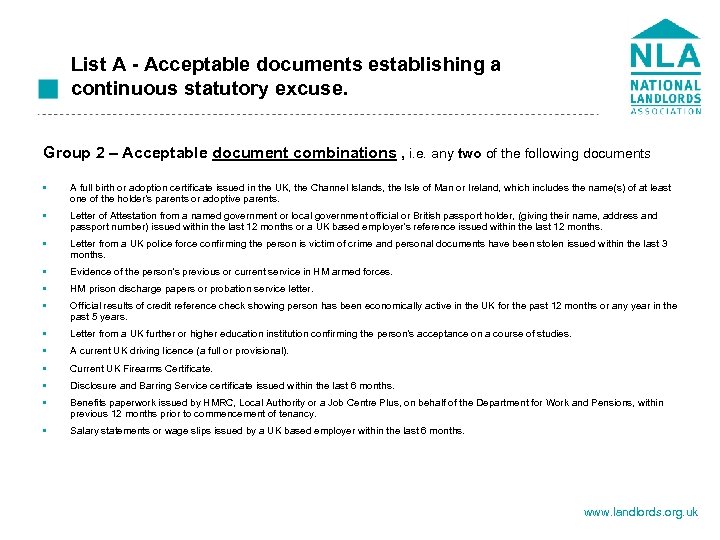
List A - Acceptable documents establishing a continuous statutory excuse. Group 2 – Acceptable document combinations , i. e. any two of the following documents • A full birth or adoption certificate issued in the UK, the Channel Islands, the Isle of Man or Ireland, which includes the name(s) of at least one of the holder’s parents or adoptive parents. • Letter of Attestation from a named government or local government official or British passport holder, (giving their name, address and passport number) issued within the last 12 months or a UK based employer’s reference issued within the last 12 months. • Letter from a UK police force confirming the person is victim of crime and personal documents have been stolen issued within the last 3 months. • Evidence of the person’s previous or current service in HM armed forces. • HM prison discharge papers or probation service letter. • Official results of credit reference check showing person has been economically active in the UK for the past 12 months or any year in the past 5 years. • Letter from a UK further or higher education institution confirming the person’s acceptance on a course of studies. • A current UK driving licence (a full or provisional). • Current UK Firearms Certificate. • Disclosure and Barring Service certificate issued within the last 6 months. • Benefits paperwork issued by HMRC, Local Authority or a Job Centre Plus, on behalf of the Department for Work and Pensions, within previous 12 months prior to commencement of tenancy. • Salary statements or wage slips issued by a UK based employer within the last 6 months. www. landlords. org. uk
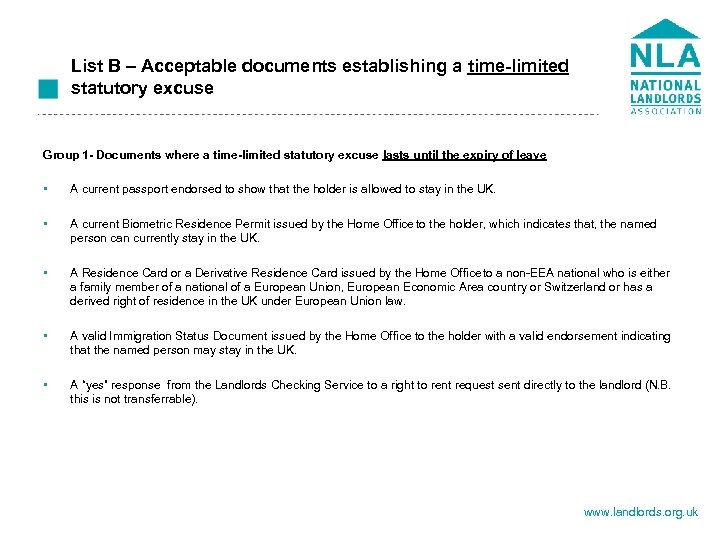
List B – Acceptable documents establishing a time-limited statutory excuse Group 1 - Documents where a time-limited statutory excuse lasts until the expiry of leave • • A current passport endorsed to show that the holder is allowed to stay in the UK. • A Residence Card or a Derivative Residence Card issued by the Home Office to a non-EEA national who is either a family member of a national of a European Union, European Economic Area country or Switzerland or has a derived right of residence in the UK under European Union law. • • A current Biometric Residence Permit issued by the Home Office to the holder, which indicates that, the named person can currently stay in the UK. A valid Immigration Status Document issued by the Home Office to the holder with a valid endorsement indicating that the named person may stay in the UK. A “yes” response from the Landlords Checking Service to a right to rent request sent directly to the landlord (N. B. this is not transferrable). www. landlords. org. uk
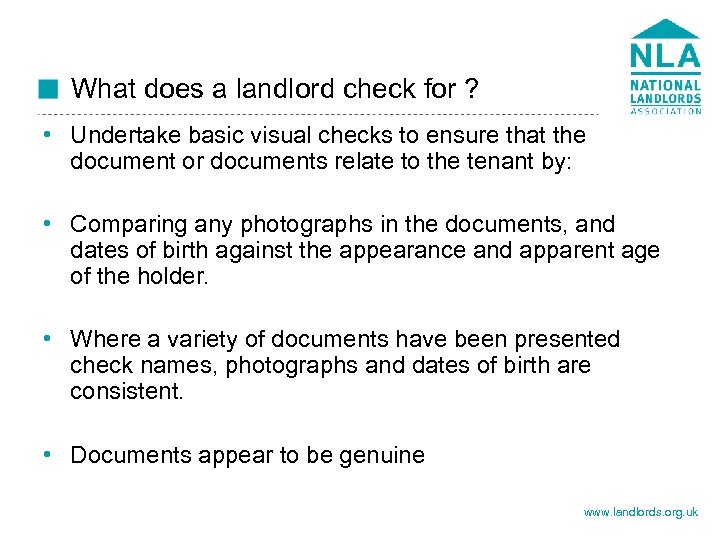
What does a landlord check for ? • Undertake basic visual checks to ensure that the document or documents relate to the tenant by: • Comparing any photographs in the documents, and dates of birth against the appearance and apparent age of the holder. • Where a variety of documents have been presented check names, photographs and dates of birth are consistent. • Documents appear to be genuine www. landlords. org. uk
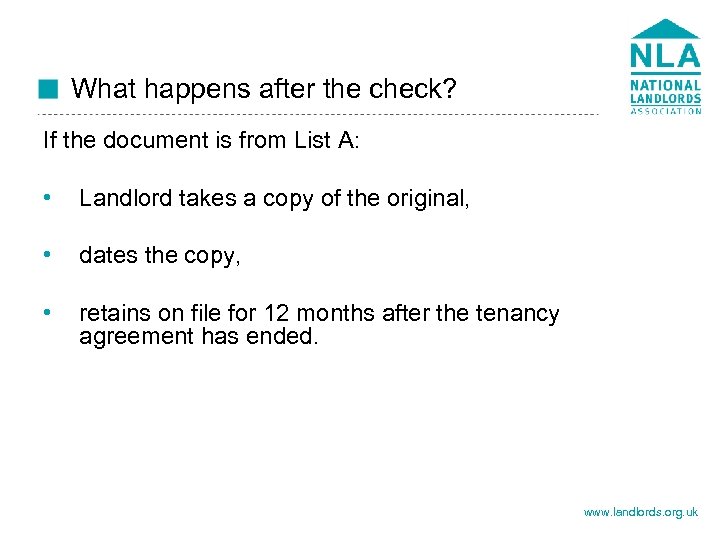
What happens after the check? If the document is from List A: • Landlord takes a copy of the original, • dates the copy, • retains on file for 12 months after the tenancy agreement has ended. www. landlords. org. uk
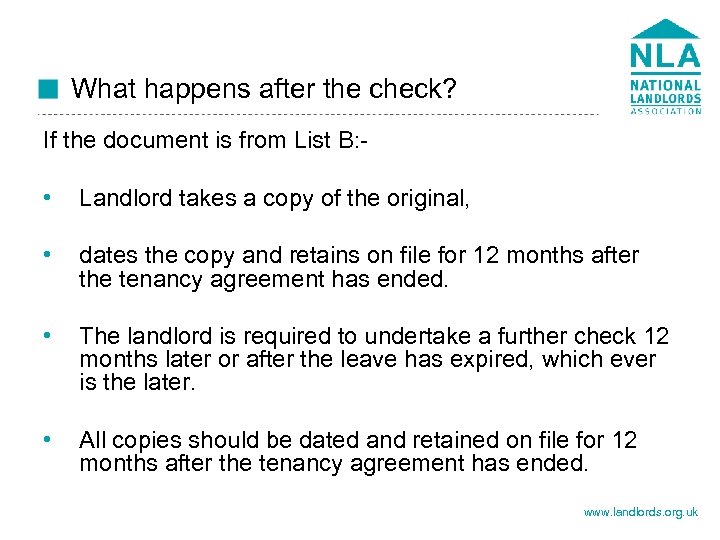
What happens after the check? If the document is from List B: • Landlord takes a copy of the original, • dates the copy and retains on file for 12 months after the tenancy agreement has ended. • The landlord is required to undertake a further check 12 months later or after the leave has expired, which ever is the later. • All copies should be dated and retained on file for 12 months after the tenancy agreement has ended. www. landlords. org. uk
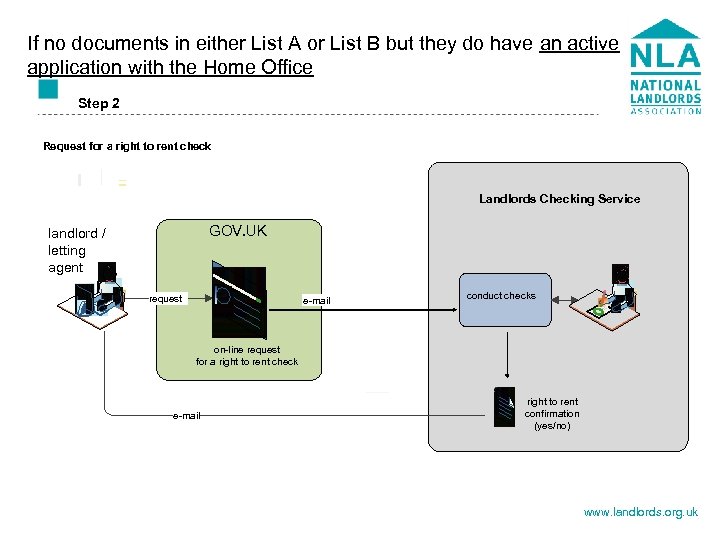
If no documents in either List A or List B but they do have an active application with the Home Office Step 2 Request for a right to rent check Landlords Checking Service GOV. UK landlord / letting agent request e-mail conduct checks on-line request for a right to rent check right to rent e-mail confirmation (yes/no) www. landlords. org. uk
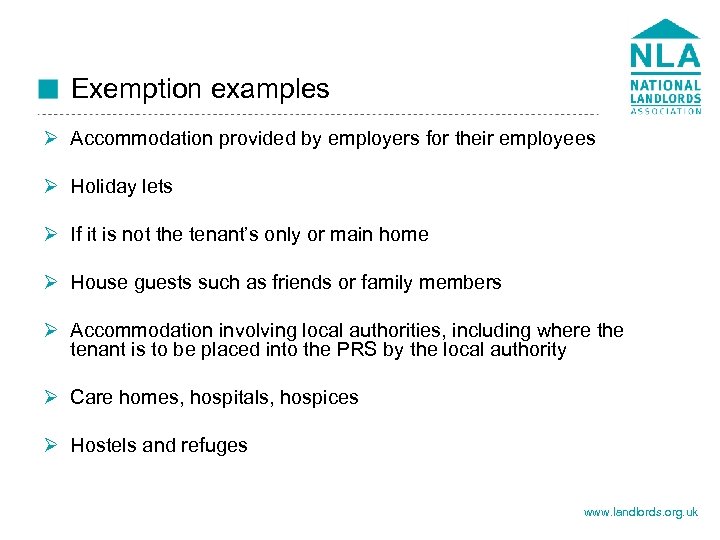
Exemption examples Ø Accommodation provided by employers for their employees Ø Holiday lets Ø If it is not the tenant’s only or main home Ø House guests such as friends or family members Ø Accommodation involving local authorities, including where the tenant is to be placed into the PRS by the local authority Ø Care homes, hospitals, hospices Ø Hostels and refuges www. landlords. org. uk
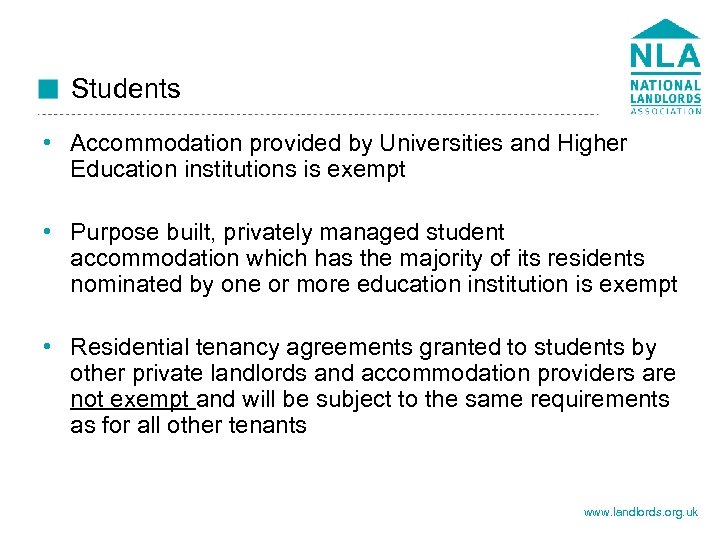
Students • Accommodation provided by Universities and Higher Education institutions is exempt • Purpose built, privately managed student accommodation which has the majority of its residents nominated by one or more education institution is exempt • Residential tenancy agreements granted to students by other private landlords and accommodation providers are not exempt and will be subject to the same requirements as for all other tenants www. landlords. org. uk
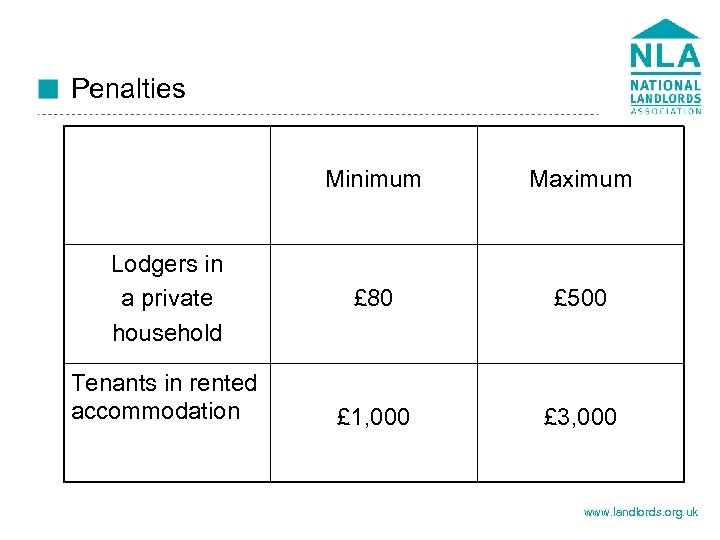
Penalties Minimum Lodgers in a private household Tenants in rented accommodation Maximum £ 80 £ 500 £ 1, 000 £ 3, 000 www. landlords. org. uk
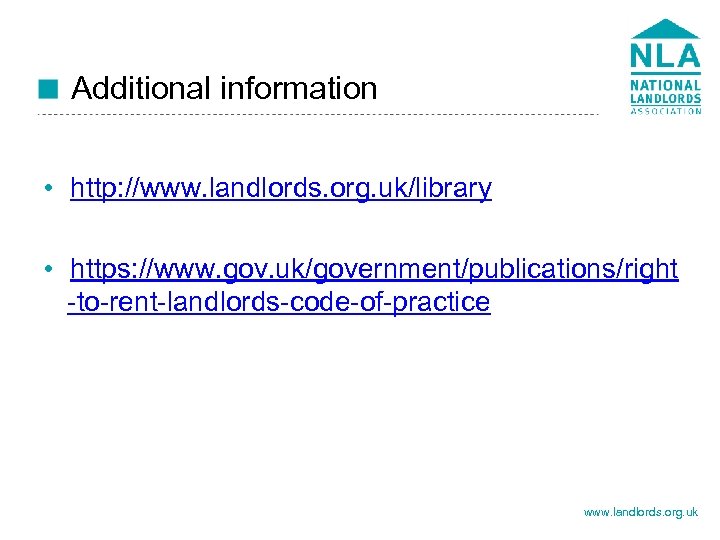
Additional information • http: //www. landlords. org. uk/library • https: //www. gov. uk/government/publications/right -to-rent-landlords-code-of-practice www. landlords. org. uk
Lunch courtesy of

HMO Network Legal Update David Smith Anthony Gold Solicitors

Tenancy Deposit Update
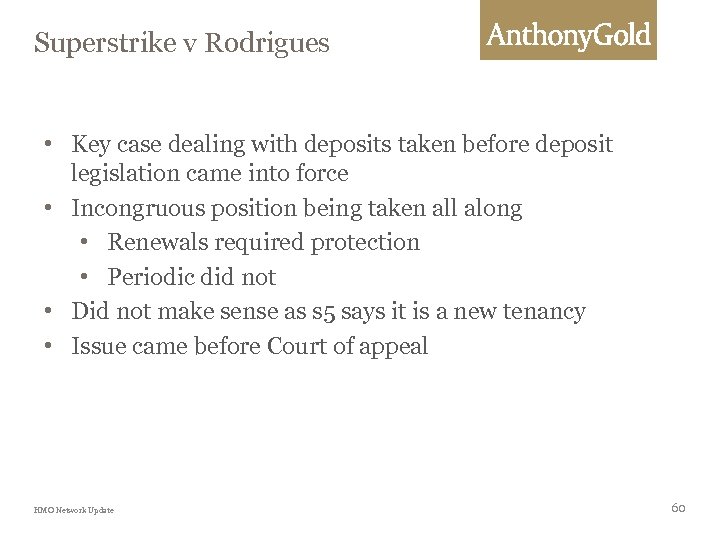
Superstrike v Rodrigues • Key case dealing with deposits taken before deposit legislation came into force • Incongruous position being taken all along • Renewals required protection • Periodic did not • Did not make sense as s 5 says it is a new tenancy • Issue came before Court of appeal HMO Network Update 60
Superstrike Outcomes • If each new tenancy is a new receipt then presumably the obligations are triggered again and again • Does this mean re-protection with the scheme? No • Re-service of PI? Yes • Many landlords in breach • No proper fix either • Only practical answers • Protect the property, its more valuable • Serve PI with every s 21 for certainty HMO Network Update 61
Charalambous v Ng • Further complex deposit case • Deals with deposits taken before deposit legislation came into force where tenancy was periodic before that date • These deposits must be protected or returned before an s 21 can be served • No financial penalties HMO Network Update 62
Deregulation Bill Changes • Many alterations to resolve cases in Bill • Still in flux • Currently • Charalambous will be formalised • Superstrike will be overturned provided deposit protected correctly in first place • Some changes to PI to allow agent details • Some issues remain unresolved HMO Network Update 63

Section 21 Update
Spencer v Taylor • Key case dealing with s 21 notices in periodic tenancies • Old position is that an s 21(4)(a) notice must be served • Causes problems with dates • Now s 21(1)(b) notice works for all • Provided there has at some stage been a fixed term tenancy • Much easier for landlords HMO Network Update 65
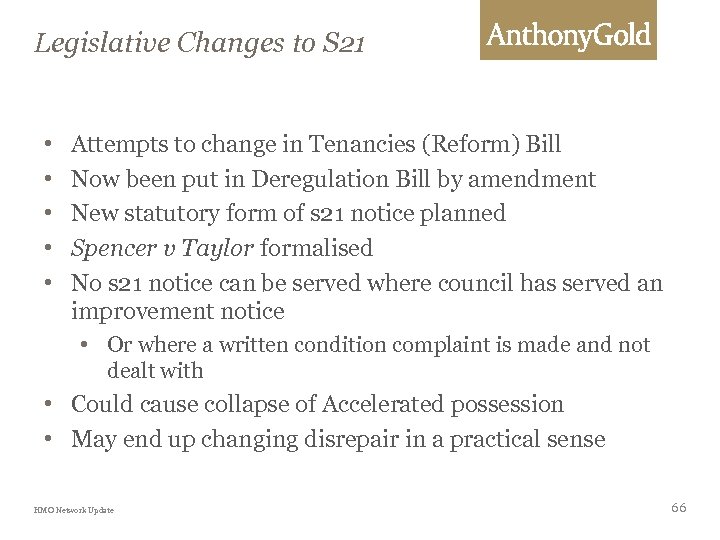
Legislative Changes to S 21 • • • Attempts to change in Tenancies (Reform) Bill Now been put in Deregulation Bill by amendment New statutory form of s 21 notice planned Spencer v Taylor formalised No s 21 notice can be served where council has served an improvement notice • Or where a written condition complaint is made and not dealt with • Could cause collapse of Accelerated possession • May end up changing disrepair in a practical sense HMO Network Update 66

Things to Watch
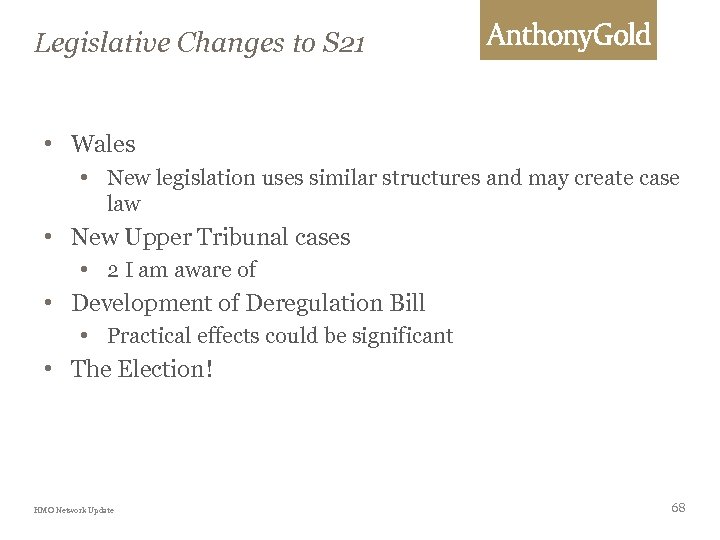
Legislative Changes to S 21 • Wales • New legislation uses similar structures and may create case law • New Upper Tribunal cases • 2 I am aware of • Development of Deregulation Bill • Practical effects could be significant • The Election! HMO Network Update 68

Contact Me David Smith Anthony Gold Solicitors david. smith@anthonygold. co. uk Linked. In: uk. linkedin. com/in/dsnsmith @hmolawyer HMO Network Update 69

Refreshments courtesy of

Housing in Multiple Occupancy: Energy Issues and Policy David Weatherall Future Climate February 2015

Agenda To cover: • Background to the research • HMOs – the context • Energy efficiency in HMOs • Policies affecting energy efficiency in HMOs • Recommendations Report available at: futureclimate. org. uk

Research background • Project funded by Eaga Charitable Trust • Comprehensive desk review early part of 2014 • Interviews with stakeholders, especially housing and environmental health teams • Manchester Case study
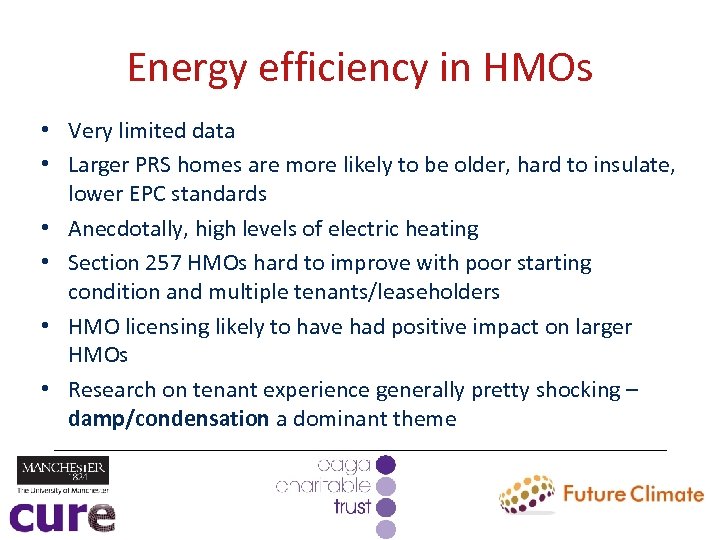
Energy efficiency in HMOs • Very limited data • Larger PRS homes are more likely to be older, hard to insulate, lower EPC standards • Anecdotally, high levels of electric heating • Section 257 HMOs hard to improve with poor starting condition and multiple tenants/leaseholders • HMO licensing likely to have had positive impact on larger HMOs • Research on tenant experience generally pretty shocking – damp/condensation a dominant theme
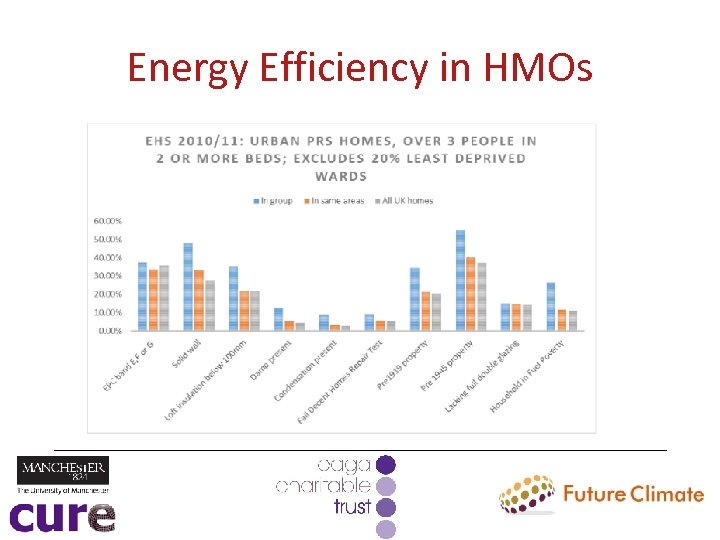
Energy Efficiency in HMOs
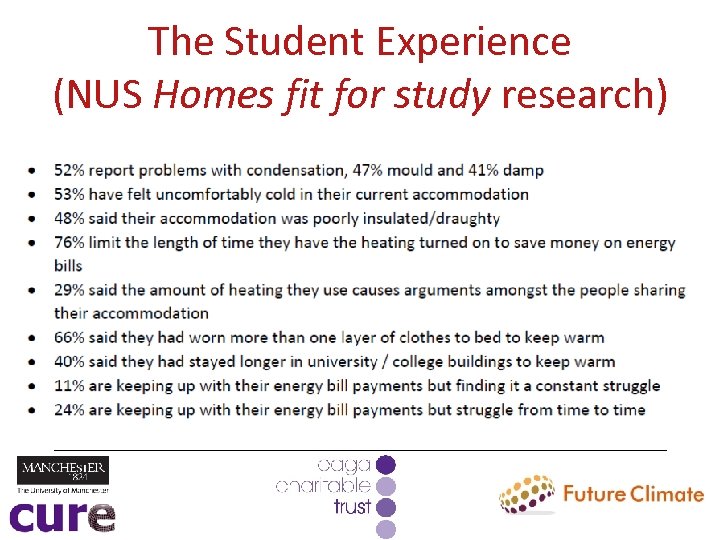
The Student Experience (NUS Homes fit for study research)
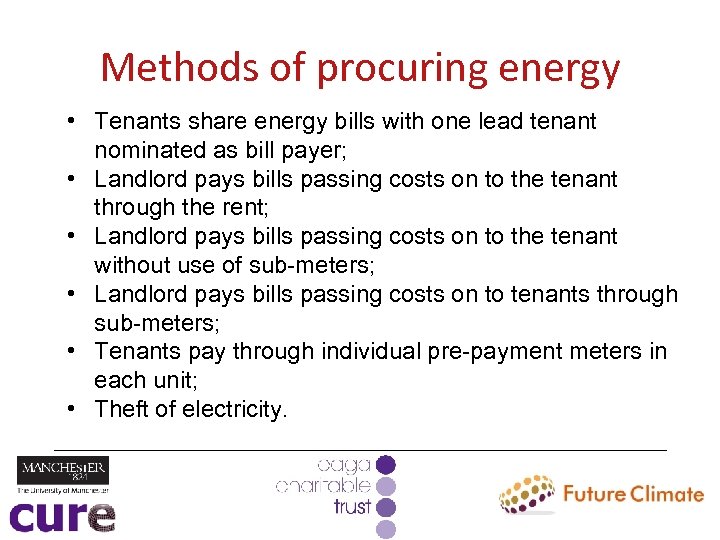
Methods of procuring energy • Tenants share energy bills with one lead tenant nominated as bill payer; • Landlord pays bills passing costs on to the tenant through the rent; • Landlord pays bills passing costs on to the tenant without use of sub-meters; • Landlord pays bills passing costs on to tenants through sub-meters; • Tenants pay through individual pre-payment meters in each unit; • Theft of electricity.
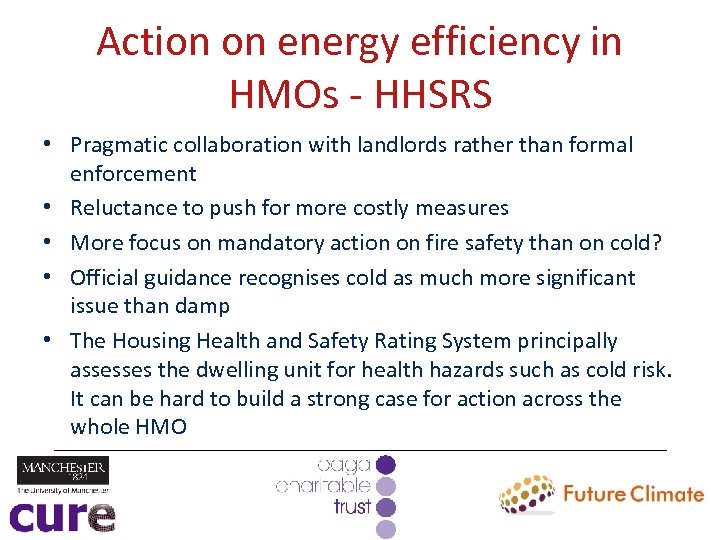
Action on energy efficiency in HMOs - HHSRS • Pragmatic collaboration with landlords rather than formal enforcement • Reluctance to push for more costly measures • More focus on mandatory action on fire safety than on cold? • Official guidance recognises cold as much more significant issue than damp • The Housing Health and Safety Rating System principally assesses the dwelling unit for health hazards such as cold risk. It can be hard to build a strong case for action across the whole HMO

HMO Licensing and cold homes • Requiring EPCs as a licence condition (several authorities) • Use of additional licensing on the grounds of fuel poverty/ concentrations of cold HMOs (Bath and North East Somerset) • Setting a minimum EPC standard as a licence condition (Bath and North East Somerset, Sheffield) • Resourcing challenges to making full use of powers (and leading to accusations that licensing just about revenue) • Best practice: linking grants, voluntary accreditation schemes, enforcement and licensing in a joined-up approach
HMOs and energy efficiency policy – overarching issues • Lack of data on HMO energy efficiency characteristics; • Official definition of fuel poverty doesn’t work for HMOs • HMOs poorly understood and rarely considered by policy makers and policy influencers (eg not mentioned in draft Fuel Poverty Strategy).
Energy Performance Certificates and HMOs • European Directive requires EPC at point of letting for building units: “a section, floor or apartment within a building which is designed or altered to be used separately” • 2010 consultation to go beyond this in UK regulation: “it would be sensible for the renting of such rooms to act as a trigger for the building as a whole to obtain an EPC” • 94% support for this proposal • Rejected by coalition government on grounds of “goldplating” • Not clear what type of EPC HMOs require – domestic or nondomestic
Energy Act 2011 • • • The Green Deal which enables householders to install energy saving measures at no or lower upfront costs, with repayments (intended to not exceed the financial savings of the measure) made on the electricity bill over the lifetime of the measure. The Energy Company Obligation (ECO) – which sets a target for energy suppliers to deliver carbon and bill savings in homes by promoting the installation of energy saving measures Private Rented Sector minimum standards – powers to set a minimum Energy Performance Certificate standard for rented properties to take effect at the latest in 2018.
ECO (and Green Deal) • Probably no regulatory barrier to HMOs benefiting from ECO; BUT • Overall level of ECO resources • Complicated and difficult – unlikely to be a priority • Politically unacceptable? • Green Deal consents issues (everyone needs to agree…. ) a fundamental barrier
PRS Minimum EE Standard • 2016 permission not to be unreasonably withheld (note, extends to freeholders) • 2018 property may not be let unless it reaches minimum EPC E standard • Exemption applies where costs cannot be fully met from grants or Green Deal or tenants funds. • 2018 Minimum EPC standard only applies where the property has an EPC. • HHSRS always take precedence • 2020 Backstop, but note commitment to higher standards over time has gone
PRS minimum EE Standards & HMOs • Consents issues - right to request regs unlikely to have significant impact • Minimum standard regs will be triggered when tenant moves into an HMO • Regs only apply where a property has an EPC - HMOs may not have an EPC – Non-compliance – Not required as haven’t been sold or let as a whole property • HMOs expensive to treat so more likely to be exempted on cost-effectiveness grounds • Will regs work if non-domestic EPCs required?
Other Areas • Retaliatory Evictions – now being regulated for the Deregulation Bill • EE Metering and Billing
Recommendations • Bringing HMOs better into scope of energy efficiency policy: – Data and research – EPC requirements to be applied on letting a room • On letting a unit where unit-level meters fitted – – Bring more fully into scope of 2016 and 2018 requirements Clarity on assessment methodology PRS ringfence within ECO Tackle wider barriers to housing quality in PRS
Recommendations • Promoting systematic local authority action on cold HMOs – Integrated programmes linking robust HHSRS action to grants and support for landlords. – Use of additional licensing in areas with concentrations of fuel poverty and HMOs – EPC and EPC “E” as a licence condition? – Minimum EPC “D” standard as a condition where individuals are placed by government in properties • .


National HMO Network Account 19 th November 2013 - 6 Feb 2015

Applications to join the Steering Group Neil Coles - Woking Borough Council Supported by Richard Hopkins, Thanet District Council

Applications to join the Steering Group Michele Glazebrook – Glazebrook Associates Supported by Kamran Naseem, Finefair Limited
Applications to join the Steering Group Richard Price – National Landlords Association Supported by Steven Day, Bournemouth Borough Council

Applications to join the Steering Group Paul Rotherham – Sheffield City Council Supported by Russell Lee, East Riding of Yorkshire Council

Applications to join the Steering Group Bob Mayho – Chartered Institute of Environmental Health Supported by Linda Cobb, DASH

Applications to join the Steering Group Greg Warwick – Mendip Council Supported by Jacqueline O’Mahoney, The Herefordshire Council

Applications to join the Steering Group John Brassel – Southend-on-Sea Council Supported by Barbara Leigh, Basildon Council

Applications to join the Steering Group Shaon Talukder – Ideal Rooms Supported by Matt Hutchinson, Spare. Room

Applications to join the Steering Group David Smith – Anthony Gold Solicitors Supported by Paula Livingstone, City and County of Swansea

Applications to join the Steering Group Gail Siddall – Bracknell Forest Council Supported by Mary Glomé, West Berkshire Council

Applications to join the Steering Group Mo Talukder – Link Investments Supported by Ian Tagg, LB Islington

Applications to join the Steering Group Lyndsay Hayward - DASH Supported by Tony Briggs, Derby City Council

Applications to join the Steering Group Paul Fitzgerald – Oxford City Council Supported by Ian Wright, Oxford City Council

Applications to join the Steering Group Jon Ruder – Colchester Council Supported by Liz Watson, LB Hackney

Applications to join the Steering Group Shonu Miah – Bradford Metropolitan District Council Supported by Ian Sanders, Hull City Council

Applications to join the Steering Group Kevin Crocker – Reading Borough Council Supported by Alan Murray, Swindon Borough Council
 Скачать презентацию National HMO Network Conference London Fire Brigade Headquarters
08bba7687c765914403378887ed4f2fa.ppt