


 Скачать презентацию National Formosa University Chapter 4 — variety of
d9ebb4eaed1f5c5fb48a1160d7ac5f7f.ppt
- Количество слайдов: 111
 National Formosa University Chapter 4 - variety of solar cells 1 Institute of Electro-Optical and Material Science
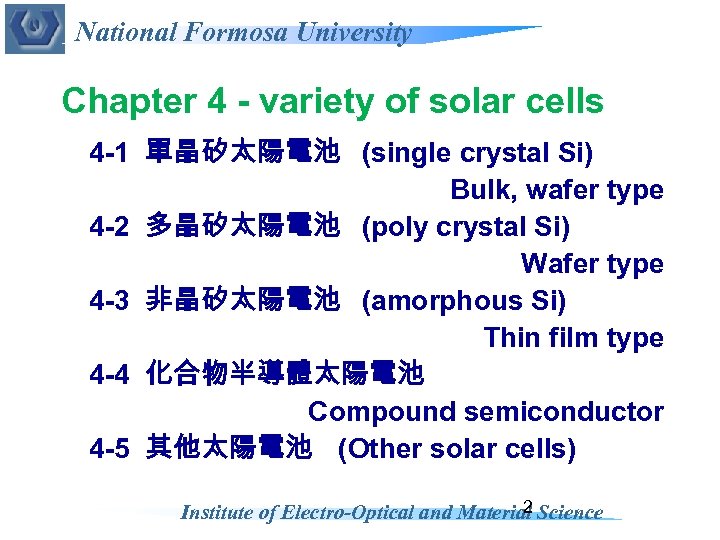 National Formosa University Chapter 4 - variety of solar cells 4 -1 單晶矽太陽電池 (single crystal Si) Bulk, wafer type 4 -2 多晶矽太陽電池 (poly crystal Si) Wafer type 4 -3 非晶矽太陽電池 (amorphous Si) Thin film type 4 -4 化合物半導體太陽電池 Compound semiconductor 4 -5 其他太陽電池 (Other solar cells) 2 Institute of Electro-Optical and Material Science
 National Formosa University 4 -1 single crystal silicon solar cells 3 Institute of Electro-Optical and Material Science
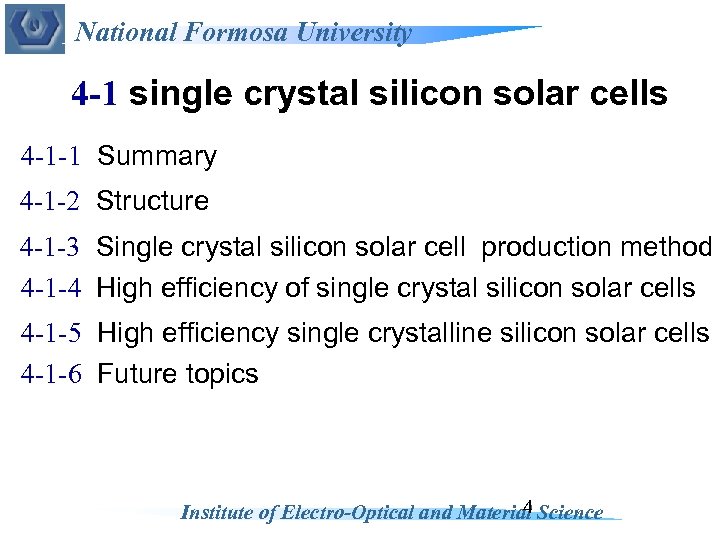 National Formosa University 4 -1 single crystal silicon solar cells 4 -1 -1 Summary 4 -1 -2 Structure 4 -1 -3 Single crystal silicon solar cell production method 4 -1 -4 High efficiency of single crystal silicon solar cells 4 -1 -5 High efficiency single crystalline silicon solar cells 4 -1 -6 Future topics 4 Institute of Electro-Optical and Material Science
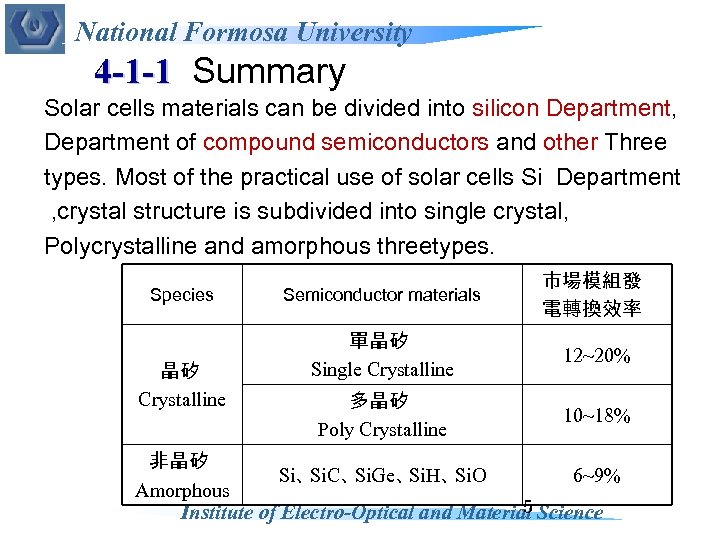 National Formosa University 4 -1 -1 Summary Solar cells materials can be divided into silicon Department, Department of compound semiconductors and other Three types. Most of the practical use of solar cells Si Department , crystal structure is subdivided into single crystal, Polycrystalline and amorphous threetypes. Species 晶矽 Crystalline 非晶矽 Amorphous Semiconductor materials 市場模組發 電轉換效率 單晶矽 Single Crystalline 12~20% 多晶矽 Poly Crystalline 10~18% Si、 Si. C、 Si. Ge、 Si. H、 Si. O 6~9% 5 Institute of Electro-Optical and Material Science
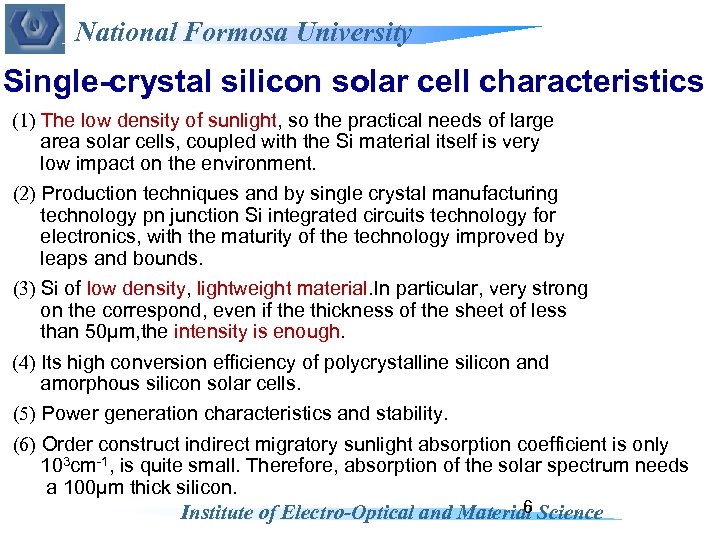 National Formosa University Single-crystal silicon solar cell characteristics (1) The low density of sunlight, so the practical needs of large area solar cells, coupled with the Si material itself is very low impact on the environment. (2) Production techniques and by single crystal manufacturing technology pn junction Si integrated circuits technology for electronics, with the maturity of the technology improved by leaps and bounds. (3) Si of low density, lightweight material. In particular, very strong on the correspond, even if the thickness of the sheet of less than 50μm, the intensity is enough. (4) Its high conversion efficiency of polycrystalline silicon and amorphous silicon solar cells. (5) Power generation characteristics and stability. (6) Order construct indirect migratory sunlight absorption coefficient is only 103 cm-1, is quite small. Therefore, absorption of the solar spectrum needs a 100μm thick silicon. 6 Institute of Electro-Optical and Material Science
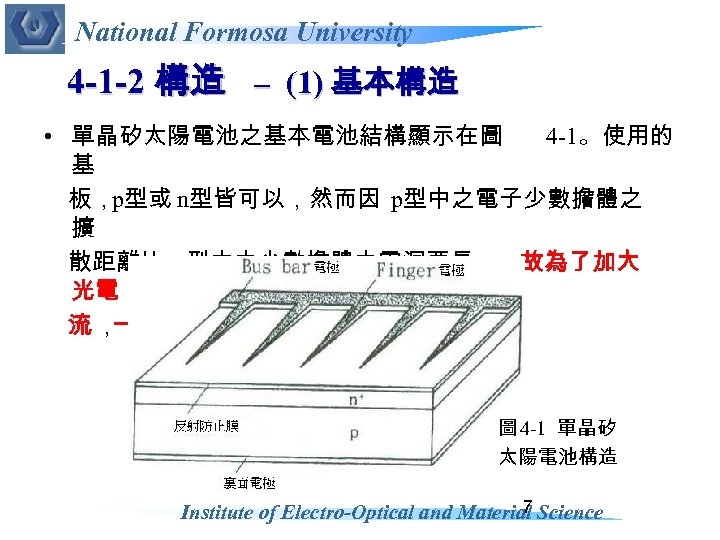 National Formosa University 4 -1 -2 構造 – (1) 基本構造 • 單晶矽太陽電池之基本電池結構顯示在圖 4 -1。使用的 基 板,p型或 n型皆可以,然而因 p型中之電子少數擔體之 擴 散距離比 n型中之少數擔體之電洞要長, 故為了加大 光電 流, 一般使用 p型 。 圖 4 -1 單晶矽 太陽電池構造 7 Institute of Electro-Optical and Material Science
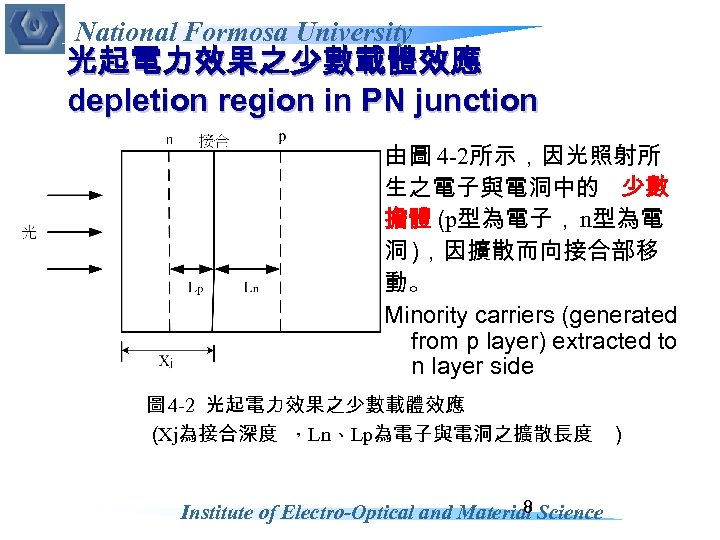 National Formosa University 光起電力效果之少數載體效應 depletion region in PN junction 由圖 4 -2所示,因光照射所 生之電子與電洞中的 少數 擔體 (p型為電子, n型為電 洞 ),因擴散而向接合部移 動。 Minority carriers (generated from p layer) extracted to n layer side 圖 4 -2 光起電力效果之少數載體效應 (Xj為接合深度 ,Ln、Lp為電子與電洞之擴散長度 8 Institute of Electro-Optical and Material Science )
 National Formosa University (2) 淺接合構造 短波長的光, 由於半導體的光吸收係數很大,故在表 面 被吸收而生成電子 -電洞對。若接合太深時,則使得 在表 面生成之少數擔體不易到達,再加上表面之再結合 速度 大時,生成之電子 -電洞對因而消滅,更使到達接合 處之 少數擔體降低。 9 Institute of Electro-Optical and Material Science
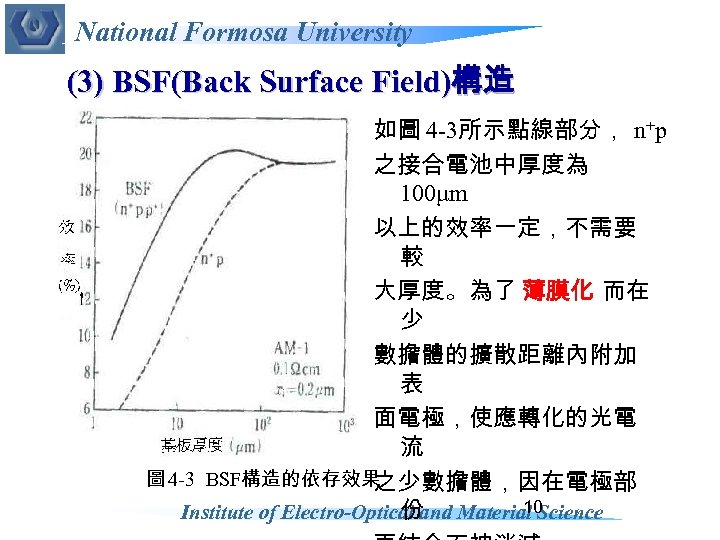 National Formosa University (3) BSF(Back Surface Field)構造 如圖 4 -3所示點線部分, n+p 之接合電池中厚度為 100μm 以上的效率一定,不需要 較 大厚度。為了 薄膜化 而在 少 數擔體的擴散距離內附加 表 面電極,使應轉化的光電 流 圖 4 -3 BSF構造的依存效果 之少數擔體,因在電極部 10 份 Institute of Electro-Optical and Material Science
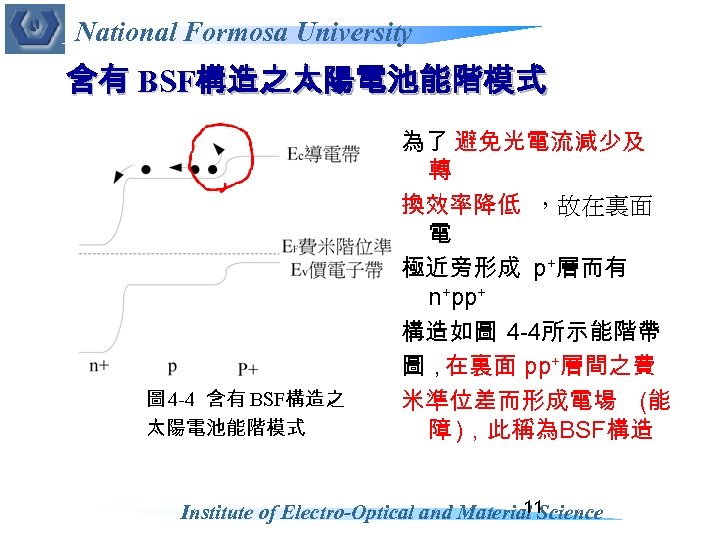 National Formosa University 含有 BSF構造之太陽電池能階模式 圖 4 -4 含有 BSF構造之 太陽電池能階模式 為了 避免光電流減少及 轉 換效率降低 ,故在裏面 電 極近旁形成 p+層而有 n+pp+ 構造如圖 4 -4所示能階帶 圖,在裏面 pp+層間之費 米準位差而形成電場 (能 障 ),此稱為BSF構造 11 Institute of Electro-Optical and Material Science
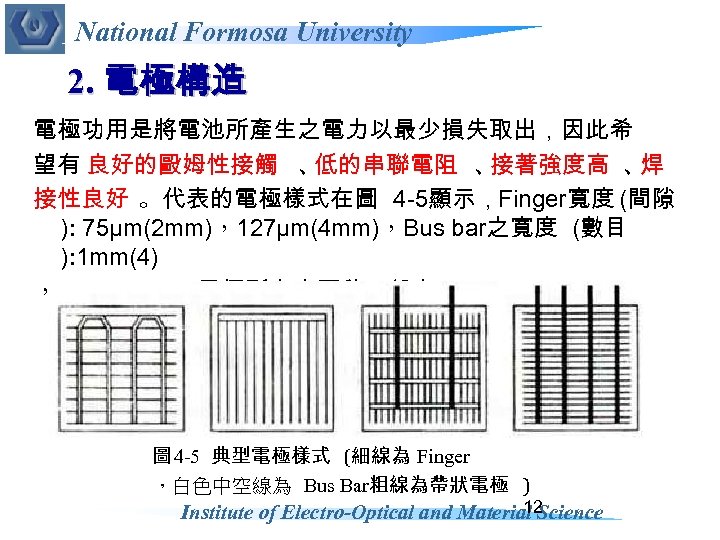 National Formosa University 2. 電極構造 電極功用是將電池所產生之電力以最少損失取出,因此希 望有 良好的毆姆性接觸 、 低的串聯電阻 、 接著強度高 、 焊 接性良好 。代表的電極樣式在圖 4 -5顯示,Finger寬度 (間隙 ): 75μm(2 mm),127μm(4 mm),Bus bar之寬度 (數目 ): 1 mm(4) ,0. 25 mm(4)。電極所占之面積一般在 5~7%。 圖 4 -5 典型電極樣式 (細線為 Finger ,白色中空線為 Bus Bar粗線為帶狀電極 ) 12 Institute of Electro-Optical and Material Science
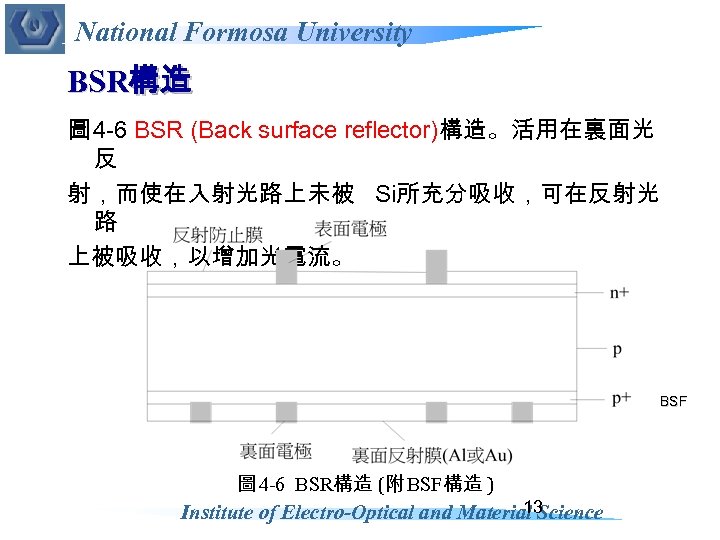 National Formosa University BSR構造 圖 4 -6 BSR (Back surface reflector)構造。活用在裏面光 反 射,而使在入射光路上未被 Si所充分吸收,可在反射光 路 上被吸收,以增加光電流。 BSF 圖 4 -6 BSR構造 (附 BSF構造 ) 13 Institute of Electro-Optical and Material Science
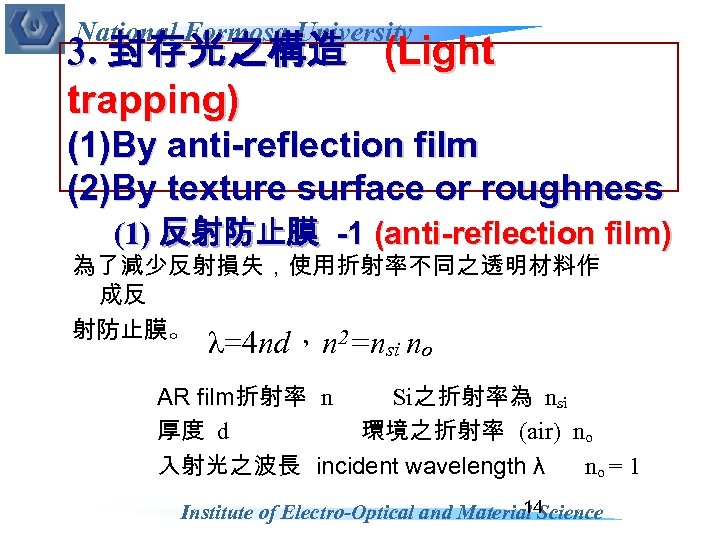 National Formosa University 3. 封存光之構造 (Light trapping) (1)By anti-reflection film (2)By texture surface or roughness (1) 反射防止膜 -1 (anti-reflection film) 為了減少反射損失,使用折射率不同之透明材料作 成反 射防止膜。 2 λ=4 nd,n =nsi no AR film折射率 n Si之折射率為 nsi 厚度 d 環境之折射率 (air) no 入射光之波長 incident wavelength λ no = 1 14 Institute of Electro-Optical and Material Science
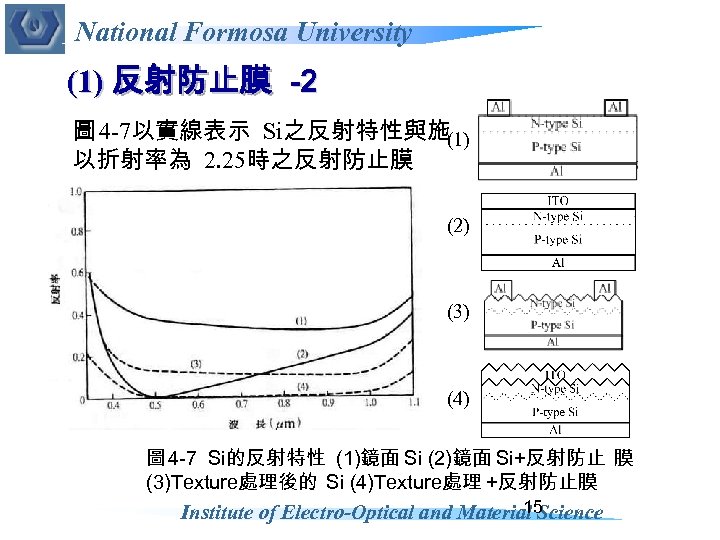 National Formosa University (1) 反射防止膜 -2 圖 4 -7以實線表示 Si之反射特性與施(1) 以折射率為 2. 25時之反射防止膜 (2) (3) (4) 圖 4 -7 Si的反射特性 (1)鏡面 Si (2)鏡面 Si+反射防止 膜 (3)Texture處理後的 Si (4)Texture處理 +反射防止膜 15 Institute of Electro-Optical and Material Science
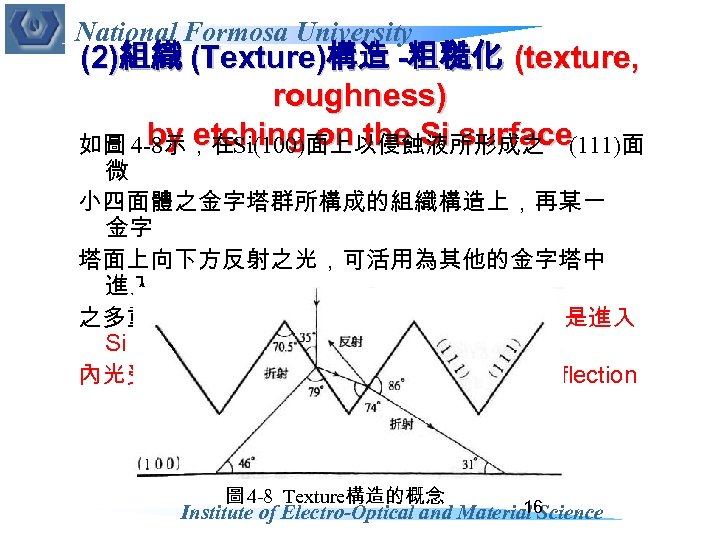 National Formosa University (2)組織 (Texture)構造 -粗糙化 (texture, roughness) by etching on the Si surface 如圖 4 -8示,在Si(100)面上以侵蝕液所形成之 (111)面 微 小四面體之金字塔群所構成的組織構造上,再某一 金字 塔面上向下方反射之光,可活用為其他的金字塔中 進入 之多重反射。 就全體而言,可減少反射。特別是進入 Si 內光受到折射。 Refractive, reflection 圖 4 -8 Texture構造的概念 16 Institute of Electro-Optical and Material Science
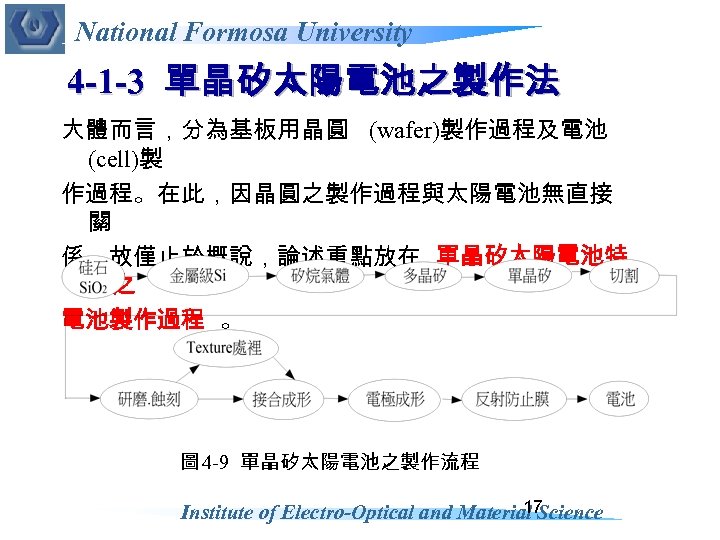 National Formosa University 4 -1 -3 單晶矽太陽電池之製作法 大體而言,分為基板用晶圓 (wafer)製作過程及電池 (cell)製 作過程。在此,因晶圓之製作過程與太陽電池無直接 關 係,故僅止於概說,論述重點放在 單晶矽太陽電池特 有之 電池製作過程 。 圖 4 -9 單晶矽太陽電池之製作流程 17 Institute of Electro-Optical and Material Science
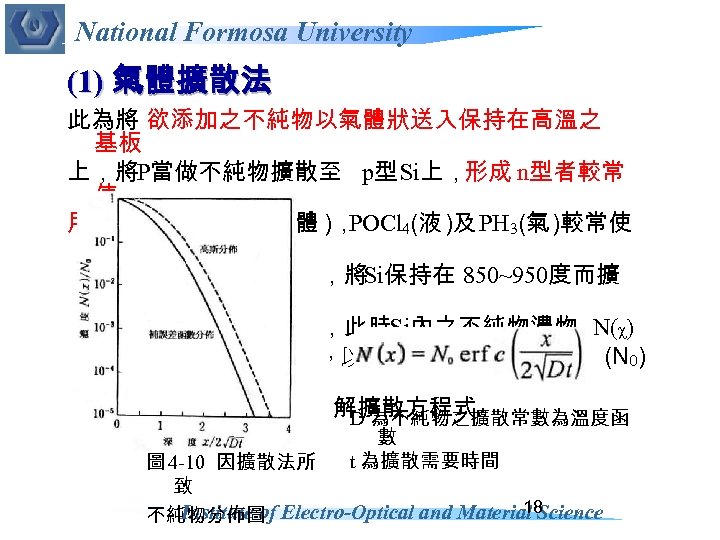 National Formosa University (1) 氣體擴散法 此為將 欲添加之不純物以氣體狀送入保持在高溫之 基板 上,將P當做不純物擴散至 p型 Si上,形成 n型者較常 使 用 。擴散源以 P 2 O 5(固體 ), POCl 4(液 )及 PH 3(氣 )較常使 用 ,將Si保持在 850~950度而擴 散 ,此時Si內之不純物濃物 N(χ) ,以表面密度為定常狀態 (N 0) 而 解擴散方程式。 D 為不純物之擴散常數為溫度函 數 t 為擴散需要時間 圖 4 -10 因擴散法所 致 18 Institute of 不純物分佈圖 Electro-Optical and Material Science
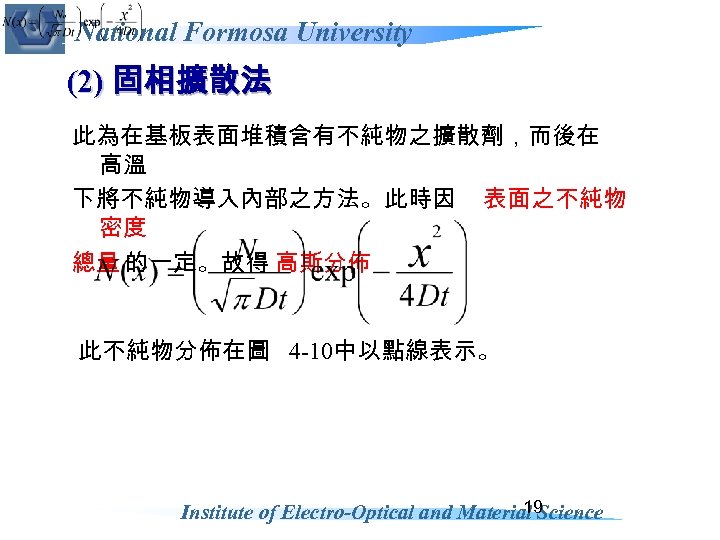 National Formosa University (2) 固相擴散法 此為在基板表面堆積含有不純物之擴散劑,而後在 高溫 下將不純物導入內部之方法。此時因 表面之不純物 密度 總量 的一定。故得 高斯分佈 此不純物分佈在圖 4 -10中以點線表示。 19 Institute of Electro-Optical and Material Science
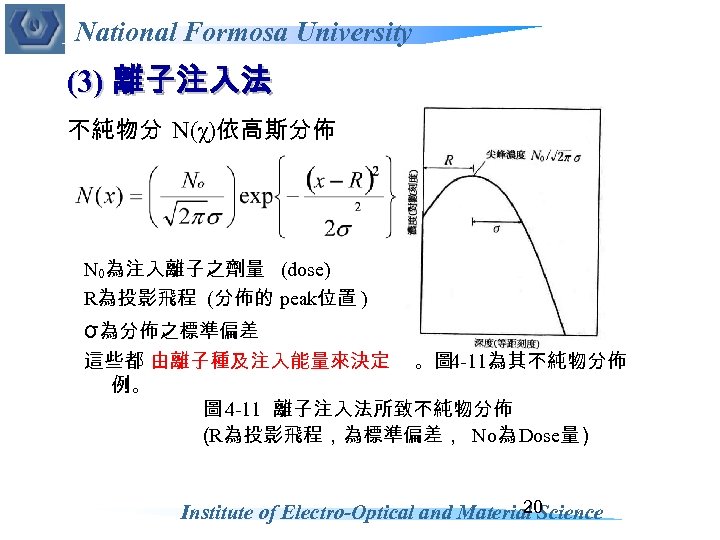 National Formosa University (3) 離子注入法 不純物分 N(χ)依高斯分佈 N 0為注入離子之劑量 (dose) R為投影飛程 (分佈的 peak位置 ) σ為分佈之標準偏差 這些都 由離子種及注入能量來決定 。圖 4 -11為其不純物分佈 例。 圖 4 -11 離子注入法所致不純物分佈 (R為投影飛程,為標準偏差, No為 Dose量 ) 20 Institute of Electro-Optical and Material Science
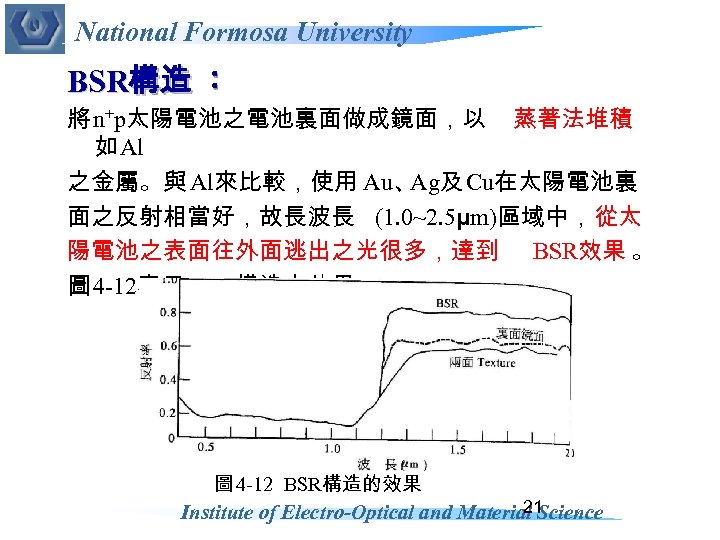 National Formosa University BSR構造 : 將 n+p太陽電池之電池裏面做成鏡面,以 蒸著法堆積 如 Al 之金屬。與 Al來比較,使用 Au、 Ag及 Cu在太陽電池裏 面之反射相當好,故長波長 (1. 0~2. 5μm)區域中,從太 陽電池之表面往外面逃出之光很多,達到 BSR效果 。 圖 4 -12表示 BSR構造之效果 圖 4 -12 BSR構造的效果 21 Institute of Electro-Optical and Material Science
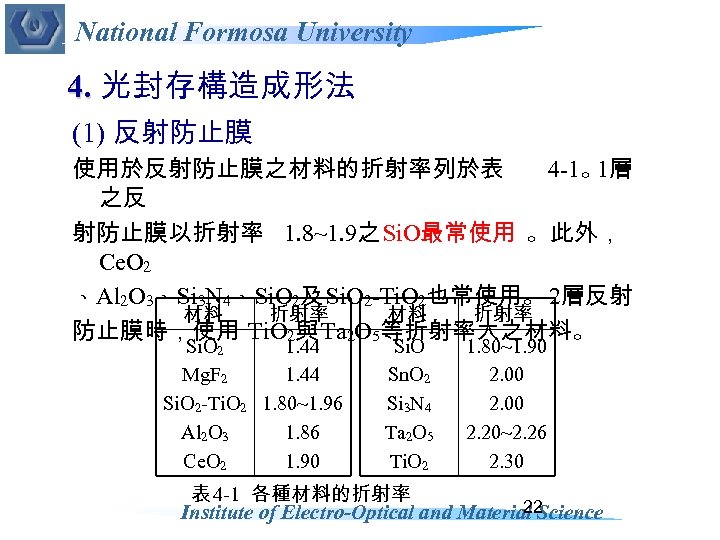 National Formosa University 4. 光封存構造成形法 (1) 反射防止膜 使用於反射防止膜之材料的折射率列於表 4 -1。 1層 之反 射防止膜以折射率 1. 8~1. 9之 Si. O最常使用 。此外, Ce. O 2 、Al 2 O 3、Si 3 N 4、Si. O 2及 Si. O 2 -Ti. O 2也常使用。 2層反射 材料 折射率 防止膜時,使用 Ti. O 2與 Ta 2 O 5等折射率大之材料。 Si. O 2 1. 44 Mg. F 2 1. 44 Si. O 2 -Ti. O 2 1. 80~1. 96 Al 2 O 3 1. 86 Ce. O 2 1. 90 Si. O Sn. O 2 Si 3 N 4 Ta 2 O 5 Ti. O 2 表 4 -1 各種材料的折射率 1. 80~1. 90 2. 00 2. 20~2. 26 2. 30 22 Institute of Electro-Optical and Material Science
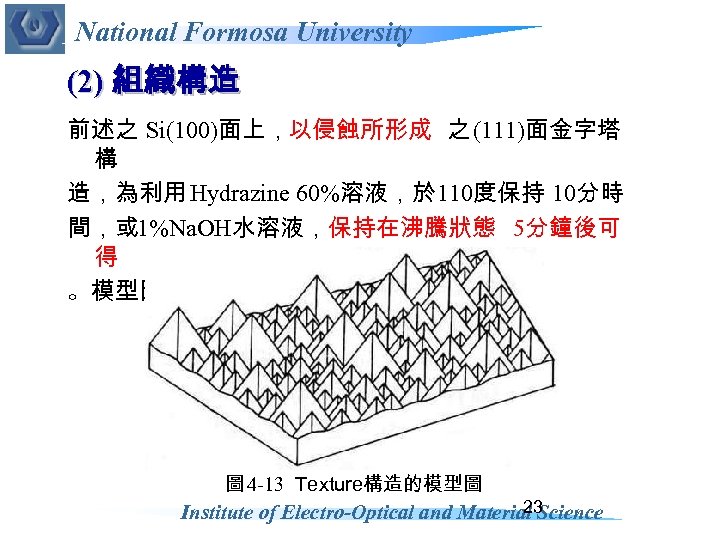 National Formosa University (2) 組織構造 前述之 Si(100)面上,以侵蝕所形成 之 (111)面金字塔 構 造,為利用 Hydrazine 60%溶液,於 110度保持 10分時 間,或 1%Na. OH水溶液,保持在沸騰狀態 5分鐘後可 得 。模型圖如圖 4 -13所示。 圖 4 -13 Texture構造的模型圖 23 Institute of Electro-Optical and Material Science
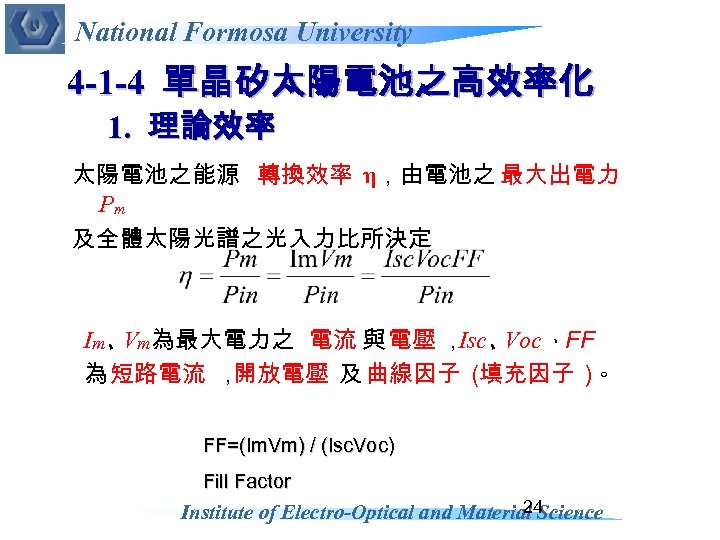 National Formosa University 4 -1 -4 單晶矽太陽電池之高效率化 1. 理論效率 太陽電池之能源 轉換效率 η,由電池之 最大出電力 Pm 及全體太陽光譜之光入力比所決定 Im、 m為最大電力之 電流 與 電壓 , 、 、FF V Isc Voc 為 短路電流 , 開放電壓 及 曲線因子 (填充因子 )。 FF=(Im. Vm) / (Isc. Voc) Fill Factor 24 Institute of Electro-Optical and Material Science
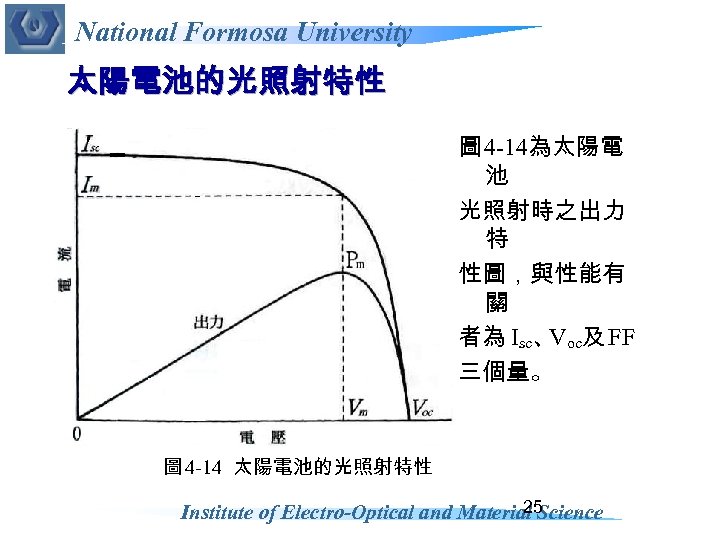 National Formosa University 太陽電池的光照射特性 圖 4 -14為太陽電 池 光照射時之出力 特 性圖,與性能有 關 者為 Isc、 oc及 FF V 三個量。 圖 4 -14 太陽電池的光照射特性 25 Institute of Electro-Optical and Material Science
 National Formosa University 2. 高效率化基本考量 現實太陽電池有以下之各項損失因素 : (1) 反射損失 :半導體表面之反射,使太陽光無法全 部進 入而產生之損失,使用反射防止膜及組織構造可改 善 (2) 透過損失 :能量比禁制帶寬小之光子,不被半導 體吸 收而透過,沒有被能量轉換,造成光電能源轉換 之損 失結果。可被自由擔體吸收而存在 。 (3) 光能之不完全利用損失 :被半導體所吸收之光子, 若 26 Institute of Electro-Optical and Material Science 其能量大於禁制帶寬時,能量被半導體之結晶格
 National Formosa University (4) 再結合損失 :生成之電子與正孔在表面或半導 體內 再結合,則不產生光電流。 (5) 電壓因子損失 :利用 p-n接合時,最大可取得之電 壓 為擴散電位,通常費米準位存在於禁制帶寬內,故 在相當於禁制帶寬之電壓以下。亦即,開放電壓較 低而造成損失。 (6) 曲線因子損失 :半導體之電阻不為零及歐姆性 接觸 部位之電阻為串聯電阻,此外理想之 p-n接合沒有 洩 漏電流。而現實上因為漏洩電流,使 p-n接合上有 並 27 Institute of Electro-Optical and Material Science 聯電阻出現。故此項包含串聯及並聯電阻損失。
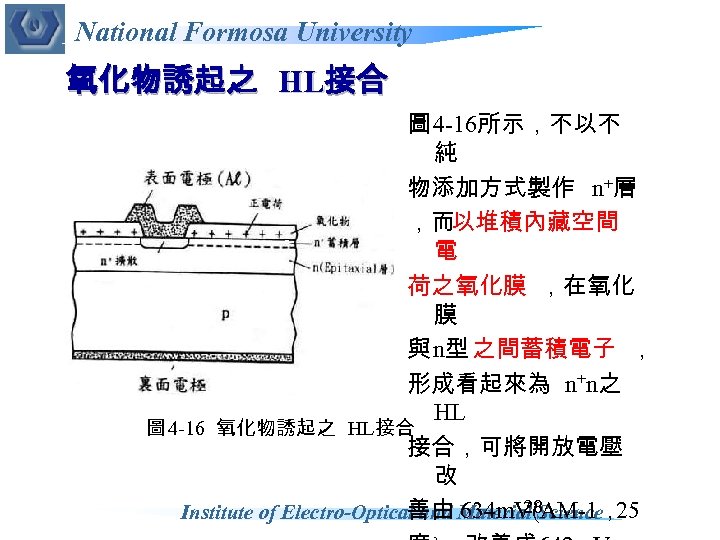 National Formosa University 氧化物誘起之 HL接合 圖 4 -16所示,不以不 純 物添加方式製作 n+層 ,而以堆積內藏空間 電 荷之氧化膜 ,在氧化 膜 與 n型 之間蓄積電子 , 形成看起來為 n+n之 HL 圖 4 -16 氧化物誘起之 HL接合 接合,可將開放電壓 改 28 善由 634 m. V(AM-1, Institute of Electro-Optical and Material Science 25
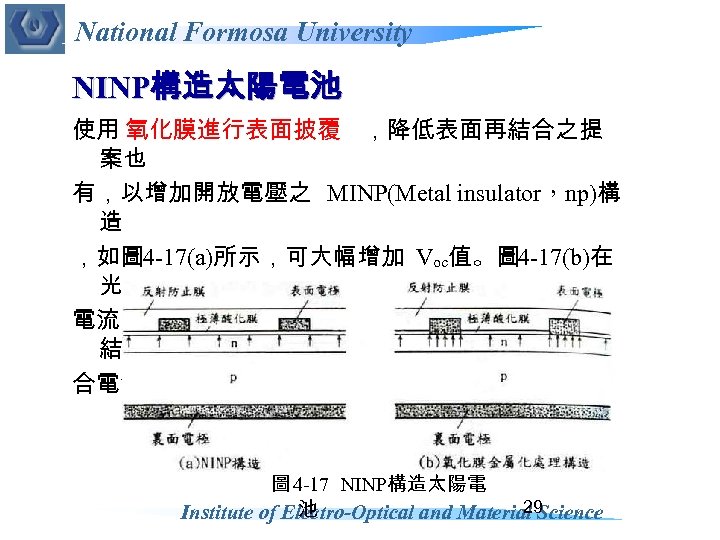 National Formosa University NINP構造太陽電池 使用 氧化膜進行表面披覆 ,降低表面再結合之提 案也 有,以增加開放電壓之 MINP(Metal insulator,np)構 造 ,如圖 4 -17(a)所示,可大幅增加 Voc值。圖 4 -17(b)在 光 電流的收集電極部上,金屬與半導體直接接觸,再 結 合電流,對暗時的逆方向飽和電流有很大影響。 圖 4 -17 NINP構造太陽電 29 池 Institute of Electro-Optical and Material Science
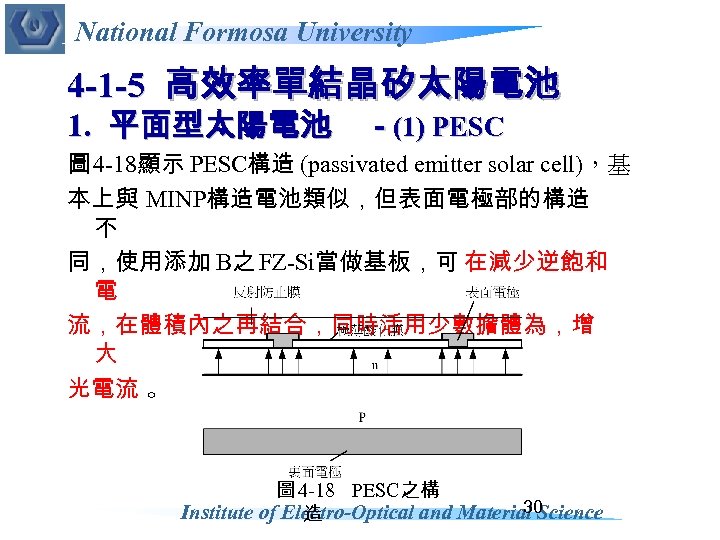 National Formosa University 4 -1 -5 高效率單結晶矽太陽電池 1. 平面型太陽電池 - (1) PESC 圖 4 -18顯示 PESC構造 (passivated emitter solar cell),基 本上與 MINP構造電池類似,但表面電極部的構造 不 同,使用添加 B之 FZ-Si當做基板,可 在減少逆飽和 電 流,在體積內之再結合,同時活用少數擔體為,增 大 光電流 。 圖 4 -18 PESC之構 30 Institute of Electro-Optical and Material Science 造
 National Formosa University (1) PESC 因金屬電極與 n+-Si間有極薄之絕緣膜,故光電流 在此 部份不用 Tunnel效果通過不行。為避免這些因素, 將 金屬電極與 n+-Si層之直接接觸部限制在微小領域 內, 可 減低逆方向飽和電流 , 並增加光電流收集率 。 在反射防止膜上與 MINP電池同樣, 採用 Zn. S與 Mg. F 2 之 2層構造 。以此電池,在AM-1. 5, 100 m. W/cm 2。 28度之條件下, η=19. 0~19. 1%。再改良製程可達到 Jsc=36. 5 m. A/cm 2, oc=662 m. V, V FF=0. 819, 31 η=19. 8% Institute of Electro-Optical and Material Science
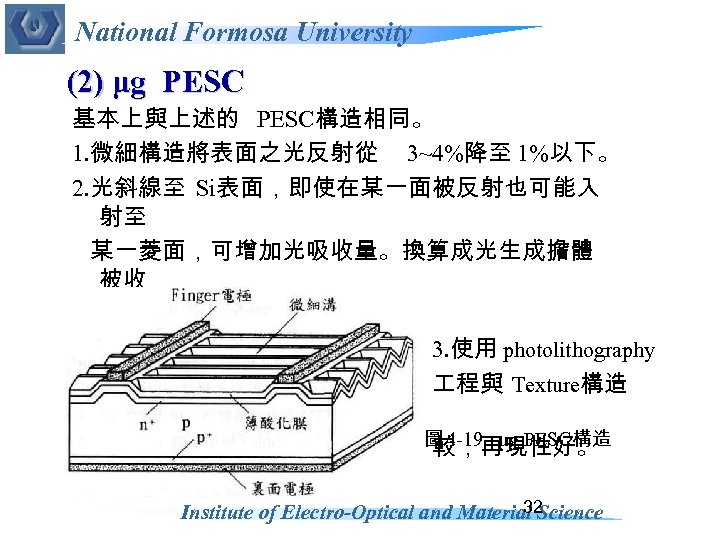 National Formosa University (2) μg PESC 基本上與上述的 PESC構造相同。 1. 微細構造將表面之光反射從 3~4%降至 1%以下。 2. 光斜線至 Si表面,即使在某一面被反射也可能入 射至 某一菱面,可增加光吸收量。換算成光生成擔體 被收 集時之擴散距離,也有 35%。 3. 使用 photolithography 程與 Texture構造 比 圖 4 -19 μg PESC構造 較,再現性好。 32 Institute of Electro-Optical and Material Science
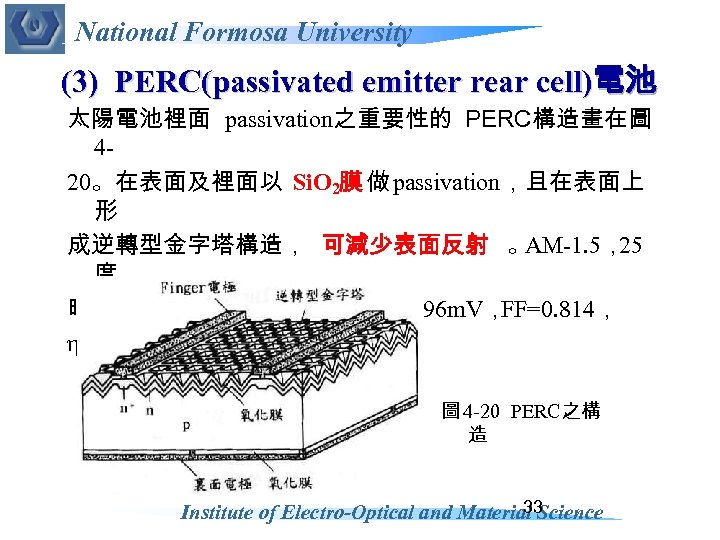 National Formosa University (3) PERC(passivated emitter rear cell)電池 太陽電池裡面 passivation之重要性的 PERC構造畫在圖 420。在表面及裡面以 Si. O 2膜 做 passivation,且在表面上 形 成逆轉型金字塔構造, 可減少表面反射 。 AM-1. 5, 25 度 時,可達成 Jsc=40. 3 m. A/cm 2, oc=696 m. V, V FF=0. 814, η=22. 8%之效果 。 圖 4 -20 PERC之構 造 33 Institute of Electro-Optical and Material Science
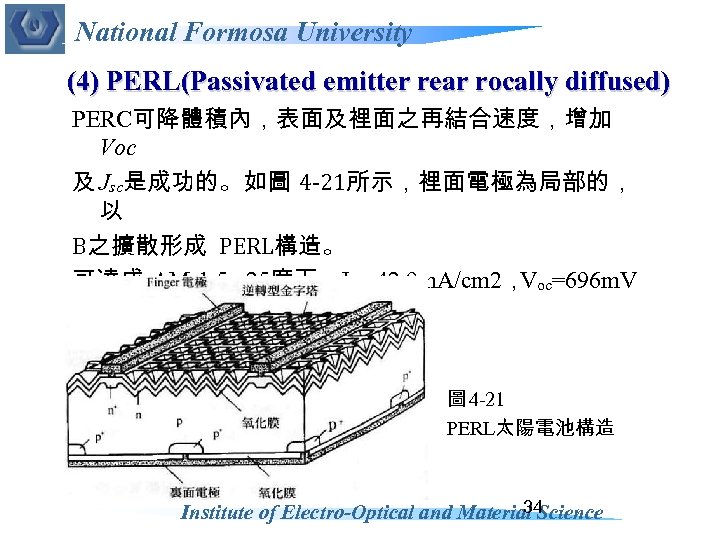 National Formosa University (4) PERL(Passivated emitter rear rocally diffused) PERC可降體積內,表面及裡面之再結合速度,增加 Voc 及 Jsc是成功的。如圖 4 -21所示,裡面電極為局部的, 以 B之擴散形成 PERL構造。 可達成 AM-1. 5, 25度下,Jsc=42. 9 m. A/cm 2, oc=696 m. V V , FF=0. 81, η=24. 2%之高效率 。 圖 4 -21 PERL太陽電池構造 34 Institute of Electro-Optical and Material Science
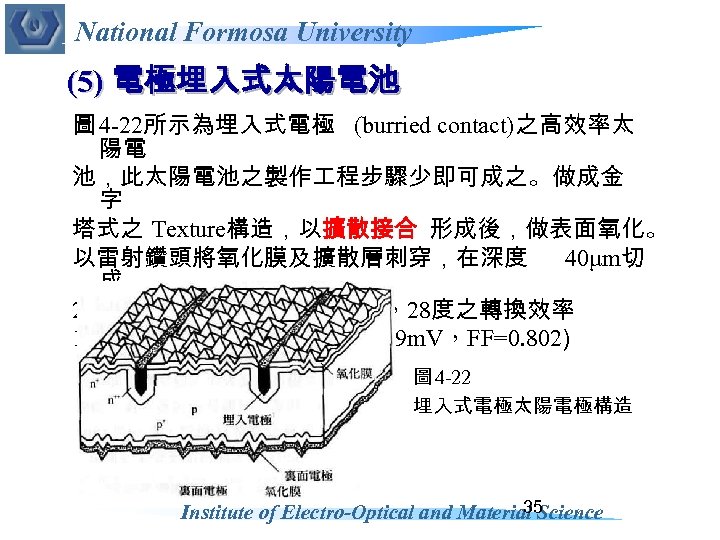 National Formosa University (5) 電極埋入式太陽電池 圖 4 -22所示為埋入式電極 (burried contact)之高效率太 陽電 池,此太陽電池之製作 程步驟少即可成之。做成金 字 塔式之 Texture構造,以擴散接合 形成後,做表面氧化。 以雷射鑽頭將氧化膜及擴散層刺穿,在深度 40μm切 成 20μm之溝 。AM-1. 5,100 m. W,28度之轉換效率 18. 6%(Jsc=38. 0 m. A/cm 2,Voc=609 m. V,FF=0. 802) 圖 4 -22 埋入式電極太陽電極構造 35 Institute of Electro-Optical and Material Science
 National Formosa University 2. 大面積太陽電池 目前 10× 10 cm 2大面積之太陽電池已近實用化,通常太 陽電 池面積增大時效率會降低,其理由為下述 : (1)所給與之表面電極樣式, 當太陽電池面積增大時電 極部之電阻也增加 。 (2)某些材料之材質不均一時, 當面積增加,含有壞材 料之比率也增大。 (3)高效率 、 大面積 特點為 : 使用高品質單晶矽太陽電池, 其高效率、小面積之製作技術若適用大面積時,性 能之低下不多。 (4)模組效率改善 : 用此大面積太陽電池, 75. 2 Wp之模組, 電池效率 16. 9%,模組效率 15. 2%。 36 Institute of Electro-Optical and Material Science
 National Formosa University 3. 集光型太陽電池 若不用排列式太陽電池,而已集光鏡或集光透鏡收 集 入射光,以少數之電池來發電時,電池成本轉為集 光 器、支持台、追尾裝置之成本,全體而言應該降低。 但集光用電池之效率不高,對整體系統而言沒什麼 優 點。電池效率隨集光比之增加而增加,但若溫度也 隨 之上升時,則效率降低 。隨集光比之增加,轉換效 率 η亦隨開放電壓 Voc對數比例增加,但因 Voc在 p-n接 37 合 Institute of Electro-Optical and Material Science
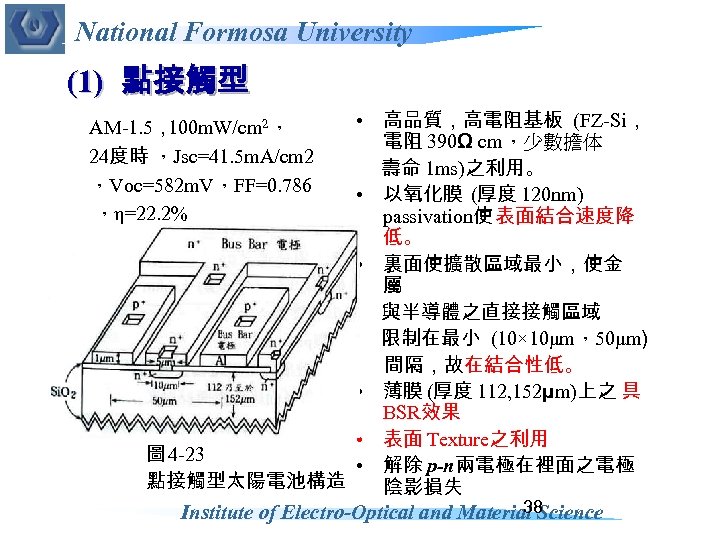 National Formosa University (1) 點接觸型 • 高品質,高電阻基板 (FZ-Si, 電阻 390Ω cm,少數擔体 壽命 1 ms)之利用。 • 以氧化膜 (厚度 120 nm) passivation使 表面結合速度降 低。 • 裏面使擴散區域最小,使金 屬 與半導體之直接接觸區域 限制在最小 (10× 10μm,50μm) 間隔,故在結合性低。 • 薄膜 (厚度 112, 152μm)上之 具 BSR效果 • 表面 Texture之利用 圖 4 -23 • 解除 p-n兩電極在裡面之電極 點接觸型太陽電池構造 陰影損失 38 Institute of Electro-Optical and Material Science AM-1. 5, 100 m. W/cm 2, 24度時 ,Jsc=41. 5 m. A/cm 2 ,Voc=582 m. V,FF=0. 786 ,η=22. 2%
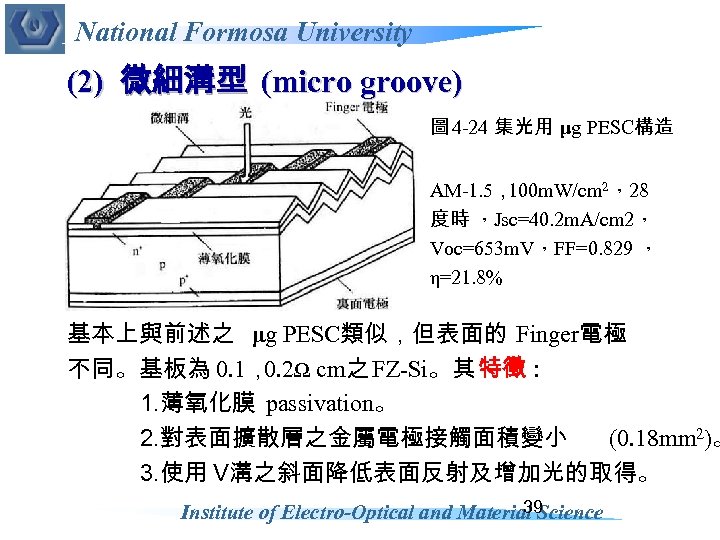 National Formosa University (2) 微細溝型 (micro groove) 圖 4 -24 集光用 μg PESC構造 AM-1. 5, 100 m. W/cm 2,28 度時 ,Jsc=40. 2 m. A/cm 2, Voc=653 m. V,FF=0. 829 , η=21. 8% 基本上與前述之 μg PESC類似,但表面的 Finger電極 不同。基板為 0. 1, Ω cm之 FZ-Si。 特徵 : 0. 2 其 1. 薄氧化膜 passivation。 2. 對表面擴散層之金屬電極接觸面積變小 (0. 18 mm 2)。 3. 使用 V溝之斜面降低表面反射及增加光的取得。 39 Institute of Electro-Optical and Material Science
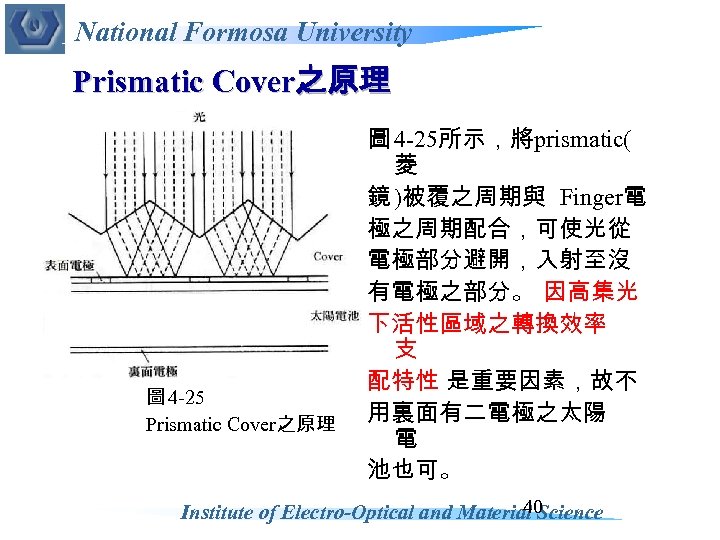 National Formosa University Prismatic Cover之原理 圖 4 -25所示,將prismatic( 菱 鏡 )被覆之周期與 Finger電 極之周期配合,可使光從 電極部分避開,入射至沒 有電極之部分。 因高集光 下活性區域之轉換效率 支 配特性 是重要因素,故不 用裏面有二電極之太陽 電 池也可。 40 Institute of Electro-Optical and Material Science
 National Formosa University 4 -1 -6 今後的課題 • 現在單結晶矽太陽電池之實用化已達 10× 10 cm 2規格。 轉換效率也高,潮流動向以目前之製作法可提高效率 及降低成本至多少,雖然沒做詳細檢討,但以 模組化 效率增加 為今後最大課題。 • 短波長光之利用 為經常課題,但對單晶矽而言,尚無 可用之提案。雖然採用寬間隙半導體與單晶矽所形成 積層構造,做為太陽電池之基波或可為此範圍,但更 不同之提案,如導入色素增加矽中之短波長光轉換, 可能有較高效率。 41 Institute of Electro-Optical and Material Science
 National Formosa University 4 -2 多晶矽太陽電池 42 Institute of Electro-Optical and Material Science
 National Formosa University 4 -2 多晶矽太陽電池 4 -2 -1 多晶矽材料之形成 4 -2 -2 結晶粒界之電氣特性及不活性化 4 -2 -3 接合構造及理論效率 4 -2 -4 太陽電池製造技術 4 -2 -5 將來展望 43 Institute of Electro-Optical and Material Science
 National Formosa University 4 -2 多晶矽太陽電池 本節中所述多晶矽電池是以 降低成本 為第一要務, 效率 為第二而開發出之太陽電池。 矽太陽電池,材料之光吸收係數小,為膜化可能減 少光 電流,得不到高效率,故不受重視。但若能將光封存 在 吸收層內,則薄膜也得到高光電流,而且也有暗電 流之 減少效果,在理論上也可達到高效率。薄膜且能吸 收光 者不一定為單晶,非晶矽為最佳例子。 44 Institute of Electro-Optical and Material Science
 National Formosa University 4 -2 -1 多晶矽材料之形成 多晶矽太陽電池是將原材料價格中之結晶化部份盡 量降 低,以降低 Si電池之價格 。單晶基板價格中,可以 降 低 成本 之部分,可分 為 : (1)原材料純度 可降低至何種程度。 (2)含結晶化等之基板 製造能源可降低至何種程度。 45 Institute of Electro-Optical and Material Science
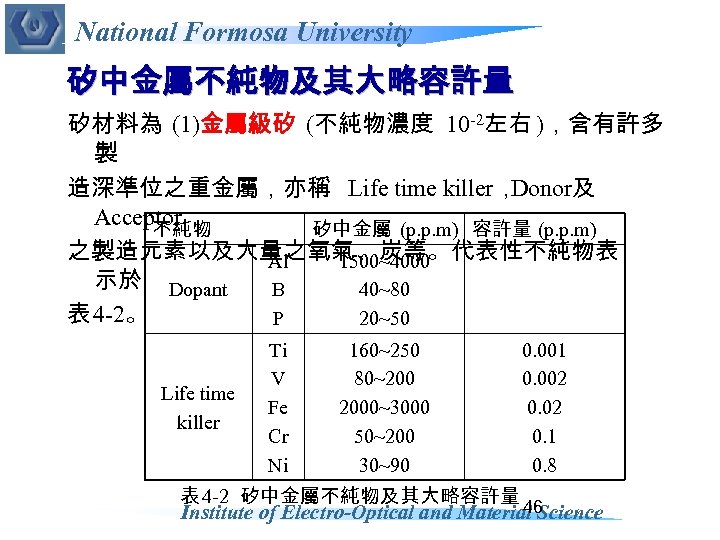 National Formosa University 矽中金屬不純物及其大略容許量 矽材料為 (1)金屬級矽 (不純物濃度 10 -2左右 ),含有許多 製 造深準位之重金屬,亦稱 Life time killer, Donor及 Acceptor 矽中金屬 (p. p. m) 容許量 (p. p. m) 不純物 之製造元素以及大量之氧氣、炭等。代表性不純物表 Al 1500~4000 示於 Dopant B 40~80 表 4 -2。 P 20~50 Life time killer Ti V Fe Cr Ni 160~250 80~200 2000~3000 50~200 30~90 表 4 -2 矽中金屬不純物及其大略容許量 0. 001 0. 002 0. 1 0. 8 46 Institute of Electro-Optical and Material Science
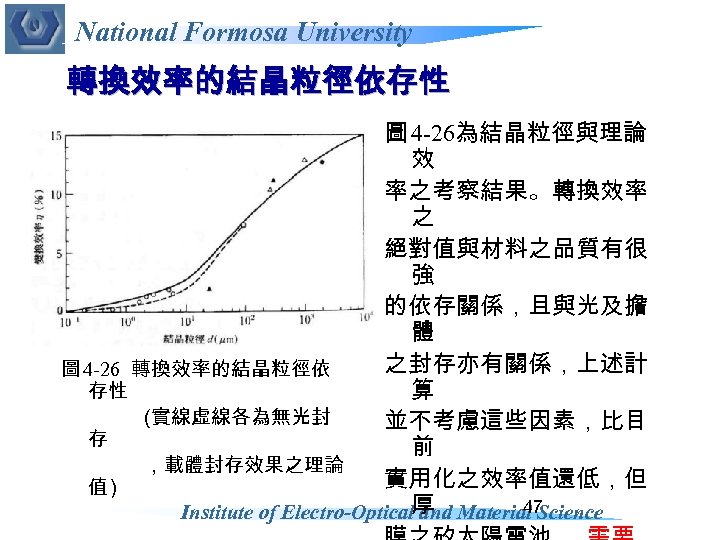 National Formosa University 轉換效率的結晶粒徑依存性 圖 4 -26為結晶粒徑與理論 效 率之考察結果。轉換效率 之 絕對值與材料之品質有很 強 的依存關係,且與光及擔 體 之封存亦有關係,上述計 圖 4 -26 轉換效率的結晶粒徑依 存性 算 (實線虛線各為無光封 並不考慮這些因素,比目 存 前 ,載體封存效果之理論 實用化之效率值還低,但 值) 47 Institute of Electro-Optical厚 Material Science and
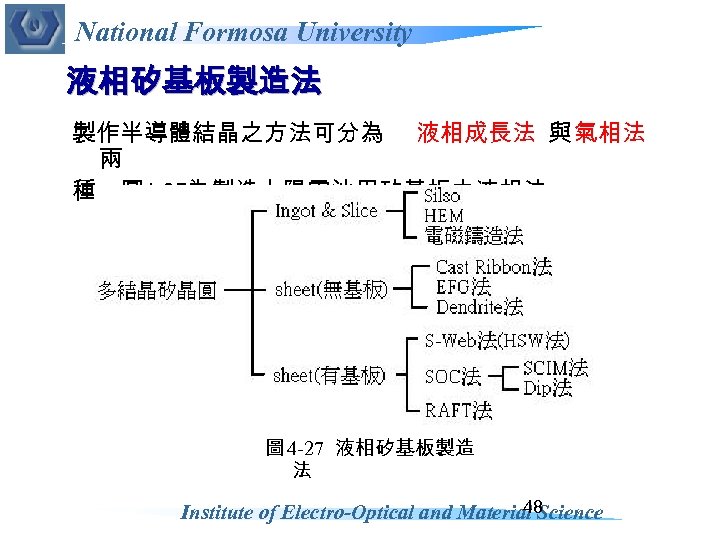 National Formosa University 液相矽基板製造法 製作半導體結晶之方法可分為 液相成長法 與 氣相法 兩 種,圖 4 -27為製造太陽電池用矽基板之液相法。 圖 4 -27 液相矽基板製造 法 48 Institute of Electro-Optical and Material Science
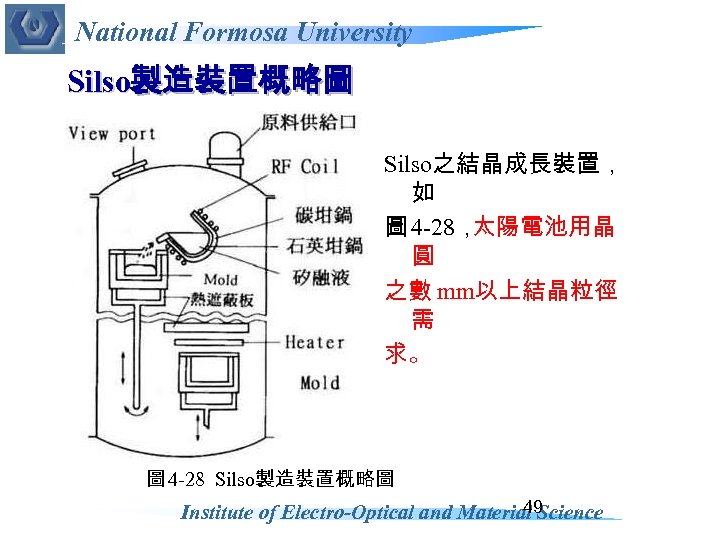 National Formosa University Silso製造裝置概略圖 Silso之結晶成長裝置, 如 圖 4 -28, 太陽電池用晶 圓 之數 mm以上結晶粒徑 需 求。 圖 4 -28 Silso製造裝置概略圖 49 Institute of Electro-Optical and Material Science
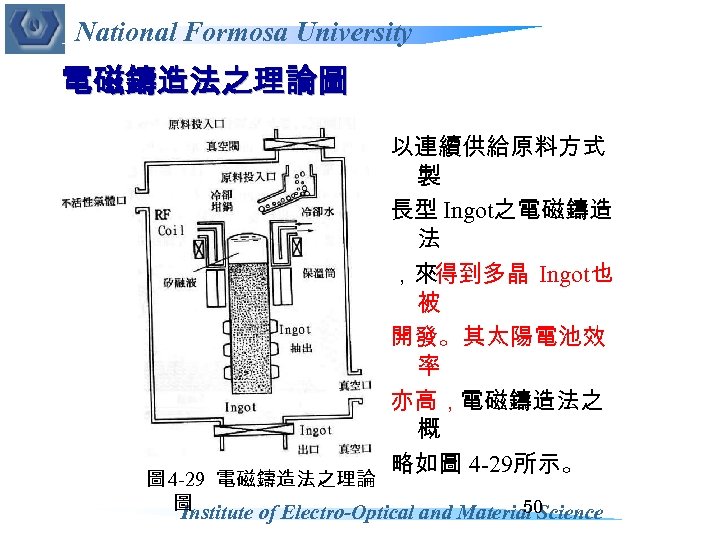 National Formosa University 電磁鑄造法之理論圖 以連續供給原料方式 製 長型 Ingot之電磁鑄造 法 ,來得到多晶 Ingot也 被 開發。其太陽電池效 率 亦高,電磁鑄造法之 概 略如圖 4 -29所示。 圖 4 -29 電磁鑄造法之理論 圖 50 Institute of Electro-Optical and Material Science
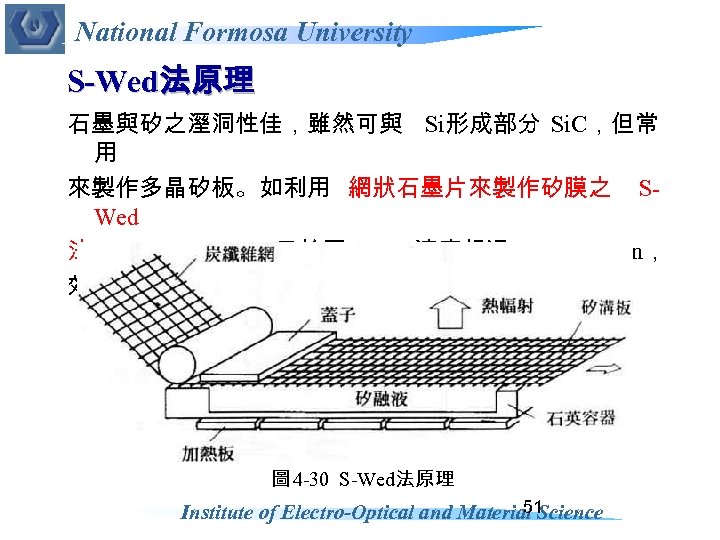 National Formosa University S-Wed法原理 石墨與矽之溼洞性佳,雖然可與 Si形成部分 Si. C,但常 用 來製作多晶矽板。如利用 網狀石墨片來製作矽膜之 SWed 法 (supported wed),示於圖 4 -30。速度超過 1000 cm 2/min, 效率為 12%。 圖 4 -30 S-Wed法原理 51 Institute of Electro-Optical and Material Science
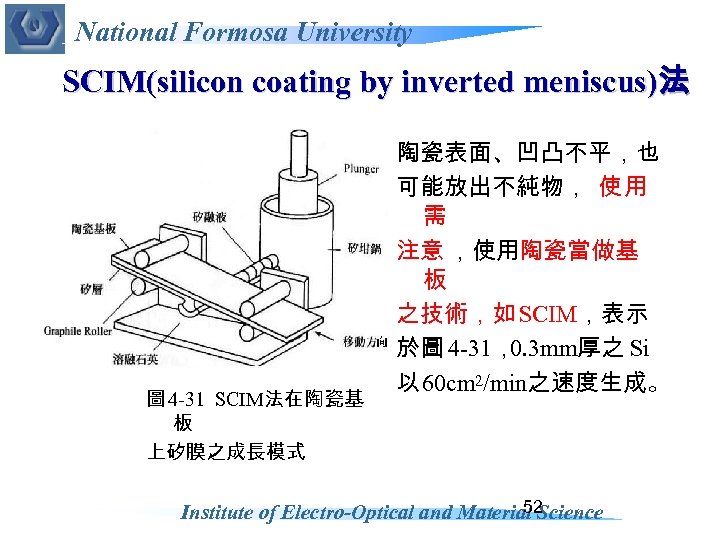 National Formosa University SCIM(silicon coating by inverted meniscus)法 圖 4 -31 SCIM法在陶瓷基 板 上矽膜之成長模式 陶瓷表面、凹凸不平,也 可能放出不純物, 使 用 需 注意 ,使用陶瓷當做基 板 之技術,如 SCIM,表示 於圖 4 -31, 0. 3 mm厚之 Si 以 60 cm 2/min之速度生成。 52 Institute of Electro-Optical and Material Science
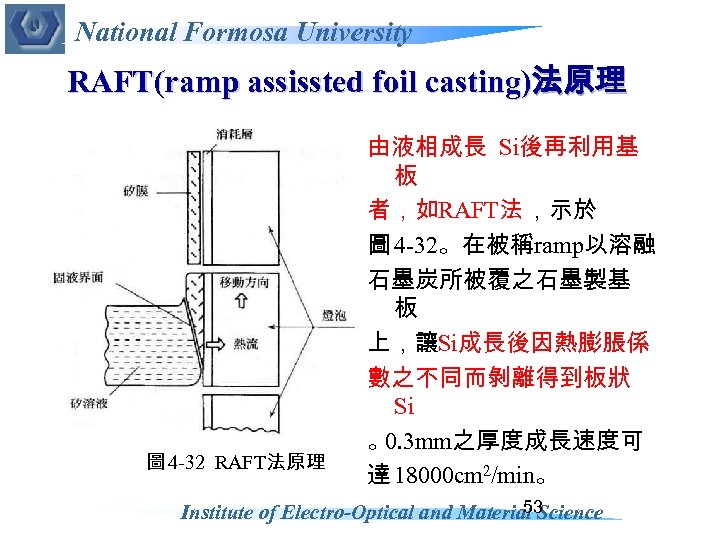 National Formosa University RAFT(ramp assissted foil casting)法原理 圖 4 -32 RAFT法原理 由液相成長 Si後再利用基 板 者,如RAFT法 ,示於 圖 4 -32。在被稱ramp以溶融 石墨炭所被覆之石墨製基 板 上,讓Si成長後因熱膨脹係 數之不同而剝離得到板狀 Si 。 0. 3 mm之厚度成長速度可 達 18000 cm 2/min。 53 Institute of Electro-Optical and Material Science
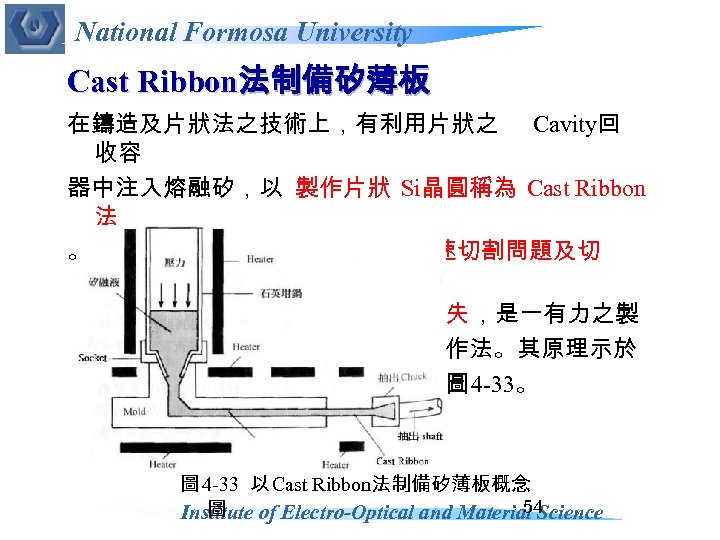 National Formosa University Cast Ribbon法制備矽薄板 在鑄造及片狀法之技術上,有利用片狀之 Cavity回 收容 器中注入熔融矽,以 製作片狀 Si晶圓稱為 Cast Ribbon 法 。雖為鑄造法,但無 Ingot製作之高速切割問題及切 片損 失 ,是一有力之製 作法。其原理示於 圖 4 -33。 圖 4 -33 以 Cast Ribbon法制備矽薄板概念 54 圖 Institute of Electro-Optical and Material Science
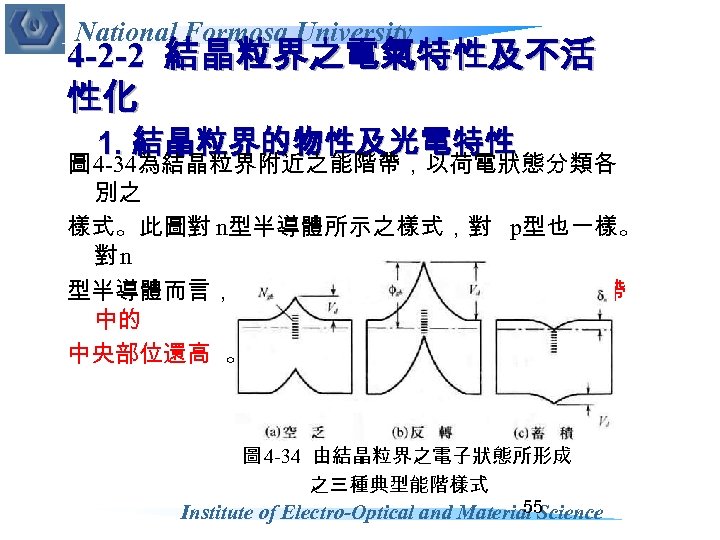 National Formosa University 4 -2 -2 結晶粒界之電氣特性及不活 性化 1. 結晶粒界的物性及光電特性 圖 4 -34為結晶粒界附近之能階帶,以荷電狀態分類各 別之 樣式。此圖對 n型半導體所示之樣式,對 p型也一樣。 對n 型半導體而言, 結晶粒界帶負電,其分佈為比禁制帶 中的 中央部位還高 。 圖 4 -34 由結晶粒界之電子狀態所形成 之三種典型能階樣式 55 Institute of Electro-Optical and Material Science
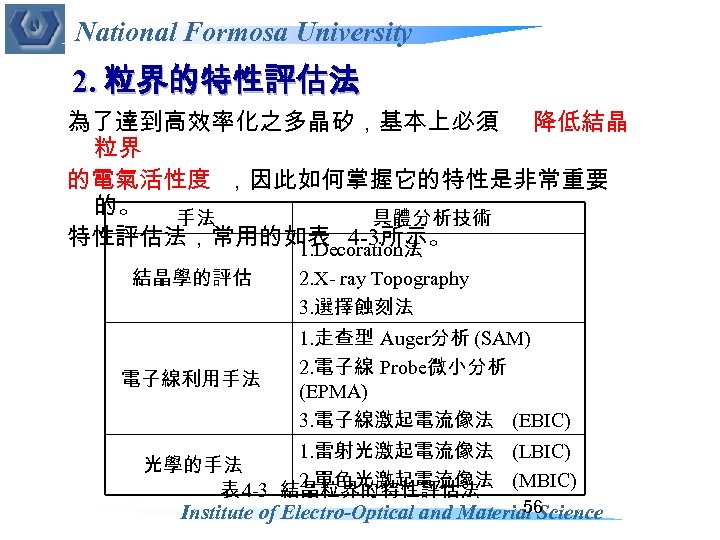 National Formosa University 2. 粒界的特性評估法 為了達到高效率化之多晶矽,基本上必須 降低結晶 粒界 的電氣活性度 ,因此如何掌握它的特性是非常重要 的。 手法 具體分析技術 特性評估法,常用的如表 4 -3所示。 1. Decoration法 結晶學的評估 電子線利用手法 2. X- ray Topography 3. 選擇蝕刻法 1. 走查型 Auger分析 (SAM) 2. 電子線 Probe微小分析 (EPMA) 3. 電子線激起電流像法 (EBIC) 1. 雷射光激起電流像法 (LBIC) 光學的手法 2. 單色光激起電流像法 (MBIC) 表 4 -3 結晶粒界的特性評估法 56 Institute of Electro-Optical and Material Science
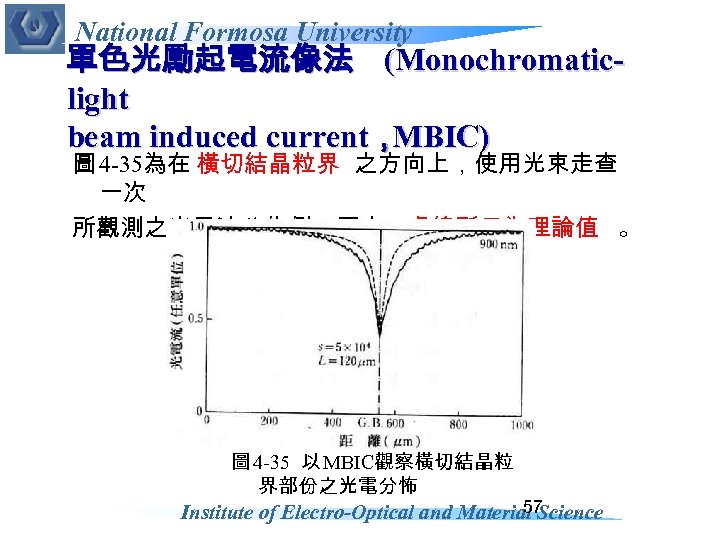 National Formosa University 單色光勵起電流像法 (Monochromaticlight beam induced current, MBIC) 圖 4 -35為在 橫切結晶粒界 之方向上,使用光束走查 一次 所觀測之光電流分佈例,圖中 虛線所示為理論值 。 圖 4 -35 以 MBIC觀察橫切結晶粒 界部份之光電分怖 57 Institute of Electro-Optical and Material Science
 National Formosa University 4 -2 -3 接合構造及理論效率 1. 多晶太陽電池作動之理論解析 多晶矽太陽電池特性,與單晶矽不同者如 (1)存在有 結晶粒界 、 整體體積 之特性,亦受到結晶粒 界 近旁之少數擔體再結合特性之影響 (2)當多數擔體橫切流過結晶粒界時,有必要超過粒 界所 生成之 能階位障 ,影響串聯電阻 (3)結晶粒界之障礙高度由光照射可變化 (4)因 長晶速度快,故體積內遍佈缺陷 ,擔體之擴散長 度 較短等四點。 58 Institute of Electro-Optical and Material Science
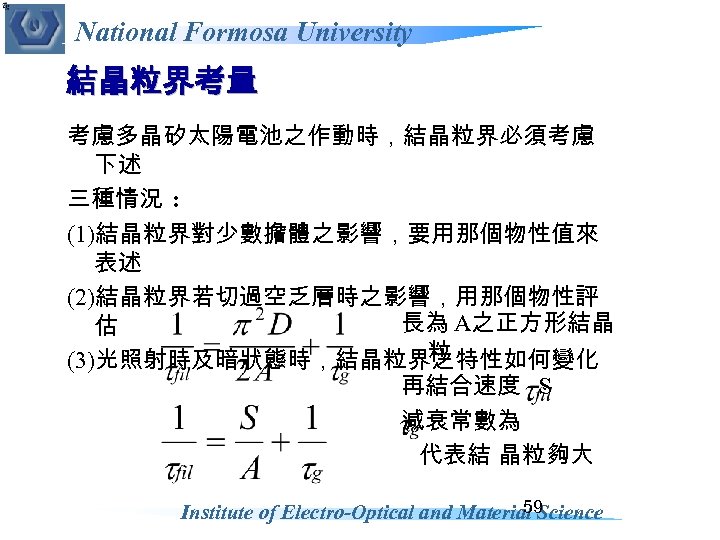 National Formosa University 結晶粒界考量 考慮多晶矽太陽電池之作動時,結晶粒界必須考慮 下述 三種情況 : (1)結晶粒界對少數擔體之影響,要用那個物性值來 表述 (2)結晶粒界若切過空乏層時之影響,用那個物性評 長為 A之正方形結晶 估 粒 (3)光照射時及暗狀態時,結晶粒界之特性如何變化 再結合速度 S 減衰常數為 代表結 晶粒夠大 59 Institute of Electro-Optical and Material Science
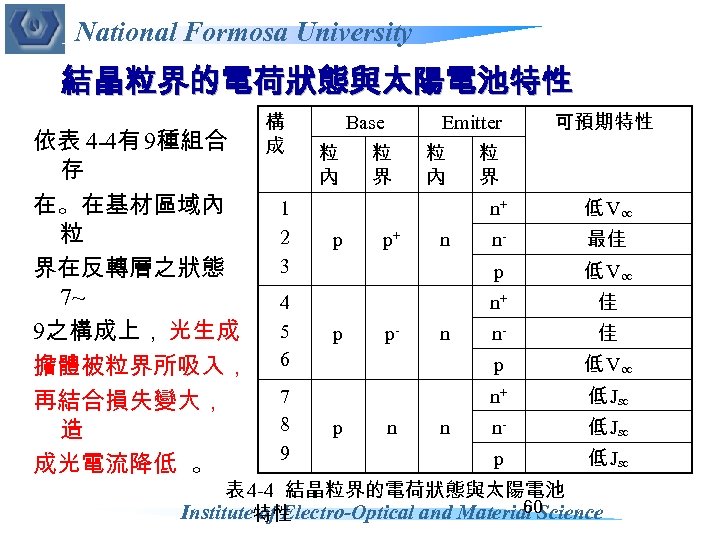 National Formosa University 結晶粒界的電荷狀態與太陽電池特性 依表 4 -4有 9種組合 存 在。在基材區域內 粒 界在反轉層之狀態 7~ 9之構成上, 光生成 擔體被粒界所吸入, 再結合損失變大, 造 成光電流降低 。 構 成 1 2 3 4 5 6 7 8 9 Base 粒 內 Emitter 粒 界 粒 內 可預期特性 粒 界 n+ p n n n 佳 n- 佳 低 Voc n+ p- 低 Voc p p n 最佳 n+ p+ np p 低 Voc 低 Jsc n- 低 Jsc p 低 Jsc 表 4 -4 結晶粒界的電荷狀態與太陽電池 60 Institute特性 of Electro-Optical and Material Science
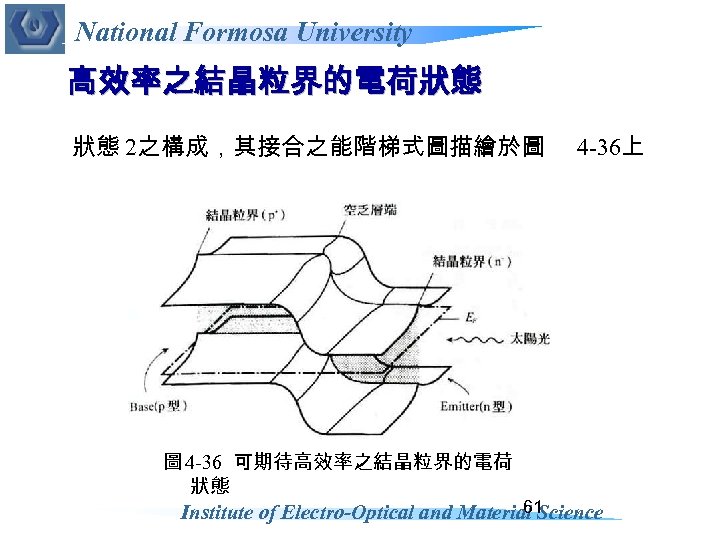 National Formosa University 高效率之結晶粒界的電荷狀態 狀態 2之構成,其接合之能階梯式圖描繪於圖 圖 4 -36 可期待高效率之結晶粒界的電荷 狀態 4 -36上 61 Institute of Electro-Optical and Material Science
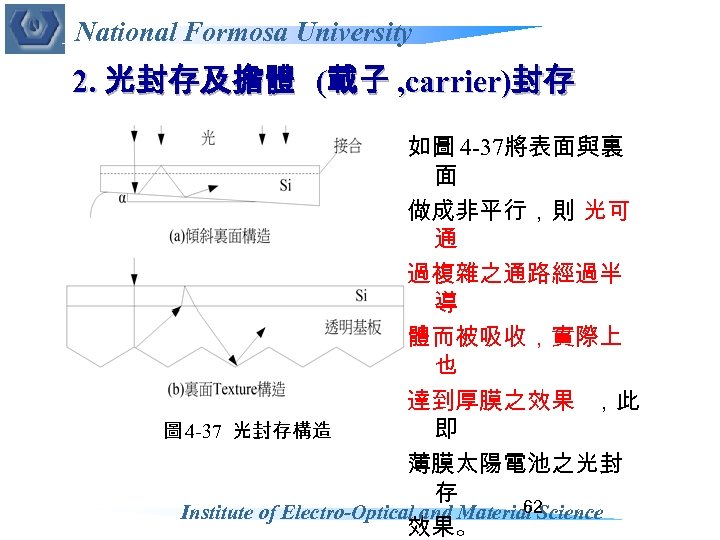 National Formosa University 2. 光封存及擔體 (載子 , carrier)封存 如圖 4 -37將表面與裏 面 做成非平行,則 光可 通 過複雜之通路經過半 導 體而被吸收,實際上 也 達到厚膜之效果 ,此 即 圖 4 -37 光封存構造 薄膜太陽電池之光封 存 62 Institute of Electro-Optical and Material Science 效果。
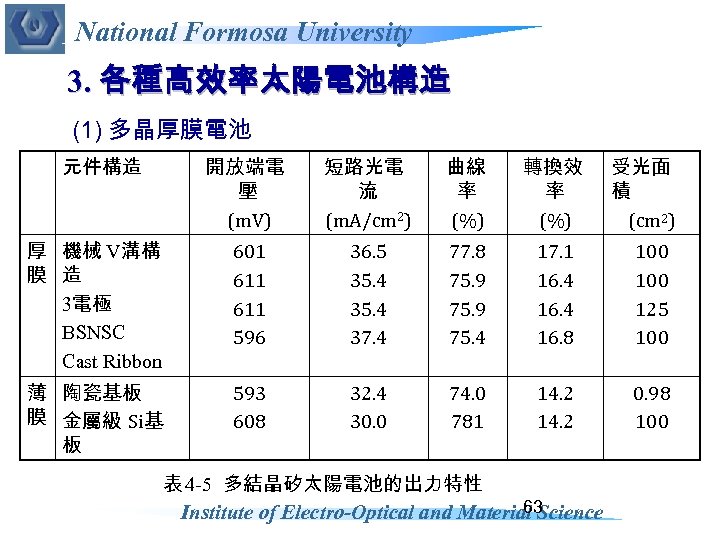 National Formosa University 3. 各種高效率太陽電池構造 (1) 多晶厚膜電池 元件構造 開放端電 壓 (m. V) 短路光電 流 (m. A/cm 2) 曲線 率 (%) 轉換效 率 (%) 厚 機械 V溝構 膜 造 3電極 BSNSC Cast Ribbon 601 611 596 36. 5 35. 4 37. 4 77. 8 75. 9 75. 4 17. 1 16. 4 16. 8 100 125 100 薄 陶瓷基板 膜 金屬級 Si基 板 593 608 32. 4 30. 0 74. 0 781 14. 2 0. 98 100 表 4 -5 多結晶矽太陽電池的出力特性 63 Institute of Electro-Optical and Material Science 受光面 積 (cm 2)
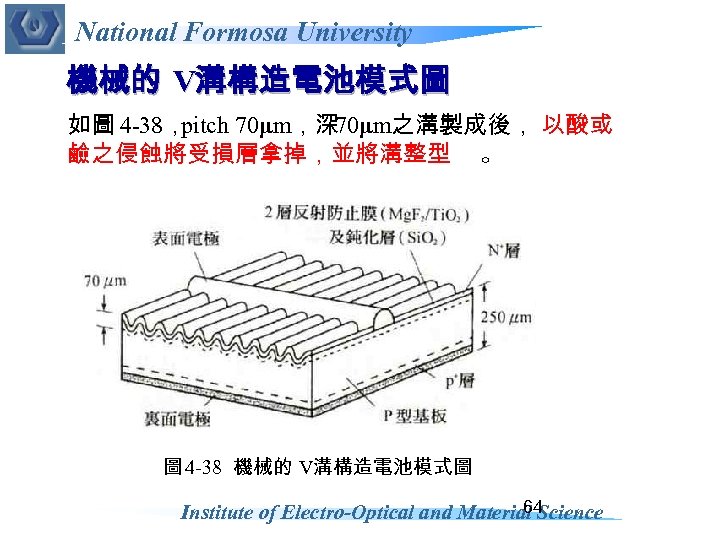 National Formosa University 機械的 V溝構造電池模式圖 如圖 4 -38, pitch 70μm,深 70μm之溝製成後, 以酸或 鹼之侵蝕將受損層拿掉,並將溝整型 。 圖 4 -38 機械的 V溝構造電池模式圖 64 Institute of Electro-Optical and Material Science
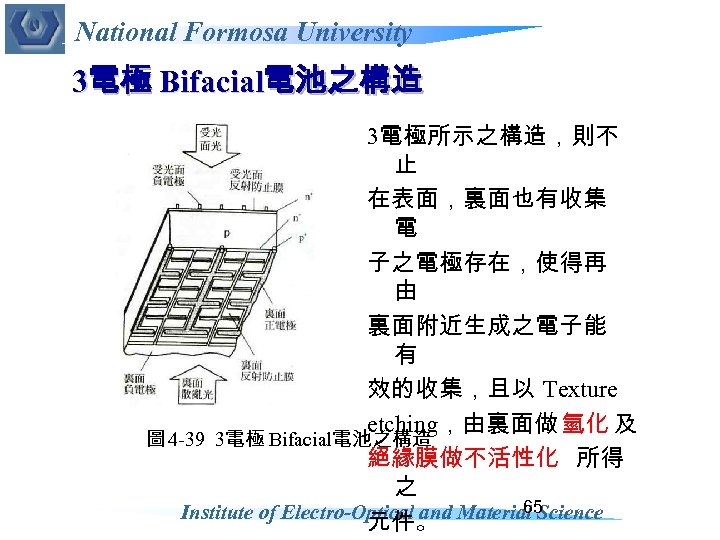 National Formosa University 3電極 Bifacial電池之構造 3電極所示之構造,則不 止 在表面,裏面也有收集 電 子之電極存在,使得再 由 裏面附近生成之電子能 有 效的收集,且以 Texture etching,由裏面做 氫化 及 圖 4 -39 3電極 Bifacial電池之構造 絕緣膜做不活性化 所得 之 65 Institute of Electro-Optical and Material Science 元件。
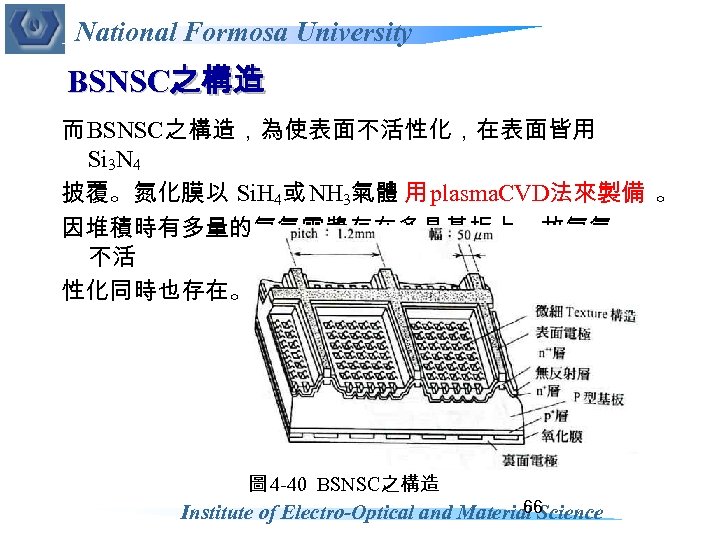 National Formosa University BSNSC之構造 而 BSNSC之構造,為使表面不活性化,在表面皆用 Si 3 N 4 披覆。氮化膜以 Si. H 4或 NH 3氣體 用 plasma. CVD法來製備 。 因堆積時有多量的氫氣電漿存在多晶基板上,故氫氣 不活 性化同時也存在。 圖 4 -40 BSNSC之構造 66 Institute of Electro-Optical and Material Science
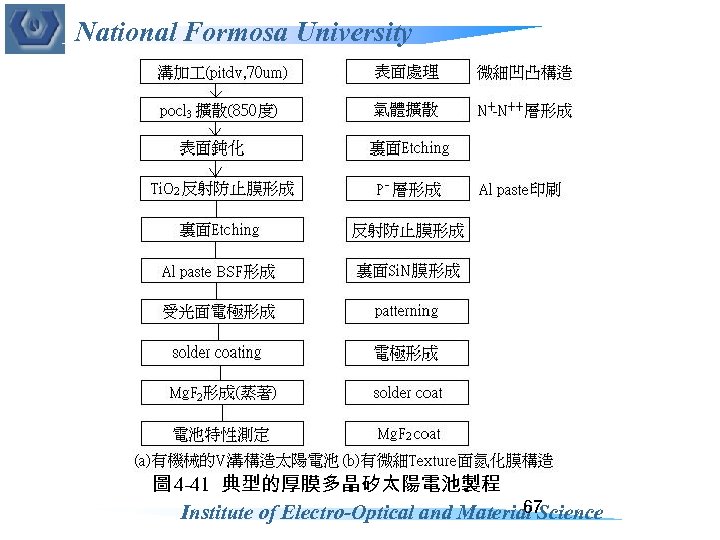 National Formosa University 圖 4 -41 典型的厚膜多晶矽太陽電池製程 67 Institute of Electro-Optical and Material Science
 National Formosa University 4 -3 非晶矽太陽電池 amorphous Si 微晶矽 micro crystal Si μc-Si 68 Institute of Electro-Optical and Material Science
 National Formosa University 4 -3 非晶系太陽電池 amorphous Si 4 -3 -1 conspectus 4 -3 -2 Preparation and properties of amorphoussilicon 4 -3 -3 Solar cell structure and preparation process 4 -3 -4 Solar cells for moving characteristics 4 -3 -5 High-efficiency technology 4 -3 -6 Stability and reliability 69 Institute of Electro-Optical and Material Science
 National Formosa University 4 -3 -1 conspectus PECVD: plasma enhanced chemical vapor deposition Amorphous solar cells dates back to the early 1970 s, to the plasma CVD method , Si. H 4 gas preparation of amorphous silicon film, visible light, has a large absorption coefficient, and excellent light transmission characteristics. Si. H 4 the plasma CVD method, system of a si (amorphous silicon), containing 10 ~ 20% atomic hydrogen can reduce the structural defects, resulting in excellent optical and electrical properties and valence electron control nature. of a-Si: H by using the fluorine iscalled a-Si: F, but is not widely available, so this section follows the a-Si: H, referred to the a-Si. 70 Institute of Electro-Optical and Material Science
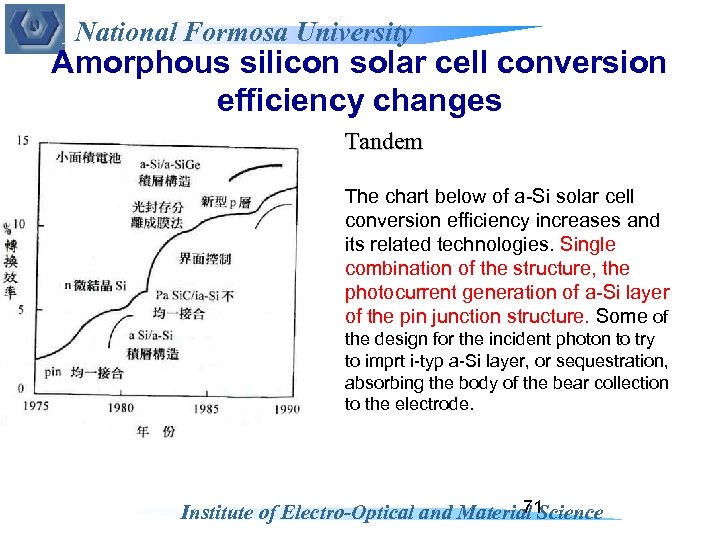 National Formosa University Amorphous silicon solar cell conversion efficiency changes Tandem The chart below of a-Si solar cell conversion efficiency increases and its related technologies. Single combination of the structure, the photocurrent generation of a-Si layer of the pin junction structure. Some of the design for the incident photon to try to imprt i-typ a-Si layer, or sequestration, absorbing the body of the bear collection to the electrode. 71 Institute of Electro-Optical and Material Science
 National Formosa University 4 -3 -2 Preparation and properties of amorphous silicon 1. Thin film deposition method a-Si and its alloys is based on the plasma CVD, thermal CVD, reactive Sputtering method or optical CVD method, vapor-phase syntheis is method to prepare thin films. Solar cells with a-Si plasma of CVD method to prepare, it is the first production method described, followed by optical CVD method, Doping. 72 Institute of Electro-Optical and Material Science
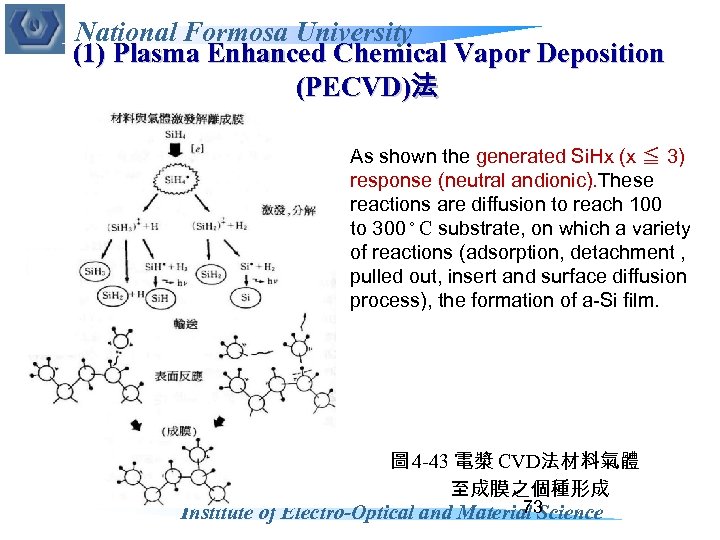 National Formosa University (1) Plasma Enhanced Chemical Vapor Deposition (PECVD)法 As shown the generated Si. Hx (x ≦ 3) response (neutral andionic). These reactions are diffusion to reach 100 to 300 。C substrate, on which a variety of reactions (adsorption, detachment , pulled out, insert and surface diffusion process), the formation of a-Si film. 圖 4 -43 電漿 CVD法材料氣體 至成膜之個種形成 73 Institute of Electro-Optical and Material Science
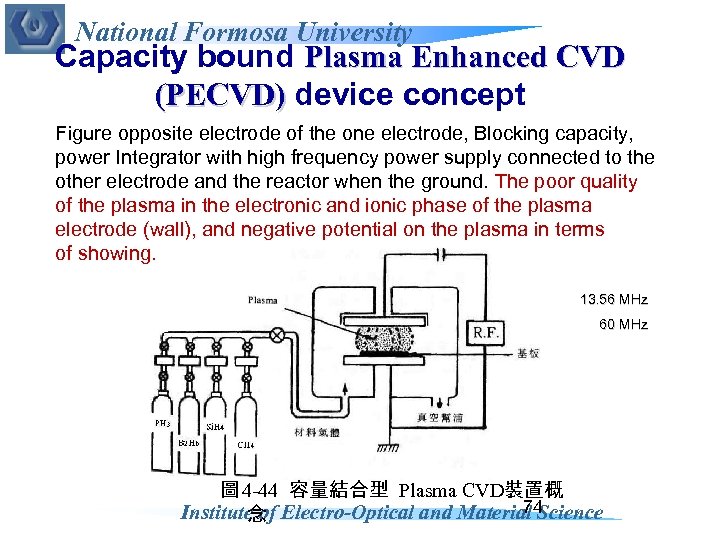 National Formosa University Capacity bound Plasma Enhanced CVD (PECVD) device concept Figure opposite electrode of the one electrode, Blocking capacity, power Integrator with high frequency power supply connected to the other electrode and the reactor when the ground. The poor quality of the plasma in the electronic and ionic phase of the plasma electrode (wall), and negative potential on the plasma in terms of showing. 13. 56 MHz 60 MHz 圖 4 -44 容量結合型 Plasma CVD裝置概 74 Institute of Electro-Optical and Material Science 念
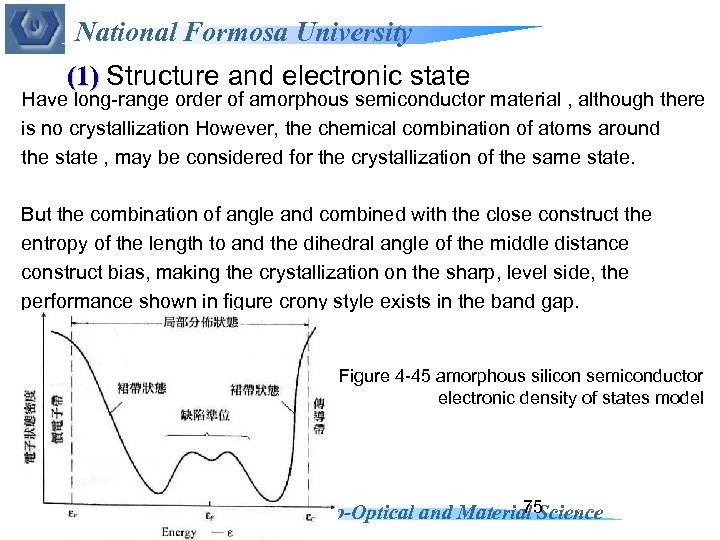 National Formosa University (1) Structure and electronic state Have long-range order of amorphous semiconductor material , although there is no crystallization However, the chemical combination of atoms around the state , may be considered for the crystallization of the same state. But the combination of angle and combined with the close construct the entropy of the length to and the dihedral angle of the middle distance construct bias, making the crystallization on the sharp, level side, the performance shown in figure crony style exists in the band gap. Figure 4 -45 amorphous silicon semiconductor electronic density of states model 75 Institute of Electro-Optical and Material Science
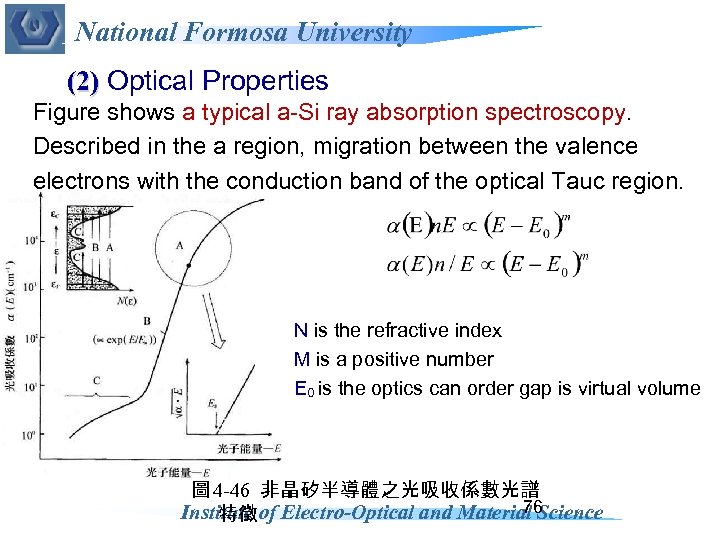 National Formosa University (2) Optical Properties Figure shows a typical a-Si ray absorption spectroscopy. Described in the a region, migration between the valence electrons with the conduction band of the optical Tauc region. N is the refractive index M is a positive number E 0 is the optics can order gap is virtual volume 圖 4 -46 非晶矽半導體之光吸收係數光譜 76 Institute of Electro-Optical and Material Science 特徵
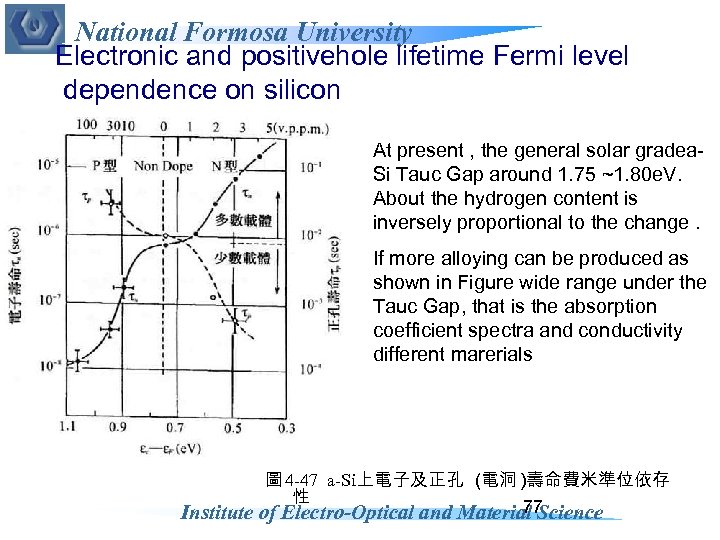 National Formosa University Electronic and positivehole lifetime Fermi level dependence on silicon At present , the general solar gradea. Si Tauc Gap around 1. 75 ~1. 80 e. V. About the hydrogen content is inversely proportional to the change. If more alloying can be produced as shown in Figure wide range under the Tauc Gap, that is the absorption coefficient spectra and conductivity different marerials 圖 4 -47 a-Si上電子及正孔 (電洞 )壽命費米準位依存 性 77 Institute of Electro-Optical and Material Science
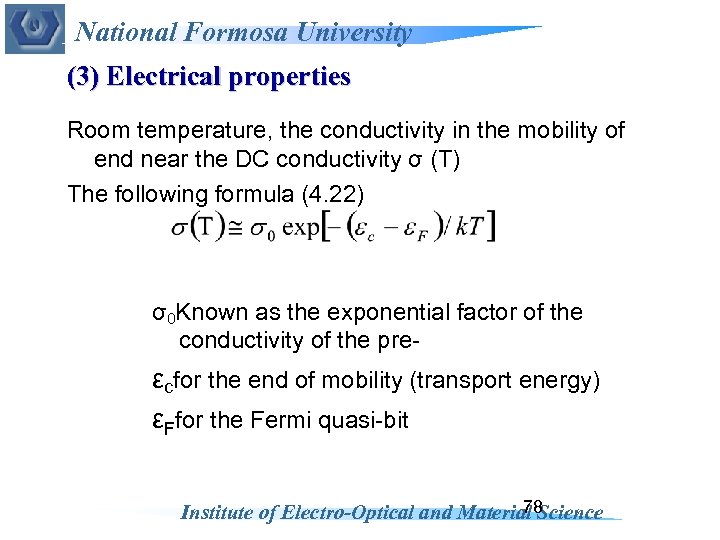 National Formosa University (3) Electrical properties Room temperature, the conductivity in the mobility of end near the DC conductivity σ (T) The following formula (4. 22) σ0 Known as the exponential factor of the conductivity of the pre- εcfor the end of mobility (transport energy) εFfor the Fermi quasi-bit 78 Institute of Electro-Optical and Material Science
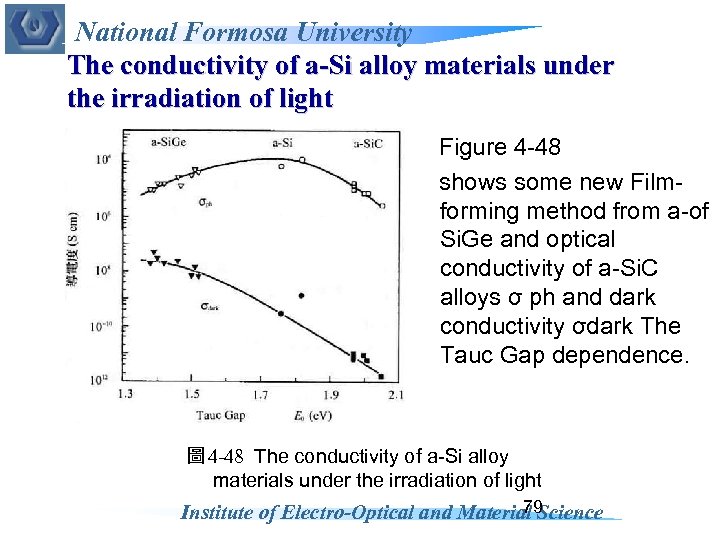 National Formosa University The conductivity of a-Si alloy materials under the irradiation of light Figure 4 -48 shows some new Filmforming method from a-of Si. Ge and optical conductivity of a-Si. C alloys σ ph and dark conductivity σdark The Tauc Gap dependence. 圖 4 -48 The conductivity of a-Si alloy materials under the irradiation of light 79 Institute of Electro-Optical and Material Science
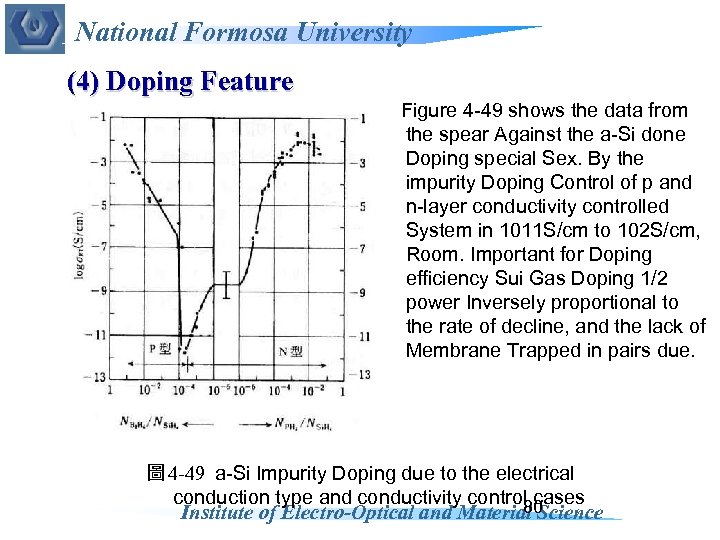 National Formosa University (4) Doping Feature Figure 4 -49 shows the data from the spear Against the a-Si done Doping special Sex. By the impurity Doping Control of p and n-layer conductivity controlled System in 1011 S/cm to 102 S/cm, Room. Important for Doping efficiency Sui Gas Doping 1/2 power Inversely proportional to the rate of decline, and the lack of Membrane Trapped in pairs due. 圖 4 -49 a-Si Impurity Doping due to the electrical conduction type and conductivity control cases 80 Institute of Electro-Optical and Material Science
 National Formosa University 4 -3 -3 Solar cell structure and preparation process 1. Solar cells constructed The basic structure of the pin junction, the general p-layer thickness of about 50 ~ 200 A, ι, layer 4000 ~ 6000 A thick nlayer thickness, while around 100 ~ 300 A. Doping had the a-Si materials, even if the optical conductivity and high defect density due to tectonic Degree, it is the internal electric field in the width of the area, not Dope (ι, type) field Hop to narrow. Therefore, pin joints constitute the transport layer that is photocurrent generated In ι layer, the p and n layers can be made to promote the Carrier, Drift ι layer containing potential. 81 Institute of Electro-Optical and Material Science
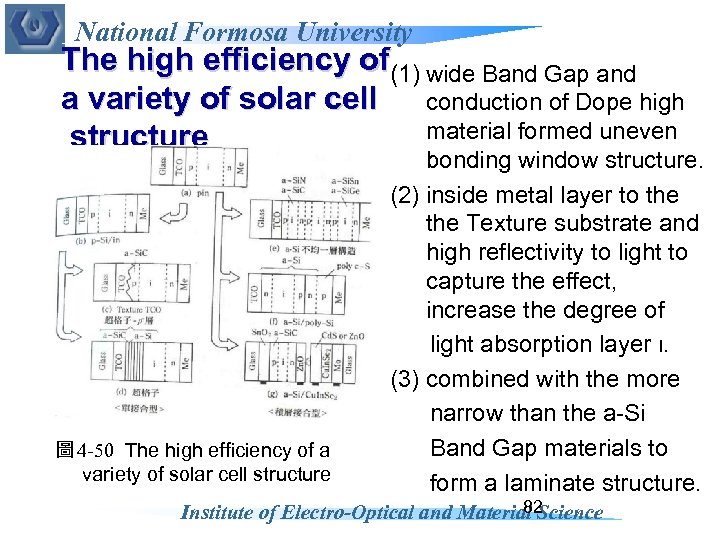 National Formosa University The high efficiency of wide Band Gap and (1) a variety of solar cell conduction of Dope high material formed uneven structure 圖 4 -50 The high efficiency of a variety of solar cell structure bonding window structure. (2) inside metal layer to the Texture substrate and high reflectivity to light to capture the effect, increase the degree of light absorption layer ι. (3) combined with the more narrow than the a-Si Band Gap materials to form a laminate structure. 82 Institute of Electro-Optical and Material Science
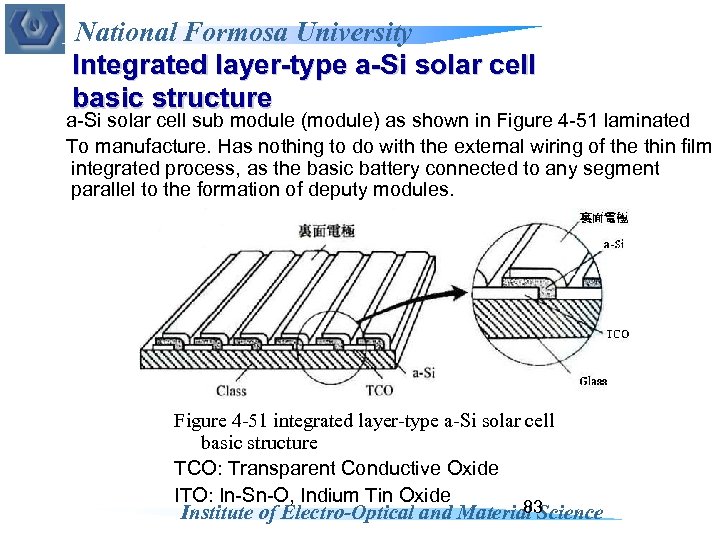 National Formosa University Integrated layer-type a-Si solar cell basic structure a-Si solar cell sub module (module) as shown in Figure 4 -51 laminated To manufacture. Has nothing to do with the external wiring of the thin film integrated process, as the basic battery connected to any segment parallel to the formation of deputy modules. Figure 4 -51 integrated layer-type a-Si solar cell basic structure TCO: Transparent Conductive Oxide ITO: In-Sn-O, Indium Tin Oxide 83 Institute of Electro-Optical and Material Science
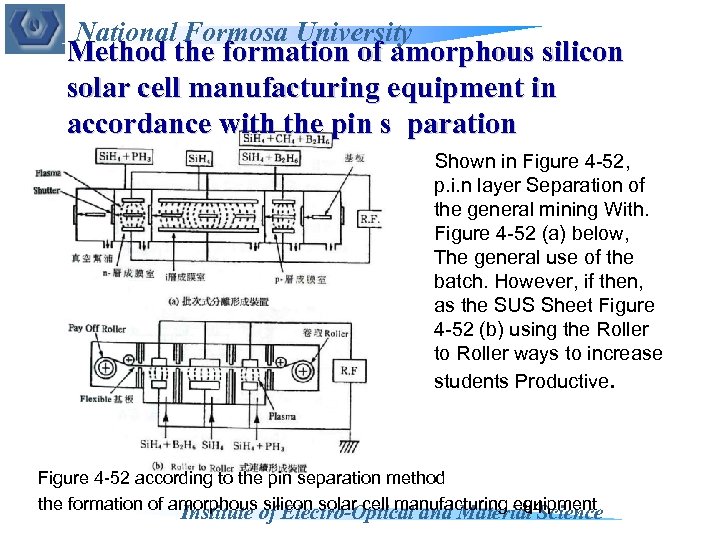 National Formosa University Method the formation of amorphous silicon solar cell manufacturing equipment in accordance with the pin s paration Shown in Figure 4 -52, p. i. n layer Separation of the general mining With. Figure 4 -52 (a) below, The general use of the batch. However, if then, as the SUS Sheet Figure 4 -52 (b) using the Roller to Roller ways to increase students Productive. Figure 4 -52 according to the pin separation method the formation of amorphous silicon solar cell manufacturing equipment 84 Institute of Electro-Optical and Material Science
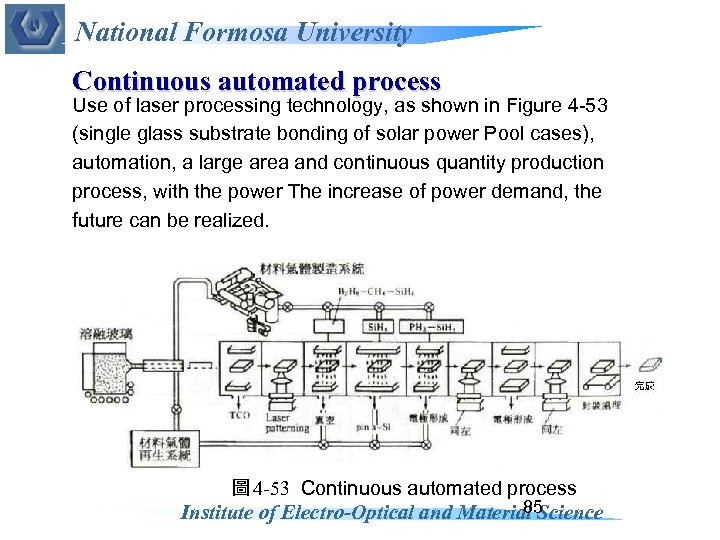 National Formosa University Continuous automated process Use of laser processing technology, as shown in Figure 4 -53 (single glass substrate bonding of solar power Pool cases), automation, a large area and continuous quantity production process, with the power The increase of power demand, the future can be realized. 圖 4 -53 Continuous automated process 85 Institute of Electro-Optical and Material Science
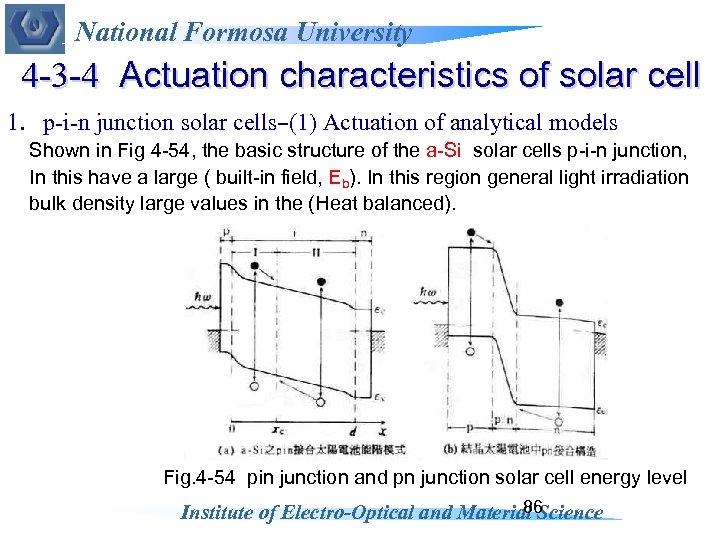 National Formosa University 4 -3 -4 Actuation characteristics of solar cell 1. p-i-n junction solar cells–(1) Actuation of analytical models Shown in Fig 4 -54, the basic structure of the a-Si solar cells p-i-n junction, In this have a large ( built-in field, Eb). In this region general light irradiation bulk density large values in the (Heat balanced). Fig. 4 -54 pin junction and pn junction solar cell energy level 86 Institute of Electro-Optical and Material Science
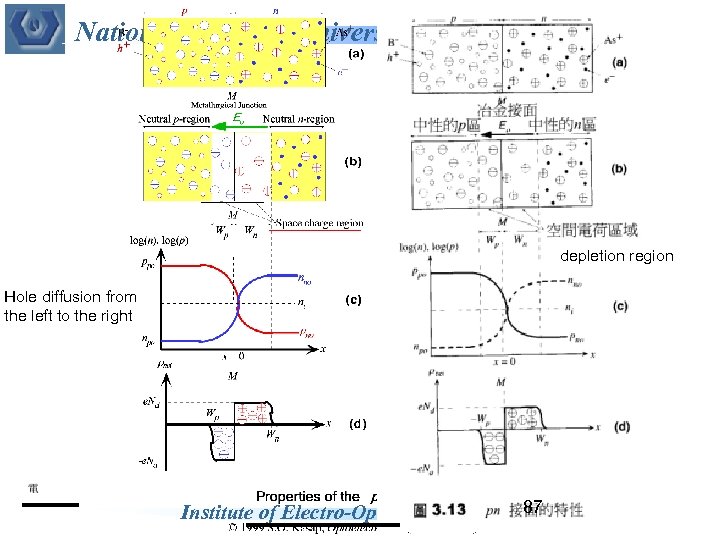 National Formosa University depletion region Hole diffusion from the left to the right 87 Institute of Electro-Optical and Material Science
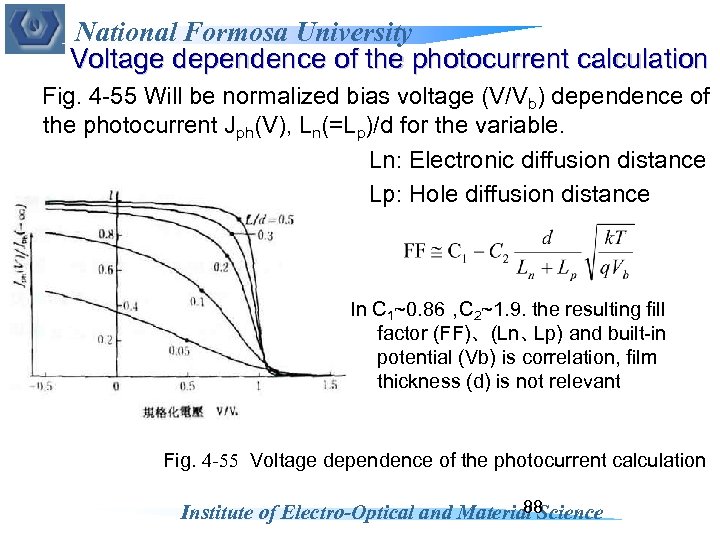 National Formosa University Voltage dependence of the photocurrent calculation Fig. 4 -55 Will be normalized bias voltage (V/Vb) dependence of the photocurrent Jph(V), Ln(=Lp)/d for the variable. Ln: Electronic diffusion distance Lp: Hole diffusion distance In C 1~0. 86, 2~1. 9. the resulting fill C factor (FF)、 (Ln、 Lp) and built-in potential (Vb) is correlation, film thickness (d) is not relevant Fig. 4 -55 Voltage dependence of the photocurrent calculation 88 Institute of Electro-Optical and Material Science
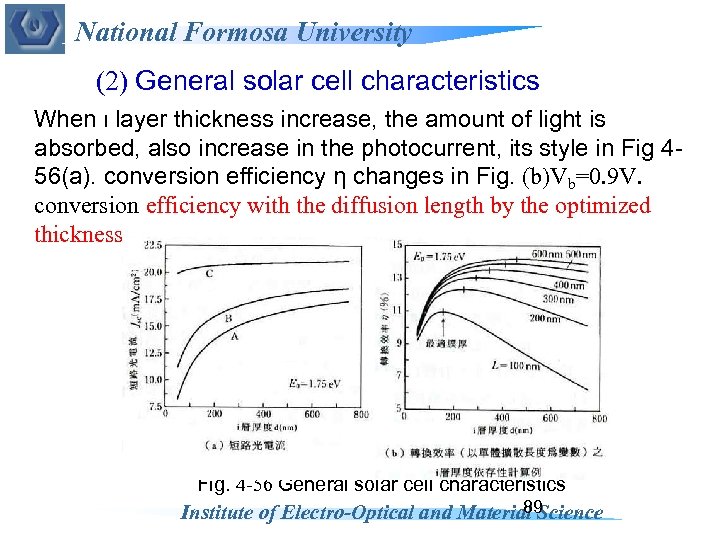 National Formosa University (2) General solar cell characteristics When ι layer thickness increase, the amount of light is absorbed, also increase in the photocurrent, its style in Fig 456(a). conversion efficiency η changes in Fig. (b)Vb=0. 9 V. conversion efficiency with the diffusion length by the optimized thickness. Fig. 4 -56 General solar cell characteristics 89 Institute of Electro-Optical and Material Science
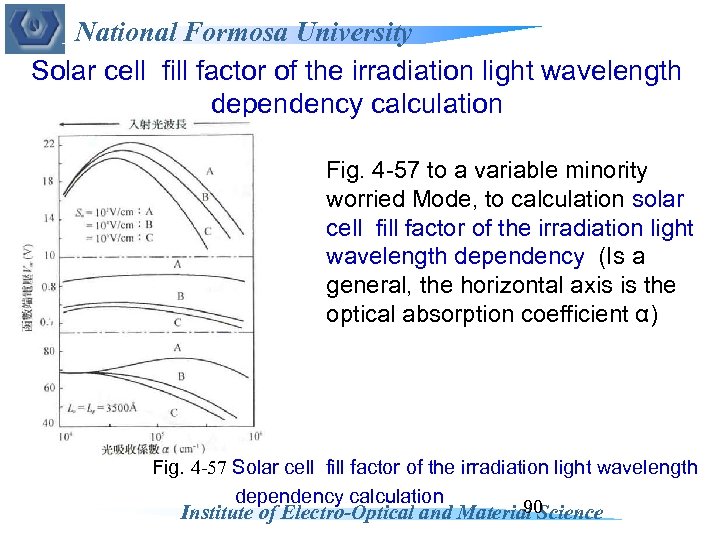 National Formosa University Solar cell fill factor of the irradiation light wavelength dependency calculation Fig. 4 -57 to a variable minority worried Mode, to calculation solar cell fill factor of the irradiation light wavelength dependency (Is a general, the horizontal axis is the optical absorption coefficient α) Fig. 4 -57 Solar cell fill factor of the irradiation light wavelength dependency calculation 90 Institute of Electro-Optical and Material Science
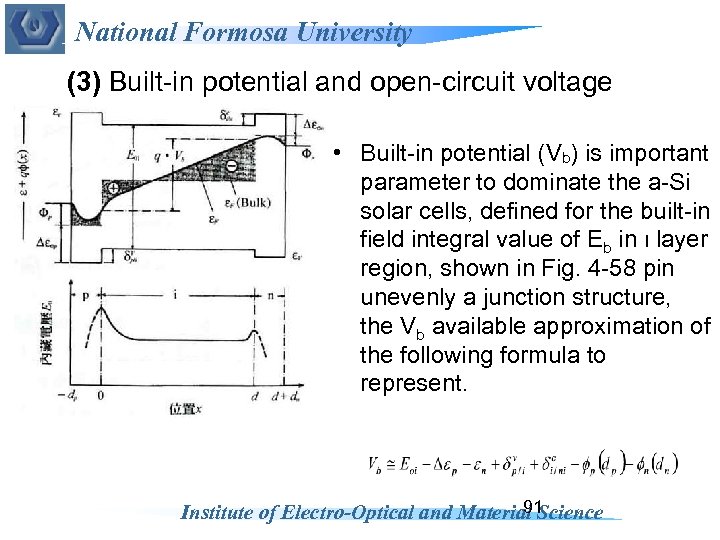 National Formosa University (3) Built-in potential and open-circuit voltage • Built-in potential (Vb) is important parameter to dominate the a-Si solar cells, defined for the built-in field integral value of Eb in ι layer region, shown in Fig. 4 -58 pin unevenly a junction structure, the Vb available approximation of the following formula to represent. 91 Institute of Electro-Optical and Material Science
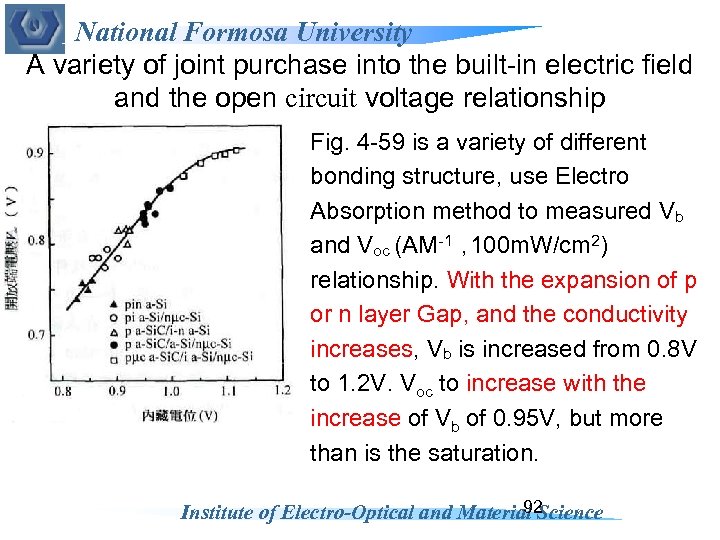 National Formosa University A variety of joint purchase into the built-in electric field and the open circuit voltage relationship Fig. 4 -59 is a variety of different bonding structure, use Electro Absorption method to measured Vb and Voc (AM-1, 100 m. W/cm 2) relationship. With the expansion of p or n layer Gap, and the conductivity increases, Vb is increased from 0. 8 V to 1. 2 V. Voc to increase with the increase of Vb of 0. 95 V, but more than is the saturation. 92 Institute of Electro-Optical and Material Science
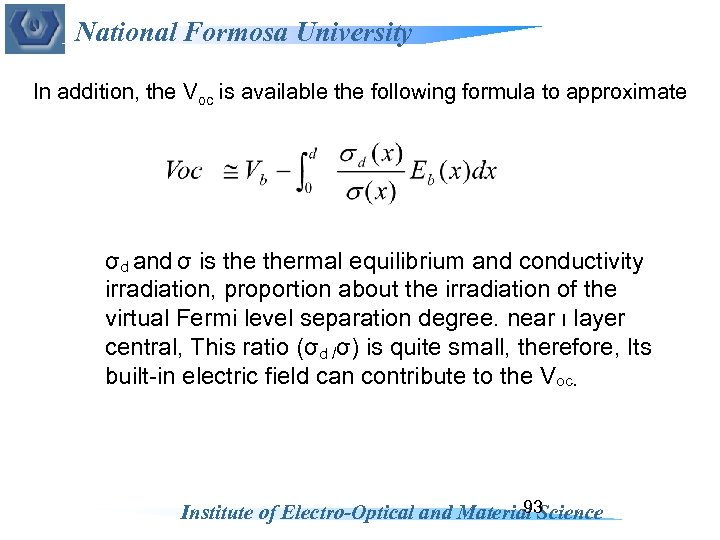 National Formosa University In addition, the Voc is available the following formula to approximate σd and σ is thermal equilibrium and conductivity irradiation, proportion about the irradiation of the virtual Fermi level separation degree. near ι layer central, This ratio (σd /σ) is quite small, therefore, Its built-in electric field can contribute to the Voc. 93 Institute of Electro-Optical and Material Science
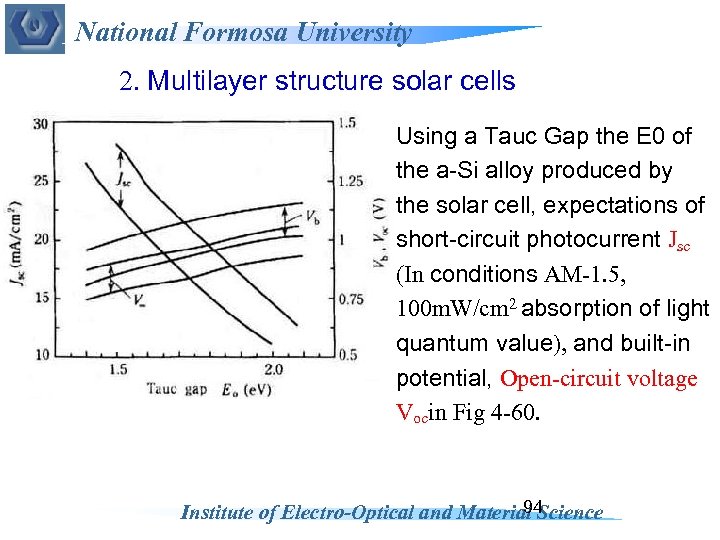 National Formosa University 2. Multilayer structure solar cells Using a Tauc Gap the E 0 of the a-Si alloy produced by the solar cell, expectations of short-circuit photocurrent Jsc (In conditions AM-1. 5, 100 m. W/cm 2 absorption of light quantum value), and built-in potential, Open-circuit voltage Vocin Fig 4 -60. 94 Institute of Electro-Optical and Material Science
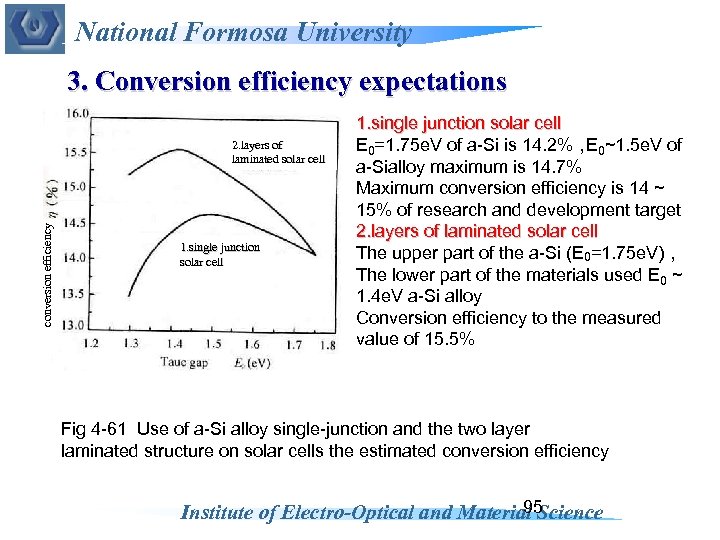 National Formosa University 3. Conversion efficiency expectations conversion efficiency 2. layers of laminated solar cell 1. single junction solar cell E 0=1. 75 e. V of a-Si is 14. 2%, 0~1. 5 e. V of E a-Sialloy maximum is 14. 7% Maximum conversion efficiency is 14 ~ 15% of research and development target 2. layers of laminated solar cell The upper part of the a-Si (E 0=1. 75 e. V), The lower part of the materials used E 0 ~ 1. 4 e. V a-Si alloy Conversion efficiency to the measured value of 15. 5% Fig 4 -61 Use of a-Si alloy single-junction and the two layer laminated structure on solar cells the estimated conversion efficiency 95 Institute of Electro-Optical and Material Science
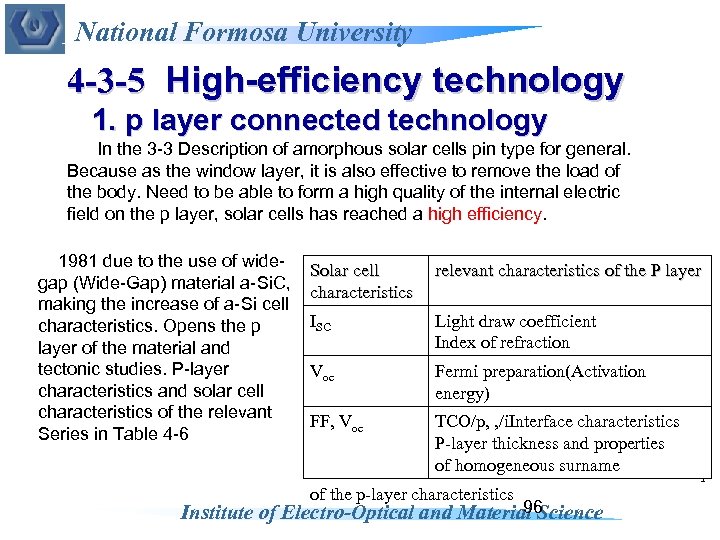 National Formosa University 4 -3 -5 High-efficiency technology 1. p layer connected technology In the 3 -3 Description of amorphous solar cells pin type for general. Because as the window layer, it is also effective to remove the load of the body. Need to be able to form a high quality of the internal electric field on the p layer, solar cells has reached a high efficiency. 1981 due to the use of widegap (Wide-Gap) material a-Si. C, making the increase of a-Si cell characteristics. Opens the p layer of the material and tectonic studies. P-layer characteristics and solar cell characteristics of the relevant Series in Table 4 -6 Solar cell characteristics relevant characteristics of the P layer ISC Light draw coefficient Index of refraction Voc Fermi preparation(Activation energy) FF, Voc TCO/p, , /i. Interface characteristics P-layer thickness and properties of homogeneous surname Table 4 -6 Solar cell characteristics and the relationship of the p-layer characteristics 96 Institute of Electro-Optical and Material Science
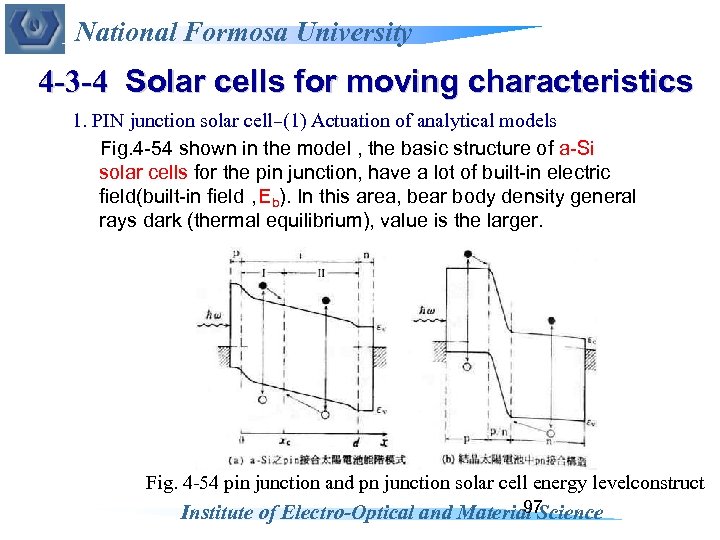 National Formosa University 4 -3 -4 Solar cells for moving characteristics 1. PIN junction solar cell–(1) Actuation of analytical models Fig. 4 -54 shown in the model , the basic structure of a-Si solar cells for the pin junction, have a lot of built-in electric field(built-in field, b). In this area, bear body density general E rays dark (thermal equilibrium), value is the larger. Fig. 4 -54 pin junction and pn junction solar cell energy levelconstruct 97 Institute of Electro-Optical and Material Science
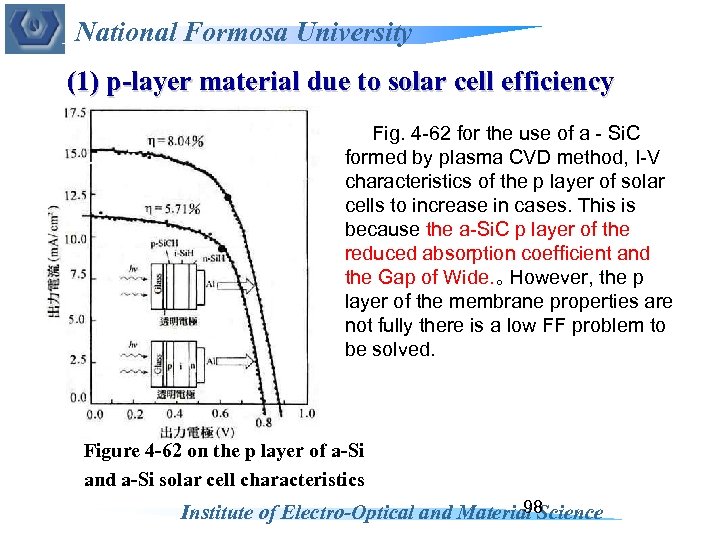 National Formosa University (1) p-layer material due to solar cell efficiency Fig. 4 -62 for the use of a - Si. C formed by plasma CVD method, I-V characteristics of the p layer of solar cells to increase in cases. This is because the a-Si. C p layer of the reduced absorption coefficient and the Gap of Wide. 。 However, the p layer of the membrane properties are not fully there is a low FF problem to be solved. Figure 4 -62 on the p layer of a-Si and a-Si solar cell characteristics 98 Institute of Electro-Optical and Material Science
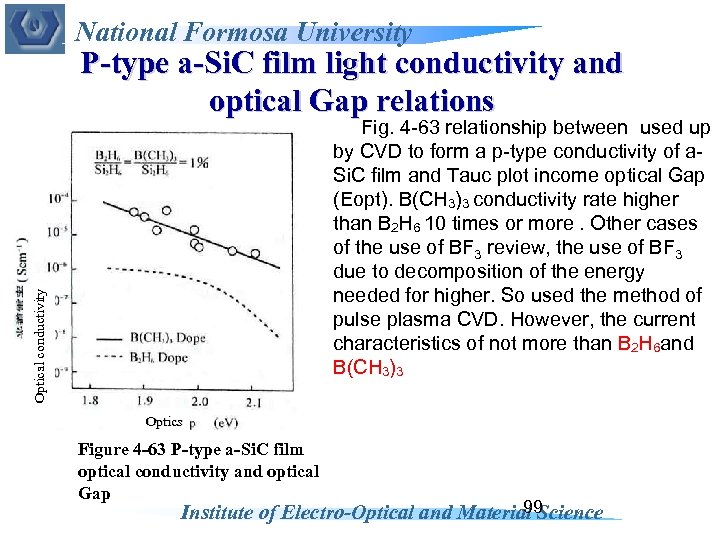 National Formosa University P-type a-Si. C film light conductivity and optical Gap relations Optical conductivity Fig. 4 -63 relationship between used up by CVD to form a p-type conductivity of a. Si. C film and Tauc plot income optical Gap (Eopt). B(CH 3)3 conductivity rate higher than B 2 H 6 10 times or more. Other cases of the use of BF 3 review, the use of BF 3 due to decomposition of the energy needed for higher. So used the method of pulse plasma CVD. However, the current characteristics of not more than B 2 H 6 and B(CH 3)3 Optics Figure 4 -63 P-type a-Si. C film optical conductivity and optical Gap 99 Institute of Electro-Optical and Material Science
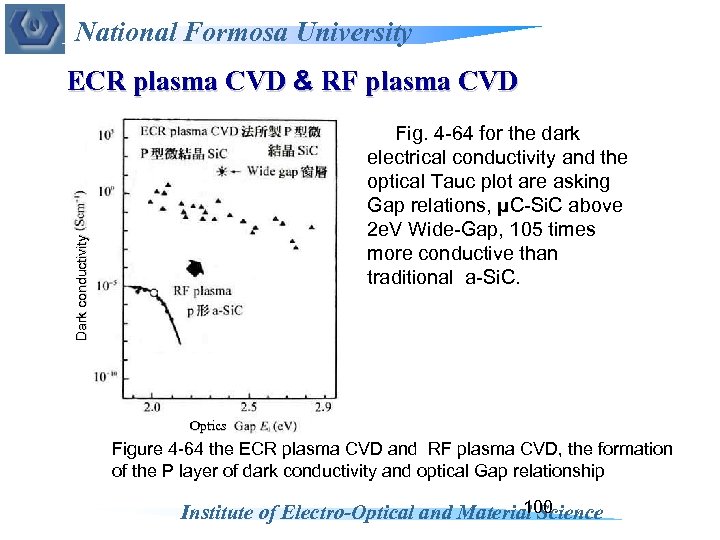 National Formosa University ECR plasma CVD & RF plasma CVD Dark conductivity Fig. 4 -64 for the dark electrical conductivity and the optical Tauc plot are asking Gap relations, μC-Si. C above 2 e. V Wide-Gap, 105 times more conductive than traditional a-Si. C. Optics Figure 4 -64 the ECR plasma CVD and RF plasma CVD, the formation of the P layer of dark conductivity and optical Gap relationship 100 Institute of Electro-Optical and Material Science
 National Formosa University 2. ι layer connected intrinsic In the non-crystalline solar cells, generating layer ι layer on the cell characteristics and most influential large. ι layer is generally of a-Si: H (1) The improvement of the reactor ι layer of oxygen or nitrogen impurities or p layer and n-tier Doping materials pollution ι membranous lower layer reason. Reduce the amount of devices of impurities. Aforementioned separation forming method proposal. Followed by the Hot Wall, type reactor. In addition, inhibition of the degassing of the chamber wall, improve the vacuum, the supply of high purity gases, which can effectively reduce the amount of impurities of a. Si: H film. 101 Institute of Electro-Optical and Material Science
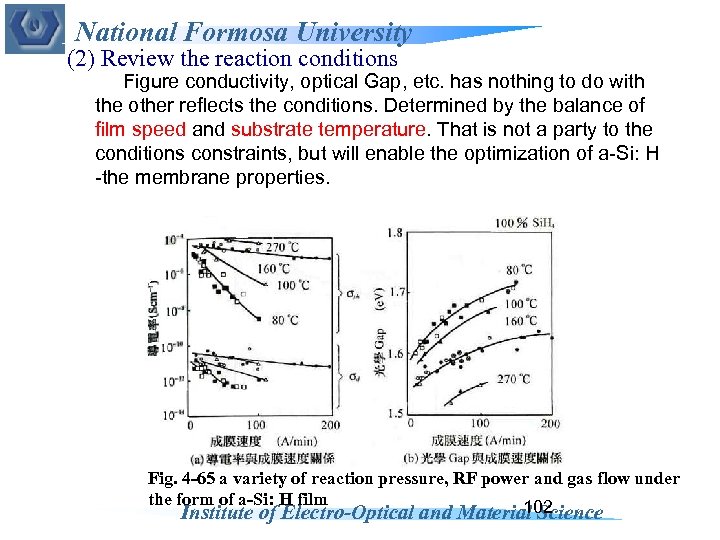 National Formosa University (2) Review the reaction conditions Figure conductivity, optical Gap, etc. has nothing to do with the other reflects the conditions. Determined by the balance of film speed and substrate temperature. That is not a party to the conditions constraints, but will enable the optimization of a-Si: H -the membrane properties. Fig. 4 -65 a variety of reaction pressure, RF power and gas flow under the form of a-Si: H film 102 Institute of Electro-Optical and Material Science
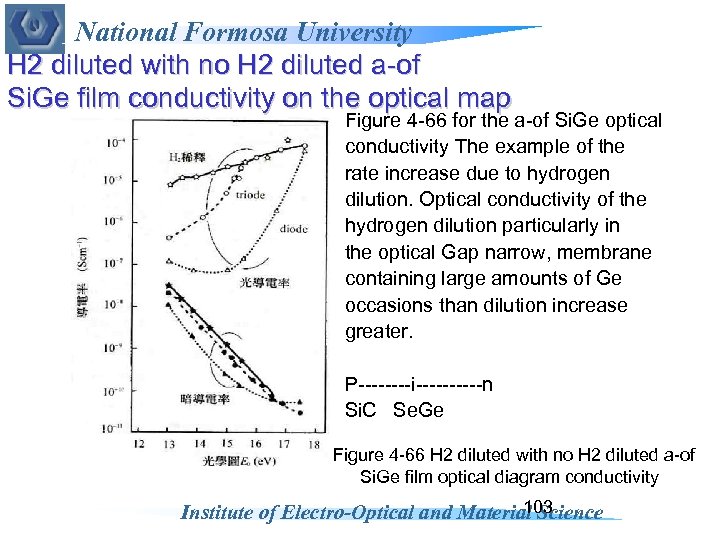 National Formosa University H 2 diluted with no H 2 diluted a-of Si. Ge film conductivity on the optical map Figure 4 -66 for the a-of Si. Ge optical conductivity The example of the rate increase due to hydrogen dilution. Optical conductivity of the hydrogen dilution particularly in the optical Gap narrow, membrane containing large amounts of Ge occasions than dilution increase greater. P----i-----n Si. C Se. Ge Figure 4 -66 H 2 diluted with no H 2 diluted a-of Si. Ge film optical diagram conductivity 103 Institute of Electro-Optical and Material Science
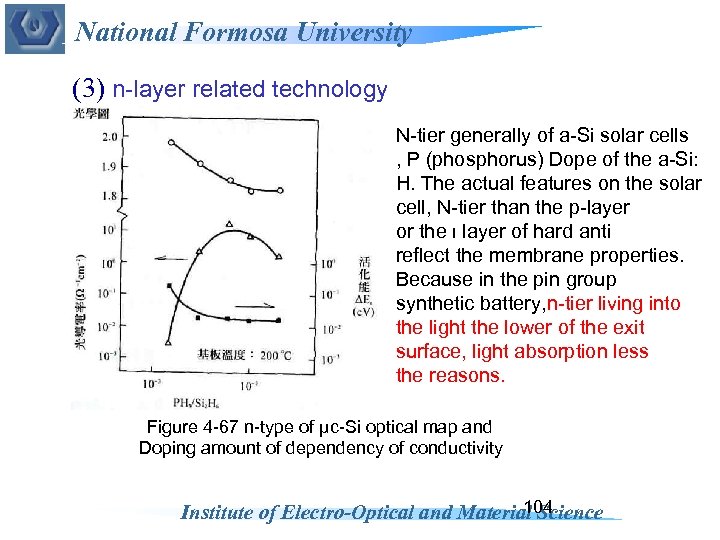 National Formosa University (3) n-layer related technology N-tier generally of a-Si solar cells , P (phosphorus) Dope of the a-Si: H. The actual features on the solar cell, N-tier than the p-layer or the ι layer of hard anti reflect the membrane properties. Because in the pin group synthetic battery, n-tier living into the light the lower of the exit surface, light absorption less the reasons. Figure 4 -67 n-type of μc-Si optical map and Doping amount of dependency of conductivity 104 Institute of Electro-Optical and Material Science
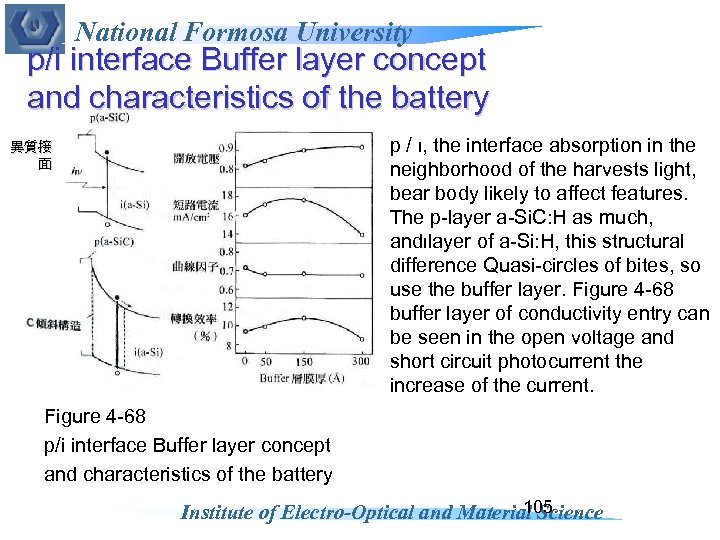 National Formosa University p/i interface Buffer layer concept and characteristics of the battery p / ι, the interface absorption in the neighborhood of the harvests light, bear body likely to affect features. The p-layer a-Si. C: H as much, andιlayer of a-Si: H, this structural difference Quasi-circles of bites, so use the buffer layer. Figure 4 -68 buffer layer of conductivity entry can be seen in the open voltage and short circuit photocurrent the increase of the current. 異質接 面 Figure 4 -68 p/i interface Buffer layer concept and characteristics of the battery 105 Institute of Electro-Optical and Material Science
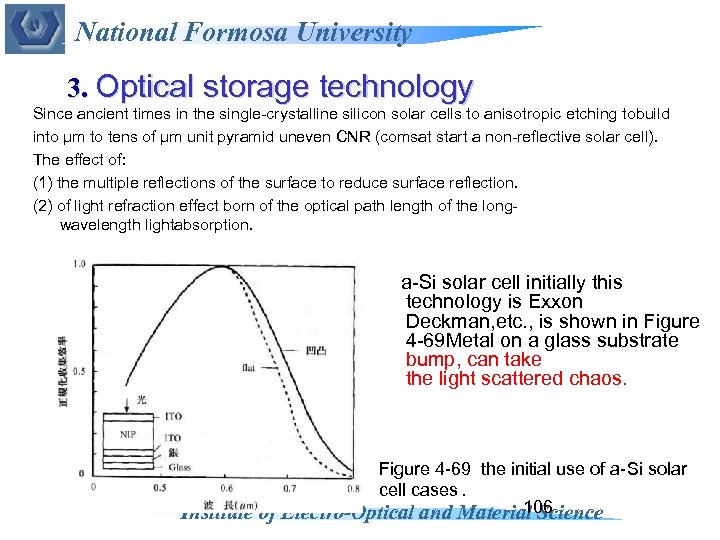 National Formosa University 3. Optical storage technology Since ancient times in the single-crystalline silicon solar cells to anisotropic etching tobuild into μm to tens of μm unit pyramid uneven CNR (comsat start a non-reflective solar cell). The effect of: (1) the multiple reflections of the surface to reduce surface reflection. (2) of light refraction effect born of the optical path length of the longwavelength lightabsorption. a-Si solar cell initially this technology is Exxon Deckman, etc. , is shown in Figure 4 -69 Metal on a glass substrate bump, can take the light scattered chaos. Figure 4 -69 the initial use of a-Si solar cell cases. 106 Institute of Electro-Optical and Material Science
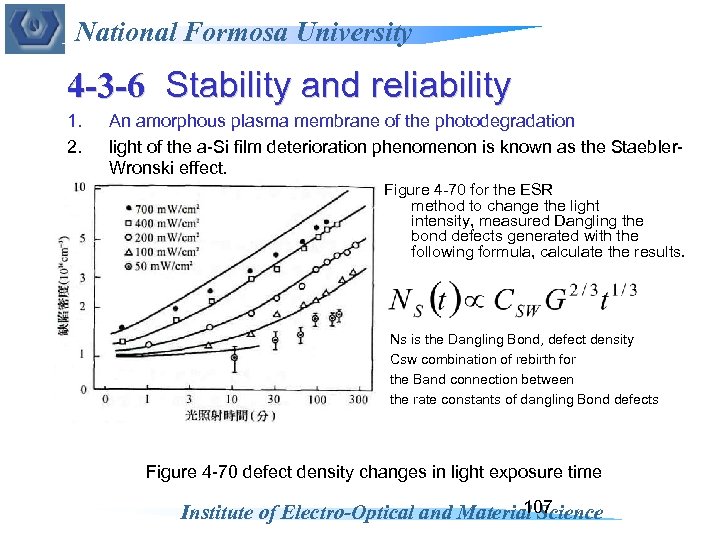 National Formosa University 4 -3 -6 Stability and reliability 1. 2. An amorphous plasma membrane of the photodegradation light of the a-Si film deterioration phenomenon is known as the Staebler. Wronski effect. Figure 4 -70 for the ESR method to change the light intensity, measured Dangling the bond defects generated with the following formula, calculate the results. Ns is the Dangling Bond, defect density Csw combination of rebirth for the Band connection between the rate constants of dangling Bond defects Figure 4 -70 defect density changes in light exposure time 107 Institute of Electro-Optical and Material Science
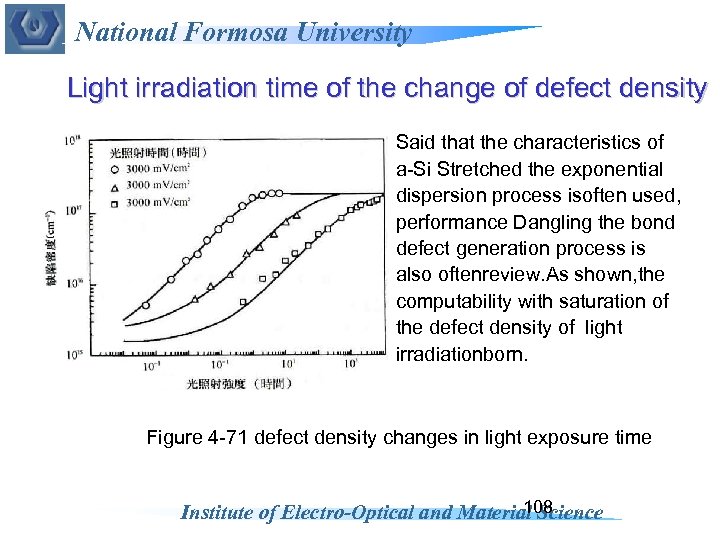 National Formosa University Light irradiation time of the change of defect density Said that the characteristics of a-Si Stretched the exponential dispersion process isoften used, performance Dangling the bond defect generation process is also oftenreview. As shown, the computability with saturation of the defect density of light irradiationborn. Figure 4 -71 defect density changes in light exposure time 108 Institute of Electro-Optical and Material Science
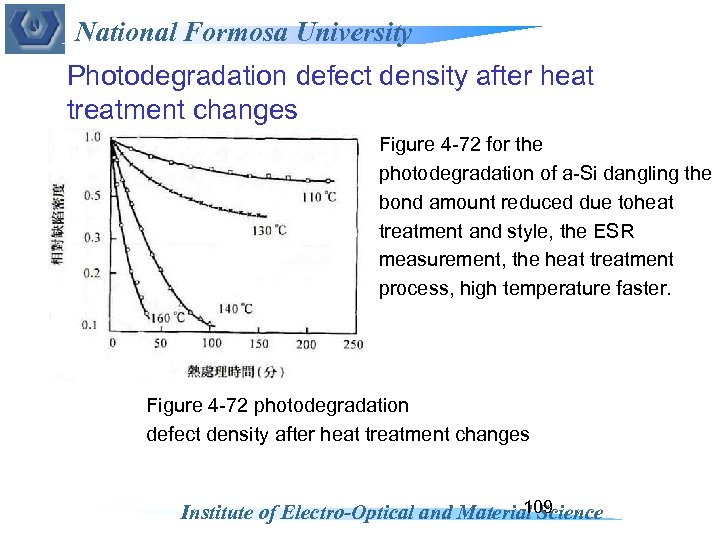 National Formosa University Photodegradation defect density after heat treatment changes Figure 4 -72 for the photodegradation of a-Si dangling the bond amount reduced due toheat treatment and style, the ESR measurement, the heat treatment process, high temperature faster. Figure 4 -72 photodegradation defect density after heat treatment changes 109 Institute of Electro-Optical and Material Science
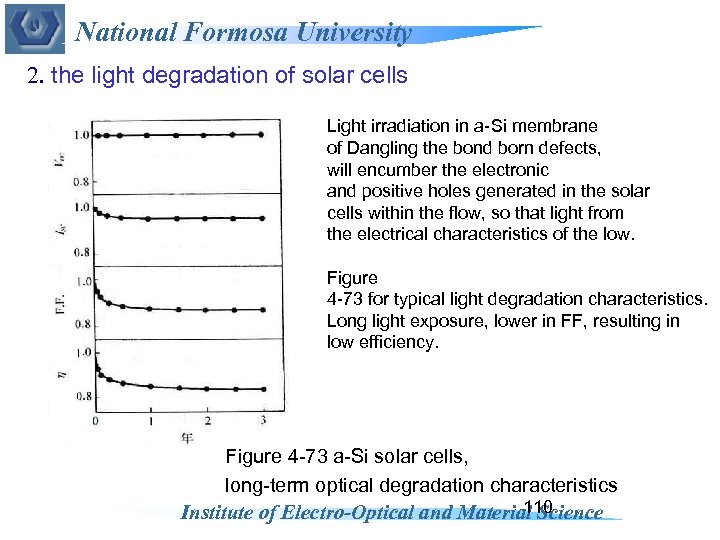 National Formosa University 2. the light degradation of solar cells Light irradiation in a-Si membrane of Dangling the bond born defects, will encumber the electronic and positive holes generated in the solar cells within the flow, so that light from the electrical characteristics of the low. Figure 4 -73 for typical light degradation characteristics. Long light exposure, lower in FF, resulting in low efficiency. Figure 4 -73 a-Si solar cells, long-term optical degradation characteristics 110 Institute of Electro-Optical and Material Science
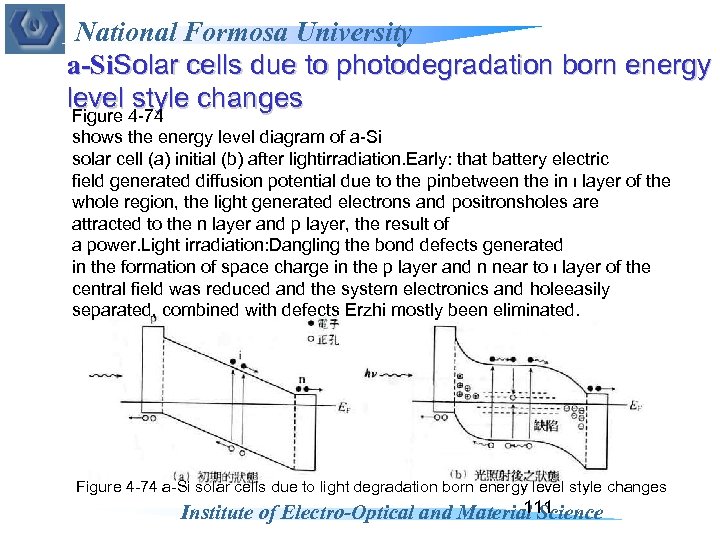 National Formosa University a-Si. Solar cells due to photodegradation born energy level style changes Figure 4 -74 shows the energy level diagram of a-Si solar cell (a) initial (b) after lightirradiation. Early: that battery electric field generated diffusion potential due to the pinbetween the in ι layer of the whole region, the light generated electrons and positronsholes are attracted to the n layer and p layer, the result of a power. Light irradiation: Dangling the bond defects generated in the formation of space charge in the p layer and n near to ι layer of the central field was reduced and the system electronics and holeeasily separated, combined with defects Erzhi mostly been eliminated. Figure 4 -74 a-Si solar cells due to light degradation born energy level style changes 111 Institute of Electro-Optical and Material Science