


 Скачать презентацию National Event Estonia January 20 2005 Innovation in
abdf7eedf0d243745d8a4107c22b3ade.ppt
- Количество слайдов: 30
 National Event Estonia, January 20, 2005 Innovation in Textile Finishing TNO Industrial Technology Anton Luiken, Manager Textile Research January 20, 2005 1
 Overview of the lecture • • • Introduction Textile finishing Process innovations Environment Applying functionalities to textiles – functional textiles Concluding remarks Anton Luiken, Manager Textile Research January 20, 2005 2
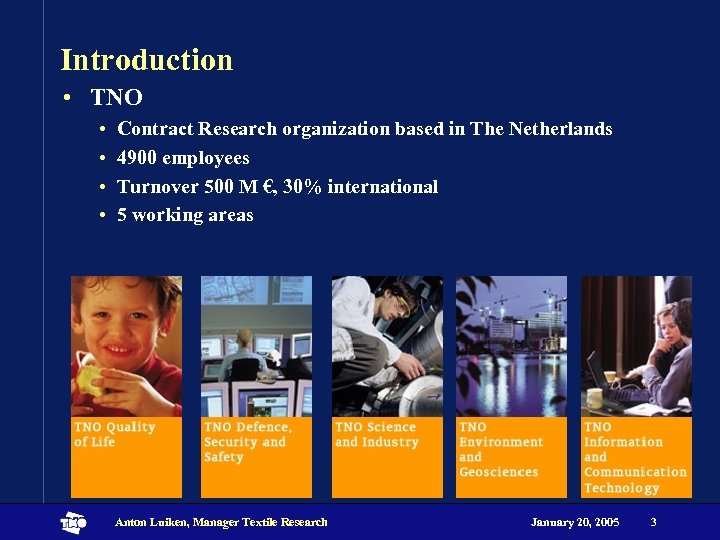 Introduction • TNO • • Contract Research organization based in The Netherlands 4900 employees Turnover 500 M €, 30% international 5 working areas Anton Luiken, Manager Textile Research January 20, 2005 3
 Scope of Textile Research in TNO • Process technology • Textiles, floor coverings, cleaning technology • Development of sustainable textile finishing processes • Development of textile products with improved properties (functionality and comfort) • Sport • Protective clothing • Smart textiles • Product evaluation with respect to specific textile properties • Comfort, mechanical properties • Durability, cleanability • Testing and evaluation • Floor coverings, upholstery, mattresses, quilts, medical stockings Anton Luiken, Manager Textile Research January 20, 2005 4
 TNO’s involvement in EU-programs • TNO is actively involved in EU-research programs • Textranet/Autex are coordinating “textile” initiatives • TNO is convener of Textranet/Autex research working group • In next call focus on technical textiles • protective • medical • construction • Number of proposals are under preparation by different members of Textranet and Autex Anton Luiken, Manager Textile Research January 20, 2005 5
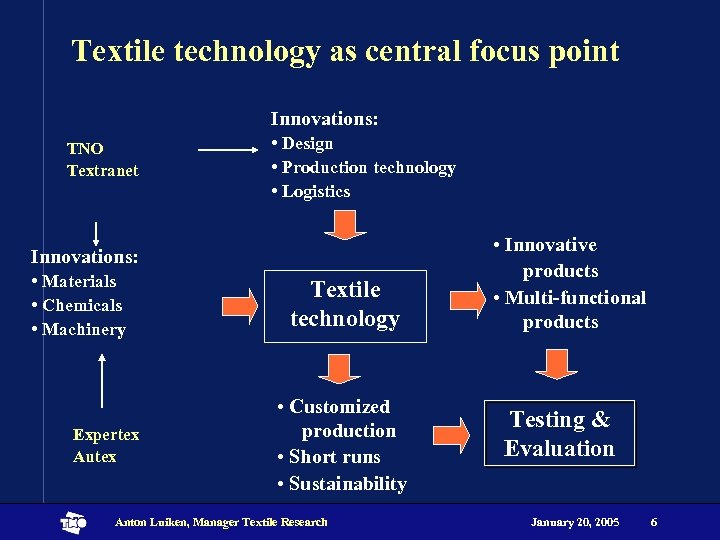 Textile technology as central focus point Innovations: TNO Textranet • Design • Production technology • Logistics Innovations: • Materials • Chemicals • Machinery Expertex Autex Textile technology • Customized production • Short runs • Sustainability Anton Luiken, Manager Textile Research • Innovative products • Multi-functional products Testing & Evaluation January 20, 2005 6
 Textile finishing • All processes after fabric formation and before making up • desizing, scouring, bleaching • dyeing, printing • finishing, coating, lamination • Continuous and batch processing • equipment, machinery, sensors and control techniques • Research items • innovation of processes • improvement of functionalities • reduced environmental impact Anton Luiken, Manager Textile Research January 20, 2005 7
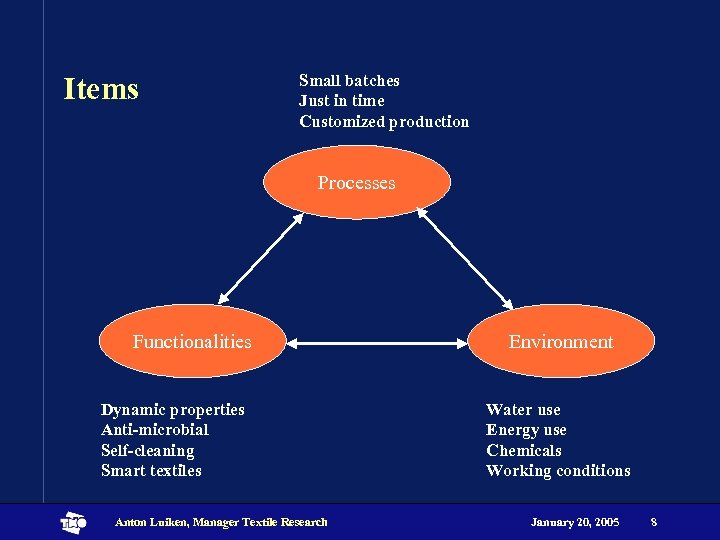 Items Small batches Just in time Customized production Processes Functionalities Dynamic properties Anti-microbial Self-cleaning Smart textiles Anton Luiken, Manager Textile Research Environment Water use Energy use Chemicals Working conditions January 20, 2005 8
 Processes • Development of new processes, working methods and equipment • • • in order to faster production smaller batches reduce use of chemicals, water and energy improve and develop new functionalities • Examples: • • • Enzymatic scouring Catalytic bleaching Ultrasound Plasma technology Ink-jet technology Anton Luiken, Manager Textile Research January 20, 2005 9
 Processes Enzymatic processes • • Low temperature Less severe processing conditions Improved product quality For • desizing • anti-pilling effect • Under development • scouring, bleaching (FP 5: BPT) • surface modification of synthetic fibres Anton Luiken, Manager Textile Research January 20, 2005 10
 Processes Catalytic bleaching • Use of catalysts in order to • • lower the bleaching temperature (65 °C; no steamer) shorten the bleaching time (5 -10 min) decrease the damage of the fabric (DP value > 2000) reduce the chemical consumption (3 g H 2 O 2/l, p. H 10) • National research project • • University Twente TNO Machinery company 2 textile finishing companies • Project will be finished in December 2006 Anton Luiken, Manager Textile Research January 20, 2005 11
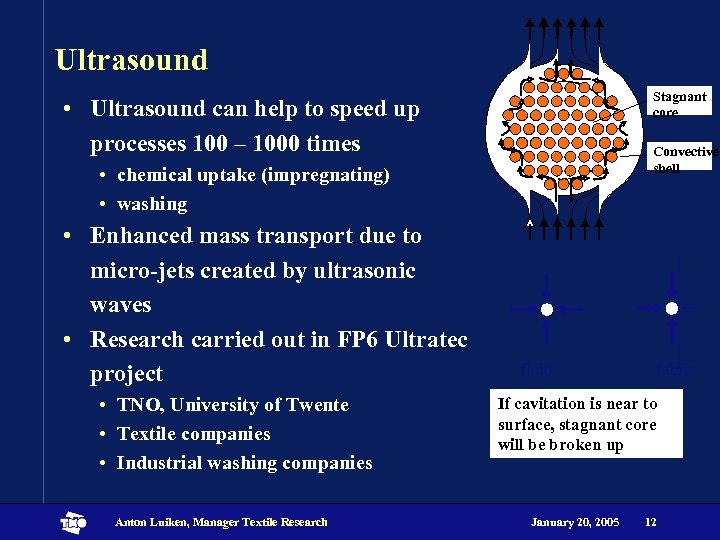 Ultrasound Stagnant core • Ultrasound can help to speed up processes 100 – 1000 times Convective shell • chemical uptake (impregnating) • washing • Enhanced mass transport due to micro-jets created by ultrasonic waves • Research carried out in FP 6 Ultratec project • TNO, University of Twente • Textile companies • Industrial washing companies Anton Luiken, Manager Textile Research fluid fabric If cavitation is near to surface, stagnant core will be broken up January 20, 2005 12
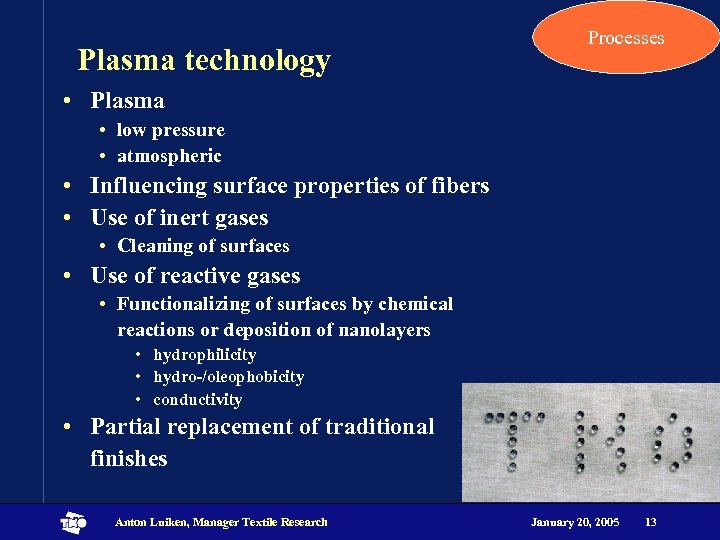 Plasma technology Processes • Plasma • low pressure • atmospheric • Influencing surface properties of fibers • Use of inert gases • Cleaning of surfaces • Use of reactive gases • Functionalizing of surfaces by chemical reactions or deposition of nanolayers • hydrophilicity • hydro-/oleophobicity • conductivity • Partial replacement of traditional finishes Anton Luiken, Manager Textile Research January 20, 2005 13
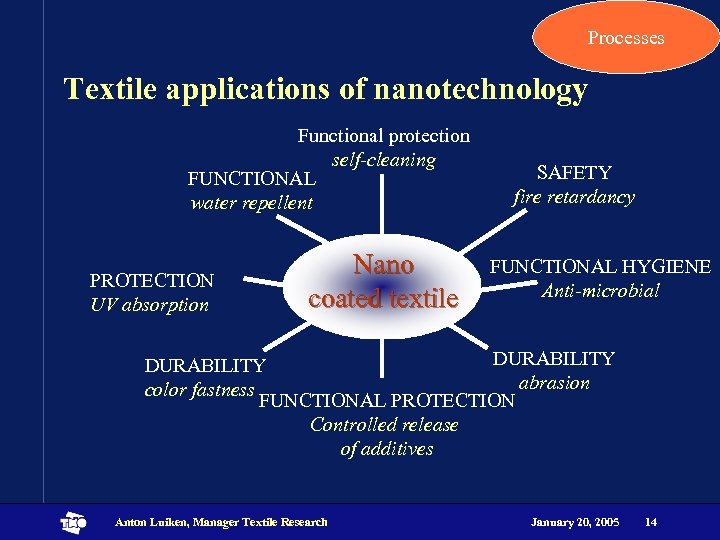 Processes Textile applications of nanotechnology Functional protection self-cleaning FUNCTIONAL water repellent PROTECTION UV absorption Nano coated textile SAFETY fire retardancy FUNCTIONAL HYGIENE Anti-microbial DURABILITY abrasion color fastness FUNCTIONAL PROTECTION Controlled release of additives Anton Luiken, Manager Textile Research January 20, 2005 14
 Processes Ink-jet technology • New technology for customized production of textile products • Single items possible • Productivity will be increased to > 1000 m 2/hr in few years • Printing of small quantities on industrial scale • Printing of flags and banners • Printing of samples • Research on the application of jet-technology for the application of finishes – Digifin • Project proposal 3 rd call FP 6 by Royal Ten Cate (Nl) Anton Luiken, Manager Textile Research January 20, 2005 15
 Processes New processes/ new processing • Textile industry needs to adapt to the need of the customers • Processing of smaller batches and quick response will be essential • Flexibility in production • Rapid changes of recipes • Broad range of processes • Textile industry has to be ready for the “Leapfrog” way of production of their customers • If not, textile industry will have to keep the stocks • High costs, high risks and low margins Anton Luiken, Manager Textile Research January 20, 2005 16
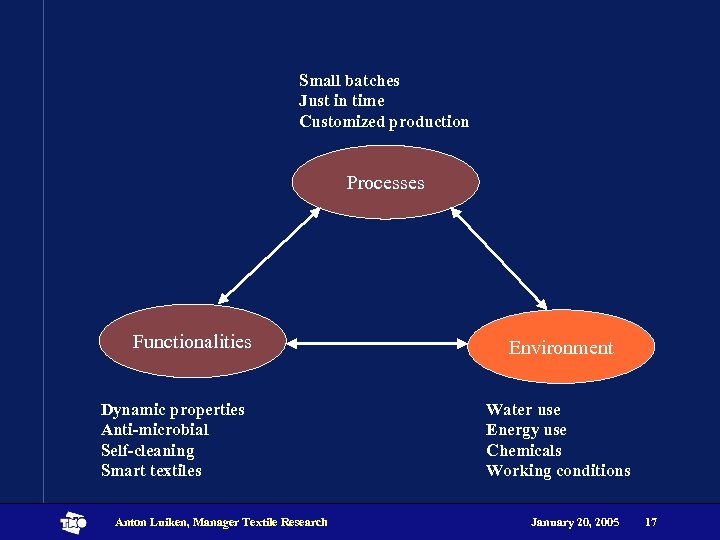 Small batches Just in time Customized production Processes Functionalities Dynamic properties Anti-microbial Self-cleaning Smart textiles Anton Luiken, Manager Textile Research Environment Water use Energy use Chemicals Working conditions January 20, 2005 17
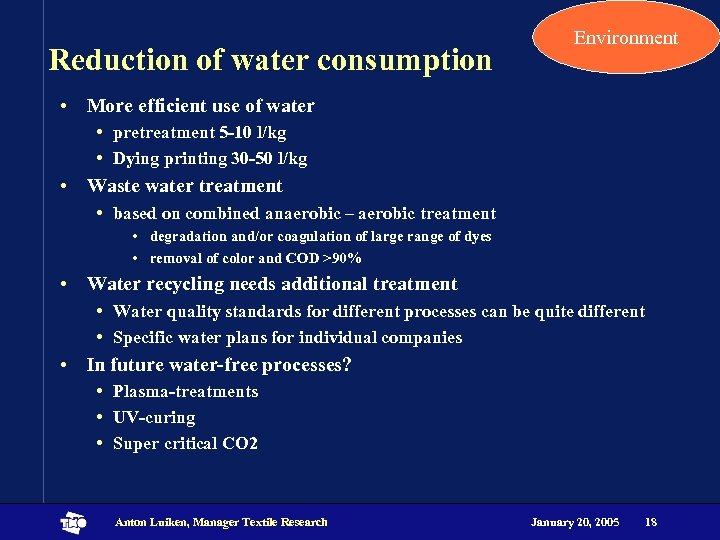 Reduction of water consumption Environment • More efficient use of water • pretreatment 5 -10 l/kg • Dying printing 30 -50 l/kg • Waste water treatment • based on combined anaerobic – aerobic treatment • degradation and/or coagulation of large range of dyes • removal of color and COD >90% • Water recycling needs additional treatment • Water quality standards for different processes can be quite different • Specific water plans for individual companies • In future water-free processes? • Plasma-treatments • UV-curing • Super critical CO 2 Anton Luiken, Manager Textile Research January 20, 2005 18
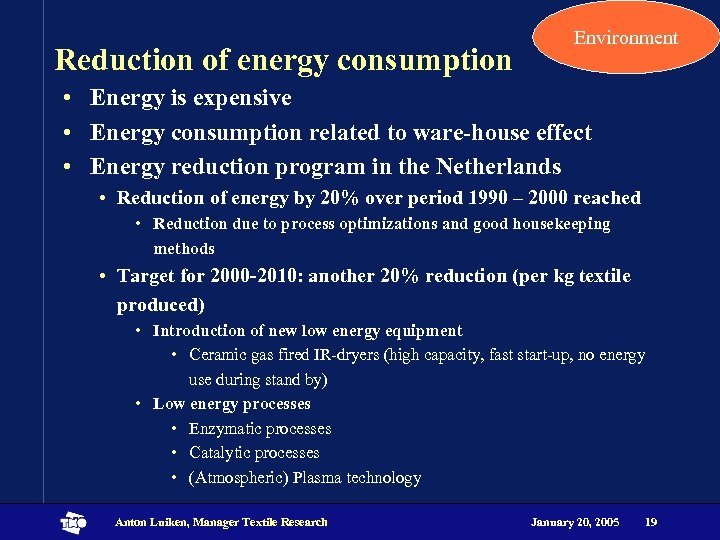 Reduction of energy consumption Environment • Energy is expensive • Energy consumption related to ware-house effect • Energy reduction program in the Netherlands • Reduction of energy by 20% over period 1990 – 2000 reached • Reduction due to process optimizations and good housekeeping methods • Target for 2000 -2010: another 20% reduction (per kg textile produced) • Introduction of new low energy equipment • Ceramic gas fired IR-dryers (high capacity, fast start-up, no energy use during stand by) • Low energy processes • Enzymatic processes • Catalytic processes • (Atmospheric) Plasma technology Anton Luiken, Manager Textile Research January 20, 2005 19
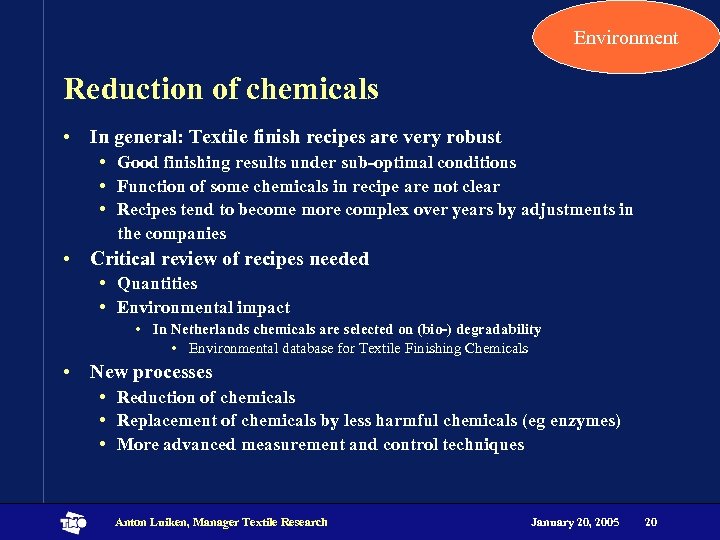 Environment Reduction of chemicals • In general: Textile finish recipes are very robust • Good finishing results under sub-optimal conditions • Function of some chemicals in recipe are not clear • Recipes tend to become more complex over years by adjustments in the companies • Critical review of recipes needed • Quantities • Environmental impact • In Netherlands chemicals are selected on (bio-) degradability • Environmental database for Textile Finishing Chemicals • New processes • Reduction of chemicals • Replacement of chemicals by less harmful chemicals (eg enzymes) • More advanced measurement and control techniques Anton Luiken, Manager Textile Research January 20, 2005 20
 Working conditions • Conditions improve by optimizing processes • Good house keeping • Processes at a lower temperature • Less hazardous chemicals • Dosing of chemicals • Reduced handling of chemicals • Use of automated color kitchens • New processes • No contact with chemicals (plasma, ink-jet) Anton Luiken, Manager Textile Research January 20, 2005 21
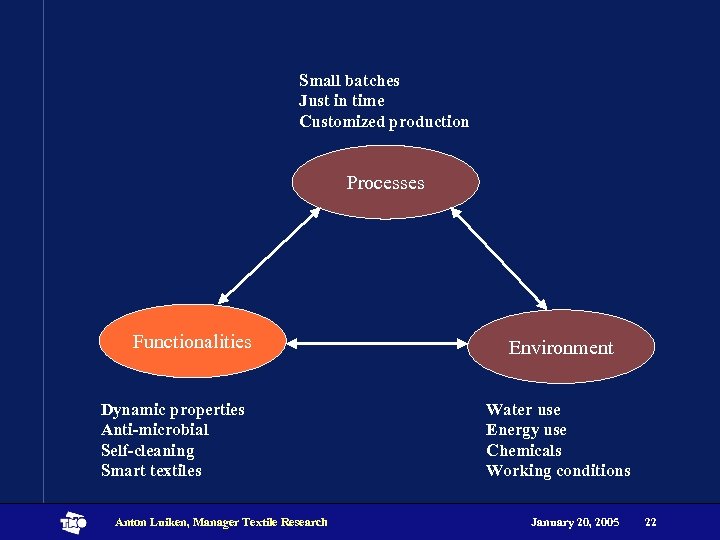 Small batches Just in time Customized production Processes Functionalities Dynamic properties Anti-microbial Self-cleaning Smart textiles Anton Luiken, Manager Textile Research Environment Water use Energy use Chemicals Working conditions January 20, 2005 22
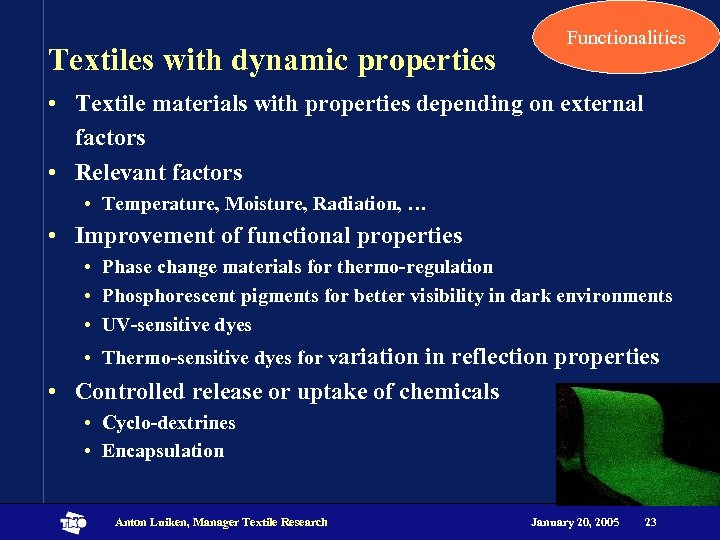 Textiles with dynamic properties Functionalities • Textile materials with properties depending on external factors • Relevant factors • Temperature, Moisture, Radiation, … • Improvement of functional properties • Phase change materials for thermo-regulation • Phosphorescent pigments for better visibility in dark environments • UV-sensitive dyes • Thermo-sensitive dyes for variation in reflection properties • Controlled release or uptake of chemicals • Cyclo-dextrines • Encapsulation Anton Luiken, Manager Textile Research January 20, 2005 23
 Functionalities Anti-microbial textiles • Many new fibers commercially available with antimicrobial properties • Research is carried out after the use of new antimicrobial agents • Silver • Chitosan • For many applications • Underwear, hygiene • Outdoor textiles • Shoes Anton Luiken, Manager Textile Research January 20, 2005 24
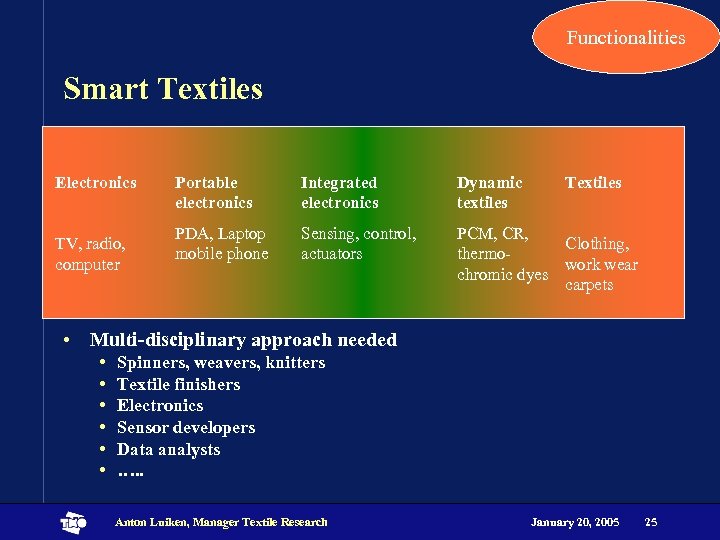 Functionalities Smart Textiles Electronics TV, radio, computer Portable electronics Integrated electronics Dynamic textiles Textiles PDA, Laptop mobile phone Sensing, control, actuators PCM, CR, Clothing, thermowork wear chromic dyes carpets • Multi-disciplinary approach needed • • • Spinners, weavers, knitters Textile finishers Electronics Sensor developers Data analysts …. . Anton Luiken, Manager Textile Research January 20, 2005 25
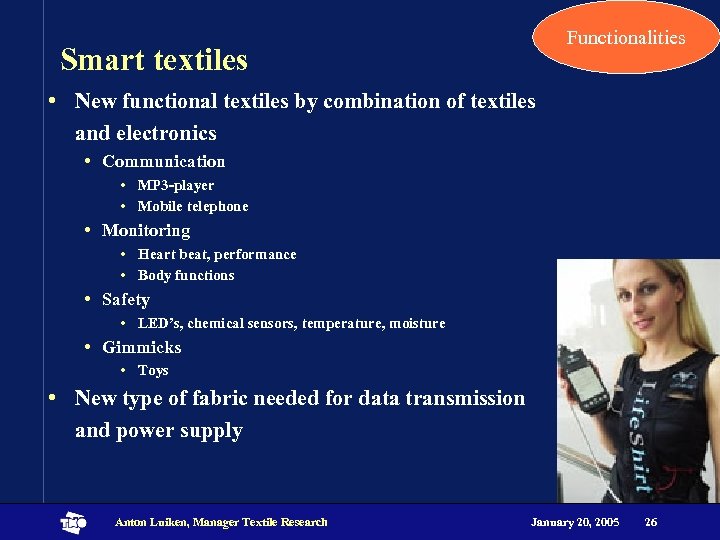 Functionalities Smart textiles • New functional textiles by combination of textiles and electronics • Communication • MP 3 -player • Mobile telephone • Monitoring • Heart beat, performance • Body functions • Safety • LED’s, chemical sensors, temperature, moisture • Gimmicks • Toys • New type of fabric needed for data transmission and power supply Anton Luiken, Manager Textile Research January 20, 2005 26
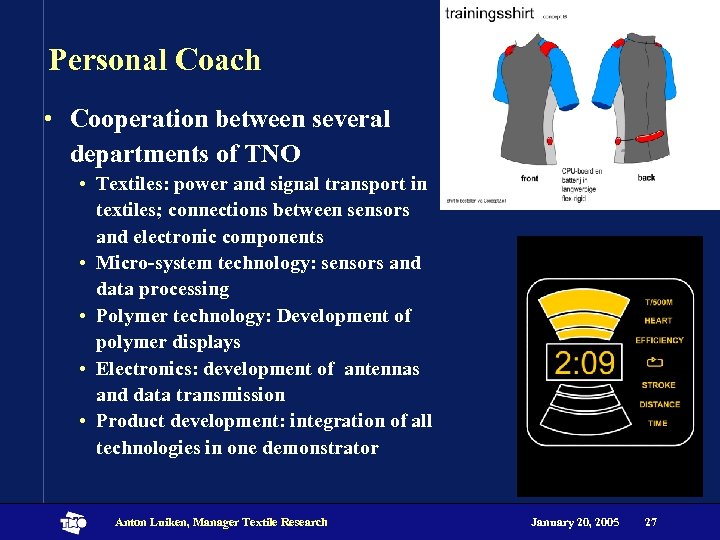 Personal Coach • Cooperation between several departments of TNO • Textiles: power and signal transport in textiles; connections between sensors and electronic components • Micro-system technology: sensors and data processing • Polymer technology: Development of polymer displays • Electronics: development of antennas and data transmission • Product development: integration of all technologies in one demonstrator Anton Luiken, Manager Textile Research January 20, 2005 27
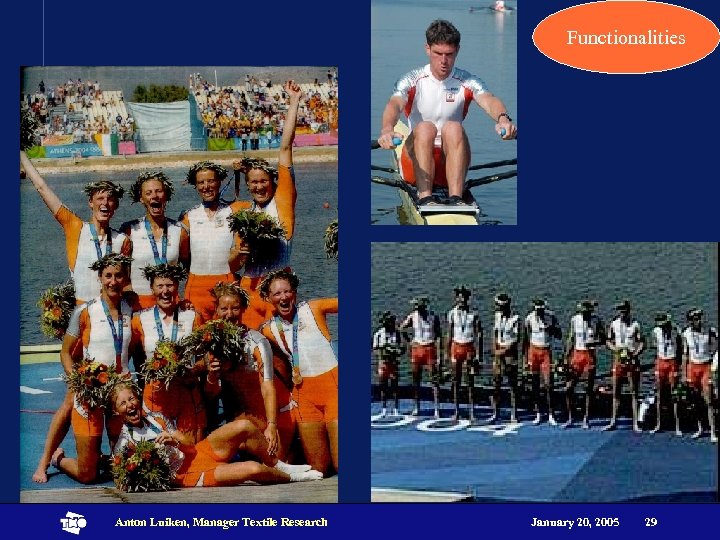
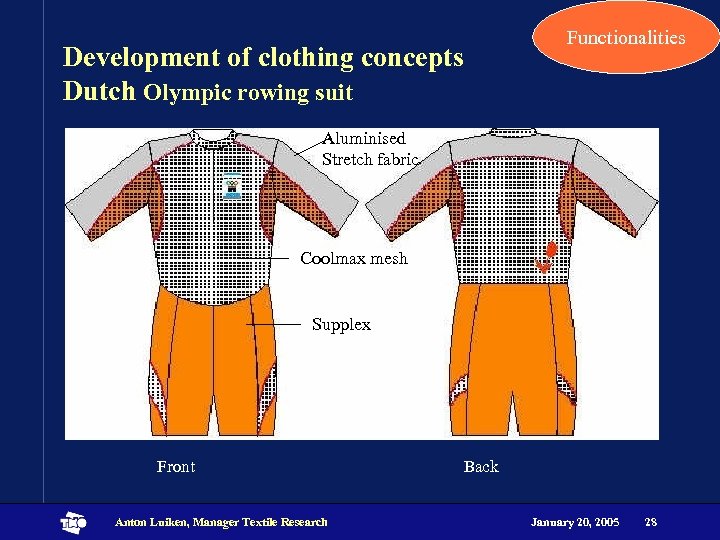 Functionalities Development of clothing concepts Dutch Olympic rowing suit Aluminised Stretch fabric Coolmax mesh Supplex Front Anton Luiken, Manager Textile Research Back January 20, 2005 28
 Functionalities Anton Luiken, Manager Textile Research January 20, 2005 29
 Concluding remarks • In textile finishing focus is on • Processes, environment and products • Products with enhanced functionality are important for the EU to survive the fierce competition • Processing concepts have to be adapted in order to be able to produce short batches • New processes offer the opportunity to fulfil the needs of the customers • EU-research can help to meet these targets Anton Luiken, Manager Textile Research January 20, 2005 30