 Скачать презентацию National Data Buoy Center Presentation to GCOOS Regional
d33e7df2414277f250fa3a4a6b77701a.ppt
- Количество слайдов: 19



National Data Buoy Center Presentation to GCOOS Regional Board of Director’s Meeting March 4, 2010 Helmut Portmann, Director
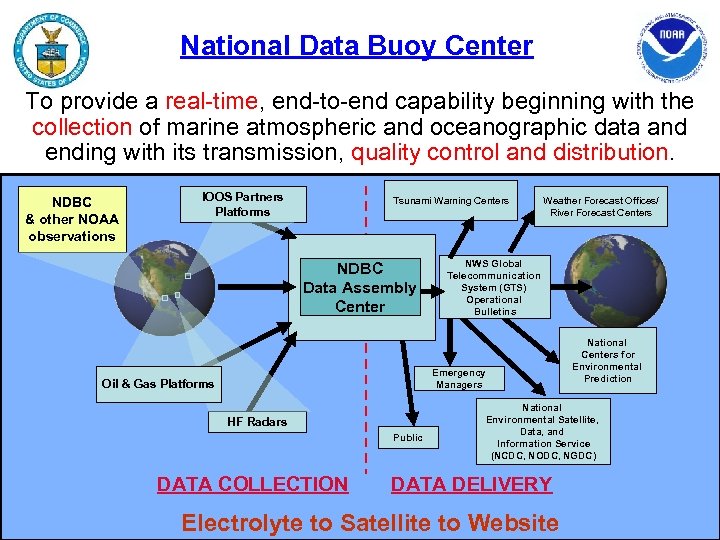
National Data Buoy Center To provide a real-time, end-to-end capability beginning with the collection of marine atmospheric and oceanographic data and ending with its transmission, quality control and distribution. NDBC & other NOAA observations IOOS Partners Platforms Tsunami Warning Centers NDBC Data Assembly Center Weather Forecast Offices/ River Forecast Centers NWS Global Telecommunication System (GTS) Operational Bulletins Emergency Managers Oil & Gas Platforms HF Radars Public DATA COLLECTION National Centers for Environmental Prediction National Environmental Satellite, Data, and Information Service (NCDC, NODC, NGDC) DATA DELIVERY Electrolyte to Satellite to Website
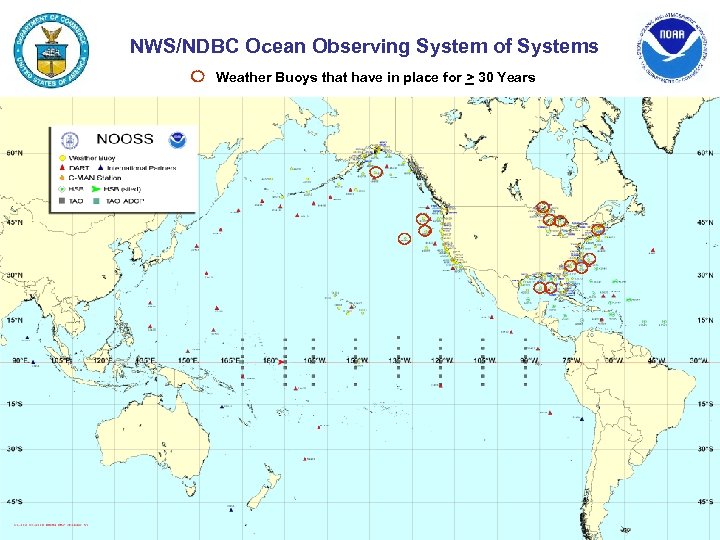
NWS/NDBC Ocean Observing System of Systems Weather Buoys that have in place for > 30 Years

NDBC’s Ocean Observing Systems 111 met/ocean buoys 4 ocean/waves buoys 49 C-MAN stations 39 DART stations 55 TAO buoys + 4 current profiler moorings 500+ Voluntary Observing Ship vessels
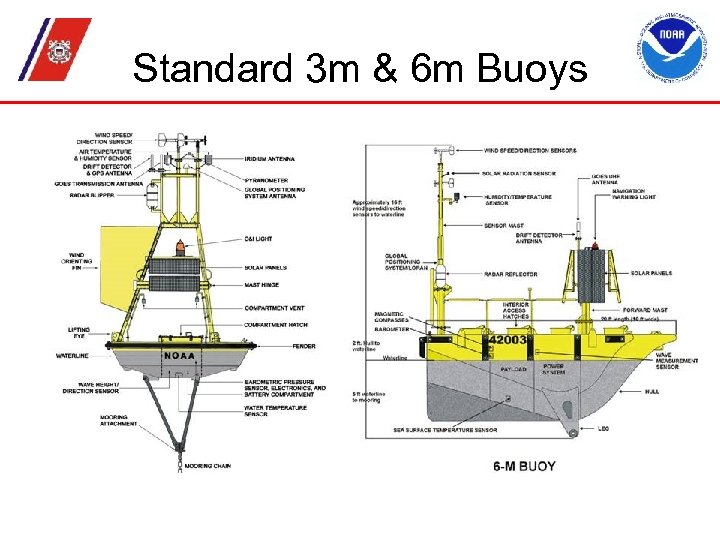
Standard 3 m & 6 m Buoys
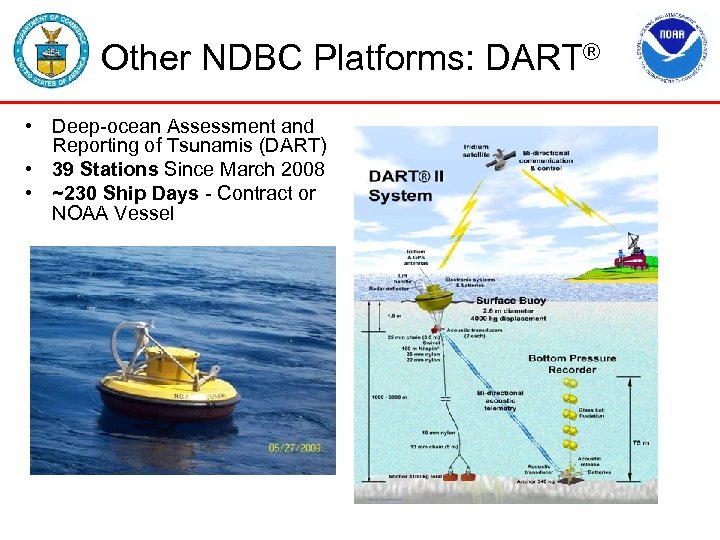
Other NDBC Platforms: DART® • Deep-ocean Assessment and Reporting of Tsunamis (DART) • 39 Stations Since March 2008 • ~230 Ship Days - Contract or NOAA Vessel
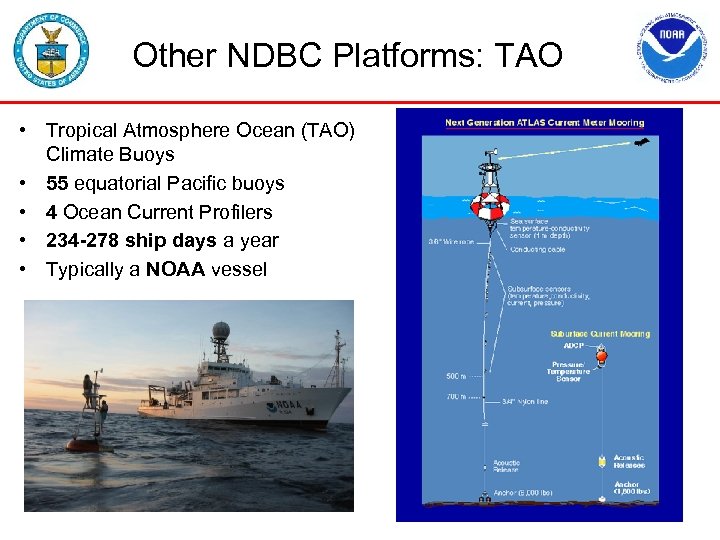
Other NDBC Platforms: TAO • Tropical Atmosphere Ocean (TAO) Climate Buoys • 55 equatorial Pacific buoys • 4 Ocean Current Profilers • 234 -278 ship days a year • Typically a NOAA vessel
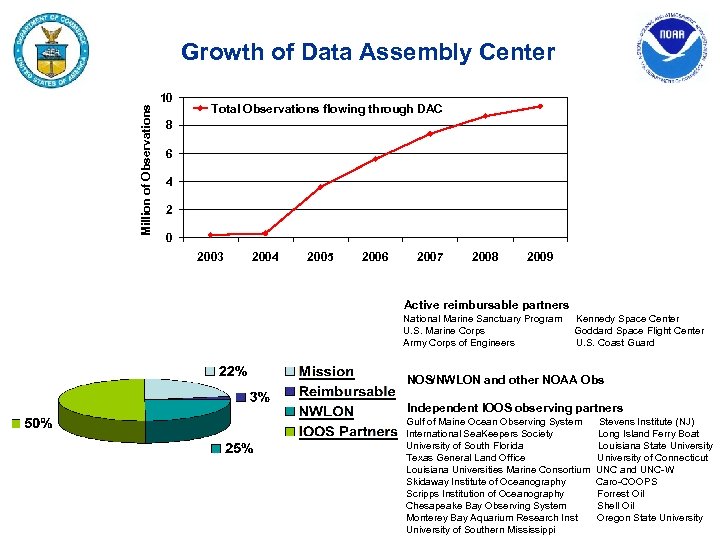
Million of Observations Growth of Data Assembly Center 10 Total Observations flowing through DAC 8 6 4 2 0 2003 2004 2005 2006 2007 2008 2009 Active reimbursable partners National Marine Sanctuary Program U. S. Marine Corps Army Corps of Engineers Kennedy Space Center Goddard Space Flight Center U. S. Coast Guard NOS/NWLON and other NOAA Obs Independent IOOS observing partners Gulf of Maine Ocean Observing System International Sea. Keepers Society University of South Florida Texas General Land Office Louisiana Universities Marine Consortium Skidaway Institute of Oceanography Scripps Institution of Oceanography Chesapeake Bay Observing System Monterey Bay Aquarium Research Inst University of Southern Mississippi Stevens Institute (NJ) Long Island Ferry Boat Louisiana State University of Connecticut UNC and UNC-W Caro-COOPS Forrest Oil Shell Oil Oregon State University
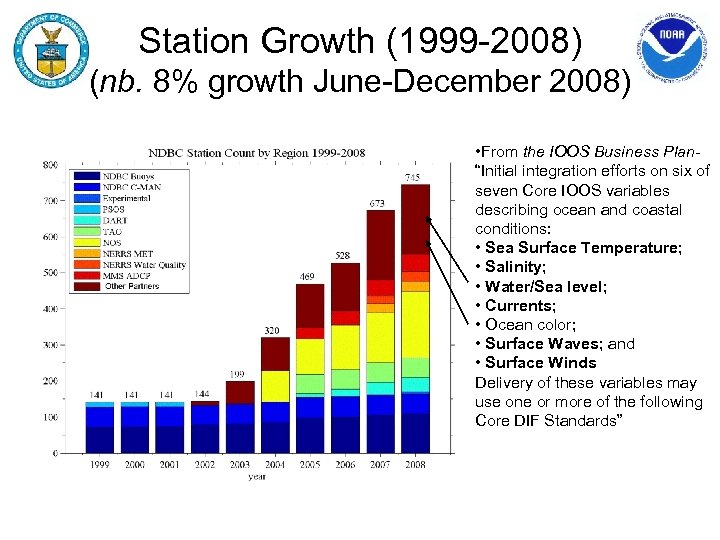
Station Growth (1999 -2008) (nb. 8% growth June-December 2008) • From the IOOS Business Plan“Initial integration efforts on six of seven Core IOOS variables describing ocean and coastal conditions: • Sea Surface Temperature; • Salinity; • Water/Sea level; • Currents; • Ocean color; • Surface Waves; and • Surface Winds Delivery of these variables may use one or more of the following Core DIF Standards”
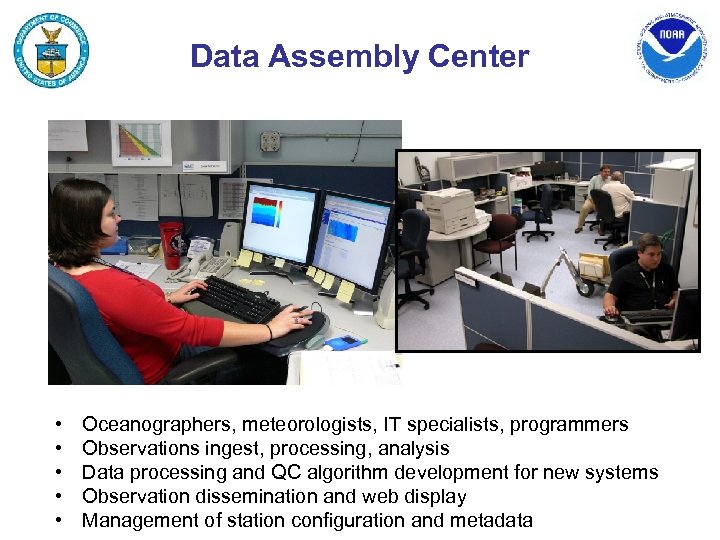
Data Assembly Center • • • Oceanographers, meteorologists, IT specialists, programmers Observations ingest, processing, analysis Data processing and QC algorithm development for new systems Observation dissemination and web display Management of station configuration and metadata
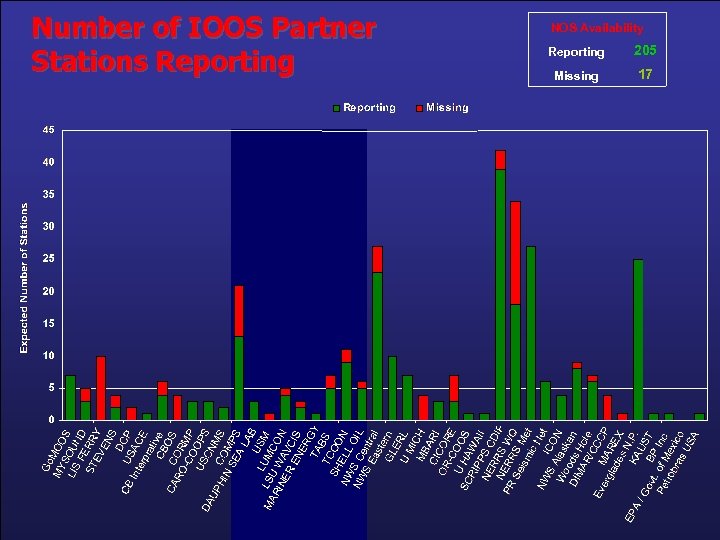
Number of IOOS Partner Stations Reporting NOS Availability Reporting 205 Missing 17
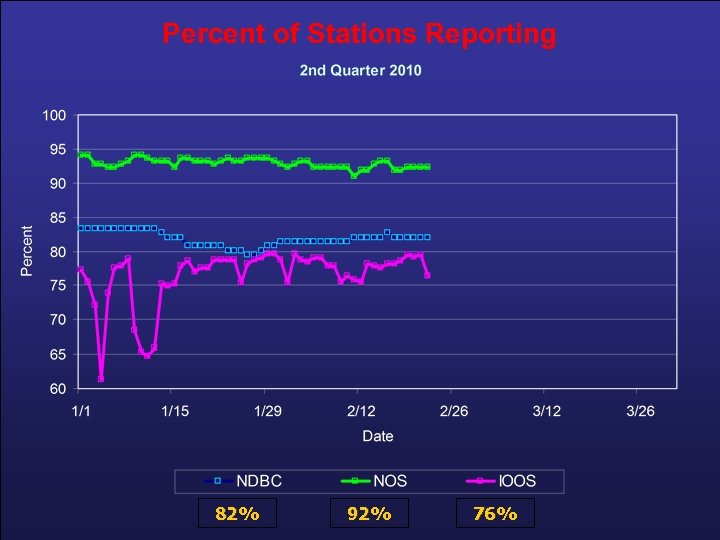
Percent of Stations Reporting 82% 92% 76%
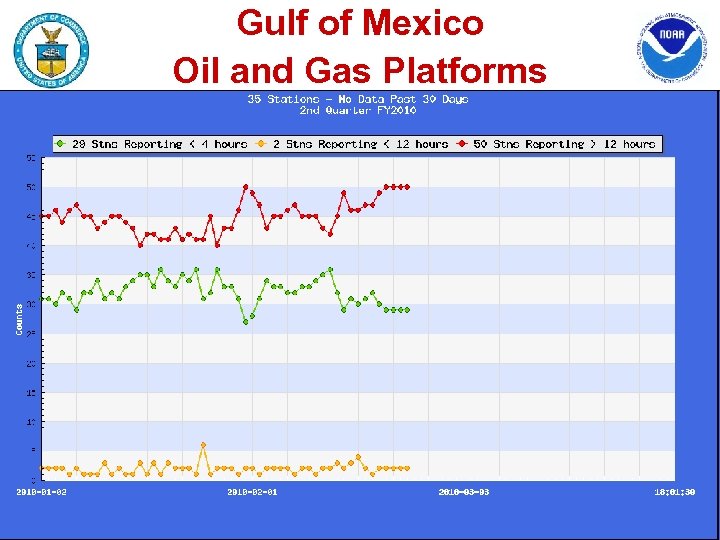
Gulf of Mexico Oil and Gas Platforms
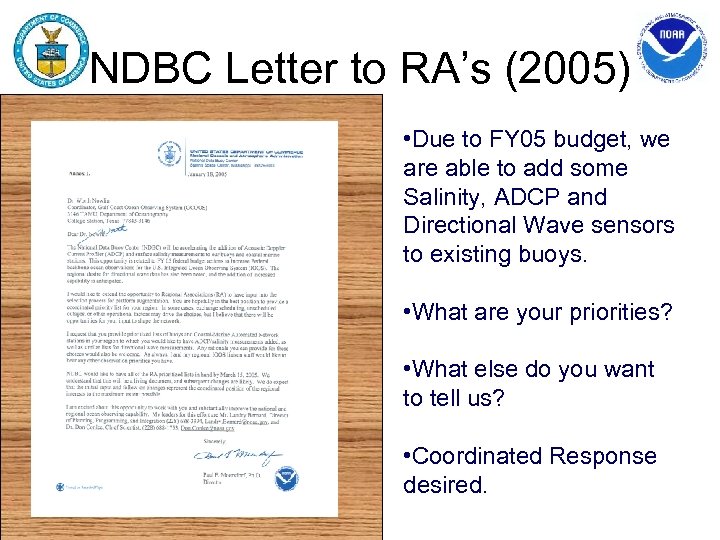
NDBC Letter to RA’s (2005) • Due to FY 05 budget, we are able to add some Salinity, ADCP and Directional Wave sensors to existing buoys. • What are your priorities? • What else do you want to tell us? • Coordinated Response desired.
GCOOS Response (2005): Directional Waves Note: Compilation of responses received, no regional arbitration/validation. • 42020 (Corpus Christi), 42035 (Galveston) – Source: Buzz Martin, TABS • 42038, 42041 (note: disestablished) (N. Mid Gulf) – Source: Greg Stone • SGOF 1 (Tyndall AFB Tower) – Source: Steve Morey, FSU • LKWF 1 (Lake Worth) – Move to Pt. Everglade entrance – Source: Alex Soloviev (Nova Southeastern)
GCOOS Response: ADCP/Salinity • Florida Keys in general (Muller-Karger (USF), et al) • DRYF 1, SANF 1, SMKF 1, LONF 1, MLRF 1, FWYF 1 need ADCP (Priority order by M-K) • 42040, 42039, 42036, 42003, CDRF 1, 42014, EGKF 1, DRYF 1, SANF 1, SMKF 1, LONF 1, MLRF 1, FWYF 1, KTNF 1, SGOF 1, BURL 1 need Salinity (Priority order by M-K) • “Mesohaline” areas (Tom Soniat, Oyster Disease) • 42020 (Corpus Christi), 42035 (Galveston) – Source: Buzz Martin, TABS • 42038, 42041 (note: disestablished) (N. Mid Gulf) – Source: Greg Stone • SGOF 1 (Tyndall AFB Tower) – Source: Steve Morey, FSU • 42020 (Corpus Christi), 42019 (Freeport) (Matt Howard, TAMU) • LKWF 1 (Lake Worth) – Move to Pt. Everglade entrance – Source: Alex Soloviev (Nova Southeastern)
GCOOS Response: Other • Do a good comparison of buoy vs. subsurface ADCPs (Van Waddell) • Coordinate a Fugro-GEOS pilot project buoy with NDBC (Ralph Rayner) • Offer to help with Lake Worth Instrumentation (Nova Southeastern U. )
GCOOS and NDBC Future Plans • Work with IOOS to develop a more formal process for the RAs to submit requirements for ocean observations on NDBC weather platforms • Review 2005 GCOOS priorities with GCOOS Board of Directors – possibly resubmit NDBC Director’s 2005 letter
 Скачать презентацию National Data Buoy Center Presentation to GCOOS Regional
d33e7df2414277f250fa3a4a6b77701a.ppt