 Скачать презентацию NATIONAL CONFERENCE FOR AGRICULTURE ON RABI CAMPAIGN 2013
36c34c50eaa9d233c94b5ae6c6ce67ad.ppt
- Количество слайдов: 70



NATIONAL CONFERENCE FOR AGRICULTURE ON RABI CAMPAIGN 2013 -14 DEPARTMENT OF AGRICULTURE GOVERNMENT OF TAMIL NADU
STRATEGIES FOR RESOURCE MANAGEMENT FOR BETTER INPUT USE EFFICIENCY
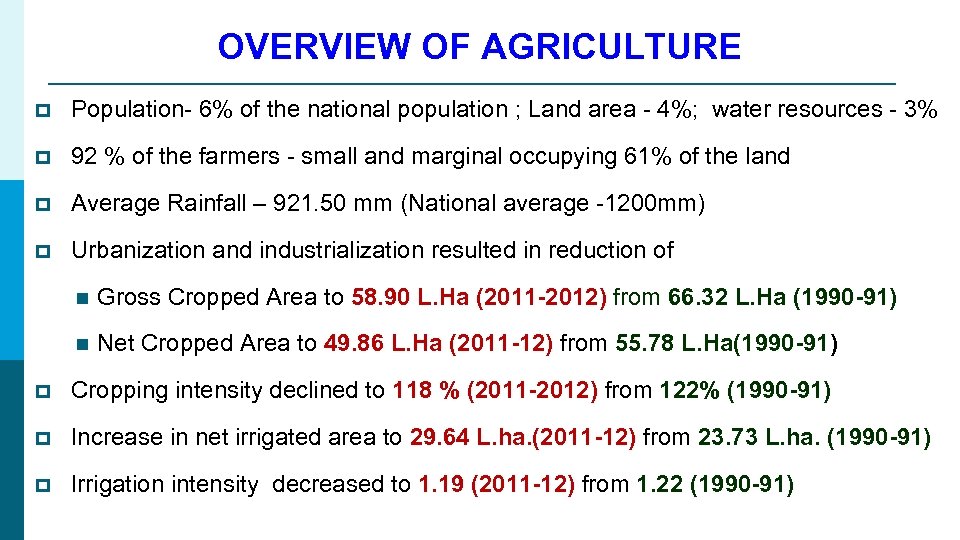
OVERVIEW OF AGRICULTURE p Population- 6% of the national population ; Land area - 4%; water resources - 3% p 92 % of the farmers - small and marginal occupying 61% of the land p Average Rainfall – 921. 50 mm (National average -1200 mm) p Urbanization and industrialization resulted in reduction of n Gross Cropped Area to 58. 90 L. Ha (2011 -2012) from 66. 32 L. Ha (1990 -91) n Net Cropped Area to 49. 86 L. Ha (2011 -12) from 55. 78 L. Ha(1990 -91) p Cropping intensity declined to 118 % (2011 -2012) from 122% (1990 -91) p Increase in net irrigated area to 29. 64 L. ha. (2011 -12) from 23. 73 L. ha. (1990 -91) p Irrigation intensity decreased to 1. 19 (2011 -12) from 1. 22 (1990 -91)
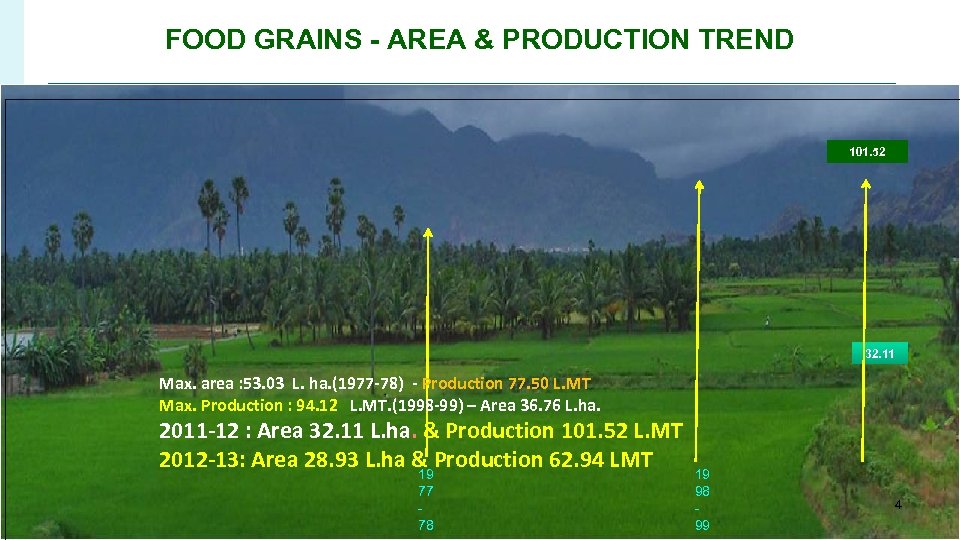
FOOD GRAINS - AREA & PRODUCTION TREND 101. 52 32. 11 Max. area : 53. 03 L. ha. (1977 -78) - Production 77. 50 L. MT Max. Production : 94. 12 L. MT. (1998 -99) – Area 36. 76 L. ha. 2011 -12 : Area 32. 11 L. ha. & Production 101. 52 L. MT 2012 -13: Area 28. 93 L. ha & Production 62. 94 LMT 19 77 78 19 98 99 4
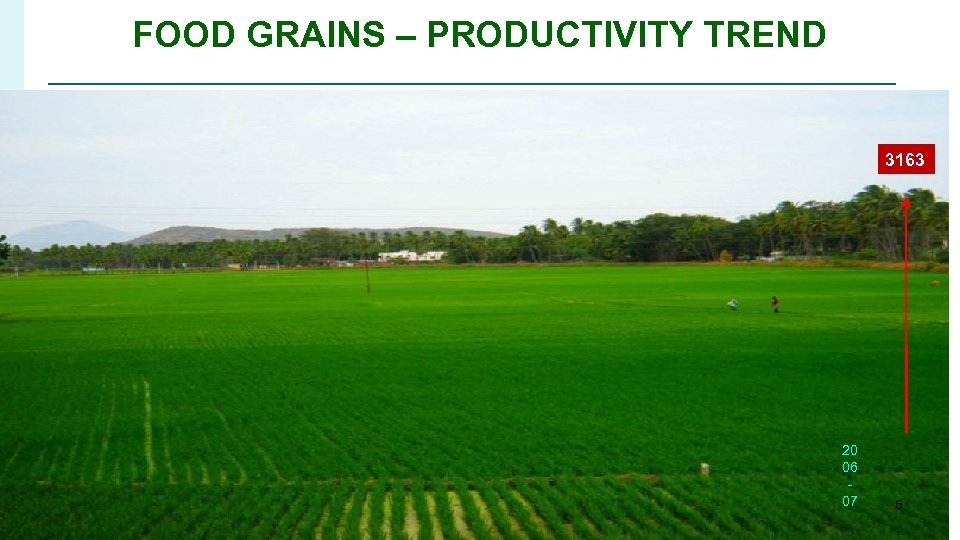
FOOD GRAINS – PRODUCTIVITY TREND 3163 20 06 07 5
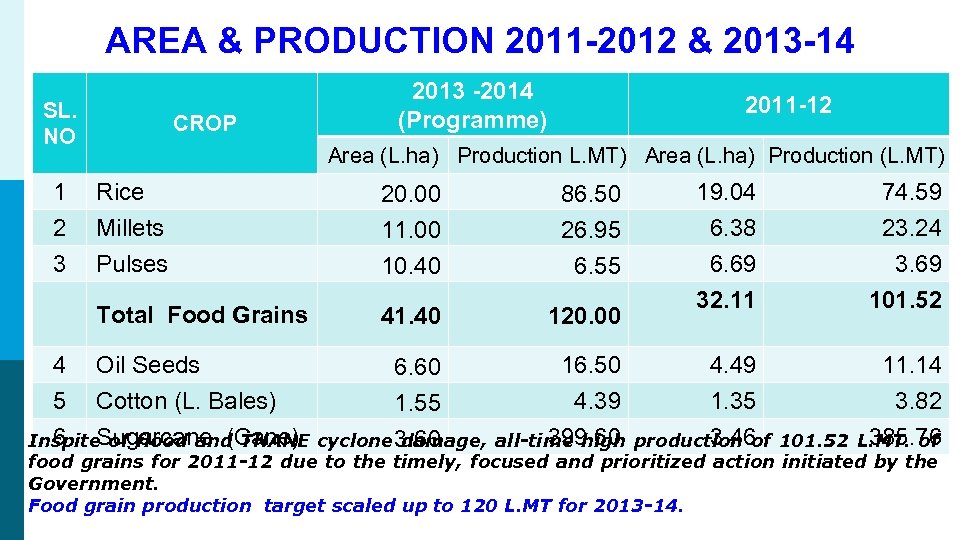
AREA & PRODUCTION 2011 -2012 & 2013 -14 SL. NO 2013 -2014 (Programme) CROP 2011 -12 Area (L. ha) Production L. MT) Area (L. ha) Production (L. MT) 1 Rice 20. 00 86. 50 19. 04 74. 59 2 3 Millets Pulses 11. 00 10. 40 26. 95 6. 55 Total Food Grains 41. 40 120. 00 6. 38 6. 69 32. 11 23. 24 3. 69 101. 52 4 Oil Seeds 6. 60 5 Cotton (L. Bales) 1. 55 6 Sugarcane (Cane) Inspite of flood and THANE cyclone 3. 60 damage, 16. 50 4. 39 399. 60 all-time high 4. 49 1. 35 3. 46 production of 11. 14 3. 82 385. 76 L. MT. of 101. 52 food grains for 2011 -12 due to the timely, focused and prioritized action initiated by the Government. Food grain production target scaled up to 120 L. MT for 2013 -14.
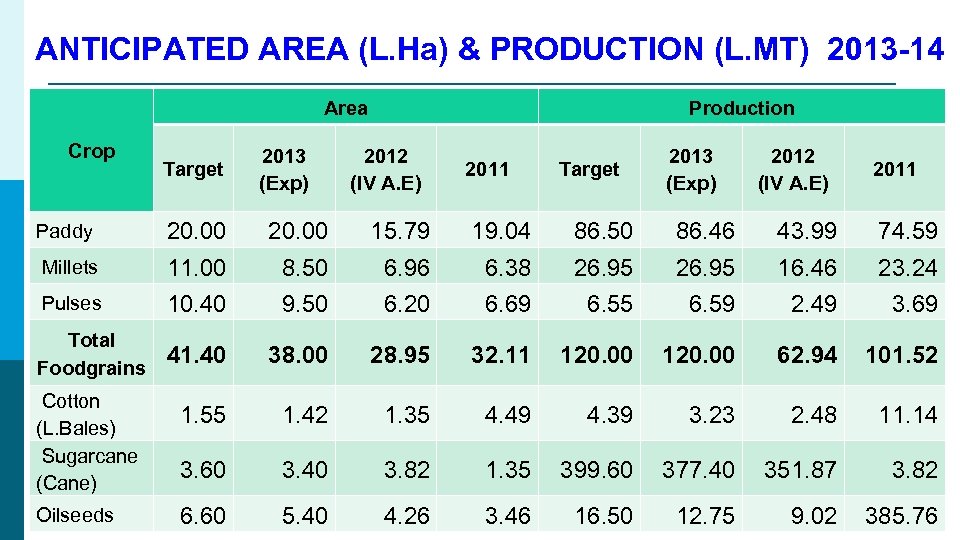
ANTICIPATED AREA (L. Ha) & PRODUCTION (L. MT) 2013 -14 Area Crop Target 2013 (Exp) Production 2012 (IV A. E) 2011 Target 2013 (Exp) 2012 (IV A. E) 2011 Paddy 20. 00 15. 79 19. 04 86. 50 86. 46 43. 99 74. 59 Millets 11. 00 8. 50 6. 96 6. 38 26. 95 16. 46 23. 24 Pulses 10. 40 9. 50 6. 20 6. 69 6. 55 6. 59 2. 49 3. 69 Total Foodgrains 41. 40 38. 00 28. 95 32. 11 120. 00 62. 94 101. 52 1. 55 1. 42 1. 35 4. 49 4. 39 3. 23 2. 48 11. 14 3. 60 3. 40 3. 82 1. 35 399. 60 377. 40 351. 87 3. 82 6. 60 5. 40 4. 26 3. 46 16. 50 12. 75 9. 02 385. 76 Cotton (L. Bales) Sugarcane (Cane) Oilseeds
CHALLENGES IN AGRICULTURE p High pressure on land due to Urbanization and Industrialization resulting in reduction of Gross Cropped Area to 58. 90 Lakh ha. (2011 -2012) from 66. 32 Lakh ha. (1990 -91) p Marginalization of land holdings - Declining farm size and income p Deteriorating soil health p Spatial and temporal variability in rain - erratic rainfall due to cyclonic North East Monsoon p Depleting natural resource base particularly water, both ground and surface water 8
CHALLENGES IN AGRICULTURE p Escalating inputs cost p Inadequate capital formation by the public sector p Declining public investment in agriculture p Shortage of Labour force p Incomplete adoption of location specific cropping system p Poor adoption of improved crop management practices p Inadequate post harvest technologies, uncertain market prospects and linkages 9
SECOND GREEN REVOLUTION • GOAL Doubling the foodgrain production Increasing the farmer’s income by 2 - 3 times higher than the present level Achieving 5% growth rate in Agriculture 10
SECOND GREEN REVOLUTION OBJECTIVES 1. Increasing the productivity of Agriculture and Horticulture crops and bridge the present yield gap 2. Improving the economic status of the farmers through mixed farming and other farm based interventions. 3. Diversifying the cultivation - high value horticulture and commercial crops - ensuring the food and nutritional security. 4. Promoting hi-tech agriculture 5. Supplying quality inputs in time 6. Promoting farmers participation in agri-business ventures. 7. Strengthening research and extension service in Tamil Nadu 11
THRUST AREAS p Rejuvenation of soil health to increase the productivity p Conjunctive use of water p Supply and management of quality inputs p Effective and economic utilization of inputs p Increasing the net cultivable area p Improving the Farmers Economic Development Index p Investment for increased capacity utilization of agriculture infrastructure p Rainfed cultivation 12
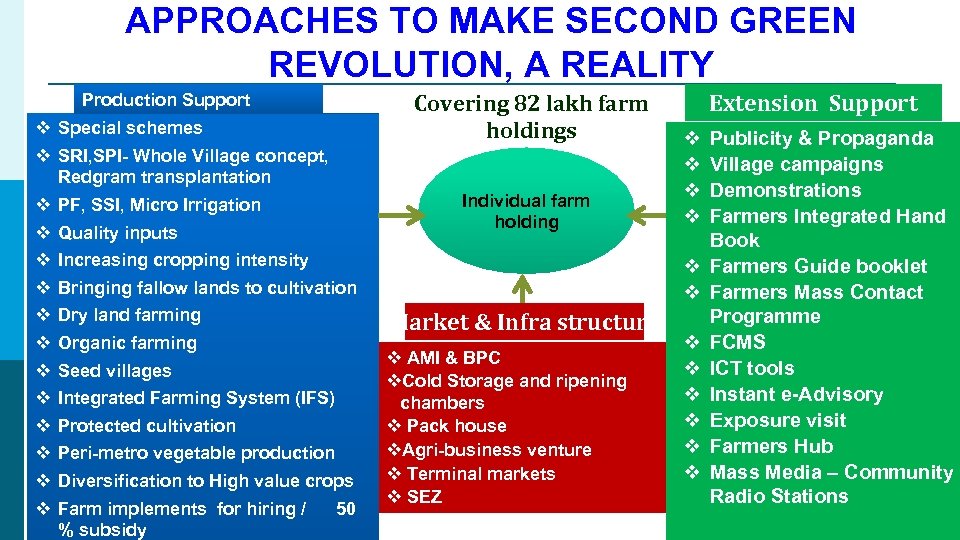
APPROACHES TO MAKE SECOND GREEN REVOLUTION, A REALITY Production Support v Special schemes v SRI, SPI- Whole Village concept, Redgram transplantation v PF, SSI, Micro Irrigation v Quality inputs v Increasing cropping intensity v Bringing fallow lands to cultivation v Dry land farming v Organic farming v Seed villages v Integrated Farming System (IFS) v Protected cultivation v Peri-metro vegetable production v Diversification to High value crops v Farm implements for hiring / 50 % subsidy Covering 82 lakh farm holdings Individual farm holding Extension Support v v v Market & Infra structure v AMI & BPC v. Cold Storage and ripening chambers v Pack house v. Agri-business venture v Terminal markets v SEZ v v v Publicity & Propaganda Village campaigns Demonstrations Farmers Integrated Hand Book Farmers Guide booklet Farmers Mass Contact Programme FCMS ICT tools Instant e-Advisory Exposure visit Farmers Hub Mass Media – Community Radio Stations
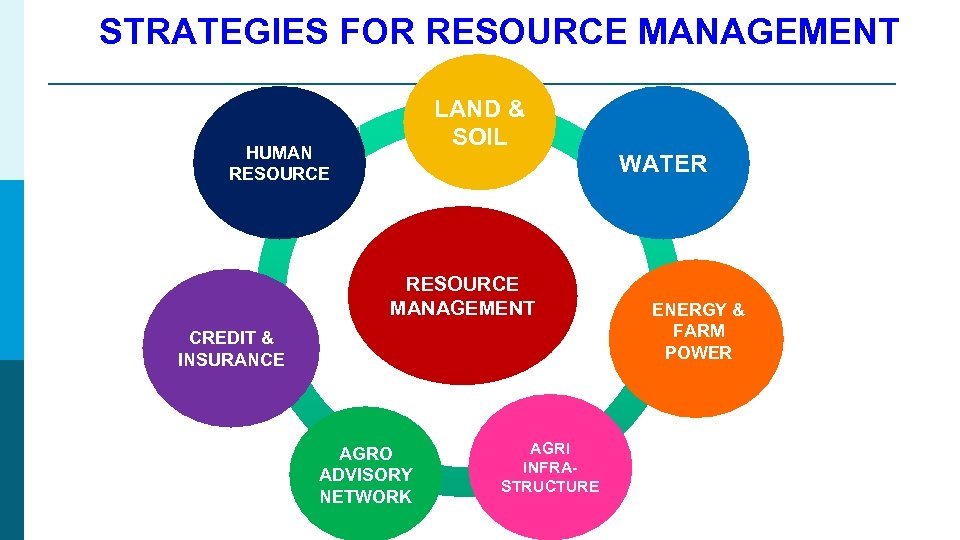
STRATEGIES FOR RESOURCE MANAGEMENT LAND & SOIL HUMAN RESOURCE MANAGEMENT CREDIT & INSURANCE AGRO ADVISORY NETWORK AGRI INFRASTRUCTURE WATER ENERGY & FARM POWER
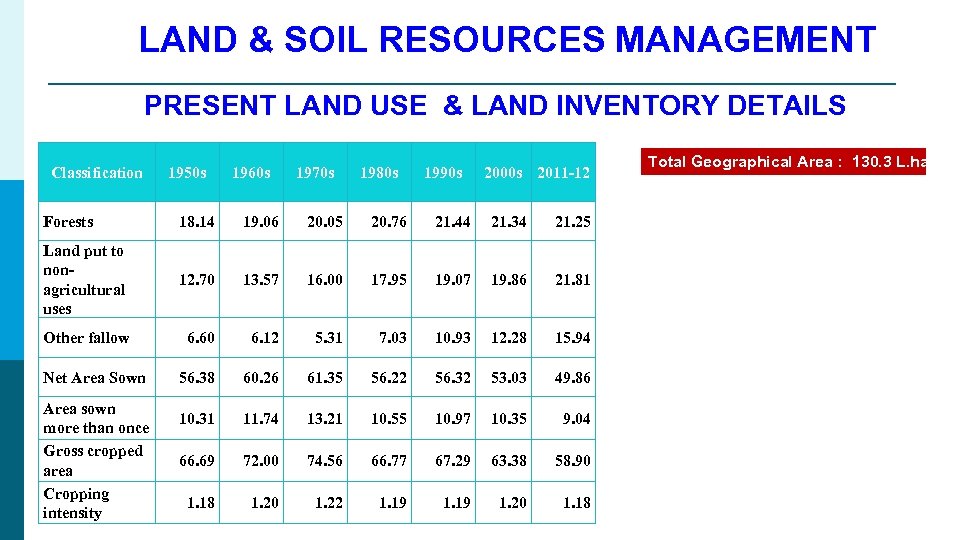
LAND & SOIL RESOURCES MANAGEMENT PRESENT LAND USE & LAND INVENTORY DETAILS Classification 1950 s 1960 s 1970 s 1980 s 1990 s 2000 s 2011 -12 Forests 18. 14 19. 06 20. 05 20. 76 21. 44 21. 34 21. 25 Land put to nonagricultural uses 12. 70 13. 57 16. 00 17. 95 19. 07 19. 86 21. 81 Other fallow 6. 60 6. 12 5. 31 7. 03 10. 93 12. 28 15. 94 56. 38 60. 26 61. 35 56. 22 56. 32 53. 03 49. 86 10. 31 11. 74 13. 21 10. 55 10. 97 10. 35 9. 04 66. 69 72. 00 74. 56 66. 77 67. 29 63. 38 58. 90 1. 18 1. 20 1. 22 1. 19 1. 20 1. 18 Net Area Sown Area sown more than once Gross cropped area Cropping intensity Total Geographical Area : 130. 3 L. ha
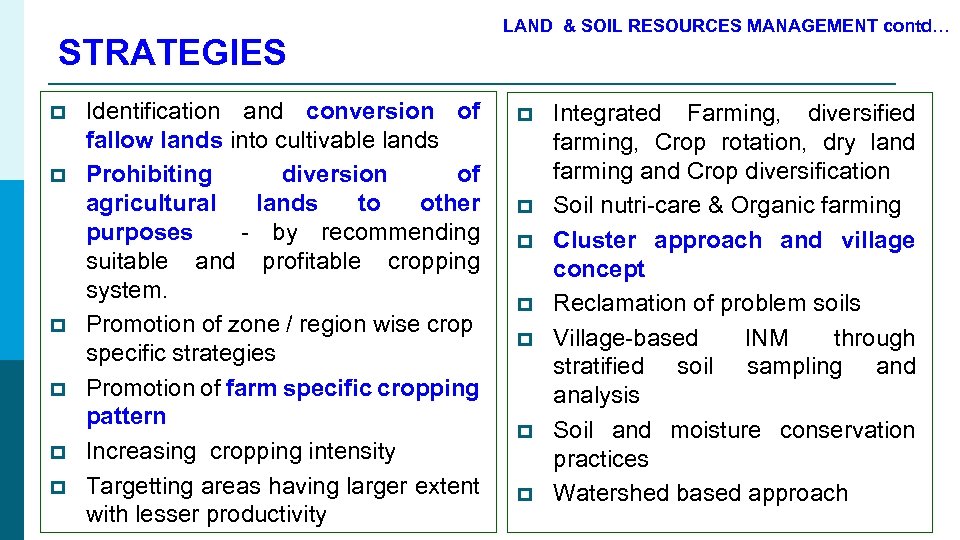
STRATEGIES p p p Identification and conversion of fallow lands into cultivable lands Prohibiting diversion of agricultural lands to other purposes - by recommending suitable and profitable cropping system. Promotion of zone / region wise crop specific strategies Promotion of farm specific cropping pattern Increasing cropping intensity Targetting areas having larger extent with lesser productivity LAND & SOIL RESOURCES MANAGEMENT contd… p p p p Integrated Farming, diversified farming, Crop rotation, dry land farming and Crop diversification Soil nutri-care & Organic farming Cluster approach and village concept Reclamation of problem soils Village-based INM through stratified soil sampling and analysis Soil and moisture conservation practices Watershed based approach
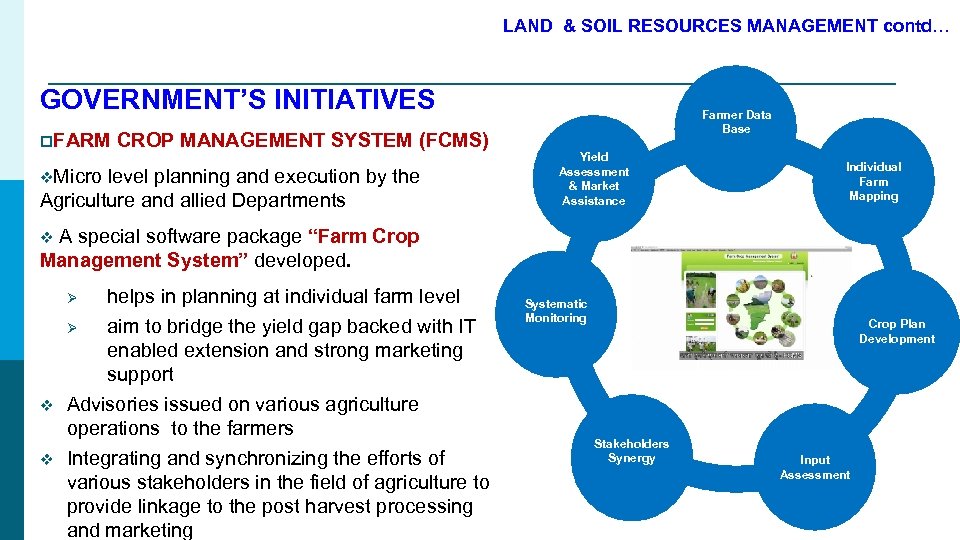
LAND & SOIL RESOURCES MANAGEMENT contd… GOVERNMENT’S INITIATIVES p. FARM CROP MANAGEMENT SYSTEM (FCMS) v. Micro level planning and execution by the Agriculture and allied Departments Farmer Data Base Yield Assessment & Market Assistance Individual Farm Mapping v A special software package “Farm Crop Management System” developed. helps in planning at individual farm level Ø aim to bridge the yield gap backed with IT enabled extension and strong marketing support Advisories issued on various agriculture operations to the farmers Integrating and synchronizing the efforts of various stakeholders in the field of agriculture to provide linkage to the post harvest processing and marketing Ø v v Systematic Monitoring Crop Plan Development Stakeholders Synergy Input Assessment
LAND & SOIL RESOURCES MANAGEMENT contd… GOVERNMENT’S INITIATIVES p BRINGING FALLOW LANDS UNDER CULTIVATION • Hon’ble Chief minister’s announcement • Project area - 12500 acres • Back ended subsidy @ • Rs. 4000/-per acre - development of land water resources • Rs. 1600/-per acre for provision of subsidized critical inputs. • 2013 -14 • Targetted area- 100 acres - Rs. 5. 60 lakhs - initially in one district on pilot basis under NADP. • Developmental works will be taken up in the farmers patta fallow land by the land owners themselves or members of local registered groups with 50% back ended subsidy. 18 • Activities - Ploughing, distribution of Millet & Pulses seeds, application of FYM, distribution of Bio-fertiliser & fertilizer
LAND & SOIL RESOURCES MANAGEMENT contd… FERTILITY STATUS OF SOIL n n Organic matter content has depleted from 1. 26% in 1980 s to 0. 68% in 2010 -11. Nutrient status of Tamil Nadu p p p Nitrogen (N) , Phosphorus (P) - low-medium Potassium (K) - medium Zinc, Copper and Boron - deficient GOVERNMENT’S INITIATIVES p. SOIL SURVEY & LAND USE n Reconnaissance soil survey at taluk level and detailed soil survey at village level - four Soil Survey Units p p p demarcate the area into soil order & series study the characteristics of the soil, nutrient status, Land irrigability, Land capability, Crop suitability etc. Soil profile studied and classified according to United States Department of Agriculture (USDA). Extent of soil mapped on standard topographic base maps interpreted to recommend survey number wise crop management strategies.
LAND & SOIL RESOURCES MANAGEMENT contd… GOVERNMENT’S INITIATIVES SOIL SAMPLING & ANALYSIS: • Programmed to collect and analyze soil samples of 81. 18 lakh farm holdings on fast track approach in 3 years. So far, • 52. 19 lakh soil samples collected • 33. 62 lakh samples analyzed • uploading done in FCMS site. • Action pursued to complete the analysis on mission mode approach by employing JRF • Central Control Laboratory - creating awareness on soil-test–based fertiliser use & imparting training to the laboratory personnel • 30 STLs & 16 MSTLs to expedite soil sample analysis • STLs computerized for uploading details of soil samples in AGRISNET 20 • 24 labs provided with Atomic Absorption Spectrophotometers
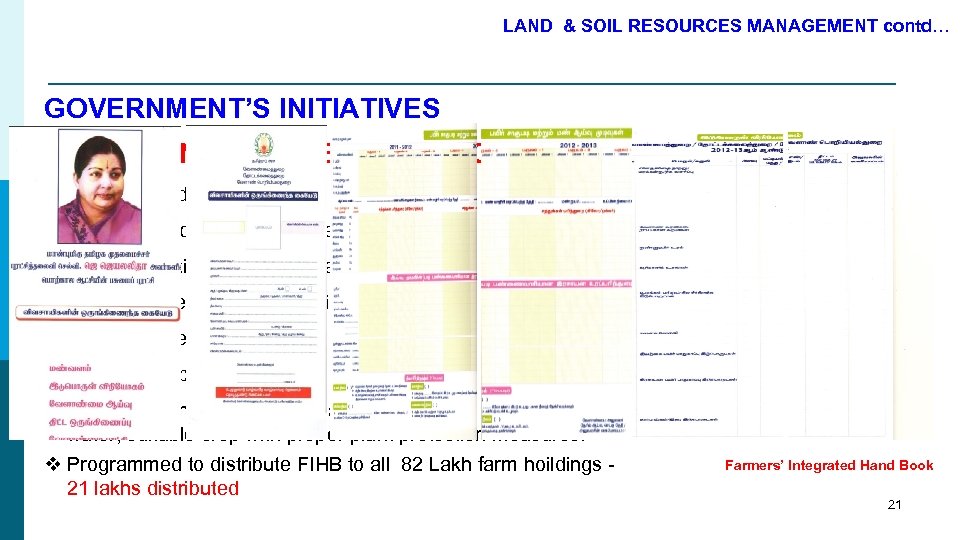
LAND & SOIL RESOURCES MANAGEMENT contd… GOVERNMENT’S INITIATIVES FARMER INTEGRATED HAND BOOK (FIHB) v 3 Year record - § information on type & extent of land § soil nutrition and water status § recommendations for fertilizer application § crop wise productivity § scheme benefits availed. v Plan of action developed for land preparation, optimum use of water, suitable crop with proper plant protection measures. v Programmed to distribute FIHB to all 82 Lakh farm hoildings - 21 lakhs distributed Farmers’ Integrated Hand Book 21
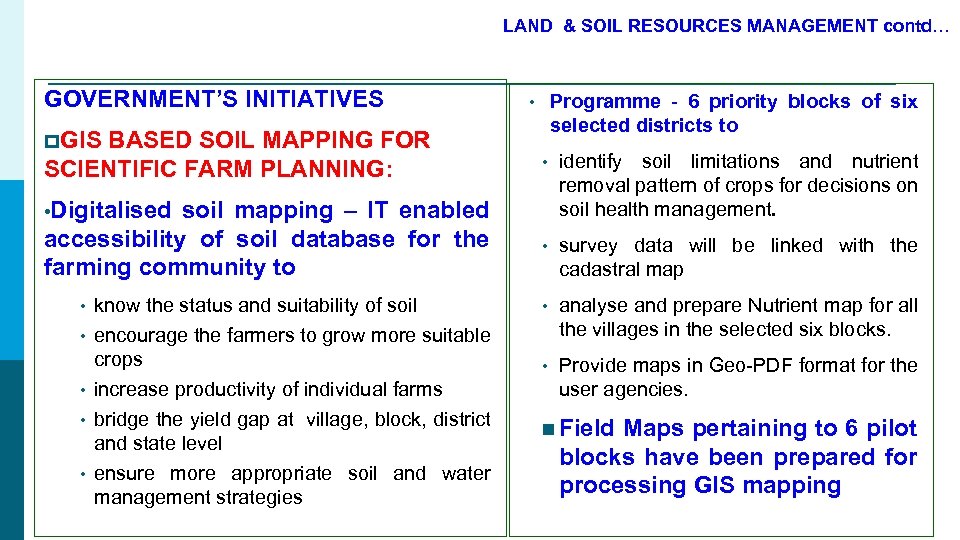
LAND & SOIL RESOURCES MANAGEMENT contd… GOVERNMENT’S INITIATIVES Programme - 6 priority blocks of six selected districts to • p. GIS BASED SOIL MAPPING FOR SCIENTIFIC FARM PLANNING: • identify soil limitations and nutrient removal pattern of crops for decisions on soil health management. • survey data will be linked with the cadastral map • analyse and prepare Nutrient map for all the villages in the selected six blocks. • Provide maps in Geo-PDF format for the user agencies. • Digitalised soil mapping – IT enabled accessibility of soil database for the farming community to • know the status and suitability of soil • encourage the farmers to grow more suitable crops increase productivity of individual farms bridge the yield gap at village, block, district and state level ensure more appropriate soil and water management strategies • • • n Field Maps pertaining to 6 pilot blocks have been prepared for processing GIS mapping
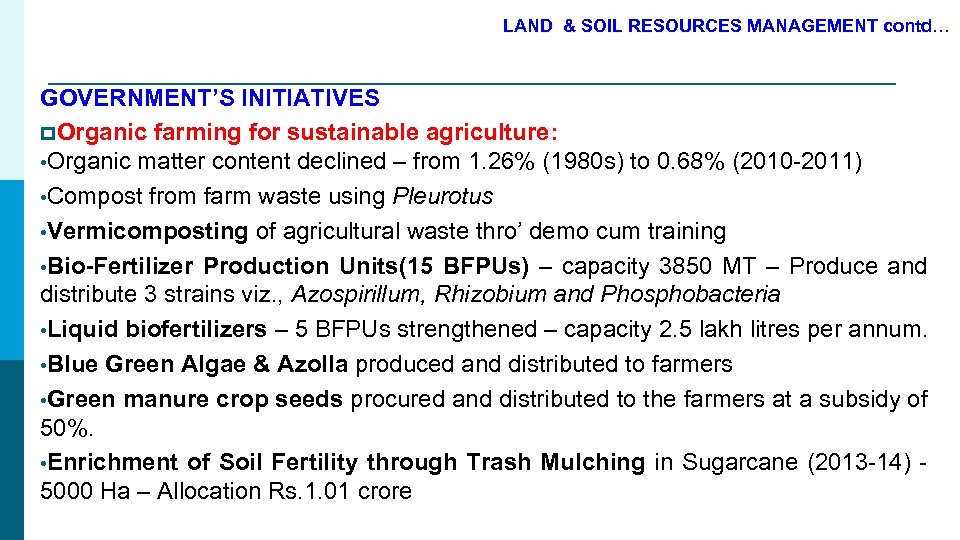
LAND & SOIL RESOURCES MANAGEMENT contd… GOVERNMENT’S INITIATIVES p. Organic farming for sustainable agriculture: • Organic matter content declined – from 1. 26% (1980 s) to 0. 68% (2010 -2011) • Compost from farm waste using Pleurotus • Vermicomposting of agricultural waste thro’ demo cum training • Bio-Fertilizer Production Units(15 BFPUs) – capacity 3850 MT – Produce and distribute 3 strains viz. , Azospirillum, Rhizobium and Phosphobacteria • Liquid biofertilizers – 5 BFPUs strengthened – capacity 2. 5 lakh litres per annum. • Blue Green Algae & Azolla produced and distributed to farmers • Green manure crop seeds procured and distributed to the farmers at a subsidy of 50%. • Enrichment of Soil Fertility through Trash Mulching in Sugarcane (2013 -14) - 5000 Ha – Allocation Rs. 1. 01 crore
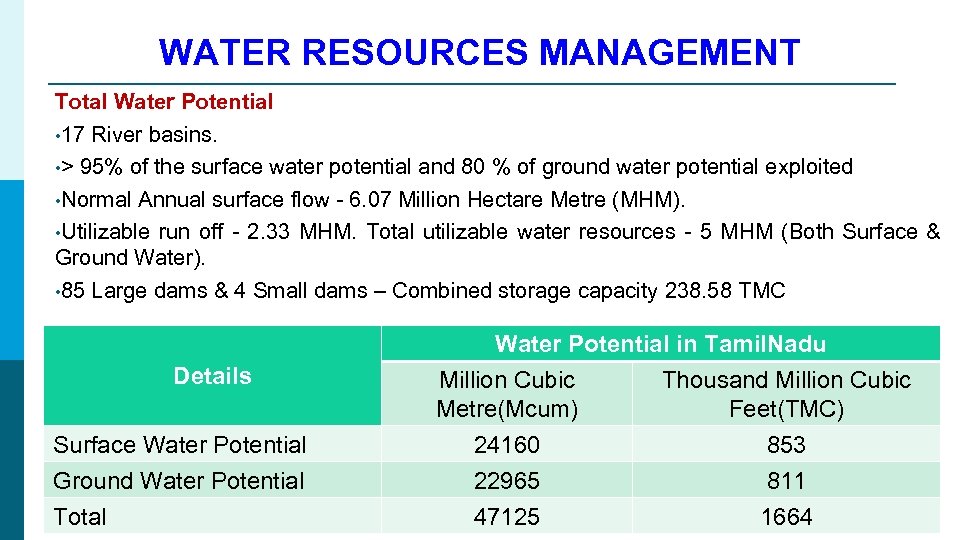
WATER RESOURCES MANAGEMENT Total Water Potential • 17 River basins. • > 95% of the surface water potential and 80 % of ground water potential exploited • Normal Annual surface flow - 6. 07 Million Hectare Metre (MHM). • Utilizable run off - 2. 33 MHM. Total utilizable water resources - 5 MHM (Both Surface & Ground Water). • 85 Large dams & 4 Small dams – Combined storage capacity 238. 58 TMC Details Surface Water Potential Ground Water Potential Total Water Potential in Tamil. Nadu Million Cubic Thousand Million Cubic Metre(Mcum) Feet(TMC) 24160 22965 47125 853 811 1664
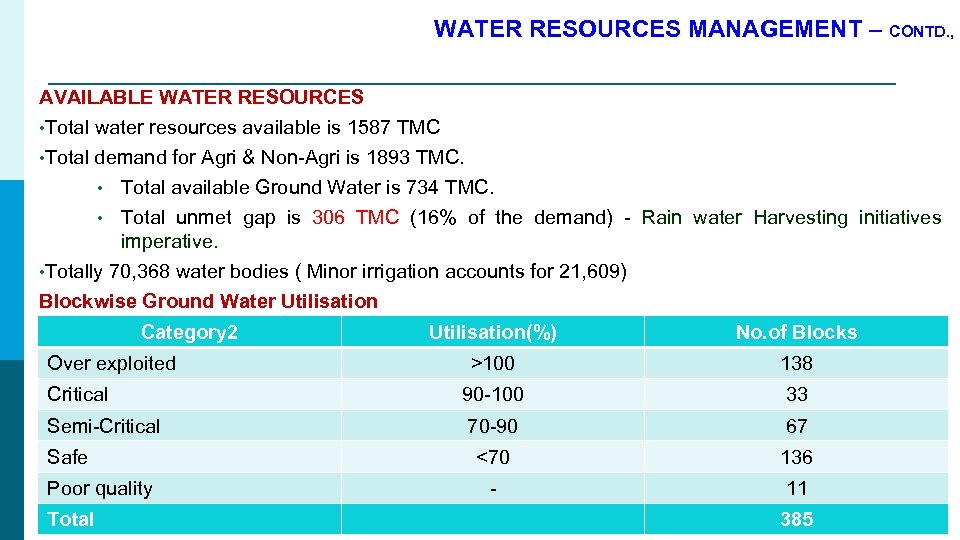
WATER RESOURCES MANAGEMENT – CONTD. , AVAILABLE WATER RESOURCES • Total water resources available is 1587 TMC • Total demand for Agri & Non-Agri is 1893 TMC. Total available Ground Water is 734 TMC. • Total unmet gap is 306 TMC (16% of the demand) - Rain water Harvesting initiatives imperative. • Totally 70, 368 water bodies ( Minor irrigation accounts for 21, 609) Blockwise Ground Water Utilisation • Category 2 Utilisation(%) No. of Blocks >100 138 Critical 90 -100 33 Semi-Critical 70 -90 67 <70 136 - 11 Over exploited Safe Poor quality Total 385
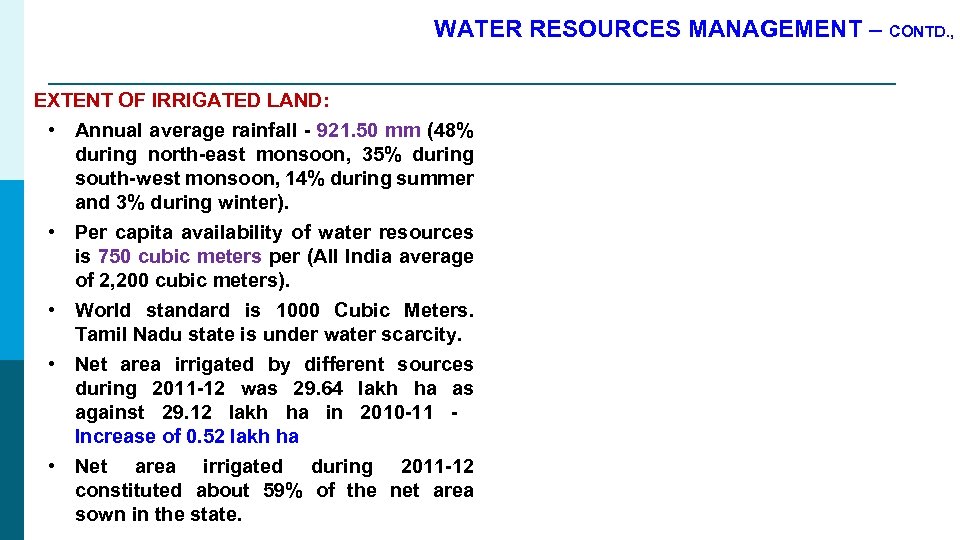
WATER RESOURCES MANAGEMENT – CONTD. , EXTENT OF IRRIGATED LAND: • Annual average rainfall - 921. 50 mm (48% during north-east monsoon, 35% during south-west monsoon, 14% during summer and 3% during winter). • Per capita availability of water resources is 750 cubic meters per (All India average of 2, 200 cubic meters). • World standard is 1000 Cubic Meters. Tamil Nadu state is under water scarcity. • Net area irrigated by different sources during 2011 -12 was 29. 64 lakh ha as against 29. 12 lakh ha in 2010 -11 - Increase of 0. 52 lakh ha • Net area irrigated during 2011 -12 constituted about 59% of the net area sown in the state.
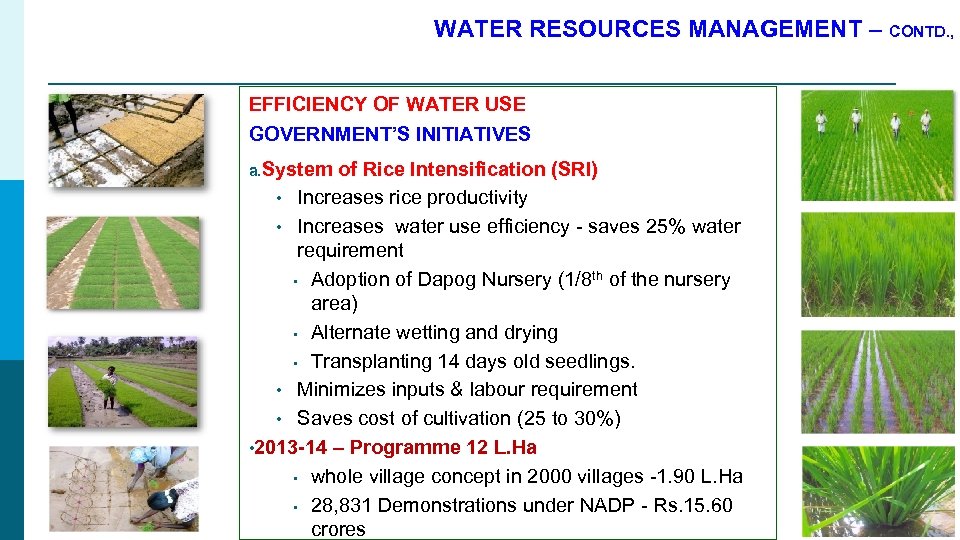
WATER RESOURCES MANAGEMENT – CONTD. , EFFICIENCY OF WATER USE GOVERNMENT’S INITIATIVES a. System of Rice Intensification (SRI) Increases rice productivity • Increases water use efficiency - saves 25% water requirement • Adoption of Dapog Nursery (1/8 th of the nursery area) • Alternate wetting and drying • Transplanting 14 days old seedlings. • Minimizes inputs & labour requirement • Saves cost of cultivation (25 to 30%) • 2013 -14 – Programme 12 L. Ha • whole village concept in 2000 villages -1. 90 L. Ha • 28, 831 Demonstrations under NADP - Rs. 15. 60 crores •
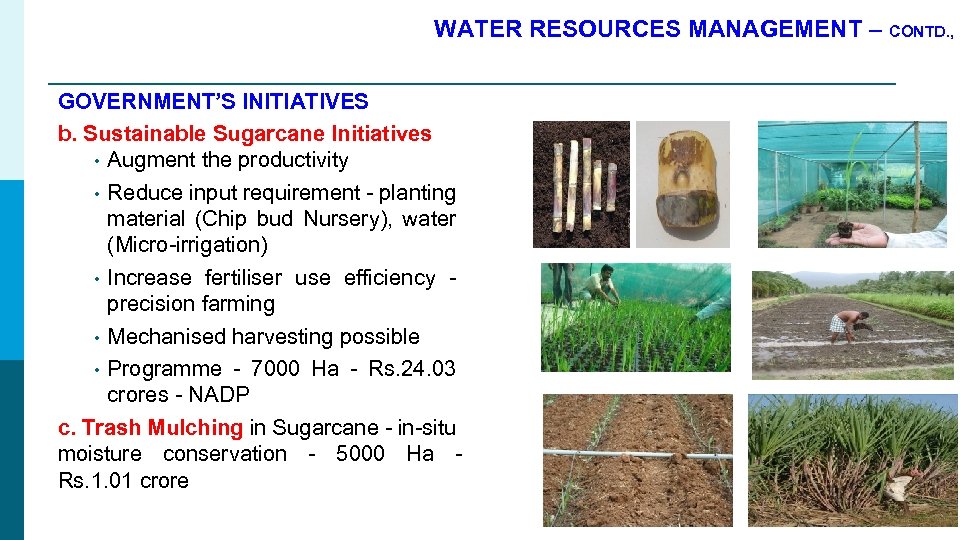
WATER RESOURCES MANAGEMENT – CONTD. , GOVERNMENT’S INITIATIVES b. Sustainable Sugarcane Initiatives • Augment the productivity • Reduce input requirement - planting material (Chip bud Nursery), water (Micro-irrigation) • Increase fertiliser use efficiency - precision farming • Mechanised harvesting possible • Programme - 7000 Ha - Rs. 24. 03 crores - NADP c. Trash Mulching in Sugarcane - in-situ moisture conservation - 5000 Ha Rs. 1. 01 crore
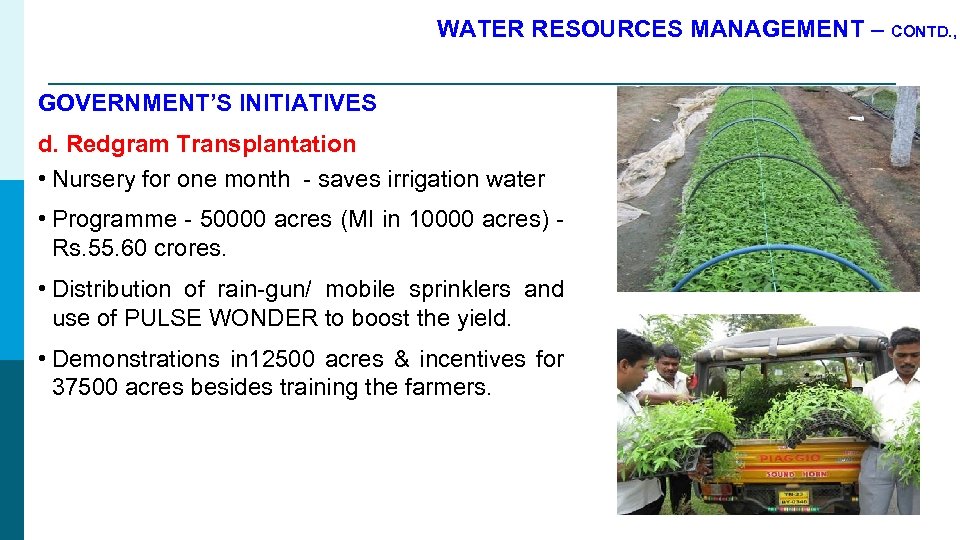
WATER RESOURCES MANAGEMENT – CONTD. , GOVERNMENT’S INITIATIVES d. Redgram Transplantation • Nursery for one month - saves irrigation water • Programme - 50000 acres (MI in 10000 acres) - Rs. 55. 60 crores. • Distribution of rain-gun/ mobile sprinklers and use of PULSE WONDER to boost the yield. • Demonstrations in 12500 acres & incentives for 37500 acres besides training the farmers.
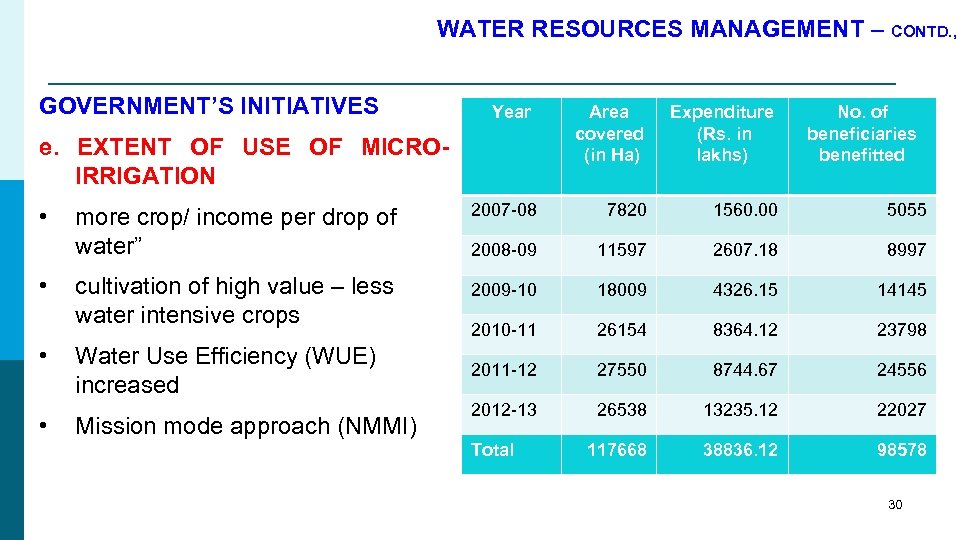
WATER RESOURCES MANAGEMENT – CONTD. , GOVERNMENT’S INITIATIVES Year e. EXTENT OF USE OF MICROIRRIGATION • • Area covered (in Ha) Expenditure (Rs. in lakhs) No. of beneficiaries benefitted more crop/ income per drop of water” 2007 -08 7820 1560. 00 5055 2008 -09 11597 2607. 18 8997 cultivation of high value – less water intensive crops 2009 -10 18009 4326. 15 14145 2010 -11 26154 8364. 12 23798 2011 -12 27550 8744. 67 24556 2012 -13 26538 13235. 12 22027 117668 38836. 12 98578 Water Use Efficiency (WUE) increased Mission mode approach (NMMI) Total 30
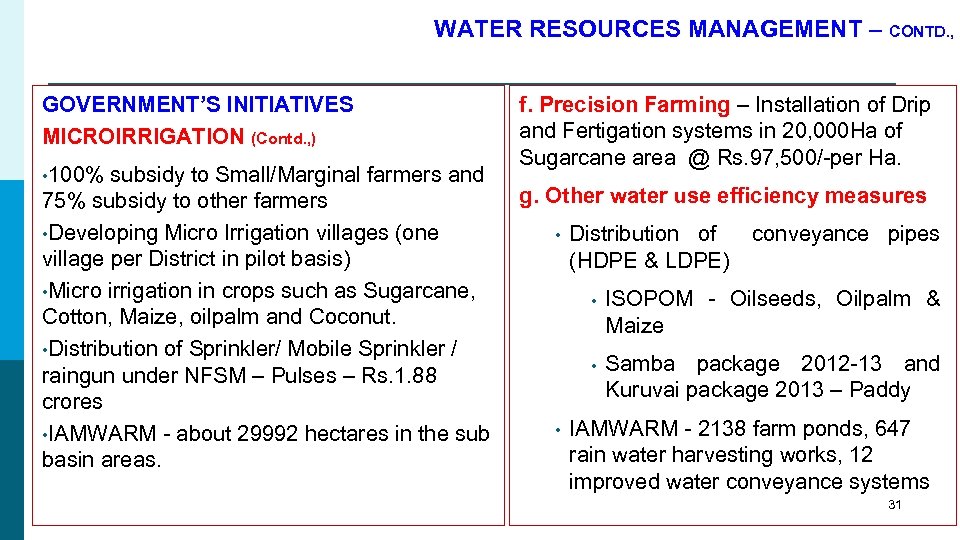
WATER RESOURCES MANAGEMENT – CONTD. , GOVERNMENT’S INITIATIVES MICROIRRIGATION (Contd. , ) • 100% subsidy to Small/Marginal farmers and 75% subsidy to other farmers • Developing Micro Irrigation villages (one village per District in pilot basis) • Micro irrigation in crops such as Sugarcane, Cotton, Maize, oilpalm and Coconut. • Distribution of Sprinkler/ Mobile Sprinkler / raingun under NFSM – Pulses – Rs. 1. 88 crores • IAMWARM - about 29992 hectares in the sub basin areas. f. Precision Farming – Installation of Drip and Fertigation systems in 20, 000 Ha of Sugarcane area @ Rs. 97, 500/-per Ha. g. Other water use efficiency measures • Distribution of conveyance pipes (HDPE & LDPE) • • • ISOPOM - Oilseeds, Oilpalm & Maize Samba package 2012 -13 and Kuruvai package 2013 – Paddy IAMWARM - 2138 farm ponds, 647 rain water harvesting works, 12 improved water conveyance systems 31
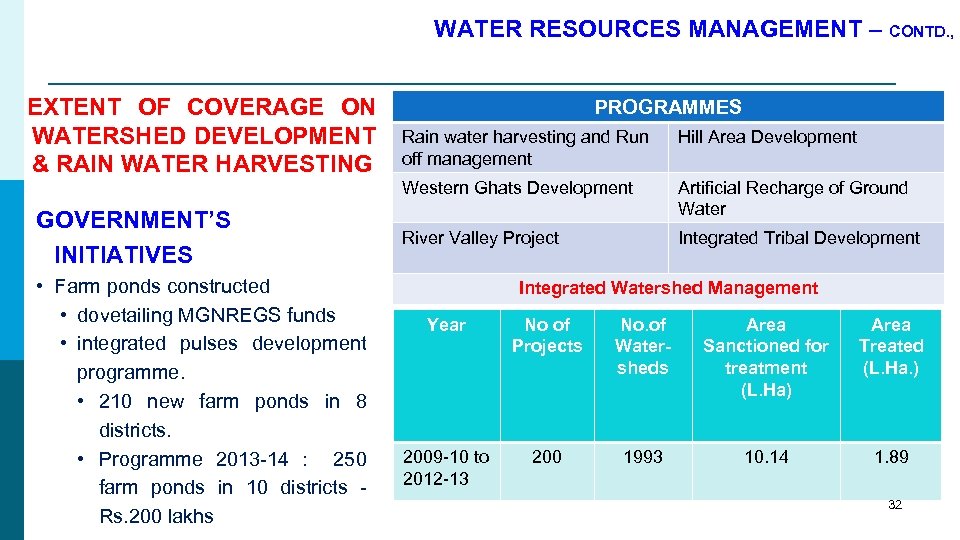
WATER RESOURCES MANAGEMENT – CONTD. , EXTENT OF COVERAGE ON WATERSHED DEVELOPMENT & RAIN WATER HARVESTING GOVERNMENT’S INITIATIVES • Farm ponds constructed • dovetailing MGNREGS funds • integrated pulses development programme. • 210 new farm ponds in 8 districts. • Programme 2013 -14 : 250 farm ponds in 10 districts - Rs. 200 lakhs PROGRAMMES Rain water harvesting and Run off management Hill Area Development Western Ghats Development Artificial Recharge of Ground Water River Valley Project Integrated Tribal Development Integrated Watershed Management Year No of Projects No. of Watersheds Area Sanctioned for treatment (L. Ha) Area Treated (L. Ha. ) 2009 -10 to 2012 -13 200 1993 10. 14 1. 89 32
WATER RESOURCES MANAGEMENT – CONTD. , STRATEGIES TO INCREASE THE EFFICIENCY OF WATER USE • Improving water holding capacity of sub-basins & bringing more cropped area under irrigation • SRI technology, Precision farming, Sustainable Sugarcane Initiatives, Micro Irrigation in a larger extent. • Intensification of irrigated area development and water management schemes. • Improving water resources - farm ponds, de-silting of lakes & ponds, percolation pond formation etc. • Rain water harvesting • Identification of fallows to cultivate less water intensive and more remunerative crops(Crop Diversification)
WATER RESOURCES MANAGEMENT – CONTD. , STRATEGIES TO IMPROVE EFFICIENCY IN AUGMENTATION AND APPLICATION OF WATER p. Improvement of land suitability & capability p. Improvement of moisture regime in the watersheds p. Conservation of soil moisture and prevention of soil erosion on Mission Mode p. Prevention of soil loss in the catchments to reduce siltation of multipurpose reservoirs and enhance the in-situ moisture through River Valley Project programme p. Conservation and surface rainwater storage in the catchments to reduce flood peaks and volumes of runoff p. Creation of farm ponds p. Buried pipe line system below the sluice outlet p. Improve controlling system of irrigation water in a closed conduit by the use of hydrants
ENERGY & FARM POWER LEVEL OF ENERGY USE IN AGRICULTURE FROM DIFFERENT SOURCES: • Animal power contributed 16. 38% in 2001 -02 (60. 37% GOVERNMENT’S INITIATIVES a. SOLAR PUMPSETS • 530 solar powered agriculture pump sets to be installed during 2013 -14 - Further 2000 Nos. of 5 HP solar PV pumping system will be procured during 2013 -14. p. SOLAR ENERGY • Out of total cost, • Government of Tamil Nadu has come out with a Solar • 50% will be met from National Agriculture Development Programme in 1971 -72 ) • Mechanical and electrical together contributed 83. 62% in 2001 -02 (39. 63% in 1971 -72) Energy Policy, 2012 • proposed to encourage and popularize use of solar energy in Agricultural sector • 30 % from the Ministry of New and Renewable Energy • providing a package of Solar PV Pumping System linked with suitable Micro Irrigation System • Balance 20% shall be farmer’s contribution to be met partly through loan and partly through farmer’s direct contribution. • forward linkage of precision faming / front-end technologies, crop specific improved cultivation methods etc. , to the progressive farmers of the State on a pilot basis • Each pump will have solar panel of 4800 Wp capacity and will deliver water equivalent to that of a 5 HP AC submersible pumpset.
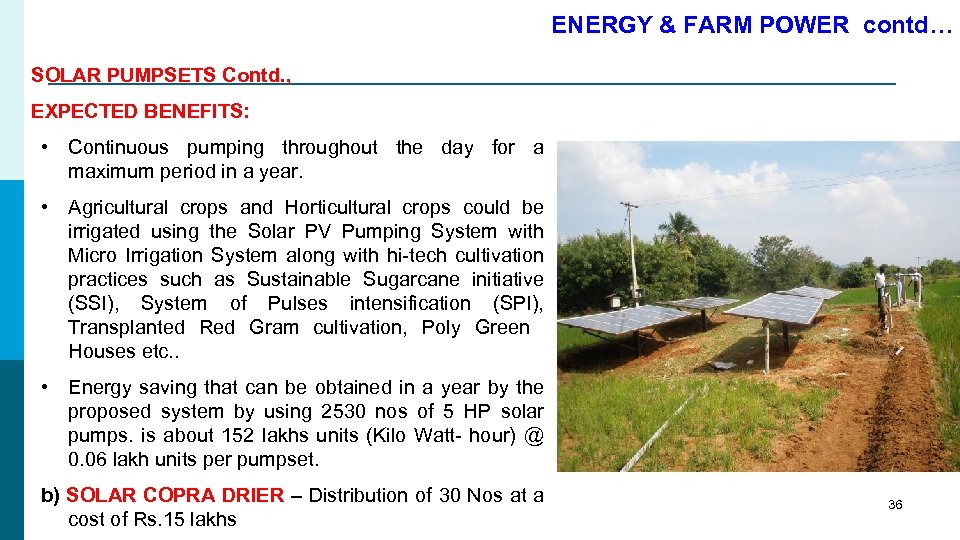
ENERGY & FARM POWER contd… SOLAR PUMPSETS Contd. , EXPECTED BENEFITS: • Continuous pumping throughout the day for a maximum period in a year. • Agricultural crops and Horticultural crops could be irrigated using the Solar PV Pumping System with Micro Irrigation System along with hi-tech cultivation practices such as Sustainable Sugarcane initiative (SSI), System of Pulses intensification (SPI), Transplanted Red Gram cultivation, Poly Green Houses etc. . • Energy saving that can be obtained in a year by the proposed system by using 2530 nos of 5 HP solar pumps. is about 152 lakhs units (Kilo Watt- hour) @ 0. 06 lakh units per pumpset. b) SOLAR COPRA DRIER – Distribution of 30 Nos at a cost of Rs. 15 lakhs 36
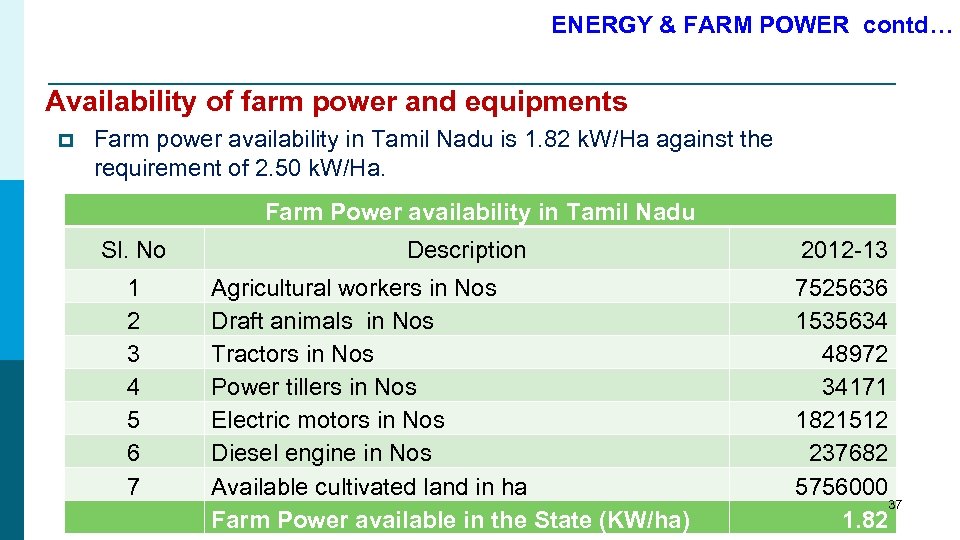
ENERGY & FARM POWER contd… Availability of farm power and equipments p Farm power availability in Tamil Nadu is 1. 82 k. W/Ha against the requirement of 2. 50 k. W/Ha. Farm Power availability in Tamil Nadu Sl. No 1 2 3 4 5 6 7 Description Agricultural workers in Nos Draft animals in Nos Tractors in Nos Power tillers in Nos Electric motors in Nos Diesel engine in Nos Available cultivated land in ha Farm Power available in the State (KW/ha) 2012 -13 7525636 1535634 48972 34171 1821512 237682 5756000 37 1. 82
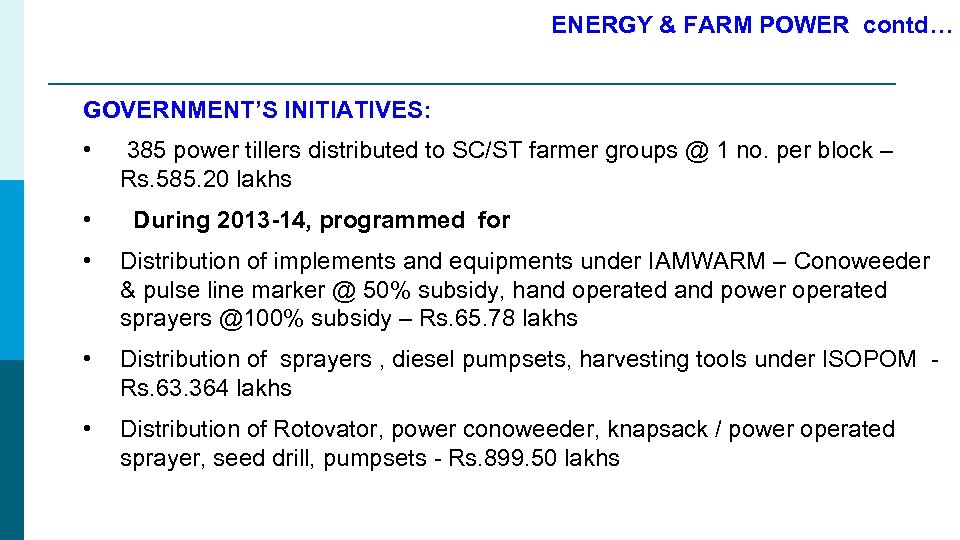
ENERGY & FARM POWER contd… GOVERNMENT’S INITIATIVES: • 385 power tillers distributed to SC/ST farmer groups @ 1 no. per block – Rs. 585. 20 lakhs • During 2013 -14, programmed for • Distribution of implements and equipments under IAMWARM – Conoweeder & pulse line marker @ 50% subsidy, hand operated and power operated sprayers @100% subsidy – Rs. 65. 78 lakhs • Distribution of sprayers , diesel pumpsets, harvesting tools under ISOPOM - Rs. 63. 364 lakhs • Distribution of Rotovator, power conoweeder, knapsack / power operated sprayer, seed drill, pumpsets - Rs. 899. 50 lakhs
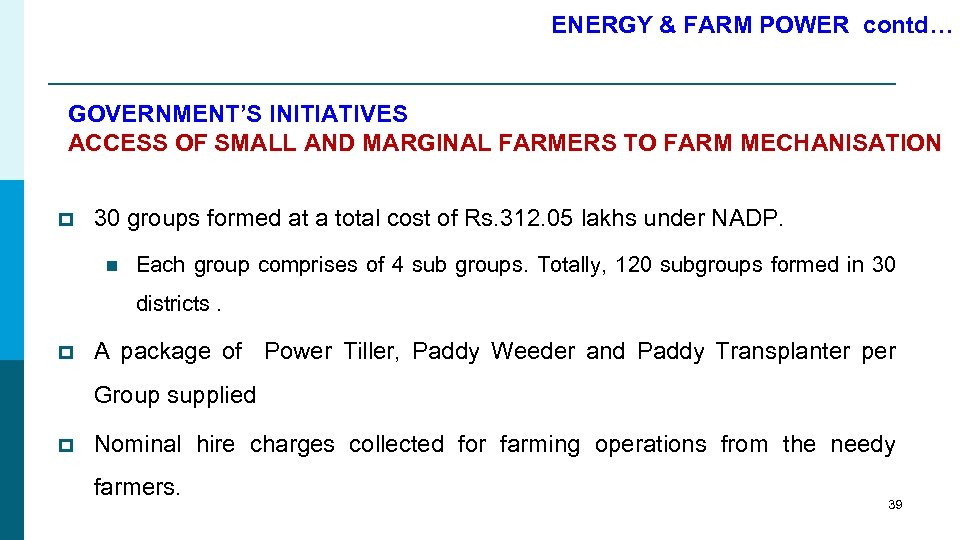
ENERGY & FARM POWER contd… GOVERNMENT’S INITIATIVES ACCESS OF SMALL AND MARGINAL FARMERS TO FARM MECHANISATION p 30 groups formed at a total cost of Rs. 312. 05 lakhs under NADP. n Each group comprises of 4 sub groups. Totally, 120 subgroups formed in 30 districts. p A package of Power Tiller, Paddy Weeder and Paddy Transplanter per Group supplied p Nominal hire charges collected for farming operations from the needy farmers. 39
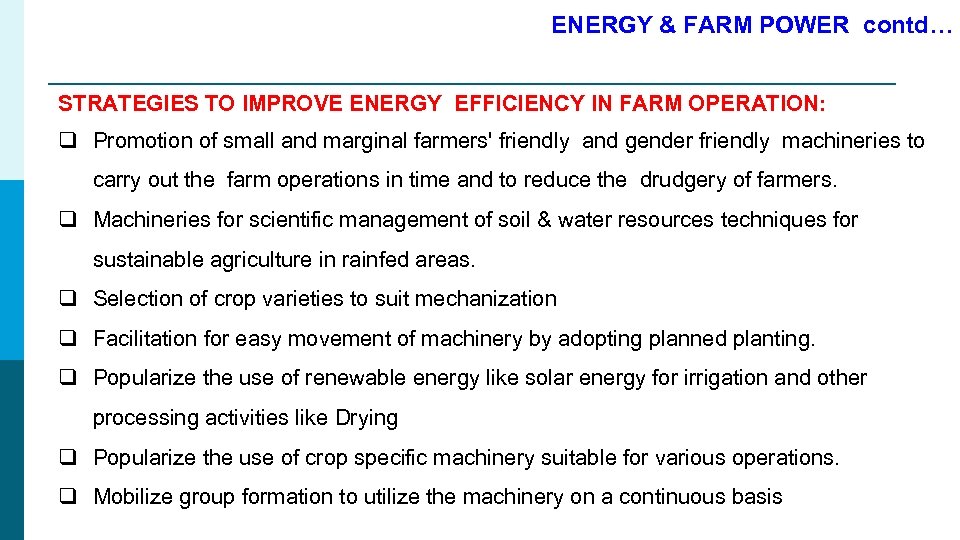
ENERGY & FARM POWER contd… STRATEGIES TO IMPROVE ENERGY EFFICIENCY IN FARM OPERATION: q Promotion of small and marginal farmers' friendly and gender friendly machineries to carry out the farm operations in time and to reduce the drudgery of farmers. q Machineries for scientific management of soil & water resources techniques for sustainable agriculture in rainfed areas. q Selection of crop varieties to suit mechanization q Facilitation for easy movement of machinery by adopting planned planting. q Popularize the use of renewable energy like solar energy for irrigation and other processing activities like Drying q Popularize the use of crop specific machinery suitable for various operations. q Mobilize group formation to utilize the machinery on a continuous basis
ENERGY & FARM POWER contd… STRATEGIES TO IMPROVE AGRICULTURAL MECHANISATION: • Identification and popularization of crop specific machine. • Creation of Awareness among the farmers • Conducting demonstration on operation of Agricultural Machinery. • Imparting hands on training in operating machinery by farmers themselves. • Training to Rural Youths in maintenance and repairing the machinery. • Developing service centres for Agricultural Equipments and Machinery through trained persons. • Promoting the local manufacturers of Agricultural Machinery and implements under the guidance of AMRC, TNAU. • Encouraging localized custom hiring for promotion of seed to seed machinery like GREEN ARMY in Kerala State 41
AGRICULTURE INFRASTRUCTURE AVAILABLE INFRASTRUCTURE • 885 Agriculture Extension Centres – 379 main centres ; 506 subcentres – provide agriculture inputs to farmers • 41 State seed farms & 22 coconut nurseries – seed & seedling production, model farm for improved crop production technologies • 81 Seed processing units – annual capacity of 29, 600 MT • Quality Control Laboratories – 14 Fertilizer Testing Laboratories, 15 Pesticide Testing Laboratories • • • Soil testing Laboratories – 30 STL, 16 MSTL Seed Testing Labs – 32 Labs provided with DNA Fp– 7 Bt Lab attached with DSC– 1 Inputs Production Centres Biofertilizers -15 (Liquid Bio- fertilzers in 5 BFPUs) p Annual capacity – 3850 MT • • Biocontrol Agents- 12 Parasites Breeding Centres - 21 (Sugarcane) 20 (Coconut) • 42
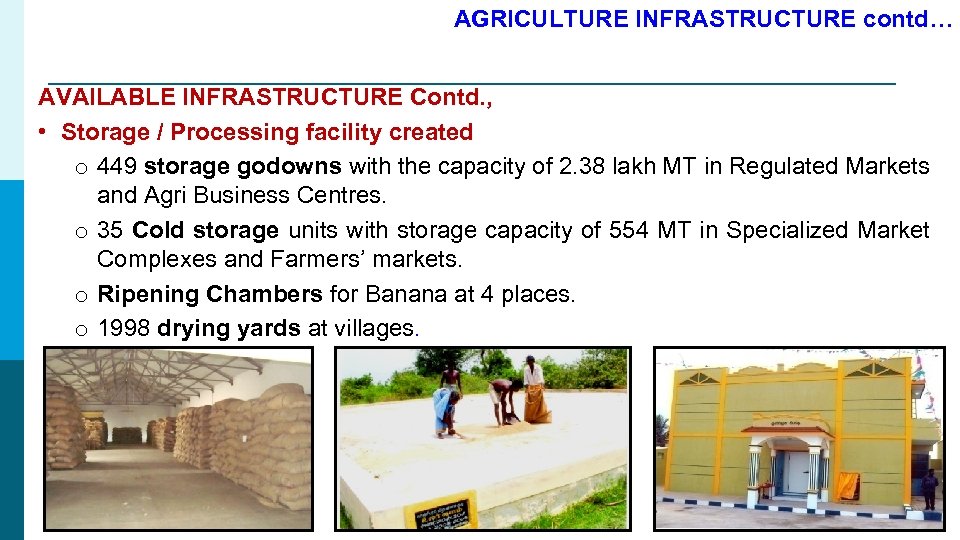
AGRICULTURE INFRASTRUCTURE contd… AVAILABLE INFRASTRUCTURE Contd. , • Storage / Processing facility created o 449 storage godowns with the capacity of 2. 38 lakh MT in Regulated Markets and Agri Business Centres. o 35 Cold storage units with storage capacity of 554 MT in Specialized Market Complexes and Farmers’ markets. o Ripening Chambers for Banana at 4 places. o 1998 drying yards at villages.
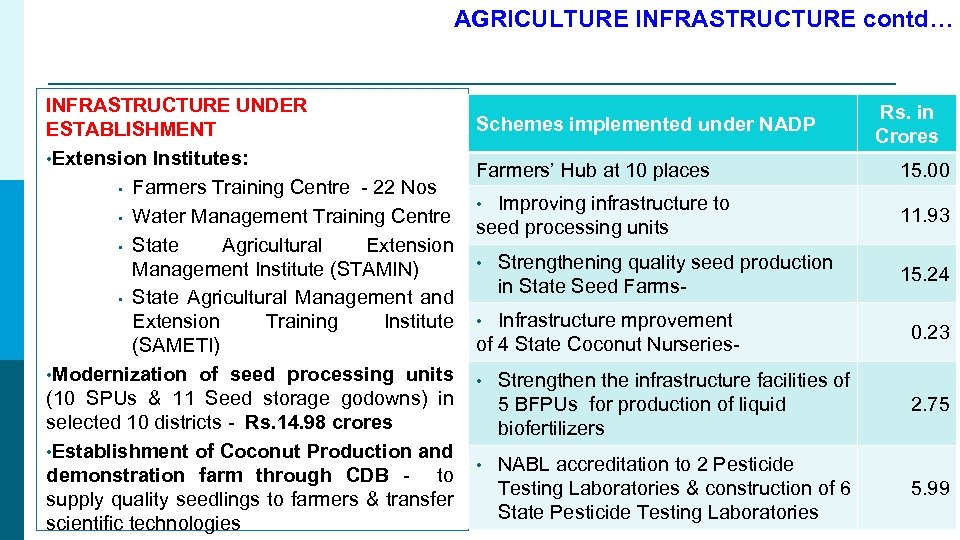
AGRICULTURE INFRASTRUCTURE contd… INFRASTRUCTURE UNDER ESTABLISHMENT • Extension Institutes: • Farmers Training Centre - 22 Nos • Water Management Training Centre • State Agricultural Extension Management Institute (STAMIN) • State Agricultural Management and Extension Training Institute (SAMETI) • Modernization of seed processing units (10 SPUs & 11 Seed storage godowns) in selected 10 districts - Rs. 14. 98 crores • Establishment of Coconut Production and demonstration farm through CDB - to supply quality seedlings to farmers & transfer scientific technologies Schemes implemented under NADP Rs. in Crores Farmers’ Hub at 10 places 15. 00 Improving infrastructure to seed processing units 11. 93 • • Strengthening quality seed production in State Seed Farms- Infrastructure mprovement of 4 State Coconut Nurseries- • • • 15. 24 0. 23 Strengthen the infrastructure facilities of 5 BFPUs for production of liquid biofertilizers 2. 75 NABL accreditation to 2 Pesticide Testing Laboratories & construction of 6 State Pesticide Testing Laboratories 5. 99
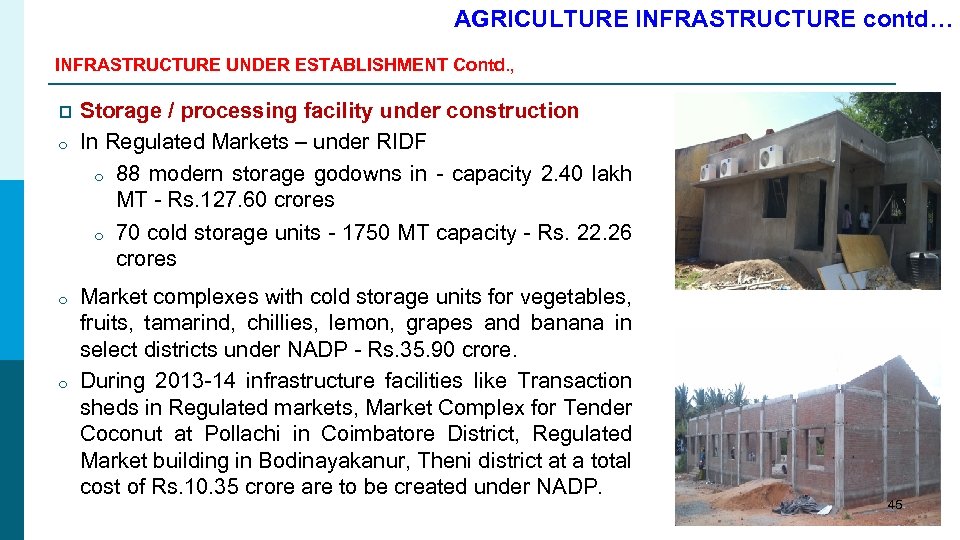
AGRICULTURE INFRASTRUCTURE contd… INFRASTRUCTURE UNDER ESTABLISHMENT Contd. , p o o o Storage / processing facility under construction In Regulated Markets – under RIDF o 88 modern storage godowns in - capacity 2. 40 lakh MT - Rs. 127. 60 crores o 70 cold storage units - 1750 MT capacity - Rs. 22. 26 crores Market complexes with cold storage units for vegetables, fruits, tamarind, chillies, lemon, grapes and banana in select districts under NADP - Rs. 35. 90 crore. During 2013 -14 infrastructure facilities like Transaction sheds in Regulated markets, Market Complex for Tender Coconut at Pollachi in Coimbatore District, Regulated Market building in Bodinayakanur, Theni district at a total cost of Rs. 10. 35 crore are to be created under NADP. 45
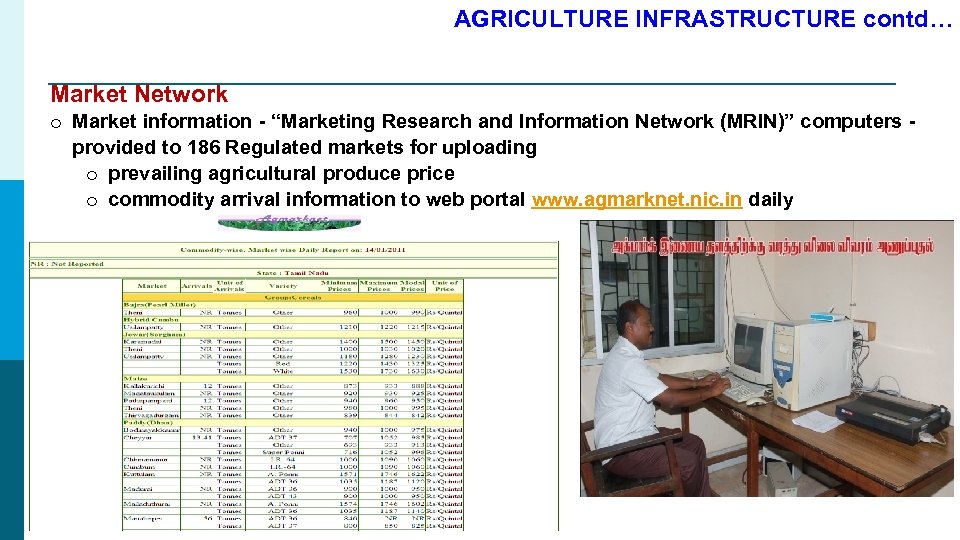
AGRICULTURE INFRASTRUCTURE contd… Market Network o Market information - “Marketing Research and Information Network (MRIN)” computers - provided to 186 Regulated markets for uploading o prevailing agricultural produce price o commodity arrival information to web portal www. agmarknet. nic. in daily
AGRICULTURE INFRASTRUCTURE contd… PRIVATE INVESTMENT IN AGRICULTURAL INFRASTRUCTURE • Modern Terminal Markets with all value addition facilities near metro areas - Terminal Market Complex o Coimbatore - 48 acres - Rs. 120. 63 crores - Construction of core infrastructure is in progress. o Chennai - 35 acres - Rs. 113. 85 crores. o Madurai - 50 acres - Rs. 105. 05 crores. o ‘Agro Processing units’ with farmers’ participation in a cluster approach.
AGRICULTURE INFRASTRUCTURE contd… SCOPE FOR IMPROVING INFRASTRUCTURE : • Development and maintenance of rural infrastructure with the participation of local communities, farmers and traders. • Improving infrastructure facilities for seed production, processing and storage involving farmers, women Self Help Groups and NGOs with back ended subsidy. • Local organisations, agencies & groups - centre for setting of priorities, planning of facilities and contribute to the provision of infrastructure. • Beneficiaries - to identify the real needs and team up in the infrastructure creation programmes. • A close interaction between farmers, extension workers and researchers is needed for diagnosing problems together and working out location specific recommendations. • Private investment in - seed storage godowns, processing units, cold storage , post harvest processing units etc. ,
AGRICULTURE INFRASTRUCTURE contd… SCOPE FOR IMPROVING INFRASTRUCTURE : o Post production loss - 10 -15% in total cereals and pulses - 30 -40% in fruits and vegetables. o Small and marginal farmers - lack to produce marketable surplus for larger and remunerative markets. o Farm gate sales are high in the State due to lack of information on market prices and on quality parameters of farm produce. o Inadequate Infrastructure facilities for agricultural marketing in rural areas 49
AGRO ADVISORY NETWORK GOVERNMENT’S INITIATIVES: • Single window system • to provide multi disciplinary advisories • To provide quality inputs, best services, information • transfer of technology to farmers in time at block level • Uzhavar peruvizha (Farmers Mass Contact Programme) • announced by Hon’ble Chief Minister • multidisciplinary awareness campaign • During 2013 -14 : 16, 208 villages covered - Rs. 43. 66 Crores - Nearly 42. 85 lakh farmers participated. • Farmers Hub • Farmers Training Centre , Water Management Training Centre , STAMIN & SAMETI - Dissemination of scientific know-how to augment income generating activities and 50 improve the standard of living of the farmers`
AGRO ADVISORY NETWORK – Contd. , GOVERNMENT’S INITIATIVES: n • • ATMA New approach in transfer of technologies - vital link between extension functionaries & farmers at village level To promote group based approach involve farmers in planning and execution of schemes to suit their needs provide man power and technical support at various levels • Extension functionaries placed at block levels – 385 BTM, 770 SMS • 8166 Farmer’s Friend positioned at village level to mobilize Farmer’s Groups and facilitate dissemination of information to farming community. PERFORMANCE OF ATMA ACTIVITIES DURING 2012 -13: • Training- 1163 • Demonstrations- 6246 • Exposure visit • Interstate- 148 • Within State- 1082 • Exhibitions- 22 • Farmers-Scientists Interaction- 47 • Farm Schools- 769 51
AGRO ADVISORY NETWORK – Contd. , IT BASED GOVERNMENT’S INITIATIVES: • Strengthening Extension System with power of Information Technology • Maintenance of Individual Farm Holding and Soil Health Database on AGRISNET. • GPRS enabled Personal Digital Assistants (PDA) and Pico Mini Projector for knowledge and 52 Technology Transfer.
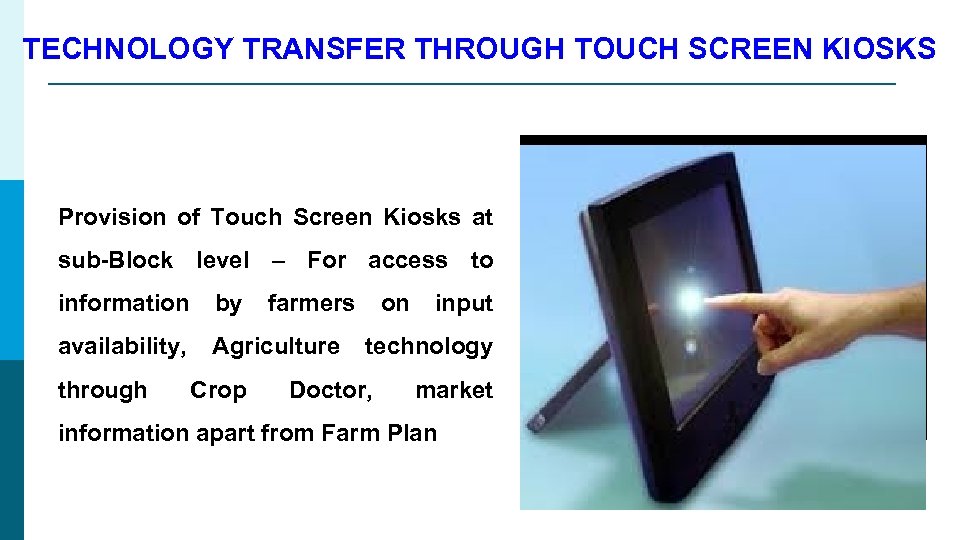
TECHNOLOGY TRANSFER THROUGH TOUCH SCREEN KIOSKS Provision of Touch Screen Kiosks at sub-Block level – For access to information by farmers on input availability, Agriculture technology through Crop Doctor, market information apart from Farm Plan
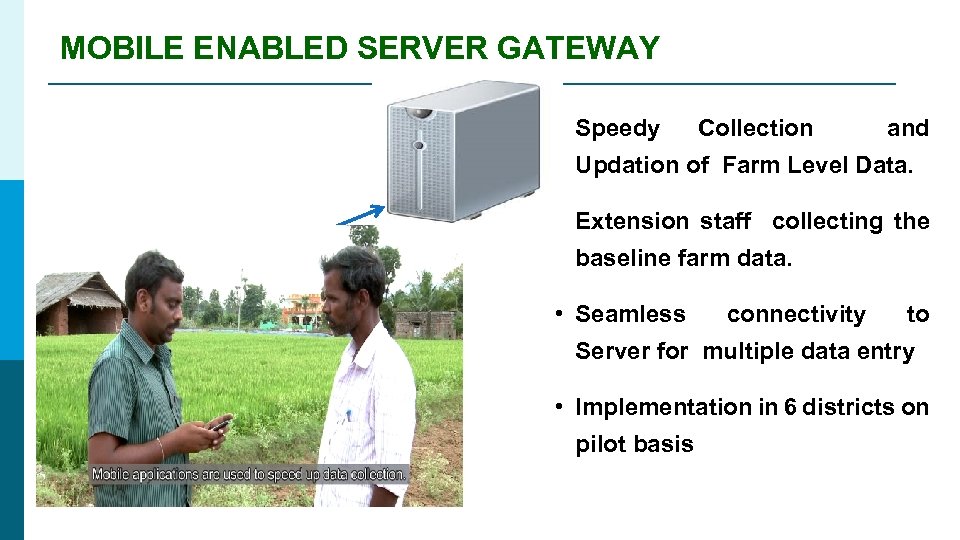
MOBILE ENABLED SERVER GATEWAY • Speedy Collection and Updation of Farm Level Data. • Extension staff collecting the baseline farm data. • Seamless connectivity to Server for multiple data entry • Implementation in 6 districts on pilot basis
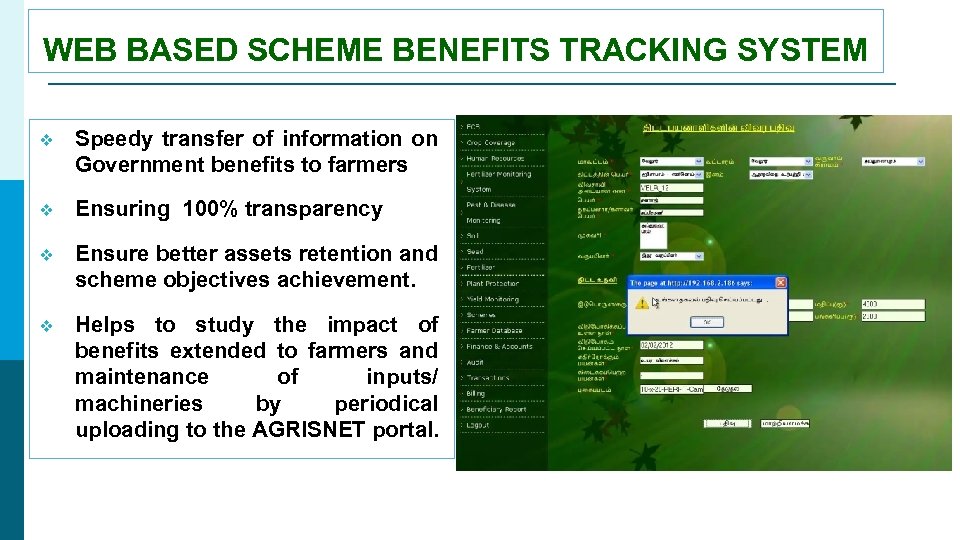
WEB BASED SCHEME BENEFITS TRACKING SYSTEM v Speedy transfer of information on Government benefits to farmers v Ensuring 100% transparency v Ensure better assets retention and scheme objectives achievement. v Helps to study the impact of benefits extended to farmers and maintenance of inputs/ machineries by periodical uploading to the AGRISNET portal.
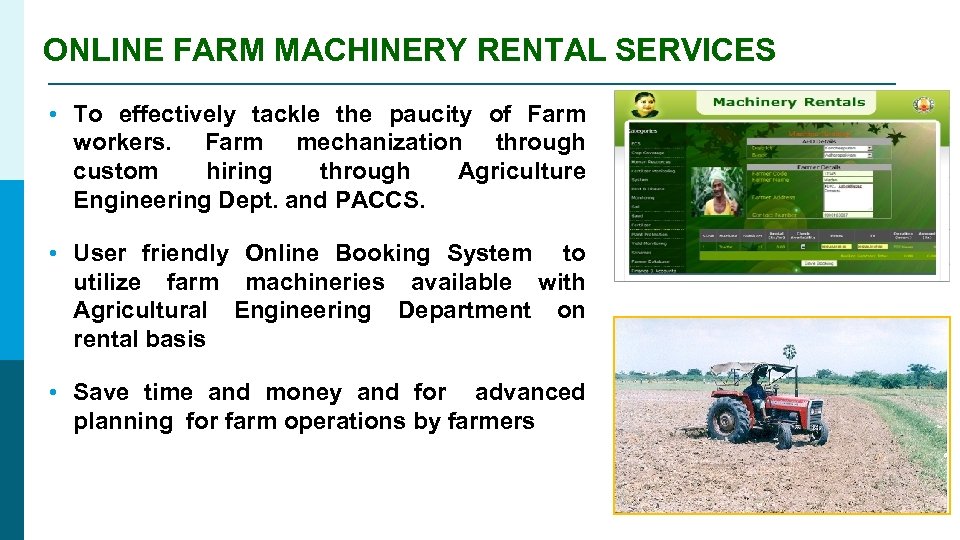
ONLINE FARM MACHINERY RENTAL SERVICES • To effectively tackle the paucity of Farm workers. Farm mechanization through custom hiring through Agriculture Engineering Dept. and PACCS. • User friendly Online Booking System to utilize farm machineries available with Agricultural Engineering Department on rental basis • Save time and money and for advanced planning for farm operations by farmers
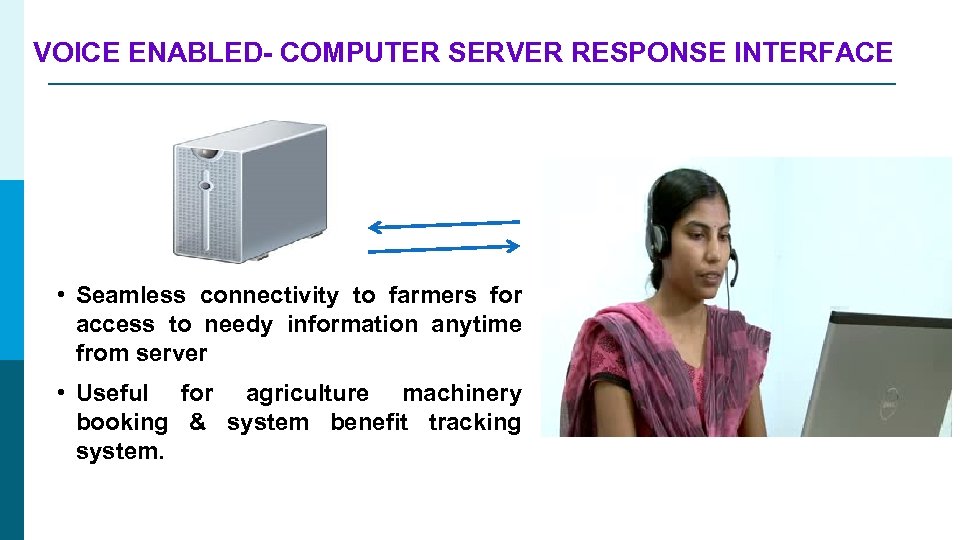
VOICE ENABLED- COMPUTER SERVER RESPONSE INTERFACE • Seamless connectivity to farmers for access to needy information anytime from server • Useful for agriculture machinery booking & system benefit tracking system.
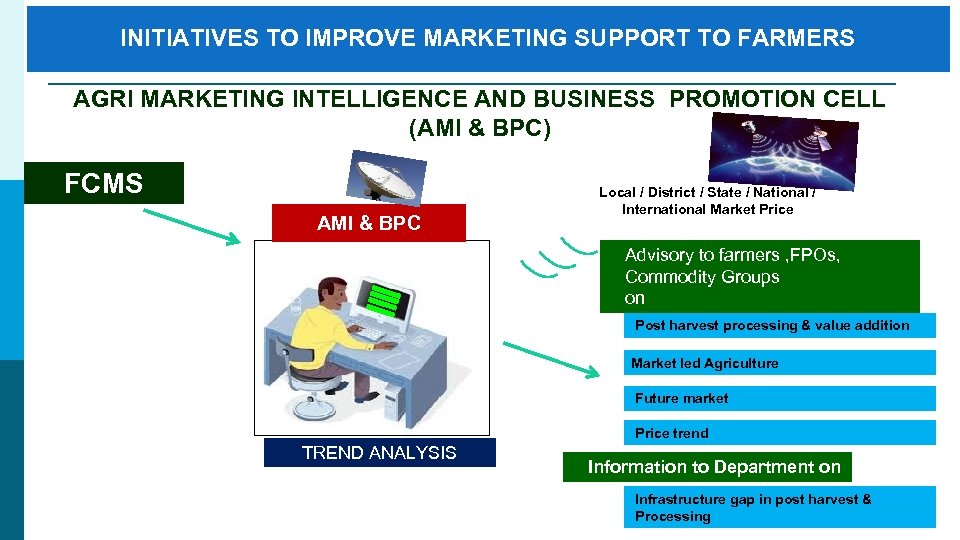
INITIATIVES TO IMPROVE MARKETING SUPPORT TO FARMERS AGRI MARKETING INTELLIGENCE AND BUSINESS PROMOTION CELL (AMI & BPC) FCMS AMI & BPC Local / District / State / National / International Market Price Advisory to farmers , FPOs, Commodity Groups on Post harvest processing & value addition Market led Agriculture Future market Price trend TREND ANALYSIS Information to Department on Infrastructure gap in post harvest & Processing
AGRO ADVISORY NETWORK – Contd. , GOVERNMENT INITIATIVES: ONLINE YIELD MONITORING: • Decision support tool for continuous monitoring of the yield trends throughout the year. • obtaining the village wise/plot wise Crop Estimation survey yields • plot-wise yields entered at the block level. ONLINE INPUT MANAGEMENT SYSTEM: • Tool to disseminate knowledge on the availability of inputs from anywhere at any time - online billing module is being introduced in all the 880 government outlets • This input management system will be integrated with the benefit tracking system which becomes transparent in the implementation of agricultural schemes. 59
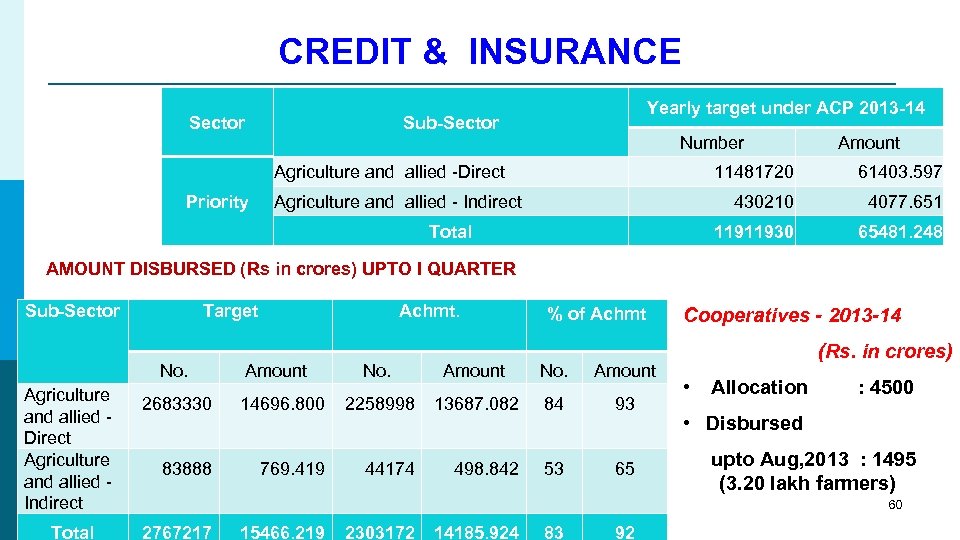
CREDIT & INSURANCE Sector Yearly target under ACP 2013 -14 Sub-Sector Number Agriculture and allied -Direct Priority Amount 11481720 430210 Total 4077. 651 11911930 Agriculture and allied - Indirect 61403. 597 65481. 248 AMOUNT DISBURSED (Rs in crores) UPTO I QUARTER Sub-Sector Target No. Achmt. Amount % of Achmt No. Amount Agriculture and allied - Direct Agriculture and allied - Indirect 2683330 14696. 800 2258998 13687. 082 84 93 83888 769. 419 44174 498. 842 53 65 Total 2767217 Cooperatives - 2013 -14 (Rs. in crores) • Allocation : 4500 • Disbursed upto Aug, 2013 : 1495 (3. 20 lakh farmers) 60 15466. 219 2303172 14185. 924 83 92
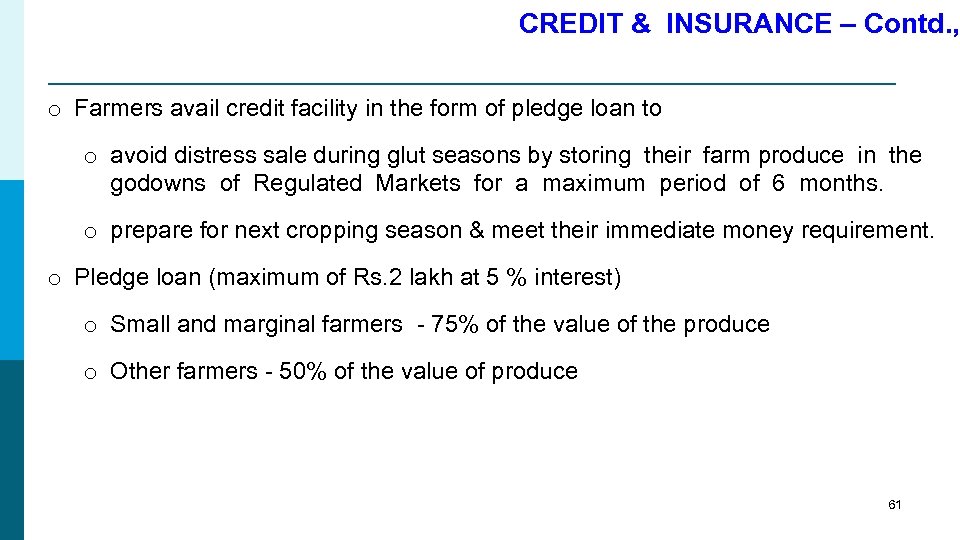
CREDIT & INSURANCE – Contd. , o Farmers avail credit facility in the form of pledge loan to o avoid distress sale during glut seasons by storing their farm produce in the godowns of Regulated Markets for a maximum period of 6 months. o prepare for next cropping season & meet their immediate money requirement. o Pledge loan (maximum of Rs. 2 lakh at 5 % interest) o Small and marginal farmers - 75% of the value of the produce o Other farmers - 50% of the value of produce 61
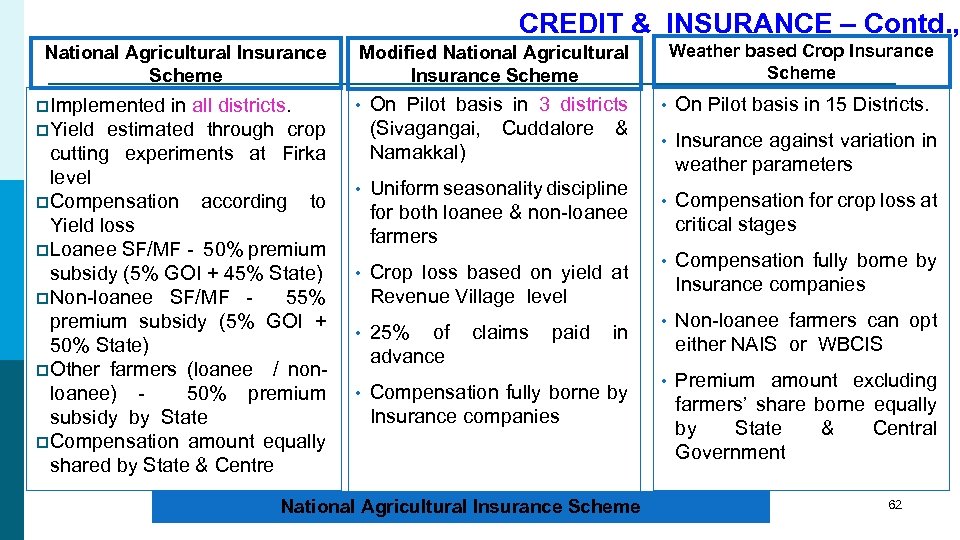
CREDIT & INSURANCE – Contd. , National Agricultural Insurance Scheme p. Implemented in all districts. p. Yield estimated through crop cutting experiments at Firka level p. Compensation according to Yield loss p. Loanee SF/MF - 50% premium subsidy (5% GOI + 45% State) p. Non-loanee SF/MF - 55% premium subsidy (5% GOI + 50% State) p. Other farmers (loanee / nonloanee) - 50% premium subsidy by State p. Compensation amount equally shared by State & Centre Modified National Agricultural Insurance Scheme Weather based Crop Insurance Scheme • On Pilot basis in 3 districts • On Pilot basis in 15 Districts. (Sivagangai, Cuddalore & Namakkal) • Uniform seasonality discipline for both loanee & non-loanee farmers • Crop loss based on yield at Revenue Village level • 25% of claims paid in advance • Compensation fully borne by Insurance companies National Agricultural Insurance Scheme • Insurance against variation in weather parameters • Compensation for crop loss at critical stages • Compensation fully borne by Insurance companies • Non-loanee farmers can opt either NAIS or WBCIS • Premium amount excluding farmers’ share borne equally by State & Central Government 62
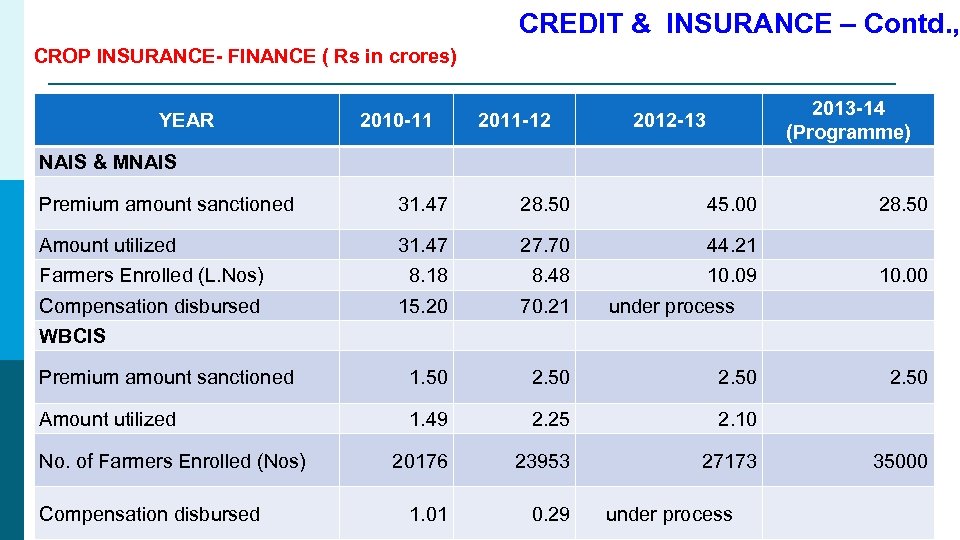
CREDIT & INSURANCE – Contd. , CROP INSURANCE- FINANCE ( Rs in crores) YEAR 2010 -11 2011 -12 2013 -14 (Programme) 2012 -13 NAIS & MNAIS Premium amount sanctioned 31. 47 28. 50 45. 00 Amount utilized 31. 47 27. 70 44. 21 Farmers Enrolled (L. Nos) 8. 18 8. 48 10. 09 Compensation disbursed 15. 20 70. 21 Premium amount sanctioned 1. 50 2. 50 Amount utilized 1. 49 2. 25 2. 10 20176 23953 27173 1. 01 0. 29 28. 50 10. 00 under process WBCIS No. of Farmers Enrolled (Nos) Compensation disbursed under process 2. 50 35000
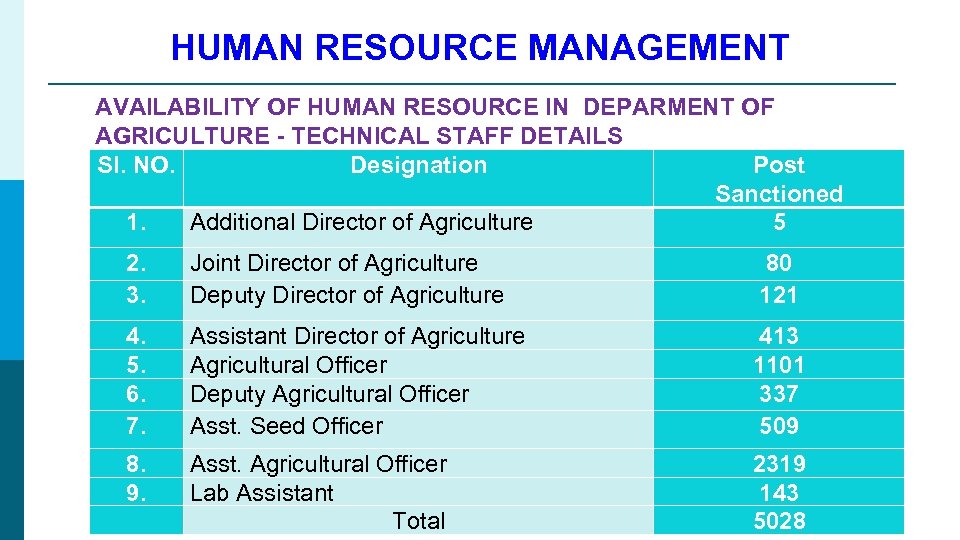
HUMAN RESOURCE MANAGEMENT AVAILABILITY OF HUMAN RESOURCE IN DEPARMENT OF AGRICULTURE - TECHNICAL STAFF DETAILS Sl. NO. Designation Post Sanctioned 1. Additional Director of Agriculture 5 2. 3. Joint Director of Agriculture Deputy Director of Agriculture 80 121 4. 5. 6. 7. Assistant Director of Agriculture Agricultural Officer Deputy Agricultural Officer Asst. Seed Officer 413 1101 337 509 8. 9. Asst. Agricultural Officer Lab Assistant Total 2319 143 5028
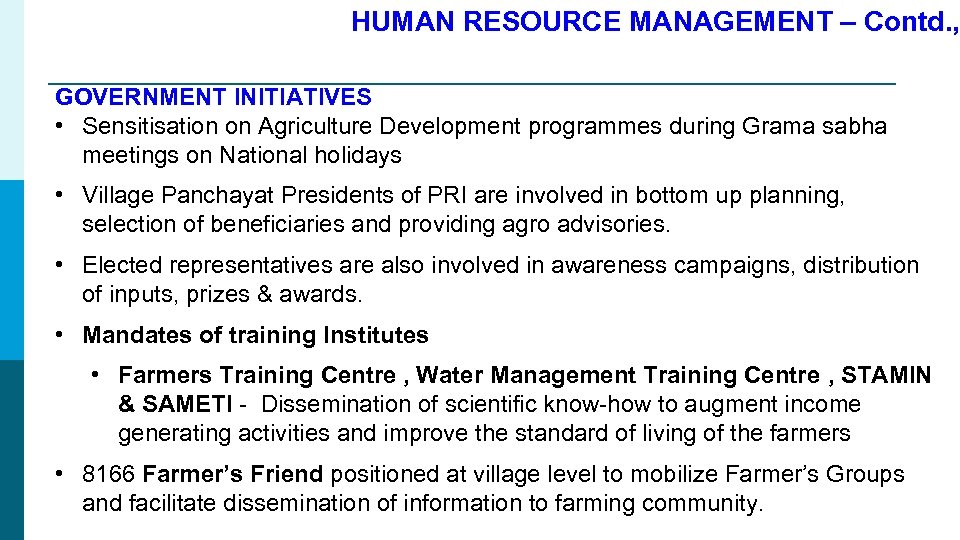
HUMAN RESOURCE MANAGEMENT – Contd. , GOVERNMENT INITIATIVES • Sensitisation on Agriculture Development programmes during Grama sabha meetings on National holidays • Village Panchayat Presidents of PRI are involved in bottom up planning, selection of beneficiaries and providing agro advisories. • Elected representatives are also involved in awareness campaigns, distribution of inputs, prizes & awards. • Mandates of training Institutes • Farmers Training Centre , Water Management Training Centre , STAMIN & SAMETI - Dissemination of scientific know-how to augment income generating activities and improve the standard of living of the farmers • 8166 Farmer’s Friend positioned at village level to mobilize Farmer’s Groups and facilitate dissemination of information to farming community.
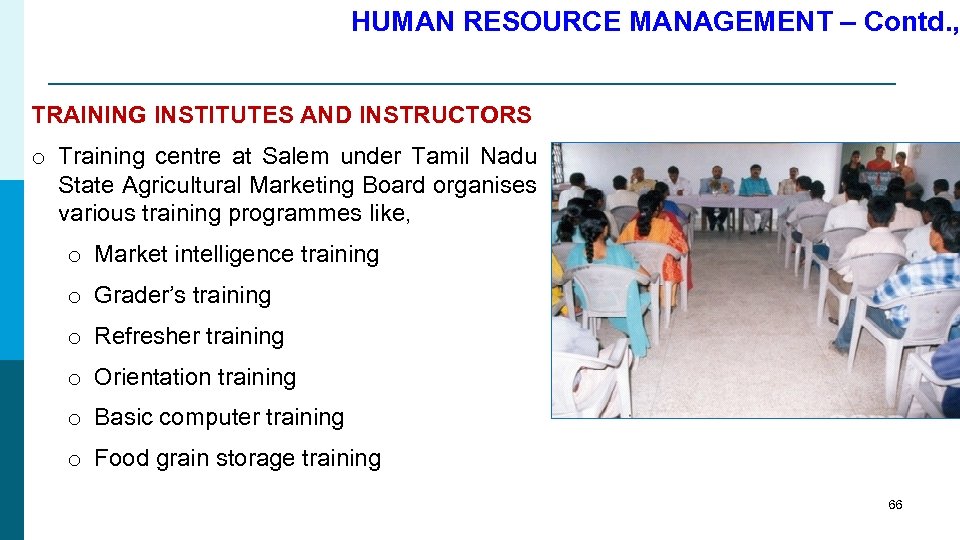
HUMAN RESOURCE MANAGEMENT – Contd. , TRAINING INSTITUTES AND INSTRUCTORS o Training centre at Salem under Tamil Nadu State Agricultural Marketing Board organises various training programmes like, o Market intelligence training o Grader’s training o Refresher training o Orientation training o Basic computer training o Food grain storage training 66
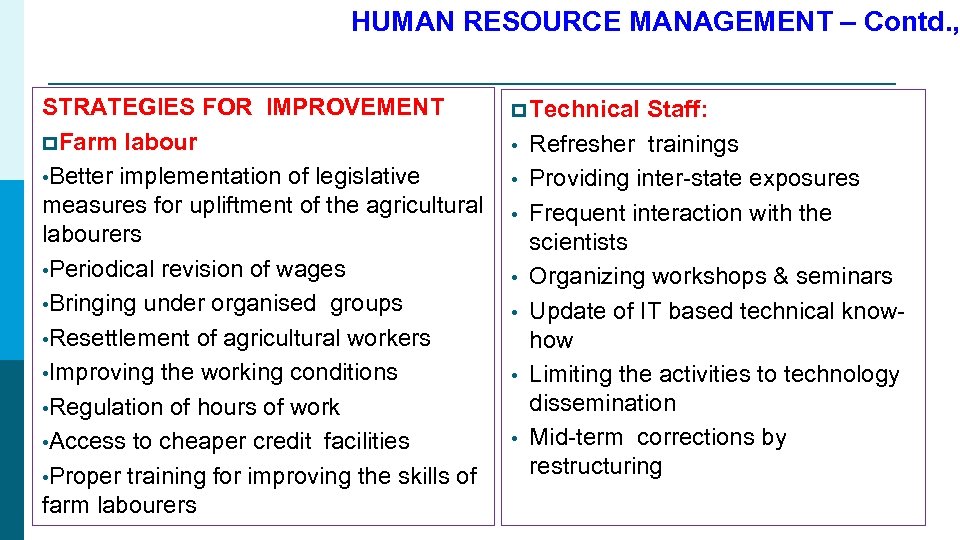
HUMAN RESOURCE MANAGEMENT – Contd. , STRATEGIES FOR IMPROVEMENT p. Farm labour • Better implementation of legislative measures for upliftment of the agricultural labourers • Periodical revision of wages • Bringing under organised groups • Resettlement of agricultural workers • Improving the working conditions • Regulation of hours of work • Access to cheaper credit facilities • Proper training for improving the skills of farm labourers p Technical Staff: • • Refresher trainings Providing inter-state exposures Frequent interaction with the scientists Organizing workshops & seminars Update of IT based technical knowhow Limiting the activities to technology dissemination Mid-term corrections by restructuring
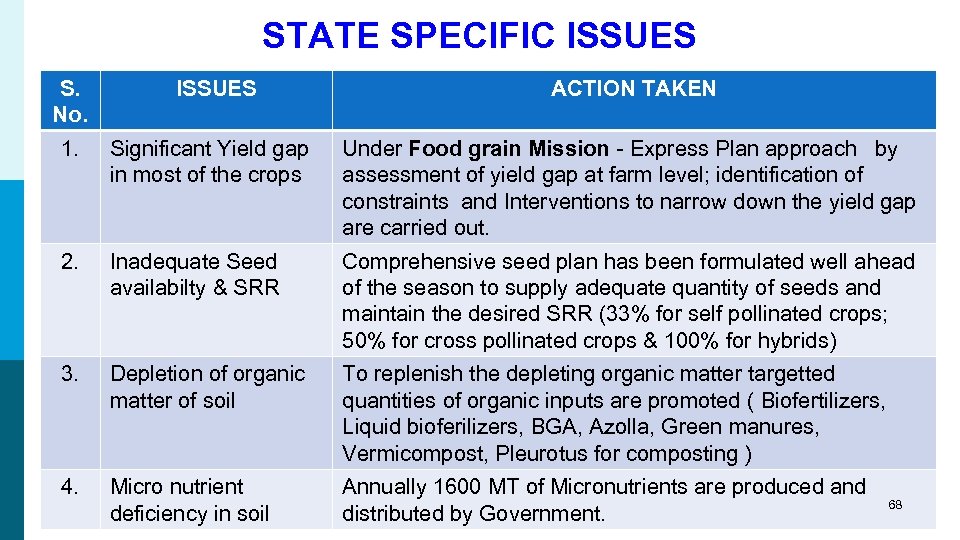
STATE SPECIFIC ISSUES S. No. ISSUES ACTION TAKEN 1. Significant Yield gap in most of the crops Under Food grain Mission - Express Plan approach by assessment of yield gap at farm level; identification of constraints and Interventions to narrow down the yield gap are carried out. 2. Inadequate Seed availabilty & SRR Comprehensive seed plan has been formulated well ahead of the season to supply adequate quantity of seeds and maintain the desired SRR (33% for self pollinated crops; 50% for cross pollinated crops & 100% for hybrids) 3. Depletion of organic matter of soil To replenish the depleting organic matter targetted quantities of organic inputs are promoted ( Biofertilizers, Liquid bioferilizers, BGA, Azolla, Green manures, Vermicompost, Pleurotus for composting ) 4. Micro nutrient deficiency in soil Annually 1600 MT of Micronutrients are produced and distributed by Government. 68
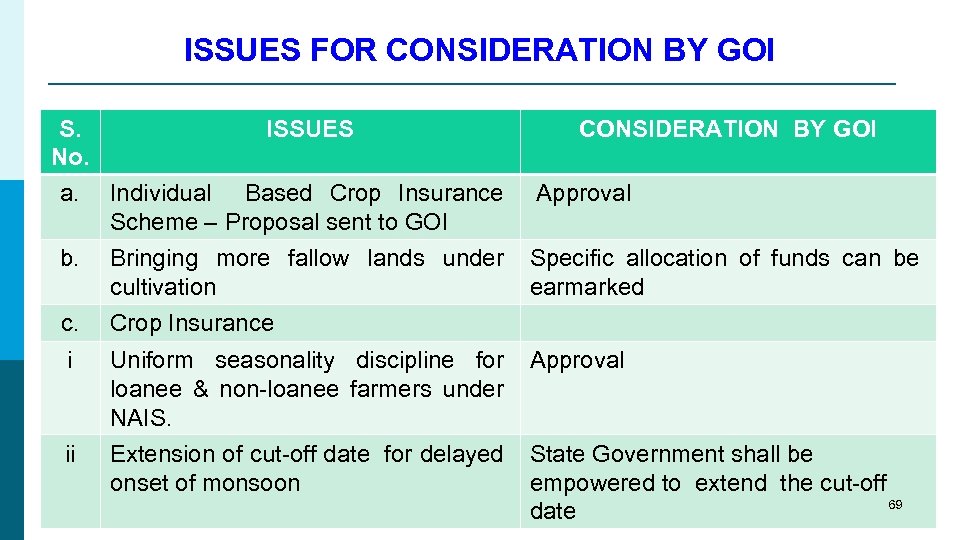
ISSUES FOR CONSIDERATION BY GOI S. ISSUES CONSIDERATION BY GOI No. a. Individual Based Crop Insurance Approval Scheme – Proposal sent to GOI b. c. i ii Bringing more fallow lands under Specific allocation of funds can be cultivation earmarked Crop Insurance Uniform seasonality discipline for Approval loanee & non-loanee farmers under NAIS. Extension of cut-off date for delayed State Government shall be onset of monsoon empowered to extend the cut-off 69 date

U O Y K N A H T 70
Скачать презентацию NATIONAL CONFERENCE FOR AGRICULTURE ON RABI CAMPAIGN 2013
36c34c50eaa9d233c94b5ae6c6ce67ad.ppt