 Скачать презентацию National Balance Sheet Accounts in Israel Methods and
d426434e3e83f54462a063cf1d828ad0.ppt
- Количество слайдов: 16



National Balance Sheet Accounts in Israel Methods and Uses 1
Contents • Introduction • Sources and Methods • Main findings - 2011 2
Introduction • The national balance sheet accounts were first published in 2002 for the year 1995. • Since then the balance sheets have been prepared for the years 2001 to 2011. • Over the years some changes have been made (no’ of sub sectors and types of instruments). 3
Sources and Methods • The value of asset/liability can be derived from : - method related to an institutional sector - distribution of the total value of an asset/liability among various sectors. 4
Sources and Methods • First phase: assets and liabilities are recorded in accordance with the data in each sector’s financial statements. • Second phase: comparison between the sums of assets and the corresponding liabilities. Choosing the most reliable estimate. • Third phase: if no information is available we use the “counterpart” method or the “residual derivation” method. 5
Sources and Methods • Non Financial Corporations, Other Financial Intermediaries and Financial Auxiliaries – based on the analysis of the balance sheets of the corporations. • Households – balance sheets of other sectors and information about specific assets known for the households (deposits and loans). 6
Sources and Methods • Deposit Money Corporations – the main source is the Central Bank, Supervisor of banks, and some details are collected directly from the large banks. • Pension and Provident Funds and Insurance Corporations – the source is the report of Capital Market of the Insurance and Saving division of the Ministry of Finance. 7
Sources and Methods • Central Government – the source is the Ministry of Finance, Office of the Accountant General. • NPISH and GNPI – survey of balance sheets for public and private NPI held by the CBS. 8
Sources and Methods • The Tel Aviv Stock Exchange is the source for the market values of the quoted governmental bonds, quoted private bonds and shares. • The source for the non financial assets is the net capital stock calculated in the NA using the PIM method (doesn’t include land). 9
Plans for the future • Breakdown of assets and liabilities by maturity (to analyze liquidity risks). • Compilation of up-to-date full quarterly national balance sheets. • Adjustment to SNA 2008 10
Main findings - 2011 • Israel’s total national wealth – NIS 2, 091 billion, which is 2. 4 times GDP. • The total assets – NIS 7, 250 billion, which is 8. 3 times GDP. • The government debt (mainly bonds) – NIS 656 billion. 11
Main findings - 2011 • The total credit – NIS 1, 763 billion. The loans from the banks – 44% from the total credit. Were mainly given to Non. Financial Corporations (33%) and the households (42%). Total credit to Non-Financial Corporations NIS 502 billion Total credit to the Households – NIS 413 billion. 12
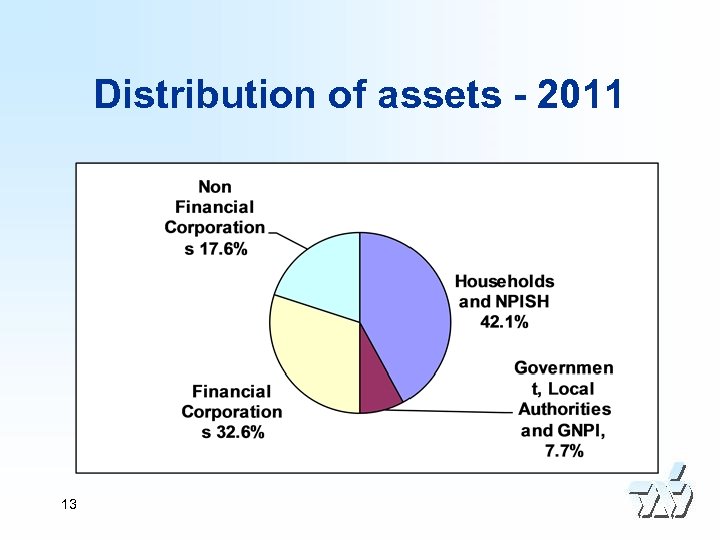
Distribution of assets - 2011 13
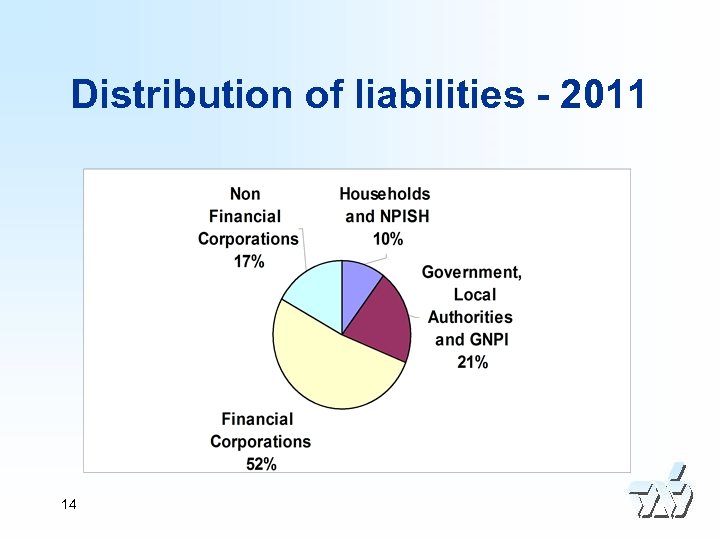
Distribution of liabilities - 2011 14
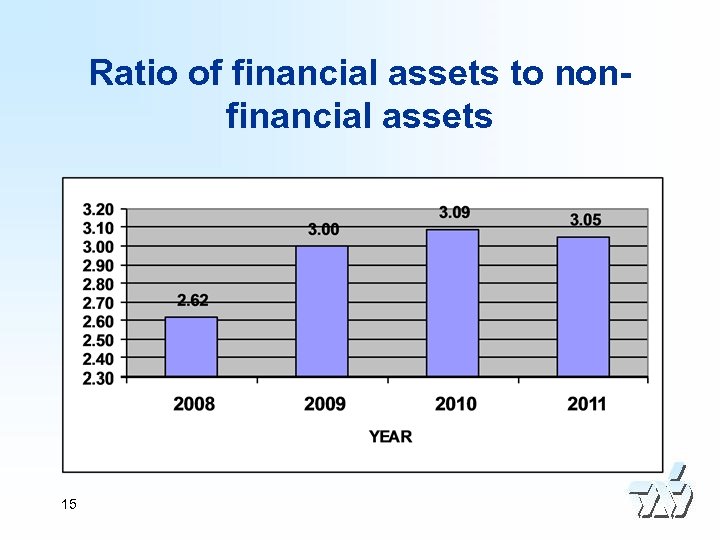
Ratio of financial assets to nonfinancial assets 15
Conclusions • The balance sheets were first developed within the NA. • The collaboration with the Central Bank has proved fruitful and has lead to wider use of the balance sheets, mainly for financial stability. • The constant development of the balance sheets will make it possible to have further analyses in the future. 16
Скачать презентацию National Balance Sheet Accounts in Israel Methods and
d426434e3e83f54462a063cf1d828ad0.ppt