


 Скачать презентацию NATIONAL AVIATION UNIVERSITY KIROVOGRAD FLIGHT ACADEMY OF UKRAINE
Topic 5_1.ppt
- Количество слайдов: 25
 NATIONAL AVIATION UNIVERSITY KIROVOGRAD FLIGHT ACADEMY OF UKRAINE Topic 5 Elevation reference system. Cruising altitude. Total - 12 hours. Lectures -4 h, Practical work - 4 h, Independent work - 4 h KIROVOGRAD - 2013
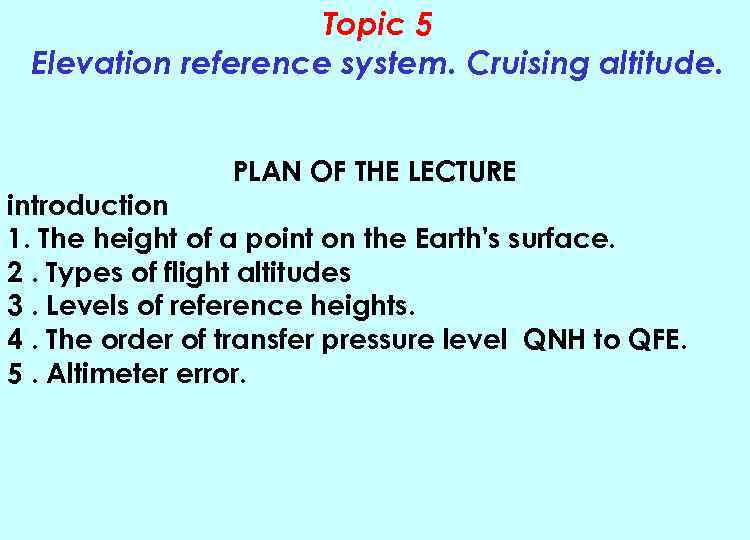 Topic 5 Elevation reference system. Cruising altitude. PLAN OF THE LECTURE introduction 1. The height of a point on the Earth's surface. 2. Types of flight altitudes 3. Levels of reference heights. 4. The order of transfer pressure level QNH to QFE. 5. Altimeter error.
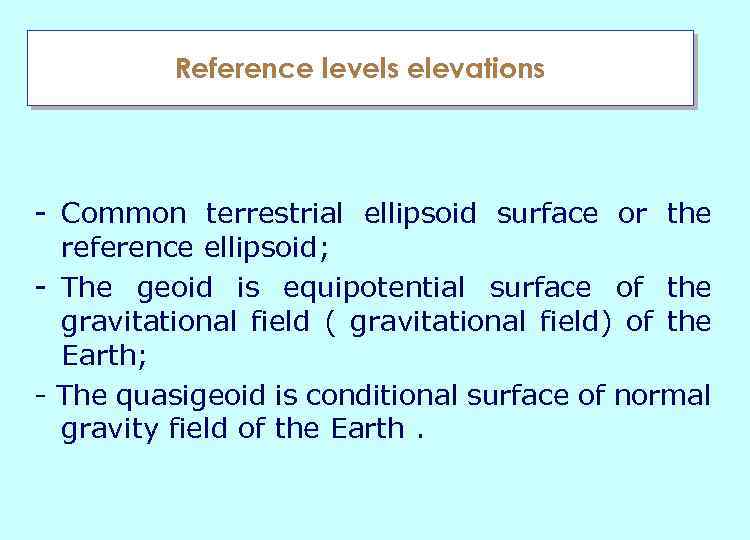 Reference levels elevations - Common terrestrial ellipsoid surface or the reference ellipsoid; - The geoid is equipotential surface of the gravitational field ( gravitational field) of the Earth; - The quasigeoid is conditional surface of normal gravity field of the Earth.
 Mathematical bases of reference s Ellipsoid Earth s Geoid model (EGM-96)
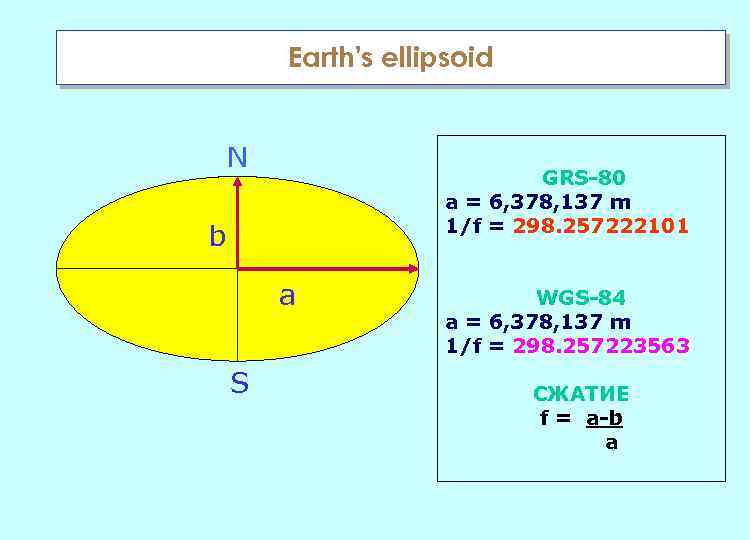 Earth's ellipsoid N GRS-80 a = 6, 378, 137 m 1/f = 298. 257222101 b a S WGS-84 a = 6, 378, 137 m 1/f = 298. 257223563 СЖАТИЕ f = a-b a
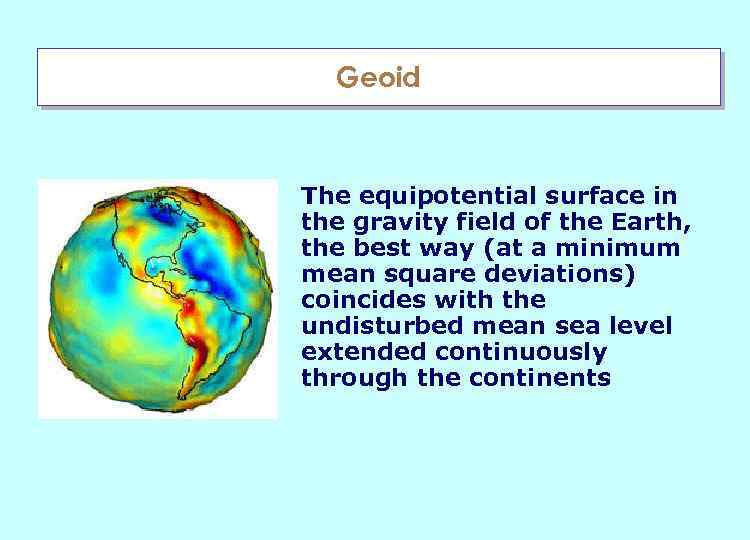 Geoid The equipotential surface in the gravity field of the Earth, the best way (at a minimum mean square deviations) coincides with the undisturbed mean sea level extended continuously through the continents
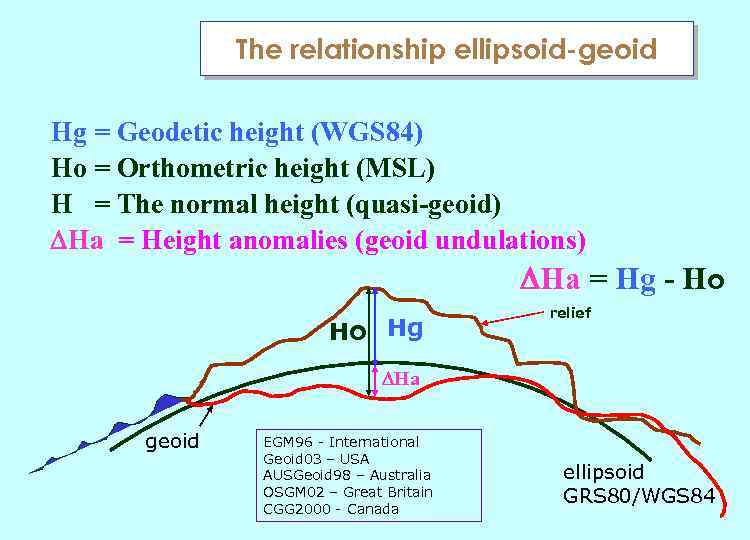 The relationship ellipsoid-geoid Нg = Geodetic height (WGS 84) Ho = Orthometric height (MSL) H = The normal height (quasi-geoid) На = Height anomalies (geoid undulations) На = Нg - Ho Ho Нg relief На geoid EGM 96 - International Geoid 03 – USA AUSGeoid 98 – Australia OSGM 02 – Great Britain CGG 2000 - Canada ellipsoid GRS 80/WGS 84
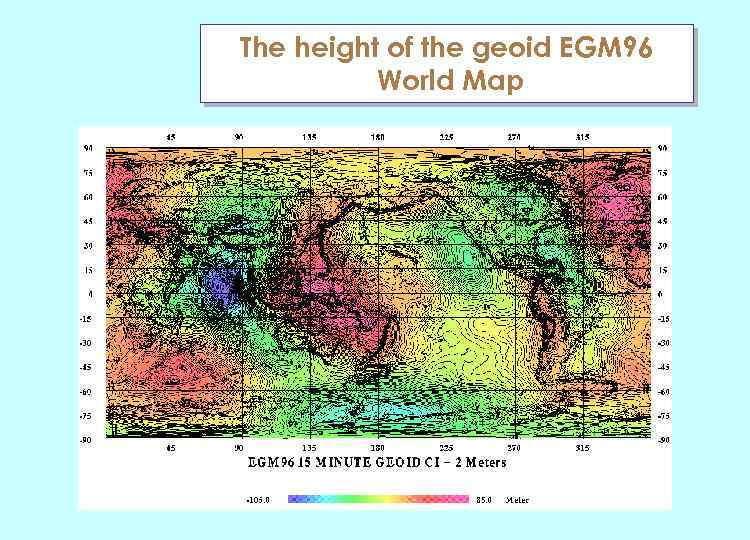 The height of the geoid EGM 96 World Map
 The physical base of reference - Relief. Irregularities of the earth's surface passed on aeronautical charts horizontals, layer tints, by washing or elevations. - Mean sea level. For the purposes of international air navigation as a reference system in a vertical plane is used as the base accepted mean sea level (MSL), which gives the relationship of gravity-related height (elevation) to a surface known as the geoid.
 The physical base of reference - Callow Earth. The surface of the Earth, including accumulations of water, permanent ice and snow, and excluding vegetation and man-made structures. - Terrain. The surface of the Earth with the naturally occurring features such as mountains, hills, ridges, valleys, bodies of water, permanent ice and snow, eliminating the obstacles. Note. For practical purposes, depending on the method of obtaining data, the terrain is a continuous surface that is located between the Earth and the naked crown cover (or somewhere in between, also called the "first reflective surface").
 Characteristics of areas s Elevation (ELEV) – превышение рельефа местности - is the vertical distance from MSL to the point, or the level of the earth's surface or object associated with it. . s The terrain is flat - Местность равнинная – terrain with relative elevations of the earth's surface to 200 m within a radius of 25 km. s The terrain is hilly - Местность холмистая – terrain with relative elevations of the earth's surface from 200 to 500 m in R 25 km. s mountain terrain - Местность горная – terrain with relative elevations of the earth's surface of 500 m and more in R 25 km, as well as the area in elevations of 2000 m above MSL, and more. Information: according to Jeppesen s The terrain is flat – an area in elevations 5, 000 feet or less. s mountain terrain – an area in elevations more than 5, 000 feet.
 Altitude classification s extremely low– up to 200 м (nap-of-theearth); s Low– от 201 до 1000 м; s Medium – от 1001 до 4000 м; s High – от 4001 до 12 000 м s Stratosphere – выше 12 000 м.
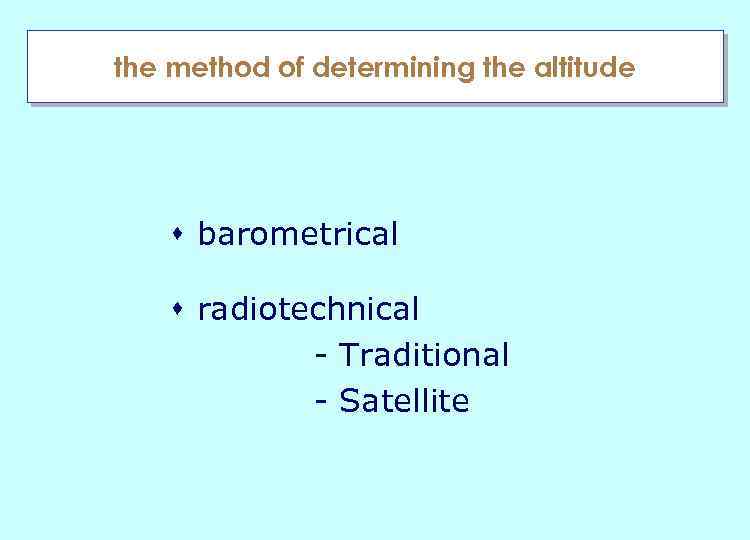 the method of determining the altitude s barometrical s radiotechnical - Traditional - Satellite
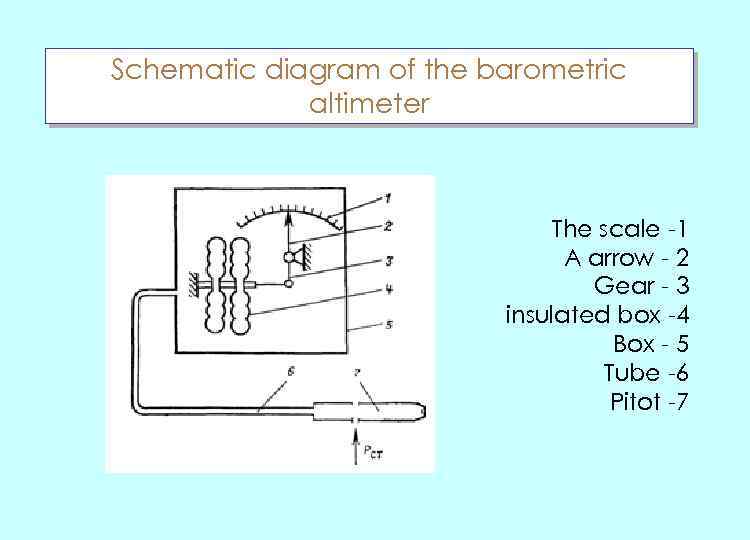 Schematic diagram of the barometric altimeter The scale -1 A arrow - 2 Gear - 3 insulated box -4 Box - 5 Tube -6 Pitot -7
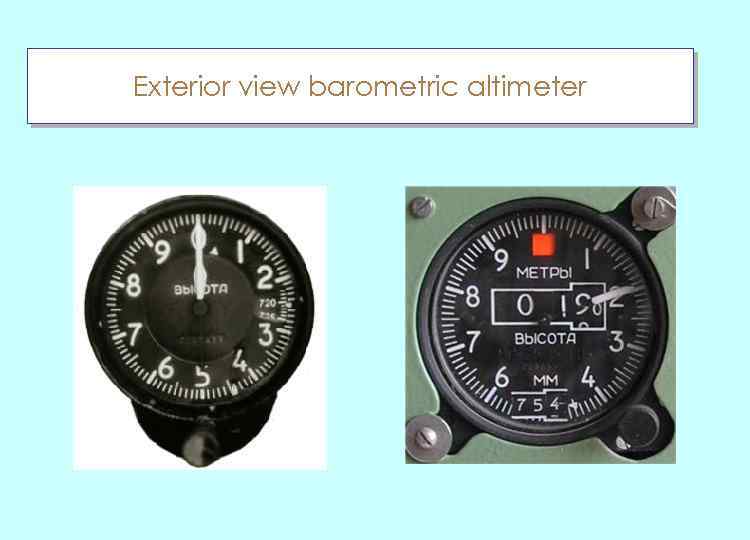 Exterior view barometric altimeter
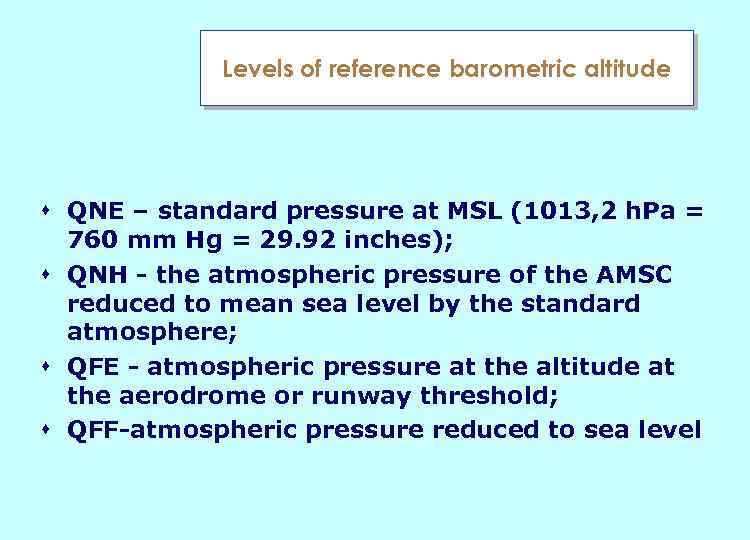 Levels of reference barometric altitude s QNE – standard pressure at MSL (1013, 2 h. Pa = 760 mm Hg = 29. 92 inches); s QNH - the atmospheric pressure of the AMSC reduced to mean sea level by the standard atmosphere; s QFE - atmospheric pressure at the altitude at the aerodrome or runway threshold; s QFF-atmospheric pressure reduced to sea level
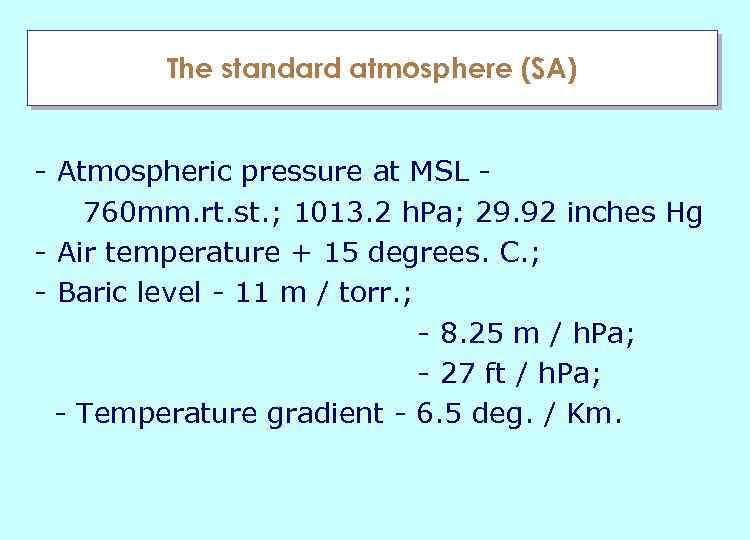 The standard atmosphere (SА) - Atmospheric pressure at MSL 760 mm. rt. st. ; 1013. 2 h. Pa; 29. 92 inches Hg - Air temperature + 15 degrees. C. ; - Baric level - 11 m / torr. ; - 8. 25 m / h. Pa; - 27 ft / h. Pa; - Temperature gradient - 6. 5 deg. / Km.
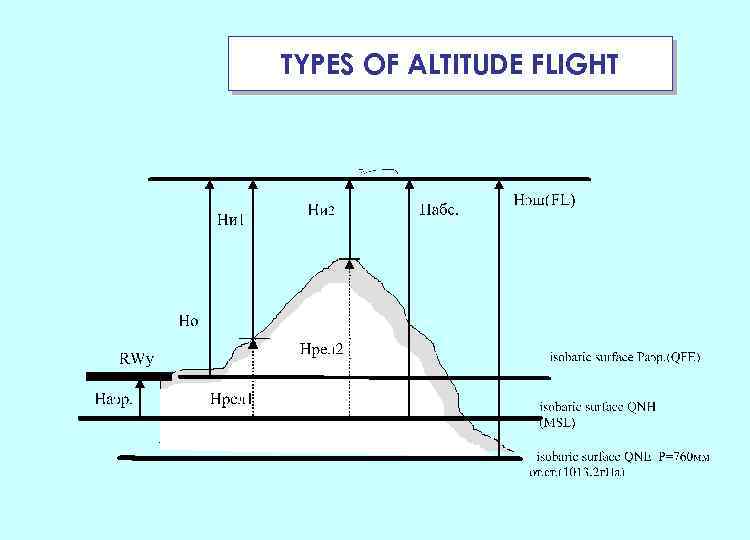 TYPES OF ALTITUDE FLIGHT
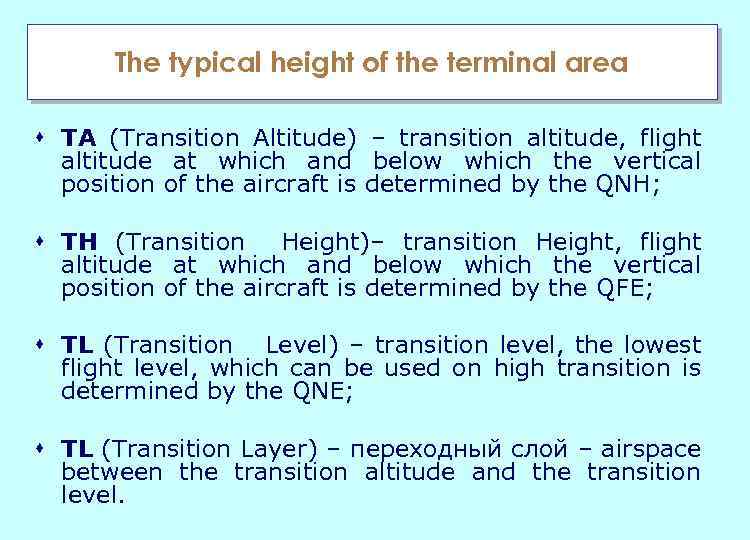 The typical height of the terminal area s TA (Transition Altitude) – transition altitude, flight altitude at which and below which the vertical position of the aircraft is determined by the QNH; s TH (Transition Height)– transition Height, flight altitude at which and below which the vertical position of the aircraft is determined by the QFE; s TL (Transition Level) – transition level, the lowest flight level, which can be used on high transition is determined by the QNE; s TL (Transition Layer) – переходный слой – airspace between the transition altitude and the transition level.
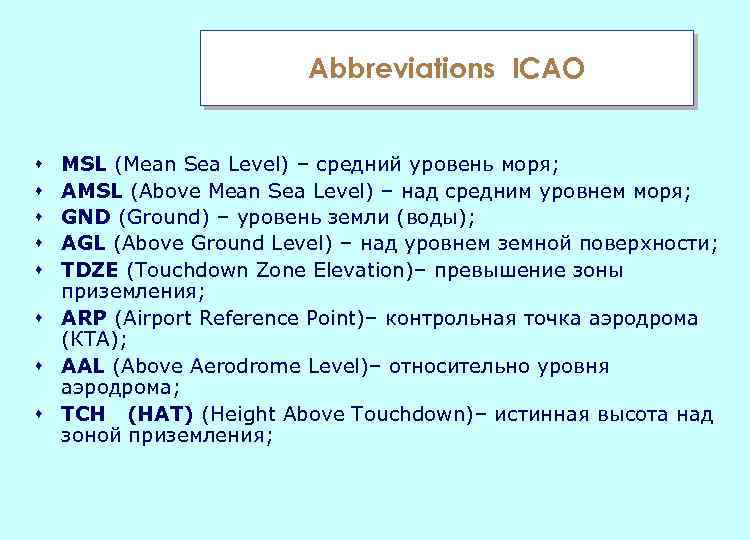 Abbreviations ICAO MSL (Mean Sea Level) – средний уровень моря; AMSL (Above Mean Sea Level) – над средним уровнем моря; GND (Ground) – уровень земли (воды); AGL (Above Ground Level) – над уровнем земной поверхности; TDZE (Touchdown Zone Elevation)– превышение зоны приземления; s ARP (Airport Reference Point)– контрольная точка аэродрома (КТА); s AAL (Above Aerodrome Level)– относительно уровня аэродрома; s TCH (HAT) (Height Above Touchdown)– истинная высота над зоной приземления; s s s
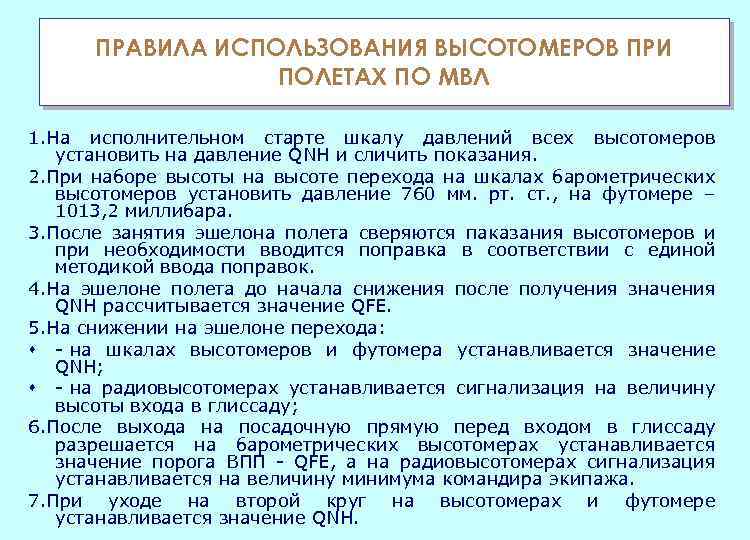 ПРАВИЛА ИСПОЛЬЗОВАНИЯ ВЫСОТОМЕРОВ ПРИ ПОЛЕТАХ ПО МВЛ 1. На исполнительном старте шкалу давлений всех высотомеров установить на давление QNH и сличить показания. 2. При наборе высоты на высоте перехода на шкалах барометрических высотомеров установить давление 760 мм. рт. ст. , на футомере – 1013, 2 миллибара. 3. После занятия эшелона полета сверяются паказания высотомеров и при необходимости вводится поправка в соответствии с единой методикой ввода поправок. 4. На эшелоне полета до начала снижения после получения значения QNH рассчитывается значение QFE. 5. На снижении на эшелоне перехода: s - на шкалах высотомеров и футомера устанавливается значение QNH; s - на радиовысотомерах устанавливается сигнализация на величину высоты входа в глиссаду; 6. После выхода на посадочную прямую перед входом в глиссаду разрешается на барометрических высотомерах устанавливается значение порога ВПП - QFE, а на радиовысотомерах сигнализация устанавливается на величину минимума командира экипажа. 7. При уходе на второй круг на высотомерах и футомере устанавливается значение QNH.
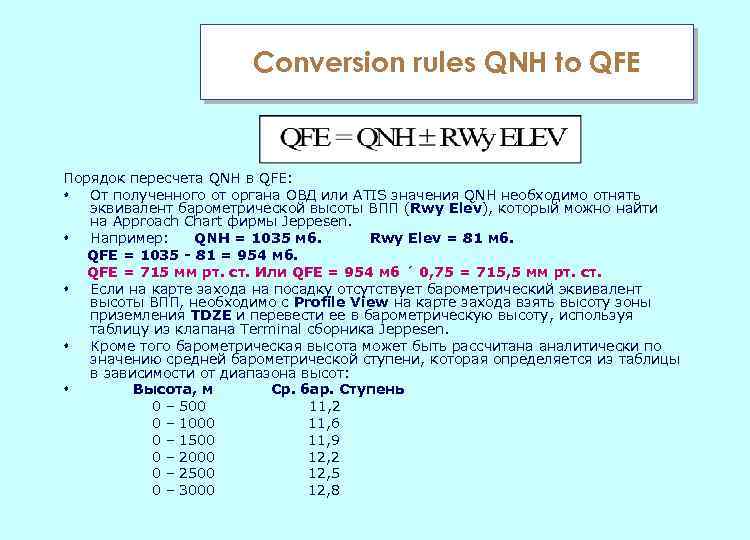 Conversion rules QNH to QFE Порядок пересчета QNH в QFE: s От полученного от органа ОВД или ATIS значения QNH необходимо отнять эквивалент барометрической высоты ВПП (Rwy Elev), который можно найти на Approach Chart фирмы Jeppesen. s Например: QNH = 1035 мб. Rwy Elev = 81 мб. QFE = 1035 - 81 = 954 мб. QFE = 715 мм рт. ст. Или QFE = 954 мб ´ 0, 75 = 715, 5 мм рт. ст. s Если на карте захода на посадку отсутствует барометрический эквивалент высоты ВПП, необходимо с Profile View на карте захода взять высоту зоны приземления TDZE и перевести ее в барометрическую высоту, используя таблицу из клапана Terminal сборника Jeppesen. s Кроме того барометрическая высота может быть рассчитана аналитически по значению средней барометрической ступени, которая определяется из таблицы в зависимости от диапазона высот: s Высота, м Ср. бар. Ступень 0 – 500 11, 2 0 – 1000 11, 6 0 – 1500 11, 9 0 – 2000 12, 2 0 – 2500 12, 5 0 – 3000 12, 8
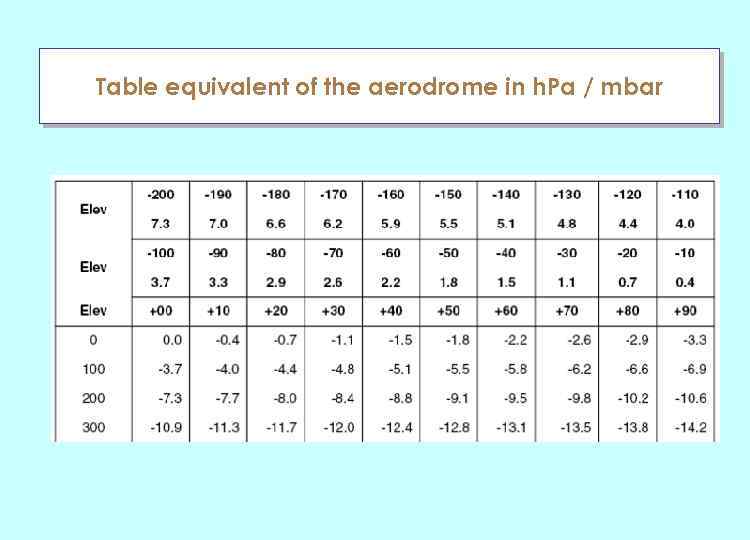 Table equivalent of the aerodrome in h. Pa / mbar
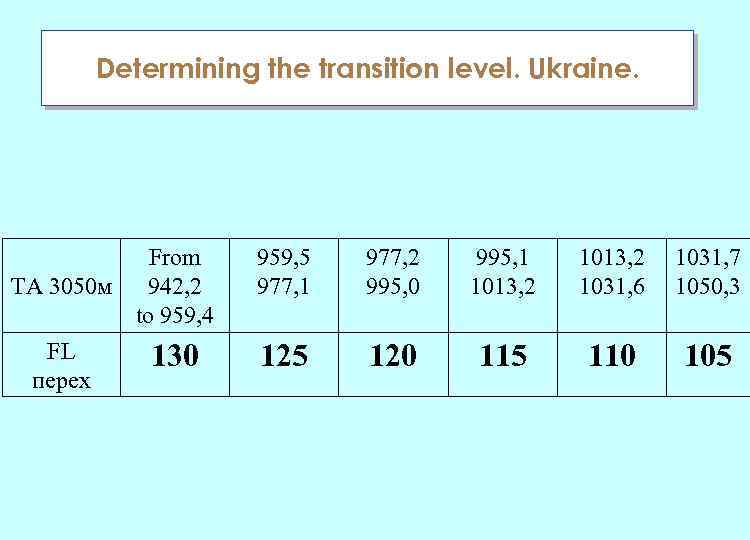 Determining the transition level. Ukraine. From TA 3050 м 942, 2 to 959, 4 FL перех 130 959, 5 977, 1 977, 2 995, 0 995, 1 1013, 2 1031, 6 1031, 7 1050, 3 125 120 115 110 105
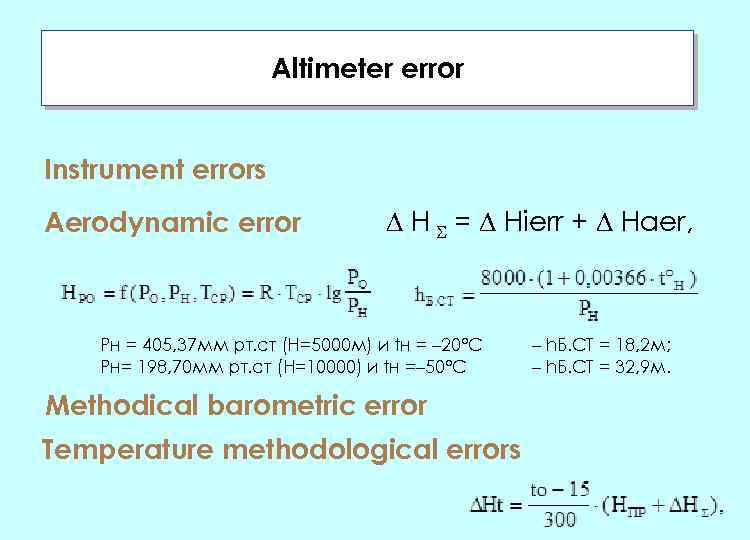 Altimeter error Instrument errors Aerodynamic error Н = Нierr + Нaer, Рн = 405, 37 мм рт. ст (Н=5000 м) и tн = – 20°С Рн= 198, 70 мм рт. ст (Н=10000) и tн =– 50°С Methodical barometric error Temperature methodological errors – h. Б. СТ = 18, 2 м; – h. Б. СТ = 32, 9 м.