


 Скачать презентацию National Association of Nanoindustry Concern NANOINDUSTRY NANOTECHNOLOGIES FOR
02f7c94965ef5537bd9be1eb312f2586.ppt
- Количество слайдов: 57
 National Association of Nanoindustry Concern NANOINDUSTRY NANOTECHNOLOGIES FOR INDUSTRY M. Ananyan President of Association
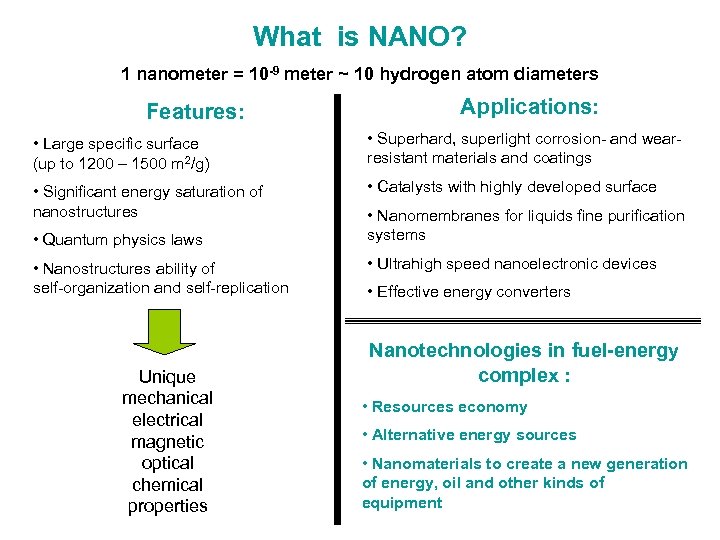 What is NANO? 1 nanometer = 10 -9 meter ~ 10 hydrogen atom diameters Features: Applications: • Large specific surface (up to 1200 – 1500 m 2/g) • Superhard, superlight corrosion- and wearresistant materials and coatings • Significant energy saturation of nanostructures • Catalysts with highly developed surface • Quantum physics laws • Nanostructures ability of self-organization and self-replication Unique mechanical electrical magnetic optical chemical properties • Nanomembranes for liquids fine purification systems • Ultrahigh speed nanoelectronic devices • Effective energy converters Nanotechnologies in fuel-energy complex : • Resources economy • Alternative energy sources • Nanomaterials to create a new generation of energy, oil and other kinds of equipment
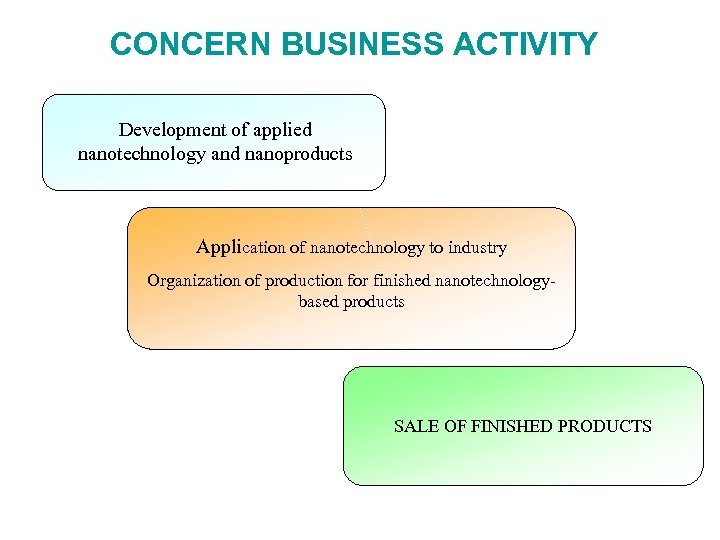 CONCERN BUSINESS ACTIVITY Development of applied nanotechnology and nanoproducts Application of nanotechnology to industry Organization of production for finished nanotechnologybased products SALE OF FINISHED PRODUCTS
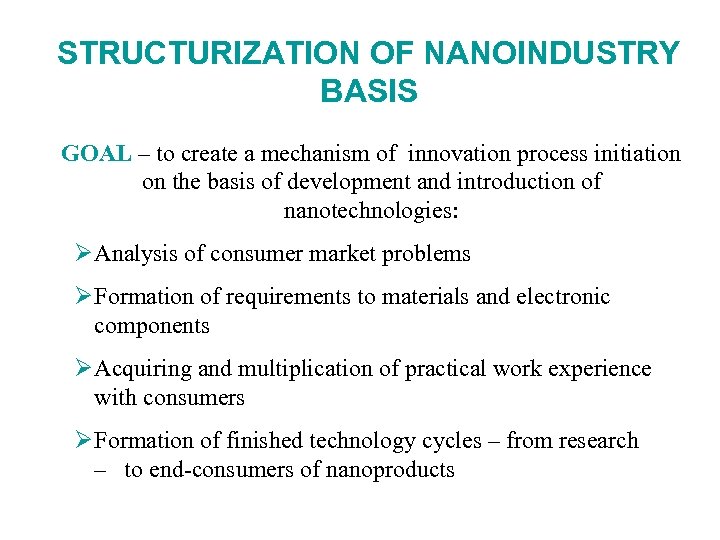 STRUCTURIZATION OF NANOINDUSTRY BASIS GOAL – to create a mechanism of innovation process initiation on the basis of development and introduction of nanotechnologies: ØAnalysis of consumer market problems ØFormation of requirements to materials and electronic components ØAcquiring and multiplication of practical work experience with consumers ØFormation of finished technology cycles – from research – to end-consumers of nanoproducts
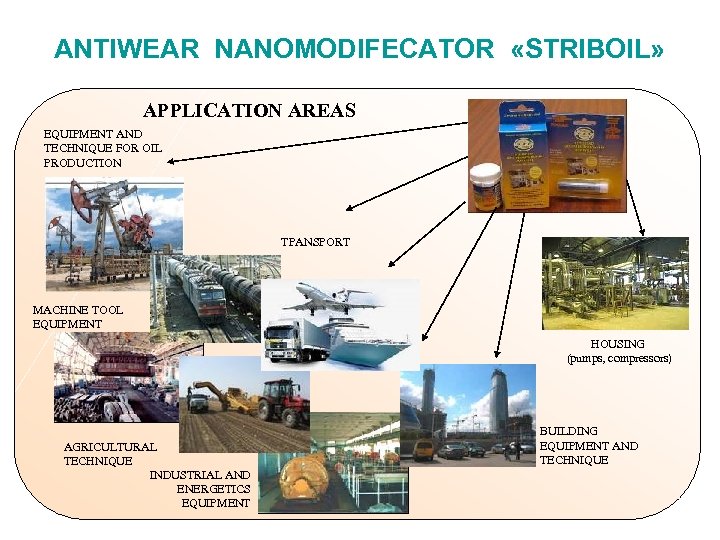 ANTIWEAR NANOMODIFECATOR «STRIBOIL» APPLICATION AREAS EQUIPMENT AND TECHNIQUE FOR OIL PRODUCTION TPANSPORT MACHINE TOOL EQUIPMENT HOUSING (pumps, compressors) AGRICULTURAL TECHNIQUE INDUSTRIAL AND ENERGETICS EQUIPMENT BUILDING EQUIPMENT AND TECHNIQUE
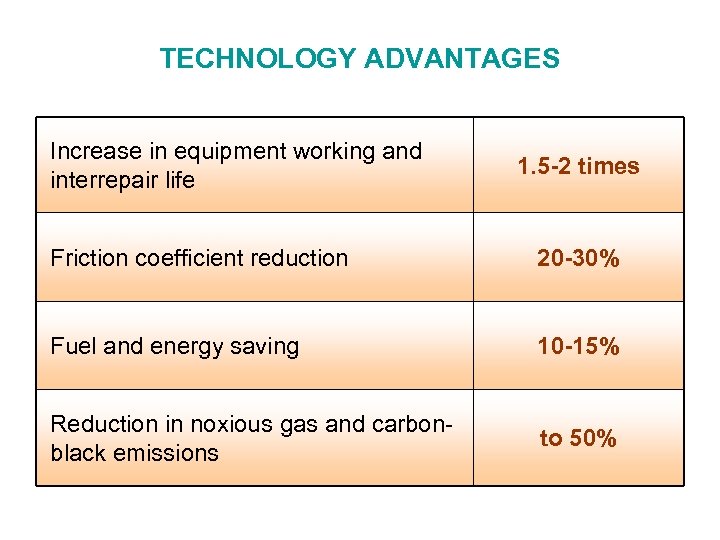 TECHNOLOGY ADVANTAGES Increase in equipment working and interrepair life 1. 5 -2 times Friction coefficient reduction 20 -30% Fuel and energy saving 10 -15% Reduction in noxious gas and carbonblack emissions to 50%
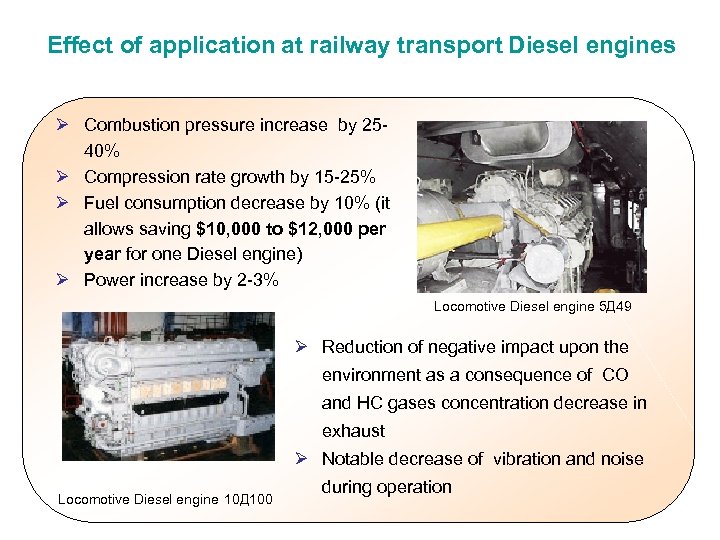 Effect of application at railway transport Diesel engines Ø Combustion pressure increase by 2540% Ø Compression rate growth by 15 -25% Ø Fuel consumption decrease by 10% (it allows saving $10, 000 to $12, 000 per year for one Diesel engine) Ø Power increase by 2 -3% Locomotive Diesel engine 5 Д 49 Ø Reduction of negative impact upon the environment as a consequence of СО and НС gases concentration decrease in exhaust Ø Notable decrease of vibration and noise Locomotive Diesel engine 10 Д 100 during operation
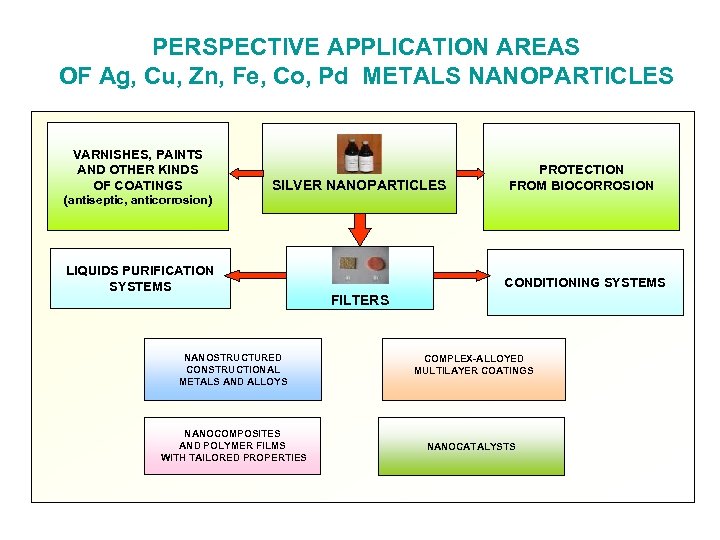 PERSPECTIVE APPLICATION AREAS OF Ag, Cu, Zn, Fe, Co, Pd METALS NANOPARTICLES VARNISHES, PAINTS AND OTHER KINDS OF COATINGS SILVER NANOPARTICLES PROTECTION FROM BIOCORROSION (antiseptic, anticorrosion) LIQUIDS PURIFICATION SYSTEMS CONDITIONING SYSTEMS FILTERS NANOSTRUCTURED CONSTRUCTIONAL METALS AND ALLOYS COMPLEX-ALLOYED MULTILAYER COATINGS NANOCOMPOSITES AND POLYMER FILMS WITH TAILORED PROPERTIES NANOCATALYSTS
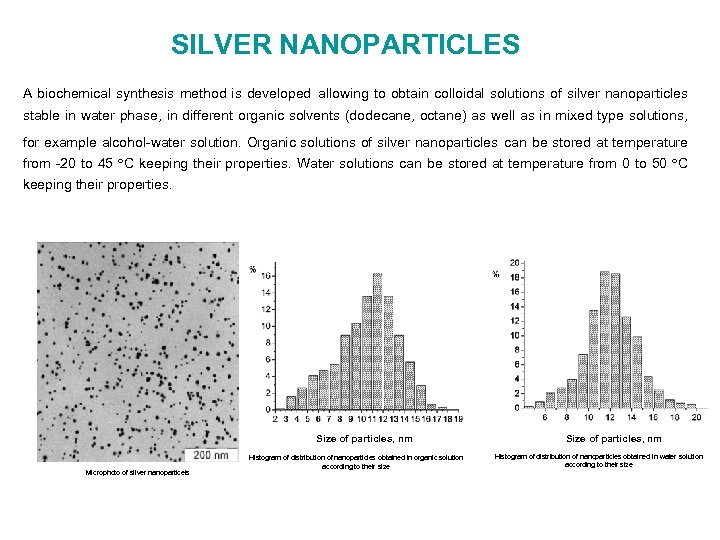 SILVER NANOPARTICLES A biochemical synthesis method is developed allowing to obtain colloidal solutions of silver nanoparticles stable in water phase, in different organic solvents (dodecane, octane) as well as in mixed type solutions, for example alcohol-water solution. Organic solutions of silver nanoparticles can be stored at temperature from -20 to 45 С keeping their properties. Water solutions can be stored at temperature from 0 to 50 С keeping their properties. Size of particles, nm Microphoto of silver nanoparticels Histogram of distribution of nanoparticles obtained in organic solution according to their size Size of particles, nm Histogram of distribution of nanoparticles obtained in water solution according to their size
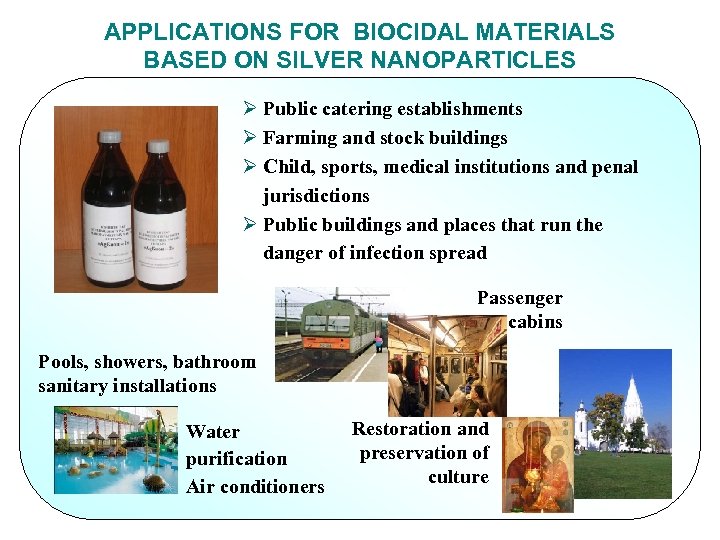 APPLICATIONS FOR BIOCIDAL MATERIALS BASED ON SILVER NANOPARTICLES Ø Public catering establishments Ø Farming and stock buildings Ø Child, sports, medical institutions and penal jurisdictions Ø Public buildings and places that run the danger of infection spread Passenger cabins Pools, showers, bathroom sanitary installations Water purification Air conditioners Restoration and preservation of culture
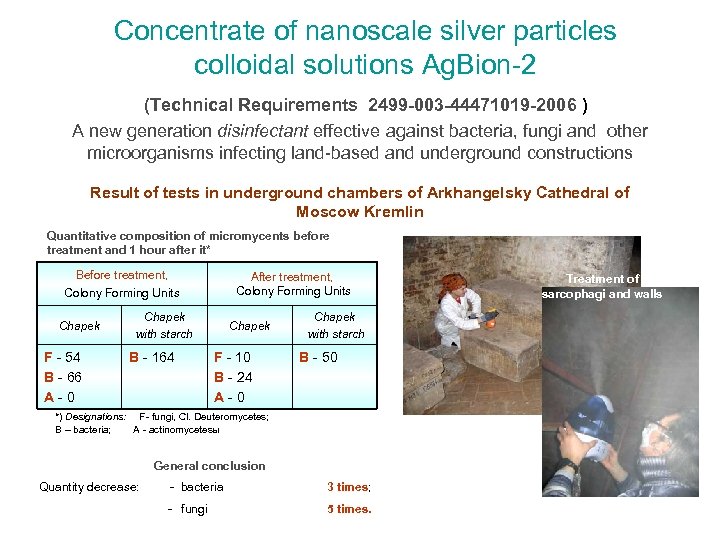 Concentrate of nanoscale silver particles colloidal solutions Ag. Bion-2 (Technical Requirements 2499 -003 -44471019 -2006 ) A new generation disinfectant effective against bacteria, fungi and other microorganisms infecting land-based and underground constructions Result of tests in underground chambers of Arkhangelsky Cathedral of Moscow Kremlin Quantitative composition of micromycents before treatment and 1 hour after it* Before treatment, Colony Forming Units Chapek F - 54 B - 66 A-0 After treatment, Colony Forming Units Chapek with starch B - 164 Chapek F - 10 B - 24 A-0 Chapek with starch B - 50 *) Designations: F- fungi, Cl. Deuteromycetes; B – bacteria; A - actinomycetesы General conclusion Quantity decrease: - bacteria 3 times; - fungi 5 times. Treatment of sarcophagi and walls
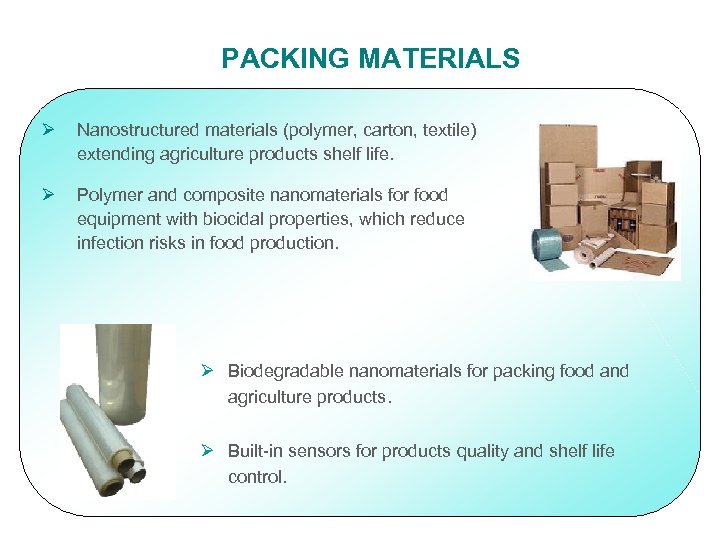 PACKING MATERIALS Ø Nanostructured materials (polymer, carton, textile) extending agriculture products shelf life. Ø Polymer and composite nanomaterials for food equipment with biocidal properties, which reduce infection risks in food production. Ø Biodegradable nanomaterials for packing food and agriculture products. Ø Built-in sensors for products quality and shelf life control.
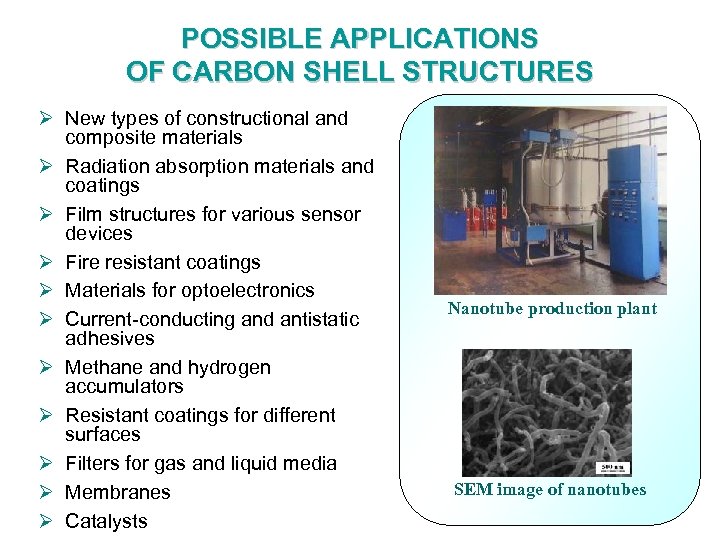 POSSIBLE APPLICATIONS OF CARBON SHELL STRUCTURES Ø New types of constructional and composite materials Ø Radiation absorption materials and coatings Ø Film structures for various sensor devices Ø Fire resistant coatings Ø Materials for optoelectronics Ø Current-conducting and antistatic adhesives Ø Methane and hydrogen accumulators Ø Resistant coatings for different surfaces Ø Filters for gas and liquid media Ø Membranes Ø Catalysts Nanotube production plant SEM image of nanotubes
 NANOTECHNOLOGY IN CERAMICS Ø High-quality powders, super- and nanodispersed powders included, to produce oxide and oxygen-free ceramics possessing stable chemical, phase and granulometric composition. Ø New types of reinforcing elements (whisker crystals, fibers, microspheres and disperse particles). Ø High-strength thermostable composite materials and coatings, including nanoceramic ones, based on refractory nitride, carbide and oxide compositions. Ø Nanoceramics products.
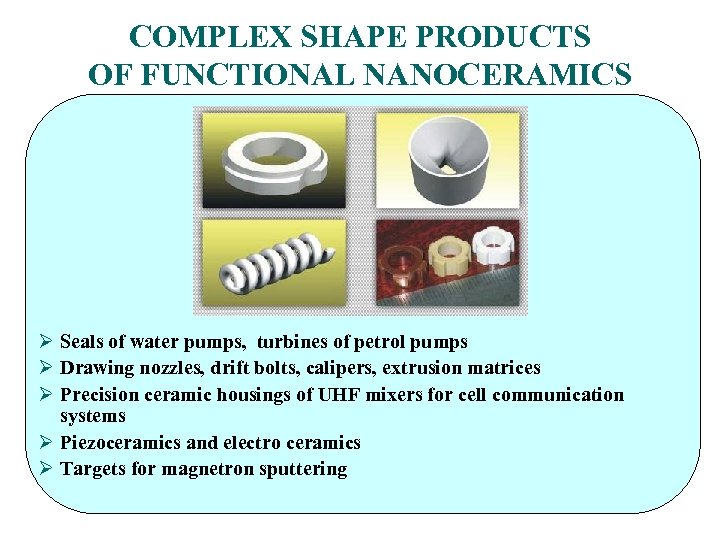 COMPLEX SHAPE PRODUCTS OF FUNCTIONAL NANOCERAMICS Ø Seals of water pumps, turbines of petrol pumps Ø Drawing nozzles, drift bolts, calipers, extrusion matrices Ø Precision ceramic housings of UHF mixers for cell communication systems Ø Piezoceramics and electro ceramics Ø Targets for magnetron sputtering
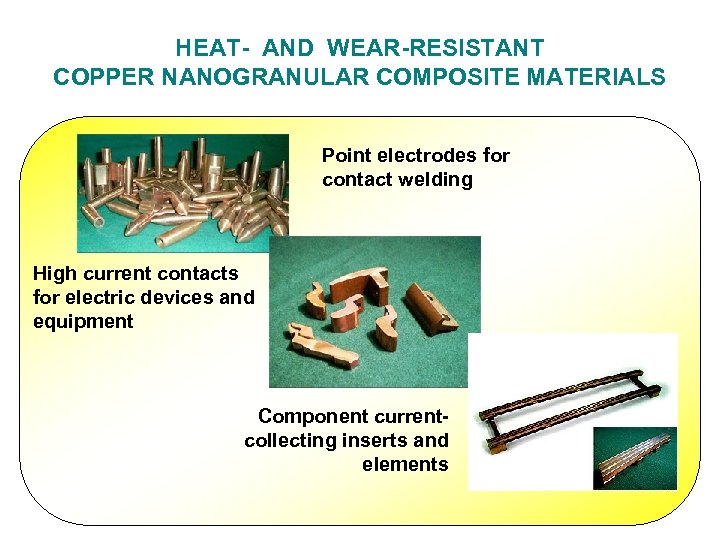 HEAT- AND WEAR-RESISTANT COPPER NANOGRANULAR COMPOSITE MATERIALS Point electrodes for contact welding High current contacts for electric devices and equipment Component currentcollecting inserts and elements
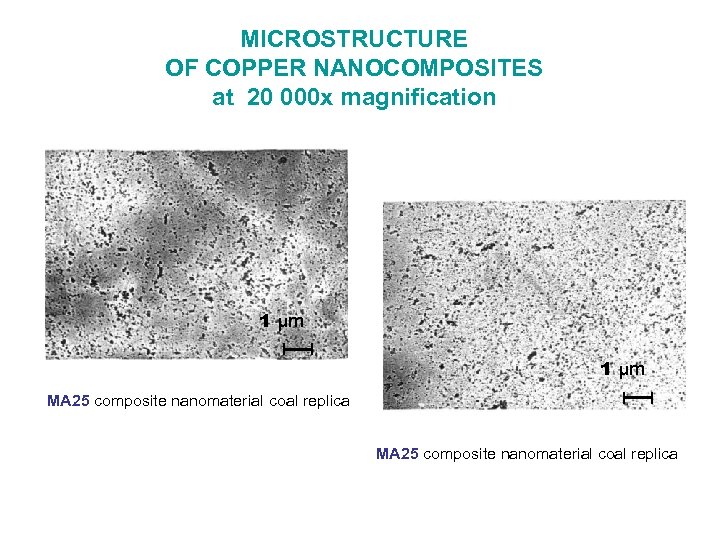 MICROSTRUCTURE OF COPPER NANOCOMPOSITES at 20 000 х magnification 1 μm МА 25 composite nanomaterial coal replica
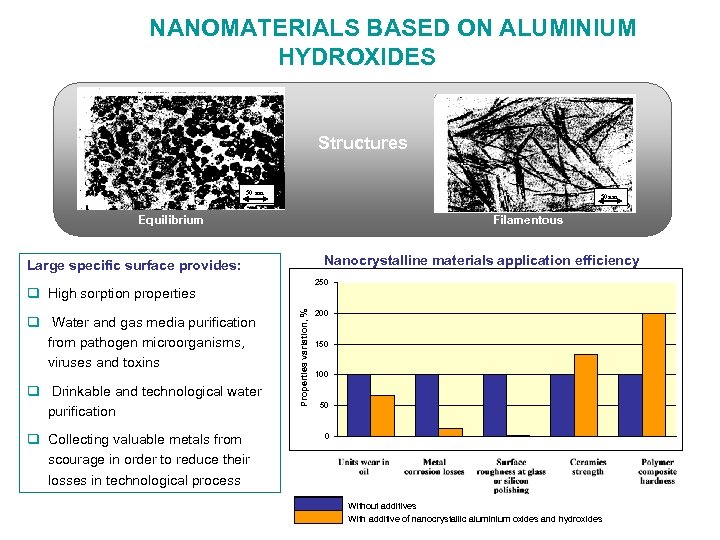 NANOMATERIALS BASED ON ALUMINIUM HYDROXIDES Structures 50 nm 50 nm Equilibrium Filamentous Nanocrystalline materials application efficiency Large specific surface provides: 250 q Water and gas media purification from pathogen microorganisms, viruses and toxins q Drinkable and technological water purification q Collecting valuable metals from scourage in order to reduce their losses in technological process Properties variation, % q High sorption properties 200 150 100 50 0 Without additives With additive of nanocrystallic aluminium oxides and hydroxides
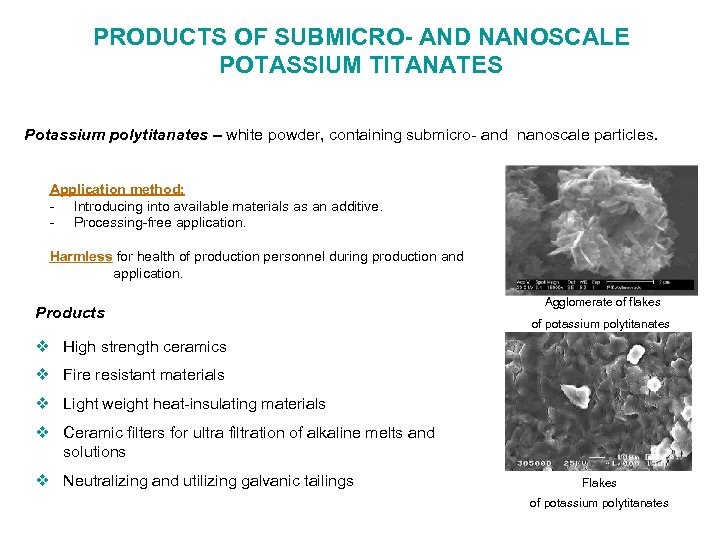 PRODUCTS OF SUBMICRO- AND NANOSCALE POTASSIUM TITANATES Potassium polytitanates – white powder, containing submicro- and nanoscale particles. Application method: - Introducing into available materials as an additive. - Processing-free application. Harmless for health of production personnel during production and application. Products Agglomerate of flakes of potassium polytitanates v High strength ceramics v Fire resistant materials v Light weight heat-insulating materials v Ceramic filters for ultra filtration of alkaline melts and solutions v Neutralizing and utilizing galvanic tailings Flakes of potassium polytitanates
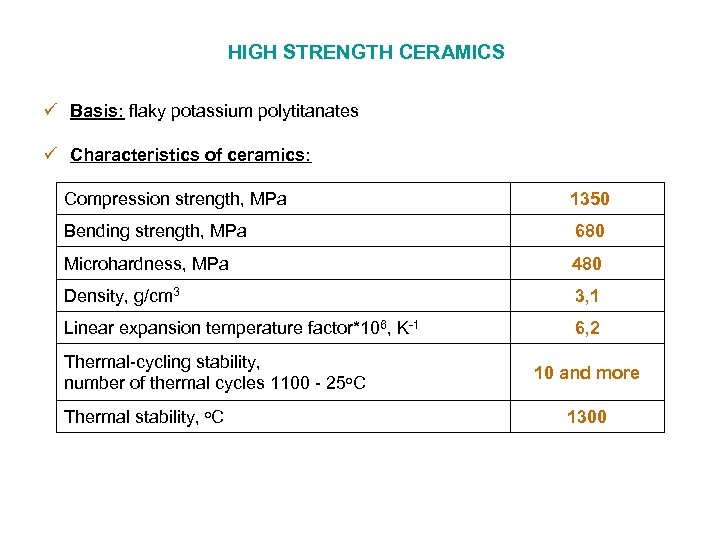 HIGH STRENGTH CERAMICS ü Basis: flaky potassium polytitanates ü Characteristics of ceramics: Compression strength, MPa 1350 Bending strength, MPa 680 Microhardness, MPa 480 Density, g/cm 3 3, 1 Linear expansion temperature factor*106, K-1 6, 2 Thermal-cycling stability, number of thermal cycles 1100 - 25 о. С Thermal stability, о. С 10 and more 1300
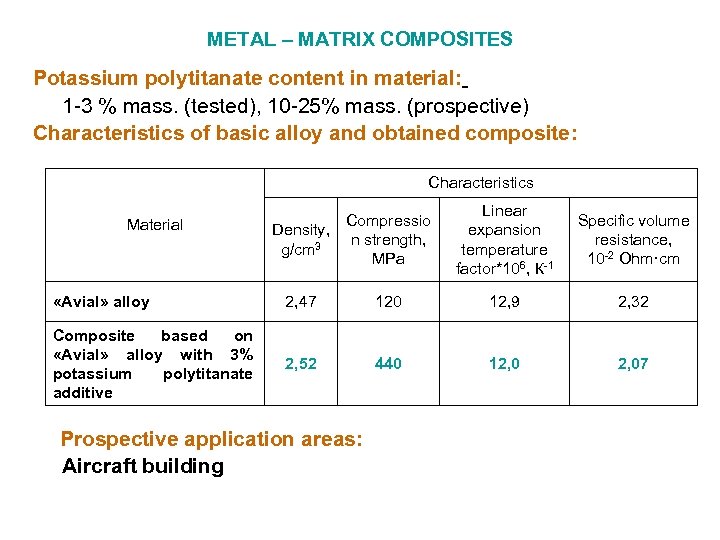 METAL – MATRIX COMPOSITES Potassium polytitanate content in material: 1 -3 % mass. (tested), 10 -25% mass. (prospective) Characteristics of basic alloy and obtained composite: Characteristics Material Compressio Density, n strength, g/cm 3 MPa Linear expansion temperature factor*106, К-1 Specific volume resistance, 10 -2 Ohm·cm «Avial» alloy 2, 47 120 12, 9 2, 32 Composite based on «Avial» alloy with 3% potassium polytitanate additive 2, 52 440 12, 07 Prospective application areas: Aircraft building
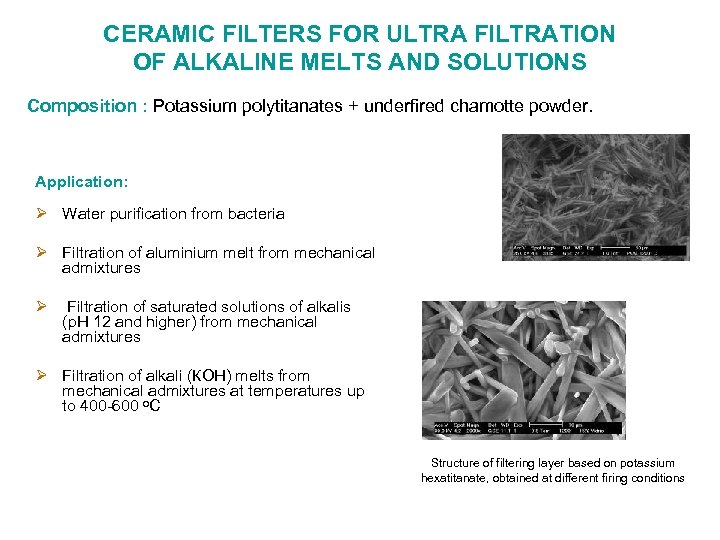 CERAMIC FILTERS FOR ULTRA FILTRATION OF ALKALINE MELTS AND SOLUTIONS Composition : Potassium polytitanates + underfired chamotte powder. Application: Ø Water purification from bacteria Ø Filtration of aluminium melt from mechanical admixtures Ø Filtration of saturated solutions of alkalis (р. Н 12 and higher) from mechanical admixtures Ø Filtration of alkali (КOH) melts from mechanical admixtures at temperatures up to 400 -600 о. C Structure of filtering layer based on potassium hexatitanate, obtained at different firing conditions
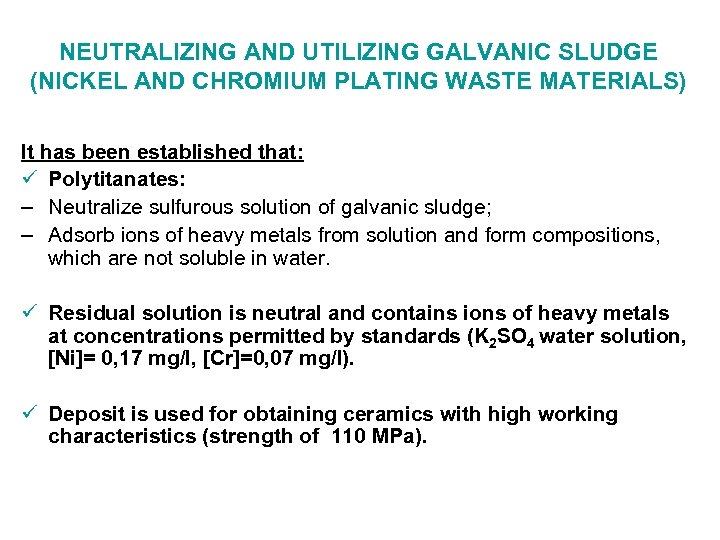 NEUTRALIZING AND UTILIZING GALVANIC SLUDGE (NICKEL AND CHROMIUM PLATING WASTE MATERIALS) It has been established that: ü Polytitanates: – Neutralize sulfurous solution of galvanic sludge; – Adsorb ions of heavy metals from solution and form compositions, which are not soluble in water. ü Residual solution is neutral and contains ions of heavy metals at concentrations permitted by standards (K 2 SO 4 water solution, [Ni]= 0, 17 mg/l, [Cr]=0, 07 mg/l). ü Deposit is used for obtaining ceramics with high working characteristics (strength of 110 MPa).
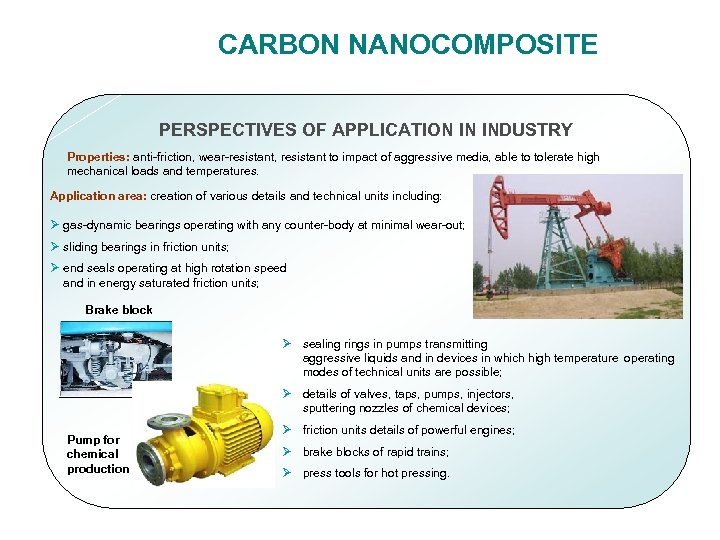 CARBON NANOCOMPOSITE PERSPECTIVES OF APPLICATION IN INDUSTRY Properties: anti-friction, wear-resistant, resistant to impact of aggressive media, able to tolerate high mechanical loads and temperatures. Application area: creation of various details and technical units including: Ø gas-dynamic bearings operating with any counter-body at minimal wear-out; Ø sliding bearings in friction units; Ø end seals operating at high rotation speed and in energy saturated friction units; Brake block Ø sealing rings in pumps transmitting aggressive liquids and in devices in which high temperature operating modes of technical units are possible; Ø details of valves, taps, pumps, injectors, sputtering nozzles of chemical devices; Pump for chemical production Ø friction units details of powerful engines; Ø brake blocks of rapid trains; Ø press tools for hot pressing.
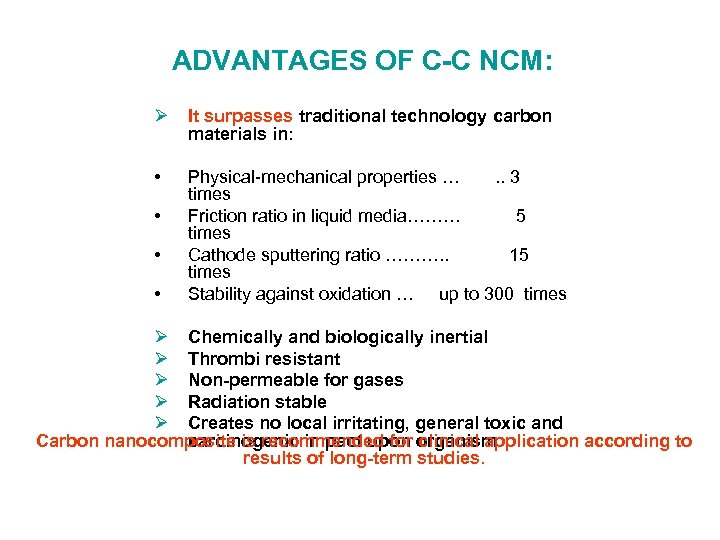 ADVANTAGES OF C-C NCM: Ø It surpasses traditional technology carbon materials in: • Physical-mechanical properties …. . 3 times Friction ratio in liquid media……… 5 times Cathode sputtering ratio ………. . 15 times Stability against oxidation … up to 300 times • • • Ø Chemically and biologically inertial Ø Thrombi resistant Ø Non-permeable for gases Ø Radiation stable Ø Creates no local irritating, general toxic and carcinogenic impact upon clinical application according to Carbon nanocomposite is recommended for organism results of long-term studies.
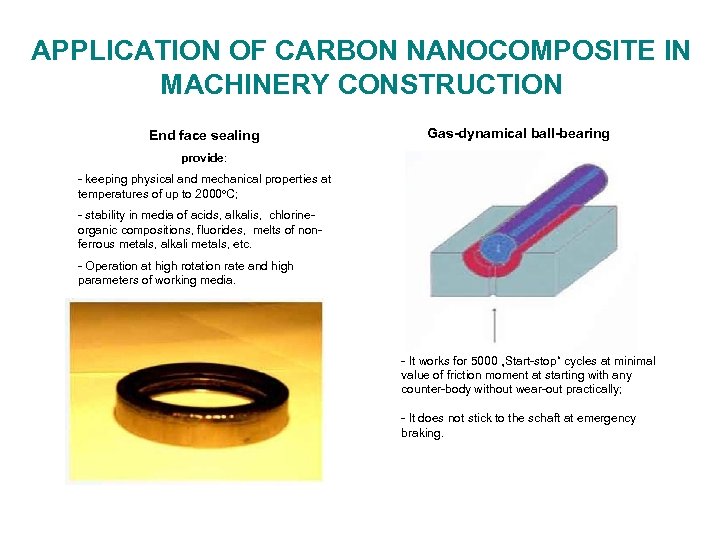 APPLICATION OF CARBON NANOCOMPOSITE IN MACHINERY CONSTRUCTION End face sealing Gas-dynamical ball-bearing provide: - keeping physical and mechanical properties at temperatures of up to 2000 o. C; - stability in media of acids, alkalis, chlorineorganic compositions, fluorides, melts of nonferrous metals, alkali metals, etc. - Operation at high rotation rate and high parameters of working media. - It works for 5000 „Start-stop“ cycles at minimal value of friction moment at starting with any counter-body without wear-out practically; - It does not stick to the schaft at emergency braking.
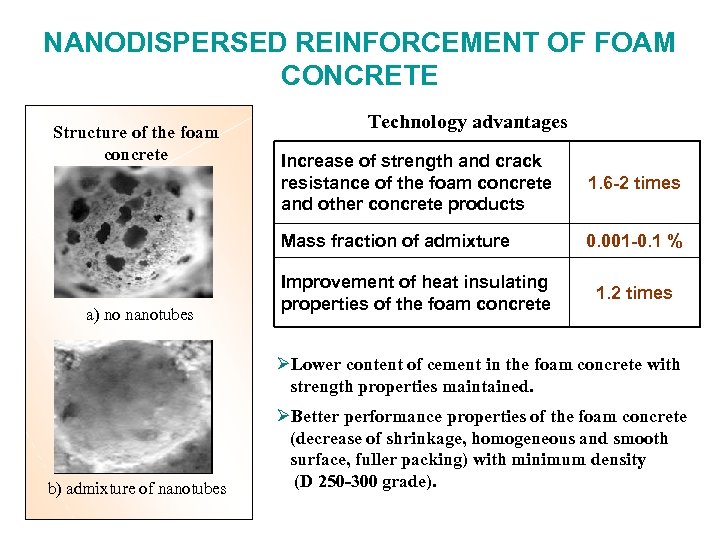 NANODISPERSED REINFORCEMENT OF FOAM CONCRETE Structure of the foam concrete Technology advantages 1. 6 -2 times Mass fraction of admixture a) no nanotubes Increase of strength and crack resistance of the foam concrete and other concrete products 0. 001 -0. 1 % Improvement of heat insulating properties of the foam concrete 1. 2 times ØLower content of cement in the foam concrete with strength properties maintained. b) admixture of nanotubes ØBetter performance properties of the foam concrete (decrease of shrinkage, homogeneous and smooth surface, fuller packing) with minimum density (D 250 -300 grade).
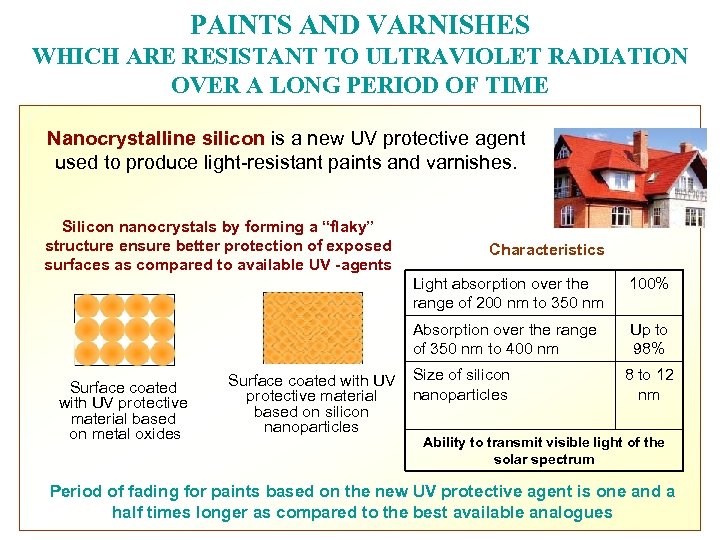 PAINTS AND VARNISHES WHICH ARE RESISTANT TO ULTRAVIOLET RADIATION OVER A LONG PERIOD OF TIME Nanocrystalline silicon is a new UV protective agent used to produce light-resistant paints and varnishes. Silicon nanocrystals by forming a “flaky” structure ensure better protection of exposed surfaces as compared to available UV -agents Characteristics Light absorption over the range of 200 nm to 350 nm Absorption over the range of 350 nm to 400 nm Surface coated with UV protective material based on metal oxides Surface coated with UV protective material based on silicon nanoparticles 100% Up to 98% Size of silicon nanoparticles 8 to 12 nm Ability to transmit visible light of the solar spectrum Period of fading for paints based on the new UV protective agent is one and a half times longer as compared to the best available analogues
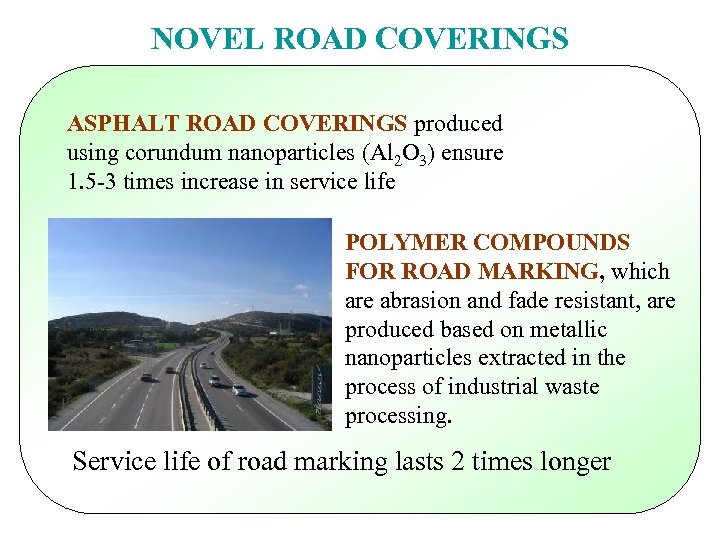 NOVEL ROAD COVERINGS ASPHALT ROAD COVERINGS produced using corundum nanoparticles (Al 2 O 3) ensure 1. 5 -3 times increase in service life POLYMER COMPOUNDS FOR ROAD MARKING, which are abrasion and fade resistant, are produced based on metallic nanoparticles extracted in the process of industrial waste processing. Service life of road marking lasts 2 times longer
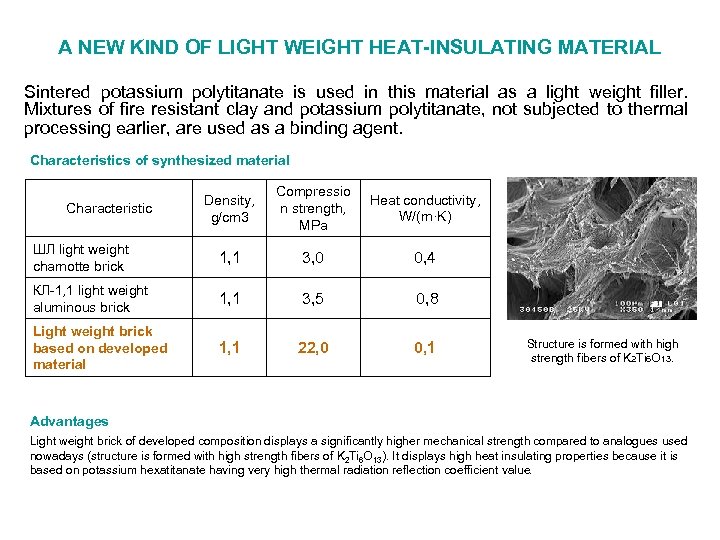 A NEW KIND OF LIGHT WEIGHT HEAT-INSULATING MATERIAL Sintered potassium polytitanate is used in this material as a light weight filler. Mixtures of fire resistant clay and potassium polytitanate, not subjected to thermal processing earlier, are used as a binding agent. Characteristics of synthesized material Density, g/cm 3 Compressio n strength, MPa Heat conductivity, W/(m·K) ШЛ light weight chamotte brick 1, 1 3, 0 0, 4 КЛ-1, 1 light weight aluminous brick 1, 1 3, 5 0, 8 Light weight brick based on developed material 1, 1 22, 0 0, 1 Characteristic Structure is formed with high strength fibers of K 2 Ti 6 O 13. Advantages Light weight brick of developed composition displays a significantly higher mechanical strength compared to analogues used nowadays (structure is formed with high strength fibers of K 2 Ti 6 O 13). It displays high heat insulating properties because it is based on potassium hexatitanate having very high thermal radiation reflection coefficient value.
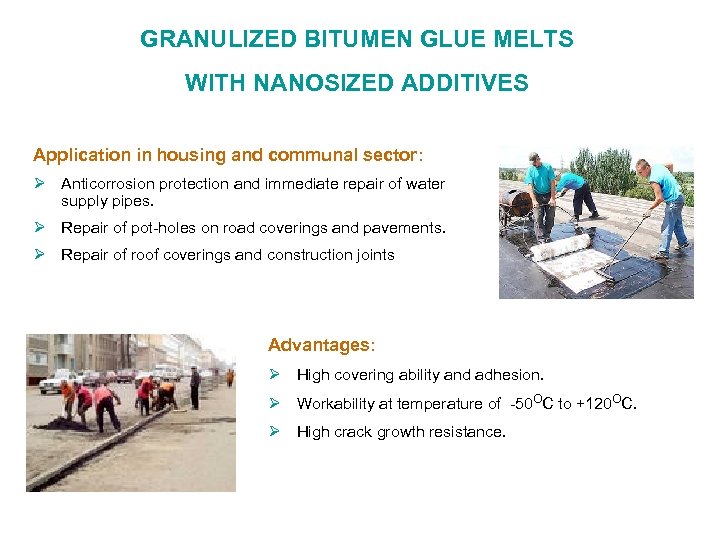 GRANULIZED BITUMEN GLUE MELTS WITH NANOSIZED ADDITIVES Application in housing and communal sector: Ø Anticorrosion protection and immediate repair of water supply pipes. Ø Repair of pot-holes on road coverings and pavements. Ø Repair of roof coverings and construction joints Advantages: Ø High covering ability and adhesion. Ø Workability at temperature of -50 ОС to +120 ОС. Ø High crack growth resistance.
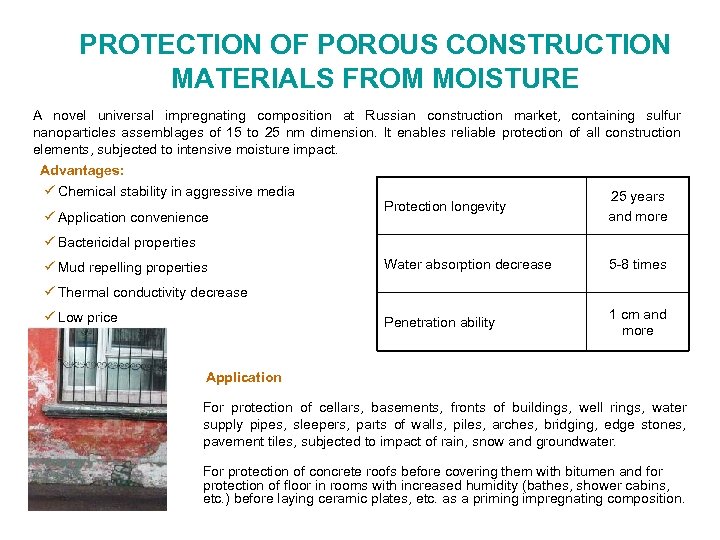 PROTECTION OF POROUS CONSTRUCTION MATERIALS FROM MOISTURE A novel universal impregnating composition at Russian construction market, containing sulfur nanoparticles assemblages of 15 to 25 nm dimension. It enables reliable protection of all construction elements, subjected to intensive moisture impact. Advantages: ü Chemical stability in aggressive media 25 years and more Water absorption decrease 5 -8 times Penetration ability ü Application convenience Protection longevity 1 cm and more ü Bactericidal properties ü Mud repelling properties ü Thermal conductivity decrease ü Low price Application For protection of cellars, basements, fronts of buildings, well rings, water supply pipes, sleepers, parts of walls, piles, arches, bridging, edge stones, pavement tiles, subjected to impact of rain, snow and groundwater. For protection of concrete roofs before covering them with bitumen and for protection of floor in rooms with increased humidity (bathes, shower cabins, etc. ) before laying ceramic plates, etc. as a priming impregnating composition.
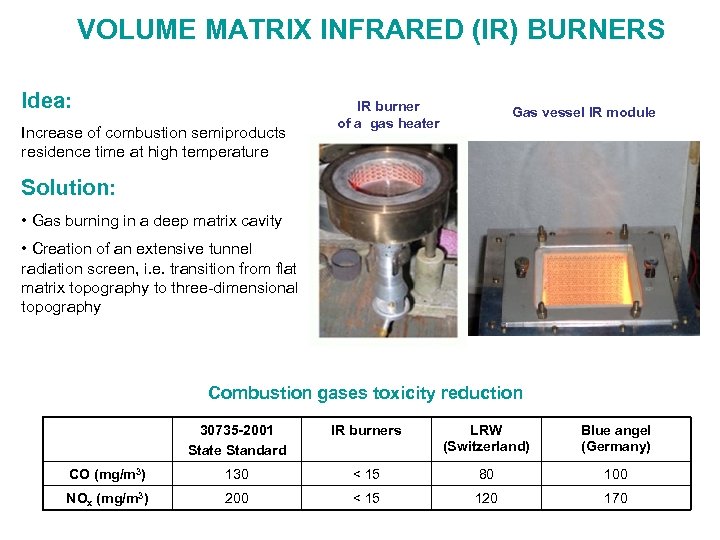 VOLUME MATRIX INFRARED (IR) BURNERS Idea: Increase of combustion semiproducts residence time at high temperature IR burner of a gas heater Gas vessel IR module Solution: • Gas burning in a deep matrix cavity • Creation of an extensive tunnel radiation screen, i. e. transition from flat matrix topography to three-dimensional topography Combustion gases toxicity reduction 30735 -2001 State Standard IR burners LRW (Switzerland) Blue angel (Germany) CO (mg/m 3) 130 < 15 80 100 NOx (mg/m 3) 200 < 15 120 170
 Advantages of volume matrix IR-burners Ø High efficiency of carbohydrate fuel burning – up to 99% and higher. Ø High ecological characteristics – combustion gases toxicity is at background level: CO и NOx concentration does not exceed 15 ppm; no carbohydrates, no soot. Ø Opportunity of significant thermal Possible application areas Ø High efficiency heating devices for oil-and-gas producing and oil refining industry, including furnaces in basic production technological cycle. Ø Constructional materials thermal processing devices (sand, ceramics, bricks drying). Ø Devices for frozen ground and runways thawing. streams obtaining – up to 2500 Ø Repair and building devices (roads, airdromes). k. Wt/m 2. Ø Heating devices in food industry. Ø Heating furnaces in metallurgy.
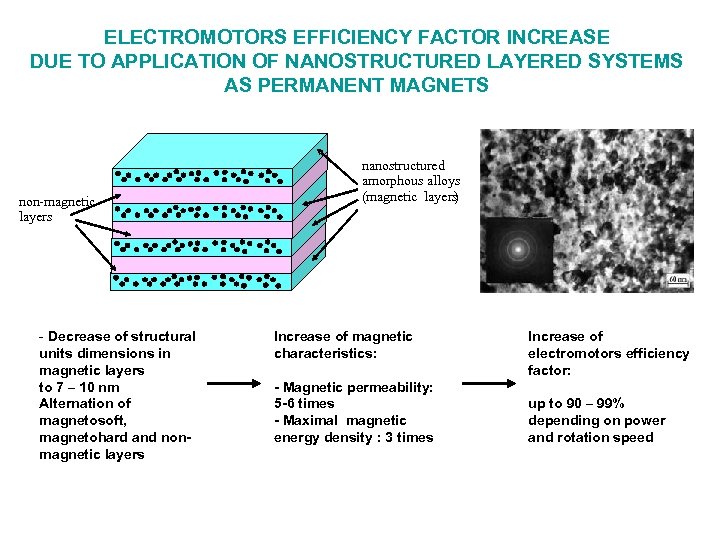 ELECTROMOTORS EFFICIENCY FACTOR INCREASE DUE TO APPLICATION OF NANOSTRUCTURED LAYERED SYSTEMS AS PERMANENT MAGNETS non-magnetic layers - Decrease of structural units dimensions in magnetic layers to 7 – 10 nm Alternation of magnetosoft, magnetohard and nonmagnetic layers nanostructured amorphous alloys (magnetic layers ) Increase of magnetic characteristics: - Magnetic permeability: 5 -6 times - Maximal magnetic energy density : 3 times Increase of electromotors efficiency factor: up to 90 – 99% depending on power and rotation speed
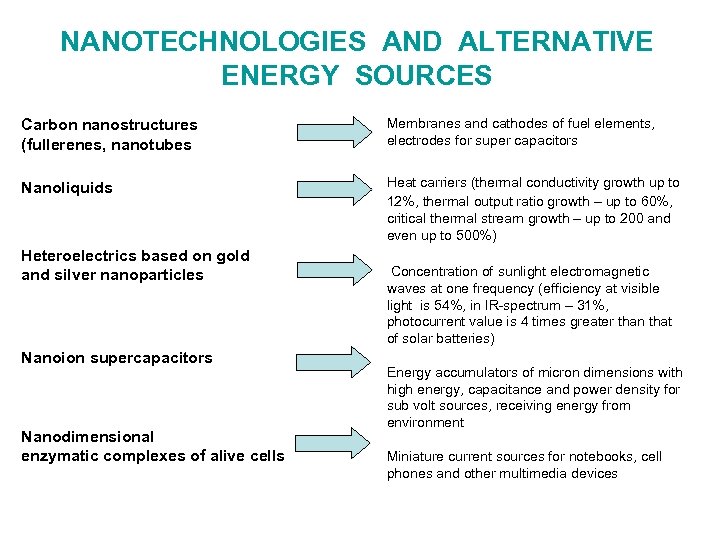 NANOTECHNOLOGIES AND ALTERNATIVE ENERGY SOURCES Carbon nanostructures (fullerenes, nanotubes Membranes and cathodes of fuel elements, electrodes for super capacitors Nanoliquids Heat carriers (thermal conductivity growth up to 12%, thermal output ratio growth – up to 60%, critical thermal stream growth – up to 200 and even up to 500%) Heteroelectrics based on gold and silver nanoparticles Nanoion supercapacitors Nanodimensional enzymatic complexes of alive cells Concentration of sunlight electromagnetic waves at one frequency (efficiency at visible light is 54%, in IR-spectrum – 31%, photocurrent value is 4 times greater than that of solar batteries) Energy accumulators of micron dimensions with high energy, capacitance and power density for sub volt sources, receiving energy from environment Miniature current sources for notebooks, cell phones and other multimedia devices
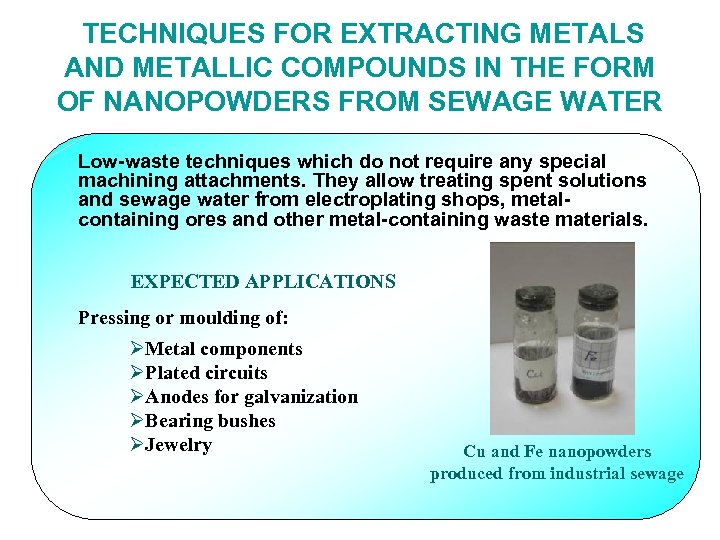 TECHNIQUES FOR EXTRACTING METALS AND METALLIC COMPOUNDS IN THE FORM OF NANOPOWDERS FROM SEWAGE WATER Low-waste techniques which do not require any special machining attachments. They allow treating spent solutions and sewage water from electroplating shops, metalcontaining ores and other metal-containing waste materials. EXPECTED APPLICATIONS Pressing or moulding of: ØMetal components ØPlated circuits ØAnodes for galvanization ØBearing bushes ØJewelry Cu and Fe nanopowders produced from industrial sewage
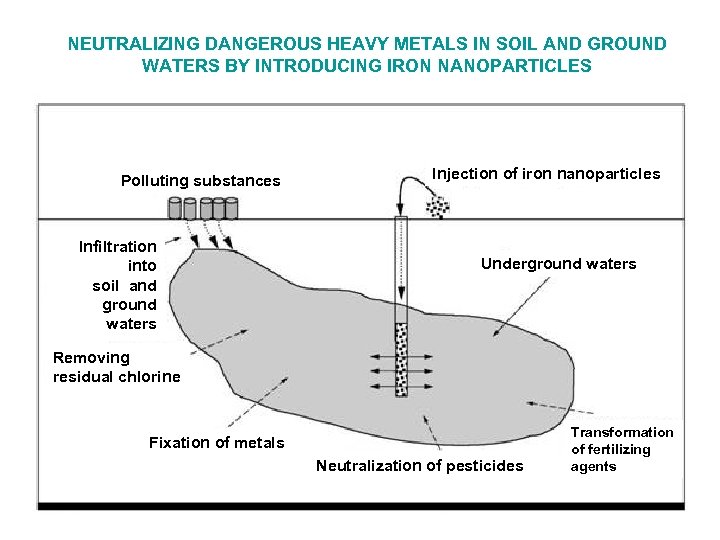 NEUTRALIZING DANGEROUS HEAVY METALS IN SOIL AND GROUND WATERS BY INTRODUCING IRON NANOPARTICLES Polluting substances Infiltration into soil and ground waters Injection of iron nanoparticles Underground waters Removing residual chlorine Fixation of metals Neutralization of pesticides Transformation of fertilizing agents
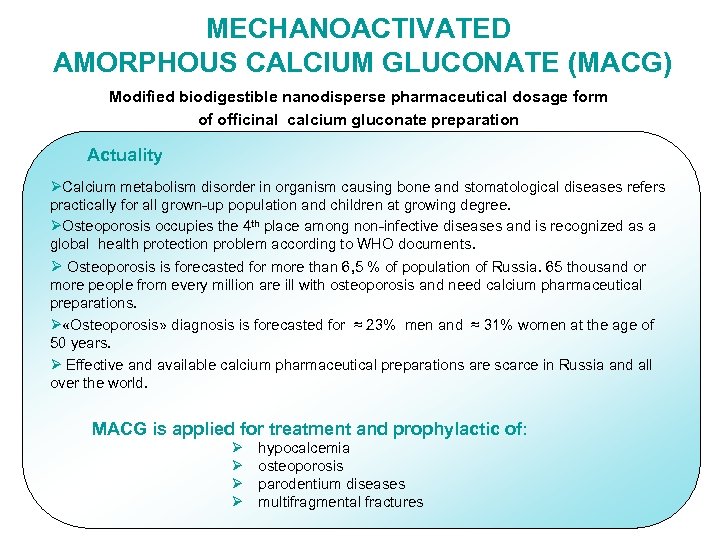 MECHANOACTIVATED AMORPHOUS CALCIUM GLUCONATE (MACG) Modified biodigestible nanodisperse pharmaceutical dosage form of officinal calcium gluconate preparation Actuality Актуальность Ø Проблемы костных и стоматологических заболеваний, обусловленные нарушением ØCalcium metabolism disorder in organism causing bone and stomatological diseases refers кальциевого grown-up организме, касаются практически всего practically for all обмена в population and children at growing degree. взрослого населения и все в возрастающей степени - детей. ØOsteoporosis occupies the 4 th place among non-infective diseases and is recognized as a ØОстеопороз прогнозируется более чем у 6, 5 documents. global health protection problem according to WHO % населения России. На 1 миллион приходится не менее 65 тысяч людей, больных остеопорозом и нуждающихся в Ø Osteoporosis is forecasted forкальция. 6, 5 % of population of Russia. 65 thousand or more than лекарственных препаратах more people from every million are ill with osteoporosis and need calcium pharmaceutical Ø В 50 -летнем возрасте диагноз «остеопороз» прогнозируется у ≈ 23% мужчин и ≈ 31% preparations. женщин. Ø «Osteoporosis» diagnosis is forecasted for ≈ 23% men and ≈ 31% women at the age of 50 Ø Как в России, так и во всем мире существует дефицит эффективных и доступных years. лекарственных препаратов кальция. Ø Effective and available calcium pharmaceutical preparations are scarce in Russia and all over the world. МАКГ применяется при лечении или профилактике: Ø гипокальцемии MACG is applied for treatment and prophylactic of: Ø Ø Ø остеопороза hypocalcemia osteoporosis заболеваний пародонта parodentium diseases многоосколочных переломов multifragmental fractures
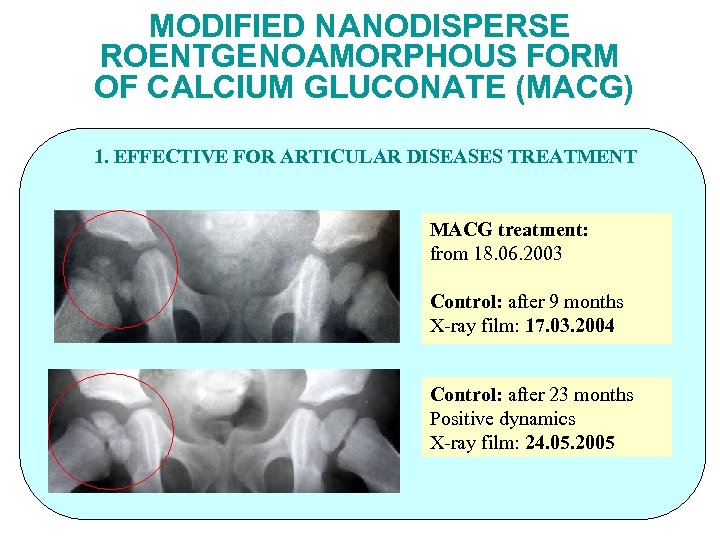 MODIFIED NANODISPERSE ROENTGENOAMORPHOUS FORM OF CALCIUM GLUCONATE (MACG) 1. EFFECTIVE FOR ARTICULAR DISEASES TREATMENT MACG treatment: from 18. 06. 2003 Control: after 9 months X-ray film: 17. 03. 2004 Control: after 23 months Positive dynamics X-ray film: 24. 05. 2005
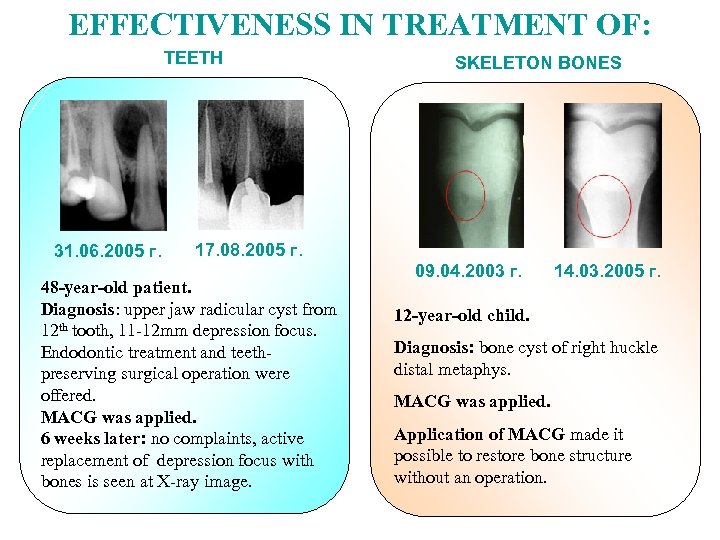 EFFECTIVENESS IN TREATMENT OF: TEETH 31. 06. 2005 г. SKELETON BONES 17. 08. 2005 г. 48 -year-old patient. Diagnosis: upper jaw radicular cyst from 12 th tooth, 11 -12 mm depression focus. Endodontic treatment and teethpreserving surgical operation were offered. MACG was applied. 6 weeks later: no complaints, active replacement of depression focus with bones is seen at X-ray image. 09. 04. 2003 г. 14. 03. 2005 г. 12 -year-old child. Diagnosis: bone cyst of right huckle distal metaphys. MACG was applied. Application of MACG made it possible to restore bone structure without an operation.
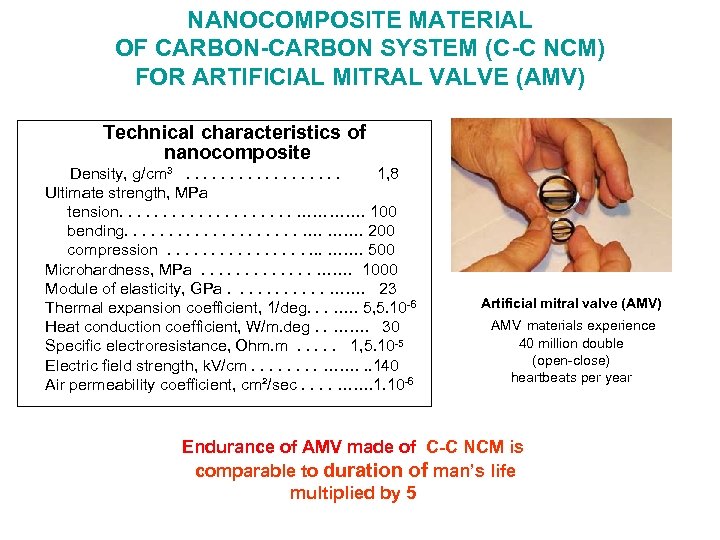 NANOCOMPOSITE MATERIAL OF CARBON-CARBON SYSTEM (С-С NCM) FOR ARTIFICIAL MITRAL VALVE (AMV) Technical characteristics of nanocomposite Density, g/cm³. . . . 1, 8 Ultimate strength, MPa tension. . . . . …………. 100 bending. . . . . …. ……. 200 compression. . . . . ……. 500 Microhardness, MPa. . . ……. 1000 Module of elasticity, GPa. . . ……. 23 Thermal expansion coefficient, 1/deg. . . …. . 5, 5. 10 -6 Heat conduction coefficient, W/m. deg. . ……. 30 Specific electroresistance, Ohm. m. . . 1, 5. 10 -5 Electric field strength, k. V/cm. . . . ……. . . 140 Air permeability coefficient, cm²/sec. . ……. 1. 10 -6 Artificial mitral valve (AMV) AMV materials experience 40 million double (open-close) heartbeats per year Endurance of AMV made of С-С NCM is comparable to duration of man’s life multiplied by 5
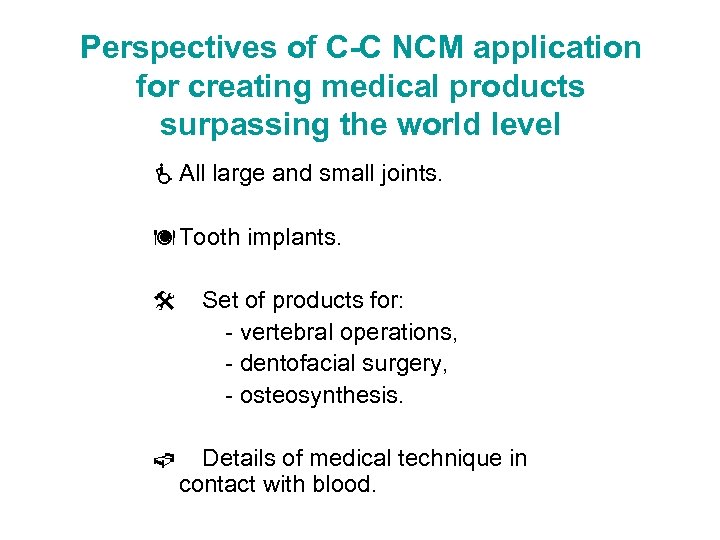 Perspectives of C-C NCM application for creating medical products surpassing the world level é All large and small joints. ä Tooth implants. Set of products for: - vertebral operations, - dentofacial surgery, - osteosynthesis. Details of medical technique in contact with blood.
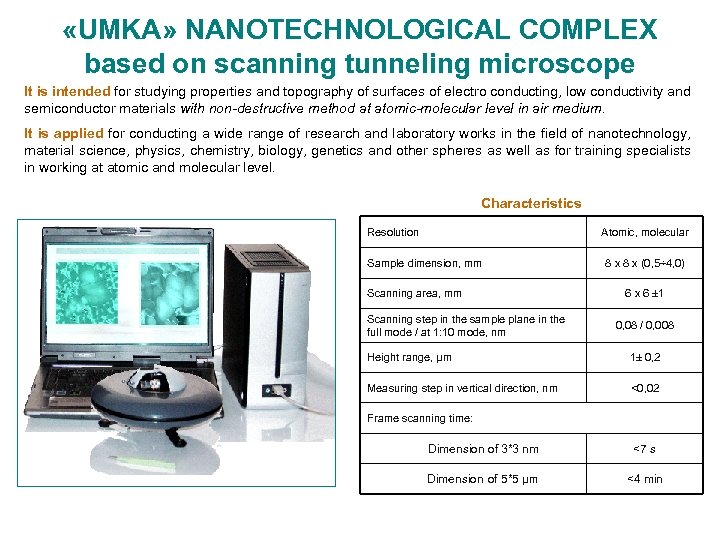 «UMKA» NANOTECHNOLOGICAL COMPLEX based on scanning tunneling microscope It is intended for studying properties and topography of surfaces of electro conducting, low conductivity and semiconductor materials with non-destructive method at atomic-molecular level in air medium. It is applied for conducting a wide range of research and laboratory works in the field of nanotechnology, material science, physics, chemistry, biology, genetics and other spheres as well as for training specialists in working at atomic and molecular level. Characteristics Resolution Atomic, molecular Sample dimension, mm Scanning area, mm Scanning step in the sample plane in the full mode / at 1: 10 mode, nm 8 х (0, 5÷ 4, 0) 6 х 6 ± 1 0, 08 / 0, 008 Height range, μm 1± 0, 2 Measuring step in vertical direction, nm <0, 02 Frame scanning time: Dimension of 3*3 nm <7 s Dimension of 5*5 μm <4 min
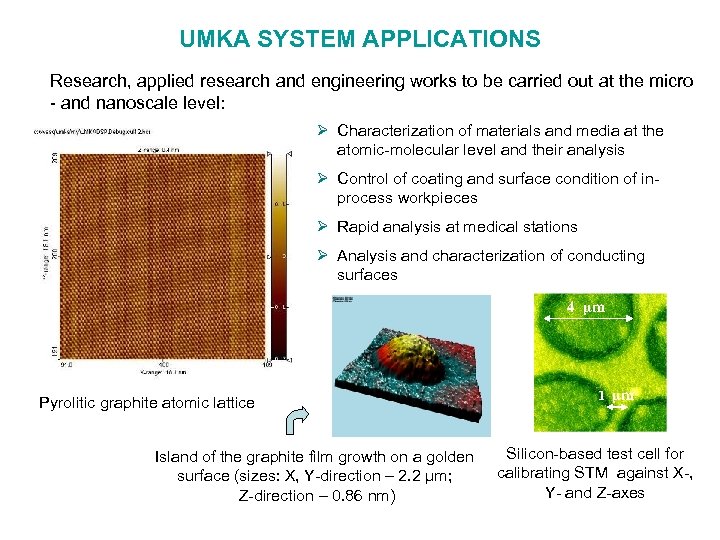 UMKA SYSTEM APPLICATIONS Research, applied research and engineering works to be carried out at the micro - and nanoscale level: Ø Characterization of materials and media at the atomic-molecular level and their analysis Ø Control of coating and surface condition of inprocess workpieces Ø Rapid analysis at medical stations Ø Analysis and characterization of conducting surfaces 4 µm Pyrolitic graphite atomic lattice Island of the graphite film growth on a golden surface (sizes: X, Y-direction – 2. 2 µm; Z-direction – 0. 86 nm) 1 µm Silicon-based test cell for calibrating STM against X-, Y- and Z-axes
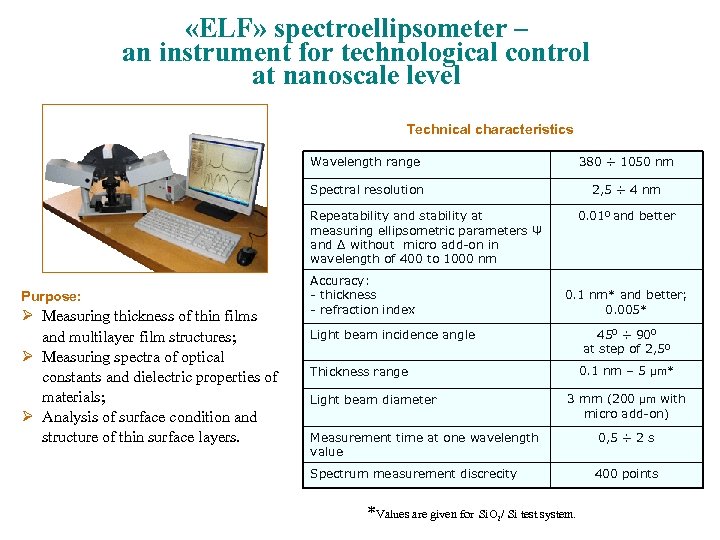 «ELF» spectroellipsometer – an instrument for technological control at nanoscale level Technical characteristics Wavelength range 380 ÷ 1050 nm Spectral resolution 2, 5 ÷ 4 nm Repeatability and stability at measuring ellipsometric parameters Ψ and Δ without micro add-on in wavelength of 400 to 1000 nm Purpose: Ø Measuring thickness of thin films and multilayer film structures; Ø Measuring spectra of optical constants and dielectric properties of materials; Ø Analysis of surface condition and structure of thin surface layers. Accuracy: - thickness - refraction index 0. 010 and better 0. 1 nm* and better; 0. 005* Light beam incidence angle 450 ÷ 900 at step of 2, 50 0. 1 nm – 5 μm* Thickness range Light beam diameter 3 mm (200 μm with micro add-on) Measurement time at one wavelength value Spectrum measurement discrecity *Values are given for Si. O 2/ Si test system. 0, 5 ÷ 2 s 400 points
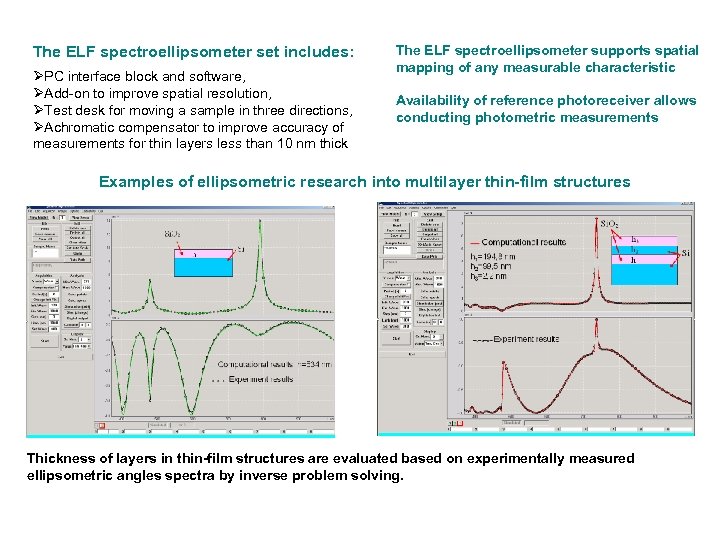 The ELF spectroellipsometer set includes: ØPC interface block and software, ØAdd-on to improve spatial resolution, ØTest desk for moving a sample in three directions, ØAchromatic compensator to improve accuracy of measurements for thin layers less than 10 nm thick The ELF spectroellipsometer supports spatial mapping of any measurable characteristic Availability of reference photoreceiver allows conducting photometric measurements Examples of ellipsometric research into multilayer thin-film structures Thickness of layers in thin-film structures are evaluated based on experimentally measured ellipsometric angles spectra by inverse problem solving.
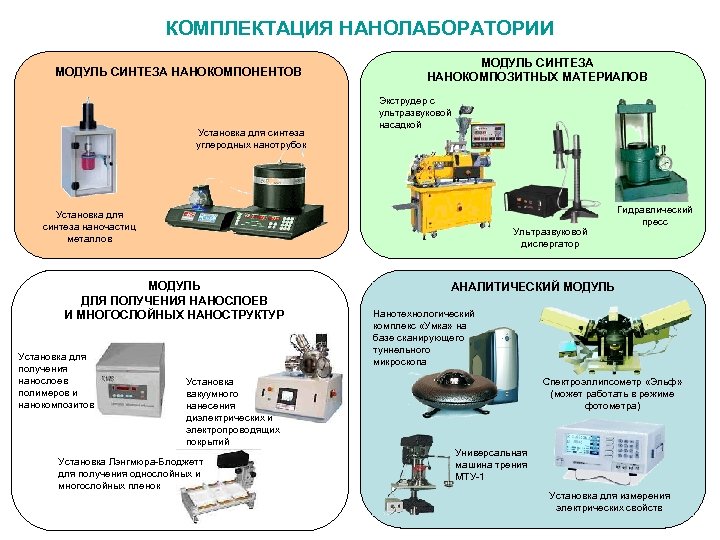 КОМПЛЕКТАЦИЯ НАНОЛАБОРАТОРИИ МОДУЛЬ СИНТЕЗА НАНОКОМПОНЕНТОВ Установка для синтеза углеродных нанотрубок МОДУЛЬ СИНТЕЗА НАНОКОМПОЗИТНЫХ МАТЕРИАЛОВ Экструдер с ультразвуковой насадкой Установка для синтеза наночастиц металлов Ультразвуковой диспергатор МОДУЛЬ ДЛЯ ПОЛУЧЕНИЯ НАНОСЛОЕВ И МНОГОСЛОЙНЫХ НАНОСТРУКТУР Установка для получения нанослоев полимеров и нанокомпозитов Установка вакуумного нанесения диэлектрических и электропроводящих покрытий Установка Лэнгмюра-Блоджетт для получения однослойных и многослойных пленок Гидравлический пресс АНАЛИТИЧЕСКИЙ МОДУЛЬ Нанотехнологический комплекс «Умка» на базе сканирующего туннельного микроскопа Спектроэллипсометр «Эльф» (может работать в режиме фотометра) Универсальная машина трения МТУ-1 Установка для измерения электрических свойств
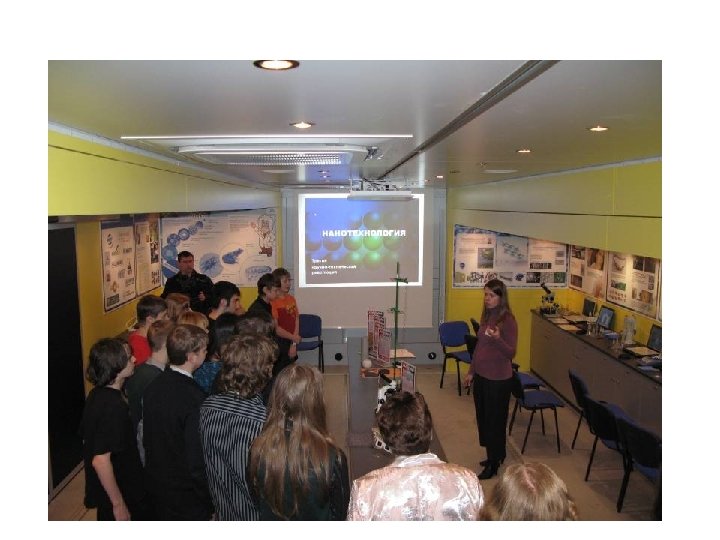
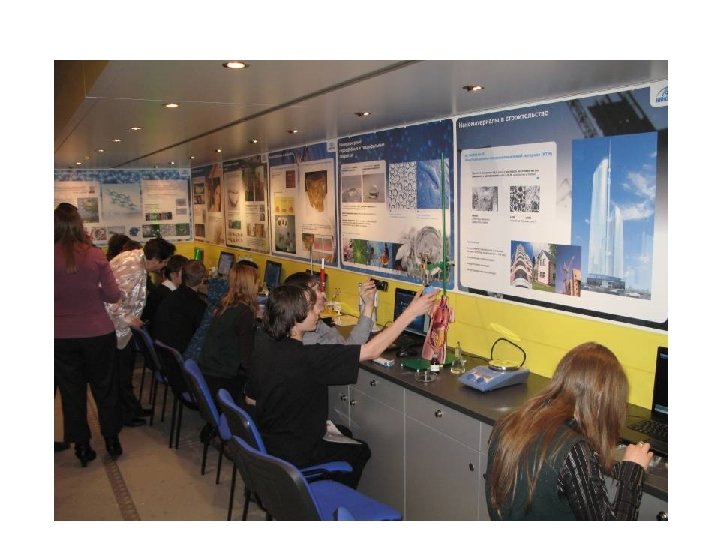
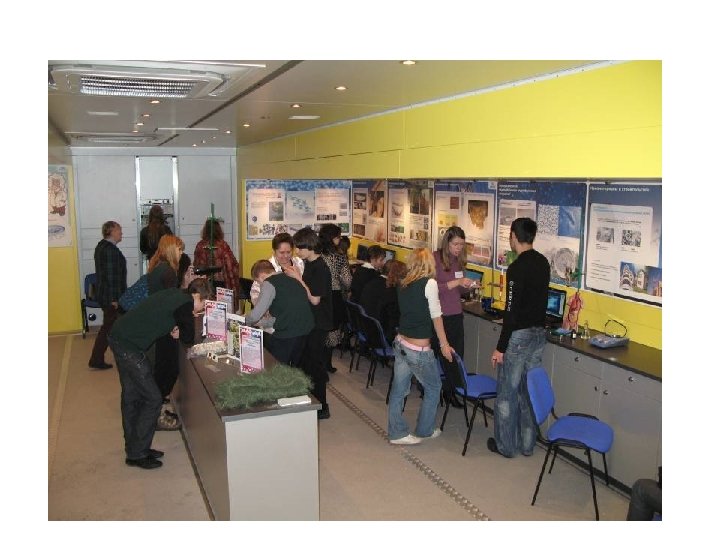
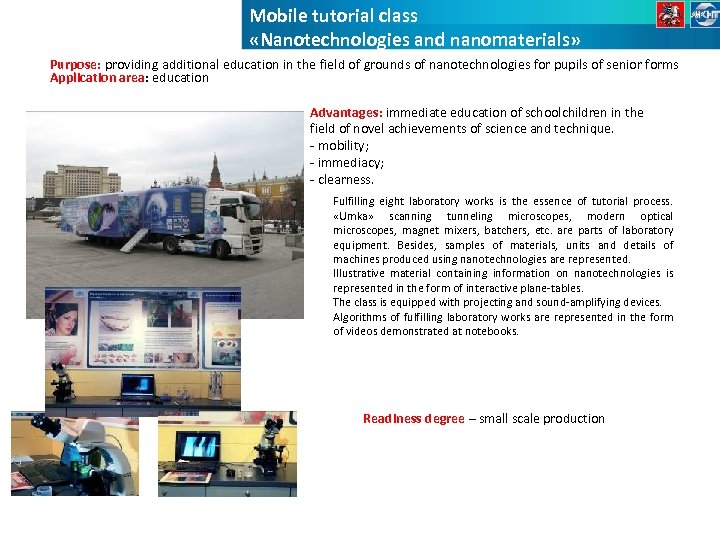 Mobile tutorial class «Nanotechnologies and nanomaterials» Purpose: providing additional education in the field of grounds of nanotechnologies for pupils of senior forms Application area: education Advantages: immediate education of schoolchildren in the field of novel achievements of science and technique. - mobility; - immediacy; - clearness. Fulfilling eight laboratory works is the essence of tutorial process. «Umka» scanning tunneling microscopes, modern optical microscopes, magnet mixers, batchers, etc. are parts of laboratory equipment. Besides, samples of materials, units and details of machines produced using nanotechnologies are represented. Illustrative material containing information on nanotechnologies is represented in the form of interactive plane-tables. The class is equipped with projecting and sound-amplifying devices. Algorithms of fulfilling laboratory works are represented in the form of videos demonstrated at notebooks. Readiness degree – small scale production
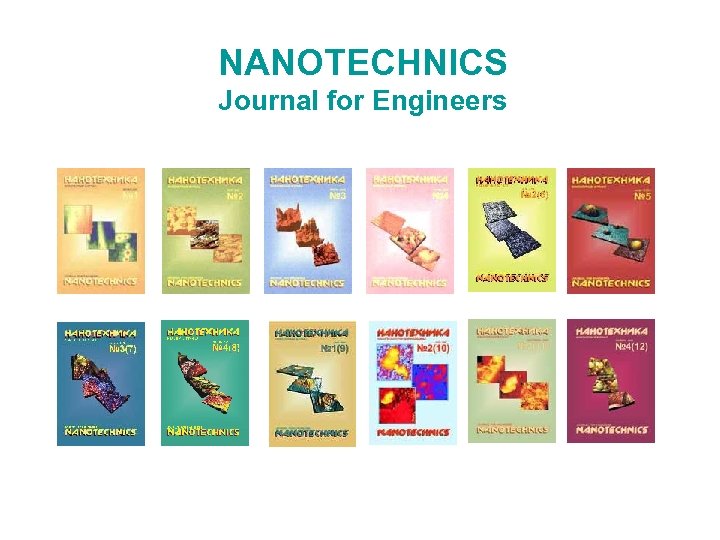 NANOTECHNICS Journal for Engineers
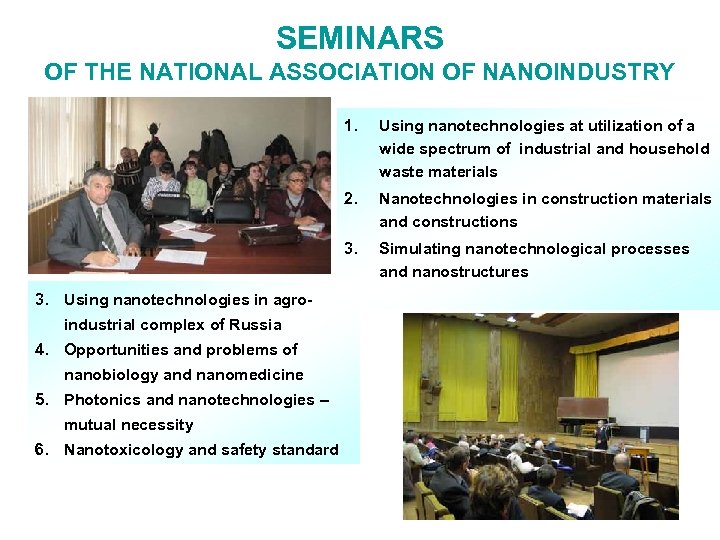 SEMINARS OF THE NATIONAL ASSOCIATION OF NANOINDUSTRY 1. 2. industrial complex of Russia 4. Opportunities and problems of nanobiology and nanomedicine 5. Photonics and nanotechnologies – mutual necessity 6. Nanotoxicology and safety standard Nanotechnologies in construction materials and constructions 3. 3. Using nanotechnologies in agro- Using nanotechnologies at utilization of a wide spectrum of industrial and household waste materials Simulating nanotechnological processes and nanostructures
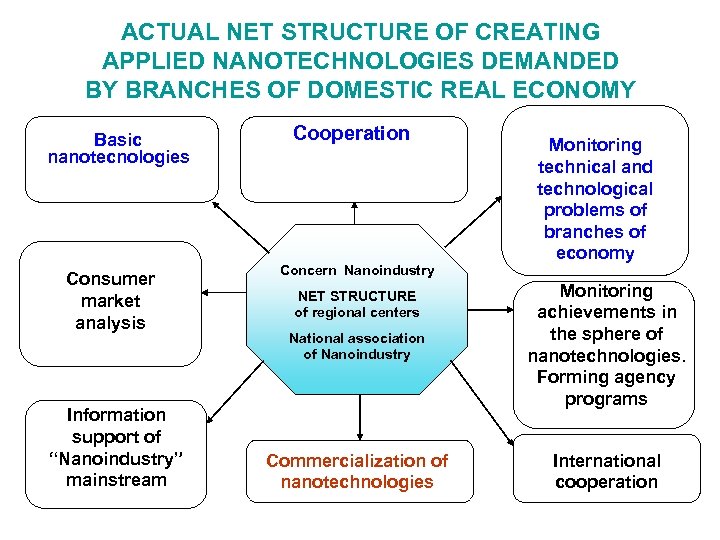 ACTUAL NET STRUCTURE OF CREATING APPLIED NANOTECHNOLOGIES DEMANDED BY BRANCHES OF DOMESTIC REAL ECONOMY Basic nanotecnologies Consumer market analysis Information support of “Nanoindustry” mainstream Cooperation Concern Nanoindustry Monitoring technical and technological problems of branches of economy National association of Nanoindustry Monitoring achievements in the sphere of nanotechnologies. Forming agency programs Commercialization of nanotechnologies International cooperation NET STRUCTURE of regional centers
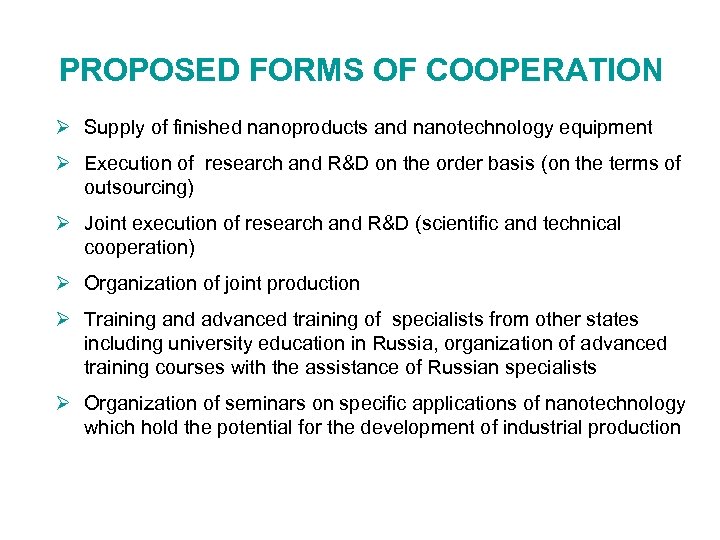 PROPOSED FORMS OF COOPERATION Ø Supply of finished nanoproducts and nanotechnology equipment Ø Execution of research and R&D on the order basis (on the terms of outsourcing) Ø Joint execution of research and R&D (scientific and technical cooperation) Ø Organization of joint production Ø Training and advanced training of specialists from other states including university education in Russia, organization of advanced training courses with the assistance of Russian specialists Ø Organization of seminars on specific applications of nanotechnology which hold the potential for the development of industrial production
 THANK YOU FOR YOUR ATTENTION NATIONAL ASSOCIATION OF NANOINDUSTRY CONCERN NANOINDUSTRY 20, sector 4, Nauchnyy passage, Mosсow, 117246, Russia Tel. + 7 495 332 -8811, Fax + 7 495 332 -8811, E-mail: nanotech@nanotech. ru, http: //www. nanotech. ru