 Скачать презентацию National Aeronautics and Space Administration Jet Propulsion Laboratory
b013f94f74b88f2c82e666ffecce3ec2.ppt
- Количество слайдов: 23



National Aeronautics and Space Administration Jet Propulsion Laboratory California Institute of Technology Pasadena, California www. nasa. gov Geo. FEST Progress Jay Parker, Gregory Lyzenga, Charles Norton, Margaret Glasscoe Jet Propulsion Laboratory, California Institute of Technology
Downloading Geo. FEST • • • Go to http: //openchannelfoundation. com/projects/Geo. FEST Click on the "GET IT!" button. Follow instructions. Order everything (do all the check boxes). When notified, download everything Start by glancing over: – – Geo. FEST User's Guide Version 4. 5 of Geo. FEST code • What are the other things good for? – – 4. 5 g demonstrates adaptive refinement, but is primitive, hardwired for one case. 4. 3 p , 4. 3 are obsolete, but have additional validation cases. • For desktop computer, enough. For parallel system, get also: – Pyramid-1. 1. 5 at http: //www. openchannelfoundation. org/projects/Pyramid – Par. Metis-3. 1, at http: //www-users. cs. umn. edu/~karypis/metis/parmetis/index. html.
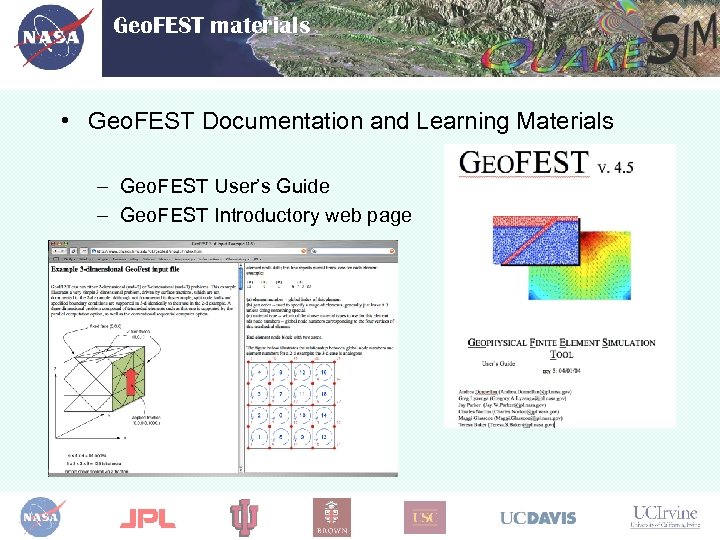
Geo. FEST materials • Geo. FEST Documentation and Learning Materials – Geo. FEST User’s Guide – Geo. FEST Introductory web page
Compiling Geo. FEST • Read the README in Geo. FEST-4. 5/ • Desktop version: – tar xvzf Geo. FEST-4. 5. tgz – cd Geo. FEST-4. 5/geofest – make -f Makefile. Sequential • Parallel version (identical geofest source): – – – Download Pyramid-1. 1. 5 Download Par. Metis-3. 1 Have MPI, a Fortran 90 compiler, and a C (99) compiler Perform minor softlink surgery (see the README): • cd Geo. FEST-4. 5 • mv Pyramid/ Pyramid. old • ln -s $HOME/Pyramid-1. 1. 5/ Pyramid • cd geofest Invoke eg. make -f Makefile. Absoft (several make files supplied, can be adapted)
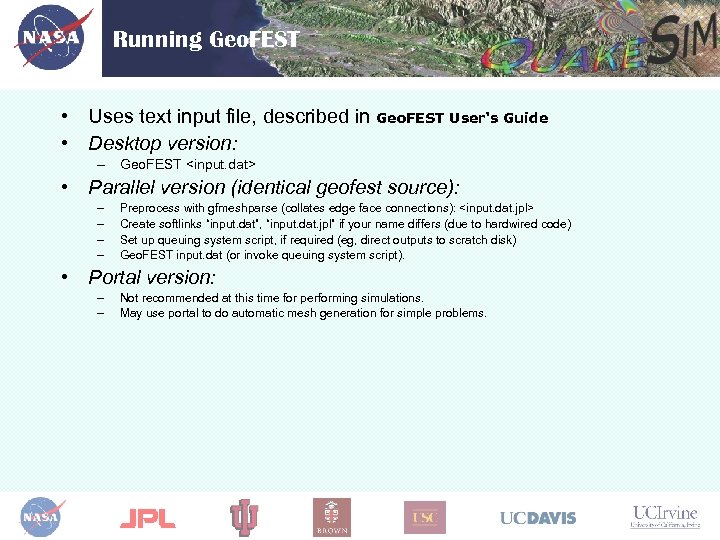
Running Geo. FEST • Uses text input file, described in Geo. FEST User's Guide • Desktop version: – Geo. FEST <input. dat> • Parallel version (identical geofest source): – – Preprocess with gfmeshparse (collates edge face connections): <input. dat. jpl> Create softlinks “input. dat”, “input. dat. jpl” if your name differs (due to hardwired code) Set up queuing system script, if required (eg, direct outputs to scratch disk) Geo. FEST input. dat (or invoke queuing system script). • Portal version: – – Not recommended at this time for performing simulations. May use portal to do automatic mesh generation for simple problems.
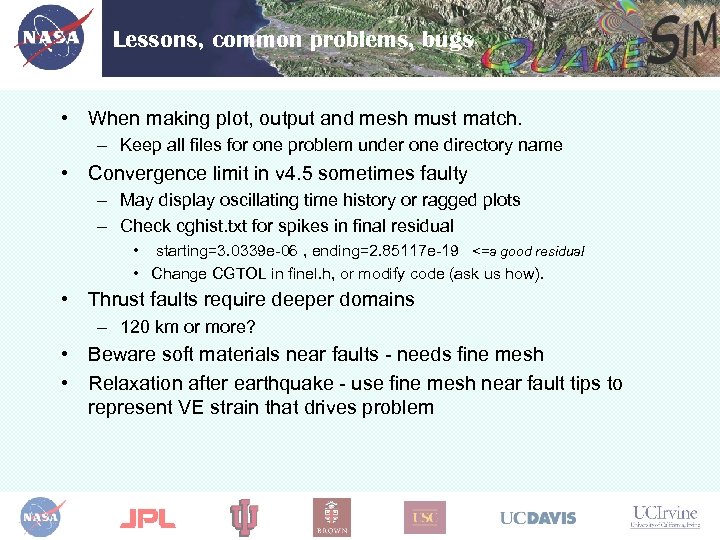
Lessons, common problems, bugs • When making plot, output and mesh must match. – Keep all files for one problem under one directory name • Convergence limit in v 4. 5 sometimes faulty – May display oscillating time history or ragged plots – Check cghist. txt for spikes in final residual • starting=3. 0339 e-06 , ending=2. 85117 e-19 <=a good residual • Change CGTOL in finel. h, or modify code (ask us how). • Thrust faults require deeper domains – 120 km or more? • Beware soft materials near faults - needs fine mesh • Relaxation after earthquake - use fine mesh near fault tips to represent VE strain that drives problem
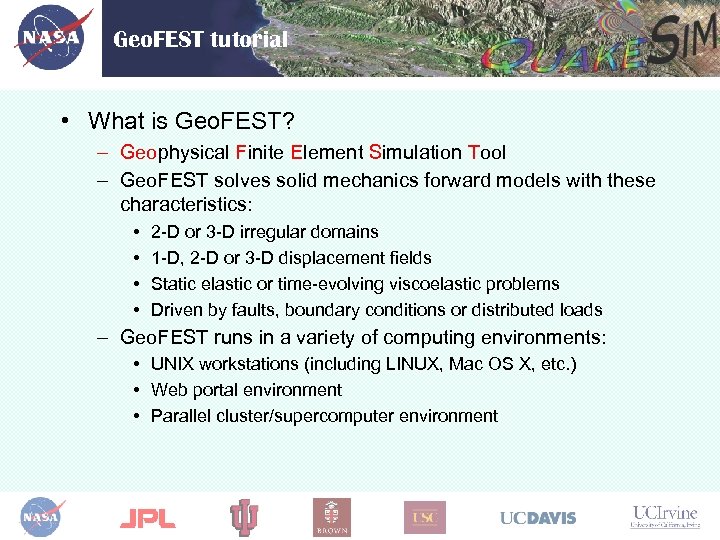
Geo. FEST tutorial • What is Geo. FEST? – Geophysical Finite Element Simulation Tool – Geo. FEST solves solid mechanics forward models with these characteristics: • • 2 -D or 3 -D irregular domains 1 -D, 2 -D or 3 -D displacement fields Static elastic or time-evolving viscoelastic problems Driven by faults, boundary conditions or distributed loads – Geo. FEST runs in a variety of computing environments: • UNIX workstations (including LINUX, Mac OS X, etc. ) • Web portal environment • Parallel cluster/supercomputer environment
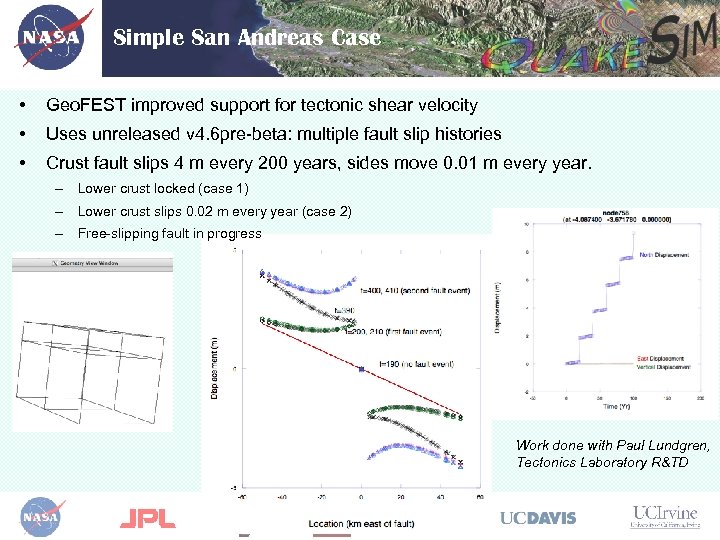
Simple San Andreas Case • Geo. FEST improved support for tectonic shear velocity • Uses unreleased v 4. 6 pre-beta: multiple fault slip histories • Crust fault slips 4 m every 200 years, sides move 0. 01 m every year. – Lower crust locked (case 1) – Lower crust slips 0. 02 m every year (case 2) – Free-slipping fault in progress Work done with Paul Lundgren, Tectonics Laboratory R&TD
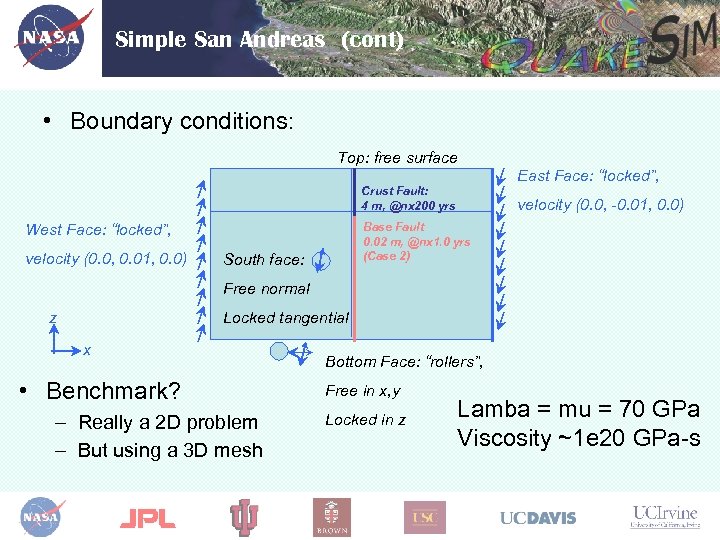
Simple San Andreas (cont) • Boundary conditions: Top: free surface East Face: “locked”, Crust Fault: 4 m, @nx 200 yrs Base Fault 0. 02 m, @nx 1. 0 yrs (Case 2) West Face: “locked”, velocity (0. 0, 0. 01, 0. 0) velocity (0. 0, -0. 01, 0. 0) South face: Free normal z Locked tangential x • Benchmark? – Really a 2 D problem – But using a 3 D mesh Bottom Face: “rollers”, Free in x, y Locked in z Lamba = mu = 70 GPa Viscosity ~1 e 20 GPa-s
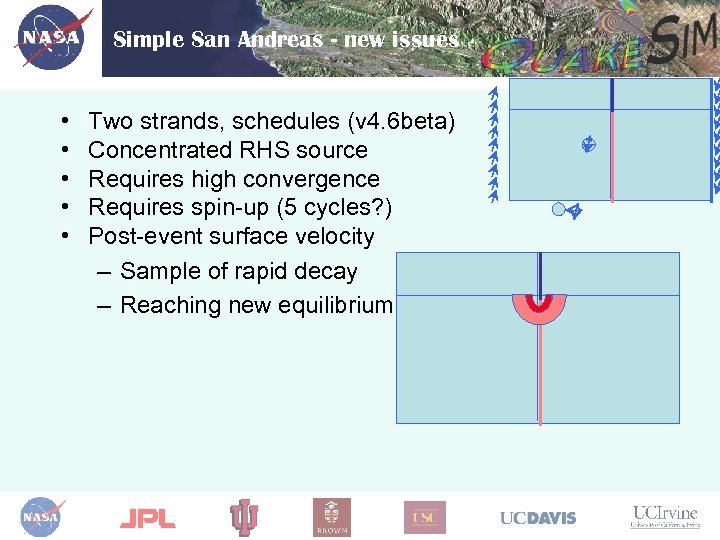
Simple San Andreas - new issues • • • Two strands, schedules (v 4. 6 beta) Concentrated RHS source Requires high convergence Requires spin-up (5 cycles? ) Post-event surface velocity – Sample of rapid decay – Reaching new equilibrium
Velocity profile at 810 years, ten years after a seismic event in the crust fault. Velocity is in m/yr. Scatter plot using all surface nodes. Good: smooth (->converged) Poor: shape wrong (->base mesh density) Time history of accumulated displacement (left axis, red) and instantaneous velocity (right axis, blue) based on node 405 history file. Displacement is in m, velocity in m/yr
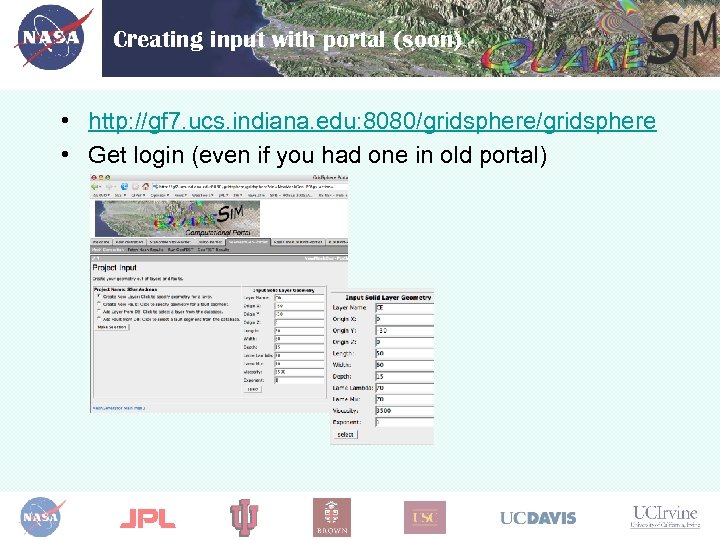
Creating input with portal (soon) • http: //gf 7. ucs. indiana. edu: 8080/gridsphere • Get login (even if you had one in old portal)
Generating Geo. FEST input: gui. VISCO route • gui. VISCO generates <proj>. node, <proj>. tetra, solids files listed in <proj>. grp: pure geometry. • Portal allows download of these. – (but only for layered model, isolated faults) • Also supply small text files: – Materials properties - <sld>. materials text file – Fault conditions - <flt>. params file – Boundary conditions, run details - keyword file • geotrans: perl program that stitches all into input. dat – (v 4. 7 release)
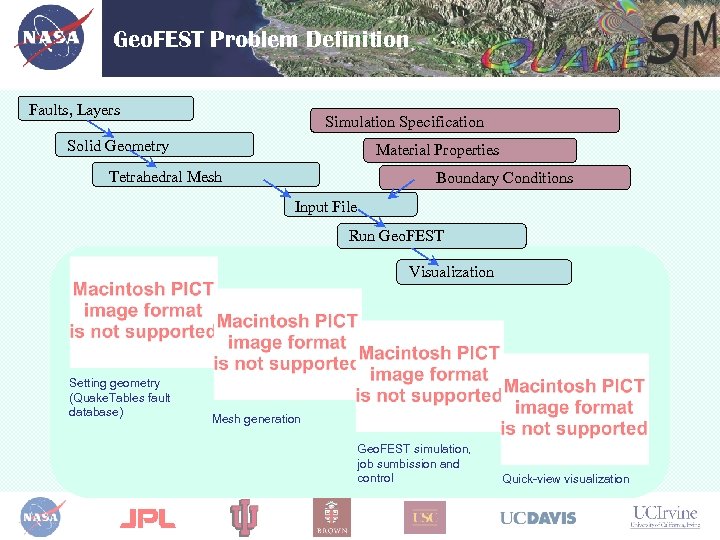
Geo. FEST Problem Definition Faults, Layers Simulation Specification Solid Geometry Material Properties Tetrahedral Mesh Boundary Conditions Input File Run Geo. FEST Visualization Setting geometry (Quake. Tables fault database) Mesh generation Geo. FEST simulation, job sumbission and control Quick-view visualization
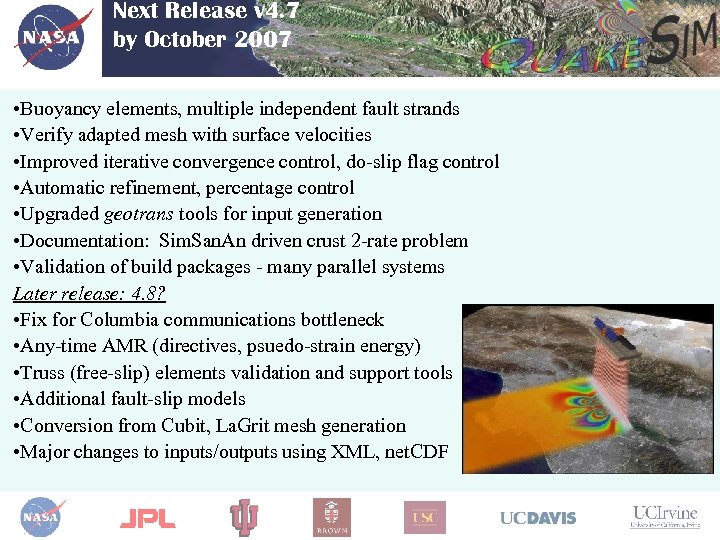
Next Release v 4. 7 by October 2007 • Buoyancy elements, multiple independent fault strands • Verify adapted mesh with surface velocities • Improved iterative convergence control, do-slip flag control • Automatic refinement, percentage control • Upgraded geotrans tools for input generation • Documentation: Sim. San. An driven crust 2 -rate problem • Validation of build packages - many parallel systems Later release: 4. 8? • Fix for Columbia communications bottleneck • Any-time AMR (directives, psuedo-strain energy) • Truss (free-slip) elements validation and support tools • Additional fault-slip models • Conversion from Cubit, La. Grit mesh generation • Major changes to inputs/outputs using XML, net. CDF
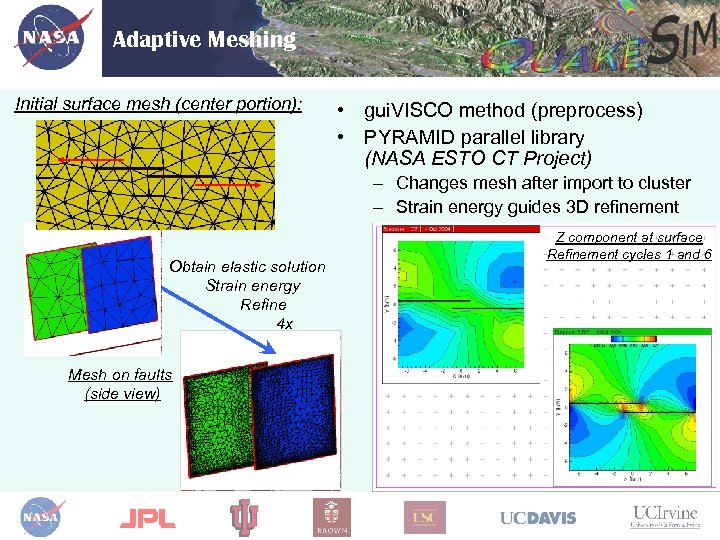
Adaptive Meshing Initial surface mesh (center portion): • gui. VISCO method (preprocess) • PYRAMID parallel library (NASA ESTO CT Project) – Changes mesh after import to cluster – Strain energy guides 3 D refinement Obtain elastic solution Strain energy Refine 4 x Mesh on faults (side view) Z component at surface Refinement cycles 1 and 6
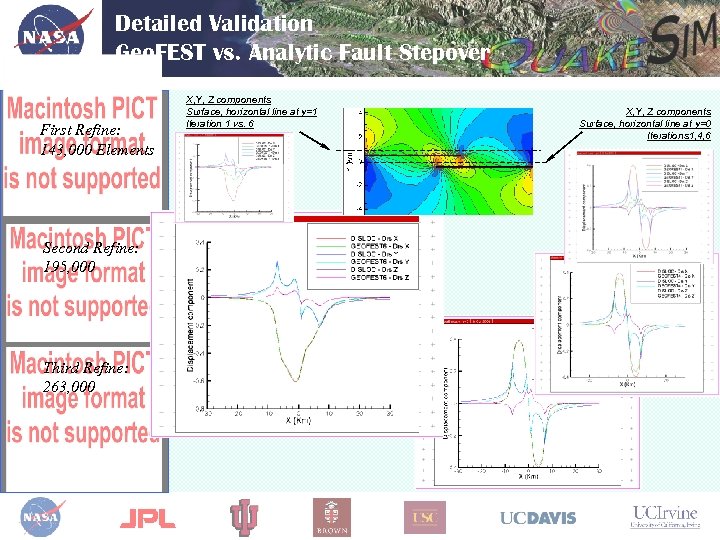
Detailed Validation Geo. FEST vs. Analytic Fault Stepover First Refine: 143, 000 Elements Second Refine: 195, 000 Third Refine: 263, 000 X, Y, Z components Surface, horizontal line at y=1 Iteration 1 vs. 6 X, Y, Z components Surface, horizontal line at y=0 Iterations 1, 4, 6
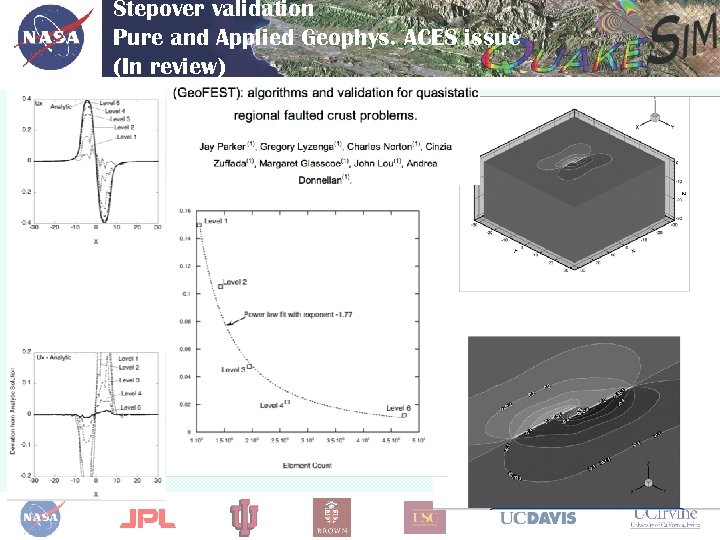
Stepover validation Pure and Applied Geophys. ACES issue (In review)
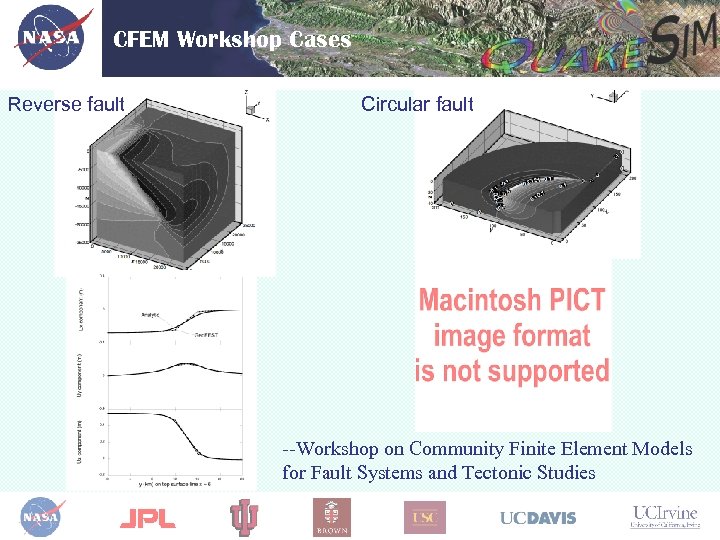
CFEM Workshop Cases Reverse fault Circular fault --Workshop on Community Finite Element Models for Fault Systems and Tectonic Studies
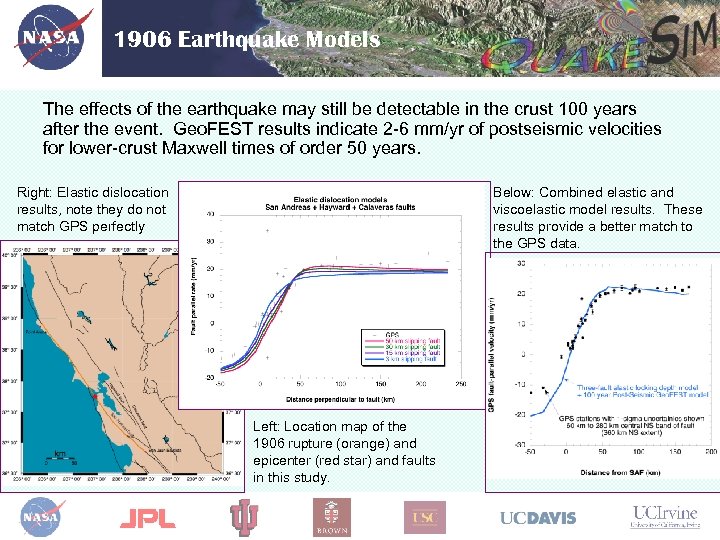
1906 Earthquake Models The effects of the earthquake may still be detectable in the crust 100 years after the event. Geo. FEST results indicate 2 -6 mm/yr of postseismic velocities for lower-crust Maxwell times of order 50 years. Right: Elastic dislocation results, note they do not match GPS perfectly Below: Combined elastic and viscoelastic model results. These results provide a better match to the GPS data. Left: Location map of the 1906 rupture (orange) and epicenter (red star) and faults in this study.
100 Million Elements? • C. Norton has set up runs on Project Columbia – up to 100 million elements – 2000 processors – working through speed, disk access issues • Automated mesh refinement – – – Parallel refinement key to these very large runs Demonstrated on initial elastic solution strain energy metric Working toward percent-refinement where needed Multiple stage refinement Separate refinement criterion for first VE step after event
How using Pyramid • v 4. 5 (Sequential code): skips (and won’t refine) • (parallel) Pyramid handles partition, MPI communication (won’t refine) • v 4. 5 g: demonstrates Pyramid refinement 10 M->16 M • v 4. 6 beta: initial elastic energy (threshhold) • v 4. 7: Pyramid x% refinement on initial elastic energy – October 2007 • v 4. 8: Pyramid x% times n, events and 1 st post-event – Spring 2008?
Summary • • Downloading, compiling and running Geo. FEST Lessons, mistakes and bugs Simple San Andreas geometry - simple, but issues Doing Sim. San. An case: portal for initial mesh, Geo. FEST tools for solution and visualization Accuracy: Validations submitted to Pageoph. special issue More robust features in v 4. 7 release, October (? ) Convenient features in v 4. 8 release (Spring ‘ 08? ) More SF quake simulations, 100 M element Columbia run, AMR extensions in progress (Glasscoe, Norton).
Скачать презентацию National Aeronautics and Space Administration Jet Propulsion Laboratory
b013f94f74b88f2c82e666ffecce3ec2.ppt