


 Скачать презентацию National Advances in Winter Maintenance Professor Wilfrid Nixon
db2728cdbe65bf0dd80976297e35c13e.ppt
- Количество слайдов: 40
 National Advances in Winter Maintenance Professor Wilfrid Nixon, Ph. D. , P. E. University of Iowa and Asset Insight Technologies, LLC February 2009 8 th Annual Road Salt Symposium February 2009
 Overview of Presentation l What is the situation now? l What challenges do we face? l What has been done? l What does the future hold? 8 th Annual Road Salt Symposium February 2009
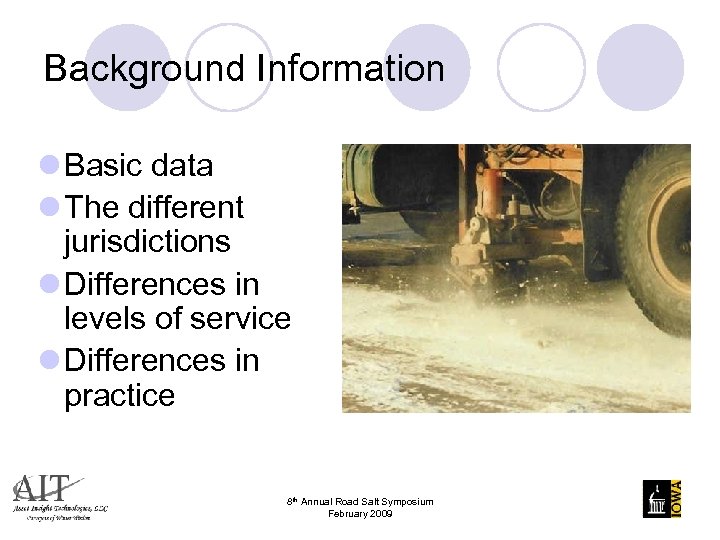 Background Information l Basic data l The different jurisdictions l Differences in levels of service l Differences in practice 8 th Annual Road Salt Symposium February 2009
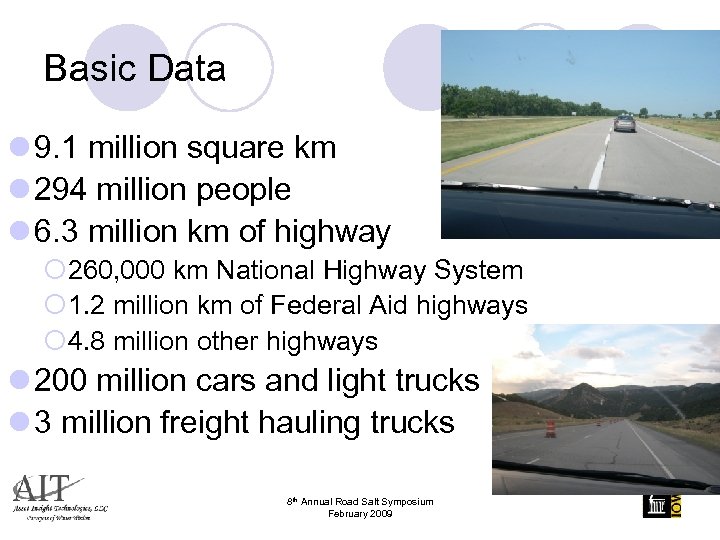 Basic Data l 9. 1 million square km l 294 million people l 6. 3 million km of highway ¡ 260, 000 km National Highway System ¡ 1. 2 million km of Federal Aid highways ¡ 4. 8 million other highways l 200 million cars and light trucks l 3 million freight hauling trucks 8 th Annual Road Salt Symposium February 2009
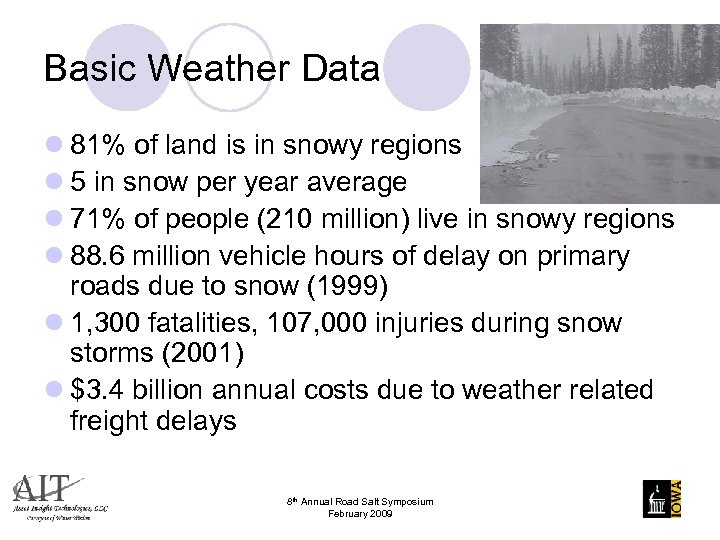 Basic Weather Data l 81% of land is in snowy regions l 5 in snow per year average l 71% of people (210 million) live in snowy regions l 88. 6 million vehicle hours of delay on primary roads due to snow (1999) l 1, 300 fatalities, 107, 000 injuries during snow storms (2001) l $3. 4 billion annual costs due to weather related freight delays 8 th Annual Road Salt Symposium February 2009
 Nature of the Weather l Most areas see frost and black ice l Light snow (less than 4 in) and freezing rain also very common l Freezing rain (and very wet freezing fog) is the worst case in most locations l Blowing snow is a major localized concern l Heavy snow (up to 3 ft) very much a local phenomenon 8 th Annual Road Salt Symposium February 2009
 Organizations l No Federal standards or rules of practice for winter maintenance l Each State sets its own standards, but only for State Highways (including the Interstate System) l Within a State, Cities and Counties set their own standards and practices l Some National limits on environmental issues ¡ Air quality ¡ Protected species 8 th Annual Road Salt Symposium February 2009
 What is the Challenge? l Safety and mobility, but… l Achieved in the context of sustainability l How? 8 th Annual Road Salt Symposium February 2009
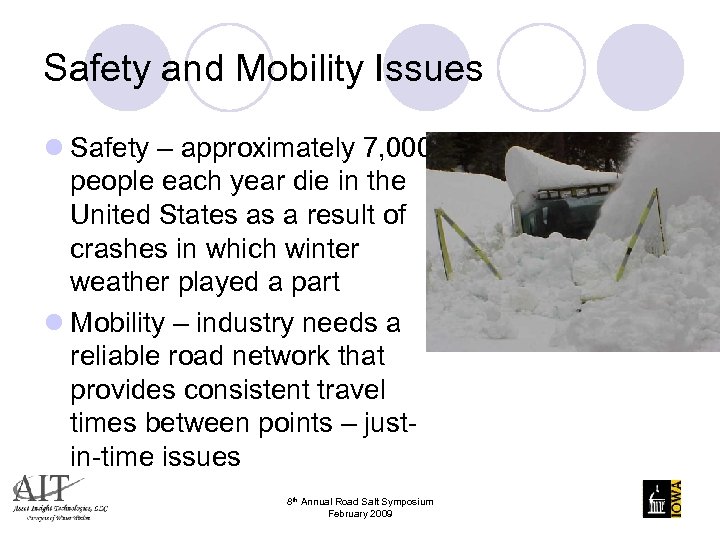 Safety and Mobility Issues l Safety – approximately 7, 000 people each year die in the United States as a result of crashes in which winter weather played a part l Mobility – industry needs a reliable road network that provides consistent travel times between points – justin-time issues 8 th Annual Road Salt Symposium February 2009
 More on Mobility Costs l National weather losses estimated at $3. 4 billion l Examples of local costs ¡ I-90 over Snoqualmie Pass - $700, 000 per hour ¡ I-5 in Northern California - $150, 000 per hour ¡ Iowa one day shut down - $27. 9 million direct, $34. 8 million derived ¡ Michigan one day shut down - $115 million direct, $144 million derived l Clearly, snow covered roads are very expensive! 8 th Annual Road Salt Symposium February 2009
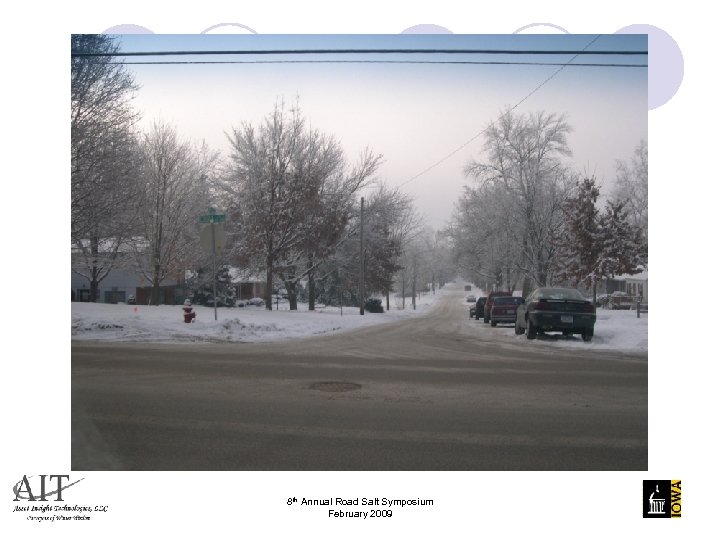
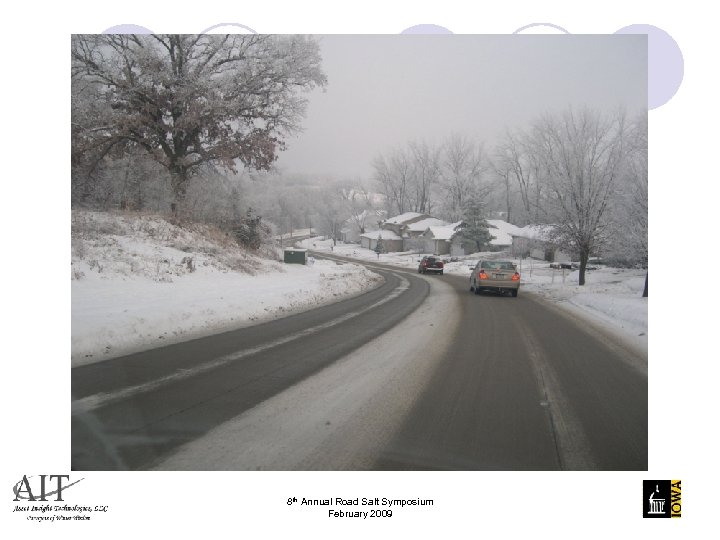
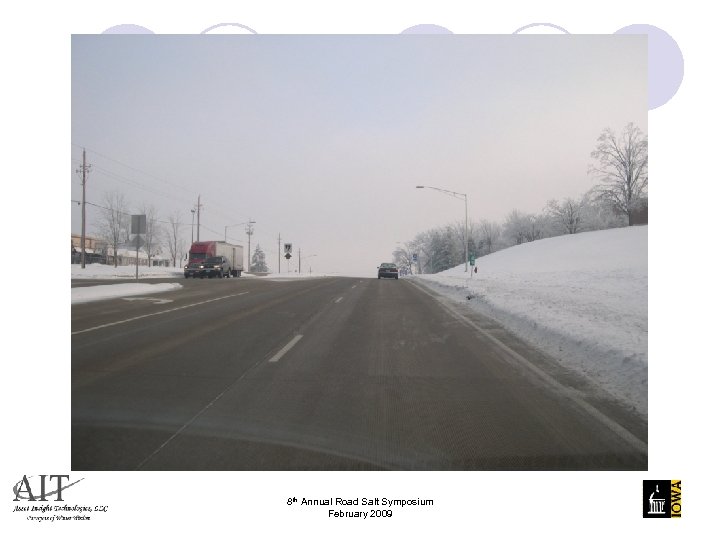
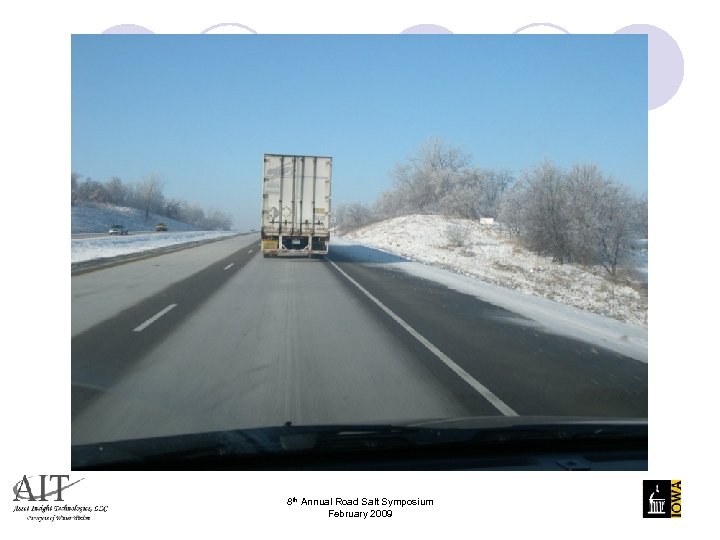
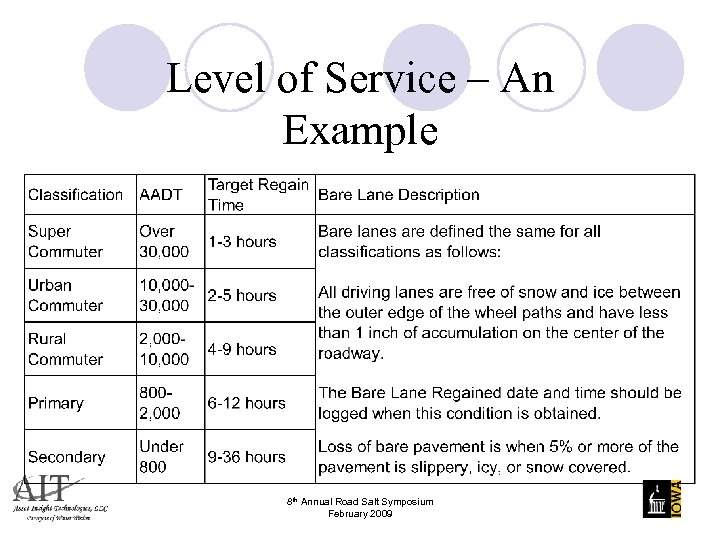
 Levels of Service l Different roads receive different levels of effort l Often some sort of manual sets the goal for a given road type l Road types often differentiated in terms of Average Daily Traffic (AADT) l Priority Levels Assigned 8 th Annual Road Salt Symposium February 2009
 8 th Annual Road Salt Symposium February 2009
 8 th Annual Road Salt Symposium February 2009
 8 th Annual Road Salt Symposium February 2009
 8 th Annual Road Salt Symposium February 2009
 Level of Service – An Example 8 th Annual Road Salt Symposium February 2009
 Making Progress l Create a community of practice l Number of organizations on local and national level ¡PNS, SICOP, Aurora, Clear Roads, etc. l Create a communication method ¡The snow and ice list-serve, ca. 1996 l Use the tools! 8 th Annual Road Salt Symposium February 2009
 Safety l Very clear indication that a road that is anti -iced is safer than one that is not ¡Idaho – 83% reduction in crashes l Also, every crash avoided is an environmental benefit l So, how do we anti-ice effectively and efficiently – we use chemicals 8 th Annual Road Salt Symposium February 2009
 Attain The Surface Goals l Primary Goal is bare pavement at the State level l Requires chemical usage l Traditional approach – apply chemical after snow pack has formed – not very efficient l Use chemicals NOT to melt snow and ice, but to break the bond. 8 th Annual Road Salt Symposium February 2009
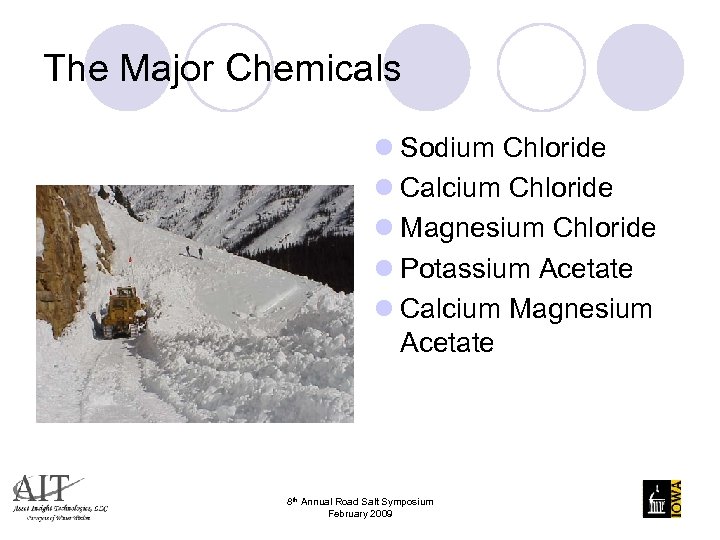 The Major Chemicals l Sodium Chloride l Calcium Chloride l Magnesium Chloride l Potassium Acetate l Calcium Magnesium Acetate 8 th Annual Road Salt Symposium February 2009
 Additives l Many chemicals are now offered with some sort of additive l Intended to reduce corrosion, and enhance melting capacity l In the past ten years, many of these have been from agricultural by-products 8 th Annual Road Salt Symposium February 2009
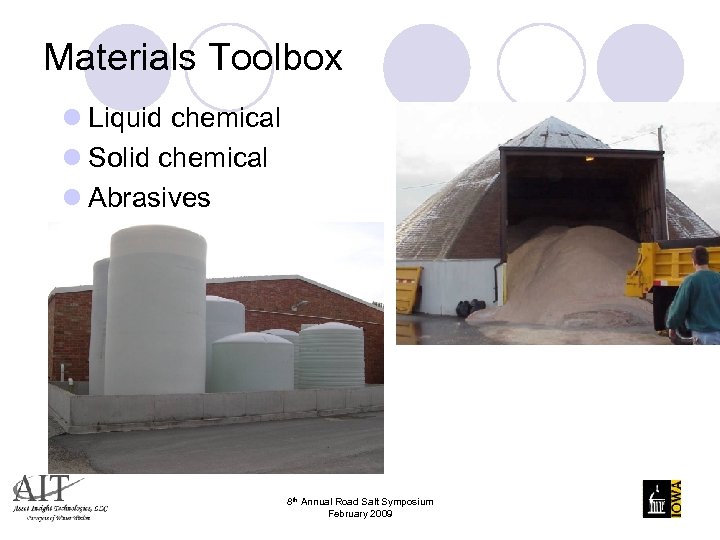 Materials Toolbox l Liquid chemical l Solid chemical l Abrasives 8 th Annual Road Salt Symposium February 2009
 Typical Application Rates l Hugely variable between agencies l A step toward uniformity in the FHWA Manual of Practice for an Effective Anti. Icing Program l Variations as functions of storm type, road surface temperature, and route cycle time l Refined by experience and becoming incorporated into MDSS type solutions 8 th Annual Road Salt Symposium February 2009
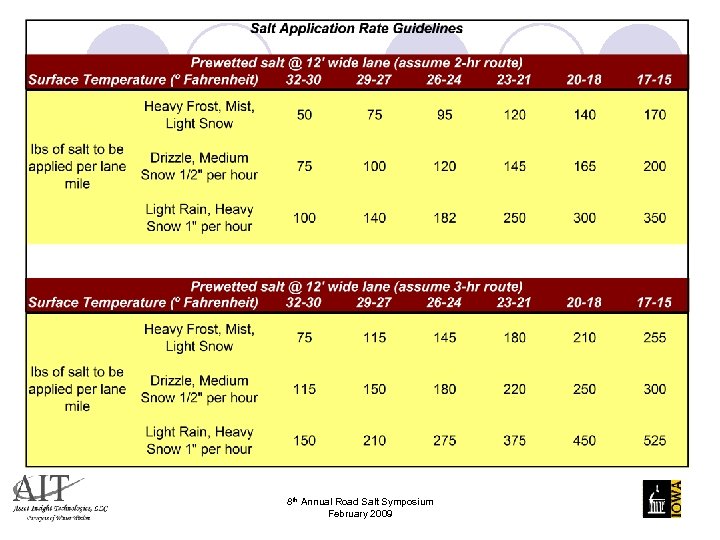 8 th Annual Road Salt Symposium February 2009
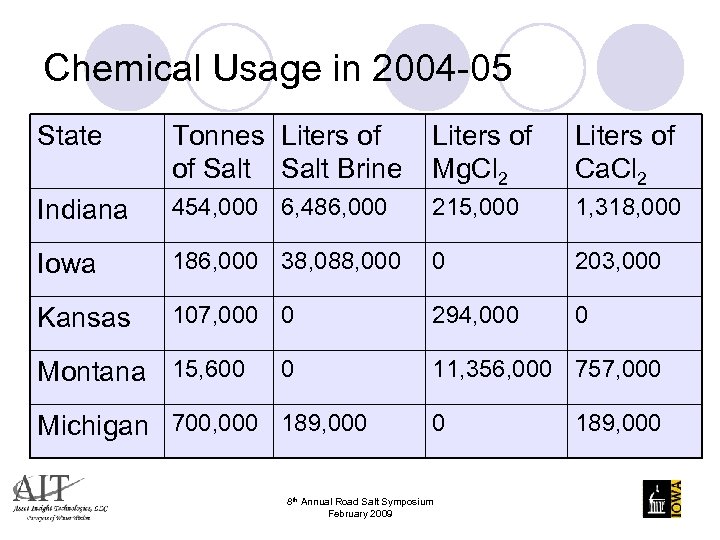 Chemical Usage in 2004 -05 State Tonnes Liters of of Salt Brine Liters of Mg. Cl 2 Liters of Ca. Cl 2 Indiana 454, 000 6, 486, 000 215, 000 1, 318, 000 Iowa 186, 000 38, 088, 000 0 203, 000 Kansas 107, 000 0 294, 000 0 Montana 15, 600 0 Michigan 700, 000 189, 000 11, 356, 000 757, 000 0 8 th Annual Road Salt Symposium February 2009 189, 000
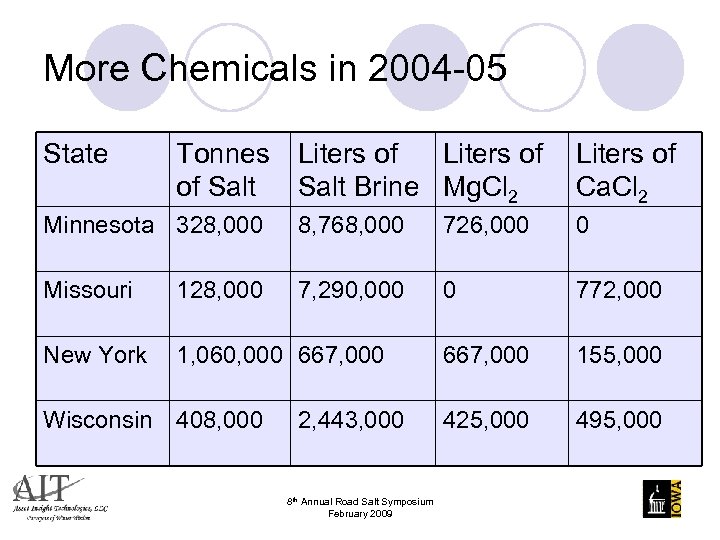 More Chemicals in 2004 -05 State Tonnes of Salt Liters of Salt Brine Mg. Cl 2 Liters of Ca. Cl 2 Minnesota 328, 000 8, 768, 000 726, 000 0 Missouri 128, 000 7, 290, 000 0 772, 000 New York 1, 060, 000 667, 000 155, 000 425, 000 495, 000 Wisconsin 408, 000 2, 443, 000 8 th Annual Road Salt Symposium February 2009
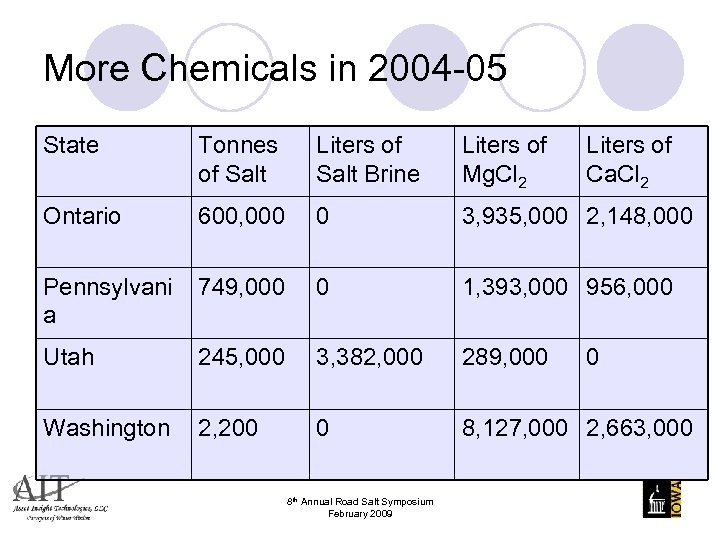 More Chemicals in 2004 -05 State Tonnes of Salt Liters of Salt Brine Liters of Mg. Cl 2 Ontario 600, 000 0 3, 935, 000 2, 148, 000 Pennsylvani a 749, 000 0 1, 393, 000 956, 000 Utah 245, 000 3, 382, 000 289, 000 Washington 2, 200 0 8, 127, 000 2, 663, 000 8 th Annual Road Salt Symposium February 2009 Liters of Ca. Cl 2 0
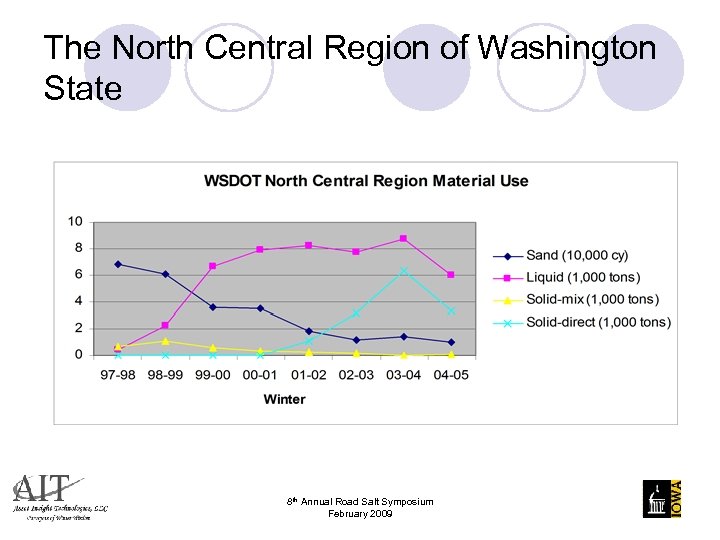 The North Central Region of Washington State 8 th Annual Road Salt Symposium February 2009
 Use of Different Chemicals? l Very clear that some agencies avoid the use of some products ¡Iowa, Michigan, Missouri used no Mg. Cl 2 in 2004 -05 ¡Utah, Minnesota, Kansas used no Ca. Cl 2 that winter ¡Montana, Ontario, Pennsylvania, Washington used no salt brine then l Less clear why these differences occur 8 th Annual Road Salt Symposium February 2009
 Anti-Icing Practices in the US l Most agencies use anti-icing in some areas and under some circumstances l Few have anti-icing as their main practice in all locations (Iowa is one State that does this) l In general, anti-icing is used in two primary ways – to treat/prevent frost and black ice, and as a pre-treatment for storms 8 th Annual Road Salt Symposium February 2009
 The Major Trend l Across the United States, agencies are moving away from plowing and sanding, and toward chemical programs l As they change, they are using more sophisticated strategies like anti-icing l This is driven by public demand for higher levels of service, and concerns over the environmental problems of abrasives 8 th Annual Road Salt Symposium February 2009
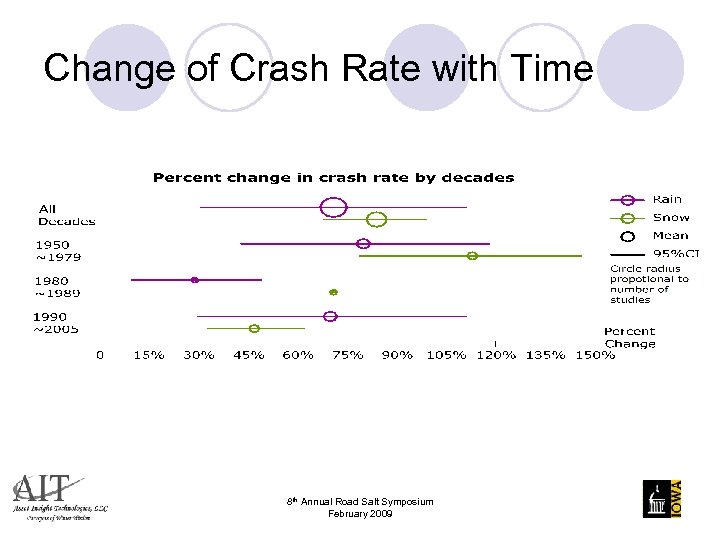 Change of Crash Rate with Time 8 th Annual Road Salt Symposium February 2009
 Innovations and Future Developments l Innovations in chemical usage l Protection of infrastructure l Improving decision and information management l Optimizing use of equipment 8 th Annual Road Salt Symposium February 2009
 Chemical Innovations l A number of agencies are experimenting with sophisticated blending approaches l Mixing salt brine, calcium chloride brine, and agricultural by-products in-house to address different surface temperatures, storm conditions, and plow routes l Also experimentation with adding inhibitor to solid salt at the spinner 8 th Annual Road Salt Symposium February 2009
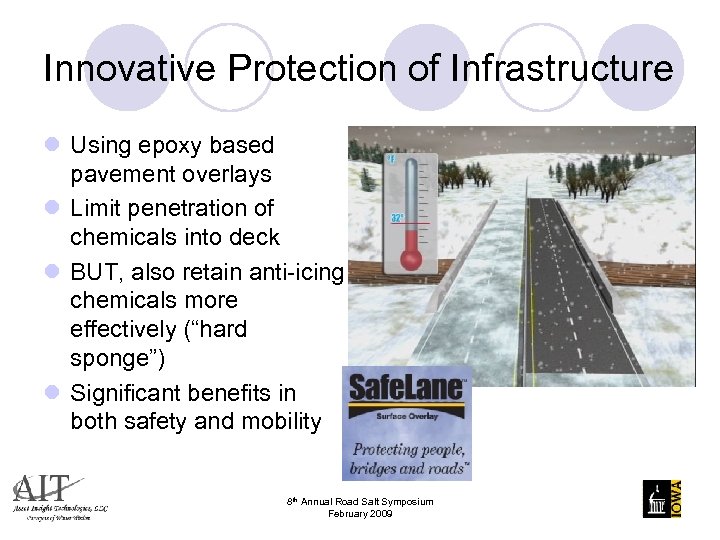 Innovative Protection of Infrastructure l Using epoxy based pavement overlays l Limit penetration of chemicals into deck l BUT, also retain anti-icing chemicals more effectively (“hard sponge”) l Significant benefits in both safety and mobility 8 th Annual Road Salt Symposium February 2009
 Decision and Information Management l Maintenance Decision Support System project funded by FHWA l Several winters of field testing l Results show potential but also show need for improved technology in certain areas ¡Especially pavement temperature forecasts l Simpler solutions may be the optimal approach for now (Storm. Logic) 8 th Annual Road Salt Symposium February 2009
 Equipment Improvements l Not so much new equipment as improved usage of existing equipment l Automated tracking of pre-trip truck inspection l Use of laser to indicate path of wing plow (thus allowing avoidance, perhaps) l Others reflective of local innovation 8 th Annual Road Salt Symposium February 2009
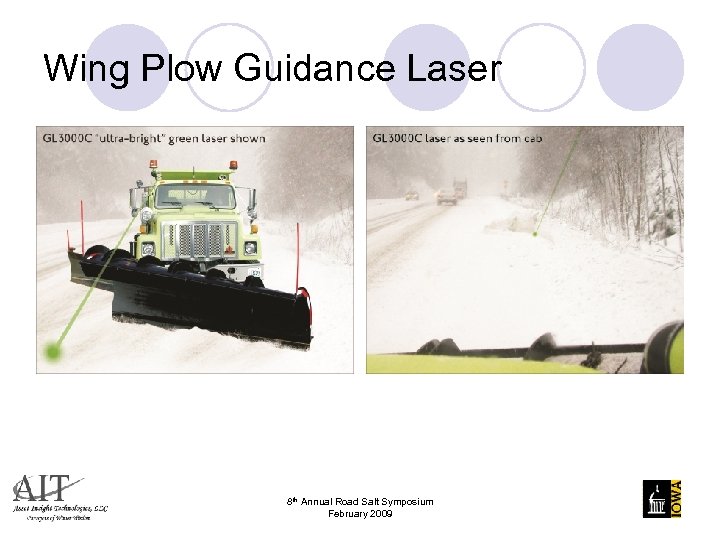 Wing Plow Guidance Laser 8 th Annual Road Salt Symposium February 2009
 And the Future? l More automation of data collection and mining of knowledge from the data l More methods to protect or enhance existing infrastructure and equipment l Improved chemical performance in certain aspects l Improved decision making tools l Better information on road conditions to road users in real time 8 th Annual Road Salt Symposium February 2009
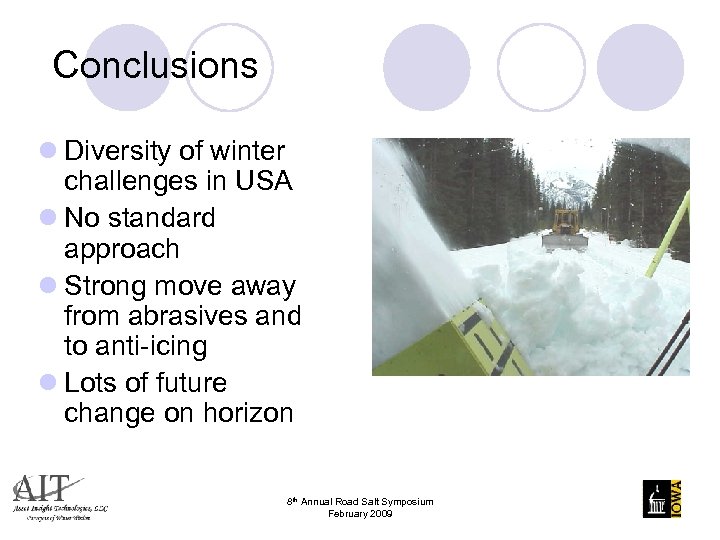 Conclusions l Diversity of winter challenges in USA l No standard approach l Strong move away from abrasives and to anti-icing l Lots of future change on horizon 8 th Annual Road Salt Symposium February 2009