


 Скачать презентацию National Accounting GDP Growth Introduction to Economics ETH
89df08039ac714bf471478cd205e894f.ppt
- Количество слайдов: 81
 National Accounting, GDP, Growth Introduction to Economics ETH Zürich, Prof. Dr. Jan-Egbert Sturm Winter Term 2006/07 10
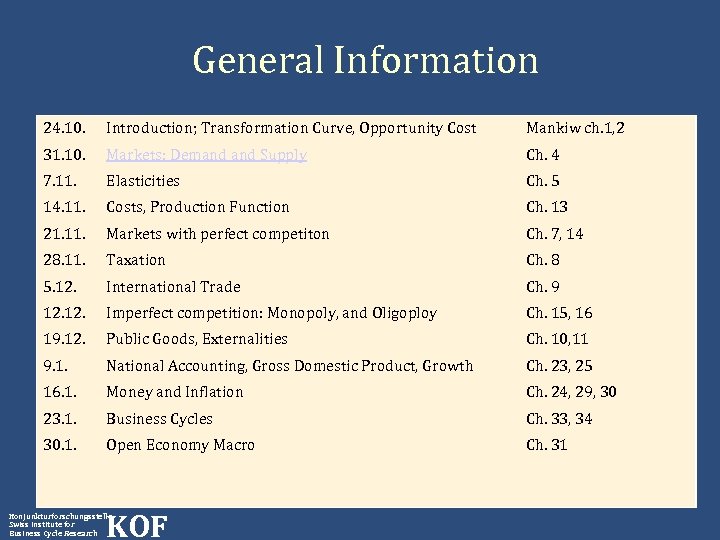 General Information 24. 10. Introduction; Transformation Curve, Opportunity Cost Mankiw ch. 1, 2 31. 10. Markets: Demand Supply Ch. 4 7. 11. Elasticities Ch. 5 14. 11. Costs, Production Function Ch. 13 21. 11. Markets with perfect competiton Ch. 7, 14 28. 11. Taxation Ch. 8 5. 12. International Trade Ch. 9 12. Imperfect competition: Monopoly, and Oligoploy Ch. 15, 16 19. 12. Public Goods, Externalities Ch. 10, 11 9. 1. National Accounting, Gross Domestic Product, Growth Ch. 23, 25 16. 1. Money and Inflation Ch. 24, 29, 30 23. 1. Business Cycles Ch. 33, 34 30. 1. Open Economy Macro Ch. 31 KOF Konjunkturforschungsstelle Swiss Institute for Business Cycle Research
 Economics • Microeconomics is the study of how individual households and firms make decisions and how they interact with one another in markets. • Macroeconomics is the study of the economy as a whole. • Its goal is to explain the economic changes that affect many households, firms, and markets at once. KOF Konjunkturforschungsstelle Swiss Institute for Business Cycle Research
 Macroeconomics • Macroeconomics answers questions like the following: • Why is average income high in some countries and low in others? • Why do prices rise rapidly in some time periods while they are more stable in others? • Why do production and employment expand in some years and contract in others? KOF Konjunkturforschungsstelle Swiss Institute for Business Cycle Research
 THE ECONOMY’S INCOME AND EXPENDITURE • When judging whether the economy is doing well or poorly, it is natural to look at the total income that everyone in the economy is earning. KOF Konjunkturforschungsstelle Swiss Institute for Business Cycle Research
 THE ECONOMY’S INCOME AND EXPENDITURE • For an economy as a whole, income must equal expenditure because: • Every transaction has a buyer and a seller. • Every dollar of spending by some buyer is a dollar of income for some seller. KOF Konjunkturforschungsstelle Swiss Institute for Business Cycle Research
 THE MEASUREMENT OF GROSS DOMESTIC PRODUCT • Gross domestic product (GDP) is a measure of the income and expenditures of an economy. • It is the total market value of all final goods and services produced within a country in a given period of time. KOF Konjunkturforschungsstelle Swiss Institute for Business Cycle Research
 THE MEASUREMENT OF GROSS DOMESTIC PRODUCT • The equality of income and expenditure can be illustrated with the circular-flow diagram. KOF Konjunkturforschungsstelle Swiss Institute for Business Cycle Research
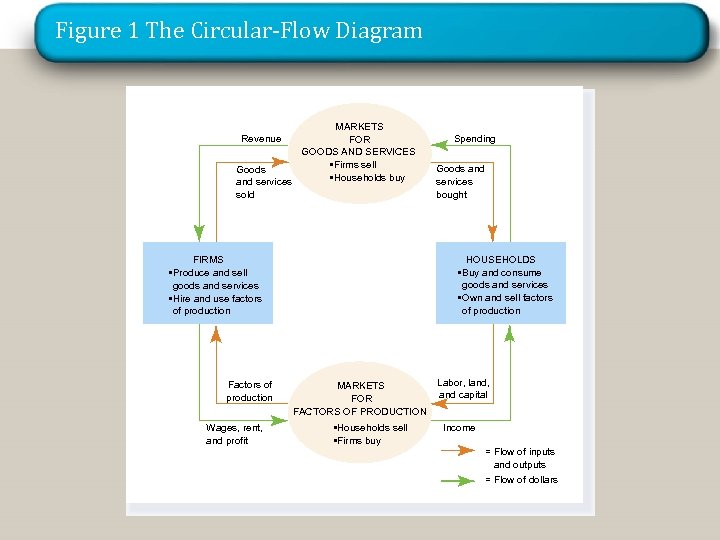 Figure 1 The Circular-Flow Diagram MARKETS FOR GOODS AND SERVICES • Firms sell Goods • Households buy and services sold Revenue Wages, rent, and profit Goods and services bought HOUSEHOLDS • Buy and consume goods and services • Own and sell factors of production FIRMS • Produce and sell goods and services • Hire and use factors of production Factors of production Spending MARKETS FOR FACTORS OF PRODUCTION • Households sell • Firms buy Labor, land, and capital Income = Flow of inputs and outputs = Flow of dollars KOF Konjunkturforschungsstelle Swiss Institute for Business Cycle Research
 THE MEASUREMENT OF GROSS DOMESTIC PRODUCT • GDP is the market value of all final goods and services produced within a country in a given period of time. KOF Konjunkturforschungsstelle Swiss Institute for Business Cycle Research
 THE MEASUREMENT OF GROSS DOMESTIC PRODUCT • “GDP is the Market Value. . . ” • Output is valued at market prices. • “. . . Of All Final. . . ” • It records only the value of final goods, not intermediate goods (the value is counted only once). • “. . . Goods and Services. . . “ • It includes both tangible goods (food, clothing, cars) and intangible services (haircuts, housecleaning, doctor visits). KOF Konjunkturforschungsstelle Swiss Institute for Business Cycle Research
 THE MEASUREMENT OF GROSS DOMESTIC PRODUCT • “. . . Produced. . . ” • It includes goods and services currently produced, not transactions involving goods produced in the past. • “. . . Within a Country. . . ” • It measures the value of production within the geographic confines of a country. KOF Konjunkturforschungsstelle Swiss Institute for Business Cycle Research
 THE MEASUREMENT OF GROSS DOMESTIC PRODUCT • “. . . In a Given Period of Time. ” • It measures the value of production that takes place within a specific interval of time, usually a year or a quarter (three months). KOF Konjunkturforschungsstelle Swiss Institute for Business Cycle Research
 THE COMPONENTS OF GDP • What Is Not Counted in GDP? • GDP excludes most items that are produced and consumed at home and that never enter the marketplace. • It excludes items produced and sold illicitly, such as illegal drugs. KOF Konjunkturforschungsstelle Swiss Institute for Business Cycle Research
 THE COMPONENTS OF GDP • GDP (Y) is the sum of the following: • • Consumption (C) Investment (I) Government Purchases (G) Net Exports (NX) Y = C + I + G + NX KOF Konjunkturforschungsstelle Swiss Institute for Business Cycle Research
 THE COMPONENTS OF GDP • Consumption (C): • The spending by households on goods and services, with the exception of purchases of new housing. • Investment (I): • The spending on capital equipment, inventories, and structures, including new housing. KOF Konjunkturforschungsstelle Swiss Institute for Business Cycle Research
 THE COMPONENTS OF GDP • Government Purchases (G): • The spending on goods and services by local, state, and federal governments. • Does not include transfer payments because they are not made in exchange for currently produced goods or services. • Net Exports (NX): • Exports minus imports. KOF Konjunkturforschungsstelle Swiss Institute for Business Cycle Research
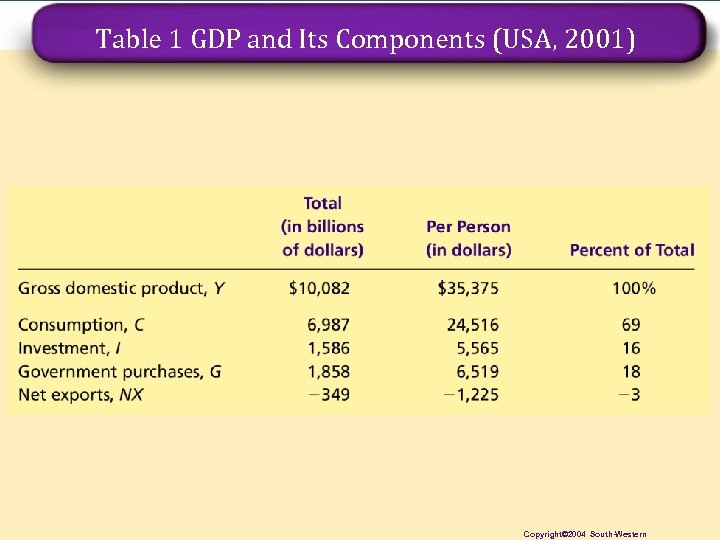 Table 1 GDP and Its Components (USA, 2001) KOF Konjunkturforschungsstelle Swiss Institute for Business Cycle Research Copyright© 2004 South-Western
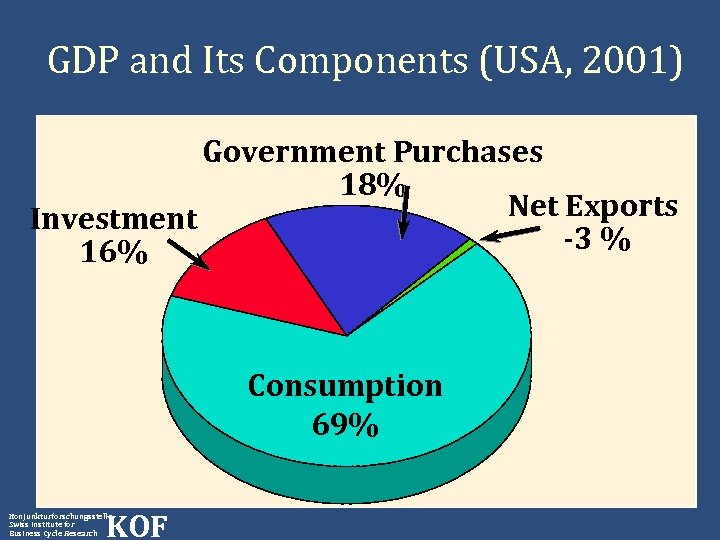 GDP and Its Components (USA, 2001) Government Purchases 18% Net Exports Investment -3 % 16% Consumption 69% KOF Konjunkturforschungsstelle Swiss Institute for Business Cycle Research
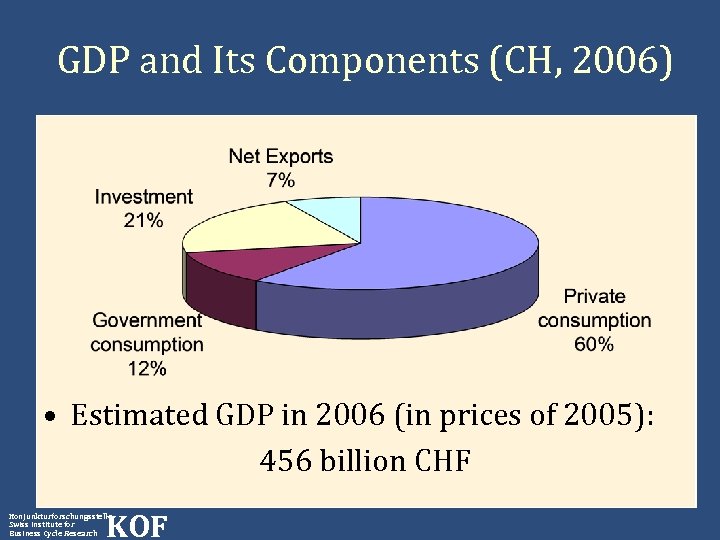 GDP and Its Components (CH, 2006) • Estimated GDP in 2006 (in prices of 2005): 456 billion CHF KOF Konjunkturforschungsstelle Swiss Institute for Business Cycle Research
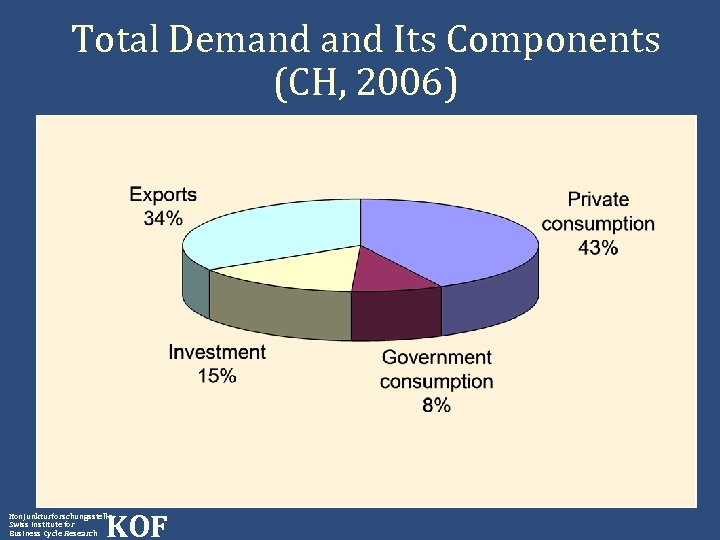 Total Demand Its Components (CH, 2006) KOF Konjunkturforschungsstelle Swiss Institute for Business Cycle Research
 REAL VERSUS NOMINAL GDP • Nominal GDP values the production of goods and services at current prices. • Real GDP values the production of goods and services at constant prices. KOF Konjunkturforschungsstelle Swiss Institute for Business Cycle Research
 REAL VERSUS NOMINAL GDP • An accurate view of the economy requires adjusting nominal to real GDP by using the GDP deflator. KOF Konjunkturforschungsstelle Swiss Institute for Business Cycle Research
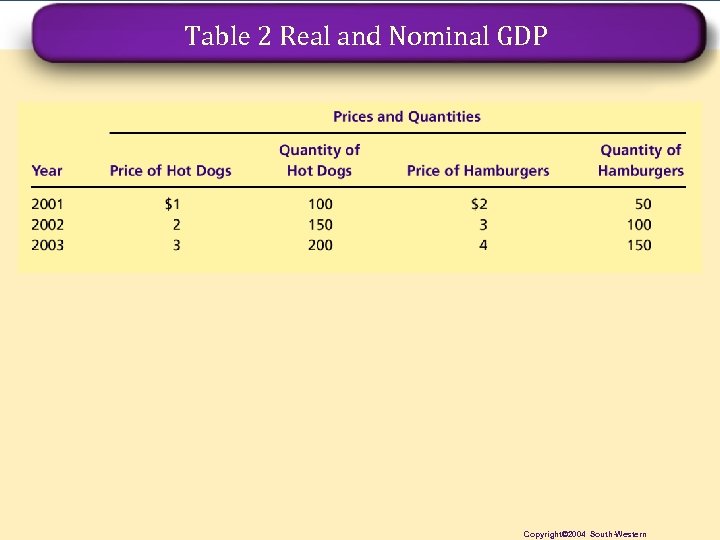 Table 2 Real and Nominal GDP KOF Konjunkturforschungsstelle Swiss Institute for Business Cycle Research Copyright© 2004 South-Western
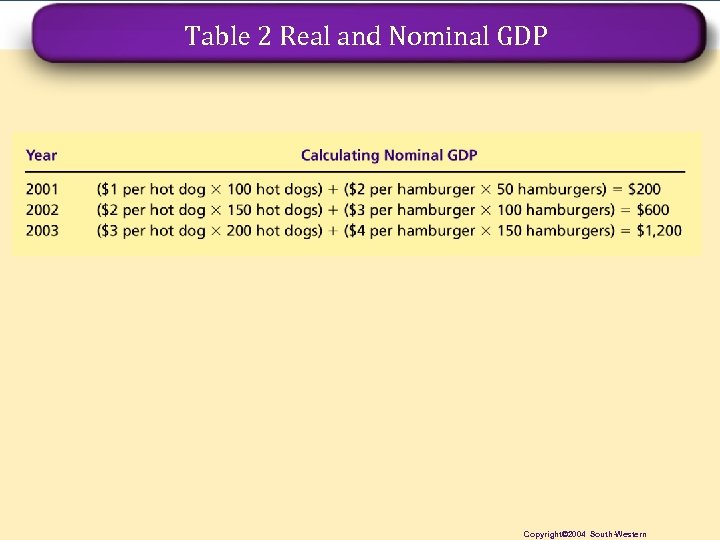 Table 2 Real and Nominal GDP KOF Konjunkturforschungsstelle Swiss Institute for Business Cycle Research Copyright© 2004 South-Western
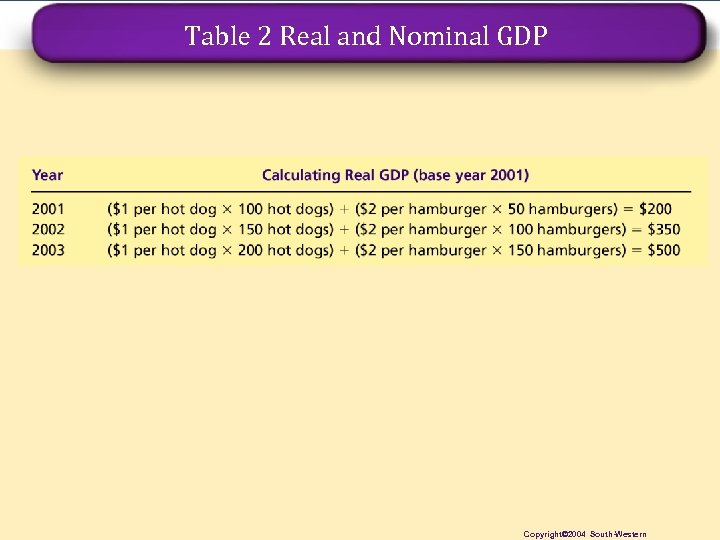 Table 2 Real and Nominal GDP KOF Konjunkturforschungsstelle Swiss Institute for Business Cycle Research Copyright© 2004 South-Western
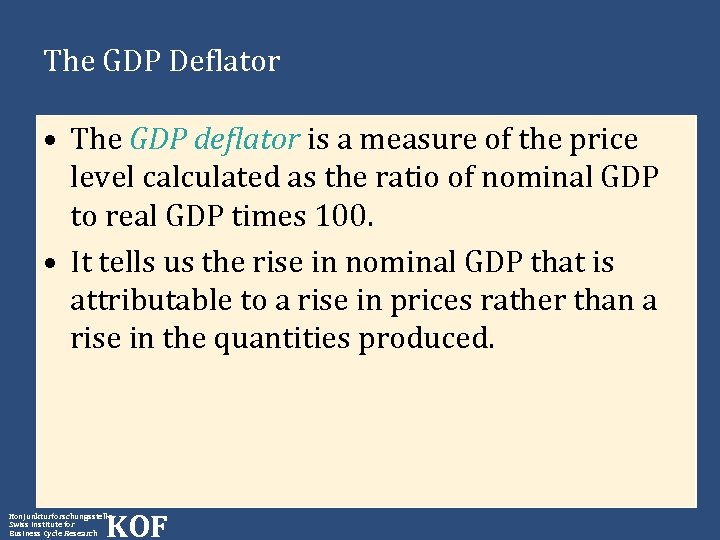 The GDP Deflator • The GDP deflator is a measure of the price level calculated as the ratio of nominal GDP to real GDP times 100. • It tells us the rise in nominal GDP that is attributable to a rise in prices rather than a rise in the quantities produced. KOF Konjunkturforschungsstelle Swiss Institute for Business Cycle Research
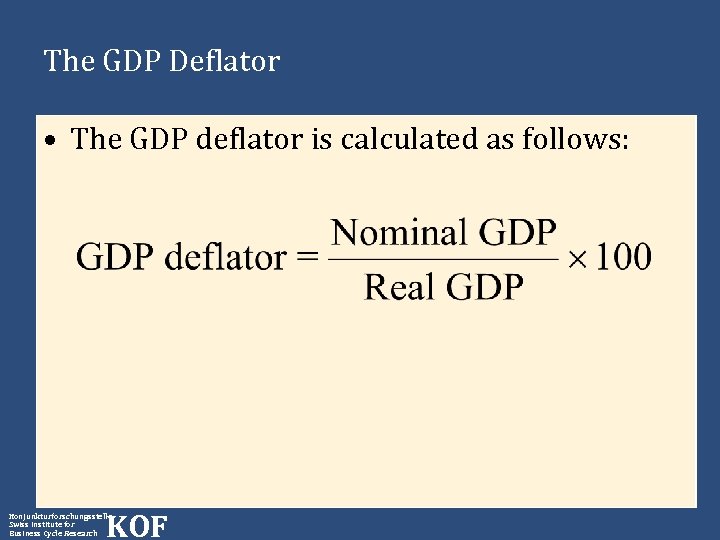 The GDP Deflator • The GDP deflator is calculated as follows: KOF Konjunkturforschungsstelle Swiss Institute for Business Cycle Research
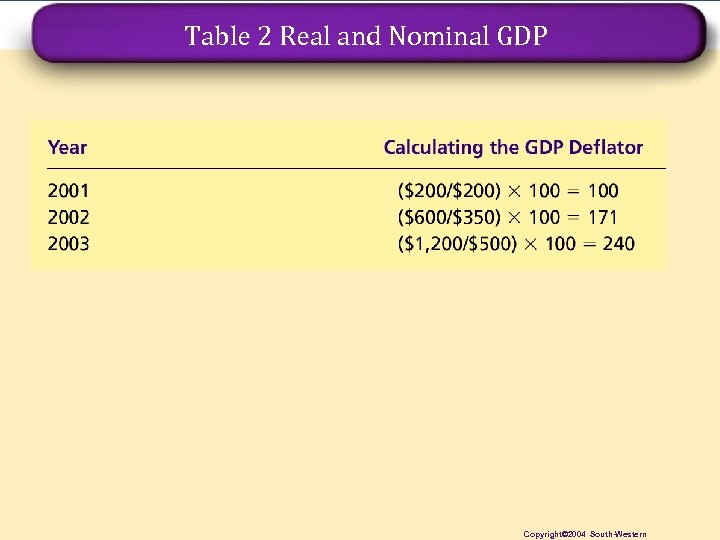 Table 2 Real and Nominal GDP KOF Konjunkturforschungsstelle Swiss Institute for Business Cycle Research Copyright© 2004 South-Western
 Chain-weighted Real GDP • Over time, relative prices change, so the base year should be updated periodically. • In essence, “chain-weighted Real GDP” updates the base year every year. • This makes chain-weighted GDP more accurate than constant-price GDP. • But the two measures are highly correlated, and constant-price real GDP is easier to compute… • …so we’ll usually use constant-price real GDP. KOF Konjunkturforschungsstelle Swiss Institute for Business Cycle Research
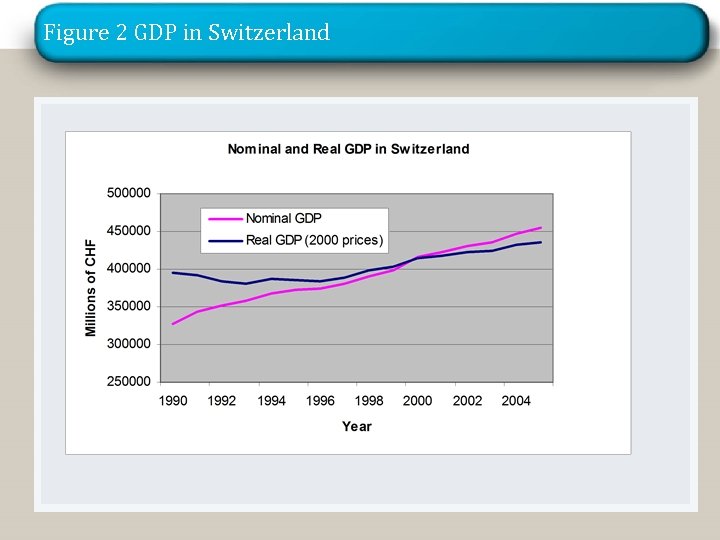 Figure 2 GDP in Switzerland KOF Konjunkturforschungsstelle Swiss Institute for Business Cycle Research
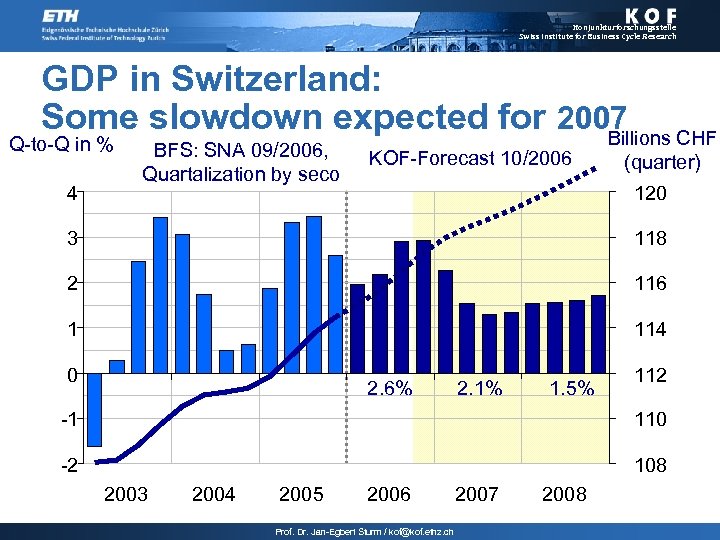 Konjunkturforschungsstelle Swiss Institute for Business Cycle Research GDP in Switzerland: Some slowdown expected for 2007 CHF Billions Q-to-Q in % 4 BFS: SNA 09/2006, Quartalization by seco KOF-Forecast 10/2006 (quarter) 120 3 118 2 116 1 114 0 2. 6% 2. 1% 1. 5% 112 -1 110 -2 108 2003 2004 2005 2006 Prof. Dr. Jan-Egbert Sturm / kof@kof. ethz. ch 2007 2008
 GDP AND ECONOMIC WELL-BEING • GDP is the best single measure of the economic well-being of a society. • GDP person tells us the income and expenditure of the average person in the economy. KOF Konjunkturforschungsstelle Swiss Institute for Business Cycle Research
 GDP AND ECONOMIC WELL-BEING • Higher GDP person indicates a higher standard of living. • GDP is not a perfect measure of the happiness or quality of life, however. KOF Konjunkturforschungsstelle Swiss Institute for Business Cycle Research
 GDP AND ECONOMIC WELL-BEING • Some things that contribute to well-being are not included in GDP. • The value of leisure. • The value of a clean environment. • The value of almost all activity that takes place outside of markets, such as the value of the time parents spend with their children and the value of volunteer work. KOF Konjunkturforschungsstelle Swiss Institute for Business Cycle Research
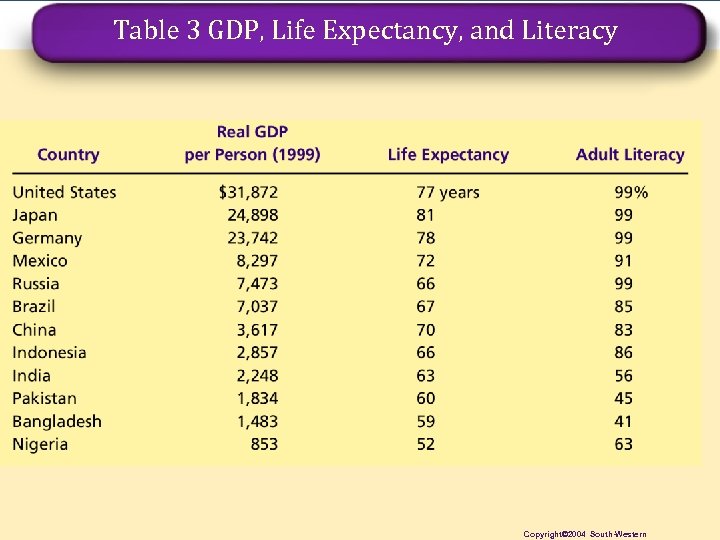 Table 3 GDP, Life Expectancy, and Literacy KOF Konjunkturforschungsstelle Swiss Institute for Business Cycle Research Copyright© 2004 South-Western
 Production and Growth • A country’s standard of living depends on its ability to produce goods and services. • Within a country there are large changes in the standard of living over time. KOF Konjunkturforschungsstelle Swiss Institute for Business Cycle Research
 Production and Growth • Productivity refers to the amount of goods and services produced for each hour of a worker’s time. • A nation’s standard of living is determined by the productivity of its workers. • Living standards, as measured by real GDP person, vary significantly among nations. KOF Konjunkturforschungsstelle Swiss Institute for Business Cycle Research
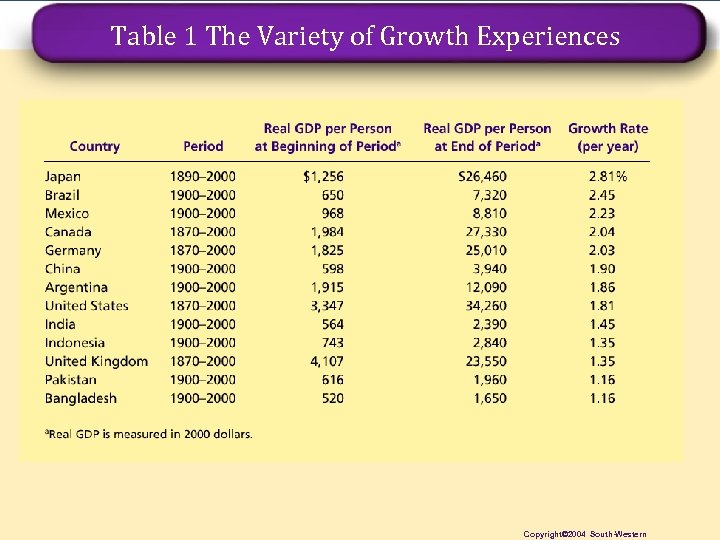 Table 1 The Variety of Growth Experiences KOF Konjunkturforschungsstelle Swiss Institute for Business Cycle Research Copyright© 2004 South-Western
 ECONOMIC GROWTH AROUND THE WORLD • Annual growth rates that seem small become large when compounded for many years. • Compounding refers to the accumulation of a growth rate over a period of time. KOF Konjunkturforschungsstelle Swiss Institute for Business Cycle Research
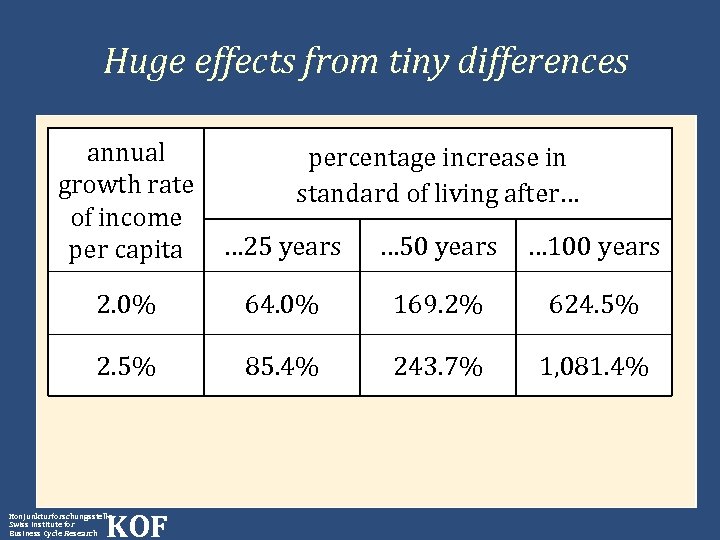 Huge effects from tiny differences annual growth rate of income per capita … 25 years … 50 years … 100 years 2. 0% 64. 0% 169. 2% 624. 5% 2. 5% 85. 4% 243. 7% 1, 081. 4% KOF Konjunkturforschungsstelle Swiss Institute for Business Cycle Research percentage increase in standard of living after…
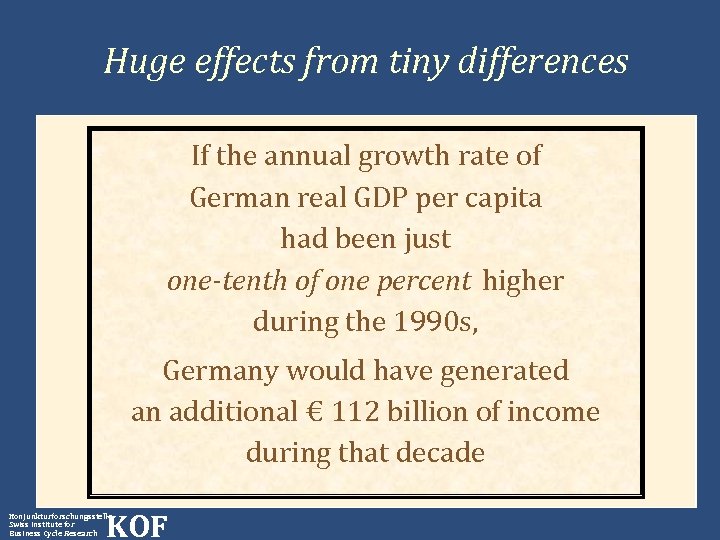 Huge effects from tiny differences If the annual growth rate of German real GDP per capita had been just one-tenth of one percent higher during the 1990 s, Germany would have generated an additional € 112 billion of income during that decade KOF Konjunkturforschungsstelle Swiss Institute for Business Cycle Research
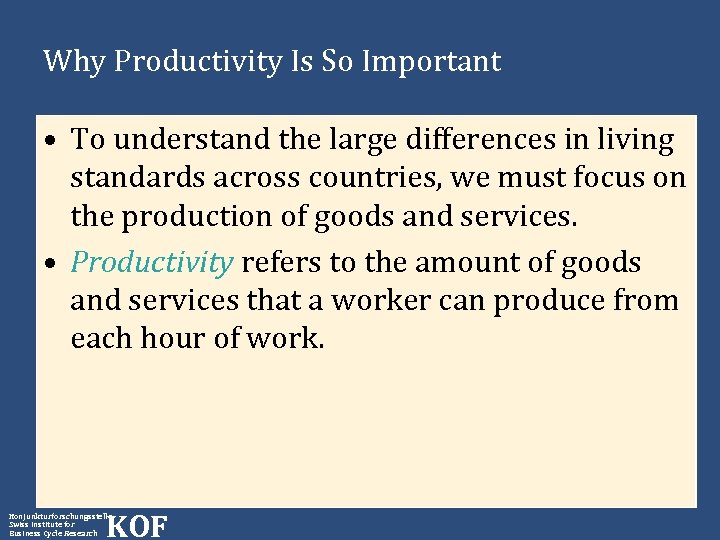 Why Productivity Is So Important • To understand the large differences in living standards across countries, we must focus on the production of goods and services. • Productivity refers to the amount of goods and services that a worker can produce from each hour of work. KOF Konjunkturforschungsstelle Swiss Institute for Business Cycle Research
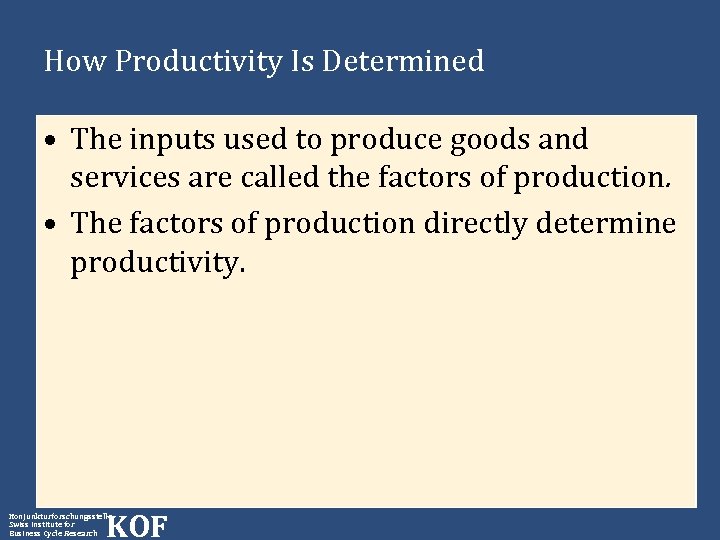 How Productivity Is Determined • The inputs used to produce goods and services are called the factors of production. • The factors of production directly determine productivity. KOF Konjunkturforschungsstelle Swiss Institute for Business Cycle Research
 How Productivity Is Determined • The Factors of Production • • Physical capital Human capital Natural resources Technological knowledge KOF Konjunkturforschungsstelle Swiss Institute for Business Cycle Research
 How Productivity Is Determined • Physical Capital • is a produced factor of production. • It is an input into the production process that in the past was an output from the production process. • is the stock of equipment and structures that are used to produce goods and services. • Tools used to build or repair automobiles. • Tools used to build furniture. • Office buildings, schools, etc. KOF Konjunkturforschungsstelle Swiss Institute for Business Cycle Research
 How Productivity Is Determined • Human Capital • the economist’s term for the knowledge and skills that workers acquire through education, training, and experience • Like physical capital, human capital raises a nation’s ability to produce goods and services. KOF Konjunkturforschungsstelle Swiss Institute for Business Cycle Research
 How Productivity Is Determined • Natural Resources • inputs used in production that are provided by nature, such as land, rivers, and mineral deposits. • Renewable resources include trees and forests. • Nonrenewable resources include petroleum and coal. • can be important but are not necessary for an economy to be highly productive in producing goods and services. KOF Konjunkturforschungsstelle Swiss Institute for Business Cycle Research
 How Productivity Is Determined • Technological Knowledge • society’s understanding of the best ways to produce goods and services. • Human capital refers to the resources expended transmitting this understanding to the labor force. KOF Konjunkturforschungsstelle Swiss Institute for Business Cycle Research
 The Production Function • Economists often use a production function to describe the relationship between the quantity of inputs used in production and the quantity of output from production. KOF Konjunkturforschungsstelle Swiss Institute for Business Cycle Research
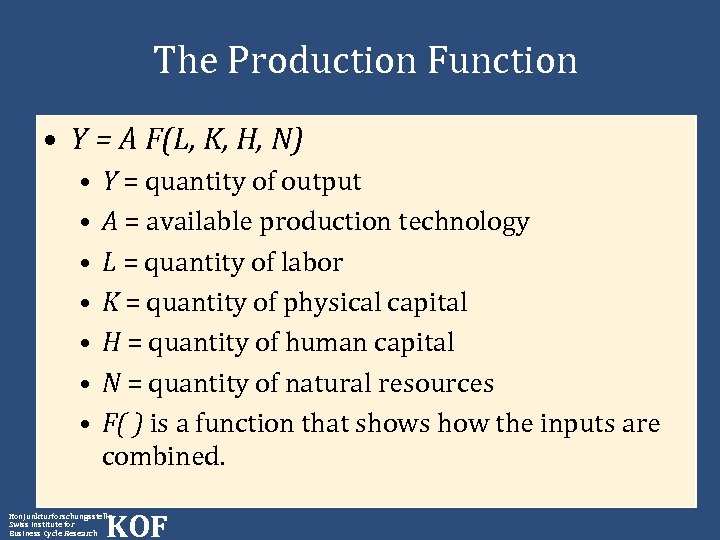 The Production Function • Y = A F(L, K, H, N) • • Y = quantity of output A = available production technology L = quantity of labor K = quantity of physical capital H = quantity of human capital N = quantity of natural resources F( ) is a function that shows how the inputs are combined. KOF Konjunkturforschungsstelle Swiss Institute for Business Cycle Research
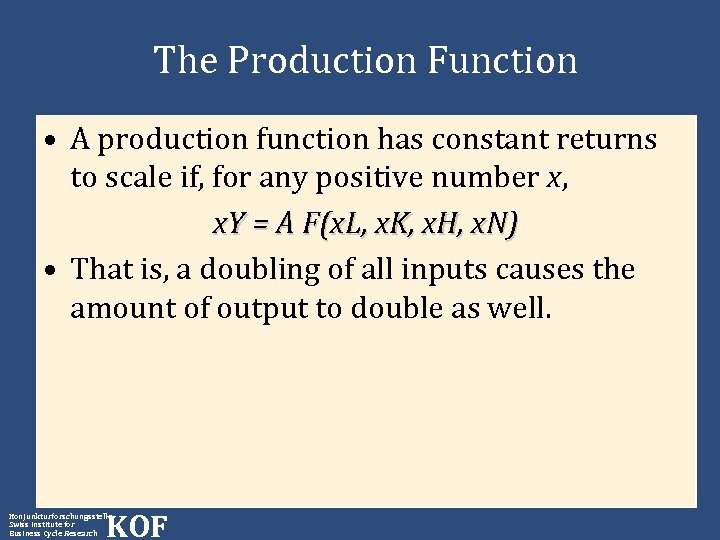 The Production Function • A production function has constant returns to scale if, for any positive number x, x. Y = A F(x. L, x. K, x. H, x. N) • That is, a doubling of all inputs causes the amount of output to double as well. KOF Konjunkturforschungsstelle Swiss Institute for Business Cycle Research
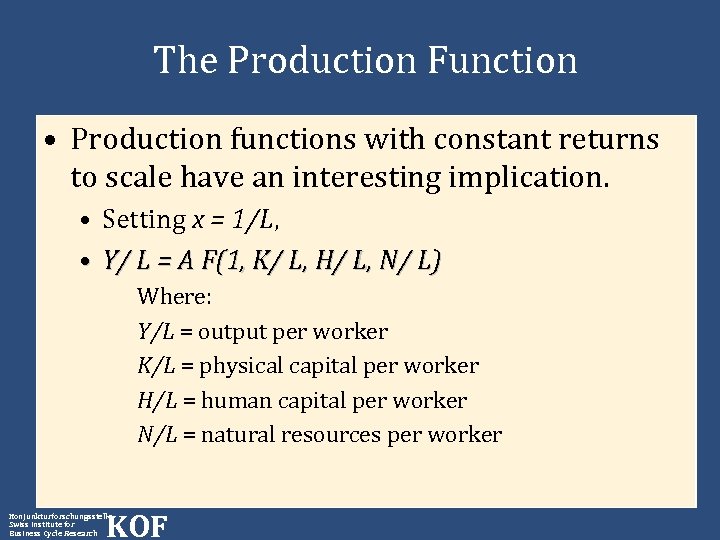 The Production Function • Production functions with constant returns to scale have an interesting implication. • Setting x = 1/L, • Y/ L = A F(1, K/ L, H/ L, N/ L) Where: Y/L = output per worker K/L = physical capital per worker H/L = human capital per worker N/L = natural resources per worker KOF Konjunkturforschungsstelle Swiss Institute for Business Cycle Research
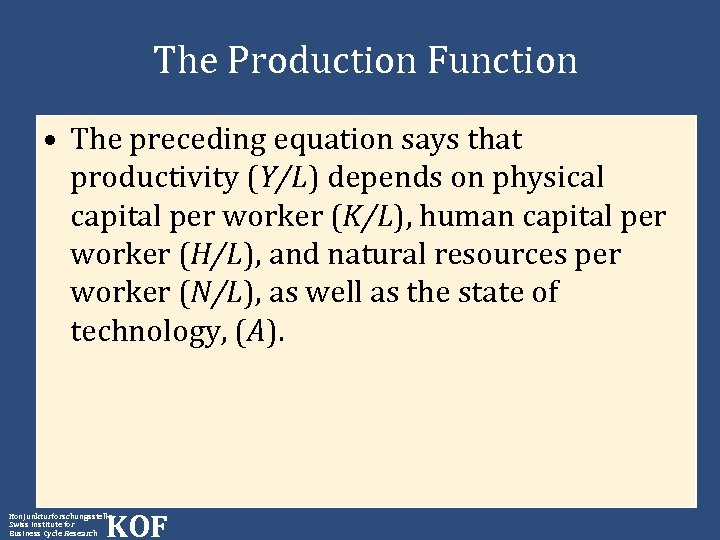 The Production Function • The preceding equation says that productivity (Y/L) depends on physical capital per worker (K/L), human capital per worker (H/L), and natural resources per worker (N/L), as well as the state of technology, (A). KOF Konjunkturforschungsstelle Swiss Institute for Business Cycle Research
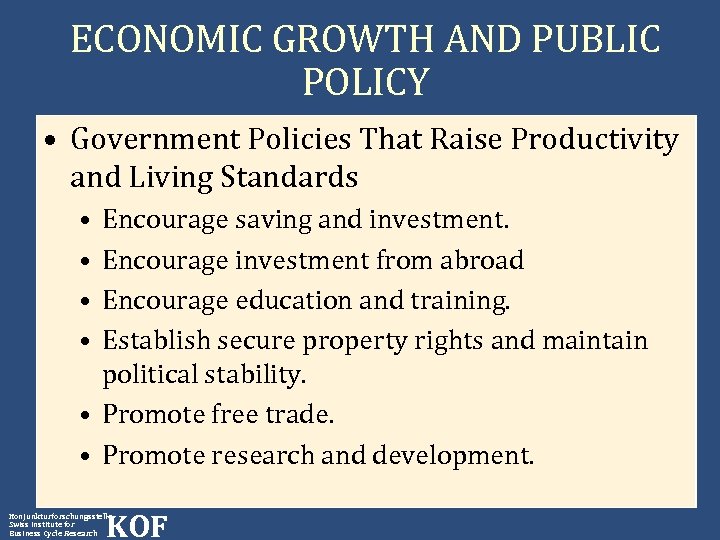 ECONOMIC GROWTH AND PUBLIC POLICY • Government Policies That Raise Productivity and Living Standards • • Encourage saving and investment. Encourage investment from abroad Encourage education and training. Establish secure property rights and maintain political stability. • Promote free trade. • Promote research and development. KOF Konjunkturforschungsstelle Swiss Institute for Business Cycle Research
 The Importance of Saving and Investment • One way to raise future productivity is to invest more current resources in the production of capital. KOF Konjunkturforschungsstelle Swiss Institute for Business Cycle Research
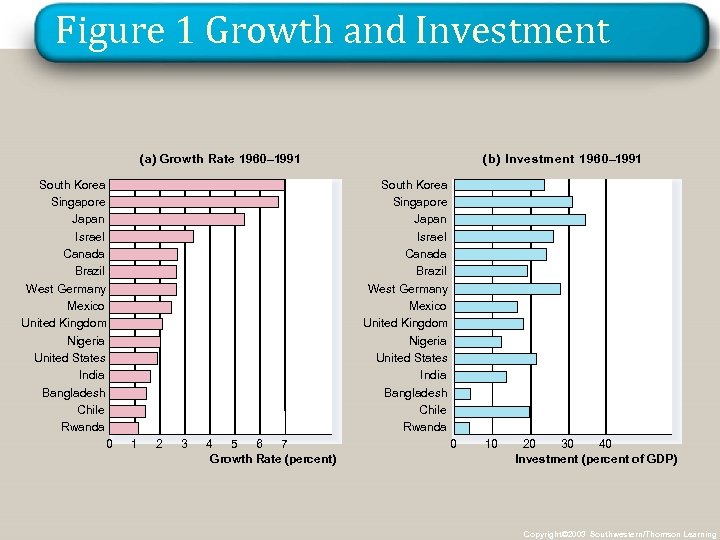 Figure 1 Growth and Investment (b) Investment 1960– 1991 (a) Growth Rate 1960– 1991 South Korea Singapore Japan Israel Canada Brazil West Germany Mexico United Kingdom Nigeria United States India Bangladesh Chile Rwanda 0 South Korea Singapore Japan Israel Canada Brazil West Germany Mexico United Kingdom Nigeria United States India Bangladesh Chile Rwanda 1 2 KOF Konjunkturforschungsstelle Swiss Institute for Business Cycle Research 3 4 5 6 7 Growth Rate (percent) 0 10 20 30 40 Investment (percent of GDP) Copyright© 2003 Southwestern/Thomson Learning
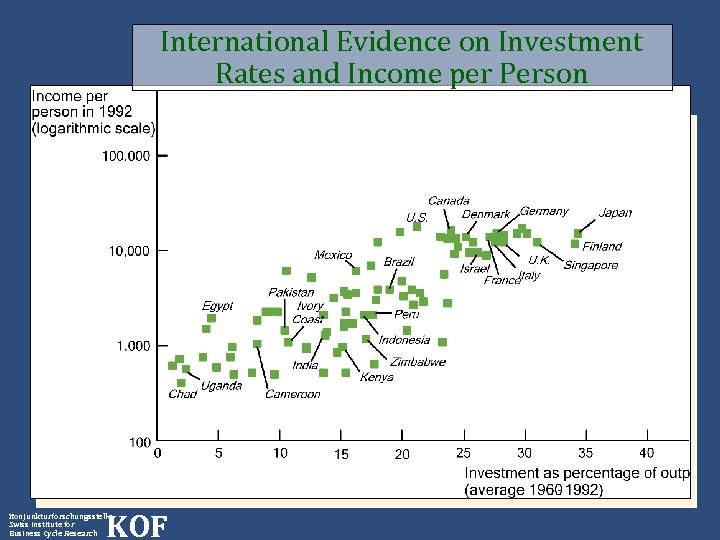 International Evidence on Investment Rates and Income per Person KOF Konjunkturforschungsstelle Swiss Institute for Business Cycle Research
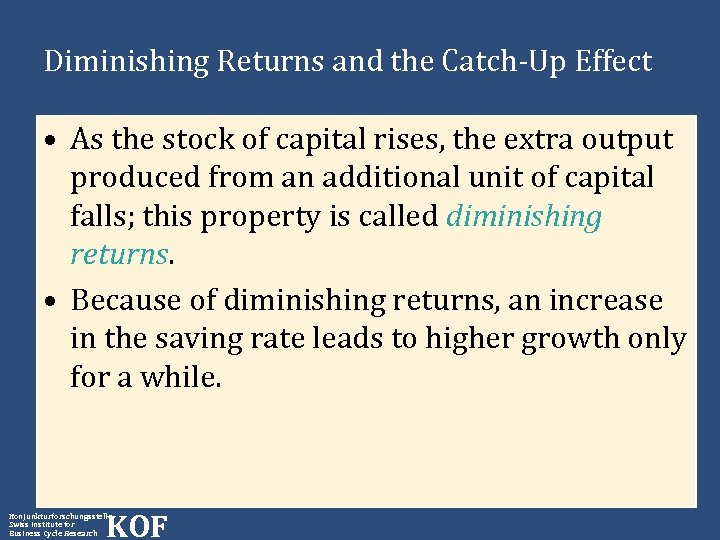 Diminishing Returns and the Catch-Up Effect • As the stock of capital rises, the extra output produced from an additional unit of capital falls; this property is called diminishing returns. • Because of diminishing returns, an increase in the saving rate leads to higher growth only for a while. KOF Konjunkturforschungsstelle Swiss Institute for Business Cycle Research
 Diminishing Returns and the Catch-Up Effect • In the long run, the higher saving rate leads to a higher level of productivity and income, but not to higher growth in these areas. KOF Konjunkturforschungsstelle Swiss Institute for Business Cycle Research
 Diminishing Returns and the Catch-Up Effect • The catch-up effect refers to the property whereby countries that start off poor tend to grow more rapidly than countries that start off rich. KOF Konjunkturforschungsstelle Swiss Institute for Business Cycle Research
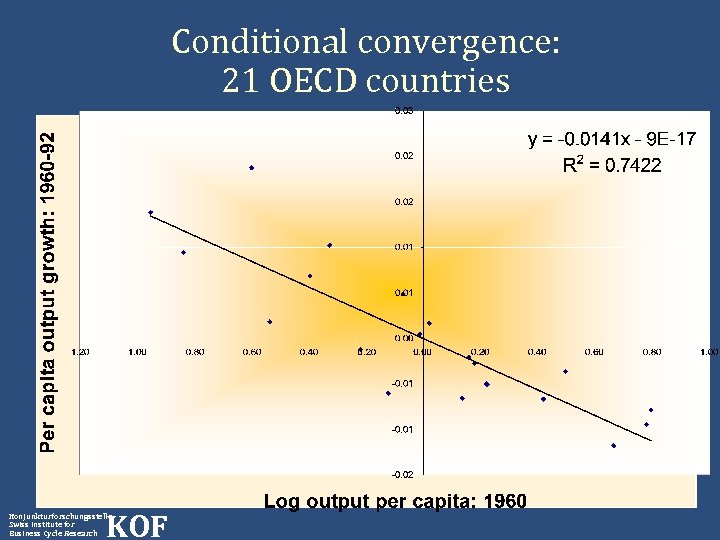 Conditional convergence: 21 OECD countries KOF Konjunkturforschungsstelle Swiss Institute for Business Cycle Research
 Investment from Abroad • Governments can increase capital accumulation and long-term economic growth by encouraging investment from foreign sources. KOF Konjunkturforschungsstelle Swiss Institute for Business Cycle Research
 Investment from Abroad • Investment from abroad takes several forms: • Foreign Direct Investment • Capital investment owned and operated by a foreign entity. • Foreign Portfolio Investment • Investments financed with foreign money but operated by domestic residents. KOF Konjunkturforschungsstelle Swiss Institute for Business Cycle Research
 Education • For a country’s long-run growth, education is at least as important as investment in physical capital. • In the United States, each year of schooling raises a person’s wage, on average, by about 10 percent. • Thus, one way the government can enhance the standard of living is to provide schools and encourage the population to take advantage of them. KOF Konjunkturforschungsstelle Swiss Institute for Business Cycle Research
 Education • An educated person might generate new ideas about how best to produce goods and services, which in turn, might enter society’s pool of knowledge and provide an external benefit to others. KOF Konjunkturforschungsstelle Swiss Institute for Business Cycle Research
 Education • One problem facing some poor countries is the brain drain—the emigration of many of the most highly educated workers to rich countries. KOF Konjunkturforschungsstelle Swiss Institute for Business Cycle Research
 Property Rights and Political Stability • Property rights refer to the ability of people to exercise authority over the resources they own. • An economy-wide respect for property rights is an important prerequisite for the price system to work. • It is necessary for investors to feel that their investments are secure. KOF Konjunkturforschungsstelle Swiss Institute for Business Cycle Research
 Free Trade • Trade is, in some ways, a type of technology. • A country that eliminates trade restrictions will experience the same kind of economic growth that would occur after a major technological advance. KOF Konjunkturforschungsstelle Swiss Institute for Business Cycle Research
 Free Trade • Some countries engage in. . . • . . . inward-orientated trade policies, avoiding interaction with other countries. • . . . outward-orientated trade policies, encouraging interaction with other countries. KOF Konjunkturforschungsstelle Swiss Institute for Business Cycle Research
 Research and Development • The advance of technological knowledge has led to higher standards of living. • Most technological advance comes from private research by firms and individual inventors. • Government can encourage the development of new technologies through research grants, tax breaks, and the patent system. KOF Konjunkturforschungsstelle Swiss Institute for Business Cycle Research
 Population Growth • Economists and other social scientists have long debated how population growth affects a society KOF Konjunkturforschungsstelle Swiss Institute for Business Cycle Research
 Population Growth • Population growth interacts with other factors of production: • Stretching natural resources • Diluting the capital stock • Promoting technological progress KOF Konjunkturforschungsstelle Swiss Institute for Business Cycle Research
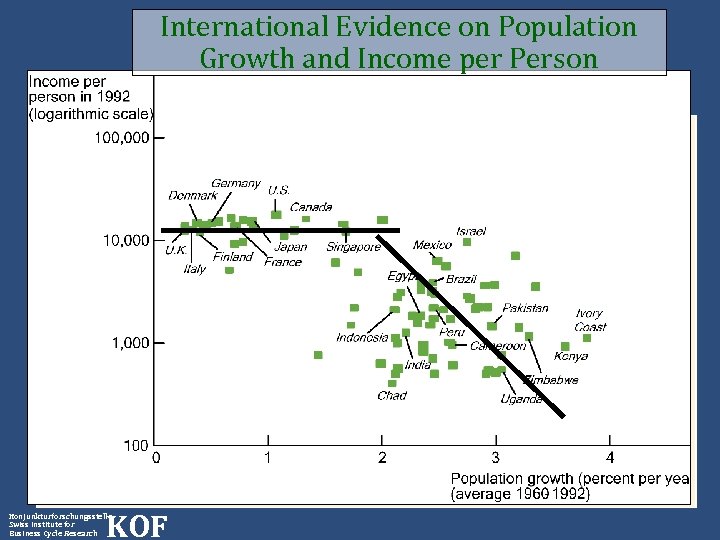 International Evidence on Population Growth and Income per Person KOF Konjunkturforschungsstelle Swiss Institute for Business Cycle Research
 Summary • Because every transaction has a buyer and a seller, the total expenditure in the economy must equal the total income in the economy. • Gross Domestic Product (GDP) measures an economy’s total expenditure on newly produced goods and services and the total income earned from the production of these goods and services. KOF Konjunkturforschungsstelle Swiss Institute for Business Cycle Research
 Summary • GDP is the market value of all final goods and services produced within a country in a given period of time. • GDP is divided among four components of expenditure: consumption, investment, government purchases, and net exports. KOF Konjunkturforschungsstelle Swiss Institute for Business Cycle Research
 Summary • Nominal GDP uses current prices to value the economy’s production. Real GDP uses constant base-year prices to value the economy’s production of goods and services. • The GDP deflator—calculated from the ratio of nominal to real GDP—measures the level of prices in the economy. KOF Konjunkturforschungsstelle Swiss Institute for Business Cycle Research
 Summary • GDP is a good measure of economic wellbeing because people prefer higher to lower incomes. • It is not a perfect measure of well-being because some things, such as leisure time and a clean environment, aren’t measured by GDP. KOF Konjunkturforschungsstelle Swiss Institute for Business Cycle Research
 Summary • Economic prosperity, as measured by real GDP person, varies substantially around the world. • The average income of the world’s richest countries is more than ten times that in the world’s poorest countries. • The standard of living in an economy depends on the economy’s ability to produce goods and services. KOF Konjunkturforschungsstelle Swiss Institute for Business Cycle Research
 Summary • Productivity depends on the amounts of physical capital, human capital, natural resources, and technological knowledge available to workers. • Government policies can influence the economy’s growth rate in many different ways. KOF Konjunkturforschungsstelle Swiss Institute for Business Cycle Research
 Summary • The accumulation of capital is subject to diminishing returns. • Because of diminishing returns, higher saving leads to a higher growth for a period of time, but growth will eventually slow down. • Also because of diminishing returns, the return to capital is especially high in poor countries. KOF Konjunkturforschungsstelle Swiss Institute for Business Cycle Research