


 Скачать презентацию National Academies Workshop Estimating STEM Workforce Needs Under
db9a203ca51ffb649d6954436d5346a1.ppt
- Количество слайдов: 9
 National Academies Workshop “Estimating STEM Workforce Needs Under Future Scenarios” Dr. John Fischer Director, Defense Laboratory Office 1 August 2011
 Defense Laboratory Enterprise Size and Scope • 62 Service and Do. D-owned Laboratories – Overseas locations – 100 s of individual laboratory facilities • >$30 B / year in Total Funds Executed (RDT&E, Proc, O&M, Mil. Con) – >60% Out-of-House: Mix of Partnerships, with industry and academia – <40% In-House: Diverse customers and competencies – Total Revenue would put it in the Fortune 100 • • >$11 B / year in Total Research (BA 1 -7) ~37, 000 Scientists and Engineers – 100, 000 total employees – mixed government and contractor personnel – International partnerships and working relationships • Diverse S&T capabilities and infrastructure mix – World leading research (Laser, Night Vision, Aero, Energetics, Armor, etc) – Innovative and capable defense engineering work across all warfighting domains – Practical implementation and solutions to legacy and current tech challenges • Extended national technical footprint (funding & competencies not assessed here) – 21 Department of Energy Labs – 10 FFRDC labs (funding & competencies not assessed herein) – 14 UARCs / 100 s of Universities
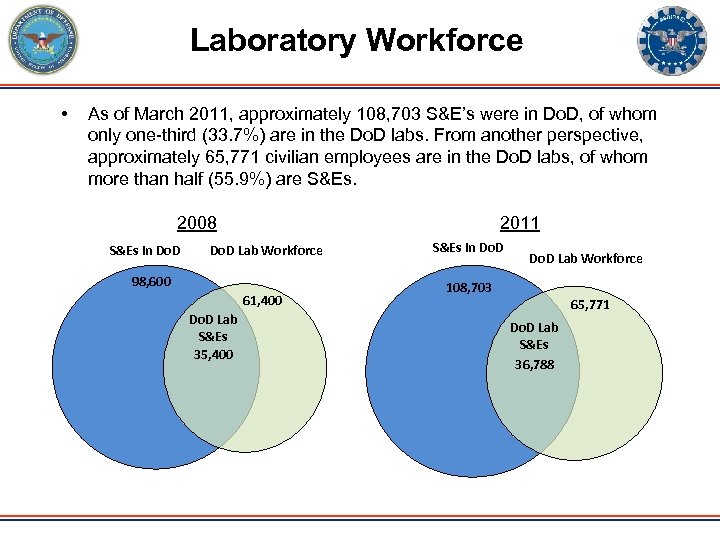 Laboratory Workforce • As of March 2011, approximately 108, 703 S&E’s were in Do. D, of whom only one-third (33. 7%) are in the Do. D labs. From another perspective, approximately 65, 771 civilian employees are in the Do. D labs, of whom more than half (55. 9%) are S&Es. 2008 S&Es in Do. D 2011 Do. D Lab Workforce 98, 600 61, 400 Do. D Lab S&Es 35, 400 S&Es in Do. D Lab Workforce 108, 703 65, 771 Do. D Lab S&Es 36, 788
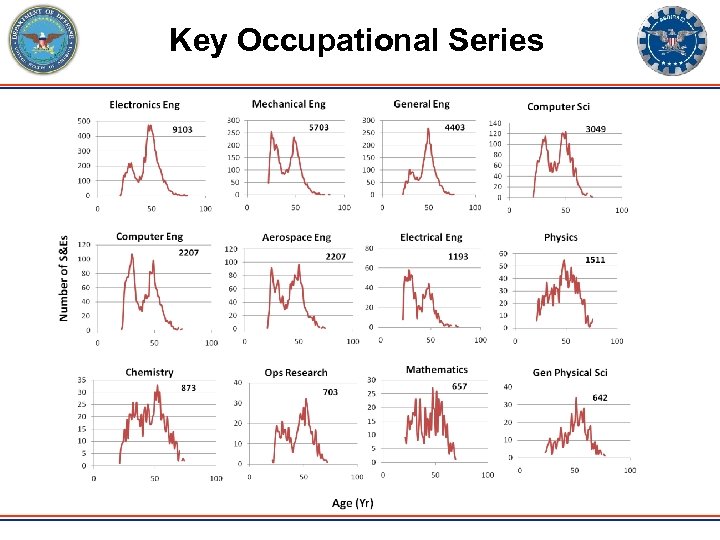 Key Occupational Series
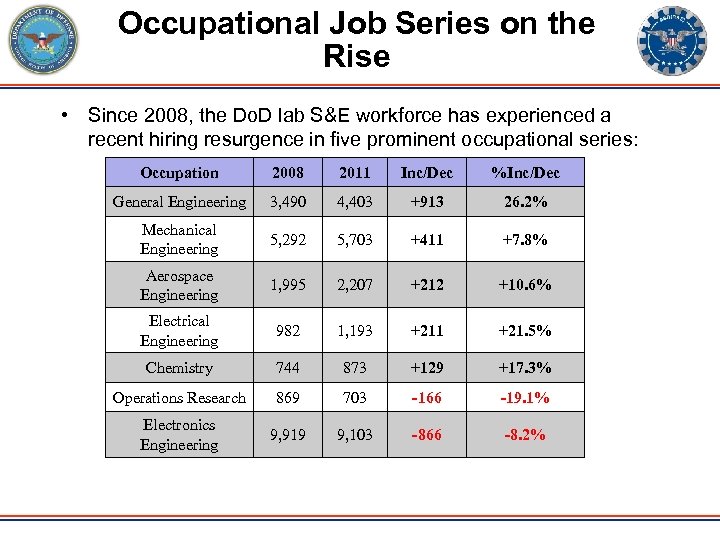 Occupational Job Series on the Rise • Since 2008, the Do. D lab S&E workforce has experienced a recent hiring resurgence in five prominent occupational series: Occupation 2008 2011 Inc/Dec %Inc/Dec General Engineering 3, 490 4, 403 +913 26. 2% Mechanical Engineering 5, 292 5, 703 +411 +7. 8% Aerospace Engineering 1, 995 2, 207 +212 +10. 6% Electrical Engineering 982 1, 193 +211 +21. 5% Chemistry 744 873 +129 +17. 3% Operations Research 869 703 -166 -19. 1% Electronics Engineering 9, 919 9, 103 -866 -8. 2%
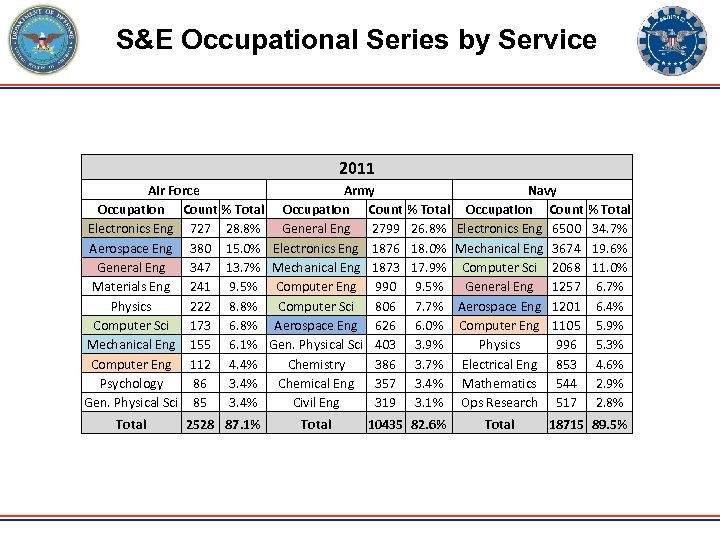 S&E Occupational Series by Service 2011 Air Force Occupation Count % Total Electronics Eng 727 28. 8% Aerospace Eng 380 15. 0% General Eng 347 13. 7% Materials Eng 241 9. 5% Physics 222 8. 8% Computer Sci 173 6. 8% Mechanical Eng 155 6. 1% Computer Eng 112 4. 4% Psychology 86 3. 4% Gen. Physical Sci 85 3. 4% Total 2528 87. 1% Army Occupation Count % Total General Eng 2799 26. 8% Electronics Eng 1876 18. 0% Mechanical Eng 1873 17. 9% Computer Eng 990 9. 5% Computer Sci 806 7. 7% Aerospace Eng 626 6. 0% Gen. Physical Sci 403 3. 9% Chemistry 386 3. 7% Chemical Eng 357 3. 4% Civil Eng 319 3. 1% Total 10435 82. 6% Navy Occupation Count % Total Electronics Eng 6500 34. 7% Mechanical Eng 3674 19. 6% Computer Sci 2068 11. 0% General Eng 1257 6. 7% Aerospace Eng 1201 6. 4% Computer Eng 1105 5. 9% Physics 996 5. 3% Electrical Eng 853 4. 6% Mathematics 544 2. 9% Ops Research 517 2. 8% Total 18715 89. 5%
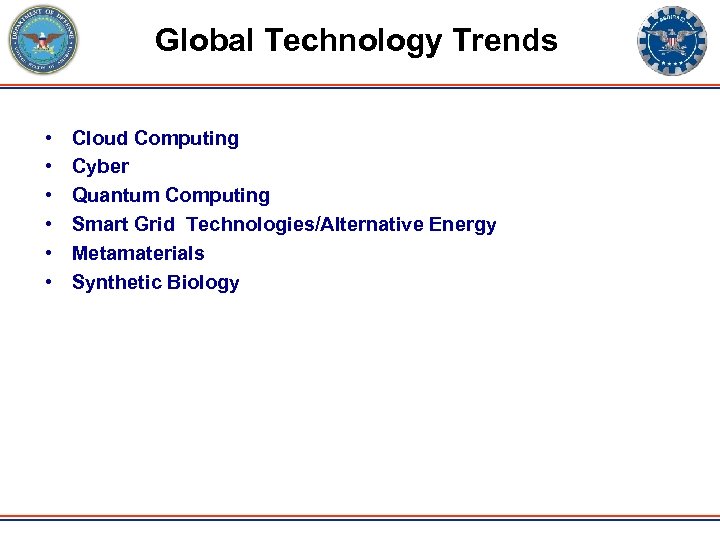 Global Technology Trends • • • Cloud Computing Cyber Quantum Computing Smart Grid Technologies/Alternative Energy Metamaterials Synthetic Biology
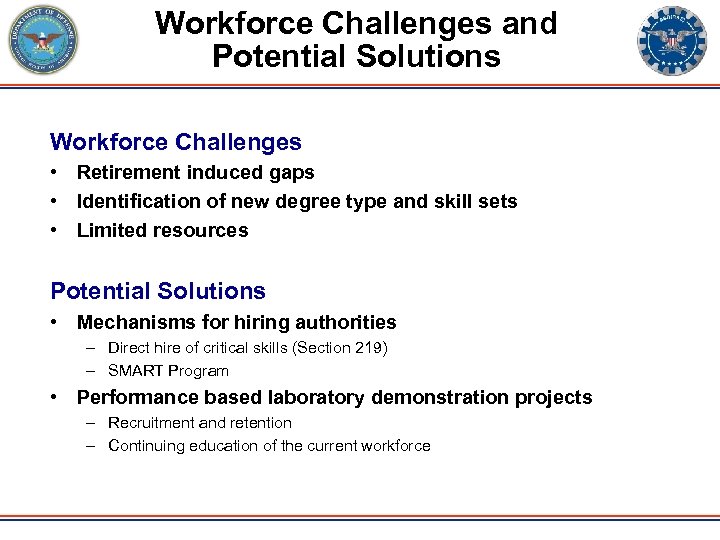 Workforce Challenges and Potential Solutions Workforce Challenges • Retirement induced gaps • Identification of new degree type and skill sets • Limited resources Potential Solutions • Mechanisms for hiring authorities – Direct hire of critical skills (Section 219) – SMART Program • Performance based laboratory demonstration projects – Recruitment and retention – Continuing education of the current workforce
 Watching Academia • What are the educational trends and expected new fields (ex. cybersecurity)? • Which fields are expected to lead to the next round of innovation? • How should we change to take advantage of the trends? • Where should we invest for the future?