


 Скачать презентацию Nathalie Nevo A Note to the Students
c9355f15d8f175a81c7e61a6c86178f6.ppt
- Количество слайдов: 74
 Nathalie Nevo
 A Note to the Students These lessons are not intended to Introduce you to the English verb system. Use them as a review of what you’ve already learned.
 Are English Verbs “difficult”? Are you miserable because you make mistakes with English verbs? Do you think you will never be able to learn? Are you sorry you didn’t listen to your teacher?
 It’s not really so hard!!! You CAN speak and write good English You CAN get good grades on English exams. You only have to learn a few simple rules. Are you ready to LEARN and PRACTICE?
 LESSON 1 An Overview
 We talk a lot in these lessons about V 1, V 2, and V 3. What in the world are V 1, V 2, and V 3?
 Does this look familiar? – eat – fall – fly ate fell flew eaten fallen flown This is the table of irregular verbs that we know and love! V 1 is the first column (“eat”, , )צורת המקור V 2 is the second column (“ate”, past simple form), V 3 is the third column (“eaten”, called—oh well, V 3)
 Lots of people forget that a verb that ends in “d” or “ed” doesn’t have to be a verb in the simple past. Maybe it’s a regular verb in V 3 DISGUISED as a simple past verb. love hate worry For example: loved hated worried
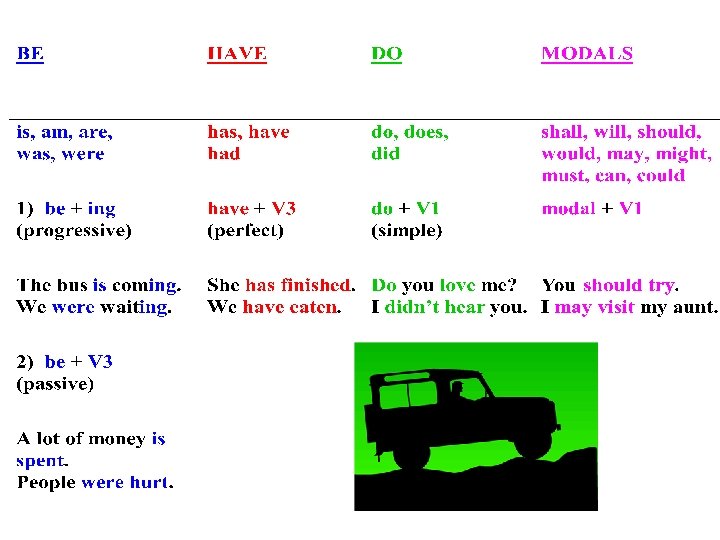
 Verb Formulas 5 ¨ be + ing (progressive)--He was crying. ¨ be + V 3 (passive)--He was beaten. Four men were killed. © have + V 3 (perfect)--I have already eaten. ª do + V 1 (simple)-- Do you love me? I don’t hate you. « modal + V 1 (modal)--I can wait.
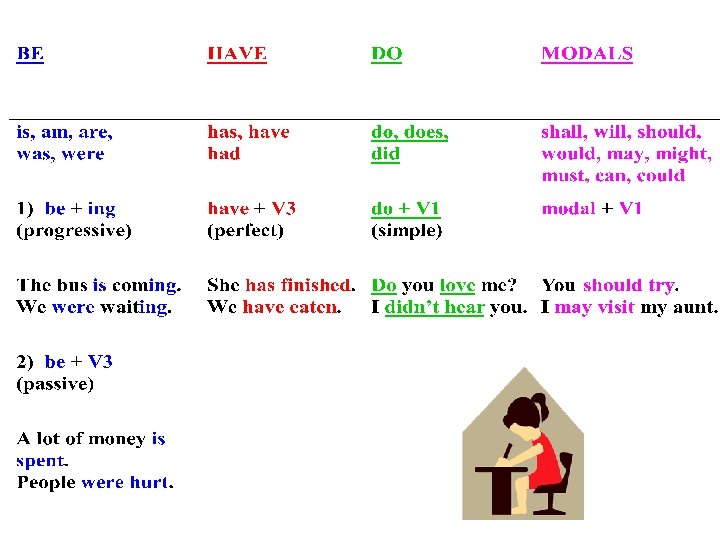
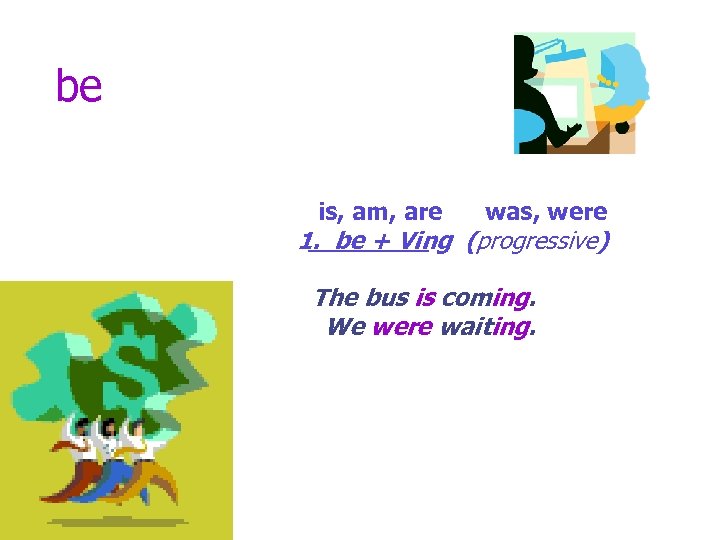 be is, am, are was, were 1. be + Ving (progressive) The bus is coming. We were waiting.
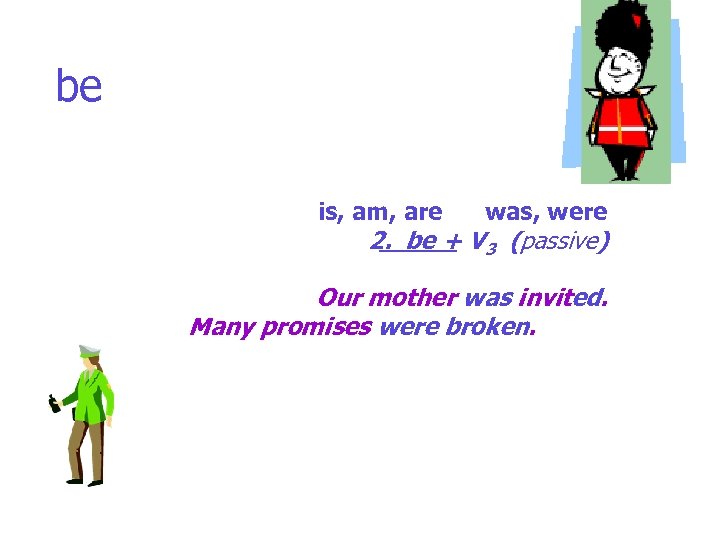 be is, am, are was, were 2. be + V 3 (passive) Our mother was invited. Many promises were broken.
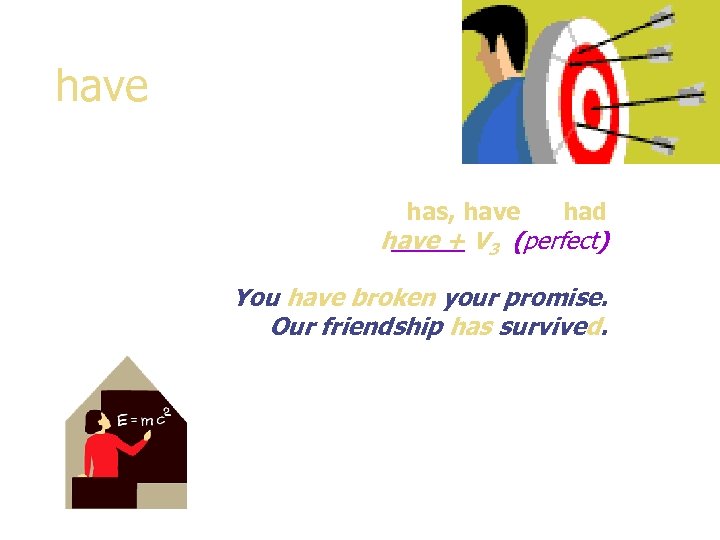 have has, have had have + V 3 (perfect) You have broken your promise. Our friendship has survived.
 do do, does do + V 1 (simple) I don’t enjoy homework. Do you like school? did
 modals shall, will, should, would, may, might, must, can, could, ought modal + V 1 (modal) Miri can speak four languages. We must finish. Would you like some coffee?
 This is the end of Lesson 1
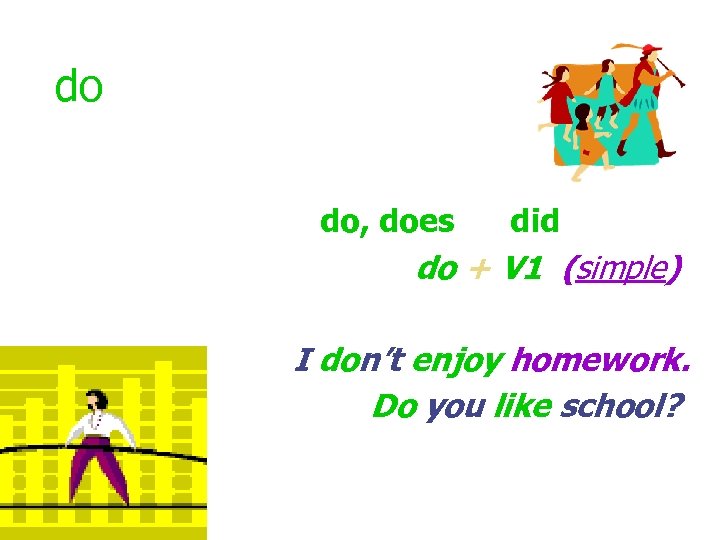 do do, does did do + V 1 (simple) I don’t enjoy homework. Do you like school?
 A special note about DO: We say that do is the helping verb for the “simple” tenses, but if they’re “simple”, then so is making peace with our neighbors! Pay attention:
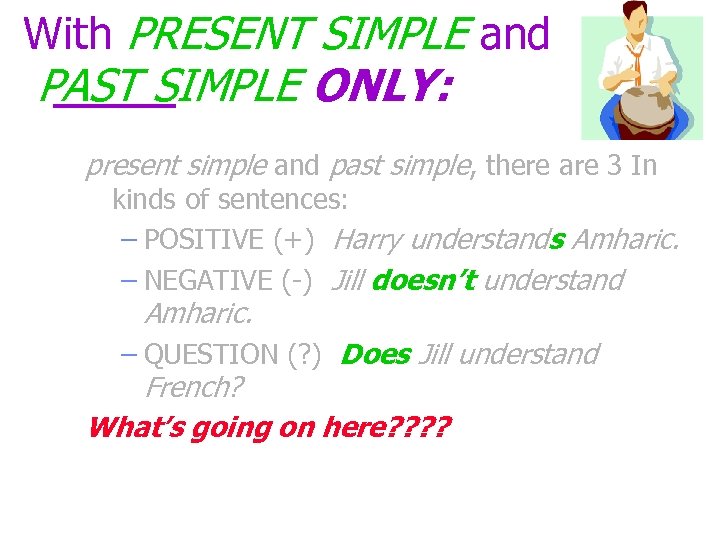 With PRESENT SIMPLE and PAST SIMPLE ONLY: present simple and past simple, there are 3 In kinds of sentences: – POSITIVE (+) Harry understands Amharic. – NEGATIVE (-) Jill doesn’t understand Amharic. – QUESTION (? ) Does Jill understand French? What’s going on here? ?
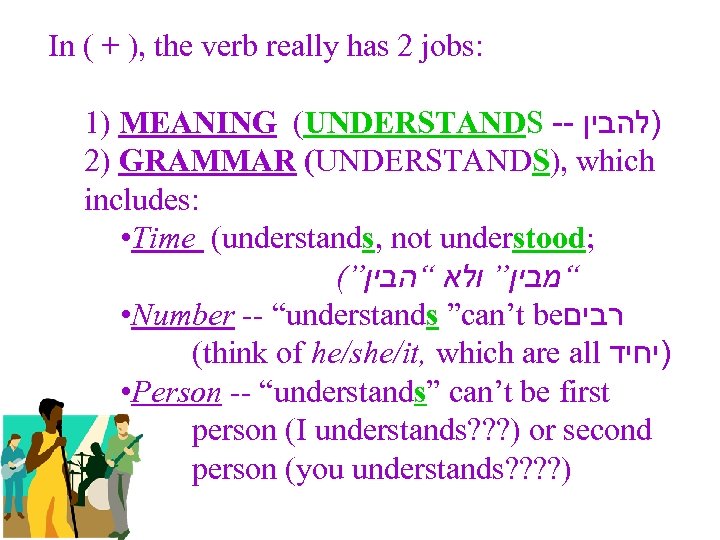 In ( + ), the verb really has 2 jobs: 1) MEANING (UNDERSTANDS -- )להבין 2) GRAMMAR (UNDERSTANDS), which includes: • Time (understands, not understood; (” “מבין” ולא “הבין • Number -- “understands ”can’t be רבים (think of he/she/it, which are all )יחיד • Person -- “understands” can’t be first person (I understands? ? ? ) or second person (you understands? ? )
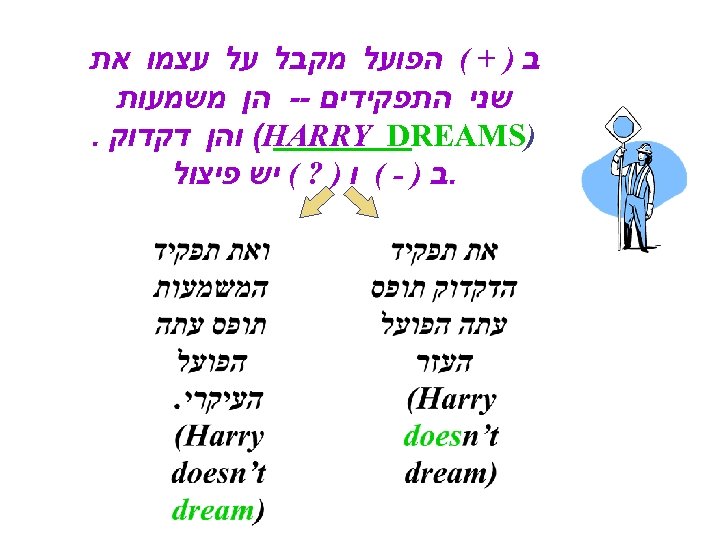 ב ) + ( הפועל מקבל על עצמו את שני התפקידים -- הן משמעות ) (HARRY DREAMS והן דקדוק. . ב ) - ( ו ) ? ( יש פיצול
 Now do you understand why the main verb must always be ? בצורת המקור
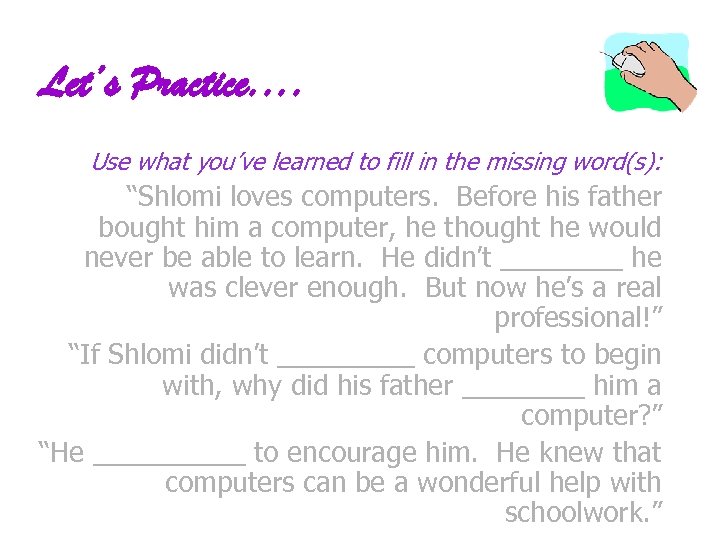 Let’s Practice. . Use what you’ve learned to fill in the missing word(s): “Shlomi loves computers. Before his father bought him a computer, he thought he would never be able to learn. He didn’t ____ he was clever enough. But now he’s a real professional!” “If Shlomi didn’t _____ computers to begin with, why did his father ____ him a computer? ” “He _____ to encourage him. He knew that computers can be a wonderful help with schoolwork. ”
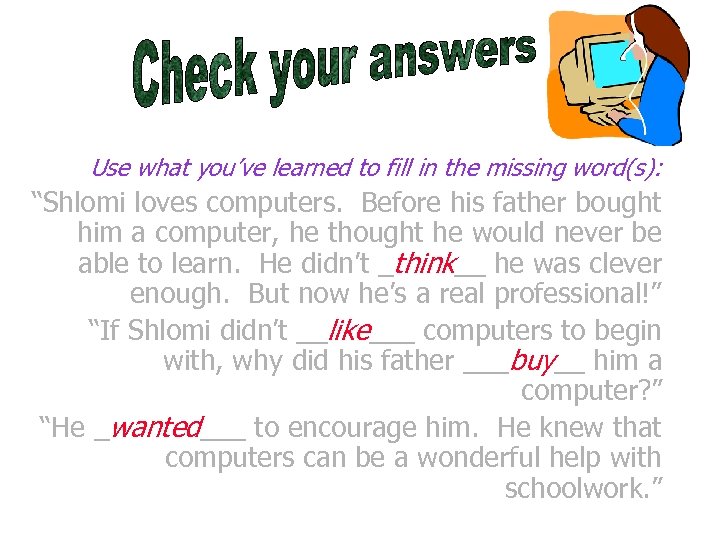 Use what you’ve learned to fill in the missing word(s): “Shlomi loves computers. Before his father bought him a computer, he thought he would never be able to learn. He didn’t _think__ he was clever enough. But now he’s a real professional!” “If Shlomi didn’t __like___ computers to begin with, why did his father ___buy__ him a computer? ” “He _wanted___ to encourage him. He knew that computers can be a wonderful help with schoolwork. ”
 Let’s Practice. . Use what you’ve learned to fill in the missing word(s): “Hello, Mom? I have a problem. I left my keys at home this morning. ” “Where did you ______ them? ” “I ______ them on the table. _____ you see them? ” “Yes, but you _____ have to worry. I won’t lock the door. ”
 Use what you’ve learned to fill in the missing word(s): “Hello, Mom? I have a problem. I left my keys at home this morning. ” “Where did you ___leave____ them? ” “I ___left____ them on the table. _Can or Do_ you see them? ” “Yes, but you __don’t__ have to worry. I won’t lock the door. ”
 BUT Don’t think BE/HAVE/DO can only be helping verbs (. )פועלי עזר Often they are main verbs . )הפועל ( העיקרי
 be/have/do as main verbs: • You are being stupid! • Dan has had too many absences. • What did you do last night?
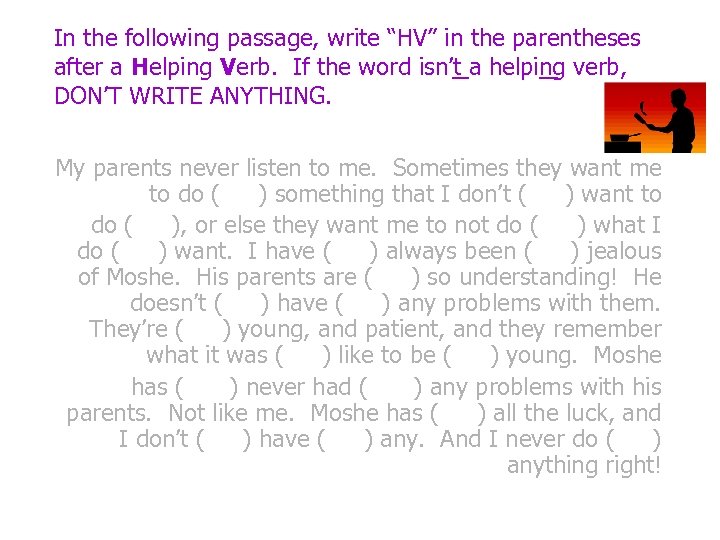 In the following passage, write “HV” in the parentheses after a Helping Verb. If the word isn’t a helping verb, DON’T WRITE ANYTHING. My parents never listen to me. Sometimes they want me to do ( ) something that I don’t ( ) want to do ( ), or else they want me to not do ( ) what I do ( ) want. I have ( ) always been ( ) jealous of Moshe. His parents are ( ) so understanding! He doesn’t ( ) have ( ) any problems with them. They’re ( ) young, and patient, and they remember what it was ( ) like to be ( ) young. Moshe has ( ) never had ( ) any problems with his parents. Not like me. Moshe has ( ) all the luck, and I don’t ( ) have ( ) any. And I never do ( ) anything right!
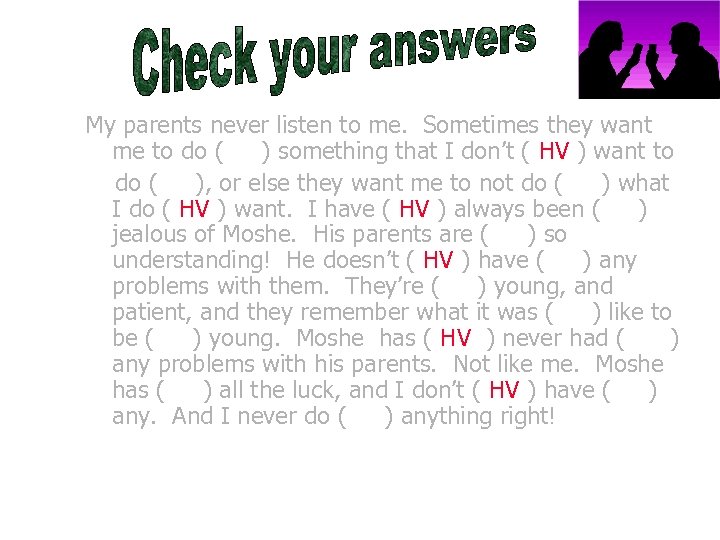 My parents never listen to me. Sometimes they want me to do ( ) something that I don’t ( HV ) want to do ( ), or else they want me to not do ( ) what I do ( HV ) want. I have ( HV ) always been ( ) jealous of Moshe. His parents are ( ) so understanding! He doesn’t ( HV ) have ( ) any problems with them. They’re ( ) young, and patient, and they remember what it was ( ) like to be ( ) young. Moshe has ( HV ) never had ( ) any problems with his parents. Not like me. Moshe has ( ) all the luck, and I don’t ( HV ) have ( ) any. And I never do ( ) anything right!
 This is the end of Lesson 2
 LESSON 3 A Few Words About Modals and Semi-Modals
 modals shall, will, should, would, may, might, must, can, could, ought modal + V 1 (modal) Miri can speak four languages. We must finish. Would you like some coffee?
 A NOTE ABOUT SEMI-MODALS You shouldn’t--indeed, you can’t--use “can” in the past or in the future tense. Use a form of “be able to” instead, or (in past tense), use “could”. Examples: I can’t speak Russian. I was able to or could speak it when I was young. I will be able to speak it again after my trip to Moscow.
 A NOTE ABOUT SEMI-MODALS Another way to say “must” is “have to” (they both mean the same thing). In fact, in negative sentences (-), questions (? ), and in the past or future tenses, you can’t use “must”; you have to use “have to”. Example: I must hurry. I have to hurry. You don’t have to hurry. She had to hurry so that she wouldn’t be late.
 Let’s Practice. . Use what you’ve learned to fill in the missing word(s): “Shirli, must you play the radio so loud? ” “What _____ you say? ” “Do you _____ play the radio so loud? ” “No, I don’t ______. Do you _____ me to turn it down? ” “Yes, I do, please, if you don’t _____ me to lose my hearing. ”
 Use what you’ve learned to fill in the missing word(s): “Shirli, must you play the radio so loud? ” “What ___did____ you say? ” “Do you __have to___ play the radio so loud? ” “No, I don’t __have to___. Do you __want___ me to turn it down? ” “Yes, I do, please, if you don’t _want____ me to lose my hearing. ”
 Let’s Practice. . Use what you’ve learned to fill in the missing word(s): “_____ you help me, please? I want a book about the Internet, but I ______ find one. ” “_____ you look among the computer books? ” “Yes, I _____, but I _______ find anything. ” “Well, I’m ______ somebody else right now, but I _______ help you in about ten minutes. ____ you come back in ten minutes? ” “OK. And in the meantime, I _____ try again. Maybe I _____ ___ find it by then. ”
 Use what you’ve learned to fill in the missing word(s): “___Can___ you help me, please? I want a book about the Internet, but I ___can’t___ find one. ” “___Did___ you look among the computer books? ” “Yes, I ___did____, but I __couldn’t____ find anything. ” “Well, I’m __helping___ somebody else right now, but I ___will be able to__ help you in about ten minutes. ___Can__ you come back in ten minutes? ” “OK. And in the meantime, I ___will___ try again. Maybe I __will be able to__ find it by then. ”
 --Refresh Your Memory Take another look at the table of helping verbs. Pay attention to the colors.
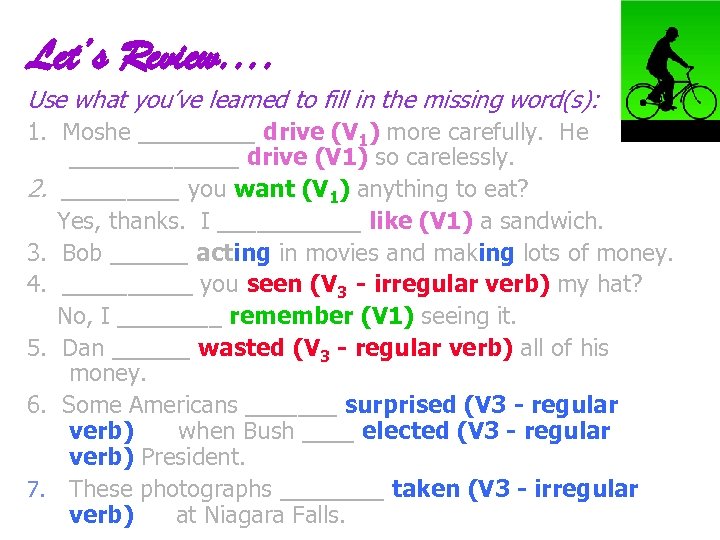 Let’s Review. . Use what you’ve learned to fill in the missing word(s): 1. Moshe _____ drive (V 1) more carefully. He _______ drive (V 1) so carelessly. 2. _____ you want (V 1) anything to eat? Yes, thanks. I ______ like (V 1) a sandwich. 3. Bob ______ acting in movies and making lots of money. 4. _____ you seen (V 3 - irregular verb) my hat? No, I ____ remember (V 1) seeing it. 5. Dan ______ wasted (V 3 - regular verb) all of his money. 6. Some Americans _______ surprised (V 3 - regular verb) when Bush ____ elected (V 3 - regular verb) President. 7. These photographs ____ taken (V 3 - irregular verb) at Niagara Falls.
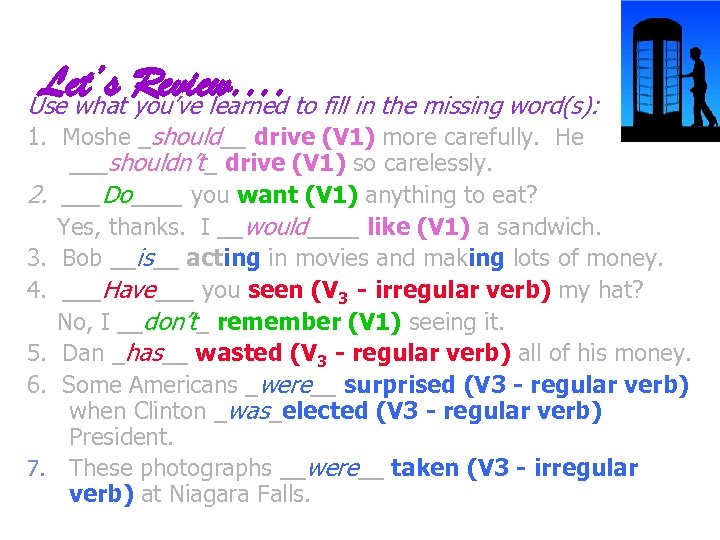 Let’s Review. . to fill in the missing word(s): Use what you’ve learned 1. Moshe _should__ drive (V 1) more carefully. He ___shouldn’t_ drive (V 1) so carelessly. 2. ___Do____ you want (V 1) anything to eat? Yes, thanks. I __would____ like (V 1) a sandwich. 3. Bob __is__ acting in movies and making lots of money. 4. ___Have___ you seen (V 3 - irregular verb) my hat? No, I __don’t_ remember (V 1) seeing it. 5. Dan _has__ wasted (V 3 - regular verb) all of his money. 6. Some Americans _were__ surprised (V 3 - regular verb) when Clinton _was_elected (V 3 - regular verb) President. 7. These photographs __were__ taken (V 3 - irregular verb) at Niagara Falls.
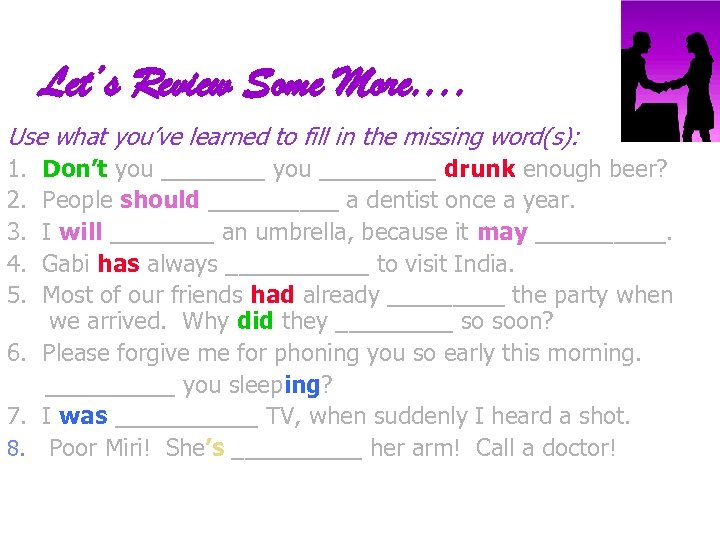 Let’s Review Some More. . Use what you’ve learned to fill in the missing word(s): 1. 2. 3. 4. 5. Don’t you _________ drunk enough beer? People should _____ a dentist once a year. I will ____ an umbrella, because it may _____. Gabi has always ______ to visit India. Most of our friends had already _____ the party when we arrived. Why did they _____ so soon? 6. Please forgive me for phoning you so early this morning. _____ you sleeping? 7. I was ______ TV, when suddenly I heard a shot. 8. Poor Miri! She’s _____ her arm! Call a doctor!
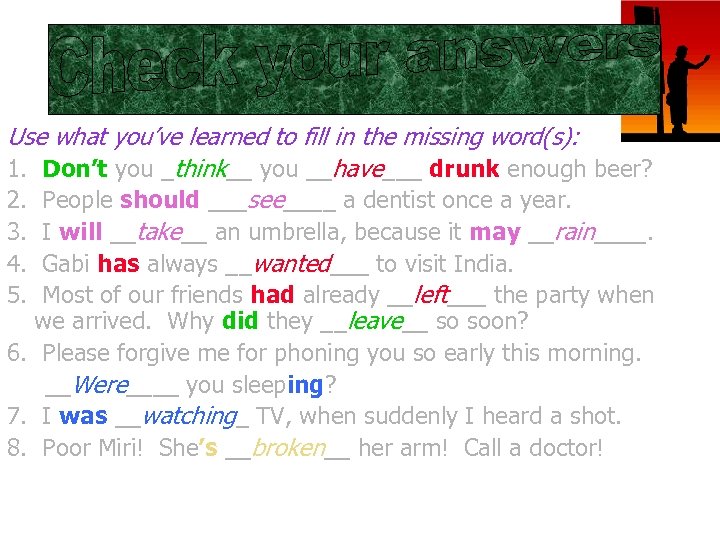 Use what you’ve learned to fill in the missing word(s): 1. Don’t you _think__ you __have___ drunk enough beer? 2. People should ___see____ a dentist once a year. 3. I will __take__ an umbrella, because it may __rain____. 4. Gabi has always __wanted___ to visit India. 5. Most of our friends had already __left___ the party when we arrived. Why did they __leave__ so soon? 6. Please forgive me for phoning you so early this morning. __Were____ you sleeping? 7. I was __watching_ TV, when suddenly I heard a shot. 8. Poor Miri! She’s __broken__ her arm! Call a doctor!
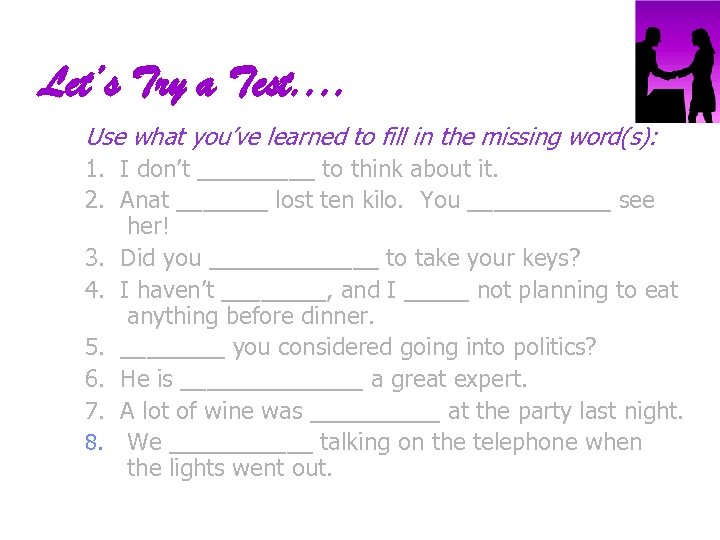 Let’s Try a Test. . Use what you’ve learned to fill in the missing word(s): 1. I don’t _____ to think about it. 2. Anat _______ lost ten kilo. You ______ see her! 3. Did you _______ to take your keys? 4. I haven’t ____, and I _____ not planning to eat anything before dinner. 5. ____ you considered going into politics? 6. He is _______ a great expert. 7. A lot of wine was _____ at the party last night. 8. We ______ talking on the telephone when the lights went out.
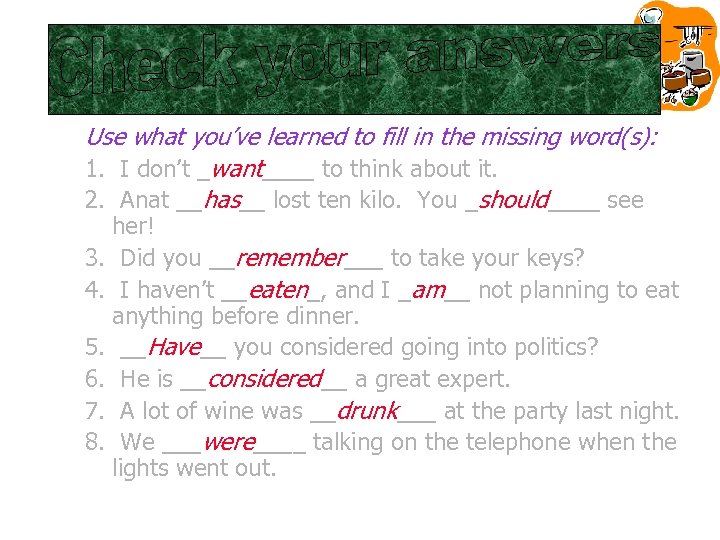 Use what you’ve learned to fill in the missing word(s): 1. I don’t _want____ to think about it. 2. Anat __has__ lost ten kilo. You _should____ see her! 3. Did you __remember___ to take your keys? 4. I haven’t __eaten_, and I _am__ not planning to eat anything before dinner. 5. __Have__ you considered going into politics? 6. He is __considered__ a great expert. 7. A lot of wine was __drunk___ at the party last night. 8. We ___were____ talking on the telephone when the lights went out.
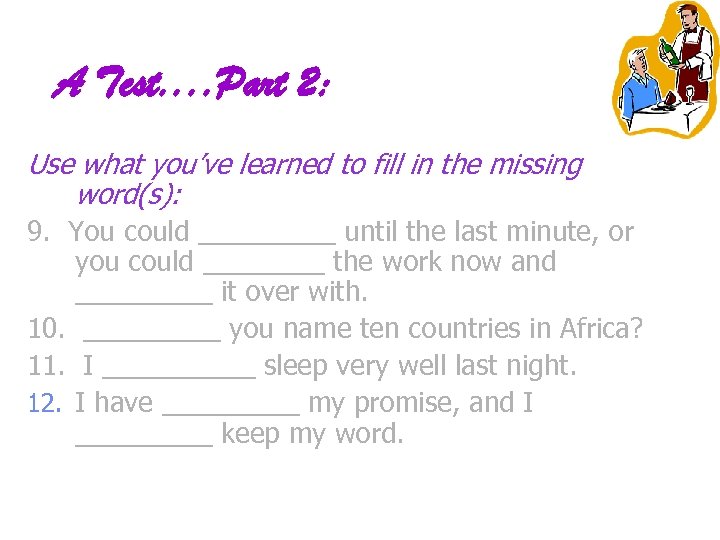 A Test. . Part 2: Use what you’ve learned to fill in the missing word(s): 9. You could _____ until the last minute, or you could ____ the work now and _____ it over with. 10. _____ you name ten countries in Africa? 11. I _____ sleep very well last night. 12. I have _____ my promise, and I _____ keep my word.
 Use what you’ve learned to fill in the missing word(s): 9. You could __wait___ until the last minute, or you could ___do___ the work now and ___get___ it over with. 10. ___Can___ you name ten countries in Africa? 11. I __didn’t__ sleep very well last night. 12. I have __given__ my promise, and I __will___ keep my word.
 This is the end of Lesson 3
 LESSON 4 ? V
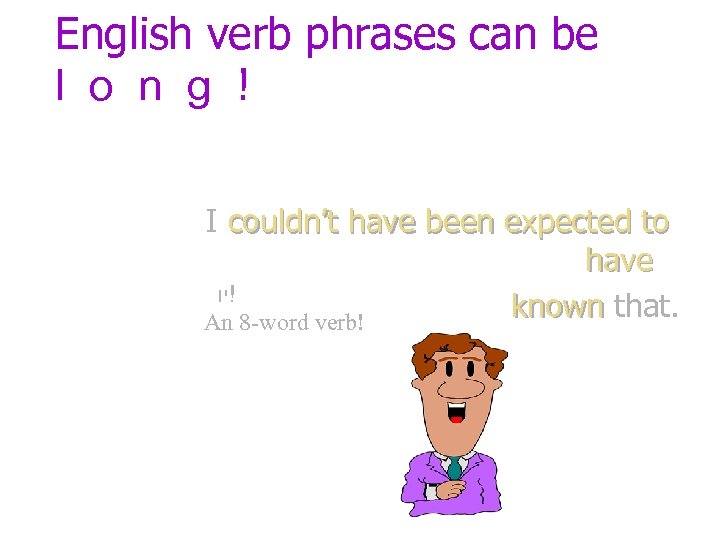 English verb phrases can be l o n g ! I couldn’t have been expected to have !יו known that. An 8 -word verb!
 Forming Yes/No Questions Take the first element ( )מרכיב of the verb and put it before the subject : ( )נושא I can believe it. Can you believe it? I’ve been there. Have you been there?
 !Forming questions. . . still Follow the same rule even for a monster verb! He couldn’t have been expected to understand. Could he have been expected to understand?
 How do I translate " "האם when I’m forming a yes-no question?
 To translate ” “האם when forming a yes -no question, simply begin the question with the suitable helping verb.
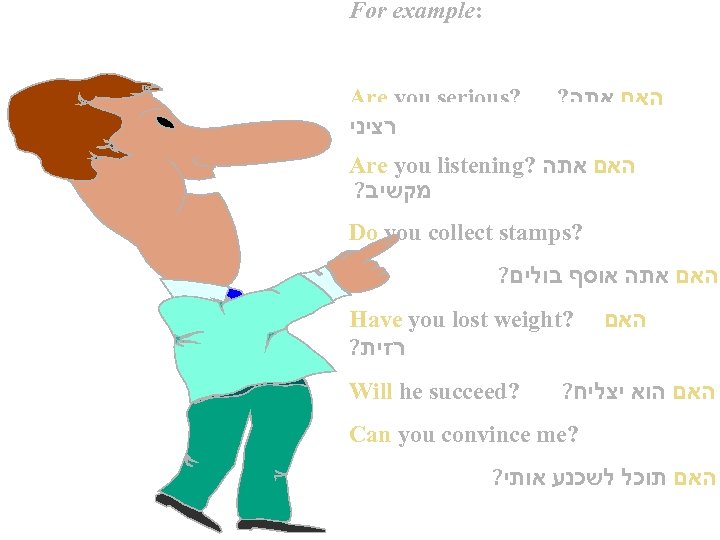 For example: Are you serious? רציני ? האם אתה Are you listening? האם אתה ? מקשיב Do you collect stamps? ? האם אתה אוסף בולים Have you lost weight? ? רזית Will he succeed? האם ? האם הוא יצליח Can you convince me? ? האם תוכל לשכנע אותי
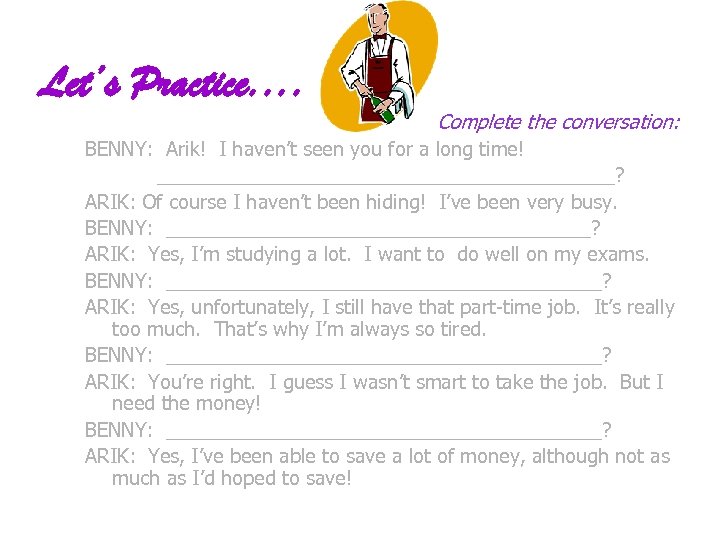 Let’s Practice. . Complete the conversation: BENNY: Arik! I haven’t seen you for a long time! _____________________? ARIK: Of course I haven’t been hiding! I’ve been very busy. BENNY: ____________________? ARIK: Yes, I’m studying a lot. I want to do well on my exams. BENNY: ____________________? ARIK: Yes, unfortunately, I still have that part-time job. It’s really too much. That’s why I’m always so tired. BENNY: ____________________? ARIK: You’re right. I guess I wasn’t smart to take the job. But I need the money! BENNY: ____________________? ARIK: Yes, I’ve been able to save a lot of money, although not as much as I’d hoped to save!
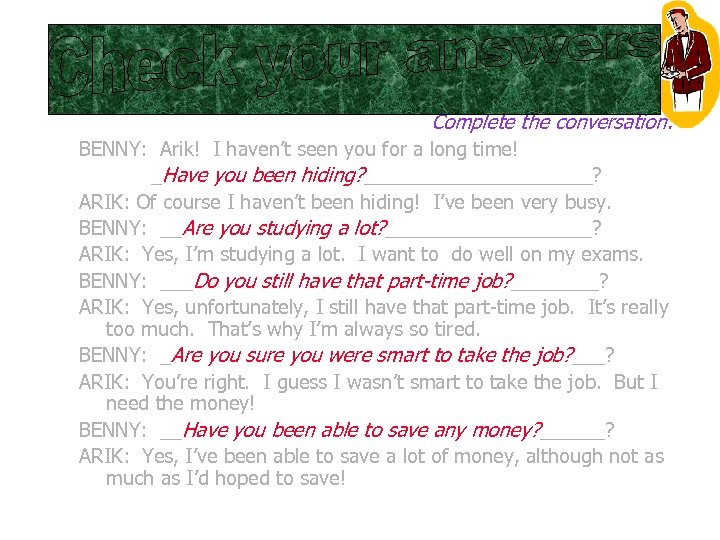 Complete the conversation: BENNY: Arik! I haven’t seen you for a long time! _Have you been hiding? ___________? ARIK: Of course I haven’t been hiding! I’ve been very busy. BENNY: __Are you studying a lot? __________? ARIK: Yes, I’m studying a lot. I want to do well on my exams. BENNY: ___Do you still have that part-time job? ____? ARIK: Yes, unfortunately, I still have that part-time job. It’s really too much. That’s why I’m always so tired. BENNY: _Are you sure you were smart to take the job? ___? ARIK: You’re right. I guess I wasn’t smart to take the job. But I need the money! BENNY: __Have you been able to save any money? ______? ARIK: Yes, I’ve been able to save a lot of money, although not as much as I’d hoped to save!
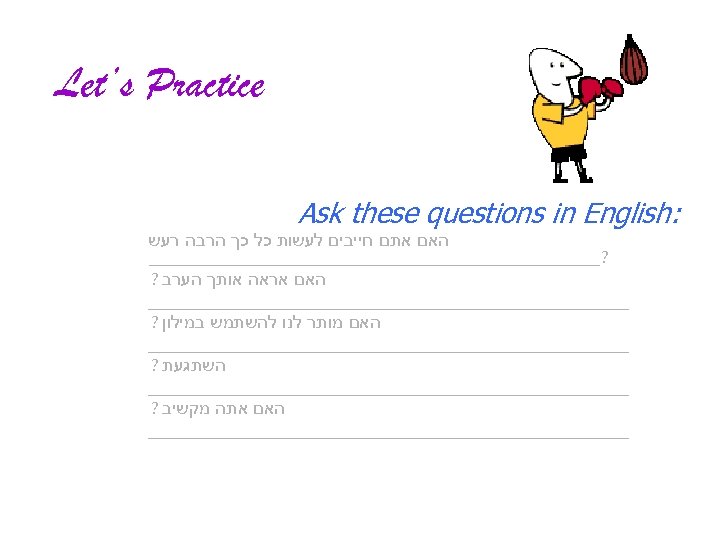 Let’s Practice : Ask these questions in English האם אתם חייבים לעשות כל כך הרבה רעש ? _______________________ האם אראה אותך הערב ? _________________________ האם מותר לנו להשתמש במילון ? _________________________ השתגעת ? _________________________ האם אתה מקשיב ? _________________________
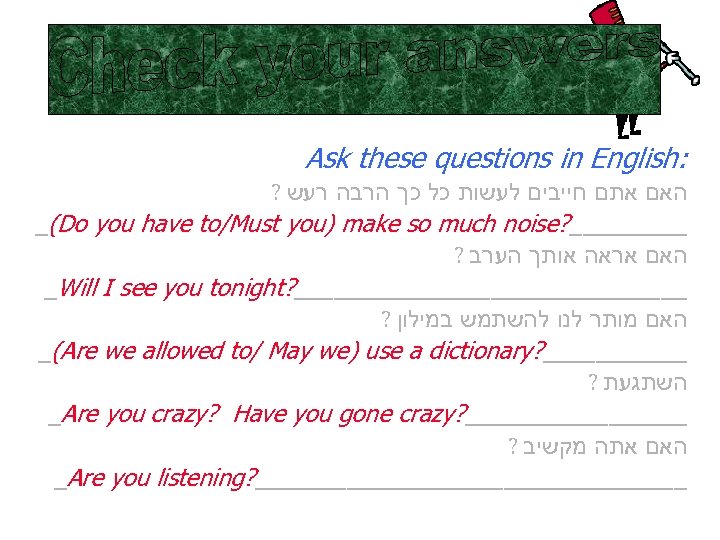 Ask these questions in English: ? האם אתם חייבים לעשות כל כך הרבה רעש _(Do you have to/Must you) make so much noise? _____ ? האם אראה אותך הערב _Will I see you tonight? _______________ ? האם מותר לנו להשתמש במילון _(Are we allowed to/ May we) use a dictionary? ______ ? השתגעת _Are you crazy? Have you gone crazy? _________ ? האם אתה מקשיב _Are you listening? _________________
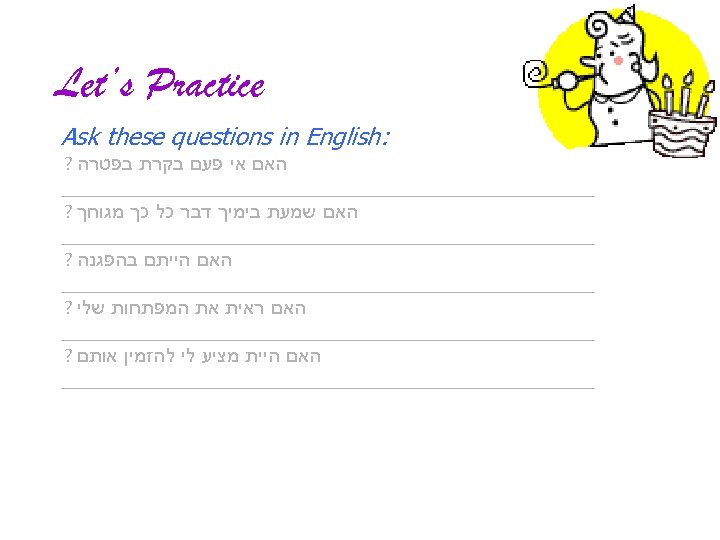 Let’s Practice : Ask these questions in English האם אי פעם בקרת בפטרה ? _________________________ האם שמעת בימיך דבר כל כך מגוחך ? _________________________ האם הייתם בהפגנה ? _________________________ האם ראית את המפתחות שלי ? _________________________ האם היית מציע לי להזמין אותם ? _________________________
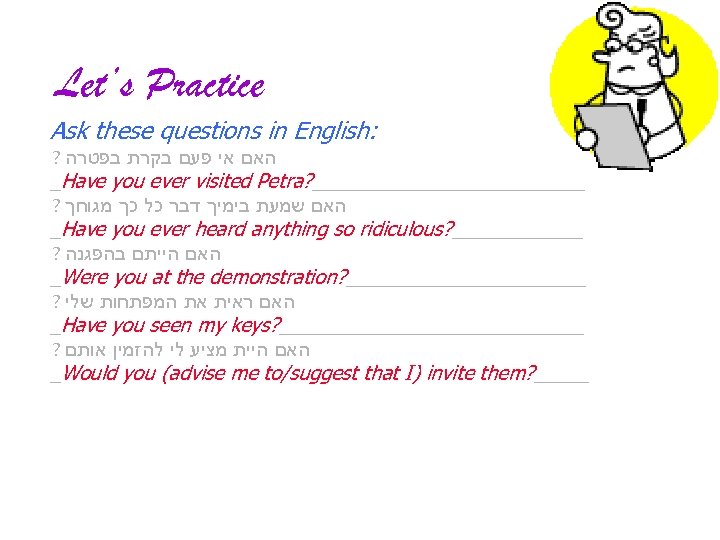 Let’s Practice Ask these questions in English: ? האם אי פעם בקרת בפטרה _Have you ever visited Petra? _____________ ? האם שמעת בימיך דבר כל כך מגוחך _Have you ever heard anything so ridiculous? ______ ? האם הייתם בהפגנה _Were you at the demonstration? ___________ ? האם ראית את המפתחות שלי _Have you seen my keys? ______________ ? האם היית מציע לי להזמין אותם _Would you (advise me to/suggest that I) invite them? _____
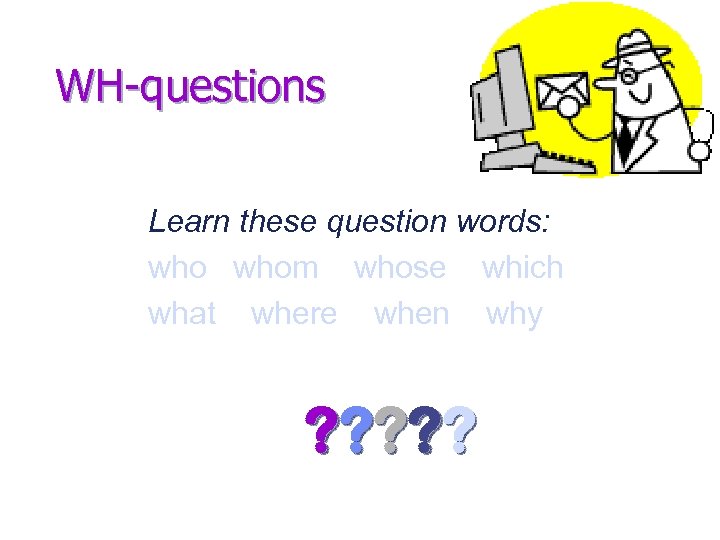 WH-questions Learn these question words: whom whose which what where when why ? ? ?
![WH-questions And these, too: how much how many how often [ ]באיזו תדירות how](https://present5.com/presentation/c9355f15d8f175a81c7e61a6c86178f6/image-66.jpg "WH-questions And these, too: how much how many how often [ ]באיזו תדירות how") WH-questions And these, too: how much how many how often [ ]באיזו תדירות how long (ago) [ ])לפני( כמה זמן how + כל תואר שהוא (how rich, how strong, how sick) ? ? ?
WH-questions And these, too: how much how many how often [ ]באיזו תדירות how long (ago) [ ])לפני( כמה זמן how + כל תואר שהוא (how rich, how strong, how sick) ? ? ?
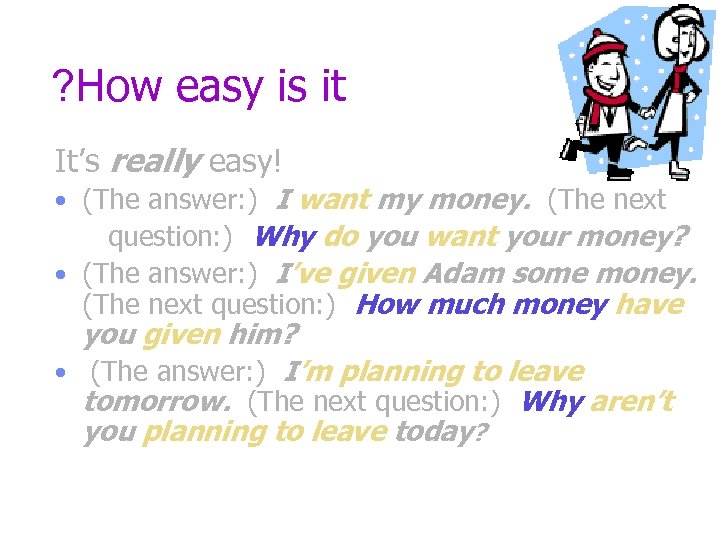 ? How easy is it It’s really easy! • (The answer: ) I want my money. (The next question: ) Why do you want your money? • (The answer: ) I’ve given Adam some money. (The next question: ) How much money have you given him? • (The answer: ) I’m planning to leave tomorrow. (The next question: ) Why aren’t you planning to leave today?
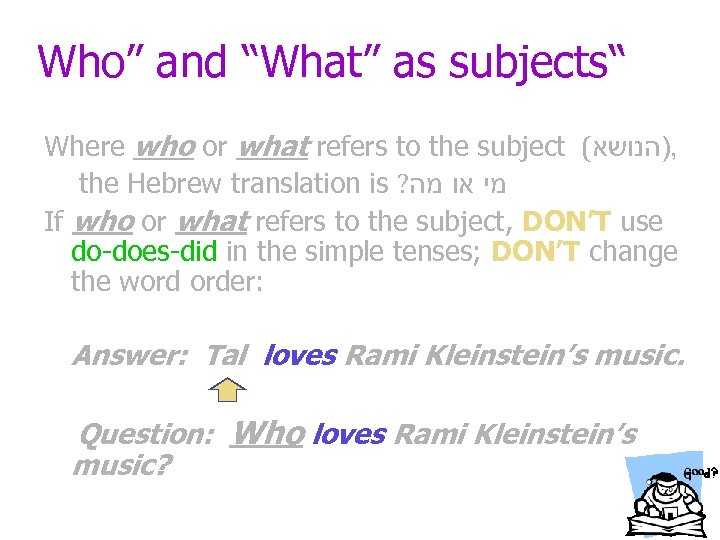 Who” and “What” as subjects“ Where who or what refers to the subject ( , )הנושא the Hebrew translation is ? מי או מה If who or what refers to the subject, DON’T use do-does-did in the simple tenses; DON’T change the word order: Answer: Tal loves Rami Kleinstein’s music. Question: Who loves Rami Kleinstein’s music?
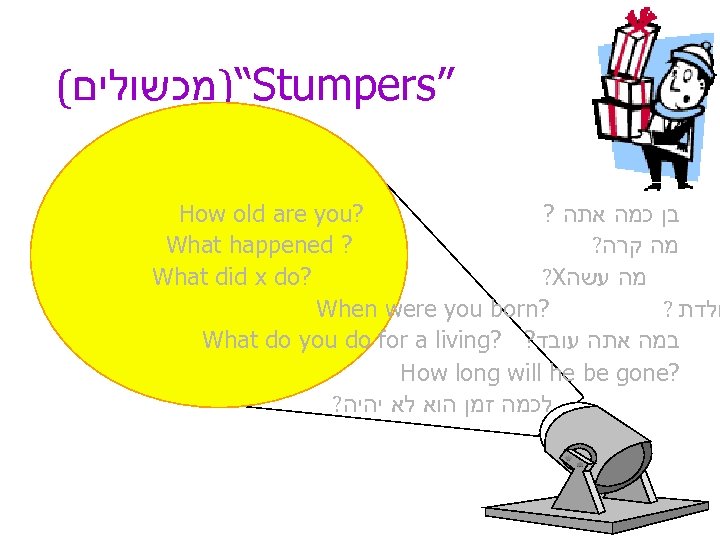 ( “)מכשולים Stumpers” How old are you? ? בן כמה אתה What happened ? ? מה קרה What did x do? ? X מה עשה When were you born? ? ולדת What do you do for a living? ? במה אתה עובד How long will he be gone? ? לכמה זמן הוא לא יהיה
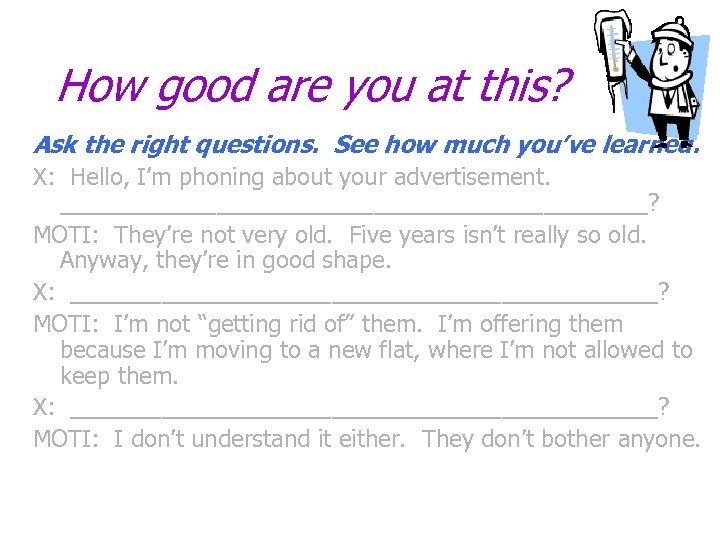 How good are you at this? Ask the right questions. See how much you’ve learned. X: Hello, I’m phoning about your advertisement. _______________________? MOTI: They’re not very old. Five years isn’t really so old. Anyway, they’re in good shape. X: _______________________? MOTI: I’m not “getting rid of” them. I’m offering them because I’m moving to a new flat, where I’m not allowed to keep them. X: _______________________? MOTI: I don’t understand it either. They don’t bother anyone.
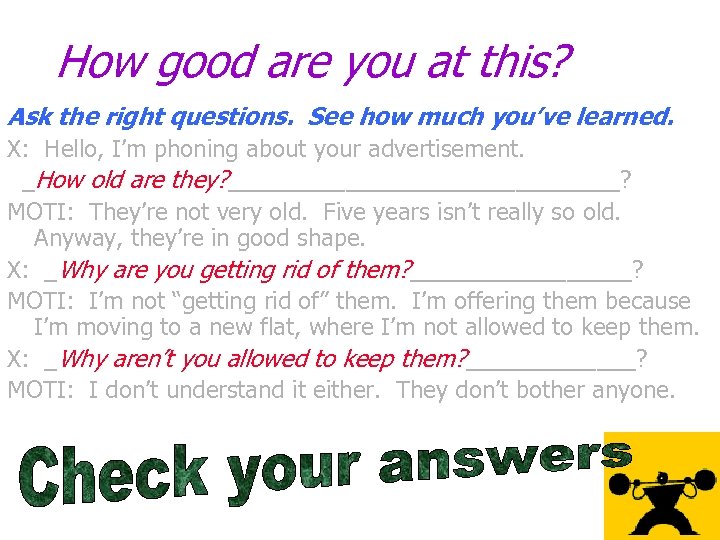 How good are you at this? Ask the right questions. See how much you’ve learned. X: Hello, I’m phoning about your advertisement. _How old are they? _______________? MOTI: They’re not very old. Five years isn’t really so old. Anyway, they’re in good shape. X: _Why are you getting rid of them? _________? MOTI: I’m not “getting rid of” them. I’m offering them because I’m moving to a new flat, where I’m not allowed to keep them. X: _Why aren’t you allowed to keep them? _______? MOTI: I don’t understand it either. They don’t bother anyone.
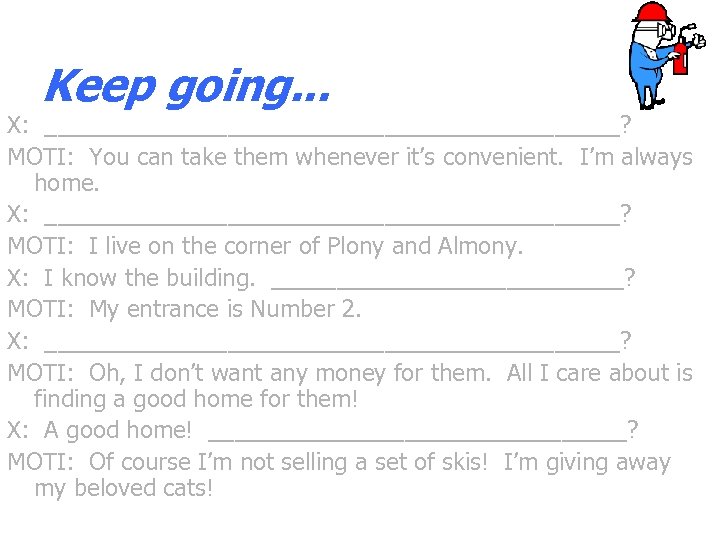 Keep going. . . X: ______________________? MOTI: You can take them whenever it’s convenient. I’m always home. X: ______________________? MOTI: I live on the corner of Plony and Almony. X: I know the building. ______________? MOTI: My entrance is Number 2. X: ______________________? MOTI: Oh, I don’t want any money for them. All I care about is finding a good home for them! X: A good home! ________________? MOTI: Of course I’m not selling a set of skis! I’m giving away my beloved cats!
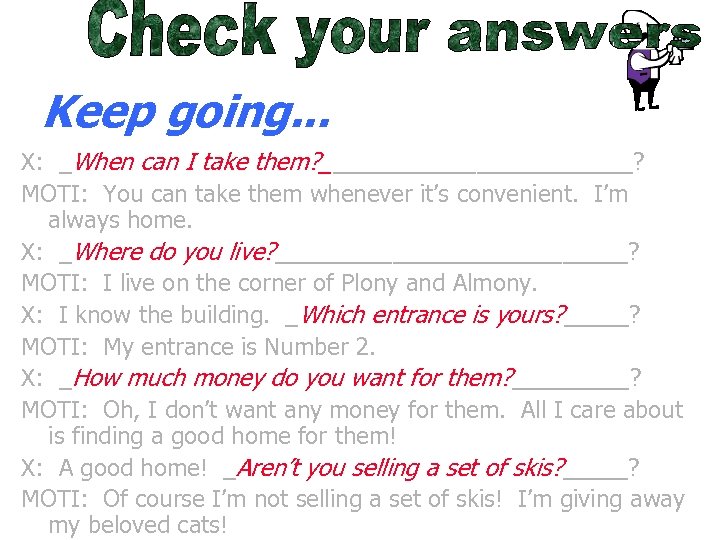 Keep going. . . X: _When can I take them? ____________? MOTI: You can take them whenever it’s convenient. I’m always home. X: _Where do you live? ______________? MOTI: I live on the corner of Plony and Almony. X: I know the building. _Which entrance is yours? _____? MOTI: My entrance is Number 2. X: _How much money do you want for them? _____? MOTI: Oh, I don’t want any money for them. All I care about is finding a good home for them! X: A good home! _Aren’t you selling a set of skis? _____? MOTI: Of course I’m not selling a set of skis! I’m giving away my beloved cats!
 CONGRATULATIONS! YOUR NAME has been awarded the M. V. (Master of Verbs)