 Скачать презентацию NASP 2010 Subrogation Litigation Skills Management Conference
5ecdad0895f138bfe1d9ec8ffbd9cf40.ppt
- Количество слайдов: 18



NASP 2010 Subrogation Litigation: Skills & Management Conference Session 6: Health Care Reform Adam V. Russo, Esq. The Phia Group, LLC 163 Bay State Dr. Braintree, MA 02184 (781) 535 -5622 arusso@phiagroup. com 1
2
§ House passed its version in 11/2009 § Senate its version on 12/24/2009 § Scott Brown cost democrats 60 vote filibuster in 1/2010 § House adopted Senate’s version but they needed to modify it § President Obama signed main bill on 3/23/2010 § House & Senate approved modifications on 3/25/2010 § President Obama signed those follow up modifications on 3/30/2010 § Starting 1/1/2014 – all citizens must have minimum essential coverage through themselves or employers 3
4
§ Elimination of lifetime and annual limits § No pre-existing condition exclusions § Extending dependent coverage until age 26 - regardless if they are married, in school or even live with primary participant(s) § On 7/1/12 plan members could leave groups to buy into “the exchange” § Employers could term plans & pay 8% of payroll per EE into exchange. § HHS to study self-insured plans - depict type of employers that selfinsure § See whether reforms encourage employers to self-insure § Explore extent self-insured groups innovative & less costly 5
§ Grandfathered plans – frozen plans that no changes have been made, if you make a change you lose grandfather status § New appeals procedure – if you are currently not subjected to ERISA claims procedure you will now be subject to it § Plans can not be reviewed in house, you must provide external review thus losing control § Effective 6 months after date of enactment § Primary care doctor – Plan must let enrollee pick any available doctor § Effective 6 months after date of enactment 6
§ Emergency services – have to cover services anywhere and treated as though in-network (i. e. if your vacationing in another state and have to go to the ER it will be covered) § Ob/Gyn – do not need prior authorization § Clinical trials – can not deny participation for patients participating for certain conditions (i. e. cancer) § Waiting periods – can not exceed 90 days § A major concern is that certain benefits like organ transplants where waiting periods are usually very lengthy – is this only the waiting period to be accepted into the program? ? § No rescission – can not take away coverage once enrolled unless for fraud/misrepresentation § Do you have fraud language in your plan document? 7
8
§ What is the outlook on repeal and replace? – Will Not Happen – takes 60 votes for it to go through as well as a veto – at least 4 years § Regulatory process will start within 3 months § Within next year other items will be given more clarity § In 2011 Medical Malpractice - Award 5 year grants to States to develop alternatives to current tort litigations § Simplify health insurance administration by adopting a single set of operating rules for eligibility verification and claims status § Electronic funds transfers effective January 1, 2014 § 4/1/14 - Health plans must document compliance with these standards or face a penalty of $1 per covered life § 2014 - Require U. S. citizens and legal residents to have qualifying health coverage 9
10
§ Biased against self insured and ERISA plans – intended to find fault – have an opportunity to show the benefits § Will result in skyrocketing costs & physicians leaving the field in droves § Young and healthy will want to pay insurance that reflects that status? SORRY! § You want cheaper policy that doesn’t cover preventive care? SORRY! § You are an employer and don’t want coverage for your employees’ children until age 26? SORRY (Section 2714)! § You’re a woman who can’t have children? SORRY (Section 1302 covers maternity)! § You’d like to offer policies with deductibles higher than $2, 000 for individuals and $4, 000 for families? SORRY (Section 1302 (c) (2) (A)! § You’re an employer offering flex spending accounts and your employees want to deduct more than $2, 500 from salaries for it? SORRY (Section 9005 (i))! 11
12
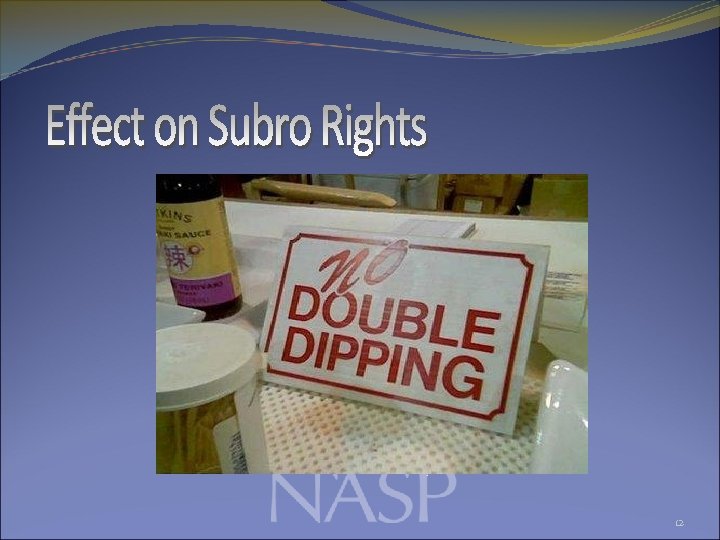
§ Unknown variables regarding ERISA plans and subro rights § ERISA sets minimum standards for health plans in private industry to provide protection for individuals in these plans § Employer plans governed by ERISA, allowing for “appropriate equitable relief” (29 USC 1132(a)(3)) § HHS conducting study to evaluate financial solvency and ability by self funded companies to provide consistent benefits during economic downturns § May mean a change in the classification from self–funded to insured plans under State insurance laws § In 2011, plans required to provide SPD and coverage info in plain language with common sense examples in uniformat § Clearer understanding of subro rights 13
§ Exchanges – State insurance commissioner reviews plans & approves § Exchange is an unknown – each State will set up a mechanism in which they can set up a plan to purchase – pick insurance companies to use § Employers have to pay or play – must offer min coverage for employees working 30 hrs a wk or pay a $2, 000 fine § Independent contractors, part timers & seasonal employees will not be included § New taxes of plans employers and TPAs § Reinsurance fee – will be imposed on TPAs and insurers at an extra cost 14
§ ERISA is kept intact § Secretary will develop a standard summary plan for everyone to follow § 4 pages in 12 point font which includes a wide variety of details – challenging to do – need to look out format (currently not available) § Must be given within 24 months of date of enactment 15
§ Fees accessed on self funded plans – for each plan on 9/23/2013 - $2. 00 per covered lives the employer will have to pay per year § 2014 -2019 – fee from previous year and multiply that by % § 2 studies on self insurance – taken from form 5500 – report on that data – sent to senate finance committee to see if any fixes are needed § Large group market – fully insured – compare characteristics of both – determine the extent § Is it less costly because it’s more efficient? 16
§ 2013 - Create the Consumer Operated and Oriented Plan (CO-OP) program to foster the creation of non-profit, member-run insurance companies in all States § Co-ops – not a lot of details – for the most part we are going to wait, encouraged across State lines, have similar characteristics 17
§ Small business tax credits – Provide small employers with no more than 25 EEs and annual wages of less than $50, 000 that purchase health insurance for employees with a tax credit § Phase I: For tax years 2010 through 2013, provide a tax credit of up to 35% of the employer’s contribution § Full credit will be available to employers with 10 or fewer EEs and average wages of less than $25, 000 § The credit phases-out as firm size and average wage increases 18
Скачать презентацию NASP 2010 Subrogation Litigation Skills Management Conference
5ecdad0895f138bfe1d9ec8ffbd9cf40.ppt