


 Скачать презентацию Nasopharyngeal Carcinoma Rusty Stevens MD Christopher Rassekh MD
Nasophar-CA-980121.ppt
- Количество слайдов: 25
 Nasopharyngeal Carcinoma Rusty Stevens, MD Christopher Rassekh, MD
 Introduction l l l Rare in the US, more common in Asia High index of suspicion required for early diagnosis Nasopharyngeal malignancies – SCCA (nasopharyngeal carcinoma) – Lymphoma – Salivary gland tumors – Sarcomas
 Anatomy l l Anteriorly -- nasal cavity Posteriorly -- skull base and vertebral bodies Inferiorly -- oropharynx and soft palate Laterally -– Eustachian tubes and tori – Fossa of Rosenmuller - most common location
 Anatomy l l Close association with skull base foramen Mucosa – Epithelium - tissue of origin of NPC • Stratified squamous epithelium • Pseudostratified columnar epithelium – Salivary, Lymphoid structures
 Epidemiology l Chinese native > Chinese immigrant > North American native – Both genetic and environmental factors l Genetic – HLA histocompatibility loci possible markers
 Epidemiology l Environmental – Viruses • EBV- well documented viral “fingerprints” in tumor cells and also anti-EBV serologies with WHO type II and III NPC • HPV - possible factor in WHO type I lesions – Nitrosamines - salted fish – Others - polycyclic hydrocarbons, chronic nasal infection, poor hygiene, poor ventilation
 Classification l WHO classes – Based on light microscopy findings – All SCCA by EM l Type I - “SCCA” – 25 % of NPC – moderate to well differentiated cells similar to other SCCA ( keratin, intercellular bridges)
 Classification l Type II - “non-keratinizing” carcinoma – 12 % of NPC – variable differentiation of cells ( mature to anaplastic) – minimal if any keratin production – may resemble transitional cell carcinoma of the bladder
 Classification l Type III - “undifferentiated” carcinoma – 60 % of NPC, majority of NPC in young patients – Difficult to differentiate from lymphoma by light microscopy requiring special stains & markers – Diverse group • Lymphoepitheliomas, spindle cell, clear cell and anaplastic variants
 Classification l Differences between type I and types II & III – 5 year survival • Type I - 10% Types II, III - 50% – Long-term risk of recurrence for types II & III – Viral associations • Type I - HPV • Types II, III - EBV
 Clinical Presentation l Often subtle initial symptoms – unilateral HL (SOM) – painless, slowly enlarging neck mass l Larger lesions – nasal obstruction – epistaxis – cranial nerve involvement
 Clinical Presentation l l Xerophthalmia - greater sup. petrosal n Facial pain - Trigeminal n. Diplopia - CN VI Ophthalmoplegia - CN III, IV, and VI – cavernous sinus or superior orbital fissure l l Horner’s syndrome - cervical sympathetics CN’s IX, X, XII - extensive skull base
 Clinical Presentation l Nasopharyngeal examination – Fossa of Rosenmuller most common location – Variable appearance - exophytic, submucosal – NP may appear normal l Regional spread – Usually ipsilateral first but bilateral not uncommon l Distant spread - rare (<3%), lungs, liver, bones
 Radiological evaluation l Contrast CT with bone and soft tissue windows – imaging tool of choice for NPC l MRI – soft tissue involvement, recurrences l l CXR Chest CT, bone scans
 Laboratory evaluation l Special diagnostic tests (for types II & III) – Ig. A antibodies for viral capsid antigen (VCA) – Ig. G antibodies for early antigen (EA) l Special prognostic test (for types II & III) – antibody-dependent cellular cytotoxicity (ADCC) assay • higher titers indicate a better long-term prognosis l CBC, chemistry profile, LFT’s
 Staging l Variety of systems used – Am Jt Comm for Ca Staging – International Union Against Ca – Ho System l Unique NPC prognostic factors often not considered and similar prognosis between stages
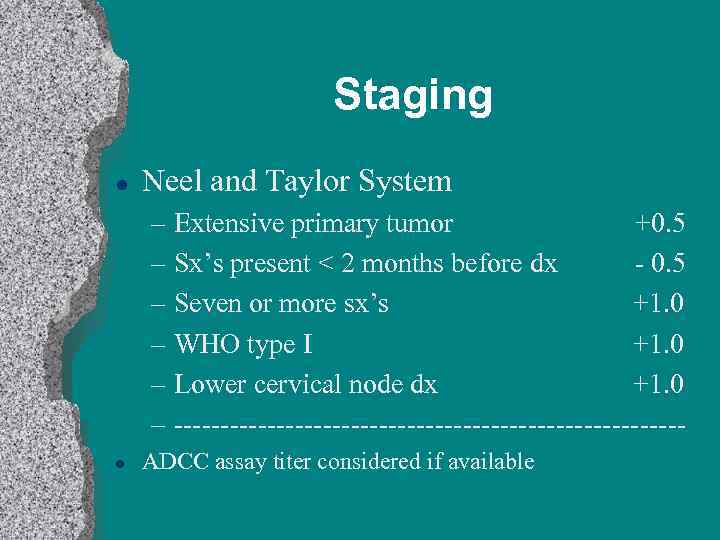 Staging l Neel and Taylor System – Extensive primary tumor +0. 5 – Sx’s present < 2 months before dx - 0. 5 – Seven or more sx’s +1. 0 – WHO type I +1. 0 – Lower cervical node dx +1. 0 – ---------------------------- l ADCC assay titer considered if available
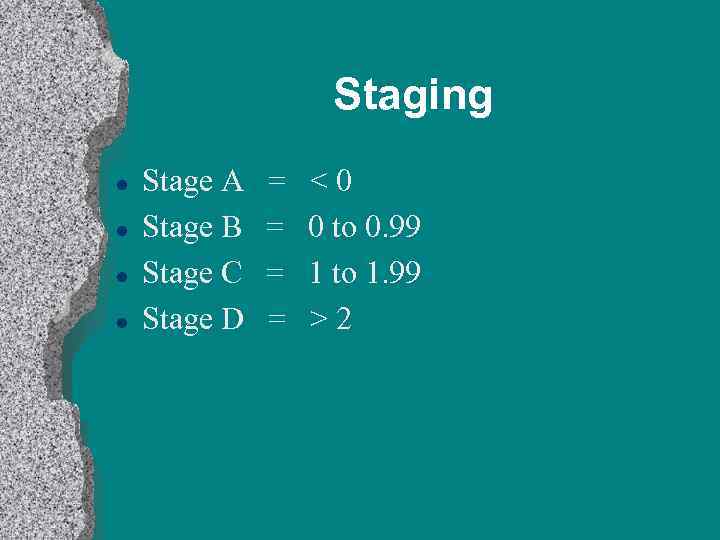 Staging l l Stage A Stage B Stage C Stage D = = <0 0 to 0. 99 1 to 1. 99 >2
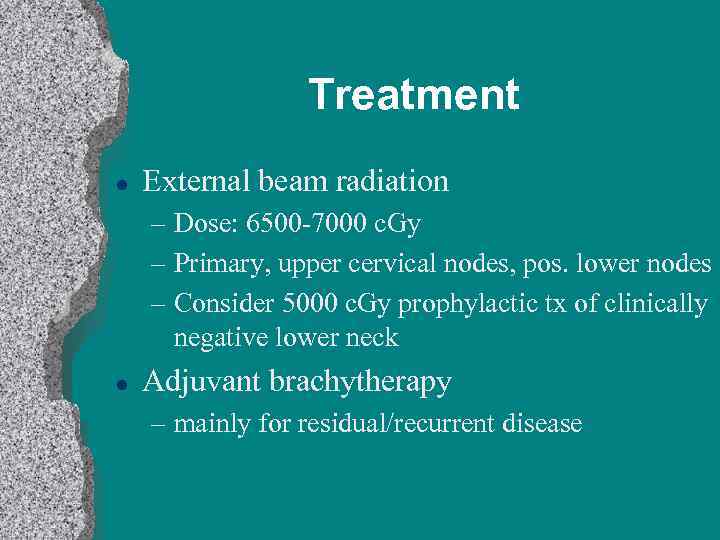 Treatment l External beam radiation – Dose: 6500 -7000 c. Gy – Primary, upper cervical nodes, pos. lower nodes – Consider 5000 c. Gy prophylactic tx of clinically negative lower neck l Adjuvant brachytherapy – mainly for residual/recurrent disease
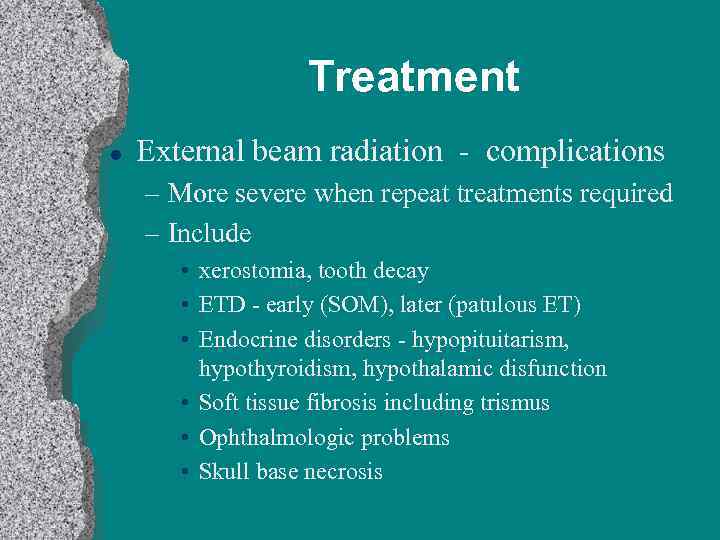 Treatment l External beam radiation - complications – More severe when repeat treatments required – Include • xerostomia, tooth decay • ETD - early (SOM), later (patulous ET) • Endocrine disorders - hypopituitarism, hypothyroidism, hypothalamic disfunction • Soft tissue fibrosis including trismus • Ophthalmologic problems • Skull base necrosis
 Treatment Surgical management l Mainly diagnostic - Biopsy – consider clinic bx if cooperative patient – must obtain large biopsy – clinically normal NP - OR for panendo and bx l Surgical treatment – primary lesion – regional failure with local control – ETD
 Treatment Surgical management l Primary lesion – consider for residual or recurrent disease – approaches • • • infratemporal fossa transparotid temporal bone approach transmaxillary transmandibular transpalatal
 Treatment Surgical management l Regional disease – Neck dissection may offer improved survival compared to repeat radiation of the neck l ETD – BMT if symptomatic prior to XRT – Post XRT • observation period if symptoms not severe • amplification may be more appropriate
 Treatment l Chemotherapy – Variety of agents – Chemotherapy + XRT - no proven long term benefit – Mainly for palliation of distant disease l Immunotherapy – Future treatment? ? – Vaccine? ?
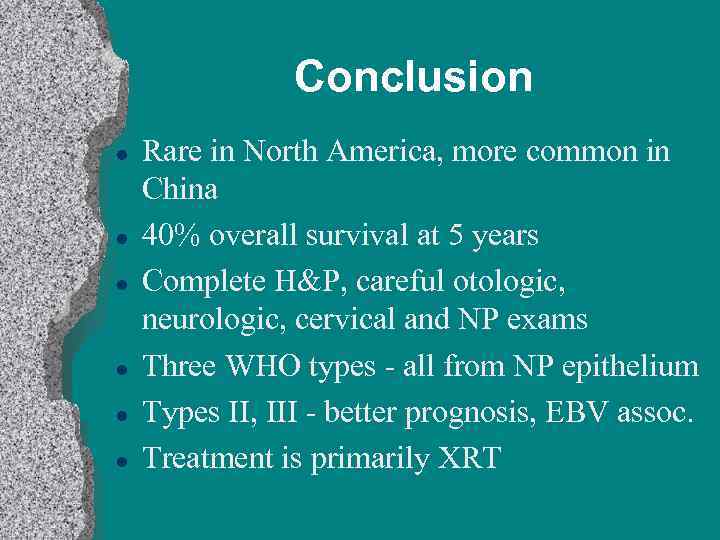 Conclusion l l l Rare in North America, more common in China 40% overall survival at 5 years Complete H&P, careful otologic, neurologic, cervical and NP exams Three WHO types - all from NP epithelium Types II, III - better prognosis, EBV assoc. Treatment is primarily XRT