


 Скачать презентацию NASDSE Satellite Conference Series May 9 2007 Response
7c4b157a8b093abae81184f441355918.ppt
- Количество слайдов: 100
 NASDSE Satellite Conference Series May 9, 2007 Response to Intervention (Rt. I) Non-Academic Barriers to Achievement-Addressing School-based Mental Health and Positive Behavior Interventions and Supports Lucille Eber Ed. D IL PBIS Network lewrapil@aol. com www. pbisillinois. org
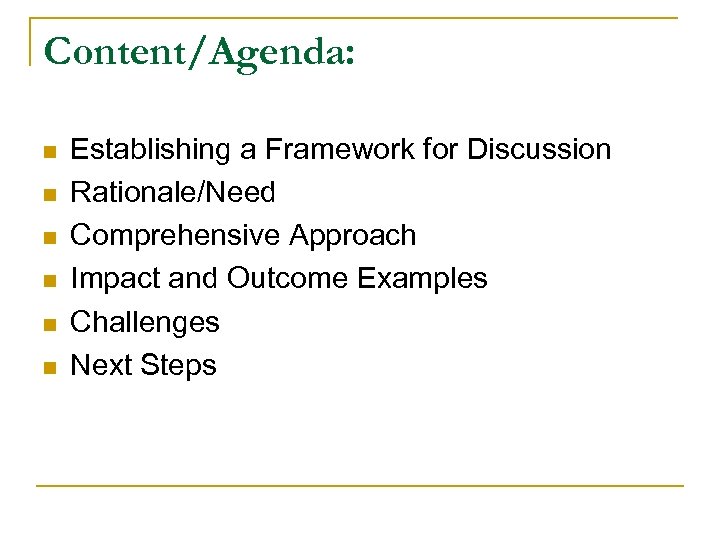 Content/Agenda: n n n Establishing a Framework for Discussion Rationale/Need Comprehensive Approach Impact and Outcome Examples Challenges Next Steps
 A Framework for Discussion….
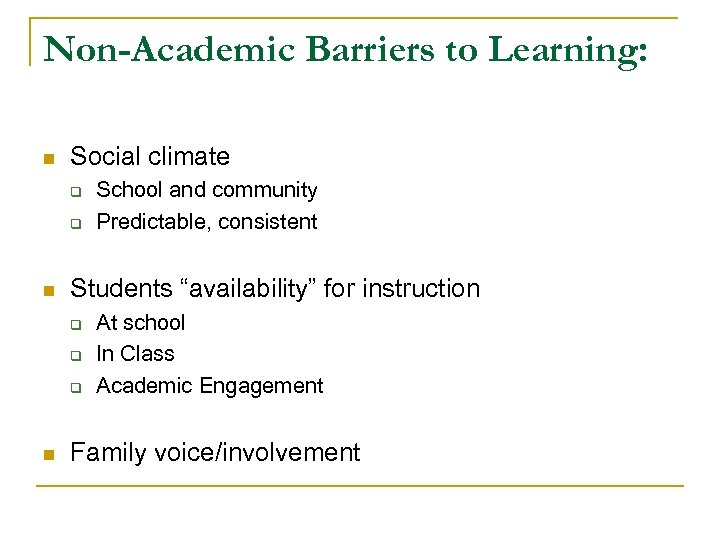 Non-Academic Barriers to Learning: n Social climate q q n Students “availability” for instruction q q q n School and community Predictable, consistent At school In Class Academic Engagement Family voice/involvement
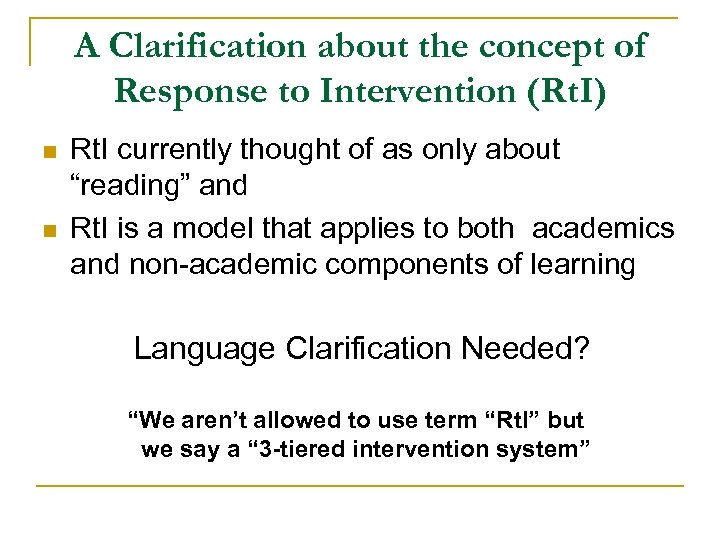 A Clarification about the concept of Response to Intervention (Rt. I) n n Rt. I currently thought of as only about “reading” and Rt. I is a model that applies to both academics and non-academic components of learning Language Clarification Needed? “We aren’t allowed to use term “Rt. I” but we say a “ 3 -tiered intervention system”
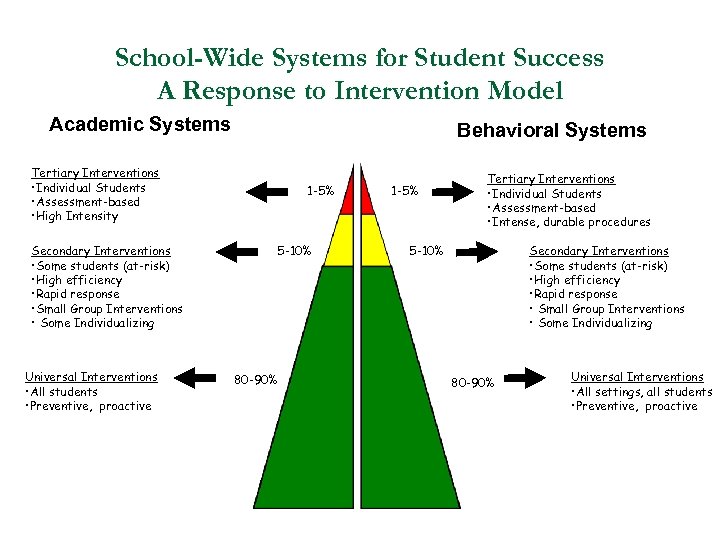 School-Wide Systems for Student Success A Response to Intervention Model Academic Systems Behavioral Systems Tertiary Interventions • Individual Students • Assessment-based • High Intensity Secondary Interventions • Some students (at-risk) • High efficiency • Rapid response • Small Group Interventions • Some Individualizing Universal Interventions • All students • Preventive, proactive 1 -5% 5 -10% 80 -90% 1 -5% Tertiary Interventions • Individual Students • Assessment-based • Intense, durable procedures 5 -10% Secondary Interventions • Some students (at-risk) • High efficiency • Rapid response • Small Group Interventions • Some Individualizing 80 -90% Universal Interventions • All settings, all students • Preventive, proactive
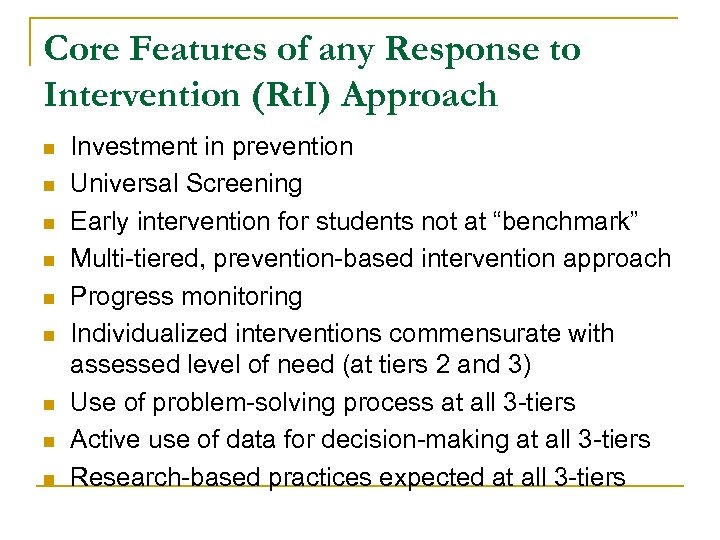 Core Features of any Response to Intervention (Rt. I) Approach n n n n n Investment in prevention Universal Screening Early intervention for students not at “benchmark” Multi-tiered, prevention-based intervention approach Progress monitoring Individualized interventions commensurate with assessed level of need (at tiers 2 and 3) Use of problem-solving process at all 3 -tiers Active use of data for decision-making at all 3 -tiers Research-based practices expected at all 3 -tiers
 Rationale/Need….
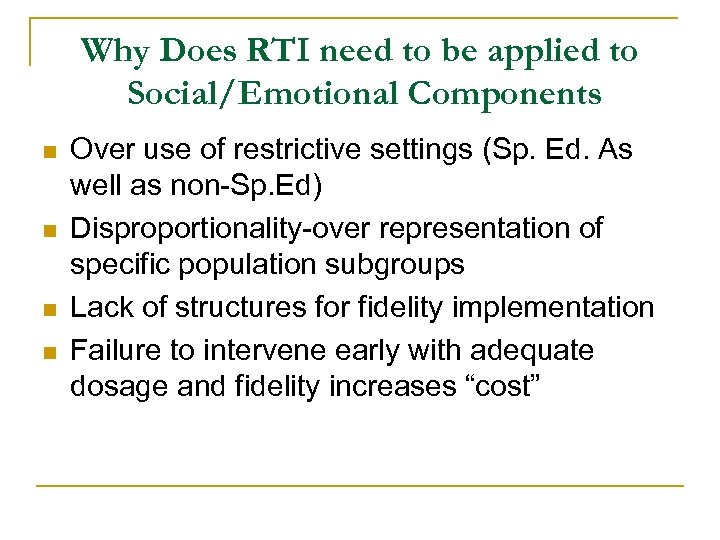 Why Does RTI need to be applied to Social/Emotional Components n n Over use of restrictive settings (Sp. Ed. As well as non-Sp. Ed) Disproportionality-over representation of specific population subgroups Lack of structures for fidelity implementation Failure to intervene early with adequate dosage and fidelity increases “cost”
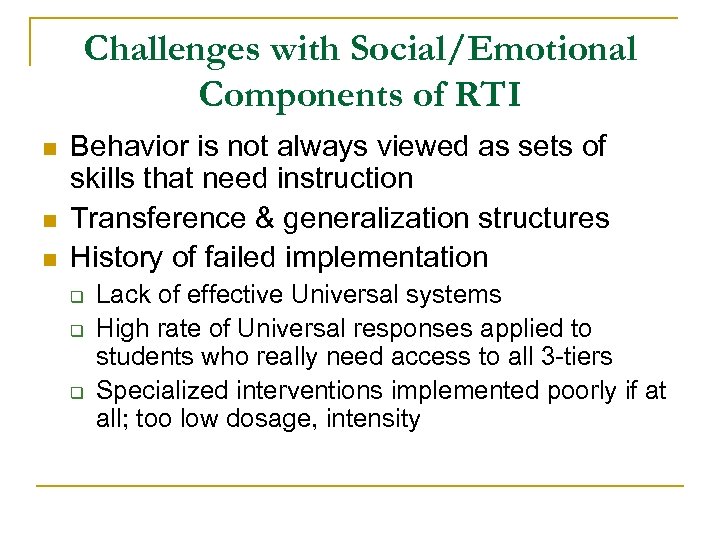 Challenges with Social/Emotional Components of RTI n n n Behavior is not always viewed as sets of skills that need instruction Transference & generalization structures History of failed implementation q q q Lack of effective Universal systems High rate of Universal responses applied to students who really need access to all 3 -tiers Specialized interventions implemented poorly if at all; too low dosage, intensity
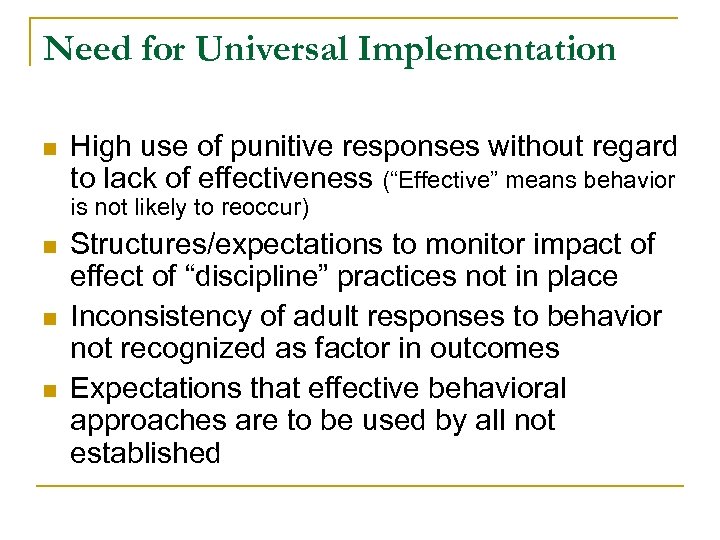 Need for Universal Implementation n High use of punitive responses without regard to lack of effectiveness (“Effective” means behavior is not likely to reoccur) n n n Structures/expectations to monitor impact of effect of “discipline” practices not in place Inconsistency of adult responses to behavior not recognized as factor in outcomes Expectations that effective behavioral approaches are to be used by all not established
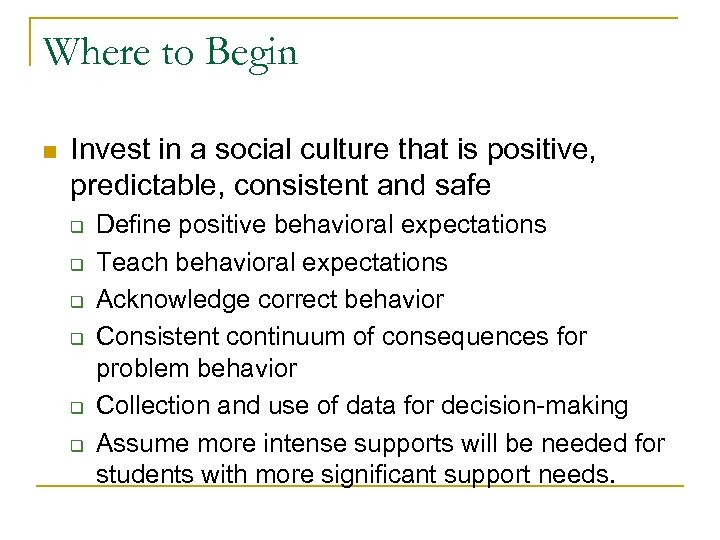 Where to Begin n Invest in a social culture that is positive, predictable, consistent and safe q q q Define positive behavioral expectations Teach behavioral expectations Acknowledge correct behavior Consistent continuum of consequences for problem behavior Collection and use of data for decision-making Assume more intense supports will be needed for students with more significant support needs.
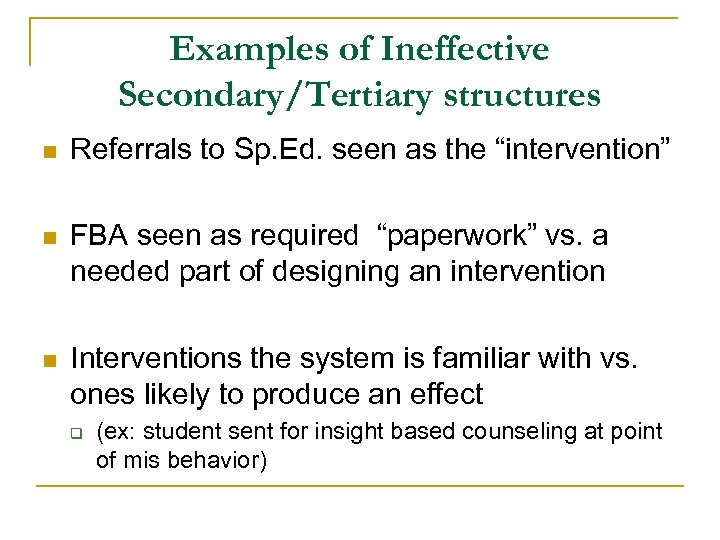 Examples of Ineffective Secondary/Tertiary structures n Referrals to Sp. Ed. seen as the “intervention” n FBA seen as required “paperwork” vs. a needed part of designing an intervention n Interventions the system is familiar with vs. ones likely to produce an effect q (ex: student sent for insight based counseling at point of mis behavior)
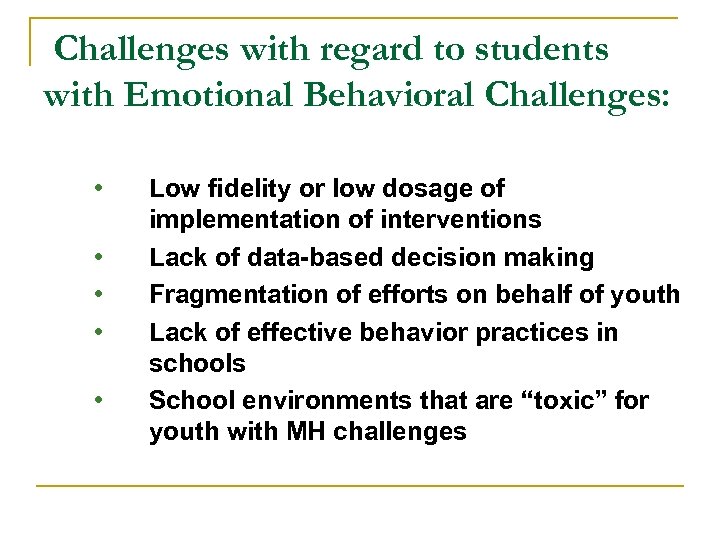 Challenges with regard to students with Emotional Behavioral Challenges: • • • Low fidelity or low dosage of implementation of interventions Lack of data-based decision making Fragmentation of efforts on behalf of youth Lack of effective behavior practices in schools School environments that are “toxic” for youth with MH challenges
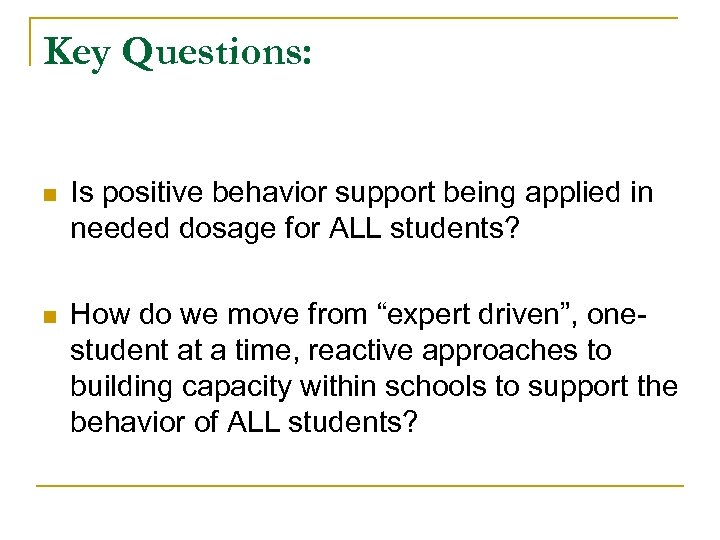 Key Questions: n Is positive behavior support being applied in needed dosage for ALL students? n How do we move from “expert driven”, onestudent at a time, reactive approaches to building capacity within schools to support the behavior of ALL students?
 Comprehensive Approach…
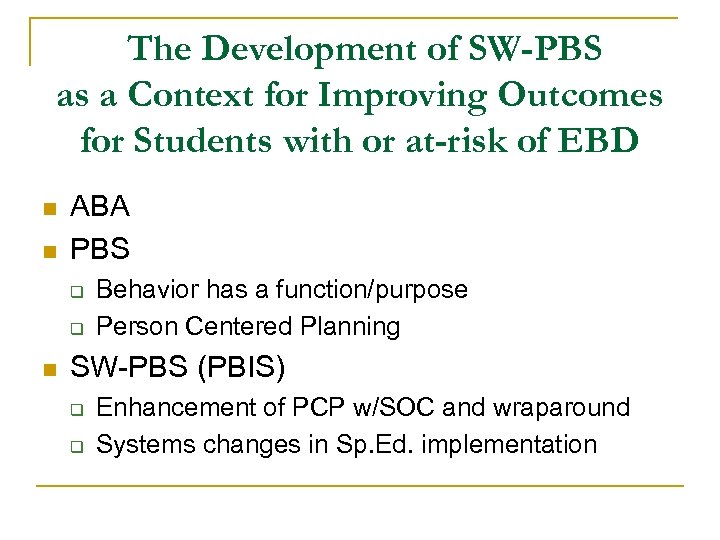 The Development of SW-PBS as a Context for Improving Outcomes for Students with or at-risk of EBD n n ABA PBS q q n Behavior has a function/purpose Person Centered Planning SW-PBS (PBIS) q q Enhancement of PCP w/SOC and wraparound Systems changes in Sp. Ed. implementation
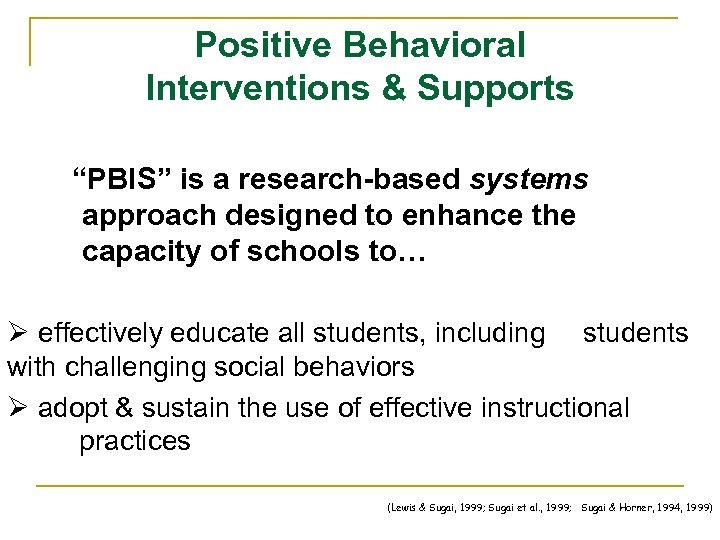 Positive Behavioral Interventions & Supports “PBIS” is a research-based systems approach designed to enhance the capacity of schools to… Ø effectively educate all students, including students with challenging social behaviors Ø adopt & sustain the use of effective instructional practices (Lewis & Sugai, 1999; Sugai et al. , 1999; Sugai & Horner, 1994, 1999)
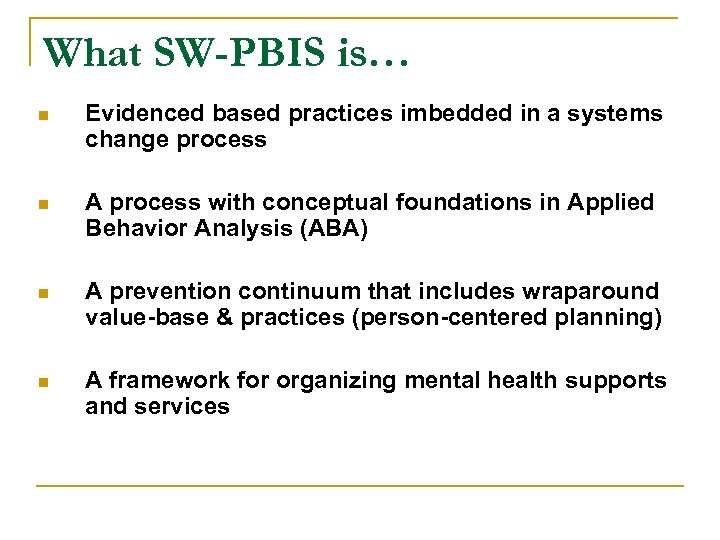 What SW-PBIS is… n Evidenced based practices imbedded in a systems change process n A process with conceptual foundations in Applied Behavior Analysis (ABA) n A prevention continuum that includes wraparound value-base & practices (person-centered planning) n A framework for organizing mental health supports and services
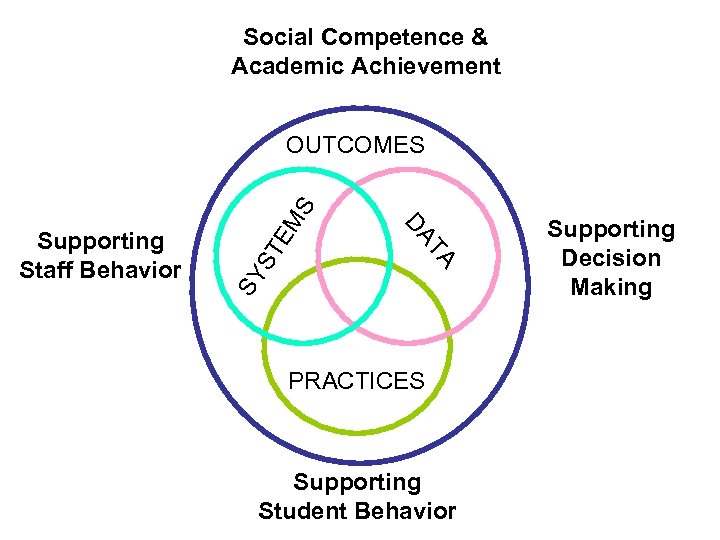 Social Competence & Academic Achievement ST SY TA DA Supporting Staff Behavior EM S OUTCOMES PRACTICES Supporting Student Behavior Supporting Decision Making
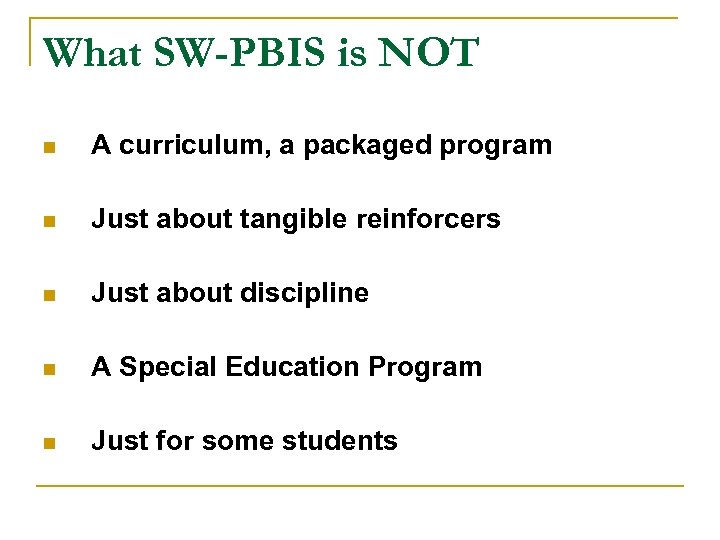 What SW-PBIS is NOT n A curriculum, a packaged program n Just about tangible reinforcers n Just about discipline n A Special Education Program n Just for some students
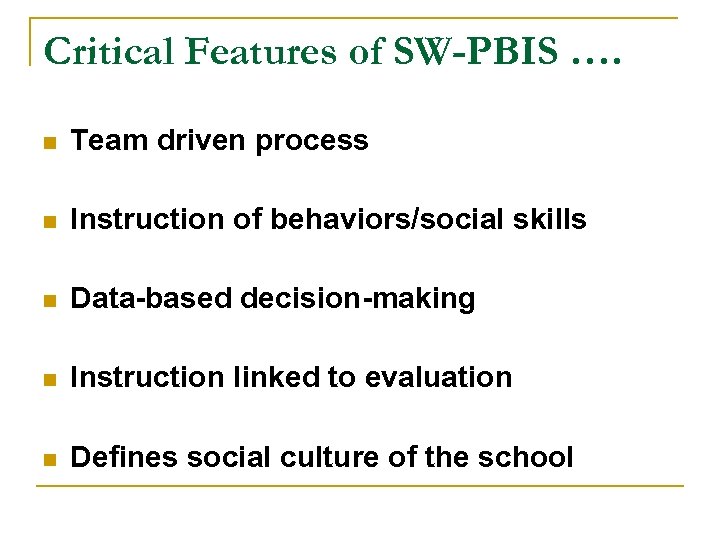 Critical Features of SW-PBIS …. n Team driven process n Instruction of behaviors/social skills n Data-based decision-making n Instruction linked to evaluation n Defines social culture of the school
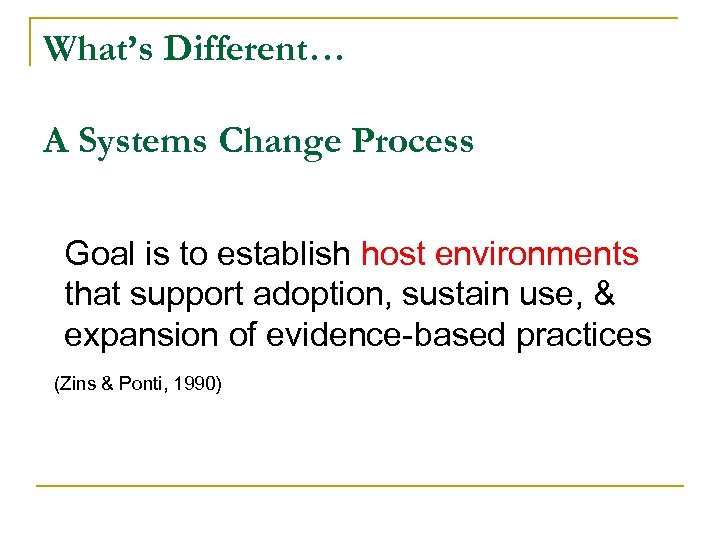 What’s Different… A Systems Change Process Goal is to establish host environments that support adoption, sustain use, & expansion of evidence-based practices (Zins & Ponti, 1990)
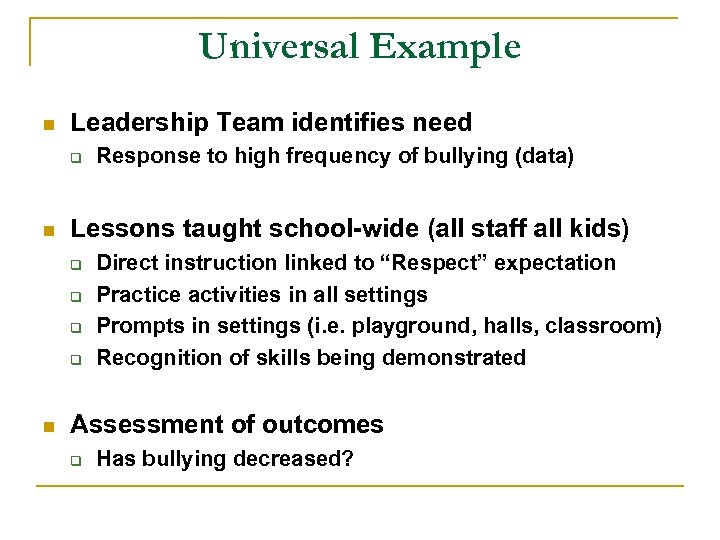 Universal Example n Leadership Team identifies need q n Lessons taught school-wide (all staff all kids) q q n Response to high frequency of bullying (data) Direct instruction linked to “Respect” expectation Practice activities in all settings Prompts in settings (i. e. playground, halls, classroom) Recognition of skills being demonstrated Assessment of outcomes q Has bullying decreased?
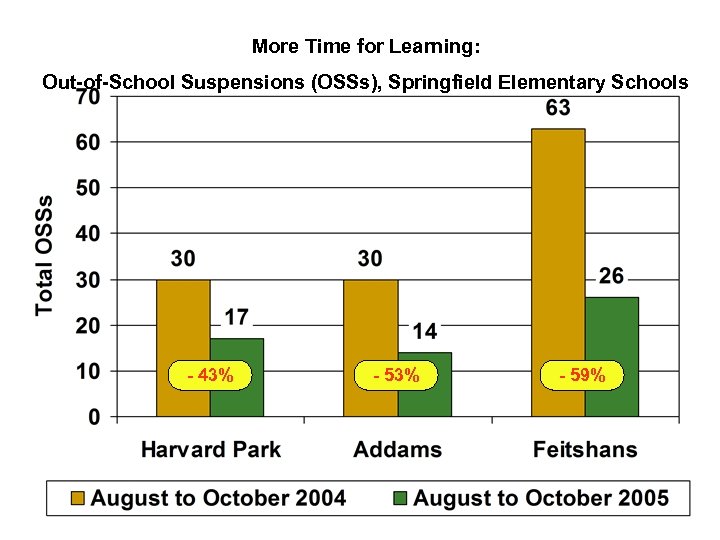 More Time for Learning: Out-of-School Suspensions (OSSs), Springfield Elementary Schools - 43% - 59%
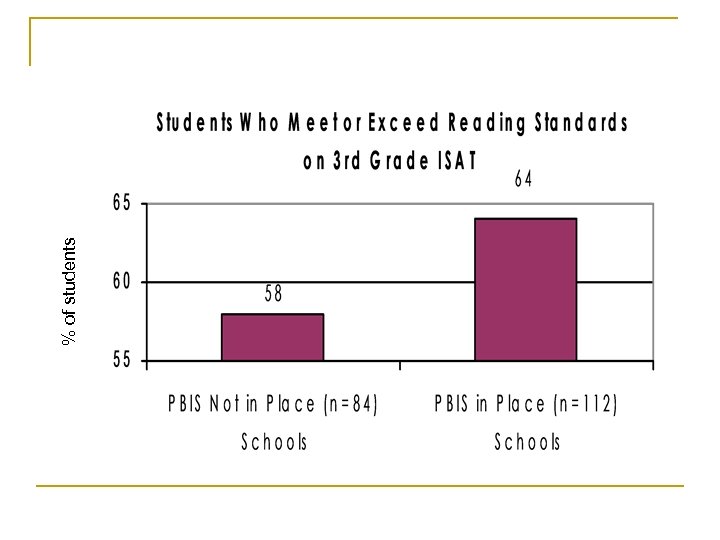 % of students
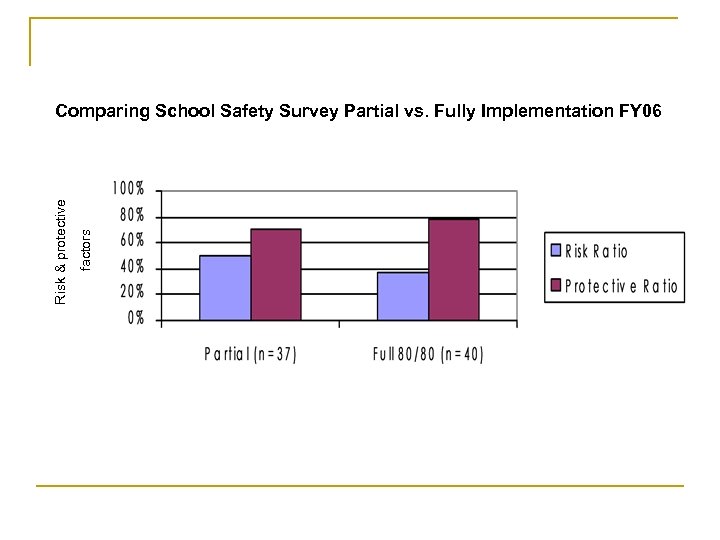 factors Risk & protective Comparing School Safety Survey Partial vs. Fully Implementation FY 06
 Does School-wide PBIS increase School’s abilities to effectively educate students with more complex needs?
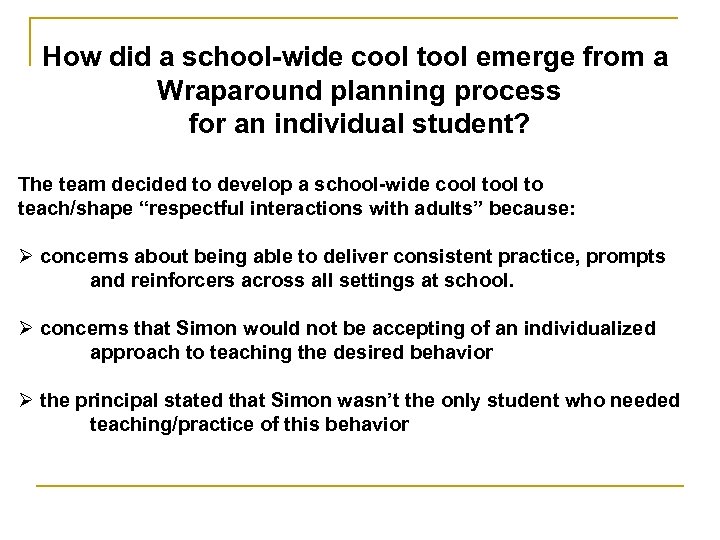 How did a school-wide cool tool emerge from a Wraparound planning process for an individual student? The team decided to develop a school-wide cool to teach/shape “respectful interactions with adults” because: Ø concerns about being able to deliver consistent practice, prompts and reinforcers across all settings at school. Ø concerns that Simon would not be accepting of an individualized approach to teaching the desired behavior Ø the principal stated that Simon wasn’t the only student who needed teaching/practice of this behavior
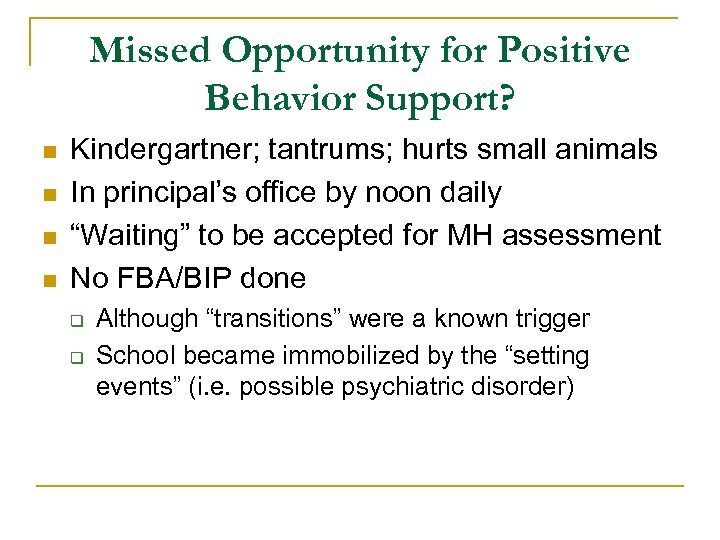 Missed Opportunity for Positive Behavior Support? n n Kindergartner; tantrums; hurts small animals In principal’s office by noon daily “Waiting” to be accepted for MH assessment No FBA/BIP done q q Although “transitions” were a known trigger School became immobilized by the “setting events” (i. e. possible psychiatric disorder)
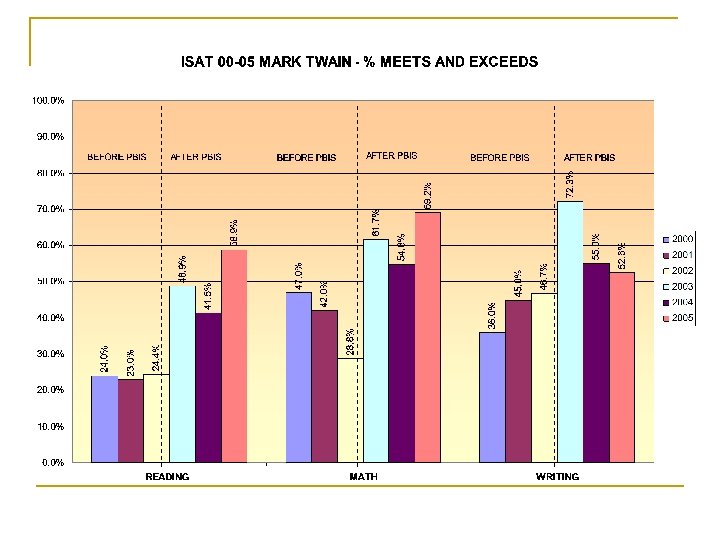
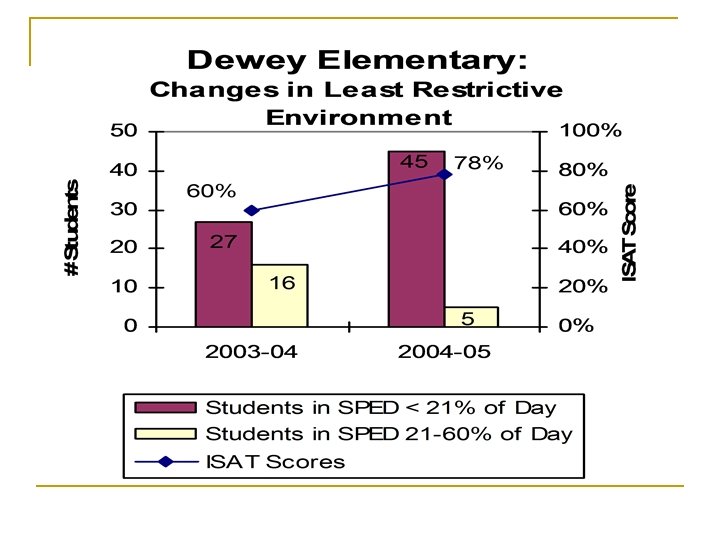
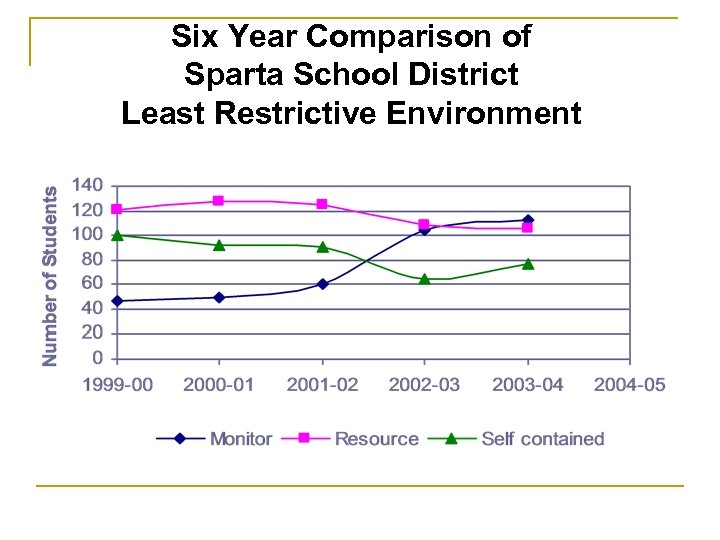 Six Year Comparison of Sparta School District Least Restrictive Environment
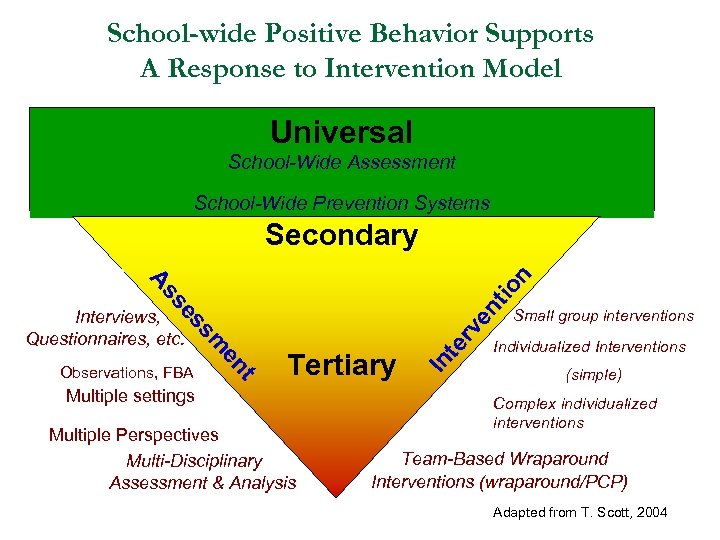 School-wide Positive Behavior Supports A Response to Intervention Model Universal School-Wide Assessment School-Wide Prevention Systems Secondary Group Small group interventions t Multiple settings Multiple Perspectives Multi-Disciplinary Assessment & Analysis te Tertiary In en m Observations, FBA rv ss en se Interviews, Questionnaires, etc. Interventions tio n As Analyze Student Data Individualized Interventions (simple) Complex individualized interventions Team-Based Wraparound Interventions (wraparound/PCP) Adapted from T. Scott, 2004
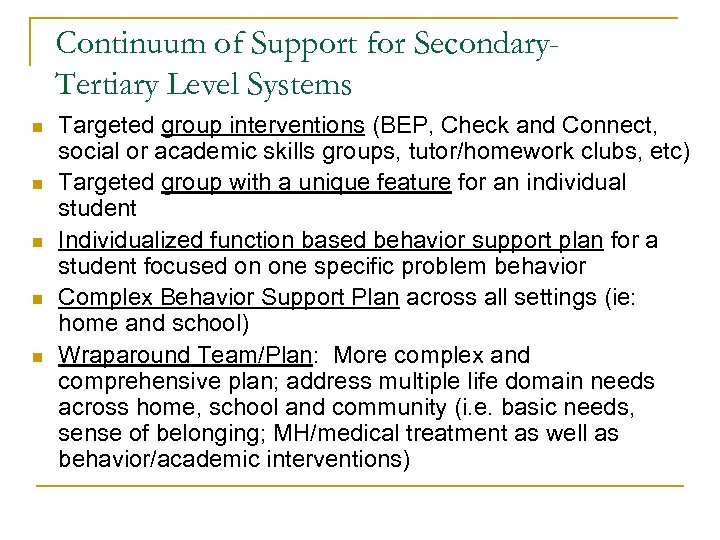 Continuum of Support for Secondary. Tertiary Level Systems n n n Targeted group interventions (BEP, Check and Connect, social or academic skills groups, tutor/homework clubs, etc) Targeted group with a unique feature for an individual student Individualized function based behavior support plan for a student focused on one specific problem behavior Complex Behavior Support Plan across all settings (ie: home and school) Wraparound Team/Plan: More complex and comprehensive plan; address multiple life domain needs across home, school and community (i. e. basic needs, sense of belonging; MH/medical treatment as well as behavior/academic interventions)
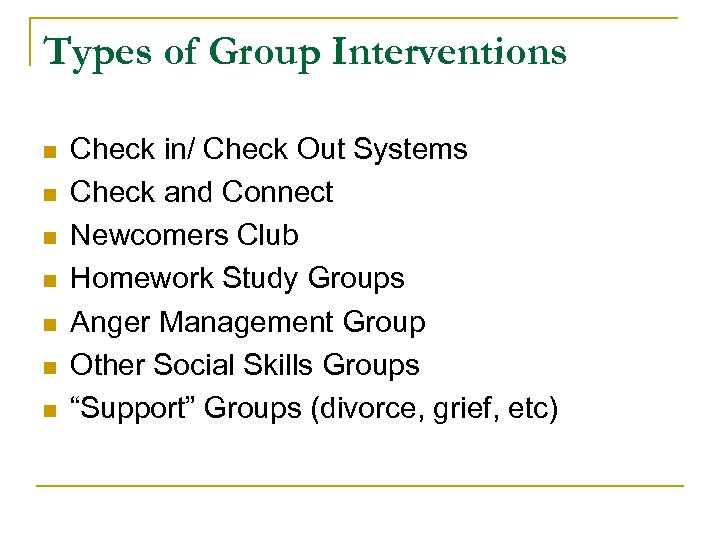 Types of Group Interventions n n n n Check in/ Check Out Systems Check and Connect Newcomers Club Homework Study Groups Anger Management Group Other Social Skills Groups “Support” Groups (divorce, grief, etc)
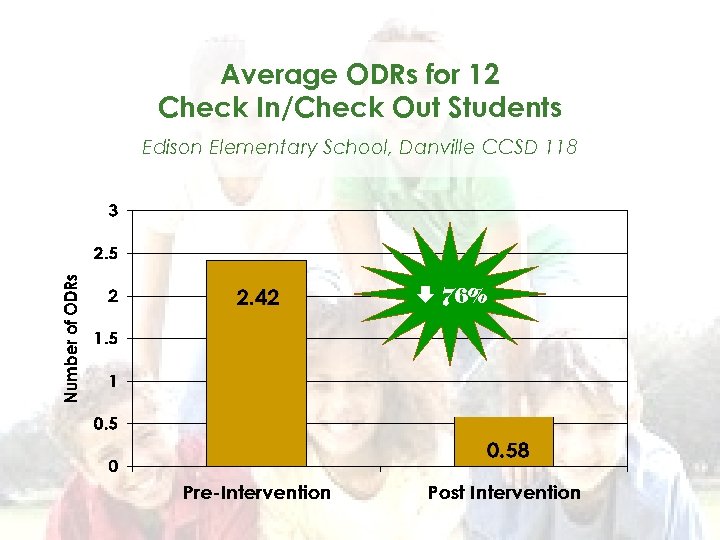 Average ODRs for 12 Check In/Check Out Students Edison Elementary School, Danville CCSD 118 76%
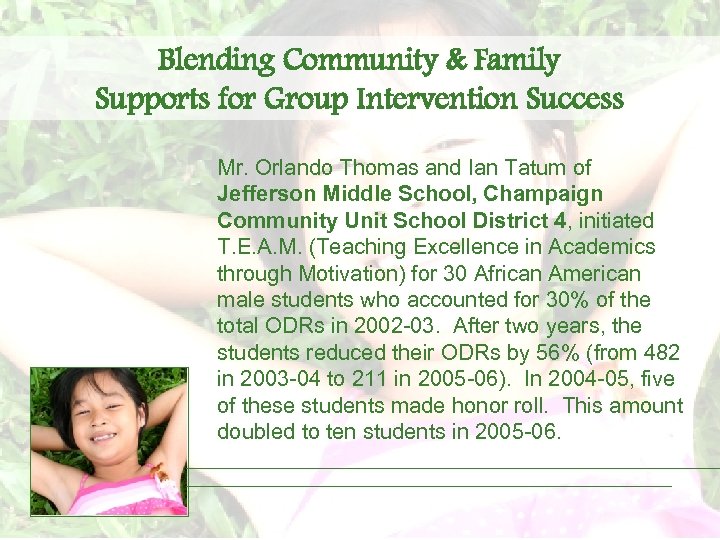 Blending Community & Family Supports for Group Intervention Success Mr. Orlando Thomas and Ian Tatum of Jefferson Middle School, Champaign Community Unit School District 4, initiated T. E. A. M. (Teaching Excellence in Academics through Motivation) for 30 African American male students who accounted for 30% of the total ODRs in 2002 -03. After two years, the students reduced their ODRs by 56% (from 482 in 2003 -04 to 211 in 2005 -06). In 2004 -05, five of these students made honor roll. This amount doubled to ten students in 2005 -06.
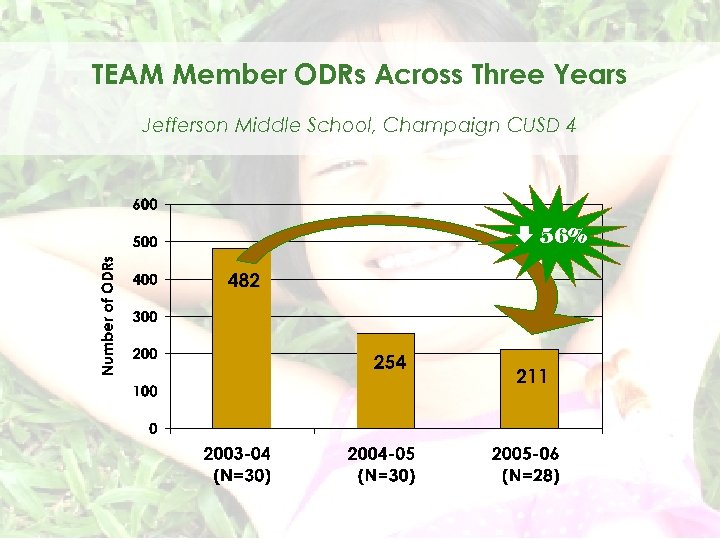 TEAM Member ODRs Across Three Years Jefferson Middle School, Champaign CUSD 4 56%
 Does School-wide PBIS increase school’s capacity to “catch” and respond to MH needs of students sooner?
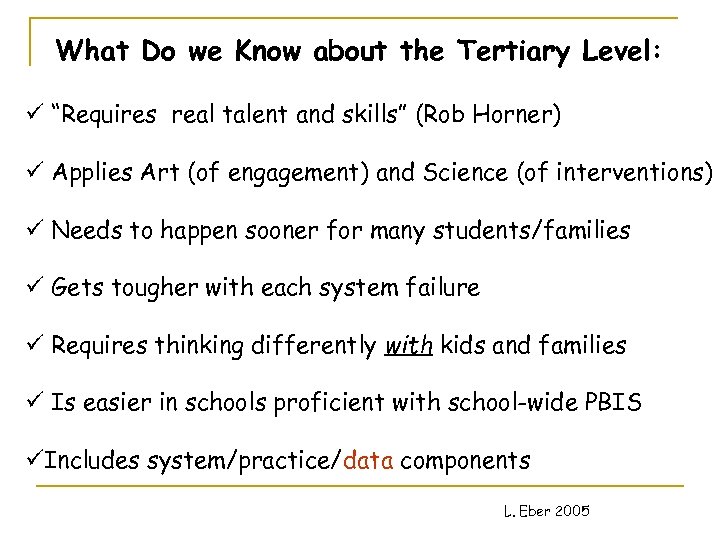 What Do we Know about the Tertiary Level: ü “Requires real talent and skills” (Rob Horner) ü Applies Art (of engagement) and Science (of interventions) ü Needs to happen sooner for many students/families ü Gets tougher with each system failure ü Requires thinking differently with kids and families ü Is easier in schools proficient with school-wide PBIS üIncludes system/practice/data components L. Eber 2005
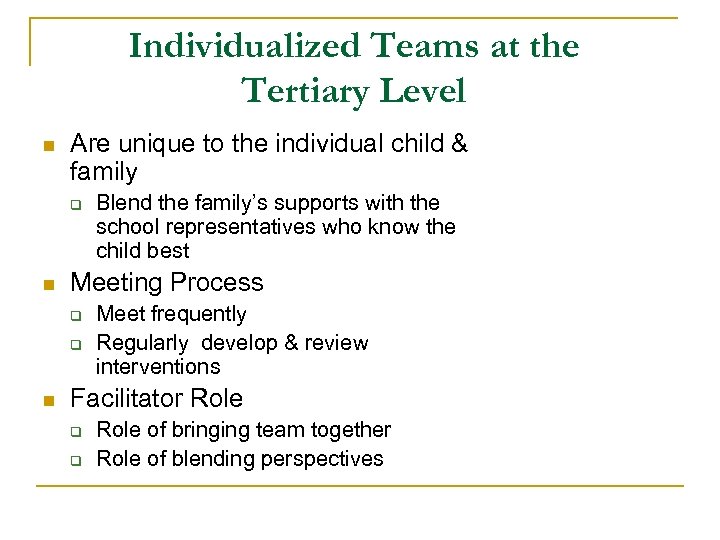 Individualized Teams at the Tertiary Level n Are unique to the individual child & family q n Meeting Process q q n Blend the family’s supports with the school representatives who know the child best Meet frequently Regularly develop & review interventions Facilitator Role q q Role of bringing team together Role of blending perspectives
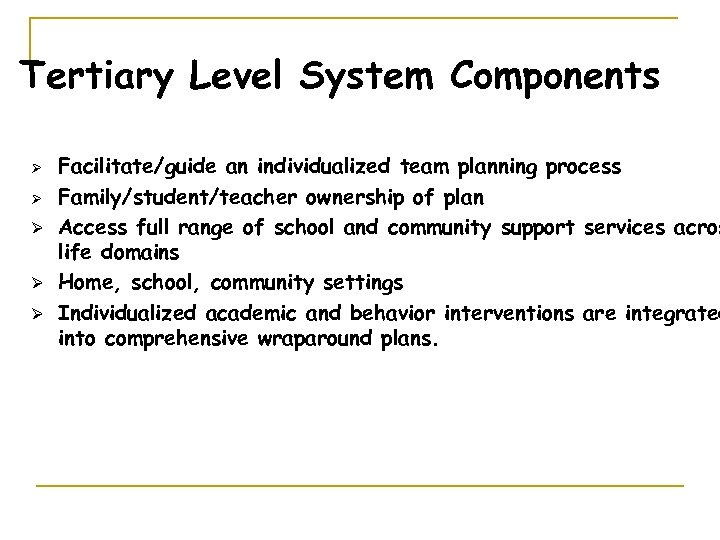 Tertiary Level System Components Ø Ø Ø Facilitate/guide an individualized team planning process Family/student/teacher ownership of plan Access full range of school and community support services acros life domains Home, school, community settings Individualized academic and behavior interventions are integrated into comprehensive wraparound plans.
 Wraparound: A SOC Tool • Emerged from practitioners struggling to implement SOC (grassroots) • Keep/bring youth home • Flexible, creative, non-categorical • Natural support networks • Community-based • Unconditional-Commit to “stay the course” • Let family voice guide service development • Non-traditional supports and services
 Value Base n Build on strengths to meet needs n Non-judgemental; non-blaming n One family-one plan n Increased family/youth voice/choice n Increased family independence n Support for youth in context of families n Support for families in context of community
 Implementing Wraparound : Key Elements Needed for Success ü Engaging students, families & teachers ü Team development & team ownership ü Ensuring student/family/teacher voice q Getting to real (big) needs ü Effective interventions q Serious use of strengths q Natural supports q Focus on needs vs. services ü Monitoring progress & sustaining ü System support buy-in
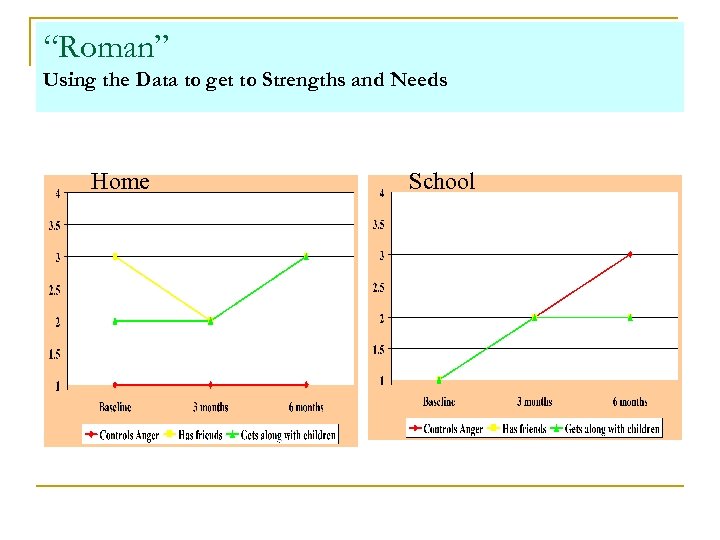
 What’s New in Wraparound? n n n n Skill set specificity Focus on intervention design/effectiveness Integration with school-wide PBS Phases to guide implementation/supervision Data-based decision-making Integrity/fidelity assessment (WIT) Tools to guide teams: q Home School Community q Education Information Tool
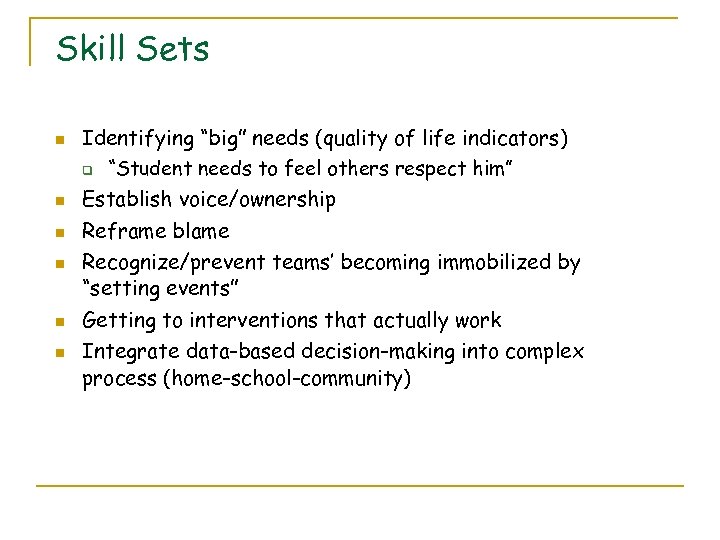 Skill Sets n n n Identifying “big” needs (quality of life indicators) q “Student needs to feel others respect him” Establish voice/ownership Reframe blame Recognize/prevent teams’ becoming immobilized by “setting events” Getting to interventions that actually work Integrate data-based decision-making into complex process (home-school-community)
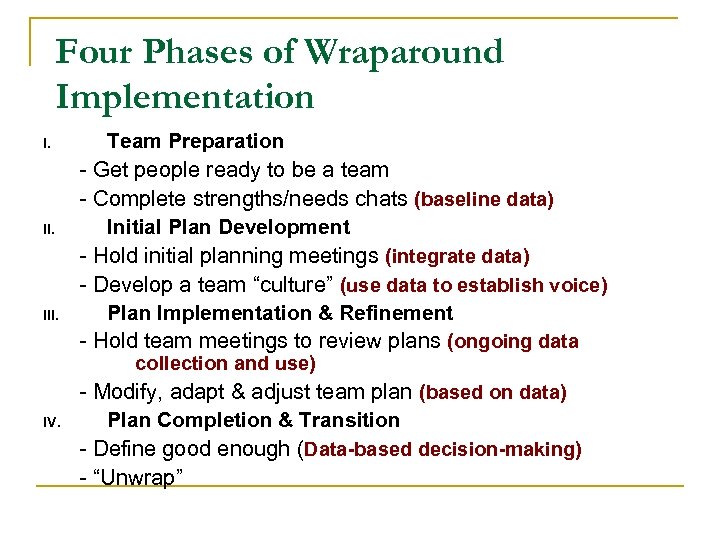 Four Phases of Wraparound Implementation I. III. IV. Team Preparation - Get people ready to be a team - Complete strengths/needs chats (baseline data) Initial Plan Development - Hold initial planning meetings (integrate data) - Develop a team “culture” (use data to establish voice) Plan Implementation & Refinement - Hold team meetings to review plans (ongoing data collection and use) - Modify, adapt & adjust team plan (based on data) Plan Completion & Transition - Define good enough (Data-based decision-making) - “Unwrap”
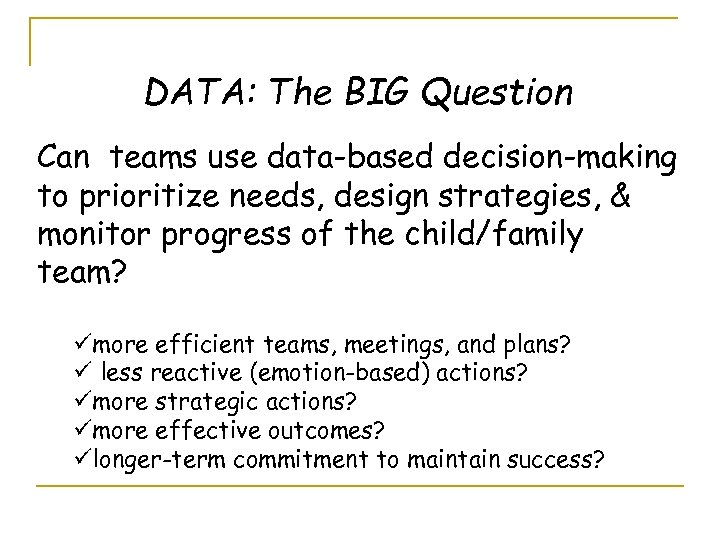 DATA: The BIG Question Can teams use data-based decision-making to prioritize needs, design strategies, & monitor progress of the child/family team? ümore efficient teams, meetings, and plans? ü less reactive (emotion-based) actions? ümore strategic actions? ümore effective outcomes? ülonger-term commitment to maintain success?
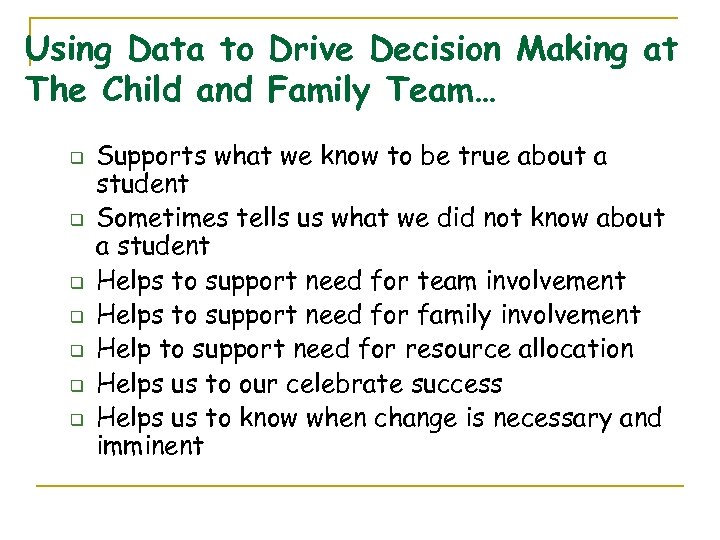 Using Data to Drive Decision Making at The Child and Family Team… q q q q Supports what we know to be true about a student Sometimes tells us what we did not know about a student Helps to support need for team involvement Helps to support need for family involvement Help to support need for resource allocation Helps us to our celebrate success Helps us to know when change is necessary and imminent
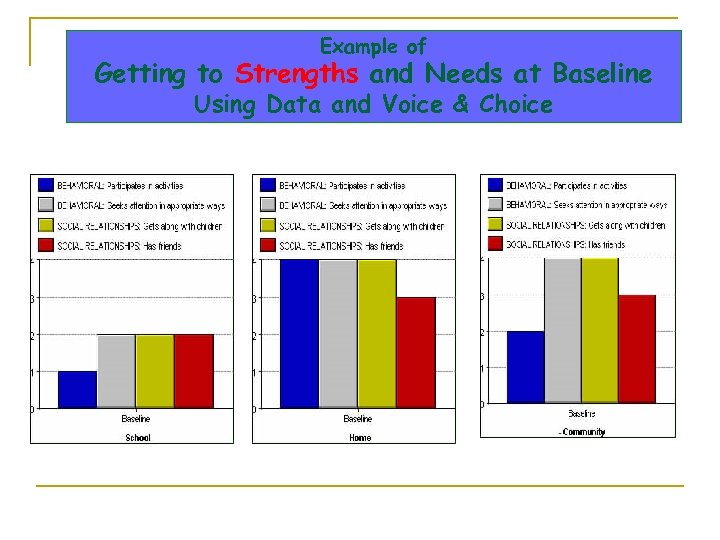 Example of Getting to Strengths and Needs at Baseline Using Data and Voice & Choice
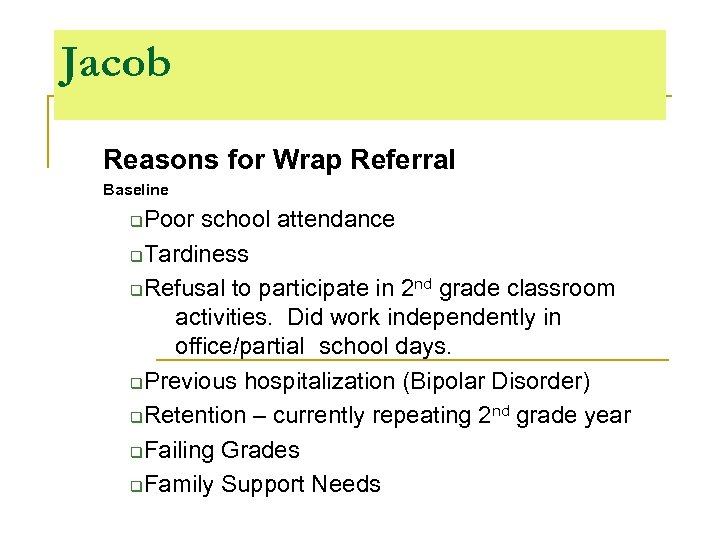 Jacob Reasons for Wrap Referral Baseline Poor school attendance q. Tardiness q. Refusal to participate in 2 nd grade classroom activities. Did work independently in office/partial school days. q. Previous hospitalization (Bipolar Disorder) q. Retention – currently repeating 2 nd grade year q. Failing Grades q. Family Support Needs q
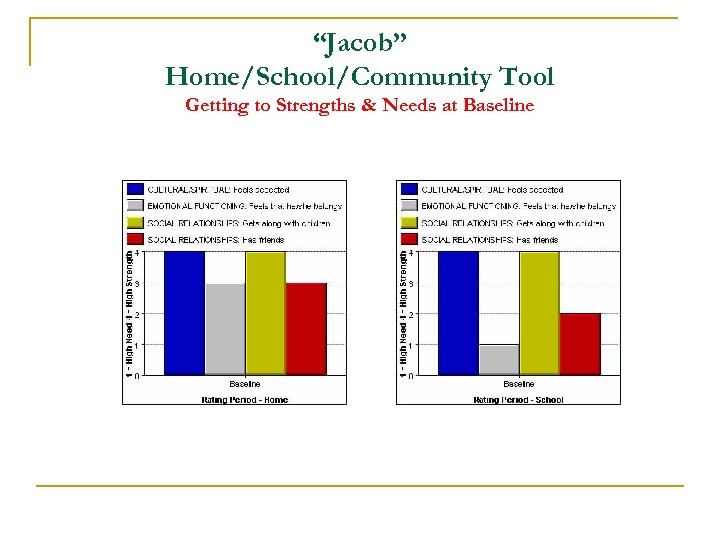 “Jacob” Home/School/Community Tool Getting to Strengths & Needs at Baseline
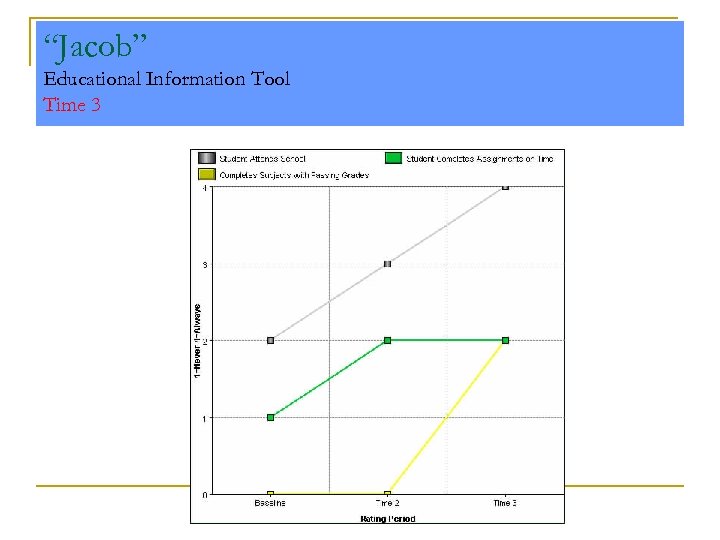 “Jacob” Educational Information Tool Time 3
 “Roman” Using the Data to get to Strengths and Needs Home School
 Results of Implementation of Wraparound within SW-PBS in IL n n Three year pilot Enhance SOC wraparound approach q n n data-based decision-making as part of wraparound intervention Development of strength-needs data tools Web-based system
 Immediate and Sustainable Change Noted in Placement Risk High Risk Low/No Risk (n = 19)
 Avg # of episodes
 Always Never
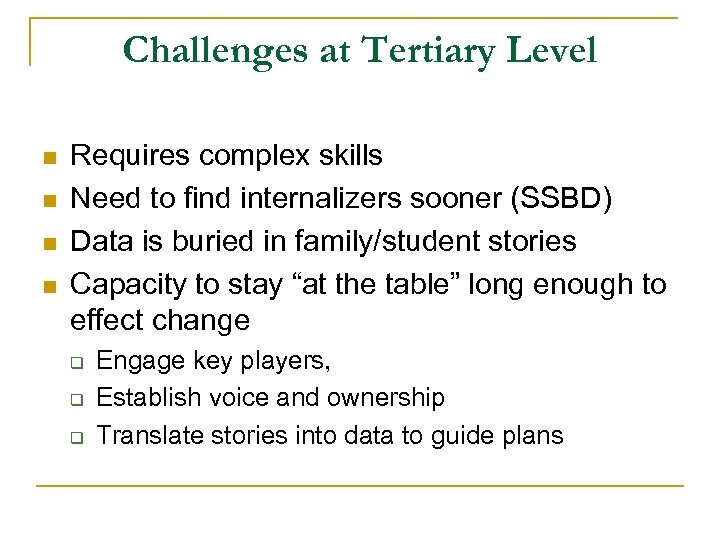 Challenges at Tertiary Level n n Requires complex skills Need to find internalizers sooner (SSBD) Data is buried in family/student stories Capacity to stay “at the table” long enough to effect change q q q Engage key players, Establish voice and ownership Translate stories into data to guide plans
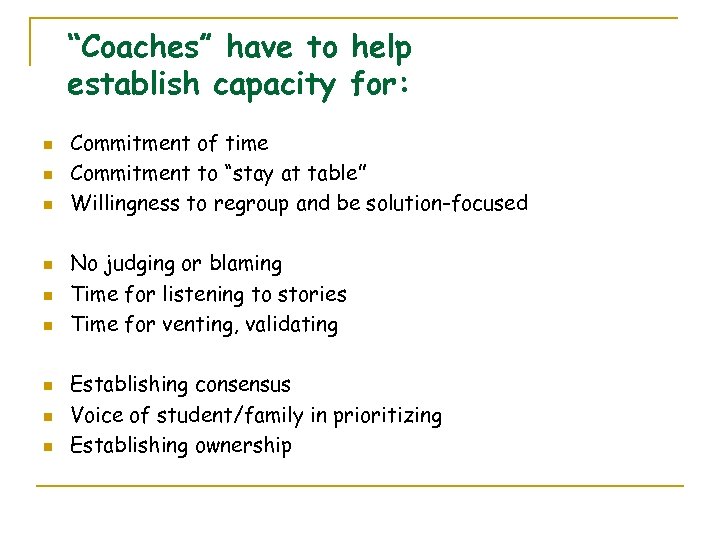 “Coaches” have to help establish capacity for: n n n n n Commitment of time Commitment to “stay at table” Willingness to regroup and be solution-focused No judging or blaming Time for listening to stories Time for venting, validating Establishing consensus Voice of student/family in prioritizing Establishing ownership
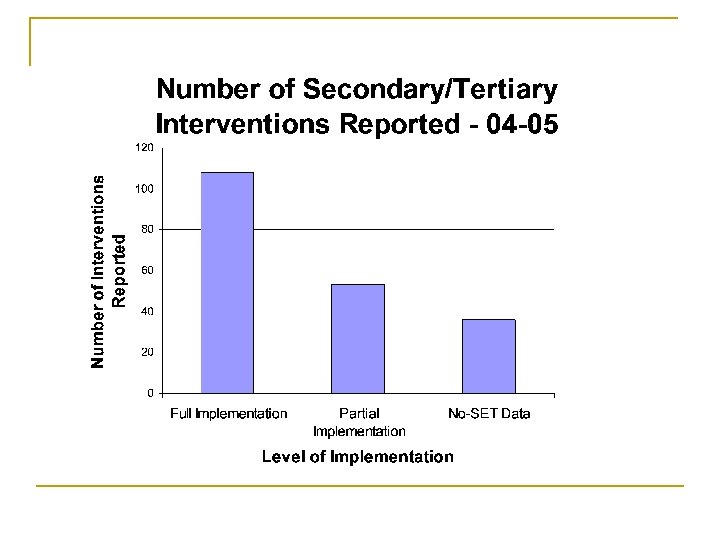
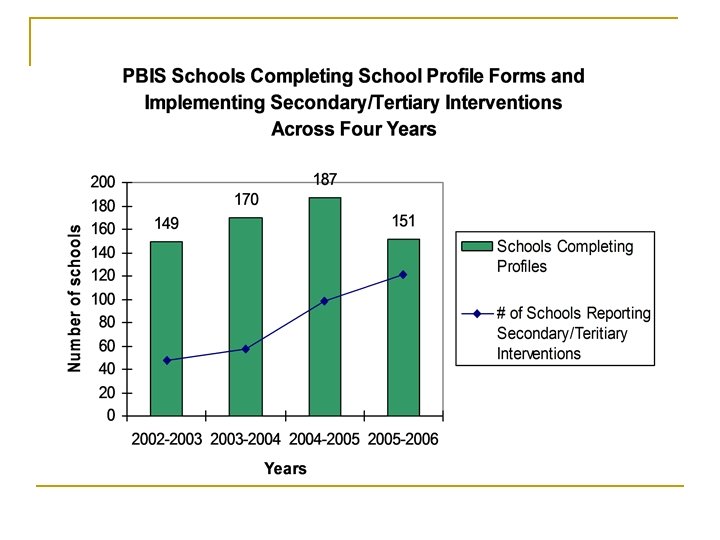
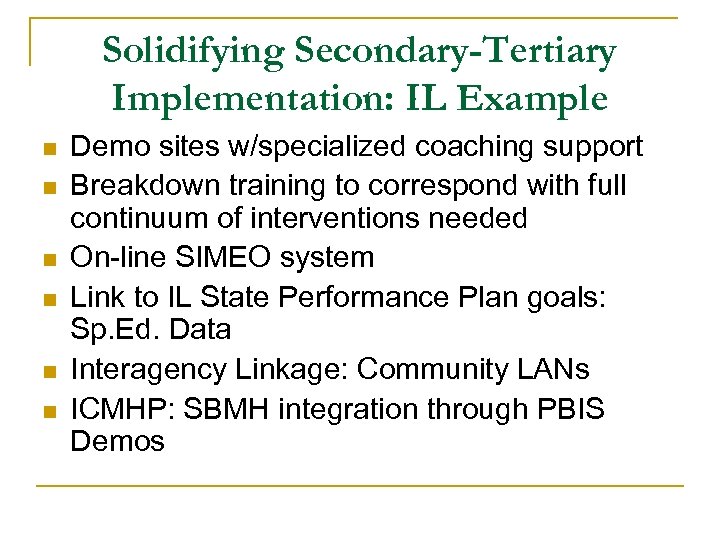 Solidifying Secondary-Tertiary Implementation: IL Example n n n Demo sites w/specialized coaching support Breakdown training to correspond with full continuum of interventions needed On-line SIMEO system Link to IL State Performance Plan goals: Sp. Ed. Data Interagency Linkage: Community LANs ICMHP: SBMH integration through PBIS Demos
 Tertiary Demos n n n District Commitment Designated Buildings/District Staff External Tertiary Coach/Coordinator Continuum of Skill Sets (training, guided learning, practice, coaching, consultation) Commitment to use of Data System q q q Going beyond ODR’s (i. e. SSBD) Self assessment/fidelity SIMEO-Student Outcomes
 District and Building Progress n n n Tertiary Coaches Allocated Intensive Skill Development Regular District and Building Meetings Secondary/Tertiary Systems being Refined Hard look at data: q q q Are current interventions working? How are youth with IEP’s doing? What does our LRE data look like?
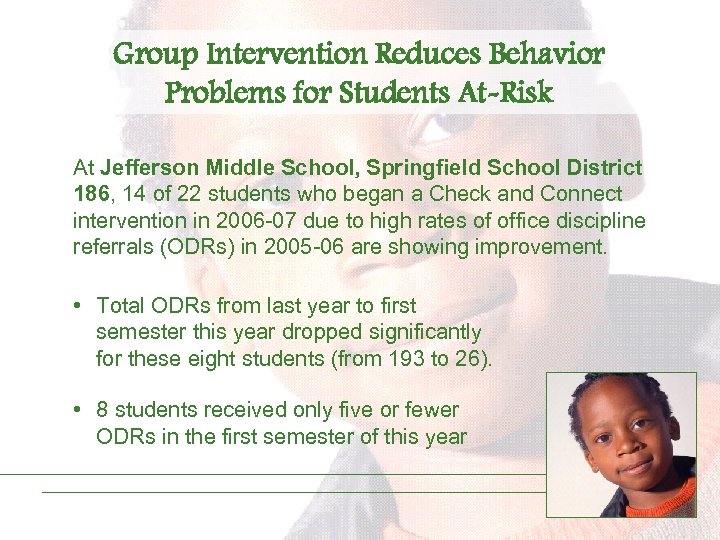 Group Intervention Reduces Behavior Problems for Students At-Risk At Jefferson Middle School, Springfield School District 186, 14 of 22 students who began a Check and Connect intervention in 2006 -07 due to high rates of office discipline referrals (ODRs) in 2005 -06 are showing improvement. • Total ODRs from last year to first semester this year dropped significantly for these eight students (from 193 to 26). • 8 students received only five or fewer ODRs in the first semester of this year
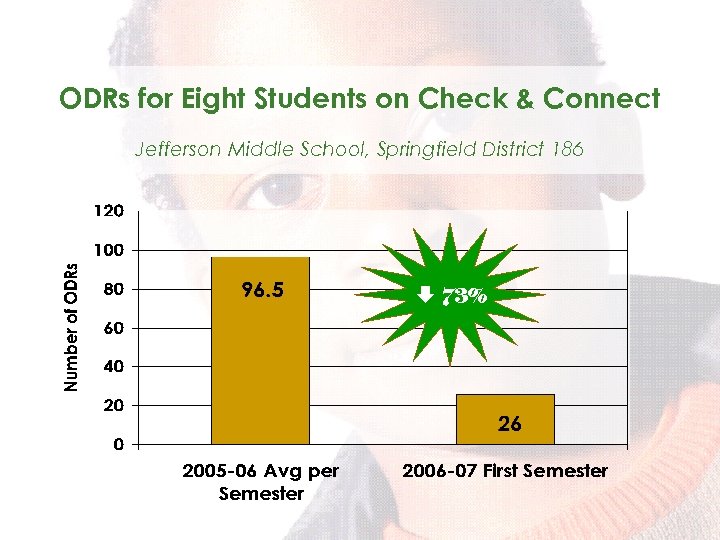 ODRs for Eight Students on Check & Connect Jefferson Middle School, Springfield District 186 73%
 Jack Benny Middle School, Waukegan n n Of 14 students placed on Check and Connect in November 2006, seven students showed progress in only three weeks. These seven students decreased their ODRs from a total of 19 in ten weeks to a total of one ODR after three weeks of the intervention.
 More Intensive Intervention Avoided? (or sets stage for more efficient/productive wraparound? ) n n n A student with four ODRs was not experiencing success with Check and Connect. After individualizing the intervention by allowing her to choose her Check and Connect person, she has received only one ODR, and teachers have observed improvement in her behavior. This student’s progress will continue to be monitored, to determine if more comprehensive support via w/a approach is needed.
 Mary Ellen 7 th grade student Referred to the Student Assistant Team as a potential WRAP because she had formed a strong attachment to a teacher that interfered with her ability to transition between classes. The team determined that when Mary Ellen transitioned between classes her anxiety increased because she wanted attention from her teacher. Staff escorts were assigned to her between classes as a safety precaution and to alleviate anxiety of the student and teacher. A staff member was also assigned outside the classroom teachers’ room. The anxiety continued and the wraparound process was initiated.
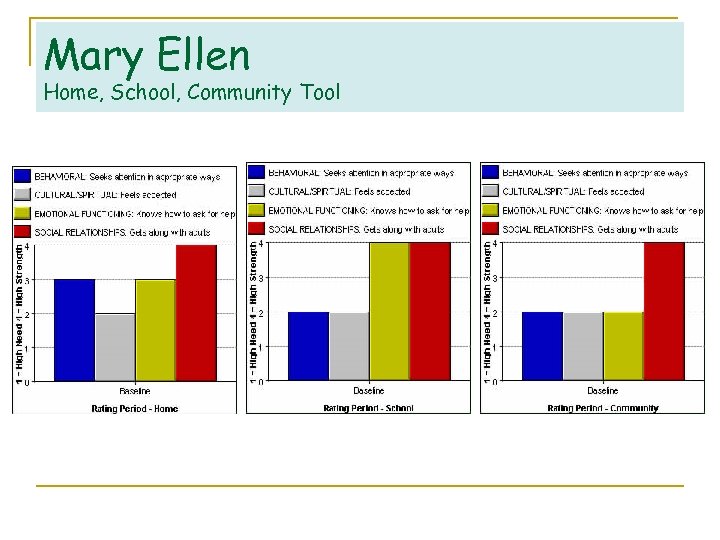 Mary Ellen Home, School, Community Tool
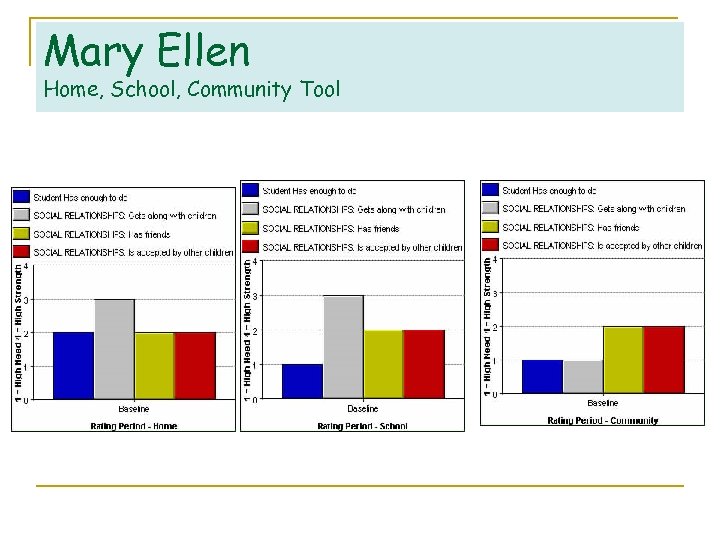 Mary Ellen Home, School, Community Tool
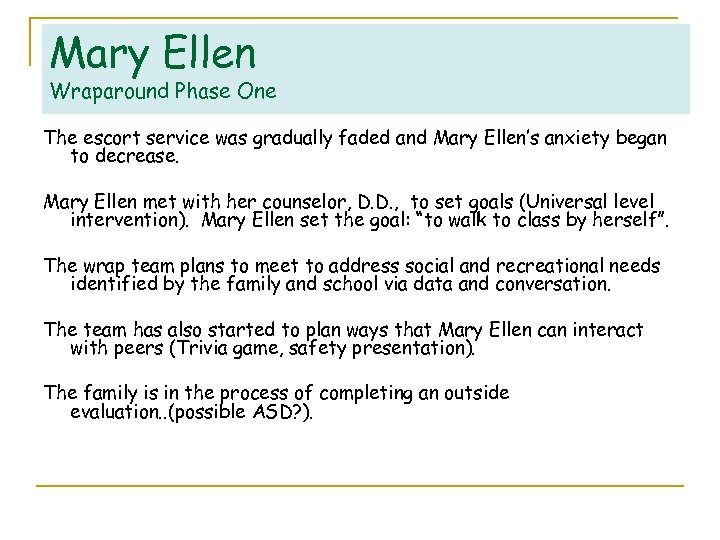 Mary Ellen Wraparound Phase One The escort service was gradually faded and Mary Ellen’s anxiety began to decrease. Mary Ellen met with her counselor, D. D. , to set goals (Universal level intervention). Mary Ellen set the goal: “to walk to class by herself”. The wrap team plans to meet to address social and recreational needs identified by the family and school via data and conversation. The team has also started to plan ways that Mary Ellen can interact with peers (Trivia game, safety presentation). The family is in the process of completing an outside evaluation. . (possible ASD? ).
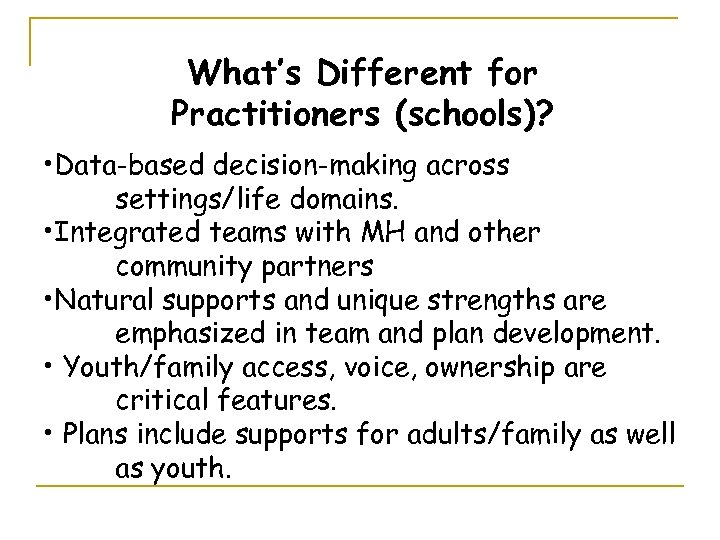 What’s Different for Practitioners (schools)? • Data-based decision-making across settings/life domains. • Integrated teams with MH and other community partners • Natural supports and unique strengths are emphasized in team and plan development. • Youth/family access, voice, ownership are critical features. • Plans include supports for adults/family as well as youth.
 Does School-wide PBIS increase School’s capacity to identify MH needs and reach out to families in a timely manner?
 Need for MH Integration…… n n n Age 10 male in BD Class Excellent teacher; good progress Teacher frustrated; can’t get him “out” more Incidents decrease in frequency but NOT in intensity (hits head on wall; screams “hates himself”) Needs other supports to deal with past trauma he has experienced?
 Missed Opportunity for Early Intervening Services? n n n n Kindergartener with ADHD (family identified and sought treatment) Teacher can “handle her” Psychiatric hospitalization (safety at home) Staff knew triggers & maintaining consequences But no FBA/BIP was done No support to family offered Use of SSBD could have led to interventions?
 Missed Opportunity… n n Kindergartner; tantrums; hurts small animals In principal’s office by noon daily “Waiting” to be accepted for MH assessment No FBA/BIP done q q Although “transitions” were a known trigger School became immobilized by the “setting events” (i. e. possible psychiatric disorder)
 Building Capacity for Wraparound in Schools Ø Establish full-continuum of PBIS in schools Ø Identify and train facilitators Ø Train other school personnel about wrap teams Ø Ongoing practice refinement and skill development Ø Review data around outcomes of teams and plans
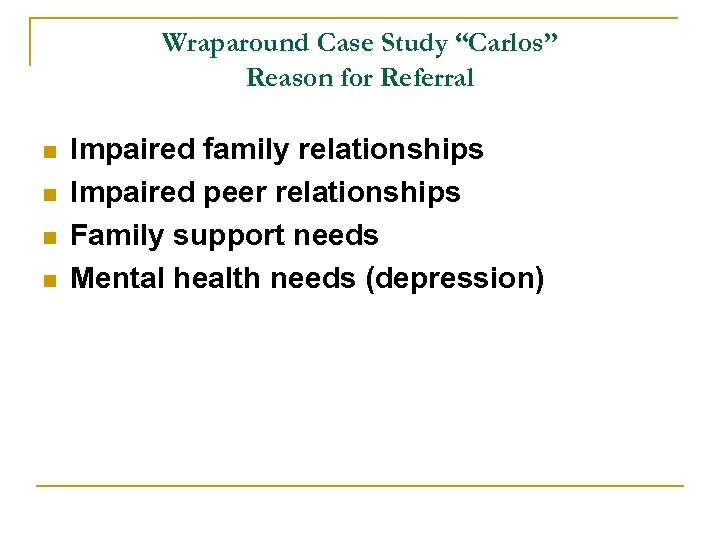 Wraparound Case Study “Carlos” Reason for Referral n n Impaired family relationships Impaired peer relationships Family support needs Mental health needs (depression)
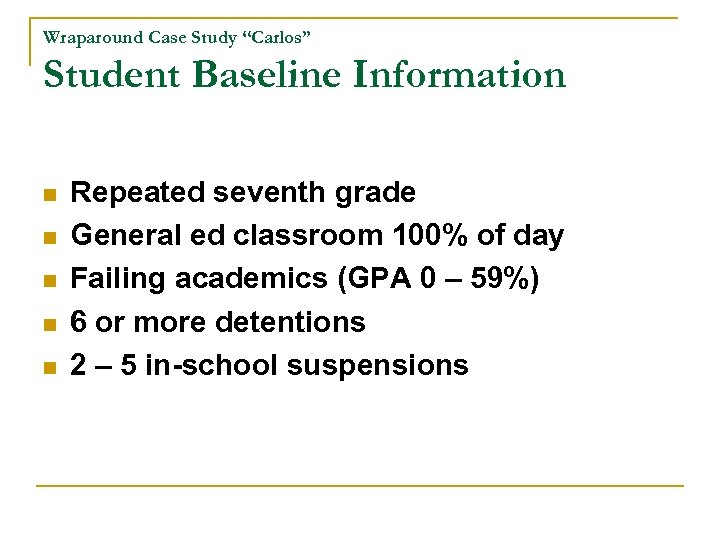 Wraparound Case Study “Carlos” Student Baseline Information n n Repeated seventh grade General ed classroom 100% of day Failing academics (GPA 0 – 59%) 6 or more detentions 2 – 5 in-school suspensions
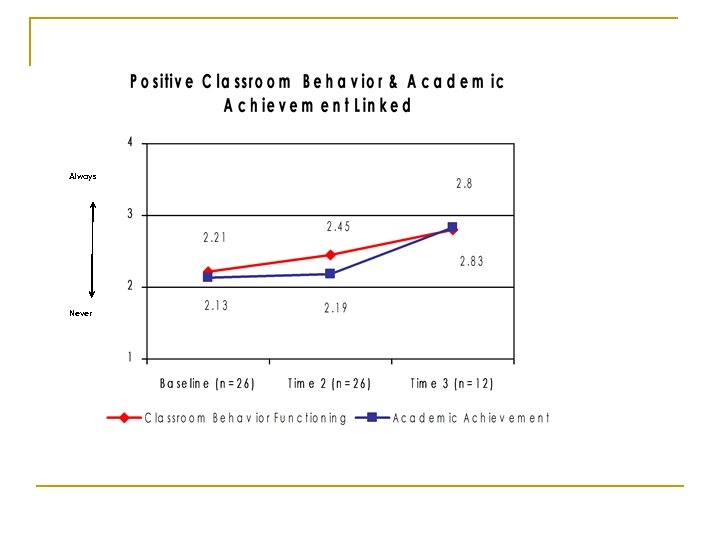
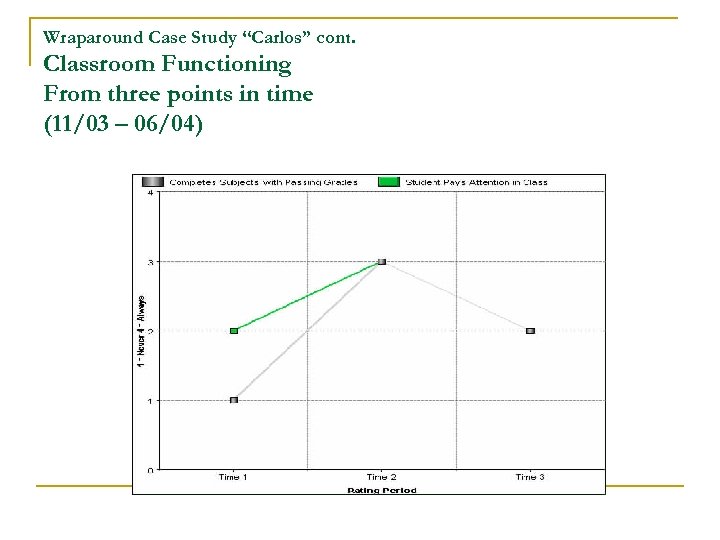 Wraparound Case Study “Carlos” cont. Classroom Functioning From three points in time (11/03 – 06/04)
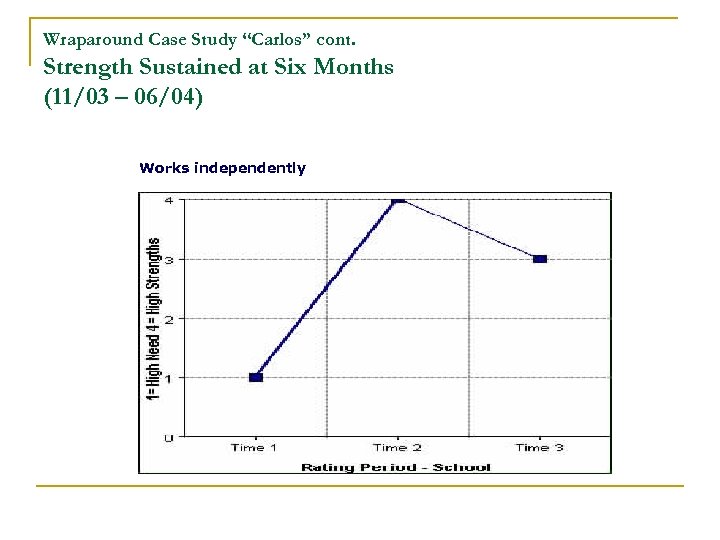 Wraparound Case Study “Carlos” cont. Strength Sustained at Six Months (11/03 – 06/04) Works independently
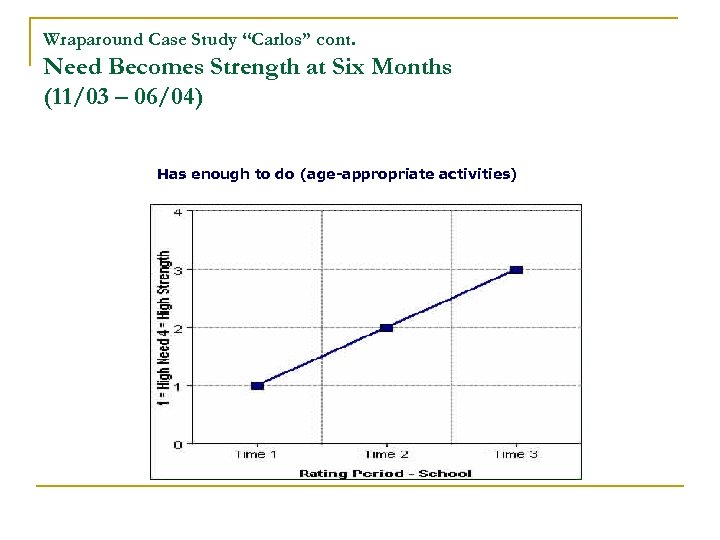 Wraparound Case Study “Carlos” cont. Need Becomes Strength at Six Months (11/03 – 06/04) Has enough to do (age-appropriate activities)
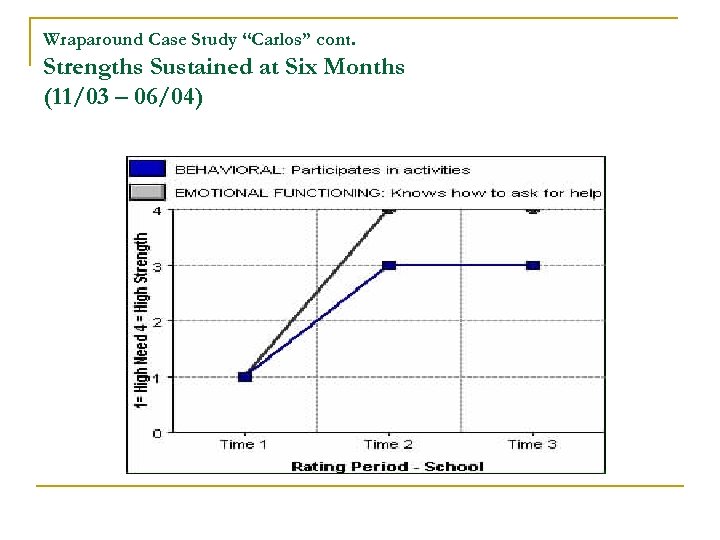 Wraparound Case Study “Carlos” cont. Strengths Sustained at Six Months (11/03 – 06/04)
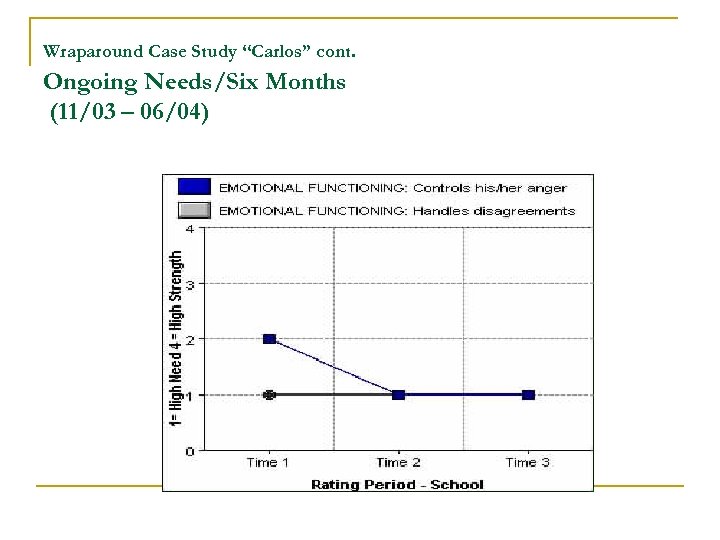 Wraparound Case Study “Carlos” cont. Ongoing Needs/Six Months (11/03 – 06/04)
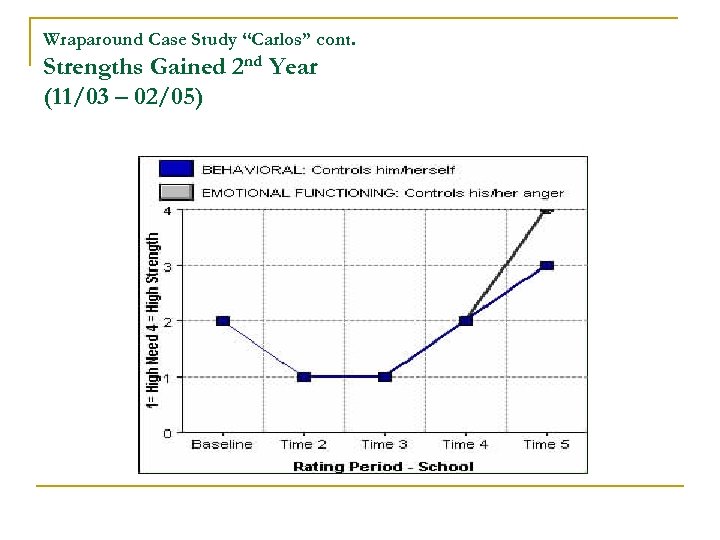 Wraparound Case Study “Carlos” cont. Strengths Gained 2 nd Year (11/03 – 02/05)
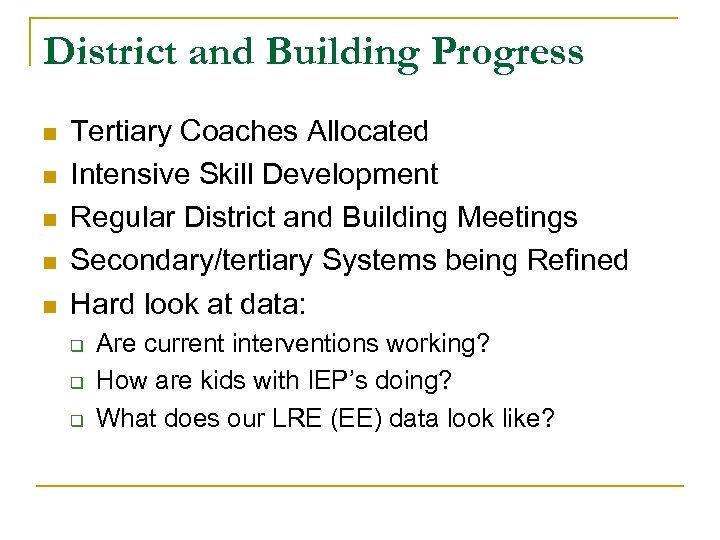 District and Building Progress n n n Tertiary Coaches Allocated Intensive Skill Development Regular District and Building Meetings Secondary/tertiary Systems being Refined Hard look at data: q q q Are current interventions working? How are kids with IEP’s doing? What does our LRE (EE) data look like?
 Possible Steps to Move Forward
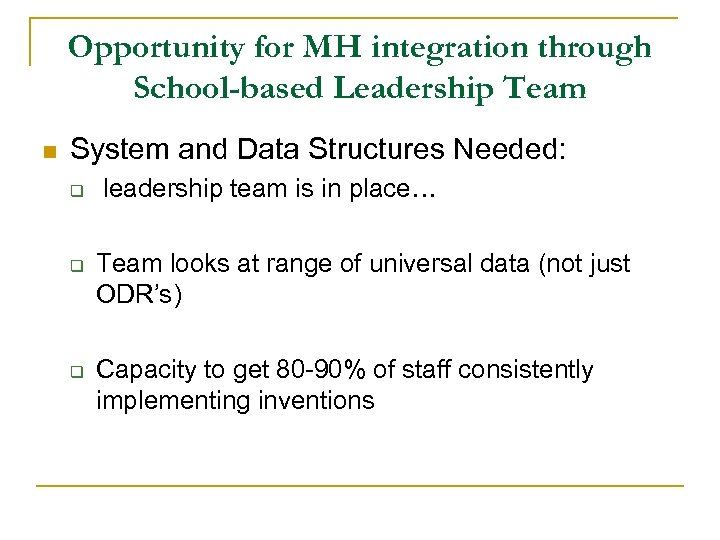 Opportunity for MH integration through School-based Leadership Team n System and Data Structures Needed: q q q leadership team is in place… Team looks at range of universal data (not just ODR’s) Capacity to get 80 -90% of staff consistently implementing inventions
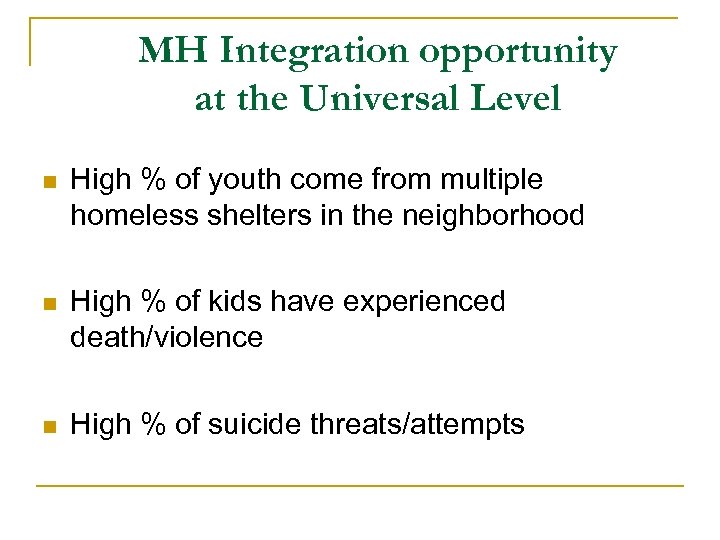 MH Integration opportunity at the Universal Level n High % of youth come from multiple homeless shelters in the neighborhood n High % of kids have experienced death/violence n High % of suicide threats/attempts
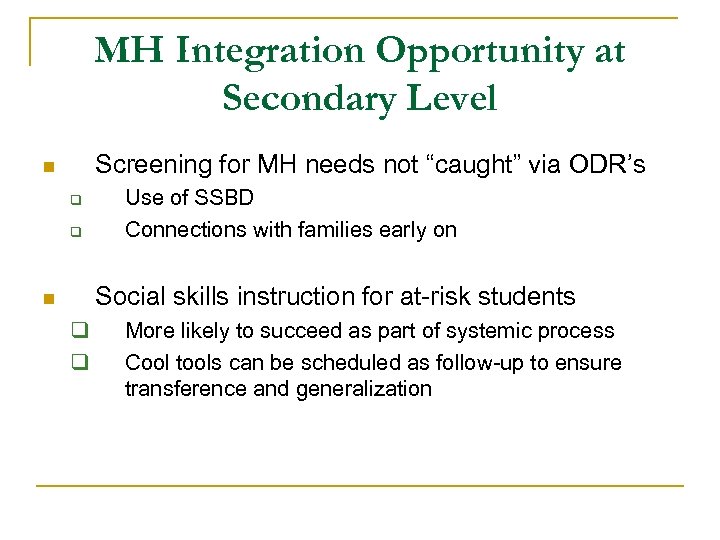 MH Integration Opportunity at Secondary Level Screening for MH needs not “caught” via ODR’s n q q Use of SSBD Connections with families early on Social skills instruction for at-risk students n q q More likely to succeed as part of systemic process Cool tools can be scheduled as follow-up to ensure transference and generalization
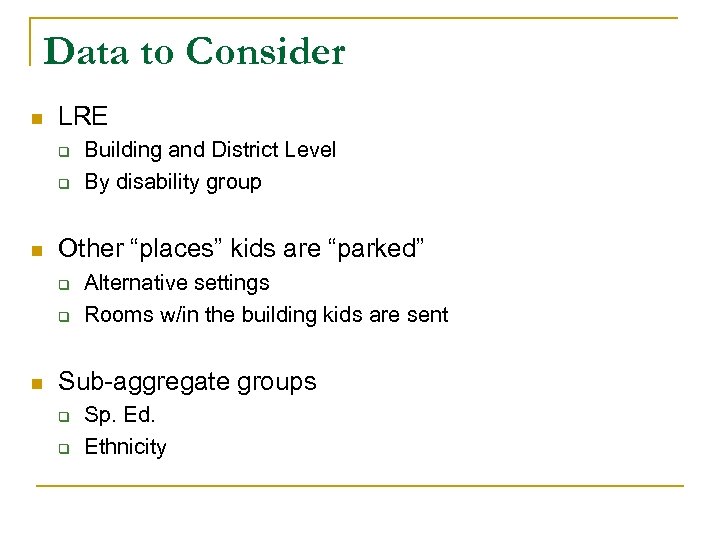 Data to Consider n LRE q q n Other “places” kids are “parked” q q n Building and District Level By disability group Alternative settings Rooms w/in the building kids are sent Sub-aggregate groups q q Sp. Ed. Ethnicity
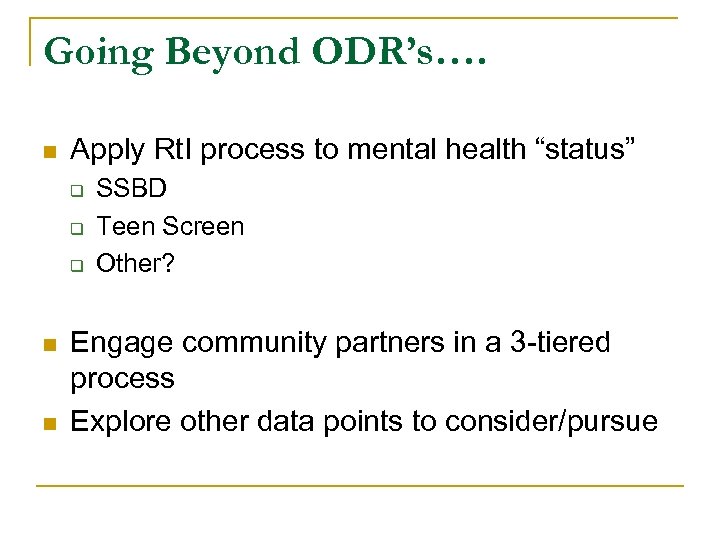 Going Beyond ODR’s…. n Apply Rt. I process to mental health “status” q q q n n SSBD Teen Screen Other? Engage community partners in a 3 -tiered process Explore other data points to consider/pursue
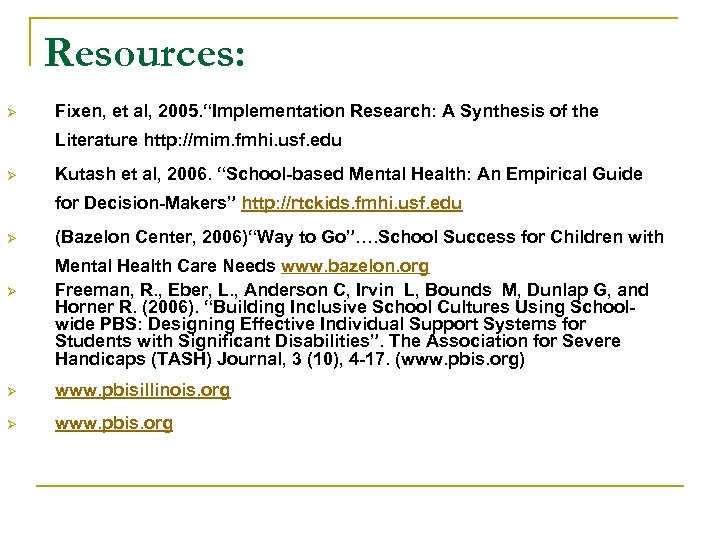 Resources: Ø Fixen, et al, 2005. “Implementation Research: A Synthesis of the Literature http: //mim. fmhi. usf. edu Ø Kutash et al, 2006. “School-based Mental Health: An Empirical Guide for Decision-Makers” http: //rtckids. fmhi. usf. edu Ø Ø (Bazelon Center, 2006)“Way to Go”…. School Success for Children with Mental Health Care Needs www. bazelon. org Freeman, R. , Eber, L. , Anderson C, Irvin L, Bounds M, Dunlap G, and Horner R. (2006). “Building Inclusive School Cultures Using Schoolwide PBS: Designing Effective Individual Support Systems for Students with Significant Disabilities”. The Association for Severe Handicaps (TASH) Journal, 3 (10), 4 -17. (www. pbis. org) Ø www. pbisillinois. org Ø www. pbis. org