 Скачать презентацию NASA-USAF Reusable Space Launch Development Industry Day Briefing
992dee2b0cbb4847028a8afe323c0234.ppt
- Количество слайдов: 21



NASA-USAF Reusable Space Launch Development Industry Day Briefing 17 January, 2002 SENSITIVE ONE 007 -
Current Tasker ¨ Chartered by Sec. AF and NASA Administrator on 10/12/01 · NASA/AF cooperation on new generation of reusable launch vehicles to meet national needs · Consider initial prototype flight as early as 2007 ¨ Air Staff (AF/XO) tasker to AF Space Command: Develop AF · CONOPS · Operational requirements · Technical requirements ¨ Study Objectives: · Credible, comprehensive plan to develop RLVs · Define, converge (where possible) NASA, AF RLV requirements · Roadmap to guide development · Identify appropriate transition opportunities – with decision points and offramps · Establish implementation plan for joint agency effort 2
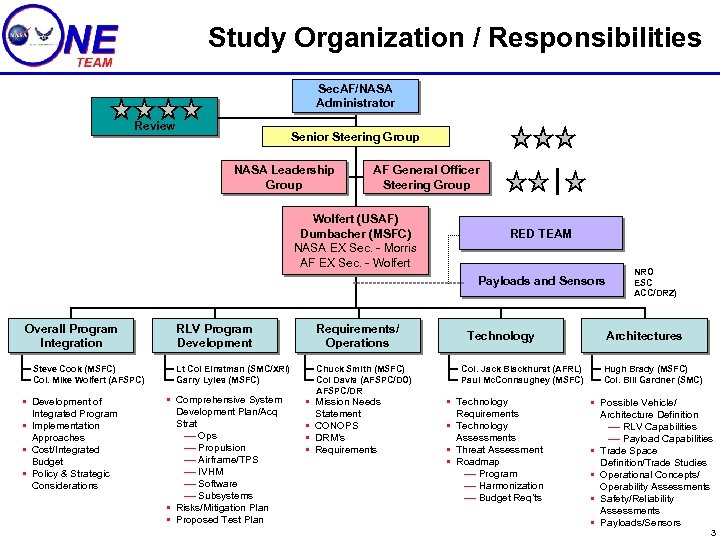
Study Organization / Responsibilities Sec. AF/NASA Administrator Review Senior Steering Group NASA Leadership Group AF General Officer Steering Group Wolfert (USAF) Dumbacher (MSFC) NASA EX Sec. - Morris AF EX Sec. - Wolfert RED TEAM Payloads and Sensors Overall Program Integration Steve Cook (MSFC) Col. Mike Wolfert (AFSPC) • Development of Integrated Program • Implementation Approaches • Cost/Integrated Budget • Policy & Strategic Considerations RLV Program Development Requirements/ Operations Lt Col Einstman (SMC/XRI) Garry Lyles (MSFC) Chuck Smith (MSFC) Col Davis (AFSPC/DO) AFSPC/DR • Comprehensive System Development Plan/Acq Strat ¾ Ops ¾ Propulsion ¾ Airframe/TPS ¾ IVHM ¾ Software ¾ Subsystems • Risks/Mitigation Plan • Proposed Test Plan • Mission Needs Statement • CONOPS • DRM’s • Requirements Technology Col. Jack Blackhurst (AFRL) Paul Mc. Connaughey (MSFC) • Technology Requirements • Technology Assessments • Threat Assessment • Roadmap ¾ Program ¾ Harmonization ¾ Budget Req’ts NRO ESC ACC/DRZ) Architectures Hugh Brady (MSFC) Col. Bill Gardner (SMC) • Possible Vehicle/ Architecture Definition ¾ RLV Capabilities ¾ Payload Capabilities • Trade Space Definition/Trade Studies • Operational Concepts/ Operability Assessments • Safety/Reliability Assessments • Payloads/Sensors 3
Study Assessing Options to Current NASA Approach ¨ Current NASA SLI / 3 rd Gen Includes: · · · 2012 spacelift vehicle for NASA, Do. D and Commercial Advanced development with competing approaches (minimum of 2) Supporting technology programs NASA unique missions Alternate access for ISS ¨ One Team Study Augments with: · · Capability to meet Military Spaceplane Needs Exploring options for earlier capability More robust advanced development program Harmonized, robust supporting technology program 4
Key Observations at Mid Point ¨ Starting point: NASA 2 nd Gen (SLI), 3 rd Gen RLV programs · More mature than AF plans, provide foundation for Do. D-augmented approach ¨ Do. D, NASA requirements differ, seeking “smart” convergence · · NASA: Human spaceflight DOD: aircraft-like responsiveness and operability ¨ Early (2007) flight prototype development: significant payoffs possible… · · Potential residual capability for DOD missions Early (though limited) operational capability for NASA Learn from building, operating prototype Provides mechanism for focusing on evolved requirements ¨ …BUT early (2007) prototype adds significant technical, programmatic risk · · Requires early decision (CY 2002) with significant forward-phased funding Historically, 66 months required from authority to proceed to first flight ¨ National Requirements (Quantitative and Qualitative) need to drive the development options · · Quantitative – Mission Need, Cost-to-Benefit, System Obsolescence, etc … Qualitative – Transformational, Evolution, World/Market Predominance, etc. . 5
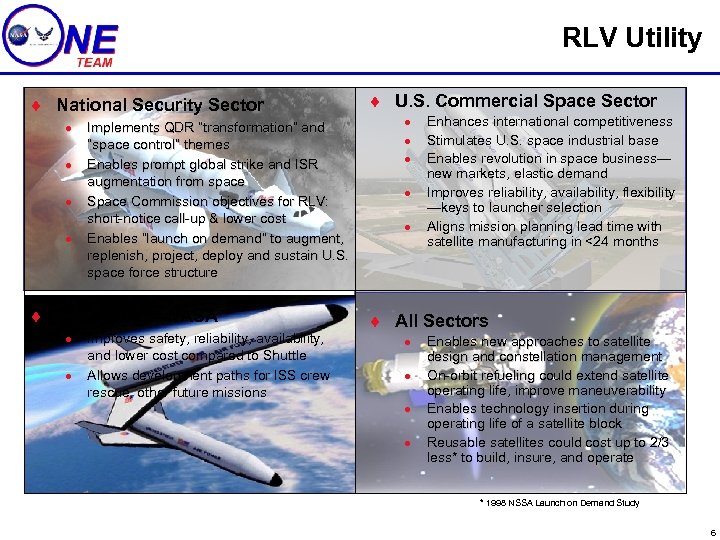
RLV Utility ¨ National Security Sector · · Implements QDR “transformation” and “space control” themes Enables prompt global strike and ISR augmentation from space Space Commission objectives for RLV: short-notice call-up & lower cost Enables “launch on demand” to augment, replenish, project, deploy and sustain U. S. space force structure ¨ Civil Sector--NASA · · Improves safety, reliability, availability, and lower cost compared to Shuttle Allows development paths for ISS crew rescue, other future missions ¨ U. S. Commercial Space Sector · · · Enhances international competitiveness Stimulates U. S. space industrial base Enables revolution in space business— new markets, elastic demand Improves reliability, availability, flexibility —keys to launcher selection Aligns mission planning lead time with satellite manufacturing in <24 months ¨ All Sectors · · Enables new approaches to satellite design and constellation management On-orbit refueling could extend satellite operating life, improve maneuverability Enables technology insertion during operating life of a satellite block Reusable satellites could cost up to 2/3 less* to build, insure, and operate * 1998 NSSA Launch on Demand Study 6
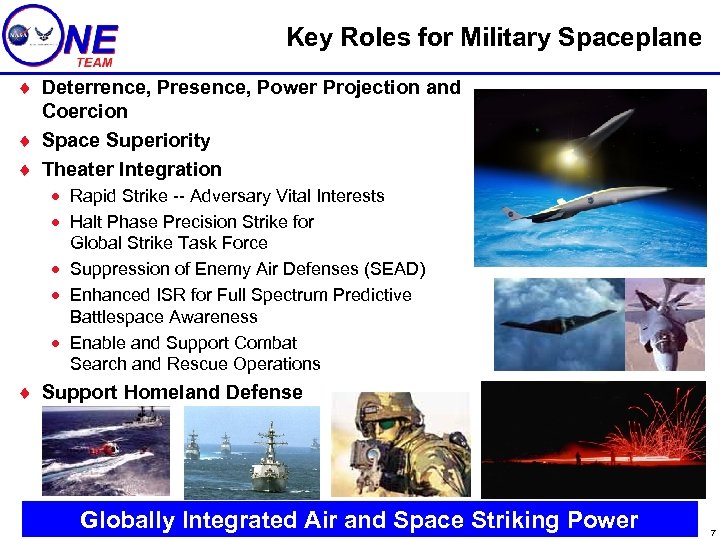
Key Roles for Military Spaceplane ¨ Deterrence, Presence, Power Projection and Coercion ¨ Space Superiority ¨ Theater Integration · Rapid Strike -- Adversary Vital Interests · Halt Phase Precision Strike for Global Strike Task Force · Suppression of Enemy Air Defenses (SEAD) · Enhanced ISR for Full Spectrum Predictive Battlespace Awareness · Enable and Support Combat Search and Rescue Operations ¨ Support Homeland Defense Globally Integrated Air and Space Striking Power 7
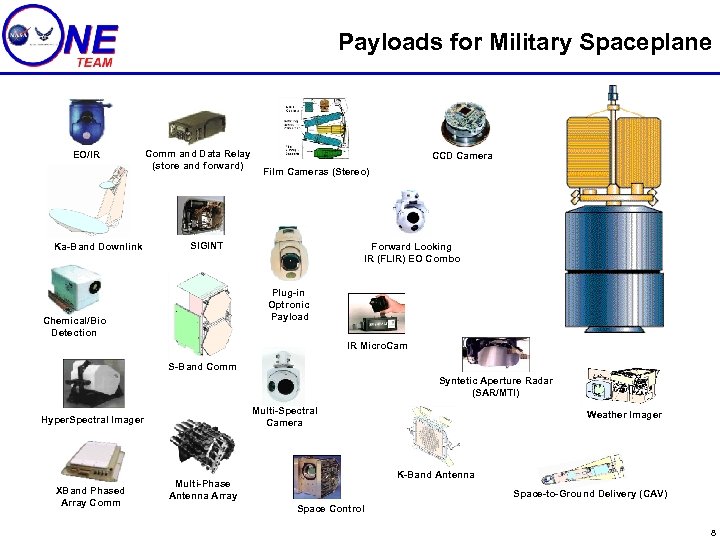
Payloads for Military Spaceplane EO/IR Ka-Band Downlink Comm and Data Relay (store and forward) CCD Camera Film Cameras (Stereo) SIGINT Forward Looking IR (FLIR) EO Combo Plug-in Optronic Payload Chemical/Bio Detection IR Micro. Cam S-Band Comm Syntetic Aperture Radar (SAR/MTI) Multi-Spectral Camera Hyper. Spectral Imager XBand Phased Array Comm Weather Imager K-Band Antenna Multi-Phase Antenna Array Space-to-Ground Delivery (CAV) Space Control 8
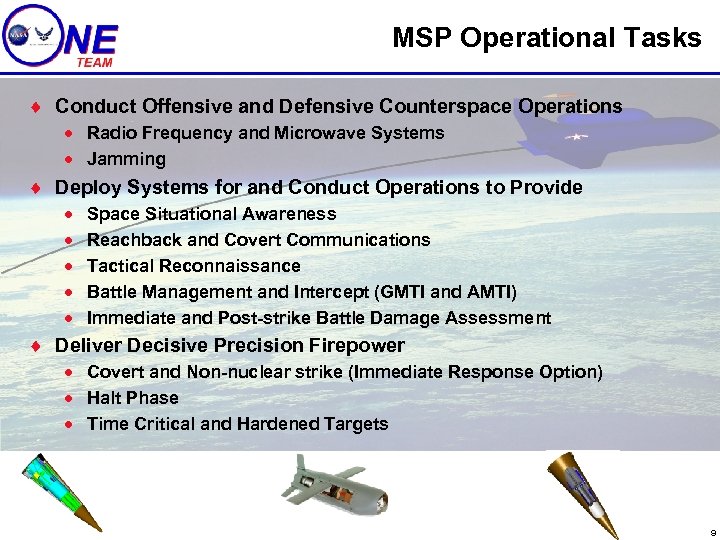
MSP Operational Tasks ¨ Conduct Offensive and Defensive Counterspace Operations · Radio Frequency and Microwave Systems · Jamming ¨ Deploy Systems for and Conduct Operations to Provide · · · Space Situational Awareness Reachback and Covert Communications Tactical Reconnaissance Battle Management and Intercept (GMTI and AMTI) Immediate and Post-strike Battle Damage Assessment ¨ Deliver Decisive Precision Firepower · Covert and Non-nuclear strike (Immediate Response Option) · Halt Phase · Time Critical and Hardened Targets 9
Critical Integrated Requirements ¨ ¨ ¨ ¨ Threat Requirement Crewed Crew Survivability Max Payload on-orbit duration Rendezvous capability Max Orbital Inclination Max Orbital Altitude On orbit Delta V Max Orbiter On-orbit duration Launch Site Landing Site Intact abort capability Command Control Site Capable of 12 -month operations ¨ ¨ ¨ ¨ Design payload mass Nominal de-orbit mass Physical payload envelope Vehicle mission reliability Mission turnaround time – Sustained Mission turnaround time – Surge Call up time – Sustained Call up time – Crew Rescue Sortie capacity – Sustained Sortie capacity – Surge Mission Planning Time – crewed Mission Planning Time – uncrewed Recurring costs 10
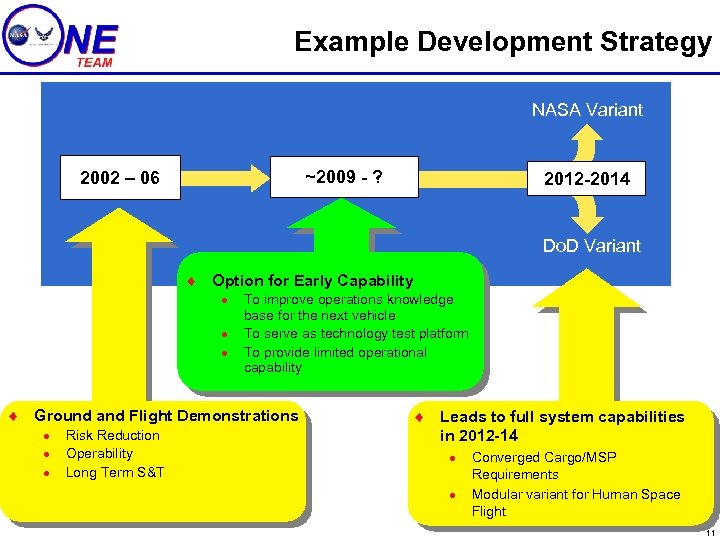
Example Development Strategy NASA Variant ~2009 - ? 2002 – 06 2012 -2014 Do. D Variant ¨ Option for Early Capability · · · To improve operations knowledge base for the next vehicle To serve as technology test platform To provide limited operational capability ¨ Ground and Flight Demonstrations · · · Risk Reduction Operability Long Term S&T ¨ Leads to full system capabilities in 2012 -14 · · Converged Cargo/MSP Requirements Modular variant for Human Space Flight 11
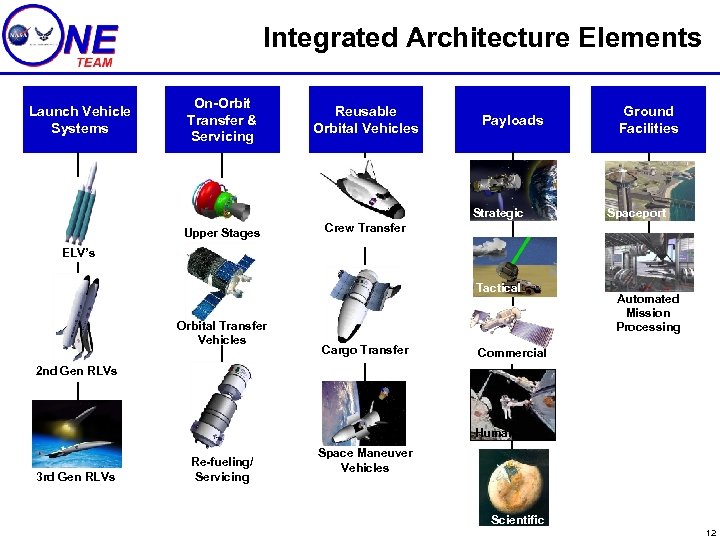
Integrated Architecture Elements On-Orbit Transfer & Servicing Reusable Orbital Vehicles Upper Stages Launch Vehicle Systems Crew Transfer Payloads Strategic Ground Facilities Spaceport ELV’s Tactical Orbital Transfer Vehicles Cargo Transfer Automated Mission Processing Commercial 2 nd Gen RLVs Human 3 rd Gen RLVs Re-fueling/ Servicing Space Maneuver Vehicles Scientific 12
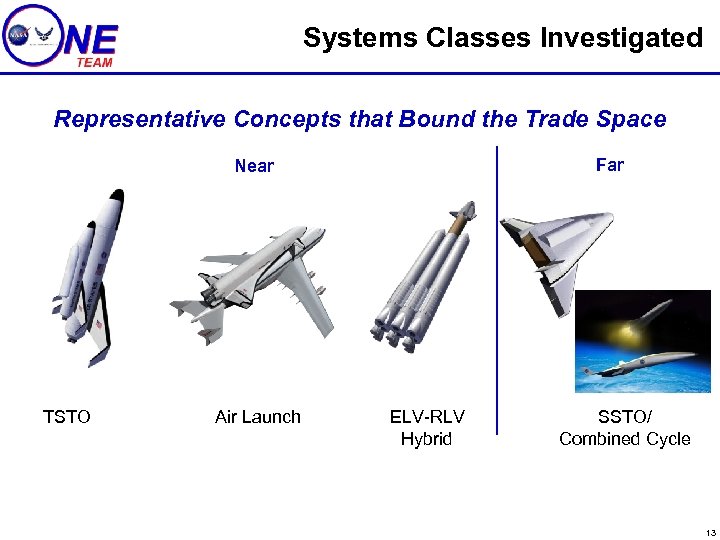
Systems Classes Investigated Representative Concepts that Bound the Trade Space Far Near TSTO Air Launch ELV-RLV Hybrid SSTO/ Combined Cycle 13
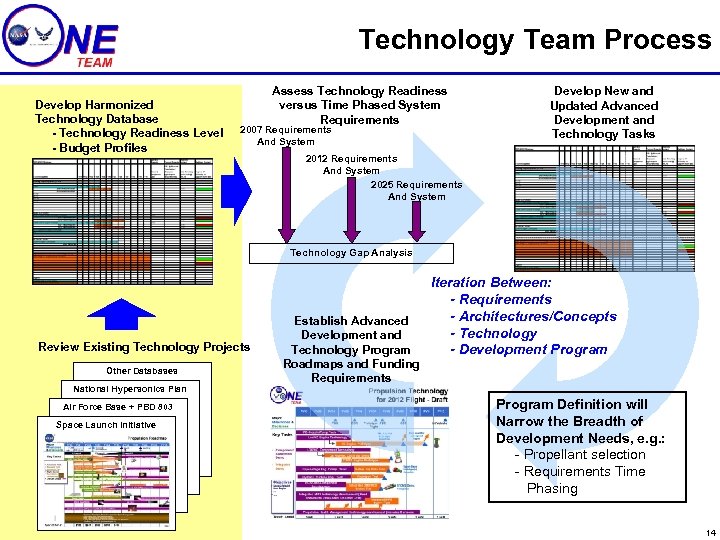
Technology Team Process Develop Harmonized Technology Database - Technology Readiness Level - Budget Profiles Assess Technology Readiness versus Time Phased System Requirements 2007 Requirements And System Develop New and Updated Advanced Development and Technology Tasks 2012 Requirements And System 2025 Requirements And System Technology Gap Analysis Review Existing Technology Projects Other Databases National Hypersonics Plan Air Force Base + PBD 803 Space Launch Initiative Establish Advanced Development and Technology Program Roadmaps and Funding Requirements Iteration Between: - Requirements - Architectures/Concepts - Technology - Development Program Definition will Narrow the Breadth of Development Needs, e. g. : - Propellant selection - Requirements Time Phasing 14
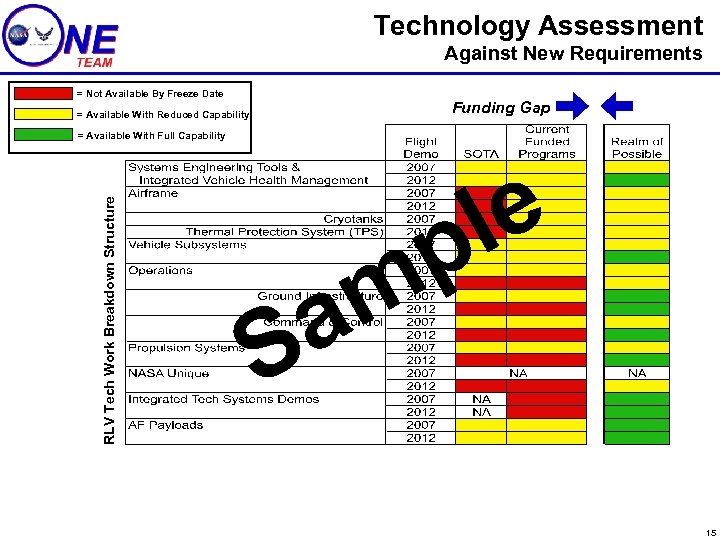
Technology Assessment Against New Requirements = Not Available By Freeze Date Funding Gap = Available With Reduced Capability RLV Tech Work Breakdown Structure = Available With Full Capability e l p m a S 15
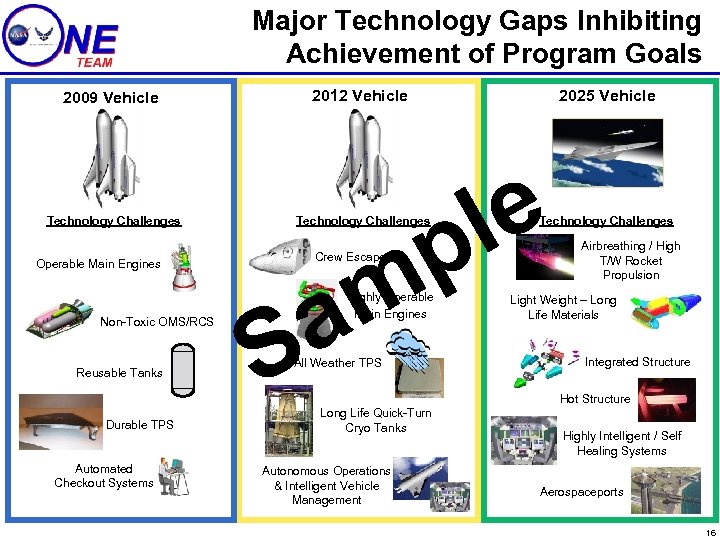
Major Technology Gaps Inhibiting Achievement of Program Goals 2009 Vehicle 2012 Vehicle Technology Challenges e l p m a Crew Escape Operable Main Engines Non-Toxic OMS/RCS Reusable Tanks Durable TPS Automated Checkout Systems 2025 Vehicle S Highly Operable Main Engines All Weather TPS Technology Challenges Airbreathing / High T/W Rocket Propulsion Light Weight – Long Life Materials Integrated Structure Hot Structure Long Life Quick-Turn Cryo Tanks Autonomous Operations & Intelligent Vehicle Management Highly Intelligent / Self Healing Systems Aerospaceports 16
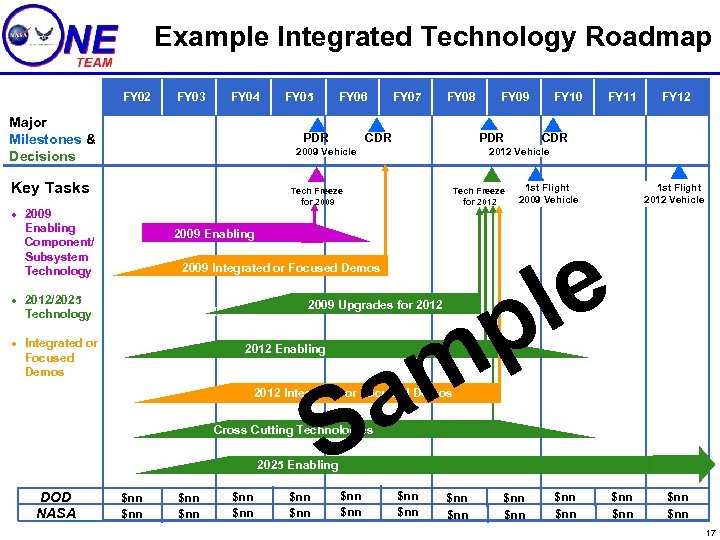
Example Integrated Technology Roadmap FY 02 FY 03 FY 04 FY 05 Major Milestones & Decisions FY 06 PDR FY 07 FY 08 CDR PDR 2009 Vehicle Key Tasks Tech Freeze for 2012 2009 Enabling FY 11 FY 12 CDR 1 st Flight 2009 Vehicle 1 st Flight 2012 Vehicle le p 2009 Integrated or Focused Demos 2007 Upgrades FY 10 2012 Vehicle Tech Freeze for 2009 · 2009 Enabling Component/ Subsystem Technology · 2012/2025 Technology FY 09 2009 Upgrades for 2012 m a S · Integrated or Focused Demos 2012 Enabling 2012 Integrated or Focused Demos Cross Cutting Technologies 2025 Enabling DOD NASA $nn $nn $nn $nn $nn $nn 17
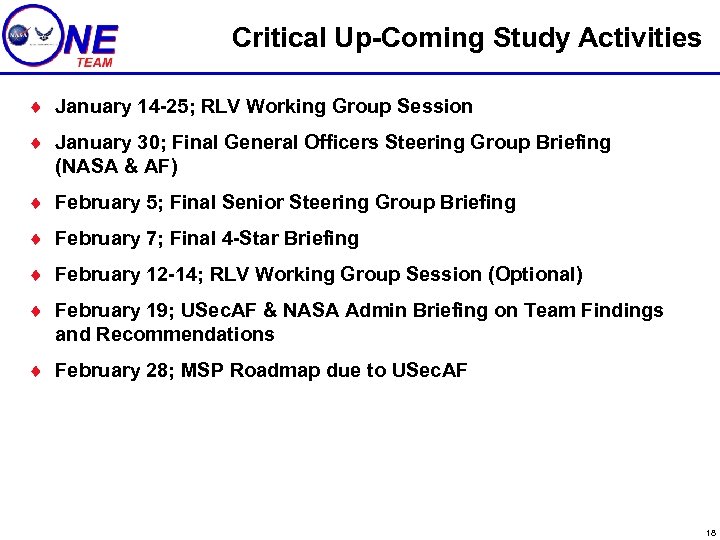
Critical Up-Coming Study Activities ¨ January 14 -25; RLV Working Group Session ¨ January 30; Final General Officers Steering Group Briefing (NASA & AF) ¨ February 5; Final Senior Steering Group Briefing ¨ February 7; Final 4 -Star Briefing ¨ February 12 -14; RLV Working Group Session (Optional) ¨ February 19; USec. AF & NASA Admin Briefing on Team Findings and Recommendations ¨ February 28; MSP Roadmap due to USec. AF 18
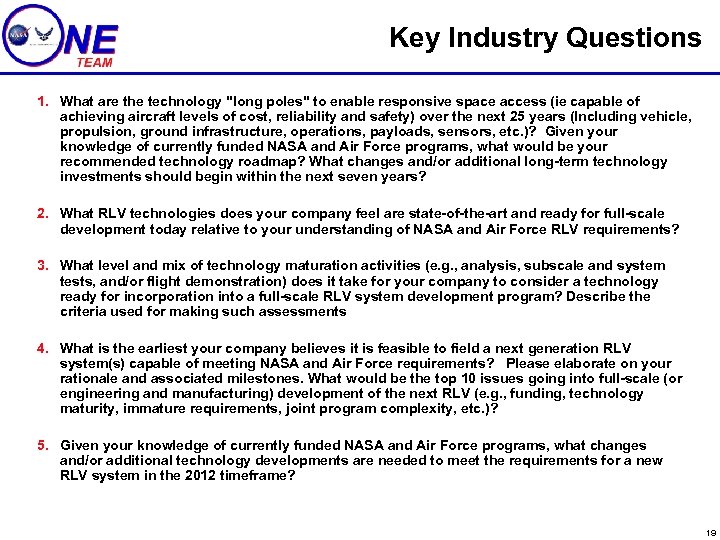
Key Industry Questions 1. What are the technology "long poles" to enable responsive space access (ie capable of achieving aircraft levels of cost, reliability and safety) over the next 25 years (Including vehicle, propulsion, ground infrastructure, operations, payloads, sensors, etc. )? Given your knowledge of currently funded NASA and Air Force programs, what would be your recommended technology roadmap? What changes and/or additional long-term technology investments should begin within the next seven years? 2. What RLV technologies does your company feel are state-of-the-art and ready for full-scale development today relative to your understanding of NASA and Air Force RLV requirements? 3. What level and mix of technology maturation activities (e. g. , analysis, subscale and system tests, and/or flight demonstration) does it take for your company to consider a technology ready for incorporation into a full-scale RLV system development program? Describe the criteria used for making such assessments 4. What is the earliest your company believes it is feasible to field a next generation RLV system(s) capable of meeting NASA and Air Force requirements? Please elaborate on your rationale and associated milestones. What would be the top 10 issues going into full-scale (or engineering and manufacturing) development of the next RLV (e. g. , funding, technology maturity, immature requirements, joint program complexity, etc. )? 5. Given your knowledge of currently funded NASA and Air Force programs, what changes and/or additional technology developments are needed to meet the requirements for a new RLV system in the 2012 timeframe? 19
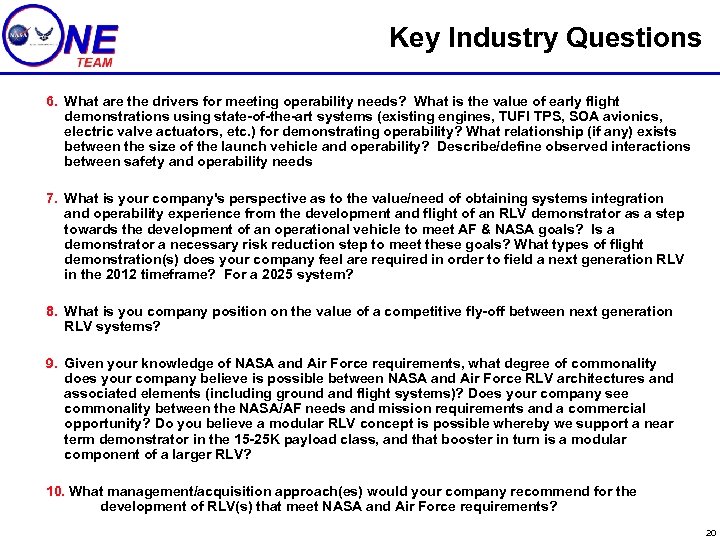
Key Industry Questions 6. What are the drivers for meeting operability needs? What is the value of early flight demonstrations using state-of-the-art systems (existing engines, TUFI TPS, SOA avionics, electric valve actuators, etc. ) for demonstrating operability? What relationship (if any) exists between the size of the launch vehicle and operability? Describe/define observed interactions between safety and operability needs 7. What is your company's perspective as to the value/need of obtaining systems integration and operability experience from the development and flight of an RLV demonstrator as a step towards the development of an operational vehicle to meet AF & NASA goals? Is a demonstrator a necessary risk reduction step to meet these goals? What types of flight demonstration(s) does your company feel are required in order to field a next generation RLV in the 2012 timeframe? For a 2025 system? 8. What is you company position on the value of a competitive fly-off between next generation RLV systems? 9. Given your knowledge of NASA and Air Force requirements, what degree of commonality does your company believe is possible between NASA and Air Force RLV architectures and associated elements (including ground and flight systems)? Does your company see commonality between the NASA/AF needs and mission requirements and a commercial opportunity? Do you believe a modular RLV concept is possible whereby we support a near term demonstrator in the 15 -25 K payload class, and that booster in turn is a modular component of a larger RLV? 10. What management/acquisition approach(es) would your company recommend for the development of RLV(s) that meet NASA and Air Force requirements? 20
Key Industry Questions 11. What is your assessment of the state of the industrial base to support development of this program simultaneously with EELV and other aerospace programs? Is there a risk to developing this Program due to shortages or deficiencies in areas such as training and expertise of engineers, manufacturing capability, or reliance on foreign parts and materials? 12. What options would you recommend to support airplane like operations for the Military Space Plane? When would these operational capabilities be available to be part of a test/development program? 13. Can we develop the launch and early orbit checkout processes, techniques, and procedures to support first or second revolution use of sensors and payloads? Does this require increased technology efforts? 14. What is your assessment of whether sensors and payloads can be developed that can be jointly used by UAVs and space to support the Global Strike Task Force concept? Which areas are the best candidates? When might these be available? 21
Скачать презентацию NASA-USAF Reusable Space Launch Development Industry Day Briefing
992dee2b0cbb4847028a8afe323c0234.ppt