


 Скачать презентацию NASA Technology Roadmaps ATK Commentary Stan Graves Vice
ee9ddb184de039302561522ee1c28b33.ppt
- Количество слайдов: 14
 NASA Technology Roadmaps ATK Commentary Stan Graves Vice President, Science & Engineering ATK Propulsion Systems 435 -863 -4062 stanley. graves@atk. com March 23 – 24, 2011 1
 Assessment Guidelines and Assumptions: Next generation heavy lift vehicles will employ both liquid and solid propulsion elements to optimize reliability, performance and cost. Assessment evaluated: 1. Total propulsion system performance and reliability 2. Ground processing timelines 3. Launch delays Conclusion: ATK endorses NASA technology roadmap and provides guidance for priority and emphasis 2
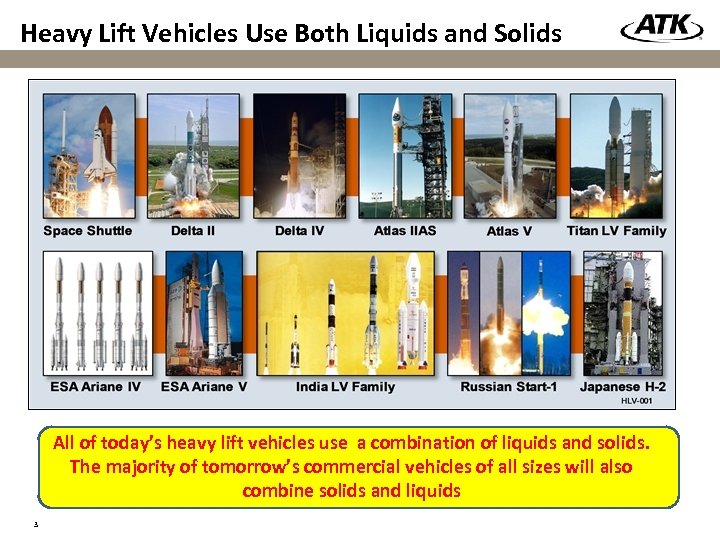 Heavy Lift Vehicles Use Both Liquids and Solids All of today’s heavy lift vehicles use a combination of liquids and solids. The majority of tomorrow’s commercial vehicles of all sizes will also combine solids and liquids 3
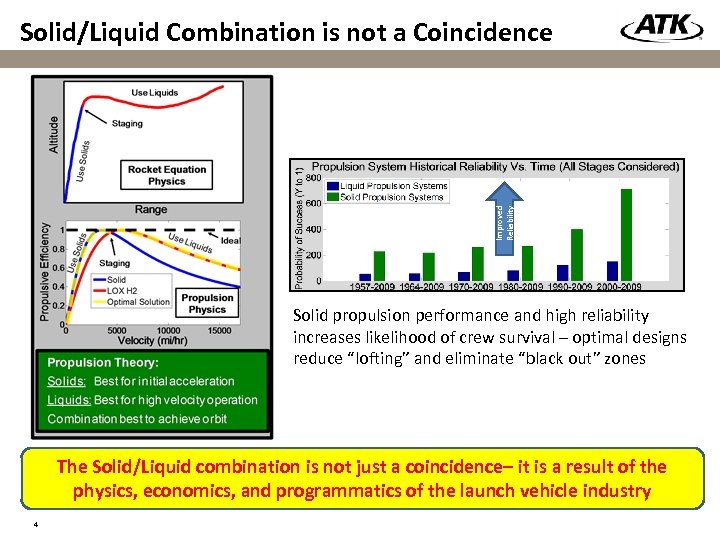 Improved Reliability Solid/Liquid Combination is not a Coincidence Solid propulsion performance and high reliability increases likelihood of crew survival – optimal designs reduce “lofting” and eliminate “black out” zones The Solid/Liquid combination is not just a coincidence– it is a result of the physics, economics, and programmatics of the launch vehicle industry 4
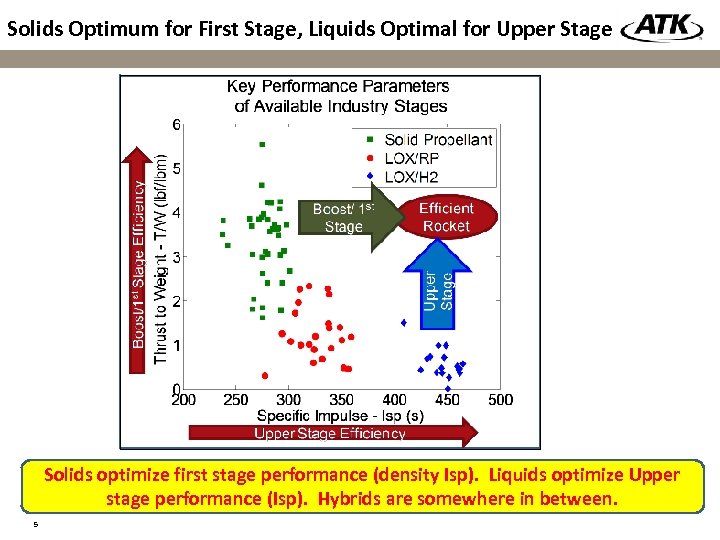 Solids Optimum for First Stage, Liquids Optimal for Upper Stage Solids optimize first stage performance (density Isp). Liquids optimize Upper stage performance (Isp). Hybrids are somewhere in between. 5
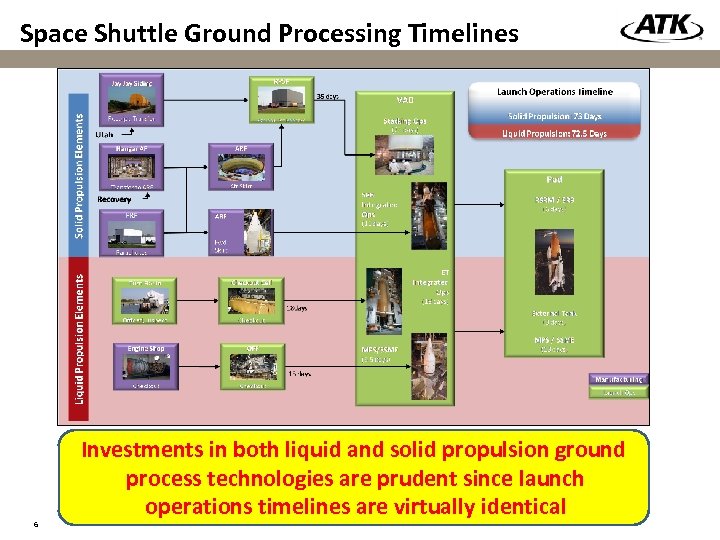 Space Shuttle Ground Processing Timelines 6 Investments in both liquid and solid propulsion ground process technologies are prudent since launch operations timelines are virtually identical
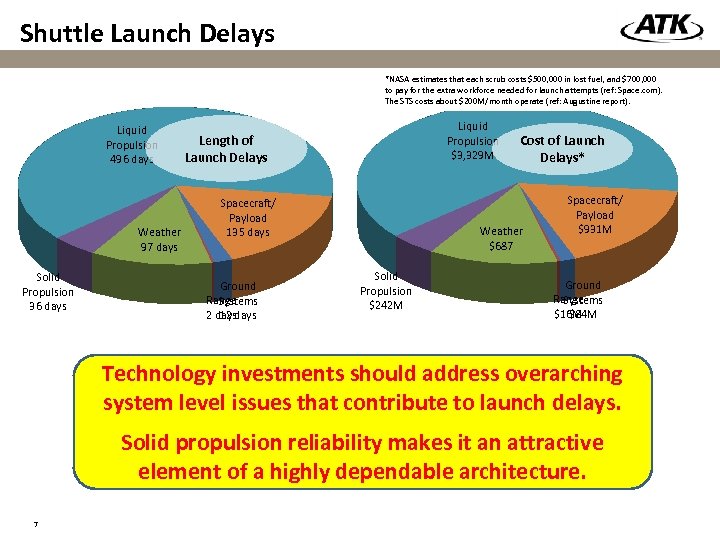 Shuttle Launch Delays *NASA estimates that each scrub costs $500, 000 in lost fuel, and $700, 000 to pay for the extra workforce needed for launch attempts (ref: Space. com). The STS costs about $200 M/month operate (ref: Augustine report). Liquid Propulsion 496 days Weather 97 days Solid Propulsion 36 days Liquid Propulsion $3, 329 M Length of Launch Delays Spacecraft/ Payload 135 days Ground Range Systems 2 days 12 days Cost of Launch Delays* Weather $687 Solid Propulsion $242 M Spacecraft/ Payload $931 M Ground Range Systems $16 M $84 M Technology investments should address overarching system level issues that contribute to launch delays. Solid propulsion reliability makes it an attractive element of a highly dependable architecture. 7
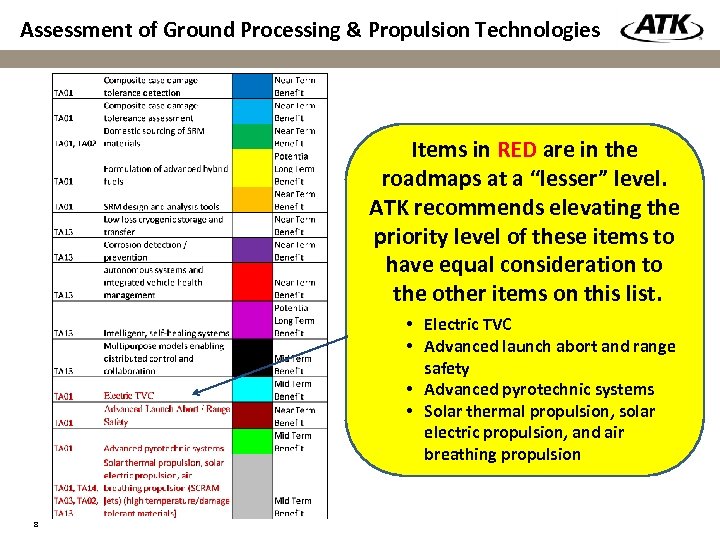 Assessment of Ground Processing & Propulsion Technologies Items in RED are in the roadmaps at a “lesser” level. ATK recommends elevating the priority level of these items to have equal consideration to the other items on this list. • Electric TVC • Advanced launch abort and range safety • Advanced pyrotechnic systems • Solar thermal propulsion, solar electric propulsion, and air breathing propulsion 8
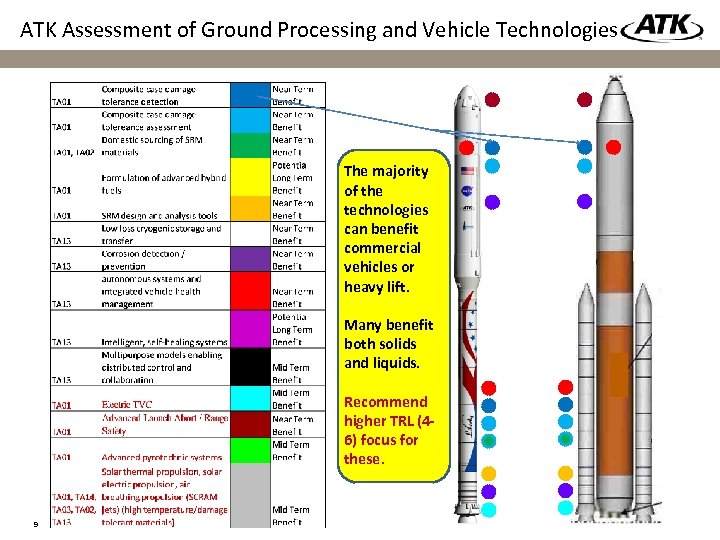 ATK Assessment of Ground Processing and Vehicle Technologies The majority of the technologies can benefit commercial vehicles or heavy lift. Many benefit both solids and liquids. Recommend higher TRL (46) focus for these. 9
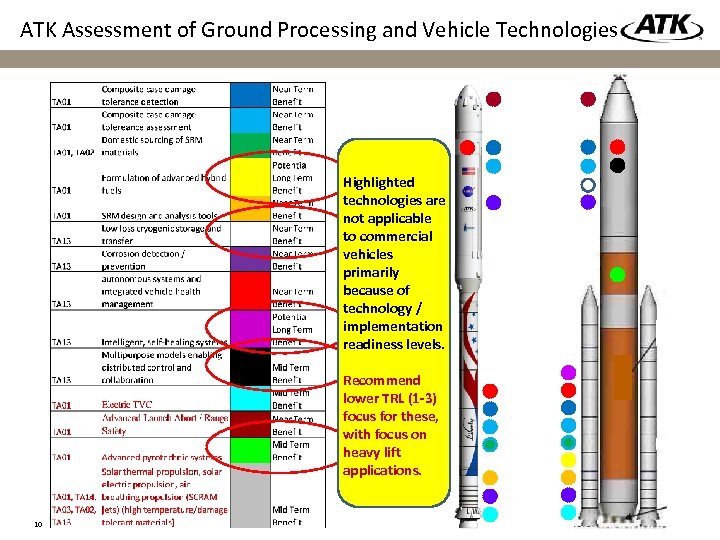 ATK Assessment of Ground Processing and Vehicle Technologies Highlighted technologies are not applicable to commercial vehicles primarily because of technology / implementation readiness levels. Recommend lower TRL (1 -3) focus for these, with focus on heavy lift applications. 10
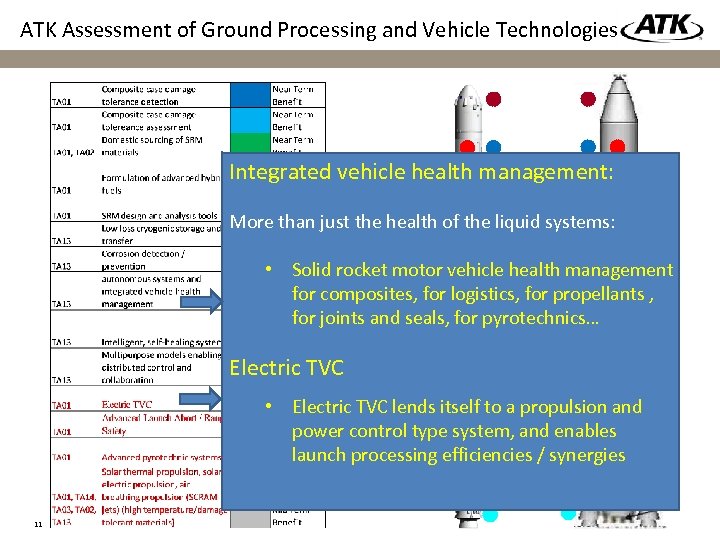 ATK Assessment of Ground Processing and Vehicle Technologies Integrated vehicle health management: More than just the health of the liquid systems: • Solid rocket motor vehicle health management for composites, for logistics, for propellants , for joints and seals, for pyrotechnics… Electric TVC • Electric TVC lends itself to a propulsion and power control type system, and enables launch processing efficiencies / synergies 11
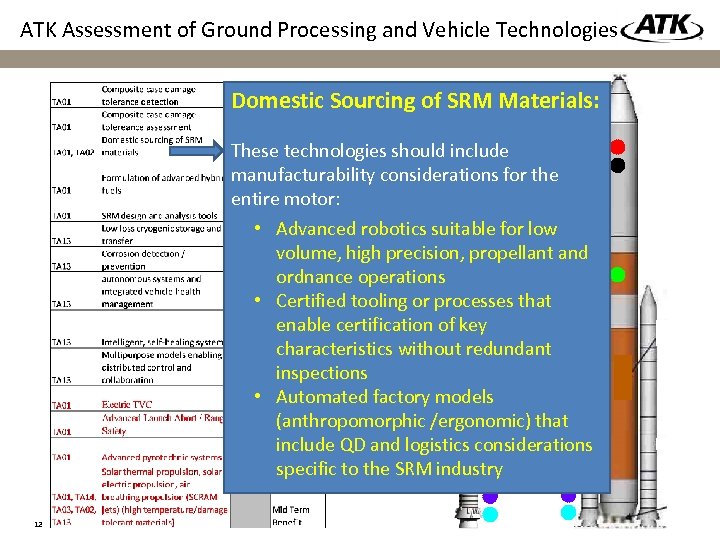 ATK Assessment of Ground Processing and Vehicle Technologies Domestic Sourcing of SRM Materials: These technologies should include manufacturability considerations for the entire motor: • Advanced robotics suitable for low volume, high precision, propellant and ordnance operations • Certified tooling or processes that enable certification of key characteristics without redundant inspections • Automated factory models (anthropomorphic /ergonomic) that include QD and logistics considerations specific to the SRM industry 12
 Conclusion • Application of both liquid and solid propulsion elements are necessary to optimize the overall system – Reliability – Performance – Cost • The majority of the technologies identified can benefit both commercial vehicles or heavy lift vehicles – Most benefit both solids and liquids 13
 ATK Assessment of Ground Processing and Vehicle Technologies Questions? 14