 Скачать презентацию NASA Human Research Program Behavioral Health and Performance
8d1ce3a162bd07c4897cc4c0c9cdf9aa.ppt
- Количество слайдов: 16



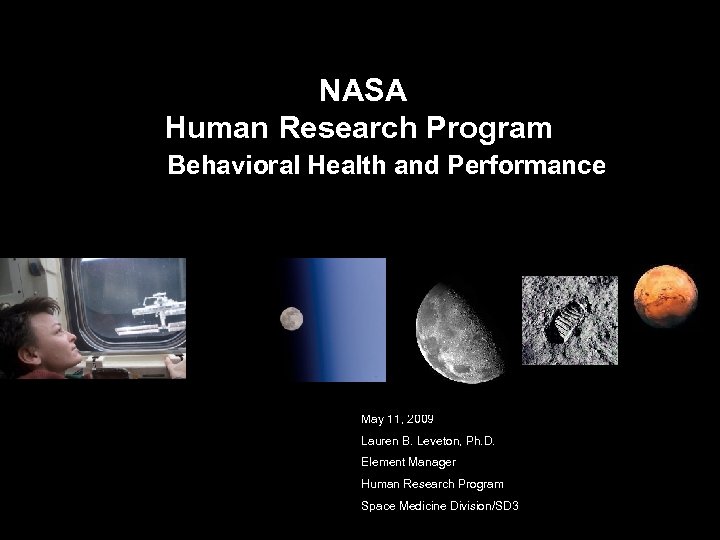
NASA Human Research Program Behavioral Health and Performance May 11, 2009 Lauren B. Leveton, Ph. D. Element Manager Human Research Program Space Medicine Division/SD 3
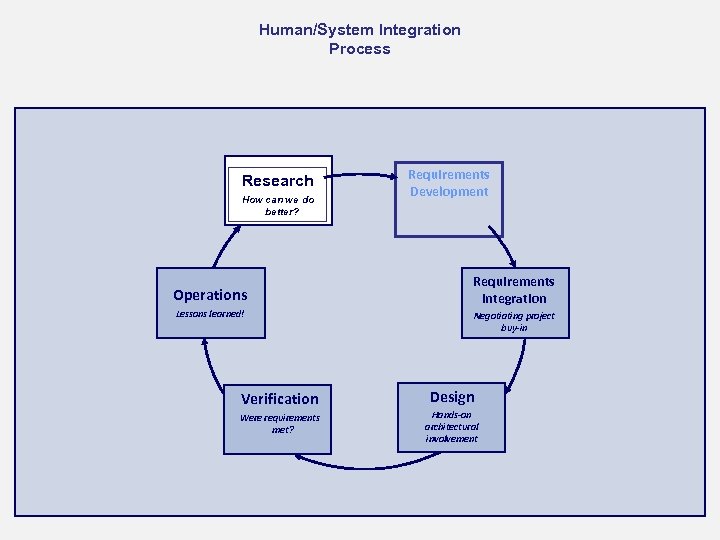
Human/System Integration Process Research How can we do better? Operations Lessons learned! Verification Were requirements met? Requirements Development Requirements Integration Negotiating project buy-in Design Hands-on architectural involvement
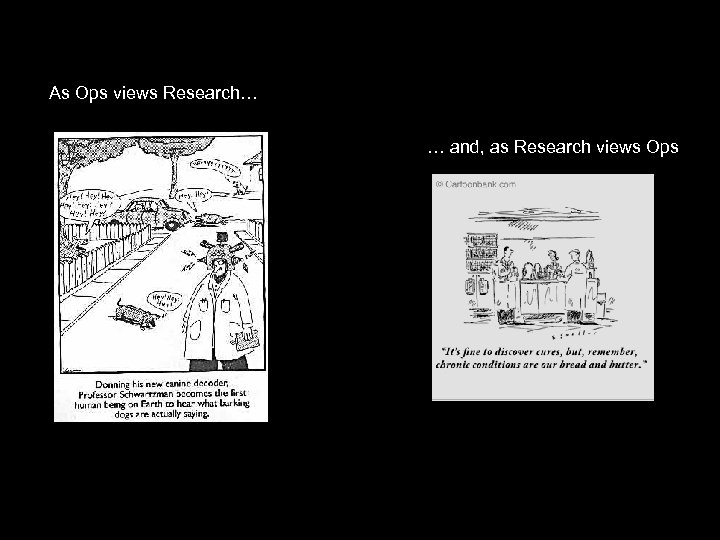
As Ops views Research… … and, as Research views Ops Fl h ig t
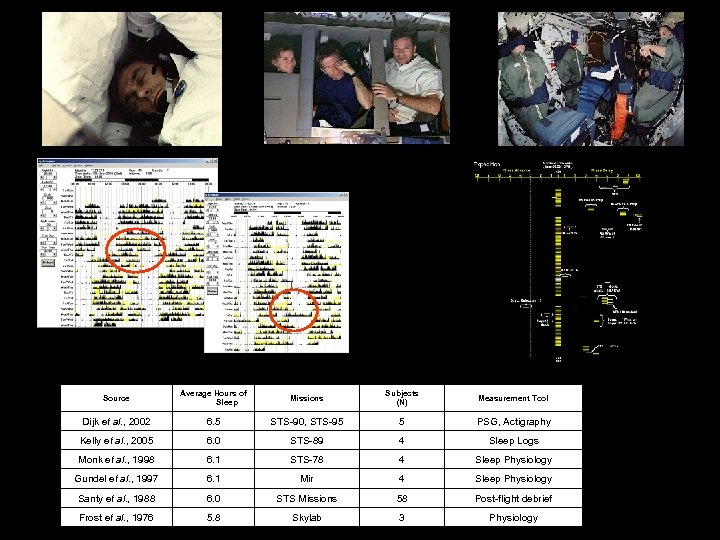
ig 6. 5 Missions Subjects (N) Measurement Tool STS-90, STS-95 5 PSG, Actigraphy 6. 0 STS-89 4 Sleep Logs Monk et al. , 1998 6. 1 STS-78 4 Sleep Physiology Gundel et al. , 1997 6. 1 Mir 4 Sleep Physiology Santy et al. , 1988 6. 0 STS Missions 58 Post-flight debrief Frost et al. , 1976 5. 8 Skylab 3 Physiology Source Dijk et al. , 2002 Kelly et al. , 2005 Average Hours of Sleep Fl ht
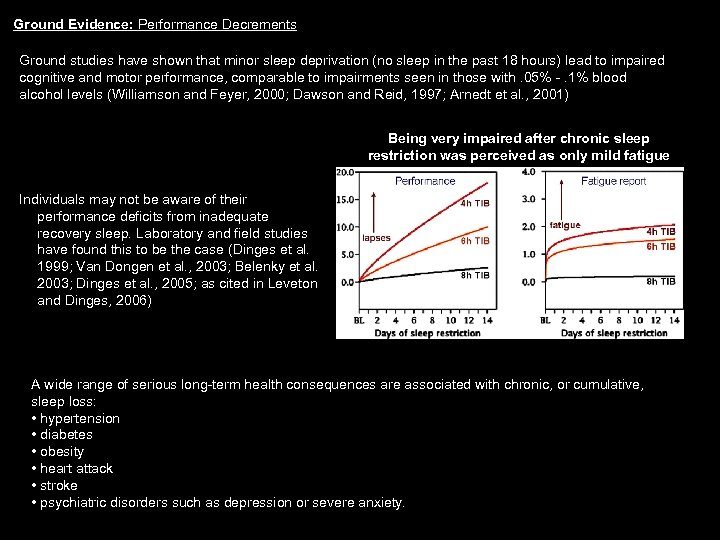
Ground Evidence: Performance Decrements Ground studies have shown that minor sleep deprivation (no sleep in the past 18 hours) lead to impaired cognitive and motor performance, comparable to impairments seen in those with. 05% -. 1% blood alcohol levels (Williamson and Feyer, 2000; Dawson and Reid, 1997; Arnedt et al. , 2001) Being very impaired after chronic sleep restriction was perceived as only mild fatigue Individuals may not be aware of their performance deficits from inadequate recovery sleep. Laboratory and field studies have found this to be the case (Dinges et al. 1999; Van Dongen et al. , 2003; Belenky et al. 2003; Dinges et al. , 2005; as cited in Leveton and Dinges, 2006) A wide range of serious long-term health consequences are associated with chronic, or cumulative, sleep loss: • hypertension • diabetes • obesity • heart attack • stroke • psychiatric disorders such as depression or severe anxiety.
Cultural Issues: “To understand sleep – wake activity, let’s study Gyroscopes on the Station”
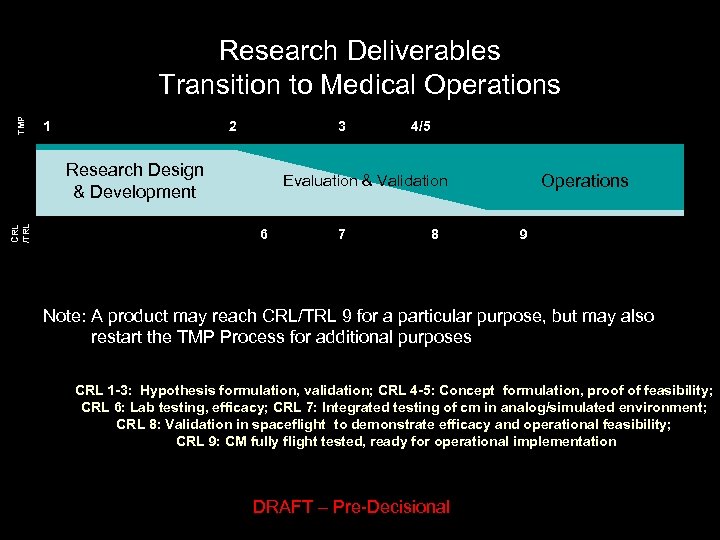
TMP Research Deliverables Transition to Medical Operations 1 2 3 CRL /TRL Research Design & Development 4/5 Operations Evaluation & Validation 6 7 8 9 Note: A product may reach CRL/TRL 9 for a particular purpose, but may also restart the TMP Process for additional purposes CRL 1 -3: Hypothesis formulation, validation; CRL 4 -5: Concept formulation, proof of feasibility; CRL 6: Lab testing, efficacy; CRL 7: Integrated testing of cm in analog/simulated environment; CRL 8: Validation in spaceflight to demonstrate efficacy and operational feasibility; CRL 9: CM fully flight tested, ready for operational implementation 3/31/09 DRAFT – Pre-Decisional 8
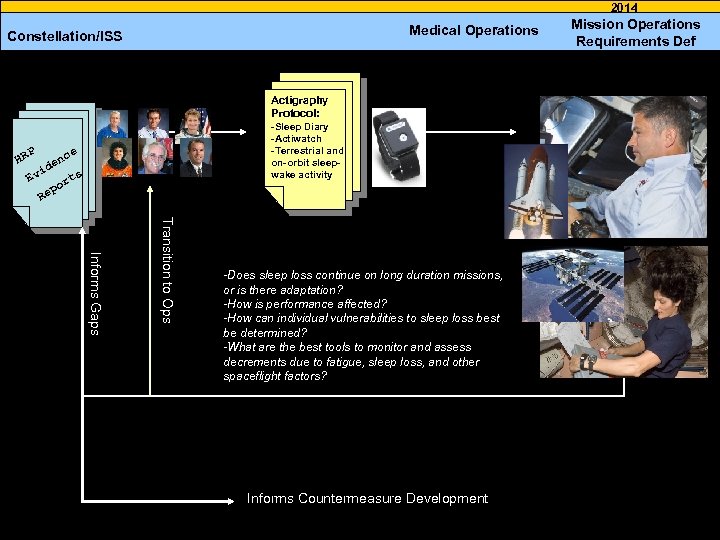
2014 Medical Operations Constellation/ISS Actigraphy Protocol: P HR e id Ev -Sleep Diary -Actiwatch -Terrestrial and on-orbit sleepwake activity e nc ts r po Re Transition to Ops Informs Gaps -Does sleep loss continue on long duration missions, or is there adaptation? -How is performance affected? -How can individual vulnerabilities to sleep loss best be determined? -What are the best tools to monitor and assess decrements due to fatigue, sleep loss, and other spaceflight factors? Informs Countermeasure Development Mission Operations Requirements Def
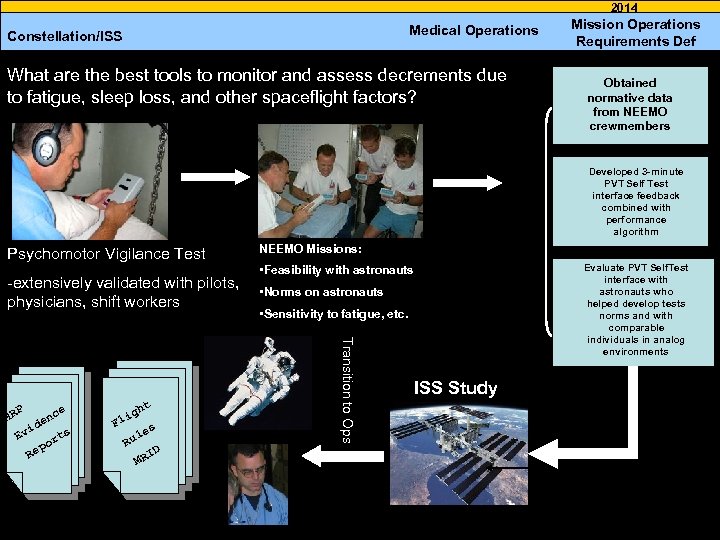
2014 Medical Operations Constellation/ISS What are the best tools to monitor and assess decrements due to fatigue, sleep loss, and other spaceflight factors? Mission Operations Requirements Def Obtained normative data from NEEMO crewmembers Developed 3 -minute PVT Self Test interface feedback combined with performance algorithm Psychomotor Vigilance Test -extensivelyevalidated with pilots, nc de i physicians, shift workers Ev c en id Ev R o ep e s rt ht ig Fl es ul R ID MR • Feasibility with astronauts • Norms on astronauts • Sensitivity to fatigue, etc. Transition to Ops P HR NEEMO Missions: ISS Study Evaluate PVT Self. Test interface with astronauts who helped develop tests norms and with comparable individuals in analog environments
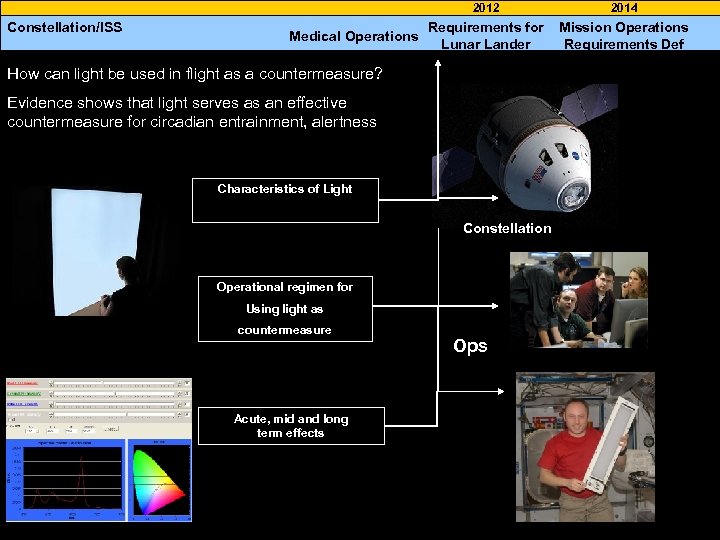
2012 Constellation/ISS Medical Operations 2014 Requirements for Lunar Lander Mission Operations Requirements Def How can light be used in flight as a countermeasure? Evidence shows that light serves as an effective countermeasure for circadian entrainment, alertness Characteristics of Light Constellation i Ev n de ce Operational regimen for Using light as countermeasure Acute, mid and long term effects Ops
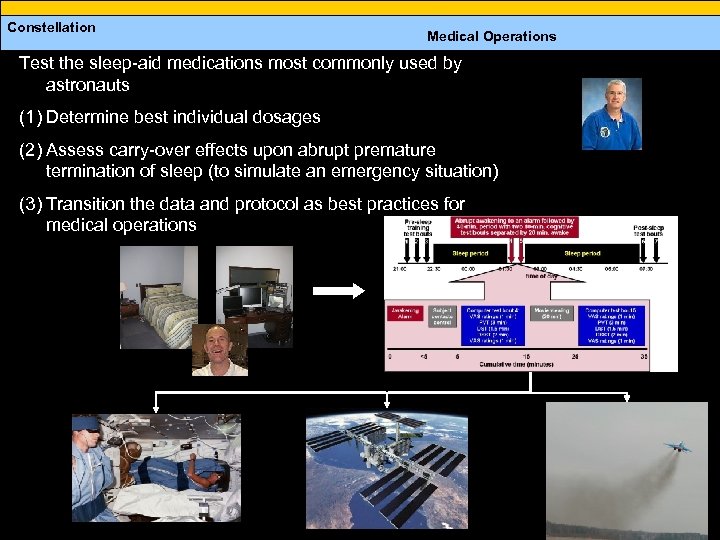
Constellation Medical Operations Test the sleep-aid medications most commonly used by astronauts (1) Determine best individual dosages (2) Assess carry-over effects upon abrupt premature termination of sleep (to simulate an emergency situation) (3) Transition the data and protocol as best practices for medical operations
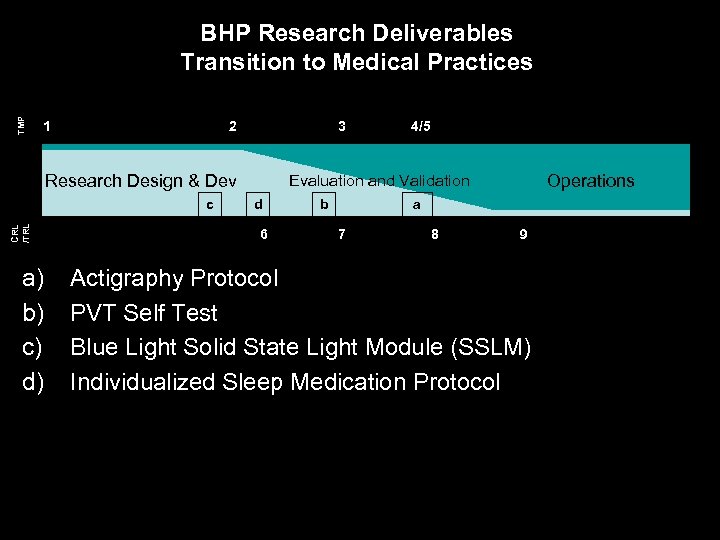
TMP BHP Research Deliverables Transition to Medical Practices 1 2 3 Research Design & Dev CRL /TRL c Operations Evaluation and Validation d 6 a) b) c) d) 4/5 b a 7 8 9 Actigraphy Protocol PVT Self Test Blue Light Solid State Light Module (SSLM) Individualized Sleep Medication Protocol 3/31/09
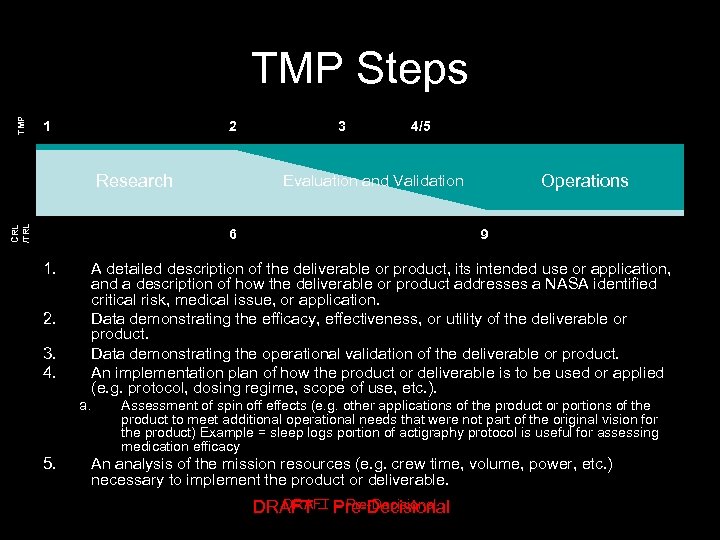
TMP Steps 1 2 CRL /TRL Research 3 4/5 6 1. 2. 3. 4. 9 A detailed description of the deliverable or product, its intended use or application, and a description of how the deliverable or product addresses a NASA identified critical risk, medical issue, or application. Data demonstrating the efficacy, effectiveness, or utility of the deliverable or product. Data demonstrating the operational validation of the deliverable or product. An implementation plan of how the product or deliverable is to be used or applied (e. g. protocol, dosing regime, scope of use, etc. ). a. 5. Operations Evaluation and Validation Assessment of spin off effects (e. g. other applications of the product or portions of the product to meet additional operational needs that were not part of the original vision for the product) Example = sleep logs portion of actigraphy protocol is useful for assessing medication efficacy An analysis of the mission resources (e. g. crew time, volume, power, etc. ) necessary to implement the product or deliverable. 3/31/09 DRAFT – Pre-Decisional 14

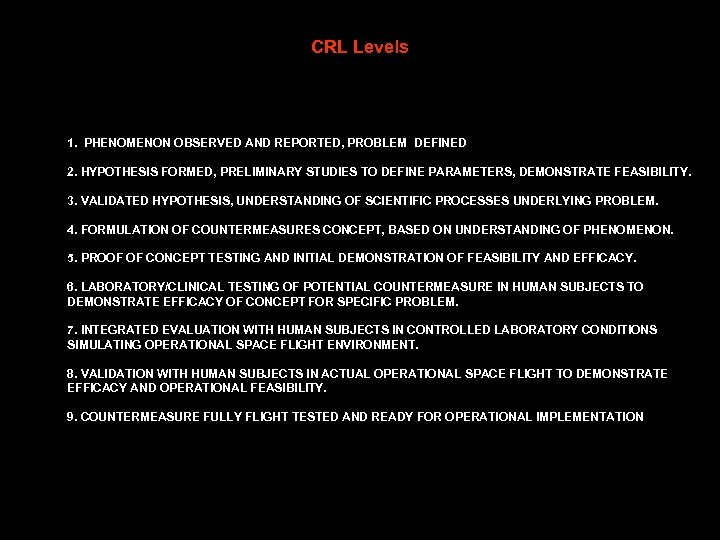
CRL Levels 1. PHENOMENON OBSERVED AND REPORTED, PROBLEM DEFINED 2. HYPOTHESIS FORMED, PRELIMINARY STUDIES TO DEFINE PARAMETERS, DEMONSTRATE FEASIBILITY. 3. VALIDATED HYPOTHESIS, UNDERSTANDING OF SCIENTIFIC PROCESSES UNDERLYING PROBLEM. 4. FORMULATION OF COUNTERMEASURES CONCEPT, BASED ON UNDERSTANDING OF PHENOMENON. 5. PROOF OF CONCEPT TESTING AND INITIAL DEMONSTRATION OF FEASIBILITY AND EFFICACY. 6. LABORATORY/CLINICAL TESTING OF POTENTIAL COUNTERMEASURE IN HUMAN SUBJECTS TO DEMONSTRATE EFFICACY OF CONCEPT FOR SPECIFIC PROBLEM. 7. INTEGRATED EVALUATION WITH HUMAN SUBJECTS IN CONTROLLED LABORATORY CONDITIONS SIMULATING OPERATIONAL SPACE FLIGHT ENVIRONMENT. 8. VALIDATION WITH HUMAN SUBJECTS IN ACTUAL OPERATIONAL SPACE FLIGHT TO DEMONSTRATE EFFICACY AND OPERATIONAL FEASIBILITY. 9. COUNTERMEASURE FULLY FLIGHT TESTED AND READY FOR OPERATIONAL IMPLEMENTATION
Скачать презентацию NASA Human Research Program Behavioral Health and Performance
8d1ce3a162bd07c4897cc4c0c9cdf9aa.ppt