 Скачать презентацию NASA Drought Project Meeting October 2009 National Drought
130793988dd8330b49a5c95da59e6b9e.ppt
- Количество слайдов: 12



NASA Drought Project Meeting October 2009 National Drought Monitoring System for Drought Early Warning Using Hydrologic and Ecologic Observations from NASA Satellite Data S. V. Nghiem and G. Neumann Jet Propulsion Laboratory California Institute of Technology Pasadena, California 91109
Investigator Team • Brakenridge, G. R. : Dartmouth College • Dole, R. : NOAA Physical Science Division • Le Comte, D. : NOAA Climate Prediction Center • Nghiem, S. V. : Jet Propulsion Laboratory • Njoku, E. G. : Jet Propulsion Laboratory • Verdin, J. : U. S. Geological Survey • Wilhite, D. : National Drought Mitigation Center Advisory Board: D. Entekhabi (MIT), D. Hall (NASA GSFC), P. Houser (George Mason U. ), A. Huete (U. Arizona), G. Leshkevich (NOAA GLERL), K. Steffen (U. Colorado/CIRES), and P. Whung (USDA).
Overall Objectives National Drought Monitoring System (NDMS) • Enhancing U. S. Drought Monitor (USDM) • Potential NASA data use for drought forecast • Utilizing NASA satellite data/results: AMSRE microwave radiometer, Quik. SCAT microwave scatterometer, MODIS spectroradiometer, and ASTER radiometer • Integrating with diverse indicators to monitor major components of hydrologic and ecologic system • Prototype demonstration and validation Near-term goal: Applications to NIDIS. Long-term goal: Expandable to GEOSS.
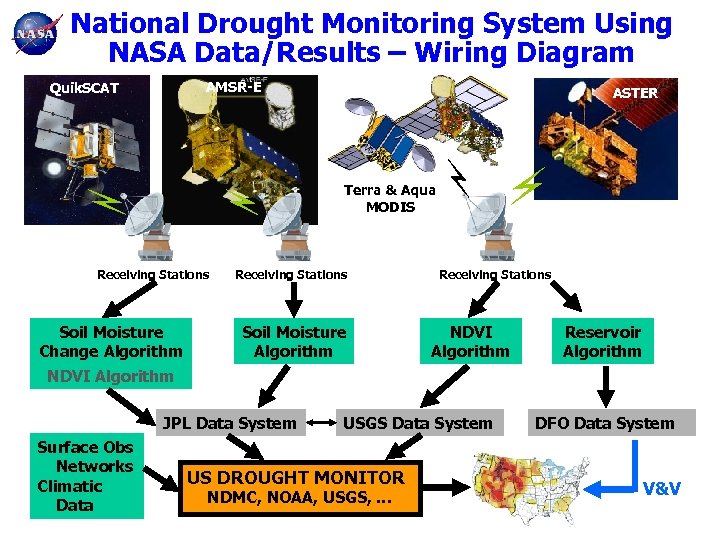
National Drought Monitoring System Using NASA Data/Results – Wiring Diagram AMSR-E Quik. SCAT ASTER Terra & Aqua MODIS Receiving Stations Soil Moisture Change Algorithm Receiving Stations Soil Moisture Algorithm Receiving Stations NDVI Algorithm Reservoir Algorithm NDVI Algorithm JPL Data System Surface Obs Networks Climatic Data USGS Data System US DROUGHT MONITOR NDMC, NOAA, USGS, … DFO Data System V&V
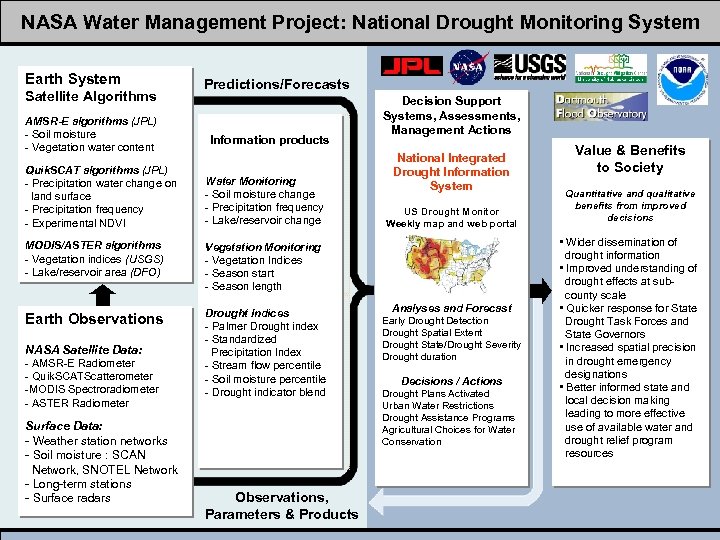
NASA Water. Integrated Project: National Drought. National System Management System Solution: Monitoring Drought Information System Earth System Satellite Algorithms AMSR-E algorithms (JPL) - Soil moisture - Vegetation water content Quik. SCAT algorithms (JPL) - Precipitation water change on land surface - Precipitation frequency - Experimental NDVI Predictions/Forecasts Information products Water Monitoring - Soil moisture change - Precipitation frequency - Lake/reservoir change MODIS/ASTER algorithms - Vegetation indices (USGS) - Lake/reservoir area (DFO) Earth Observations National Integrated Drought Information System US Drought Monitor Weekly map and web portal Vegetation Monitoring - Vegetation Indices - Season start - Season length Drought Indices - Palmer Drought index - Standardized Precipitation Index - Stream flow percentile - Soil moisture percentile - Drought indicator blend Decision Support Systems, Assessments, Management Actions NASA Satellite Data: - AMSR-E Radiometer - Quik. SCATScatterometer -MODIS Spectroradiometer - ASTER Radiometer Surface Data: - Weather station networks - Soil moisture : SCAN Network, SNOTEL Network - Long-term stations - Surface radars Observations, Parameters & Products Analyses and Forecast Early Drought Detection Drought Spatial Extent Drought State/Drought Severity Drought duration Decisions / Actions Drought Plans Activated Urban Water Restrictions Drought Assistance Programs Agricultural Choices for Water Conservation Value & Benefits to Society Quantitative and qualitative benefits from improved decisions • Wider dissemination of drought information • Improved understanding of drought effects at subcounty scale • Quicker response for State Drought Task Forces and State Governors • Increased spatial precision in drought emergency designations • Better informed state and local decision making leading to more effective use of available water and drought relief program resources
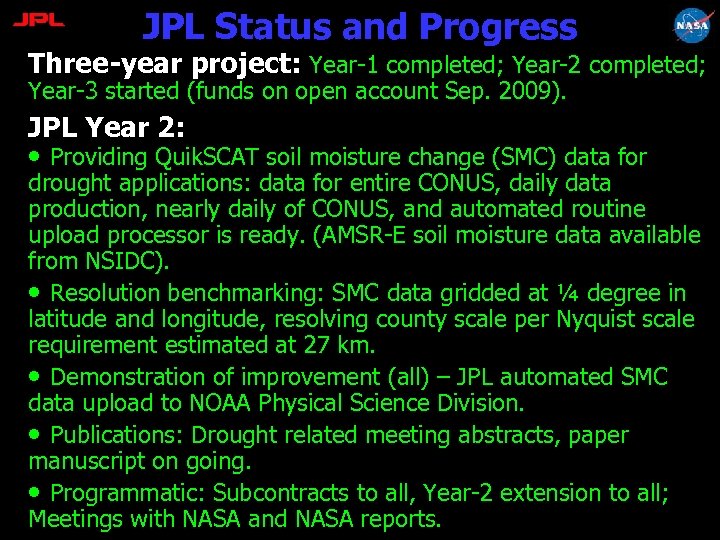
JPL Status and Progress Three-year project: Year-1 completed; Year-2 completed; Year-3 started (funds on open account Sep. 2009). JPL Year 2: • Providing Quik. SCAT soil moisture change (SMC) data for drought applications: data for entire CONUS, daily data production, nearly daily of CONUS, and automated routine upload processor is ready. (AMSR-E soil moisture data available from NSIDC). • Resolution benchmarking: SMC data gridded at ¼ degree in latitude and longitude, resolving county scale per Nyquist scale requirement estimated at 27 km. • Demonstration of improvement (all) – JPL automated SMC data upload to NOAA Physical Science Division. • Publications: Drought related meeting abstracts, paper manuscript on going. • Programmatic: Subcontracts to all, Year-2 extension to all; Meetings with NASA and NASA reports.
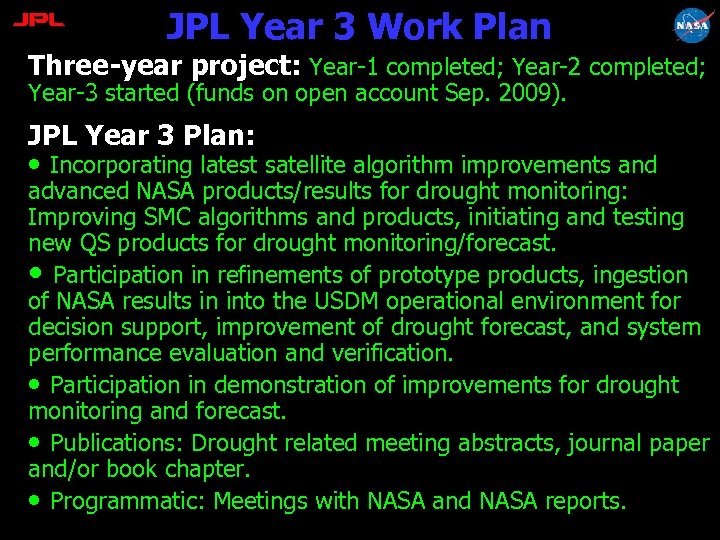
JPL Year 3 Work Plan Three-year project: Year-1 completed; Year-2 completed; Year-3 started (funds on open account Sep. 2009). JPL Year 3 Plan: • Incorporating latest satellite algorithm improvements and advanced NASA products/results for drought monitoring: Improving SMC algorithms and products, initiating and testing new QS products for drought monitoring/forecast. • Participation in refinements of prototype products, ingestion of NASA results in into the USDM operational environment for decision support, improvement of drought forecast, and system performance evaluation and verification. • Participation in demonstration of improvements for drought monitoring and forecast. • Publications: Drought related meeting abstracts, journal paper and/or book chapter. • Programmatic: Meetings with NASA and NASA reports.
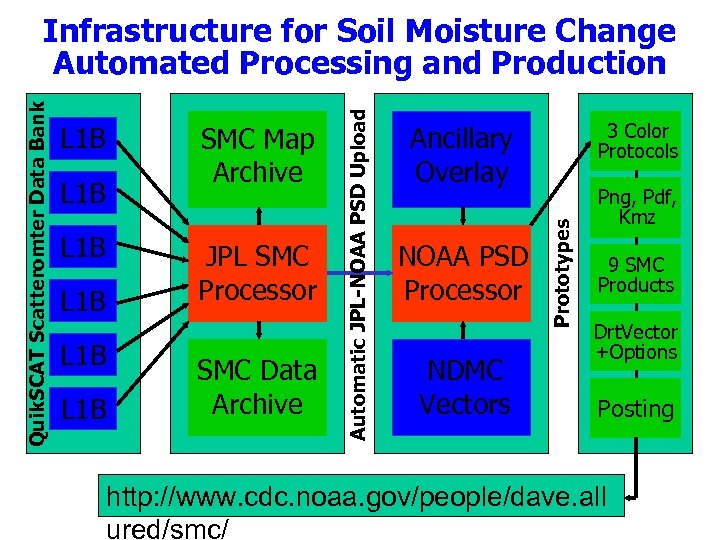
SMC Map Archive L 1 B JPL SMC Processor L 1 B SMC Data Archive 3 Color Protocols Ancillary Overlay NOAA PSD Processor NDMC Vectors Prototypes L 1 B Automatic JPL-NOAA PSD Upload Quik. SCAT Scatteromter Data Bank Infrastructure for Soil Moisture Change Automated Processing and Production Png, Pdf, Kmz 9 SMC Products Drt. Vector +Options Posting http: //www. cdc. noaa. gov/people/dave. all ured/smc/
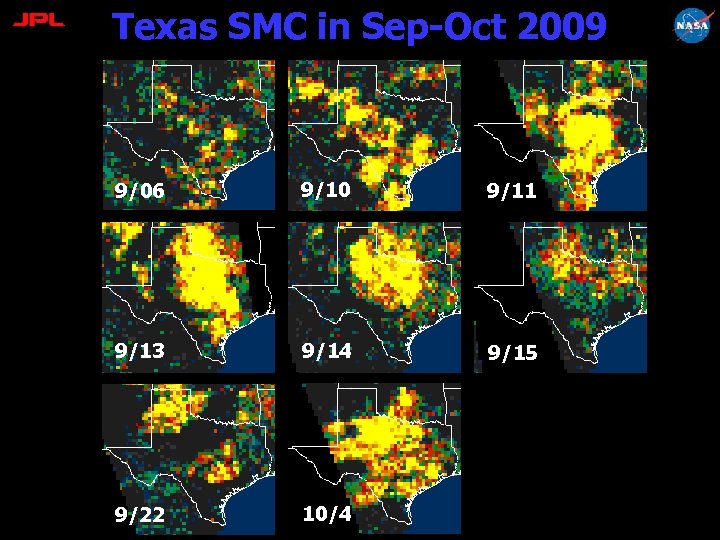
Texas SMC in Sep-Oct 2009 9/06 9/10 9/11 9/13 9/14 9/15 9/22 10/4
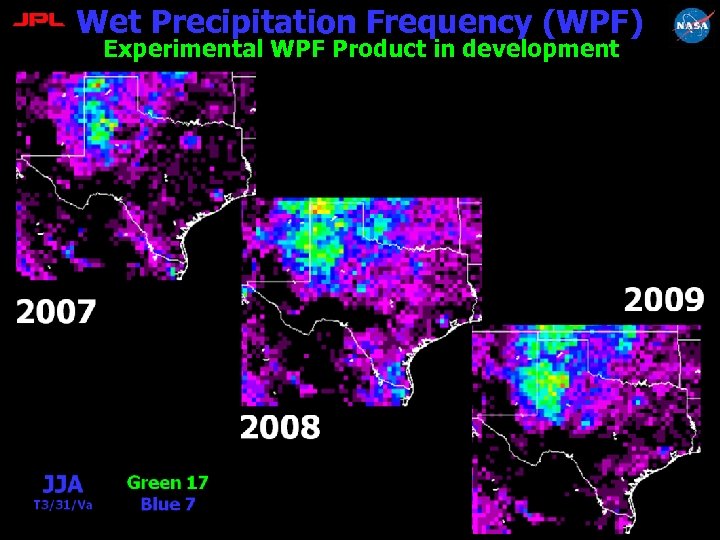
Wet Precipitation Frequency (WPF) Experimental WPF Product in development
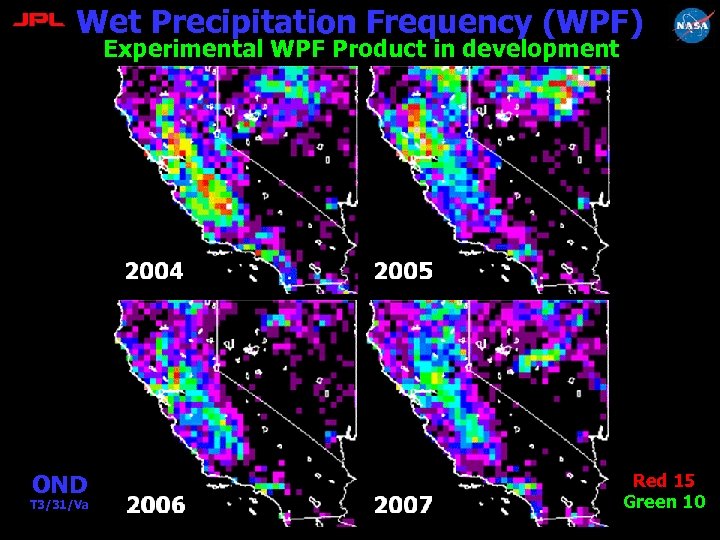
Wet Precipitation Frequency (WPF) Experimental WPF Product in development OND T 3/31/Va Red 15 Green 10
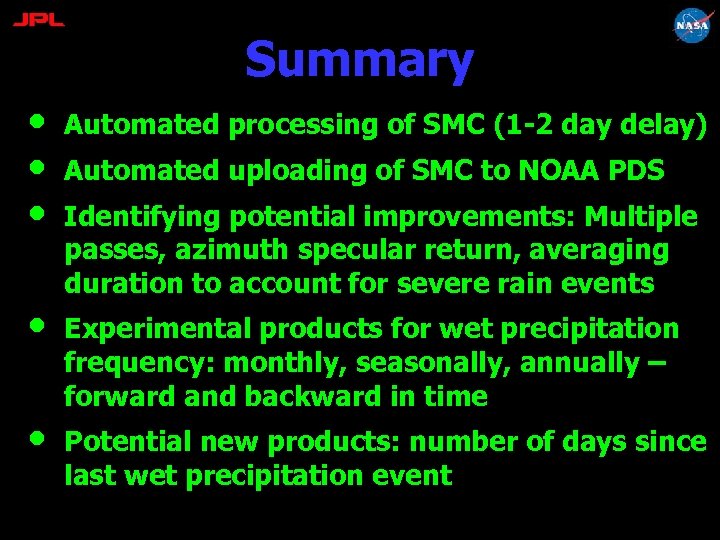
Summary • • • Automated processing of SMC (1 -2 day delay) • Experimental products for wet precipitation frequency: monthly, seasonally, annually – forward and backward in time • Potential new products: number of days since last wet precipitation event Automated uploading of SMC to NOAA PDS Identifying potential improvements: Multiple passes, azimuth specular return, averaging duration to account for severe rain events
Скачать презентацию NASA Drought Project Meeting October 2009 National Drought
130793988dd8330b49a5c95da59e6b9e.ppt