


 Скачать презентацию NASA AIST Projects Cloud Computing Michael M Little nasa
d9198361d0926553096c0a00ac495fa1.ppt
- Количество слайдов: 11
 NASA AIST Projects: Cloud Computing Michael. M. Little@nasa. gov
 What’s the Role of AIST? • The objectives of the AIST Program are to research, develop, and demonstrate advanced information system technologies that: – Reduce the risk, cost, size, and development time for Earth science space-based and groundbased information systems, – Increase the accessibility and utility of science data, and – Enable new observations and information products. • The AIST Program Focuses on three Technology Areas: – Operations Technologies – broadly support the future challenges of operating NASA’s Earth science space-based, airborne or ground-based systems – Computational Technologies – operate directly on Earth Science data produced by sensors (real or simulated) to improve/enhance information extracted from the data stream or model outputs, measurements to be acquired by a new mission or science campaign, or researchers’ tools for analytics (including development of quantum annealing algorithms) – Data-Centric Technologies – broadly support the science and applications communities in conducting the sequence of activities needed to transform Earth science observational data to improve information re-use, facilitate collaboration within the research community, and increase the speed with which results are produced and published Earth Science Technology Office (ESTO)
 AIST Funds Two Major Cloud Efforts • AIST Managed Cloud Environment (AMCE) • Technology Developments which need Cloud Computing – SAR Science Data Processing • i. ISCE • ARIA series of projects Earth Science Technology Office (ESTO)
 AMCE: Overview Managing wide-spread use of AWS cloud resources by individual scientific teams • Ensure PI-led Teams have access to as much capability as possible – Fast-track AWS capabilities as soon as FEDRAMP approved • Avoid Financial Management and Procurement Problems – Ensure resource consumption is properly tagged (automatically) • Minimize Computer Security Problems – Provide an Authorization to Operate for public information with minimum restriction • Minimize management overhead costs through automation Earth Science Technology Office (ESTO)
 AMCE: Implementation • Objective: – Supply AWS cloud resources instead of paying for University/Center/Company computer hardware or time – Demonstrate a model by which Science users can leverage AWS to reduce their computing costs and accelerate science • AIST Project Users of Compute Resources – Awardees receive an allocation of funding on AIST support cloud, based on their proposal estimates • • • NASA awardees University awardees without NASA credentials Industry (non-contractor) awardees without NASA credentials Other Government Agency awardees without NASA credentials Non-US citizens are expected to be on most teams – Awardees require supercomputing resources and apply for an allocation under HEC – During initial startup, all SBU computing will be handled by PI on their own • AIST Overhead – Cost of cloud management software (DC 2) and instance to run it on – Computer Security instance – Computer Security labor moving up learning curve (anything above and beyond that required for onsite computer systems) – Cloud Sys. Admin and Business Management labor Earth Science Technology Office (ESTO)
 AMCE: Concept of Operations • Analogous to running an apartment building – Some projects need to be in a single family dwelling • Fundamental Principles – Provide Project PI with maximum flexibility in determining what to use in AWS – Ensure that projects are protected from each other • Orientation should include how to avoid interfering with other projects – Ensure that projects do not over run their budget – Monitor compliance with essential Computer Security restrictions – Automate overrun notices: alert, warning and shutdown • PI, PI’s privileged users, PI’s • AIST Project Manager and AIST Technical Manager notifications • AIST PM notified before. Earth Science Technology Office (ESTO) instance shutdown
 AMCE: Research to Ops Transition • Reduce cost of refactoring to run in a NASA environment – Use accepted Operating Systems (OS), libraries, security measures • Pre-scanned – Central authority for reviewing/approving images updates • Schedule for de-authorizing environment images – Build in log distribution to CSO Instance to detect incidents – Appropriate forensic data for post-incident analysis • Potentially avoid re-installation when apply technology to Software as a Service – Integration with other Science assets, like NEX or NCCS • Encourage use of source control, documentation tools • Improve ability to conduct independent testing per AIST requirements Earth Science Technology Office (ESTO)
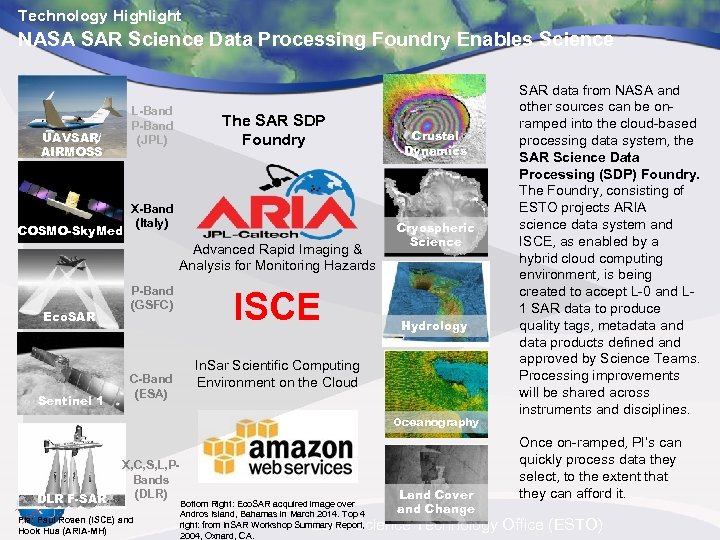 Technology Highlight NASA SAR Science Data Processing Foundry Enables Science L-Band P-Band (JPL) UAVSAR/ AIRMOSS COSMO-Sky. Med The SAR SDP Foundry X-Band (Italy) Advanced Rapid Imaging & Analysis for Monitoring Hazards Eco. SAR Sentinel 1 P-Band (GSFC) C-Band (ESA) ISCE Crustal Dynamics Cryospheric Science Hydrology In. Sar Scientific Computing Environment on the Cloud Oceanography DLR F-SAR X, C, S, L, PBands (DLR) PIs: Paul Rosen (ISCE) and Hook Hua (ARIA-MH) Bottom Right: Eco. SAR acquired image over Andros Island, Bahamas in March 2014. Top 4 right: from In. SAR Workshop Summary Report, 2004, Oxnard, CA. Land Cover and Change SAR data from NASA and other sources can be onramped into the cloud-based processing data system, the SAR Science Data Processing (SDP) Foundry. The Foundry, consisting of ESTO projects ARIA science data system and ISCE, as enabled by a hybrid cloud computing environment, is being created to accept L-0 and L 1 SAR data to produce quality tags, metadata and data products defined and approved by Science Teams. Processing improvements will be shared across instruments and disciplines. Once on-ramped, PI’s can quickly process data they select, to the extent that they can afford it. Earth Science Technology Office (ESTO)
 SAR SDP: Key Considerations • Any SAR mission can produce thousands to millions of images – Orbital global mapping produces data continuously – Sub-orbital flight missions and campaigns support specific objectives • Science Data Products vary depending on system design, domain and intended purpose – Radar frequency (Band) – Scanning strategy (multi-pass, single pass, etc) – Platform operations artifacts (orbital vs. aircraft) • Science Data Processing has some common characteristics – High volume of embarrassingly parallel processing jobs – Quality Assurance, metadata and registration of images – Cloud Computing offers scalable, if not affordable, solution • Prioritization for scheduling • Event Triggers • Low latency processing – Create metadata for provenance, geolocation, temporal, quality • A big pool of money is easily targeted for budget reductions Earth Science Technology Office (ESTO)
 SAR SDP: Foundry Concept • Definition – A set of user-selectable components which are implemented in a scalable processing environment to leveraging a common framework for producing community-accepted Science Data Products from SAR instruments – Support multiple research and applied science communities – Community review/acceptance of processing model and subsequent improvements – Community defined science data products • Components – Interface to Instruments which have been on-ramped – Production Processing Codes for Community defined Science Data Products which have been on-ramped – ISCE – Processing environment for instrument output – ARIA SDS – end-to-end SDS for SAR processing and data management – Hybrid Cloud – Provides scalable processing environment, including AWS – Foundry User Interface • Implements Business Model • Permits user selection of instrument, scenes, standard data products – EOS-DIS designated repository provides common destination for output products Earth Science Technology Office (ESTO)
 SAR SDP: Foundry Benefits • Processing is under the control of the customer with data and funding – JPL can leverage their cloud interface – NASA can leverage OCIO SEWP Acquisition and simply use a WBS instead of a PR – Non-NASA collaborators, through agreement, can buy their own processing on AWS • • • Hybrid cloud helps to keep cost as low as possible as the technology evolves – AWS Spot Pricing – Could move processing closer to data sources – Processing continues expensive, but could harvest idle local resources Processing environment is published and community-accepted Well defined processes for onramping instruments and data product specifications – Interface Control Documents publish requirements for L 0 and L 1 to permit processing – Instrument Team can account for high volume processing at initial product design • Processing improvements are shared among the science communities – Example: Reliable use of Spot-pricing • Science Data Products can become available to the communities regardless of who funded their production – Consistent with 2004 In. SAR Working Group Workshop Summary Report (10/20/2004) – Can also deliver to an optional destination for immediate use Earth Science Technology Office (ESTO)