


 Скачать презентацию Narrow Focus on Pre Nominal Modifiers in Spanish
b2391b1faf24b3de48d9b945be9aa185.ppt
- Количество слайдов: 28
 Narrow Focus on Pre. Nominal Modifiers in Spanish An Optimality Theoretic Analysis Brad Hoot University of Illinois at Chicago (bhoot 1@uic. edu) Hispanic Linguistics Symposium October 14 -17, 2010 Bloomington, Indiana
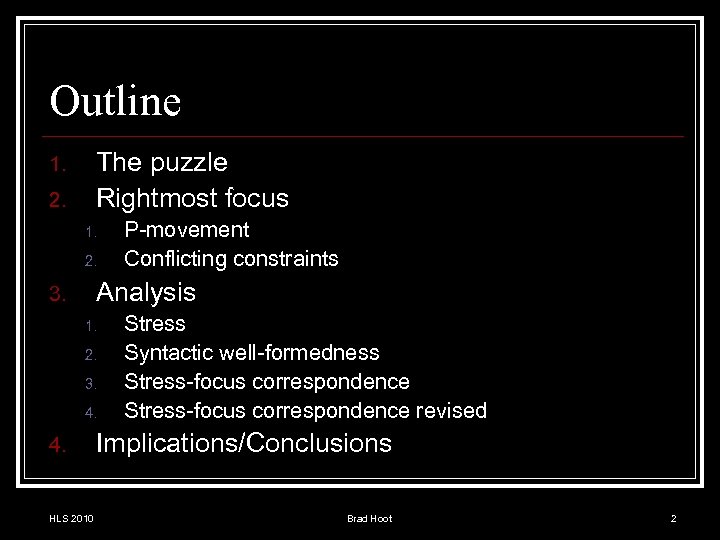 Outline The puzzle Rightmost focus 1. 2. P-movement Conflicting constraints Analysis 3. 1. 2. 3. 4. HLS 2010 Stress Syntactic well-formedness Stress-focus correspondence revised Implications/Conclusions Brad Hoot 2
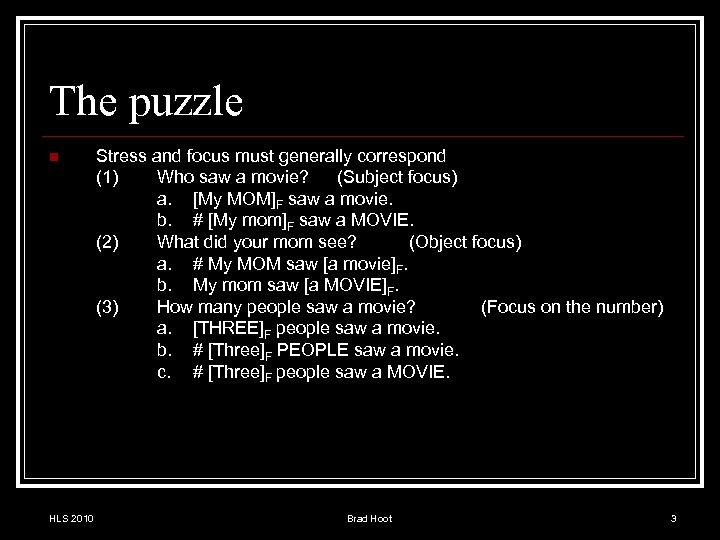 The puzzle n HLS 2010 Stress and focus must generally correspond (1) Who saw a movie? (Subject focus) a. [My MOM]F saw a movie. b. # [My mom]F saw a MOVIE. (2) What did your mom see? (Object focus) a. # My MOM saw [a movie]F. b. My mom saw [a MOVIE]F. (3) How many people saw a movie? (Focus on the number) a. [THREE]F people saw a movie. b. # [Three]F PEOPLE saw a movie. c. # [Three]F people saw a MOVIE. Brad Hoot 3
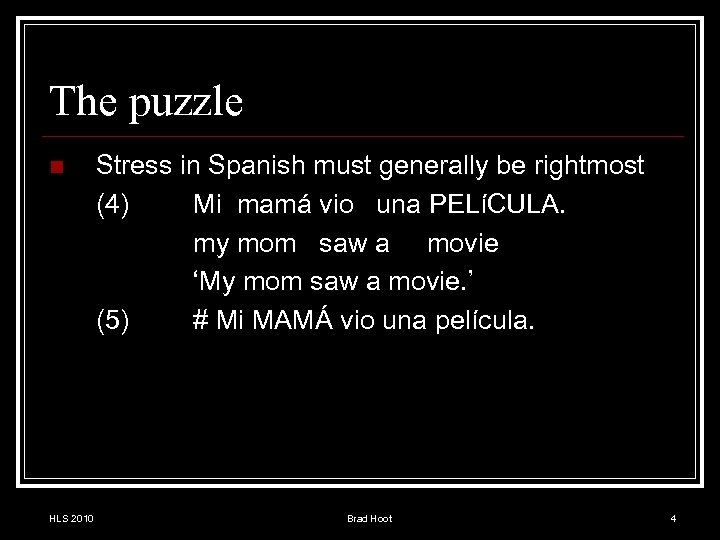 The puzzle n HLS 2010 Stress in Spanish must generally be rightmost (4) Mi mamá vio una PELíCULA. my mom saw a movie ‘My mom saw a movie. ’ (5) # Mi MAMÁ vio una película. Brad Hoot 4
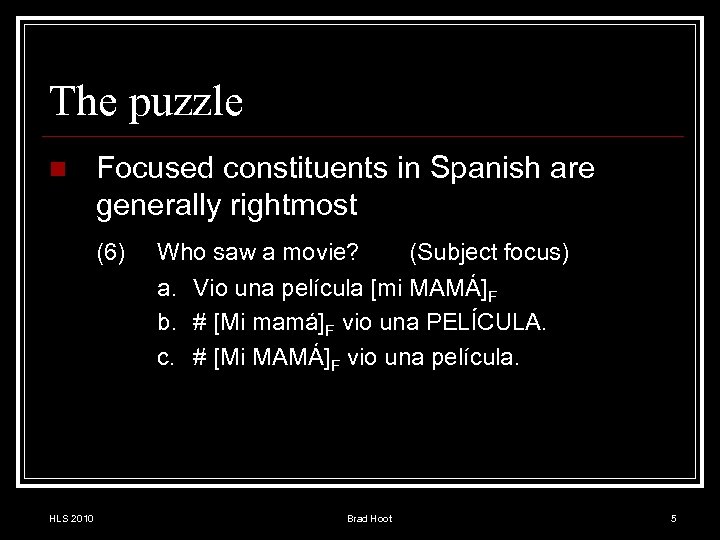 The puzzle n Focused constituents in Spanish are generally rightmost (6) Who saw a movie? (Subject focus) a. Vio una película [mi MAMÁ]F b. # [Mi mamá]F vio una PELÍCULA. c. # [Mi MAMÁ]F vio una película. HLS 2010 Brad Hoot 5
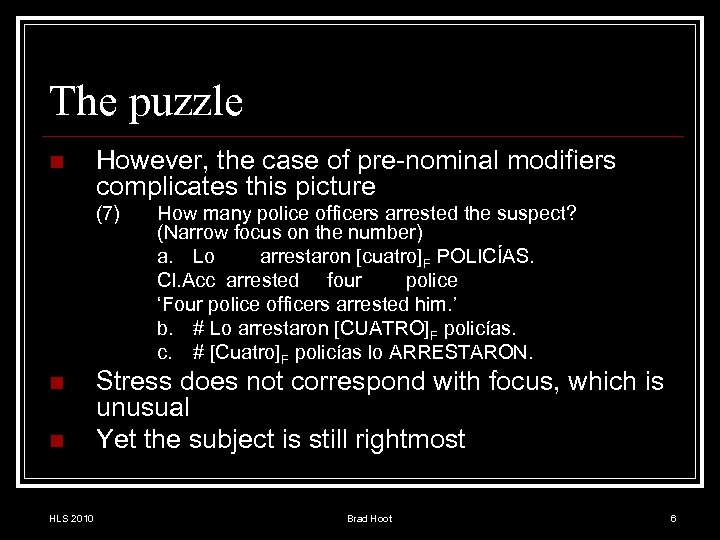 The puzzle n However, the case of pre-nominal modifiers complicates this picture (7) n n HLS 2010 How many police officers arrested the suspect? (Narrow focus on the number) a. Lo arrestaron [cuatro]F POLICÍAS. Cl. Acc arrested four police ‘Four police officers arrested him. ’ b. # Lo arrestaron [CUATRO]F policías. c. # [Cuatro]F policías lo ARRESTARON. Stress does not correspond with focus, which is unusual Yet the subject is still rightmost Brad Hoot 6
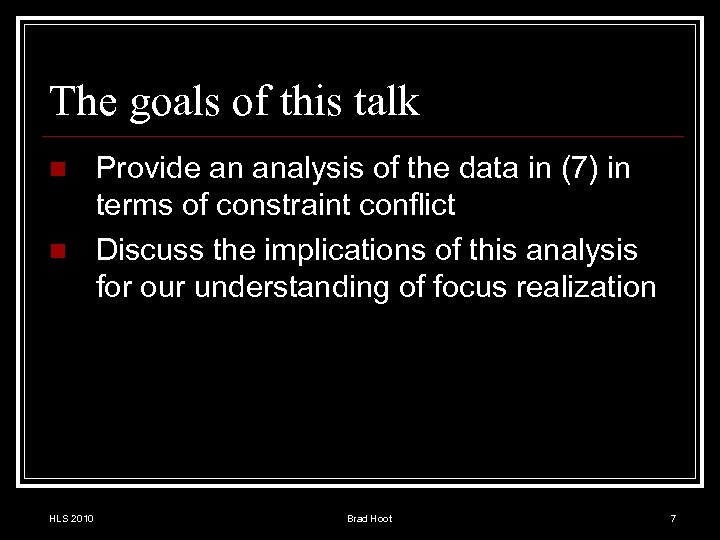 The goals of this talk n n HLS 2010 Provide an analysis of the data in (7) in terms of constraint conflict Discuss the implications of this analysis for our understanding of focus realization Brad Hoot 7
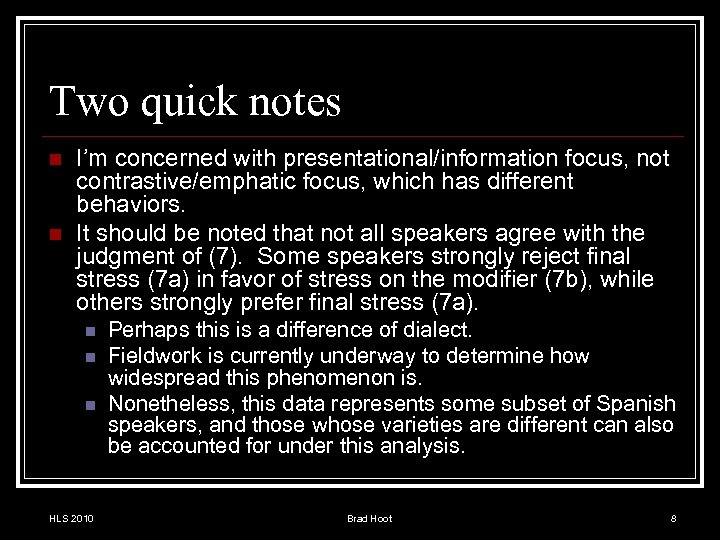 Two quick notes n n I’m concerned with presentational/information focus, not contrastive/emphatic focus, which has different behaviors. It should be noted that not all speakers agree with the judgment of (7). Some speakers strongly reject final stress (7 a) in favor of stress on the modifier (7 b), while others strongly prefer final stress (7 a). n n n HLS 2010 Perhaps this is a difference of dialect. Fieldwork is currently underway to determine how widespread this phenomenon is. Nonetheless, this data represents some subset of Spanish speakers, and those whose varieties are different can also be accounted for under this analysis. Brad Hoot 8
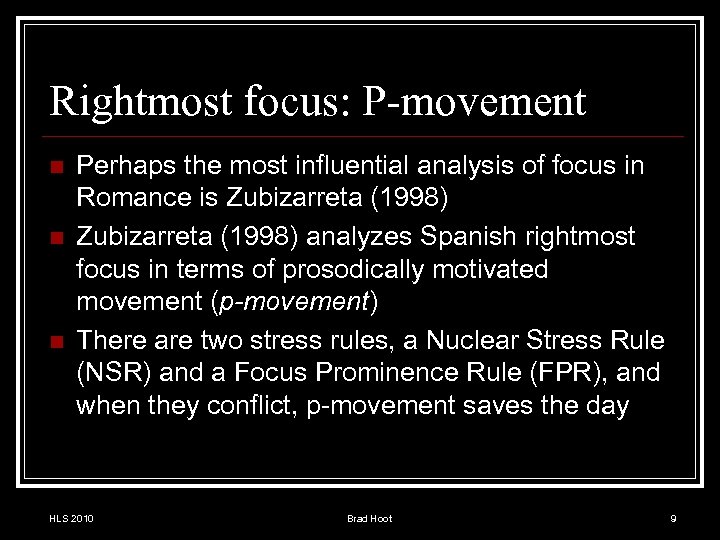 Rightmost focus: P-movement n n n Perhaps the most influential analysis of focus in Romance is Zubizarreta (1998) analyzes Spanish rightmost focus in terms of prosodically motivated movement (p-movement) There are two stress rules, a Nuclear Stress Rule (NSR) and a Focus Prominence Rule (FPR), and when they conflict, p-movement saves the day HLS 2010 Brad Hoot 9
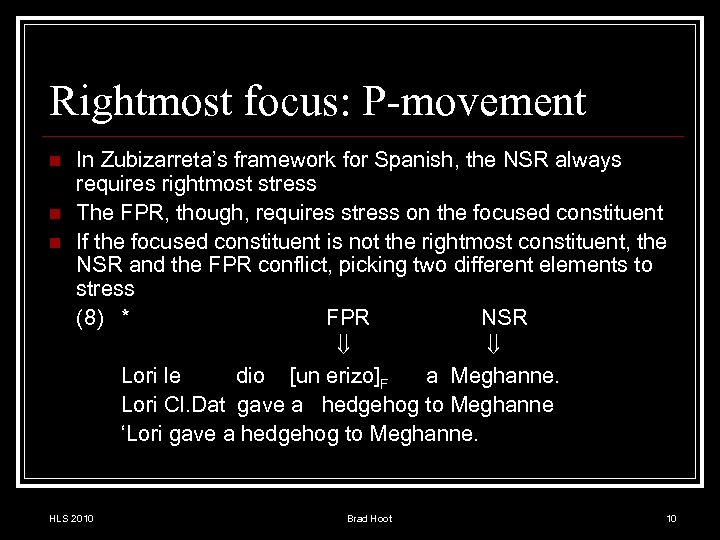 Rightmost focus: P-movement n n n In Zubizarreta’s framework for Spanish, the NSR always requires rightmost stress The FPR, though, requires stress on the focused constituent If the focused constituent is not the rightmost constituent, the NSR and the FPR conflict, picking two different elements to stress (8) * FPR NSR Lori le dio [un erizo]F a Meghanne. Lori Cl. Dat gave a hedgehog to Meghanne ‘Lori gave a hedgehog to Meghanne. HLS 2010 Brad Hoot 10
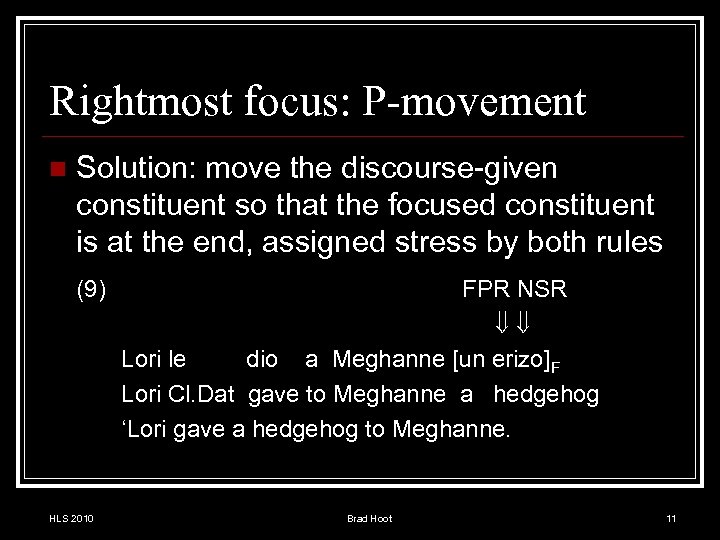 Rightmost focus: P-movement n Solution: move the discourse-given constituent so that the focused constituent is at the end, assigned stress by both rules (9) FPR NSR Lori le dio a Meghanne [un erizo]F Lori Cl. Dat gave to Meghanne a hedgehog ‘Lori gave a hedgehog to Meghanne. HLS 2010 Brad Hoot 11
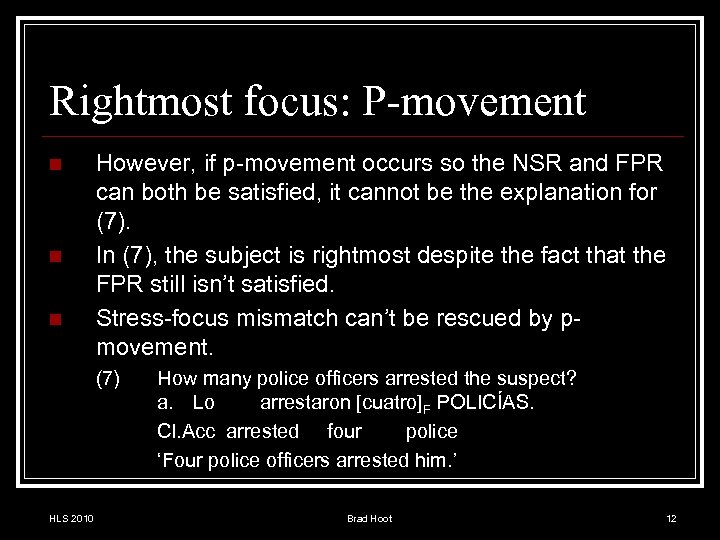 Rightmost focus: P-movement n n n However, if p-movement occurs so the NSR and FPR can both be satisfied, it cannot be the explanation for (7). In (7), the subject is rightmost despite the fact that the FPR still isn’t satisfied. Stress-focus mismatch can’t be rescued by pmovement. (7) HLS 2010 How many police officers arrested the suspect? a. Lo arrestaron [cuatro]F POLICÍAS. Cl. Acc arrested four police ‘Four police officers arrested him. ’ Brad Hoot 12
 Rightmost focus: Conflicting Constraints n n n HLS 2010 Büring & Gutiérrez-Bravo (2006), Gutiérrez-Bravo (2002) and Samek-Lodovici (2005) analyze focus realization in Romance and Germanic using Optimality Theory They propose constraints requiring rightward stress, stressfocus correspondence, and syntactic well-formedness, which conflict In Romance, it is claimed, stress-focus correspondence is undominated Rightmost stress in Spanish is also claimed to be undominated Both outrank syntactic well-formedness (for our purposes, this means SVO order) Thus, stress must be rightmost, and stress and focus must correspond, so the focused constituent must be rightmost Brad Hoot 13
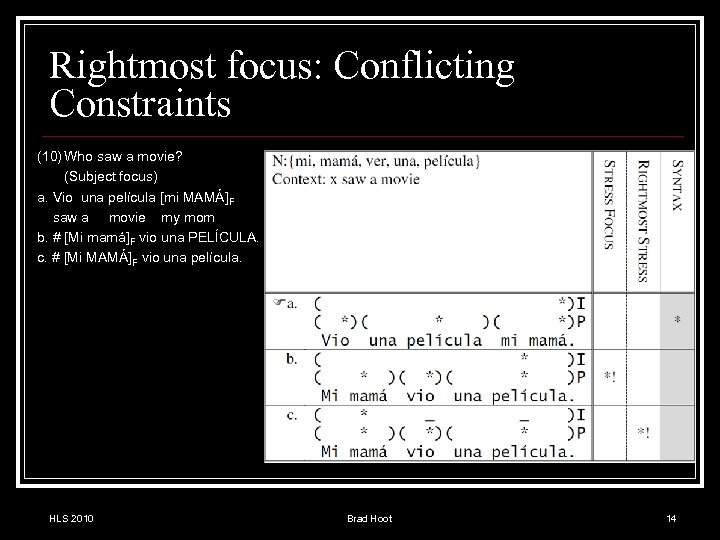 Rightmost focus: Conflicting Constraints (10) Who saw a movie? (Subject focus) a. Vio una película [mi MAMÁ]F saw a movie my mom b. # [Mi mamá]F vio una PELÍCULA. c. # [Mi MAMÁ]F vio una película. HLS 2010 Brad Hoot 14
 Analysis: Stress n Let’s assume a constraint on prosody similar to Samek-Lodovici’s (11) Align (Head, Right; i. P, Right) (Align-i. P-R) The head of each intonational phrase is aligned with the right edge of the phrase. Violated once for phonological phrase boundary between the intonational phrase head and the intonational phrase’s right edge. n n Let’s further assume it is undominated And that it admits gradient violation HLS 2010 Brad Hoot 15
 Analysis: Syntax n n n Assume constraints on syntactic well-formedness to be low-ranked n EPP: Sentences must have subjects. n Stay: No traces But, if syntactic well-formedness is ranked low, why can’t we get (12)? (12) How many police officers arrested the suspect? Policías lo arrestaron [CUATRO]F tpolicías. police Cl. Acc arrested four ‘Four police officers arrested him. ’ Not all syntactic constraints are created equal (13) Trace-Government (T-Gov) (Samek-Lodovici 2005) A trace is governed. Violated once for each trace that is not properly governed. T-Gov is undominated Has the practical upshot of not letting the noun move out from below its modifier HLS 2010 Brad Hoot 16
 Analysis: Stress-focus correspondence n n Some constraint requires that stress and focus correspond Let’s take something basic to start with, like Büring & Gutiérrez. Bravo’s Focus. Prominence (14) Focus. Prominence (FP) [Initial formulation] Focus is most prominent. Violated if the main stress (the i. P-level stress) does not correspond to the Foc-marked node(s). As mentioned, Büring & Gutiérrez-Bravo, and Samek-Lodovici take some similar constraint to be undominated In fact, something similar – such as the Stress-Focus Correspondence Principle (Reinhart 2006; Szendrői 2001) or the Focus Prosody Correspondence Principle (Zubizarreta 1998, based on Chomsky 1971 and Jackendoff 1972) – seems to be a part of all analyses of focus across the board HLS 2010 Brad Hoot 17
 Analysis: Stress-focus correspondence n n n However, as we’ve already seen, stress and focus do not correspond in the Spanish data presented here Obviously, then, FP can’t be undominated But allowing Align-R to outrank FP isn’t enough – That way we just end up with (15 b) (15) How many police officers arrested the suspect? a. Arrestaron al sospechoso tres POLICÍAS. Arrested the suspect three police officers ‘Three police officers arrested the suspect. ’ b. # Tres policías arrestaron al SOSPECHOSO. c. # TRES policías arrestaron al sospechoso. d. # Arrestaron al sospechoso TRES policías. e. * Policías arrestaron al sospechoso TRES. HLS 2010 Brad Hoot 18
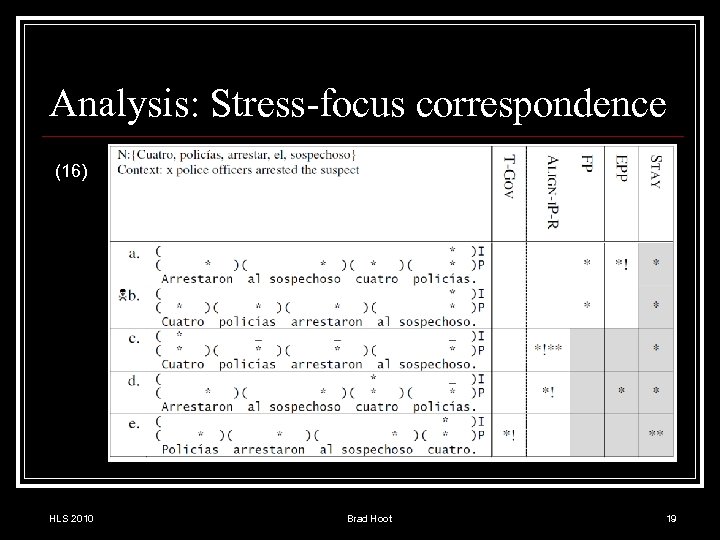 Analysis: Stress-focus correspondence (16) HLS 2010 Brad Hoot 19
 Analysis: Stress-focus correspondence n n n HLS 2010 FP needs to be reformulated What if it were an alignment constraint, like with stress? In fact, this isn’t that crazy an idea – Truckenbrodt (1999) proposes an alignment constraint that aligns focus and prosodic structure (specifically, with the edge of an phonological phrase in Chicheŵa), and notes that similar constraints exist in Bengali, Japanese, and Korean (17) Focus. Prominence (FP) [Revised formulation] Focus is aligned with prominence. Violated once for each phonological phrase boundary between main stress (the phonological phrase head that projects the intonational phrase head) and a phonological phrase head corresponding to a Foc-marked node. This has the practical upshot of penalizing a structure for each ‘step’ away from the focus the main stress falls This would give the correct predictions Brad Hoot 20
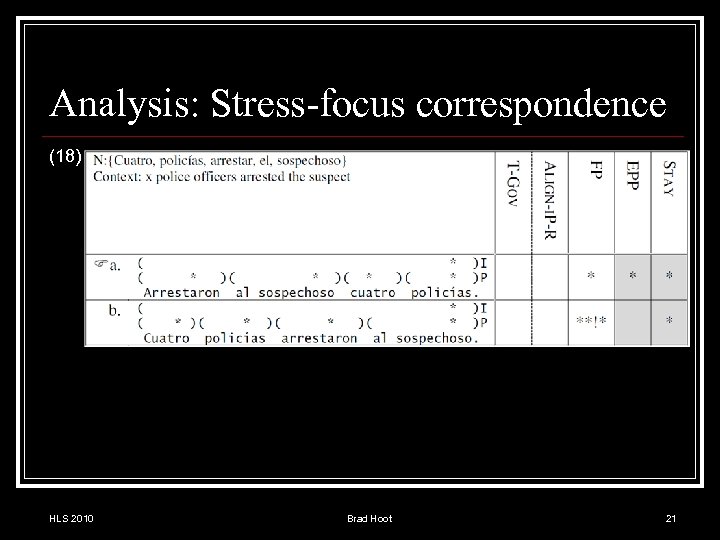 Analysis: Stress-focus correspondence (18) HLS 2010 Brad Hoot 21
 Analysis: Stress-focus correspondence Reformulating FP gives the correct predictions for the data n It also explains why the subject should be rightmost despite the fact that the stressfocus mismatch still occurs – the answer is that the mismatch is less severe, that is, it incurs fewer violations of FP n HLS 2010 Brad Hoot 22
 What about other focused modifiers? n They seem to have the same behavior (19) Which Bad Religion record did you buy? a. Compré su [último]F DISCO. bought. 1 st their latest record ‘I bought their latest record. ’ b. # Compré su [ÚLTIMO]F disco. (20) Which contestant won the prize? a. Ganó el premio el [primer]F CONCURSANTE. won the prize the first contestant ‘The first contestant won the prize. ’ b. # Ganó el premio el [PRIMER]F concursante. c. # El [primer]F concursante ganó el premio. (Regardless of stress) (21) Which platypus did Kalyani buy? a. Kalyani compró [este]F ORNITORRINCO. Kalyani bought this platypus ‘Kalyani bought this platypus. ’ b. # Kalyani compró [ESTE]F ornitorrinco. (22) Which platypus ate all the food? a. Comió toda la comida [este]F ORNITORRINCO. Ate all the food this platypus ‘This platypus ate all the food. ’ b. # Comió toda la comida [ESTE]F ornitorrinco. c. # [Este]F ornitorrinco comió toda la comida. (Regardless of stress) HLS 2010 Brad Hoot 23
 Implications/Conclusions n An analysis was given of (7) based on conflicting constraints (7) n How many police officers arrested the suspect? a. Lo arrestaron [cuatro]F POLICÍAS. Cl. Acc arrested four police ‘Four police officers arrested him. ’ b. # Lo arrestaron [CUATRO]F policías. c. # [Cuatro]F policías lo ARRESTARON. Constraint Ranking: (23) (T-Gov <<>> Align-i. P-R) >> FP >> EPP >> Stay HLS 2010 Brad Hoot 24
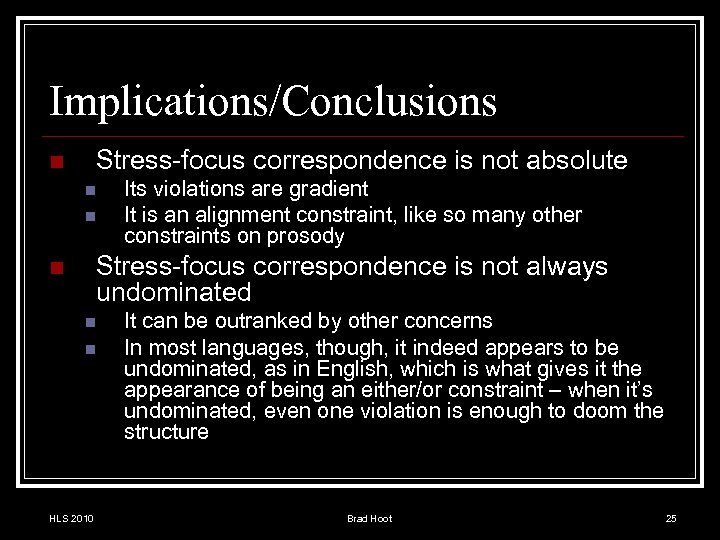 Implications/Conclusions Stress-focus correspondence is not absolute n n n Its violations are gradient It is an alignment constraint, like so many other constraints on prosody Stress-focus correspondence is not always undominated n n n HLS 2010 It can be outranked by other concerns In most languages, though, it indeed appears to be undominated, as in English, which is what gives it the appearance of being an either/or constraint – when it’s undominated, even one violation is enough to doom the structure Brad Hoot 25
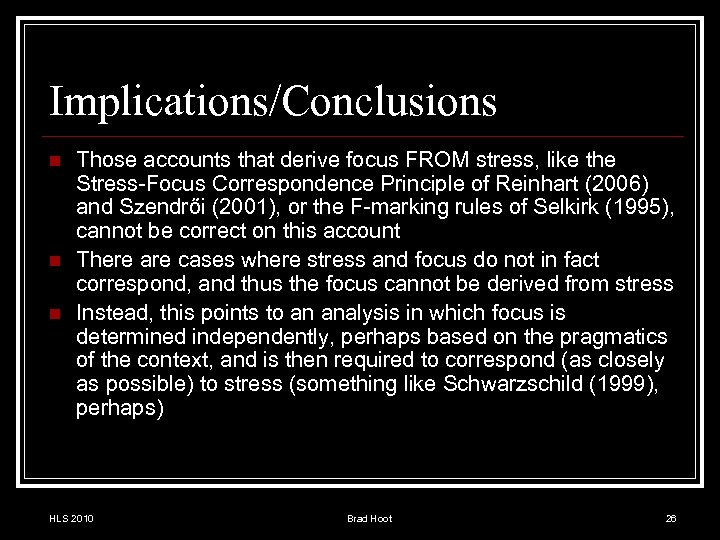 Implications/Conclusions n n n Those accounts that derive focus FROM stress, like the Stress-Focus Correspondence Principle of Reinhart (2006) and Szendrői (2001), or the F-marking rules of Selkirk (1995), cannot be correct on this account There are cases where stress and focus do not in fact correspond, and thus the focus cannot be derived from stress Instead, this points to an analysis in which focus is determined independently, perhaps based on the pragmatics of the context, and is then required to correspond (as closely as possible) to stress (something like Schwarzschild (1999), perhaps) HLS 2010 Brad Hoot 26
 References Büring, D. , & Gutiérrez-Bravo, R. 2006. Focus-related constituent order without the NSR: A prosodybased crosslinguistic analysis. In M. Séamas (Ed. ), Syntax at Santa Cruz 3, 41 -58. Chomsky, N. 1971. Deep structure, surface structure and semantic interpretation. In D. Steinberg and L. Jakobovits (Eds. ), Semantics: An interdisciplinary reader in philosophy, linguistics, and psychology. Cambridge: Cambridge University Press. Gutiérrez-Bravo, R. 2002. Focus, word order variation and intonation in Spanish and English: An OT account. In C. Wiltshire & J. Camps (Eds. ), Romance phonology and variation (pp. 39 -53). Amsterdam: John Benjamins. Jackendoff, R. 1972. Semantic interpretation in generative grammar. Cambridge, MA: MIT Press. Reinhart, T. 2006. Interface Strategies. Cambridge, MA: MIT Press. Samek-Lodovici, V. 2005. Prosody-syntax interaction in the expression of focus. Natural Language and Linguistic Theory 23: 687 -755. Selkirk, E. 1995. Sentence prosody, intonation, stress, and phrasing. In J. Goldsmith (Ed. ), The handbook of phonological theory (550 -569). Oxford: Blackwell. Schwarzschild, R. 1999. Givenness, Avoid. F and other constraints on the placement of accent. Natural language semantics 7: 141 -177. Szendrői, K. 2001. Focus and the syntax-phonology interface. UCL Dissertation. Truckenbrodt, H. 1999. On the Relation Between Syntactic Phrases and Phonological Phrases. Linguistic Inquiry 30: 219 -256. Zubizarreta, M. L. 1998. Prosody, Focus, and Word Order. Cambridge, MA: MIT Press. HLS 2010 Brad Hoot 27
 Thank you! Special thanks to Luis López-Carretero and the members of the Bilingualism Research Laboratory at the University of Illinois at Chicago. Comments/feedback welcome. Brad Hoot University of Illinois at Chicago (bhoot 1@uic. edu) HLS 2010 Brad Hoot 28