 Скачать презентацию Nanotube Fabrication by Anodic Aluminum Oxide Self-Aligned Processing
56745703484f880e978f4b1e6267e426.ppt
- Количество слайдов: 6



Nanotube Fabrication by Anodic Aluminum Oxide, Self-Aligned Processing, and Atomic Layer Deposition Processing Rubloff Research Group Accomplishments
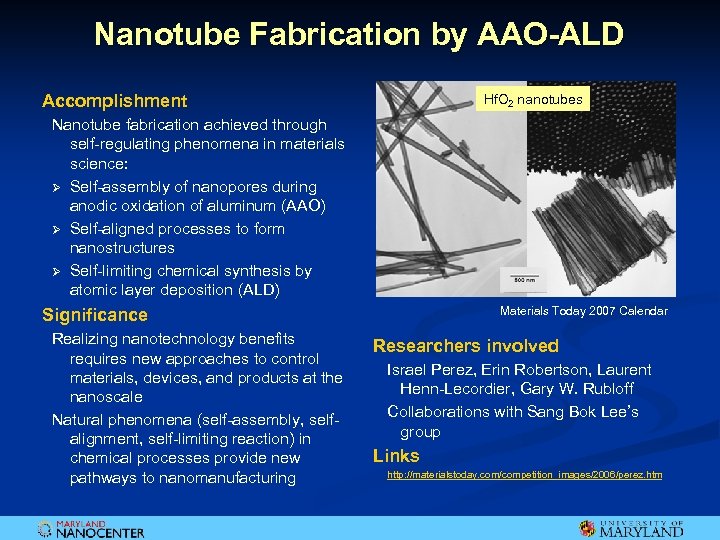
Nanotube Fabrication by AAO-ALD Accomplishment Hf. O 2 nanotubes Nanotube fabrication achieved through self-regulating phenomena in materials science: Ø Self-assembly of nanopores during anodic oxidation of aluminum (AAO) Ø Self-aligned processes to form nanostructures Ø Self-limiting chemical synthesis by atomic layer deposition (ALD) Materials Today 2007 Calendar Significance Realizing nanotechnology benefits requires new approaches to control materials, devices, and products at the nanoscale Natural phenomena (self-assembly, selfalignment, self-limiting reaction) in chemical processes provide new pathways to nanomanufacturing Researchers involved Israel Perez, Erin Robertson, Laurent Henn-Lecordier, Gary W. Rubloff Collaborations with Sang Bok Lee’s group Links http: //materialstoday. com/competition_images/2006/perez. htm
Nanotube Fabrication by AAO-ALD We have combined anodic aluminum oxide (AAO) nanostructures with atomic layer deposition (ALD) to fabricate nanotube structures of Hf. O 2 high-K dielectric in size ranges 20 -300 nm diameter, a few nm wall thickness, and microns in length. Natural self-assembly during anodization causes arrays of nanopores with strikingly uniform dimensions and inter-pore spacing to be formed in Al films from submicron to 25 microns thick. The resulting nanotubes can be released by etching away the Al 2 O 3 nanotemplate, or alternatively used in place in the template, for applications ranging from drug delivery nanoparticles to high density energy storage structures. TEM images of these structures are shown in the figure for freed nanotubes (left) and nanotubes held together by leaving the top ALD film while removing the Al 2 O 3 template (right). These images, by UMD graduate student Israel Perez, have been chosen for inclusion in the MRS 2007 calendar.
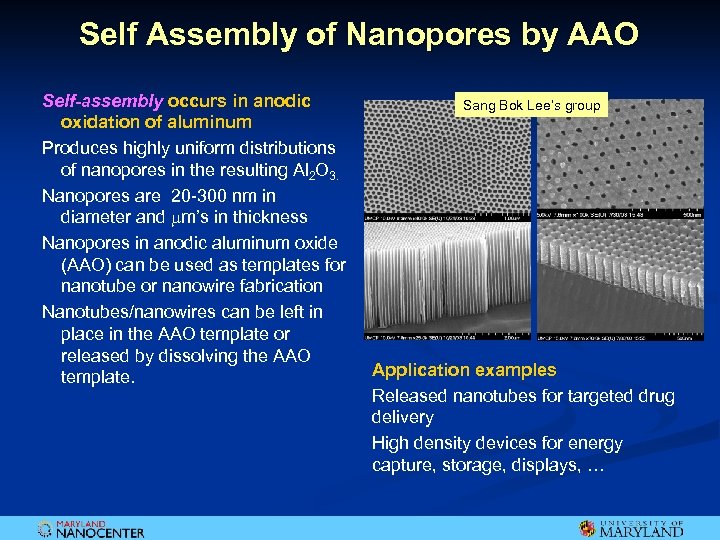
Self Assembly of Nanopores by AAO Self-assembly occurs in anodic oxidation of aluminum Produces highly uniform distributions of nanopores in the resulting Al 2 O 3. Nanopores are 20 -300 nm in diameter and mm’s in thickness Nanopores in anodic aluminum oxide (AAO) can be used as templates for nanotube or nanowire fabrication Nanotubes/nanowires can be left in place in the AAO template or released by dissolving the AAO template. Sang Bok Lee’s group Application examples Released nanotubes for targeted drug delivery High density devices for energy capture, storage, displays, …
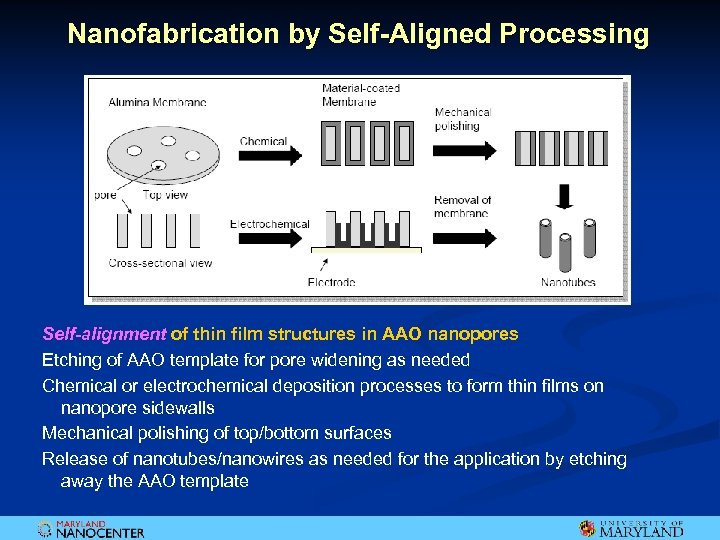
Nanofabrication by Self-Aligned Processing Self-alignment of thin film structures in AAO nanopores Etching of AAO template for pore widening as needed Chemical or electrochemical deposition processes to form thin films on nanopore sidewalls Mechanical polishing of top/bottom surfaces Release of nanotubes/nanowires as needed for the application by etching away the AAO template
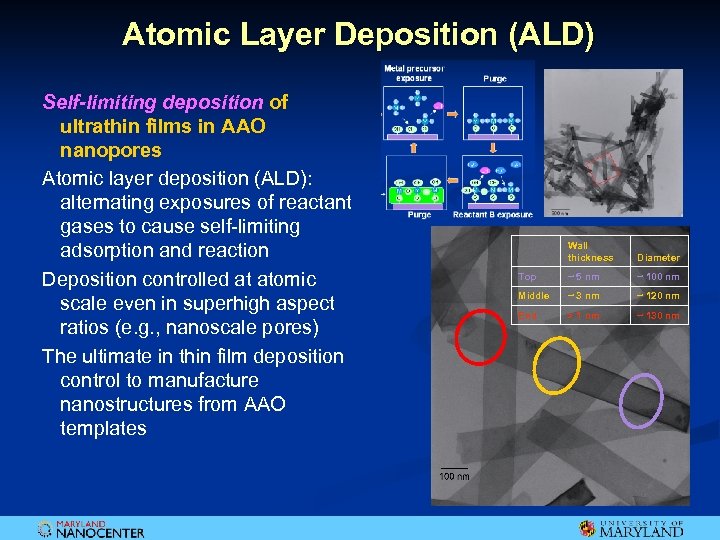
Atomic Layer Deposition (ALD) Self-limiting deposition of ultrathin films in AAO nanopores Atomic layer deposition (ALD): alternating exposures of reactant gases to cause self-limiting adsorption and reaction Deposition controlled at atomic scale even in superhigh aspect ratios (e. g. , nanoscale pores) The ultimate in thin film deposition control to manufacture nanostructures from AAO templates Wall thickness Diameter Top ~ 5 nm ~ 100 nm Middle ~ 3 nm ~ 120 nm End > 1 nm ~ 130 nm
Скачать презентацию Nanotube Fabrication by Anodic Aluminum Oxide Self-Aligned Processing
56745703484f880e978f4b1e6267e426.ppt