


 Скачать презентацию NANORESTART NANOmaterials for the RESToration of works of
6a8263571ce5c0d310633149197d23b6.ppt
- Количество слайдов: 30
 NANORESTART NANOmaterials for the RESToration of works of ART Coordinator: Prof. Piero Baglioni CSGI –– Center for Colloid and Surface Science –– Florence – Italy – www. csgi. unifi. it HORIZON 2020
 NANORESTART HORIZON 2020 TOPIC: NMP-21 -2014 ″Materials-based solutions for protection or preservation of European cultural heritage” Specific challenge: Europe has significant cultural diversity together with exceptional ancient architecture, built environment and artefact collections. However time, exposure and environmental changes present significant threats to this cultural heritage (which is one of the assets on which the tourism-related industry relies).
 NANORESTART HORIZON 2020 NANORESTART focuses on nanotechnologies and contemporary art. TOPIC: NMP-21 -2014 “Materials-based solutions for protection or preservation of European cultural heritage” Duration: 42 months as of June 2015 Budget: about EUR 9 million Coordinated by
 NANORESTART HORIZON 2020 Why? Contemporary art is a major challenge for conservators since there is a significant lack of established conservation methodologies that can safely tackle the often extremely fast degradation of materials used by contemporary artists. The most effective way to solve this issue is to develop specific materials to counteract the degradation and consolidate works of art.
 NANORESTART HORIZON 2020 RELEVANCE The Johannesburg World Summit on Sustainable Development (2002) recognized cultural diversity as the fourth pillar of sustainable development, alongside the economic, social and environment pillars. According to the UNESCO Universal Declaration on Cultural Diversity (2001), ‘development’ is “understood not only in terms of economic growth, but also as a mean to achieve a more satisfactory intellectual, emotional, moral and spiritual existence”. The Competitiveness Council of the European Union noted (October 12 th 2010) that European cultural heritage is of exceptional economic importance for the tourism industry, generating an estimated European annual revenue of € 335 billion, and about 10 million jobs. Tourism indirectly generates more than 10% of the European Union's GDP and provides about 12% of the labour force (EUbusiness 2013). In this context Cultural Heritage and Cultural Diversity are a basic motor for economic development. To maximize the benefits, it is necessary to develop effective strategies that ensure the long-term conservation of irreplaceable cultural heritage resources.
 NANORESTART HORIZON 2020 KEY-POINT Thousands of museums and historical organizations across the world maintain important collections of artefacts representing a gigantic cultural diversity. The challenge of preserving and making accessible such heritage is enormous and the need for knowledgeable staff is significant and on-going. Contemporary art materials are highly prone to degradation. Differently from ‘classic’ art, contemporary artists have experimented and used a large variety of materials coming from industrial production. Also the invention of new creative processes and manufacturing techniques has produced art objects with very short lifetime expectancy. The huge number of artworks that fill museums and private collections worldwide is another fundamental amplification factor of the importance of finding durable and efficient solution to guarantee long-term protection.
 NANORESTART HORIZON 2020 KEY-POINT Nano- and advanced materials have recently contributed to great advancements in the restoration and conservation of ‘classic’ art materials. This is due to the unique physico-chemical properties (also due to high surface area/volume ratio) that involve significant changes in chemical reactivity and stability. This approach has offered the real possibility to design a restoration treatment respectful of the original characteristics of the materials. This project aims to find solutions affordable in terms of cost and/or complexity of operation by those who will use the materials and techniques developed. The critical point is to make conservators confident with this new technology. The project dissemination activities will catalyze this process, thanks to the strict connections that conservators have established together.
 NANORESTART HORIZON 2020 ACTION ON A GLOBAL SCALE An international approach is fundamental to get a suitable impact of the project results. We will pursue: • Involvement of a wider cultural heritage community (beyond project partnership), to share the developed technology solutions and ensure they can be effectively exploited in other environments and operations of different complexity. These include international, EU and Member State authorities, research institutes, museums, practitioners, students, the public, etc. • Engage with EU and international standard bodies, regulators, risk assessors and safety experts active in relevant fields, to keep the project updated with state-of-the -art health and environmental safety practices. Amongst them: the EU Nanosafety cluster, OECD Working Party on Manufactured Materials, ISO TC 229 Nanotechnologies and the EU Nanoreg project. • Liaise with industry and business players (e. g. professional associations) active in sectors relevant for surface treatments application, to design tailored and application specific business cases, also beyond the cultural heritage. The technology and market scenario, interviews and specific working groups and workshops with business players will be organized to address actual industry needs and targets and design a sound and reliable exploitation plan.
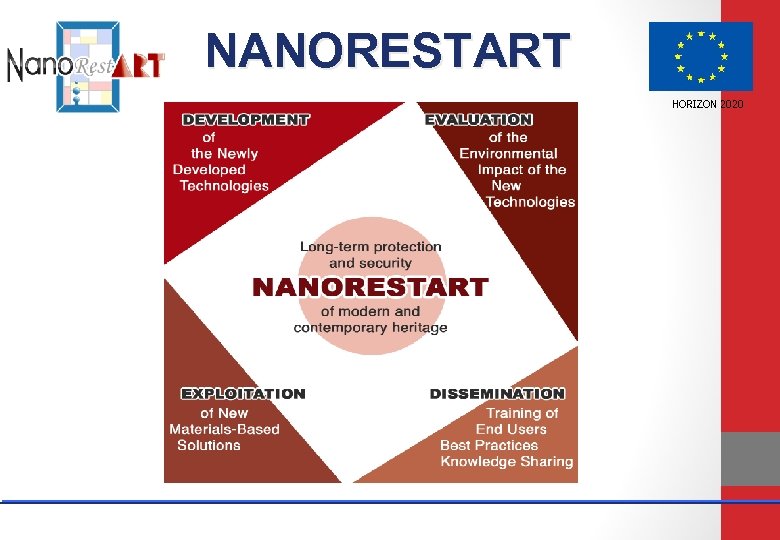 NANORESTART HORIZON 2020
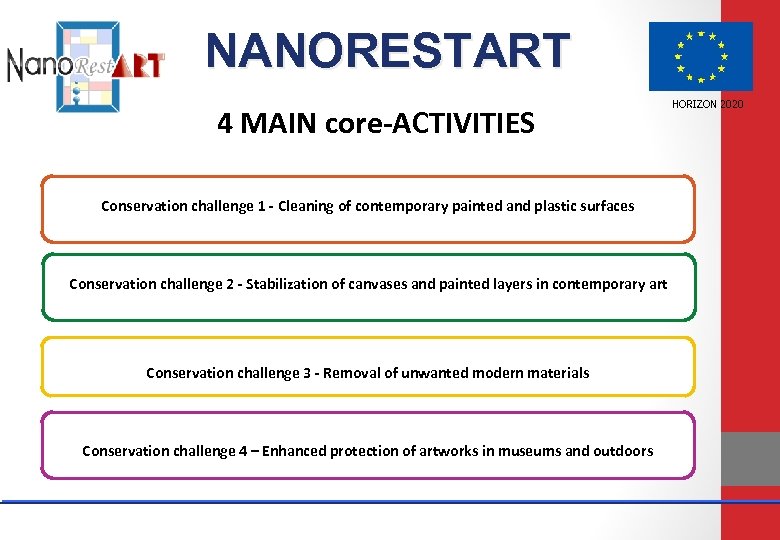 NANORESTART 4 MAIN core-ACTIVITIES Conservation challenge 1 - Cleaning of contemporary painted and plastic surfaces Conservation challenge 2 - Stabilization of canvases and painted layers in contemporary art Conservation challenge 3 - Removal of unwanted modern materials Conservation challenge 4 – Enhanced protection of artworks in museums and outdoors HORIZON 2020
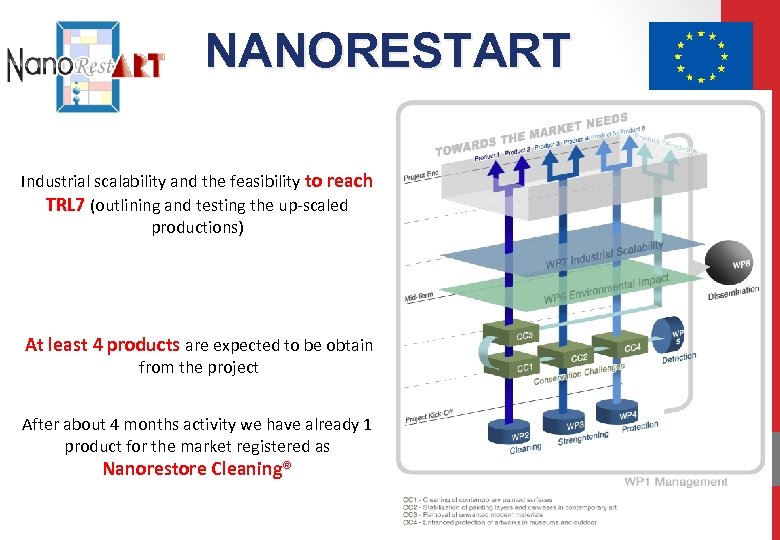 NANORESTART HORIZON 2020 Industrial scalability and the feasibility to reach TRL 7 (outlining and testing the up-scaled productions) At least 4 products are expected to be obtain from the project After about 4 months activity we have already 1 product for the market registered as Nanorestore Cleaning®
 NANORESTART Work package(s) HORIZON 2020 The NANORESTART project is articulated into eight work-packages (WPs) that will cover 42 months. WP 1 is entirely dedicated to management of the project The workplan will start with the design and formulation of nanostructured systems with special functionalities (WP 2 -WP 5) to face the conservation challenges already described. These systems, whose formulation will be optimized according to their functions, will be characterized and accurately evaluated in terms of environmental and eco-toxicological impact (WP 6). Once the applicability and safety of the most promising materials will be assessed, the industrial scalability of the new processes (WP 7) will take place. Dissemination of the knowledge and of the developed technologies, and training activities on the use of these new tools (WP 8) will start after the second year. End users (museums, public and private conservation bodies) will be active in this phase.
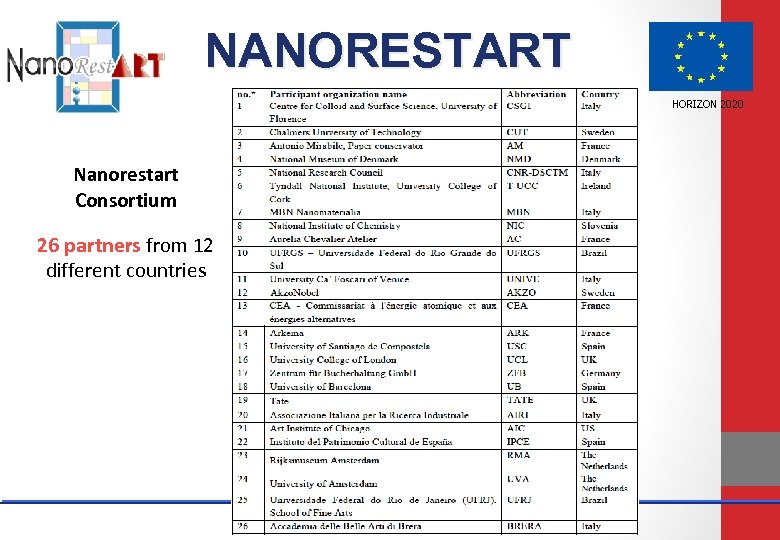 NANORESTART HORIZON 2020 Nanorestart Consortium 26 partners from 12 different countries
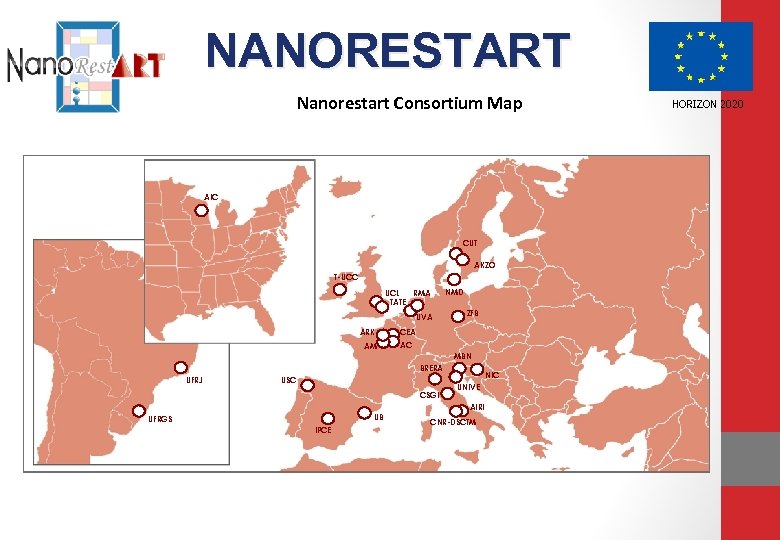 NANORESTART Nanorestart Consortium Map AIC CUT AKZO T-UCC UCL RMA TATE UVA ARK AM NMD ZFB CEA AC MBN BRERA UFRJ USC CSGI NIC UNIVE AIRI UB UFRGS IPCE CNR-DSCTM HORIZON 2020
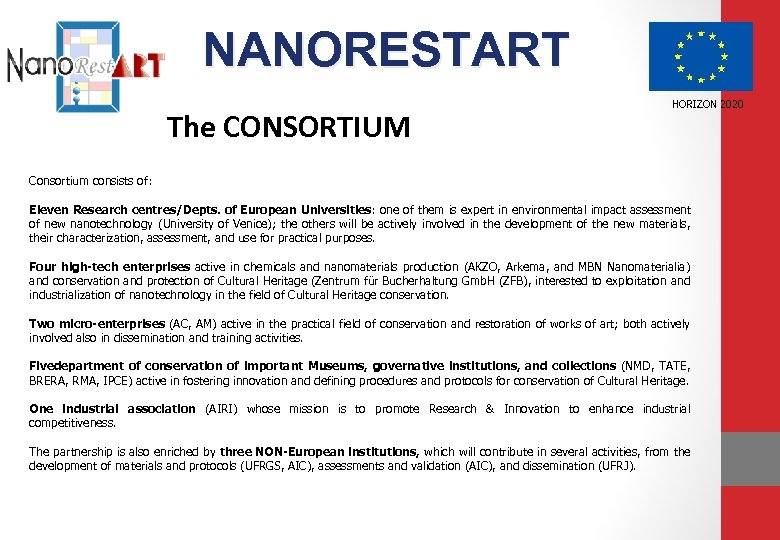 NANORESTART The CONSORTIUM HORIZON 2020 Consortium consists of: Eleven Research centres/Depts. of European Universities: one of them is expert in environmental impact assessment of new nanotechnology (University of Venice); the others will be actively involved in the development of the new materials, their characterization, assessment, and use for practical purposes. Four high-tech enterprises active in chemicals and nanomaterials production (AKZO, Arkema, and MBN Nanomaterialia) and conservation and protection of Cultural Heritage (Zentrum für Bucherhaltung Gmb. H (ZFB), interested to exploitation and industrialization of nanotechnology in the field of Cultural Heritage conservation. Two micro-enterprises (AC, AM) active in the practical field of conservation and restoration of works of art; both actively involved also in dissemination and training activities. Fivedepartment of conservation of important Museums, governative institutions, and collections (NMD, TATE, BRERA, RMA, IPCE) active in fostering innovation and defining procedures and protocols for conservation of Cultural Heritage. One industrial association (AIRI) whose mission is to promote Research & Innovation to enhance industrial competitiveness. The partnership is also enriched by three NON-European institutions, which will contribute in several activities, from the development of materials and protocols (UFRGS, AIC), assessments and validation (AIC), and dissemination (UFRJ).
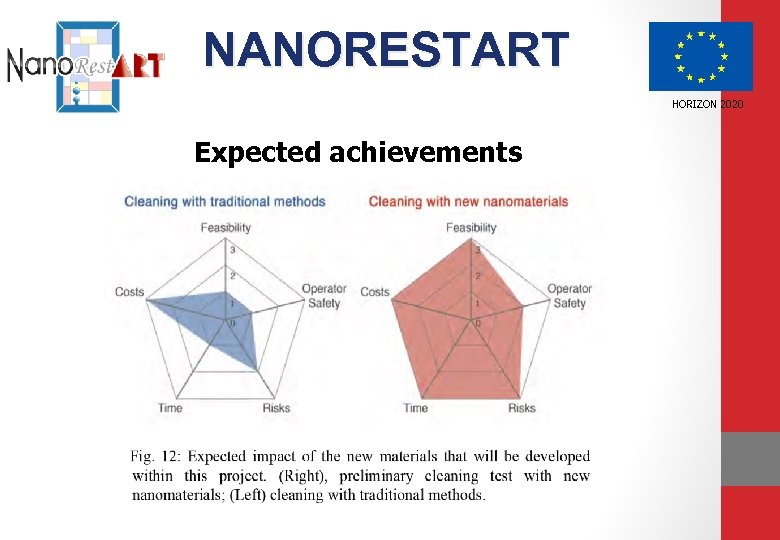 NANORESTART HORIZON 2020 Expected achievements
 NANORESTART HORIZON 2020 BARRIERS/OBSTACLES AND FRAMEWORK CONDITIONS TO ACHIEVE THE EXPECTED IMPACT Cultural Heritage assets are characterized by several factors that hinder the ability to express directly (bottom-up) an innovation demand. These are: - tendency to rely on traditional methods, with well-known performances; - scarce tendency to introduce novelties because of caution in any change by decision-makers; - very rare presence of scientific “interface” inside the cultural organisation; - the (supposed) high cost of introducing high-technology in conservation practices. According to our experience, an important role is played by the “confidence factor” that makes conservators and museum curators more open to the advices of their customary “service providers” (usually SMEs selling, delivering, and transporting materials) than to R&D makers.
 NANORESTART HORIZON 2020 BARRIERS/OBSTACLES AND FRAMEWORK CONDITIONS TO ACHIEVE THE EXPECTED IMPACT For these reason, the involvement of museums, collections curators, conservators, and organizations dedicated to the conservation of cultural heritage is a fundamental key-point in order to overcome such obstacles. It is also of paramount importance that these efforts are made in the framework of a European rather that national or local context and involving Museum, institutions and SME active in this field. Cultural Heritage valorization mostly depends on the decisions of policymakers, which define, together with national institute devoted to conservation, the best protocols to be used by conservators; but, policy-makers, sometimes, are far from the real expectations of the professional operators in this field. Therefore, it is important to create a unique block, possibly at worldwide level, to achieve a critical mass in order to be influent at political level.
 NANORESTART HORIZON 2020 BARRIERS/OBSTACLES AND FRAMEWORK CONDITIONS TO ACHIEVE THE EXPECTED IMPACT The strategy for the dissemination and exploitation of NANORESTART results are focused on some very important points: - sensitization of institutes and conservators actively involved in education and training activities; - sensitization of big museums and laboratory/departments therein, which have an eminent institutional role and play a big influence on their own country, being a “school” for the conservators community; - favouring the institutes that presents a strict connection between scientists, conservator scientists, and conservators because they can become a visible “model structure” capable to catalyze the technological transfer; - selection of important restoration workshops presenting complex challenges and clear examples of conservation issues, and dissemination of the project results making them open to the large public thanks to the internet and if possible to guided tours; - organization of training activities by SMEs, institutes, and museum active in professional practical restoration.
 NANORESTART HORIZON 2020 BARRIERS/OBSTACLES AND FRAMEWORK CONDITIONS TO ACHIEVE THE EXPECTED IMPACT This work can really increase the impact of the project because it is fully targeted to: - policy-makers, which will be directly in contact with museum and national institutes devoted to conservation of cultural heritage and also with the advisory committee; - interest groups, collecting together a big number of micro- (the more abundant) and smallmedium enterprises working in this field - media and the public at large, through the open-access to some representative restoration workshops as example of high-technology application for the improvements of the socioeconomic fall-down; high-tech restoration as a touristic and cultural attraction.
 FP 7 th Horizon 2020
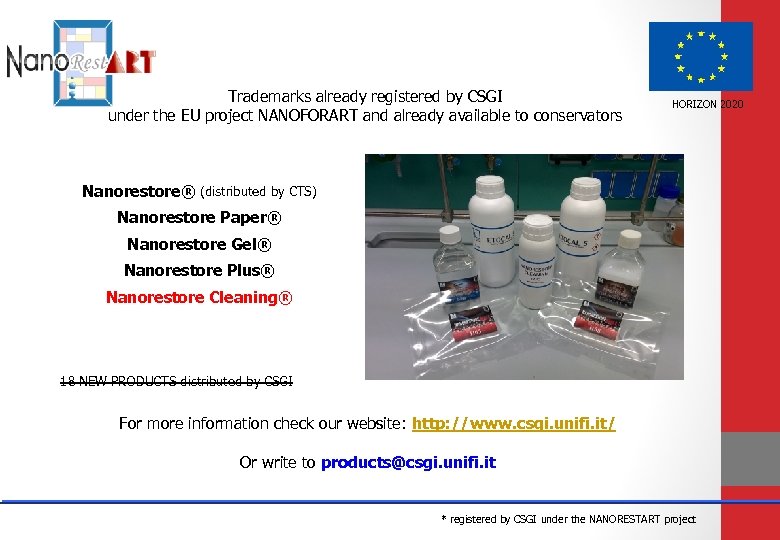 Trademarks already registered by CSGI under the EU project NANOFORART and already available to conservators HORIZON 2020 Nanorestore® (distributed by CTS) Nanorestore Paper® Nanorestore Gel® Nanorestore Plus® Nanorestore Cleaning® 18 NEW PRODUCTS distributed by CSGI For more information check our website: http: //www. csgi. unifi. it/ Or write to products@csgi. unifi. it * registered by CSGI under the NANORESTART project
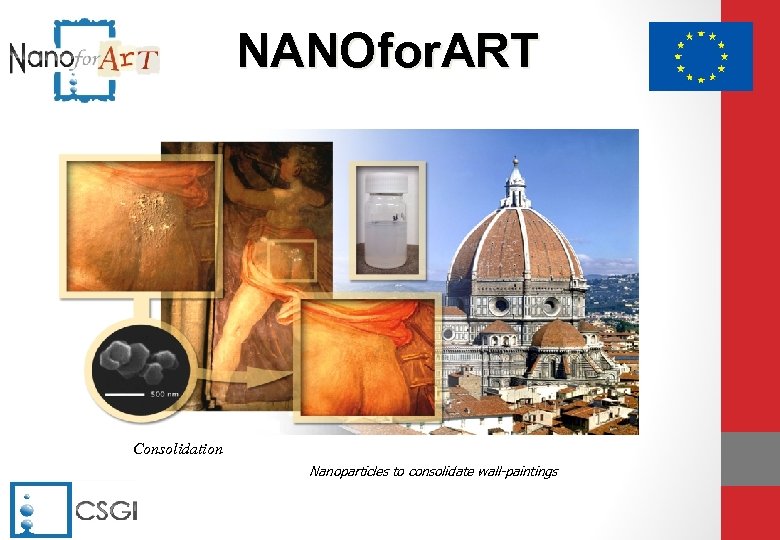 NANOfor. ART Consolidation Nanoparticles to consolidate wall-paintings
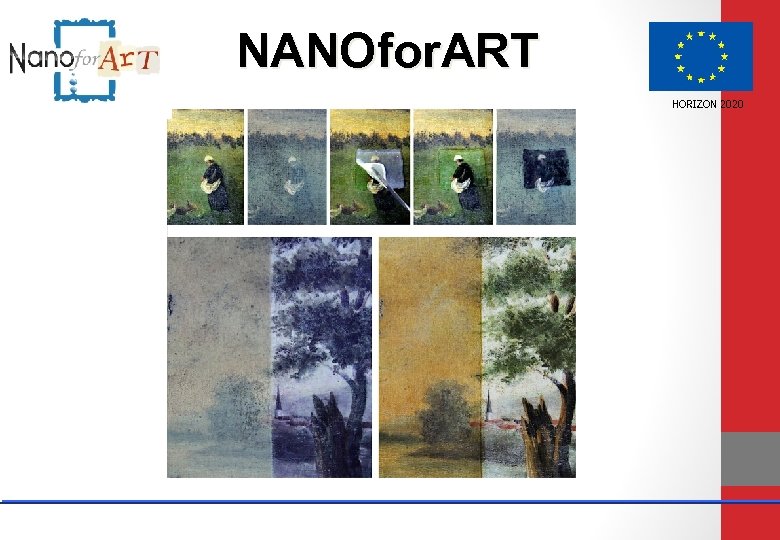
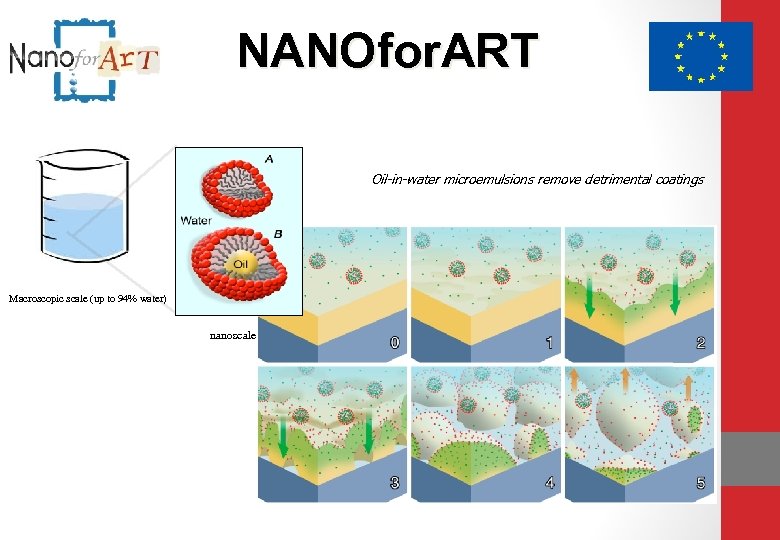 Microemulsions NANOfor. ART Oil-in-water microemulsions remove detrimental coatings Macroscopic scale (up to 94% water) nanoscale
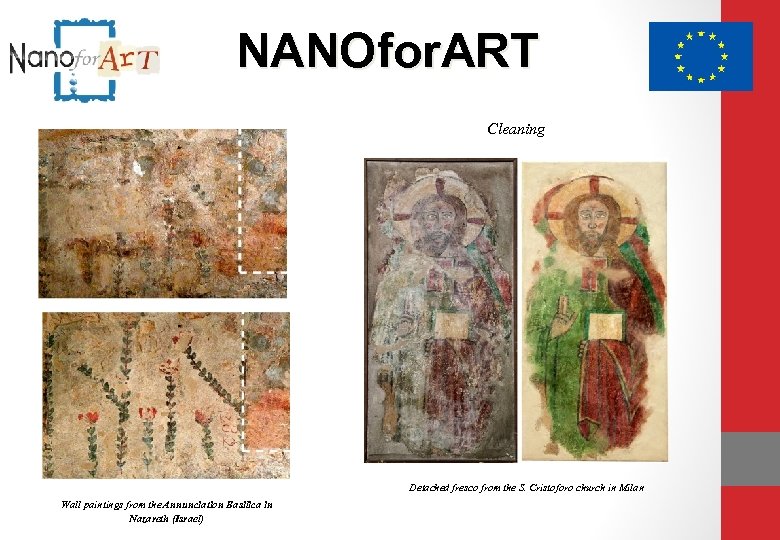 NANOfor. ART Cleaning after Detached fresco from the S. Cristoforo church in Milan Wall paintings from the Annunciation Basilica in Nazareth (Israel)
 NANOfor. ART HORIZON 2020
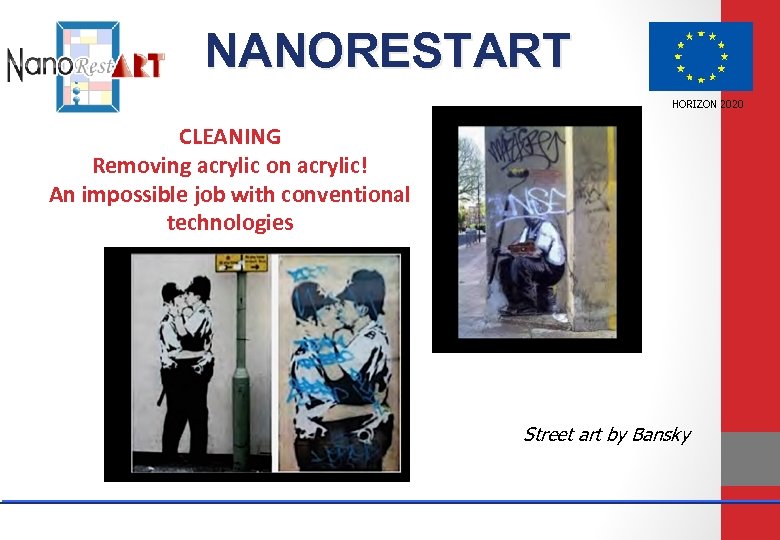 NANORESTART HORIZON 2020 CLEANING Removing acrylic on acrylic! An impossible job with conventional technologies Street art by Bansky
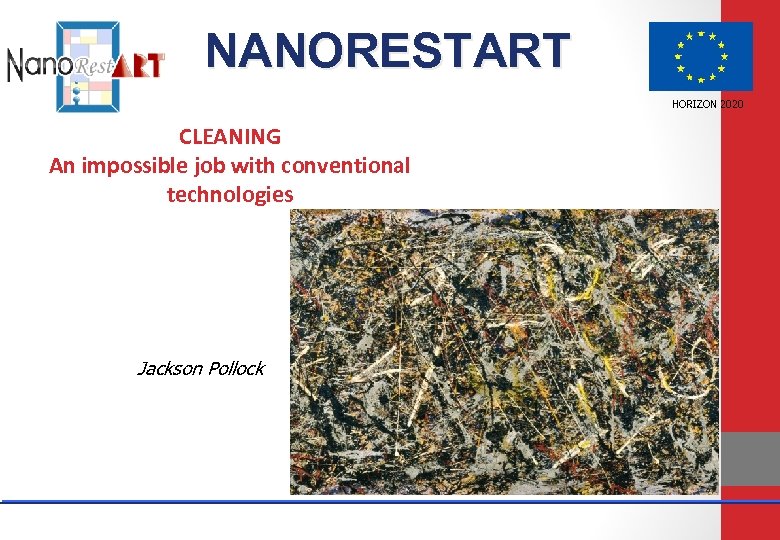 NANORESTART HORIZON 2020 CLEANING An impossible job with conventional technologies Jackson Pollock
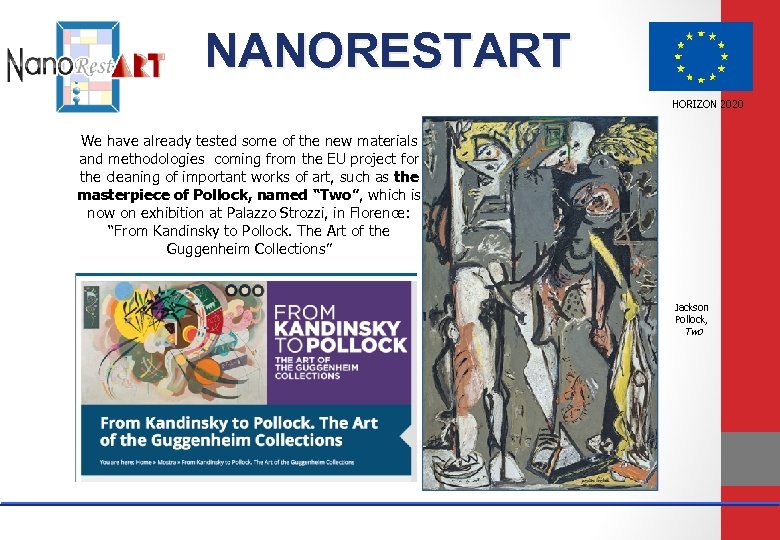 Highly retentive hydrogels NANORESTART HORIZON 2020 We have already tested some of the new materials and methodologies coming from the EU project for the cleaning of important works of art, such as the masterpiece of Pollock, named “Two”, which is now on exhibition at Palazzo Strozzi, in Florence: “From Kandinsky to Pollock. The Art of the Guggenheim Collections” Jackson Pollock, Two
 NEW CALL NMBP-35 -2017: Innovative solutions for the conservation of 20 th century cultural heritage HORIZON 2020 Projects should develop one or more innovative solutions (functional materials or techniques) for the conservation of tangible 20 th century cultural heritage. To maximise the impact, the most relevant issues and objects should be identified and addressed. For this purpose, convergent contributions from relevant Social Sciences and Humanities (SSH) disciplines should be considered A participation of relevant SSH disciplines is expected. SSH research should contribute criteria for targeting specific cultural heritage and analyse the expected long-term societal spill-over effects of the project.